Introduction
Natural disasters are events in which people have no direct involvement. Owing to their devastating effects on human and material resources, and to the interruption of the natural trend of community life, these disasters are beyond the society adaptation capacity and have the potential to create severe crises.Reference Araghizadeh, Saghafi Nia and Entezari 1 For example, natural disasters claimed over 950 thousand lives, injured 124 billion people, and affected the lives of more than two billion people between 2000 and 2011.Reference Abolghasemi, Radfar, Khatami, Nia, Amid and Briggs 2 , Reference Nia, Nafissi and Moharamzad 3 Iran has the world’s sixth place concerning natural disasters and is considered as one of the world’s 10 earthquake-prone zones; nearly 69% of the area of Iran is located on earthquake faults.Reference Omidvar, Zafari and Derakhshan 4 In the last century, 20 earthquakes measuring 6.0 on the Richter scale occurred in Iran and killed 500 thousand people.Reference Motamedi, Saghafinia, Bafarani and Panahi 5 One of the most devastating earthquakes that occurred in Iran was the Bam Earthquake.Reference Akbari, Farshad and Asadi-Lari 6 Bam is a 2000-year-old historic city located in the southeastern part of Iran (190km away from Kerman County). On December 26, 2003, a massive earthquake measuring 6.8 on the Richter scale hit Bam, killing approximately 40,000 people and injuring more than 30,000 people.Reference Emami, Tavakoli and Alemzadeh 7
Usually after an earthquake, foodstuff supply, storage, and distribution becomes chaotic and can cause many problems for the victims and the authorities. This condition results from the destruction of food-producing centers (ie, food industry factories, livestock and poultry farms, and slaughterhouses), food-storing centers (ie, warehouses, cool warehouses, and silos) and food-distributing centers (ie, stores and distribution centers) and causes severe problems for the victims.Reference Rabeian, Hosseini, Radabadi, Taheri Mirghaed and Bakhtiari 8 , Reference Asef 9 Therefore, one of most important crisis management duties is to take exact steps to supply nutritional needs of the people. The more clear and exact these steps are, the fewer problems faced after a disaster.Reference Eitzen 10 Thus, providing enough energy for the public, paying attention to the vulnerable groups (children, the elderly, the sick, and nursing mothers), providing food variety in the food basket, preparing food-storage facilities, preventing food poisoning and spoilage, making use of proper methods of food distribution, and gaining people’s trust and satisfaction are of great importance.Reference Movaghar, Goodarzi, Izadian, Mohammadi, Hosseini and Vazirian 11 , Reference Gautschi, Cadosch, Rajan and Zellweger 12 To do this, the nutritional requirement tables recommended by the World Health Organization (WHO; Geneva, Switzerland) and the United Nations’ World Food Planning Committee (Rome, Italy) can be used, 13 , 14 and appropriate measures in the proper distribution of food among all population groups can also be taken into consideration.Reference Katano 15
Experiencing the previous disasters in the world and in Iran, including the Bam Earthquake, shows that the issue of supplying and distributing foodstuff for the disaster-stricken people, especially in the first few days after the disaster, is considered as one of the major problems in the crisis management system.
The aim of this study was to analyze the health care managers’ experiences of the challenges of providing food baskets and nutritional service presentation systems in the Bam Earthquake. Understanding the problems and obstacles in this field can help to plan foodstuff distribution and a supply chain standard in future crises.
Methodology
Study Methods
This qualitative research is of phenomenological type. The aim of this study was to explain and describe the structure or nature of live experiences about a phenomenon and to find and present a single meaning and concept which was a symbol of the nature and entity of that phenomenon and an exact description of the everyday experiences of that phenomenon. In this phenomenological study, data main resources were done using deep conversations between the researcher and the participants as co-workers.Reference Amiresmaili, Yazdi Feyzabadi and Khosravi 16
This research was conducted at Kerman University of Medical Sciences (Kerman, Iran) in the summer of 2014. Purposive sampling method was used in this study. People who were involved in the nutritional aiding in the Bam Earthquake, and those who were willing to take part in this study and to explain numerous problems they had experienced in nutritional aiding, were selected. The interview consisted of some semi-structured questions based on literature review and an in-depth interview with one of the interviewees at the beginning of the study. The interview questions were reviewed by the researchers several times and were finally approved.
The main aim of this study was to examine different aspects of nutritional aiding, such as determining the type and amount of food and different methods of food supply, transfer, storage, and distribution among the people. Every interview lasted on average between 60 to 90 minutes. Interviews were saturated in the tenth interview and information gathering was stopped at this stage. At the end of every interview, the researchers listened to the recorded information several times and wrote the entire interview on paper. In addition, the researchers took some notes during the interviews. In the findings section, the letter (P) along with a number represented the participants who the researchers had quoted from.
In this study, data were analyzed from the first interview. Moreover, Colaizzi’s method was used in parallel with the interviews. In this case, all information was studied and understood completely by the researchers. In the second step, all words and sentences related to the phenomenon were extracted and encoded. Then, the information was re-read and categorized; finally, themes were obtained. At this stage, the researcher tried to seek the relationships between the themes and their statements, as well as the links between the themes, and to achieve a comprehensive description of the phenomenon.
In order to obtain the accuracy and validity of the study, credibility, dependability, and confirmability of data were evaluated. To ensure validity, participants were asked to share their ideas about research findings. Moreover, the research team thought about the issues at different stages of the research. Confirmability of this study was also guaranteed by keeping documents in all research stages. Researchers’ interest in this phenomenon, working on data for long hours, and attempts to gain the peoples’ viewpoints are other data analysis guaranteeing confirmability of data. In addition, since this study was a teamwork with the guidance and supervision of experts, its credibility and confirmability was approved.
Ethical Considerations
This study was approved by Kerman University of Medical Sciences Ethics Committee (ethics code: IR.KMU.rec.1395.236). Also, during all steps of this process from data collection, data analysis, and findings report, the researchers paid great attentions to cases such as informed consent, maintaining anonymity, confidentiality of information, and the right to withdraw from the study at any time.
Results
All participants were male with an average age of 40 years old.
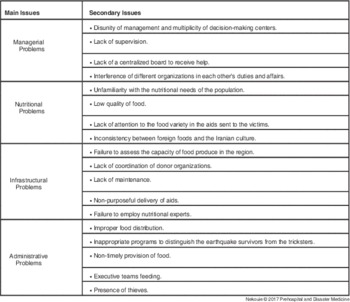
Data analysis extracted four main issues (significant structures) from the quotes; they constituted the main findings of this study. These main issues were managerial problems, nutritional problems, infrastructural problems, and administrative problems (Table 1).
Main and Secondary Issues Extracted from the Interviews

Managerial Problems
Their secondary issues were disunity of management and multiplicity of decision-making centers, lack of supervision, lack of a centralized board to receive help, and interference of different organizations in each other’s duties and affairs. Concerning the main and secondary issues, participants mentioned some cases including interference in each other’s affairs, doing parallel activities, inconsistency between the needs and human forces, the involvement of macro-authorities and incorrect decision making, unfair work division, unclear team tasks, and no team supervision.
Some of the participants stated that: “We didn’t have a single commander; everybody worked for himself and they did whatever they thought was correct (P.3);” “At the crisis time, all think that they must decide and thus they forget their main duty (P. 5);” “No person was in charge of receiving and sending aids at the destination and origin. Foodstuffs were sent to Kerman from different cities but nobody was there to receive them on time, so most of them were spoiled (P.1).”
Nutritional Problems
Their secondary issues extracted from the interviews included officials’ unfamiliarity with the nutritional needs at normal conditions, and especially at crisis conditions, paying no attention to the food variety in the aids sent to the victims, low quality of food, and inconsistency between the consumption culture of imported foodstuffs and the Iranian culture or unfamiliarity of disaster-stricken people with the food storage and consumption methods.
Concerning the extracted issues, participants mentioned some cases including unfamiliarity with the general characteristics of the population before the disaster, such as the nutritional vulnerable groups, culture, habits, and food patterns, and thus, inconsistency between the nutritional needs of the people and receiving food aids, continuous distribution of canned foodstuffs, paying no attention to the expiration date of packed food, and unfamiliarity with different types of foodstuffs donated by other countries.
Some of the participants stated that: “Concerning food organizing, there was no comprehensive viewpoint in terms of foodstuffs sent to this region; for example, we didn’t have dried milk at all (P. 8);” “The WHO officials asked us why we only gave people canned food for every meal; they told us to have different types of food (P.1);” “Most of foreign aids were unfamiliar to us; for example, there was a foodstuff which we hadn’t seen before and didn’t know how to eat (P.1).”
Infrastructural Problems
The secondary issues extracted from the interviews included failure to assess the potential capacities of food produce in the region, lack of coordination of donor organizations, the absence of food storage facilities, non-purposeful delivery of aids, the absence of nutritional experts, and lack of using their nutritional knowledge to examine different nutritional problems and nutritional needs of the earthquake-stricken people.
In this regard, the participants mentioned some issues such as unclear location of cool warehouses, wholesale stores and places where people could use in times of crisis, the absence of a clear structure in sending the aids, and unfamiliarity with food storage facilities to prevent food spoilage.
Interviewees stated that: “Bam was the center of Kerman cool warehouses; however, these warehouses weren’t recognized and organized (P.10);” “At first, we had to keep the foodstuffs. We received a lot of foodstuffs and we had no place to store them. People also had no home so they couldn’t keep their foodstuffs (P.4);” “Unfortunately, we did not have any nutritionists in to guide us and to recognize our needs according to the local condition, favorites, and people requirements to looking for (P.5).”
Administrative Problems
The interviewees who had experienced the Bam Earthquake talked about problems and challenges which caused some problems presenting services. Secondary issues included improper distribution of food, inappropriate programs to distinguish the earthquake survivors from the tricksters, non-timely provision of food, executive teams’ feeding, and presence of thieves.
In this regard, secondary issues included lack of a comprehensive teamwork for food distribution, which caused unfair food distribution; presence of tricksters who pretended to be earthquake victims; and inadequate supervision over food storages to protect them against thieves.
Some of the quotes related to this part included: “There was no clear plan to distribute of food (P.4);” “One or two days after the earthquake, some people came to us and asked for food but we didn’t know whether these people were native or not (P. 3);” “People came to us in groups and asked for help; when they got there, they told us what should we eat (P.1);” “A group of people came to Bam from their city, but they couldn’t find any bread to eat, so they called their city and told their friends to send them some bread (P. 1,5).”
Discussion
Nutritional management in crises is an inter-sectoral and inter-organizational issue in which the relevant organizations must plan and cooperate to prevent, prepare, respond, and rehabilitate.Reference Ardalan, Masoomi and Goya 17 One of the most important responsibilities of the health authorities before the crisis is to have exact plans and studies on how foodstuffs must be supplied, stored, and distributed after the disaster.
Having in-depth interviews with a number of nutritional aiding experts in the Bam Earthquake, this study specified problems related to the nutritional aiding at the time of an earthquake. In this study, it was found that lack of proper management in times of crisis could cause serious problems in this area. Mismanagement in the region caused several problems, such as a multiplicity of decision-making centers, parallel activities and interference of groups, and teams in each other’s affairs and duties. In a study conducted by Farajzadeh et al.,Reference Farajzadeh, Tavakoli and Sarrafpour 18 it was shown that mismanagement and the absence of a comprehensive program were the main problems in the field of nutrition caused by the earthquake. According to some studies carried out in Indonesia and China, the absence of a pre-determined program at the time of natural disasters was one of the main problems in crisis. 19
Results of the present study revealed that nutritional problems at the time of an earthquake were the main problems which officials experienced at the time of the Bam Earthquake. In his study, Tavakoli stated that 82.5% of people and all officials confessed that there was no food variety within two weeks after the earthquake, and although the vulnerable groups needed meat, fruits, and dairy products, bread and canned food were their only food.Reference Tavakoli, Faraj Zade, Izadi and Jonaidi 20 Although, according to the WHO, canned foods are the best meal for people during the first days, but these canned foods must be different. It also states that ready-to-eat foods and canned meat, vegetables, and fruits must be added to this diet.Reference Ardalan, Masoomi and Goya 17 The Food and Agriculture Organization (FAO; Rome, Italy)/WHO Joint Committee has proposed a special diet for emergency situations such as earthquakes; it can provide and supply nutritional requirements of the disaster victims, especially the vulnerable groups. 13 Therefore, the most important issues that the national authorities must take into consideration are preparing a suitable food pattern, paying attention to food diversity and quality at the time of crisis, providing a suitable and diverse diet, and paying attention to the foods received from foreign countries.
Infrastructural problems were also examined in this study. The absence of storage facilities, the absence of expert nutritionists, and non-purposeful aids were the most important problems in this regard. In his study, Farajzadeh suggested that 99% of interviewees and all authorities believed that no expert nutritionist and health professionals were used, and that in 78% of cases, non-expert and non-native people were employed. According to the authorities and victims, the absence of experts caused unfair food distribution.Reference Farajzadeh, Tavakoli and Sarrafpour 18 Moosazade et al.Reference Moosazadeh, Zolala, Sheikhzadeh, Safiri and Amiresmaili 21 found that the aids and gifts were non-purposive in the Bam Earthquake and did not meet the real needs of the victims; these results confirmed the results of the present research.
One of the important cases in supplying food for the earthquake victims is considering some places around the disaster-stricken region to store food; determining these centers before the disaster can be very useful for the neighboring provinces.
Concerning administrative problems, distribution of foodstuffs is of great importance because if all stages of food storage and supply are done appropriately, but its distribution is not desirable, it will cause dissatisfaction of the victims and to be wasted all efforts; it was obviously observed in the Bam Earthquake, despite of all national and international aids. 14 The most important points which should be considered in food distribution are distribution method, justice, respecting people’s personality, employing expert nutritionist and health professional and native people, paying attention to nutritional needs of the vulnerable groups, authorities’ supervision over food distribution, and gaining victims’ satisfaction. The results of the present study were in line with the study conducted by Tavakoli. According to people, people had no certain and specific plan to distribute food, but the authorities announced that there was a certain program after the second week. According to people’s statements, food distribution was unfair (a part of it was inevitable); only 36% of people stated that they were respected during the food distribution process. Therefore, food distributors must take it into huge account. Employing expert nutritionist and native people who know the region will significantly cause fair and correct food distribution. Concerning the presence of tricksters, the representative of the WHO announced in his report that about 100,000 people received food in Bam every day; but, while Bam had a total population of 100,000 people, 40,000 of whom were dead and 20,000 of whom were in other cities.Reference Tavakoli, Faraj Zade, Izadi and Jonaidi 20
Limitations
This study focused on the viewpoints of people who were involved in the nutritional aiding in the Bam Earthquake; the results may differ in more recent earthquakes due to improvements and development in disaster management. As an interview study, there is risk of selection bias due to the small number of participants interviewed. This study was conducted well after the earthquake event, and it is likely there was memory decay and temporal loss of immediate event recall.
Conclusions
The present study showed that the main problems in the field of nutrition and foodstuffs in disaster were the absence of a comprehensive program, designing a suitable nutritional program, and nutritional assessment at the time of crises. The results of this study revealed that the national authorities must take steps to resolve these problems by forming specialized teams, training them in this field, and employing expert nutritionist in these teams.