On 21 May 1908, nine years after having set up a seminary in Soibada, in the southern highlands of Portuguese Timor, Padre Sebastião Maria Aparício da Silva embarked on a zealous mission: to burn to the ground the sacred houses in the highlands. They were, according to him, “full of gentile superstitions,” “temples” to accursed “lúlic” objects that he had denounced unrelentingly during his sermons (Reference Silva1908: 194). Like many Catholic missionaries Padre da Silva held the view that “lúlics” were “fetishized” objects that the Timorese stored in their sacred houses; they were the material expressions of “native cults.” The priest felt that the apparent Timorese “attachment” to these objects was the major obstacle to their embracing the Christian religion, and that only through the total destruction of such “fetishized” objects could the “souls” of the Timorese be saved.
He thought the “common people” were the problem since, while children of chiefs could be converted easily, ordinary folks were attached to their “devilish ceremonies” (ibid.: 194). When the priest decided to advance into the highlands, his loyal converts (sons of local chiefs) agreed to help. Astonishingly, however, once the mission squad had ascended the steep mountains, they found themselves warmly welcomed by local residents, who had even prepared a feast of a buffalo killed for the occasion. Having been introduced to what he called the “witch doctor,” Padre da Silva, who was fluent in Tetum, proceeded to explain the basics of Christianity. To his surprise, the highlanders responded positively to his petition and told the priest that “he could burn everything, they would not be angry” (ibid.). That day a total of nine lulik houses were burned to the ground. For Padre da Silva, the ready acceptance of this act of destruction was a sure sign that all the new converts wanted “was to have God by their side and go to heaven,” for one of them even “cried out loud” with “intense spirit” that he wanted to be a Christian (ibid.: 195).
What does this act of iconoclasm reveal about the missionary understanding or misunderstanding of sacred lulik powers? How did the interactions of Timorese colonial subjects with Catholic missionaries, including the latter's determined and deliberate destruction of sacred objects and houses, affect local articulations of occult powers? Was their willing acceptance of the Padre da Silva's destruction of their sacred houses really a sign that the highlanders of Soibada had swiftly abandoned their preoccupation with lulik, or was it perhaps that they believed the power of lulik would survive and even be somehow augmented by the destruction of such material expressions?
Drawing on both missionary and contemporary accounts, this article addresses these questions in order to explore the historical transformations of lulik.Footnote 1 While initially Catholic missionaries described “lúliques” as “fetishes” or “objects of cult” that had nothing in common with Catholic religiosity, nowadays the term lulik is commonly translated as “sacred” and used in both non-Catholic and Catholic contexts and practices. (Catholic priests are, for example, called amu lulik).Footnote 2 Other translations of the Tetum term lulik include “holy,” “taboo,” “proscribed,” “totem,” “sacred object,” and “ancestral spirit” (Hull Reference Hull1999: 227), and there are numerous regional variants with similar meanings (McWilliam, Palmer, and Shepherd Reference McWilliam, Palmer and Shepherd2014: 1). Moreover, a variety of animals and plants are forbidden (lulik) to eat and maintaining such food taboos is essential to well-being. Lulik is also used to describe a range of objects, houses, and sites in the landscape that are animated by invisible occult powers. Anderson's (Reference Anderson1990: 22) description of spiritual potency in Southeast Asia as “an energy that animates the universe” neatly captures this significant connection.Footnote 3
An important aspect of lulik in contemporary Timor-LesteFootnote 4 is a degree of ambivalence as to whether lulik powers are life-giving or life-taking. On one hand, lulik sites, objects, and houses are sources of authority, reverence, well-being, and utopian hopes of prosperity; on the other, they are seen as sources of intense danger, disease, death, and madness and thus feared and avoided. This inherent ambivalence of lulik is a key concern of this article, which contends that Timorese interactions with foreign sacred powers further accentuated this ambivalence.
Another key feature of lulik is that it is seen as one element of a binary opposition that underlies non-state political and ritual organization. According to this binary logic, things that are classified as lulik are strictly indigenous and diametrically opposed to the category of the foreign, even though these dichotomous elements can in certain situations be converted into one another. Juxtaposing present-day ethnographic explorations of lulik powers with an analysis of the mission archives from the early twentieth century, this article thus explores not just how historical interactions and confrontations have affected local religious formations, but also how they have shaped the very perception of the relationship between indigenous and foreign powers.
Most of the empirical data in this article comes from the area roughly comprising present-day Manatuto district, and in particular from Bovensiepen's research in the highland region (the Laclubar subdistrict, as well as Soibada and Manatuto Town), while the historical sketches rely mainly on data from Soibada/Samoro, Manatuto, and Laclo. Our aim is not to give a comprehensive historical overview of the transformation of lulik; rather, we take inspiration from McWilliam, Palmer, and Shepherd (Reference McWilliam, Palmer and Shepherd2014) in focusing on particular “encounters” between lulik agents and outsiders. Similar to these authors, who show how lulik can adapt to novel situations, we consider how the significance of lulik has changed through Timorese interactions with Catholic missionaries. However, we try to take the argument a step further by seeking to unravel the relational dimension of lulik, exploring how lulik changes its significance precisely when indigenous relations with outsiders undergo transformation. We do so by using our understanding of the dynamism of lulik in the present to establish hypotheses about its dynamics in the past.
We focus on missionary encounters alone, using these as vantage points from which to think about broader interactions between political and religious powers. In doing so, we do not mean to imply that interactions with colonial administrators were not equally important in shaping Timorese ritual organization. “Others” that have played a significant role in East Timor's history include a range of colonial agents (Portuguese, Japanese, and Indonesian), other Timorese (e.g., affines, rivals, trade-partners, Topasse), and recently arrived outsiders involved in the post-conflict reconstruction boom (e.g., researchers, aid workers, investors, international military personnel). The presence of missionaries was clearly not the only factor that influenced people's relationship with lulik, and it would be interesting to see whether a sustained analysis of the influences of other foreigners and colonial agents would reach the same conclusion that we have. However, this is beyond the scope of the present paper.
Examining human interactions with the sacred from a historical perspective is particularly challenging in the case of East Timor. Information about indigenous understandings of sacred powers at the time of the European colonization tends to be strongly tainted by the prejudices of the missionaries, military officers, and colonial administrators who set out to record Timorese “habits and customs” (usos e costumes). There is no written documentation of the nature of people's relations with lulik in the precolonial period. Moreover, a significant feature of East Timorese engagements with lulik and with ancestral spirits is precisely the negation of historical change—it is by presenting lulik as being connected to an unchanging ancestral realm that it has such power and influence in people's lives.
We know that this form of essentialism can also be found—often disparagingly—in the colonial/missionary discourse on “native creeds,” and not only in Southeast Asian contexts. The French missionary Léopold Cadière, for example, declared in Reference Cadière1958 that animism in Vietnam was a religion without history. The “Annamites,” Footnote 5 he argued, shared their world with a number of invisible agents, such as ghosts, spirits, gods, and ancestors—a “spirit cult” that was coincident with “the origin of the race” (Reference Cadière1958: 6). Cadière's perspective may be taken as paradigmatic of a prevalent, though by no means singular colonial interpretation of such animating powers as part of some timeless “enduring indigenous substratum” (Taylor Reference Taylor2004: 33, a term from Carlo Ginzburg), which had survived the conversion of Southeast Asian populations to world religions such as Buddhism, Hinduism, Islam, and Christianity.
We believe, perhaps optimistically, that historical anthropology no longer needs to insist on the limitations of such arguments, according to which indigenous people's relations with the unseen potency of the environment could remain untouched by or removed from historical events and broader political processes—that they could or still can exist as “an indigenous substratum” that survived colonization and mass conversion, let alone national independence, without undergoing considerable transformations. In any case, and keeping in mind that lulik has been described as being “core” to East Timorese society today, orientating moral action and structuring human obligations toward the environment and toward other social groups (Trindade Reference Trindade2011), our aim here is precisely to explore how East Timorese engagements with lulik have changed over time, that is, how they have developed in dynamic interaction with historical and political processes that involved outside agents who sought to gain control over the region.
Before detailing the different modes of engagement (and non-engagement) between Catholic missionaries and ancestral ritualists in East Timor, we will relate contemporary Timorese understandings of the relationship between sacred and foreign powers to scholarly examinations of taboo (especially the work of Valerio Valeri and Mary Douglas) and of the construction of otherness. This will give the reader a better understanding of how we conceptualize lulik and the theoretical foundations of our overall argument that informs our discussion of the empirical material.
SACRED POWERS AND FOREIGN OTHERS
The symbolic juxtaposition of lulik and foreign (malae) powers is a key aspect of social, ritual, and political relations in many regions of Timor-Leste today. In the Laclubar subdistrict, at least, lulik is associated with the ancestors and ancestral practice, and lulik objects such as baskets, metal plates, spears, and swords are said to have been handed down directly from the ancestors, who in turn received them from lulik land or acquired them on journeys. Lulik is indigenous and diametrically opposed to the category of the foreign, and this distinction is externalized in specific origin houses, which are the main units of social organization and exchange. Sacred lulik houses are considered to be Timorese and foreign houses are associated with political power.
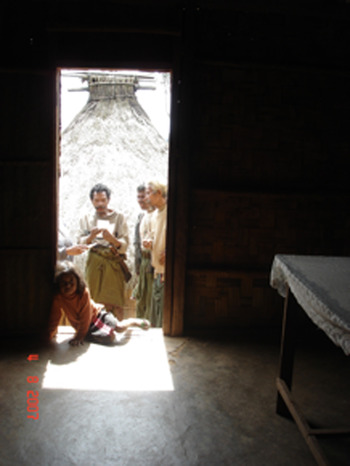
The need to keep the foreign and lulik apart could be seen, for example, in the prohibition against foreigners entering the most sacred of houses in the village of Funar (Laclubar subdistrict), where Bovensiepen carried out large parts of her fieldwork (see figure 1). It is said that a foreigner was once permitted to enter and as a consequence several members of that house died in a big fire. Since that time, foreigners (malae) have been forbidden from entering this indigenous lulik house since they or the house members would die as a consequence.Footnote 6
View onto the lulik house (ada timor), from which foreigners are banned. Photo taken by Bovensiepen, August 2007.

Despite the opposition between foreign and lulik powers, there is a frequent identification of land-spirits (which are liable to appear at lulik sites) with foreigners (see also Hicks Reference Hicks2004 [1976]: 37). During Bovensiepen's fieldwork, she repeatedly heard jokes about her apparent resemblance to such spirits. Suspicions were also voiced about one of the resident Peace Corps volunteers, who, in order to get phone reception, climbed up a sacred mountain associated with an “army” of land-spirits. Land-spirits are said to appear in the shape of white women with long, red hair or as black women with long, black hair. When they are male, they typically appear in military uniform, sometimes being described as African soldiers. They can also take the shape of snakes or, when they are the guardians of springs, of eels, which is why it is forbidden (lulik) to kill or eat these animals. Land-spirits are the guardians of lulik places, but they are also connected with the ancestors and the dead more generally.
In Robert McKinley's (Reference McKinley2015 [Reference McKinley1976]: 445) analysis of personhood in Borneo, he argues that the tension between the familiar and the foreign, the human and the non-human, is a key contradiction in Southeast Asian cosmologies. With growing distance, “others” increasingly come to resemble spirits of the dead, since ancestors are external social persons very much like the “enemies” of the outside (ibid.: 93, 472; see also Vilaça Reference Vilaça2010).Footnote 7 A similar dynamic is at work in this central region of Timor-Leste, where, despite their difference, lulik and malae are both used to legitimize power through their association with an external domain (the domains of the ancestors and of strangers, respectively). The ancestors, though located “inside” in relation to overseas foreigners, are also considered to live in a different world, and in this sense, they are internal others. Moreover, land-spirits are frequently said to appear at lulik sites. As we will outline in more detail later, even though lulik is symbolically opposed to the foreign, in practice both categories are mobilized in remarkably similar ways, indicating a certain structural similarity between these terms, akin to McKinley's analysis of the structural position of outsiders and ancestors.
The ambiguity of the relations between the dead, spirits, and lulik places observed in Timor-Leste (McWilliam Reference McWilliam, McWilliam and Traube2011) has obvious points of connection with studies from Melanesia, Indonesia, and Amazonia that have examined the symbolic construction of otherness specifically in relation to colonial others (see Stasch Reference Stasch2009: 7–14, for an overview of various approaches to the construction of otherness). An interesting aspect of this rich and complex literature is the observation that colonizers are frequently viewed with a level of ambivalence, as sources of danger or subjugation but also of desire, longing, or value (see e.g., Bashkow Reference Bashkow2006; Rutherford Reference Rutherford2003; Vilaça Reference Vilaça2010).
Our analysis seeks to contribute to existing examinations of the affinity between foreign and endogenous occult powers, connecting religious transformations to an internal ambivalence of existing religious principles (e.g., Tuzin Reference Tuzin1997). This resonates with other studies that have examined how interactions with outsiders transformed indigenous hierarchies (e.g., Sissons Reference Sissons2014) and how indigenous notions of power informed violent colonial encounters (e.g., Wiener Reference Wiener1995). By focusing on lulik, we follow Wiener (ibid.: 9) in trying to highlight the role of invisible powers in shaping historical encounters, a perspective that has been missing from scholarly accounts of the colonial period.
Scholars have observed structural affiliations between interactions with powerful outsiders and those with internal others, such as affines, ancestors, divinities, and spirits (e.g., Jonsson Reference Jonsson2012; Stasch Reference Stasch2009; Vilaça Reference Vilaça2010). The best known example of this kind of analysis is probably Sahlins’ (Reference Sahlins, Caldwell and Henley2008 [1985]) study of encounters between Hawaiians and Europeans and his argument that the 1778–1779 arrival of Cook was interpreted as the cyclical return of the god Lono. Examinations of such “stranger king” narratives have given rise to analyses of not just specific historical conjunctures but also how the incorporation of outsiders into systems of meaning can lead to the reorganization and reclassification of existing ideas, relations, and categories.Footnote 8
This article builds on this scholarship by examining how outside influences are accommodated within understandings of indigenous sacred and foreign power and how this process can lead to the reorganization of existing relations. In addition, we wish to show that colonial encounters not only led to the reclassification of the categories “sacred” and “foreign,” but also transformed the constitution of indigenous subjectivity in relation to such powers. To this end, we draw on Valerio Valeri's examination of “taboo” as key to embodied subject formation, as well as on Mary Douglas' argument that ambiguous categories change their power depending on people's relations with the outside. This allows us to bring to light the relational features of sacred powers in East Timor.
Let us now consider the relationship between lulik and the foreign in the Manatuto district in more detail. Why are foreigners associated with lulik sites and identified with their guardians (land-spirits), when lulik and malae, as mentioned, are seen as opposed and mutually exclusive categories? One explanation for this is the notion that foreigners are actually not foreign at all, since they represent a returning autochthone, a younger brother who is coming back from a long journey (see also Fox Reference Fox, Caldwell and Henley2008; Traube Reference Traube1986). Echoing familiar “stranger king” narratives, there are a number of accounts in Laclubar of outsiders who managed to acquire the status of local rulers (liurai), while the indigenous population maintained ritual responsibilities. However, many of these accounts reveal that the incoming outsider was actually a returning younger brother of an autochthonous pair of male siblings. Born from the land, the two brothers split: the older brother stayed behind and guarded the ritual sphere, while the younger journeyed afar before assuming political power on his return.
That such accounts lend themselves particularly well to the accommodation of foreign powers is clear (see Traube Reference Traube1986). However, we would like to emphasize a different aspect of such narratives, namely the implicit recognition that the other is essentially part of the self. This recognition of the subjective characteristics of the self in the other also underlies the ways in which people engage with lulik. Bovensiepen has outlined this argument in detail elsewhere (Reference Bovensiepen2014b), but a brief summary is helpful here to take the idea further. In the Laclubar subdistrict, places, buildings, and objects that have subjective human features tend to be lulik. Objects and houses are lulik when they contain an ancestral presence. Places are lulik when the ancestors emerged out of them, or when the ancestors interacted with these sites in other ways (e.g., living there, leaving a footprint, thrusting a spear into the earth). This identification (with the land, the dead, or foreigners) raises the possibility of non-differentiation between oneself and the other. Lulik sites are places that lack such differentiation and are therefore considered to be dangerous, so a distance must be established from them. Lulik, as that which is set apart (in the Durkheimian sense), reinforces a distinct human identity, since humans distance themselves from sites or beings that transgress the neat separation between human and non-human, and hence threaten the boundaries of the subject.
Bovensiepen bases her argument on Valerio Valeri's (Reference Valeri2000) study of Huaulu taboo (maquwoli), which Valeri says exemplifies the “dangers of identity by association” (ibid.: 136). When subjective characteristics are identified in a non-human other, distance and differentiation have to be established through specific taboos or prohibitions. In Valeri's case in Seram, these prohibitions commonly take the form of food taboos. Lulik—defined as both taboo and sacred—is embedded in a similar dynamic, since it necessitates processes of constant distancing and differentiation. It is because of this identification that a boundary or “relation of distance” (Traube Reference Traube1986: 143, original italics) needs to be established to such lulik beings.
Valeri builds his argument on a critical discussion of Mary Douglas’ (Reference Douglas2002 [Reference Douglas1966]) examination of dirt and taboo in Purity and Danger, in which she maintains that animals that do not fit into any neat category are prohibited from consumption. Valeri's (Reference Valeri2000: 61) critique of Douglas' well-known argument centers on the fact that Douglas reduces taboo to a question of classification and ignores that such categories are relative in the first place. Yet even though Valeri reproaches Douglas for neglecting how taboo is connected to the embodied processes of subject formation, there is a clear continuity between their approaches. Douglas (Reference Douglas2002: xi) emphasizes that taboo confronts us with ambiguous entities, which are staved off into the category of the sacred. Similarly, Valeri maintains that taboo occurs when there is a mismatch between subjects and objects, and when human qualities are identified in non-human beings.
Mary Douglas herself reassessed and pinpointed some problems with her initial argument, in her 1972 essay entitled “Self-Evidence.” She states there that in Purity and Danger she overlooked the fact that anomalous beings are not just considered dangerous but can also be venerated as sacred. She asks why it is that in some societies anomalies are seen as disgusting or threatening, whereas in others they are considered to be holy. She compares three case studies: her initial work on Hebrew food taboos, material from her research amongst the Lele in Congo, and the case of the Karam in Papua New Guinea. Her conclusion is that people's attitudes toward anomalies depend on their relationship with outsiders and their openness toward exchange.
If we think about taboo not in classificatory terms but in terms of the mismatch between subjects and objects, as Valeri maintains, then Mary Douglas' analysis offers an interesting model for thinking about the transformation of the sacred. But rather than arguing that a society tends to relate in a stable, structural way to its sacred or anomalous entities, we would like to suggest that as relations with outsiders change so can relations with the sacred. As mentioned previously, lulik has the potential to cause disastrous effects, yet at the same time it can be venerated as a life-giving source of prosperity. Building on Mary Douglas' argument, we believe that the question of which aspect is accentuated is related to people's experiences of outsiders.
Although we would not describe lulik as an anomaly in Douglas' sense, the historical and ethnographic material we will discuss seems to support the suggestion that, when exchanges with outsiders are positive, lulik is venerated as a sacred and productive source of authority. Lulik's fear-inducing aspects are accentuated when outsiders threaten the integrity of the self, such as by destroying people's sacred houses or through other forms of violence.
This article tries to add a diachronic dimension to Mary Douglas' synchronic model of the interconnection between outsiders and the sacred. Developing her argument, we suggest that as relations with outsiders change historically, so do attitudes toward sacred beings. From Valeri we take the insight that taboo is not a matter of classification but a matter of subject formation. Prohibitions, like those surrounding lulik or the Huaulu maquwoli, are means through which people can reinforce their own identity as human beings by distancing themselves from non-human others that have human characteristics. According to Valeri (Reference Valeri2000: 180), it is precisely because Huaulu do not postulate an inseparable barrier between human and animal that they are so concerned with creating differentiation.
Because Timorese “stranger-king” narratives and other mythic accounts implicitly recognize the underlying similarity—and relatedness—of living humans with the ancestors, the land, and foreigners, there is also a need to establish a distance from these beings. Lulik is at the center of these differentiating practices, since lulik sites require people to create (physical or symbolic) distance from sites where objects and subjects are fused. From this perspective, the structural opposition between the lulik-malae dyad must be seen as revealing how such terms are inherently interdependent. In other words, it brings out the relational character of the sacred. Hence when foreign agents appear to threaten the integrity of the self, the threat of lulik also increases; this necessitates additional precautions and distancing from lulik sites in order to defend and reinforce the boundaries of the self.
DESTRUCTION, FEAR, AND THE PERSISTENCE OF LULIK
Timor-Leste is a country that has only recently regained independence after more than three hundred years of Portuguese colonial presence, in addition to approximately eighty years of more effective colonial occupation and rule. This was followed by the brutal Indonesian invasion in 1975 (at the time of the turbulent transition to democracy in Portugal), during which there was widespread resettlement and forced dislocation. In the highlands of the Manatuto district, the Indonesian military, fearing local residents might be tempted to join the resistance movement, forced all those living in the remote, mountainous areas to abandon their land and homes.
In order to think about the meaning of the missionaries' destruction of lulik houses we will draw on ethnographic examples of more recent house destructions that took place in the village of Funar (in the Manatuto highlands). Prior to the Indonesian invasion, during conflicts between political parties in 1975, all lulik houses were burned to the ground. Funar villagers were then forcibly resettled by the Indonesian military and only returned in the 1990s, able to rebuild their houses and the village at large. The lulik power of the land and of the ancestral houses were key motivating factors for the return to the ancestral land, and people stressed they would not be successful anywhere else (Bovensiepen Reference Bovensiepen2015).
The reconstruction of previously destroyed lulik houses took place in many parts of the country after Timor-Leste regained independence (Bovensiepen Reference Bovensiepen2014a; McWilliam Reference McWilliam2005). Immense efforts were invested in these reconstructions, and reviving relations with lulik sites was seen as a precondition for achieving prosperity and well-being. Located underground and sometimes associated with large gold deposits, lulik is connected to idealized notions of societal improvement. Yet there is a darker side to lulik: while people associated it with great wealth, health, and productivity, it could also inspire fear and anxiety.
In mid-2006, conflicts between different political factions erupted in Timor-Leste's capital city, Dili. The country had been hailed a “success story” for international intervention and UN-sponsored peace building, so many international observers were taken by surprise when conflict broke out following the dismissal of nearly six hundred soldiers from the country's 1,400-strong army, which had gone on strike in protest over alleged discrimination. This internal conflict intensified, leading to violent clashes involving sections of the civilian population, the collapse of the main state institutions, and an official request for international military peacekeeping assistance. It was during this period of political turmoil that “fear of the land” became particularly intense. As part of the peacekeeping mission in 2006, for example, Australian military helicopters flew over Funar looking for so-called renegade soldiers who were hiding in the highlands. The daily drone of the helicopters put everyone on edge, and while watching them circle overhead villagers would often say, “I am scared of the land,” adding, “There will be war again, a big war.” The fear of an impending war was hence expressed in terms of a fear of the land, and by extension a fear of lulik.
War, conflict, and the neglect of reciprocal relations with sacred sites and with the ancestors during the Indonesian occupation have made the land more dangerous (Bovensiepen Reference Bovensiepen and Allerton2009; Reference Bovensiepen2015). Here we want to highlight that lulik land is particularly dangerous when outsiders are seen to pose a threat. Even though the 2006 “crisis” did not lead to the war that many people anticipated, it still brought this possibility to people's minds. And although conflicts took place between internal factions, suspicions circulated at the time that outside actors had instigated these clashes to destabilize the country. For many locals, the dangers of lulik are particularly intense when foreigners put the integrity of the self at risk.
With this contemporary ethnography in mind, we shall now return to the archival data. Although the missionaries had a difficult and at times antagonistic relationship with the colonial administration in Portuguese Timor, their activities were nevertheless a cornerstone of Portuguese colonization. The nostalgic idea that there had been splendiferous though short-lived moments of successful and widespread conversion to Catholicism in the colony was recurring among missionaries of the late imperialist period. Yet there is little evidence that the missions were particularly successful, at least before 1834. The endemic rivalries between religious orders, especially the Jesuits and Dominicans, were one of the reasons the Catholic presence remained weak on Timor. This is not the place to attempt a comprehensive historical overview of the missionary presence in East Timor (see Durand Reference Durand2004). Suffice it to say that the failure of more than three hundred years of attempted evangelization was fully admitted by the Catholic Church in twentieth-century Portuguese Timor. This failure was partly due to the fact that some, if not all religious orders in the region had been periodically dispossessed for political anticlerical reasons and subjected to repeated involuntary withdrawals (in 1759, 1834, and 1910) from the island (actually from the metropolis and all her colonies).
When speaking of “the missionaries” it is important to bear in mind that there was heterogeneity not just among East Timorese responses to Catholic conversion attempts, but also among the different religious orders. Historically, Manatuto district was under the influence of different Catholic orders. Franciscans set up missions in the towns of Manatuto and Laclo in 1670 (ibid.: 50), and in 1752 a church was built in Manatuto (ibid.: 47). Historical documents show that in 1856 there were Catholic converts in Manatuto (seven hundred “souls”) and Laclo (370 “souls”), but none were recorded in Soibada or in the highland areas of Funar and Laclubar until 1882, when small numbers of converts were recorded both in Funar and Samoro (the area surrounding Soibada) (ibid.: 52–54). This indicates that those living in the coastal area of the Manatuto district were exposed to missionary activities much earlier than people in the highlands, where conversion only started in the late nineteenth century. In 1899, Jesuit priests established a college in Soibada, while a group of Canossian sisters from Macau founded a school for girls (ibid.: 57). These schools were attended by the children of local rulers from Manatuto district and other areas of Portuguese Timor.
We know that for late nineteenth- and early twentieth-century missionaries the only way of achieving true conversion was the destruction of lulik objects and houses. However, since the history of missionaries on Timor was characterized by cycles of withdrawal and return, this meant that the destructive activities never lasted for very long (Delgado Rosa Reference Delgado Rosa2013). Moreover, missionaries also seem to have substituted lulik objects with Catholic items, which, as we shall see, often became lulik themselves. How did these different ways of engaging with the local population—destruction, withdrawal, and substitution—impact on Timorese notions of the sacred? To answer this question, let us consider these different engagements one by one, beginning with destruction. Recall that our challenge is to relate missionary destructive activity to the sentiment of fear expressed toward lulik today. We have established such a connection in contemporary engagements with lulik. Will this connection provide some insight into the ways in which missionary activities were perceived?
One of the most crucial and recurrent justifications for the apprehension and/or destruction of lulik items by missionaries was precisely the suggestion that the Timorese religion was purely one of fear, in contrast to Christianity, which was understood as a religion of love. In 1910, as a result of the proclamation of the First Republic and the fall of the eight-century-old Portuguese monarchy, religious orders had been evicted from Portuguese Timor and their possessions confiscated. Regular clergy could only return to the colonies with the end of the First Republic in 1926, when the missionaries' political status started to improve. However, not until the start of Salazar's Estado Novo regime in the 1930s were missionary activities truly reinvigorated, only to be interrupted again by the Japanese invasion during World War II.
Padre Abílio José Fernandes, superior of the Catholic missions in that momentous decade, characterized the Timorese creed as rooted above all in terror and horror. The priest subordinated all aspects of Timorese religion to “fear of the dead,” or “fear of spirits,” which he considered to be the only reason why Timorese kept lulik houses full of allegedly sacred things. According to him, “The terror of spirits inspires in them the respect to save and retain any object used by their ancestors” (Reference Fernandes1931: 22). Fernandes suggested that this fear provoked them to make human sacrifices and to participate in “filthy orgies.” He asserted that the “fear of spirits” had no moral component to it and thus could not be ascribed the status of a religion. Accordingly, he described non-Catholic Timorese “pagans” as “animal-like people” (gente animalizada) who lived “half-naked” in “sexual promiscuity,” using “pornographic language” and practicing “truly hellish nocturnal dances” (ibid.: 18, 40).
Padre Fernandes may be considered an extreme representative of religious ethnocentrism, but a similar focus on fear is found even among less radical missionaries. Padre Ezequiel Pascoal, who wrote lengthy descriptions of what he called “native superstitions,” was at the forefront of the missionary endeavor (Pascoal Reference Pascoal1967: 13). He arrived on the island in 1932 and was initially placed in the mission of Manatuto on the north coast, where he was involved in the building of the church of “Our Lady of Fatima” in 1933. Later he taught at the pre-seminary of Soibada and at the School of Catechists, and he was the first director of the monthly eschatological bulletin Seara, which he also founded (Paulino Reference Paulino and Roque2011). From his point of view, the “cult of the lúlic” was an “obsession” that, he stated, “has nothing that resembles love or affection” (Pascoal Reference Pascoal1949: 14). He argued that the religion of the Timorese “pagan” revolved around the fear of “lúlics,” which were “his [the pagan's] continuous obsession” (ibid.: 12):
The “lúlics” are shadows that chase him, and at the same time they are a protection in which he takes refuge. They are a nightmare that torments him, but at the same time, they are the pretext for his biggest orgies, for his clamorous bacchanals, where, during successive days, he beats drums monotonously, gets drunk, and sets free all kinds of pleasures at his reach.… Fear is the only motivator that orients all relations with those strange beings that have the destinies of the pagan Timorese in their hands. He considers them to be obscure, vindictive, and arbitrary. There are some that are more powerful than others—hotter—manas—say the natives (ibid.: 12–14, bold in original).
According to Padre Pascoal, Timorese religiosity lacked a sense of morality, since “lúlics” would arbitrarily decide to bring disease or to heal, to “devour the soul of any mortal, but if they fancy, to restore it” (ibid.: 13).Footnote 9 He admitted the intangible and invisible nature of “lúlics,” their sometimes “vague” association with different features of the environment, but only to reinforce his argument about their “fetishistic” nature. “Lúlics” were spirit beings that used objects or sites in the landscape as their “mansions” or “temples” (ibid.: 13, 14). Pascoal therefore considered “lúlics” to be objects of veneration or even “objects of prayer”—a fundamental misunderstanding of lulik, as the anthropologist David Hicks has noted (Reference Hicks2004: 26).Footnote 10
No wonder, then, that according to Padre Pascoal, “lúlics” required sacrifices. He described how in Manatuto there was a large rice field (called Cadoras) whose “lúlic” guardian used to demand that the locals sacrifice a child each year in order to ensure a plentiful harvest. However, since this practice was no longer allowed once the residents converted to Catholicism, they had stopped using that rice field altogether. If they ploughed it, they maintained, the “lúlic” would kill them immediately (Reference Pascoal1949: 14). This brings us back to the subject of the destructive actions these attitudes inspired. This first case involving the prohibition of practices directed at lulik agents is particularly useful, since it allows us to consolidate our contemporary ethnographical understanding of lulik with information from the archives. Making it impossible for people to engage in appropriate ways with lulik agents did not actually destroy them, as intended. In fact, being unable to engage in appropriate reciprocal relations with lulik would have made lulik more powerful and frightening in the minds of local residents.
Let us approach sacred houses with the same train of thought. Padre Sebastião da Silva, who burned down nine lulik houses in 1908, was not the last missionary to undertake such aggression. Not surprisingly, Padre Fernandes, intent on protecting the reputation of the missionaries against criticism from the colonial government, embarked on a similar course of destruction, as the new dictatorial regime of the Estado Novo had allowed the missions to reestablish their position. His stated goal was the systematic destruction of the most tangible manifestations of Timorese religion, particularly lulik objects, ancestral relics, and houses, and the systematic disarmament of the local kingdoms.
Although Padre Pascoal's attitude toward those he wanted to convert seemed less disparaging than that of his superior, he followed a similar strategy when stationed in Manatuto and Soibada. He urged people to believe that the only way to fulfill their religious duties in a sincere way was to renounce their “lúliques” (Reference Pascoal1936b: 283). Ideally they would surrender and destroy them on their own initiative, but this tactic was not always successful. Padre Pascoal recounted how he went on a raid of lulik objects in 1935 when he visited the town of Laclo, a mission station that was at the time dependent on Manatuto.
Once he had identified what he thought was “the main lúlique of the kingdom” (of Laclo), he “set out to dethrone [it]” (Reference Pascoal1937: 847). After the death of the ritual guardian of the lulik house, Padre Pascoal with the help of a number of chiefs gathered all the lulik objects and burned them in a big bonfire that they made beside the chapel (ibid.). The archives tell us little about the Timorese response to those attacks. Padre Pascoal, like Padre da Silva three decades earlier, described the reaction to his arrival as a warm and welcoming one. There are some accounts of people appearing reluctant to surrender their sacred items to the missionaries, and there is also some scant evidence of deliberate desacralization of sacred houses (Almeida Reference Almeida1937: 750–51; Correia Reference Correia1935: 60–61; Parada Reference Parada1937: 593–97; Pascoal Reference Pascoal1936b: 283). Still, one has to wonder why locals participated so willingly in the destruction of such potent lulik objects and houses, as described by Padre Pascoal and Padre da Silva.
It is impossible for us to assess whether those whose houses were destroyed were really as acquiescent as the missionaries make out. It may be that the priests exaggerated the hospitality they received in order to present their mission as a success. Timorese responses to these destructive acts almost certainly differed throughout the country, and it is also possible that those who participated in the destruction did so for their own political ends. It is likely no coincidence that such iconoclastic destruction occurred at the time when so-called pacification campaigns were being launched across Portuguese Timor. Attacks on lulik houses may have been part of the radical reordering of power relations by colonial powers from the mid-nineteenth century onward. After all, the missionaries' activities coincided with attempts by the Portuguese colonial administration to consolidate its power by establishing a system of indirect rule, restructuring domains that were not sufficiently loyal, imprisoning disloyal rulers, and empowering others.Footnote 11 Was the “willing” participation of local people in the destruction of lulik houses perhaps part of such reordering? There is a large variety of lulik houses in any one region, and we are never told whether those who participated in the burning of lulik houses were indeed their members, or instead political rivals. It may also be that the Timorese guardians of lulik houses thought that superficial collaboration was a more beneficial strategy than open confrontation. The power asymmetry of the colonial encounter may well have coerced people into agreeing to the destruction of lulik sites because they saw no other option.
However, we also need to take into account that lulik does not cease to exist when the edifice of lulik houses is destroyed. When asked about the demolition of lulik houses before the Indonesian occupation, research participants in Funar responded that the houses had never disappeared. This was because lulik houses cannot be reduced to the houses' tangible edifice; they represent entire social groups, and as such they have an existence beyond their material form. Similarly, lulik objects that had been destroyed, lost, or stolen could be remade and “re-inspirited” (a process called aluli).
Even though lulik can survive the destruction of its material manifestations, we should not underestimate the negative effects that non-respectful behavior toward lulik sites would have had. Not engaging in the appropriate reciprocal relations with lulik agents can have dramatic consequences. Such negligence can cause war or lead to illness and death among family members. This is the crux of our argument: the destruction of lulik objects did not sever people's relation with lulik, but rather heightened lulik's power, especially its destructive potential.
Hence, we suggest that forcing converts to neglect their obligations toward lulik would have intensified their fear thereof. So perhaps what priests saw as a religion ruled by a “fear of spirits” was in fact partly a product of their own doing. As ethnographic research has shown, lulik can be both dangerous and extremely productive. When highlanders are faced by an outside threat, lulik induces more fear and danger. Therefore, the missionaries' violent attacks must have intensified people's fear of lulik. What the missionaries saw as a timeless “superstition,” a “terror of spirits,” may have in fact developed in interaction with those who tried to bring “the light of Evangelism” (Pascoal Reference Pascoal1949: 15) to the island. The missionaries' quest to destroy lulik houses (and concomitant attacks by the colonial army or political rivals that were part of the “feudalization” of indigenous polities [Kammen Reference Kammenn.d.] in the late imperialist period) may have given rise to the “fetishstic” terror the missionaries sought to eradicate.
WITHDRAWAL, SUBSTITUTION, AND THE EMERGENCE OF CATHOLIC LULIK OBJECTS
If we accept that there is a correlation between the threat posed by outsiders and the threat posed by lulik, could the inverse also be true? Were there certain historical conditions that strengthened lulik, in the sense of accentuating its benevolent and productive features? Let us consider accounts from the area of Bobonaro and Suai, where missionaries had been active in the eighteenth century, though their presence had subsequently been forgotten. The discovery of past missionary activities was made in those final, less anticlerical years of the First Portuguese Republic of the 1920s, when newly arrived missionaries found Catholic items in lulik houses. These objects, which included a disfigured wooden carving of Our Lady of the Rosary (Nossa Senhora do Rosário), had themselves become lulik. Another object was a Portuguese letter written in 1790, confirmation that missions had existed in the region until the late eighteenth century. Whereas the missionaries who arrived in the 1920s did not know about their own mission history, non-Catholic Timorese had preserved evidence of this history in their lulik houses. In a letter to the bishop, Padre Cardoso wrote about these findings:
This does not mean that the same people who have preserved objects of worship for so long have also maintained the religious faith of their ancestors. They possessed objects of old missions, since it is the custom of all natives to keep all that belonged to their ancestors, even if it is a simple letter without any importance. With the passage of time, these people have fallen back into paganism, becoming as superstitious as those populations where there has never been a mission and they are currently in this state (1923: 50).
For the Catholic missionaries, these Catholic-lulik items had no historical or religious value; their idolatrous worship meant that they had been completely stripped of their original meanings. Rather than possessing an enduring sacred status, Catholic objects in lulik houses had become part of the “cult of the ancestors.” Padre Pascoal stated that “with the passing of time” the objects that had fallen into the possession of the “natives” would be considered “pure and simply as ‘l úlic’” (1949: 13).
Catholic items, such as crosses or statues of the Virgin Mary, are said to exist in a number of lulik houses across Manatuto district, where the arrival and subsequent withdrawal of missionaries due to the periodic ban on religions orders (e.g., in Soibada) were common occurrences. When the religious orders returned, the missionaries did not try to salvage the original meanings of these objects, but instead dismissed them as part of what they saw as local superstitions. Amidst the missionaries' discussions about whether or not those worshipping Catholic-lulik items were “true” Catholics or not, one important point was missed: that objects became lulik in periods directly following the withdrawal of missionaries. How did residents confronted by the arrival of missionaries interpret the repeated departures of those same missionaries?
One salient feature of contemporary engagements with lulik is that lulik brings misfortune when not treated with adequate respect and can retaliate against offenders, as the following account from present-day Manatuto district illustrates. A few years ago, in the Laclubar subdistrict, a priest (who came from a different region in Timor-Leste) beat his cleaning lady so badly that she had to go into hospital. Subsequently he had a car accident, and this was widely interpreted as an act of revenge by the lulik of the woman's sacred house. After this event, the bishop of Baukau ordered the priest to go to Rome for a couple of years to receive additional education, and this withdrawal was widely interpreted as confirmation of the woman's strong lulik house, which had punished the offender.
Similar accounts are known from other regions of Timor-Leste. McWilliam, Palmer, and Shepherd (Reference McWilliam, Palmer and Shepherd2014), for example, discuss the experiences of the American anthropologist Shepherd Forman, who arrived in Portuguese Timor in the early 1970s to undertake fieldwork amongst Makassae-speakers in the foothills of Mount Matebian. He was very interested in issues related to lulik, and one of his main informants was an old man and guardian of oral traditions, who hoped a foreigner's presence would boost his own position within the local hierarchy (ibid.: 8; Forman Reference Forman1976). One day, Forman's apprenticeship came to an abrupt end when the old man decided that the door to “the path” (of knowledge) must be closed again and that lulik names could not be shared with an outsider. During the ritual of “closing the path,” Forman made several mistakes: first he sat on a lulik stone, and then he killed a cobra, considered to be a spiritual messenger. Subsequently, a fire broke out in the village that burnt down the entire complex of lulik houses to whose knowledge Forman had been given access (McWilliam, Palmer, and Shepherd Reference McWilliam, Palmer and Shepherd2014: 9–11).
McWilliam, Palmer, and Shepherd (ibid.: 3, 14) also report on the encounter between lulik and the naturalist Henry Forbes, who visited Portuguese Timor in 1882–1883 to collect environmental samples. Local residents repeatedly told him not to cut branches from lulik sites, yet Forbes had “no sympathies for local etiquette” (ibid.: 3). Traveling with the ruler of Samoro (in present-day Manatuto district), he callously ignored warnings that violating prohibitions associated with lulik would lead to disaster and continued to collect botanical specimens. Shortly after this incident, Forbes' wife Anna became seriously ill and they had to leave the country to seek treatment (ibid.: 5). It is likely that those who witnessed Forbes' ruthless treatment of lulik forest would have connected this to the wife's illness, which, along with the couple's abrupt departure from the country, must have confirmed to them the strength of lulik and its ability to avenge transgressions.
These examples illustrate the close link between misfortunes or disappearances and lulik. A key element in these cases is the connection between withdrawal and retaliation. Given the history of the Portuguese missions, and in particular the open attacks on lulik by missionaries and their recurrent withdrawals, such disappearances could also have been interpreted as retaliations by lulik. Thus the withdrawals of missionaries, leaving only Catholic icons behind, may well have, against their intent, inadvertently confirmed and strengthened the power of lulik in a positive way instead of accentuating its threatening aspects (a likely effect of the burning of lulik houses). The most ironic consequence of this dynamic is that Catholic-lulik objects would also become potent signs of authority, strengthening the prestige of the objects' owners.
We can see here two different understandings of the role of sacred objects. For the missionaries, Catholic objects lost their legitimate spiritual meaning once removed from their context and particularly from the sanction of the clergy. Without a priest present, the objects themselves had no (symbolic) power whatsoever. This is the exact opposite of the ways in which sacred objects gain significance in the eyes of Timorese ancestral ritualists, and arguably also in other areas of Eastern Indonesia: objects are effective signs of authority when their social context has been entirely removed or abstracted.
Webb Keane has analyzed this dynamic in detail in his book Signs of Recognition. Drawing on Peirce's distinction between icon, symbol, and index, he argues that in Anakalang (Sumba), signs need to appear “natural” for people to consider them to manifest real essences (Reference Keane1997: 19). For signs and ritual action to be authoritative, they need to appeal to an agency that is assumed to transcend present-day humans. In other words, signs should not be recognized as symbols (signifying by virtue of social convention) because that would lead others to seek out the intention and agency that lie behind the sign. Lulik objects, as is clear from research in Funar, likewise necessitate the negation of human intention, while for Catholic missionaries objects are truly meaningful only if they are embedded in appropriate social (and religious) conventions.
Of course, the missionaries did not leave religious objects behind deliberately; in this sense, their integration into lulik houses was an unintended consequence, not a purposeful strategy. Yet, by trying to substitute one kind of religious object with another, they ended up producing new combinations, and perhaps an even more powerful kind of lulik object. This point can help us to reinterpret the effects of the chronic frailty of Catholicism in East Timor: having tapped into the power of the “outside,” the new lulik objects may have been even more powerful than the original objects.
Dismissing Catholic-lulik objects as worthless and spiritually vacuous was not, however, the only response among missionaries who encountered items of this sort in sacred houses. In the 1930s, Padre Pascoal found a statue of Saint Anthony in a lulik house, which local Timorese called—following the old Portuguese tradition of “lyrical Christianity” (Freyre Reference Freyre1986 [Reference Freyre1933])—“Amo-Deus Coronel Santo António” (Lord-God Colonel Saint Anthony). Padre Pascoal decided to research the statue's history and published an article in five parts about it in 1949 and 1950 (Pascoal Reference Pascoal1949–1950). The statue had resided in a chapel in Manatuto in the eighteenth century (although later sources date it from 1815 only), but in the nineteenth century it found its way to the lulik house of the local ruler, which was specifically dedicated to the saint. It was accompanied by the skull of a friar, said to be a great miracle worker, who would preach to rats and birds so they would spare people's rice fields. Before embarking on a headhunting raid, local warriors would throw corn at the feet of this statue, while a ritual specialist sitting next to it would mark the foreheads of the warriors with red betel juice (ibid.: 219).
Was this object Catholic or lulik? And what about Saint Anthony's guardians? “Were they bad Christians? Were they heathens?” asked Padre Pascoal (ibid.: 217). The statue of Saint Anthony had a following of devotees and was guarded by the Catholic widow of the local ruler. Although skeptical of this practice, the missionary Pascoal at least acknowledged the spiritual character of people's worship of the statue. Nonetheless, such hybrid religious activities were soon put to an end. On a visit in 1933, the bishop of Macau, José da Costa Nunes, decided that the “idolized” statue of Saint Anthony should no longer be stored in a lulik house but instead venerated in a church, preventing all “heathen” practices of worship associated with it. The widow is said to have given up the statue without the slightest resistance. A little later, though, an entourage of “the staunchest lulik fanatics” (ibid.: 84) came to the mission of Manatuto to ask that the statue be reinstalled in the house of the liurai. The request was denied, since only the Pope could revoke a bishop's order.
This example also shows that what was an incompatibility for certain missionaries was no incompatibility at all for Timorese converts. For the latter, it seemed there was no inherent contradiction between Catholicism and their ancestral religion, and they recognized the spiritual value of Christian artifacts. Indeed, it may even be that Timorese ancestral ritualists saw the “presence” of Catholic objects as affirming the spiritual potency and precedence of their indigenous sacred powers. In his discussion of conversion of Wari’ (in the Brazilian Amazon) in the mid-twentieth century, Vilaça argues that the asymmetry between indigenous peoples and white foreigners centered on the question of difference. Europeans wanted to transform Indians into replicas of themselves, but Indians wanted to become European “in their own way” (Reference Vilaça2010: 12–13). Discussing Eduardo Viveiros de Castro's perspectivist interpretation of the missionary encounter, particularly complaints by missionaries about the “inconstancy of the savage soul,” Vilaça holds:
For indigenous peoples, difference means a difference of position: the possibility of experiencing this other position—which involves transforming oneself into an other in order to acquire the other's point of view—does not imply erasing difference. On the contrary, the transformation is only desirable when reversible; though, again, this reversibility does not presume the existence of an original point of view or culture to which one must return. Just as shamans transform into animals to acquire a supplementary capacity, derived precisely from this alteration, so indigenous peoples wanted to turn into whites (ibid.: 13).
The “fickleness” that Catholic missionaries ascribed to Timorese Catholicism may be understood in a similar way. We cannot delve here into different theories of conversion or perspectivism, but our argument can benefit from an important point of this comparison, namely the possibility that Timorese converts who accepted Catholic artifacts had no intention of turning themselves into (replicas of) the colonizers (thereby erasing difference). The potency of endogenous sacred powers may have increased when they were able to tap into the sacred power of the outside (Catholicism), but not because this allowed Timorese to take the point of view of the outside. Rather, gifts of Catholic objects would have been interpreted as an act of recognition by spiritual outsiders that the true origins of faith and humanity are in fact in Timor.
This notion of precedence that sublates the opposition between foreign and lulik underlies various religious and political formations. There are accounts, for example, about “scepters” that the Portuguese colonial administration gave to local rulers in order to consolidate indirect rule. In a number of these accounts, the scepter is described as lulik. In the village of Funar, for example, a narrative about the establishment of indirect rule describes how the Portuguese governor recognized Funar as a “kingdom” (reino) independent from its neighbors (Bovensiepen Reference Bovensiepen and Feijó2016). When local rulers benefited from their alliances with outsiders, the positive side of lulik was strengthened. This became evident, according to local residents, when golden lulik rainbows shone over the land of the ruler at that time, improving the fertility of his livestock. Similar accounts exist in Laclubar Town, where the gift of a “scepter” by the Portuguese allowed Laclubar to become independent from the neighboring domain, Samoro (Bovensiepen Reference Bovensiepen, McWilliam and Traube2011).
Gifts of foreign objects were frequently interpreted as “signs” of the authority and strength of individual ruling houses, suggesting that even outsiders recognized the significance and authority of the local elite. Yet ultimately such foreign gifts are always seen to have been predestined in some way (i.e., foreigners are said to provide them because the lulik land had already determined which group should own such objects). Thus, the gifts not only confirm the authority of a particular house group (or the autonomy of a region); they are also signs of the power and strength of lulik. In Laclubar Town, some house groups also maintain that lulik land gave a scepter of rule to the first ancestors. This means that the “other” is in fact part of the self—foreign power has its origin in East Timor. The scepter or other objects associated with foreigners take on the role of the “stranger king”; like the returning younger brother, they return to their origin.
We can only speculate, but it is possible that local Timorese also saw Catholic icons, such as the statue of Saint Anthony of Manatuto, in this way. Just as scepters given by the Portuguese colonial administration were interpreted as ultimately confirming the power of the lulik land, the “capture” of the statue of Saint Anthony by the ruler of Manatuto may well have been understood as a sign of his great authority—an authority that, even if represented as predetermined, had thus been recognized by foreigners from distant lands.
During the Estado Novo, missionaries started to erect crosses at lulik sites across Portuguese Timor, often replacing ancestral objects or superimposing Catholic symbols. Many of these interventions are still visible today. Later in the twentieth century, with the Timorese Catholic Church's late but active support of inculturation, such substitution became a more deliberate, strategic combination of ancestral with Catholic practices and symbolism. Beside one of the most sacred trees in Soibada we can now find a little shrine to the Virgin Mary (Our Lady of Thorns, Nossa Senhora de Aitara), who is said to have appeared there. This place is an extremely popular destination for pilgrims and Nossa Senhora de Aitara even has her own Facebook page. Similarly, the priest of Laclubar used to have a little structure outside his residence that strongly resembled a lulik house, and he organized large feasts of buffalo meat at religious or political events (reminiscent of ancestral rituals), inviting local ritual speakers to contribute. A cross has also been erected by the grave of Laclubar's most significant ancestor, who gained independence for his region with the help of lulik land. In Funar center, a Catholic shrine has been constructed on a lulik hill, which is now identified with God and with the Virgin Mary.
In spite of, or perhaps because of, the destructive nature of past missionary interventions, the superimposing of Catholic symbolism on lulik sites is largely interpreted by local residents as proof that their lulik land is particularly powerful. Ancestral narratives are recast to integrate biblical stories, by suggesting that the first ancestors' “real” or non-“heathen” names were actually Adam and Eve, or that the Virgin Mary was born in Laclubar. These accounts are used to demonstrate that the origins of humanity are in East Timor, and to make the claim that Catholicism has always been part of Timorese culture. Today, the Catholic Church is seen as a supporter, not an antagonist, of ancestral practices (see also Nygaard-Christensen Reference Nygaard-Christensen, Bubandt and Van Beek2012). Just as the opposition between material and immaterial cannot be maintained when it comes to lulik objects, the new kinds of lulik-Catholic objects, such as lulik crosses or saint statues, which resulted from Timorese encounters with missionaries, ended up collapsing the opposition between foreign and ancestral.
PRECEDENCE OF THE SACRED
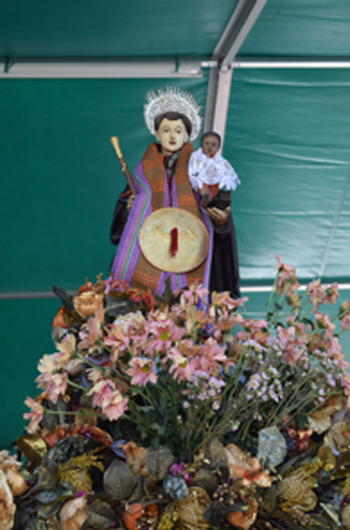
On 13 June 2015, celebrations were held in Manatuto Town to mark two hundred years since the arrival of the statue of Saint Anthony. A gigantic field had been cleared for the celebrations, which involved a three-hour mass in the morning and traditional carnivalesque games in the afternoon. Several political leaders had come from Dili to attend the mass, which was given in Tetum and English by Archbishop Joseph Salvador Marino (Apostolic Nuncio to Malaysia). Standing behind a series of beautifully decorated statues, including the old one of Saint Anthony (see figure 2), the archbishop recounted how, in 1815, Dom Mateus Soares of Manatuto received the statue from the Bishop of Malacca. He argued that in the acceptance of this gift “we see one of [the] true characteristics of Timor-Leste, namely a deep union between faith and culture” (Marino Reference Marino2015). Weaving biblical verse into his speech, the Nuncio made a moving claim that the East Timorese already knew “the light of God” before the missionaries arrived. He based this assertion on a speech made by the Prime Minister Rui Maria de Araújo to a conference in Dili on the role of the Catholic faith in the resistance struggle: “Christianity did not enter our culture and our history by being imposed through arms.… Christianity elevated, dignified, and enriched that which already pulsated in the nature of the Timorese people. In other words, Christianity found a people with the sense of God (Maromak) and the sense of Sacred (Lulik)” (Rui Araújo Reference Araújo2015: 3–4). Citing the prime minister in this way during the mass pleased many members of the East Timorese audience, since it confirmed something they had long known: that their own religiosity and spirituality matched that of the Catholic faith in every sense. Reflecting on the period of conversion in Portuguese Timor, the archbishop continued, “This is exactly what happened here. The Timorese people so accustomed to the presence of God in their lives, in their very being, joyfully embraced Christianity, and ever since then your identity as Timorese and Christian has been inseparable … the people of Timor-Leste have possessed that light, that sense of being with God, from the very beginning” (Marino Reference Marino2015).
Statue of Saint Anthony that arrived in Manatuto in 1815. Photo taken by Bovensiepen in June 2015.

The warm ceremony was a wonderful elaboration of the idea of precedence, one that validated the claims that East Timorese spirituality preceded the spiritual powers brought by outsiders. The mass was an act of recognition. Of course, it also contributed to the invention of a less hostile history of the Catholic Church in East Timor, entirely ignoring the Church's complicity in the colonial project and erasing any memory of the destruction and discrimination perpetrated by missionaries.
After the mass, sitting in the shade of the large trees surrounding the church, a young student from Manatuto, in conversation with Bovensiepen, recounted how during the Indonesian occupation the statue of Saint Anthony had assisted villagers by ploughing and watering their fields at night. Locals knew this because the next day the statue's feet would be covered in mud. The student connected his ruminations on Saint Anthony to his suggestion that some places in Manatuto were strongly lulik—including the rice field Cadoras, mentioned seventy years earlier by Padre Pascoal. There was a large, very potent tree near the rice field, the student said. With the right gifts, and words of ritual speech (hamula), one can obtain anything one desires from this lulik site. This, the student added, was not in contradiction with the Catholic faith. God is most important, he said; he is the first, but lulik and the ancestors were a close second.
The day before the mass to remember the arrival of Saint Anthony, a large reconciliatory meeting was held in Manatuto. Supporters of the Indonesian occupation who had fled to West Timor were invited back—“the doors were opened” for them. A Manatuto resident explained that those who had fled were suffering from health problems and infertility. By carrying out a ritual to receive a blessing from the ancestors (called matak malirin), as well as from Saint Anthony, they would be able to address these problems. The reconciliation event thus drew on both Catholic and ancestral practices.
How the antagonistic attitude of many missionaries transformed into a more accommodating position is surely matter for a separate article, and the role of the Catholic Church in the resistance struggle against Indonesia should no doubt play an important part in that article, as should changes within the Catholic Church such as the Second Vatican Council. In many parts of Timor-Leste today, Catholicism is creatively combined with what are now designated as “traditional” practices. As Kelly Silva (Reference Silva2008) has argued, Catholicism has become an integral part of the Timorese national identity. Nevertheless, Silva (Reference Silvan.d.) has also shown that even today there are different, often contradictory views about the relationship between Catholicism and what is glossed as kultura within the Catholic Church in Timor-Leste. Some see Christianity and kultura as incompatible, some see a selective overlap between both, and others view Christianity and kultura as mutually reinforcing.
The Nobel Peace Prize winner Bishop Belo, for example, was known for actively integrating animist practices with Catholic activities, including ideas about lulik and the ancestors. In the 1990s, he held religious ceremonies on two of East Timor's most significant mountains, Mount Ramelau and Mount Matebian (Durand Reference Durand2004: 104). During the Indonesian occupation, the Catholic Church refused to be hierarchically subjugated to the Indonesian Catholic Church and remained directly linked to the Vatican. It enjoyed enough freedom to continue performing mass in Portuguese and Tetum (Silva Reference Silva2008: 3). After the country regained independence in 2002, the Catholic Church continued to assert its significance in the nation-building project, as exemplified by its organization of mass rallies in favor of compulsory religious education in 2004 (ibid.). From its meager beginnings, the Catholic Church has become a key player in the country.
We hope that our analysis provides a more dynamic model of Timorese engagements with sacred potency than previous descriptions of Southeast Asian animism have allowed for. What lulik means to people, how they engage with it, and how it relates to other sacred forms has changed throughout East Timor's turbulent history. Our argument is that through their interventions, aggression, and withdrawals, and through the ultimate weakness of the Portuguese colonial apparatus, outsiders have inadvertently contributed to an overall strengthening of lulik both in its negative, threatening aspects and in its positive, productive possibilities.
We have developed our argument by drawing on two complementary theoretical approaches. The first is Valerio Valeri's (Reference Valeri2000) analysis of the role of taboo in the constitution of the self, in which he argues that prohibitions and dangers arise when identification with a foreign agent threatens to shatter the boundaries of the subject. The second is Mary Douglas’ (Reference Douglas1972) examination of the ways in which attitudes toward anomalies differ according to society's relations with outsiders; more specifically her claim that when relations with strangers are positive then anomalous beings are venerated as sacred, and when such relations are closed and adversarial such beings are seen as a source of danger. In the case of lulik, then, when indigenous relations with foreigners were productive and empowering (at least for parts of the population), the positive aspects of lulik as a sacred source of prosperity and authority were accentuated. However, when foreign powers threatened the existence of the self, as they frequently did throughout East Timor's history, those aspects of lulik that are dangerous and threatening moved to the fore.
We have described three different modes of engagement between Catholic missionaries and indigenous sacred powers and suggested the effects such encounters would have had. First, attempts to destroy “lúliques” by burning down lulik houses and sacred objects did not destroy lulik, but rather merely increased people's fear thereof. Lulik becomes more dangerous in those moments when it is treated with disrespect. Second, local Timorese may well have seen the repeated withdrawals of missionaries as a form of retaliation by lulik against those aggressors, confirming the ultimate superiority of this indigenous potency. And thirdly, when missionaries tried to substitute lulik with Catholic objects, and then left them behind when they withdrew, this created a whole new and perhaps even more powerful type of lulik object. These Catholic-lulik objects could have been interpreted as signs of autonomy or as proof that even foreigners recognized the importance of a particular lulik house. The actions of the missionaries did not always work as they intended, and in fact, ironically, they often had opposite effects.
Juxtaposing present-day ethnography and archival ethnohistory, we have argued for a relational understanding of the sacred. We have highlighted the correlation between the power and fearfulness of foreigners and the power and fearfulness of lulik, emphasizing how the local ambivalence of the sacred is accentuated as relations with foreigners change. The sacred and the foreign must be understood in a relational context that informs not just religious sensibilities, but a whole range of different social and political processes.