Introduction
Theory predicts that when a parasite with an indirect life cycle is located within the body of an intermediate host that is part of the correct food chain leading to an appropriate definitive host, the parasite will benefit from being able to alter intermediate host behaviour so as to enhance transmission efficiency to the correct definitive host (Barnard & Behnke, Reference Barnard and Behnke1990; Poulin, Reference Poulin1994a, Reference Poulin1995; Klein, Reference Klein2005; Thomas et al., Reference Thomas, Adamo and Moore2005). For trophically transmitted parasites this means changing host behaviour in such a way as to make the host more likely to be consumed by the definitive host: this is known as the ‘Behavioural Manipulation Hypothesis’ (hereafter referred to as BMH). This hypothesis implies that any alteration in a parasite-infected host's behaviour, leading to patterns that are never or rarely observed in uninfected hosts, is a consequence of adaptive manipulation by the parasite, rather than a behavioural change arising as a by-product of infection (e.g. as a result of some form of parasite-induced pathology; Barnard & Behnke, Reference Barnard and Behnke1990; Poulin, Reference Poulin1995; Thomas et al., Reference Thomas, Adamo and Moore2005).
The most likely targets for adaptive manipulation are those linked to escape responses from predators, such as speed of movement and vigilance, and those concerned with conspicuousness in the environment, such as orientation, patterns of activity, exploratory behaviour, phototactic responses leading to emergence from shelter, etc., changes in all of which are likely to make the infected host more vulnerable to predation (Moore, Reference Moore2002). Bethel & Holmes (Reference Bethel and Holmes1973) provided the first empirical evidence in support of the BMH with their work on acanthocephalan parasites and gammarid species (Marriott et al., Reference Marriott, Collins, Paris, Gudgin, Barnard, McGregor, Gilbert, Hartley and Behnke1989; Bauer et al., Reference Bauer, Haine, Perrot-Minnot and Rigaud2005). Infected gammarids demonstrated reduced concealment behaviour and positive phototaxis, and the adaptive significance of these behavioural changes for the parasite was confirmed by appropriate predation experiments (Bethel & Holmes, Reference Bethel and Holmes1977). A highly relevant finding from this study, however, was the discovery that altered behaviour in gammarids only occurred in those harbouring mature infective cystacanths (Bethel & Holmes, Reference Bethel and Holmes1974). More recently, Tain et al. (Reference Tain, Perrot-Minnot and Cezilly2006, Reference Tain, Perrot-Minnot and Cezilly2007) have shown that acanthocephalan parasites alter host behaviour using complex neurological pathways, in particular the 5-hydroxytryptamine (5-HT – serotonin) pathways in the brain.
However, non-adaptive explanations, such as those based on changes in host behaviour stemming from pathology, have gained widespread acceptance in recent years, to the extent that Poulin (Reference Poulin2000) claimed the BMH to be a ‘weakening paradigm’. This on-going debate of manipulation versus pathology is fuelled largely by the complexities of host–parasite relationships, which complicate the identification of the underlying proximal causes and the exact nature of the phenotypic changes in host behaviour (Klein, Reference Klein2005; Thomas et al., Reference Thomas, Adamo and Moore2005; Medoc et al., Reference Medoc, Rigaud, Bollache and Beisel2009). A good example of the controversy centres on the metacercariae of the parasite Diplostomum spathaceum which encyst in fish eyes, leading to impaired vision (Crowden & Broom, Reference Crowden and Broom1980; Moore, Reference Moore2002; Karvonen et al., Reference Karvonen, Seppala and Valtonen2004; Seppälä et al., Reference Seppälä, Karvonene and Valtonen2005), and another is found in the gross distortions of the body of sticklebacks, and lack of vigilance, that follow infection with the pleuroceroids of the tapeworm Schistocephalus solidus (Milinski, Reference Milinski, Barnard and Behnke1990). The literature contains many other examples of studies detailing how parasites alter the behaviour of intermediate hosts but relatively few of these show conclusively that this is due to adaptive manipulation of host behaviour rather than to behavioural changes caused inadvertently by the pathological consequences of infection (Poulin, 1995; Thomas et al., Reference Thomas, Adamo and Moore2005; Worth et al., Reference Worth, Lymbery and Thompson2013).
In recent years some studies have shown additional layers of complexity, including the risk of diverting a large proportion of parasite stages into infecting inappropriate hosts as a result of changes in host behaviour (Mouritsen & Poulin, Reference Mouritsen and Poulin2003; Seppälä & Jokela, Reference Seppälä and Jokela2008), competition between different species of parasites in intermediate hosts parasitized by more than one species to alter host behaviour in opposite ways (Cezilly et al., Reference Cezilly, Gregoire and Bertin2000; Haine et al., Reference Haine, Boucansaud and Rigaud2005; Rigaud & Haine, Reference Rigaud and Haine2005), and exploitation by a second parasite of changes induced by the first parasite (the hitch-hiking hypothesis; Thomas et al., Reference Thomas, Poulin and Renaud1998). All these conflicts are understandable not only in the context of the evolutionary ‘arms race’ between hosts and parasites, but also of that between different species of parasites infecting a single host, each with different definitive hosts, and hence requiring different patterns of change in host behaviour in order to achieve, maintain and enhance their reproductive fitness.
The majority of published studies testing the BMH have exploited acanthocephalan, digenean and cestode parasites (Moore, Reference Moore1984), and in comparison the BMH has not been extensively tested on nematode parasites and even less so on trophically transmitted nematodes. Given that many different species of nematodes exploit the trophic route of transmission (Lafferty, Reference Lafferty1999), it is perhaps surprising that there are so few studies, especially in the light of a meta-analysis of parasite-induced behavioural changes which concluded that nematodes altered host behaviour most significantly in terms of levels of activity and choice of microhabitat (Poulin, Reference Poulin1994b). A notable example is the isopod, Armadillium vulgare, which when infected with the nematode Dispharynx nasuta is more likely to locate in the light in contrast to healthy individuals (Moore & Lasswell, Reference Moore and Lasswell1986).
In this paper we report on a novel laboratory host–parasite system for such studies. Protospirura muricola is a spirurid nematode that predominantly parasitizes rodents in tropical and semitropical regions of the world (Baylis, Reference Baylis1928; Smales et al., Reference Smales, Harris and Behnke2009). Adult worms are located in the stomach and can accumulate to create very heavy burdens in murine hosts such as the eastern (or Sinai) spiny mouse Acomys dimidiatus (Behnke et al., Reference Behnke, Barnard, Mason, Harris, Sherif, Zalat and Gilbert2000, Reference Behnke, Harris, Bajer, Barnard, Sherif, Cliffe, Hurst, Lamb, Rhodes, James, Clifford, Gilbert and Zalat2004) and occasionally in primates (Foster & Johnson, Reference Foster and Johnson1939). Like other spirurids, this species employs insects as intermediate hosts, and transmission is via the trophic route, the insect hosts constituting part of the normal diet of the definitive hosts. Among the reported intermediate hosts are cockroaches (Blattaria), earwigs (Dermaptera) and fleas (Siphonaptera) (Foster & Johnson, Reference Foster and Johnson1939; Quentin, Reference Quentin1969; Campos & Vargas, Reference Campos and Vargas1977), but ground-feeding tenebrioniids are also likely hosts. In the laboratory the parasite has been maintained successfully in flour beetles Tribolium confusum.
Here we tested the hypothesis that having developed to the infective L3 stage in beetles, the larvae of P. muricola should alter the behaviour of their hosts adaptively, i.e. in a way that would enhance their chances of transmission by the trophic route to suitable definitive mammalian hosts. Tribolium confusum is highly unlikely to be a common natural host for this parasite in nature, and specifically in the arid mountain wadis where our strain of P. muricola was originally isolated, and hence this combination probably constitutes an unnatural host–parasite association. Nevertheless, the parasite has been maintained for 15 years in flour beetles in Nottingham, and we were intrigued as to whether the T. confusum system could be employed to test the BMH. We tested for effects on the movement of the infected hosts, since retardation of movement may make infected hosts more vulnerable to predation, and their response to light, since failure to hide may also make them more obvious to predators. We also assessed the survivorship of groups of infected and control uninfected beetles, to determine whether infection affected host longevity.
Materials and methods
Maintenance of the nematodes and beetles
The strain of P. muricola used here was isolated from the eggs of a female worm collected from an eastern spiny mouse, A. dimidiatus, trapped in Wadi El Arbaein in the Sinai mountains of Egypt in 1997 (Behnke et al., Reference Behnke, Barnard, Mason, Harris, Sherif, Zalat and Gilbert2000). After ingestion by insects, the parasite localizes in the haemocoel and develops through two moults. It is not known precisely when moults occur (Quentin, Reference Quentin1969), but our unpublished data based on infections in T. confusum suggest that the first moult (L1 to L2) occurs about day 10–15 and that the second moult to the L3 occurs after day 25, but the times of moults are highly sensitive to temperature, optimal growth being at 25–30°C and very little growth in beetles maintained at 20°C or less.
The life cycle of this parasite has been maintained ever since its isolation, at the University of Nottingham in T. confusum and BKW mice (Lowrie et al., Reference Lowrie, Behnke and Barnard2004). For maintenance of the life cycle, and for the experimental infections in this paper, BKW mice with patent infections (over 2 months old) were killed and dissected to retrieve worms from the stomach. Adult female worms were incubated individually in Hanks' saline overnight to provide eggs which were then concentrated to 10,000 eggs/ml. Small aliquots of the egg suspension were then added to a bread flour mixture (48% white flour, 48% wholemeal flour and 4% brewer's yeast) and fed to adult, mature T. confusum of mixed sexes that had been starved for 4–5 days. Beetles were allowed to feed on flour containing eggs for 24 h and after this time the beetles were removed and transferred to containers with fresh flour without parasite eggs.
All beetles were housed in a thermostatically controlled dark room at 25°C. Every 4–5 weeks beetle larvae emerged from hatched eggs and therefore the infected adult beetles were transferred to fresh containers with fresh flour medium to ensure that the infected stocks/experimental groups were not contaminated by newly pupated non-infected beetles. After a minimum period of 3 weeks post-infection adult T. confusum were separated into three experimental conditions: uninfected, single-cyst infection and multiple-cyst infection. Uninfected beetles also came from the same routine maintenance cultures, where no infection was possible and from which the infected beetles had been removed, prior to being infected. They were removed from stock cultures at the same time as the beetles selected for infection. All infected beetles were screened under a binocular dissecting microscope, with sub-stage illumination to determine their infection status. With experience, the cysts of P. muricola could be detected as dense spheres in the haemocoel of beetles. This method provided a non-invasive way of determining presence/absence of cysts in the body cavity of infected beetles, but distinguishing between single- and multiple-cyst infected individuals was not totally reliable and a likely source of some experimental error. All beetles that did not have an obvious cyst were rejected from inclusion in the infection-carrying treatment groups.
Unless stated otherwise, all experiments (except Experiment 4a: Phototaxis) were carried out in an artificially illuminated main laboratory at room temperature (approximately 20°C).
Experimental design
Experiment 1: Survival of beetles
A batch of beetles was exposed to the eggs of P. muricola 2 months after pupating and the beetles were sorted into single- and multiple-cyst groups 5 weeks later. Each of the three experimental conditions (uninfected, single-cyst and multiple-cysts) was further separated into two sub-categories, one being group-maintained and the other individually. Thus each infection condition had a total of 98 beetles, of which 50 were maintained as a ‘group’ in a square 100 × 100 mm Petri dish, while 48 beetles were maintained ‘individually’ in a 48-welled plate. Each well measured 10 mm in diameter and 15 mm in depth. Individually kept beetles were provided with 0.15 g of flour mixture (see above). Grouped beetles received 7.5 g (i.e. 50 × 0.15 g) and a round piece of filter paper measuring 70 mm in diameter. Each group was inspected at weekly intervals, and deaths were recorded. Dead beetles from the infected groups were normally dissected to confirm infection and to count the cysts, but this was not always possible because with weekly inspections some individuals had dried out and shrivelled by the time they were found dead. Flour was replaced every 2 weeks in all cultures and any larvae found were removed. Uninfected beetles were also dissected to ensure the absence of infection. For each beetle, the date of death was noted, and its longevity (the duration from the start of the experiment, when infective eggs were provided for the infected group), was calculated to enable statistical analysis. The experiment was continued until all beetles had died.
Experiment 2: Concealment from ambient light
The experimental design used here was adapted from Robb & Reid (Reference Robb and Reid1996). A Petri dish with a diameter of 86.5 mm provided the arena. A filter paper circle with a diameter of 70 mm was placed in the centre. Beetles were placed individually in the centre of the filter paper and given 180 s to conceal themselves, i.e. hide underneath the paper. No time to acclimatise was given, to ensure results reflected a true response to sudden exposure, the beetles having been kept in total darkness until selection for a specific trial. The time for initial concealment was recorded and, for quantitative analysis, beetles that had made no attempt at concealment during the period of observation were scored as taking 180 s to conceal themselves. We recorded concealment attempts, i.e. whether at some point during the 180 s a beetle was actually concealed (i.e. was hidden at some stage, since some emerged out of concealment within the 3 min) and, finally, for each beetle whether it was concealed or not after 180 s.
Experiment 3: Distance and speed of movement
The experimental design was adapted from the method used by Robb & Reid (Reference Robb and Reid1996). A square plastic container measuring 220 × 220 mm was used as an arena. Graph paper with grid squares of 20 × 20 mm was sellotaped to the base of the container to prevent beetles crawling underneath. The grid lines were darkened to make them visible through disposable paper (renewed for each trial) which was placed on top to ensure that no pheromonal contamination occurred with the base layer. Individual beetles were placed in the centre of the arena and left for 1 min to acclimatise. Distance travelled was calculated by counting the number of squares covered in 120 s. Initially, problems arose with beetles climbing up the sides of the container and falling on their backs, as observed by Robb & Reid (Reference Robb and Reid1996). A square glass container (rounded corners) measuring 160 × 160 mm was inverted and placed on top of the disposable paper creating a new chamber that prevented beetles from climbing up the sides. Any time the beetles spent motionless or on their backs was subtracted when calculating speed, so our measure of speed was based only on actual periods of motion within the 120-s period of observation.
Experiment 4: Phototaxis
Experiment 4a was conducted in a thermostatically controlled dark room maintained at a constant 25°C. A cold light source (LED head-lamp) was taped inside a funnel (320 mm). The funnel was fixed 40 mm above a Petri dish (86.5 mm in diameter) and the Petri dish was placed so that approximately half was illuminated, the illuminated area describing an arc across the midline of the Petri dish.
This experiment involved two starting conditions: illuminated and dark. Each infection level (uninfected, one-cyst or multiple-cysts) was tested in both experimental starting conditions with five trials conducted at each condition. Every 5 min the number of beetles located in the starting condition was recorded for 30 min (length of each trial). Thus a total of 30 trials, with 10 beetles in each, were conducted. Experiments were completed on two separate days.
The experiment was repeated with a slightly different experimental design (Experiment 4b). This time a glass Petri dish (95 mm in diameter) was coated in 2 g of white bread flour, spread out evenly to ensure no beetles could burrow underneath. A piece of white A4 paper was fixed down to the bench using Blue-Tack and the outline of the Petri dish drawn on to the centre of the paper. A cold lamp was then set up 10 cm above the paper so that approximately one-half of the Petri dish template was covered in the spotlight, and the other half in the dark. The same template was used throughout the experiment and since the cold lamp was fixed in place this ensured that the light–dark area was kept the same in all the tests. The Petri dish was then placed on to the template and all the lights in the room (apart from the cold lamp) were turned off. Infected and uninfected beetles were tested separately in groups of 18. After 3 min, the numbers of beetles in the light and dark halves of the Petri dish were recorded. The old flour was removed and new flour added after each test to avoid any effect of pheromones influencing the next set of beetles. All of the tests were completed on the same day and room temperature was kept at a constant 25°C throughout the experiment.
Experiment 5: Pre-infective nematode stages and beetle movement
The final experiment was carried out identically to Experiment 3, except that here we tested beetles with an 18-day infection. The developing larvae would have been at the second larval stage and hence not yet infective to the final mammalian hosts (Quentin, Reference Quentin1969). Since it is even more difficult to ascertain whether beetles have one or more cysts at this younger stage of infection, we only used one infection category, i.e. infected with P. muricola. Here we used a total of 60 beetles; 30 uninfected and 30 infected and for statistical analysis combined the data with those from Experiment 3. In the latter experiment we had originally employed two infection categories (one-cyst and multiple-cysts) and therefore to allow direct comparison between these experiments we combined the one-cyst and multiple-cysts treatment groups from Experiment 3 to give a corresponding infection group. The current experiment, combined with the data from Experiment 3, tested the idea that the retardation of movement in infected beetles is adaptive for the parasite. Our prediction was that changes in the speed of movement of the beetles would only be apparent after the parasite had developed to the infective L3 stage in the insects. Changing host behaviour to make the host more susceptible to predation at a time when the parasite cannot be transmitted to the definitive host would not benefit the parasite and hence cannot be considered to be adaptive.
Data analysis
Summary data are presented as arithmetic mean values with accompanying standard error of the mean (SEM), or percentages with 95% confidence limits (95% CL) calculated as described by Rohlf & Sokal (Reference Rohlf and Sokal1995) employing bespoke software. Data analysis was conducted by Student's t-test, generalized linear model (GLM) or repeated measures GLM (rmGLM) with normal error structures in SPSS 16.0.0 (SPSS Inc., Chicago, Illinois, USA) as appropriate for relevant datasets. Goodness of fit in rmGLM was assessed by the Mauchley Test of sphericity, and if sphericity was violated we erred on the side of caution and used the Huynh–Feldt adjusted P values. If the data did not meet the assumptions of parametric tests, we employed non-parametric analyses (chi-squared test, and the non-parametric one-way analysis of variance (ANOVA), the Jonckhere–Terpstre test) as described by Barnard et al. (Reference Barnard, Gilbert and McGregor2007). Percentages were analysed using maximum likelihood methods by log-linear analysis in SPSS 16.0.0. Survivorship of infected and uninfected beetles was analysed by two-way GLM, after conversion of the recorded date of death of each beetle into duration of survival in days. Throughout we considered P= 0.05 as the cut-off for statistical significance.
Results
Encysted L3 stages
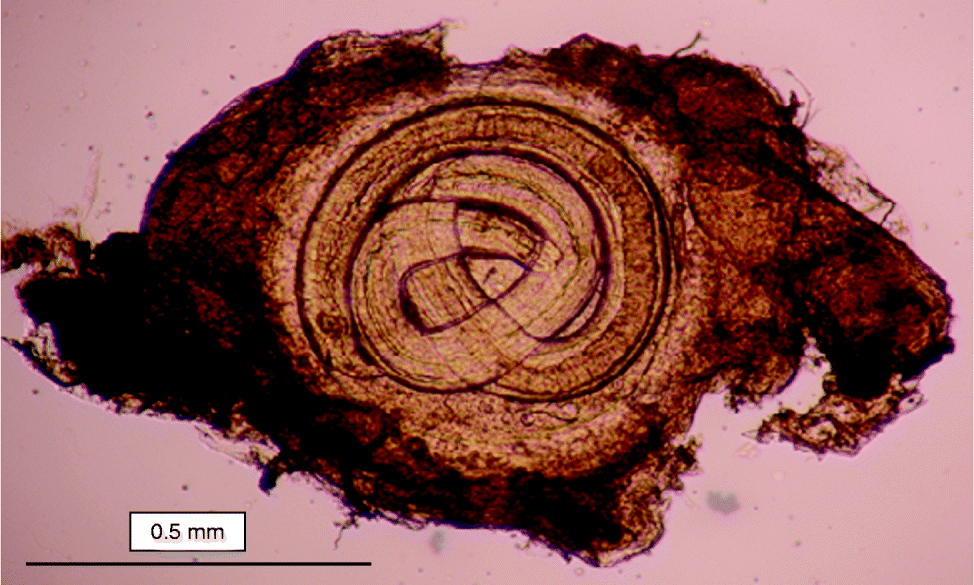
A freshly dissected encysted L3 stage from the haemocoel of an infected beetle is illustrated in fig. 1. The widest dimension across the encysted worm was between 0.55 and 0.6 mm, but together with the surrounding layers, the cysts were extremely variable and could reach as much as 2 mm across, particularly when relaxed in saline after removal from the beetle host. When hatched from the cysts, these stages varied from 1.5 to 2.25 mm, dimensions that concur with published data (1.95 mm in Quentin, Reference Quentin1969). The prevalence of infection in infected batches of beetles varied but was often very high, approaching 90%, with an average of 2.9 cysts per beetle, and although most infected beetles had just one cyst, occasionally beetles with up to eight cysts were encountered.
Infective L3 cyst removed from the haemocoel of an infected Tribolium confusum.

Experiment 1: Survival of beetles
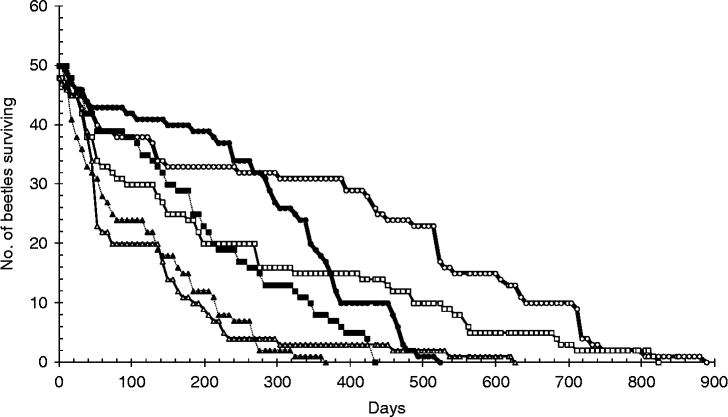
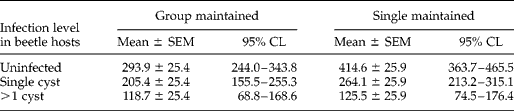
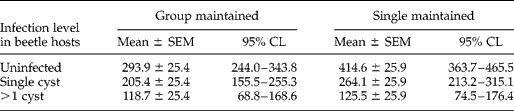
The longevity of each of the six groups in this experiment is illustrated in fig. 2. All groups, whether infected or not, suffered some mortality in the early stages of this experiment (first 50 days or so) and overall group-maintained beetles in all three categories showed higher earlier mortality than comparably infected beetles that were kept in isolation (i.e. single- versus group-maintained beetles, F 1,288= 8.8, P= 0.003). However, very clearly, in each of these two experimental conditions (group- versus single-maintained) the pattern of survival was the same with respect to intensity of infection; namely, best survival among uninfected beetles, intermediate among those with one cyst and least among those with more than one cyst (table 1; for main effect of infection F 2,288= 41.1, P< 0.001, model adjusted R 2= 0.24). There was no interaction between these factors (for two-way interaction F 2,288= 2.48, P= 0.086).
Survival of beetles infected with Protospirura muricola (days after the start of the experiment); beetles kept singly (○, □, △), beetles in groups (●, ■, ▲), uninfected control beetles (○, ●), beetles infected with one nematode cyst (□, ■) and those with more than one cyst (△, ▲).
Mean survival times (days ± SEM) of uninfected beetles and those infected with Protospirura muricola; CL, confidence limits.
Since the beetle cultures were inspected at approximately weekly intervals, it was not always possible to recover encysted nematodes from dead beetles, which in many cases had dried out by the time they were found (never more than 8 days from the previous inspection). Live cysts were frequently found in infected beetles in the early stages of the experiment but among the longest-lived examples also: on day 423 among recently deceased beetles carrying only one cyst in the group-maintained treatment; in four beetles from those carrying one cyst in the singly maintained group (on days 487, 562, 564 and 683); and in two beetles from the multiple-infection singly maintained group, both of which carried two cysts, with live motile worms on days 536 and 620.
Experiment 2: Concealment from ambient light
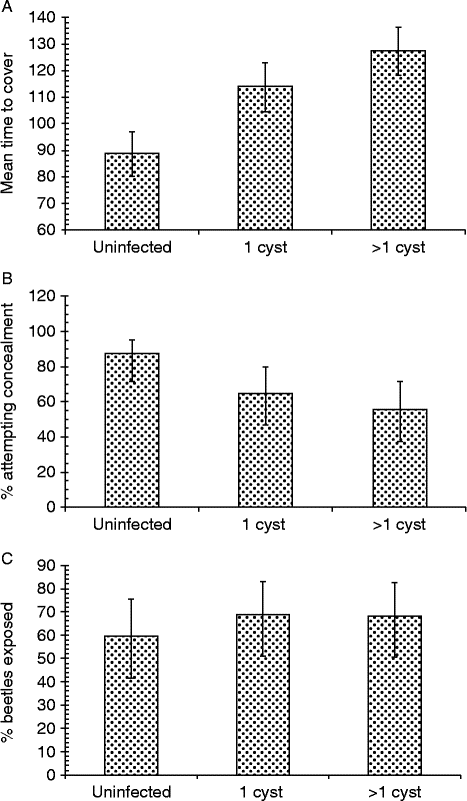
The results of this experiment are shown in fig. 3. We first tested the specific prediction that time to initial concealment should be least among uninfected beetles, intermediate among those carrying one cyst and longest in the case of those with multiple cysts, and this was borne out by the data (Jonckhere–Terpstre test, z= 3.18, P= 0.0007). On average, beetles carrying one cyst took 28.4% longer to conceal themselves and those with multiple cysts 43.7% longer, compared to uninfected beetles (fig. 3A).
The effect of infection with Protospirura muricola on attempts by beetles to conceal themselves: (A) time to initial concealment (s); (B) percentage of beetles making an attempt at concealment during the period of observation; (C) percentage of beetles exposed at the end of the period of observation. The number of beetles in each infection status group was as follows: uninfected n= 47, 1 cyst infection n= 48, >1 cyst infection n= 47 and the error bars in (A) give the SEM while those in (B) and (C) represent the 95% confidence intervals.
Figure 3B shows the percentage of beetles in each infection status that had made at least one attempt at concealment during the period of observation: as can be seen, 87.2% of the uninfected beetles made an attempt at concealment, whereas only 55.3% of those carrying multiple cyst infections had done so. The difference between infection status groups was significant (χ22= 12.87, P= 0.002).
Finally we tested whether there was any difference in the percentage of exposed and unexposed beetles at the end of the period of observation. Figure 3C shows that the mean number of exposed uninfected beetles was lower than for infected beetles, but this was not significant (χ22= 1.08, P= NS).
Experiment 3: Distance covered and speed of movement
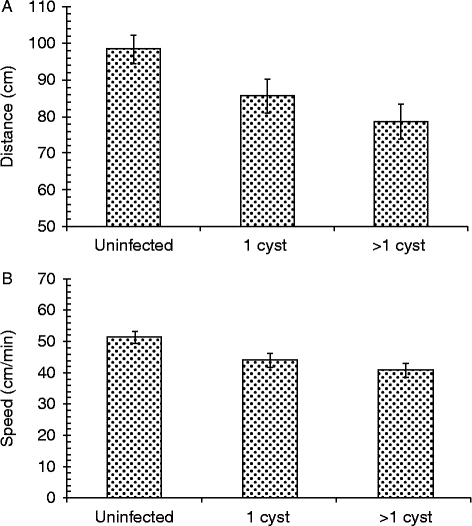
Figure 4A shows that despite considerable variation among beetles, the distance covered by uninfected beetles, during the 120 s of observation, was greater than that of either of the two infected groups, and this difference between groups was significant (F 2,87= 5.0, P= 0.009, R 2= 0.130). Uninfected beetles also had the highest average speed over that period when stationary periods were not included (fig. 4B, based only on periods of actual movement in the 120-s observational period). Beetles with a single-cyst infection moved about more slowly but the slowest of all were those beetles infected with more than one cyst (F 2,87= 6.52, P= 0.002; R 2= 0.130). Post-hoc analysis indicated that there was a significant difference between uninfected beetles and both single- and multiple-cyst beetles (P< 0.05 in each case). There was no significant difference between single- and multiple-cyst beetles (P= 0.55).
The effect of infection with Protospirura muricola on the distance moved and the speed of movement of beetles: (A) distance moved in 120 s; (B) speed of movement, calculated only during actual movement and not including stationary periods. The number of beetles in each infection status group was n= 30 and the error bars are SEMs.
This experiment was repeated using 19 uninfected beetles and 19 infected beetles (not separated into single-cyst and multiple-cyst categories) with a very similar outcome. The mean speed of movement of uninfected beetles was 57.8 ± 2.71 cm/min and of the infected beetles 40.8 ± 2.79 cm/min (19 beetles in each group, t 36= 4.38, P< 0.001). These means correspond very closely to those illustrated in fig.4B, where the mean for uninfected beetles was 51.4 ± 1.9 cm/min (n= 30) and for infected beetles (both infection categories combined) 42.4 ± 1.6 cm/min (n= 60).
Experiment 4: Phototaxis
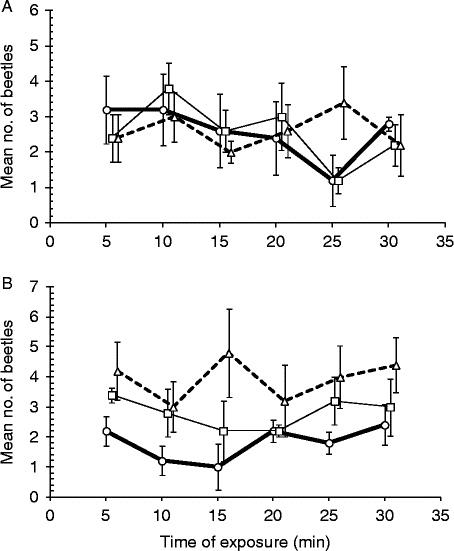
Experiment 4a tested whether infection with P. muricola altered the phototactic behaviour of beetles. Figure 5A shows the mean numbers of beetles observed in the illuminated part of the observation arena after initial placing of the beetles in the middle of this area. As can be seen, on average six or more beetles moved into the dark area within 5 min, and thereafter while numbers fluctuated a little, there was no evident difference between the treatment groups.
The phototactic preferences of uninfected beetles and beetles infected with Protospirura muricola: in (A) all the beetles were placed in the light to begin with and in (B) all the beetles were placed in the dark to begin with. In both, the y-axis shows the number of beetles in the illuminated portion of the experimental arena ( ± SEM) over a period of 30 min after exposure in the experimental arena and each point on the graph represents the average from five trials of ten beetles; uninfected beetles (○), beetles infected with one cyst (□) and those with multiple cysts (△).
Figure 5B illustrates the mean numbers of beetles in the illuminated part of the arena after initial placing of the beetles in the middle of the darkened part of the arena. Again there was no obvious trend of increasing or falling numbers but, on the whole, fewer uninfected beetles appeared to enter the illuminated arena compared to the infected group (rmGLM with infection status as a factor, between-subjects test, F 2,12= 3.69, P= 0.056).
In Experiment 4b, after 14 individual trials, each comprising 18 beetles, the number of infected beetles recorded in the illuminated area of the arena was 81, and uninfected beetles 65. Thus with 126 beetles of each category tested, the uninfected beetles were split almost equally between illuminated and darkened areas of the arena (65 (51.6%) and 61 (48.4%), for illuminated and darkened, respectively), but among the infected ones 64.3% were in the illuminated area and 35.7% in the darkened area. This difference was significant (2 × 2 chi-squared test, χ21= 4.17, P= 0.0412).
Experiment 5. Pre-infective nematode stages and beetle movement
The results of Experiment 5 and comparison to Experiment 3 are summarized in table 2. The infected beetles performed quite differently in the two experiments. In Experiment 3 in which the infections were 39 days old, the infected beetles travelled only 83.5% of the distance covered by uninfected beetles in the test period, whereas in Experiment 5, where the infection was only 18 days old, there was no significant difference between the distance covered by infected and uninfected beetles (t 58= − 1.52, P= NS), although the means show an arithmetically longer distance for the infected group. Analysis by two-way GLM with experiment and infection status as factors, confirmed that this difference between experiments in the behaviour of the infected beetles was highly significant (interaction between experiment and infection status, F 1,146= 9.6, P= 0.002). Much the same effect was seen on speed, with a highly significant interaction between experiment and infection (F 1,146= 11.9, P= 0.001).
Distance travelled over 2 min and the speed of movement (during time spent moving) of beetles with an 18- or 39-day infection with Protospirura muricola.

Discussion
The experiments described in this paper establish convincingly that T. confusum beetles infected with the third-stage infective larvae of P. muricola show altered patterns of behaviour, consistent with the idea that the presence of infective cysts of the nematode would make the beetles more vulnerable to predation. Relative to uninfected beetles, over a measured time period, infected beetles were likely to move over a shorter distance; when moving, their speed of movement was slower; they were more likely to stay in the illuminated area of their environment and more likely to emerge from darkened areas into illuminated areas. The changes in behaviour, as reflected in effects on speed of movement, were only evident among beetles that actually harboured infective cysts and not among those carrying younger infections when the larvae within their haemocoels would still have been at an earlier stage of development and not yet capable of infecting the definitive murine hosts. It is highly likely that changes such as these would have made the beetles more susceptible to predation by the omnivorous rodents, such as the eastern spiny mice in Egypt, although the real test of greater susceptibility can only come from experiments that include exposure of infected and uninfected beetles to predators. However, the fundamental question is whether they represent a specific mechanism of the parasite for enhancing transmission (Klein, Reference Klein2005; Thomas et al., Reference Thomas, Adamo and Moore2005). In other words, do they represent an evolved strategy of the parasite, are they adaptive for P. muricola or are they simply the inevitable consequence of the presence of a relatively large parasite in the body of the insect host and the consequent pathological effects of infection (Poulin, 1995)?
Slow movement, lethargy in terms of the distance covered when movement was possible and the propensity to enter illuminated areas, rather than seek shelter, would probably make the infected beetles more apparent to rodents, and easier to catch. Uninfected beetles were a full 31 s quicker to initial concealment than the averaged time of single-cyst and multiple-cyst beetles together. These results are in accordance with the data of Robb & Reid (Reference Robb and Reid1996) who showed that T. confusum infected with the cysticercoids of the cestode Hymenolepis diminuta were approximately 20 s slower to concealment than uninfected beetles. Interestingly, while infected beetles were significantly less likely to make a concealment attempt from ambient light, in comparison to uninfected beetles, by the end of the allocated 3 min of observation there was no difference between the treatment groups (fig. 3C). One possible explanation is based on a combination of activity levels and speed of movement. Uninfected beetles appear to be more active and unless they become quiescent once they find shelter from light, they are unlikely to stay hidden for very long in the type of experimental arena used for this experiment. Therefore these findings can be interpreted as supportive of the BMH because increased exposure time, conspicuous behaviour or impaired concealment behaviour are all likely to make beetles easier prey targets for the definitive host (Lafferty, Reference Lafferty1992; Moore, Reference Moore2002).
However, there is an acute need for caution before extrapolating further. The tapeworm H. diminuta has also been reported to cause delayed attempts at concealment of infected beetles (Hurd & Fogo, Reference Hurd and Fogo1991), but when the vulnerability of infected and uninfected beetles to predation by rats was tested in an experimental arena in the dark, under semi-natural conditions, there was no significant difference in the numbers of each category consumed (Webster et al., Reference Webster, Gowtage-Sequeira, Berdoy and Hurd2000). The salient point is that rodents typically show crepuscular and nocturnal peaks of activity, and any tendency by the beetles to emerge from shelter in the light would have little significance under dark conditions at night-time in the field, other than on intensely moon-lit nights. Acomys dimidiatus, the natural host of the isolate of P. muricola used in the present work, is almost entirely crepuscular and nocturnal when occurring sympatrically with the more daytime-active A. russatus, as in the Sinai (Jones & Dayan, Reference Jones and Dayan2000). The results of Webster et al. (Reference Webster, Gowtage-Sequeira, Berdoy and Hurd2000) have an important message, therefore, one of caution in extrapolating from the artificial arenas of laboratory-based experiments to the actual realistic situation in the field.
Crucially, our data showed that infection with P. muricola only affected Tribolium after the cysts had reached the L3 stage and had become infective to definitive hosts (table 2). We found that there was no difference in speed between infected and uninfected beetles 18 days post-infection at a time when the larvae are still at the L2 stage, and hence not yet infective to rodents, but a highly significant difference 39 days post-infection, after the moult to the infective L3 stage. Similar observations have been made previously on other host–parasite systems (Hurd & Fogo, Reference Hurd and Fogo1991; Poulin et al., Reference Poulin, Curtis and Rau1992; Robb & Reid, Reference Robb and Reid1996; Seppala et al., Reference Seppälä, Karvonene and Valtonen2005). While this finding can be viewed as further support for the BMH, there is a counter argument: it is possible that the developing L1 and L2 are not yet large enough to deliver comparable pathology to that which may be induced by the larger L3 stages in their cysts. It is important to note, however, that apart from the cellular surroundings evident around the encysted larvae (see fig. 1), there are no detailed studies of pathological changes in beetles that can be cited in support.
Our longevity data show convincingly that there is a dose-related negative effect on survivorship. Tribolium confusum are known to be very long-lived beetles (Pearl et al., Reference Pearl, Park and Miner1941; Soliman & Lints, Reference Soliman and Lints1975), and although deaths were recorded in all groups from the outset, the infected beetles died sooner in larger numbers than the control group under both group-maintained and isolated conditions. Interestingly, beetles maintained singly rather than in groups lived significantly longer, as expected (Sohal & Buchan, Reference Sohal and Buchan1981), but nevertheless the effect of parasitism on longevity was evident under both experimental conditions, albeit over a different time scale. In both cases, the longevity of beetles designated as carrying more than one cyst was shorter than among those with just one cyst, and both were markedly reduced relative to uninfected controls; this may suggest a relationship between parasite burden and longevity. However, we are cautious of this interpretation for two reasons. First, the allocation of beetles into single- and multiple-cyst groups is not foolproof and actually technically quite difficult. Some of the beetles classified as ‘single-cyst beetles’ in fact harboured several cysts on dissection, but overall there was a consistent difference in the required direction in worm burdens between the single-cyst and multiple-cyst treatment groups. Second, for logistic reasons it was not possible to include replicates of each treatment as ideally required. Nevertheless, as can be seen for fig. 2, some infected beetles survived for over 700 days, and although cysts could not always be recovered from infected beetles (mostly because the beetles had dried up by the time they were inspected, since inspections were at weekly intervals), live cysts were in fact recorded 683 days after infection in one beetle, so the nematodes are also long-lived at this stage in their life cycles.
The survivorship results therefore suggest a detrimental effect of infection on the longevity of beetles. Likewise, the significant reduction in speed of infected individuals may have also a pathological explanation. In relation to T. confusum, P. muricola is a large parasite and, with an average of 2.9 cysts in infected individuals, would have occupied significant space in the haemocoel. Parasite size and burden are likely to interfere with the digestive ability of beetles and to compete for energy resources (Voge & Heyneman, Reference Voge and Heyneman1957; Roy et al., Reference Roy, Steinkraus, Eilenberg, Hajek and Pell2006). Alternatively, the cost to the host of producing an immune response against infection may be a significant limiting factor on resource utilization, including movement and behaviour (Read & Allen, Reference Read and Allen2000; Rigby et al., Reference Rigby, Hechinger and Stevens2002). Several other pathological explanations have been proposed to account for a reduction in speed of intermediate hosts in other host–parasite combinations (Poulin, Reference Poulin1995). It is possible that the increased weight of cysts may slow or unbalance the host. Barber et al. (Reference Barber, Hoare and Krause2000), for example, showed that heavy infection in fish with the plerocercoid stages of cestodes distended the abdomen, affected streamlining and reduced swimming speed. Rau & Putter (Reference Rau and Putter1984) showed that T. spiralis, which encysted in muscle fibres of mice, reduced the running speed of their host. Protospirura muricola is restricted to the haemocoel but may interfere with other internal functions, e.g. neuronal functioning, similar to that discussed by Libersat & Moore (Reference Libersat and Moore2000).
It may also be relevant that T. confusum are laboratory hosts and the true intermediate hosts of P. muricola in Egypt are currently unknown. It is, however, most likely that the natural intermediate host is an arthropod, as pointed out earlier (e.g. a species of cockroach or scarabeid beetle; Quentin, Reference Quentin1969; Campos & Vargas, Reference Campos and Vargas1977). The fact that T. confusum is not a natural host warrants further caution before using our results as evidence in support of the BMH. Given that the life cycle of P. muricola is maintained artificially at the University of Nottingham in the absence of selection pressures from predatory definitive hosts, it is unlikely that adaptive strategies for enhancing transmission of P. muricola to the definitive host have evolved in this environment in the 13 years over which the parasite has been passaged prior to this experiment. However, if the true intermediate hosts in Egypt are closely related to T. confusum, and show the same effects of parasitism on their behaviour, then the mechanism, whether based on adaptive strategy or pathology, may be common. A very recent paper by Mukaratirwa et al. (Reference Mukaratirwa, Pillay and Munsammy2010) showed that the spirurid nematode Spirocerca lupi lacked tight host specificity and was able to infect five different arthropod species of the family Scarabaeidae. It appears likely also that P. muricola lacks narrow intermediate host specificity (Quentin, Reference Quentin1969; Campos & Vargas, Reference Campos and Vargas1977) and thus it is plausible that different arthropod hosts are affected similarly. For this reason, we believe that further studies on the exact causes of the alterations in the behaviour of infected T. confusum are justified, but ultimately the key to unlocking the true nature of how P. muricola affects its intermediate hosts and whether it manipulates them adaptively, lies with its actual intermediate host in Egypt's Sinai region. It may also be relevant that our strain of P. muricola was isolated from the eggs of a single female worm, and having been passaged for 13 years, its genetic diversity is likely to be very limited, as indeed is the case with most laboratory-passaged helminth model systems.
Host–parasite relationships are complex and, as stressed by some authors (Poulin, Reference Poulin2000; Klein, Reference Klein2005; Nickol, Reference Nickol2005), the phrase ‘adaptive manipulation’ has been too easily applied where, at best, evidence is circumstantial. However, beneficial behavioural changes that originated as by-products of infection may have been recruited by parasites and, through evolutionary selection pressures, now play an important role in altering host behaviour to favour parasite transmission and, in this respect, can be considered to be specific adaptive manipulations of host behaviour (Poulin, Reference Poulin1994a; Vyas & Sapolsky, Reference Vyas and Sapolsky2010). Recent attention in this field has turned to multidimensional phenomena associated with the BMH, and the relative importance, as well as sequence, of changes in altered host traits over evolutionary time when hosts experience more than one phenotypic change as a result of parasitism (Poulin, Reference Poulin2010; Thomas et al., Reference Thomas, Poulin and Brodeur2010). However, in the current system it is still premature to separate and grade the changes in host behaviour that we have demonstrated, since they may all reflect the consequences of a single process. On this contentious note, we adopt a cautionary stance and conclude that, in the circumstances, an explanation based on parasite-induced pathology for the effects of P. muricola on T. confusum is most parsimonious and consistent with our experimental findings. It is not easy to distinguish unambiguously between incidentally induced pathology and specifically evolved adaptive strategies purely on the basis of behaviour in this instance (Klein, Reference Klein2005; Thomas et al., Reference Thomas, Adamo and Moore2005). The adaptive value of the mechanism, whether through pathology or through a specifically evolved strategy, resides in whether it actually enhances transmission strategy and thereby benefits the parasite, and the ultimate test of this can only come from experiments such as those reported by Webster et al. (Reference Webster, Gowtage-Sequeira, Berdoy and Hurd2000), in which the relevant infected intermediate hosts were exposed to predation by appropriate definitive hosts.
Acknowledgements
We thank Ann Lowe for maintenance of the parasite's life cycle, and for assistance and advice in setting up the laboratory experiments, Dr Joseph Jackson for advice and Sian Griffiths for the photograph in fig. 1.
Financial support
The project was funded by the University of Nottingham through the teaching budget to the School of Biology
Conflict of interest
None.
Ethical standards
The authors assert that all procedures contributing to this work comply with the ethical standards of the national guides on the care and use of laboratory animals in the UK (The Animals (Scientific Procedures) Act 1986) and were locally approved by the Animal Welfare and Ethical Review Body of the University of Nottingham. Importantly all work is conducted within a recognized culture of care and compliance to meet the expectations of both the University and the UK Home Office Inspectorate.