The Consilium de emendanda Ecclesia, read to Paul III on March 9, 1537, identified the ordination of unsatisfactory priests as the primary cause of the ills of the Church.Footnote 2 The Council of Trent took up this suggestion almost thirty years later when it set a new model of the priesthood.Footnote 3 The priest trained in a seminary was to be a man apart, clearly detached from, as well as superior to, lay society. Such a task, the formation of “a newly self-conscious clerical caste in society,”Footnote 4 which the Counter Reformation set for itself, is believed to have broken the mold of the medieval clergy. To quote Louis Pérouas,
Despite his several natural ties with the people the priest became more and more conscious of being different from them. This psychology nourished itself on the notion of the eminent dignity of the priesthood. … Leaving deliberately aside the laity's way of life, the parish clergy shut themselves up within the domain of the sacred.Footnote 5
In his seminal book published in 1971, Jean Delumeau, who was highly praised by John Bossy, asserted that this vision of the Catholic Church was accomplished by the end of the seventeenth century.Footnote 6 While this claim has been generally accepted, Professor Po-Chia Hsia warns us, in an equally influential book, to remind ourselves that clerical discipline was imposed unevenly and with difficulty.Footnote 7 Professor Adriano Prosperi agrees with this thesis: to speak of an ignorant, unprepared, and immoral clergy who became exemplary almost overnight is unreal.Footnote 8 Did not the curate of Malgrate, a parish in sixteenth-century Milan, find it difficult “to realize what his function in a newly oiled hierarchical system was”?Footnote 9 Agostino Borromeo further explains that the decrees of Trent produced tangible results and promoted evident religious renewal, but the process was slow, laborious, and non-uniform.Footnote 10 Kathleen M. Comerford came to the same conclusion about Florence, Lucca, and Arezzo, where the bishops were unable to enforce the Tridentine mandates.Footnote 11 Speaking of the French clergy in the diocese of Nîmes in the seventeenth century, Robert Sauzet claims that if, by that time, the intellectual and moral level of the clergy had been assuredly improved, it was rather uneven.Footnote 12 Similarly, Rona Johnston says for Lower Austria that the implementation of the reform decrees of the council of Trent was neither a speedy achievement nor a straightforward task.Footnote 13
This piece supports the latter view that the Tridentine ideal was usually well beyond full-scale implementation in Malta. Four themes inform my analysis: attire, manual work, sexual irregularities, and violence. But the article especially analyzes the social and historical factors that account for the remarkably slow formation of a clerical elite in Malta. Their extremely slim prospects for advancement, their excessive number—with its concomitant dangers of lack of vocation and discipline—and their rudimentary education were some of the material and practical aspects of cultural life in Malta that retarded religious reform.
In 1574 Pope Gregory XIII sent Monsignor Pietro Dusina as apostolic delegate to Malta to see that the decrees of the council were being put into effect.Footnote 14 In 1582 he proposed to Grand Master Verdale the opening of a Jesuit college “for the reform of that city”Footnote 15 but which was also to serve as a seminary. Moreover, the development of pastoral visitations, synods, spiritual exercises, ecclesiastical conferences, retreats, and pastoral letters suggests that the Counter-Reformation Church in Malta was attempting to improve the cohesion and discipline of the diocesan corps and impose the marks of a profession on the clergy.Footnote 16
Yet, with all this urgency, it will be argued that non-committed priests, whose duties did not include the care of souls, still remained involved in daily affairs, undistinguished from the rest of the people among whom they lived. If by professionalization of the clergy is meant “the formation of a compact, well-trained, socially distinctive and culturally cohesive body of ‘pastoral workers,’ endowed with a professional ethos and collaborating within an efficient hierarchy towards the creation of a new Catholic identity,”Footnote 17 then Maltese priests were far from being so. The evidence is taken mainly from the diocesan tribunals, which offer rare windows into clerical behavior. Our prime source of the discussion is the episcopal court, but other evidence comes from the corte provicariale of Mdina as well as the tribunal of the Roman Inquisition.Footnote 18
I. Attire and Manual Work
In public the clergy were to put on the cassock so that “by the propriety of their outward apparel they may show forth the inward uprightness of their morals.”Footnote 19 A special clerical dress suggested superiority or at least difference in kind from laymen. This separateness of clergy from the rest of society was, of course, an ideal recommendation of the conciliar fathers, a counsel of perfection. The story is well known that when in 1623 Louis XIII met a priest in clerical garb and with short hair he mistook him for a monk of a new religious order.Footnote 20 This was the situation in France, but Trent's directives were only partially observed in Malta more than a century later. In 1783 Bishop Labini still felt the need to threaten with “suspension a divinis those members of the clergy who appeared in public without collar, shoes, and cassock.”Footnote 21
Generally, priests discarded the soutane when they undertook manual work. This is exemplified by a 1785 Cospicua case against Don Giuseppe Zammit, who built his own house. Witnesses testified that they saw him with his sleeves rolled up loading stones onto a cart and leveling the road with a hoe.Footnote 22 Most priests, though, were reported to the ecclesiastical court when, as one deponent put it,Footnote 23 they “disguised” themselves in peasant fashion. They wore a cap, a shirt, a waistcoat and trousers. They went barefoot or else wore peasant shoes (qorq).Footnote 24
Most clergymen, in fact, were priests-cum-peasants. They purchased,Footnote 25 inherited, or rentedFootnote 26 land to farm, but often these agricultural holdings formed part of their sacred patrimony or title. In other words, as in nineteenth-century Lecce (Italy), the bond between the clergy and the land was fundamental.Footnote 27 What type of activities did these “peasant-priests” pursue, and on what scale? Most practiced mixed farming. Apart from arable land producing mainly cotton, wheat, and barley, they were also engaged in animal husbandry and owned cows,Footnote 28 sheep, horses, donkeys, and pigs.Footnote 29
A few priests, like Don Arcangelo Cumbo of Tarxien,Footnote 30 managed their own economic affairs and farmed the land themselves. They prepared the ground for the cotton seed, mowed and threshed the grain, and helped with the tying of the sheaves.Footnote 31 They transported seaweed to their fields, perhaps like Don Giuseppe Frendo of Naxxar, on a female donkey.Footnote 32 This must have consumed a considerable part of their time and interfered so with their priestly ministry that in 1783 Don Salvatore Farrugia of Qrendi was reported to the bishop for not serving in church.Footnote 33 Often, therefore, priests employed castaldi. These stewards slept in their masters' own houses and did all the necessary agricultural work, “with all punctuality and attention as it needs an obedient, humble and diligent disciple.”Footnote 34
Priests could also employ day laborers to take the sheep to graze, pick cotton, look after the animals, take the fruit to market, plough the land, and glean the ears of corn.Footnote 35 In this way they became dependent on the ability of the workers to carry out their work. The same difficulty arose when priests leased out the land to one of their parishioners to farm it for them because these lessees could not always meet their commitment.Footnote 36 Similar problems were faced in 1759 by Don Michel'Angelo Ellul with the métayer Michel'Angelo Grech, who refused to share the produce with him.Footnote 37 Other priests sued their antagonists in court for trespassing or theft, or for having their fields damaged by their neighbors' hens.Footnote 38
In return, clergy were prosecuted for planting trees too close to cotton fields, because the roots “sucked their humidity.”Footnote 39 Prosecution for debt was more frequent than prosecution for planting practices.Footnote 40 In such instances priests had their animals or fields auctioned to pay their creditors.Footnote 41 Occasionally, the courts heard cases involving fraudulent sale of animals. By way of example, in 1770 Don Pietro was made to take back within two days the she-ass he had sold to Alessandro Zammit; it was lame, besides having other defects “in other parts of the body, as several witnesses testified.”Footnote 42 Sometimes a picture of clergy doing business in a shrewd and resolute manner is exhibited. When he came to know that cotton was selling at 5 scudi a rotolo, Don Giuseppe Zerafa demanded 8 tarì more from Giovanni Maria Galea and refused to honor the agreement they had made earlier.Footnote 43
This striking series of examples of priests' involvement in agricultural interests suggests that, in economic and social terms, firm distinctions between clergy and laity were rarely drawn. Priests were firmly integrated into the cycles of the agrarian economy, which put them on a par with many parishioners, engaging in agriculture like several of them. Some of the rural clergy, that is, were very much part of the village community in that they were farmers. But this was not the only way in which priests were practically indistinguishable from the peasants farming the adjacent land. They were not dissimilar, for instance, when it came to seeking the sexual favors of women.
II. Sexual Irregularities
“Fornication of ministers of the sacred altar” had been a focus of church reform since Gregory VII in the eleventh century.Footnote 44 The most cogent argument brought forward by the adherents of a celibate clergy was that it symbolized the unique and superior status of the consecrated person of a priest. By the sixteenth century, however, “clerical marriage” had become prevalent again, which impelled the Council of Trent to make a forceful drive against clerical incontinence. In its twenty-third session it decreed that those “called to have the Lord for their portion, ought by all means so to regulate their life and conduct that their actions may inspire reverence.” How could the clergy correct the laity, the Fathers asked, “when they must answer silently to themselves that they have committed the same things that they censure?”Footnote 45
Despite these admonitions, in the bishopric of Speyer more than half of the priests investigated in the 1580s lived with concubines.Footnote 46 In France, “the curès who had fathered children used their sons to serve mass … , and taught them the rudiments of reading, writing and Latin, hoping to be able to hand over their benefice or vicariate in due course.”Footnote 47 Malta also had its share of concubinary clergy.Footnote 48 In the immediate aftermath of the council, the apostolic delegate Monsignor Dusina identified the incumbent of St. Helen's (B'Kara), Don Giuseppe Bellia, who kept a concubine at his own parish and another at St. Lawrence's (Vittoriosa).Footnote 49
By the eighteenth century, the effort to create a morally upright clergy had been under way for a long time, although with limited success. In 1703 Bishop Cocco Palmieri still found it necessary in one of his synod's decrees de vita et honestate to caution priests to eschew private meetings with members of the opposite sex and ordered the officials of the ecclesiastical court to take special pain to ferret out offenders.Footnote 50 Such moral deviants were “presented” to the bishop during visitations. Don Celestino Borg of St. Lawrence's, who in 1796 was confined in prison for his relations with Aloisia Grech, was a case in point.Footnote 51
However, morality cases were overwhelmingly “office” cases initiated by the ecclesiastical judge. Generally, he was informed of suspicious behavior by court officials like the captain and the alarii or apparitors.Footnote 52 Such vigilance is glimpsed in a case in 1757. Rocco Falconi, the capitano of the episcopal court, reported on August 1:
My Lords, it came to my notice that Don Valerio Borg of città Burmola has been having scandalous relations with one Fortunata of the same city for many years, sleeping with her in his own house. Last Saturday, 30 July, toward seven in the evening I went to Burmola… . Having found the door of the priest's house open I went inside. He was shaving while Fortunata held up a candle in her hand to make light for him. I called as witnesses Giuseppe Fenech and the cleric in minor orders Giovanni Andrea Zahra, both of Burmula. Then I ordered the priest under pain of 50 onze to present himself before the Revd. capitular vicar in the bishop's palace at Valletta this morning. Therefore, in fulfillment of my duty, I inform you of this fact so that Your Lords take the necessary steps.Footnote 53
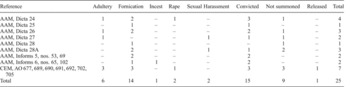
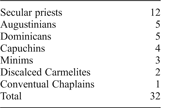
People often engaged in ribald gossip about the sexual misdeeds of lecherous priests, but the number of clergy detected to the church courts for sexual crimes between 1750 and 1798 amounted to a mere handful, 25 in all (Table 1).Footnote 54 Some words of caution are needed here regarding these numbers before going on with our analysis. First, they refer only to actual physical sexuality and not to instances of sollecitazione ad turpia, or the tempting of penitents during confession for dishonest ends.Footnote 55 In the period 1743–1798 these amounted to thirty-two cases and were decided by the tribunal of the inquisition and not by the episcopal court (Table 2).Footnote 56 The man who best illustrates such a “bear who attacks travelers who have lost their way” is Don Baldassare Marchesan, the organist of the parish church of Senglea. This jovial, short, pale, curly-haired priest with an aquiline nose was held by most to be a flirt and in love with 35-year-old Elisabetta Durante. He told her during confession in 1755, “I have spent all this night with you … I dreamed that you came to me and stayed on your knees by my bed. Then you went to sleep and then … ”Footnote 57
Sexual charges against priests before the Ecclesiastical Court, 1750–1798

Confessors accused of solicitation, 1743–1798
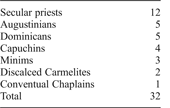
SOURCE: Frans Ciappara, Society and the Inquisition, 151.
Secondly, can we take these statistics to be representative, or do such figures underestimate the incidence of sinful priests, in which case our quantification becomes worthless? It has been argued for other countries, for instance Italy, Spain, and Catholic Germany, that parishioners connived at priests' immorality as long as this did not interfere with their priestly office.Footnote 58 This could not be said for Malta, where, as in late medieval Lincoln,Footnote 59 it seems that clerical sexuality did conflict with the parish's sexual norms and the faithful were greatly concerned with the lives of their ministers. This begs the remark that a new-style clergy eventually emerged not only on the initiative of the bishop but also of the people. Parishioners had a particularly strong interest in correcting priests' sexual immorality because a bad minister was a threat to the whole community. Concern for the safety of wives and daughters was only one cause of the hostility toward unchaste clergy. People were preoccupied with their priests' sexuality mainly because it was commonly believed that sacraments administered by a wicked minister were invalid. This belief was theologically unsound, but it was held by some of the clergy themselves. In 1672 Don Giuseppe Calleja, the parish clerk of Zabbar, was reported to the Holy Office for having allegedly told his congregation that they were not to hear the Mass of a priest in mortal sin.Footnote 60 Instead, Rosolea Mifsud was catechized by Inquisitor Gallarati Scotti in 1785 that sacraments conferred grace ex opere operato, irrespective of the qualities or the merits of the persons administering them.Footnote 61
Thirdly, how reliable were these charges? Could not these indictments have been maliciously motivated, concocted by disgruntled parishioners in order to discredit a clergyman? These are pertinent questions because in nine cases the defendant was not even summoned while one case was dismissed because the charge could not be sustained. It concerned Don Andrea Camilleri tal vaiuu of Tarxien. In 1767 a widow brought suit against him for having fathered a child by her. But he succeeded in proving that she was a prostitute and that the child she bore on the feast of S. Andrea was a result of her commerce with one Antonio of casal Zebbug. Besides, the witnesses whom she produced were “vile and infamous.” The charges against him, so he claimed, were brought deliberately in order to make him maintain her child.Footnote 62 That accusations of sexual impropriety should be treated with caution is also demonstrated by the case of Don Aloiso Camilleri of Naxxar. In 1793 his nephew accused him of entertaining a lewd woman in his house, but he had ulterior motives connected with an inheritance for wishing to discredit her: the priest's mother had left her a house for tending her during her illness for almost a year right up to her death.Footnote 63
Other charges, though, resulted in prosecutions, and in fifteen instances (60 percent) the accused were convicted. Such cases implied that the pitiless urge of carnal desire could not be contained within the pattern of lifelong clerical chastity. Continence must have been, as Christopher Black has said in a passage full of warmth and understanding, “an ideal that took … little account of natural worldly instincts and temptations.”Footnote 64 The case of Don Andrea Borg of Hasseiet from St. Helen's serves to illustrate this point. In 1789 he contemplated going to Turkey to apostatize to Islam and there “take as many wives as my strength allowed me.” He did not execute his wish, however, or so he confided to Inquisitor Gallarati Scotti, only because he found no way of escaping from Malta, “despite all the attempts I made.”Footnote 65 In further confirmation of this irresistible libidinous urge, Don Michele Micallef of the parish of the annunciation (Balzan) claimed in 1749 that the Church “allows its priests to give vent to their passions and know carnally a woman once a month.”Footnote 66
Immorality cases against priests handled by the ecclesiastical court were invariably restricted to what Thomas Aquinas refers to as “natural lust”: adultery (six cases) and fornication (fourteen cases). Plausibly there were relatively few cases of the latter because sexual intercourse between an unmarried man and an unmarried woman was considered a less serious crime than adultery. Illicit intercourse with a married woman is an act that hurts a third party; and besides the sexual crime involved, the offender commits the added injustice of taking over the rights of another man.
Included in Table 1 are two rape charges and one single case of a priest convicted of incest. It concerned Don Pantaleone Dalli from the parish of the assumption (Gudja). His brother, Giuseppe, had married one Maria on October 6, 1793.Footnote 67 She gave birth to a child five months later on February 26, 1794,Footnote 68 but it started being rumored in the village that the priest was its father. Maria's husband protested that it was not his child, so he refused to be present at church at its christening and, on the excuse that his wife was unwell, gave the child to the foundlings' hospital. Don Pantaleone was incarcerated in the bishop's prisons at Vittoriosa, but after a month, on April 4, 1794, “I asked the prosecutor in so important a matter to conduct me to this tribunal to make the present spontaneous confirmation”:
I declare that I raped her (Maria) twice last May, that is, five months before marriage. It was the result of blind passion when as a neighbor she came almost daily to our house to help us with the chores.Footnote 69
This example sheds light on the fact that servants engaged in domestic work or farm labor were especially easy prey for lascivious priests. Trent had prohibited “all clerics whatsoever to presume to keep concubines or other women concerning whom suspicion can be had in their house or elsewhere, or to presume to have any association with them.”Footnote 70 The Maltese synod of 1703 further laid down that these women or perpetue Footnote 71—to refer to them by the name of Don Abbondio's in Alessandro Manzoni's The Betrothed Footnote 72—should be over fifty years of age and of good morals. Nor could priests employ them before having permission in writing by the bishop or the vicar general.Footnote 73
All the same, women repeatedly charged priests with attempts on their virtue.Footnote 74 The fact that most of them were widows was itself a source of suspicion: they were subject to the control of neither father nor husband. Anna, of St. Bartholomew's, for instance, started frequenting Don Giovanni Bezzina as soon as her husband died in 1767.Footnote 75 Separated women were in like position. Liberata, from the parish of the assumption (Mqabba), was abandoned by her husband just a few days after marriage, “not having found her a virgin, as the common fame goes.” She left her village and went to Valletta where in 1783 she moved in with Don Bartolomeo Zarb of Zebbug. Her mother was very happy that “the priest provides her with everything for the house.”Footnote 76
As this last example shows, underlying these cases was a great deal of human misery. Their poverty made these women especially vulnerable. Take the 1796 case of Maria from the village of Balzan. All the villagers knew that her mother constrained her to lend her sexual favors to Don Salvatore Sammut and threatened to beat her if she declined.Footnote 77 The priest, so the case implies, must have been maintaining the girl's family in return. Other instances indicate that a priest was bringing up his own offspring. Was this not the reason perhaps why Don Bernardo Ellul of Qrendi organized a wedding party for Grazia's son when the lad got married in 1778?Footnote 78 A case of 1765 from the town of Rabat in Gozo provides further proof. Grazia and her family lived in the same house with Don Nicola Zammit and when, on orders from the bishop, they were evicted, the priest bought another house for them behind the church of S. Francesco. However, a son of hers, Giuseppe, stayed with the priest, who paid for his schooling. Were the people to blame when their suspicions were aroused and called the boy the priest's bastard?Footnote 79
III. Violence
Priests lived in close proximity with the laity because they still resided with their families in the areas where they had grown up. They were local figures since in Malta, unlike France, the clergy did not migrate to other parishes.Footnote 80 This familiarity meant that the people accepted the local priest without any difficulty. But it also meant that the priest could more readily have been caught up in local disputes, resentment and enmity sometimes boiling over into intense antagonism.
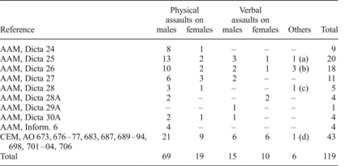
This observation leads to the fourth topic of our analysis since violence further lessened the distance between priest and people. It was the most notorious aspect of a secularized priestly way of life, or as one French author put it, “un style de vie communément vulgaire.”Footnote 81 The evidence from the ecclesiastical court is astounding and, as Jean-François Soulet has observed for the central PyreneesFootnote 82 and H. Roure for the southeast of France in the seventeenth century,Footnote 83 it provided the most serious indictment of the quality of the Maltese clergy in the late eighteenth century. The situation should not be compared, though, to that in southern Italy where, according to Bishop Zuccari, in 1771 several priests guilty of homicide took refuge in the mountains.Footnote 84 Even so, for the years 1750 through 1798, the laity brought 119 suits in the ecclesiastical court for such incidents (Table 3).
Violence by the clergy, 1750–1798

(a) placing horns on the roof of one's house
(b) shooting at a dog and at pigeons, attempt to poison parish priest
(c) spoiling door with excrement
(d) shooting at pigeons
A striking feature of these denunciations is the paucity of verbal assaults. Only 25 instances, or 20.8 percent of the total, are recorded and, besides, if suits were abusive and insulting, they were not all strictly defamatory. A case from Floriana provides illustration of this point. In October 1780, toward two in the afternoon, Clara the wife of Filippo Xerri was watching Don Giusto Mangani quarrelling with two porters near her house. Suddenly he started beating his buttocks with his hands while telling Clara, “Come and kiss my … ”Footnote 85
As is evident from this case, most of the deprecations were uttered in passion or anger without any real intention of harming a person's repute. Thus, in another case of 1790, Don Giuseppe Tonna of Rabat (Gozo) shouted abuse at Grazia from his balcony across the open street after she returned a perforated kettle he had lent her.Footnote 86 Other slanders, though, did not concern trivial exchanges of wordsFootnote 87 but were designed to hurt. In 1777, two priests from Gudja threatened Giuseppe Hellul with exile from Malta or else to “bring my days to an end beneath the earth.”Footnote 88 And Don Lazzaro Azzopardi of St. Catherine's (Zejtun) assaulted Rosa Aquilina where it hurt most, her reputation. In an attempt to frustrate her betrothal to his nephew, he boasted that he had laid her himself. “Do you want to marry that whore and fill our house with dung? You thief!” he fulminated against him in 1779.Footnote 89
Regrettably, there is no sequel to this latter incident, but often these bouts of defamation, or what Peter Burke calls “the ritualized sequence of words and gestures,”Footnote 90 were only the prelude to fighting. A typical case was that of Don Francesco Scerri of Rabat. When in 1777 he fell out with Lorenzo Bugeja, he first called him a cuckold and a thief and then attacked him “like a tiger.”Footnote 91 In other words, abusive language and violent behavior were intimately related. Shouting and threats were generally accompanied by punches, but an instrument could also be used, like a whip, a hammer, a hoe and, rarely, a knife.Footnote 92
Turning now to the context in which these squabbles occurred, which were the circumstances that made priests forget their priestly calling and made them no different from the people? Fortunately, there is enough material for a close study. It could be a frivolous matter over precedence. Claiming that his confraternity of the Holy Sacrament was the oldest in the village, Don Alberto Abela of Zejtun in 1755 did not let the confratelli of the Holy Rosary stay on the highest step of the presbytery. He pushed one of them to the ground and smashed to pieces the candle that another brother held in his hand.Footnote 93 One more incident worth citing because of its detail concerned Alberto Cassar, who was attacked for having in 1755 pelted a priest's dog with a stone:
Last Saturday toward four in the afternoon while I was passing in front of the shop of Lorenzo Rapa at the village of Caccia an angry dog came out of the shop. It tried to bite me but I threw a stone at it and hit it in the leg. There at once appeared Don Agostino Buhagiar, who started hitting me on my neck. And he would have beaten me more if Giuseppe Mizzi had not interceded.Footnote 94
Unlike the case in England,Footnote 95 instances of drunkenness that led to physical assault were particularly rare among the Maltese clergy. One such unusual case concerned Don Giuseppe Grima of St. Lawrence's. In 1776 he punched one Michele so soundly on the face and chest that he forced him to escape into his neighbor's field and hide under a tree of prickly pears.Footnote 96
Apart from such examples, as has been observed above, these priests-cum-peasants were generally embroiled in disputes with people over matters related to agriculture. One such incident resulted in homicide. On Saturday, July 27, 1765, Martino Vassallo, a 17-year-old lad, together with other workers, was on his way from Zabbar to his native village of Siggiewi. At tal Handach he climbed over a wall to pick two figs from the field of Don Lorenzo Pace tal furnara (the baker's son). The priest pelted him with a stone and hit him in the belly. The boy fell to the ground so that he had to be helped to reach home by his fellow workers. The next day, Sunday, he felt so ill that his father took him to the hospital, where he died on Tuesday at 10 p.m. The priest was arrested but the victim's father forgave him.Footnote 97
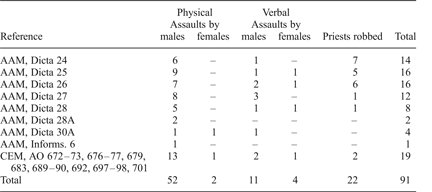
Was this the usual way people responded to clerical violence? The best way to answer this query is to analyze the number of suits brought by clergy against the laity. In the period 1750–1798 these amounted to 91, but only seven of them ended in conviction (see Table 4). The rest of the suits may have been settled outside the court while in other cases it was impossible to establish the exact facts owing to conflicting evidence. These cases require some clarification. According to the canon Si quis suadente of 1139, a sentence of excommunication could be passed on any who laid violent hands on the clergy.Footnote 98 This penalty, unlike the case in seventeenth-century England,Footnote 99 should have terrified the people because it was commonly believed that neither the parish priest nor the bishop, the pope, God, or the Holy Trinity could absolve it.Footnote 100 Even if this was a wrong theological tenet, excommunication did mean exclusion from the Church and the solace of the sacraments. Besides these spiritual effects, excommunication also involved social exclusion or ostracism, segregation from the faithful in Christ.Footnote 101 According to one author, this was “symbolic of the fact that the Church was supposed to be coterminous with the whole of society.”Footnote 102 The “cursed” one was to be avoided by the rest of the Christian community until he had purged himself. He could not be greeted in the street, and all normal conversation with him was forbidden because whoever came into contact with him was touched by his pollution.
Violence against the Clergy, 1750–1798

In a society in which the community was needed for sustenance, social ostracism might result in starvation. A case that came before the ecclesiastical court reflects the significance of this. On Sunday, July 31, 1768, toward five in the evening, Vincenszo Corso, a 22-year-old boatman of Burmula, was transporting some bathers to Rinella bay. As he was in his boat, smoking the pipe, the cleric Giuseppe Attard called him a cuckold and a thief. On land they came to blows and Vincenzo threatened to pluck out his adversary's eye if he did not substantiate his charges. Vincenzo was arrested on August 11 and on the 30th he was excommunicated. But, “being a poor man who had to work daily to earn his living,” he asked to be absolved and integrated within the Church.Footnote 103
How effective were these “horrible censures which, like a sharp sword, separate a Catholic from the body of the Christian republic”?Footnote 104 Did they serve, as they did in More's Utopia, as a deterrent for people not to lay violent hands on a man “dedicated and consecrated to God as a holy offering”?Footnote 105 Could a priest avert an assault on his person by an appeal to his priesthood and fall back on his position as the anointed man of God? Attitudes toward priestly violence are perhaps best summed up in a 1790 case. Giovanni Battista Diacono was an inmate at Saura hospital. When Don Michele Felici assaulted him he refrained from retaliating, even though he kept a stick beside his bed, “being so much afraid of excommunication.”Footnote 106
Other individuals were less cautious and “don't esteem your collar.”Footnote 107 Such an attitude is glimpsed in a 1755 case when a Zabbar man, Andrea ta sula, told his clerical antagonist not to delude himself “that the tonsure enables you to devour the people.”Footnote 108 In another case, Giuseppe Attard, a coachman, warned Don Pietro Borg in 1752 not to raise his hands because he would raise his as well.Footnote 109 Taking such evidence into account, it seems likely that not much shame or disgrace seems to have been attached to handling priests roughly. In other words, not all Maltese resembled the Gozitan carpenter who, on hitting Don Antonio Teuma in 1783 with a piece of wood, asked for pardon, knelt down, and kissed the priest's feet.Footnote 110
What matters here is that in such encounters priests were lucky if they escaped simply with having their hat taken violently off their head.Footnote 111 In 1788 Grazia Gatt of Ghaxaq spat in Don Michele Vella's face for allegedly stealing one of her hens.Footnote 112 Other priests had their fingers bitten or their faces scratched “as Your Excellencies can well see.”Footnote 113 Antonio Borg of Zurrieq pointed a gun at Don Giovanni Mifsud's chest, telling him in 1753, “I'll disembowel you like a pig.”Footnote 114 In one exceptional case, Don Bernardo Busuttil was murdered in November 1794 as he was on his way from Zebbug to Xaghra (Gozo). His corpse was found after eight days, on December 2, in a valley close to Hayn Emhellel. Suspicion fell on Tomaso ta cannabusa whom the priest had cited for 14 tarì, but the document contains no further information.Footnote 115
IV. Social and Historical Factors
Having explained that priests in Malta were slow to professionalize along lines set forth at Trent, it now remains to analyze the social and historical factors that account for this remarkably slow formation of a clerical elite. In other words, why were priests in Malta not so distinct from the people?
One reason that must be dismissed outright was their poverty. In order to be ordained they had to have proof of sufficient economic support, which was a guarantee that they would not become a burden on the Church.Footnote 116 This ordination title or patrimony stood at 45 scudi a year until 1777, when it was nearly doubled to 80 scudi.Footnote 117 In fact, priests' salaries compared well with those of other professions. In 1754, Giovanni Bazilio Zammit, a “doctor of the poor” at Senglea, had a salary of 50 scudi a year;Footnote 118 a master builder in 1772 earned half that sum, 25 scudi.Footnote 119 Moreover, priests augmented their salary by their daily Mass stipends (messe manuali) and by sharing the common revenues of the parish church. Above all, they were the sons of well-to-do families. If in France, as Joseph Bergin has demonstrated, a large proportion of them were drawn from the bourgeoisie,Footnote 120 in Malta, as in southern Italy,Footnote 121 they belonged to families of property holders, with a primary involvement in agriculture.Footnote 122 Don Giuseppe Giovanni Dimech of Burmola, for example, was the son of a grocer, but his father possessed several houses and fields and had some 6,000 scudi invested in sea exchanges (pret a la grosse aventure).Footnote 123 As Luise Schorn-Schütte claims for Germany,Footnote 124 the entrance to clerical office was open for the sons of prosperous families but barred to the great majority of poor independent ones. Timothy Tackett has put it more succinctly: “The long-held myth that the Old-Regime clergy arose from the midst of the common people has now been largely exploded.”Footnote 125 This is also confirmed for NaplesFootnote 126 but contrasts with what Mario Rosa has said for Italy in general, and Thomas Deutscher for Novara and Silvia Mostaccio for Saluzzo in particular.Footnote 127
In Malta one does come across isolated instances of priests who, like Don Arcangelo Saliba of St. Catherine's (Zurrieq), wore the cassock on their bare flesh and cleaned themselves of lice. But such extremely rare examples refer not to destitute priests but to those members of the clergy who lived on their own with no one to look after them. After all, witnesses testified that Don Arcangelo had “enough means with which to live decently” and behaved that way only because he was mentally unbalanced.Footnote 128 If, then, Don Antonio Galea, who left some 150,000 scudi when he died in 1762, must have been an exception,Footnote 129 it is fair to say that priests led a fairly decent life and did not live on meager incomes. They must have possessed effective financial independence and cannot be regarded as an impoverished clerical proletariat.
If poverty was not at stake in determining the profile of the priests studied in this article, the extremely slim prospects for advancement were a major reason why priests appeared like other villagers. This is a seminal consideration because it illustrates that in ancien régime Catholic Europe priests did not simply administer to their sacred ministry.Footnote 130 The clerical market was extremely limited, and those priests who were able to secure a beneficed post were only a tiny minority.Footnote 131 The rest did not possess a career pattern and simply recited the Mass and read the breviary. In a way, ignoring the pastoral care of the population was in consonance with Catholicism, which stresses the sacrificial function of the priest in offering the Mass.Footnote 132 But did not these priests resemble, as has been well remarked, barristers who never practiced and teachers who never taught?Footnote 133
This plethora of clergy without care of souls went against the decrees of the Council of Trent, which stipulated that in a parish there should only be “as many priests as are necessary to administer the sacraments and carry on divine worship.”Footnote 134 It also created grave problems for the church authorities.Footnote 135 Blocked in their ecclesiastical career, some of these “marginal” priests, as Angelo Turchini calls them,Footnote 136 served as churchwardens (procuratori), sacristans,Footnote 137puntatori,Footnote 138 and church organists, or else gave music lessonsFootnote 139 and ran their own “schools.”Footnote 140 In Gozo in 1770, Don Francesco Sapiano was the commune's school teacher for 28 scudi a year.Footnote 141 As we have already observed, though, not all priests exercised their activities in a manner consonant with their priestly character. A few were lawyers or, like Don Giuseppe Micallef of città Pinto, medical doctors.Footnote 142 Others, like Don Giovanni Balzan, who in 1744 appointed the Frenchman Giacchino Pignateau as his trade representative at Tripoli, were involved in commerce.Footnote 143 In a letter to his superiors at Rome, dated 14 December 1738, Inquisitor Carlo Francesco Durini denounced the shamelessness of those priests in Malta “who are seen all day amongst merchants in the public square transacting business.”Footnote 144
The great number of clergy, who in 1782 made up 1.3 percent of the population,Footnote 145 was another plausible reason why ecclesiastical officials in the late eighteenth century were still having difficulty inculcating the new values enshrined in the sixteenth-century decrees on the priesthood. St. Philip's, for instance, with a population of about 4,000, boasted 54 priests, while that same year the tiny parish of the assumption (Attard), with some 808 inhabitants, was served by seventeen priests, or a priest for every 48 persons. These numbers, which tally with those in other Catholic countries like Italy,Footnote 146 amply justify the clericalization of the Maltese islands.Footnote 147 Simply put, priests riding and walking about were familiar figures.
This easy access to the ranks of the clergy meant that there were more than enough clergymen to attend to the normal liturgical services, even if sometimes not enough to say the abnormally large number of death Masses.Footnote 148 Parishes teemed with clergy; yet this exorbitantly high level of recruitment had its disadvantages. First, there can be little doubt that some priests lacked a vocation. They could have joined the ranks of the Church perhaps forced by their familiesFootnote 149 for the legal and fiscal exemptions that they enjoyed.Footnote 150 Did not The Catechism of the Council of Trent warn that “some there are who embrace this state to secure the necessaries of life … attracted to the priesthood by ambition and love of honors”?Footnote 151 Secondly, it was practically impossible to keep this multitude in check. Trent had strengthened the power of the parish priests, but their assistant clergy, natives of the community, spited these “foreigners” like the rest of the parishioners.Footnote 152 One such instance occurred at Cospicua in 1746. Although Don Francesco Crispo ordered his priests—“as rector of my church and also on the authority of the bishop, my master”—to take part in the viatico procession, Don Felice Demarco defied him and preferred to say Mass instead.Footnote 153
How did this insubordination originate? In its twenty-third session, the Council of Trent had enacted a series of laws in default of which it was impossible for young men to be ordained.Footnote 154 In a highly informative essay, Angelo Turrini classifies these rules as “internal” and “external.” The first regarded the person of the candidate, his vita et mores, his birth, his physique, his level of instruction. The second group had nothing to do with his personal qualities but with such conditions as the sacred patrimony.Footnote 155 Candidates, therefore, exercised their office only after reaching the expected level, and those of them with moral and intellectual qualities below standard were excluded. At Naples, for instance, Bishop Innico Caracciolo (1667–1685) proceeded with so much vigor that he halved the number of candidates for the tonsure.Footnote 156
How does this theme appear in eighteenth-century Malta? Until the end of the seventeenth century, priests were educated at the Jesuit College or the studium generale of the Dominicans.Footnote 157 The seminary was set up only in 1703.Footnote 158 Bishops, therefore, started participating more extensively in establishing the clerical and spiritual contents of what was taught. But what kind of supervision was imposed on those young men aspiring to be ordained? In other words, did ordination follow automatically at the end of a spiritual itinerary? Unfortunately, present research has only dimly enlightened this point. Hence, there is no reference that the seminarians returned home in the evenings or that they resided in the seminary for only a semester before their ordination.Footnote 159 Nor do we have any proof that, as was the case in eighteenth-century Lombardy, the seminary served just as a boarding school (convitto), the teaching being delivered outside in colleges run by the religious orders.Footnote 160 What we can say with certainty is that to be able to finance itselfFootnote 161 the seminary in Malta as elsewhereFootnote 162 provided a general education for other young men who did not intend to become priests.Footnote 163 On August 14, 1769, in fact, Inquisitor Mancinforte reported to the cardinal secretary of state that the capitular vicar had closed the seminary for lack of funds.Footnote 164 But did not these fee-paying students generally outnumber the seminarians?Footnote 165 In such cases could not the presence of such youths make discipline difficult to keep, besides weakening a devout atmosphere?Footnote 166 However that may be, on April 25, 1744, Inquisitor Paolo Passionei informed the Sacra Congregazione del Sant'Ufficio that “grave and intolerable disorders presently prevail in this seminary.”Footnote 167 In 1764 it was the turn of Inquisitor Angelo Maria Durini to report to Rome that the procuratore of the seminary, Don Girolamo Rizzardopoli, had been dismissed for publicly defaming and threatening the rector.Footnote 168
Besides, if Trent decreed that each diocese must have such institutions, future clergy were not compelled to attend them, and young men could still proceed to the priesthood much as before.Footnote 169 Several clerks, in fact, never attended the seminary and made their apprenticeship at the local church where they served as altar boys. They were ordained after receiving a rudimentary clerical education at a “private school” in their own village conducted by a local priest.Footnote 170 The point I want to make is that in this way they still lived in the village environment, in the area in which they had grown up. This phenomenon of chierici casalinghi (domestic clerics) was not confined to Malta. For instance, from 1635 to 1675, about 59 percent of the priests ordained in Fiesole (Italy) spent no time at all in the seminary. They were “for the most part locals who remained local.”Footnote 171
According to Trent, ordinands were to be examined by the bishop assisted by “priests and other prudent men skilled in the divine law and experienced in the laws of the Church.” But in actual fact many queries present themselves. What form did the examination take? How rigorous was it? Which qualities were regarded as essential in candidates? Was it simply the right canonical age, a legitimate birth and the possession of a patrimony to ensure physical maintenance that examiners insisted on? Was the examination perfunctory? Were ordinations easily obtained with few questions asked? Unfortunately, we are unable to answer these questions because in Malta, unlike the case in Ely,Footnote 172 documentation on this point is nonexistent.
V. Conclusion
My concerns in this exercise in micro-history were twofold. First, I tried to identify those priests who did not administer the cure of souls and did not live up to their priestly ministry. They differed very little from their neighbors and, like priests in southern Italy, led at best semi-secular lives.Footnote 173 These homegrown clerics were involved in agricultural pursuits and had enough spare time to go hunting and fishing.Footnote 174 They went about perhaps with a wig onFootnote 175 and a kerchief around their necks.Footnote 176 They frequented “low” company in taverns and wine shopsFootnote 177 to socialize and play such card games as the reversino.Footnote 178 They sought sexual relations with women, even seducing them during confession. They carried weapons and were violent, quarrelsome, aggressive, and blasphemous.Footnote 179 They held carnival balls at nighttime in their housesFootnote 180 and attended wedding receptions, where they could have danced a minuet and contradanza with the bride.Footnote 181 Their nicknames are a further proof that they were not much different from the people among whom they lived. If a nickname is a sign of endearment, it also signifies that the priest was not a man to be feared and respected.Footnote 182 My second and more important aim was to explore the social and historical factors that made it permissible for priests not to be much different from the people. This situation can be attributed less to economic factors than to limited career opportunities, the great number of clergy, and uneven education and institutional controls.