Introduction
The rate of obesity throughout the world has risen dramatically over the last three decades (Stevens et al., Reference Stevens, Singh, Lu, Danaei, Lin and Finucane2012), to the point that it is now considered to be a major global health problem (Lehnert et al., Reference Lehnert, Sonntag, Konnopka, Riedel-Heller and König2013). It has a negative impact on quality of life, increases mortality and is related to morbidity and disability (Lim et al., Reference Lim, Vos, Flaxman, Danaei, Shibuya and Adair-Rohani2013). Childhood obesity is associated with a higher likelihood of becoming obese as an adult and has been linked to numerous health problems later in life including type 2 diabetes, hypertension and cardiovascular disease (Freedman et al., Reference Freedman, Mei, Srinivasan, Berenson and Dietz2007). According to the National Survey of Health and Nutrition (ENSANUT) 2012, in Mexico, 34.4% of school-aged children were overweight/obese, while in urban and rural communities of the Yucatan, 45.2% of the children aged 5–11 were overweight or obese (INSP, 2013).
Merida is the most populated city in southern Mexico with almost one million residents and is home to almost half of the total population of the state of Yucatan (Monkkonen, Reference Monkkonen2010). Merida is a thriving tourist destination as people from around the world are not only attracted to its Mayan culture and coastal resorts, but also to the agricultural lands that have been transformed into golf courses and the colonial hacienda tourist corridor (Lutz et al., Reference Lutz, Prieto and Sanderson2000; Diggles, Reference Diggles2008). Merida is also a strategic business centre where several transnational companies have established their factories and headquarters (Biles, Reference Biles2004; Caro-Encalada & Leyva-Morales, Reference Caro-Encalada and Leyva-Morales2008). Many institutions have centred their operations in Merida and are a major provider of non-rural jobs (Kaltmeier, Reference Kaltmeier2011).
Industrialization and urbanization are rapidly transforming Merida. Its population density has increased dramatically in the last 20 years (COMEY, 2010). The forests and cultivated land that used to surround the city are now used for residential construction to satisfy the increased need for housing the growing population (SEDESOL, 2010). Affordable houses for middle-income residents are commonly clustered together and have very limited access to parks or green areas. Higher and lower income neighbourhoods are less densely populated (Graniel et al., Reference Graniel, Morris and Carrillo-Rivera1999), but lower income housing units commonly lack basic urban services (Monkkonen, Reference Monkkonen2010).
Two socioeconomic traits distinguish the inhabitants of Merida: the strong presence of the indigenous population and the high economic disparities between social groups. Merida is the city with the second largest proportion of indigenous-speaking population in Mexico (INEGI, 2009). Mayan heritage is present among the contemporary citizenry of Merida. Recent studies conducted with Maya families in the south of Merida, where the poorest neighbourhoods are located, show a prevalence of stunting (low height-for-age) in children (aged 4–9 years) ranging from 11 to 31%, and a prevalence of overweight/obesity above 30% (Varela-Silva et al., Reference Varela-Silva, Azcorra, Dickinson, Bogin and Frisancho2009, Reference Varela-Silva, Dickinson, Wilson, Azcorra, Griffiths and Bogin2012; Azcorra et al., Reference Azcorra, Varela-Silva, Rodríguez, Bogin and Dickinson2013a). These studies also showed an association between child stunting and maternal overweigh/obesity (Varela-Silva et al., Reference Varela-Silva, Dickinson, Wilson, Azcorra, Griffiths and Bogin2012; Azcorra et al., Reference Azcorra, Varela-Silva, Rodríguez, Bogin and Dickinson2013a). Social disparities in Merida are evident in the context of the urban infrastructure. The northern area of Merida is home to the population with the highest levels of income and, in general, this area shows more advanced infrastructure and services. In contrast, the south is the home to the lowest income population and lacks proper infrastructures in terms of education, health and recreation services (García Gil et al., Reference García Gil, Oliva Peña and Ortiz Pech2012).
Although ENSANUT is an important resource to identify BMI status of Mexicans, the 2012 edition only included a sample of 159 children aged 5–11 from urban communities in Yucatan. To the authors’ knowledge there are no recently published studies about overweight, obesity or short stature prevalence among primary school children in the city of Merida. Having detailed information about the nutritional status of school children would be useful for planning school-based interventions, as a reference for future comparisons and for programme evaluation. It would also contribute to the understanding of child obesity as a global health problem.
Previously, Shultz and colleagues used the Social Determinants of Health and Environmental Health Promotion model to describe how socioeconomic processes interact with the built environment mediate to between fundamental factors, such as physical activity and overweight/obesity, which can ultimately increase the risk of developing cardiovascular diseases (Schulz et al., Reference Schulz, Kannan, Dvonch, Israel, Allen and James2005). Social disadvantage in a child’s broader environment may confer higher risk of obesity (Grow et al., Reference Grow, Cook, Arterburn, Saelens, Drewnowski and Lozano2010), and ethnicity (in this study, by Mayan surnames) might be associated with children’s BMI and stature under certain socioeconomic conditions (Krieger et al., Reference Krieger, Chen, Waterman, Rehkopf and Subramanian2003; Kumanyika, Reference Kumanyika2008; Quiroz-Carranza, Reference Quiroz-Carranza2012). As in many other rapidly growing cities, socioeconomic disparities can be found within the city of Merida (Cruz, Reference Cruz2009; Gómez & Salazar, Reference García Gómez and Ruiz Salazar2011; García Gil et al., Reference García Gil, Oliva Peña and Ortiz Pech2012) and therefore the present study examines the association of the BMI and stature of children living in Merida with their parent(s) income and ethnicity.
Methods
Sample selection and data collection
This was a cross-sectional, school-based study conducted over a period of nine months from April to December 2012. Sample size calculation was based on the total population (70,778) of students attending public elementary schools in Merida. Sample sizes were calculated expecting 80% participant participation. With a confidence of 99% and an error margin of 2.06, the estimated sample size was 3296 students using the last published prevalence of overweight/obesity among children aged 5–11 living in Yucatan (0.38) (Olaiz-Fernández et al., Reference Olaiz-Fernández, Rivera-Dommarco and Shamah-Levy2006). For the selection of schools, the inclusion criterion was primary schools located within the city limits. This information was obtained from the Board of Education of the State of Yucatan Statistics for the 2011–2012 school year (SEEY, 2012). After assigning random order to the list of schools that met the inclusion criteria (256), the first sixteen schools were selected and it was verified that the schools were distributed throughout the city using city maps.
Each school was visited and permission obtained from the schools’ principals, then the teachers, parents and students were informed about the objectives of the study. The research staff personally provided most of the parents with a consent form for each student during parent meetings. When it was not possible to personally reach the parents, informational brochures were sent home with the students’ homework.
On the day of the measurements, children were asked for their assent to participate. Measurements were taken in school rooms specifically designated for this purpose. Children’s weight was measured with a digital scale to the nearest 100 grams (Terrailon© TPRO 3100) while they were wearing as little clothing as possible and without shoes (lightweight clothing was provided when needed). Height was measured with a portable stadiometer (Seca© 206) to the nearest millimetre following standard procedures (Lohman et al., Reference Lohman, Roche and Martorell1991).
Data transformation
The 2007 WHO reference (Onis et al., Reference Onis, Onyango, Borghi, Siyam, Nishida and Siekmann2007) was used to describe the anthropometric status of sample children, since it has been proven to be useful for both clinical and epidemiologic purposes (De Onis & Lobstein, Reference De Onis and Lobstein2010) and to be a good predictor of cardiovascular risk (De Onis et al., Reference De Onis, Martínez-Costa, Núnez, Nguefack-Tsague, Montal and Brines2012). BMI and height and BMI z-score standard deviations (SD) were calculated using the WHO AnthroPlus software program by entering date of measurement, sex, height, weight and age. Age was confirmed using the Mexican Birth Registry for each child. According to the WHO reference, in children aged 5–19, a z-score value between ≥+1SD and <+2SD equals a BMI of 25–29.9 kg/m2, which is defined as overweight for the adult population, and a z-score ≥+2SD is equivalent to the ≥30 kg/m2 that defines obesity in adults (Osorio, Reference Osorio2011).
Variables
Variables were classified as follows:
BMI status
Children with BMI z-scores <−2SD were classified as underweight, those between ≥−2SD and <+1SD as healthy weight, those between ≥+1SD and <+2SD as overweight and those >+2SD as obese. Those who had a BMI z-score ≥+1SD were classified as overweight/obese.
Stature status
Children with height z-scores between ≤−1SD and >−2SD were classified as short and those with ≤−2SD were classified as stunted.
Stunting and underweight
Children with BMI z-scores ≤−2SD and height z-scores ≤−2SD were considered to be stunted and underweight.
Stunting and overweight/obese (‘double burden’)
Children with BMI z-scores ≥+1 and height z-scores ≤−1 were considered to have the ‘double burden’ of being stunted and overweight or obese.
Ethnicity
Full names in Mexico are structured by a first name and two surnames (father’s first surname followed by mother’s first surname). Participants were considered as M-M when they had two Mayan surnames, M-NM when they had one Mayan surname and one non-Mayan surname and NM-NM when none of their surnames was Mayan. This surname-based classification has previously been used for categorizing ethnicity in studies conducted in the Yucatan (Wolañski et al., Reference Wolañski, Dickinson, Siniarska and Varela-Silva1993; Mclorg 2005; Valencia Villalvazo et al., Reference Valencia Villalvazo, Canto-Cetina, Romero Arauz, Coral-Vázquez, Canizales-Quinteros and Coronel2012).
Income
The amount of money that an individual earns per working day (eight hours) in Mexico is commonly expressed in units called Minimum Daily Salaries (MDS). The MDS is defined by the National Department of Employment and Social Welfare (DESW) according to the type of work. Information about the parents’ MDS was collected from the school records and parent incomes were categorized as follows: ≤4 MDS as lower income; >4 MDS and <8 MDS as intermediate income; and ≥8 MDS as higher income as this categorization has been used in prior studies in Mexico (Torres Ornelas et al., Reference Torres Ornelas, Evangelista-Salazar and Martínez-Salgado2011; García-Pérez et al., Reference García-Pérez, Harlow, Sampselle and Denman2012). When data regarding parent income were missing, information regarding the type of job he/she currently had or his/her career or profession was used and the DESW webpage (http://www.conasami.gob.mx/) was consulted to get the equivalent income for that type of work income in terms of MDS. The average MDS in the studied area was approximately 5 USD.
Analysis
The descriptive statistics (mean and standard deviations) of anthropometric measurements (height and BMI) and derived variables (z-score values of height and BMI) were calculated by age group, income and ethnicity. The Kolgomorov–Smirnov test was used to verify normality in growth variables. Unpaired t-tests were applied to determine the differences between boys and girls and the Wilcoxon rank-sum test was used to analyse differences in growth by income and ethnicity levels. Chi-squared analyses were applied to analyse the differences in the proportion of boys and girls in the body weight status categories. The estimates of association of BMI and stature categories based on income and ethnicity categories were performed by calculating the odds ratios in logistic regression tests for categorical outcomes (multinomial) and the corresponding 95% confidence intervals. The reported probability values (p-values) were based on two-sided tests and the established statistically significant level was 5%. STATA 12 software was used for the all analyses (STATA Corporation, College Station, TX, USA).
Study limitations
This study represents a probabilistic sample of school children attending public primary schools in the city of Merida, Yucatan. Private primary schools from Merida were excluded, as they represent a small proportion (8.17%) of the school-going children and most of them are located in the north of the city, so this study does not represent children going to private schools and is limited to children in Merida.
Ethical considerations
This study was approved by the Board of Ethics at the Faculty of Medicine of the Autonomous University of Yucatan. All the parents whose children participated in this study gave written informed consent and all child participants gave verbal assent. Every parent received a closed envelope with the BMI and height information of his/her child and a written explanation of how to interpret that information, along with some general and personalized nutritional, physical activity and sedentary behaviour recommendations. The research team included dieticians and medical doctors, who presented the envelopes with the results to the parents, explained the information enclosed in person and provided medical references for free medical consulting and biomedical analyses to all obese the children who did not have health insurance.
Results
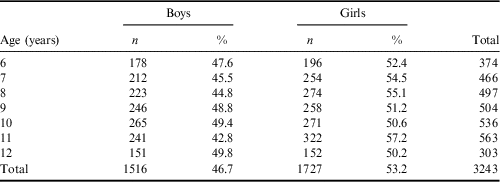
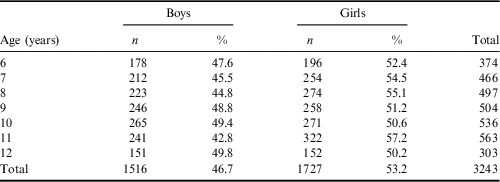
After excluding 199 children for being outside the study’s age range (<5 or >12 years old) and 58 for medical reasons (genetic and congenital illnesses), the final sample consisted of 3243 children recruited in the sixteen selected schools. The age and sex distribution of the sample is presented in Table 1. There were no significant differences in the proportions of boys and girls by age group (χ 2=8.34, p>0.05). The distribution of the sample by sex (girls 53.3% vs boys 48.8%) is consistent with the sex distribution in Merida.
Distribution of participant children by age and sex, Merida, Mexico, 2012
Socioeconomic characteristics
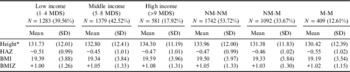
About 40% of the sample were in the lower income range, 42% in the intermediate range and about 18% in the higher income range. Almost half of the sample had at least one Mayan surname (M-NM=34%, M-M=13%), and the remaining 53% had no Maya surnames.
Anthropometric characteristics and nutritional status
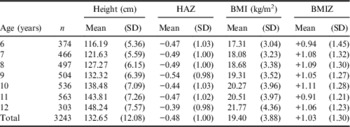
The descriptive statistics of measured and derived anthropometric variables of the children by age and sex are given in Table 2. The BMI mean z-score for the sample was 1.03 SD (±1.30) and the average height z-score was −0.48 SD (±1.00). No significant differences in height, z-score values of height and BMI were found between boys and girls. Girls, as a group, showed significantly higher z-score BMI values than boys (girls=1.18 vs boys=0.91, p<0.001). No significant differences in BMI and z-score height and BMI values were found among categories of income and ethnicity (Table 3). However, height increased significantly with income (low=131.73±12.01 cm, intermediate=132.80±12.41 cm, high=134.30±11.19 cm; p<0.05) and decreased significantly as the number of Maya surnames decreased (NM-NM=133.96±12.00 cm; NM-M=131.38±11.83 cm, M-M=130.42±12.39 cm; p<0.05).
Descriptive statistics of measured and derived anthropometric variables of children by age, Merida, Mexico, 2012
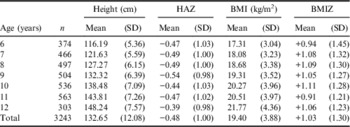
HAZ: height-for-age z-score; BMIZ: BMI-for-age z-score.
Descriptive statistics of anthropometric variables by income levels and ethnicity, Merida, Mexico, 2012

MDS: Minimum Daily Salary; M: Mayan surname, NM: non-Mayan surname.
HAZ: height-for-age z-score; BMIZ: BMI-for-age z-score.
*p<0.05.
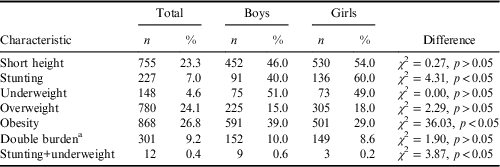
The results for BMI and height status are displayed in Table 4. The overall prevalence of overweight was 24.1% and that of obesity was 26.8%. The combined prevalence of overweight and obese in the sample was 50.8% (±2.06, with a confidence value of 99%). It was observed that 23.3% of the children had short stature and 7.0% were classified as stunted. The combined prevalence for short stature and stunting was 30.3%. The combination of stunting and underweight was only present in 0.4% of the sample. The percentage of children classified as stunted was significantly higher in girls (7.9%) than in boys (6.08%).
Anthropometric status categories by children’s sex, Merida, Mexico, 2012
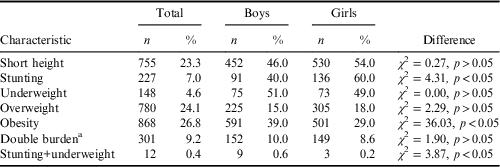
a Double burden is stunting/short height +overweight/obese.
Height and BMI status was defined based on the WHO reference values: height z-score between ≤−1SD and >−2SD=short; height z-score ≤−2SD=stunting; BMI z-score <−2SD=underweight; BMI z-score ≥−2SD and ≤+1SD=healthy weight; BMI z-score ≥+1SD=overweight; and BMI z-score ≥+2SD=obesity.
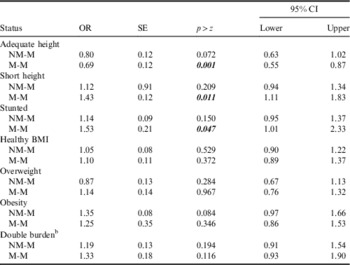
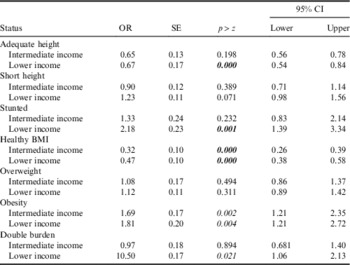
Tables 5 and 6 present the results of multinomial logistic regression models of association between income, ethnicity and BMI status, adjusted by age. Table 5 shows the results of the association between ethnicity, BMI and height status, where having two Maya surnames significantly increased the odds for short height (OR=1.42, 95% IC=1.11–1.82), and stunting (OR=1.53, 95% IC=1.00–2.33), but not for being overweight, obese or having the ‘double burden’ of short stature/stunting+overweight/obesity. Table 6 presents the results for the association between income level and BMI and height status, where belonging to a lower income group doubled the odds of being stunted (OR=2.185, 95% IC=1.38–3.34) and was also associated with double burden; intermediate and lower income categories were associated with increased risk of being obese.
Multinominal logistic regression models showing association of BMI and height status with ethnicityFootnote a , Merida, Mexico, 2012

a Reference category: NM-NM.
b Double burden is stunting/short height+overweight/obese.
BMI and height status was defined based on WHO reference values. The underweight category was excluded from the analysis due to the small number of underweight participants.
M-M=two Mayan surnames; M-NM=one Mayan and one non-Mayan surname; NM-NM=two non-Mayan surnames.
Significant p<0.05 values are shown in bold, italic font. Data adjusted by age.
Multinominal logistic regression models association of BMI and height status with income levelFootnote a , Merida, Mexico, 2012

a Reference category: higher income.
BMI and height status was defined based on the WHO reference values. The underweight category was excluded from the analysis due to the small number of underweight participants.
Significant p<0.05 values are shown in bold, italic font. Data are adjusted by age.
Discussion
The study sample of 6- to 12-year-old primary school children in urban Mexico had an average BMI SD value of +1.03 (±0.04), indicating that as a group the sample tends to be overweight. The overweight and obesity prevalence observed in the sample is concerning (24.1% and 26.8%), as more than half of the sample of children were overweight or obese. The implication of having a generation where the majority of individuals are overweight or obese at a very early age is the negative impact this will have on the quality of life of the individuals, but also on productivity and the economy at many levels (Rtveladze et al., Reference Rtveladze, Marsh, Barquera, Romero, Levy and Melendez2013) when these individual become adults.
The children who participated in this study live in a highly urbanized area, where many structural barriers limit physical activity and access to healthy food (Mendez, Reference Mendez2013) while at the same time promoting sedentary behaviour and the consumption of excessive calories. The odds of being overweight or obese were significantly lower among children from higher income families, perhaps because children from lower income families in Merida city consume a diet of lower nutritional value and high calories or have fewer opportunities to be active. Local public primary schools offer only one physical education session per week and any extracurricular activity means an extra expense for parents. Children from higher income families might have access to more sporting activities. These costs might pose a barrier to physical activity (Sonneville et al., Reference Sonneville, La Pelle, Taveras, Gillman and Prosser2009), so parents with higher income might be able to financially support their children’s sporting activities.
Children with intermediate and lower parental income were more likely to have short stature and stunting than higher income children. Short stature and stunting among lower income children might reflect adverse socioeconomic circumstances, unbalanced diets or poor health conditions. Shorter children tend also to be shorter adults and childhood height has been found to be associated with cardiovascular risk (Rogers et al., Reference Rogers, Metcalfe, Gunnell, Emmett, Dunger and Holly2006) and premature mortality in large cohort studies (Wang et al., Reference Wang, Zhang, Xiang, Yang, Li and Gao2011; Whitley et al., Reference Whitley, Martin, Davey Smith, Holly and Gunnell2012).
Having two Mayan surnames (M-M) was associated with short stature and stunting, but in children with a mixed ancestry (NM-M category) this association was not found. More research is needed to describe the social and health factors that might be related to the potential growth retardation and nutrition imbalance of mixed ancestry children. Children living in the east and south of Merida (where there is a higher proportion of the NM-M population) receive hypercaloric, vitamin-enriched nutritional supplements as a part of in-kind nutritional programmes, similar to what Leroy and colleagues reported in rural communities (Leroy et al., Reference Leroy, Gadsden, Rodríguez-Ramírez and González-de-Cossío2010). This effort operates under the supposition that offering more calories and vitamins to children from underserved communities will prevent malnutrition and help them to grow taller. Research to further understand the impact of this type of programme on not only height but weight is recommended.
Recent studies on Maya families from the south of Merida have described how this population has undergone a nutritional transition, with a shift from traditional and locally produced foods to a globalized diet with a high presence of processed products, high in sugar, fats and poor in micronutrients and fibre (Azcorra et al., Reference Azcorra, Wilson, Bogin, Vazquez-Vazquez and Dickinson2013b; Bogin et al., Reference Bogin, Azcorra, Vazquez-Vazquez, Avila, Castillo Burguete, Varela Silva and Dickinson2014). Nutritional transition is not necessarily bad for health. From 2006 to 2012 the rates of stunting in urban communities of Yucatan declined by 12% in 1- to 4-year-old children. It is possible that increased availability of energy in foods is contributing to reduced rates of chronic malnutrition among urban Maya children. However, this shift in the dietetic pattern seems to be related to the combination of short stature and overweight/obesity in children (nutritional double burden) resulting from a diet deficient in essential nutrients for lineal growth, but excessive in total energy (Steven et al., Reference Stevens, Singh, Lu, Danaei, Lin and Finucane2012).
Previous studies in the Guatemalan Mayan migrant population conducted in the US (where ‘Mayan’ was defined as those who had migrated from Guatemala, irrespective of their surnames or self-identity) showed a similar prevalence of overweight and obesity as in the present study. Another similarity was that girls were more likely to be overweight while boys were more likely to be obese. The authors of that study described the changes in diet as a result of migration, with greater access to food, resulting in a high frequency of overweight and obesity (Smith et al., Reference Smith, Bogin, Varela-Silva, Orden and Loucky2002). However, in the present study, a similar prevalence was found in the city of Merida, which possibly indicates that migration and acculturation to a different country might not be a determinant factor underlying overweight and obesity among Mayan children. Instead, the westernization of diets might be a global phenomenon affecting not only high-income countries, or tourist-based economies in small towns in the Yucatan (Leatherman et al., Reference Leatherman, Goodman and Stillman2010), but also lower income families living in urban settings of middle-income countries such as Mexico.
Socioeconomic status generally (Murasko, Reference Murasko2009), as well as Mayan ethnicity (Makkes et al., Reference Makkes, Montenegro-Bethancourt, Groeneveld, Doak and Solomons2011), have been considered to have a positive relation with children’s height (Murasko, Reference Murasko2009), but in this sample it was found that short stature and stunting were also prevalent among children without Mayan surnames (NM-NM children). Further studies will be needed to better understand the factors underlying the high prevalence of short stature and stunting among children living in Merida. Inter-generational influences of adverse living conditions have been proposed to explain the persistence of linear growth deficit among Maya children in Yucatan (Azcorra et al., Reference Azcorra, Varela-Silva, Rodríguez, Bogin and Dickinson2013a).
This study demonstrated that overweight/obesity and also short stature are common among the Meridan population aged 6–12 years attending public primary schools. Short height and stunting was more common among children from the lower income group. It was also found that children with two Mayan surnames and those with one Mayan surname and one non-Mayan surname might be more likely to develop a short height accompanied by being overweight/obese.
In conclusion, overweight, obesity and short stature are major health issues among children aged 6–12 attending primary public schools of Merida, Yucatan. These health issues affect children from the higher income group less, when compared with intermediate and lower income groups. Short height was more common among children in the lower income group. This study provides useful information supporting the view that childhood overweight/obesity and short stature are global health problems that are common in urbanized areas.