Bilinguals do sometimes have an advantage in inhibition, but they also have an advantage in selection; bilinguals do sometimes have an advantage in switching, but they also have an advantage in sustaining attention; and bilinguals do sometimes have an advantage in working memory, but they also have an advantage in representation and retrieval. Together, this pattern sounds like ‘mental flexibility’, the ability to adapt to ongoing changes and process information efficiently and adaptively.
(Bialystok, Craik & Luk, Reference Bialystok, Craik and Luk2012, p. 247)
This observation has precisely documented the diverse and even contradictory results on bilingual advantage in executive control. However, there has not been a theory that can explain these phenomena. Aiming to integrate these findings and fulfill this theoretical gap, we propose that task demands influences bilingual advantage in executive control over monolinguals.
Bilingual advantage in executive control is sensitive to task demands
In line with previous theoretical proposals that bilinguals are advanced in inhibitory control (e.g., Green, Reference Green1998), conflict resolving (e.g., Bialystok, Reference Bialystok2006), monitoring (e.g., Costa, Hernández, Cost-Faidella & Sebastián-Gallés, Reference Costa, Hernández, Cost-Faidella and Sebastián-Gallés2009), working memory (Morales, Calvo & Bialystok, Reference Morales, Calvo and Bialystok2013), and cognitive flexibility (Prior & Gollan, Reference Prior and Gollan2011; Prior & Macwhinney, Reference Prior and MacWhinney2010) we propose that, compared to monolinguals, bilinguals are advanced in executive control due to their daily regulation of two languages. However, different from the previous component perspective on executive control (Miyake & Friedman, Reference Miyake and Friedman2012) which states that executive control is composed of a common component, inhibition, and two specific sub-components, updating and shifting, we define executive control as the ability consciously to allocate limited cognitive resources according to a prioritized goal so as to fulfill the task demand (Qu, Finestone, Loh & Leong, Reference Qu, Finestone, Loh and Leong2012; Zelazo, Qu & Müller, Reference Zelazo, Qu, Müller, Schneider, Schumann-Hengsteler and Sodian2005). In terms of executive control, there are several essential assumptions associated with our proposal.
First, executive control is an adaptive ability that evolves in human beings (Friedman, Miyake, Young, DeFries, Corley & Hewill, Reference Friedman, Miyake, Young, DeFries, Corley and Hewitt2008). At an individual level, the more we use executive control, the more we develop it (e.g., Diamond, Reference Diamond2012).
Second, our cognitive resources such as working memory and attention are limited (e.g., Baddeley, Reference Baddeley1986; Norman & Shallice, Reference Norman, Shallice, Davidson, Schwartz and Shapiro1986), and there is competition in terms of cognitive resources for simultaneously performing various activities (e.g., Norman & Bobrow, Reference Norman and Bobrow1975).
Third, when cognitive resources are limited and under competition, in order to achieve a particular task's goal individuals need to rely on executive control to allocate cognitive resources accordingly. They need to analyze the situation and formulate the goal, and then rely on executive control to regulate cognitive resources in order to fulfill that goal. Depending on the task demand, cognitive resources will be allocated differently, and the outcome of executive control can be different. Following these assumptions, we can reason that when there is no competition in terms of cognitive resources, for example when a task is relatively easy or the response is relatively automatic, executive control may not be activated because there is no need for it to allocate cognitive resources. Additionally, when task demands differ, although the same executive control is activated, the outcome of executive control can vary. For instance, at a conference, while engaging in conversation with a colleague, we need to remember her email address so that we can contact her later for an article. In this situation, our executive control will allocate more cognitive resources to remembering the email address than monitoring the conversation. However, if we realize that we can just search for this colleague's email address on the internet and there is no need to remember it in the first place, our executive control will allocate more cognitive resources to monitoring the conservation and inhibit the tendency to try to remember the email address. In both situations our executive control is involved, however the outcomes are completely different and our performances in these two situations may not correlate with each other either. Therefore, executive control should be examined in terms of whether the task goal has been achieved successfully and efficiently, rather than what type of executive control is used.
In terms of bilingual speech production, we follow the single network hypothesis (Abutalebi & Green, Reference Abutalebi and Green2007). According to this hypothesis, although bilingual people process their two languages differently, they share a common representation and production neural network for their first and second languages, including prefrontal cortex, anterior cingulate cortex, basal ganglia, and inferior parietal lobule (Abutalebi & Green, Reference Abutalebi and Green2007). In order to use a particular language appropriately (i.e., according to the situational demand), bilingual people need executive control to regulate the use of these two languages. Within this network, prefrontal cortex and anterior cingulate cortex are specifically in charge of executive control such as monitoring the environment demands and individual responses, forming goals and plans, detecting conflicts and errors, and inhibiting irrelevant responses. For instance, Luk, Green, Abutalebi and Grady's (Reference Luk, Green, Abutalebi and Grady2012) meta-analysis has shown that activation in the left inferior frontal gyrus and left middle frontal gyrus are particularly associated with voluntary language switching. Compared to monolinguals, bilinguals have more opportunities to exercise their executive control. The more they practise their executive control, the better they become in terms of executive control (e.g., Bialystok, Craik, Klein & Viswanathan, Reference Bialystok, Craik, Klein and Viswanathan2004; Prior & Gollan, Reference Prior and Gollan2011).
Hence, integrating the research on executive control and bilingual language production, we have proposed that, compared to monolingual people, bilingual people are experts at executive control due to their frequent use of it in daily life. When cognitive resources are limited and under competition, executive control is engaged. Like other areas of expertise, the bilingual advantage in efficiently managing cognitive resources according to task demands may only appear when there is competition for cognitive resources or when cognitive resources are not sufficient to support all activities (e.g., Calmels, Foutren & Stam, Reference Calmels, Foutren and Stam2011). When a task is simple or when automatic responses are sufficient to fulfill the task goal, individuals do not need to recruit a large amount of cognitive resources for the task. In this case, the bilingual advantage in executive control may not appear. When the ongoing task is difficult and requires efficient management of cognitive resources, the bilingual advantage in executive control may appear. When a task requires information monitoring and updating, bilinguals are able to allocate limited cognitive resources successfully to monitor information instead of conducting other actions. Likewise, when a task requires inhibiting irrelevant responses, bilinguals are able successfully to allocate their limited cognitive resources to suppress inappropriate responses.
Therefore, it is essential to consider task demands when analyzing bilingual advantage in executive control. In particular, in the current study, we propose to separate the types of inhibition, the degree of conflict involvement, and the level of monitoring when analyzing bilingual advantages in executive control.
Inhibition and conflict
The process of inhibition is not just about suppressing irrelevant competing response sets (Anderson & Spellman, Reference Anderson and Spellman1995). It also involves activating target response sets (Anderson, Bothell, Byrne, Douglass, Lebiere & Qin, Reference Anderson, Bothell, Byrne, Douglass, Lebiere and Qin2004; see review in Hasher, Lustig & Zacks, Reference Hasher, Lustig, Zacks, Gorfein and MacLeod2007). This phenomenon is especially significant when multiple trials are used in the investigation. For example, in the Dimensional Change Card Sorting task (DCCS; Zelazo, Müller, Frye & Marcovitch, Reference Zelazo, Müller, Frye and Marcovitch2003), a color–shape switching task, participants are asked to sort a series of bivalent test stimuli, first according to one dimension (e.g., shape) and then according to the other (e.g., color). During switch trials, participants need to suppress the tendency to use the previous dimension (in this case, shape) to match pictures and facilitate the response tendency of using the current dimension (in this case, color). Likewise, in a flanker task, the flankers in the incongruent trials can impair performance and thus should be suppressed, whereas the flankers in the congruent trials can facilitate performance and thus should be activated. Hence, it is important to consider both suppression and activation when different types of trials are mixed in a task.
Additionally, both suppression and activation may or may not involve proactive interference. If a stimulus is a target in the previous trial but is a distractor in the current trial (i.e., the stimulus is relevant to the previous goal but irrelevant to the current goal), a response conflict is involved. Given that the task goal has changed, the previous relevant response becomes irrelevant and should be suppressed. It is more difficult to suppress a previously relevant response than to suppress a response set that is completely irrelevant to the previous task. In other words, in terms of suppression, it is more challenging to suppress a conflicting response than to suppress a non-conflicting response. Likewise, if a stimulus was a distractor in the previous trial but is a target in the current trial (i.e., the stimulus was previously irrelevant but becomes relevant in the current trial), individuals need to adjust their responses towards this stimulus as well. In the current trial, this previously suppressed stimulus should be dis-inhibited because it is the target now. Although involving response conflicts, depending on the task condition, it may be more difficult or much easier to dis-inhibit or activate the previously suppressed stimulus than to activate a stimulus completely irrelevant in the previous trial. For example, when the response-to-stimulus interval (RSI; the interval between the response to the previous trial and the appearance of the stimulus of the current trial) is relatively long, the suppression of the particular response may dissipate and it will not be more difficult to activate the previously suppressed stimulus than to activate a novel stimulus. However, if in addition to the activation demand, there is also suppression demand simultaneously, regardless of the RSI, it is still more difficult to activate the previously suppressed stimulus than to activate a novel stimulus (see May, Kane & Hasher, Reference May, Kane and Hasher1995, for a review). Similarly, by manipulating stimulus onset asynchrony (SOA) in the Stroop task, Glaser and Glaser (Reference Glaser and Glaser1982) also showed that the Stroop interference effect disappeared or even was reversed and became the Stroop facilitation effect (see also Coderre, Van Heuven & Conklin, Reference Coderre, Van Heuven and Conklin2013).
Previous work has suggested that bilinguals are advanced in suppressing conflicting response sets as examined via the anti-saccade task (e.g., Bialystok & Viswanathan, Reference Bialystok and Viswanathan2009), the Simon task (e.g., Bialystok et al., Reference Bialystok, Craik, Klein and Viswanathan2004; Martin-Rhee & Bialystok, Reference Martin-Rhee and Bialystok2008), the Stroop task (e.g., Coderre et al., Reference Coderre, Van Heuven and Conklin2013), the flanker task (e.g., Costa et al., Reference Costa, Hernández, Cost-Faidella and Sebastián-Gallés2009), and the attention network task (e.g., Costa, Hernandez & Sebastian-Galles, Reference Costa, Hernández and Sebastián-Gallés2008; Yang, Yang & Lust, Reference Yang, Yang and Lust2011). However, bilinguals may not be advanced in activating conflicting response sets. For instance, Treccani, Argyri, Sorace and Sala (Reference Treccani, Argyri, Sorace and Sala2009) gave bilingual and monolingual adults a target-stimulus locating spatial task, in which participants needed to detect where targets were in the presence of distractors. Some distractors predicted where targets would appear in the following trials. Compared to monolinguals, bilinguals were more able to inhibit irrelevant spatial information; however, bilinguals benefited less from the location of previous distractors. Likewise, Coderre et al. (Reference Coderre, Van Heuven and Conklin2013) also documented that bilinguals had a significantly smaller Stroop facilitation effect though they also had a significantly smaller Stroop interference effect than monolinguals did. Therefore, when analyzing bilingual advantage in executive control, in terms of inhibition, it is important to separate activation from suppression, and also to consider the situations with and without response conflicts (Hilchey & Klein, Reference Hilchey and Klein2011).
Monitoring
Another issue related to executive control is that, when having a block of trials, participants need to monitor and update the task demands in each particular trial, but simultaneously they also need to maintain, monitor, and update the task demand of the whole block. Both the local task demand of each trial and the global demand of the block can influence participants’ performance. For instance, Morales et al. (Reference Morales, Calvo and Bialystok2013) focused on the local task demand of each trial and examined whether bilinguals were advanced in monitoring and updating stimuli and response sets compared to monolinguals. They separated the task demands of suppressing conflicting responses and activating appropriate responses in a modified Simon task. To manipulate the working memory load, they presented participants either two or four stimuli. To manipulate the conflict level, they either presented the stimuli in the center (i.e., non-conflict) or at the side (i.e., conflict). They have found that bilinguals outperformed monolinguals in the high working memory conditions with and without response conflict. These results suggest that, compared to monolinguals, bilinguals are advanced in updating local task demand, especially when the working memory load to monitor and update is relatively high. However, because these researchers did not measure the global performance of participants, it is not clear whether bilinguals would also be advanced in monitoring and updating the global task demand.
Other studies that measured the performance related to the local task demand and the global task demand respectively have shown that these two abilities are indeed separable. Costa et al. (Reference Costa, Hernández, Cost-Faidella and Sebastián-Gallés2009) manipulated the general task demand of the whole block without changing the particular task demand of each trial. They gave participants three versions of the flanker task: in the low-monitoring version, either 92% or 8% of trials were congruent. In the high-monitoring version, 75% of trials were the same type. In the extreme high-monitoring version, 50% of trials were the same type. They have found that there was a significant global task demand effect: participants performed differently in each version. Additionally, bilinguals performed much faster compared to monolinguals in the two high-monitoring versions but not in the low-monitoring version, suggesting that bilinguals were advanced in monitoring global task demands when the monitoring demands were high. However, in terms of resolving conflicts, it was only in the 75% of congruent trials version that bilinguals had a smaller flanker effect compared to monolinguals. Additionally, Prior and Macwhinney (Reference Prior and MacWhinney2010) found that compared to monolinguals, bilinguals had smaller switching costs but they had the same amount of mixing costs. Together, these results suggest that the ability to update global task demands can be different from the ability to update local task demands. Therefore, it is necessary to study them separately.
Current study
In the present study we investigated whether task demands can influence bilingual advantage over monolinguals in terms of performance during task switching. We hypothesized that bilinguals would outperform monolinguals during task switching when the particular switch trials have a high demand on suppression or activation.
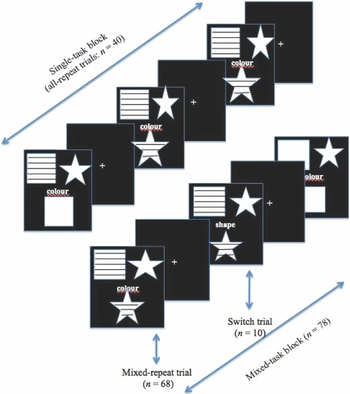
To examine suppression and activation simultaneously, we used the computerized DCCS (Qu, Wijeya, Zelazo & Craik, Reference Qu, Wijeya, Zelazo and Craik2007; Wilson, Christensen, King, Qu & Zelazo, Reference Wilson, Christensen, King, Qu and Zelazo2008; Zelazo et al., Reference Zelazo, Müller, Frye and Marcovitch2003), a color–shape switching task in which participants are asked to sort a series of bivalent test stimuli, first according to one dimension (e.g., shape) and then according to the other (e.g., color; see Figure 1).
Illustration of the computerized Dimensional Change Card Sorting task.

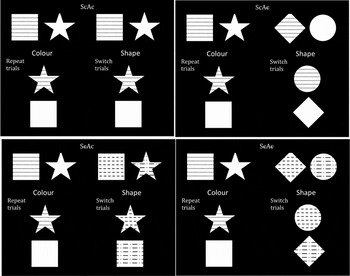
To manipulate the response conflicts, we created 2 (suppression demand: suppress conflicting responses vs. suppress non-conflicting responses) × 2 (activation demand: activate conflicting responses vs. activate non-conflicting responses) versions of a task-switching task (see Figure 2). In particular, in the secondary task we either maintained the same values used in the dominant task (i.e., with conflicts) or involved new values (i.e., without conflicts). In the ScAc version (see the note at Figure 2 for the meaning of this and related abbreviations), participants needed to suppress previously relevant response sets and activate previously irrelevant response sets, during which conflicts were involved in both suppression and activation. In the ScAc version, participants needed to suppress previously relevant response sets but activate non-conflicting response sets, during which conflicts were only involved in suppression but not activation. In the ScAc version, participants needed to suppress non-conflicting response sets and activate previously irrelevant response sets, during which conflicts were only involved in activation but not suppression. In the ScAc version, participants needed to suppress one set of non-conflicting response sets and activate another set of non-conflicting response sets, during which conflicts were not involved in suppression nor in activation.
Illustration of four versions of the computerized Dimensional Change Card Sorting task.

Given that switching costs reflect how efficient an individual is in selecting response sets upon immediate task demands, and mixing costs reflect how efficient an individual is in maintaining the appropriate task sets and following the global task demands in a continuous switching context, for each version we calculated switching costs and mixing costs for accuracy and reaction time respectively. Switching costs are defined as the performance difference between the switch trials and the mixed-repeat trials in a mixed-task block, whereas mixing costs are defined as the performance difference between the mixed-repeat trials in a mixed-task block and the all-repeat trials in a single-task block (e.g., Prior & Macwhinney, Reference Prior and MacWhinney2010).
We carefully controlled participants, test materials, and test procedure. To control participants, we followed previous studies (Marecová, Asanowicz, Krivá & Wodniecka, Reference Marecová, Asanowicz, Krivá and Wodniecka2013; Prior & Gollan, Reference Prior and Gollan2011) and specially recruited monolingual participants from mainland China who did not use English in daily conversation, and Chinese participants from Singapore who were proficient in both Chinese and English and had spoken both languages in daily life since early childhood. One unique feature of Singapore is that most Singaporean Chinese use both Chinese and English in daily life, often mixing the two languages in their conversation (Kamwangamalu & Lee, Reference Kamwangamalu and Lee1991). For example, they often say OK La for assurance instead of just Chinese Hao La or English OK. This constant code mixing and switching does not interfere with their communication. On the contrary, it facilitates communication. For instance, instead of saying I need to go to the lab in English or wo yao qu shi yan shi in Chinese, a undergraduate student will say wo yao qu lab, which is much shorter than saying it in either language. In this sense, Chinese Singaporeans who are proficient in both Chinese and English are like the Spanish–English bilinguals who participated in Prior and Gollan's (Reference Prior and Gollan2011) study and, hence, may be advanced in task switching. Chinese Singaporeans are genetically Chinese and still follow Confucianism in their society (De Vos & Slote, Reference De Vos and Slote1998). By comparing Chinese Singaporean bilinguals with Chinese monolinguals, to certain degree, we can control for the potential impacts of gene and culture on bilingual advantage (e.g., Chang, Kidd, Kivak, Pakstis & Kidd, Reference Chang, Kidd, Kivak, Pakstis and Kidd1996; Chen, Hastings, Rubin, Chen, Cen & Stewart, Reference Chen, Hastings, Rubin, Chen, Cen and Stewart1998; Qu, Gao, Yip, Li & Zelazo, Reference Qu, Gao, Yip, Li and Zelazo2012; Qu & Zelazo, Reference Qu and Zelazo2007). To control for education level and socioeconomic status, we recruited university students whose families were from the middle classes within their respective countries.
To control the global monitoring demand, we followed the procedure of Costa et al. (Reference Costa, Hernández, Cost-Faidella and Sebastián-Gallés2009) to create a high-monitoring task: during the mixed-task block, 85% of trials were repeating trials and 15% of trials were switching trials. In this case, bilinguals would show smaller switching costs than monolinguals and they would outperform monolinguals on both mixed-repeat (i.e., congruent) and switch (i.e., incongruent) trials during the mixed-task blocks. To make the task mildly challenging, we used external cues instead of relying on participants’ working memory to internally monitor which trials should switch (Kray, Li & Lindenberger, Reference Kray, Li and Lindenberger2002). Additionally, we used the same type of color–shape switch task as in Prior and MacWhinney's (Reference Prior and MacWhinney2010) study except that, to decrease the extra need to memorize arbitrary cues (Rubinstein, Meyer & Evans, Reference Rubinstein, Meyer and Evans2001), we used verbal cues instead of graphic cues as in Prior and MacWhinney's (Reference Prior and MacWhinney2010) study. Additionally, to examine executive control during the exact moment of task switching without advanced preparation (Rogers & Monsell, Reference Rogers and Monsell1995), expectation (Dreisbach, Haider & Kluwe, Reference Dreisbach, Haider and Kluwe2002), or foreknowledge (Rogers & Monsell, Reference Rogers and Monsell1995), we chose the cue–target interval (CTI) to be 0 ms by presenting the cues and targets simultaneously. Finally, to allow the dissipation of previous suppression, we set the RSI to 1000–1200 ms (Allport, Styles & Hsieh, Reference Allport, Styles, Hsieh, Umilta and Moscovitch1994).
We have formulated the following two hypotheses:
-
1. Local task demands would influence the performance of both monolingual and bilingual participants. In particular, there should be a significant suppression demand effect on participants’ switching costs and mixing costs: it should be more difficult to suppress conflicting responses than to suppress non-conflicting responses, regardless of whether there is a simultaneous extra demand of activation. Additionally, we expect that there should be an interaction effect between the suppression demand and the activation demand: when there is no simultaneous suppression demand, it should be easier to activate conflicting responses than to activate non-conflicting responses. However, when there is a simultaneous extra suppression demand, it should be easier to activate non-conflicting responses than to activate conflicting responses.
-
2. Local task demands would moderate bilingual advantage in executive control. We expect that there would be a significant interaction effect between the suppression demand and language group, and a significant interaction effect between the suppression demand, the activation demand, and language group on participants’ switching costs. In other words, language group differences would only appear when the suppression demand is high (i.e., suppressing conflicting responses as in the ScAc and ScAc), or when the activation demand is high (i.e., activating non-conflicting responses when there is no extra suppression demand as in the ScAc, or activating conflicting responses when simultaneously there is an extra suppression demand as in the ScAc). We did not expect significant language group differences in mixing costs given that we maintained the global task demand, and previous work generally did not report significant language group differences in mixing costs (e.g., Paap & Greenberg, Reference Paap and Greenberg2013; Prior & Gollan, Reference Prior and Gollan2011; Prior & Macwhinney, Reference Prior and MacWhinney2010).
Method
Participants
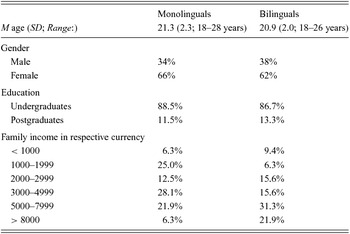
In total, 64 university students participated in the study. Among them, 32 were Chinese monolinguals from mainland China who spoke only Chinese in daily communication (M age = 20.5 years, SD = 1.3, Range: 18–24 years; 12 males and 20 females) and 32 were Chinese–English bilinguals from Singapore (M age = 20.9 years, SD = 2.0, Range: 18–26 years; 12 males and 20 females) who reported that their first language was Chinese, that they were proficient in both Chinese and English languages though scored higher in Chinese than in English on the Peabody Picture Vocabulary Test (Dunn & Dunn, Reference Dunn and Dunn2006), and that they had spoken both languages in daily life since early childhood. All participants were from the middle class of their respective country (see the Table 1 for their family monthly income). All participants were healthy and none were color blind, as indicated by their performance on the Ishihara color-blindness test (Reference WaggonerWaggoner). Participants received RMB10 or SGD10 for compensation. All participants provided written informed consent.
Demographic information of the participants

Materials
Computerized Dimensional Change Card Sorting task (Qu et al., Reference Qu, Wijeya, Zelazo and Craik2007; Wilson et al., Reference Wilson, Christensen, King, Qu and Zelazo2008)
Twenty geometric shapes and 20 colors were used to construct 8 cm × 8 cm stimuli. For each participant, target and test stimuli were randomly chosen and neither target nor test stimuli were repeated across different conditions. The task was programmed in E-Prime 1.1 software (Schneider, Eschman & Zuccolotto, Reference Schneider, Eschman and Zuccolotto2002) and run on a Pentium 4 laptop computer with a 32 cm × 24 cm monitor that was positioned approximately 50 cm away from the participant. Participants responded using the numerals 1 and 2 on the number pad of the standard keyboard. The task was presented in either English or Chinese.
The task included four versions of the DCCS. Each version consisted of two blocks of trials (see Figure 1 above): the first block served as a baseline of 40 trials which required participants to match stimuli by the dominant dimension while the second block, a mixed-task block, had a total of 78 trials with a mixture of 68 dominant trials, and 10 secondary trials (15%). In the dominant task, participants were instructed to sort test stimuli according to one dimension (i.e., the dominant dimension); in the secondary task, participants were instructed to switch to another dimension (i.e., the secondary dimension). The dominant dimension, color or shape, was counter-balanced between participants. Each trial started with a fixation “+” lasting for 500 ms. This was followed by a test screen with two target stimuli on the top, a test stimulus on the bottom, and the cue at the center of the screen instructing the participant which dimension (either color or shape) to use to match the test stimulus to the target stimuli. The test screen remained visible until the participant responded with the response key “1” or “2”, with “1” indicating that the test stimulus matched the target stimulus on the left and “2” indicating that the test stimulus matched the target stimulus on the right. A blank screen was shown for 500–700 ms after each response. Each version took less than six minutes, and there was a two-minute filler task (answering demographic questions and watching cartoon figures) between each version.
Ishihara colour-blindness test (Waggoner)
Participants were asked to identify digits embedded in six colored plates.
Peabody Picture Vocabulary Test – Fourth Edition (PPVT–IV; Dunn & Dunn, Reference Dunn and Dunn2006)
This test has been widely used in bilingual studies (e.g., Bialystok & Feng, Reference Bialystok and Feng2009). Participants were asked to select one picture out of four that best represents the meaning of a stimulus word presented orally. Both forms A and B of the PPVT–IV were translated into Chinese by a native Chinese speaker and examined by three Singaporeans and two mainland Chinese speakers to make sure the translation fitted local customs. Participants were given one form in English and the other form in Chinese. The test order was counter-balanced between participants. Separate raw scores for English and Chinese were calculated by using the number of correct responses on English and Mandarin Chinese versions.
Design and procedure
We used a mixed design: the suppression demand and the activation demand were the within-subject variables as all participants received all four versions of the DCCS, and language group was the between-subject variable. The dependent variables were switching costs and mixing costs in terms of accuracy and reaction time during the correct trials. Chinese monolinguals were tested in Chinese. Singaporean bilinguals were randomly assigned either to being tested in Chinese or in English. After filling in the consent form and information sheet, all participants were tested for their color-blindness using the Ishihara colour-blindness test and for their proficiency level in their test language using forms A or B of the PPVT–IV. After the computerized DCCS, bilingual participants were assessed for their proficiency level in English using the other form of the PPVT–IV. Additionally, the test order of the four versions was randomly arranged. Different target and test stimuli were used in each version, and the order in which specific test stimuli within each version were presented was determined randomly. The whole study took less than 60 minutes. The test materials and procedure were approved by the ethics committee of the Division of Psychology, Nanyang Technological University.
Results
Demographic information
In terms of family income and education level, separate Mann–Whiteny U tests did not show significant language group differences (U family income = 1.808, p > .05; U education = 0.207, p > .05).
Verbal ability
As the PPVT–IV was not normed based on the Chinese population in China or the bilingual population in Singapore, the raw scores were used for comparison. A one-way analysis of variance (ANOVA) showed that, consistent with previous reports, Chinese monolinguals (M = 217.6, SD = 4.9) outperformed Singaporean Chinese–English bilinguals (Chinese: M = 211.0, SD = 5.1; English: M = 196.3, SD = 10.5).
Task switching data cleaning and transforming
The first four trials following practice or break were excluded, and the following trials were excluded from the final reaction time (RT) data analyses: (i) error trials, (ii) trials immediately following an error, and (iii) trials with RTs shorter than 100 ms or longer than 3 SDs of the mean RTs for the corresponding age group and condition (e.g., Chevalier & Blaye, Reference Chevalier and Blaye2009). On average, 97.8% of trials remained for analysis.
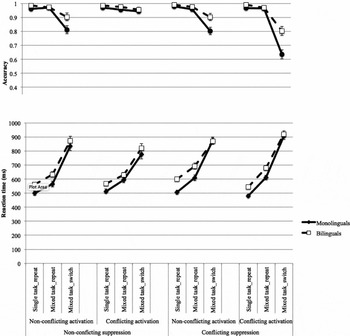
Percentage of accuracy (ACC) and mean reaction time during the correct trials (CRT) were computed for the all-repeat, mixed-repeat, and switch trials. To reduce the kurtosis, ACCs were transformed using the arc-sine function and RTs were transformed using the logarithm function respectively (e.g., Whitson, Karayanidis & Michie, Reference Whitson, Karayanidis and Michie2012). These normalized data were used in the following analysis, but the raw data are reported in Figure 3. Separate univariate ANOVAs on the ACCs and RTs did not show any significant effects of sex, dominant dimension of the task switching task, test language (i.e., Chinese or English), or any interaction effect. Hence, data were combined across these variables. We calculated switching costs (SC) for ACCs (SC-ACCs = ACCmixed-repeat trials in a mixed-task-block − ACCswitch trials in a mixed-task-block) and CRTs (SC-CRTs = CRTswitch trials in a mixed-task-block − CRTmixed-repeat trials in a mixed-task-block), mixing costs (MC) for ACCs (MC-ACCs = ACCall-repeat trials in a single-task block − ACCmixed-repeat trials in a mixed-task-block) and CRTs (MC-CRTs = CRTmixed-repeat trials in a mixed-task-block − CRTall-repeat trials in a single-task block), respectively.
Means (and standard errors) of performance accuracy (upper panel) and reaction time (lower panel) by trial type, suppression demand, activation demand, and language group.

Performance on all-repeat trials in single-task blocks
Two separate 2 (suppression demand) × 2 (activation demand) × 2 (language group) ANOVAs were conducted on the ACCs and CRTs for the all-repeat trials in the single-task blocks. Results showed significant effects of language group on ACCs (F(1,62) = 11.850, p < .01, ηp 2 = .160) and CRTs (F(1,62) = 15.146, p < .001, ηp 2 = .196). These indicated that as a baseline, when matching targets by just one dimension, bilinguals responded significantly more accurately (d = .09, p = .001) though not as fast (d = .06, p < .001) as monolinguals did.
Switching costsFootnote 1
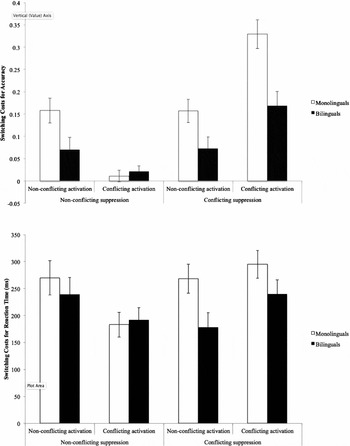
To examine how efficient participants were in selecting appropriate response sets according to the immediate task demand, we conducted separate 2 (suppression demand) × 2 (activation demand) × 2 (language group) ANOVAs on the switching costs for ACCs (SC-ACCs) and CRTs (S-CRTs). In terms of S-ACCs, the results (see Figure 4, upper panel) showed that there was a significant suppression demand effect (F(1,62) = 50.609, p < .001, ηp 2 = .449), a significant main effect of language group (F(1,62) = 6.921, p < .05, ηp 2 = .100), a significant interaction effect of the suppression demand and the activation demand (F(1,62) = 56.713, p < .001, ηp 2 = .478), and a significant interaction between the suppression demand, the activation demand, and language group (F(1,62) = 4.496, p < .05, ηp 2 = .068).
Means (and standard errors) of the switching costs for accuracy (upper panel) and reaction time (lower panel) during correct trials by suppression demand, activation demand, and language group.

Further analyses on the interaction effects were conducted by separating suppression demands. When participants did not need to suppress conflicting responses as in the Sc Ac and the ScAc versions, there was an activation demand effect: the SC-ACCs were significantly smaller when participants also needed to activate conflicting responses, as in the ScAc version, than when participants did not need to activate conflicting responses, as in the ScAc version (F(1,62) = 20.990, p < .001, ηp 2 = .253, d = −.26). Additionally, there was a significant interaction between the activation demand and the language group (F(1,62) = 4.732, p < .05, ηp 2 = .071). We separately examined the activation demand effect in the two language groups. The results revealed that the activation demand effect was only significant in monolinguals who had smaller SC-ACCs in the ScAc version than those in the ScAc version (F(1,31) = 23.567, p < .001, ηp 2 = .432, d = −.39). This activation demand effect was not significant in bilinguals (F(1,31) = 2.806, p > .05, ηp 2 = .083).
When participants needed to suppress conflicting responses as in the ScAc and the ScAc versions, there was an activation demand effect: the SC-ACCs were significantly larger when participants also needed to activate conflicting responses, as in the ScAc version, than when participants did not need to activate conflicting responses, as in the ScAc version (F(1,62) = 26.221, p < .001, ηp 2 = .297, d = .28). Additionally, there was a significant language group difference indicating that bilinguals had significantly smaller SC-ACCs than monolinguals did (F(1,62) = 8.257, p < .01, ηp 2 = .118, d =−.18). Another set of analyses on the interaction effects were conducted by separating activation demands. When participants did not need to activate conflicting responses as in the ScAc and the ScAc versions, there was a significant language group difference showing that bilinguals had significantly smaller SC-ACCs than monolinguals did (F(1,62) = 4.912, p < .05, ηp 2 = .073, d = −.16). There were no significant suppression demand or any interaction effects.
When participants needed to activate conflicting responses as in the ScAc and the ScAc versions, there was a significant suppression effect: the SC-ACCs were significantly larger when participants also needed to suppress conflicting responses, as in the ScAc version, than when participants did not need to suppress conflicting responses as in the ScAc version (F(1,62) = 94.980, p < .001, ηp 2 = .605, d = .53). Additionally, there was a significant interaction between the suppression demand and language group (F(1, 62) = 6.662, p < .05, ηp 2 = .097). After separately examining the suppression demand effect in the two language groups, we found that the suppression demand effect was significant for both monolinguals (F(1,31) = 56.861, p < .001, ηp 2 = .647, d = .68) and bilinguals (F(1,31) = 38.664, p < .001, ηp 2 = .555, d = .39).
In terms of SC-CRTs, the results (see Figure 4, lower panel) showed that there was significant interaction between suppression demands and language groups (F(1,62) = 5.485, p < .05, ηp 2 = .081), and a significant interaction effect of suppression demands and activation demands (F(1,62) = 15.579, p < .001, ηp 2 = .201). Other effects were not significant. Further analyses on the interaction effects, by separately examining whether conflicting responses were involved in suppression, revealed that when there was no need to suppress conflicting responses, as in the ScAc and ScAc versions, the SC-CRTs were significantly larger when participants needed to activate non-conflicting response sets, as in the ScAc version, compared to when they needed to activate conflicting response sets, as in the ScAc version (F(1,62) = 9.311, p < .05, ηp 2 = .131, d = .04). When participants needed to suppress conflicting responses, as in the ScAc and ScAc versions, the SC-CRTs were significantly smaller when participants activated non-conflicting response sets, as in the ScAc version, compared to when they needed to activate conflicting response sets, as in the ScAc version (F(1,62) = 4.684, p < .05, ηp 2 = .070, d = −.02). Additionally, when participants needed to suppress conflicting responses, as in the ScAc and ScAc versions, the SC-CRTs were significantly smaller in bilinguals compared to monolinguals (F(1,62) = 7.079, p = .01, ηp 2 = .102, d = −.05).
Taken together, these results have shown that both the suppression demand and the activation demand could influence switching costs. Additionally, compared to monolinguals, bilinguals had smaller SC-ACCs in the ScAc, ScAc, and ScAc versions, and smaller SC-CRTs in the ScAc and ScAc versions. These results indicate that bilinguals were more efficient in suppressing conflicting responses and activating non-conflicting responses.
Mixing costs
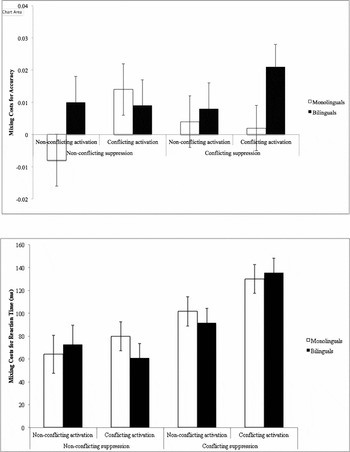
To examine how efficient participants were in continuously maintaining appropriate response sets, we conducted separate 2 (suppression demand) × 2 (activation demand) × 2 (language group) ANOVAs on the mixing costs for ACCs (MC-ACCs). Results (see Figure 5, upper panel) showed a significant suppression demand × activation demand × language group interaction effect (F(1,62) = 7.072, p = .01, ηp 2 = .102). Further analyses, examining the effects in the two language groups separately, showed that the interaction effect between suppression demands and activation demands was only significant among monolinguals (F(1,31) = 6.857, p < .05, ηp 2 = .181): when there was no need to activate conflicting responses, there was a significant suppression demand effect (F(1,31) = 8.320, p < .01, ηp 2 = .212), indicating that the MC-ACCs were significantly larger when there was a need to suppress conflicting responses compared to when there was no need to suppress conflicting responses (d = .13, p < .01). Additionally, when separately examining the impacts of suppression demands and activation demands, the language group difference appeared: bilinguals had significantly larger MC-ACCs than monolinguals did when they needed to suppress one set of conflicting responses and simultaneously activate the other set of conflicting responses, as in the ScAc version (F(1,62) = 4.173, p < .05, ηp 2 = .063, d = .09).
Means (and standard errors) of the mixing costs for accuracy (upper panel) and reaction time (lower panel) during correct trials by suppression demand, activation demand, and language group.

In terms of mixing costs for correct trials (MC-CRTs), the results (see Figure 5, lower panel) showed that there were significant main effects from suppression demands (F(1,62) = 23.709, p < .001, ηp 2 = .272), activation demands (F(1,62) = 5.933, p < .05, ηp 2 = .087), and a significant interaction between suppression demands and activation demands (F(1,62) = 6.520, p < .05, ηp 2 = .095). Further analyses showed that when there was a need to activate previously suppressed conflicting responses, as in the ScAc and ScAc, the MC-CRTs were significantly smaller to suppress non-conflicting responses, as in the ScAc version, than to suppress conflicting responses, as in the ScAc version (F(1,62) = 29.842, p < .001, ηp 2 = .325, d = −.05). Additionally, when they needed to suppress conflicting responses as in the ScAc and ScAc versions, the MC-CRTs were significantly smaller when they needed to activate non-conflicting responses, as in the ScAc version, than when they needed to activate the other set of conflicting responses simultaneously, as in the ScAc version (F(1, 62) = 18.029, p < .001, ηp 2 = .225, d = −.03).
In summary, mixing costs significantly increased as local suppression demands and activation demands increased. In the ScAc version, bilinguals showed larger mixing costs compared to monolinguals.
Discussion
In the past three decades, research on bilingual advantage in executive control has been fruitful. Nevertheless, most of the studies did not consider the role of task demands in executive control so bilinguals are reported to have advantages in different types of executive control. Taking a comprehensive and functional approach, we propose that executive control is the ability consciously to allocate limited cognitive resources according to a prioritized goal so as to fulfill the task demand. In other words, we are arguing that there is only one type of executive control though there may be various task demands. In the current study, by manipulating local task demands and controlling global task demands, we were able to examine how suppressing conflicting or non-conflicting responses, and simultaneously activating conflicting or non-conflicting responses, would influence participants’ performance in general and bilingual advantage specifically.
Inhibition, conflict, and monitoring demands
Consistent with our hypotheses, in the current study we have found a significant suppression effect and a significant interaction effect between the suppression demand and the activation demand on participants’ performance. Consistent with previous work (Coderre et al., Reference Coderre, Van Heuven and Conklin2013; Treccani et al., Reference Treccani, Argyri, Sorace and Sala2009), we have found that it is more difficult to suppress conflicting responses than to suppress non-conflicting responses and when there is no extra suppression demand, it is easier to activate conflicting responses than to activate non-conflicting responses. These findings suggest that the involvement of conflicting responses cannot be regarded as a single factor to determine whether a task is difficult or not and proactive interference can facilitate the performance in the following trials as well. Therefore, it is essential to consider the inhibition demand and conflict type together.
Additionally, by varying the suppression demand and the activation demand of the local trials, we manipulated the local task demand. Following the procedure of Costa et al., (Reference Costa, Hernández, Cost-Faidella and Sebastián-Gallés2009), we had 85% of mixed-repeat trials in the mixed-task blocks and, hence, fixed the global task demand. As a result, both the switching costs and mixing costs varied depending on the suppression demand and the activation demand. These results, again, highlight the importance of considering local task demands in analyzing executive control. Furthermore, executive control is not just about suppression, resolving conflicts, monitor or updating information. Rather, it is the ability to manage cognitive resources according to particular task demands. When a task has a large demand on suppression or activation, individuals need to rely on executive control so as to achieve the particular task goal.
Task demands influence bilingual advantage in executive control
Consistent with our hypothesis, we have found significant interaction effects between task demands and language group, including the suppression demand × language group, and the suppression demand × the activation demand × language group on SC-ACCs and SC-CRTs. In particular, bilinguals had smaller switching costs in ScAc, ScAc, and ScAc. In other words, we have found that bilinguals showed an advantage in suppression when the task had a high demand for response suppression, as in the case of suppressing conflicting responses, and also in activation when the task had a high demand for response activation, as in the case of activating non-conflicting responses when there was no extra demand of response suppression.
Although these results nicely replicated previous findings (e.g., Bialystok et al., Reference Bialystok, Craik, Klein and Viswanathan2004; Costa et al., Reference Costa, Hernández, Cost-Faidella and Sebastián-Gallés2009; Morales et al., Reference Morales, Calvo and Bialystok2013), none of previous theory alone can explain this pattern. According to the proposal that bilinguals have an advantage in resolving conflicts (e.g., Bialystok et al., Reference Bialystok, Craik, Klein and Viswanathan2004; Costa et al., Reference Costa, Hernández and Sebastián-Gallés2008; Martin-Rhee & Bialystok, Reference Martin-Rhee and Bialystok2008; Yang et al., Reference Yang, Yang and Lust2011), bilinguals should not have smaller switching costs in the ScAc version than monolinguals. According to the proposal that bilinguals are advanced in working memory (e.g., Morales et al., Reference Morales, Calvo and Bialystok2013), bilinguals should have smaller switching costs than monolinguals in the ScAc. According to the monitoring advantage (Costa et al., Reference Costa, Hernández, Cost-Faidella and Sebastián-Gallés2009) or cognitive flexibility advantage (e.g., Prior & Gollan, Reference Prior and Gollan2011; Prior & Macwhinney, Reference Prior and MacWhinney2010), bilinguals should have smaller switching costs than monolinguals on all four versions.
Therefore, we propose that, compared to monolingual people, bilingual people are advanced in executive control – managing limited cognitive resources to fulfill particular task goals. During the switch trials, when the task required participants to activate particular sets of responses, bilinguals were able successfully to allocate limited cognitive resources to engage in such actions. Likewise, during the switch trials when the task required participants to suppress irrelevant responses, bilinguals were able successfully to allocate limited cognitive resources to suppress inappropriate responses. Executive control is not just about inhibition, monitoring, updating, or shifting. Rather, it includes all of these functions (Miyake & Friedman, Reference Miyake and Friedman2012). Most importantly, executive control is the process of allocating our cognitive resources to achieve the prioritized goal as demanded by the particular task. Compared to monolinguals, during their daily management of two languages according to the situational demand, bilinguals have more opportunities to practice their executive control (Abutalebi & Green, Reference Abutalebi and Green2007). Hence, bilinguals are sensitive to task demand, and are more advanced in monitoring environmental demands, detecting conflicts and errors, suppressing irrelevant responses, and activating relevant responses.
Unanswered questions: Bilingual disadvantage?
Bilingual disadvantage in lexical processing?
Our results showed that during baseline, although bilinguals were more accurate compared to monolinguals, they were also significantly slower. Research in the past using picture naming, lexical decision, and lexical retrieval tasks has shown that bilinguals generally perform worse than monolinguals (e.g., Bialystok, Craik & Luk, Reference Bialystok, Craik and Luk2008; Coderre et al., Reference Coderre, Van Heuven and Conklin2013; Gollan, Montoya, Fennema-Notestine & Morris, Reference Gollan, Montoya, Fennema-Notestine and Morris2005). In this study we used written words as the matching cues. Our bilinguals, although proficient in spoken language, were possibly not as advanced as monolinguals in written language. In this case, bilinguals might need more time to process the cues before making any responses. However, it is also possible that bilinguals focused on performance accuracy whereas monolinguals aimed to finish the tasks as fast as possible. Future studies can use graphic cues, as in Prior and MacWhninney's (Reference Prior and MacWhinney2010) study, to examine this issue further.
Unique monolingual advantage
In the current study we found that, in monolinguals only, when there was no extra demand to suppress conflicting responses it was much easier to activate conflicting responses, as in the ScAc, than to activate non-conflicting responses, as in the ScAc. This finding is similar to the results of Treccani et al. (Reference Treccani, Argyri, Sorace and Sala2009) on the faciliation effect of negative priming, the results of Coderre et al. (Reference Coderre, Van Heuven and Conklin2013) on the facilitation effect of the Stroop effect, and the observation of Marecová et al. (Reference Marecová, Asanowicz, Krivá and Wodniecka2013) on a left visual field advantage when resolving conflicts, in that these effects only appeared in monolinguals and not in bilinguals. It is possible that compared to that in monolinguals, the neural network in bilinguals is more connected (Luk, Bialystok, Craik & Grady, Reference Luk, Bialystok, Craik and Grady2011) and less lateralized (Marecová et al., Reference Marecová, Asanowicz, Krivá and Wodniecka2013). It is also possible that when the task demand of a previous task is in conflict with that of the current task, the previous outcomes may become barriers for the current task. Compared to bilinguals, monolinguals were less able to suppress distractors; as a result, in the current task, when the previous distractors became targets they were more able to release the suppression on the distractors. It seems that, depending on the task demand, monolinguals may outperform bilinguals as well.
Bilingual disadvantage in executive control?
Unexpectedly, we found that in the ScAc version, compared to monolinguals, bilinguals had significantly larger mixing costs in terms of ACCs, though they also had significantly smaller switching costs in terms of ACCs and CRTs. This seems to suggest a bilingual disadvantage or an artificial bilingual advantage (e.g., Paap & Greenberg, Reference Paap and Greenberg2013). Given that this version is much more complex than the other three versions and that we did not find any significant language group differences in mixing costs in other three versions, we disagree with this suggestion. Instead we propose that when a task is overly challenging, participants may sacrifice their ability to keep track of global task demands in order to follow up the local task demands, otherwise their performance on the local trials may be impaired (see Miyake, Friedman, Emerson, Witzki, Howerter & Wager, Reference Miyake, Friedman, Emerson, Witzki, Howerter and Wager2000; Prior & Macwhinney, Reference Prior and MacWhinney2010 for similar discussions). Under this situation, the problem-solving strategy an individual chooses may influence the outcome. It is possible that bilinguals focused on the accuracy of each trial whereas monolinguals focused on how fast they could finish the whole task. As a result, when working on this demanding version, bilinguals possibly allocated their cognitive resources more to local task demands whereas monolinguals allocated their cognitive resources to global task demands. In this case, bilinguals had smaller switching costs whereas monolinguals had smaller mixing costs. Future studies can examine whether problem-solving strategies would mediate or moderate the bilingual advantage in executive control over monolinguals.
Limitations and implication
Task switching can be manipulated in various ways. In the current study we chose to manipulate target and test stimuli. To control the task difficulty we (i) used explicit external cues to signal switch trials, (ii) presented cue, targets, and stimuli simultaneously, and (iii) set a relatively long RSI. These factors can affect switch costs. We also used one-to-one mapping between cue and task, and a two-stimuli response-link paradigm, which was relatively simple. To fully distinguish the repetition effects of stimuli, cue, and task effect from switch costs, future studies can use two-to-one mapping between cue and task (Logan & Bundesen, Reference Logan and Bundesen2003), and a four-stimulus response-link task (Hubner, Kluwe, Luna-Rodriguez & Peters, Reference Hubner, Kluwe, Luna-Rodriguez and Peters2004). Additionally, in the current study we only used the PPVT (Dunn & Dunn, Reference Dunn and Dunn2006) to measure language proficiency, which is a measure of receptive verbal ability. Hence, future studies can include measures of expressive verbal ability as well as other language abilities. In addition, as other scholars (e.g., Abutalebi, Della Rosa, Ding, Weekes, Costa & Green, Reference Abutalebi, Della Rosa, Ding, Weekes, Costa and Green2013; Coderre et al., Reference Coderre, Van Heuven and Conklin2013; Luo, Luk & Bialystok, Reference Luo, Luk and Bialystok2010; Prior & Gollan, Reference Prior and Gollan2011) have emphasized, bilinguals are a heterogeneous group and may vary greatly in terms of their uses of two languages. We chose English–Chinese speaking Chinese Singaporeans in the current study – this population frequently mixes two languages in daily conversation. Hence, future studies are needed to verify whether our findings can be generalized to other types of bilinguals. Lastly, even if the task demand has not changed, executive control may still change given that it is a dynamic process to control and manage cognitive resources; hence, future studies should examine whether bilingual advantage in executive control is still present over a relatively long testing period (e.g., Bialystok et al., Reference Bialystok, Craik, Klein and Viswanathan2004; Coderre et al., Reference Coderre, Van Heuven and Conklin2013; Costa et al., Reference Costa, Hernández, Cost-Faidella and Sebastián-Gallés2009; Luo et al., Reference Luo, Luk and Bialystok2010).
Despite these limitations, our study has contributed to the field in the following aspects. Theoretically, first, we have demonstrated that it is important to take a comprehensive and functional approach to examine executive control. Second, our results highlight the importance of taking task demands into consideration while investigating bilingual advantages. Our results have shown that bilinguals do have an advantage in executive control when executive control is in high demand, and their advantage may not appear when executive control is not in high demand. Although previous work has shown that bilinguals outperform monolinguals when tasks are complex in terms of conflict, monitoring, working memory, and task switching respectively, our study is the first one to investigate all these demands together in one task paradigm. Hence, our findings are more comprehensive and can bring some insights into the theoretical debate on whether bilinguals have an advantage in inhibitory control, conflict resolving, monitoring, working memory, or task switching. Furthermore, in terms of methodology, unlike previous work, we used the same task-switching paradigm, the DCCS (Zelazo et al., Reference Zelazo, Müller, Frye and Marcovitch2003), and designed four versions by manipulating test stimuli only without changing the structure of the task. Hence, the contrasts between these versions are much clearer than would be found with different task paradigms. Additionally, this paradigm can be used in future studies, for example, by changing the presentation methods of the cues, the RSI, the response strategies, and so forth. Thus, methodologically, our study highlights a new direction to examine task switching and bilingualism. Furthermore, this paradigm can also be used in developmental studies to illustrate how bilingual advantage in executive control develops during early childhood and how bilingualism may potentially slow down the aging process of executive control.
Conclusion
Taken together, our study has revealed that, compared to monolinguals, bilinguals are advanced in executive control. In particular, they were advanced in monitoring and updating local task demands, and engaging in appropriate responses when participants needed to suppress conflicting responses and activate non-conflicting responses. Although bilinguals had smaller switching costs compared to monolinguals, they also had larger mixing costs when they needed to suppress one set of conflicting responses and simultaneously activate another set of conflicting responses. These findings highlight the importance of considering task demands in examining the bilingual advantage in executive control.
Supplementary Material
For supplementary material accompanying this paper, visit http://dx.doi.org/10.1017/S1366728914000376.