Twenty-five years ago, Schneider and Ingram (Reference Schneider and Ingram1993) introduced a new theoretical perspective for analyzing and understanding public-policy process and design through the social construction of target populations theory. This theory proposed that we are likely to see systematically biased policy patterns because policy makers are incentivized to reward positively constructed groups—especially the politically powerful—and pressured to develop onerous policies for negatively constructed groups, being especially harsh to those groups with little power. This theory has been pivotal for policy scholars because it incorporates value-laden components of the policy-making process in addition to rational and instrumental components of design (Schneider and Sidney Reference Schneider and Sidney2009).
This concept provided a sturdy theoretical foundation for those who seek to explain not only the shape of policy design but also the feedback and feed-forward effects of policy—although it has its critics. Sabatier (Reference Sabatier1999, 11), for example, argued that this framework is “largely non-falsifiable”; however, Schneider and Ingram—as well as several scholars across disciplines—provided empirical evidence for the theory and wielded the predictive power of the framework to produce new insights. Although the originators rebutted critiques and strengthened the theory over time, there are two matters that have yet to be resolved neatly.
First, Schneider and Ingram developed four “ideal-type” target groups: advantaged, contenders, dependents, and deviants. Since 1993, scholars have provided examples of these ideal types by largely relying on textual analysis and case studies. Although these methods provide rigorous analysis, taken together, there has not yet been a systematic, cross-case validation of the categorization of various target groups. Second, the authors noted that constructions often are subject to contention, thereby highlighting the complexity introduced by the social construction of target groups. Ultimately, however, the theory implies that consensus around the social construction of many target populations exists. Indeed, Schneider and Ingram (Reference Schneider and Ingram1993, 335) noted, “The actual social construction of target groups, as well as how widely shared the constructions are, are matters for empirical analysis. Social constructions are measurable, empirical phenomena” that “have boundaries that are empirically verifiable and exist within objective conditions.” To our knowledge, there has not been a systematic or standardized categorization of politically salient target groups based on the four ideal types. Neither has there been an empirical assessment of whether or the extent to which consensus around the social constructions of target groups exists.
This article assesses underlying assumptions of the theory. Specifically, can we pinpoint the location of target populations on Schneider and Ingram’s (1993) two-by-two matrix in a systematic, standardized way? If so, are there widely shared social constructions of salient target groups? To what degree do high levels of consensus emerge around politically relevant groups? What are the theoretical and political implications for a lack of consensus, if such an outcome is uncovered? We revisit this theory to offer a novel perspective by leveraging advances in technology and methodological strategies.
By crowdsourcing the task of evaluating the social construction of various target populations, we can place a plethora of target groups on the two dimensions of importance to Schneider and Ingram’s (1993) theory: power and deservingness.
Research shows that crowdsourcing the task of categorization to numerous non-experts allows scholars to generate reproducible and replicable results that mimic those of experts (Benoit et al. Reference Benoit, Conway, Lauderdale, Laver and Mikhaylov2016). By crowdsourcing the task of evaluating the social construction of various target populations, we can place a plethora of target groups on the two dimensions of importance to Schneider and Ingram’s (1993) theory: power and deservingness. Until now, scholars individually attempted to sort out this matter, which inhibits researchers from replicating the data analysis as well as the data-collection and group-categorization processes of other scholars. Second, we can discern the extent to which a consensus emerges around the stereotypes of these groups.
Our results settle some major points of contention around this theory and provide new insights into social construction theory in an era marked by political polarization, scapegoating, and degenerative politics. We conclude by commenting on how our methodological approach and results reinvigorate discussion and open new avenues of research for policy scholars.
SOCIAL CONSTRUCTION THEORY
Schneider, Ingram, and colleagues (Schneider, Ingram, and DeLeon Reference Schneider, Ingram, DeLeon, Sabatier and Weible2014; Schneider and Sidney Reference Schneider and Sidney2009) explained that we can best understand the constraints and motivations of policy makers to design policies that create, maintain, or ameliorate disparities between and among groups through a theory of social construction of target populations. They highlighted two characteristics of target groups: social construction and perceived political power.
According to Schneider and Ingram (1993, 335), “[s]ocial constructions are stereotypes about particular groups of people that have been created by politics, culture, socialization, history, the media, literature, religion, and the like.” Those with positive social reputations are viewed as deserving, intelligent, public-spirited, and hardworking. On the other end of the spectrum, there are groups that are imbued with negative stereotypes (e.g., undeserving, selfish, and lazy). They suggested that political power is well defined by “votes, wealth, and propensity of the group to mobilize for action” and access to politically influential individuals or institutions (Schneider and Ingram Reference Schneider and Ingram1993)—although measuring various aspects of power always remains elusive.
The intersection of social construction and perceived political power creates the four ideal types: advantaged, contenders, dependents, and deviants. Advantaged target populations are those characterized as deserving and politically powerful. The theory explains that policy makers are likely to provide beneficial policy treatment to the advantaged. Contenders are those who are politically powerful but have poor reputations. Policy makers tend to provide sub rosa benefits to contenders due to their political power; however, they are willing to provide punitive (but hollow) policy to this group when public interest is high. Dependent target groups are sympathetic, positively constructed groups, but they have little political power. Policy makers have little incentive to produce easily accessible and highly beneficial policies for dependents. Therefore, when benefits are allocated, they tend to be symbolic or to have strings attached (e.g., paternalistic social-welfare programs). Finally, deviants are target populations associated primarily with negative stereotypes and have little political power. Policy makers gain political capital for developing punitive policies for groups categorized as deviant. Simply stated, politicians like (and are rewarded for) doing good things for good people and bad things to bad people.
CROWDSOURCING
Schneider and Ingram (Reference Schneider and Ingram1993, 335) provided substantial latitude for scholars to measure the social construction of target groups, guiding them only with the instruction to rely on “texts, such as legislative histories, statues, guidelines, speeches, media coverage…interviews or surveys of policy makers, media representatives, members of the general public, and persons within the target group itself.” On reflection, we understand how complex and “messy” this process can be. For example, Schroedel and Jordan (1998, 113) explained that in their effort to determine where various groups fit into the typology, they had to use three methods; they still found groups that were difficult to categorize. They decided to categorize those groups, such as gay men, by “comparing their attributes relative to one another” (e.g., gay men versus intravenous drug users). Ultimately, they classified gay men as contenders and drug users as deviants—although if they used another set of comparisons, we can imagine that their classifications may have differed.
Crowdsourcing the categorization of politically relevant groups provides scholars with empirically verifiable, systematic, and replicable results, and it allows them to discern the extent to which a consensus emerges on the stereotypes of various groups.
We show that the task of uncovering social constructions rooted in “objective reality” (Schneider and Ingram Reference Schneider and Ingram1993, 335) can be fulfilled through crowdsourcing—that is, the employment of hundreds of individuals to accomplish a series of small tasks, thereby problem solving on a massive scale (Benoit et al. Reference Benoit, Conway, Lauderdale, Laver and Mikhaylov2016). We argue that this area of study actually requires something akin to crowdsourcing because the theory hinges on what elected officials think their constituents’ perceptions of target groups are. Crowdsourcing the categorization of politically relevant groups provides scholars with empirically verifiable, systematic, and replicable results, and it allows them to discern the extent to which a consensus emerges on the stereotypes of various groups. Schneider, Ingram, and colleagues placed meaning-making of groups and their reputations at the center of their theory, noting that “shared understandings among people give rise to rules, norms, identities, concepts, and institutions” (Schneider and Sidney Reference Schneider and Sidney2009, emphasis added). We understand that to mean that social constructions arise from the aggregation of public attitudes, which can be uncovered by analyzing public discourse. By crowdsourcing, we can accurately determine the placement of dozens of target populations along the two dimensions outlined by the theory as well as discern the level of agreement around these constructions among members of society.
METHODS AND DATA
We employed the labor of 1,572 workers to appraise the social construction of 73 groups. We crowdsourced through Amazon’s Mechanical Turk (MTurk) to evaluate the deservingness and perceived power of several groups. MTurk is a marketplace in which individuals can opt to perform tasks best delegated to humans. Researchers also have found the work of MTurk respondents to be reliable, especially those who have highly regarded reputations based on MTurk evaluation standards. Our sample relies on those with at least a 99% accuracy rating (Rouse Reference Rouse2015).
We posed two tasks, each concerning one aspect of the central theory. First, we explained to the workers, “Some groups are more united, easy to mobilize, wealthy, skilled, focused on their goals, or accustomed to voting or directly contacting public officials.” We asked them to rate groups from powerless (0) to powerful (100) based on these attributes. Second, we tasked them to rate deservingness, from 0 (i.e., greedy, disrespectful, disloyal, immoral, or disgusting) to 100 (i.e., good, smart, hardworking, loyal, disciplined, or generous).Footnote 1 The workers were tasked to evaluate 73 target groups derived from the previous literature, including ethno-racial subgroups (e.g., white men), professional groups (e.g., teachers), criminals (e.g., sex offenders), and many other politically salient groups (e.g., unions and “illegal” immigrants).
RESULTS
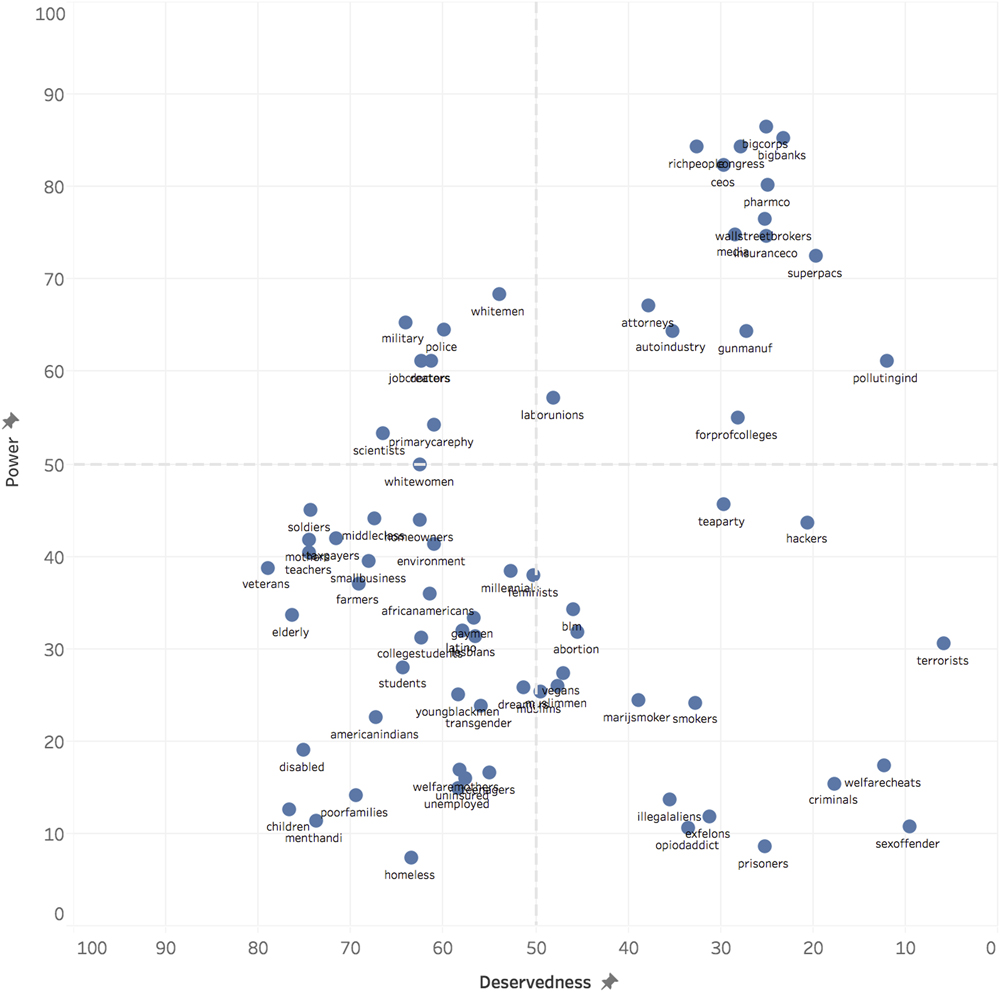
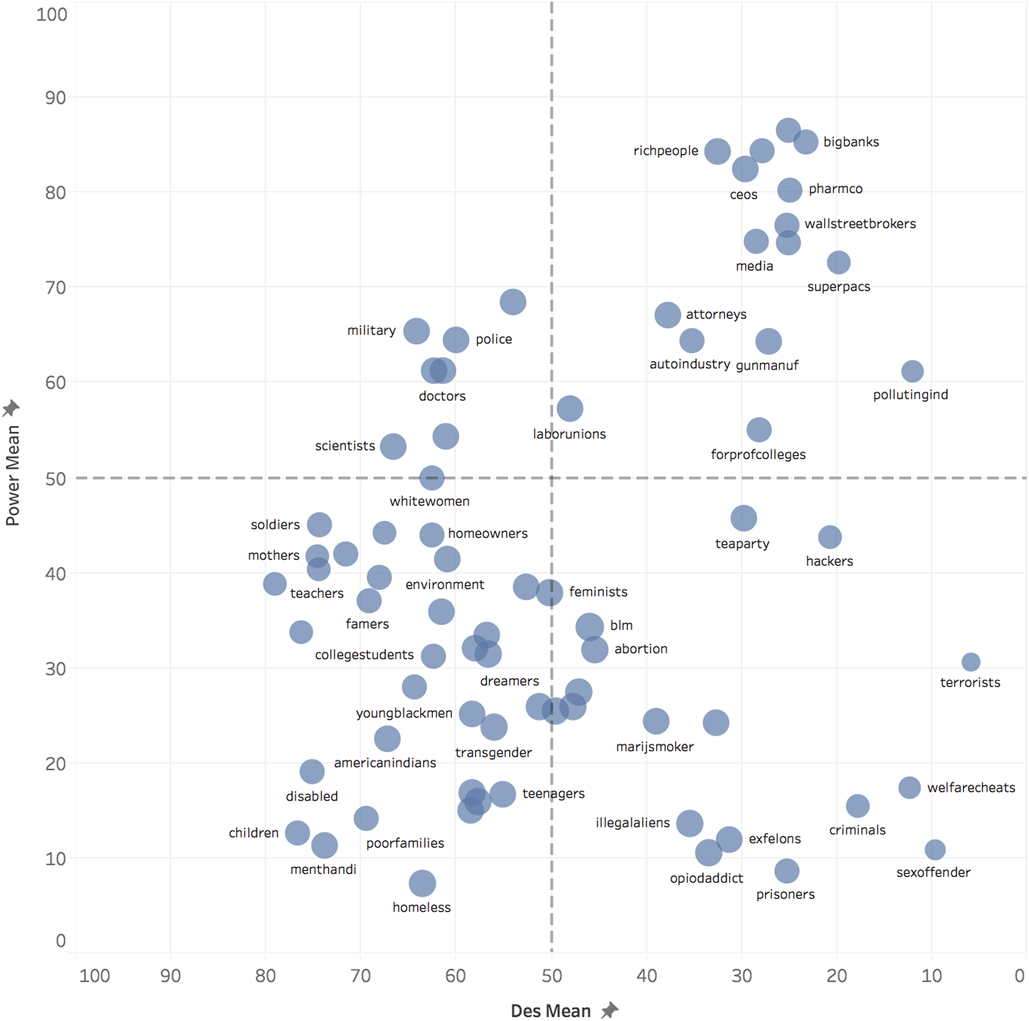
Figure 1 illustrates the placement of these groups on the two-dimensional matrix proposed by Schneider and Ingram (Reference Schneider and Ingram1993). We averaged the deservingness and power scores that MTurk workers gave to each group. Where a group fell on the horizontal axis relates to their level of deservingness; those who are high in deservingness are on the left. The vertical axis is related to perceived levels of political power. Those at the top are perceived as very powerful, whereas those at the bottom are viewed as powerless.Footnote 2 Although some interpreted Schneider and Ingram to suggest that groups are categorized dichotomously—as deserving or undeserving and politically powerful or weak (e.g., Schroedel and Jordan Reference Schroedel and Jordan1998)—it is important to emphasize that groups are arranged on a spectrum across these two dimensions.
Estimating the Power and Deservingness of Socially Constructed Groups
Note: The axes are arranged to mimic the matrix developed by Schneider and Ingram (Reference Schneider and Ingram1993).

At first glance, most groups are where we might intuit them to be. For example, criminals of all sorts are perceived as deviants, children are classified as dependents, and doctors are in the advantaged group. However, a few groups are notably different in placement than in Schneider et al.’s (2014) figure. Perhaps—to some degree—they should be, given the fact that social constructions can change as circumstances and politics change.Footnote 3 For instance, Schneider et al. (Reference Schneider, Ingram, DeLeon, Sabatier and Weible2014) categorized small businesses and taxpayers as advantaged, but our results show that they are clearly perceived as dependents. Similarly, our sample places young black men in the dependent category instead of the deviant category, where Schneider et al. placed them. Relatedly, groups such as the uninsured, DREAMers, and “illegal aliens” are solidly in one category based on power, whereas they were placed in the middle of the power spectrum in Schneider et al.’s (2014) figure. Notably, society views few groups as both politically powerful and deserving.
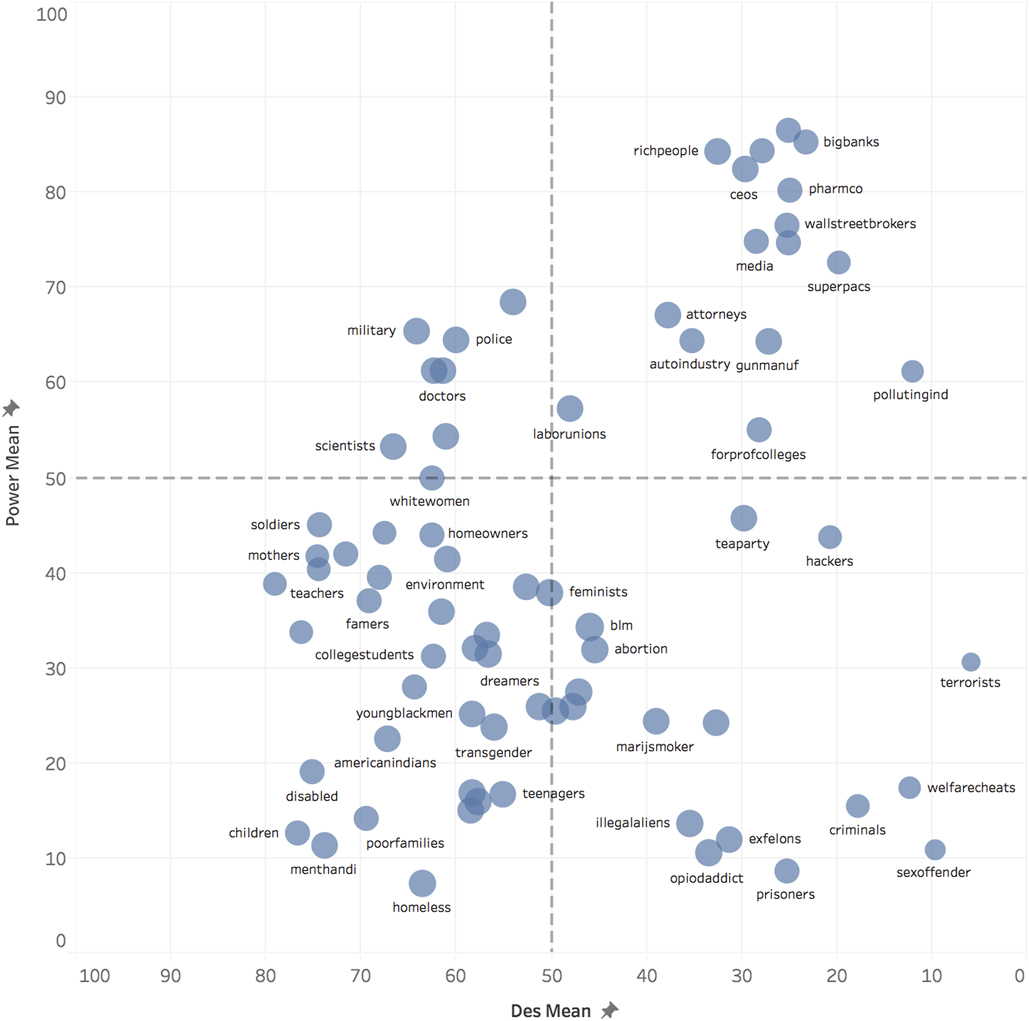
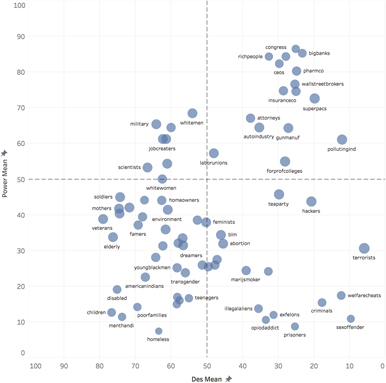
Figure 1 illustrates the location of groups in the two-dimensional space; however, closer analysis of the point estimates reveals considerable variation in the extent to which society agrees on levels of deservingness and power. Even with a very large sample, there are still some groups with much contention about how they should be categorized. Degree of consensus is depicted in figures 2 and 3. The size of the bubbles represents the magnitude of the standard deviations in deservingness and power, respectively. Essentially, our effort to empirically estimate the position of various groups elucidates the underlying contention and variation that exists.
Estimating the Contention of Deservingness of Social Constructions
Note: The size of the bubbles represents the magnitude of the standard deviation in deservingness for each target group based on N = 1,572.
Estimating the Contention of Power of Social Constructions
Note: The size of the bubbles represents the magnitude of the standard deviation in power for each target group based on N = 1,572.

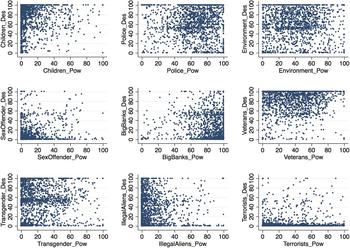
Figure 4 presents this information in another way: a representative series of scatterplots shows where each of the 1,572 MTurk workers evaluated groups’ levels of deservingness (i.e., horizontal axis) and power (i.e., vertical axis). Altogether, three patterns emerge; a few examples of each are provided.
Patterns of Consensus among Individual Respondents
Note: Similar to figures 1–3, the deservingness (horizontal axis) scale moves from high (left) to low (right). Power (vertical axis) shifts from high (top) to low (bottom), as delineated by Schneider and Ingram (Reference Schneider and Ingram1993).

First, some groups have significant consensus on both dimensions. In the case of children, for instance, most people view them as highly deserving but as having low levels of power. This is represented by the fact that the dots in the scatterplot are clustered in the lower left-hand corner. This pattern is similar for sex offenders and major banks, which clearly are categorized as deviants and contenders, respectively.
On the other end of the certainty spectrum are groups such as environmentalists. The scatterplot reveals substantial empirical noise around the evaluation of this group; there is no consensus on either dimension of concern. Other less-extreme examples of this pattern arise in evaluations of police and transgender people. Generally speaking, we found this pattern for most identity groups (e.g., Latinos and gay men).
The third pattern that emerged includes those that have consensus on one dimension but lack consensus on the other (e.g., veterans, terrorists, and “illegal aliens”). There is significant agreement on the notion that terrorists are low in deservingness, but there is no consensus about how much power this target group has, which makes intuitive sense. Some are likely to believe that people who become terrorists do so because they have low political efficacy, thus eschewing the use of existing political institutions. Conversely, others view terrorists as having significant political power, considering perceptions of their influence on others and sophistication of organization (e.g., ISIL and KKK), or because violence carries its own type of power. Similarly, we found that society agrees that “illegal aliens” have little political power, but there is major disagreement on levels of deservingness. This is likely to have political implications, but in what direction? If undocumented immigrants are viewed as deviants, we should expect policy makers to punish this group with few political consequences. However, if society views them as dependents, we would expect a different set of policy outcomes. New advances in the theory would provide more guidance for predicting the fate of ambiguously constructed or highly contested groups.
Our results empirically assessed the claim by (1) calculating point estimates that represent how deserving or politically powerful society views various groups, and (2) illustrating the extent to which consensus arose around those constructions. We found that whereas there are several groups whose social constructions are clearly agreed on, there are many more that are incredibly contentious.
NEW INSIGHTS
The social construction of target populations theory is critical to policy-design scholars. At its core, the theory is incredibly useful because it provides predictive insight, especially as it relates to how and why policy makers exacerbate inequality through the policy process. Our results resolved the questions we raised, particularly concerning the degree of consensus, but they also sparked new points of discussion.
To begin, we show that crowdsourcing can be used as a highly replicable and accurate way to (inexpensively) determine the contemporary social construction of target populations. The methods suggested by Schneider and Ingram (Reference Schneider and Ingram1993) likely would lead to much inconsistency in the categorizing process, especially for highly contentious groups. In contrast, crowdsourcing allows scholars to collect data on judgments of groups’ deservingness and power in a way that is accurate, reproducible, and replicable.
Schneider and Ingram (Reference Schneider and Ingram1993) noted that some groups’ reputations are likely to be more contentious than others, but they implied that we mostly should expect consensus. Our results empirically assessed the claim by (1) calculating point estimates that represent how deserving or politically powerful society views various groups, and (2) illustrating the extent to which consensus arose around those constructions. We found that whereas there are several groups whose social constructions are clearly agreed on, there are many more that are incredibly contentious.
Additionally, although our sample evaluated groups similarly to Schneider and Ingram’s (1993) hypothetical placements of groups, many categorizations were quite different. It is well known that the aggregation of answers from numerous lay people often can come closer to the “truth” than the estimates of a few experts (Lyon and Pacuit Reference Lyon, Pacuit and Michelucci2013). The difference between what Schneider and Ingram implicitly expected and what we found speaks volumes about Americans’ worldview as well as questions about who gets what, when, how, and why.
Theoretically, our results suggest that not only should we think about the groups in terms of the two dimensions posed by the theory but also about a third dimension: the degree of consensus. Schneider and Ingram (Reference Schneider and Ingram1993) initially developed this theory when the two major American political parties could agree more frequently on policy matters; however, this third dimension is likely to be particularly relevant in an era of high political polarization in American politics. We might expect to find multiple realities by which Democrats and Republicans, or liberal and conservatives, live. Perhaps there are multiple constructions of target groups that should be delineated. Drastically different worldviews should lead to different policy outcomes as legislative majorities shift from one party to another.
By analyzing data about respondents’ political identification and demographic profiles, we also could generate several relevant predictions. These data would allow us to uncover the underlying political determinants of consensus—or lack thereof. Scholars also could delineate predictions about how policy makers of various demographic groups might view the world; that is, we may understand better how descriptive and substantive representations are related. This type of data also might allow us to gain systematic insight on how members of target groups view themselves. We thereby could make predictions about chances for group mobilization—perhaps even develop intuition on whether mobilization is likely to happen within (e.g., voting) or outside (e.g., protest) of American political institutions. Taken together, methodological advances can be leveraged to expand the contributions of this tried-and-true theory.
Although our study examined and compared a vast array of groups rather than focusing on those within a particular policy realm (which is typical), our findings address the proposition that not all policy enhances democracy. For instance, we found that few groups can be easily categorized as advantaged: (1) there are no groups in the most upper left-hand corner, and (2) there are many more groups in the contenders’ area compared to the matrix depicted in Schneider, Ingram, and DeLeon’s (Reference Schneider, Ingram, DeLeon, Sabatier and Weible2014) most recent chart. Because “no legislators want to openly do good things for shady people,” our results may address a public mood marked by cynicism or portend an increasingly large gap between harsh rhetoric toward contenders and the hollow regulations presented to them.
In an era marked by polarization, which direction should we expect policy makers to take regarding groups whose construction is unclear or ambiguous? Our results reveal that some groups border two categories whereas others have consensus on one dimension but not another; this makes outcomes of the policy process for these groups difficult to predict. However, ambiguity provides room for a wider array of discursive maneuvers to be employed by policy entrepreneurs. Undocumented immigrants make an excellent case in point. In the 1980s, political parties could agree on amnesty; today, however, there ostensibly is more leeway for policy makers to carve out subgroups that elicit more agreement (e.g., DREAMers versus “illegal aliens”). Relatedly, it is possible that social constructions now may pivot on partisan lines, or it may be the case that lack of consensus around the construction of a group suggests that there is both interparty and intraparty contention about how to best deal with these groups. Indeed, groups that we found having substantial empirical noise (e.g., veterans and environmentalists) may be understood best as wedge groups, potentially a fifth category or ideal type. These issues must be resolved empirically.
Schneider and Ingram (2005, 10) suggested that “contested social constructions are inherently unstable and ripe for policy change that subdivides the populations into more deserving and less deserving categories.” Moreover, political entrepreneurs can capitalize by scapegoating negatively constructed groups, thereby sustaining or facilitating degenerative politics, or the “exploitation of derogatory social constructions, manipulation of symbols or logic, and deceptive communication that masks the true purpose of policy” (Schneider and Ingram Reference Schneider, Ingram, Schneider and Ingram2005, 11). Our results show, unexpectedly, that there are many politically relevant, salient target groups with much contention and controversy around their social construction. An important next step would be to discern empirically the consequences of these contested social constructions on policy, particularly as those implications speak to whether policy is increasingly likely to result in degenerative politics.
SUPPLEMENTARY MATERIAL
To view supplementary material for this article, please visit https://doi.org/10.1017/S1049096518000987
ACKNOWLEDGMENTS
The authors thank Lorin Bruckner of UNC-Chapel Hill’s Davis Library for lending her expertise and assistance in data visualization.