Introduction
Biotic interactions play an important role in the structure and stability of ecological communities (Ives and Carpenter, Reference Ives and Carpenter2007; Thébault and Fontaine, Reference Thébault and Fontaine2010; Benkman, Reference Benkman2013). Food web interactions have been extensively investigated in ecological research (Williams and Martinez, Reference Williams and Martinez2000; Tang et al., Reference Tang, Pawar and Allesina2014; Allesina et al., Reference Allesina, Grilli, Barabás, Tang, Aljadeff and Maritan2015), showing that direct trophic (feeding) interactions are only one of many mechanisms by which species can influence each other (Bertness and Callaway, Reference Bertness and Callaway1994; Ings et al., Reference Ings, Montoya, Bascompte, Blüthgen, Brown, Dormann, Edwards, Figueroa, Jacob, Jones, Lauridsen, Ledger, Lewis, Olesen, van Veen, Warren and Woodward2009; Mougi and Kondoh, Reference Mougi and Kondoh2012; Sanders et al., Reference Sanders, Jones, Thébault, Bouma, van der Heide, van Belzen and Barot2014), and that non-trophic interactions can have important effects on the dynamic of insect populations (Schmitz, Reference Schmitz1998; Anderson et al., Reference Anderson, Inouye and Underwood2009; Utsumi, Reference Utsumi2011). Both trophic and non-trophic interactions can change species distribution and abundance through trait- and density-mediated indirect effects (Ohgushi et al., Reference Ohgushi, Craig and Price2007; Bukovinszky et al., Reference Bukovinszky, van Veen, Jongema and Dicke2008; Eubanks and Finke, Reference Eubanks and Finke2014). Indirect effects occur when the effect of one species on another is mediated by changes to a third species (Wootton, Reference Wootton1994).
Trait-mediated indirect interactions are important in plant–insect communities (Ohgushi, Reference Ohgushi2008; Karban, Reference Karban2011; Giron et al., Reference Giron, Dubreuil, Bennett, Dedeine, Dicke, Dyer, Erb, Harris, Huguet, Kaloshian, Kawakita, Lopez-Vaamonde, Palmer, Petanidou, Poulsen, Sallé, Simon, Terblanche, Thiéry, Whiteman, Woods and Pincebourde2018) because herbivory leads to phenotypic changes affecting physiology, chemistry and morphology of the plant (Karban and Baldwin, Reference Karban and Baldwin1997; Kant et al., Reference Kant, Jonckheere, Knegt, Lemos, Liu, Schimmel, Villarroel, Ataide, Dermauw, Glas, Egas, Janssen, van Leeuwen, Schuurink, Sabelis and Alba2015; Ohgushi and Hambäck, Reference Ohgushi and Hambäck2015), which affect the performance of other herbivores. These herbivore-induced plant traits have the potential to affect whole host plant communities (Dicke et al., Reference Dicke, van Loon and Soler2009; Soler et al., Reference Soler, van der Putten, Harvey, Vet, Dicke and Bezemer2012; Poelman and Kessler, Reference Poelman and Kessler2016; Stam et al., Reference Stam, Dicke and Poelman2018; Vaello et al., Reference Vaello, Sarde, Marcos-García, Boer and Pineda2018), and they may facilitate or impede the performance of subsequent herbivores (Stam et al., Reference Stam, Kroes, Li, Gols, van Loon, Poelman and Dicke2014; Harvey et al., Reference Harvey, Ode, Malcicka and Gols2015; Cornelissen et al., Reference Cornelissen, Cintra and Santos2016; Uesugi et al., Reference Uesugi, Morrell, Poelman, Raaijmakers, Kessler and Heil2016; Lee et al., Reference Lee, Joo, Kim and Baldwin2017; Li et al., Reference Li, Zhong, Sanders, Smit, Wang, Nummi, Zhu, Wang, Zhu and Hassan2018). Changes caused by herbivory can create new habitats within a plant that can be used by opportunistic herbivores (Ohgushi, Reference Ohgushi2008). Plants are often attacked by multiple herbivores and they respond specifically to single or dual herbivory (Kessler and Halitschke, Reference Kessler and Halitshke2007; Poelman et al., Reference Poelman, Broekgaarden, van Loon and Dicke2008), which differentially affects the interactions with a third herbivore (Kroes et al., Reference Kroes, Stam, David, Boland, van Loon, Dicke and Poelman2016). Here, we studied a special case of interaction among herbivores, wherein the natural distribution of the moth Atheloca bondari Heinrich (Lepidoptera: Pyralidae) is influenced by the co-occurrence with the mites Aceria guerreronis Keifer (Acari: Eriophyidae) and Steneotarsonemus concavuscutum Lofego and Gondim (Acari: Tarsonemidae). Assessing this co-occurrence is a first step in assessing the pest status of this moth as a coconut pest in natural fields.
The coconut palm is a perennial plant native to Southeast Asia but is currently distributed throughout the pantropics (Chan and Elevitch, Reference Chan, Elevitch and Elevitch2006; Gunn et al., Reference Gunn, Baudouin and Olsen2011; Ahuja et al., Reference Ahuja, Ahuja and Ahuja2014) and considered a crop of economic importance in many countries (Hoe, Reference Hoe2018). Mites and months are considered important coconut pests around the world, usually related to decreasing production of coconut fruits due to damage and abortion of the reproductive structure (Bondar, Reference Bondar1940; Moore, Reference Moore, Howard, Moore, Giblin-Davis and Abad2001; Fernando and Aratchige, Reference Fernando, Aratchige, Sabelis and Bruin2010; Navia et al., Reference Navia, Gondim, Aratchige and Moraes2013; Rezende et al., Reference Rezende, Melo, Oliveira and Gondim2016). Larvae of different species of moths feed on the male and female flowers of coconuts (Bondar, Reference Bondar1940; Moore, Reference Moore, Howard, Moore, Giblin-Davis and Abad2001; Cock and Burris, Reference Cock and Burris2013). The moths can complete their life cycle in developing nuts (Bento et al., Reference Bento, Nava, Chagas and Costa2006; Santana et al., Reference Santana, Barros, Torres and Gondim2010), but their occurrence in nuts is very low. This suggests that the larvae of moths are not able to bore the exocarp of the nuts.
The exterior of the nut is formed by a fibrous exocarp and an arranged set of tepals (perianths) covering the meristematic region (Smit, Reference Smit1970; Howard and Rodriguez, Reference Howard and Rodriguez1991). Herbivores that can access the meristematic region can feed on nutritional tissues, but only very small organisms such as mites are able to enter the space between the exocarp and perianth (Moore, Reference Moore, Howard, Moore, Giblin-Davis and Abad2001; Navia et al., Reference Navia, Moraes, Lofego and Flechtmann2005; Lawson-Balagbo et al., Reference Lawson-Balagbo, Gondim, Moraes, Hanna and Schausberger2008). For example, the mites Ac. guerreronis and S. concavuscutum are often found feeding on the meristematic region of the nuts under the perianth (Lofego and Gondim, Reference Lofego and Gondim2006; Lawson-Balagbo et al., Reference Lawson-Balagbo, Gondim, Moraes, Hanna and Schausberger2007; Lima et al., Reference Lima, Oliveira, Melo, Gondim, Sabelis, Pallini and Janssen2017). Coconuts infested by mites show necrotic lesions extending from the meristematic region to the surface of the nut not covered by the perianth (Navia et al., Reference Navia, Moraes, Lofego and Flechtmann2005; Lofego and Gondim, Reference Lofego and Gondim2006).
A previous study shows that the moth At. bondari is an opportunistic species that uses necrosis of Ac. guerreronis to access the meristematic region of the nut (Santana et al., Reference Santana, Torres, Gondim and Barros2009). Although At. bondari is associated with economic loss in coconut crops (Bondar, Reference Bondar1940; Ferreira et al., Reference Ferreira, Araújo, Sarro and Ferreira2002), the study of Santana et al. (Reference Santana, Torres, Gondim and Barros2009) reveals that this species may be a secondary pest. However, Santana et al. (Reference Santana, Torres, Gondim and Barros2009) did not evaluate fallen nuts, and if nuts infested only by At. bondari have a higher probability of falling, the co-occurrence between At. bondari and Ac. guerreronis may have been overestimated.
In the laboratory, larvae of At. bondari were better able to access the meristematic region of nuts that had necrosis of Ac. guerreronis or had received mechanical damage (Santana et al., Reference Santana, Torres, Gondim and Barros2009), reinforcing the idea that morphological changes of the exocarp of the coconut facilitate the infestation of the larva of At. bondari. Aceria guerreronis and S. concavuscutum cause similar necrotic lesion patterns (Navia et al., Reference Navia, Moraes, Lofego and Flechtmann2005), so it is expected that At. bondari also co-occurs with S. concavuscutum. This is what we set out to test in this manuscript by sampling coconuts in the field and assessing co-occurrence of the moth and the two mite species.
Since the space between the perianth and the exocarp increases as fruits ages (Lima et al., Reference Lima, Melo, Gondim and Moraes2012), we collected nuts with different ages to analyse if age influenced the occurrence of At. bondari larvae. In addition, as both mite species and the moth occupy the same feeding sites, each could in theory influence the distribution of the other species (Capitán et al., Reference Capitán, Cuenda and Alonso2015; Segre et al., Reference Segre, Malach, Henkin and Kadmon2016), we also evaluated the co-occurrence of the mites and how this influenced the presence of At. bondari.
Materials and methods
We randomly collected bunches from the tree and fallen nuts of coconut palms (Cocos nucifera L.). According to coconut tree phyllotaxis (Sobral, Reference Sobral, Ferreira, Warwick and Siqueira1994), we collected the bunches corresponding to leaves 12–16, which refers to bunches of 2– 6 months old, respectively. The fallen nuts under the palm trees were collected, the age of fallen nuts was determined by comparing their size with nuts removed from bunches of the palm tree, and fallen nuts were subsequently grouped by age. Fallen nuts that did not have the perianths or that were damaged by humans were not evaluated. Nuts were harvested from trees every 15 days in the state of Pernambuco, Brazil, between March and July of 2016 in the following fields: Itamaracá (Sossego) (7°43′S, 34°49′W), Itamaracá (Pilar) (7°47′S, 34°51′W), Itamaracá (Coroa do Avião) (7°48′S, 34°50′W) and Igarassú (Mangue Seco) (7°49′S, 34°50′W). Fallen nuts were collected only from Igarassú (Mangue Seco). In total, 1194 nuts (967 collected from coconut palms and 227 fallen nuts) were brought to the laboratory for evaluation, where we carefully removed the perianths and observed the meristematic region under them with a stereomicroscope (Zeiss Stemi DV4), and we scored the presence of Ac. guerreronis, S. concavuscutum and larvae of At. bondari.
The probability of co-occurrence was calculated following Griffith et al. (Reference Griffith, Veech and Marsh2016), assuming a hypergeometric distribution:
 $$Pj = \;\displaystyle{{\left({\matrix{ {N_1} \cr j \cr } } \right)\times \;\left({\matrix{ {N-N_1} \cr {N_{2\;}-j} \cr } } \right)} \over {\left({\matrix{ N \cr {N_2} \cr } } \right)}}\comma \;$$
with Ni the number of nuts with species i (= 1, 2) and N the total number of plants sampled, and j ranging from 1 to N 1 (Griffith et al., Reference Griffith, Veech and Marsh2016). This probability shows whether the species are positively, negatively or randomly associated. We analysed all co-occurrence combinations among species and discuss the results with a focus on At. bondari infestations. A positive association could be the result of attraction of At. bondari and the mites to the same nuts, independent of the presence of the other species or of facilitation of the caterpillars entering the area under the perianth due to mite damage. The absence of a positive or negative association would show that the moths and mites are not attracted to the same nuts, and that the infestation of mites does not facilitate the infestation by moths. The proportions of nuts infested by the different herbivores were compared between fallen nuts and nuts on trees and among nuts of different ages with a generalized linear model (GLM) with a binomial error distribution (Crawley, Reference Crawley2013). All statistical analyses were performed in R (R Development Core Team, 2014).
Results
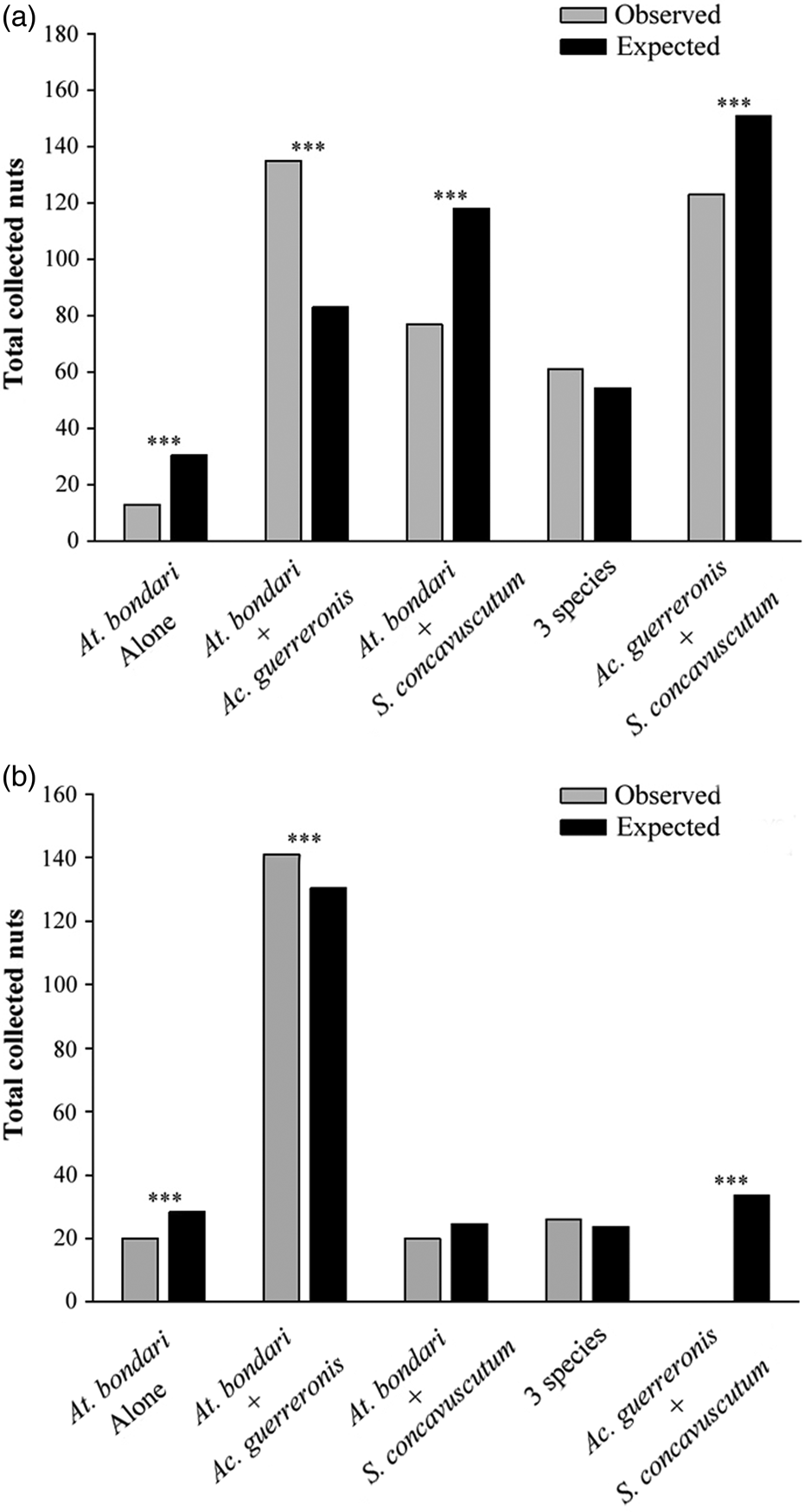
The presence of At. bondari larvae in nuts not infested by mites was lower than expected in both fallen fruits and fruit from trees (fig. 1a, b). We observed a significant positive co-occurrence between At. bondari and Ac. guerreronis in both nuts collected from coconut palms and in fallen nuts (fig. 1a, b). The moth occurred significantly less than expected when the nuts on trees were infested by S. concavuscutum (fig. 1a), but the numbers of fallen fruits coinfested with At. bondari and S. concavuscutum did not differ from expected under a random distribution (fig. 1b). The observed distribution of At. bondari also did not differ from expected for nuts infested by both species of mites, both in nuts from trees and in fallen nuts (fig. 1a, b). Furthermore, we found that Ac. guerreronis and S. concavuscutum co-occur less than expected in nuts from trees and fallen nuts (fig. 1a, b).
Occurrence of At. bondari, Ac. guerreronis and Steneotarsonemus concavuscutum and their co-occurrence in the field. (a) Nuts collected from trees; (b) fallen nuts. The grey bars correspond to the total number of nuts collected for each category and the black bars represent the number expected. Asterisks indicate significant differences between observed and expected (hypergeometric distribution test, Griffith et al., Reference Griffith, Veech and Marsh2016): *P < 0.05; **P < 0.01; ***P < 0.001.

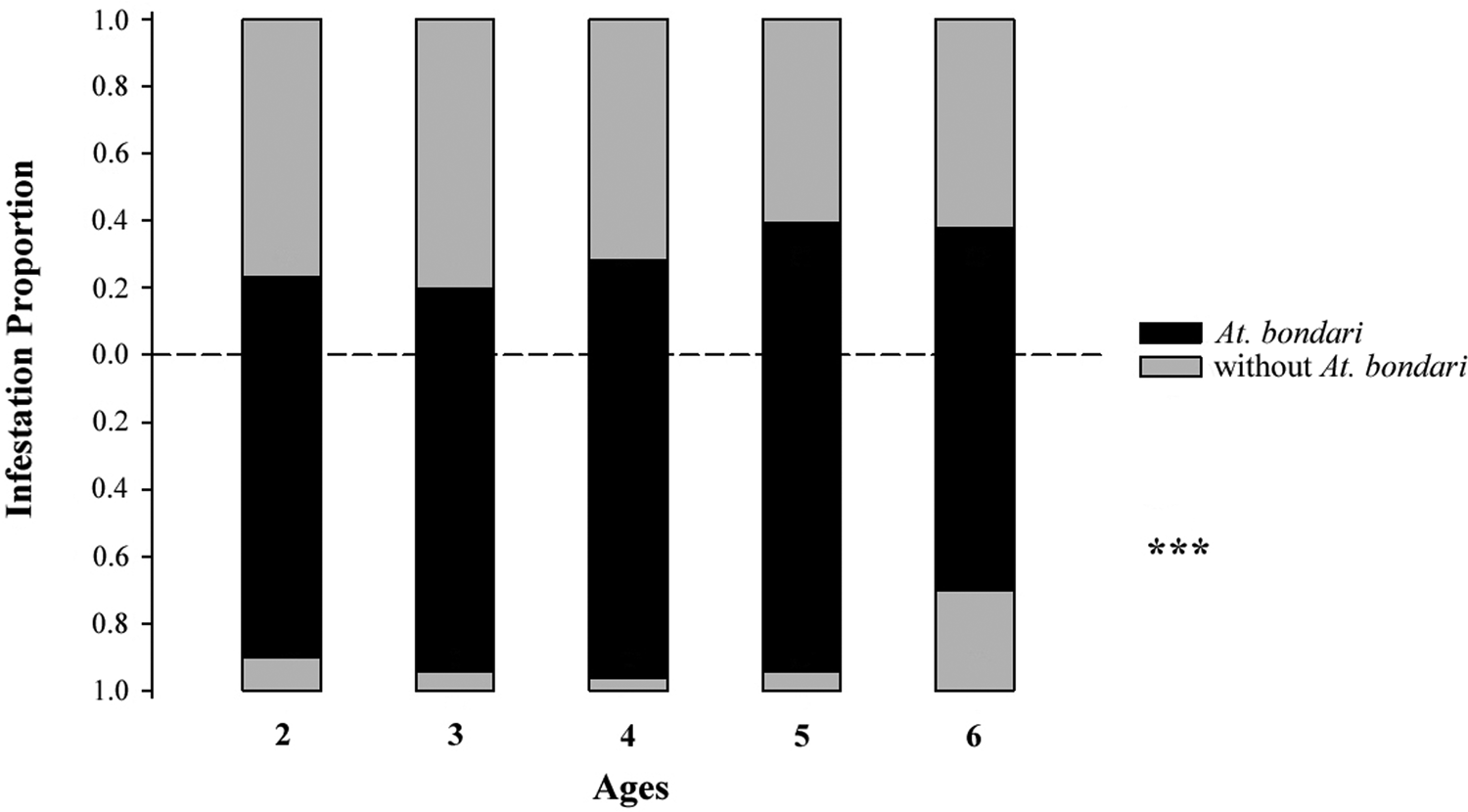
The distance between the edge of the perianth of coconut and the subjacent nut surface increases with nut age (Lima et al., Reference Lima, Melo, Gondim and Moraes2012) and may therefore become more accessible to the moth caterpillars. We therefore first analysed the occurrence of At. bondari in nuts of different ages both in fallen nuts and nuts from trees. The proportion of At. bondari did not differ among nuts of different ages (P = 0.32), but the proportion of infested nuts was higher in fallen nuts than from trees (P < 0.0001) (fig. 2).
Proportion of At. bondari in fallen coconuts and nuts from trees of different ages. Bars below the dashed line represent the proportion of fallen nuts; these above the dashed line represent the proportion of nuts collected from trees. Asterisks indicate significant overall difference between fallen and trees nuts (GLM): *P < 0.05; **P < 0.01; ***P < 0.001.

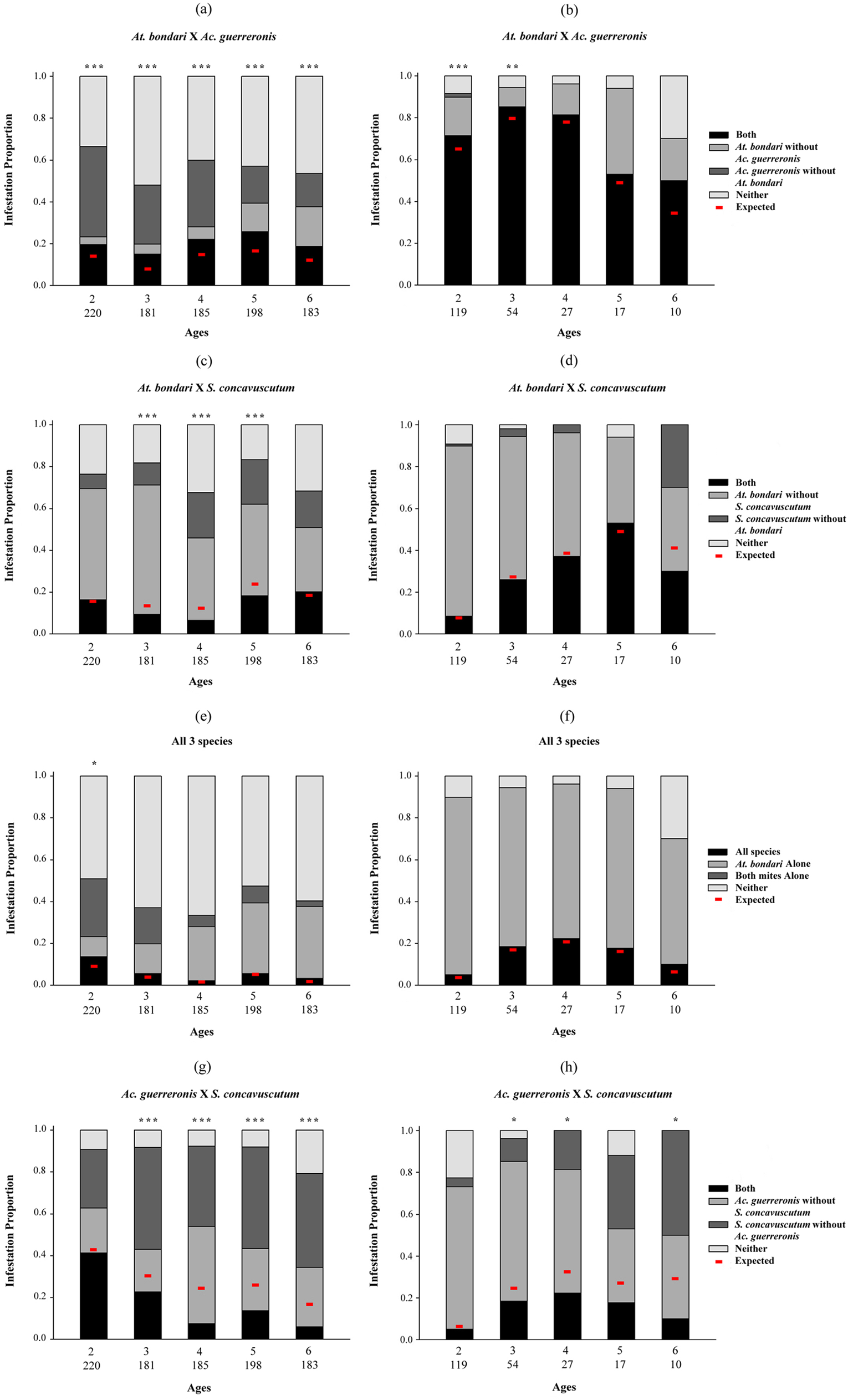
Third, we analysed the co-occurrence of At. bondari, Ac. guerreronis and S. concavuscutum in nuts of different ages. The proportion of At. bondari was higher than expected in nuts infested by Ac. guerreronis of all ages sampled from the coconut palm (fig. 3a). The proportion of fallen nuts infested by At. bondari and Ac. guerreronis was also higher than expected at all ages sampled; however, this difference was not always significant (fig. 3b).
Proportion of At. bondari, Ac. guerreronis and S. concavuscutum and their co-occurrence on coconut fruits of different ages for different combinations of these three species (a–h). Left-hand panels represent the nuts collected from trees; right-hand panels fallen nuts. The red dash indicates the expected proportion of fruits infested by both species. The total numbers of fruits sampled per age show below the ages along the horizontal axis. Asterisks indicate significant differences between observed and expected (hypergeometric distribution test; Griffith et al., Reference Griffith, Veech and Marsh2016): *P < 0.05; **P < 0.01; ***P < 0.001.

The proportion of nuts infested by At. bondari and S. concavuscutum varied between different ages. In nuts collected from palm trees, the co-occurrence of these two species was lower than expected at age 3, age 4 and age 5 (fig. 3c). The co-occurrence of At. bondari and S. concavuscutum did not differ from expected on fallen fruits of any age (fig. 3d).
Co-occurrence of the three species did not differ from random in nuts of different ages. In nuts collected from trees, At. bondari, Ac. guerreronis and S. concavuscutum co-occurred more often than expected only in nuts of age 2 (fig. 3e). There was no difference in occurrence in fallen nuts of any age (fig. 3f).
Co-occurrence of the two mites was significantly lower than expected for all nut ages both on nuts collected from coconut palm and on fallen nuts. In nuts from trees, the proportion of nuts infested by Ac. guerreronis and S. concavuscutum did not differ from expected at age 2 (fig. 3g). In fallen nuts, the co-occurrence of mites was significantly lower than expected at age 3, age 4 and age 6 (fig. 3h).
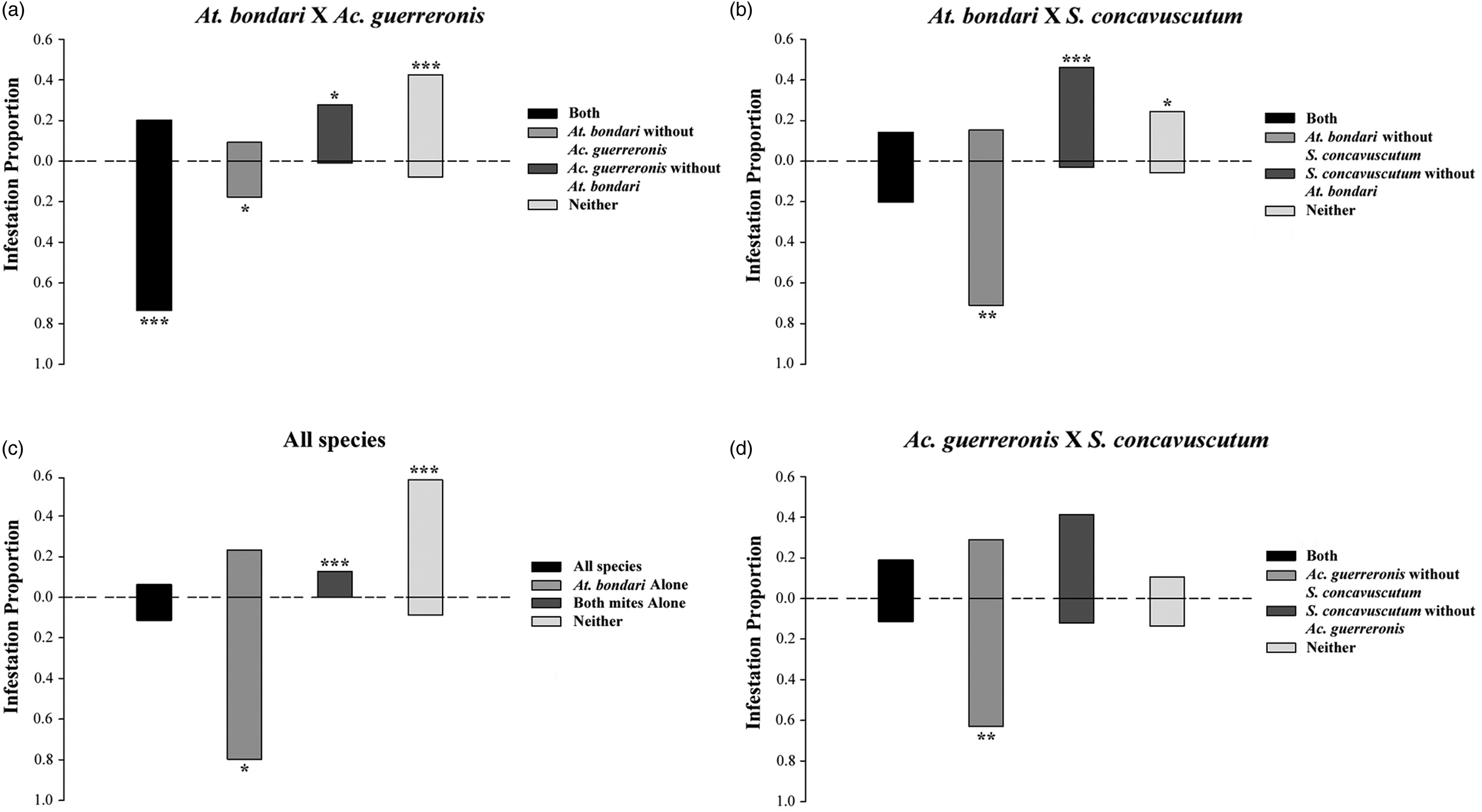
Finally, we compared the occurrence and co-occurrence of species between fruits collected from trees and fallen fruits. The proportion of fruits with At. bondari was always higher in fallen fruits than fruits from trees, but the proportion of fruits infested by At. bondari together with S. concavuscutum did not differ between fruit origins (fig. 4a, b, c). The proportion of fruits infested by At. bondari and Ac. guerreronis was significantly higher in fallen fruits than in fruits from trees, but the proportion of fruits infested by Ac. guerreronis without At. bondari was higher in fruits from trees than in fallen fruits (fig. 4a). The proportion of fruits infested by At. bondari without Ac. guerreronis was higher in fallen fruits (fig. 4a). The highest proportion of fruits without these two species was found in fruits collected from the palm trees (fig. 4a).
Proportion of At. bondari, Ac. guerreronis and S. concavuscutum and their interactions in fruits collected from tree and fallen fruits for different combinations of these three species (a–d). Bars below the dashed line represent the proportion of fallen fruits, above the dashed line the proportion of fruits collected from trees. Asterisks indicate significance with a GLM test: *P < 0.05; **P < 0.01; ***P < 0.001.

Steneotarsonemus concavuscutum occurred more in fruits collected from trees than in fallen fruits when not co-occurring with At. bondari (fig. 4b). In contrast, without S. concavuscutum, At. bondari occurred significantly more in fallen fruits. The proportion of fruits without these two species was higher in fruits collected from the trees (fig. 4b).
The proportion of fruits infested by both mites without At. bondari was higher in fruits from trees than in fallen fruits, the same was found for fruits without any of the three species (fig. 4c). The occurrence of At. bondari in fruits not infested by mites was higher in fallen fruits than fruits from coconut palms (fig. 4c).
Without S. concavuscutum, Ac. guerreronis was observed in higher proportions in fallen fruits than in fruits from trees, this is probably due to the higher co-occurrence of At. bondari with Ac. guerreronis (fig. 4d).
Discussion
We show positive and negative co-occurrence among three species that use coconuts as a resource. The occurrence of larvae of the moth At. bondari under the perianths of coconuts on palm trees was higher than expected when the nuts were infested by Ac. guerreronis, whereas it was lower than expected for nuts that were infested by the other mite species S. concavuscutum (fig. 1a). Santana et al. (Reference Santana, Torres, Gondim and Barros2009) suggest that the co-occurrence of At. bondari and Ac. guerreronis is mainly due to a change in nut shape caused by the necrotic lesions of the mite, which allow the larvae of the moth access to the meristematic region under the perianths. However, the patterns of necrotic lesions caused by S. concavuscutum are similar to those caused by Ac. guerreronis (Navia et al., Reference Navia, Moraes, Lofego and Flechtmann2005), thus positive co-occurrence would also be expected between S. concavuscutum and At. bondari. Thus, our results show that the co-occurrence among these species seems not to be related only to the necrotic lesions caused by the mites.
The simplest explanation for the co-occurrence, or lack thereof, is that the mites and the moths prefer the same, or different fruits, independent of the presence of the other species. For example, if At. bondari and Ac. guerreronis prefer to infest coconuts with the same quality inside a bunch, the positive co-occurrence between these species may be caused by similar preferences of the two species for nuts with a certain quality. Likewise, the lack of co-occurrence between At. bondari and S. concavuscutum may be caused by these two herbivores having different preferences.
Another explanation for the co-occurrence, or lack thereof, is the effects of the herbivores on each other through induced plant defences. Changes of plant traits induced by herbivory (Karban and Baldwin, Reference Karban and Baldwin1997; Kessler and Baldwin, Reference Kessler and Baldwin2002; Kant et al., Reference Kant, Jonckheere, Knegt, Lemos, Liu, Schimmel, Villarroel, Ataide, Dermauw, Glas, Egas, Janssen, van Leeuwen, Schuurink, Sabelis and Alba2015) are known to affect the interactions in herbivore–plant communities (Gouinguené and Turlings, Reference Gouinguené and Turlings2002; Heil, Reference Heil2008; Ohgushi, Reference Ohgushi2008; Ali and Agrawal, Reference Ali and Agrawal2014; Stam et al., Reference Stam, Kroes, Li, Gols, van Loon, Poelman and Dicke2014; Ohgushi and Hamback, Reference Ohgushi and Hambäck2015; Poelman and Kessler, Reference Poelman and Kessler2016; Howard et al., Reference Howard, Kalske and Kessler2018; Rusman et al., Reference Rusman, Lucas-Barbosa and Poelman2018; Vries et al., Reference Vries, Poelman, Anten and Evers2018). These changes may be a simple loss of plant tissue, resulting in resource competition between herbivores, but may also be of chemical origin, through the induction of herbivore-induced plant defences (Kessler and Halitschke, Reference Kessler and Halitshke2007; Ohgushi et al., Reference Ohgushi, Craig and Price2007; Poelman et al., Reference Poelman, Broekgaarden, van Loon and Dicke2008; Poelman and Kessler, Reference Poelman and Kessler2016). Attacks of herbivores can activate induced defences of plants through the jasmonic acid and salicylic acid (SA) phytohormonal signalling networks (Pieterse et al., Reference Pieterse, van der Does, Zamioudis, Leon-Reyes and van Wees &2012; Glas et al., Reference Glas, Alba, Simoni, Villarroel, Stoops, Schimmel, Schuurink, Sabelis and Kant2014; Grinberg-Yaari et al., Reference Grinberg-Yaari, Alagarmalai, Lewinsohn, Perl-Treves and Soroker2015), and different herbivore species can induce different defences. Due to cross-talk between these two phytohormonal pathways, induction of defences by one species may have positive, neutral or negative effects on the performance and occurrence of other species (Rodriguez-Soana et al., Reference Rodriguez-Saona, Musser, Vogel, Hum-Musser and Thaler2010; Mathur et al., Reference Mathur, Tytgat, Graaf, Kalia, Reddy, Vet and van Dam2013; Kant et al., Reference Kant, Jonckheere, Knegt, Lemos, Liu, Schimmel, Villarroel, Ataide, Dermauw, Glas, Egas, Janssen, van Leeuwen, Schuurink, Sabelis and Alba2015), resulting in positive, negative or no effects of herbivores on each other's performance (Thaler et al., Reference Thaler, Karban, Ullman, Boege and Bostock2002). If Ac. guerreronis and S. concavuscutum induce different plant defence responses, coconuts with different induced defences may not only influence the occurrence of At. bondari larvae but also the co-occurrence of both mites, as was found in this study (fig. 1a).
Furthermore, changes induced by herbivory may be physical, for example, the habitat construction by species of leaf-rolling caterpillars (Lill and Marquis, Reference Lill and Marquis2004). In our study system, physical changes as a result of herbivore attacks do occur, for example, the damage caused by the mites may increase the size of the opening between the perianth and the nut, allowing access to other herbivores. Thus, the co-occurrence of the three herbivores studied here may well be the consequence of all such changes induced by the mites on the coconuts. Clearly, to disentangle these different mechanisms, studies of the performance of At. bondari larvae on nuts that are both naturally or artificially infested with Ac. guerreronis, S. concavuscutum or not infested, as well as studies on the preference of larvae and oviposition of females for such nuts are needed.
Atheloca bondari larvae were not totally incapable to access the meristematic region of nuts that were not infested by mites (fig. 1a). Attacks by other herbivores or natural increases of the perianth opening may also facilitate the access of At. bondari larvae to nuts without mites. However, the distribution of At. bondari did not differ among coconuts of distinct ages (fig. 2), suggesting that the natural increase of the opening to the meristematic region in older nuts (Howard and Rodriguez, Reference Howard and Rodriguez1991; Lima et al., Reference Lima, Melo, Gondim and Moraes2012) is not sufficient to allow larval infestation. We recommend a study to measure the size of access to the meristematic region in nuts either infested by Ac. guerreronis or S. concavuscutum, and not infested by mites.
The presence of At. bondari larvae in coconuts seems mostly positively related to infestations by Ac. guerreronis (fig. 1a, b; fig. 3a, b). In nuts collected from palm trees, At. bondari larvae co-occur with Ac. guerreronis more frequently than expected at all ages of nuts, whereas the co-occurrence these species was higher than expected only in fallen nuts of ages 2 and 3 (fig. 3a, b). The lack of significant co-occurrence between At. bondari and Ac. guerreronis in older fallen fruits may be due to the low number of these nuts found (fig. 3b, d, f, h). Apparently, older coconuts tend to fall less than the younger ones, in agreement with observations that the nuts typically fall 3–8 weeks after the spathe opens (Lever, Reference Lever1969; Cock et al., Reference Cock, Gallego, Godfray, Ferrar and Stechmann1985), where younger nuts are more likely to fall after the herbivore attack (Vanderplank, Reference Vanderplank1959; McKinlay, Reference McKinlay1965; Williams, Reference Williams1974).
Aceria guerreronis is considered the main pest of the coconut palm, where the attack of this mite results in copra yield loss (Mathews et al., Reference Mathew, Anand and Nair2004; Navia et al., Reference Navia, Gondim, Aratchige and Moraes2013). In some cases, it has been reported that Ac. guererronis infestations cause significant premature coconut drop (Nair, Reference Nair, Fernando, Moraes and Wickramananda2002; Rezende et al., Reference Rezende, Melo, Oliveira and Gondim2016). If Ac. guerreronis reduces the vigour and germination of coconut seeds, premature drop of nuts infested by the mite may be advantageous for the coconut palm, because it might reduce the risk of infection of the other nuts in the bunch and reduce the investment in nuts of lower quality. However, many nuts infested with Ac. guerreronis produce vigorous seedlings (Haq et al., Reference Haq, Sumangala, Fernando, Moraes and Wickramananda2002; Regi and Mathews, Reference Regi and Mathews2004; Beevi et al., Reference Beevi, Mohan, Paul and Mathew2006), hence, the question remains whether feeding by Ac. guerreronis is also detrimental for the coconut trees, and not just for commercial production of coconuts. Here we show that infestations by At. bondari are correlated with the fall of coconuts (fig. 4a, b, c), whereas infestations with Ac. guerreronis are less so (fig. 4a, c). Thus, the presence of Ac. guerreronis in nuts can increase production losses not due to herbivory of this mite, but due to the facilitation of nut attack by other herbivores. Clearly, further study is needed into the causes of prematurely fallen coconuts.
The co-occurrence of At. bondari and S. concavuscutum was exceptionally low in nuts of age 3, 4 and 5 harvested from trees (fig. 3c), and the proportion of fallen nuts with At. bondari and S. concavuscutum did not differ from that of nuts collected from the trees (fig. 4b). It is not clear to us why At. bondari and S. concavuscutum co-occur less in nuts of intermediate age, but this may be due to the low quality of the nuts of these ages. We emphasize again the importance of studying the performance of At. bondari in nuts that are artificially infested with mites.
In nuts from trees, there is a tendency of Ac. guerreronis and S. concavuscutum to co-occur less frequently as coconut nuts become older (fig. 3g), and this tendency cannot be explained by the larger number of old fallen nuts infested by both mites (fig. 3h). Measurements of non-infested coconuts show that the opening between the perianth and the nut surface of nuts of age 2 is 20–40 μm (Lima et al., Reference Lima, Melo, Gondim and Moraes2012). The tiny adult females of Ac. guerreronis (36–52 μm thick) (Keifer, Reference Keifer1965) can colonize these young nuts; however, adult females of S. concavuscutum (110–125 μm wide) (Lofego and Gondim, Reference Lofego and Gondim2006) may have difficulties to enter the microhabitat of non-infested young nuts. Lima et al. (Reference Lima, Melo, Gondim and Moraes2012) show that infestation by Ac. guerreronis increases the opening between the perianth and the meristematic region. The co-occurrence of Ac. guerreronis and S. concavuscutum in younger nuts may thus be due to facilitation of S. concavuscutum by Ac. guerreronis, and the less frequent co-occurrence in older fruits may be due to competitive exclusion.
Acknowledgements
We thank the CAPES Foundation (Brazilian Ministry of Education) for their financial support [grant numbers 88882.183145/2018-01, 88881.187087/2018-01].
Author contribution
AAPN, DBL and JWSM conceived and designed the experiments. AAPN and MGCGJ conducted the experiments. AJ analysed the data. AAPN and AJ wrote the manuscript. All authors read and approved the manuscript.
Conflict of interest
The authors declare that they have no conflict of interest.