1. Introduction
Sino-Tibetan historical linguistics is still in its early stages of development. This is mainly due to a lack of data from conservative branches and a limited understanding of the internal morphology in eroded language varieties. As a result, a substantial portion of research in this domain does not fully embrace the Neogrammarian method, particularly in the context of subgrouping.
With the increasing emphasis on quantitative analysis in historical linguistics, computational methods, such as Bayesian inference in phylogeny, have gained significant traction (Gray and Atkinson Reference Gray and Atkinson2003). For instance, Sagart et al. (Reference Sagart, Jacques, Lai, Ryder, Thouzeau, Greenhill and List2019) and Zhang Menghan et al. (Reference Zhang, Yan, Pan and Jin2019) have produced phylogenetic trees for Sino-Tibetan languages using Bayesian inference. While quantitative methods often align with linguistic intuitions, they have received criticisms (see for example DeLancey Reference DeLancey, Sidwell and Jenny2021). Thus, the primary role of such quantitative methods is to assist historical linguists rather than replace traditional linguistic analysis, as emphasized by List et al. (Reference List, Greenhill and Gray2017: 2) and Greenhill et al. (Reference Greenhill, Heggarty, Gray, Janda, Joseph and Barbara2020: 230). Therefore, there is still an urgent need for detailed qualitative analysis, employing the rigorous Neogrammarian Method, to determine language subgrouping within Sino-Tibetan.
This paper focuses on the genetic position of Tangut, with a primary emphasis on the recent debates surrounding the genetic relationship between Tangut and modern Gyalrongic, as initiated by Jacques (Reference Jacques2014) and Lai et al. (Reference Lai, Xun, Gates and Jacques2020). This choice serves two crucial purposes in achieving the paper’s ultimate goal of illustrating a systematic, methodologically sound approach to language subgrouping in the Sino-Tibetan context. First, among the various Sino-Tibetan branches, modern Gyalrongic languages stand out as particularly conservative, providing valuable insights into the Sino-Tibetan family tree, as noted by Sun (Reference Sun2000a; Reference Sun2000b), Jacques (Reference Jacques2014), and Lai and List (Reference Lai and List2023). Second, as a medieval Sino-Tibetan language that became extinct around the sixteenth century, there are enduring debates concerning Tangut’s genetic affiliation. The challenges associated with Tangut, such as its eroded phonology, obscure morphology, and the complexity of its script, have led to inconclusive results in past discussions regarding its linguistic classification.
The paper aims to address two key objectives. First, it seeks to provide a right track towards answering the question of Tangut’s place within Sino-Tibetan based on the rigorous Neogrammarian method. Second, it utilizes the subgrouping of Gyalrongic as a representative case study to demonstrate a way to identify shared innovations, encompassing both languages with conservative morphology as well as those with eroded morphology. This will serve as a valuable reference for the application of the Neogrammarian method in the subgrouping of Sino-Tibetan. However, the paper does not aim to assert with certainty that Tangut and Horpa constitute a subgroup within Gyalrongic; rather, its purpose is to demonstrate how such hypotheses should be evaluated using rigorous comparative principles.
The rest of the paper is organized as follows. Section 2 introduces the general methodology of the Neogrammarian method in language subgrouping, emphasizing its universal validity with examples from Indo-European, Semitic and the Sino-Tibetan branches (Sinitic, Tibetic and Kiranti). Section 3 returns to the issue of the affiliation of Tangut within Sino-Tibetan. It is juxtaposed with our comments on a recent study conducted by Beaudouin (Reference Beaudouin2023) that attempted to subgroup Tangut and Horpa (West Gyalrongic), which serves as an illustration of an incorrect method. Section 4 proposes several directions to discuss the plausibility of the Tangut-Horpa clade based on the Neogrammarian method, before reaching conclusions in Section 5.
2. The universality of the Neogrammarian method in language subgrouping
In this section, we briefly comment on the general methodology in historical linguistics, with a focus on its principles of language subgrouping. In Section 2.1, we discuss the concepts of “cognate” and “cognacy”, along with the technique for identifying them. In Section 2.2, we emphasize the gold standard of language subgrouping in Neogrammarian historical linguistics, which is shared innovations.
2.1. The search for cognacy
Historical linguistics is built on genetic relations of words or parts of words (morphemes), i.e. cognacy and cognates (see Trask Reference Trask2000: 62–3 and Campbell and Mixco Reference Campbell and Mixco2007: 33–4, among others, for a definition of “cognacy” and “cognate”). The identification of cognates is a fundamental step towards language subgrouping. Ever since Osthoff and Brugmann (Reference Osthoff and Brugmann1878: XIII), who stated that “[…] alle Wörter […] werden ohne Ausnahme von der Änderung ergriffen (all words are subject to change without exception)”, the principle of Ausnahmslosigkeit has been the benchmark for identifying cognacy. In practical terms, the process of identifying cognates requires a meticulous approach.
The real world of languages frequently diverges from the ideal, with sound correspondences often deviating due to the unique evolutionary paths that each language has undergone. These complexities can obscure the recognition of cognates. For instance, Middle Chinese 署 dʑò “to place, to position” shows no superficial similarity with the related Gyalrongic forms such as Japhug ta “to place”, Bragbar Situ tâ “to place”, Siyuewu Khroskyabs s-tî (< *[ɕ-]tæ) “to place” and Tangut  5449 tjị1 “to place” (< Pre-Tangut *S-tja1). However, an internal reconstruction of the Old Chinese (OCh.) form, *m-taʔ-s, would reveal that they are actually related.Footnote 1 The stem of the Chinese form, *taʔ, is regularly related to the Gyalrongic forms. The rhyme correspondence pattern is also found in OCh. 斧 *p(r)aʔ:: Japhug tɯ-rpa:: Bragbar ɕɐ-rpiɛ̂ (< *ɕɐ-rpâ):: Siyuewu rví (< *rə̆.pæ):: Tangut
 5203 wị1 (< *Sə̆.pa), all meaning “axe” (Zhang Shuya et al. Reference Zhang2019; Lai Reference Lai2022). While all the languages above share the same bare stem, they underwent different morphological processes which triggered distinct pathways of sound changes, resulting in the non-resemblance of the attested forms.Footnote 2 Without the internal reconstruction of Old Chinese, we would never discover that the original stem of 署 dʑò “to place, to position” has Gyalrongic cognates.
Instances of such blurred cognates commonly arise within language families marked by significant typological diversity. Therefore, the search for cognates in Sino-Tibetan needs careful examination, requiring a profound understanding of the internal and historical morphology of the languages in question.Footnote 3 We will address this issue by providing detailed analyses focusing on the cognacy among Gyalrongic numerals in Section 3.4.
2.2. Shared innovations
While the presence of cognacy indicates that two languages share a common ancestor, cognacy alone is not enough to determine language subgrouping. Admittedly, regular correspondences from cognate sets like Sanskrit bhárāmi, Greek pherō and Latin ferō, all meaning “to.carry.1sg.ind” indicate that these three languages are derived from a common source, but they do not tell us about their internal subgrouping. To obtain a plausible classification of related languages, one must search for shared innovations.
Although it was Schleicher (Reference Schleicher1853: 787) who drew the first Stammbaum for related languages, one had to wait until Leskien (Reference Leskien1876: vii) to propose an explicit criterion to establish this tree:
Die Kriterien einer engeren Gemeinschaft können nur in positiven Uebereinstimmungen der betreffenden Sprachen, die zugleich Abweichungen von den übrigen sind, gefunden werden.
The criteria of a closer community can only be found in positive agreements of the respective languages in question, which are also deviations from the others.
The “positiven Uebereinstimmungen” (positive agreements) mentioned above would soon be dubbed “positive shared innovations”, or more often just “shared innovations” in the English literature. Shared innovations remain the sole criterion for proving a subgroup among related languages.
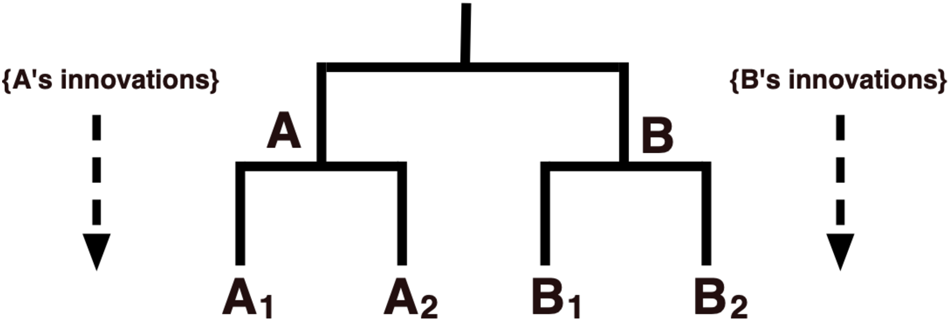
When an ancestral language splits into two varieties, say A and B, the latter two must have evolved individually through time and become distinct from each other, by modifying phonological systems, replacing vocabulary, transforming morphology and so on. All these individual changes can be considered innovations that distinguish A from B. After the split, A and B would continue to evolve and become each the ancestor of their own descendants. The descendants would inherit a subset of the characteristics of A or B, among which some of said innovations would be present. Descendants that share A’s innovations would all be under the A clade, and those that share B’s innovation would all be considered members of the B clade. In practice, the vast majority of sister languages belonging to the same sub-branch exhibit shared innovations in one way or another. See Figure 1 for a graphic illustration.
Shared innovations as the sole criterion for language subgrouping.

2.2.1. Defining shared innovation
While the principle of shared innovation is intuitive, it is crucial to exercise caution when establishing shared innovation to avoid misconceptions. This section explores concepts often confused with shared innovation, including homoplasy, shared retention, and negative innovation. Confusing shared innovation with these can lead to pitfalls in language subgrouping.
Shared innovations vs. homoplasy. Generally, homoplasy occurs when similarities observed in two languages are not attributed to a shared heritage, such as being purely coincidental or typological commonalities. A typical example of homoplasy concerns the auxiliary perfective in French and German. Both languages exhibit perfective constructions with two auxiliaries depending on the verb: one translated as “to be”, Fr. être, Ger. sein, the other translated as “to have”, Fr. avoir, Ger. haben. The distribution of “to be” and “to have” presents some overlap between French and German cognates or homonymies, such as Ger. kommen/Fr. venir “to come” (from Proto-Indo-European *gʷem-, auxiliary: “to be”), Ger. holen “to get”/Fr. clamer “to call” (from Proto-Indo-European *kel(ə)- or *kal-, auxiliary: “to have”).Footnote 4 If we look more closely at the auxiliary perfective in both languages, we may find ten or more such examples. However, such overlap is a superficial coincidence, and certainly does not validate French and German as a separate sub-branch, not to mention the many mismatches that contradict the subgrouping of French and German within Indo-European.
Shared innovation vs. shared retention. Retention can be misleading in language sub-grouping. If two languages exhibit a certain degree of genetic relationship, we anticipate that they have inherited features not only from their most recent common ancestor’s innovations, but also from what has always existed in higher nodes of the Stammbaum. However, we cannot, in turn, rely on shared retention to determine the closeness of languages. From a pure lexical perspective, Zhang Shuya et al. (Reference Zhang, Jacques and Lai2019) listed about 100 cognates shared between Gyalrongic and Chinese, which represent the oldest layer of Sino-Tibetan vocabulary. Nevertheless, these cognates cannot definitively establish a Chinese-Gyalrongic clade. The same goes for morphological evidence. Kiranti and Gyalrongic languages both retain the second person prefix in *tV- (Jacques Reference Jacques2012; DeLancey Reference DeLancey2014), however, this shared retention is obviously insufficient to support them forming a clade within Sino-Tibetan.Footnote 5
Positive innovation vs. negative innovation. While shared innovation as the sole criterion for language subgrouping is easy to understand, people tend to forget the adjective “positiv” (positive) in Leskien’s passage. In the context of language subgrouping, one must exercise particular vigilance when confronted with the phenomenon of negative innovation. It is true that there are instances where the so-called shared negative innovations can be identified within the confines of a specific language branch. However, employing shared loss as a foundational premise for subgrouping is fraught with risks, since in many cases, a loss of a feature is highly random, meaning that sometimes a claimed “shared loss” among languages is merely a matter of coincidence. The Proto-East-Gyalrongic yod unspecified orientation prefix *jV- has been lost in Zbu (Northern Gyalrong) and Bragbar (Situ Gyalrong) (Gong Reference Gong2018; Zhang Reference Zhang2020). However, we cannot extrapolate from this that Zbu and Bragbar constitute a single clade. Similarly, the Proto-Gyalrongic rhotic unspecified orientation prefix *rə- is preserved in Zbu, but was lost in Bragsteng (Situ Gyalrong), as well as in Japhug and Tshobdun (Northern Gyalrong) (Zhang Reference Zhang2023b). Again, this “shared loss” by no means supports a Bragsteng–Japhug–Tshobdun clade. Moreover, relying on the shared loss of orientation prefixes would make the subgrouping of the mentioned Gyalrongic varieties an unsolvable puzzle.
2.2.2. The idiosyncratic nature of shared innovations
The application of shared innovation in language subgrouping demands further scrutiny. Some “innovations” may appear to be shared, but they could be homoplastic changes or common borrowings that offer limited insights into language subgrouping.
Hetzron (Reference Hetzron1976) proposed looking for “innovations which are as arbitrary as possible […] and as little likely to be borrowed as possible”. He considered morpholexicon to be the decisive type to look for. By “morpholexicon”, Hetzron meant morphological components serving as derivational and inflectional operators, such as affixes. He believed that inflectional affixes are the least subject to borrowing, and provided a successful demonstration of using shared morpholexical or morphological innovations to deal with the subgrouping of Semitic languages.
Hetzron (Reference Hetzron1976) compared a variety of morphological operations and affixes in Semitic, and found that Ethiopian, South-Arabian, Aramaic, Arabic and Canaanite innovatively turned the original permansive marker into a past marker. Such a positive shared innovation is sufficient for justifying a distinct branch, namely “West Semitic”, as opposed to Akkadian (East Semitic) retaining the most archaic forms. Furthermore, under West Semitic, two branches, South and Central Semitic, have been identified with morphological innovations. South Semitic (i.e. Ethiopian and South Arabian) are marked by the generalization of -k- in the past tense and that of a closed vowel in verbal prefixes; while Central Semitic (i.e. Arabic, Canaanite and Aramaic) introduced the jussive +u and generalized -t- in the past tense. Finally, within Central Semitic, the feminine plural -na was innovatively adopted by Arabic and Canaanite, providing solid evidence for the latter two to form a sub-branch as opposed to Aramaic.
The concept of shared innovations being arbitrary is a well-accepted notion among historical linguists, described using various terms like “significant”, “non-trivial”, and “unusual” (Clackson Reference Clackson2022: 25). Notably, in the context of Sino-Tibetan, Sun (Reference Sun2023) employed “highly-idiosyncratic” shared lexical and phonological innovations to demonstrate that Gserskad and Rdoskad, formerly considered Amdo Tibetan dialects, actually constitute a distinct subgroup within Tibetic.
The Neogrammarian subgrouping methodology has yet to be extensively applied to Burmo-Qiangic (Sino-Tibetan). Prior to Jacques and Pellard (Reference Jacques and Pellard2021), a systematic investigation of shared lexical innovations to identify Burmo-Qiangic was lacking. Little attention has been paid to phonology and morphology. Using Tangut as a case in point, the remainder of this paper aims to illustrate how we can uncover the genetic relationship between Tangut within Gyalrongic (Burmo-Qiangic) through positive shared innovations, especially in phonology and morphology.
3. Tangut as an alleged Horpa language
The quest for Tangut’s affiliation serves as an illustrative example of the imperative need for adequate methods in language subgrouping in Sino-Tibetan.
Since the early twentieth century, Tangut has been tentatively linked to what is now known as the Burmo-Qiangic languages, encompassing Qiang (or Rma) varieties, Lolo-Burmese, and Gyalrongic languages. These early associations primarily relied on lexical and grammatical similarities (Laufer Reference Laufer1916; Wolfenden Reference Wolfenden1931; Nishida Reference Nishida1976; Sun Reference Sun1991). Matisoff (Reference Matisoff, Lin, Hsu, Lee, Sun, Yang and Ho2004) attempted to use vowel “brightening” or vowel heightening (e.g. *a > i) as an argument for associating Tangut with Qiangic, but this phenomenon seems to be more of an areal feature observed in individual Qiangic languages rather than a shared innovation (Chirkova and Handel Reference Chirkova and Handel2019; Lai Reference Lai2022; Hill Reference Hill2022).
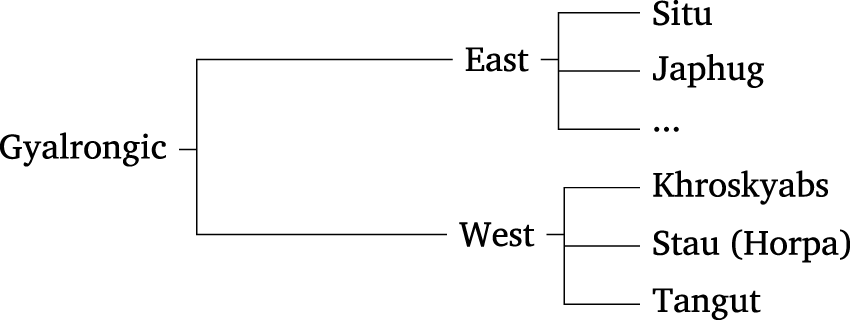
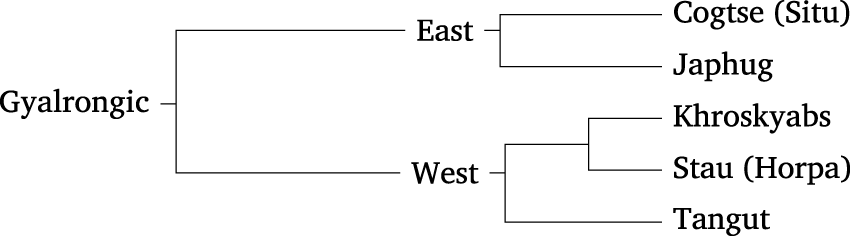
Jacques (Reference Jacques2014) first revealed a close genetic relationship between Tangut and modern Gyalrongic languages by identifying shared lexical innovations. Subsequently, Lai et al. (Reference Lai, Xun, Gates and Jacques2020) conducted a more comprehensive analysis of shared lexical, phonological, and morphosyntactic innovations between Tangut and West Gyalrongic (including Horpa and Khroskyabs), ultimately concluding that Tangut is specifically affiliated with West Gyalrongic. The classification implied in Lai et al. (Reference Lai, Xun, Gates and Jacques2020) is shown in Figure 2. The qualitative analysis aligns globally with the Bayesian inference conducted by Sagart et al. (Reference Sagart, Jacques, Lai, Ryder, Thouzeau, Greenhill and List2019). While Lai et al. (Reference Lai, Xun, Gates and Jacques2020) does not explicitly specify the relationship among Tangut, Horpa and Khroskyabs, the Stammbaum in Sagart et al. (Reference Sagart, Jacques, Lai, Ryder, Thouzeau, Greenhill and List2019) places Tangut as the first branch of West Gyalrongic, grouping Khroskyabs and Horpa in a separate clade, as reproduced in Figure 3. Thus, although it is quite clear that Tangut is more closely related to modern West Gyalrongic, its precise position within this branch remains uncertain.
Gyalrongic subgrouping according to Lai et al. (Reference Lai, Xun, Gates and Jacques2020).

Gyalrongic subgrouping according to Sagart et al. (Reference Sagart, Jacques, Lai, Ryder, Thouzeau, Greenhill and List2019).

Beaudouin (Reference Beaudouin2023) claimed to be the first dedicated study to demonstrate a close affinity between Tangut and Horpa within West Gyalrongic. However, as will be shown in Section 4, the notion of Tangut-Horpa proximity can be traced back to the 1960s. While the Tangut-Horpa clade itself cannot be immediately dismissed, Beaudouin (Reference Beaudouin2023) suffered from methodological errors, specifically swapping the concept of shared innovation. These methodological errors have led to difficulties in the description of Tangut grammar and constitute a significant setback in the field of language subgrouping in Gyalrongic and Qiangic.
This section explores several dilemmas in Beaudouin’s (Reference Beaudouin2023) analysisFootnote 6 due to methodological errors in Sections 3.1 through 3.3, and provides proper analyses for the illustrated data.Footnote 7
3.1. False similarity between Tangut  4342 dja2- and Geshiza dæ-
 4342 dja2- and Geshiza dæ-
Tangut attests two series of verbal prefixes known in the literature as orientation prefixes or directional prefixes. The Series A prefixes exhibit a dual function, simultaneously fulfilling a primary perfective role and conveying certain spatial semantics.Footnote 8 The prefix  4342 dja2- has traditionally been seen as a Series A prefix, associated with the spatial semantics of translocative or “loss” (Chang Reference Chang, Yang, Hsu, Lee, Ho, Sun and Lin2004; Kepping Reference Kepping1985).
Beaudouin (Reference Beaudouin2023: 624, §2.2.4) departed from the traditional analysis, advocating that the orientation prefix  4342 dja2- had lost its spatial meaning and serves only as a perfective (or, in his words, a “true change of state”) in Tangut. Furthermore, he claimed that the Tangut
 4342 dja2- and the Geshiza orientation prefix dæ- exhibit distributional similarities, which he used as evidence to support the Tangut-Horpa clade. However, Beaudouin’s proposed analysis suffers from methodological inappropriateness and factual inaccuracy.
On the one hand, Beaudouin failed to illustrate internal evidence supporting Tangut  4342 dja2- as a “true change of state” with “semantic inadequacy of the orientational/modal interpretations”, as he claimed in §2.2.4.1, page 624. There is no textual example in the article to demonstrate the “true change of state” use of
 4342 dja2- in Tangut; textual examples were only given for other Series A prefixes that convey transparent or fictive orientation meanings (such as
 1452 nja1-,
 2590 wjɨ2-,
 0795 rjɨr2-, see Beaudouin Reference Beaudouin2023: 628–30, §2.2.4.2). The presence of orientation meanings with other Series A prefixes by no means supports the argument that
 4342 dja2-, as a member of the same paradigm, lost orientation meanings.
On the other hand, Beaudouin (Reference Beaudouin2023: 630–32, §2.2.4.3) over-relied on external evidence from Geshiza to support his proposal of  4342 dja2- as a generic perfective that lost its orientational meaning. He pointed out that Tangut
 4342 dja2- and Geshiza dæ- “have the same distribution on the whole” (Beaudouin Reference Beaudouin2023: 631, 2nd line). Nevertheless, this alleged “same distribution” is a false similarity.
First, it is important to note that Geshiza dæ- has been generalized as a standard perfective prefix (Honkasalo Reference Honkasalo2019: 545), and can theoretically be prefixed to any verb. If Tangut  4342 dja2- were indeed a general perfective marker, we would expect it to have been generalized to a large number of verbs through analogy. Comparing two morphological systems that have clearly been flattened by analogy is risky, as analogy can spontaneously and independently apply in different branches.
Second, the claim of a “shared” distribution between Tangut  4342 dja2- and Geshiza dæ- is not faithful to the linguistic data. In Beaudouin (Reference Beaudouin2023: 633, Tab. 8), only ten verbs out of 27 share the dV- prefix between Tangut and Geshiza; among them, only four can Beaudouin assert as a “true change of state”, i.e. excluding the semantic value of “direction” or “loss”. Therefore, the portion of this purported “shared” distribution is well under 40%. Beaudouin (Reference Beaudouin2023: 631) attributed the nine instances that Tangut did not employ
 4342 dja2-, while Geshiza had dæ-, to insufficiency of data, explaining that “a cognate not preceded by
 4342 dja2- […] does not imply that the association is impossible. It is possible that we simply do not have enough texts to ascertain it for the time being”. While insufficiency of data can sometimes be considered an excuse, the current data listed in Beaudouin’s (Reference Beaudouin2023: 633) Tab. 8 is equally sufficient to illustrate the different distribution of Tangut
 4342 dja2- and Geshiza dæ-, contrary to his own claim.
Beaudouin’s (Reference Beaudouin2023: 624–34 §2.2.4) analysis of the Tangut  4342 dja2- is comparable to the mock analysis trying to relate the French and German auxiliary perfective as a shared innovation, seen in Section 2.2. The distribution of the generalized perfective marker dæ- in Geshiza necessarily overlaps with that of the Tangut
 4342 dja2-, as well as its cognates in other Horpa languages that have not developed into a general perfective (such as Mazur Stau tə-, see Gates Reference Gates2021 and also Section 4.2.4). Such coincidental overlap is not valid as a key piece of evidence for language subgrouping. Besides, this methodological error is accompanied by circular reasoning, as Beaudouin (Reference Beaudouin2023) assumes that Tangut
 4342 dja2- must follow the usage of Geshiza dæ-, which in turns forced him to seek unfalsifiable explanations for apparent discrepancies.
The complexity of spatial semantics in Tangut orientation prefixes has been a subject of enduring debate. However, before investigating external comparisons, it is crucial to establish a reliable internal analysis (Kepping Reference Kepping1982; Reference Kepping1985; Lin Reference Lin1987; Arakawa Reference Arakawa and Popova2012; Chang Reference Chang2020). Concerning the Tangut prefix  4342 dja2-, its spatial meaning has long been recognized, and it does not contradict its grammatical function of encoding the perfective (Chang Reference Chang, Yang, Hsu, Lee, Ho, Sun and Lin2004; Kepping Reference Kepping1984). The translocative or “loss” semantics is evident with verbs like
 2511 rjɨr2 “to leave” (Example 1),
 1105 khjow1 “to give”,
 3072 sji2 “to die”, but opaque in combination with verbs such as
 5712 dʑjwa1 “to finish” (Example 2),
 5921 zar2 “to be ashamed” (see Chang Reference Chang2020 and Zhang Reference Zhang2024 for a detailed account, see also Section 4.2.4). Such dual semantic structure is also observed in other orientation prefixes of Tangut (Zhang Reference Zhang2025, among others), as well as in modern Qiangic and Gyalrongic languages (see for example, Shirai Reference Shirai2009).


3.2. Shared retention as an argument for language subgrouping
Beaudouin’s (Reference Beaudouin2023: 640–44) discussion on argument indexation erroneously used shared retention of the third person suffix *-w as a pivotal proof to support Tangut having a closer relationship with Horpa than with Khroskyabs in West Gyalrongic. However, this shared retention between Tangut and Horpa not only failed to support a Tangut-Horpa clade within West Gyalrongic, it also complicated the position of Zbu (East Gyalrongic), the subgrouping of which had been elucidated as early as in Sun (Reference Sun2000a).
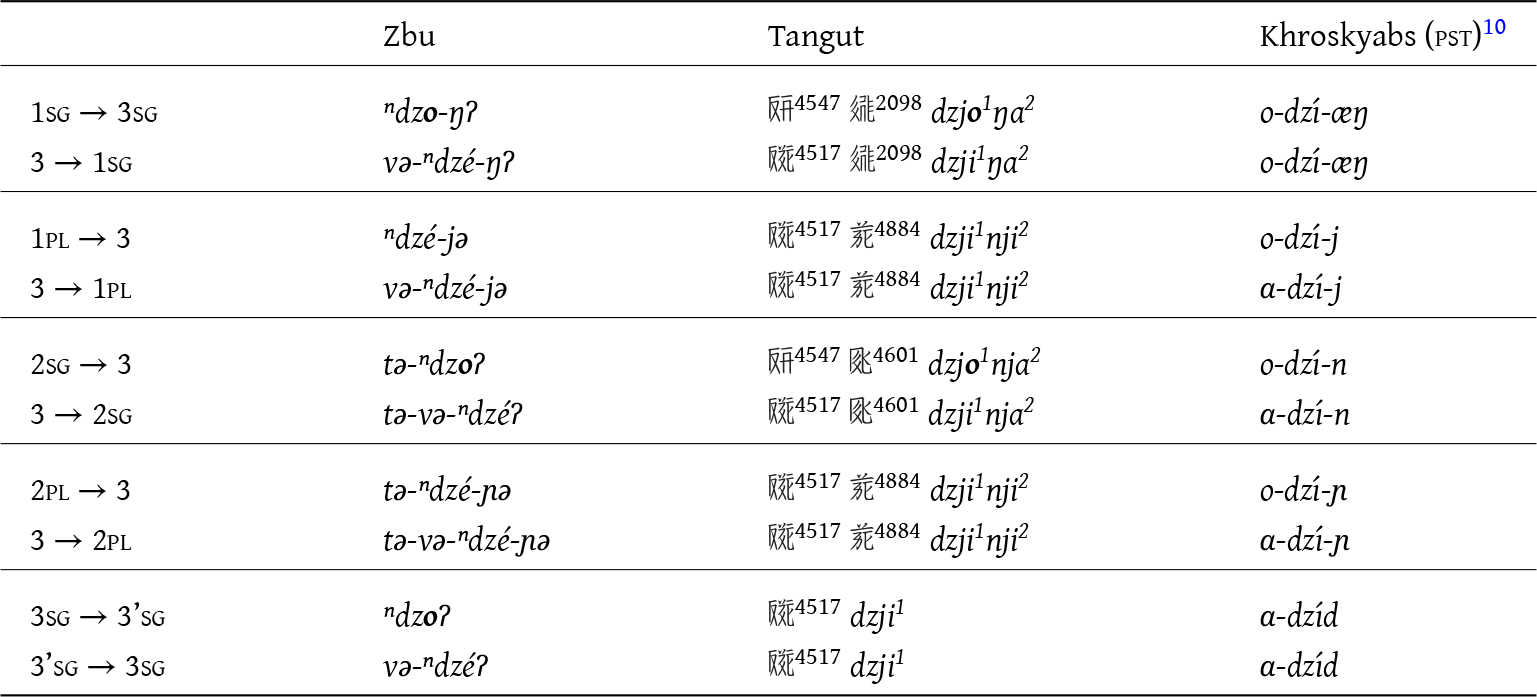
Beaudouin (Reference Beaudouin2023: 641) cited Gong (Reference Gong2017: 33–4) regarding the similar behaviour of verb stems in Tangut and Zbu (East Gyalrongic). In many transitive scenarios, the Zbu Stem I ndzéʔ (to.eat.I) and Stem III ndzoʔ (to.eat.III) align distributionally with their counterparts in Tangut, Stem A  4517 dzji1 (to.eat.A) and Stem B
 4547 dzjo1 (to.eat.B), respectively (see Table 1 for an illustration). The presence of rounded vocalism with -o in both languages indicates an old suffix *-w for the third person patient of transitive verbs, which is still overtly attested in Situ (East Gyalrongic) (Jacques Reference Jacques2009; Prins Reference Prins2017; Zhang Reference Zhang2019).Footnote 9 Beaudouin (Reference Beaudouin2023: 642, Tab. 12) reproduced Gong’s (Reference Gong2017: 33) table, but concluded “striking similarities between mixed contexts of Tangut and the stem 3 of a core Gyalrong language, Zbu” (Beaudouin Reference Beaudouin2023: 641). This “striking similarity” is indeed valuable as a morphosyntactic parallelism between Tangut and Zbu. However, this parallelism represents a shared retention inherited from Proto-Gyalrongic.
Indexation in the stem-alternating verb “to eat” in Zbu and Tangut (Gong Reference Gong2017: 33), in comparison with Khroskyabs cognate (Lai Reference Lai2020)

After pointing out this shared retention between Tangut and Zbu, Beaudouin (Reference Beaudouin2023: 642–3) further compared the transitive paradigm in Tangut with Khroskyabs and Horpa. In the Horpa-lects that Beaudouin examined, the 1sg → 3 scenario is indexed by a rounded suffix -w or -u, which is believed to be a cognate with the rounded vocalism in Tangut Stem B,  4547 dzjo1. There is no cognate morpheme in the transitive paradigm of Khroskyabs. Beaudouin (Reference Beaudouin2023: 668) acknowledged a common retention of the third person patient suffix *-w, as he concluded, “my analysis of verb agreement […] shows common retentions abandoned in Wobzi Khroskyabs”. However, this conclusion not only contradicts the principle of shared innovation, but also creates a dilemma regarding the position of Zbu within Gyalrongic. If the shared retention of the third person patient suffix *-w holds to support a Tangut-Horpa clade, then one should posit a Tangut-Horpa-Zbu clade, as Zbu also retained this morphology.Footnote 11
Currently, there is no evidence supporting innovations in person indexation shared between Tangut and Horpa. The available evidence instead points to an innovation within the West Gyalrongic group, shared by Tangut, Horpa, and Khroskyabs. Table 1 presents Gong’s (Reference Gong2017) original comparison between Tangut and Zbu, alongside Khroskyabs equivalents based on Lai (Reference Lai2020). Gong (Reference Gong2017) first observed that the pattern of stem alternation shared between Tangut and Zbu does not hold for non-local scenarios. Zbu continues to distinguish between ndzéʔ (eat.I, non-local inverse) and ndzoʔ (eat.III, non-local direct). However, Tangut unified all non-local scenarios with  4517 dzji1 (eat.A) which is cognate with Zbu ndzéʔ (eat.I, used in non-local inverse), indicating that Tangut treats all non-local scenarios as inverse. This pattern aligns with all West Gyalrongic languages (Jacques et al. Reference Jacques, Lai, Antonov, Nima, Thurgood and LaPolla2017; Lai Reference Lai2015; Reference Lai2020; Lai et al. Reference Lai, Xun, Gates and Jacques2020). As demonstrated in Table 1, Khroskyabs invariably employs the inverse series of the past marker, ɑ-.
3.3. Negative innovation as subgrouping evidence
As discussed in Section 2.2.1, negative innovations are much less reliable than positive ones as evidence of subgrouping. This section critiques Beaudouin’s (Reference Beaudouin2023) use of a negative innovation to bolster the Tangut-Horpa clade.
Within Beaudouin’s work, the sole instance of shared innovation highlighted is the alleged shared loss of two orientation prefixes between Tangut and Horpa; nV- and lV-, or “dir.4” and “dir.5” in Beaudouin’s terms. As Beaudouin (Reference Beaudouin2023: 622) asserted, “One of the most interesting points in the distribution relates to directions 4 and 5 […] The loss of dir.4 and dir.5 in both Tangut and Horpa languages could be analyzed as a shared innovation”. Nonetheless, as is previously exemplified with the Gyalrongic unspecified orientation prefixes in Section 2.2.1, the “shared loss” of orientation prefixes in Gyalrongic is probably a coincidence, offering no insight in subgrouping.
It should also be pointed out that using shared loss of orientation prefixes as the basis for subgrouping leads to many dilemmas. First, as previously demonstrated with the loss of unspecified orientation prefixes in Gyalrongic, such a shared loss makes the issue of Gyalrongic subgrouping unsolvable. Second, it also blurs the relationship between Gyalrongic languages and other closely related Qiangic languages such as Munya and Ersu. The latter two languages, though their subgrouping is not Beaudouin’s focus, were frequently discussed as comparative data to support a Tangut-Horpa clade and a distant relationship between Tangut and Khroskyabs (West Gyalrongic). As Beaudouin (Reference Beaudouin2023: 619, Table 2) indicates, Munya, a Qiangic language with an unconfirmed relationship with Horpa, also exhibits the loss of dir.4 and dir.5, which would imply a Tangut-Horpa-Munya clade on the Stammbaum following the author’s analysis.Footnote 12 However, a Tangut-Horpa-Ersu clade was also implied in Beaudouin’s (Reference Beaudouin2023: 630–2, §2.2.4.3) claim of shared similarity among Tangut  4342 dja2-, Geshiza dæ- and Ersu tʰɛ- with the exclusion of Munya (emphasized by Beaudouin Reference Beaudouin2023: 632, Ft.26).
Partial reproduction of Table 17 in Beaudouin (Reference Beaudouin2023: 652)

In terms of data accuracy, Beaudouin’s (Reference Beaudouin2023: 622) claim of a “shared loss” of nV- and lV- between Tangut and Horpa is incorrect. Not all Horpa languages share such a loss. Northern Horpa retains dir.5: two varieties of Puxi Stod.sde (for Puxi Proper, see Sun Reference Sun2000b; Dayili, see Qu and Jingsong Reference Qu2007) provide evidence of the cognate prefix ldə- meaning “upstream”. Hence, it is not accurate to conclude that Horpa languages have completely lost the lV- prefix.
The paradigm of orientation prefixes can indeed leave clues for language subgrouping within Gyalrongic. However, these clues are by no means based on shared loss. In Section 4.2.3, we examine evidence of paradigmatic innovations shared among different subgroups of Gyalrongic.
3.4. Faulty innovations based on hasty identification of sound correspondences
In this section, we focus on issues related to establishing cognacy and sound correspondences in Beaudouin (Reference Beaudouin2023). The most challenging analysis found in Beaudouin (pp. 651–4, Tab. 17) is the comparative examination of numerals. His analysis not only fails to adhere to the principle of Ausnahmslosigkeit, but also leaves behind an array of adverse implications for our comprehension of Tangut’s historical morphology, creating a convoluted scenario within the internal classification of West Gyalrongic. As we shall see in the following paragraphs, the purported shared phonological innovations that Beaudouin (Reference Beaudouin2023: §3.1) proposes compelled an affiliation between Tangut and only one variety of Geshiza, disregarding both other Geshiza dialects and Horpa languages.
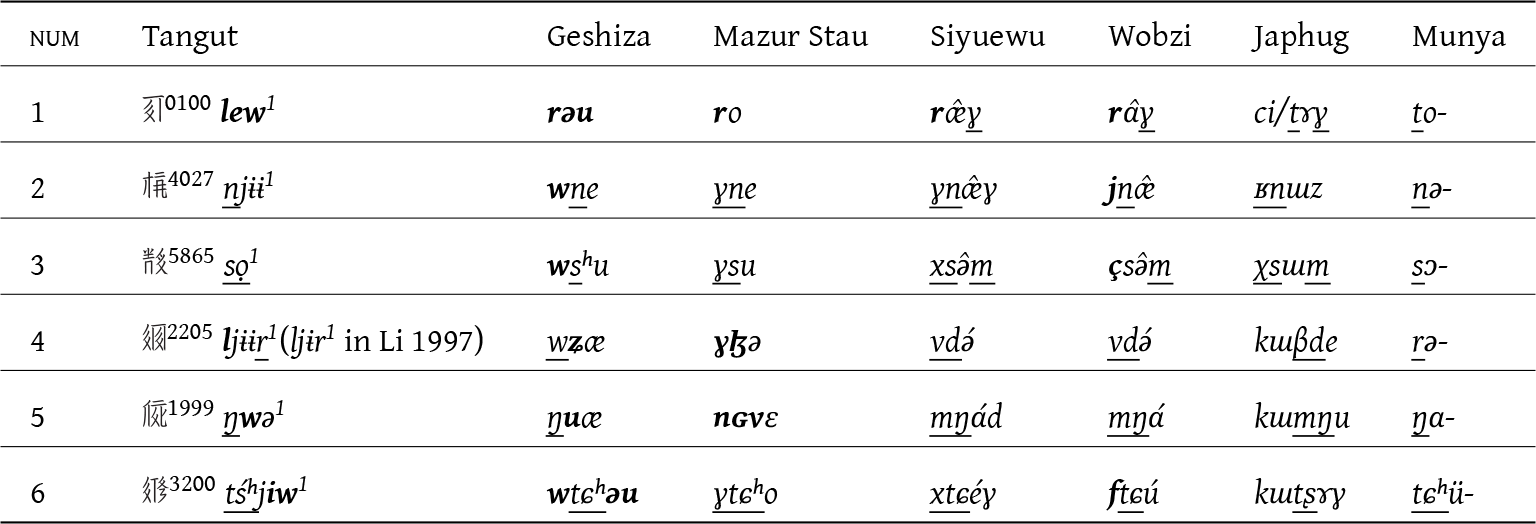
Thus, it is necessary to clarify the right sound correspondences and innovations exhibited in numerals. In order to do so, we reproduce a part of Beaudouin (Reference Beaudouin2023: 652, Tab. 17) in Table 2. The bold letters are considered “innovations” and the underlined ones “retentions” by Beaudouin. We start by summarizing Beaudouin’s problems, before proposing the corresponding plausible analyses.
The coda -w in Tangut. Beaudouin (Reference Beaudouin2023: 620, Ft. 17) explicitly identifies that Tangut -w and Geshiza -u in their forms for “one” ( 0100 lew1 and rəu respectively) and for “six” (
 3200 tśʰjiw1 and wtɕʰəu respectively) are a shared innovation. This alleged innovation, according to Beaudouin, is not shared by Mazur (Horpa), which exhibits ro “one”. However, Tangut -w and Geshiza -u are in fact both retentions. Mazur Stau ro shares with Tangut and Geshiza the vocalization of the coda *-ɣ, probably through a *-w stage: *-eɣ > *-ew > *-ow > -o. The same correspondence is found in Mazur zo “edible root”:: Geshiza zəu “Potentilla anserina” (Khroskyabs zôɣ “Potentilla anserina”) and Mazur tɕo “waist”:: Geshiza dʑəu “waist” (Khroskyabs ɟôɣ “waist”). The Tangut and Geshiza semi-vowel codas are admittedly innovated from a consonant, but compared to the Mazur form, they are a retention of the original coda. The full monophthongization in Mazur is an innovation.
Beaudouin’s analysis would suggest that Tangut forms a clade with Geshiza, excluding Mazur, a conclusion that raises significant doubts.
The preinitial wC- in Geshiza. Beaudouin (Reference Beaudouin2023: 653) considered that the preinitial wC- in Geshiza wʑæ “four” (Khroskyabs vdə́ “four”) was a retention, while the same preinitial in wne “two” and wsʰu “three” (Khroskyabs ɣnæ̂ɣ “two” and xsə̂m “three”) was an innovation. However, this claim can be rejected.
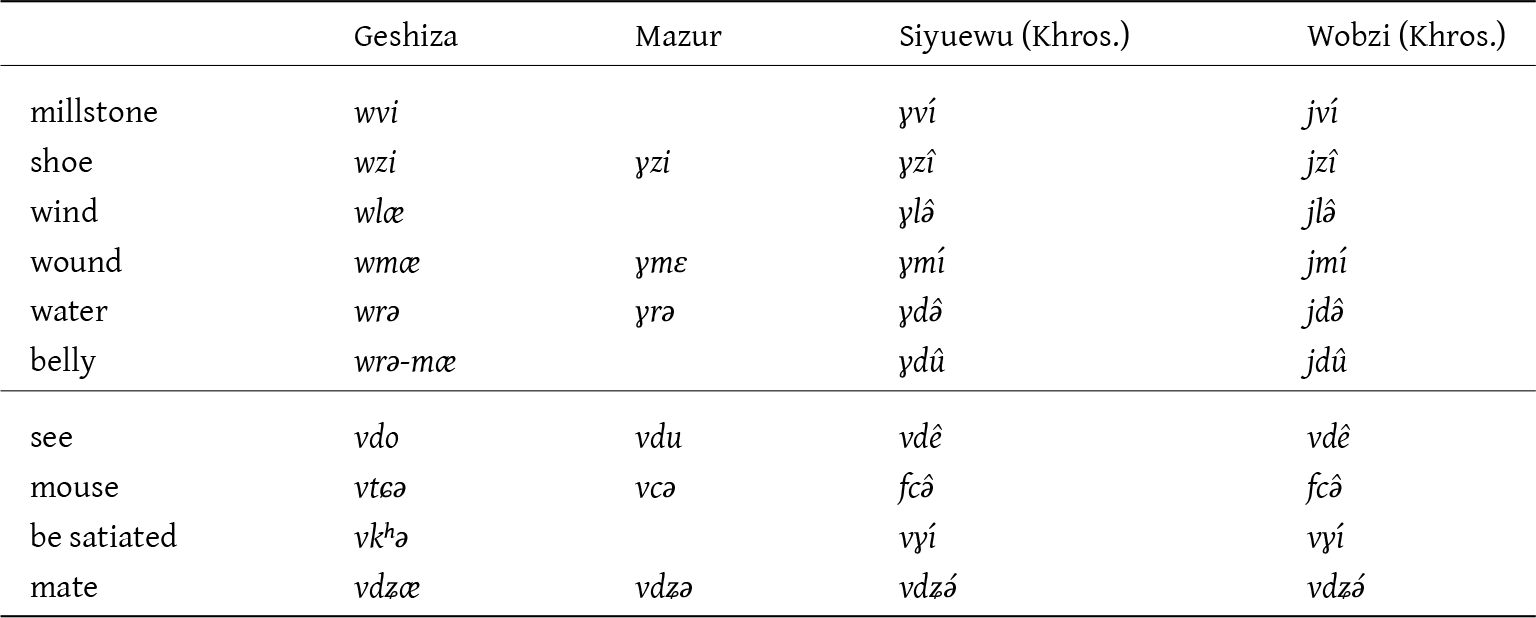
Comparative study suggests that the wC- in Geshiza wʑæ “four” is innovated, whereas wC- in “two” and “three” are retentions. It suffices to look at the correspondences of Geshiza wC- and vC- with other West Gyalrongic languages. See Table 3.
West Gyalrongic velar and labial preinitials

As shown in Table 3, Geshiza wC- regularly corresponds to Mazur ɣC-, Siyuewu Khroskyabs ɣC- and Wobzi Khroskyabs jC-, which implies that the preinitial wC- in Geshiza wne “two” and wsʰu “three” are also regular and non-innovative, contrary to Beaudouin’s claim. On the other hand, Geshiza vC- regularly corresponds to vC- in all of the other three languages (the fC- in Khroskyabs dialects are conditioned variants of vC-). Apart from Geshiza wʑæ “four”, and a potential stative causative prefix w- which is attested with only one verb (wʑælæ “to peel”) (Honkasalo Reference Honkasalo2019: 428), there is no instance where Geshiza wC- corresponds to Khroskyabs vC- or to Japhug βC-. This observation implies that Geshiza wʑæ “four” and Mazur ɣɮə “four” have innovated their preinitials from a proto *v- to *ɣ-, probably by contamination.
Beaudouin’s analyses complicated the understanding of sound correspondences among numerals in Gyalrongic. Such analyses failed to yield any conclusive findings regarding subgrouping, but more importantly, overlooked a genuine shared innovation in Horpa.
The preinitial in “six”. Concerning the numeral “six”, Beaudouin (Reference Beaudouin2023: 653) seemed to have favoured the hypothesis that Mazur ɣtɕʰo and Siyuewu xtɕéɣ both innovated the velar preinitial ɣ-/x-, while confusingly colouring it in blue (reproduced as underlined in Table 2) which indicates a retention.Footnote 13
In reality, the velar preinitials in Siyuewu, Mazur and Geshiza in the numeral “six” are all retentions, corresponding to kɯ- in Japhug kɯtʂɤɣ “six”. The labial preinitial in Wobzi ftɕú is a variant of x- influenced by the rounded vowel -u, thus *xtɕú > ftɕú (Lai Reference Lai2025: 10–12).
The inaccurate recognition of shared innovations, stemming from inadequate engagement with West Gyalrongic morphology, did not lead to the internal classification of West Gyalrongic. Instead, it created confusion in our understanding of this branch.
The metathesis in “five”. The metathetical sound change *wŋ- > ŋw- in the numeral “five”, shown in Tangut  1999 ŋwə1, Geshiza ŋuæ and Mazur nɢvɛ is the only plausible analysis concerning numerals in Beaudouin (Reference Beaudouin2023: 652). This sound change was first proposed by Honkasalo (Reference Honkasalo2019: 314), but it was not fully acknowledged in Beaudouin’s work.
In any case, the metathesis *wŋ- > ŋw- is not a shared innovation between Tangut and Horpa. First, this particular metathesis is rather areally trivial, commonly found in Burmo-Qiangic, as exemplified by Ersu ŋwá˞ (Chirkova Reference Chirkova2014), also cited in Beaudouin (Reference Beaudouin2023: 652), Jiulong Prinmi ŋuə and Xinlong Choyul ŋua55 (Huang and Dai Reference Huang and Dai1992), all meaning “five”. It is difficult to exclude the possibility that the sound change in question is an individual innovation. Second, Honkasalo (Reference Honkasalo2019: 314) cites the Geshiza form wŋæ “five” noted by Duo’erji (1998: 88), which probably comes from a more conservative Geshiza variety. Should the metathesis in question be a shared innovation, one would have to admit that Honkasalo’s Geshiza is closer to Tangut than to Duo’erji’s Geshiza, despite the fact that the two Geshiza varieties are mutually intelligible.
4. Evaluating the Tangut-Horpa clade based on shared innovations
The idea about a close relationship between Tangut and Horpa has been circulating for over half a century. It was first proposed by Stein (Reference Stein1966: 285), who speculated that “il est désormais certain qu’on trouvera des parents beaucoup proches du si-hia parmi les langues diverses parlées dans les régions de Hor Kandze, Tao-fou (Ta’o), Mi-ñag (Tatsienlou), Kin-tch’ouan” (It is now certain that we will find relatives very close to Tangut among the various languages spoken in the regions of Hor Kandze (Hor Dkar.mdzes, 霍爾甘孜 Huò’ěr Gānzī), Tao-fou (Ta’o) (Rta’u, 道孚 Dàofú), Mi-ñag (Tatsienlou) (Dar.rtse.mdo, 康 定 Kāngdìng), Kin-tch’ouan (Chu.chen, 金川Jīnchuān)).Footnote 14 Later, based on a comparison of core vocabulary, Li and Lin (Reference Li and Lin1983) deemed that Tangut is most closely related to Horpa-lects, and further proposed that Horpa speakers were descendants of the Tangut people.
Contemporary works that implicitly suggest a closer relationship between Tangut and Horpa begin with Gong (Reference Gong2017: 33–4), who noted that Tangut shares with Dgebshes Horpa the neutralization of inverse to non-local scenarios (although this phenomenon turned out to be an innovation of the entire West Gyalrongic branch, see Table 1). Lai et al. (Reference Lai, Xun, Gates and Jacques2020) highlight more shared innovations in terms of case marking and modal markers between Tangut and Horpa than between Tangut and Khroskyabs. Honkasalo (Reference Honkasalo2019: 646) identifies a similar distribution of “basic” and “modal” negative prefixes in Tangut and Geshiza (also mentioned in Gates et al. Reference Gates, Honkasalo and Lai2022: 236). Zhang (Reference Zhang2020; Reference Zhang2023b; Reference Zhang2025) uncovered non-trivial shared innovations of orientation prefixes between Tangut and Horpa. Additionally, Lai (Reference Lai2023: 27) asserts a Tangut-Horpa clade within West Gyalrongic, presented in the form of a partial Stammbaum, based on the evolution of a set of voiceless nasals in Proto-Gyalrongic.
The purpose of this section is not to claim the final word on the Tangut-Horpa clade within Gyalrongic. Our goal is to propose a plausible framework for demonstrating this subgrouping, emphasizing the data and aspects that should be considered when encountering similar languages and circumstances. Here, we present evidence currently available in the literature that supports said clade, offering comments, additional data, and conditions for refutation. Section 4.1 focuses on phonological evidence, including the reflexes of proto voiceless nasals (Section 4.1.1) and the behaviour of preinitials (Section 4.1.2), Section 4.2 on shared morphological innovations, encompasses the negator for modal verbs (Section 4.2.1), case markers (Section 4.2.2), the pairing of orientation prefixes (Section 4.2.3), as well as their lexicalization (Section 4.2.4).
4.1. Phonological evidence
There has yet to be a detailed and comprehensive phonological account of the relation between Tangut and Horpa. Recently, two papers have discussed specific topics in the comparative phonology of West Gyalrongic, and both point to a closer relationship between Tangut and Horpa. Lai (Reference Lai2023) analysed the evolution of Proto-Gyalrongic voiceless nasals; and Lai (Reference Lai2024) used Mutual Implicative Entropy to study preinitial correspondences among Gyalrongic languages.
4.1.1. Development of voiceless nasals
Lai (Reference Lai2023) reconstructed a series of voiceless nasal initials in Proto-Gyalrongic, namely *m̥ -, *n̥-, *ŋ̊-, *ɴ̥- and *ɴ̥w-, which have non-trivial reflexes including nasals and different kinds of stops in daughter languages, depending on the position of the voiceless nasal. These reconstructed voiceless nasals are used to account for a small group of superficially irregular correspondences between nasals and stops, like Khroskyabs snóɣ vs Japhug stoʁ “bean” (*n̥-) and Geshiza sqʰar vs Bragbar tə-ŋiɛ́r “phlegm” (*ɴ̥-).
Lai (Reference Lai2023) used data from Situ (Cogtse, Bragbar and Leilecun), Japhug and Zbu for East Gyalrongic, and Khroskyabs, Geshiza and Tangut for West Gyalrongic. These data show a general tendency for the reflexes of voiceless nasals in Tangut to be more consistent with Geshiza than with Khroskyabs, implying a closer relationship between Tangut and Geshiza. This can be best illustrated by the reflexes for etymon “leaf”, reconstructed as *ləp-m̥[æ]k. In both Tangut and Geshiza, the voiceless nasal *m̥- is reflected as b-: Tangut  4567 bạ2 and Geshiza lbala respectively, while in Khroskyabs, it derives pʰ-: ɬpʰǽʁ. As shown in Table 4, the reflexes of *m̥- in *ləp-m̥[æ]k “leaf” is highly varied among Gyalrongic languages, with five different outcomes (w-, b-, m-, v- and pʰ-). Despite the superficial randomness, Geshiza and Tangut both developed a voiced initial, rather than an aspirated initial as in Khroskyabs. This observation leads to the hypothesis that Tangut and Geshiza form a separate sub-branch in West Gyalrongic.
Reflexes of *ləp-m̥[æ]k “leaf” in Gyalrongic (extended from Lai Reference Lai2023: 25)

While there is only one Horpa variety (Geshiza) in Lai (Reference Lai2023), a search into other varieties shows that other Horpa varieties invariably exhibit b- as the reflex of *m̥-, meaning that the analysis still stands. See Table 5.Footnote 15
Reflexes of *ləp-m̥[æ]k “leaf” in various Horpa-lects

The exact reconstruction of voiceless nasals in Proto-Gyalrongic is still open to future revision; however, the consistent innovative behaviour between Tangut and Horpa within the set of cognates in question is an indication for their subgrouping.
4.1.2. Towards a quantitative account of shared phonological innovations
Lai (Reference Lai2024) introduces a new information-theoretical method to measure the degree of regularity of sound correspondences, namely the Mutual Implicative Entropy (MIE) method. This method involves four steps.
First, a set of cognates (or suspected cognates) among sister languages is established. Second, the linguist observes the sound correspondences in the cognates and selects a specific group of phonemes deemed to contain the clearest phylogenetic signals. Depending on the language branch, this group of phonemes can include initial consonants, syllable nuclei, tones, and so on. The selected sound correspondences are then stored in a spreadsheet. Proceeding to the third step, the MIE between the selected sound correspondences of every pair of languages is computed to measure the predictiveness of sounds from one language to another, hence the regularity of sound correspondences. A high MIE value indicates low predictiveness, meaning that the sound correspondences of the two languages tend to be irregular. Conversely, a low MIE value indicates high predictiveness, meaning that it is easy to guess a sound from one language to the other. Thus, it is assumed that a high MIE value corresponds to a remote relationship between two languages, while a low MIE value corresponds to a close relationship. In the final step, a distance matrix featuring all language pairs and their corresponding MIE values is established, and a Neighbornet network is generated to visualize the inferred subgrouping of the family.
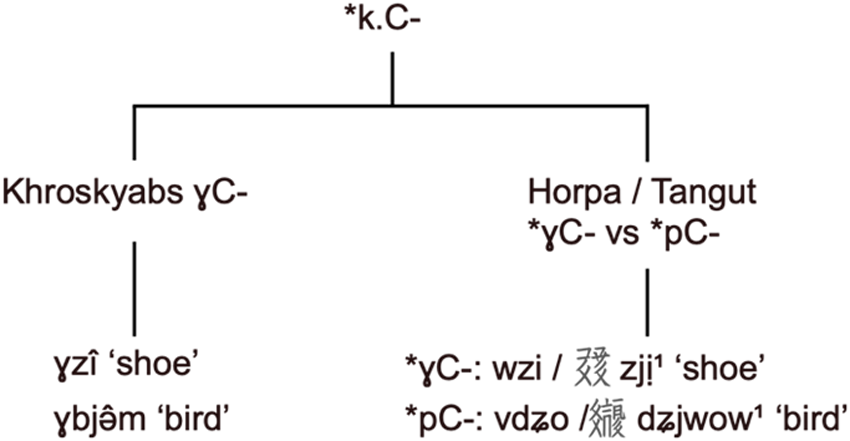
In order to apply the method to Gyalrongic languages, Lai (Reference Lai2024) selects the correspondences of preinitials. Modern Gyalrongic languages exhibit various types of preinitials that may or may not correspond to each other, due to different pathways of splits and mergers. Although Tangut does not have segmental preinitials according to common opinion, it contains traces of old preinitials that transphonologized into tense vowels, rhotic vowels, long vowels and rhymes with medials (Gong Reference Gong1999; Jacques Reference Jacques2014; Gong Reference Gong2021; Lai Reference Lai2024). For instance, the proto-preinitial *k.C- typically results in ɣC- in Khroskyabs, wC- in Geshiza, and undergoes transphonologization into a tense vowel in Tangut (See Lai Reference Lai2024 for a detailed reconstruction of Tangut transphonologization types). This is illustrated in the case of “shoe” in Figure 4. However, in certain instances, both Tangut and Horpa introduce an innovative substitution for the original preinitial, namely *p.C-. This substitution yields vC- in Geshiza and a medial -w- in Tangut (Jacques Reference Jacques2014: 23, 29–30), illustrated in the case of “bird” in Figure 4. The behaviour of *k.C- shows that Tangut and Geshiza share the same innovative phonological split, while Khroskyabs retains the original form. When such splits and mergers become too numerous to handle manually, the MIE method systematically takes them into account, forming the basis for statistically plausible subgrouping.
Shared split of *k.C- between Tangut and Horpa (Horpa variety used: Geshiza).

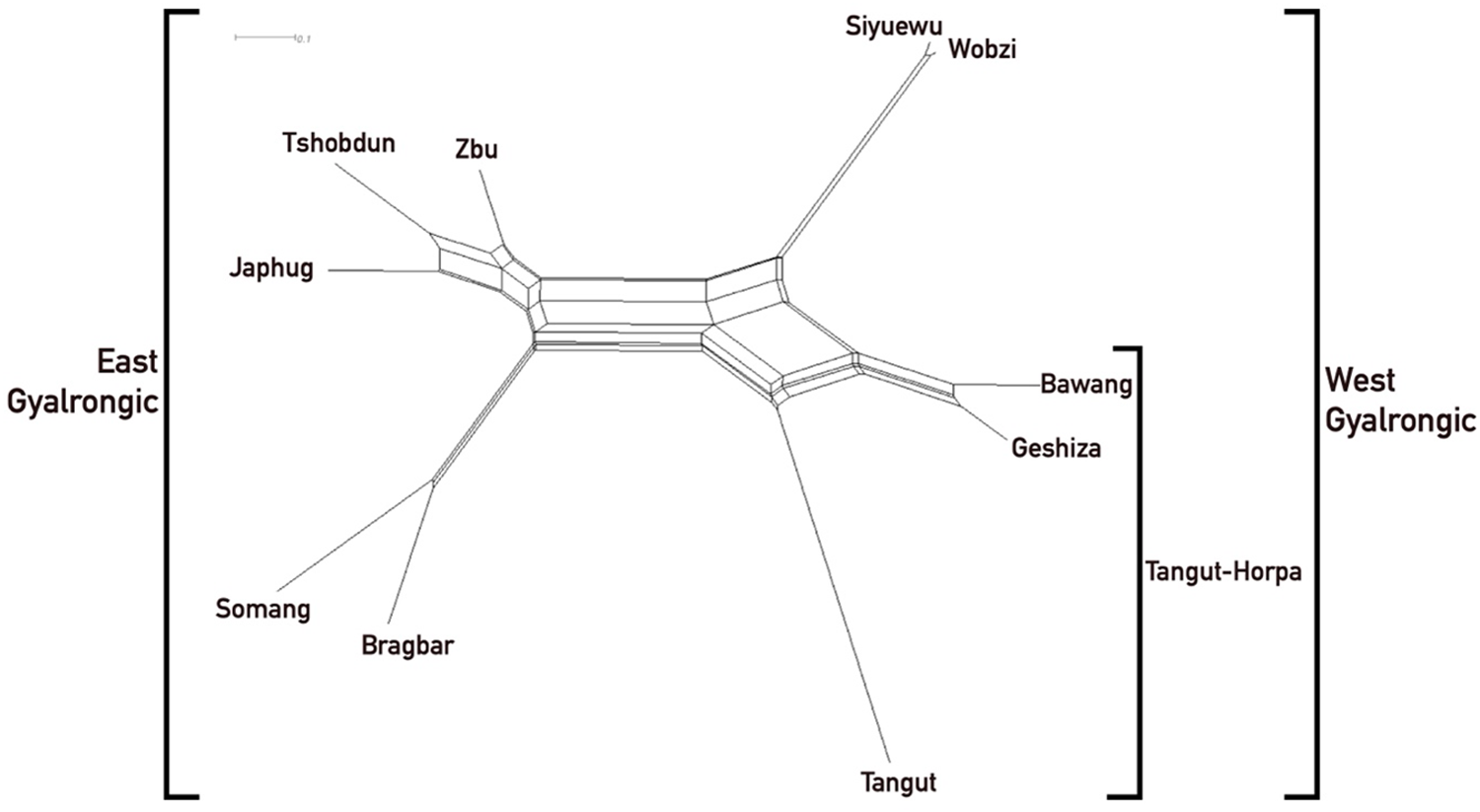
Figure 5 shows the Neighbornet inferred from the MIEs based on all the preinitials in Lai (Reference Lai2024), which shows a clear division of East and West Gyalrongic, and Horpa dialects such as Geshiza and Bawang are visually closer to Tangut. In the network, the Tangut-Horpa clade has a weight of 0.1437, slightly higher than the Horpa-Khroskyabs clade, with a weight of 0.1225, marginally confirming the plausibility of a Tangut-Horpa clade.
Gyalrongic Neighbornet inferred from MIE.

4.2. Morphological innovations
A careful examination reveals that most morphological similarities between Tangut and Horpa are shared retentions, rather than innovations. Moreover, some shared innovations identified by previous studies have proven to be problematic with new emerging data. For example, Lai et al. (Reference Lai, Xun, Gates and Jacques2020: 193) and Gates (Reference Gates2021: 333–4) suggested that the vowel raising of the optative series of orientation prefixes from *-a- (as preserved in Khroskyabs and East Gyalrongic, see Lin Reference Lin2003, Jacques Reference Jacques2008: 283, etc.) to -ij- (Tangut), -e- (Mazur) and -i- (Khang.gsar) represents a shared innovation between Tangut and Horpa. However, the a-vocalism presented in the Geshiza optative orientation series (Honkasalo Reference Honkasalo2019) questions this hypothesis of vowel raising as a shared innovation between Tangut and Horpa. This observation hints at the scarcity of confirmed morphological innovations shared between Tangut and Horpa, which require a solid understanding of their morphology.
This section aims to provide indications of shared morphological innovations between Tangut and Horpa, which are potentially valid to the best of our knowledge. We will focus on negative prefixes (Section 4.2.1), locative and modal markers (Section 4.2.2), paradigms of orientation prefixes (Section 4.2.3) and lexicalization of orientation prefixes (Section 4.2.4).
4.2.1. Innovated negator for modal verbs
Honkasalo (Reference Honkasalo2019: 646) documented a special type of negative prefix mə- in Geshiza, as opposed to the neutral negator mi-, which only occurred before the eight modal verbs in that language. See (3) where the neutral negative prefix mi- marks the non-modal verb kʰroŋ (catch.npst.1pl), while the modal negative prefix marks the modal verb mɲoŋ (mod.neg-aux.can.1).

Jacques (Reference Jacques2011; Reference Jacques2014: 239–43) provided a detailed account for the allomorphy of negation in Tangut. Among the four negative prefixes in Tangut,  5643 mjɨ1 has the same modal distribution, while presenting perfect phonological correspondences with the Geshiza negative prefixes.

Honkasalo (Reference Honkasalo2019: 646) cited Jacques’ (Reference Jacques2011) observation about Tangut, clearly stating that “the negator mə- also exists in Stau with largely the same verbs as in Geshiza, but core Gyalrong languages lack the phenomenon. Presence of modal non-controllable negation can thus be seen yet another feature shared by Tangut and East [recte West] Gyalrong languages, illustrating the close affinity of the former in the latter”.
Although the same phenomenon is discussed in Beaudouin (Reference Beaudouin2023: 636–7, §2.2.7), with slightly more data and Tangut texts, the recognition of this shared innovation should be attributed to Honkasalo (Reference Honkasalo2019) concerning the shared innovation of negation morphology, which was however, not mentioned in Beaudouin’s passage.
4.2.2. Case/modal markers
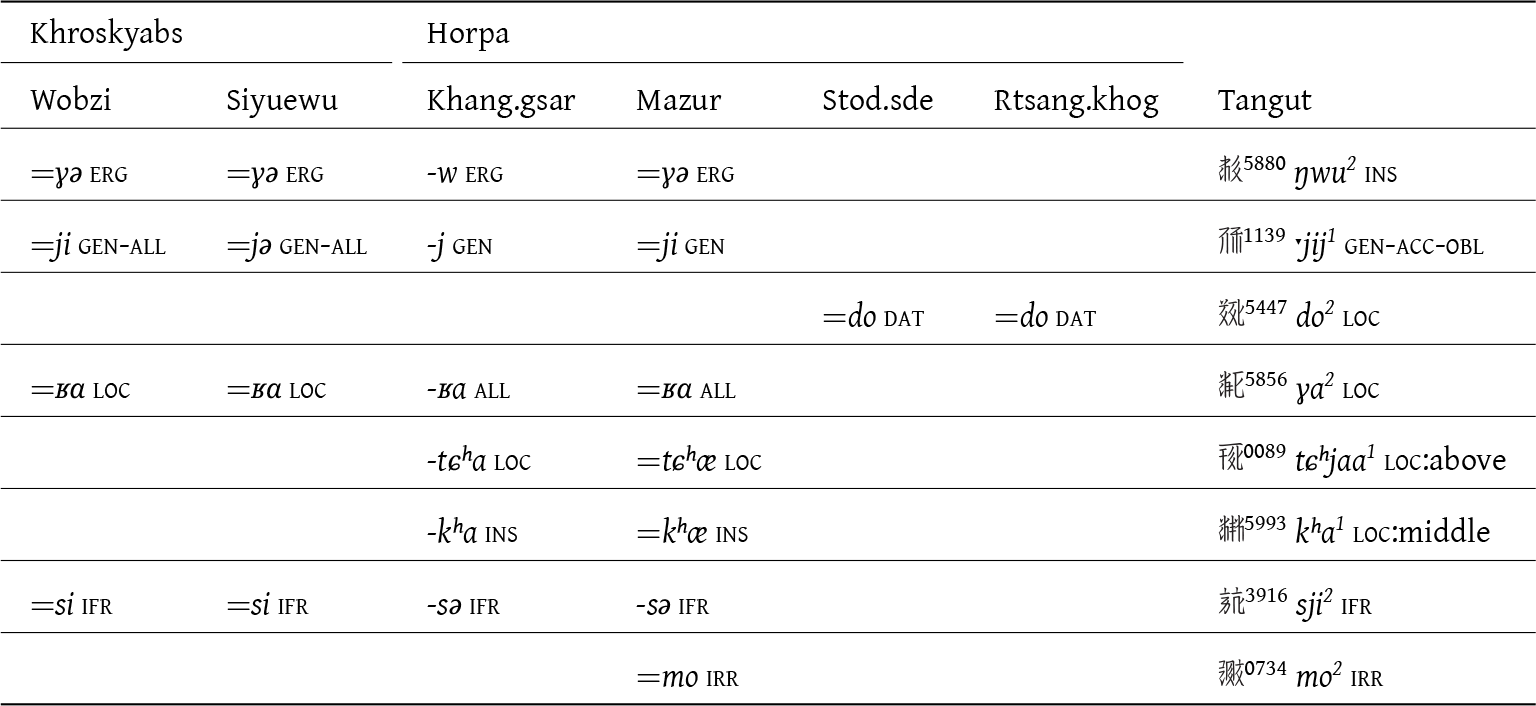
Table 6 compares the case and modal markers in Khroskyabs, Horpa, and Tangut. The comparison is based on Gates (Reference Gates2021: 311, 339–42, 346–7), Lai et al. (Reference Lai, Xun, Gates and Jacques2020: 183, 193–6) and Zhang (Reference Zhang2023a: 671). The glosses of the listed case markers in Tangut basically follows Arakawa (Reference Arakawa and Sawada2010) with slight modifications.Footnote 16
Case and modal markers in Horpa,Footnote 18 Khroskyabs and Tangut

Table 6 clearly demonstrates that Horpa and Tangut share four markers that are absent in Khroskyabs. Among these, three are discussed in detail in Gates (Reference Gates2021: 311, 339–42, 346–7) and Lai et al. (Reference Lai, Xun, Gates and Jacques2020: 183, 193–6): (i) the locative marker -tɕʰa in Khang.gsar, =tɕʰæ in Mazur, and  0089 tɕʰjaa1 in Tangut; (ii) the instrumental marker -kʰa in Khang.gsar, =kʰæ in Mazur, and
 5993 kʰa1 in Tangut; (iii) the irrealis marker Khang.gsar =mo/
 0734 mo2.
The comparison of (iv) the locative  5447 do2 in Tangut and the dative =do in Rtsang.khog and Stod.sde is proposed by Zhang (Reference Zhang2023a: 671).Footnote 17 The functional discrepancies between Tangut
 5447 do2 and Horpa -do is due to the fact that they represent different stages of grammaticalization. The dental dative -do in Horpa serves as an abstract case. For instance, in Rtsang.khog, it marks the subject of an indirect intransitive verb (Example 5), or in Stod.sde, it marks the causee (i.e. semantic recipient, Example 6). Their cognates in Tangut
 5447 do2 primarily serves as a locative, allowing contextual interpretations of both static location (Example 7) or the goal of motion. In Tangut,
 5447 do2 also encodes a semantic recipient (Example 8), as an extended use of locative, based on the interpretation of “at the place of, at the vicinity of”.


Proto-Gyalrongic likely did not possess a complex case system. The only case reconstructible for Proto-Gyalrongic is the yod locative *=i (Jacques Reference Jacques2014: 210), which underwent a shared innovation in West Gyalrongic as a genitive (Lai et al. Reference Lai, Xun, Gates and Jacques2020: 183; Zhang Reference Zhang2023a). Consequently, the aforementioned four markers shared between Horpa and Tangut, but absent in Khroskyabs as well as East Gyalrongic, are more likely to be shared innovations than retentions, thereby supporting a Tangut-Horpa clade.
4.2.3. Innovative pairing of orientation prefixes
As touched on in Section 3, Gyalrongic languages, together with their geographic neighbours, exhibit a series of orientation prefixes, or preverbs (see early discussions in Kepping Reference Kepping1984, Nishida Reference Nishida1986, Sun Reference Sun2001, etc.) The orientation prefixes are considered to have a dual function, encoding spatial information and marking the TAME of the host verb. These prefixes are an essential part of the verbal morphology, and their descriptions can be found in nearly every account of languages in this area. A more recent comparison of orientation prefixes from a Burmo-Qiangic perspective is Shirai (Reference Shirai2020).
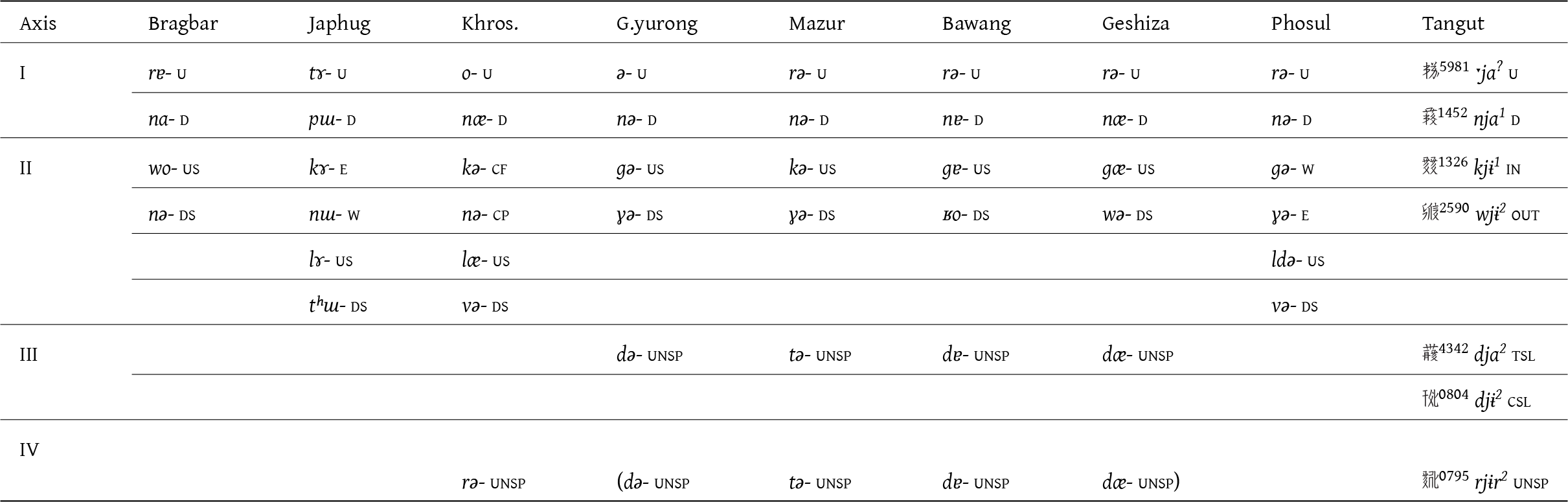
Building upon Sun (Reference Sun2000a), Zhang (Reference Zhang2023b; Reference Zhang2025) proposed a multi-axial model to account for the paradigms of orientation prefixes in Gyalrongic languages. Orientation prefixes are divided into groups. In most cases, each group is composed of two prefixes, denoting opposite directions of a spatial axis. There are also groups or axes that have only one member, typically expressing an unspecified orientation. The axes noted with Roman numerals represent the division of semantic categories of the orientation system in these languages, minimizing interference from semantic divergence attested with orientation prefixes in modern Gyalrongic (see Zhang Reference Zhang2020: 495, Yang Reference Yang2021: 133 for an illustration). Such a model has analytical benefits, as it helps us to examine shared paradigmatic innovations that could happen in terms of the pairing of orientation prefixes cross-Gyalrongic.
Table 7 is based on Zhang’s (Reference Zhang2020: 488–90; Reference Zhang2023b: 210; Reference Zhang2025) comparison of the default Series A prefixes, with additional Horpa data from Gates (Reference Gates2021) and Yang (Reference Yang2021: 133).Footnote 19
Multi-axial analysis of orientation prefixes in Gyalrongic

Abbreviations: u: upward, d: downward, us: upstream, ds: downstream, e: East, w: West, csl: cislocative, tsl: translocative, cf: centrifugal, cp: centripetal, in: inward, out: outward, unsp: unspecified.
In Bragbar, Japhug (East Gyalrongic) and Khroskyabs (West Gyalrongic), the prefixes kV- (Bragbar wo- being lenited from a former *ko-, Zhang Reference Zhang2020: 468) and nV- are paired together in Axis II. Since this pairing of kV- and nV- is found across East and West Gyalrongic, it suggests a retention that the opposition between these two prefixes goes back to Proto-Gyalrongic (Zhang Reference Zhang2023b: 211).
Horpa dialects and Tangut both exhibit a prefix ɣV- to pair with kV-, the latter prefix is cognate with the kV- prefix found in East Gyalrongic and Khroskyabs (West Gyalrongic). This suggests that Proto-Gyalrongic orientation prefix kV- was inherited in Tangut and Horpa, with a new pairing with ɣV-.Footnote 20 The new pairing can be regarded as a positive shared innovation between Horpa and Tangut, thus validating their classification under the same node.Footnote 21
4.2.4. Lexicalization of orientation prefixes
Orientation prefixes constitute an essential part of TAME morphology in Gyalrongic languages. However, experts in both Tangut and modern Gyalrongic all noticed the complexity in terms of the distribution of orientation prefixes in the TAME morphology (Kepping Reference Kepping1982; Nishida Reference Nishida1986; Jacques Reference Jacques2008: 251; Sun Reference Sun, Thurgood and LaPolla2003: 496; see also Shirai Reference Shirai2009 for a similar phenomenon in nDrapa).
In some TAME categories, especially in perfective, there is a certain degree of flexibility for the host verb for choosing a particular orientation prefix, the phenomenon is named verbal “orientability” in the literature (Jacques Reference Jacques2021; Zhang Reference Zhang2020, Reference Zhang2025). With motion verbs, the selection of orientation prefixes is transparent: one selects the prefix denoting the direction of the motion event. With non-motion verbs, the combinations between orientation prefixes and host verbs are mostly lexicalized, unpredictable, and the orientation prefix encodes opaque spatial values.Footnote 22 For lexicalization of orientation prefixes, to cite two prominent examples, in Khroskyabs, ndʑədʑɑ́v “to fall” selects the orientation prefix o- “upward” to form its past tense despite the common sense that things fall downward, and rǽz “to say” selects kə- “centripetal”, even though “say out” would sound more normal in English and in Chinese. In brief, lexicalization of orientation prefixes can be understood as the reflex of the inherited semantic classification of verbs.
Lexicalization reflects a historically more stable use of the orientation prefixes (Gong Reference Gong2018, Zhang Reference Zhang2023b: 209). The selection of orientation prefixes is unpredictable and random, the odds are low that cognate verbs across sister languages separately select the same orientation prefix. Thus, the selection of orientation prefixes of non-motion verbs is indicative of genetic relation, a method first applied to East Gyalrongic data by Gong (Reference Gong2018: 287-288).
Zhang (Reference Zhang2024, Reference Zhang2025) noticed innovations in the selection of orientation prefixes in Tangut. In particular, the verbs  4225 sja1 “to kill” and
 3072 sji2 “to die” are encoded with the same prefix
 4342 dja2 “translocative”. This syncretism is uniquely shared by Horpa-lects. In Khroskyabs and East Gyalrongic languages, the two cognate verbs lexicalize different prefixes. As is clearly shown in Table 8,Footnote 23 there is an innovative merger of lexical orientations for the verb “to kill” and “to die” in Tangut and Horpa, while Khroskyabs and East Gyalrongic retain the distinction by assigning “downward” to “to kill”, and “centrifugal” to “to die”. It should be mentioned that the use of Geshiza dæ- in Table 8 may be due to analogy, as Geshiza generalized the prefix as a standard perfective (Honkasalo Reference Honkasalo2019: 545). However, Mazur and Bra’go did not undergo such generalization, and they both employ the cognate prefix tə-, forming a strong argument for a shared innovation between Horpa and Tangut.
Orientation prefix selection for “to kill” and “to die”

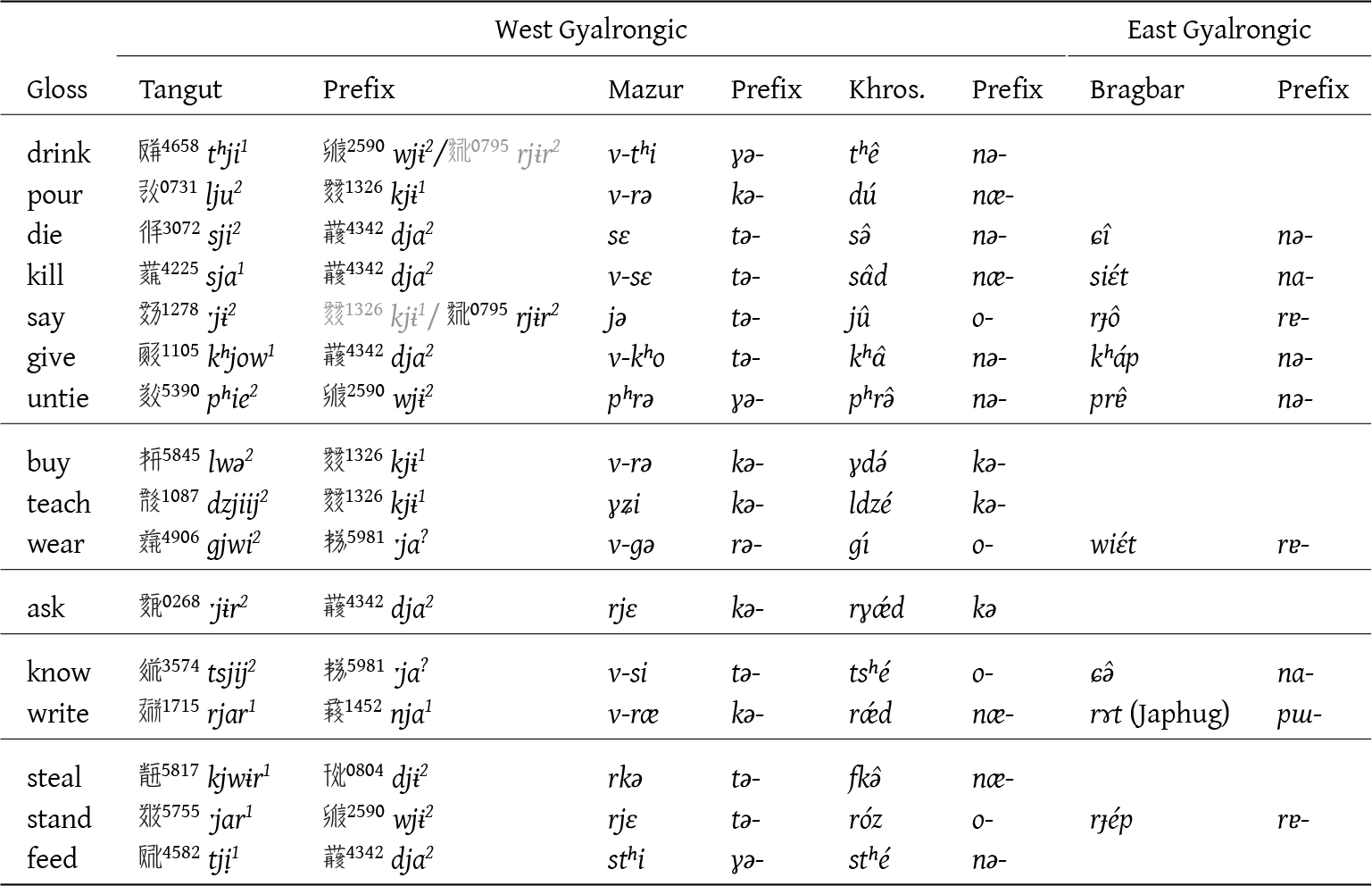
There is no comprehensive study on the lexicalization of orientation prefixes in Horpa to date, we can only rely on fragmentary data from Horpa grammars. For now, a quick comparison of Tangut, Khroskyabs and Mazur (without generalizing a universal perfective) must suffice. Due to the limited information at hand, we have assembled a list of 16 cognate verb sets where lexicalized orientation prefixes are known (see Table 9, based on Zhang’s Reference Zhang2025 summary of Tangut lexical orientation by adding modern Gyalrongic data). When a verb can be prefixed to two orientation markers, we place the more frequently used one, as indicated by available sources,Footnote 24 before the less commonly employed one. The orientation prefix not involved in the comparison are shown in grey.
Lexicalization of orientation prefixes

Note: the horizontal lines in the table are dividers of types. Please make these dividers visible.
Innovations in lexical orientation are considered parallel to those in the orientation paradigm (Section 4.2.3). It is important to note that when an orientation paradigm undergoes morpheme replacement, the new morpheme can also cover the distribution of the original one, encompassing the semantic categories encoded by the old morpheme. A typical example concerns the Japhug prefix pɯ- for “downward”, which resulted from a recent grammaticalization of ɯ-pa “bottom”, replacing the original nasal downward prefix (Jacques Reference Jacques2008: 245). With this morpheme replacement, pɯ- covers the semantic domain of the original nasal “downward” prefix, including the encoding of the lexical orientations of verbs to which the nasal prefix was originally assigned (see Table 8).
Therefore, the comparison of lexical orientation in Table 9 focuses more on the semantic categories reflected by orientation prefixes. For example, in the cognate set “to say”, Tangut prefix  0795 rjɨr2 and Mazur’s tə- are treated as representing the same semantic category, both reflecting the spatial axis of the unspecified orientation despite unrelated etymologies (see Table 7). Similarly, in the cognate set of the verb “to wear”, the vocalic prefixes o- in Khroskyabs,
 5981 ˑja? in Tangut, and the dental prefixes rə- in Geshiza, rɐ- in Bragbar are also treated as representing the same semantic category, all unambiguously reflecting the semantic category of “upward” in their orientation paradigm.
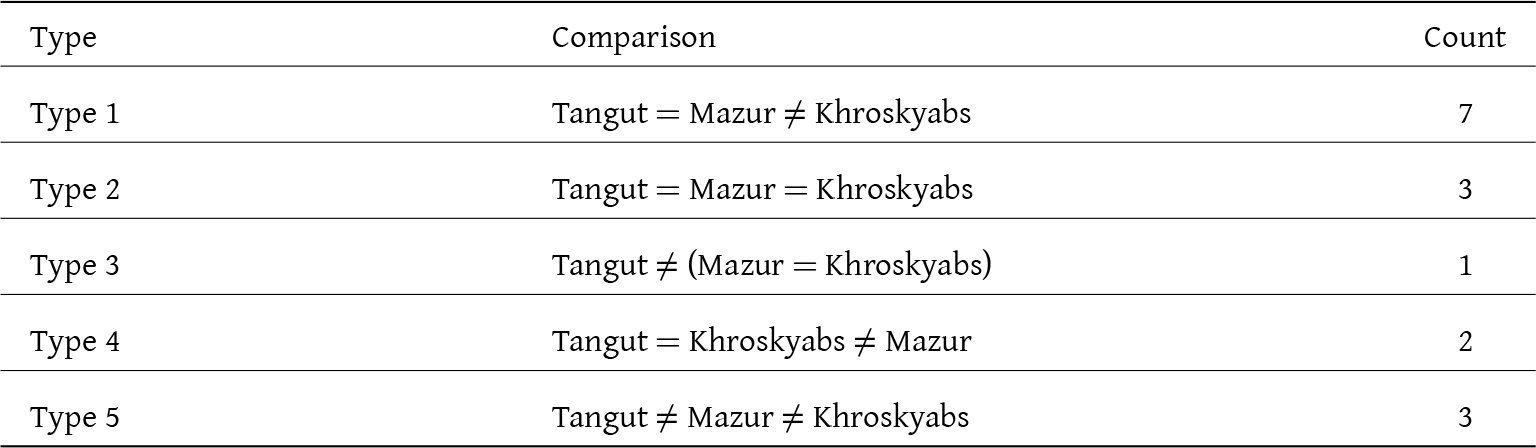
The comparison of lexical orientation in Table 9 is divided into five types, separated by horizontal lines. The five parts are summarized in Table 10, focusing on West Gyalrongic for now.
Summary of lexicalized orientation prefixes

In Type 1, Tangut’s prefixes correspond to the Mazur ones, while excluding the Khroskyabs prefixes. It is worth noting that the Khroskyabs prefixes correspond to Bragbar’s, whenever we find a cognate. Bragbar being a confirmed East Gyalrongic language, the consistent use of prefixes between Khroskyabs and Bragbar must be a retention, which in turn demonstrates that the cases in Tangut and Mazur are shared innovations.
Type 2 illustrates cases of shared retention in lexical orientation across Gyalrongic.
Type 3 shows a single case with the verb “to ask” that shows consistency between Khroskyabs and Mazur, excluding Tangut.
Type 4 encompasses two cases where Khroskyabs aligns with Tangut, but not with Mazur. In the first case, with the verb “to know”, the use of o- “up” in Khroskyabs may result from a generalization of this prefix as a perfective marker for stative verbs, and is therefore likely not inherited. In the second case, with the verb “to write” Tangut and Khroskyabs use the same prefix as Japhug, indicating that it is a retention.
Type 5 presents verb forms with distinct lexicalized prefixes in Tangut, Mazur, and Khroskyabs, which may indicate individual innovations.
Tangut and Mazur present a significant number of shared innovations in terms of lexicalization of orientation prefixes, which means they should be classified under the same branch.
We may pursue additional research on this issue when we have more comprehensive data, which could either corroborate or challenge the tendency evidenced by the current data. However, the primary aim of this section is to present a plausible tract for investigating genetic relationships through orientation prefixes within Gyalrongic.
5. Conclusion
Sino-Tibetan historical linguistics, encompassing reconstruction and subgrouping, has posed a longstanding challenge for historical linguists from its inception (Meillet Reference Meillet1914). To date, a consensus on the applicability of the Neogrammarian method to this huge language family with great internal typological diversity has not been reached, even though fragmentary work has been continuously published along with the increase in detailed descriptions and analyses. This paper selects Tangut and modern Gyalrongic as an example to show how to implement the principles of Ausnahmslosigkeit and shared innovation to determine the genetic relationship within a branch with both conservative and eroded varieties.
The classification of Tangut is a litmus test for the Neogrammarian method. On the surface, Tangut appears to share noticeable similarities with Horpa languages, hinting at a potential subgrouping. However, establishing this affiliation remains a formidable challenge at this stage due to our limited understanding of this medieval language and the lack of comprehensive investigations on Horpa. Consequently, there is a prevailing tendency to overlook methodological rigour in classifying Tangut, which is in dire need of scrutiny.
This paper tackles this issue by distinguishing between superficial similarities, trivial distributional resemblances, and negative innovations, as opposed to positive shared innovations. It also consolidates plausible tracks for the historical comparison between Tangut and modern Gyalrongic languages, offering detailed commentary and additional data. Notably, we have provided a list of linguistically grounded shared phonological and morphological innovations between Tangut and Modern Horpa, offering scientifically rigorous insights into their genetic relationship. Although these analyses might require adjustment in light of new data, we believe that the methodology outlined in this paper sets a promising course for exploring both Tangut grammar, its affiliation, and the genetic reconstruction with the Sino-Tibetan context.
Abbreviations
We follow the Leipzig Glossing Rules. Additional abbreviations are listed as follows:
- concsv:
concessive
- dir
directional
- hes
hesitation
- ifr
inferential
- lnk
linker
- mod
modal discourse enclitic
- opt
optative
- tsl
translocative
Acknowledgements
This research is supported by the Nanyang Assistant Professorship (NAP 2024), Nanyang Technological University, Singapore (Project ID: #024576-00001, Language evolution through trees, entropies, reconstruction and networks; Lai Yunfan), the Irish Research Council under the SFI-IRC Pathway Programme (Project ID: 21/PATH-A/9374, “Gyalrongic Unveiled: Languages, Heritage, Ancestry”; Lai Yunfan) and the Horizon Europe Marie-Skłodowska-Curie Actions Postdoctoral Fellowship (101110215 “Kinship Systems in Gyalrong: History and Transformation”; Zhang Shuya). We would like to thank Jesse Gates, Nathan Hill, Sami Honkasalo, Shang Li and Laurent Sagart for their constructive comments. We also extend our gratitude to the three anonymous reviewers for their valuable suggestions. All the remaining errors are ours.
 3916 -sji2 (Beaudouin
 4342 dja2- (Beaudouin
 1101 -ˑjij1 (Beaudouin
 0795 rjɨr2- to the prefixes ro- and rə- in Kyomkyo. However, in Kyomkyo, ro- and rə- are two different prefixes, designating towards the mountain and towards the river respectively (Prins
 5856 ɣa2 serves as a locative-accusative-dative (場所格-對格-與格), but we gloss it only as “locative” in
 5856 ɣa2. We also slightly modifiy Arakawa’s (
 1139 ˑjij1, glossing it as “genitive-accusative-oblique”, where “oblique” encompasses the semantic recipients and bene/maleficiaries (Zhang
 1139 ˑjij1 as “genitive/antiergative”, with “antiergative” following LaPolla (
 1139 ˑjij1 resemble the Greek genitive, and could be simply described as “genitive”, we emphasize its distinct syntactic roles, especially compared with Horpa languages.
 5447 do2 serves as both “terminative” and “dative”, and compares it with the Geshiza terminative lɔ. The analysis is not adopted here for two reasons. First, we do not consider “terminative” as the primary source function of
 5447 do2, as it is also associated with stative locative. Second, the phonetic correspondence remains uncertain, as the Geshiza rhyme -ɔ in may imply the existence of a coda, which requires further verification.
 5981 ˑja?-. The dental upward prefix rə- in Geshiza, Bawang and Mazur Stau may reflect initial lenition of the dental tV- prefix, as attested in East Gyalrongic (Zhang
 4342 dja2-. However, in terms of paradigmatic structure, Horpa dental unspecified prefixes and the Tangut
 2511 rjɨr2- belong to the same semantic category.
 2590 wjɨ2 “outward” corresponds regularly to both the ɣV- prefixes in Horpa-lects, or to və- “downstream” in Phosul (Horpa) and Khroskyabs. It is likely that Tangut dropped one of them, or merged them as an “outward, centrifugal” prefix. Sound changes leading to confusion of orientation prefixes is also found with Bragbar rɐ- “up”, which could have originated from Proto-Situ *to- “up” and *ro- “uphill, inclined up” (Zhang
 1139 jij1 in Tangut: How did the accusative/genitive syncretism come about?