INTRODUCTION
Imagine an employee working in an organization in which temporal flexibility is supported. Even if the person does not need temporal flexibility often, knowing that the possibility exists to take advantage of it when he or she wants to, could change his or her perception of fit with the organization. Temporal flexibility may be valued by all employees who may need flexibility from time to time in order to take care of someone, to go to a doctor, or perhaps to rest after a particularly effortful project. In providing employees with this opportunity, organizations indicate they are supportive of greater employee autonomy regarding their daily schedule that could increase employees’ comfort and well-being, resulting in a sense of greater person–environment (P–E) fit.
Temporal flexibility, also known as flexi-time (Ronen, Reference Ronen1984; Shockley & Allen, Reference Shockley and Allen2007), flexible scheduling (Bohen & Viveros-Long, Reference Bohen and Viveros-Long1981; Solomon, Reference Solomon1996), or flexible work hours, involves variation in the time and duration of employees’ work schedules and can include compressed workweeks or staggered work hours. Employees are able to select the times they start and/or finish work (Golden, Reference Golden2001a), which allows for personal control over their work schedule and may help employees to meet their family needs and their own personal obligations, improve work/family balance, and increase personal and family well-being (Campbell-Clark, Reference Campbell-Clark2001; Butler, Grzywacz, Ettner, & Liu, Reference Butler, Grzywacz, Ettner and Liu2009). Moreover, temporal flexibility can help employees cope with stressful job demands and can foster positive lifestyle behaviors such as making time for more physical activity (Grzywacz, Casey, & Jones, Reference Grzywacz, Casey and Jones2007), which decreases sickness absence (e.g., Van Amelsvoort, Spigt, Swaen, & Kant, Reference Van Amelsvoort, Spigt, Swaen and Kant2006; Amlani & Munir, Reference Amlani and Munir2014). Having greater control over one’s schedule also results in more positive work attitudes and behaviors including increased job satisfaction (Galinsky & Stein, Reference Gajendran and Harrison1990; Rothausen, Reference Rothausen1994; Campbell-Clark, Reference Campbell-Clark2001; Lu, Kao, Chang, Wu, & Cooper, Reference Lu, Kao, Chang, Wu and Cooper2008), increased commitment (Scandura & Lankau, Reference Scandura and Lankau1997), greater productivity (Muchinsky & Monahan, Reference Muchinsky and Monahan1987; Solomon, Reference Solomon1996; Warr, Reference Warr2007), reduced stress and burnout (Almer & Kaplan, Reference Almer and Kaplan2002), and lower turnover rates (Marshall & Barnett, Reference Marshall and Barnett1994; Meyer, Reference Meyer1997; Campbell-Clark, Reference Campbell-Clark2001; Chou, Boldy, & Lee, Reference Chou, Boldy and Lee2002), all of which are of benefit to organizations. All the same, a debate about the need for temporal flexibility continues since some researchers have not found support for the relation between temporal flexibility and these employee attitudes (e.g., Martens, Nijhuis, Van Boxtel, & Knottnerus, Reference Martens, Nijhuis, Van Boxtel and Knottnerus1999; Ferrer & Gagne, Reference Ferrer and Gagne2013), thus necessitating additional research to explore the direct effects of temporal flexibility on attitudes such as job satisfaction.
Of the past research of the effect of temporal flexibility on employee attitudes, the focus, for the most part, has been on the direct effects; however, it is likely that there are important factors that mediate this association. For example, it is possible that temporal flexibility provides employees with greater autonomy over their working life, which improves their sense of fit between their work and their private life (Hill, Jacob, Shannon, Brennan, Blanchard, & Martinengo, Reference Hill, Jacob, Shannon, Brennan, Blanchard and Martinengo2008), thus contributing positively to their sense of P–E fit. It may be this sense of P–E fit that then results in positive employee attitudes, such as job satisfaction. Although we are beginning to see the pattern suggesting that temporal flexibility improves employee attitudes and that P–E fit directly influences employees’ attitudes (e.g., Currivan, Reference Currivan1999; Campbell-Clark, Reference Campbell-Clark2001; Chou, Boldy, & Lee, Reference Chou, Boldy and Lee2002) to date, no research has examined whether temporal flexibility is an environmental antecedent of P–E fit, which, in turn, is a significant predictor of job satisfaction. Therefore, the overall purpose of the present study was to examine how temporal flexibility is related to job satisfaction directly and indirectly, with perceptions of P–E fit as a mediator of this relation.
In studies examining the relation between P–E fit and job satisfaction, typically only one conceptualization of fit, for example, supplementary fit, needs–supplies fit, or demands–abilities fit, has been assessed as a predictor of employee attitudes and when examined individually, each conceptualization of fit has been found to be significantly associated with increased job satisfaction (e.g., Cable & Judge, Reference Cable and Judge1996; Lauver & Kristof-Brown, Reference Lauver and Kristof-Brown2001; Cable & DeRue, Reference Cable and DeRue2002; Arthur, Bell, Villado, & Doverspike, Reference Arthur, Bell, Villado and Doverspike2006). It is possible, however, that these results are a function of the association between the three kinds of fit rather than each contributing uniquely to job satisfaction (Cable & DeRue, Reference Cable and DeRue2002; Cable & Edwards, Reference Cable and Edwards2004; Edwards & Shipp, Reference Edwards and Shipp2007). Therefore, a secondary purpose of the present research was to examine the role of these three conceptualizations of P–E fit to explore whether supplementary fit, needs–supplies fit, and demands–abilities fit work in concert or individually in influencing the role of temporal flexibility on job satisfaction.
The current study contributes to the P–E fit field in two ways. The first contribution is to explore the relative importance of temporal flexibility on perceptions of P–E fit. If temporal flexibility is a predictor of employee attitudes including job satisfaction because it primarily supports perceptions of P–E fit, then interpretations of the previous studies about the direct relation between temporal flexibility and job satisfaction need to be reconsidered from this perspective. Thus, the study provides a more expanded theoretical explanation about how temporal flexibility is related to employee attitudes and provides organizations with evidence to help them consider supporting temporal flexibility at the workplace especially to support employees’ perceptions of fit. The second contribution is to explore the relationship between three different conceptualizations of P–E fit and how each conceptualization works together to increase or decrease job satisfaction. It is vital to understand how different types of P–E fit are related to job satisfaction as satisfaction is highly associated with job performance and well-being (Judge, Thoresen, Bono, & Patton, Reference Judge, Thoresen, Bono and Patton2001; Harrison, Newman, & Roth, Reference Harrison, Newman and Roth2006; Ostroff, Reference Ostroff1992). Knowing about these interrelations could inform whether measuring the three conceptualizations together when studying the fit as a predictor of employee attitudes, motivation, or performance is important to consider in future research.
Describing P–E fit
P–E fit was defined as the degree of match that an individual has with his or her environment, which may be one’s organization, job, supervisor, group, or vocation (Ostroff & Schulte, Reference Ostroff and Schulte2007; Warr, Reference Warr2007; Wheeler, Buckley, Halbesleben, Brouer & Ferris, Reference Warr2005). The degree of similarity between the individual and the situational variables results in important outcomes such as performance and satisfaction (Muchinsky & Monahan, Reference Muchinsky and Monahan1987). Within P–E fit, a significant distinction has been made between supplementary fit and complementary fit. Supplementary fit occurs when people share similar characteristics, values, or norms with the others in the environment and they believe they fit with the environment (Muchinsky & Monahan, Reference Muchinsky and Monahan1987; Kristof, Reference Kristof1996). Conversely, complementary fit occurs when an individual believes he or she can contribute something that was previously absent in the environment and through their contribution can have positive results for the environment such as increased productivity (Muchinsky & Monahan, Reference Muchinsky and Monahan1987). Complementary fit can be further broken into needs–supplies fit and demands–abilities fit (Kristof, Reference Kristof1996; Cable & DeRue, Reference Cable and DeRue2002; Edwards & Shipp, Reference Edwards and Shipp2007). People have different needs including biological needs, psychological desires, goals, or motives (French, Rogers, & Cobb, Reference French, Rogers and Cobb1974; Kristof, Reference Kristof1996). If the individual’s needs and conditions are met by the organization, they feel like they have a good fit with the organization and are likely to remain longer (Edwards & Shipp, Reference Edwards and Shipp2007; Ostroff & Schulte, Reference Ostroff and Schulte2007). All organizations also have some requirements from individuals such as demands related to specific tasks or work roles (Edwards & Shipp, Reference Edwards and Shipp2007); when individuals have the knowledge, skills, abilities, and resources to fulfill these demands, there should be compatibility between demands and abilities (French, Caplan, & Harrison, Reference French, Caplan and Harrison1982; Kristof, Reference Kristof1996).
Hence, P–E fit is not a unidimensional construct but rather can be conceptualized in three different ways that are complementary and each contributing uniquely to work-related attitudes. Employees may feel that they share similar values or characteristics with the organization (supplementary fit; Kristof, Reference Kristof1996), that the organization meets individual’s needs (needs–supplies complementary fit; French, Caplan, & Harrison, Reference French, Caplan and Harrison1982; Edwards & Shipp, Reference Edwards and Shipp2007), and that the organization requires specific knowledge, skills, or abilities that a particular employee may have (demands–abilities complementary fit; French, Caplan, & Harrison, Reference French, Caplan and Harrison1982; Kristof, Reference Kristof1996). Given these nuances in P–E fit, it is likely that the three conceptualizations of fit would have unique and important roles in the association of workplace temporal flexibility and job satisfaction.
Because temporal flexibility creates feelings of autonomy and control (Ronen, Reference Ronen1984) and provides a sense of support from the organization (Kossek, Lautsch, & Eaton, Reference Kossek, Lautsch and Eaton2006; Kinman & Jones, Reference Kinman and Jones2008), we would expect that temporal flexibility would also have an impact on employees’ perception of P–E fit (also see in Newton, Teo, Pick, Yeung, & Salamonson, Reference Newton, Teo, Pick, Yeung and Salamonson2013). Several studies (Kulik, Oldham, & Hackman, Reference Kulik, Oldham and Hackman1987; Chatman, Reference Chatman1989; Edwards & Rothbard, Reference Edwards and Rothbard1999; Ehrhart & Makransky, Reference Ehrhart and Makransky2007) of P–E fit have applied the job characteristics theory (Hackman & Oldham, Reference Hackman and Oldham1976, Reference Hackman and Oldham1980) and they describe job characteristics as the environmental component of P–E fit. According to this theory, core job characteristics such as autonomy are important precursors of positive employee attitudes such as job satisfaction or intention to stay. Specifically, an increased sense of autonomy and organizational support would positively influence employees’ perceptions about supplementary fit if an employee places importance on autonomy at work. Temporal flexibility would also contribute to a sense that one’s job fulfills the employee’s needs, which increases the perception of needs–supplies fit and employees who believe they are better able to fulfill the demands of a job when they have more flexible hours or when they can arrange their work hours should also have an improved sense of demands–abilities fit. In this sense, temporal flexibility should increase the level of autonomy, which would have a positive impact on employees’ perceptions about their fit with the environment.
Similarly, the theory of work adjustment (Dawis & Lofquist, Reference Dawis and Lofquist1984) conceptualizes work in terms of the interaction between an employee and his or her work environment. An employee is expected to have certain skills to perform the job and the work environment is expected to provide opportunities to use these skills appropriately. When these requirements are both met, there should be good P–E fit. Thus, particularly for employees who need autonomy over their job schedule, having temporal flexibility likely would be a key component of creating a good sense of fit with the organization. Therefore, both the job characteristics theory and the theory of work adjustment support a possible relation between temporal flexibility and the perception of P–E fit.
Hypothesis 1: Temporal flexibility would be positively related to supplementary fit, needs–supplies fit, and demands–abilities fit.
Most of the research in P–E fit focuses either on the organization or the job (e.g., Cable & Judge, Reference Cable and Judge1996; Lauver & Kristof-Brown, Reference Lauver and Kristof-Brown2001; Erdogan & Bauer, Reference Erdogan and Bauer2005). Person–organization fit is described as the compatibility between a person and the organization, in which the person and the organization share similar characteristics or values (Kristof, Reference Kristof1996). Person–job fit is the match between the abilities and/or demands of a person and the demands and/or attributes of the job (Edwards, Reference Edwards1991). Person–organization fit is often equated with the supplementary fit perspective because of the focus on congruence of values, whereas person–job fit is often equated with the complementary fit perspective because of the focus on meeting demands and individual skills and knowledge that are often at the level of the job, although it is acknowledged by some that both supplementary and complementary fit can occur at either the organizational and job level (Edwards & Shipp, Reference Edwards and Shipp2007).
Person–job fit and person–organization fit are correlated with each other but each has a unique direct effect on employee attitudes and job satisfaction in particular (O’Reilly, Chatman, & Caldwell, Reference O’Reilly, Chatman and Caldwell1991; Saks & Ashforth, Reference Saks and Ashforth1997; Kristof-Brown, Reference Kristof-Brown2000; Lauver & Kristof-Brown, Reference Lauver and Kristof-Brown2001; Cable & DeRue, Reference Cable and DeRue2002; Silverthorne, Reference Silverthorne2004; Piasentin & Chapman, Reference Piasentin and Chapman2006; Bao, Vedina, Moodie, & Dolan, Reference Bao, Vedina, Moodie and Dolan2012; Hardin & Donaldson, Reference Hardin and Donaldson2014; Yu, Reference Yu2014; Duffy, Autin, & Bott, Reference Duffy, Autin and Bott2015; Swider, Zimmerman, & Barrick, Reference Swider, Zimmerman and Barrick2015). Kristof-Brown, Zimmerman, and Johnson (Reference Kristof-Brown, Zimmerman and Johnson2005) argued that needs–supplies fit should have a stronger direct link to job satisfaction relative to supplementary fit because people experience more positive job attitudes when their needs are satisfied rather than simply having congruent values. Accordingly, not only when there is a similarity between values of the individuals and the environment, but also when employees are able to fill a need for an organization, they will have greater job satisfaction. This effect generalizes to other positive work attitudes (Cable & Edwards, Reference Cable and Edwards2004) and also is related to greater work motivation (Cennamo & Gardner, Reference Cennamo and Gardner2008) and stronger intention to remain at one’s job (Schneider, Reference Schneider1987).
Hypothesis 2: Supplementary fit, needs–supplies fit, and demands–abilities would be positively related to job satisfaction.
Although there is considerable evidence that each of the three P–E fit conceptualizations (supplementary fit, needs–supplies fit, demands–abilities fit) are related to job satisfaction, there has not been as much investigation of the nature of the potential interrelationships, as most studies of P–E fit tend to include only one conceptualization at a time. However, there are some tenable arguments for including more than one conceptualization as each may play a unique role or possibly that that one kind of fit may influence others. Cable and DeRue (Reference Cable and DeRue2002) suggest that value congruence, that is supplementary fit, precedes needs–supplies fit. They argue that when there is value congruence with the organization, employees perceive this as a reward that helps to fulfill one of their needs. In support this idea, they report a significant correlation of 0.53 between supplementary fit and needs–supplies fit. Similarly, Cable and Edwards (Reference Cable and Edwards2004) point out personal and environmental characteristics that are involved in supplementary fit also influence needs and supplies. For example, an organization that values autonomy would likely encourage autonomy in the workplace, which can fulfill the need for an employee who highly values having autonomy. According to this idea, supplementary fit directly affects needs and supplies fit, which influences job satisfaction (Edwards & Shipp, Reference Edwards and Shipp2007).
Edwards and Shipp (Reference Edwards and Shipp2007) also argue that demands–abilities fit does not directly change employees’ attitudes toward their job but it does so indirectly through its influence on needs–supplies fit. According to these researchers, when individuals fulfill the demands of their job, this facilitates job performance and employees may experience a sense of competence or internalize the demands as desires, which would serve to fulfill their needs. Thus, it is not the perception of demands–abilities fit that determines employee attitudes, but rather the positive perception of demands–abilities fit that determines their needs–supplies fit. This suggestion is supported, to some degree, by the moderately strong correlation (r=0.53) between demands–abilities fit and needs–supplies fit (Cable & DeRue, Reference Cable and DeRue2002). Although the relationships between the three conceptualizations of P–E fit have been previously proposed, to date there has been no examination of all three in a single model. We expect that supplementary fit and demands–abilities fit are antecedents of needs–supplies fit, and if this is the case, they need to be considered together in future studies of P–E fit.
Hypothesis 3: Supplementary fit and demands–abilities fit would be positively related to needs–supplies fit.
P–E fit as a mediator between temporal flexibility and job satisfaction
According to the theory of work adjustment (Dawis & Lofquist, Reference Dawis and Lofquist1984), both employees and their work environments need something from each other – employees are expected to have certain skills to perform the job tasks and the work environment is expected to provide positive rewards in terms of work conditions and pay. When the requirements are both met, there is congruency, and if this correspondence is maintained, it results in job satisfaction. Similarly, according to social exchange theory (Blau, Reference Brayfield and Rothe1964), employees are unlikely to reciprocate positively if their employers fail to fulfill their work-related needs. Given the importance of autonomy and temporal flexibility in allowing employees to have discretion and control in their work schedule in order to accommodate their work and personal demands, it may be possible that this sense of temporal flexibility increases their perceived fit with the environment, particularly the congruence between personal and organizational values, and it is this sense of fit that leads to greater job satisfaction.
It has been well established that the more people believe there is congruence between themselves and their jobs and organizations, the more likely they will be satisfied with their jobs (Diener & Lucas, Reference Diener and Lucas2000; Lauver & Kristof-Brown, Reference Lauver and Kristof-Brown2001; Cable & DeRue, Reference Cable and DeRue2002; Arthur et al., Reference Arthur, Bell, Villado and Doverspike2006). However, research investigating the role of P–E fit as a mediator between organizational variables and job satisfaction remains relatively rare. It has been reported that person–organization fit mediates the effect of supervisor communication on affective commitment (Van Vuuren, de Jong, & Seydel, Reference Van Vuuren, de Jong and Seydel2007) and the effect of human resources management practices on affective and continuance commitment (Takeuchi & Takeuchi, Reference Takeuchi and Takeuchi2013). Specifically related to job satisfaction, Velez and Moradi (Reference Velez and Moradi2012) found that a supportive workplace climate positively influences person–organization fit, which in turn is associated with greater job satisfaction. Gajendran and Harrison (Reference Galinsky and Stein2007) found that telecommuting increases perceived autonomy, which then is associated with greater job satisfaction and Morganson, Major, Oborn, Verive, and Heelan (Reference Morganson, Major, Oborn, Verive and Heelan2010) highlighted the importance of autonomy and temporal flexibility in increasing job satisfaction for teleworkers. Given this role of P–E fit as a mediator in past research, we expected that having greater temporal flexibility would increase employees’ perception of all three conceptualizations of fit with their work environment, which would result in increased job satisfaction.
Hypothesis 4: Temporal flexibility would have a direct relationship with job satisfaction as well as an indirect relationship with supplementary fit, needs–supplies fit, and demands–abilities fit.
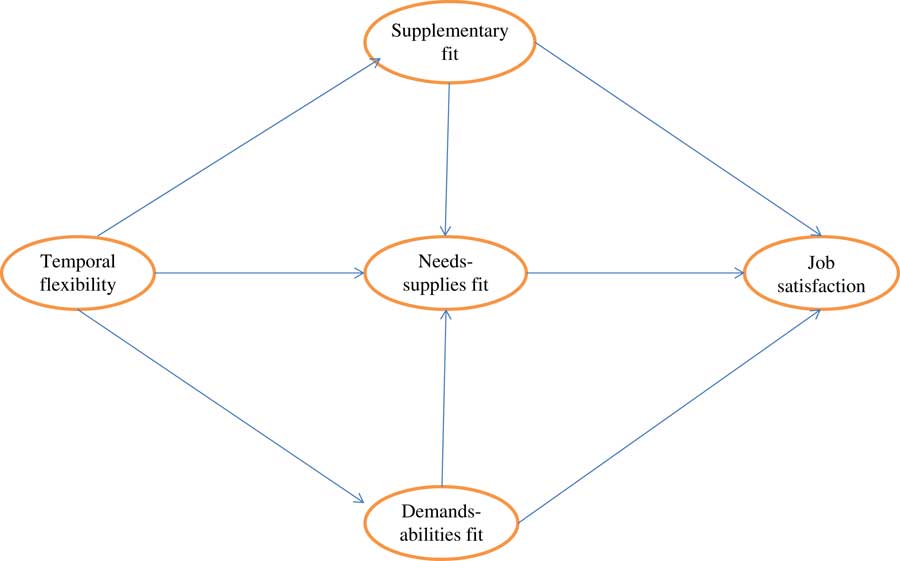
Overall, the purpose of the present research was to conduct a preliminary investigation whether P–E fit would be greater when employees have temporal flexibility and whether perceptions of fit would mediate the association between temporal flexibility and job satisfaction. Further, we proposed that the relationship between temporal flexibility and job satisfaction would be mediated by all three conceptualizations of P–E fit, including supplementary fit, demands–abilities fit, and needs–supplies fit (Figure 1).
Hypothesized model

METHOD
Participants and procedures
Participants were recruited either through snowball sampling, in which recruitment emails were sent directly to personal contacts who were asked to forward the invitation to their network list, or through the Study Response Project (Stanton & Weiss, Reference Stanton and Weiss2002), which was a web-based service hosted by the School of Information Studies at the University of Syracuse and enables researchers to pay respondents ($5 Amazon gift card) while maintaining their anonymity. The Study Response Project has been used in several studies such as Inness, Turner, Barling, and Stride (Reference Inness, Turner, Barling and Stride2010) and McNall, Masuda, Shanock, and Nicklin (Reference McNall, Masuda, Shanock and Nicklin2011). Data were collected as a self-report and it was a cross-sectional study which can be a limitation for the inference of causal associations among the study variables. In total, 175 (48%) participants were recruited through snowball sampling and 189 (52%) were recruited through the Study Response Project. A series of t-tests, using a Bonferroni correction to control for multiple tests, indicated there were no significant differences between the two samples for any of the research variables.
Participants were 364 employees working full-time or part-time in private and public organizations in Canada and the United States. Of these, 39% were male and 57% were female (4% did not indicate gender), with a mean age of 39.43 (SD=11.20; range 16–71 years). Based on an examination of skewness, kurtosis, and multivariate analysis of outliers, 14 participants were excluded from the subsequent analyses leaving a sample of 350. Most of the participants (91%) worked full-time and the majority (89%) had permanent jobs. Because the focus in this study was temporal flexibility we excluded the participants who were already working as part-time employees; thus there were 320 full-time employees in the final sample. The mean organizational tenure was 7.1 years (SD=7.2) and the mean job tenure was 4.8 years (SD=5.7).
Measures
Temporal flexibility
Five items measuring temporal flexibility, developed by Campbell-Clark (Reference Campbell-Clark2001), were used to assess employees’ perceived control over their working hours. The items were: I am able to arrive and depart from work when I want; I am free to work the hours that are best for my schedule; there is no flexibility in my schedule; it is okay with my employer if I work at home; I would easily take a day off of work if I wanted to. Ratings were made on 5-point Likert-type scales ranging from 1=‘strongly disagree,’ to 5=‘strongly agree’. The Cronbach’s α was 0.82 in the present study.
P–E fit
P–E fit was measured for supplementary fit, needs–supplies fit, and demands–abilities fit. Supplementary fit, defined as the congruence between one’s values and the values of the organization, was assessed at the level of person–organization fit with a 5-item scale used by Resick, Baltes, and Shantz (Reference Resick, Baltes and Shantz2007) that combined three items from Cable and Judge (Reference Cable and Judge1996) and two items from Saks and Ashforth (Reference Saks and Ashforth1997) (e.g., I feel my values ‘match’ or fit this organization and the current employees in this organization). Ratings were made on 5-point Likert-type scales ranging from 1=‘strongly disagree,’ to 5=‘strongly agree’. The Cronbach’s α for this scale was 0.89.
Needs–supplies fit takes into account how employees perceive their jobs in terms of meeting personal needs and desires and it was measured with a 4-item scale from Saks and Ashforth (Reference Saks and Ashforth1997) (e.g., This job is a good match for me). Demand–abilities fit, defined as the perception of how well individuals believe they fulfill the organizational demands or job demands with their knowledge, skills, abilities, and resources, was measured with a 2-item scale adapted from Cable and Judge (Reference Cable and Judge1996) and also used by Hutcheson (Reference Hutcheson1999) (e.g., I believe my skills and abilities match those required by the job). These two measures are considered to assess person–job fit and ratings were made on 5-point Likert-type scales ranging from 1=‘strongly disagree,’ to 5=‘strongly agree’. The Cronbach’s α was 0.94 for the needs–supplies fit scale and 0.73 for the demands–abilities scale.
Job satisfaction
Job satisfaction was measured using the 5-item version of Brayfield and Rothe’s (Reference Blau1951) Overall Job Satisfaction Scale (e.g., I am enthusiastic about my work) designed to assess how participants feel about their jobs. Ratings were made on 5-point Likert-type scales ranging from 1=‘strongly disagree,’ to 5=‘strongly agree’. The Cronbach’s α was 0.85.
Demographics
Participants were asked to indicate their gender, age, organizational, and job tenure, the type of industry, type of employment (permanent, contract), and work schedule (full-time, part-time).
Results
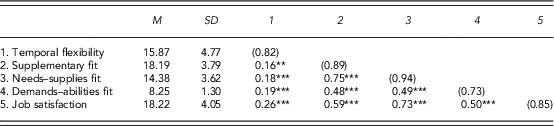
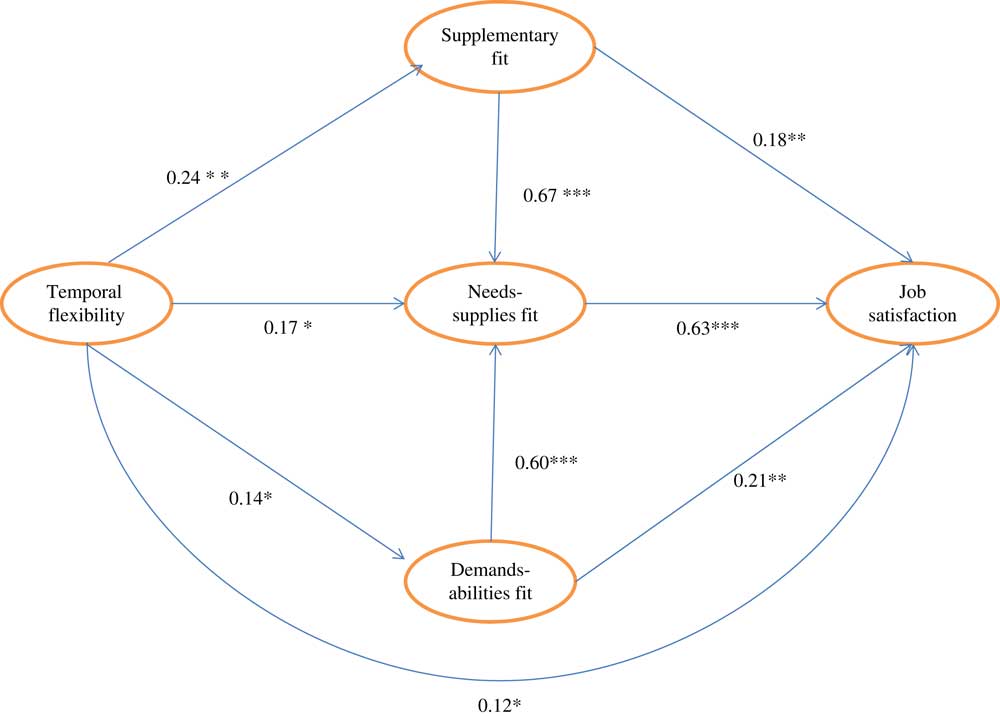
Means, standard deviations, reliabilities, and interscale correlations for the measured variables are shown in Table 1. In order to test our hypothesis and the proposed model, we first examined the measurement model (see Figure 1) with a confirmatory factor analysis to determine whether the model had an acceptable fit to the data. When a meditational model involves latent constructs, structural equation modeling provides the basic data analysis strategy (Judd & Kenny, Reference Judd and Kenny1981; Baron & Kenny, Reference Baron and Kenny1986). The hypothesized model was tested using the maximum likelihood method in AMOS 7.0. The initial test of the measurement model resulted in a good fit to the data (Table 2). All paths between the independent variable (temporal flexibility), the mediating variables (supplementary fit, needs–supplies fit, demands–abilities fit) and the dependent variable (job satisfaction) were significant. All of the standardized factor loadings of the 21 measured items for the latent variables were statistically significant. However, on the basis of the modification indices (Schreiber, Nora, Stage, Barlow, & King, Reference Schreiber, Nora, Stage, Barlow and King2006; Hooper, Coughlan, & Mullen, Reference Hooper, Coughlan and Mullen2008), the fit of the measurement model could be improved slightly by allowing one pair of errors from the job satisfaction scale that were similar in content to correlate. We therefore obtained a revised model with better fit to the data, as evidenced by a significant χ2 difference test (∆χ2=72.29, p<.001) (see Table 2). In the revised model, the estimated parameters indicate that temporal flexibility was positively related to supplementary fit (β=0.24, p<.01), needs–supplies fit (β=0.17, p<.05) and demands–abilities fit (β=0.14, p<.05). As well, supplementary fit (β=0.18, p<.01), needs–supplies fit (β=0.63, p<.001), and demands–abilities fit (β=0.21, p<.01) were positively related to job satisfaction, thus supporting the first and second hypotheses.
Means, standard deviations, reliabilities, and interscale correlations for measured research variables

Note. N=320.
**p<.01; ***p<.001.
Comparison of hypothesized model with full mediation model

Note. Modified hypothesized model: one pair of errors is included in the job satisfaction scale (partial mediation model).
Full mediation model: direct path from temporal flexibility to job satisfaction was deleted.
CFI=comparative fit index; GFI=goodness of fit index; IFI=incremental fit index; RMR=root mean square residual; RMSEA=root mean square error of approximation.
To test the third hypothesis that supplementary fit and demands–abilities fit would precede needs–supplies fit, the estimated parameters of the revised model were examined. As expected, these estimated parameters indicated that supplementary fit was positively related to needs–supplies fit (β=0.67, p<.001) and demands–abilities fit was positively related to needs–supplies fit (β=0.60, p<.001). The estimated parameters of the direct path between needs–supplies fit and job satisfaction (β=0.63, p<.001) was higher relative to the direct path from supplementary fit to job satisfaction and the direct path from demands–abilities fit to job satisfaction, thus supporting Hypothesis 3 and in line with Edwards and Shipp (Reference Edwards and Shipp2007).
According to our fourth hypothesis, there should be both direct effects of temporal flexibility on job satisfaction as well as indirect effects through the three conceptualizations of fit. To test this hypothesis, the model with direct and indirect effects was compared to a second indirect effects only model, that is, the path indicating the direct effect of temporal flexibility to job satisfaction was removed. The proposed model had a good fit to the data (see Figure 2). The indirect effects only model also had a good fit to the data; however, the χ2 for the alternative model was higher than the χ2 for the hypothesized model. A χ2 difference test was computed to examine the difference between the proposed model and the alternative model (Hoyle, Reference Hoyle1995), which was significant (∆χ2=3.92, p<.05), suggesting the proposed model had a better fit to the data. Thus, temporal flexibility had a positive effect on job satisfaction through supplementary fit, needs–supplies fit, and demands–abilities fit, but also a small direct influence on job satisfaction (β=0.12, p<.05).
Modified hypothesized model regression weights of the paths were given. *p<.05, **p<.01, ***p<.001

Recent studies in the area of P–E fit have found significant differences for P–E fit related to various demographics such as age (e.g., Krumm, Grube, & Hertel, Reference Krumm, Grube and Hertel2013; Zacher, Feldman, & Schulz, Reference Zacher, Feldman and Schulz2014) or organization (O’Reilly, Chatman, & Caldwell, Reference O’Reilly, Chatman and Caldwell1991). In order to test those previous findings, research variables were also tested by using the demographic information of the participants. According to the results, age was significantly correlated with needs–supplied fit (r=0.13, p=.02). Therefore, older adults perceive higher needs–supplies fit which is also supported by Krumm, Grube, and Hertel (Reference Krumm, Grube and Hertel2013). It can be concluded that with age, experienced employees would be more accurate about their needs and more likely prefer to stay in the jobs where they perceive fit. Likewise Krumm, Grube, and Hertel (Reference Krumm, Grube and Hertel2013) concluded that with age, employees will be more sensitive to needs–supplies fit. Moreover, as it was discussed by Chatman and Jehn (Reference Chatman and Jehn1994), in different industries, organizational characteristics can also be different. In order to test any differences between research variables in various industries, employees working in different industries were also compared by using analysis of variance. Although numbers of employees in various groups were not equal, results showed significant differences between temporal flexibility and supplementary fit of the participants. The analysis revealed that employees who were working in counseling, social and guidance services were reported more flexibility compared to the other industries. Moreover, employees who were in performing arts and publishing sectors were reported higher supplementary fit compared to others. However, in both groups the number of participants was quite low and therefore it would not be correct to make any inferences about the differences related to different industries.
Discussion
The purpose of the present research was to explore the role of temporal flexibility on P–E fit and job satisfaction, looking specifically at the role of three conceptualizations of P–E fit. In general, people who report greater temporal flexibility at work are also more likely to report greater satisfaction with their jobs (Galinsky & Stein, Reference Gajendran and Harrison1990; Rothausen, Reference Rothausen1994; Campbell-Clark, Reference Campbell-Clark2001; Lu et al., Reference Lu, Kao, Chang, Wu and Cooper2008). The present research, however, provided evidence to suggest that part of this effect is through the positive impact of temporal flexibility on increased perceptions of supplementary fit, needs–supplies fit, and demands–abilities fit. Thus, when employees believe they have flexible work arrangements, they may be more likely to report that they share similar characteristics and values with the organization and that their job fulfills their needs, which results in an increase in their job satisfaction.
Implications to theory
This study has important contributions for our understanding of both temporal flexibility and P–E fit. In literature while some studies found that temporal flexibility is related to employee attitudes (e.g., Scandura & Lankau, Reference Scandura and Lankau1997; Baltes, Briggs, Huff, Wright, & Neuman, Reference Baltes, Briggs, Huff, Wright and Neuman1999), some failed to find support for that relation (e.g., Martens et al., Reference Martens, Nijhuis, Van Boxtel and Knottnerus1999). In this study the relation between temporal flexibility and job satisfaction was examined from different perceptive than the previous studies. In the related literature, direct relations between temporal flexibility and various employee attitudes have been studied. However, it is also important to explore any indirect relations between those variables as it is a need to clarify whether temporal flexibility is essential for the organization. First, the research has uncovered the likelihood that temporal flexibility is important not only for increasing positive employee attitudes but also for increasing perceptions of employees’ fit with their organization and their job. When employees have the ability to control, or at least the ability to influence, when they work, it increases their sense of fit with the values and the norms of the organization, with the demands of their job, and their ability to use their knowledge and skills. Temporal flexibility is important for meeting family needs and personal obligations and for improving employees’ sense of well-being (Campbell-Clark, Reference Campbell-Clark2001; Grzywacz, Casey, & Jones, Reference Grzywacz, Casey and Jones2007; Butler et al., Reference Butler, Grzywacz, Ettner and Liu2009) as well as improving job-related attitudes beyond job satisfaction (Scandura & Lankau, Reference Scandura and Lankau1997; Chou, Boldy, & Lee, Reference Chou, Boldy and Lee2002). Thus, this study provides more expanded theoretical explanation about how temporal flexibility leads to high job satisfaction in line with self-determination theory (Ryan & Deci, Reference Ryan and Deci2000) – will be discussed in the following section in more detail – when flexibility satisfies individual needs, satisfaction will increase. According to the self-determination theory psychological needs of autonomy, competence, and relatedness are essential for satisfaction and psychological well-being.
In order to further investigate how temporal flexibility shapes employees’ perceptions of fit, future research may focus on the reasons for the importance of workplace temporal flexibility, particularly whether it is for autonomy, as suggested by Gajendran and Harrison (Reference Galinsky and Stein2007), and whether it is this sense of autonomy rather than another variable that drives the increased positive perceptions of P–E fit. Researchers should also ask whether employees have particular preferences for temporal flexibility and whether these preferences have any influence on their decision about their commitment to their jobs.
The second major contribution of the research was the inclusion of three conceptualizations of fit – supplementary, needs–supplies, and demands–abilities – in one study in order to test the relationship between these different perspectives and their unique influence on job satisfaction. It was hypothesized that supplementary fit and demands–abilities fit would act like antecedents of needs–supplies fit (Cable & DeRue, Reference Cable and DeRue2002; Cable & Edwards, Reference Cable and Edwards2004; Edwards & Shipp, Reference Edwards and Shipp2007). Supplementary fit was conceptualized as the congruency of values of the person and the organization, needs–supplies fit assessed personal evaluation of whether the job met the employee’s personal needs and desires, and demands–abilities fit focused on the individual’s perception of whether he or she had the knowledge, skills, abilities, and resources to meet organizational or job demands. We found that all three conceptualizations of fit were significantly related to each other, and in particular, supplementary fit had an influence on needs–supplies fit, consistent with Kristof-Brown (Reference Kristof-Brown2000) and Cable and DeRue (Reference Cable and DeRue2002). Although all three conceptualizations had unique significant associations with job satisfaction, needs–supplies fit had the strongest regression path. As such, our findings offer support for Edwards and Shipp’s (Reference Edwards and Shipp2007) proposal that supplementary fit and demands–abilities fit are important for perceptions of needs–supplies fit, which is highly related with job satisfaction. Recently Yu (Reference Yu2016) and Travaglianti, Babic, Pepermans, and Hansez (Reference Travaglianti, Babic, Pepermans and Hansez2016) were also found similar results showing significant relationship between types of P–E fit and employee attitudes. The results are all valuable as we gain practical understanding of how different types of fit can be used to support or improve job-related employee attitudes. Additional research is required to replicate these findings and to test whether the model generalizes to other employee attitudes such as commitment and turnover intentions. It is possible that needs–supplies fit is the most contiguous for job satisfaction and perhaps similar attitudes that focus on the work such as job engagement, but that the other fit conceptualizations may be better predictors of more organizationally focused attitudes such as commitment or morale.
Research limitations
This research should, of course, be considered in the light of key limitations. First and foremost, our data were self-report and cross-sectional, limiting the inference of causal associations among the study variables. Although tested as a mediation model, we cannot conclude that temporal flexibility caused a better sense of P–E fit that subsequently caused job satisfaction. Nonetheless, this research provides a useful framework and a model for future longitudinal research, particularly focusing on the role of multiple dimensions of P–E fit.
Common method bias may have inflated or attenuated the associations between perceptions of fit, temporal flexibility, and job satisfaction, despite our efforts to follow best practices (Podsakoff, MacKenzie, & Podsakoff, Reference Podsakoff, MacKenzie and Podsakoff2012) by adequately explaining the purpose of the research in order to encourage accurate responding, providing assurance of participant anonymity, and separating individual scales. It is necessary, however, to use self-report data for at least some of the variables because they assess subjective perceptions of supplies, values, demands, and abilities that are best judged by the employees themselves. Indeed, for P–E fit, it has been argued by others that direct measures present the strongest relations with work attitudes and organizational outcomes (Arthur et al., Reference Arthur, Bell, Villado and Doverspike2006; Piasentin & Chapman, Reference Piasentin and Chapman2006). Even so, future studies may need to include both direct measures and indirect measures in order to gain more information to compare the differences between two sources. Moreover, collecting the data by using two different methods can be thought as a possible limitation in research. Not all participants were recruited by snowball sampling and those 52% were recruited by Study Response Project whom was compensated. According to Freeman (Reference Freeman1997) intrinsic motivation can be important for volunteer behavior. Frey and Goette (Reference Frey and Goette1999) implied that external awards would have an impact on intrinsic motivation in other words receiving payment reduces individual effort. Therefore, two groups may have some differences related to their motivation to complete the questionnaires. In other words, participants who were compensated might have lower motivation to complete the questionnaire compared to the other participants who participated to the study without getting any compensation. This difference can be a confounding variable, however, no significant differences were found between research variables of the two groups, therefore it may not be an important issue to consider in this study.
Finally, we assessed three dimensions of P–E fit (supplementary fit, needs–supplies fit, and demands–abilities fit), but we did not assess different levels of fit, which are measureable at the level of organization, job, group, team, supervisor, and so forth (Edwards & Shipp, Reference Edwards and Shipp2007). Because of this, it is possible that the participants in the present research were not referring implicitly to the same level. Most research in P–E fit has focused either on organization fit or job fit (e.g., Cable & Judge, Reference Cable and Judge1996; Lauver & Kristof-Brown, Reference Lauver and Kristof-Brown2001; Erdogan & Bauer, Reference Erdogan and Bauer2005) because it is believed that these two levels of fit have the greatest influence on work behaviors (Kristof-Brown, Reference Kristof-Brown2000; Hoffman & Woehr, Reference Hoffman and Woehr2006). Researchers seldom include both job and organization fit at the same time (Cable & Judge, Reference Cable and Judge1996; Lauver & Kristof-Brown, Reference Lauver and Kristof-Brown2001) even though person–job fit has a unique effect on work attitudes over and above person–organization fit (Saks & Ashforth, Reference Saks and Ashforth1997; Kristof-Brown, Reference Kristof-Brown2000; Kristof-Brown, Jansen, & Colbert, Reference Kristof-Brown, Jansen and Colbert2002). Moreover, rarely are the different conceptualizations of fit included in studies assessing levels of fit. Rather, supplementary fit is often equated with person–organization fit because it assesses the similarity of the employee’s values, goals, and personality and the organization’s culture, values, goals, and norms (Muchinsky & Monahan, Reference Muchinsky and Monahan1987; Kristof, Reference Kristof1996), whereas complementary fit (needs–supplies fit and demands–abilities fit) is equated with person–job fit because of the concerns with specific resources including financial, physical, and psychological resources and, in turn, specific knowledge, skills, and abilities to do one’s job (Kristof, Reference Kristof1996). Future research needs to explore whether this is, in fact, the case or whether there is both supplementary and complementary fit at all levels. We suggest that each conceptualization of fit is important at each level but just plays out differently. Although the research would become much more complex, the P–E fit field may now be at the point that it can incorporate this greater level of nuance.
Implications for organizations
From a practical perspective, the present study supports the importance of matching employees to jobs that fulfill their psychological needs, motives, and goals in addition to assigning people to positions based on their knowledge, skills, and abilities. Moreover, temporal flexibility is not only important to determine positive employee attitudes, but it also can be a significant determinant for perceptions of P–E fit, in line with self-determination theory (Ryan & Deci, Reference Ryan and Deci2000), which posits that satisfying the needs of autonomy, competence, and relatedness is essential for satisfaction and psychological well-being. Similar to Greguras and Diefendorff (Reference Greguras and Diefendorff2009), who found that autonomy mediates the influence of person–organization fit on employee outcomes, our results support the idea that giving employees some control over their schedule increases their autonomy, helping to satisfy their core psychological needs. Frequently employees can be frustrated by the inflexibility of their work schedules, particularly when there is no reason other than tradition to work regular business hours. If these employees have personal needs that can only be met during the regular schedule, they may prefer to change their jobs to part-time or to strike out on their own (Golden, Reference Golden2001b), which can be a negative outcome for organizations if they lose their high-potential employees. It may be possible to retain these employees full-time, and even help improve their productivity, if organizations consider what kind of temporal flexibility would best suit them.
Conclusion
Previous research (Bohen & Viveros-Long, Reference Bohen and Viveros-Long1981; Ronen, Reference Ronen1984) has demonstrated that temporal flexibility is related to job satisfaction. In the present study, we demonstrated that the effects of temporal flexibility on job satisfaction might not be direct but rather indirect through variables such as P–E fit. Indeed, we found that temporal flexibility was an important antecedent for P–E fit, and perceptions about supplementary fit, needs–supplies fit, and demands–abilities fit were significant mediators between temporal flexibility and job satisfaction. As jobs become more complex and when employees have greater needs for flexible work arrangements, particularly to balance their job with other important aspects of their lives, organizations that pay attention to giving employees greater control over their work schedules may help to satisfy key psychological needs and, in doing so, retain more committed and satisfied people.
Acknowledgment
The authors are thankful to editors and anonymous reviewers for their valuable feedback.