Myth hides nothing: its function is to distort.
—Roland BarthesIn Los Angeles, California, the home of the nation's second largest Federal Theatre Project (FTP), a group of FTP artists spent over a year developing The Sun Rises in the West, a popular and critically well-received but forgotten play about the Dust Bowl migration and its effects on California's agricultural valleys. The play was mounted by the Southwest Theatre Unit (SWTU), an experimental branch of the Los Angeles Federal Theatre Project that worked as a collective to produce plays independently of the FTP's more mainstream endeavors. The SWTU attracted ample publicity during the latter half of the 1930s for its experimental, politically charged material, but because the group's artistic record has been buried for decades in government and university archives, much critical work remains to be done on its contributions to theatre history. This essay seeks to remedy this gap with a brief sketch of the SWTU as an avant-garde force in Los Angeles and an analysis of the SWTU's original play, The Sun Rises in the West.
The SWTU produced five plays in three years under the direction of Mary Virginia Farmer. The Sun Rises in the West, the SWTU's only original production, tells the story of a Midwestern American farming family displaced by the 1930s Dust Bowl. Unlike protagonists in other Dust Bowl narratives, such as the Joads in John Steinbeck's The Grapes of Wrath, this play's lead, Jeff Gillen, maintains an individualist ethos that fuels an unwavering belief in the viability of the American Dream of the self-made man. He never lets go of the American agrarian ideal, that idealistic equating of independent farm ownership with patriotism and virtue, even as the Depression empties his bank account and dust storms destroy his farm. He would rather travel west to build a new independently operated farm than work for another farmer or seek financial help from state and federal governments. His convictions never falter, even at the play's end, when he and his family are living in destitution. This depiction of abject poverty suggests that the Depression-era American Dream was little more than a myth perpetuated by ideological conservatism.
In the second half of this essay I discuss the play's representation of Mexican American migrant workers and the racism these workers faced. Mexican and Mexican American laborers accounted for a significant percentage of the laborers working in California at this time, yet representations of them are almost entirely absent from the Dust Bowl genre, one of the most popular genres to emerge from the Depression decade. Of course, few plays with Latin American themes were produced during this time. The 1920s witnessed an unprecedented boom in Latin American theatre in the United States, but by the 1930s, most of the theatre spaces in which this theatre took place had been “razed and turned into parking lots.”Footnote 1The Sun Rises in the West can therefore be viewed as a bridge between the Latin American theatre of the 1920s and its resurgence in the 1940s and 1950s.
The play's challenge to racism, combined with its portrayal of conservative Dust Bowl farmers distrustful of leftist ideology, make The Sun Rises in the West a fascinating departure from most narratives about the Dust Bowl, theatrical or otherwise. Recovering this play and the history of the SWTU expands our conception of the Dust Bowl genre and contributes to our understanding of how the Federal Theatre Project challenged conservative American ideology during one of the greatest economic disasters in American history.
Leftism and Labor Camps: The Southwest Theatre Unit Emerges in Los Angeles
In 1936, J. Howard Miller, the national deputy director of the Federal Theatre Project, oversaw the development of the Southwest Theatre Unit. His goal was to distinguish artistically the Los Angeles Federal Theatre Project from projects in other cities, just as Elmer Rice's Living Newspaper unit had done in New York.Footnote 2 Moreover, Miller wanted to fulfill the vision of Hallie Flanagan—the Federal Theatre Project's national director—of a truly regional federal theatre that reflected the history and character of the communities in which it operated. The SWTU met these expectations by producing four plays by contemporaneous playwrights that were relevant to California and the Southwest and by writing and developing a fifth, final play of their own, one that addressed the issue of the thousands of poverty-stricken Midwestern farmers who were leaving their barren farms and traveling to California for a new start in the West. So relevant to California's social concerns was The Sun Rises in the West that after sitting in on a rehearsal, Flanagan remarked that the play “would prove to be a potent source of drama not only for Federal Theatre but for the theatre ... in general.”Footnote 3
Miller recruited Mary Virginia Farmer to direct the Southwest Theatre Unit. Farmer was an experienced East Coast theatre actor, director, and teacher who also acted as artistic consultant for the general Los Angeles FTP. Farmer's professional background included experiences with the Group Theatre of New York and the Theatre Collective, one of the most politically left-leaning theatres in New York in the 1930s.Footnote 4 Farmer sought to use her professional influences to create a unique rehearsal environment that matched the Group Theatre's political yet professional “middle-class theatre” sensibility with what she described as the “collective kind of leadership [and] democracy” of the more experimental New York theatres.Footnote 5 Because of Farmer's reputation as an artist and a teacher,Footnote 6 Miller gave her the power to handpick several of the Los Angeles actors who joined the SWTU. Many of these actors had moved to California from New York in the late 1920s and early 1930s, when New York's theatres were closing because of poor ticket sales and the fact that the less-expensive “talkies” were commanding an increasing share of scarce entertainment dollars. A number of these New York transplants had participated in the same leftist theatre scene to which Farmer had once belonged.Footnote 7 Other members of the SWTU were aging vaudevillians, actors who had relied on stock characters for years and were wary of Farmer's more radical techniques, which included Stanislavsky's Method and exercises based on animal characterizations and improvisations.Footnote 8 Diana Rivers, a seasoned vaudevillian who joined the SWTU in 1937, quit the group and then the Los Angeles Project altogether, stating that she “just didn't want to go on and on and on with all this improvisational work.”Footnote 9 Theodore Pezman, one of three playwrights listed for The Sun Rises in the West, described Farmer as at once “very affirmative, very experimental … autocratic and permissive in the same way.” He also said that she was the only person working in the Los Angeles Federal Theatre Project who could have integrated such an amalgam of methodologies and still have “produced an actual play.”Footnote 10
All five of the plays the SWTU produced used experimental staging techniques. Donald Murray, the second writer listed on The Sun Rises in the West, described the SWTU shows as “quite stylized and just fascinating to watch in the theatre.”Footnote 11 The group's first production, Class of ’29, by Orrie Lashin and Milo Hastings, opened on 12 November 1936 at the Musart Theatre. The play was another Federal Theatre Project original by two up-and-coming New York playwrights that had stirred controversy in New York for its alleged “communist” content. Farmer's SWTU production was the only FTP production to keep the original New York script intact.Footnote 12 In 1937, the unit produced Paul Green's The House of Connelly, the inaugural production of the Group Theatre, and Like Falling Leaves, by Italian playwright and librettist Giuseppe Giacosa.Footnote 13 The SWTU's next project, a revival of a 1929 play by Oklahoma playwright Lynn Riggs called Roadside, opened on 8 April 1938. This “lusty American comedy,” as the play's marketing poster touted it, was performed at the Musart Theatre in Los Angeles.Footnote 14 According to Murray, the SWTU performed Roadside while working on The Sun Rises in the West, which ran for roughly three weeks at the Mayan Theatre in Los Angeles, 1–17 July 1938.Footnote 15The Sun Rises in the West had a short subsequent run in San Francisco, when the San Francisco Federal Theatre, looking for a region-specific hit, picked up the play and opened it at the Greek Theatre on 17 August 1938.Footnote 16
The SWTU was able to devote a significant amount of time to the writing of The Sun Rises in the West because the actors rented out a house on Harvard Street in Glendale, away from where the Los Angeles project conducted its rehearsals.Footnote 17 According to a 1961 interview with Ralph Freud, chairman of UCLA's Theater Arts Departmnet from 1953 to 1969, the SWTU lived together at this location.Footnote 18 This practice was unusual for the FTP, and it spurred rumors of communism. When the new regional director, Alexander Leftwich, arrived in Los Angeles to replace Miller in mid-1938, the SWTU had already spent nearly a year on The Sun Rises in the West. Leftwich refused to believe that so much time could have been spent devising a single play. When his disbelief turned to suspicion, he reported several SWTU actors to Congress for subversive political activity, including Pezman and Murray. Leftwich's suspicions had been fed by SWTU actor and playwright Rena Vale. Vale, who had been working on the Los Angeles Federal Writers' Project, joined the SWTU after Farmer asked Miller if she could hire someone from the Writers' Project to augment the writing talent in the SWTU. Vale agreed to join the SWTU for reasons undisclosed in any of the SWTU's archival materials.
Although Vale was the third listed writer for The Sun Rises in the West, she later disavowed herself from the project.Footnote 19 Exactly what Vale witnessed, if anything, has remained a point of contention: decades later, Murray stated that Vale had a falling out with Farmer and that her name became a “bad word” among the SWTU. In testimony given in 1940 to the House Un-American Activities Committee (HUAC), Vale claimed that playwright John Howard Lawson had asked her to insert Communist Party propaganda into The Sun Rises in the West.Footnote 20 When Farmer was asked in 1976 about this statement, she called the claim “absolutely false.” When the interviewer asked Farmer why Vale would have made such a report, Farmer remarked that Vale had come “under the influence” of an unnamed person and then asked that the recorder be shut off.Footnote 21
Vale and Leftwich's accusations proved deadly to the careers of Pezman and Murray. Both men were subjected to the investigations of the HUAC in 1938. Murray was subsequently blacklisted in Hollywood, and in the 1950s Pezman lost his job as a public schoolteacher after it was discovered that he had failed to note the congressional investigation on his job application.Footnote 22
But in 1937 these allegations had yet to occur, and the SWTU had just begun work on The Sun Rises in the West, one of the largest research projects conducted by a dramatic unit of the FTP outside of the Living Newspapers. Although this final SWTU play differed stylistically from the Living Newspapers—a genre that tended to be more episodic and more expressionistic and that used shadow play, projections, and scrims—the SWTU in many ways modeled its collaborative writing and research techniques after the methods of the New York Living Newspapers unit. Because it aimed to produce a play that would accurately represent the state of California, it based its original work on many news stories and testimonies that members gathered and corroborated.Footnote 23 The actors investigated numerous California-related topics, from the history of the state's founding to trends in its contemporary cultural-political milieu. They dedicated nearly a third of their research to understanding the plight of white dispossessed farmers from the Plains; they created a bibliography of nearly a hundred articles from newspapers and periodicals about the Dust Bowl that had been published between 1928 and 1936; and they read fictional portrayals of the United States in the 1930s, including Sherwood Anderson's Puzzled America and Howard Baker's Orange Valley.Footnote 24 The SWTU also embarked on a series of “field trips” into California's Central Valley, during which they conducted interviews with Dust Bowl migrants in labor camps. The team sought answers to questions about the migrants' daily life and how they had adapted to their new environment.Footnote 25 According to Pezman, the SWTU's goal was to “know what the real situation was and encounter the reality of the problems of the people” so it could represent the migrants fairly onstage.Footnote 26
Perhaps the most significant event to occur during the development of this play was the SWTU's brief encounter with John Steinbeck. While traveling with the group to San Francisco in late 1937 to conduct research, Pezman arranged a meeting with Steinbeck, who had stopped in the area to conduct research for The Grapes of Wrath. Steinbeck and the SWTU spent an evening together discussing the seriousness of the migrant workers' situation and the shape and content of the story line that would become The Sun Rises in the West.Footnote 27 The SWTU drew a series of political and philosophical conclusions that became themes of the play from the artistic insights the SWTU gleaned from this meeting and from the details the actors collected during their fieldwork.
When The Sun Rises in the West opened at the Mayan Theatre, the critical reaction was mostly positive.Footnote 28 A critic at the Herald Express described the play as “the strongest social drama I've seen”; another wrote that the play “was no doubt plotted as a telling blow to capital.”Footnote 29 The power of the play was perhaps rooted in its realism. The critic further called it “entertainment ... of an exciting sort that comes from witnessing recognizable characters and scenes in life-like portrayal.”Footnote 30 A critic for the Hollywood-Citizen News wrote that “the theme is not a pleasant one, but it is real.”Footnote 31
The play consists of two acts with three scenes in each. The first scene takes place in 1851. A pioneering family named Gillen is traveling west to California. They see themselves as history makers, for as one family member exclaims, “Some day there'll be many people in all this West … . And there'll be a cleaner friendlier life in this great new land all because we found the way.”Footnote 32 Their vision of the West is challenged, however, when a group of men returning from California stop to discuss their experiences in the state. They describe it as a filthy dump overrun by “scoundrels” where prices are too high to live well (1.1.31). Their stories convince the Gillens to end their journey on the frontier and make the Plains their final home.
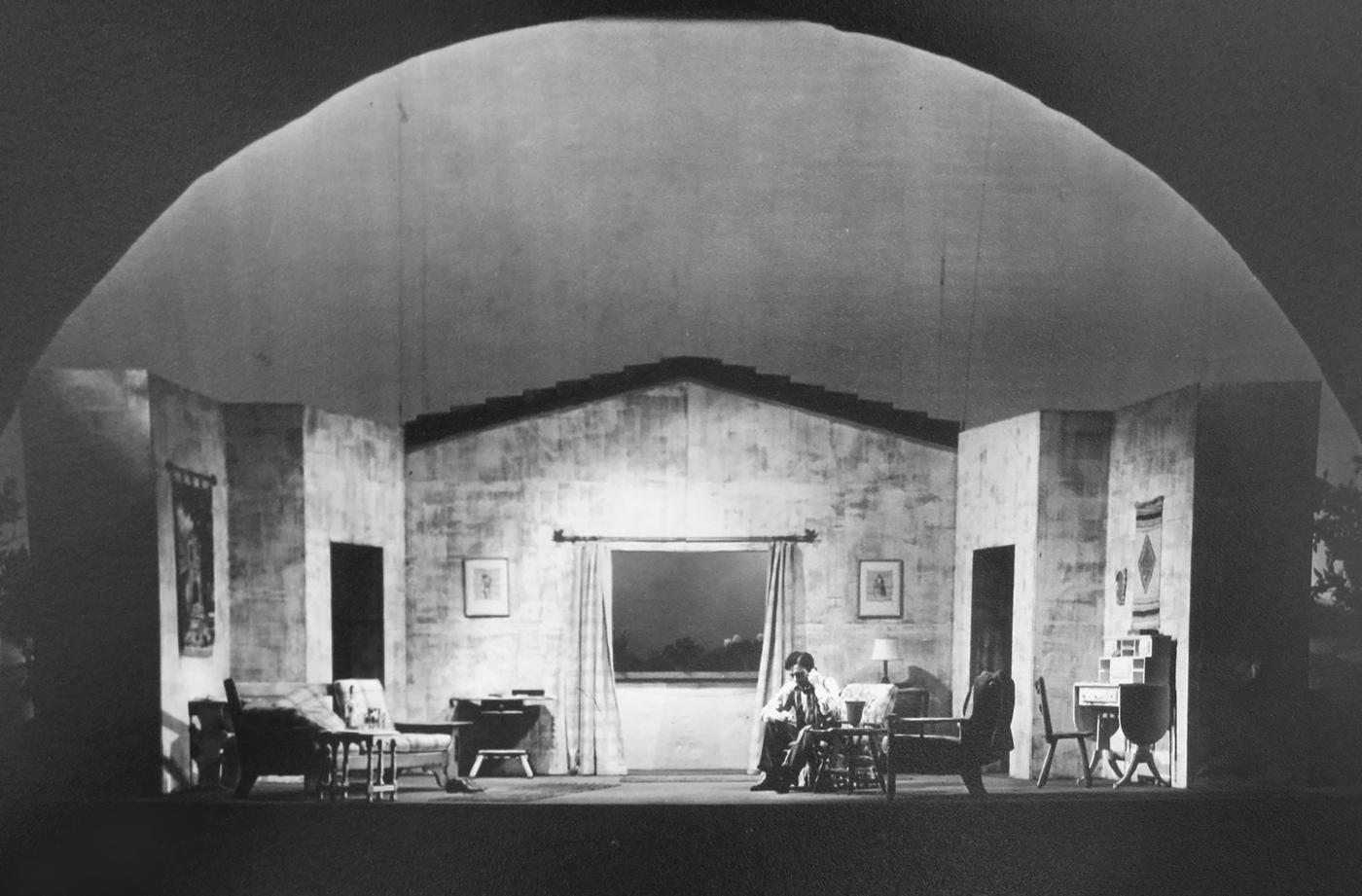
The second scene opens in 1929 on the same plot of land on which the pioneering Gillens stopped. The juxtaposition suggests a comparison between the modern-day Gillens' story of migration and that of their ancestors. The association was intentional. According to Donald Murray, “the [play's] structure ... was to make a connection between the previous big migration West in [the] 1850s, and the dust bowl migration.”Footnote 33 In this scene we also learn that the family's latest patriarch, Jeff Gillen (Henry Hall), has turned the land into a productive farm. In the center of the land he has built a “comfortable modern farm house” (1.2.1). The original script calls for a sofa, a large plant on a table, and a “high-backed leather arm chair” in the center area of the stage (1.2.1). Photos of the original 1938 Los Angeles Mayan Theatre performance depict a set that matches this description (Fig. 1). Jeff and his wife Martha (Eleanor Mack) have three adult children, Matt (Walter Worden), David (Wallace Warner), and Hannah (Betty Folawn). As a family they joke and laugh easily, and they demonstrate a robust belief in the power and import of self-sufficiency. At the end of the second scene, the Gillens receive news that their local bank has collapsed and that Jeff will be unable to withdraw money to pay the family's mortgage and property taxes. Matt, who has been looking for an excuse to set out on his own, decides to move to California to pursue a farming opportunity. Jeff protests: “I don't want it. This family's holdin' together on its own land the way it always has. You're going nowhere to work as hired help” (1.2.45). Matt leaves in spite of his father's statement.
Still from The Sun Rises in the West, act 1, scene 2, produced by the Los Angeles Federal Theatre. Wallace Warner as David Gillen has a phone discussion with a neighbor regarding the Association, the local farming organization. Source: Library of Congress.

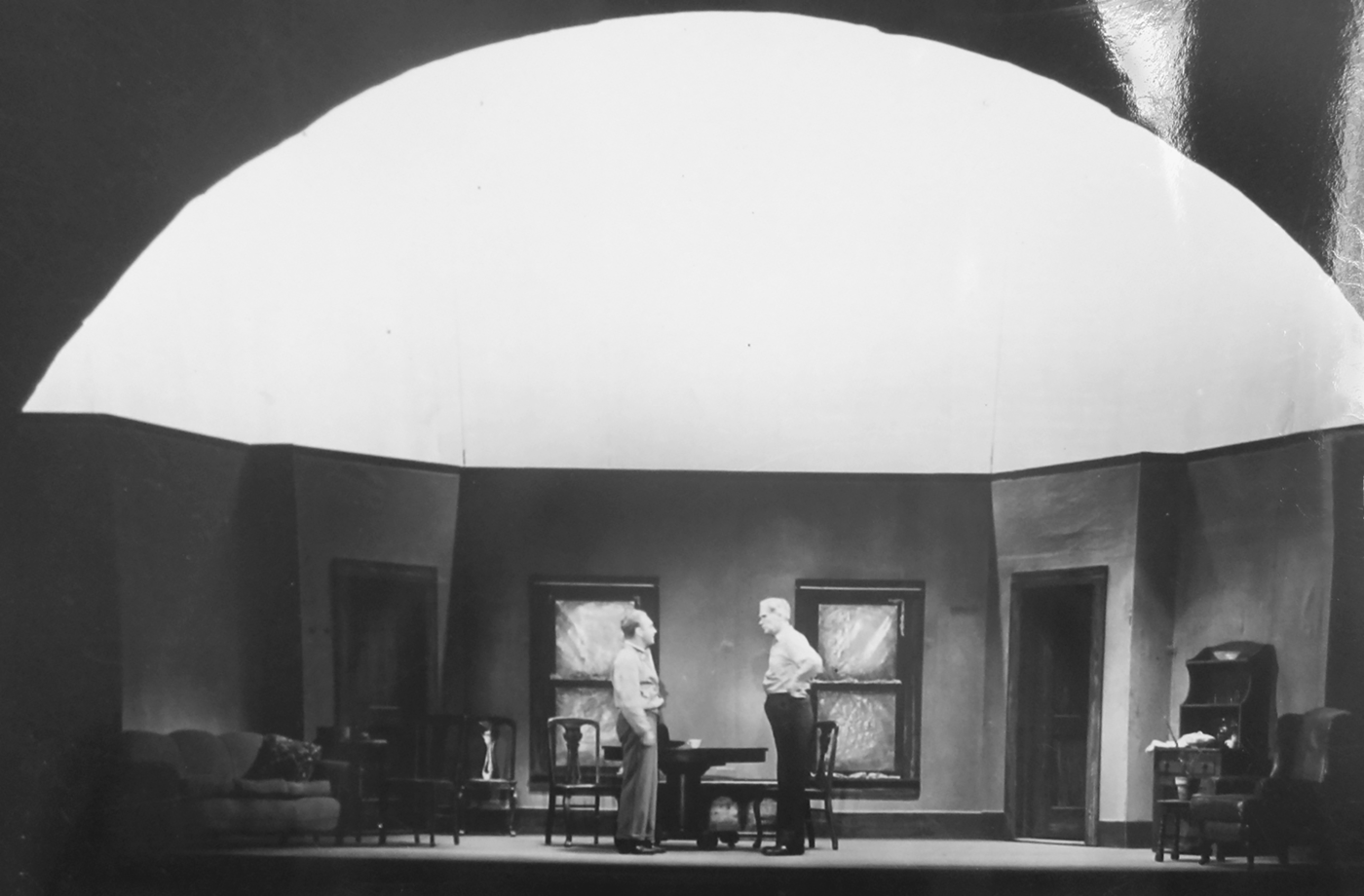
In the third scene of act 1, the play jumps forward in time to 1935. The Gillens have held onto their land, but their crops and cattle are dead. The living room has been stripped bare, save for Jeff's leather chair, now described as “old,” and a few straight-back chairs brought in from the kitchen (1.3.1). The original script calls for a literal bowl of dust was put in the center area of the stage, at once suggesting the collection of dust inside the home and symbolizing the cause of the Gillens' plight. The windows were covered with newspaper to keep out the dust. The large plant, at this point brown and dead, further symbolized drought (Fig. 2). An out-of-town cattle buyer offers Jeff six dollars a head for his cattle, but Jeff refuses on grounds that he paid much more for them originally. The Gillens' neighbor, McElroy (Donald Murray), comes to the house to ask Jeff to join the local organization that keeps prices of crops and cattle level among farmers in the region. David urges his father to join the organization, but Jeff refuses; he believes that if he joins he will have to give up his individualism in the marketplace (1.3.11). News of a large and particularly threatening dust storm headed their way finally convinces Jeff to relocate his family.
Still from The Sun Rises in the West, act 1, scene 3. Neighbor McElroy pays a visit to Jeff Gillen to convince him to join the local organization. From left: Donald Murray as McElroy, Henry Hall as Jeff Gillen. Source: Library of Congress.
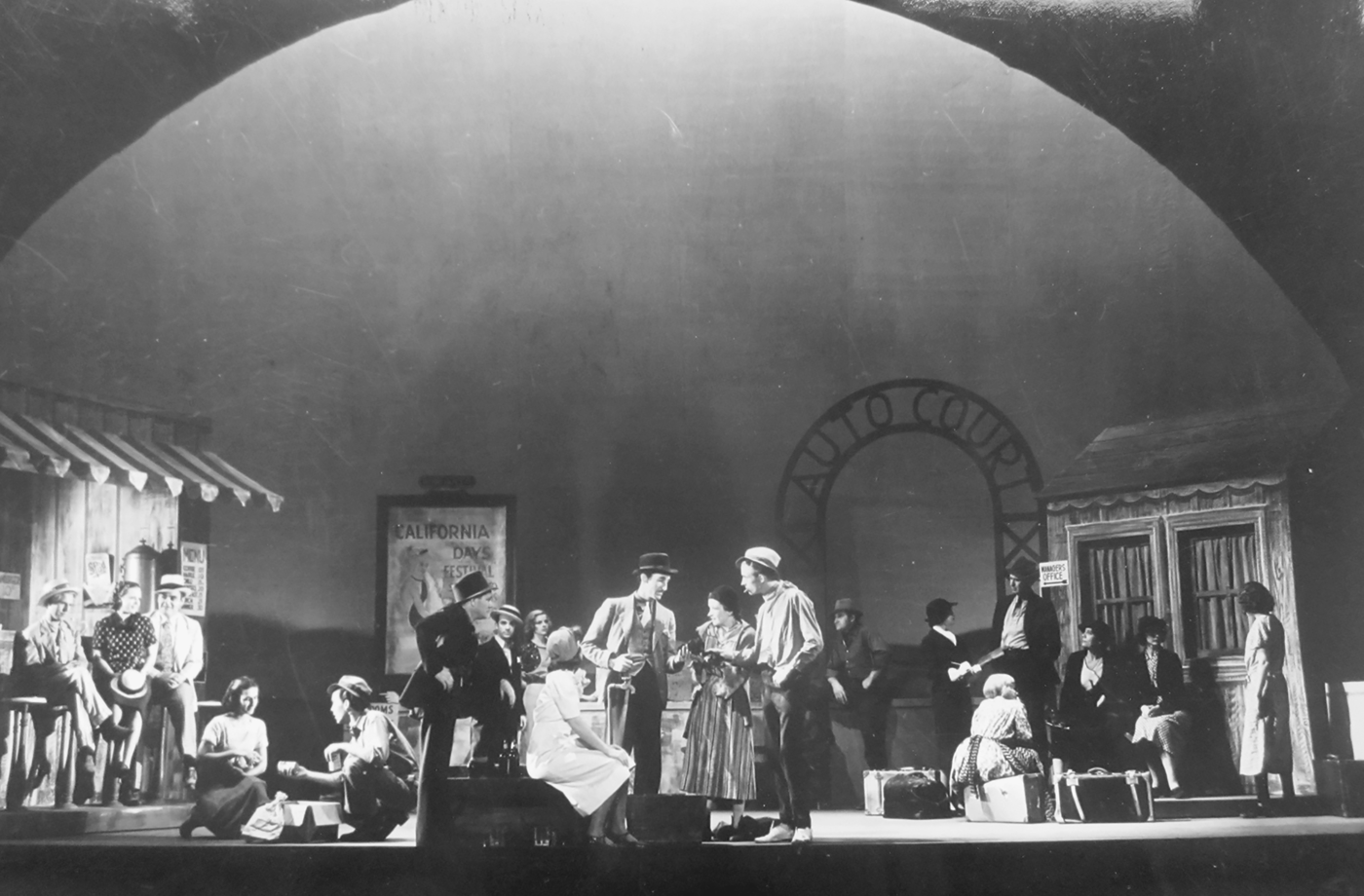
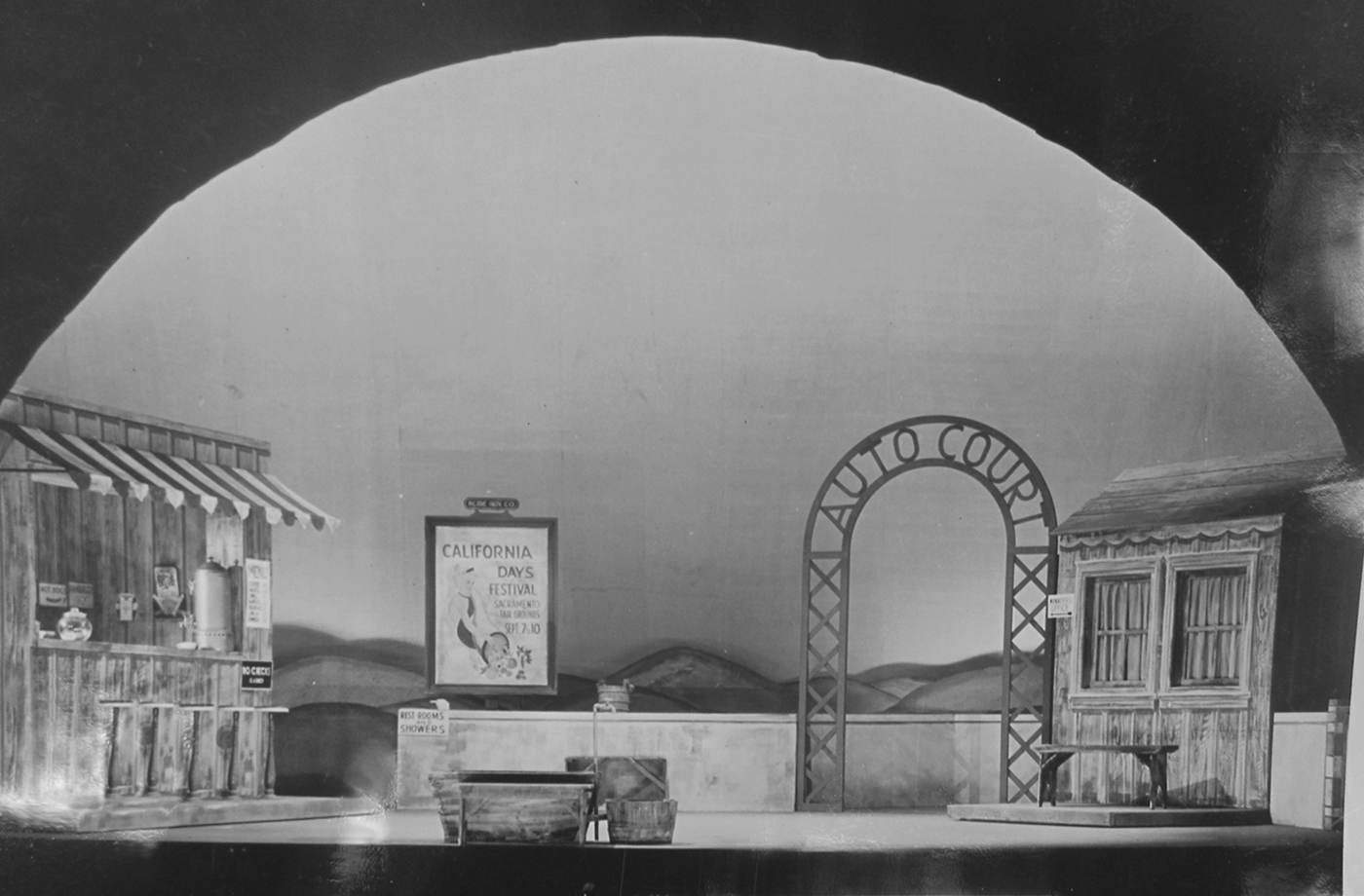
The second act again jumps forward in time. The Gillens have been on the road for a week and have just arrived at “a typical California motor lodge” that is occupied by other Dust Bowl farmers (2.1.1). Unable to afford rooms in any of the lodge's cabins, the Gillens sleep outside. In the original production, their campsite was suggested onstage by stacked suitcases and other belongings (Fig. 3). The script describes a backdrop that illustrates the “wealth, beauty, and fertility of California,” but a photo of the original SWTU production depicts a painted background of sparse rolling hills, a disparity that can be read as an ominous warning of the lack of opportunities the West will offer (Fig. 4). The Gillens soon encounter a government surveyor (Araby Childs) who explains that it is her job to survey Dust Bowl migrants entering California. She explains to the Gillens that they will need to get on government assistance to survive in the state. Jeff does not believe her and tells her to mind her own business.
Still from The Sun Rises in the West, act 2, scene 1. Tourists and migrant laborers gather at the California Motor Lodge for the California Days festival. In the center, two Dust Bowl migrants, Grandma and Ebert Briggs, talk with Slater, the owner of the lodge. Center, from left (the actors standing): Bernie Peck (in the vest), Lou Polley, Earl Faullin (cigarette in mouth). Source: Library of Congress.
Still from The Sun Rises in the West, act 2, scene 1. Empty set for the California motor lodge, the site of the California Days festival and the Gillens' first encounter with Concha and Jesus. Note the simplistically painted hills in the background. Source: Library of Congress.
Later that evening the Gillens meet Jesus Martinez (Marcel Fernandez) and his daughter Concha (Lillian Sidney), Mexican American migrant laborers. After spending the evening with them, David becomes sympathetic about the racism and financial hardships Mexican American laborers face. He offers them food to help them on their journey west, but Martha and Jeff do not approve of his helping them because they believe the limited food supply should be reserved for their own family. At the end of the scene another Dust Bowl migrant grabs Concha from behind, telling her to get out of the camps. David yells at him to let her go. He calls on Jeff to do something, but Jeff refuses to get involved. Not wanting the confrontation to escalate, Jesus and Concha leave the camp. David tells Concha he is “sorry this had to happen” as she walks away (2.1.29).
The second scene of act 2 begins several days later in the living room of the owners of the Glengold Ranch, the large California orchard that has hired Matt to manage its “pickers” (2.2.1). The Gillens have been staying with Matt while Jeff looks for land to buy so he can rebuild his farm. When the action begins, Matt is on the phone speaking with his employer. Martha enters wearing an apron; she has been cooking breakfast for the family. Matt hangs up and tells Martha that they need to convince Jeff not to buy his own land because Jeff cannot compete with farms like Glengold and will lose everything if he tries. Matt suggests that instead, Jeff work at Glengold in a management position with him. Martha reminds him that Jeff cannot stand the idea of “working for wages” but says she will try to convince him to take a job (2.2.4). Matt's assistant enters the room and explains that they are short on fruit pickers because of a strike enacted by the Mexican American laborers. He suggests that Matt hire the “refugees from the Dust Bowl,” because unlike the striking laborers, they won't “give him any trouble” (2.2.6). His brother David, who has been hired to “manage” the striking laborers, enters the room at this moment. He explains that the fruit on the trees will rot if they are not picked soon. Matt explains his idea of hiring Dust Bowl migrants to do the work, and David responds angrily, telling Matt to give the Mexican American laborers the wages they are asking for. He then storms out. Matt asks his assistant how many Dust Bowl migrants he can hire by the end of the day, and the assistant replies no more than two hundred. Matt worries that two hundred is not enough to pick the ripened fruit, but the assistant tells him not to worry because the “Mexicans” are “not really organized” and because they will “have them picking day after tomorrow if we handle it right” (2.2.8). Moments later, Jeff arrives to tell Matt that he has found a plot of land to buy but needs Matt to cosign the loan. Matt refuses, and an argument ensues between them. As they argue, David reenters the room with Pico (Jas Wells), a spokesman for the Mexican American laborers. Pico explains that the laborers are starving and need the pay raise they have been asking for. Matt refuses to discuss the issue, and David yells at him that he is “starving people to death” (2.2.15). The scene culminates in a three-way argument among Matt, David, and Jeff. David tells Matt that he is quitting and will look for work on a rival farm. Jeff, completely ignoring the argument about the Mexican American labor strike, yells at both of them for working for wages: “Any farmer that's worth the name will get himself a piece of ground ... because he knows it'll take care of him, keep him his own master. That's the only kind of ‘decent job.’ If you two have forgotten what you come from, I ain't. I'll have me a farm, I'll make it yield, and I'll beholden to no on” (2.2.21). He storms out of the house. Martha stares after him, and Matt calls him a “damn fool” (2.2.21). Matt then gives David one more chance to keep his job, and David replies “to help you starve those people out there?” (2.2.21). Matt, exasperated, leaves, and David and Martha stare after him.
In the next and final scene, another year has passed. The Gillens are financially bereft and living in a tent in a Dust Bowl migrants' labor camp not far from Glengold Ranch. Two vigilantes Matt has hired are sneaking around the periphery of the camp. Concha, who is staying at the camp, hears the men rustling and starts to pace in fear. One of the Dust Bowl migrants ask her why she is so scared, and she explains that her father stole money from Glengold Ranch to buy food for starving Mexican American workers (his theft has not been depicted onstage). She and her father, she says, had been staying in a nearby labor camp populated primarily by Mexican American workers. But that camp was attacked by these same vigilantes when they discovered Jesus was there, and the Martinezes had run for their lives. Concha ran to the Dust Bowl migrants' camp, but Jesus never made it. Concha is not sure where he is and says that if the vigilantes catch him, they will kill him. The other Dust Bowl migrants also hear the vigilantes and discuss what they will do if they try to attack their camp. Martha enters the scene and tells Jeff that they are low on water. Jeff looks for David to fetch a bucketful, but David is nowhere to be found. Concha says that he is visiting the Mexican American labor camp to get a better sense of why they are on strike. Jeff grows angry, not understanding why David is helping others when his family needs him. Jesus suddenly arrives, hobbling on one foot; he has broken his ankle as he ran from the labor camp. Some of the Dust Bowl migrants grow suspicious because it seems that the vigilantes appeared at roughly the same time Jesus did. They ask Jesus if he led the vigilantes to their camp, and Jesus denies it. Jeff, still feeling as if David deserted his family, takes his anger out on Jesus, telling him he is not welcome. The migrants are divided about whether Jesus should be allowed to stay and they start to argue. Then David appears. Jeff tries to convince David to take his side, but David refuses; he explains that the majority of the Mexican American workers would have starved if Jesus had not stolen money to help them.
At that moment the vigilantes break through the bushes surrounding the camp and demand that the Dust Bowl migrants give up Jesus, who is now hiding behind a tent. The Dust Bowl migrants refuse to give him up, and a fight breaks out between the migrants and the vigilantes. Matt appears, worried about his family's safety. He tries to get the vigilantes to lower their guns, but they read his behavior as a trick and shoot him through the chest, then flee to the hills. Jeff leans over his dead son's body to conceal it from Martha. Through tears he says to David that “there's justice somewhere,” but David explains that justice will not be gained by any one person seeking it alone: “Not out there, Dad. Not by yourself—not alone” (2.3.29). Several of the Dust Bowl migrants gather their things as they prepare to leave the camp, but David stops them. He explains that all migrant laborers, whites and nonwhites, continue to suffer because everyone insists on helping only themselves. The solution, he says, is cooperative action among Dust Bowl migrants and Mexican American laborers to achieve labor-law reform that would help all laborers earn livable wages:
We've been tryin' to get the things we want by ourselves—just for ourselves—not givin' a damn for the next fellow. And where'd it get us? Not any of us would be in this rotten ditchbank camp if anywhere along the line we stood our ground with our own people—people we know we belong to because they're sufferin' the same things we're sufferin'—wantin' the same things we want. (2.3.29)
Many of the Dust Bowl migrants, along with Concha and Jesus, gather around David to listen to his ideas. Jeff also agrees to at least consider what David has to say. Other Dust Bowl migrants ignore David. They continue packing their things, looking simultaneously afraid and defeated as the scene fades to dark.
The ending is not quite the conversion ending that was characteristic of the workers' theatre agitprop of the early 1930s or of the Federal Theatre Project's Triple-A Plowed Under, a Living Newspaper about the Dust Bowl that ends with all of the characters “converting” to a similar ideology that includes the belief that everyone should fight together for the same cause. In the Sun Rises in the West Jeff considers David's ideas, but there is no indication that he will give up his conservative belief in the American Dream of the self-made man for David's more radical vision. Moreover, there is no indication that David's plan will work. Indeed, the fearfulness of the Dust Bowl migrants after Matt's death and their readiness to leave indicate that they are more likely humoring David because his brother just died than taking him seriously. Yet despite this somewhat ideologically indeterminate ending, I argue that the play ultimately sides with David. Through depictions of abject poverty as experienced by multiple ethnic populations, the play contends that Jeff's view of the American Dream is alienated from the material reality of the Depression; it is little more than a myth. By clinging to his mythic American Dream, Jeff is rendered a tragic figure who is destined for financial failure, a frightening illustration of Roland Barthes's warning that the primary purpose of myth is “to distort.”Footnote 34
The Sun Rises in the West's inclusion of Mexican American laborers and the racism they face suggests that the Depression-era American Dream is a mythic concept for nonwhite migrant workers as well, though nonwhite workers often defined the American Dream differently than did the Dust Bowl migrants. As Tsui-fen Jiang writes in her work on ethnic American drama, African American, American Indian, and Latin American characters of the twentieth century tend to elevate racial equality above other definitions of the American Dream and for good reason: many were geographically displaced, imported as slaves, and/or forced to follow laws prescribed by white European settlers.Footnote 35 In The Sun Rises in the West, Jesus Martinez's act of stealing and David Gillen's proposal for collective action among all the workers can be read as attempts to achieve racial equality as well as economic stability. The uniqueness of the play's racial and ideological observations become evident when compared to those in some of the Dust Bowl genre's most well-known narratives.
Racial and Ideological Identities in the Dust Bowl Genre
The farmers who left the Dust Bowl and migrated west have survived in the nation's cultural memory as the embodiment of Depression-era populism. They have become, in the words of Ma Joad in the novel The Grapes of Wrath, “the people.” Indeed, John Steinbeck's 1939 novel and John Ford's cinematic interpretation of it in 1940 have been identified as the cultural productions most responsible for bringing the story of the Dust Bowl migrants to the nation's attention.Footnote 36 Michael Denning has called the Joads' story of crossing the Southwestern desert to California a “powerful, sentimental epic,” and although the book and the film were dismissed by critics at the time, the story serves today as “one of the most striking examples of a Popular Front narrative [to become] part of American mass culture.”Footnote 37
The people depicted in Steinbeck's novel and Ford's film—poor, white, downtrodden farmers from the plains—were represented in multiple works throughout the latter half of the Depression decade. When Steinbeck met with the SWTU, they spoke of a “community” of people of various artistic backgrounds who were seeking to enact social change on behalf of migrants from the Dust Bowl and their families.Footnote 38 In 1937, Dorothea Lange, a documentary photographer hired by the federal government, ventured into migrant labor camps to collect photographs that were published as An American Exodus, a collection that includes the famous portrait that became known as “Migrant Mother.” Lange's husband, Paul Schuster Taylor, an economist from Berkeley, published several firsthand reports of migrant life in papers and journals in the 1930s, and Lange's photos often accompanied his writing. Renowned American folksinger Woody Guthrie wrote a collection of songs that he recorded on the album Dust Bowl Ballads in 1940. Each song was loosely based on things he observed as he traveled with migrant farmers and their families. Pare Lorentz's 1936 documentary film The Plow That Broke the Plains, also a government-sponsored project, depicts the devastation of the Dust Bowl region and the early stages of the migrants' journey.Footnote 39
The inclusion of Mexican American migrant characters and the social forces that affected their lives in The Sun Rises in the West is a departure from the Dust Bowl genre in that the majority of the genre's protagonists are white. In his critique of photographs of Dust Bowl migrants published in Time magazine during the Depression, Charles Cunningham reminds us that the “whiteness of the popular representations of rural poverty [during the 1930s] was not accidental.”Footnote 40 For example, when Lange asked her supervisor at the Farm Security Administration, Roy Stryker, on whom she should focus her lens, he replied “take both black and white but place the emphasis upon the white tenants, since we know that these will receive much wider use.”Footnote 41 As Cunningham points out, Stryker's response says much about U.S. culture in the 1930s: the suffering of whites is what aroused sympathy.Footnote 42 Michael Denning notes that three-quarters of the workers in Steinbeck's In Dubious Battle are Mexican, but all the workers in the far more popular The Grapes of Wrath are white. He also notes that Steinbeck's political pamphlet Their Blood Is Strong uses a particularly strong “racial rhetoric,” not only in its title but also in its predictions that America's future farmers will be white, because “‘they are of the best American stock.’”Footnote 43
This focus on white peoples' migration is especially egregious when considering the number of ethnic groups that participated in large population movements in the 1930s. In Dark Sweat, White Gold, Devra Weber writes that more than 75 percent of the agricultural labor force of California in the early 1930s consisted of Mexican workers who migrated throughout the state and on both sides of the U.S.–Mexican border during the growing season.Footnote 44 Chinese, Filipino, and Japanese laborers worked as harvesters and tenant farmers throughout California and particularly in the Sacramento–San Joaquin Delta region, an area known for its frequent flooding and high risk of malaria.Footnote 45 In Factories in the Field, Carey McWilliams recounts the labor histories of Mexican, Asian, and South Asian laborers working in California and describes the effects of the arrival of Dust Bowl migrants on their working conditions.Footnote 46 Langston Hughes's One-Way Ticket and Richard Wright's photo collection 12 Million Black Voices documented the large-scale movement of African Americans from the agricultural fields of the South to the urban areas of the North. Yet it is the narrative of the white “Okie” that has had “extraordinary resonance in American culture.”Footnote 47
With The Sun Rises in the West, the SWTU captured a picture of U.S. migrant labor that was more true to life than Steinbeck's historical revisions. Mexican American workers perform vital roles at Glengold Ranch and are presented as knowing more about California farm production than Dust Bowl migrants. The racism Mexican American workers faced despite their value to California farms is another accurate depiction. Mexican American laborers have been key to California farming practices since at least the War of 1812, when a large Mexican population living in southern California was granted American citizenship.Footnote 48 Yet, as Marilyn Wyman writes, farm owners reviled Mexican workers as much as they desired to hire them. Wyman argues that the ambiguous attitude of farm owners was shaped in part by the longtime presence of U.S. labor groups in California and the reluctance of white workers to take jobs that were historically done by slaves or immigrants:
The founding of California coincided with the growth of the Republican Free Labor Party that represented American workers. Forced to take jobs traditionally assigned to slaves or foreign-born workers, white American men in California sought to elevate the status of their manual labor jobs. They did not want to work side-by-side with nonwhite labor because this would presumably undermine their sense of privilege and power.Footnote 49
In The Sun Rises in the West, Matt becomes the mouthpiece of white workers' claims of supremacy when he enforces the wage freeze on Mexican American workers and tries to hire Dust Bowl migrants to replace them.
Jesus Martinez, meanwhile, becomes the embodiment of the ethnic farmworker activist. Consider, for example, the moment when the audience learns that he stole from Glengold to help provide for other Mexican American laborers. His actions foretell the farm labor battles of the bracero program period (1942–64), a federal program that authorized the hiring of millions of Mexican male workers for agricultural labor in the United States. Although the play precedes the inauguration of the bracero program by at least four years, in its valiant portrayal of Jesus it predicts the successes of future Chicano labor leaders such as Cesar E. Chavez and Ernesto Galarza.Footnote 50
Martinez and other Mexican American workers are also responsible for inspiring action among the Dust Bowl migrants. It is not until Jesus talks to David during their first meeting at the California motor lodge that David comes to comprehend the degree of suffering Mexican American laborers face. It is only after David visits the Mexican American labor camp in the final scene that he understands how cooperation between Mexican American workers and Dust Bowl migrants could be mutually beneficial. The play's focus on Jesus as the catalyst for social action is important, considering that in the majority of Dust Bowl genre narratives it is Dust Bowl farmers—not ethnic workers—who are depicted as proponents of social activism and leftist ideology more generally.
This depiction of Dust Bowl farmers as political progressives is not historically accurate. In his study of 1930s representations of Dust Bowl migration, Charles J. Shindo asserts that works in this genre generally “present a portrait of dust bowl migrants as the quintessential depression victims and, as such, the key to solving the problems of the depression.”Footnote 51 These works not only tell the (simplified) story of Dust Bowl farmers, they transform the farmers into symbols of poverty in the United States, and, as such, a source of potential political reform. Shindo reminds us, however, that the political ideology of the migrants rarely matched the ideology of the artists who represented them, and as a result, the migrants underwent a kind of “cultural appropriation by well-meaning reformers,” thus becoming “‘unwitting publicists’” of a politically progressive agenda with which they did not necessarily agree.Footnote 52 Indeed, as James N. Gregory concludes, the migrants' arrival in the state led to the rise of the conservative movement that elected Ronald Reagan governor of California in 1966.Footnote 53 In their reappropriated image, white migrants became victims of both natural disaster and a broken capitalist system. The artists who purveyed this view either jettisoned the migrants' political and cultural values in favor of more leftist viewpoints or read their subjects as uninformed individuals who were ready to be educated about the tenets of leftist ideology.Footnote 54
The play's representation of Mexican American laborers as social activists fighting for fair wages in the face of rampant racism is a more accurate picture of history. Its treatment of Latin American themes is also vital to the history of Latin American theatre, given such theatre's scarcity during the 1930s. Racist Depression-era politics devastated Latin American theatre in California and throughout the Southwest as Mexican and Mexican American theatre artists were forced to return to Mexico under state repatriation plans.Footnote 55 Entrepreneurs seeking to open movie houses in and around Hollywood bought out many of the theatres that had formally housed Latin American productions and converted them to talking-picture venues.Footnote 56 Without theatres to perform in, many of the Mexican and Mexican American artists who escaped repatriation left the Southwest for New York City, where they joined the Cuban and Puerto Rican theatre companies that were popular among New York working-class audiences.Footnote 57 But even in New York, Latin American productions frequently opened to houses that were empty. The Federal Theatre Project provided few opportunities. Though it supported several Yiddish-language and African American companies across the country, it funded only one Latin American company in its four years of existence: a small group of Cuban artists in Tampa, Florida.Footnote 58 As John C. Miller so succinctly puts it, “the economic and political circumstances of the 1930s almost destroyed [the Latin American] theatrical tradition.”Footnote 59
In light of this history, The Sun Rises in the West can be viewed as a bridge between the flourishing pre-Depression era of Latin American theatre, when Los Angeles and San Antonio supported more than twenty Spanish-language houses and at least thirty playwrights who addressed Latin American themes, and the postwar period of the late 1940s and early 1950s, when Latin American theatre experienced a gradual rebuilding.Footnote 60 Indeed, the SWTU's decision to represent the plight of Mexican American workers can perhaps be considered a critical response to what Denning calls “a long campaign by the [ethnic] farmworkers for representation ... in the stories and pictures of the cultural apparatus.”Footnote 61
Conclusions
Mary Virginia Farmer, the original director of The Sun Rises in the West, was never completely satisfied with the play's production. In the SWTU's official Production Bulletin, a book of reports and designs that Hallie Flanagan required to be completed after every show, Farmer wrote that she was “deeply disappointed” with the final result. Her dissatisfaction seemed to stem more from the staging of the play than from the script. She wished for a redesign of the set, one that better utilized the Mayan Theatre space by bringing the actors closer to the audience. In Farmer's view, the themes of the play would have been more pronounced had the audience “felt like they [were] being let in on the passing of life's actions.”Footnote 62
Archival evidence suggests that audience members did pick up on the realism of the play, however. According to one audience member's review, “conditions were portrayed, not exaggerated … . Plays of this sort picture life as it is for these people.” Another audience member, though, resisted the play because it brought to mind a familiar social ill: “Well done, but not the type of play I like. We get enough of this in real life.”Footnote 63 It seems that Farmer either discounted such opinions on the matter or felt that audience members' experience with realism differed somehow from what she envisioned.
Problematic, too, for Farmer, was the failure of the SWTU to utilize staging techniques similar to those employed by the New York Federal Theatre's Living Newspapers. In her view, the play should have been staged with a sparse set and with detailed lighting cues to signal who was speaking: “The three group scenes were to be played without sets other than one indicatory set piece or an unconventionally painted traveler's curtain … . We were to use light in the group scenes like a panning camera to pick up one group and then another dimming out on the others.”Footnote 64 It seems that she wished for a more expressionistic staging, one that perhaps complemented the somewhat episodic structure of the play.
Yet despite these perceived staging problems, Farmer recognized that the play resonated with audiences. Toward the end of the Production Bulletin she writes, “We finally achieved a show which interested and held the audience and moved them to an enthusiasm which should have been more completely deserved.” A review in the Hollywood-Citizen News supports Farmer's claims of an enthusiastic audience by stating that on opening night the play was “received with shouts of ‘Bravo!’ and a thunder of prolonged applause as the final curtain was rung down.”Footnote 65
The recovery of the history of the Southwest Theatre Unit and of The Sun Rises in the West sheds light on how the Federal Theatre Project sought to represent accurately some of America's most poverty-stricken populations while allowing for critique from some of its most leftist artists. The play also helps to fill a significant cultural gap with its representation of Depression-era Mexican American laborers and the hardships they faced. The Sun Rises in the West was unique among Los Angeles Federal Theatre shows. As Flanagan wrote in Arena, when compared to New York (which frequently made the news with its union strikes and rebellious performances), the Los Angeles Federal Theatre Project “picketed less and laughed more.”Footnote 66 Yet when asked to document and stage the experiences of impoverished people living within their own state's borders, the Los Angeles Federal Theatre Project found its political voice.