Introduction
Substance use among women during pregnancy is a significant public health concern worldwide. According to a recent survey in Alberta, Canada, 10% of pregnant women report monthly binge drinking and 2% report use of street drugs, such as cocaine or marijuana.1 Up to 10% of women in the Community Perinatal Care (CPC) trial in Calgary, Canada reported taking street drugs within a 12-month period before becoming pregnant.Reference Tough, Johnston and Siever2 According to a recent UK study of recreational drug users, women predominantly smoked marijuana (61%) in the 12 months before pregnancy, followed by ecstasy (37%) and cocaine (35%).Reference Moore, Turner and Parrott3 The study also noted that use, especially of marijuana, continued well into the first trimester in the majority of women.
Many immediate effects of in utero exposure to street drugs, including cocaine, marijuana, opiates and methamphetamine, are well known. Children born to a substance-using mother carry a higher risk of being born prematurely or low birth weight,Reference Pinto, Dodd and Walkinshaw4 and more than half will exhibit drug withdrawal symptoms, including respiratory distress, soon after birth.Reference Kelly, Davis and Henschke5–Reference Streissguth, Barr and Martin7 Cocaine, opiate and marijuana use in pregnancy have been associated with a number of negative outcomes in infants, such as lower arousal, less self-regulation and higher excitability.Reference Lester, Tronick and Lagasse8, Reference Morrow, Bandstra and Anthony9 There is also evidence that street drug use in pregnancy can alter long-term developmental trajectories in offspring via abnormal neuroendocrine and neurotransmitter system development, altered stress responses or epigenetic mechanisms.Reference Salisbury, Ponder, Padbury and Lester10 Language delays, behavior problems and reduced executive function in later childhood have been reported as a result of maternal prenatal drug use.Reference Fried, Watkinson and Gray11, Reference Goldschmidt, Day and Richardson12
There is building evidence that street drug use in pregnancy has the capacity to program future disease morbidity, including that of a respiratory nature. In the United States, preschool children of mothers admitted for substance abuse treatment have asthma rates at twice the national average.Reference Conners, Bradley and Mansell13 Some of this excess may be attributed to birth complications following street drug use, such as premature birth and respiratory distress syndrome.Reference Schaubel, Johansen and Dutta14 However, prenatal exposure to substances like marijuana and cocaine have been shown to affect the development of the immune system, as well as the hypothalamic–pituitary axis system.Reference Lester and LaGasse15–Reference Basu and Dittel17 Chronic exposure to cannabinoids during the development of the endocannabinoid system in neonates can lead to severe functional impairments in offspring.Reference Fride18, Reference Viveros, Marco, Lopez-Gallardo, Garcia-Segura and Wagner19 Disruptions to all of these systems may increase the risk of respiratory or allergic disease in childhood. Further, some of these programming effects have been shown to be sex specific.Reference Viveros, Marco, Lopez-Gallardo, Garcia-Segura and Wagner20
Women who use street drugs are more likely to experience stress and mental health problems.Reference Simmons, Havens, Whiting, Holz and Bada21 Maternal stress during pregnancy is widely regarded as having a major role in the programming of the fetal immune system.Reference Wright22 Importantly, stress levels in pregnancy predict infant cortisol reactivity in the postpartum period.Reference Leung, Tasker and Atkinson23 More recently, prenatal maternal stress and depression have been identified as risk factors for elevated pro-inflammatory cytokines and exaggerated allergen response in neonates, and wheeze at 12 months of age.Reference Wood, Bloomberg and Kattan24, Reference Wright25 Although, street drug use increases the likelihood of stress during pregnancy, as well as alcohol and tobacco use,Reference Simmons, Havens, Whiting, Holz and Bada21, Reference Pajulo, Savonlahti, Sourander, Helenius and Piha26, Reference Salisbury, Lester and Seifer27 it is also conceivable that programming effects of street drugs on the fetal immune or respiratory system may lead to future development of wheeze and allergic disease in children. As a starting point, we sought to determine whether maternal street drug use during pregnancy, independent of maternal distress, was associated with the outcome of childhood wheeze and allergies at age 3 years. As fetal responses to stress are considered to be sex specific,Reference Clifton28, Reference Kajantie and Phillips29 we conducted our analyses separately for boys and girls.
Methods
This was a secondary analysis of the CPC trial, a randomized controlled trial of prenatal nursing or home visitor support conducted from 2001 to 2004 in Calgary, Alberta, Canada. Women from several maternity clinics completed phone interview questionnaires at 7 and 32–34 weeks pregnant, respectively, 8 weeks postpartum, and when their children were 3 years old. Approval was received from the Conjoint Medical Bioethics Committee of the University of Calgary and the Calgary Health Region. The CPC trial intervention of prenatal support had no impact on infant or child outcomes, including wheeze or allergies.Reference Tough, Johnston and Siever2
The follow-up CPC survey contained 791 mother–child pairs. We used survey data for these pairs on maternal distress and substance use during pregnancy (street drugs, alcohol, tobacco) and related it to child wheeze and allergies reported at age 3 years. Knowing that substance use in pregnancy is underreported,Reference Funkhouser, Butz, Feng, McCaul and Rosenstein30 we implemented a measure of probable street drug use during pregnancy that included maternal report of current use in pregnancy, use in the 12 months before the current pregnancy and history of use. We proposed that this measure would capture a larger number of fetuses exposed to street drugs in utero because many women do not alter their drug use until after the first trimester.Reference Moore, Turner and Parrott3 Similar questions have been employed by others to determine street drug use in pregnancy.Reference Heil, Jones and Arria31, Reference Holtrop, Meghea and Raffo32 In the CPC surveys, street drugs were referred to as ‘street drugs, such as cocaine or marijuana’. Smoking during pregnancy was defined as smoking at least two to three cigarettes per week (moderate to heavy smoking) at either of the two time periods women were surveyed during pregnancy v. light smoking (one cigarette per week) or not at all. Smoking after pregnancy was measured in the same manner at 8 weeks postpartum.Reference Erickson and Arbour33 Alcohol use in pregnancy was defined as drinking at least once a month also at either of the same survey periods.Reference Tough, Siever and Leew34 The Symptom Questionnaire, consisting of anxiety, depression, somatic and hostility subscales summing to a total distress score, was used to identify maternal distress in pregnancy as severe or moderate.Reference Kellner35
At 3 years of age, wheeze in the child was recorded as maternal report of a diagnosis of chronic breathing problems made by a healthcare worker. Such problems could include asthma, or bronchopulmonary dysplasia (a chronic lung disease of prematurity), among others. Given that only two children were born at 28 weeks’ gestation, when the risk for bronchopulmonary dysplasia is the highest, and that asthma is difficult to confirm in preschool-aged children, we interpreted maternal responses to this question to indicate preschool wheeze.Reference Doyle and Anderson36 In addition to asthma, this category includes transient or episodic viral wheeze, a well-known phenotype of asthma-like wheeze.Reference Martinez, Wright and Taussig37, Reference Saglani and Bush38 Mothers also reported allergies in their children at age 3 years based on diagnosis by a healthcare worker. Parent report of breathing problems, such as wheeze and allergy, have been validated in a number of studies,Reference Kuehni, Davis, Brooke and Silverman39, Reference Castro-Rodriguez, Holberg, Wright and Martinez40 including those using phone interviews.Reference Wright, Cohen, Carey, Weiss and Gold41
Using SPSS version 18.0, logistic regression was performed to determine crude odds ratios (OR) for child wheeze and allergies and ORs adjusted for the following confounding factors: lower maternal education (no post-secondary education),Reference Midodzi, Rowe, Majaesic, Saunders and Senthilselvan42 pre- and postnatal smoking,Reference Alati, Al, O'Callaghan, Najman and Williams43, Reference Lannero, Wickman, Pershagen and Nordvall44 prenatal alcohol use,Reference Streissguth, Barr and Martin7, Reference Conners, Bradley and Mansell13 pregnancy stress,Reference Wright22, Reference Wood, Bloomberg and Kattan24, Reference Wright25 birth weight and preterm birth (<37 weeks’ gestation),Reference Jaakkola, Ahmed and Ieromnimon45 long-term exclusive breastfeeding (8 weeks or greater), daycare attendance (20 h or greater for out-of-home care)Reference Midodzi, Rowe, Majaesic, Saunders and Senthilselvan42 and prenatal vitamin use.Reference Devereux46 Variables were considered significant at a 95% confidence level (CI). Model fit was tested using the Hosmer–Lemeshow test. To account for sex differences in wheeze risk factorsReference Jaakkola, Ahmed and Ieromnimon45 and fetal responses to stress,Reference Clifton28, Reference Kajantie and Phillips29 an a priori decision was made to stratify our analysis by sex. We tested for sex and other variable interactions. With the exception of sex, sample sizes were insufficient to test for interaction effects.
Results
Maternal characteristics
At study intake, 7.4% of women in the follow-up study of the CPC trial were identified as probable users of street drugs during pregnancy according to our definition. A total of 6.6% of pregnant women reported using street drugs in the past 12 months, whereas only 2.2% reported street drug use during their current pregnancy. Of the women reporting use during pregnancy, 94% used street drugs in the previous year or had a history of use. Among women reporting pregnancy or previous use of street drugs, 94% smoked marijuana and 12% used cocaine. With respect to other current substance use during pregnancy, 13.5% of women reported alcohol use and 11.1% reported smoking at least two to three times a week. According to the Symptom Questionnaire, 11.5% of women had scores that revealed moderate distress at study intake, and 4.2% had severe distress during pregnancy.
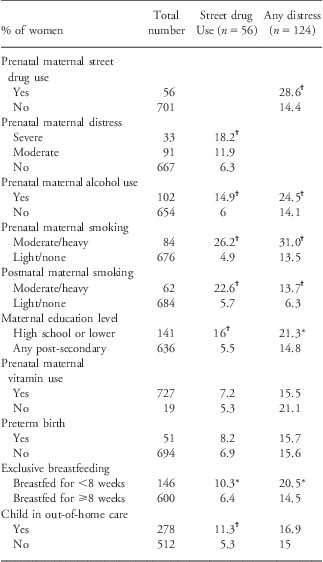
Substantially, more women had taken street drugs if they smoked during their current pregnancy (26.2%) or reported drinking alcohol (14.9%; Table 1). Moderate or severe distress during pregnancy was significantly more likely in women with probable street drug use, as well as in those reporting alcohol or tobacco use during their current pregnancy. Women with no post-secondary school education were more likely to have used street drugs or be distressed during pregnancy. Distress during pregnancy was more likely in women reporting shorter-term exclusive breastfeeding. Women who were distressed or used street drugs were more likely to smoke after pregnancy. The children of mothers who reported street drug use were more likely to attend daycare.
Prenatal street drug use and distress by maternal characteristics

*P < 0.1.
†P < 0.05.
Child health outcomes
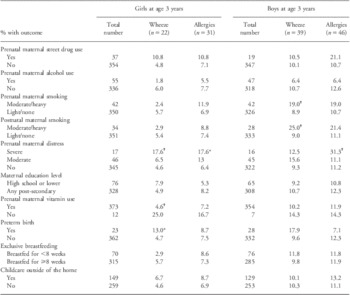
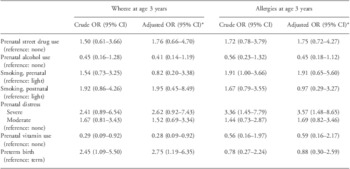
Almost half of the study children were boys. Consistent with rates from previous studies using validated methods of doctor-diagnosed wheeze in preschool children,Reference Lannero, Wickman, Pershagen and Nordvall44, Reference Akinbami48 a reported 7.7% of all children had wheeze at age 3 years. Wheeze was noted in 10% of boys and 5% of girls. Allergies were reported in 9.7% of all children at age 3 years, which represented 12% of the boys and 8% of the girls in the sample. Seven percent of children were born preterm and 35% had attended child care outside of the home. Wheeze was two to three times more prevalent among boys born to mothers who smoked during or after pregnancy (Table 2). Allergies were three times more common in boys if their mothers reported distress during pregnancy. In girls, both wheeze and allergies were more prevalent in girls whose mothers reported distress during pregnancy. Independent of other factors (Table 3), severe maternal distress during pregnancy elevated the risk for wheeze and allergies in all children, although statistical significance was not achieved for wheeze. Preterm birth increased the likelihood of preschool wheeze, whereas prenatal vitamin use diminished it. Despite elevated ORs, maternal street drug use during pregnancy was not found to be statistically associated with either outcome.
Sex-specific child outcomes at age 3 years by maternal and child characteristics
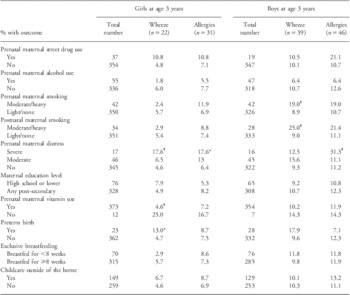
*P < 0.1.
†P < 0.05.
Risk of wheeze and allergies in relation to prenatal street drug use in all children

*Adjusted for prenatal maternal alcohol use, smoking, distress and vitamin use, postnatal smoking, preterm birth, duration exclusive breastfeeding, maternal education level and out-of-home childcare.
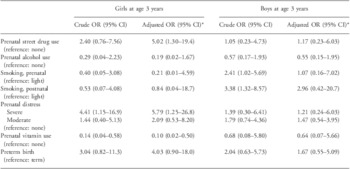
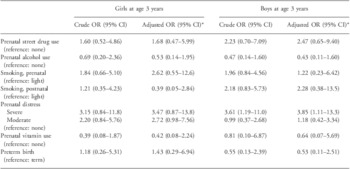
Evidence of an interaction between sex and maternal street drug use (P < 0.11) and between sex and prenatal smoking (P < 0.04) was found for preschool wheeze, justifying our a priori decision to proceed with stratified analyses. Indeed, sex-specific analyses uncovered associations with in utero street drug exposure. Among girls, severe distress in pregnancy (crude OR: 4.41, 95% CI: 1.15–16.9) and prenatal vitamin use (crude OR: 0.14, 95% CI: 0.04–0.58) were the only univariate determinants of wheeze (Table 4). However, when adjusted for alcohol use in pregnancy, smoking during and after pregnancy, prenatal maternal distress, preterm birth, prenatal vitamin use, maternal education level and out-of-home child care, wheeze was fivefold more likely in girls born to women with probable street drug use (95% CI: 1.30–19.4). Severe maternal distress during pregnancy (OR: 5.79, 95% CI: 1.25–26.8), and prenatal vitamin use (OR: 0.14, 95% CI: 0.04–0.58) also retained statistical significance in this model. Wheeze was fourfold higher among girls born preterm but this association was not statistically significant. Subsequent to the small cell size, we verified our results by performing exact logistic regression for street drug use; it remained significant (P < 0.04).
Sex-specific risk of preschool wheeze in relation to prenatal street drug use

*Adjusted for prenatal maternal alcohol use, smoking, distress and vitamin use, postnatal smoking, preterm birth, duration exclusive breastfeeding, maternal education level and out-of-home childcare.
Smoking during (crude OR: 2.41, 95% CI: 1.02–5.69) and after pregnancy (crude OR: 3.38 95% CI: 1.32–8.57) were the only individual pregnancy exposures to be associated with preschool wheeze in boys (Table 4). Prenatal smoking lost statistical significance in the final model when adjusted for pregnancy distress, as well as following adjustment for postnatal smoking, but not street drug or alcohol use during pregnancy. Similarly, postnatal smoking lost statistical significance in the final model only when adjusted for smoking during pregnancy. Prenatal smoking retained statistical significance in a model without postnatal smoking. Probable street drug use was unrelated to wheeze in boys in unadjusted and adjusted models.
Severe pregnancy distress was associated with allergy in boys in unadjusted analyses (crude OR: 3.61, 95% CI: 1.19–11.0, Table 5). In the final model that included drug use, alcohol and tobacco use and other confounding factors, severe maternal distress during pregnancy continued to be a statistically significant risk factor for allergies in boys (OR: 3.85, 95% CI: 1.11–13.3). Despite ORs near 2.0, no significant associations were found between street drug use and allergy in boys in any model. Among girls, probable street drug use during pregnancy, pregnancy distress and smoking showed substantially elevated risk for allergies in crude and adjusted analyses. However, none of these associations were statistically significant (Table 5). The OR for moderate pregnancy distress approached statistical significance in adjusted models: 2.72 (95% CI: 0.98–7.56).
Sex-specific risk of preschool allergies in relation to prenatal street drug use

*Adjusted for prenatal maternal alcohol use, smoking, distress and vitamin use, postnatal smoking, preterm birth, duration exclusive breastfeeding, maternal education level and out-of-home childcare.
Discussion
This follow-up study of 791 preschool children in a prenatal care trial found that probable maternal street drug use, along with severe distress during pregnancy, were individually associated with an increased risk of wheeze in preschool girls. Severe maternal distress during pregnancy increased the risk of wheeze nearly sixfold. Independent of this strong association with prenatal stress, as well as alcohol use during pregnancy, tobacco use during and after pregnancy, prenatal vitamin use, maternal socioeconomic status and other confounding factors, the likelihood of wheeze was fivefold higher (95% CI: 1.30–19.4) in girls born to women with probable street drug use during pregnancy. Our research also revealed a fourfold increased risk for allergies in young boys following severe maternal distress in pregnancy. No associations were found between probable prenatal maternal street drug use, and childhood allergy or wheeze in boys. Our research builds on a growing body of evidence for the association between wheeze and allergy in children, and caregiver stress in key developmental stages in utero and after birth.Reference Wright22, Reference Wright, Cohen, Carey, Weiss and Gold41, Reference Kozyrskyj, Mai and McGrath49, Reference Cookson, Granell, Joinson, Ben-Shlomo and Henderson50 Although links between prenatal substance use and respiratory distress in newborn infants have been reported,Reference Kelly, Davis and Henschke5, Reference Streissguth, Barr and Martin7 we are the first to find a link between maternal street drug use in pregnancy and the development of wheeze in young girls at age 3 years.
Several possible biological mechanisms in utero may explain the results of our research. Findings related to pregnancy stress contribute evidence to the concept of prenatal programming with respect to wheeze and allergic disease. Stress has been found to elevate maternal IgE levels in pregnant women, sensitizing the fetus to allergens.Reference Wright22, Reference Liu, Wang and Chuang51 Moreover, stress exposure is also posited to alter the programming of the hypothalamic–pituitary–adrenal (HPA) axis function in the fetus, which impacts the immune system and subsequently lung function.Reference Wright25, Reference Seckl and Holmes52 Although prenatal stress and depression have also been associated with infant wheeze,Reference Wood, Bloomberg and Kattan24 our findings associating prenatal street drug use with wheeze in girls were independent of prenatal distress. The risk from street drug use was also independent of an association with preterm birth, a birth outcome that has been linked to maternal street drug use, as well as childhood allergy and respiratory morbidity.Reference Midodzi, Rowe, Majaesic, Saunders and Senthilselvan42, Reference Jaakkola, Ahmed and Ieromnimon45 It is conceivable then that street drug use in pregnancy can have programming effects on lung development and subsequent wheeze in young children. We return to this hypothesis later in the discussion.
Other competing hypotheses for our results include the effects of smoking and poor maternal diet in pregnancy, both of which are more common among women who use street drugs.Reference Salisbury, Lester and Seifer27, Reference Zaichkin and Houston53In utero exposure to alcohol, as well as pre- and postnatal exposure to tobacco smoke, can lead to the development of early childhood wheeze or low birth weight, a strong determinant of wheeze.Reference Alati, Al, O'Callaghan, Najman and Williams43, Reference Lannero, Wickman, Pershagen and Nordvall44, Reference Patelarou, Chochlidaki, Vivilaki and Brokalaki54 Expectedly, we found associations between pre- and postnatal smoking and wheeze. However, as models controlled for maternal smoking and alcohol use, these exposures are not an adequate explanation for our findings. Poor nutrition during pregnancy and subsequent vitamin D deficiency may also contribute to the development of preschool wheeze.Reference Devereux46, Reference Erkkola, Kaila and Nwaru55 Prenatal vitamin use, a major source of Vitamin D intake during pregnancy,Reference Li, Green and Innis56 had an independent inverse association with wheeze in our models, providing further evidence for possible protective properties, but it did not explain the association between maternal street drug use and distress on preschool wheeze. A final explanation for our results centers on socioeconomic status. Financial difficulties cause distress in pregnant women with addiction problems and they are often barriers to good prenatal care.Reference Daley, Shepard and Bury-Maynard57, Reference Grella58 Respiratory conditions are often observed in the offspring of low-income women.Reference Midodzi, Rowe, Majaesic, Saunders and Senthilselvan42, Reference Kozyrskyj, Kendall, Jacoby, Sly and Zubrick47, Reference Chen, Martin and Matthews59 However, the inclusion of maternal education, our measure of socioeconomic status, did not change the results for street drug use or distress during pregnancy.
We now return to the potential programming effects of street drugs, such as cocaine and marijuana, on fetal development and propose reasons for the programming of wheeze in preschool girls. The use of such drugs in pregnancy has been shown to affect the developing fetal endocannabinoid system, as well as to alter regulation of the immune system and suppress T-lymphocyte response, all of which can impact later lung function.Reference Karlix, Behnke and vis-Eyler16–Reference Fride18 In particular, chronic interference with the developing endocannabinoid system in utero has been shown to have significant disease programming effects in childhood,Reference Viveros, Marco, Lopez-Gallardo, Garcia-Segura and Wagner60 potentially impacting development of the pulmonary system. Street drug use in pregnancy also alters fetal development of the hypothalamic–pituitary axis system, which can lead to impaired cortisol regulation later in childhood, and subsequent respiratory problems.Reference Lester and LaGasse61
There are a number of explanations for the differential effects of drug use in preschool girls. Exposure in key developmental periods to substances such as cocaine and cannabinoids has shown sex-specific effects across a variety of health outcomes; this has been attributed to the earlier maturation of many physiologic systems in female fetuses and greater exposure to drugs during their development.Reference Viveros, Marco, Lopez-Gallardo, Garcia-Segura and Wagner62, Reference Dow-Edwards63 Little is known about the determinants of preschool wheeze in girls because of greater research interest in the persistent wheeze that progresses to asthma in boys.Reference Martinez, Wright and Taussig37, Reference Lowe, Carlin and Bennett64 In both genders, lower lung function is seen before 1 year of age in children with transient or persistent wheeze during their preschool years.Reference Martinez, Wright and Taussig37 However, at birth, girls have greater lung maturity and lower IgE levels, which may explain their lower prevalence of preschool wheeze and allergies to begin with.Reference Becklake and Kauffmann65 On the other hand, the placental enzyme 11β-hydroxysteroid dehydrogenase 2 (11β-HSD 2), which prevents transplacental passage of cortisol, is more sensitive to changes in maternal catecholamines in the female v. the male placenta.Reference Clifton28 Cocaine and marijuana alter maternal catecholamine levels, such as noradrenaline, with the potential to downregulate 11β-HSD 2 production and increase fetal cortisol levels.Reference Lester and Padbury66, Reference Trezza, Cuomo and Vanderschuren67 This places the female fetal lung at greater risk for the HPA axis programming effects of cortisol.Reference Wright25 Moreover, prenatal cocaine exposure causes periodic breathing in newborns and is postulated to play a role in fetal programming of respiratory control.Reference Bavis and Mitchell68 Fetal breathing is also critical to the development of lung function.Reference Lowe, Carlin and Bennett64 As modulation of respiration is sex specific, it is plausible that cocaine has a greater inhibitory affect on breathing movements of female fetuses.Reference Bavis and Mitchell68
The strengths of this hypothesis-generating study include the use of validated instruments for maternal distress during pregnancy,Reference Fava, Kellner and Perini69, Reference Bull, Luo and Maruyama70 the longitudinal design and the large sample size, which was sufficient to run separate models in boys and girls that were adjusted for essential confounding factors. However, the limitations of our study must not go without mention. The longitudinal design of the CPC trial resulted in a loss to follow-up from 1324 to 791 participants,Reference Tough, Johnston and Siever2 meaning that we only were able to analyze information on the women who participated in all four surveys. Dropouts in the trial were more likely to use drugs, smoke, have a history of depression and have adverse life events. Further, a higher proportion of unreachable women reported street drug use within 12 months of pregnancy.Reference Tough, Siever and Johnston71 Given that our sample size was small, if these participants had been retained in analysis it is possible that our results may have been strengthened. We have discussed the potential for underreporting of street drug use during pregnancy, and our rationale for combining pregnancy and recent use to identify actual use. Recent studies of recreational drug use in UK women show that first trimester use is similar to the year before pregnancy; after the first semester, it drops off for cocaine (30%) and ecstasy (5%), but remains high for alcohol (75%) and marijuana (65%).Reference Moore, Turner and Parrott3 It is important to note, however, that we were not able to examine the effects of individual illicit drugs, which have different pharmacological actions. We also did not have comprehensive data on nutrition during pregnancy. Instead, we relied on a measure of prenatal supplement use but this measure is a very good estimate for Vitamin D intake. The measure of wheeze in our research was based on parent report of a diagnosis for a chronic breathing problem like asthma, made by a healthcare worker. As noted under our research methods, this measure has been validated and likely identifies many children with transient or episodic viral wheeze, the most common wheezing condition at this age next to asthma.Reference Martinez, Wright and Taussig37, Reference Lannero, Wickman, Pershagen and Nordvall44, Reference Akinbami48 In further support of this measure, rates of wheeze prevalence in our study are similar to rates in US children. Finally, parents were not asked about their own atopic status. Although this is a well-known determinant of childhood atopic disease,Reference Holloway, Yang and Holgate72 family history of atopy is not a risk factor for transient wheeze, our main outcome of interest.Reference Martinez, Wright and Taussig37, Reference Saglani and Bush38
Prevalence rates of wheeze are strikingly high in preschool children of mothers who have substance abuse problems.Reference Conners, Bradley and Mansell13 We have uncovered evidence that maternal street drug use may have independent, sex-specific programming effects on the development of wheeze in young children. Mental health disorders and substance abuse are commonly found together.Reference Najt, Fusar-Poly and Brambilla73 As rates of substance use in pregnancy, in particular multi-substance use, continue to rise,Reference Kuczkowski74 prenatal street drug use may become a more common determinant of childhood wheeze. Further research with larger study populations needs to be done in order to verify the veracity of our findings and to explore possible programming mechanisms in this pathway. In the interim, akin to smoking cessation during pregnancy,Reference Vardavas, Chatzi and Patelarou75 treatment of drug addiction and stress during pregnancy has multiple benefits for long-term health of children.
Acknowledgments
Funding for this project provided by the Norlien Foundation and the Women & Children's Health Research Institute (WCHRI). Funding for the CPC Trial provided by the Calgary Children's Initiative, the Physician Partnership Steering Committee and the Child and Women's Health Portfolio of the Calgary Health Region. Salary for M.A. provided by the Faculty of Medicine and Dentistry at the University of Alberta. Salary for AK's Research Chair, Maternal-Child Health and the Environment provided by WCHRI/Stollery Children's Hospital. The authors thank Sheila McDonald, postdoctoral fellow, University of Calgary and statistician Yiye Zeng for their help with data extraction and analysis.