It is the first home match of the season for Beşiktaş Jimnastik Klübü (Beşiktaş Gymnastic Club) of Istanbul, one of Turkish football's Üç Büyükler (Big Three) football teams.Footnote 1 Hours before kickoff, members of Çarşı, the fervent supporters’ group that for thirty years has formed the core of the club's fans, begin to congregate downtown in the Istanbul precinct of Beşiktaş, a weekly gathering that gives the group its name (Çarşı is from the Turkish for “market,” “shopping center,” or “downtown”). As night descends, they make the short walk to İnönü Stadium, the club's home. As they gather on the terraces, standing shoulder to shoulder and ignoring the seats, they smoke and chew on sunflower seeds, the spat-out shells littering the ground. They let off flares, chant political slogans, and hoist banners bearing the anarchist “A.” Over the loudspeaker, an announcement from the Turkish Red Crescent thanks the Beşiktaş fans for their support, and a loud cheer rings out. On the pitch, however, a less earthy scene greets the assembled crowds: an enormous soft drink advertisement (Cola Turka) covers the center circle, and a twenty-five-meter banner for a mobile telephone company (AVEA) lies on the grass, oriented perfectly for the television cameras, as players worth millions of pounds from all over the world—Brazil, Germany, Cameroon—are stretching and limbering up. Twenty or so people dressed in red approach the banner in the center circle, lifting it and wafting it in the air while men dressed as large cans of Cola Turka run up and down the touchline.
This scene, and all its apparent contradictions, is what greeted me as I began three months of ethnographic fieldwork in Istanbul in the summer of 2009. Caught between a socialist past and a commercialized, commodified present, the question of the identity of Beşiktaş fans seemed an interesting test case for how football supporters (and society) in Turkey as a whole have responded to the consequences of rapid economic change. Like elsewhere in Europe, the last fifteen or twenty years have seen an influx of wealth into the country's football industry along with increased media attention and a sharp rise in the cost of attending matches.Footnote 2 I set out to explore how these processes have affected fans. Do they reject these changes outright, or are they tolerated or even accepted? In what manner have fans dealt with both the unwelcome changes and the increased opportunities that commodification seems to have brought in equal measure? And, finally, can the case of Beşiktaş tell us anything about shifts in identity construction in Turkey more broadly?
The commodification of Turkish football is intimately linked to the 1983 election of Turgut Özal as prime minister and the subsequent shift to a neoliberal political and economic order. Scholars have observed that this process precipitated both a greater fragmentation of social identities and an increasing complexity in their public performance. Esra Özyürek notes that “as the symbolism of the market, of privacy, and of voluntarism as located outside the state are increasingly becoming hegemonic, the symbolic center of politics is not dismantling but shifting from public institutions to such things as civil society, consumer activism and faith-based organisations.”Footnote 3 This shift is serving to complicate and reconfigure state–citizen relations in Turkey in a variety of ways. Patriotic secularists, keen to shelter state ideals from the perceived public threat of Islamism, are “privatising state symbolism” by purchasing images of the Turkish republic and its founder Kemal Ataturk to fill homes and other private spaces. Religious volunteers are acting as “neighborhood capillary systems,” collecting private donations and delivering welfare to the vast new urban suburbs that government programs have yet to reach. Idealistic students and philanthropic businessmen have helped form the vanguard of a huge “spontaneous reaction of the civil society” to natural disasters, surpassing the state in numbers of relief workers and speed of response, such as in the relief effort for the 1999 Marmara earthquake. While not replacing state-led conceptions of citizenship or politics, such activities generate new questions as to which kinds of identities are being allowed to be publicly expressed and which curtailed—and how.Footnote 4
To date, the arena of sport in light of these changes has not been investigated despite the fact that Turkish football generates hundreds of millions of Euros in revenues annually, dominates the airwaves and newspaper columns, and is responsible for whipping tens of millions of its followers into a weekly frenzy. To borrow from Yael Navaro-Yashin, for many (especially male) Turks, alongside religion or secularism or other ethnic, political, and cultural identities, football teams are “a central commodity and symbol of cultural identity in contemporary Turkey.”Footnote 5 For the most fanatical, it is the primary identity: Beşiktaş fan first, Turk or Muslim second. Moreover, with their emphasis on communalism and mass following, football fans seem to stand counter to the perceived fragmented performance of modern social identities. This article, then, aims to fill the gap. Based on ethnographic research in Istanbul, it takes as its subjects the fans of the Beşiktaş football club and, in particular, those supporters who associate themselves with the fan group Çarşı.
After establishing a working definition of commodification, the first section of this article, “harnessing commodification,” will look at how the commercialism of football has been exploited by Çarşı to make political statements and convey its anarcho-socialist message. Integral to this process has been the transformation of Çarşı from a small (often violent) neighborhood gang into a (trans)national humanistic, socialist “brand.” The second section, “mediating commodification,” focuses in more detail on the individual fan. It looks at the processes by which fans are integrating discourses of commodification into their own ideas of fandom and the issues and debates that arise from this. Processes of harnessing and mediating are driven by the possibilities opened up by the internet, which is transforming how fans construct their allegiance to the fan group and the club, allowing for a conception of fandom detached from the locales of the Beşiktaş neighborhood, Istanbul, and even Turkey. What emerges is a heightened tension behind efforts to cling to a particular conception of football and politics that runs counter to dominant cultural trends. In this way, the actions of Çarşı and Beşiktaş fans resonate with wider social, cultural, and identity issues revolving around the messy day-to-day politics of opposing certain activities while being shaped implicitly and explicitly by them.
HARNESSING COMMODIFICATION
The literature on “commodification” has grown exponentially over the last thirty years. An attempt to trace the emergence and development of the term as it is used in academic investigations is beyond the confines of this article and has been undertaken expertly elsewhere.Footnote 6 In its recent form, the broad meaning of “commodification” is the transformation of goods and services into commodities, that is, the commercialization of a good, activity, or service that was not previously commercial. Don Slater and Frank Tonkiss, for instance, view the process as “transforming into saleable objects social phenomena which were not previously framed in that manner.”Footnote 7 This has direct relevance when considered in the light of football culture and fan groups. While commerce has long been a part of football, those involved in the game have historically emphasized it as a cultural pursuit outside of formal market systems. Richard Giulianotti and Adrian Walsh have labeled this the “Manifest Image” of sport: an arena distinct from the everyday world, a refuge from “the world of economic imperatives and business” where the only goal is the pursuit of individual or collective excellence.Footnote 8 The rapid commercialization of the game over the last few decades, however, has made this legerdemain increasingly difficult to uphold.
Arjun Appadurai, in the introduction to his 1986 The Social Life of Things, warns readers against viewing commodities as a certain kind of “thing,” encouraging them instead to think of items as possessing a “commodity phase.” The social life of any “thing” has the capacity for a commodity phase, which can be defined as “the situation in which its exchangeability (past, present, or future) for some other thing is its socially relevant feature.”Footnote 9 Appadurai reminds us that items possess the capability of becoming and, crucially, of not becoming commodified, an important capability to recognize in relation to football supporters and consumer items. When, say, a football shirt is purchased, it is in a commodified “phase,” yet if it is then altered, doctored, or worn in another context, the “exchange” element of the item fades into the background as its symbolism or usage becomes more prevalent. Appadurai's analysis also brings to the foreground the agency of the individual in the process of making and unmaking commodities, a conclusion that seems to reflect the realities of the Çarşı group.
It is no coincidence that the usage of the term “commodification” has proliferated as processes of neoliberal economic development and globalization have made themselves felt more widely in modern society. Commodification is linked inherently to broader economic developments and to the policies adopted by governments, international organizations, and corporations. I join scholars such as Esra Özyürek and Ayşe Öncü in focusing particularly on the social and cultural impact of these processes in Turkey.Footnote 10 My focus is on gauging the importance of commodification, and its sister process of consumption,Footnote 11 in generating identity for a group of football fans. As will become clear, it seems that the engagement of fans with these processes has led to a series of interconnected paradoxes, as Çarşı clashes with elements of change while simultaneously cooperating with the forces they unleash.
There are millions of Beşiktaş football fans in Turkey (and beyond) and, like supporters for the other top teams, they come from a range of backgrounds.Footnote 12 It is possible to glimpse in these supporters all of Richard Giulianotti's classifications of football followers—from hardcore supporters who attend every match to occasional “flaneurs” who tune in for the twice-yearly games against their rivals, Galatasaray and Fenerbahçe.Footnote 13 Also in line with the other top teams, Beşiktaş have seen the geographical origin of their fans alter considerably. Whereas forty years ago the bulk of supporters in the Beşiktaş stadium came from the surrounding neighborhood, vast rural-to-urban migration and the extensive gentrification of inner-city neighborhoods such as Beşiktaş have transformed the demography of the club. Combined with the growth of televised football, these shifts have weakened the geographical affiliation of fans to clubs: nowadays, the majority of fans travel from Istanbul's vast outskirts for games—as far as forty or fifty kilometers away.Footnote 14
Where do Beşiktaş fans end and those of Çarşı begin? The answer twenty-five years ago was straightforward: Çarşı was a small group of men who lived nearby, knew the founders personally, and were willing to attend all games, sing passionately, and throw a few punches if challenged by rival fans.Footnote 15 Today, however, there is no hard and fast answer. The ambiguities of what, exactly, Çarşı is now lie at the heart of my main argument: that neoliberal economic ideology has prompted social and economic developments, vast population shifts, and rapid technological changes that have led to a fragmentation of cultural identities in Turkey and a recasting of how individuals relate to and interact with one another. There is significant overlap between Çarşı and Beşiktaş, because individuals feel they have the autonomy to define their own link between the two concepts.Footnote 16 It is, however, possible to identify, albeit crudely, the main grouping of Çarşı as those who stand regularly on the top tier of the Kapalı Tribün (Covered Terrace) stand in İnönü Stadium, roughly a few thousand fans. They are almost all male. There is no widespread uniform or initiation ceremony to indicate that someone is a member of Çarşı; the signifiers are as diffuse as the position they occupy in the stadium (the prime spot for galvanizing the crowd), the loudness of their voices, and the respect with which the rest of the fans look to and refer to them. Within the Çarşı collective, there are many different groupings. My findings are based on conversations and interviews with a range of fans who consider themselves part of Çarşı, from journalists and auditors to restaurant owners and travel agents to students and unemployed people, ranging from sixteen to sixty years of age.Footnote 17
Çarşı provides an interesting object of study as its genesis and development are linked intimately to the ruptures and shifts within Turkish society from the 1970s to the present. The founders of Çarşı were witness to the extreme leftist–rightist political violence of the late 1970s, the military takeover of 1980 and its resulting crackdown (650,000 arrested, the banning of all political parties, associations, and trade unions), and, since 1983, the liberalization of the political system and the growth of civil society activities.Footnote 18 While the fan group was founded in 1980 to generate support for the team, its uniqueness when compared to the fan groups of other Turkish teams is that it became colored by the iconography and ideologies of the leftist cause during this period. Growing up in Beşiktaş, a historically mixed-class, heterogeneous, and progressive neighborhood of Istanbul that was dominated by leftists in the late 1970s, the group's founders unsurprisingly harbored resentment toward many of the social and cultural changes ushered in by repressive military rule and the neoliberal period that followed it. The football terrace was arguably the only public forum where opposition could be expressed.Footnote 19
One of Çarşı's founders, Mehmet Işıklar (nickname Optik Başkan, the Optical Chief), possessed a rudimentary knowledge of socialism, an eye for leftist iconography, and a mischievous desire to be viewed outside of dominant trends and to flout the law. At his behest, and in the knowledge that a wider group of supporters would appreciate it, the imagery and ideology of the group became peppered with anarchist and socialist philosophy and iconography: its logo contains the anarchist “A,” and its tongue-in-cheek rhyming mantra Çarşı her şeye karşı (Çarşı is against everything) captures its part flippant, part confrontational stance toward neoliberal orthodoxy in Turkish society.Footnote 20 This position dovetailed nicely with the history of the Beşiktaş football team as the least successful Turkish team in Istanbul—lagging behind Galatasaray and Fenerbahçe in terms of prestige and trophies—and lent impetus to the idea of Beşiktaş as an antiestablishment club. For many, this image crystallized in the form of Alen Markaryan as tribün lider (leader of the terraces). Responsible for leading the thousands-strong crowd, Markaryan is a restaurant owner of Armenian descent, an ethnicity that still elicits much prejudice and suspicion in Turkish society. His position at the head of the group, and the noisy backing he receives from the Beşiktaş fans, cements the idea of Çarşı as a shelter for those who felt victimized, marginalized, and disaffected by the Sunni Muslim, neoliberal orthodoxy in Turkey, encapsulated most recently by Recep Erdoğan and his Adalet ve Kalkınma Partisi (Justice and Development Party or AKP).
The splendor of the iconography, combined with the interweaving of anarcho-socialist elements around a deeper history of working-class support, belies the reality that the connection of the fan club to socialist and anarchist party politics is slight. The politics on offer is sensationalist, combining the leftist ideologies of the student struggles of the 1970s with a sharp wit and the desire to thumb one's nose at prevailing conformity, an actuality perhaps best underlined by the incompatibility of anarchist and socialist political philosophies at the conceptual level.
There is a remnant of fans over the age of forty who enjoyed the game prior to its hypercommodification and bring to Çarşı a set of associations to the sport that are a far cry from the moneyed reality of the present game. They obstinately refuse to engage with the present large-scale commercialism, preferring instead to cling to a romantic, nostalgic view of football and support the belief that it was always better in the “old days.”Footnote 21 At the other end of the spectrum are those for whom the increased commercialism has been welcome, such as the local entrepreneurs who fashioned their T-shirt and DVD shop into an unofficial Çarşı merchandise store (see Figure 1). More intriguing are those somewhere in the middle: the group leader who tries to organize and stage political protests at matches or the sixteen-year-old fan who kits himself in Çarşı anarchist paraphernalia yet knows nothing but a commercialized football realm. In examples like these, we glimpse the multiple ways in which, despite being nominally karşı (against) commercial practices, Çarşı finds itself replicating and embodying systems and trends of thought that have been ushered in by the neoliberal era. The process is not simply one of fans being stripped of agency, duped, or exploited by such change, although elements of this are present. Instead we notice the ways in which the group has been able to mobilize neoliberal structures for furthering its own agenda: it has made the most of available opportunities to create new identities, expand its public profile, and add to its legions of supporters.
The front of the Çarşı store in downtown Beşiktaş (author's photo). [A color version of this figure can be viewed online at http://journals.cambridge.org/mes]

A prime example is in the way certain groups of Çarşı fans have exploited opportunities presented by the increasing commodification of football to make political statements and raise the overall profile of the group. The proliferation of live football coverage in Turkey engendered an increase in shows offering highlights and fierce debates on the sport. NTVSpor started a show devoted to football fans called Yenilsen de Yensen de (Whether You Lose or Win), in which a group of fans is given the opportunity to discuss the week's action live on air. The increased media focus on the game of football in general, and on giving fans the chance to “have their say” in particular, generates a situation in which the actions of fans are being picked up, commented upon, and discussed. Prominent members of Çarşı, such as Alen Markaryan, have found their voices and opinions coveted by media outlets and have responded accordingly: “I participate in TV programs, and I explain the same things there [about the views of Çarşı fans]. I also visit around twenty to twenty-five cities a year, universities, as a panelist . . . when they ask me, I transmit my experience.”Footnote 22
There has also been increased media attention in the last five years on the use of banners and placards among the mass of Çarşı supporters during games. These banners cover a variety of issues, from objections to racism in football to opposition to government nuclear policy (see Figure 2). They are very much a reactive phenomenon, responding to current news or topical issues rather than following a defined plan or schedule. For instance, the banner Çarşı Danimarkaya Karşı (Çarşı against Denmark) appeared in the aftermath of the 2005 Danish cartoon controversy.Footnote 23 Supporters normally cite these banners as evidence of the unique, politicized nature of Çarşı.Footnote 24 Such slogans and images are not commonly seen among the supporters of other teams in Turkey (nor are they tolerated by the management of other clubs). Even so, at Beşiktaş only a handful of fans will have been involved in their production, and the politics rarely goes beyond the generation of the image or phrase in question. Bağış Erten, a sports journalist with the newspaper Radikal, producer of NTVSpor, and presenter of Whether You Lose or Win, outlined why the media as a whole are interested in Çarşı: “We cover them because they are passionate and different from the other groups. . .. Their banners are always incredible. For instance, I always reserve space for them in my article when I write about Beşiktaş. I really can't wait to see—what will they do?”Footnote 25
“A nuclear-free Turkey. Çarşı, 25 Years.” Shown in 2007. Copyright Greenpeace Akdeniz. Printed with permission. [A color version of this figure can be viewed online at http://journals.cambridge.org/mes]

Nevertheless, in a media environment where hundreds of journalists have been imprisoned over the last five years, and with the majority of readers more keen to hear about the game itself, there is little inclination for the sports media to engage systematically with the issues and debates behind the banners nor any obvious benefit in doing so. If kept superficial, the increased attention is mutually productive: it raises the profile of Çarşı into the general social currents of Turkey, and it helps media outlets fill pages and airtime. Opportunities and openings generated by increased media coverage have therefore been exploited by Çarşı to make statements and express their opinions on certain topics.Footnote 26
Branding Çarşı
People come to Beşiktaş . . . and feel that Beşiktaş and Çarşı are ideals. Actually, Çarşı turns out to be a “brand” and a very popular one. There are ample differences between its “essence” and the reality of its existence today.
Alen Markaryan, Çarşı terrace leader
Closely tied up with the commodification of the football world is the question of branding. While the idea of brands is not new, the term “branding” is fairly recent; it describes the process whereby a diffuse set of commercial practices have been “consolidated into an integrated approach to marketing and business strategy” and applied to a specific logo or brand.Footnote 27 A pertinent question is whether the proliferation of T-shirts, lighters, and mugs emblazoned with the Çarşı logo, or the description of the organization by founding members as a popular “brand” (as in the quote shown previously), signifies the penetration of the movement by ideas of commerce and marketization.
Liz Moor suggests that the growth of branding techniques does not necessarily mean that noncommercial activities have become commercialized; instead, she views branding as having itself “mutated from being a form of capital accumulation to operating as a managerial technique for the patterning of information and the organisation of institutional activity.” That is, the emerging role of branding in these areas is functioning more as “a technique of governance” than for any commercial or economic benefit.Footnote 28 One example given by Moor is the form of branding used by football supporters in England. While accepting that fans are spending increasing amounts of money on football, she suggests that “club affiliation continues to serve as the basis upon which many non-monetized forms of activity are organized,” such as through online fan communities or the presence of fans at demonstrations. What is more, Moor believes that fans “have frequently been involved in forms of social and political action that attempt to ‘re-frame’ football-as-commodity so that it incorporates its various forms of ‘overflow’ or externality back into the ‘product.’” Examples include antiracist initiatives or attempts to provide community cohesion.Footnote 29
It is worthwhile to consider the applicability of this analytical framework to Çarşı. Many of the activities fans engage in are “non-monetized,” such as participation in the internet forum ForzaBesiktas.com, where individuals share news, organize events, and discuss developments at the club and in the wider world. In addition, the governance of fans at various events under the banner of Çarşı is a well-documented phenomenon—from May Day demonstrations to gigs of the socialist Turkish and Kurdish band Grup Yorum (The Commentary Group).Footnote 30 Further examples can be found in the organization of free talks on the football industry, held in Beşiktaş parks, or the public donation of blood to the Turkish Red Crescent. In each situation, the label of Çarşı is used as an organizational principle, a point around which to rally and shape fan behavior.
In addition, Moor notes how fans “continue to put up considerable opposition in the form of protests, petitions, and boycotts, for example, if clubs or other commercial operations attempt to use the club's name and reputation (its ‘brand’) in ways which they believe conflict with its social and cultural values.”Footnote 31 An example of Moor's thesis can be found in the introduction of Türk Telekom advertisements on the roof of the Kapalı Tribün. For the first friendly match of the 2009–10 season, Çarşı fans found that alongside the large “Beşiktaş” lettering in the roof of their stand were two large navy and turquoise logos advertising Türk Telekom, the state-backed telecommunications company. A friend mentioned to me that the fans would protest against the symbols during the game. A month later, when I returned to the stadium, the advertisements had been repainted in black and white—the Beşiktaş colors. The ability of a small group of supporters to force a compromise out of the largest telecommunications company in the country is highly significant: the Türk Telekom logo adorns buildings and telephone boxes all over Turkey in its conventional format. I have found no other instances of the organization allowing the logo to be altered. The incident suggests that although Çarşı members may not have the power to stop the creeping commercial branding of the stadium space, they can nevertheless influence the process.
Moor points out how the ultimate affiliation—whether with a team or a supporters’ group—is not driven by commercial imperative: “The branded spaces created by these techniques are not simply designed to be attractive or profitable but increasingly to make new kinds of experience possible, produce new modes of perception, invest percepts with affects . . . [such that] through certain technical means, a new way of seeing is constructed.”Footnote 32 This framework can help open up aspects of how such “new kinds of experience” are often reported by Çarşı fans, as intimated by Alen Markaryan, who notes: “I use the pure power and potential of the terraces to do something for the good of humanity, the Child Care Foundation, the Red Crescent, and making oppressed people's voices heard around the whole world; and I am successfully supporting my team.”Footnote 33
The talk is of harnessing the power of a group of people in the football stadium, not for any commercial ends but for the basic “good of humanity.” Regardless of its integration with commercial and consumption networks, those within Çarşı focus on the educational and transformative power of the group. The sentiments driving their actions—the search for the right slogan, the right organization to support, the “right thing” to do—are more ethical than ideological. The politics of Çarşı operates less as a specific political doctrine and more as a set of ethics; that is, it is framed around moral principles deemed fundamental to humanity. This often takes the form of espousing a general position or ideal, such as supporting a player who was racially abused, rather than campaigning for a specific course of action, such as heavier fines for racism at football matches. The Çarşı “brand” is arguably the most successful vehicle used by the group to assert this ethical standpoint, to navigate and negotiate the pitfalls and possibilities of hypercapitalism, in order to show themselves and their football club as intrinsically “good” in the public discourses of contemporary Turkey.
MEDIATING COMMODIFICATION
The proliferation of branding in the last few decades hints at a deeper shift in ideas of identity and affiliation in contemporary society. Many recent thinkers on consumption believe that the image of a good or product often trumps its use value in processes of selection and exchange; consumer objects largely operate as signs, coming to mean something—whether prestige, luxury, or convenience—through their difference from other objects rather than through how they are used: “A refrigerator, a vase, a coffee, and a car all have something fundamentally in common, which has nothing to do with use and everything to do with signification.”Footnote 34
For Jean Baudrillard, a pioneer of the semiotic analysis of consumption, the exchange at the heart of social relations is not money but symbols. As Mark Gottdiener notes, Baudrillard's argument revolves around the belief that “people respond to goods as images and symbols. . .. The consumption of goods as images constitutes a process of representational positioning.” Contemporary consumption can be viewed as more about how social relations between people are mediated by consumer objects than about the fulfilment of needs or wants. If the focus is on social relations, then consumerism should be thought of as, in Gottdiener's words, “play[ing] a significant role in the formation and realization of the self.” The question thus morphs into one of self-composition and identity; consumption becomes a question of which symbols we want to be associated with our identity or, to use Dick Hebdige's term, how people “communicate through commodities.”Footnote 35 Branding feeds into this process by emphasizing the semiotic and symbolic aspect of organizations or products.
Mary Douglas goes a step further, viewing consumption as the “very language of personal and social identity.” Douglas holds short shrift with the romantic idea of the benefits of the traditional “close-knit” community, an idea perhaps held by older Çarşı members, viewing such social relations as oppressive and stultifying. Consumption, in contrast, “permits individuals to express their affiliation with others who hold similar views to themselves and to distinguish themselves from those who do not.” As such, she seems to tap into Gottdiener's conception of the self as “a multiply manifested existential construct. In today's society everyone has the option of being many things.”Footnote 36
Perhaps Douglas overstates the empowering potential of consumerism; after all, it still involves monetary transaction and hence is linked strongly to constraints of background and occupation. Yet her analysis is useful in helping us view consumption not as a passive absorption but as a formative and expressive practice. With Çarşı, international goods, images, and ideas are taken on board, adjusted, and fashioned into forms and ideas for local consumption and identity construction, and it is this process that allows individual fans to forge meaningful relationships with others.
Inspirations
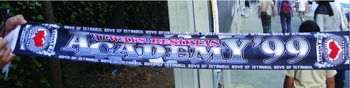
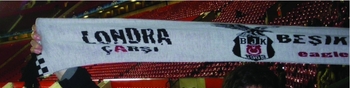
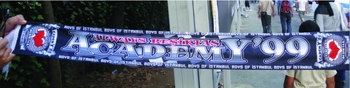
At the first football match of the new season, a friendly game against Italian First Division (Serie A) side Catania, I was introduced to a young fan who had established his own supporters’ group within Çarşı. The fan gave me the URL for a website he had created (http://www.academybjk.com) and told me that the “academy” it refers to was set up by him and some friends when they were attending university in 1999. He then drew my attention to his scarf, which turned out to be personalized (see Figure 3). The phenomenon of personalizing merchandise is widespread among Çarşı fans. It is driven in part by an element of competition—the more personal the object of support, the more distinguished the wearer and ergo the more “committed” within the Beşiktaş or Çarşı fan group. As the archetypal football symbol, the scarf seems to be the vehicle for much of this personalization. Scarves are used to express a complex array of sub-identities within the Beşiktaş fanbase, such as those associated with a university attended by a group of supporters, an ethnicity, or a geography (see Figure 4). The use of foreign (mostly English) words in many of the scarves (“Always Beşiktaş,” “Academy,” “Forza,” “Boys of Istanbul”) is worth noting. As others have pointed out in relation to football graffiti in Italy, the use of English often functions as “a cult language to be deciphered by initiates”Footnote 37—cool, edgy phrases from the country that spawned the game are co-opted into local discourses in a desire to emulate the (perceived) glamorous images of British fans and set the wearers apart.
A personalized scarf of the Beşiktaş Çarşı subgroup “Academy '99” (author's photo). [A color version of this figure can be viewed online at http://journals.cambridge.org/mes]
A scarf of Çarşı Londra (London), the U.K.-based offshoot, at a Manchester United versus Beşiktaş match, 25 November 2009 (author's photo). [A color version of this figure can be viewed online at http://journals.cambridge.org/mes]

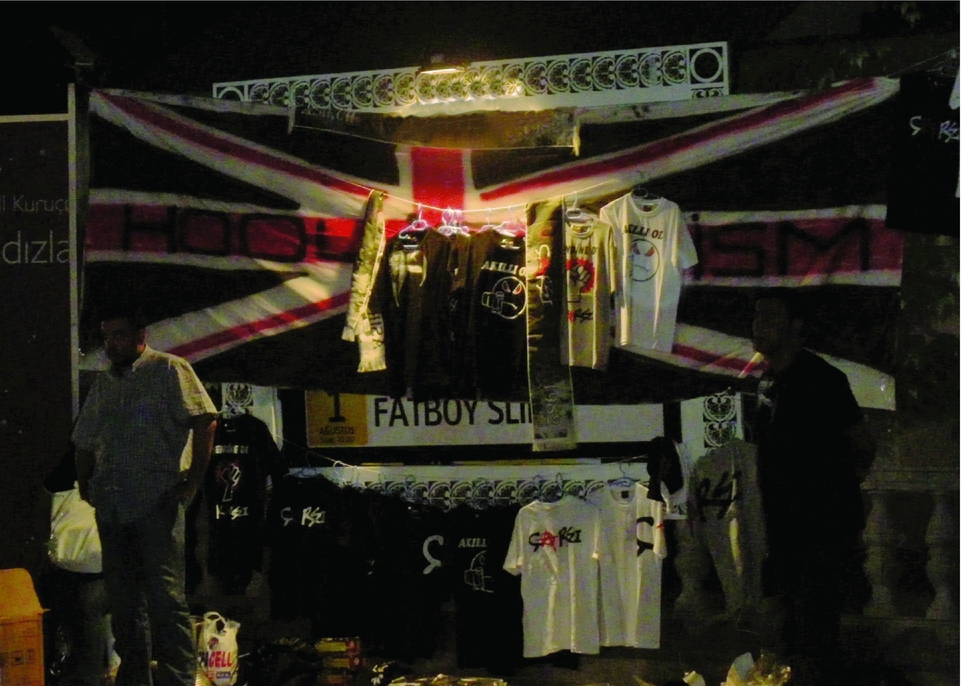
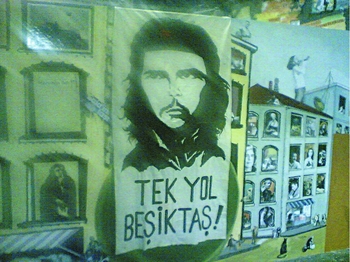
It is not just language that has been adopted: a noteworthy trend among young Çarşı fans is the drawing of comparisons between Beşiktaş supporters and British football hooligans. The game in England was blighted by hooliganism in the 1970s and 1980s, resulting in English teams being banned for five years from European competitions. Several of the Çarşı fans I met compared themselves to the characters in the film Green Street Hooligans, a stark and violent depiction of a group of hooligans from West Ham United, an East London team.Footnote 38 When trying to describe the fanaticism of Çarşı, one young fan asked: “Have you seen the film Green Street? On the match day they wake up and meet friends for breakfast before then going to drink before the match. Straight away from waking, they just think about the match. We are exactly the same.”Footnote 39 As this example suggests, the film is presented in a favorable light despite the fact that the final scene of the film depicts one of the young protagonists dying in football-related violence. The paraphernalia of U.K. football hooligan culture can be found elsewhere in Çarşı: a Union Jack flag with “hooliganism” inscribed along the center was displayed at an end-of-season party (see Figure 5), while the internet is littered with “Çarşı Hooligan” graphics and profiles on social networking sites. There is, certainly, a gap between discourse and action: those making the comments shown previously did not have any personal anecdotes of involvement in violence. Nevertheless, many young members of Çarşı identify with the images of football hooliganism displayed in American and European films, adopting the language into their scarves, banners, and internet personae. Another symbol and slogan that has been taken on and adapted by Çarşı fans is the phrase Tek yol devrim (The only way is revolution). It initially became a popular slogan of the left during the political violence of the late 1970s but has appeared recently in the new form of Tek yol Beşiktaş (The only way is Beşiktaş) on some fans’ banners (see Figure 6).
The “Hooliganism” Union Jack Banner at a Çarşı party to celebrate winning the league (author's photo). [A color version of this figure can be viewed online at http://journals.cambridge.org/mes]

An updated pun on the former socialist statement, reading, “The only way is Beşiktaş!” (author's photo). [A color version of this figure can be viewed online at http://journals.cambridge.org/mes]

A profitable way of interpreting these patterns of altering signs and signifiers is as part of a semiotic bricolage. The term (from the French for tinkering, “DIY”) was introduced to anthropology by Claude Levi-Strauss and developed and modified in discussions of subcultures by John Clarke and Dick Hebdige. It refers to the process by which a system of communication is created by picking and mixing objects and signs, taking them out of their characteristic position, placing them in a new “symbolic ensemble,” and, in doing so, serving to “subvert their original straight meanings” and convey a different message.Footnote 40 For Hebdige, the Teddy Boys, Punks, and Mods of 1960s and 1970s England functioned as bricoleurs, ascribing new meanings to commodities such as scooters, flags, and safety pins by using them in different, fresh contexts.Footnote 41 With Çarşı, the symbols of former socialist struggles in Turkey and of world socialism in general have become appropriated (see Figure 7). Even with socialist symbols, the appropriation still takes the form of consumption. As Joseph Heath and Andrew Potter outline in their work on counterculture, despite the rhetoric of “selling out” or the suggestion that creativity is antithetical to consumption, in capitalist systems, short of moving to the wilderness and becoming self-sufficient, any form of rebellion must involve consumption, for “rebellion is one of the most powerful sources of distinction in the modern world. As a result, people are willing to pay good money for a piece of it, just as they are willing to pay for any other form of social status.”Footnote 42 It is thus a question not of whether commodification and consumption are at play but of how particular commodities are used in a way that marks the subculture off from mainstream cultural formations. Indeed, if we look again at the “hooliganism” Union Jack banner in Figure 5, we can see that, as well as referring to U.K. football hooliganism, it is functioning as the backdrop to a stand selling Çarşı merchandise. These images are plugged firmly into networks of commodification and consumption because in contemporary society consumption plays an important role in processes of rebellion. As with the Teddy Boys or the Punks, it is the quotidian routines and stultifying traditionalism of contemporary mainstream culture that Çarşı fans predominately kick against. The anachronism of “old” socialist symbols in 21st-century, “newly” moneyed Istanbul helps reinforce the separateness of the group, lending credence to the idea of being willfully out of step with the “immoral” principles and “warped” ideology of mainstream culture. Since 2002, the more ostentatiously Islamic, neoliberal hegemony of the AKP has made the distinction with secular socialism even easier to uphold.
The Çarşı banner with the communist star. The text reads, “Çarşı lives, buddy!” (author's photo). [A color version of this figure can be viewed online at http://journals.cambridge.org/mes]

Hebdige argues that the fabricated nature of this process does not detract from the message, but rather is the aim of it. Drawing attention to the invented nature of the gathered objects
is what distinguishes the visual ensembles of spectacular subcultures from those favored in the surrounding culture(s). They are obviously fabricated. . .. They display their own codes or at least demonstrate that codes are there to be used and abused. In this they go against the grain of a mainstream culture whose principal defining characteristic, according to Barthes, is a tendency to masquerade as nature.Footnote 43
Che Guevara obviously never declared that “the only way is Beşiktaş,” and Beşiktaş fans do not ordinarily refer to themselves as “the boys of Istanbul.” A playfulness is consequently injected into proceedings via the ridiculous image, the humorous banner, or the obstinately intransigent use of old signs.
Finally, a focus on consumption does not require us to strip politics out of the process. If identity is expressed through consumption, then it follows that politics finds expression in the same patterns. Esra Özyürek believes that the consumer culture of the 1980s and 1990s led directly to the creation of a “commodity-based identity politics.” The sudden public appearance of Islam was a direct result of the process, becoming possible in part because of the “commodification of Islamic political symbols” such as the hijab.Footnote 44 The process discussed in this article can thus additionally be thought of as the leftist-anarchist corollary to what Özyürek has outlined: commodities for Çarşı are instilled and operate with both humor and politics. Consumption should consequently be seen as in part an expressive and enjoyable process and not simply an exploitative or imprisoning one.
The Consumption of Media
Earlier we touched briefly upon the role of the media in increasing the exposure of Çarşı. They are also serving to weaken traditional geographic connections to Çarsı and Beşiktaş by expanding the potential for a Çarsı fandom based on other forms of affiliation. Hebdige believes the media play “a crucial role” in defining our experience and position in the world; they provide groups with images both of their own lives and those of other groups in order to try to demystify them and to situate subcultures “within the dominant framework of meanings.” Crucially for us, Hebdige believes the main method of achieving this aim is through what he calls “the commodity form,” that is, the “conversion of subcultural signs (dress, music, etc.) into mass-produced objects.” He continues: “As soon as the original innovations which signify ‘subculture’ are translated into commodities and made generally available [by the media], they become ‘frozen.’ Once removed from their private contexts . . . they become codified, made comprehensible, rendered at once public property and profitable merchandise.”Footnote 45 This analysis is useful for highlighting the role the media play in commodification, as subcultures take on, process, and adapt the image that is being fed to them. Yet Hebdige's work was written in 1979, and thus his analysis of the media is based solely on “traditional” 20th-century forms, such as newspapers, radio, and television. Since then, the development of digital photography, a fall in the cost of equipment, and the growth of websites disseminating new kinds of content (such as Facebook and YouTube) have all profoundly affected the media landscape. Supporters now possess the technological means to generate and circulate their own media, leading to a situation in which Çarşı fans are creating and consuming their own images of themselves, as technological development enables a process of “self-mythologization.”
A pertinent example can be found in the form of a video posted to YouTube entitled “Çarşı Hooligans in Mekka.” A video filmed in the holy Muslim city of Mecca begins with text on a black background: “Çarşı is a world brand, isn't it? We found the legend in Mecca!” (Çarşı bir dünya markası değil miydi? Biz O Efsaneyi Mekke'dede bulduk!). We see a wall bearing some Arabic graffiti and a road sign that unmistakably identifies the setting as Mecca, before the camera pans across to the Çarşı logo sprayed in large letters.Footnote 46 It is logical to assume that the graffiti was written by a fan on the hajj (pilgrimage to Mecca). The inclination to write the name of one's football fan group in the most holy of places, in the midst of supposedly the most religious of experiences, marks the act as not simply rebellious but sacrilegious.
Matt Mason believes that graffiti and advertising are closely bound:
When you locate their roots, [they are] one and the same thing, only ads are tolerated, graffiti is not. The kings in the advertising world live and die by the mantra “if you're not everywhere you're nowhere.” The New York graffiti explosion [of the 1970s] was the blowback caused by this attitude and deliberately mimicked it.Footnote 47
It is possible to view the video as an advertisement for Çarşı, where the “product” is a football fan group. We could even go a step further and read it as an advertisement for Turkey: an example of Turks on the hajj exhibiting a primarily nationalist consciousness, identifying first and foremost as Turks, with footballing culture providing the basis for a pivot away from the umma (the global Muslim community) and toward a more select identity. The reference to Çarşı as a “world brand” seems an attempt to mythologize both the significance of the act and the movement (and nation) to which it refers.
The primacy of the internet in the circulation of images and symbols is such that the importance of the staying power of physical graffiti has diminished. As Mason notes:
in the past, [graffiti] writers wanted their work to stay up on the trains for as long as possible. . .. Writers now snap pictures and videos of their work, which they throw onto photo-sharing sites such as Flickr.com. . .. The new way to achieve status is virally, via the information supersubway.Footnote 48
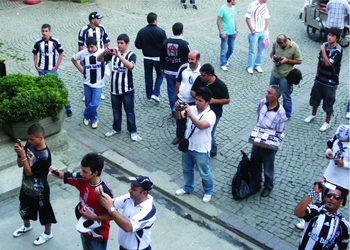
The same process can be glimpsed in the actions of Çarşı. Images of fans at games and videos of them socializing in Beşiktaş or even abroad are caught on camera and circulated via online forums and YouTube. Both young and old want to see themselves and have their actions immortalized online. This desire for exposure has led to the situation where there are often more people trying to capture the moment for online posterity than there are taking part in the action. In the drinking and congregation before a home game against Gaziantepspor, I captured no fewer than eight people with cameras who were trying to photograph the Çarşı fans singing and cheering (see Figure 8 and Figure 9). In the days following each game, these pictures and videos pop up on media-sharing sites, clog the Facebook news feeds of fans, and become folded into ongoing online debates and conversations surrounding Beşiktaş and Çarşı. For many youths, each photo, clip, or graffiti tag is viewed as an implicit challenge to produce material that is even more fanatical, amusing, and widely disseminated; for those in middle age, it serves mostly to conjure a nostalgic reverie for a time when they were similarly galvanized to produce such ostentatious shows of support.
Eight people taking photos of Beşiktaş fans chanting before the home match with Gaziantepspor, 28 August 2009 (author's photo). [A color version of this figure can be viewed online at http://journals.cambridge.org/mes]

The fans in question (author's photo). [A color version of this figure can be viewed online at http://journals.cambridge.org/mes]

Yet physical space is not abolished altogether: Beşiktaş cannot play their home matches in Mecca or Berlin, and supporters from other locales cannot physically be there regularly, except at great expense. Does the Çarşı fan who paints the group's slogans on the walls of Berlin have a greater claim to legitimacy than one who simply goes along to a match in Istanbul? This question forms a key fault line in the debates of the fan group, with supporters not split in any predictable fashion.
Is this obsession with the image a glimpse of how fans have used technological change to slip out from under the fixing glare of conventional media or in fact less liberating than it seems at first glimpse? As touched upon previously, Hebdige notes that the process of making images public by removing them from their “private contexts” serves to make the signifiers of a subculture “frozen.” This in turn leads to a situation in which “youth cultural styles may begin by issuing symbolic challenges, but they must inevitably end by establishing new sets of conventions; by creating new commodities, new industries or rejuvenating old ones.”Footnote 49 In the case of Çarşı, the videos and still images often follow a set format, with fans creating and re-creating similar scenes be they in Berlin, London, or Istanbul—often a group of supporters replicating the üçlü (on three) chant from the start of games or singing an offensive ode to rival fans, such as the Fener'e Opera (Opera for Fenerbahçe).Footnote 50
What initially is seen as innovation and liberation soon becomes dogma, a set of processes to which people must adhere. The youth of Çarşı are establishing new conventions, new legends, built out of the detritus of the movement's socialist past and the present-day hypercommodified society. By capturing these new processes, putting them on the internet, and freezing them into new symbols of identity, they are creating another, more postmodern set of actions that a person has to undertake before being defined as Beşiktaşlı: a Beşiktaş fan.
CONCLUSION
Over the course of my time in Istanbul, what struck me most was the importance placed by many Çarşı fans on appearance: from the clothes worn to the banners held up at matches, the impression was of a group of fans highly aware of how they were viewed and how they would like to be viewed. Allied with the growth of new forms of communication, such as internet forums and social networking sites like Facebook, the result is a pushing and pulling of the group identity away from earlier markers such as geography or family ties and toward one based on a bricolage of symbols and images, with the internet as the virtual space where assemblage often takes place. This process has been aided by the increased emphasis placed by modern capitalistic systems on the symbol and the brand. Identity construction is driven by consumption, and the creation and purchase of symbols and images has increased in importance. Those who can buy, generate, record, or wear the symbol, or disseminate it online or through graffiti, are encouraged to do so. These people consequently view themselves as a part of Çarşı, whether in Istanbul, Berlin, Mecca, or anywhere in between.
These trends—deterritorialization, increased consumption—are linked to the rapidly unfolding cultural consequences of neoliberal economic development in Turkey since 1980. The titles of recent books devoted to the subject of contemporary culture in Turkey—such as Fragments of Culture and Faces of the State Footnote 51—hint at a general consensus: that the last twenty years have seen a fracturing of monolithic grand narratives and the proliferation of smaller, more distinct, social, ethnic, and religious identities. This study has shown how this process can be discerned in the identities of football fan groups while serving to warn the reader against viewing it as the only trend active in identity construction. Just as the currently ruling AKP has managed successfully to galvanize a large and diverse cross-section of society by moral reference to Islam, so the overarching notions of “Çarşı” and “Beşiktaş” help provide a shared set of parameters and an element of social and cultural cohesion: if you are a Beşiktaş fan, then you are not, and never will be, a Galatasaray or Fenerbahçe fan. Within that broad distinction, of course, we have seen that there is huge contrast in terms of fan behavior and thinking. But in our desire to lend the necessary nuance and complication to modern-day processes of identity construction, we should not ignore completely the continuing presence and role of overarching, catch-all identities. The dynamic present, at least in relation to football fans, is not so much the fracturing of overarching narratives as their extreme malleability. The idea of “Çarşı” in the last decade has been, and continues to be, stretched and molded by the actions of fans to accommodate all manner of different social strata and opinions.
If we widen our scope, we might note that trends such as the hypercommodification of the Beşiktaş club, its mass support, and its transnational fan base are more redolent of the large clubs across Europe than those in the Middle East. Beşiktaş fans associate themselves with other teams in Europe that have a socialist, leftist, or progressive history, such as St Pauli in Germany, which has the first openly gay club owner in football, or Livorno in Italy with its deep communist history.Footnote 52 What is more, the causes that Çarşı fans adopt fit neatly into the debates surrounding changing football consumption in Europe, namely, clubs with unsustainable debts, fans being priced out of live attendance, and the accompanying rise in ease of armchair support.Footnote 53 Furthermore, the annual exposure on television to British teams playing Turkish teams, or Spanish or Italian supporters roaming the streets of Istanbul, has allowed the integration of Turkey into the sporting rituals and calendar of Europe. In light of the push for EU accession and the general desire of many in Turkey to be accepted as “European,” it may be argued that football culture is a key activity serving to “Europeanize” the culture of Turkey. It is possible, then, to conclude by suggesting tentatively that commodification and consumption can remain significant heuristic tools for understanding the larger context of modern identity formation in contemporary Turkey, largely because they are so well suited to explorations of identity construction in Europe as a whole.