





Current conceptual frameworks widely acknowledge that social withdrawal is not a unitary construct (McVarnock et al., Reference McVarnock, Cheng, Stone, DeGroot and Coplan2024). Specifically, different subtypes of withdrawal have been identified, comprising different combinations of social approach and social avoidance motivations (Asendorpf, Reference Asendorpf1990). For example, shyness is characterized by a desire for social interaction, which is superseded by feelings of wariness and fear of judgement in social situations (i.e., high approach and high avoidance motivations; Crozier, Reference Crozier1995). Unsociability is described as a non-fearful preference for spending time alone (i.e., low approach and low avoidance motivations; Coplan et al., Reference Coplan, Prakash, O’Neil and Armer2004), whereas social avoidance reflects a low desire to interact with others combined with active social avoidance behaviors (i.e., low approach and high avoidance motivations; Coplan et al., Reference Coplan, Ooi, Xiao and Rose-Krasnor2018).
Although social withdrawal subtypes represent relatively stable (i.e., trait-like) characteristics (Poole et al., Reference Poole, Cunningham and Schmidt2020; Rubin et al., Reference Rubin, Coplan and Bowker2009), they may demonstrate varying developmental trajectories during childhood (Zhu et al., Reference Zhu, Xiang, Li, Shen, Tian and Li2026). The meanings and implications of subtypes of social withdrawal may also change across cultural contexts (Ran et al., Reference Ran, Liu, Niu and Zhang2022). For example, social and economic changes that have occurred recently in mainland China have redefined individuals’ beliefs about social withdrawal, and contemporary research suggests that all subtypes of social withdrawal during late childhood and early adolescence are now associated with negative psychological outcomes among Chinese children (Ding et al., Reference Ding, Zhang, Ooi, Coplan, Zhu and Sang2023). It is thus important to understand the developmental processes by which social withdrawal subtypes and aspects of childhood psychological adjustment interact dynamically over time in China.
To date, multi-time-point repeated assessment longitudinal studies of these associations remain relatively scarce. According to developmental cascades theory (Masten & Cicchetti, Reference Masten and Cicchetti2010), a child’s functioning across multiple systems interacts cumulatively over time to produce chain effects. Problems related to subtypes of social withdrawal may thus cascade into other life areas (e.g., psychological adjustment) as children get older, which may, in turn, lead to increased social withdrawal (i.e., a bidirectional feedback loop). Of note, limited available studies in this area have focused almost exclusively on links at the between-person level (i.e., examining whether withdrawn children experience more adjustment problems over time; Barzeva et al., Reference Barzeva, Richards, Meeus and Oldehinkel2020; Ding et al., Reference Ding, Zhang, Ooi, Coplan, Zhang and Dong2022; Xiao et al., Reference Xiao, Bullock, Liu and Coplan2021). Less is known regarding how deviations from a child’s own level of social withdrawal predict subsequent deviations in adjustment problems, and vice versa (i.e., within-person changes). This is a notable gap in the literature because longitudinal data can be conceived as multilevel, with occasions being nested within individuals (Berry & Willoughby, Reference Berry and Willoughby2017). Without disaggregating within- from between-person variation, prior findings may conflate interindividual differences with intraindividual processes, thereby obscuring the potentially bidirectional nature of development.
To address this gap, this study explored the bidirectional between- and within-person associations between social withdrawal subtypes (i.e., shyness, unsociability, social avoidance) and indices of psychological adjustment (i.e., internalizing problems and well-being) in a longitudinal sample of children and early adolescents in mainland China.
Social withdrawal subtypes
Cross-sectional research on social withdrawal indicates that shy and avoidant children growing up in Western cultures experience heightened internalizing issues (e.g., depression, anxiety, loneliness) and poorer well-being compared to their unsociable counterparts (Coplan et al., Reference Coplan, Rose-Krasnor, Weeks, Kingsbury, Kingsbury and Bullock2013; Sette et al., Reference Sette, Brunetti, Pecora, Laghi, Longobardi and Coplan2025; Stone et al., Reference Stone, DeGroot, McVarnock, Cheng, Bowker and Coplan2025). Historically, research on social withdrawal told a different story regarding childhood shyness in China – one wherein shy children were not left at a disadvantage. Indeed, traditional Chinese culture valued behavioral wariness and restraint as positive traits reflecting social maturity, mastery, and understanding (Chen, Reference Chen2019). Shy Chinese children thus enjoyed a range of benefits, including popularity among peers, being viewed as leaders, and thriving academically (Chen et al., Reference Chen, Rubin and Li1995). However, rapid economic and social reforms have occurred in mainland China over the last few decades and new behavioral qualities (e.g., initiative-taking and self-expression) have taken on a positive meaning (Liu et al., Reference Liu, Bowker, Coplan, Yang, Li and Chen2019). Such changes in societal values have had negative effects on how people view shyness (Chen et al., Reference Chen, Cen, Li and He2005), potentially contributing to increasingly poor mental health outcomes among Chinese youth (Huang et al., Reference Huang, Wang, Wang, Liu, Yu, Yan, Yu, Kou, Xu, Lu, Wang, He, Xu, He, Li, Guo, Tian, Xu, Xu, Ma, Wang, Wang, Yan, Wang, Xiao, Zhou, Li, Tan, Zhang, Ma, Li, Ding, Geng, Jia, Shi, Wang, Zhang, Du, Du and Wu2019).
In contemporary Chinese society, shyness is robustly linked to increased internalizing and peer problems in children (Ding et al., Reference Ding, Fu, Ooi, Coplan, Zheng and Deng2020, Reference Ding, Mcvarnock, Li, Coplan, Ooi, Yu and Sang2025; Li et al., Reference Li, Chen, Ran, Zhang and Li2021; Zhao et al., Reference Zhao, Kong, Li, Zhu, Wang, Ding and Ding2024). Of note, shyness appears to be particularly maladaptive in urban centers of China, where societal changes are most pronounced (Ding et al., Reference Ding, Fu, Ooi, Coplan, Zheng and Deng2020, Reference Ding, Mcvarnock, Li, Coplan, Ooi, Yu and Sang2025). Compared to childhood shyness, childhood unsociability and social avoidance remain under-explored in China. Although unsociability is predominantly viewed as benign in the West (likely due to Western attitudes regarding personal choice and autonomy), traditional values regarding social integration remain a high priority in China (Chen, Reference Chen2019). Perhaps not surprisingly, then, accumulating evidence suggests that unsociability and social avoidance are both linked with poor adjustment outcomes in Chinese culture. For example, unsociability and social avoidance are associated with higher feelings of loneliness, anxiety, and depression, as well as lower well-being among Chinese children (Ding et al., Reference Ding, Mcvarnock, Li, Coplan, Ooi, Yu and Sang2025; Haidabieke et al., Reference Haidabieke, Kong, Zhang, Zhang, Zhou and Ding2026; Yang & Zhang, Reference Yang and Zhang2026; Zhang et al., Reference Zhang, Xiao, Zhang, Zhu, Dong and Ding2024). Of note, social avoidance appears to be the most maladaptive form of social withdrawal in both Western cultures and in China (Brunetti et al., Reference Brunetti, Sette, Longobardi, Laghi and Coplan2023; Coplan et al., Reference Coplan, Ooi, Xiao and Rose-Krasnor2018, Reference Coplan, Hipson and Bowker2021; Liu & Zhang, Reference Liu and Zhang2026).
Bidirectional effects
Within a developmental cascade model of social withdrawal, early shyness, unsociability, and social avoidance may lead to negative changes in psychological adjustment over time (Masten & Cicchetti, Reference Masten and Cicchetti2010). Psychological adjustment problems, such as anxiety and depression, may then exacerbate children’s motivations to steer clear of others. Alternatively, the cascade may begin with psychological maladjustment, which could exacerbate social withdrawal. To date, only a handful of empirical studies have attempted to delineate these transactional processes, typically employing between-person analytic approaches (e.g., Yang & Zhang, Reference Yang and Zhang2026). However, these findings are somewhat mixed both across and within subtypes. For instance, some studies have reported bidirectional associations between shyness and depression in Chinese children (Jiang et al., Reference Jiang, Ding, Wang, Sun, Li, Xie and Nguyen2023; Wang et al., Reference Wang, Pan, Wu, Zhu, Wang, Tian, Sun and Wang2022). Xiao et al. (Reference Xiao, Bullock, Liu and Coplan2021) found a bidirectional association between unsociability and loneliness over time, whereas Liu et al. (Reference Liu, Coplan, Chen, Li, Ding and Zhou2014) reported that unsociability predicted later internalizing problems. However, this association was not bidirectional. For social avoidance, the only study to implement a cross-lagged panel model in Chinese children found that depression predicted later social avoidance, but not the opposite (Ding et al., Reference Ding, Coplan, Deng, Ooi, Li and Sang2019).
Taken together, social withdrawal subtypes appear to demonstrate differential bidirectional associations with psychological maladjustment over time, but more longitudinal research using within-person analytic approaches is clearly required. In one study, Barzeva et al. (Reference Barzeva, Richards, Meeus and Oldehinkel2020) employed a random intercept cross-lagged panel model (RI-CLPM) to explore bidirectional associations between (general) social withdrawal and social anxiety in Norwegian adolescents. RI-CLPM extends traditional cross-lagged panel models by distinguishing between within- and between-person variance (Hamaker et al., Reference Hamaker, Kuiper and Grasman2015). Findings showed that although social anxiety at age 11 predicted increased social withdrawal two years later, the relation was not reciprocal. Given that social withdrawal is heterogeneous, we applied RI-CLPM to explore the implications of shyness, unsociability, and social avoidance in this study.
Gender and age effects
In this study, we also considered gender and age effects. For example, some research suggests that social withdrawal subtypes may be more problematic for Chinese boys than girls (Bullock et al., Reference Bullock, Xiao, Xu, Liu, Coplan and Chen2020; Li et al., Reference Li, Zhu, Coplan, Gao, Xu, Li and Zhang2016; Liu et al., Reference Liu, Coplan, Chen, Li, Ding and Zhou2014). This pattern of effects might be attributable to the violation of male gender stereotypes in Chinese culture, which often emphasize dominance and social assertion (as opposed to withdrawal) during social interaction (Chen et al., Reference Chen, Rubin and Li1995; Tang et al., Reference Tang, Chua and Harris2012). Accordingly, socially withdrawn behaviors among boys may lead to more negative reactions from the peer group (Bullock et al., Reference Bullock, Xiao, Xu, Liu, Coplan and Chen2020), which may predict psychological maladjustment (Bernasco et al., Reference Bernasco, van der Graaff, Meeus and Branje2022). Notwithstanding, evidence from empirical studies remains mixed, with some studies demonstrating stronger links between unsociability and difficulties with peers among Chinese girls (Chen et al., Reference Chen, Wang and Cao2011) and others demonstrating adjustment problems for socially withdrawn children, regardless of gender (Bian et al., Reference Bian, Chen, Li, Liu, Fu, Cui and Liu2026; Hu et al., Reference Hu, Zhang, Haidabieke, Wang, Zhou, Ding and Zheng2024; Li et al., Reference Li, Yu, Coplan, Bowker, Xu and Ding2025). For example, Zhao et al. (Reference Zhao, Barstead, Rubin, Zhang and Zhou2021) found that compared to their non-withdrawn peers, shy Chinese boys and girls both received fewer friendship nominations. Shy boys were also less likely to nominate male classmates as friends, whereas shy girls reported poorer friendship quality.
In addition, social withdrawal may be differentially associated with maladjustment as children get older (Ding et al., Reference Ding, Zhang, Ooi, Coplan, Zhu and Sang2023; Liu et al., Reference Liu, Chen, Zhou, Li, Fu and Coplan2017). For instance, children face increased social demands (e.g., expanding social circles) as they transition to early adolescence, which can be daunting for socially withdrawn young people (Rubin et al., Reference Rubin, Coplan and Bowker2009). Yet, adolescence is also a developmental period wherein solitude becomes more routine and accepted (Coplan et al., Reference Coplan, Ooi and Baldwin2019). Moreover, adolescents (particularly those higher in unsociability) may cope better than children with the challenges of social withdrawal by engaging in constructive solitary activities, such as hobbies or personal interests (Coplan et al., Reference Coplan, Hipson and Bowker2021).
Thus, on a theoretical basis, social withdrawal subtypes (especially unsociability) may become less risky from childhood to adolescence. Indeed, Chen et al. (Reference Chen, Zhou, Li, Liu and Cui2024) found that affinity for solitude (which shares conceptual overlap with unsociability) was more strongly associated with poor psychological adjustment (i.e., depression and lower self-esteem) among Chinese children in Grade 4 compared to Grade 6. Bian et al. (Reference Bian, Chen, Li, Liu, Fu, Cui and Liu2026) also recently found that, regardless of gender, shyness in China was a bigger risk factor for negative outcomes across multiple life domains during childhood than adolescence. Of note, one study found that social avoidance played a bigger role in some negative adjustment outcomes during childhood (i.e., social anxiety, depressive symptoms, and peer difficulties), but others during adolescence (i.e., life dissatisfaction and ill-being; Ding et al., Reference Ding, Zhang, Ooi, Coplan, Zhu and Sang2023).
The present study
This study extends the literature by exploring the longitudinal associations between subtypes of social withdrawal (i.e., shyness, unsociability, and social avoidance) and psychological adjustment outcomes (i.e., internalizing problems, such as depression, social anxiety, and loneliness, and well-being) among Chinese children and adolescents using RI-CLPM (Hamaker et al., Reference Hamaker, Kuiper and Grasman2015). This statistical approach was designed to account for stable (i.e., trait-like) differences between individuals and allows for the exclusive assessment of within-person dynamics (Mulder & Hamaker, Reference Mulder and Hamaker2021). In other words, RI-CLPM decomposes observed scores into within-person and between-person differences. Gender and age group differences were also explored.
Consistent with past research findings (Ding et al., Reference Ding, Zhang, Ooi, Coplan, Zhu and Sang2023; Sang et al., Reference Sang, Ding, Coplan, Liu, Pan and Feng2018), it was hypothesized that shyness, unsociability, and social avoidance would each be positively associated with internalizing problems (i.e., depression, social anxiety, and loneliness) and negatively associated with well-being at both the between- and within-person level. Moreover, significant cross-lagged effects were expected at the within-person level. Drawing upon developmental cascades theory (Masten & Cicchetti, Reference Masten and Cicchetti2010), it was hypothesized that each social withdrawal subtype would be bidirectionally associated with internalizing problems (positive relations) and well-being (negative relations) over time. By identifying the points where social withdrawal subtypes cascade into psychological problems (or vice versa), this approach highlights specific moments for intervention, which could help prevent further maladjustment in Chinese youth. Given mixed findings regarding the role of demographic factors, analyses including gender and age were exploratory, and formal hypotheses were not offered.
Method
Participants
Participants were N = 1,001 children (563 boys, M age = 11.71 years, SD = 1.45 years) in grades 4–8 recruited from public elementary and middle schools situated in urban centers of Eastern China. Schools were randomly selected from a comprehensive list of public schools in the region. Schools served students living in their geographic areas. According to China’s Ministry of Education, all schools follow the same organizational structure. Students typically follow similar schedules of courses and other activities in the school and generally stay in the same class over the years (Chen et al., Reference Chen, Zhou, Liu, Li, Zhang, Zheng, Dai, Zhou and Han2026). Students were recruited from randomly selected classes in elementary schools (n = 12, with 215 fourth graders, 203 fifth graders, 204 sixth graders) and middle schools (n = 8, with 192 seventh graders and 187 eighth graders). The average class size was approximately 50 students. All students were of Han descent, the predominant ethnic group in mainland China (92% of the population).
Procedure
After receiving approval from the Research Ethics Board of Shanghai Normal University, written informed consent (parents) and assent (students) were obtained prior to data collection. The participation rate was approximately 95%. Students completed the paper-based measures in their classrooms, in testing sessions (approximately 30 minutes) led by trained research assistants. Data were collected approximately every six months across four waves from 2022 to 2024.
Measures
Social withdrawal
Shyness was assessed using the Chinese version of the self-report Children’s Shyness Questionnaire (Crozier, Reference Crozier1995), which consists of 19 items (e.g., “I feel nervous about joining a new class”). Children were asked to rate each item on a 3-point scale (1 = no, 2 = sometimes, 3 = yes). This measure has previously demonstrated good psychometric properties and evidence of validity in Chinese children (Ding et al., Reference Ding, Liu, Coplan, Chen, Li and Sang2014). In this study, internal reliability was excellent (α = .91 to .93 across Time 1–Time 4).
Unsociability was assessed with the Chinese version of the Child Social Preference Questionnaire (Coplan et al., Reference Coplan, Rose-Krasnor, Weeks, Kingsbury, Kingsbury and Bullock2013). This scale includes 7 items assessing preference for solitude (e.g., “If given a choice, I prefer to play alone than with other kids”) rated on a 5-point scale (1 = not at all to 5 = always). The measure has previously demonstrated good psychometric properties and evidence of validity in Chinese children (Coplan et al., Reference Coplan, Liu, Ooi, Chen, Li and Ding2016). Internal reliability ranged from high to excellent (α = .85 to .92 across Time 1–Time 4).
Social avoidance was assessed using the Chinese version of the Social Avoidance Scale (Sang et al., Reference Sang, Ding, Coplan, Liu, Pan and Feng2018), which includes 4 items assessing children’s active avoidance of social interaction (e.g., “I don’t want to play with other children”). Children were asked to rate each item on a 5-point scale (1 = not at all to 5 = always). This measure has demonstrated good psychometric properties and evidence of validity in Chinese children (Ding et al., Reference Ding, Zhang, Ooi, Coplan, Zhang and Dong2022). In the present sample, internal reliability ranged from high to excellent (α = .82 to .91 across Time 1–Time 4).
Taken together, these well-established scales were chosen for their demonstrated validity and reliability in the Chinese context. They are among the most frequently used measures of social withdrawal subtypes in China (Coplan et al., Reference Coplan, Liu, Ooi, Chen, Li and Ding2016; Ding et al., Reference Ding, Zhang, Ooi, Coplan, Zhu and Sang2023; Li et al., Reference Li, Yu, Coplan, Bowker, Xu and Ding2025), thereby ensuring cultural appropriateness.
Internalizing problems
Children’s depression was measured using the 14-item Chinese version of the Children’s Depression Inventory (Kovacs, Reference Kovacs1992). The scale assesses aspects of depression (e.g., self-blame, fatigue, reduced appetite). Items are rated by choosing one of three response options (e.g., “I feel like crying every day,” “I feel like crying most days,” and “I feel like crying once in a while”) that best described them in the past two weeks. Loneliness was measured with the Chinese version of the Loneliness and Social Dissatisfaction Questionnaire (Asher et al., Reference Asher, Hymel and Renshaw1984), which consists of 16 items. Items are rated on a 5-point scale (1 = not at all true to 5 = always true). An example item includes “I have nobody to talk to.” Finally, social anxiety was measured by the Chinese version of the Social Anxiety Scale for Children-Revised (La Greca & Stone, Reference La Greca and Stone1993), which includes 15 items rated on a 5-point scale (1 = not at all to 5 = always). An example item includes “I worry about what other kids think of me.”
All three measures demonstrated high internal consistency (α = .84 to .95 across Time 1–Time 4). As well, these measures have demonstrated good reliability and validity in previous samples of Chinese youth (Ding et al., Reference Ding, Ooi, Coplan, Zhang and Yao2021; Liu et al., Reference Liu, Coplan, Ooi, Chen and Li2015; Yang et al., Reference Yang, Coplan, Zhang, Ding and Zhu2023).
Well-being
General self-worth was assessed using the 6-item Chinese version of the Self-Perception Profile for Children (Harter, Reference Harter1985). Each item offers two contrasting statements (e.g., “Some people are happy with themselves as a person,” but “Other people are often not happy with themselves”). Children choose the statement that best describes them and rate each item on a 4-point scale (“sort of true” and “really true” for each statement). This measure has demonstrated good psychometric properties and validity in previous studies with samples of Chinese children (Zhang et al., Reference Zhang, Dong, Xiao, Coplan, Wang and Ding2025). Internal reliability was acceptable in this study (α = .73 to .82 across Time 1–Time 4). Life satisfaction was assessed using the 5-item Chinese version of the Satisfaction with Life Scale-Child (Gadermann et al., Reference Gadermann, Schonert-Reichl and Zumbo2010). Items (e.g., “The things in my life are excellent”) are rated on a 5-point scale from 1 = disagree a lot to 5 = agree a lot. This measure has previously been found to be reliable and valid in samples of Chinese children (Ding et al., Reference Ding, Fu, Ooi, Coplan, Zheng and Deng2020). In this study, internal reliability was high (α = .81 to .89 across Time 1–Time 4). Of note, given that general self-worth and life satisfaction are conceptually and empirically correlated (Caprara et al., Reference Caprara, Steca, Alessandri, Abela and McWhinnie2010, Reference Caprara, Corbelli, Caprara, Contreras, Paciello and Zuffianò2025; Diener, Reference Diener1984; Oleś et al., Reference Oleś, Alessandri, Oleś, Bak, Jankowski, Laguna and Caprara2013) and there was a high positive intercorrelation in this study (r = .53 to .60 across Time 1–Time 4, ps < .001), general self-worth and life satisfaction were standardized and aggregated into a single index of well-being.
Analytic approach
Data were analyzed using SPSS 22.0 and Mplus 8.3 software. A series of random intercept cross-lagged panel models (RI-CLPM; Hamaker et al., Reference Hamaker, Kuiper and Grasman2015) were computed to explore the longitudinal relations between shyness, unsociability, and social avoidance, internalizing problems (social anxiety, depression, loneliness), and well-being at both between- and within-person levels. To attain model parsimony, autoregressive and cross-lagged paths were constrained to be equal over time (Mulder & Hamaker, Reference Mulder and Hamaker2021). Constrained models were directly compared to baseline models with the χ2 difference test (Bollen, Reference Bollen1989) and changes in goodness of fit indices (Chen, Reference Chen2007). When significant differences in fit were not indicated, we retained the most parsimonious model. Finally, to explore potential differences between genders and age groups, we conducted multi-group analyses. This approach allowed us to compare an unconstrained model (i.e., all paths permitted to fluctuate across gender or age groups) with a constrained model (i.e., all paths set as equal across gender or age groups). Potential disparities among paths within the model were tested using the Wald χ2 test.
Longitudinal measurement invariance testing was conducted to assess the ability of the items to function similarly across time points. Given our interest in the estimation of mean levels and path coefficients, we deemed the establishment of configural, metric, and scalar invariance (the same pattern of factor indicators, invariance of factor loadings, and invariance of indicator intercepts) adequate for cross-wave comparisons (Putnick & Bornstein, Reference Putnick and Bornstein2016). Following guidelines proposed by Chen (Reference Chen2007), results supported configural invariance (χ2/df = 1.146−2.255, RMSEA = .012−.036, CFI = .952−.997, TLI = .950−.995, SRMR = .022−.054), metric invariance, and scalar invariance (△CFI and △TLI < .01, △RMSEA ≤ .015) across time points for all measures. Measurement invariance tests across gender and age groups were also conducted. Results supported configural invariance (χ2/df = 0.802−2.645, RMSEA = .000−.067, CFI =.947−1.000, TLI = .948−1.000, SRMR = .008−.047), metric invariance, and scalar invariance (△CFI and △TLI < .01, △RMSEA ≤ .015) across genders for all measures. Results also supported configural invariance (χ2/df = 0.627−2.855, RMSEA = .000−.070, CFI = .946−1.000, TLI = .948−1.000, SRMR = .009−.047), metric invariance, and scalar invariance (△CFI and △TLI < .01, △RMSEA ≤ .015) across age groups for all measures.
RI-CLPM captures stable differences between individuals by extracting random intercept factors, which reflect time-invariant trait components among individuals. The between-person associations are represented by correlations between these intercept factors. Autoregressive and cross-lagged effects are also estimated using residual scores after extracting the trait factors, enabling the model to capture within-person deviations from trait levels (Hamaker et al., Reference Hamaker, Kuiper and Grasman2015). Specifically, the autoregressive path reflects the carry-over effect within an individual, suggesting that a rise in social withdrawal or adjustment outcomes at a specific point in time may predict a higher level of such behaviors or symptoms at a subsequent point. The cross-lagged effect captures how changes in one variable influence changes in another variable over time, such as how an increase in social withdrawal could portend an escalation in internalizing problems.
Results
Descriptive statistics
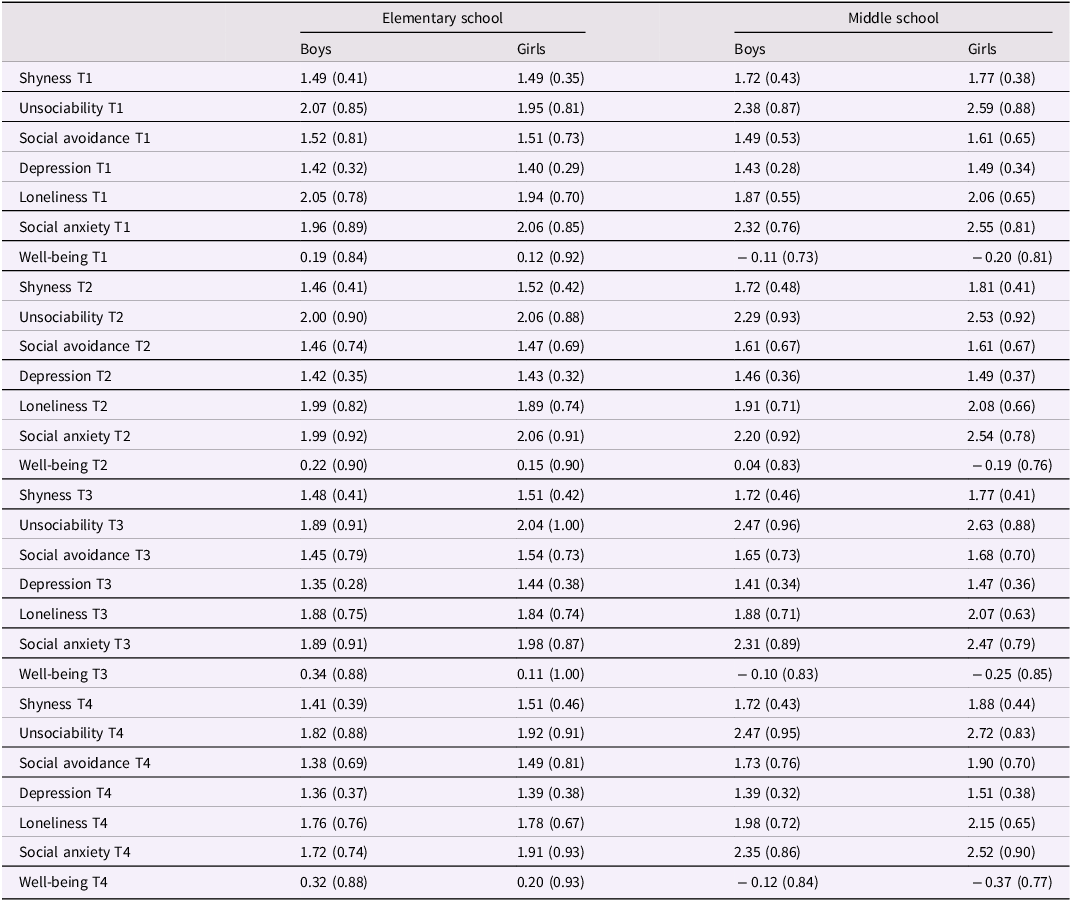
Descriptive statistics for continuous study variables (broken down by age group and gender) are displayed in Table 1. A repeated measures MANOVA was conducted to assess the effects of Gender, Age Group, and Time. Results indicated a significant main effect of Age Group, Wilk’s λ = .70, F(7, 545) = 33.71, p < .001, η 2 = .30. Children in middle school reported greater shyness, unsociability, social avoidance, depression, loneliness, and social anxiety, as well as lower well-being, than children in elementary school.
Means and standard deviations of all study variables by grade and gender

Table 1. Long description
A table with 4 columns and 40 rows. The columns are labeled Elementary school, Middle school, Boys and Girls. The rows are labeled with various psychological traits and time points, such as Shyness T1, Un sociability T1, Social avoidance T1, Depression T1, Loneliness T1, Social anxiety T1, Well being T1, Shyness T2, Un sociability T2, Social avoidance T2, Depression T2, Loneliness T2, Social anxiety T2, Well being T2, Shyness T3, Un sociability T3, Social avoidance T3, Depression T3, Loneliness T3, Social anxiety T3, Well being T3, Shyness T4, Un sociability T4, Social avoidance T4, Depression T4, Loneliness T4, Social anxiety T4, Well being T4. Each cell contains a mean value and a standard deviation in parentheses. The values vary across different traits and time points, with some traits showing higher values in middle school compared to elementary school. All values are approximated.
A significant Time effect was also found, Wilk’s λ = .88, F(21, 531) = 3.38, p < .001, η 2 = .12. Children reported greater depression and lower social avoidance at Time 2 than at Time 4. Finally, significant Time × Age Group interactions were also found, Wilk’s λ = .86, F(21, 531) = 4.08, p < .001, η 2 = .14. Children reported greater unsociability at Time 2 than Time 4 in elementary school, but lower unsociability at Time 2 than Time 4 in middle school. Social avoidance increased in middle school but remained stable in elementary school from Time 1 to Time 4. Loneliness and social anxiety decreased in elementary school, but remained stable in middle school from Time 1 to Time 4. There were no significant effects for Gender, F(7, 545) = 1.93, p = .06, η 2 = .02, Gender × Grade, F(7, 545) = 1.85, p = .08, η 2 = .02, Time × Gender, F(21, 531) = 1.42, p = .10, η 2 = .05, nor Time × Age Group × Gender, F(21, 531) = 1.40, p = .11, η 2 = .05.
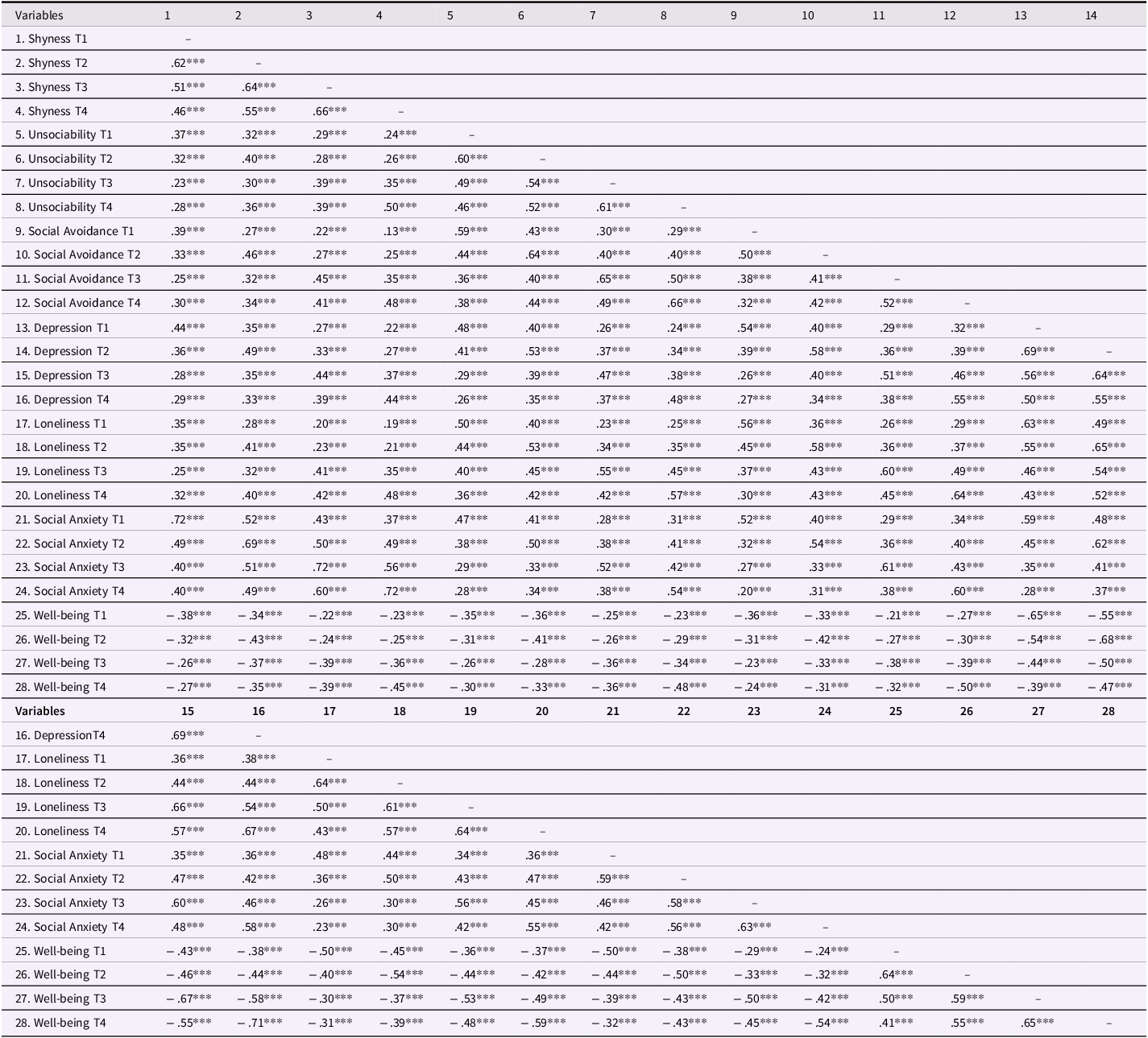
Correlations among study variables across four time points are displayed in Table 2. Shyness, unsociability, and social avoidance were all moderately and significantly positively intercorrelated, as well as significantly associated with indices of internalizing problems and well-being both concurrently and longitudinally. Specifically, all three subtypes of social withdrawal were positively related to social anxiety, symptoms of depression, and loneliness, as well as negatively related to well-being.
Intercorrelations among all study variables

Table 2. Long description
The table presents intercorrelations among various study variables across four time points. It includes 28 variables and 14 columns, with each row representing a different variable and each column representing a different time point. The variables include shyness, unsociability, social avoidance, social anxiety, depression, loneliness, and well-being. Each cell in the table contains correlation values between the variables at different time points. For example, shyness at time point 1 is correlated with shyness at time points 2, 3, and 4, as well as with other variables like social avoidance and depression. The table shows how these variables are interrelated over time, with notable trends indicating positive and negative correlations among them.
Notes. T1 = at time 1; T2 = at time 2; T3 = at time 3; T4 = at time 4. *** p < .001.
Study variables had missing data ranging from 2.9% to 6.5% for T1 variables, 2.2% to 4.9% for T2 variables, 24.7% to 27.5% for T3 variables, and 27.4% to 34.0% for T4 variables. The main reasons for the missingness were school dropout, school suspension, school transfer, school transition, family relocation, and illness. Attrition analysis was conducted between participants who had completed measures across all four time points and participants who dropped out at any time point. Results indicated that the two groups did not differ significantly in gender (χ 2 = 2.912, p > .05), age (|t| = 0.979, p > .05), or any other study variables (|ts| = 0.267−1.123, ps > .05). Accordingly, the missing data were missing at random (MAR), and we employed full information maximum likelihood (FIML) estimation (Graham, Reference Graham2009) to handle missing data.
Social withdrawal subtypes, internalizing problems, and well-being
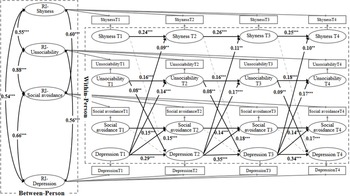
Four RI-CLPMs were conducted to examine the longitudinal relations between social withdrawal subtypes and indices of adjustment. Model comparisons were performed between unconstrained and constrained models. The constrained models did not significantly decrease the fit of the unconstrained model (ΔCFIs ≤ .01, ΔRMSEAs ≤ .015, and ΔSRMRs ≤ .015; Chen, Reference Chen2007). To attain model parsimony, we kept the constrained model results. Significant effects are reported here. Results for depression are displayed in Figure 1. The RI-CLPM fit the data well, χ 2 = 158.48, df = 76, χ 2/df = 2.09, p < .001, RMSEA = .033, CFI = .989, TLI = .983, SRMR = .042. At the between-person level, social withdrawal subtypes were all positively associated with children’s depression. At the within-person level, significant autoregressive effects were found for withdrawal and depression, reflecting stability within individuals over time. Social withdrawal subtypes were concurrently associated with symptoms of depression at all time points, with standardized effect sizes from .25 to .50. Furthermore, a significant bidirectional cross-lagged effect was observed between unsociability and depression within individuals. That is, increases in unsociability predicted heightened depression, which in turn predicted subsequent unsociability. Additionally, prior depressive symptoms predicted higher levels of shyness and social avoidance over time.
RI-CLPM for social withdrawal motivations and depression. Notes. Significant paths and standardized estimates are shown in bold. The dashed arrows indicate paths that were estimated but were not statistically significant. * p < .05. ** p < .01. *** p < .001. The same notes apply to subsequent figures.

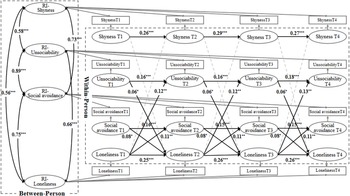
Results for loneliness are displayed in Figure 2. The RI-CLPM fit the data well, χ 2 = 193.77, df = 76, χ 2/df = 2.55, p < .001, RMSEA = .039, CFI = .985, TLI = .976, SRMR = .046. Social withdrawal subtypes were positively associated with loneliness at the between-person level, and autoregressive effects were significant for withdrawal and loneliness at the within-person level. Social withdrawal subtypes were all concurrently associated with loneliness at Time 1 – Time 4, with standardized effect sizes from .21 to .49. Significant bidirectional cross-lagged effects were also found between unsociability and loneliness, as well as between social avoidance and loneliness. Children exhibiting higher levels of unsociability and social avoidance were more susceptible to experiencing loneliness, which in turn contributed to the reinforcement of unsociability and social avoidance over time.
RI-CLPM for social withdrawal motivations and loneliness.

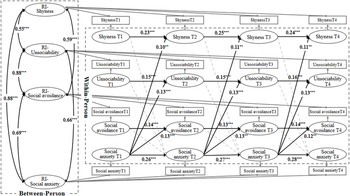
Results for social anxiety are displayed in Figure 3. The RI-CLPM fit the data well, χ 2 = 148.16, df = 76, χ 2/df = 1.95, p < .001, RMSEA = .031, CFI = .992, TLI = .987, SRMR = .043. At the between-person level, social withdrawal subtypes were positively associated with social anxiety. At the within-person level, significant autoregressive effects were also found for withdrawal and social anxiety, indicating stability within individuals over time. Social withdrawal subtypes were all concurrently associated with social anxiety at all time points, with standardized effect sizes from .30 to .61. In addition, unidirectional effects were observed wherein prior social anxiety predicted shyness, unsociability, and social avoidance over time.
RI-CLPM for social withdrawal motivations and social anxiety.

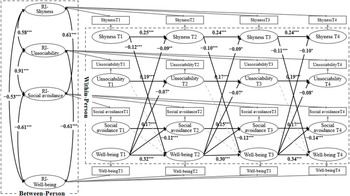
Finally, results for well-being are displayed in Figure 4. The RI-CLPM fit the data well, χ 2 = 157.69, df = 76, χ 2/df = 2.07, p < .001, RMSEA = .033, CFI = .988, TLI = .981, SRMR = .034. At the between-person level, social withdrawal subtypes were negatively associated with well-being. At the within-person level, autoregressive effects were significant for withdrawal and well-being. Significant negative concurrent associations were found between all social withdrawal subtypes and well-being at all time points, with standardized effect sizes from − .14 to − .33. A significant bidirectional cross-lagged effect was also observed between shyness and well-being within individuals. Shyness predicted poorer well-being, which in turn predicted increased shyness. Additionally, prior poorer well-being predicted increased unsociability and social avoidance over time.
RI-CLPM for social withdrawal motivations and well-being.

Figure 4. Long description
A diagram of the relationships between social withdrawal motivations and well-being over time. The diagram is divided into two main sections: Between-Person and Within-Person. The Between-Person section shows the correlations between different social withdrawal motivations and well-being. RI-Shyness, RI-Unsociability, RI-Social avoidance, and RI-Well-being are interconnected with correlation values indicated by arrows. The Within-Person section depicts the temporal relationships and stability of these factors over four time points (T1, T2, T3, T4). Each time point includes Shyness, Unsociability, Social avoidance, and Well-being, with arrows indicating the direction and strength of relationships between these factors across time points.
Gender and age group differences
Multi-group tests were performed to examine possible differences in the cross-lagged paths and associations among random intercepts in RI-CLPMs across gender and age groups. Accordingly, we compared nested models with and without specific associations constrained equally across groups. Significant gender differences were found in all four RI-CLPMs. Results for depression indicated that the model fit decreased significantly when associations among random intercepts were constrained to be equal across gender, Δ χ 2 (6) = 12.79, p = .046. Follow-up analyses indicated that positive associations between depression and shyness (Wald’s χ 2 (1) = 8.78, p = .003), unsociability (Wald’s χ 2 (1) = 7.28, p = .007), and social avoidance (Wald’s χ 2 (1) = 7.80, p = .005) were stronger for girls than for boys. The cross-lagged paths were equivalent across gender, Δχ 2 (18) = 26.05, p > .05.
Results for loneliness indicated associations among random intercepts were different across gender, Δχ 2 (6) = 28.20, p < .001. Shyness was positively associated with loneliness, but the association was significantly stronger for girls than for boys, Wald’s χ 2 (1) = 17.10, p < .001. The cross-lagged paths were equivalent across gender, Δχ 2 (18) = 22.73, p > .05.
Results for social anxiety indicated that the associations among random intercepts were different across gender, Δχ 2 (6) = 13.39, p = .037. The positive associations between social anxiety and both shyness (Wald’s χ 2 (1) = 9.79, p = .002) and social avoidance (Wald’s χ 2 (1) = 7.19, p = .007) were significantly stronger for girls than for boys. The cross-lagged paths were also different across gender, Δχ 2 (18) = 42.76, p < .001. Social anxiety at Time 1 predicted unsociability at Time 2 for girls only, Wald’s χ 2 (1) = 4.59, p = .032. Shyness at Time 2 positively predicted social anxiety at Time 3 for girls only, Wald’s χ 2 (1) = 4.49, p = .034.
Finally, results for well-being indicated that associations among random intercepts were different across gender, Δχ 2 (6) = 17.17, p = .009. The negative associations between well-being and shyness (Wald’s χ 2 (1) = 7.60, p = .006), unsociability (Wald’s χ 2 (1) = 14.50, p < .001), and social avoidance (Wald’s χ 2 (1) = 7.58, p = .006) were stronger for girls than for boys. The cross-lagged paths were also different across gender, Δχ 2 (20) = 40.83, p = .004. Unsociability at Time 3 negatively predicted well-being at Time 4 for girls only, Wald’s χ 2 (1) = 7.22, p = .007.
Significant age group differences were found in the models for depression and loneliness. Results for depression indicated that the model fit decreased significantly when cross-lagged paths were constrained to be equal across age group, Δχ 2 (18) = 36.74, p = .006. The prediction from depression at Time 3 to shyness at Time 4 was stronger in elementary school than in middle school, Wald’s χ 2 (1) = 6.42, p = .011. The associations among random intercepts were equivalent across age group, Δχ 2 (6) = 1.33, p > .05.
Results for loneliness indicated that cross-lagged paths were different across age group, Δχ 2 (18) = 31.49, p = .025. The path from loneliness at Time 1 to shyness at Time 2 was stronger in middle school than elementary school, Wald’s χ 2 (1) = 5.00, p = .025. Loneliness at Time 2 positively predicted unsociability at Time 3, with stronger effects in elementary school than middle school, Wald’s χ 2 (1) = 6.13, p = .013. The associations among random intercepts were equivalent, Δχ 2 (6) = 2.42, p > .05.
Results for social anxiety indicated no significant age group differences in the cross-lagged paths (Δχ 2 (18) = 14.81, p > .05) and associations among random intercepts (Δχ 2 (6) = 4.25, p > .05). Similarly, results for well-being similarly demonstrated no significant differences in the cross-lagged paths (Δχ 2 (20) = 30.31, p > .05) and associations among random intercepts (Δχ 2 (6) = 3.60, p > .05).
Discussion
This was the first study to distinguish between within- and between-person variability when examining the implications of shyness, unsociability, and social avoidance over time among Chinese youth. Overall and consistent with hypotheses, we found that all three social withdrawal subtypes were associated with increased internalizing issues (i.e., social anxiety, depression, and loneliness) and poorer well-being at the between-person level. These findings are in line with previous research on the implications of social withdrawal among children and early adolescents growing up in mainland China (Ding et al., Reference Ding, Coplan, Deng, Ooi, Li and Sang2019, Reference Ding, Mcvarnock, Li, Coplan, Ooi, Yu and Sang2025).
At the within-person level, social withdrawal subtypes were all concurrently linked to negative outcomes across the four timepoints. Importantly, however, results indicated a more complex pattern of within-person bidirectional associations between social withdrawal subtypes and adjustment outcomes over time, which provided partial support for the hypothesized developmental cascade model. Gender differences were also demonstrated (with between-person associations and, to a lesser extent, within-person associations), wherein subtypes of social withdrawal were more strongly linked to negative outcomes for girls than boys. Finally, associations were largely invariant across elementary and middle school.
Implications of social withdrawal subtypes over time
Our main study goal was to examine whether the trajectory of increased social withdrawal over time was predicted by a developmental cascade involving earlier social withdrawal followed by poor psychological adjustment at the within-person level. Results yielded a complex set of findings, which displayed some unique patterns across social withdrawal subtypes. Perhaps most notably, depression, social anxiety, and (poorer) well-being all predicted increased social withdrawal (across all subtypes) over time. These findings suggest that Chinese children and adolescents respond to psychological maladjustment by becoming less motivated to interact with peers. In traditional Chinese culture, mental illness is attributed to wrongdoing and associated with poor moral standing (Wong et al., Reference Wong, Tsui, Pearson, Chen and Chiu2004). Despite efforts to reduce public stigma, losing moral standing within society still appears to lead to social exclusion and avoidance (i.e., “social death”; Yang & Kleinman, Reference Yang and Kleinman2008). Indeed, Yin et al. (Reference Yin, Wardenaar, Xu, Tian and Schoevers2020) found that stigma toward mental illness in China was especially evident within individuals’ close personal relationships, rather than the general public. Taken together, these cultural factors may help explain the direction of effect evidenced in our results, with indicators of psychological maladjustment predicting increased social withdrawal over time (but not vice versa).
Our hypotheses regarding bidirectional associations between social withdrawal subtypes and child maladjustment were partially supported, such that each social withdrawal subtype was bidirectionally associated with at least some indices of maladjustment. For example, a significant within-person bidirectional effect was found between shyness and well-being, with shyness predicting poorer well-being, which, in turn, predicted increased shyness. This pattern of results supports contemporary evidence indicating that shyness is now maladaptive in China (Bullock et al., Reference Bullock, Xiao, Xu, Liu, Coplan and Chen2020; Ding et al., Reference Ding, Mcvarnock, Li, Coplan, Ooi, Yu and Sang2025; Liu et al., Reference Liu, Bowker, Coplan, Yang, Li and Chen2019; Zhao et al., Reference Zhao, Kong, Li, Zhu, Wang, Ding and Ding2024), perhaps due to shifting cultural values. In Western nations, shyness is a robust predictor of internalizing issues, such as depression and anxiety (Coplan et al., Reference Coplan, Rose-Krasnor, Weeks, Kingsbury, Kingsbury and Bullock2013). However, no other significant bidirectional associations emerged for shyness in this study. This is inconsistent with previous studies suggesting between-person bidirectional associations between shyness and depression (Jiang et al., Reference Jiang, Ding, Wang, Sun, Li, Xie and Nguyen2023; Wang et al., Reference Wang, Pan, Wu, Zhu, Wang, Tian, Sun and Wang2022). Given that shyness appears to be a stronger predictor of long-term internalizing problems in the West, our findings suggest that some traditional Chinese values may remain intact.
Within Asendorpf’s (Reference Asendorpf1990) approach-avoidance model of social withdrawal, shyness is uniquely characterized by the combination of strong social approach and social avoidance motivations. In line with transactional developmental models, the implications of social withdrawal on internalizing problems over time may be impacted by environmental responses (Ladd et al., Reference Ladd, Ettekal, Ladd and Coplan2025; Rubin et al., Reference Rubin, Coplan and Bowker2009). Because shy Chinese children want to interact with others (which is in line with collectivistic values), they may be met with increased social approval and support compared to their unsociable and avoidant peers. Over time, such experiences may protect against the development of psychological problems among shy children. Alternatively, shy children’s strong social approach motivations may translate to increased social experiences that, at least on some level, satisfy their desire to connect and protect against the development of loneliness.
In line with these arguments, both unsociability and social avoidance evidenced significant within-person bidirectional effects with loneliness. That is, increases in unsociability and social avoidance were followed by heightened feelings of loneliness, which were then followed by increased unsociability and social avoidance over time. Cacioppo et al.’s (Reference Cacioppo, Hawkley, Ernst, Burleson, Berntson, Nouriani and Spiegel2006) evolutionary theory of loneliness suggests that chronic loneliness can lead to increased social withdrawal, which further increases loneliness in a self-reinforcing cycle (i.e., a developmental cascade model). Our findings and others (i.e., Xiao et al., Reference Xiao, Bullock, Liu and Coplan2021) provide some empirical support for this theory. Present findings also expand upon previous research by suggesting that unsociability and social avoidance may both be comprised by internal social approach-avoidance motivations and emotional elements, including loneliness (Coplan et al., Reference Coplan, Prakash, O’Neil and Armer2004, Reference Coplan, Rose-Krasnor, Weeks, Kingsbury, Kingsbury and Bullock2013). Without strong social approach motivations to buffer against social isolation, socially avoidant young people may actively avoid opportunities for social interaction with peers, which may predict increased feelings of loneliness. Over time, children who feel lonelier may become increasingly social avoidant, as loneliness is linked to a more negative social self-concept (e.g., Sletta et al., Reference Sletta, Valas, Skaalvik and Sobstad1996). Consistent with research suggesting that avoidance and social anhedonia are connected to feelings of loneliness (Zhang et al., Reference Zhang, Xiao, Zhang, Zhu, Dong and Ding2024), findings here suggest that (even without strong social approach motivations) socially avoidant children and adolescents may possess a need to belong.
Of note, we also found that unsociability was bidirectionally associated with depression over time (but these effects were not evidenced for avoidance). Thus, despite cultural shifts in recent decades, a personal preference for solitary play over peer interaction still appears to be perceived as selfish (i.e., anti-collective) and deviant in Mainland China (Chen, Reference Chen2019). Contemporary studies have linked unsociability with interpersonal issues among Chinese youth, including peer rejection and victimization (Bullock et al., Reference Bullock, Xiao, Xu, Liu, Coplan and Chen2020; Ding et al., Reference Ding, Mcvarnock, Li, Coplan, Ooi, Yu and Sang2025). Such negative peer experiences represent significant risk factors for internalizing issues (Bernasco et al., Reference Bernasco, van der Graaff, Meeus and Branje2022). Moreover, some evidence suggests that negative peer experiences mediate the link between unsociability and increased depression (Bullock et al., Reference Bullock, Xiao, Xu, Liu, Coplan and Chen2020). As feelings of depression increase, our findings suggest that children become less motivated to interact with others.
Before concluding that cultural responses toward unsociability in mainland China differ from those in the West, it is important to note that we examined associations in the context of late childhood and early adolescence. Although unsociability is viewed more positively in Western cultures, theoretical and empirical evidence suggests that unsociability does not become adaptive until late adolescence and young adulthood (Borg & Willoughby, Reference Borg and Willoughby2022; Coplan et al., Reference Coplan, Ooi and Baldwin2019). As such, future longitudinal research with Chinese children should use RI-CLPM to examine whether the bidirectional association between unsociability and depression remains beyond the early adolescent years. This will shed light on whether attitudes toward unsociability in Chinese culture are truly changing to reflect Western values related to individualism and personal choice.
It should also be acknowledged that, contrary to expectations, no significant bidirectional within-person associations were found between social withdrawal subtypes and feelings of social anxiety. That is, social withdrawal subtypes did not predict (but were predicted by) increased social anxiety over time. Although inconsistent with our predictions, findings here mirror previous research on generalized social withdrawal. Recall that Barzeva et al. (Reference Barzeva, Richards, Meeus and Oldehinkel2020) examined bidirectional between- and within-person associations between generalized social withdrawal and feelings of social anxiety among adolescents. The researchers found that withdrawal and social anxiety were positively associated between persons. Although social anxiety at age 11 predicted increased self-reported (but not parent-reported) social withdrawal two years later, social withdrawal was not implicated in the progression of social anxiety within persons. The finding that social withdrawal and social anxiety were not bidirectionally associated was speculated to be rooted in the heterogenous nature of social withdrawal (i.e., different social withdrawal subtypes). However, our findings suggest that other factors may be at play. For instance, even in non-threatening social situations, people battling feelings of social anxiety may engage in increased social avoidance behaviors (Evans et al., Reference Evans, Chiu, Clark, Waite and Leigh2021). Although social avoidance behaviors may provide immediate feelings of safety for those with social anxiety, they may interfere with extinction and thus maintain social anxiety over time (Lovibond et al., Reference Lovibond, Mitchell, Minard, Brady and Menzies2009).
Gender and age effects
We also considered the moderating roles of both gender and age group. Overall, results indicated that concurrent associations between social withdrawal subtypes and negative outcomes were stronger among girls compared to boys. Gender differences in cross-lagged associations were generally non-significant, with a few exceptions. Most notably, the longitudinal association between shyness at Time 2 and social anxiety at Time 3 was significant for girls but not boys. As such, our findings indicate that shyness may increase the risk of social anxiety symptoms more for Chinese girls.
As well, the relation between unsociability at Time 3 and poorer well-being at Time 4 was significant for girls only. Although gender stereotypes in Chinese culture have traditionally emphasized social assertion and dominance among males (Chen et al., Reference Chen, Rubin and Li1995; Tang et al., Reference Tang, Chua and Harris2012), our findings indicate that socially withdrawn girls might be especially at risk for poor psychological outcomes. Chen et al. (Reference Chen, Wang and Cao2011) similarly found that unsociability was more strongly associated with interpersonal difficulties among girls in China. Because girls are more sensitive to relationship issues (Cillessen & Bellmore, Reference Cillessen and Bellmore1999), it may be that social situations serve as a source of psychological problems for girls more than boys. Within traditional Chinese family structures, males are also expected to assume the primary responsibility of upholding and advancing family reputation (Ho, Reference Ho and Lamb1987). Consequently, Chinese parents may (potentially) be more concerned with boys’ social and emotional difficulties, which could protect against adjustment difficulties. This speculative explanation is in line with transactional developmental models emphasizing the role of environmental responses in associations between social withdrawal and adjustment (Rubin et al., Reference Rubin, Coplan and Bowker2009). Still, given inconsistent results, further investigation is necessary to clarify if – and how – gender might moderate links between social withdrawal subtypes and psychological outcomes.
Regarding age group differences, early adolescents (i.e., middle school) reported higher levels of withdrawal than children (i.e., elementary school) in this study. This suggests that as children transition into adolescence, they may become less motivated to engage with peers, which is consistent with theoretical and empirical research on the developmental trajectory of time spent alone (Coplan et al., Reference Coplan, Ooi and Baldwin2019; Sette et al., Reference Sette, Brunetti, Pecora, Laghi, Longobardi and Coplan2025). Although spending increased time away from peers may become more normative with age (Coplan et al., Reference Coplan, Ooi and Baldwin2019), “too much” solitude may still be costly (Rubin et al., Reference Rubin, Coplan and Bowker2009). Indeed, depression, loneliness, and feelings of social anxiety were higher (and well-being was lower) among middle school participants in this study, which suggests that increases in social withdrawal subtypes among early adolescents are accompanied by poorer adjustment outcomes.
Overall, we found a general lack of significant interactions involving age, indicating that links between withdrawal and psychological outcomes over time were relatively consistent across students in elementary versus middle school. It should be noted, however, that the pathway from loneliness at Time 1 to shyness at Time 2 was stronger in middle school, whereas the pathway from depression at Time 3 to shyness at Time 4 was stronger in elementary school. As well, the pathway from loneliness at Time 1 to unsociability at Time 3 was stronger in elementary school. Thus, whereas loneliness may exacerbate shyness as children transition to early adolescence, depression may be a stronger trigger for shyness in elementary school. Similarly, loneliness appears to promote unsociability more strongly in elementary school. Given that results here were unexpected, additional research is necessary to explore why this may be.
Strengths and implications
Our study was among (if not) the first to examine the bidirectional within-person associations between social withdrawal subtypes, internalizing problems, and well-being among Chinese youth. This is a critical area for exploration, as bidirectional interactions between individuals and contexts are theorized to represent core developmental processes that unfold at the within-person level (Lerner & Castellino, Reference Lerner and Castellino2002). Moreover, disentangling within- from between-person variability in this study yielded different results. Although social withdrawal subtypes were all concurrently and longitudinally associated with all indices of maladjustment between persons, within-person associations varied across (and within) social withdrawal subtypes. Findings provide some support for contemporary developmental theory (Lerner & Castellino, Reference Lerner and Castellino2002; Rubin et al., 2009) and highlight the importance of accounting for why children withdraw from others when examining within-person associations between social withdrawal and psychological functioning.
Compared to shyness and unsociability, we currently know much less regarding the origins and implications of social avoidance. Our findings are among some of the first to shed light on how avoidance may develop. In terms of unidirectional associations, depressive symptoms were positively associated with social avoidance (as well as shyness) over time. These findings support previous studies on links between social avoidance and depression, which suggests that depression may predict social avoidance (but not the other way around; Ding et al., Reference Ding, Coplan, Deng, Ooi, Li and Sang2019). Moreover, given that shyness and avoidance are uniquely characterized by high social avoidance motivations, our findings suggest that depression in childhood and adolescence may be followed by increased social avoidance motivations as children get older. Similar to our unidirectional findings regarding unsociability, social avoidance in this study was also predicted over time by lower well-being and higher social anxiety. Thus, social anxiety may also serve as a pathway through which social avoidance develops. However, additional research is necessary.
Our findings also have some potential practical implications. As previously mentioned, the overall pattern of between- and within-person associations for shyness is consistent with contemporary research and theory indicating that shyness has become a precursor for negative psychological adjustment in China (Bullock et al., Reference Bullock, Xiao, Xu, Liu, Coplan and Chen2020; Ding et al., Reference Ding, Mcvarnock, Li, Coplan, Ooi, Yu and Sang2025; Liu et al., Reference Liu, Bowker, Coplan, Yang, Li and Chen2019; Zhao et al., Reference Zhao, Kong, Li, Zhu, Wang, Ding and Ding2024). Given that shyness was found to be the most stable form of social withdrawal over time, our findings further highlight the importance of developing interventions to assist Chinese children who are (or are at risk of becoming) shy. Recall that increased depression and social anxiety, as well as lower well-being, were linked to increased shyness over time. What is more, these indices of psychological maladjustment were also associated with other forms of social withdrawal, including unsociability and social avoidance. Thus, when psychological adjustment is positive, children may feel more motivated to engage with others. Taken together, our findings offer preliminary evidence that early intervention programs targeted toward improving symptoms of social anxiety and depression among Chinese children may hold promise for reducing social withdrawal (and thereby potentially improving psychological adjustment). For example, school-based programs might be adapted to help socially anxious children develop social problem-solving skills and master emotional regulation strategies through structured group activities. Community mental health centers in urban Chinese cities could consider organizing interest-based after-school clubs (e.g., art, music, robotics) where children can interact around shared activities. These possibilities warrant further investigation. Such approaches may be particularly worth exploring for girls, given the observed sex differences in our data.
Limitations and future directions
This study is not without limitations. First, all measures were self-report, which may lead to shared method variance. Going forward, studies should employ alternative sources of assessment, including parents, teachers, and peers. In addition, our sample included children and adolescents from urban regions of China. Recent research suggests that there are regional differences in the implications of social withdrawal for children living in different areas of China (e.g., Ding et al., Reference Ding, Mcvarnock, Li, Coplan, Ooi, Yu and Sang2025; Ding & Kong, Reference Ding and Kong2026; Hu et al., Reference Hu, Zhang, Haidabieke, Wang, Zhou, Ding and Zheng2024; Liu & Zhang, Reference Liu and Zhang2026). For example, shyness and social avoidance may be most precarious in urban areas, whereas unsociability may be most precarious in suburban areas. To account for these differences and determine whether our findings extend beyond urban China, future studies should sample children living in urban, suburban, and rural settings.
In addition, missing data was handled using FIML. While our findings are robust with respect to the estimated within- and between-person associations, the relatively high missing rates at Time 3 and Time 4 may limit the generalizability of our findings. Future studies with lower attrition would help confirm these results. It should also be noted that shyness and social anxiety share some conceptual overlap, raising the possibility that some within-person cross-lagged effects could reflect measurement overlap rather than developmental processes (Rapee & Coplan, Reference Rapee and Coplan2010; Rubin et al., Reference Rubin, Coplan and Bowker2009). Although this possibility cannot be discounted, previous studies have demonstrated that shyness and social anxiety do indeed represent distinct constructs (e.g., Bekkhus et al., Reference Bekkhus, McVarnock, Coplan, Ulset and Kraft2023). Notwithstanding, future research should continue to explore the unique nature of these two constructs.
Further, we assessed outcomes related to internalizing problems and well-being. However, the difficulties associated with social withdrawal subtypes are known to permeate various life domains (Coplan et al., Reference Coplan, Liu, Cao, Chen and Dan2017; Ding et al., Reference Ding, Mcvarnock, Li, Coplan, Ooi, Yu and Sang2025). Future research should look beyond psychological adjustment to consider interpersonal (e.g., peer problems) and educational outcomes (e.g., academic disengagement, school dropout, school liking). Findings will contribute to a more holistic view regarding the bidirectional links between withdrawal and outcomes over time.
Lastly, to better understand the mechanisms by which social withdrawal and psychological maladjustment indices may be associated, future studies may also consider potential mediators, such as social avoidance behaviors. To pinpoint factors that may help determine which socially withdrawn children are most (or least) at risk of developmental difficulties over time, potential moderators may also be considered. Indeed, some cross-sectional evidence suggests that increased screen exposure amplifies the risks of adjustment difficulties for shy Chinese children (Zhu et al., Reference Zhu, McVarnock, Polakova, Xiang, Li and Coplan2023).
Data availability statement
Code and materials are available from the authors upon request (REB stipulations do not allow for the release of raw data).
Funding statement
This research was supported by the National Social Science Fund of China (Grant No. 25BSH086).
Competing Interests
The authors declare no competing interests.
AI statement
No AI was used in any stage of this work.
Pre-registration statement
This research was not pre-registered. It was designed as an exploratory, longitudinal investigation aimed at examining novel hypotheses regarding social withdrawal motivations and psychological adjustment among Chinese youth. At the time of data collection, the analytic strategy had not been fully specified, as the primary goal was to identify patterns and relations within a complex developmental framework rather than to test a narrowly defined set of predictions. Given these circumstances, formal pre-registration was not feasible without compromising the flexibility required for hypothesis generation and model refinement.

 Open access

