Introduction
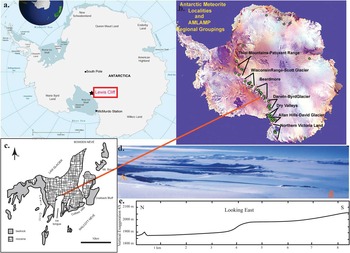
The Lewis Cliff ice tongue (LCIT) is located east of the Lewis Cliff, Buckley Island quadrangle in Antarctica (84°14'S, 161°39'E, elevation 1837 m, 2.3 by 7.0 km). The LCIT is surrounded by a large body of supraglacial moraine in the north and north-east, by the Colbert Hills on the east and converges with the Walcott Névé to the south (Fig. 1; Fitzpatrick & Muhs Reference Fitzpatrick and Muhs1989). As a well-known meteorite-stranding site, the LCIT is within the Beardmore Region of Antarctica (Fig. 1b), which has accumulated numerous meteorites naturally preserved on the glacial surface. The Beardmore Region has been explored for meteorites at least five times, since the first expedition during the 1985–86 field season, and at least 1871 meteorite samples have been recovered since 1985. Subsequent to initial meteorite expeditions, the presence of evaporite minerals on the LCIT began to attract attention by 1990, initiated by Fitzpatrick et al. (Reference Fitzpatrick, Muhs and Jull1990) and mentioned by Cassidy (Reference Cassidy1990). However, possible formation mechanism(s) for these aggregates of evaporite deposits were not proposed until Harvey et al. (Reference Harvey, Bish, Socki and Tonui2006) considered the deposits as possible terrestrial analogues to evaporite deposits discovered on Mars. Based on the sodium (Na)-evaporite deposits found at the LCIT, Harvey et al. (Reference Harvey, Bish, Socki and Tonui2006) proposed that the formation mechanism(s) for the deposits could be summarized as evaporative wicking in a morainal environment, repeatedly affected by percolation of small volumes of water, thereby forming the large accumulation of evaporites. Socki et al. (Reference Socki, Harvey, Bish, Tonui and Bao2008) measured the oxygen and sulfur isotopic compositions of the glacial ice and lake water from LCIT, which have the potential to shed light on sources and formation processes active at the LCIT.
a. Location map of Antarctica. b. Meteorite localities. c. Surficial map of Lewis Cliff ice tongue (LCIT; Fitzpatrick et al. Reference Fitzpatrick, Muhs and Jull1990). d. Aerial photograph of the LCIT from west–east. e. Slope profile of the LCIT. (b., d. & e. from http://geology.cwru.edu/~amlamp/BDM/LEW/LEW15text.html.)

Similar cryogenic deposits have been documented in the saline and hypersaline lakes in the northern Great Plains of western Canada by Last (Reference Last1989) and Last & Vance (Reference Last and Vance1997). These deposits are dominated by carbonates, hydrous sulfates, chlorides and oxides, occurring as encrustations, bedding deposits, spring deposits and subsurface precipitates (Last Reference Last1989). Depositional environments for early diagenetic evaporites, i.e. marginal, shallow, and deep subaqueous settings in both marine and non-marine surroundings, were addressed by Schreiber & El Tabakh (Reference Schreiber and El Tabakh2000). Salt formations mainly composed of chlorides and sulfates that crystallized in hypersaline brines were discovered in the Canadian, Fennoscandian and Bohemian Shields (Starinsky & Katz Reference Starinsky and Katz2003), whose origins were related to seawater as evidenced by chloride-bromine-sodium compositional relationships.
Another well-known evaporite-bearing area, the Dry Valleys, has been studied from the perspectives of biogeochemical components (dissolved organic carbon, DOC; Aiken et al. Reference Aiken, McKnight, Harnish and Wershaw1996), origins and distribution of sulfate minerals in soils (Bao et al. Reference Bao, Campbell, Bockheim and Thiemens2000, Bao & Marchant Reference Bao and Marchant2006), source of chloride minerals (Bao et al. Reference Bao, Barnes, Sharp and Marchant2008), solubility of salts in lake water (Marion Reference Marion1997), physical, chemical and biological conditions of saline lakes (de Mora et al. Reference De Mora, Whitehead and Gregory1991, Shacat et al. Reference Shacat, Green, Decarlo and Newell2004, Green & Lyons Reference Green and Lyons2009), distribution and origins of common salts (Nakai et al. Reference Nakai, Wada, Kiyosu and Takimoto1975, Keys Reference Keys1979, Reference Keys1980, Keys & Williams Reference Keys and Williams1981), halogen geochemistry of saline lakes (Lyons et al. Reference Lyons, Welch, Snyder, Olesik, Graham, Marion and Poreda2005), and chemical weathering by streams of glacial meltwater (Nezat et al. Reference Nezat, Lyons and Welch2001). Salt formations occurring at the terminus of the Hobbs Glacier (Black & Bowser Reference Black and Bowser1968, Bowser et al. Reference Bowser, Rafter and Black1970), west of McMurdo Sound, and precipitates in the saline water discharging from the Taylor Glacier (Black et al. Reference Black, Jackson and Berg1965, Black & Bowser Reference Black and Bowser1968, Keys Reference Keys1979), Victoria Land, have also been studied. The sulfate salts in these localities were proposed to have formed via freezing and/or evaporation processes. Precipitates of salts forming in saline lakes in Taylor Valley were apparently repeatedly washed and altered, but they are mixed and thus their origins are varied and not always well defined. In contrast to these deposits, evaporites at the LCIT in the Transantarctic Mountains, south-east of McMurdo Station, contain several hydrous evaporite species, including sulfates, carbonates and borates. These phases have been investigated with respect to their formation mechanism (Harvey et al. Reference Harvey, Bish, Socki and Tonui2006), and their oxygen and sulfur isotopic compositions (Socki et al. Reference Socki, Harvey, Bish, Tonui and Bao2008, Reference Socki, Sun, Niles, Harvey, Bish and Tonui2012). Based on the arid and cold climate conditions, Liu (Reference Liu2010) deduced possible formation mechanisms of the LCIT evaporite deposits and discussed whether they could represent a potential terrestrial analogue to Martian evaporite deposits.
Although the stable isotopic composition of several of the evaporite deposits at the LCIT has been studied, a complete mineralogical picture of the deposits does not exist. Such information is crucial for a complete understanding of mineral-forming processes in cryogenic environments. Fitzpatrick (Reference Fitzpatrick1990) first investigated the LCIT evaporite deposits, identifying Na-carbonate, -bicarbonate and -borate minerals as the primary mineralogy, also including nahcolite (NaHCO3), trona (Na3(CO3)(HCO3)·2H2O) and borax (Na2B4O7·10H2O). Borax was the first boron-bearing mineral documented in Antarctica (Fitzpatrick Reference Fitzpatrick1990), closely associated with nahcolite. Evaporites often undergo an ongoing process of mineral alteration, dissolution and precipitation. This study focuses on a mineralogical analysis of samples collected from several locations at the LCIT using environmentally controlled powder X-ray diffraction (XRD) measurements. Data are provided that can be used to infer the histories and mechanisms of mineral formation, particularly when combined with previous isotopic studies.
Materials and methodology
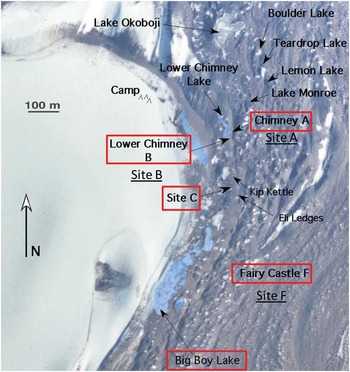
All analysed evaporite samples were collected at the LCIT during the 2005–06 field season from both evaporite mounds and surface efflorescences at five locations shown on Fig. 2: chimney A (site A), low chimney B (site B), site C, fairy castle F (site F), and the big boy lake vicinity. Temperature and relative humidity (RH) were measured at the time of sample collection using a humidity-temperature probe with a Honeywell IH-3610-1 RH sensor and a National Semiconductor LM335Z temperature sensor.
Sampling locations at the Lewis Cliff ice tongue. Study areas are indicated by red boxes, informal names were used to identify individual features during fieldwork.

All samples were stored after collection in a -20°C freezer until the time of analysis, and each sample was prepared for analysis in a cold room at 4°C. Sets of mortar and pestle, spatulas and specimen mounts were pre-cooled for subsequent sample mounting to minimize any phase modifications caused by elevated temperatures during the sample preparation process. Identification of mineral phases was accomplished using a Bruker D8 Advance X-ray diffractometer using Cu Kα radiation and a SolX energy-dispersive detector. Measurements were started under ambient room temperature immediately after mounting the specimens. The RH monitored at the time of field collection was c. 50%, therefore the environment surrounding samples during XRD data measurement was maintained at 50% RH using an InstruQuest VGen humidity generator and a custom cell on the diffractometer. The XRD data were measured from 2–70°2θ with a step size of 0.02°. Specimens mounted in cavities were measured at a rapid scan rate (0.5 sec step-1) to minimize the possibility of mineral modifications at room temperature. These measurements were followed by slower scans (1 sec step-1), which were repeated to assess the progress of any phase transition(s). In practice, two successive runs were sufficient to monitor the stability and variability of targeted minerals during short periods of time at room temperature (23°C).
Results
Evaporite mineral distribution at the Lewis Cliff ice tongue
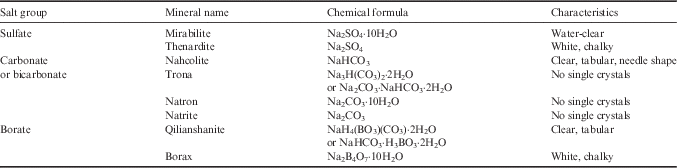
Hydrous and anhydrous forms of Na-sulfate, Na-bicarbonate, hydrous Na-carbonates and Na-borates constitute the evaporite mineral assemblage at the LCIT. Site A included all mineral phases detected in all samples collected at the LCIT, site C primarily contained Na-bicarbonate and Na-borate minerals, and site F was distinguished by containing exclusively Na-bicarbonate. The efflorescences and encrustations from the vicinity of big boy lake displayed white to dark colours, a sponge-like texture, as well as a broad range of mineralogy. Site B mainly provided rock and soil samples with occasional evaporites on their surfaces. Table I lists the mineralogy, corresponding chemical formulae and the mineralogical characteristics seen in specific samples.
Mineral occurrences at the Lewis Cliff ice tongue and their corresponding chemical formulae.

The multi-phase site A
Samples at site A were collected from the interior and surfaces of the evaporite mounds and were composed primarily of mirabilite (Na2SO4·10H2O) and thenardite (Na2SO4), with lesser amounts of nahcolite. Recorded ambient conditions at the time of collection were 4.6°C and 51.7% RH. The borate mineral qilianshanite (NaH4(BO3)(CO3)·2H2O; first discovered in the Juhongtu boron deposit, China) was found at the LCIT as single crystals, occasionally intergrown with nahcolite and borax. Qilianshanite is a rare boric carbonate mineral, and this is the first discovery in Antarctica. Single crystals and aggregates, as well as efflorescences were examined by XRD, but two typical occurrences were chosen to represent the primary mineralogical compositions at site A.
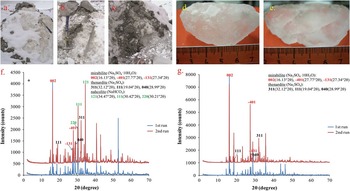
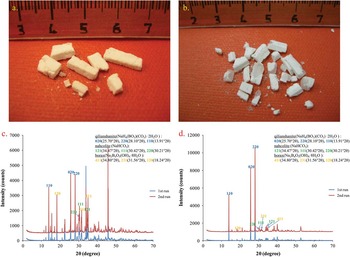
Sample A-4DB contained clear massive crystals with one direction of perfect cleavage, and these were found in the interior of the large mound by breaking open the mound. Sample A-5DB consisted of the same water-clear crystal as A-4DB and was found in the centre of the mound. Figure 3 presents images and the mineralogy of these samples. The dominant mineral phase of A-4DB and A-5DB was mirabilite. Both samples partially dehydrated to thenardite during the second XRD measurement due to the higher temperature of the laboratory environment, even though the RH was maintained at 50%. Nahcolite also occurred in A-4DB in the sulfate-dominant deposits. White massive and powdery materials covered the outside of the mounds, reflecting secondary alteration due to interactions with the atmosphere. Similar to the interior clear crystals, mirabilite, thenardite and nahcolite were also found in the white chalky materials.
a.–c. Evaporite mounds. d. & e. Water-clear crystals (A-4DB and A-5DB, scale=cm). f. & g. XRD patterns for A-4DB and A-5DB.

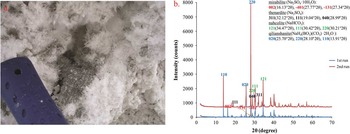
As shown in Fig. 4, A-3DB was composed of tiny, lath-like and clear crystals growing in vugs that were pervasive around the mound. The sample was originally comprised of mirabilite, nahcolite and qilianshanite, but mirabilite dehydrated completely to thenardite after the first XRD measurement. Nahcolite and qilianshanite appeared stable at room temperature and 50% RH, at least over the period of the XRD measurements.
a. Sample A-3DB (hammer handle for scale). b. XRD patterns for A-3DB.

The bicarbonate- and borate-enriched site C
The two predominant evaporite components at site C were Na-bicarbonate and -borate minerals, i.e. nahcolite, borax and qilianshanite. The translucent samples exhibited euhedral crystal forms, showing prismatic and needle-like morphologies, and some were coated with white powdery material. Collection temperature and RH conditions were -8.4°C and 63.4%. Two similar samples are presented here to show the form and composition of the assemblages at this site.
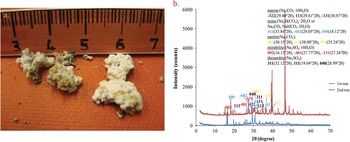
Samples from becca A (a subarea not shown in Fig. 2) at site C (Fig. 5) showed a prismatic crystal form covered by a layer of white crust on the exteriors with translucent interiors. Both samples contained the same mineral phases, qilianshanite, nahcolite and borax. These three relatively unreactive minerals persisted under room temperature and 50% RH conditions.
a. & b. Samples from becca A at site C (subarea not specified in Fig. 2, scale=cm). c. & d. XRD patterns.

The single-phase site F
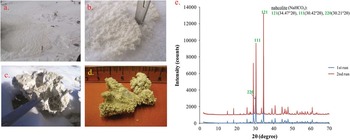
Although the samples collected at site F showed a variety of different crystal forms, their mineralogy was consistently nahcolite. The ambient environment at collection was -16.5 to -14.6°C with RH of 68.4–53.7%. The crystals were typically pock-marked, prismatic, elongated and needle-like. Sample F-1DB (Fig. 6), nahcolite, had a pock-marked exterior, unlike the common needle-like nahcolite crystals in the area, and it appeared stable at room temperature and 50% RH.
a.–c. Locality of sample F-1DB (a. footprints, b. & c. knife blade for scale). d. Microscopic view of F-1DB (scale=cm). e. XRD pattern for F-1DB.

Big boy lake vicinity samples
Efflorescent samples collected near big boy lake possibly originated from the adjacent mounds that are cemented with efflorescences and gravels. Available samples revealed the presence of mirabilite, thenardite, natron (Na2CO3·10H2O) and trona in the original material. During XRD measurement, mirabilite and natron dehydrated to thenardite and trona, respectively (appearing during the second XRD measurement). The efflorescent samples from this site and the dehydration of mirabilite and natron are shown in Fig. 7.
a Efflorescent sample (photo taken indoors, scale=cm). b. XRD pattern.

Soil samples at site B
In addition to the evaporite minerals, soil samples were collected from site B. Fine-grained ‘worm-like’ material occurred on top of snow-free loose regolith and appeared to be clumps of the underlying material (Fig. S1; http://dx.doi.org/10.1017/S0954102014000406). The mineralogy of both the surface and underlying materials determined by XRD included quartz, a mica (10Å phyllosilicate), plagioclase, microcline, chlorite and zeolites (barrerite and laumontite).
Discussion
Occurrences of Na-sulfate, -bicarbonate, and -borates at the Lewis Cliff ice tongue
A variety of minerals occur in the evaporite deposits at the LCIT, and the data presented here show that the most hydrated minerals occur within the central portions of the evaporite mounds. A number of phases appear to have formed in response to interactions between the original evaporite minerals and the atmosphere. For example, the transition between mirabilite and thenardite is related to atmospheric interactions in Antarctica, due to temperature-induced changes in RH. Mirabilite maintained its hydrated state in the subzero environment in Antarctica in central portions of evaporite mounds, but exposed outer portions of the mounds have dehydrated into powdery thenardite. This reaction occurred in spite of RH often above 50% at sample collection.
Fitzpatrick et al. (Reference Fitzpatrick, Muhs and Jull1990) documented the occurrence of boulders comprised of borax and nahcolite on moraines found at the LCIT. These two minerals, together with qilianshanite that was discovered by XRD measurements conducted in this study, suggest a chemical system involving CO2 and H2O. It is unknown whether qilianshanite occurred in the samples collected by Fitzpatrick et al. (Reference Fitzpatrick, Muhs and Jull1990), as it was not structurally described until the work of Luo et al. (Reference Luo, Lu, Wang and Zhu1993) and Wang et al. (Reference Wang, Zhou and Shi1994). It is possible that qilianshanite was not present in the deposits. However, it is also possible that qilianshanite could have reacted to form nahcolite and borax after sample collection. It is unclear whether qilianshanite crystallizes with nahcolite and borax or whether it is a secondary mineral generated from a reaction of nahcolite and borax. The intergrowth of bicarbonate and borate minerals also raises questions about the source(s) of boron and carbon, although the latter is probably of atmospheric origin.
Nahcolite from site F exists in several crystal forms. Several possible fluid sources and mechanisms for the formation of carbonate/bicarbonate minerals have been suggested, including from interactions with bedrock (Gore et al. Reference Gore, Creagh, Burgess, Colhoun, Spate and Baird1996), hydrothermal fluids (Hardie Reference Hardie1991, White & Blum Reference White and Blum1995), precipitation from groundwater (Clark & Lauriol Reference Clark and Lauriol1992), microbial activity (Cultrone & Sebastián Reference Cultrone and Sebastián2008), marine origin (Hardie Reference Hardie1991) and non-marine salt lakes (Fitzpatrick Reference Fitzpatrick1990, Hardie Reference Hardie1991, Starinsky & Katz Reference Starinsky and Katz2003). In addition to the possible fluid sources, the levels of atmospheric CO2 and H2O, and the ambient meltwater abundance and composition constitute additional critical factors determining which carbonate species are formed. As nahcolite exists in a variety of forms, more than one source and mechanism may be responsible for its formation at the LCIT.
Source(s) of sulfur at the Lewis Cliff ice tongue and the formation of mirabilite
Samples collected from the five sites at the LCIT contain unique suites of minerals that provide insight into their modes of formation. Both sites A and C contain Na-bicarbonate and -borate minerals, possibly from the same carbon and boron sources. Based on the mineralogy of each deposit, models can be constructed of the potential factors involved in mineral formation.
Sources for the mirabilite deposits in Antarctica have been discussed previously and include: i) oceanic aerosols, ii) entrapped seawater, iii) volcanic emissions, iv) reconstitution of pre-existing salt deposits, and v) thermal spring waters. Mirabilite deposits in the coastal areas of Antarctica, such as those in the Vestfold Hills district of Princess Elizabeth Land and in the McMurdo Sound area of southern Victoria Land, are considered to have formed from aerosols of marine origin (Keys & Williams Reference Keys and Williams1981, Gore et al. Reference Gore, Creagh, Burgess, Colhoun, Spate and Baird1996). Disseminated and massive mirabilite deposits occurring at the terminus of the Hobbs Glacier, Victoria Land, were isotopically determined to have a seawater source for sulfate and a glacial ice water source (Bowser et al. Reference Bowser, Rafter and Black1970). Although Antarctic evaporite deposits were thought to occur in lower inland areas, crystallization has also occurred in mountain valleys and on peaks in southern Victoria Land, possibly from entrapped seawater (Dort & Dort Reference Dort and Dort1970). Na-sulfate deposits have never been directly attributed to a volcanic origin on Ross Island, but active Mount Erebus is suspected to contribute sulfate for evaporite mineral formation (Dort & Dort Reference Dort and Dort1970). There have been suggestions of an origin from pre-existing salt deposits, but little or no evidence of pre-existing salt formations has been found in the bedrock in southern Victoria Land (Dort & Dort Reference Dort and Dort1970). There is some evidence of participation of thermal spring waters. Lake Bonney and Lake Vanda in Victoria Land have been found to have hot and highly saline bottom waters; this origin was proposed in the early 1960s, although later work has discounted this theory (Dort & Dort Reference Dort and Dort1970).
In light of the distance from the LCIT to the coast and the lack of chloride species in the evaporite deposits, the possibility of a marine-derived source was discounted. The relatively simple constituents, especially given the exclusive occurrence of sodium, provide strong evidence that chemical weathering was not involved in evaporite precipitation. Finally, the possibility of volcanic emanations or recycling of pre-existing evaporite materials cannot be excluded because the geological and tectonic histories of the LCIT are not well documented and require further investigation. Both sodium and sulfate ions are required for formation of mirabilite. When Fitzpatrick et al. (Reference Fitzpatrick, Muhs and Jull1990) first reported these evaporites at the LCIT, they found widespread Na-bicarbonate/carbonate and -borate minerals, and they concluded that the sodium was supplied by sodium-rich thermal spring waters.
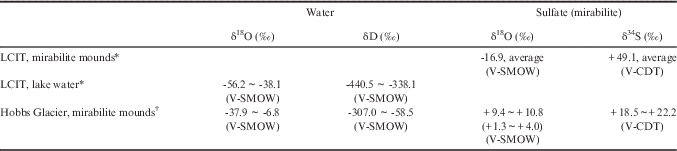
All of the evaporite mounds found in this study appeared to be adhering to the icy morainal surface rather than forming on top of boulders or gravels. If hydrothermal fluids had interacted with the moraine, with associated melting of ice, all of the boulders, clasts and muddy sediments in the moraine would sink to create the base of the newly formed evaporites that had been supplied by the thermal fluids. This situation does not apply to the evaporite deposit scenario in this study. Thus, an alternative model is proposed here. The moving glaciers constantly carry a wide distribution of sizes of soil grains, gravels and sediments, and in the case of the LCIT, the moraine hosts a series of lakes. It is not clear whether the lakes are supraglacial or were formed by/within the moraine. The lakes adjacent to site A (Fig. 2) are lake Monroe and lower chimney lake. The low δ18Owater and δDwater values for water from the adjacent lakes (Table II) indicate the waters are a mixture of glacial ice and local snow (Socki et al. Reference Socki, Sun, Niles, Harvey, Bish and Tonui2012). Dissolved ions that were constituents of the glacial till were transported to the lakes and eventually precipitated, either by freezing/sublimation or by evaporation, and subsequently upwelled onto the morainal ice surface. The sodium and sulfate ions derived from the moraine deposit and/or the brine solution ultimately fed mirabilite formation. The source of the sulfate ions has been shown to be related to, or significantly affected by, microbial activity (Socki et al. Reference Socki, Harvey, Bish, Tonui and Bao2008, Reference Socki, Sun, Niles, Harvey, Bish and Tonui2012), with anomalously high δ34S values (Table II), compared with values for the mirabilite at the Hobbs Glacier that suggest a seawater sulfate origin (Bowser et al. Reference Bowser, Rafter and Black1970). The 18Osulfate in mirabilite at the LCIT was extremely depleted, suggesting that the oxygen in sulfate originated from glacial water (Socki et al. Reference Socki, Sun, Niles, Harvey, Bish and Tonui2012). The mirabilites sampled by Bowser et al. (Reference Bowser, Rafter and Black1970) have a 18Osulfate composition similar to seawater sulfate, suggesting they originated from a marine source. However, a few samples at Hobbs Glacier did show relatively lower 18Osulfate composition, indicating glacier meltwater was incorporated into the sulfate oxygen through a microbial-facilitated sulfate reduction and reoxidation. Socki et al. (Reference Socki, Sun, Niles, Harvey, Bish and Tonui2012) proposed that these interactions could have occurred in an anoxic environment, possibly a subglacial lake. Mirabilite later crystallized, and the deposits in which mirabilite dominates indicate a high concentration of dissolved sodium and sulfate ions at the locality of site A. It is probable that evaporite mineral formation is continuing as the ice continues to sublimate at the rate of several cm per year (Harvey et al. Reference Harvey, Bish, Socki and Tonui2006).
Cited isotopic data of the oxygen, hydrogen and sulfur in water and mirabilite samples from Lewis Cliff ice tongue (LCIT) of this study and Hobbs Glacier at McMurdo Sound in Antarctica.
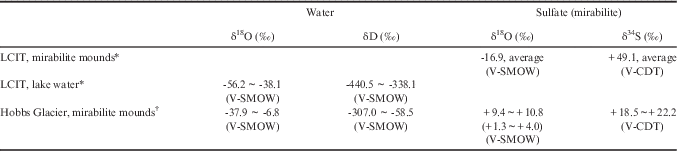
*Socki et al. Reference Socki, Sun, Niles, Harvey, Bish and Tonui2012, †Bowser et al. Reference Bowser, Rafter and Black1970.
V-SMOW=Vienna-Standard Mean Ocean Water, V-CDT=Vienna Canyon Diablo Troilite.
Sporadic occurrences of evaporite minerals on top of the regolith imply an additional crystallization process known as ‘evaporative wicking’ (Harvey et al. Reference Harvey, Bish, Socki and Tonui2006). The moraine, which is mixed with glacial ice and various sizes of sediment, receives solar radiation during each warmer season. Meltwaters percolate through the morainal sediment, dissolving soluble ions. These ions will rise in solution onto the moraine surface and salt minerals will crystallize via sublimation or evaporation. It is probable that this process, repeated countless times across the moraine, is responsible for the formation of small volumes of sponge and efflorescent evaporites.
Source(s) of carbon and boron at the LCIT and the formation of nahcolite and boron-bearing minerals
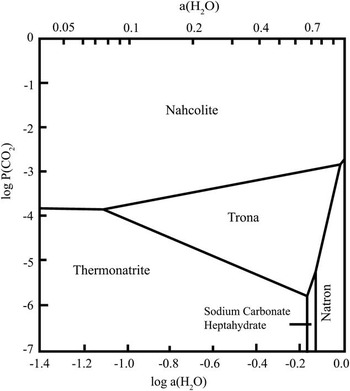
Nahcolite is a major mineral at the LCIT, associated with Na-sulfate and Na-borate minerals at site A. The formation of nahcolite indicates an alkaline brine environment, and the activity of water and fugacity of CO2 also influence the stability of nahcolite (Fig. 8). Nahcolite appears to be stable over a wide range of a(H2O) as long as the P(CO2) is greater than c. 10-3.8. As the P(CO2) in the atmosphere is 10-3.5, nahcolite is generally stable near the surface, whether it is covered or exposed. Under current atmospheric CO2 concentrations, the hydrous minerals trona and natron can exist at higher a(H2O) values. Fluctuations in the concentration of CO2 will influence the transformations of several Na-carbonate/bicarbonate minerals, depending on the ambient a(H2O) (Fig. 8), i.e. fluid compositions or atmospheric RH.
Hydrous Na-carbonate/bicarbonate phase relations as a function of P(CO2) and a(H2O) at 25°C and 1 bar (thermonatrite: Na2CO3·H2O, Na-carbonate heptahydrate: Na2CO3·7H2O) (after Bodine & Jones Reference Bodine and Jones1986).

The first occurrence of boron-bearing minerals in Antarctica was documented by Fitzpatrick & Muhs (Reference Fitzpatrick and Muhs1989), Fitzpatrick (Reference Fitzpatrick1990) and Fitzpatrick et al. (Reference Fitzpatrick, Muhs and Jull1990) at the LCIT, where they discovered pseudomorphs of euhedral borax in a matrix of tabular and euhedral nahcolite crystals. The pseudomorphs displayed zoning phenomena (Fitzpatrick & Muhs Reference Fitzpatrick and Muhs1989), with the inner portions being fine-grained borax crystals and the outer portions being fine-grained nahcolite laths. Based on the configuration of the crystals, they excluded the possibility of efflorescence, alteration and crystallization from pore water, and they concluded that the formation process occurred subglacially where glacial meltwater mixed with low calcium/sodium ratio, carbonate/bicarbonate-dominated, boron-enriched alkaline hydrothermal fluids. They suggested that kernite (Na2B4O7∙4H2O) was the precursor of borax based on the presence of pseudomorphs of borax in the inner core. Crystallization of kernite from thermal fluids is consistent with the solubility experiments of Nies & Hulbert (Reference Nies and Hulbert1967), who found that kernite is the least soluble phase >58ºC, whereas borax is least soluble at temperatures <58°C. Assuming equilibrium with a fluid, kernite will dissolve and borax will precipitate as temperature decreases below 58ºC. Of these two phases, borax will be the phase in equilibrium with ice below c. -0.42°C. The distribution of borax and kernite may indicate that the boron-minerals precipitated from thermal fluids at temperatures >58ºC.
The typical mineralogy of the Na-carbonate/bicarbonate/borate assemblage at the LCIT consists of borax, nahcolite and qilianshanite, or any two of these. The existence at site C of single crystals of nahcolite and the appearance of qilianshanite, which is a boric acid carbonate, suggest that qilianshanite may be a secondary mineral resulting from reaction of nahcolite and borax via:
 $${\rm Na}_{{\rm 2}} {\rm B}_{{\rm 4}} {\rm O}_{{\rm 7}} \!\cdot \! {\rm 1}0{\rm H}_{{\rm 2}} {\rm O}{\plus}{\rm 2NaHCO}_{{\rm 3}} {\plus}{\rm 2CO}_{{\rm 2}} {\plus}{\rm 5H}_{{\rm 2}} {\rm O}={\rm 4NaH}_{{\rm 4}} \left( {{\rm BO}_{{\rm 3}} } \right)\,\left( {{\rm CO}_{{\rm 3}} } \right)\!\cdot \!{\rm 2H}_{{\rm 2}} {\rm O}{\rm .}$$
Aggregates of borax and nahcolite were found in sample C-1DB. Sample C-2DB was composed of borax and qilianshanite, and displayed two distinct portions, coated with a white powdery material. It is probable that borax precipitated directly rather than being a replacement product of kernite, as the aqueous system does not appear to have been fed by hydrothermal fluids. Thus, the water at site C is believed to have been a Na+-, HCO3 -- and boron-bearing alkaline brine.
Euhedral crystals of nahcolite appeared at site C in the form of tiny needle-like laths (C-4DB and C-5DB, see Fig. S2 http://dx.doi.org/10.1017/S0954102014000406), as described in Fitzpatrick & Muhs (Reference Fitzpatrick and Muhs1989), in both the matrix and the rims.
The mineral assemblage from site A contained nahcolite and qilianshanite, both of which occurred on the intricate surfaces of mirabilite crystals, and qilianshanite occasionally occurred alone (A-6DB). A complex sample from this site (A-clear) has a clear interior containing mirabilite and less thenardite, a chalky exterior containing thenardite and less mirabilite, and less-clear tabular crystals containing nahcolite, borax and qilianshanite (see Fig. S2 http://dx.doi.org/10.1017/S0954102014000406). Therefore, this sample includes all evaporite species found at the LCIT, with the exception of trona and natron. It can be inferred that saline water with composition similar to that at site C was also present at site A and may have migrated at a later stage into the mirabilite mound to form the complex multi-mineralic crust. The reverse of Eq. (1) is also plausible, in which borax and nahcolite are the secondary minerals:
 $$\eqalign{ \quad{\rm 4NaH}_{{\rm 4}} \left( {{\rm BO}_{{\rm 3}} } \right)\,\left( {{\rm CO}_{{\rm 3}} } \right)\!\cdot \!{\rm 2H}_{{\rm 2}} {\rm O}\,=\,{\rm Na}_{{\rm 2}} {\rm B}_{{\rm 4}} {\rm O}_{{\rm 7}} \!\cdot \! {\rm 1}0{\rm H}_{{\rm 2}} {\rm O} \cr\quad{\plus}{\rm 2NaHCO}_{{\rm 3}} {\plus}{\rm 2CO}_{{\rm 2}} {\plus}{\rm 5H}_{{\rm 2}} {\rm O}.(2)$$
However, the widespread occurrence of borax and nahcolite contradicts the formation of the rare qilianshanite as an authigenic mineral in the presence of borate and bicarbonate ions.
Site F is differentiated by containing nahcolite exclusively. Either the aqueous sulfate and boron supplies did not extend to site F or alteration within the atmosphere was complete. The nahcolite crystals occur in various forms, such as pock-marked masses and needle-like, clear crystals. The material is exposed on surfaces (Fig. 6) and thus could have been strongly influenced by atmospheric CO2 levels. Figure 8 shows that transformations among nahcolite, trona and natron may occur in the modern atmosphere, and phase changes may be driven by elevated CO2. The ambient liquid water supply, which is affected by the comparatively strong solar radiation during summer, could also facilitate reactions between these phases.
The pervasive tiny needle-like nahcolite crystals that appear to be newly formed do not appear to derive from saline waters, as formation of such fragile crystals on the surface is unlikely to occur. Instead, once atmospheric CO2 interacts with wet surfaces created by heating ice or snow, dissolved CO2 will be present as bicarbonate, allowing sodium ions to precipitate into tiny crystals of nahcolite, which remain on the surface.
The pock-marked sample (F-1DB, Fig. 6) and some clear tabular samples (F-2DB, F-4DB and F-Adam, see Fig. S2 http://dx.doi.org/10.1017/S0954102014000406) that may have formed in a brine environment, also probably formed by incorporating atmospheric CO2 over c. 10–40 ka (Fitzpatrick et al. Reference Fitzpatrick, Muhs and Jull1990). The Na-sulfate and -borate deposits at site F may have existed before nahcolite, but if so, they dissolved or were recrystallized at an early time. In the case of possible mineral formation in a brine environment, the accumulation of dissolved CO2 into the nearby brine ponds could have directly contributed to precipitation of nahcolite.
By extension of this assumption, the euhedral nahcolite crystals at site C (C-4DB and C-5DB, see Fig. S2 http://dx.doi.org/10.1017/S0954102014000406) that show clear tabular form are also believed to have precipitated from saline fluids incorporating dissolved atmospheric CO2. This process may explain the mineral assemblages at site C. Although boron is typically contributed by volcanism or hydrothermal fluids, the specific source and carrier of borate ions is still unknown at this site. In any case, borax and nahcolite are regarded as authigenic minerals, whereas qilianshanite appears to be secondary.
Crystal structure of qilianshanite
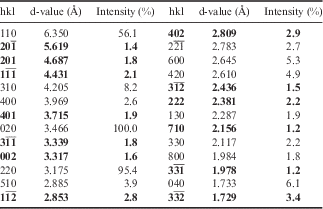
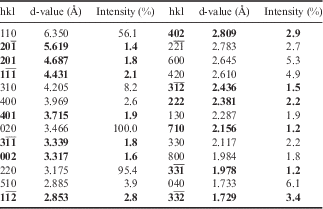
Information on the crystal structure of qilianshanite was first provided by Luo et al. (Reference Luo, Lu, Wang and Zhu1993) and Wang et al. (Reference Wang, Zhou and Shi1994). Comparison of the XRD data measured for sample A-6DB revealed a more complex pattern and a number of additional diffraction peaks. After accounting for the diffraction peaks from a small amount of nahcolite, several unidentified peaks remained in the pattern. The unidentified peaks were due either to an additional impurity or to qilianshanite. Diffraction data for qilianshanite were subsequently indexed and fit using TOPAS 4 (Coelho Reference Coelho2007) to extract a complete powder diffraction pattern for qilianshanite (Table III). The additional and discernible reflections, have intensities (relative percentage to the most intense peak) greater than 1% over the 2θ range of 10–75°. These data can be used to identify qilianshanite in the future.
Measured diffraction peaks of qilianshanite, with their associated Miller indices (Cu Kα radiation, bold items represent newly determined peaks).
Conclusions
Detailed information on the mineralogy of the evaporite deposits collected from four locations at the LCIT has been provided by XRD analysis. The major phases at the LCIT include Na-sulfates, Na-carbonate/bicarbonates and Na-borates. In addition, XRD was used to evaluate the stability of these minerals at room temperature (with RH maintained similar to LCIT), which facilitated comparison of stability in ambient and subzero environments.
Large mounds of Na-sulfate deposits are spread over one location at the LCIT. Some mounds consist of massive water-clear crystals of mirabilite in their interiors with powdery, chalky, and sometimes efflorescent thenardite exteriors, along with needle-like crystals of nahcolite in vugs on the surfaces. Formation of mirabilite may have occurred via a freezing/sublimation process operating in glacial or subglacial bodies of water, whereas the mineralogy of the mound exteriors is a result of relatively slow dehydration/crystallization processes in the atmosphere. Nahcolite is believed to derive from dissolved atmospheric CO2 in thin films of liquid water on the mound surfaces, and it appears to be a stable phase throughout the temperature range from subzero to at least 22°C.
Na-carbonate/bicarbonate and Na-borate minerals are widely distributed over the LCIT, and they probably represent an additional unique formation mechanism. The varied crystal forms of nahcolite as an exclusive mineral phase at one location suggest a dissolution-precipitation process. The occurrence of borax indicates the presence of B-containing fluids that probably incorporated atmospheric CO2. The rare mineral qilianshanite appears to be secondary. The variety of Na-carbonate/bicarbonate minerals suggests formation via transformations under ambient conditions in response to atmospheric CO2 and changes in RH. Additional insight into mineral formation conditions at the LCIT could be provided by B and C isotopic data, as well as from additional information on the compositions and pH values of the adjacent pond waters.
Acknowledgements
Sample collection was supported by an NSF grant to R. Harvey, and further mineralogical analysis was supported by the Haydn Murray fund at Indiana University. Authors acknowledge the valuable comments and insights provided by two anonymous reviewers, which further improved the quality of the work. Authors declare no competing interests from this work.
Author contribution statement
In this collaborative work, Tingting Liu conducted the x-ray diffraction experiment, took sample pictures, and prepared the manuscript draft. Prof David Bish was part of the field expedition during the 2005–06 field season at the LCIT. He supervised Tingting Liu to conduct this research and offered a great amount of time to read and edit the manuscript. He also co-ordinated with the additional authors. Dr Richard Socki was part of the field expedition at the LCIT and contributed isotopic data and mirabilite deposit formation mechanism in this work. Prof Ralph Harvey was the Principal Investigator of this project (Mars analogy study) and was part of the field expedition. Dr Eric Tonui was part of the field expedition.