1 Introduction
At the level of ergodic probability measure-preserving bijections, quantitative orbit equivalence aims at bridging the gap between the well studied but very complicated relation of conjugacy and the trivial relation of orbit equivalence, which is equality of orbits up to conjugacy.
To be more precise, given two ergodic probability measure-preserving bijections S and T on a standard atomless probability space
 $(X,\mathcal {A},\mu )$
, if S and some system
 $\Psi ^{-1}T\Psi $
conjugate to T have the same orbits, then S and T are said to be orbit equivalent and the probability measure-preserving bijection
 $\Psi \colon X\to X$
is called an orbit equivalence between T and S. Dye’s theorem [Reference DyeDye59] states that if S and T are ergodic, then they are orbit equivalent.
To get an interesting theory, let us define the cocycles associated to
 $\Psi $
, these are the integer-valued functions
 $c_S$
and
 $c_T$
defined by
 $Sx=\Psi ^{-1}T^{c_S(x)}\Psi (x)$
and
 ${Tx=\Psi S^{c_T(x)}\Psi ^{-1}(x)}$
. Shannon orbit equivalence requires that there exists an orbit equivalence whose cocycles are Shannon, meaning that the partitions associated to
 $c_S$
and
 $c_T$
are both of finite entropy. For
 $\varphi $
-integrable orbit equivalence, we ask that both integrals
 $\int _X{\varphi (|c_S(x)|)\,\mathit {d}\mu (x)}$
and
 $\int _X{\varphi (|c_T(x)|)\,\mathit {d}\mu (x)}$
are finite. In the particular case of a linear map
 $\varphi $
,
 $\varphi $
-integrable orbit equivalence exactly requires the integrability of the cocycles, and is simply called integrable orbit equivalence.
Belinskaya’s theorem [Reference BelinskayaBel69] implies that integrable orbit equivalence is exactly flip-conjugacy (S and T are flip-conjugate if S is conjugate to T or
 $T^{-1}$
). In fact, it only requires that one of the two cocycles is integrable. Carderi et al [Reference Carderi, Joseph, Le Maître and TesseraCJLMT23] proved that this result is optimal, meaning that
 $\varphi $
-integrable orbit equivalence never implies flip-conjugacy for a sublinear map
 $\varphi $
. Moreover,
 $\varphi $
-integrable orbit equivalence implies Shannon orbit equivalence when
 $\varphi $
is asymptotically greater than
 $\log $
. An impressive result of Kerr and Li [Reference Kerr and LiKL24] guarantees that these relations are not trivial: entropy is preserved under Shannon orbit equivalence (and this is the only invariant of which we know). As a consequence, two transformations with different entropies can neither be Shannon orbit equivalent nor
 $\varphi $
-integrably orbit equivalent for any
 $\varphi $
greater than
 $\log $
.
Historically, the question of preservation of entropy in quantitative orbit equivalence was asked in the more general setting of group actions. We do not give any definition in this setting, as the paper is only about probability measure-preserving bijections S, which can be seen as
 $\mathbb {Z}$
-actions via
 $(n,x)\in \mathbb {Z}\times X\mapsto S^nx$
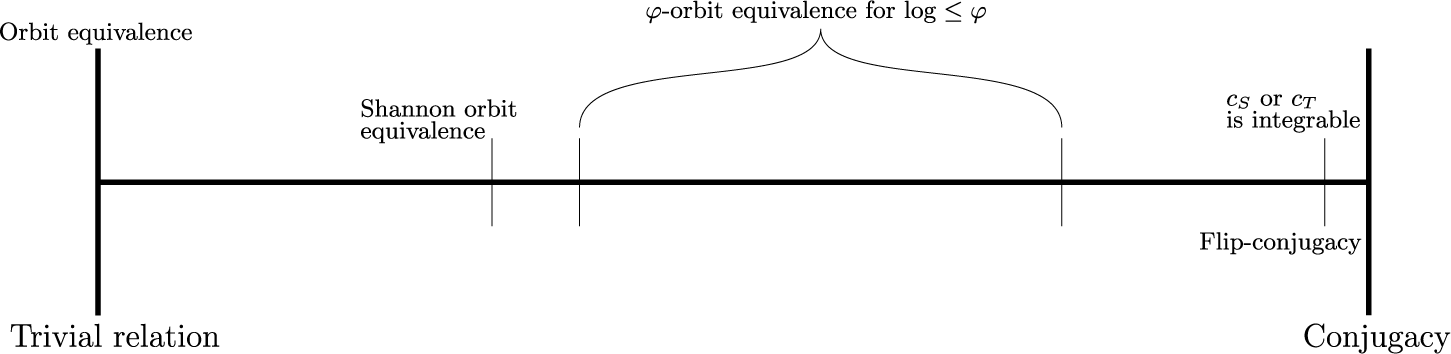
. Austin [Reference AustinAus16] showed that integrable orbit equivalence between actions of infinite finitely generated amenable groups preserves entropy. Kerr and Li [Reference Kerr and LiKL21, Reference Kerr and LiKL24] then generalized this result, replacing integrable orbit equivalence by Shannon orbit equivalence, and going beyond the amenable case using sofic entropy (see Figure 1).
Schematic view of the interplay between the relations on ergodic bijections we have seen so far.

1.1 The universal odometer and a theorem of Kerr and Li [Reference Kerr and LiKL24]
In [Reference Carderi, Joseph, Le Maître and TesseraCJLMT23], the statement about
 $\varphi $
-integrable orbit equivalence in the sublinear case is the following. This gives a result on Shannon orbit equivalence since this is implied by
 $\varphi $
-integrable orbit equivalence for
 $\varphi $
greater than
 $\log $
.
Theorem. (Carderi et al [Reference Carderi, Joseph, Le Maître and TesseraCJLMT23])
Let
 $\varphi \colon \mathbb {R}_+\to \mathbb {R}_+$
be a sublinear function. Let S be an ergodic probability measure-preserving transformation and assume that
 $S^n$
is ergodic for some
 $n\geq 2$
. Then, there is another ergodic probability measure-preserving transformation T such that S and T are
 $\varphi $
-integrably orbit equivalent but not flip-conjugate.
Corollary. (Carderi et al [Reference Carderi, Joseph, Le Maître and TesseraCJLMT23])
Let S be an ergodic probability measure-preserving transformation and assume that
 $S^n$
is ergodic for some
 $n\geq 2$
. Then, there is another ergodic probability measure-preserving transformation T such that S and T are Shannon orbit equivalent but not flip-conjugate.
The proof is constructive and the resulting transformation T is built so that
 $T^n$
is not ergodic. It is natural to wonder whether this statement holds for systems T without ergodic non-trivial powers. A well-known example of such a system is the universal odometer.
Question 1.1. Which systems are Shannon orbit equivalent to the universal odometer?
A first answer is given by Kerr and Li.
Theorem. (Kerr and Li [Reference Kerr and LiKL24])
Every odometer is Shannon orbit equivalent to the universal odometer.
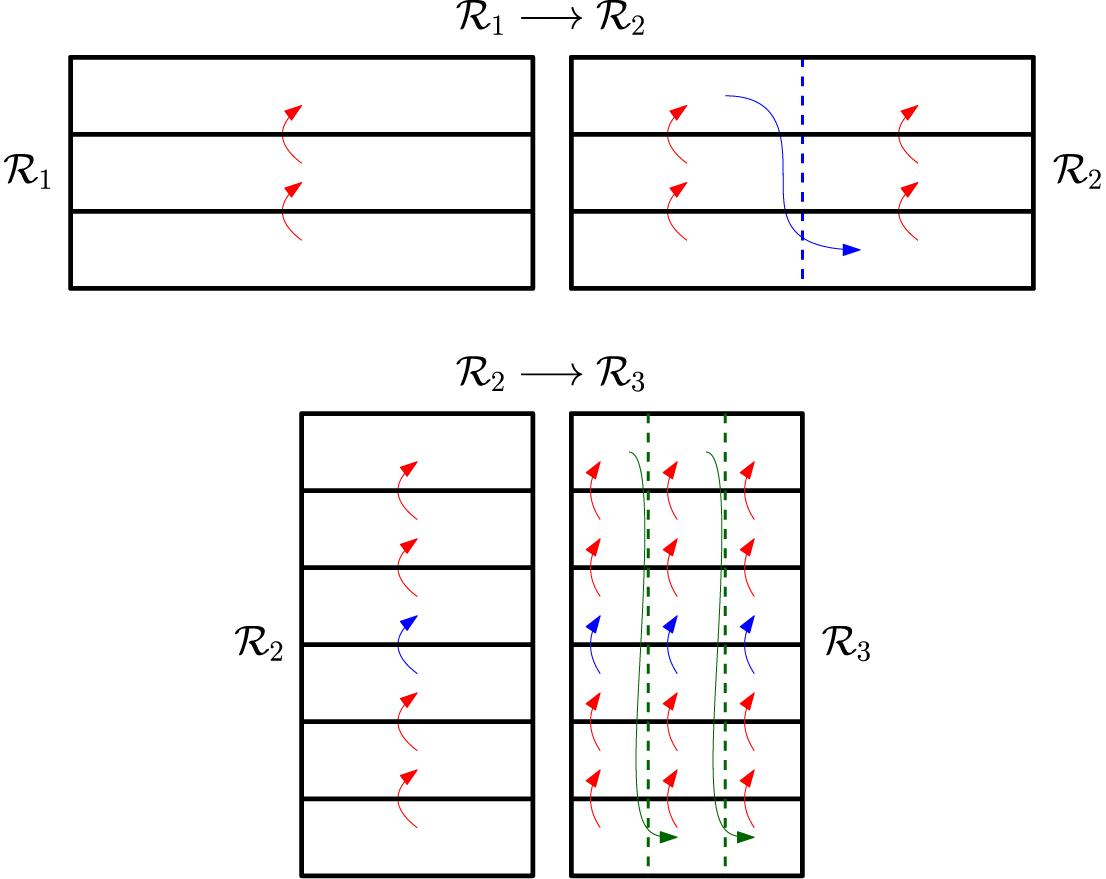
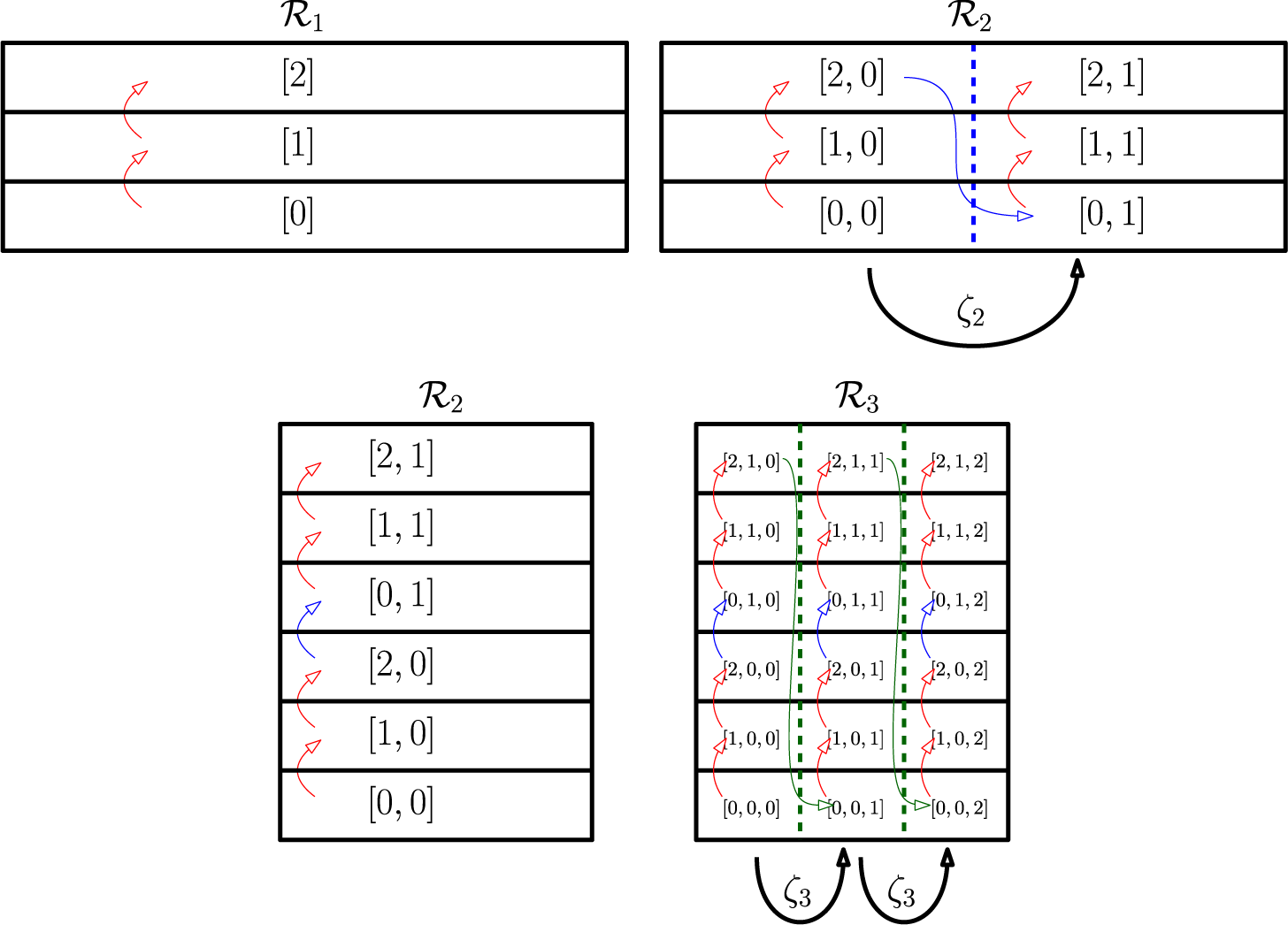
Odometers are exactly probability measure-preserving bijections admitting a nested sequence of partitions of the space, each of them being a Rokhlin tower, and increasing to the
 $\sigma $
-algebra
 $\mathcal {A}$
, see Figure 2 (we refer the reader to the end of §3.1 for concrete examples with adding machines). Kerr and Li use this combinatorial specificity of these bijections to build an orbit equivalence between them.
In this example,
 $(\mathcal {R}_n)$
denotes the nested sequence of Rokhlin towers defining an odometer. Dividing
 $\mathcal {R}_1$
in two sub-towers and stacking them, this gives the next tower
 $\mathcal {R}_2$
. From
 $\mathcal {R}_2$
,
 $\mathcal {R}_3$
is defined by dividing in three sub-towers and stacking them.

1.2 Rank-one systems
The aim of the paper is to extend Kerr and Li’s result to rank-one bijections. These are more general transformations admitting a nested sequence of Rokhlin towers increasing to the
 $\sigma $
-algebra
 $\mathcal {A}$
, but the towers do not necessarily partition the space. This means that from a tower to the next one, we need to add some parts of the space which are not covered by the previous tower, called spacers, so that the measure of the subset covered by the nth tower tends to
 $1$
as n goes to
 $+\infty $
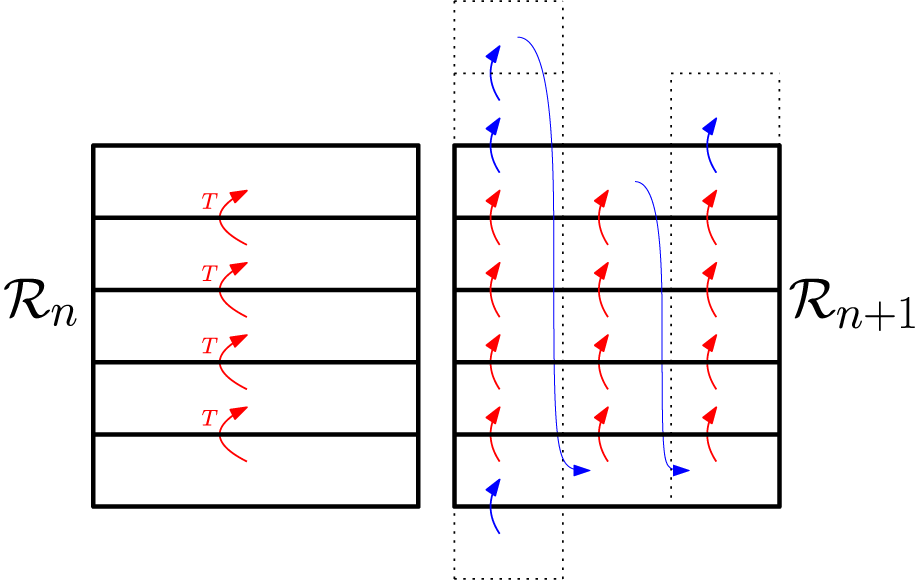
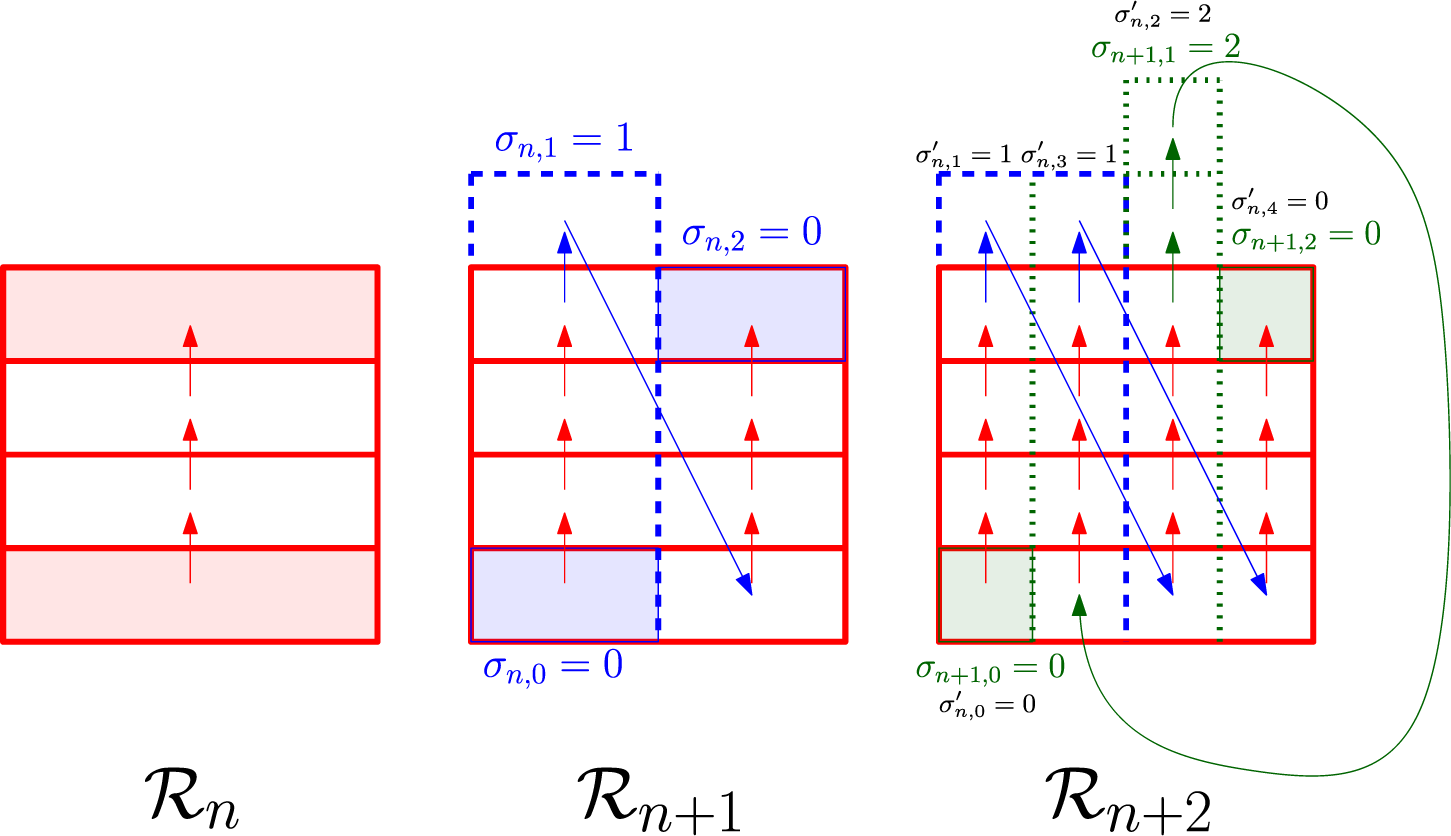
. As illustrated in Figure 3, to get the next tower, the current one is subdivided in sub-towers which are stacked with optional spacers between them. The number of sub-towers is called the cutting parameter and the number of consecutive spacers between these sub-towers are the spacing parameters (see Definition 3.2). For example, an odometer admits a cutting-and-stacking construction with spacing parameters equal to zero at each step.
In this example, there are four spacers and the cutting parameter is three.

Rank-one systems all have entropy zero. They include systems with a discrete spectrum [Reference Del JuncoJun76], also called compact systems. Such systems are not weakly mixing and are completely classified up to conjugacy by their point spectrum [Reference Halmos and Von NeumannHVN42]. Examples include odometers and irrational rotations.
The family of rank-one systems is much richer than its subclass of discrete spectrum systems. Indeed, the latter are not weakly mixing, whereas there exist strongly mixing systems of rank one and also rank-one systems which are weakly mixing but not strongly mixing (Chacon’s map was the first example of such a system and opened the study of rank-one systems). Rank-one systems can have irrational eigenvalues (that is, of the form
 $\exp {(2i\pi \theta )}$
with irrational numbers
 $\theta $
), which is the case of irrational rotations, whereas odometers only have rational eigenvalues. The reader may refer to the complete survey of Ferenczi [Reference FerencziFer97] about rank-one systems and, more generally, systems of finite rank.
The combinatorial structure of a general rank-one system does not differ too much from the structure of an odometer but the systems can have completely different properties; thus this class may extend the result of Kerr and Li and provide interesting flexibility results about Shannon orbit equivalence.
1.3 A first extension of Kerr and Li’s theorem
The construction of an orbit equivalence between the universal odometer S and any rank-one system T is a natural generalization of Kerr and Li’s method for the universal odometer and any odometer (see Remark 5.18). The difficulty is to quantify the cocycles.
At the beginning of our work, we first proved that the Shannon orbit equivalence established by Kerr and Li in [Reference Kerr and LiKL24] is actually a
 $\varphi $
-integrable orbit equivalence for any
 $\varphi \colon \mathbb {R}_+\to \mathbb {R}_+$
with
 $\varphi (t)=o(t^{1/3})$
. We then generalized this to rank-one systems called BSP, for ‘bounded-spacing-parameter’, see Definition 3.5. This notion of BSP systems was already introduced by Gao and Ziegler in [Reference Gao and ZieglerGZ19], using the symbolic definition of rank-one systems (in this paper, we will only consider the cutting-and-stacking definition of rank-one systems, which is often more appropriate for constructions in a measure-theoretic setting).
Theorem A. Every BSP rank-one system is
 $\varphi $
-integrably orbit equivalent to the universal odometer for any
 $\varphi \colon \mathbb {R}_+\to \mathbb {R}_+$
satisfying
 $\varphi (t)\underset {t\to +\infty }{=}o (t^{1/3} )$
.
Therefore,
 $\varphi $
-integrable orbit equivalence, for a
 $\varphi $
as in the above theorem, and Shannon orbit equivalence do not preserve weak mixing since Chacon’s map is a BSP rank-one system.
Now the goal is to get a result for systems of rank one outside the class of BSP systems. For this purpose, we find a more general framework with the notion of flexible classes, and a general statement (Theorem B) implying Theorem A and other flexibility results (Theorems C, E and F). Theorem D is a refinement of Theorem C.
1.4 A modified strategy
We first have to understand why the quantification of the cocycles is more difficult to determine for general rank-one systems than for odometers (or even for BSP systems in Theorem A). In [Reference Kerr and LiKL24], the quantification of the cocycles relies on a series whose terms vanish to zero as the cutting parameters get increasingly larger. The key is then to get quickly increasing cutting parameters for the series to converge. To do so, it suffices to skip steps in the cutting-and-stacking process, that is, from the nth Rokhlin tower, we can directly build the
 $(n+k)$
th Rokhlin for k so big that the new cutting parameter is large enough. In other words, we can recursively choose the cutting parameters so that they increase quickly enough.
When the rank-one system is not an odometer, we need an asymptotic control on the spacing parameters (recall that they are zero for an odometer) for the cocycles to be well quantified. When skipping steps in the cutting-and-stacking method, the spacing parameters may increase too quickly, preventing us from quantifying the cocycles. As we will see in Lemma 3.6, we do not have this problem with BSP rank-one systems.
When the rank-one system is not BSP, skipping steps in the cutting-and-stacking construction is not relevant as it may improperly change the spacing parameters. In §5.3 (see Lemma 5.9), we will notice that the construction of Kerr and Li enables us to build the universal odometer S while we are building the rank-one system T, focusing only on the combinatorics behind the systems, whereas for Kerr and Li, T and its cutting-and-stacking settings are fixed and S is built from these data. This new strategy will enable us to have a result for systems of rank one outside the class of BSP systems, with the notion of flexible class.
1.5 Flexible classes
A flexible class (see Definition 3.7) is basically a class of rank-one systems satisfying a common property (e.g. the set of strongly mixing rank-one systems), with the following two requirements. We first ask for a sufficient condition, given by a set
 $\mathcal {F}_{\mathcal {C}}$
, on the first n cutting and spacing parameters (for all integers
 $n\geq 0$
) for the underlying rank-one system to be in this class. Second, given a sequence of n cutting and spacing parameters in
 $\mathcal {F}_{\mathcal {C}}$
(they will be the first n parameters of a cutting-and-stacking construction), we require that it can be completed in a sequence of
 $n+1$
parameters in
 $\mathcal {F}_{\mathcal {C}}$
, with infinitely many choices for the
 $(n+1)$
th cutting parameters, and with the appropriate asymptotic control on the
 $(n+1)$
th spacing parameters.
The idea is to inductively choose the parameters so that the cutting parameters increase quickly enough, with the appropriate asymptotics on the spacing parameters, and the underlying rank-one system has the desired property, namely the system is in the flexible class that we consider.
The general statement on flexible classes is the following.
Theorem B. (See Theorem 3.9)
Let
 $\varphi \colon \mathbb {R}_+\to \mathbb {R}_+$
be a map satisfying
 $\varphi (t)\underset {t\to +\infty }{=}o (t^{1/3} )$
. If
 $\mathcal {C}$
is a flexible class, then there exists T in
 $\mathcal {C}$
which is
 $\varphi $
-integrably orbit equivalent to the universal odometer.
A very interesting phenomenon is when a rank-one system T is flexible, meaning that
 $\{T\}$
is a flexible class. This first means that given the parameters of a cutting-and-stacking construction of T, it is possible to change the
 $(n+1)$
th parameters so that they have the desired asymptotic control, and to inductively do so for every n so that the underlying rank-one system is again T. We do not know if every rank-one system is flexible. Second, Theorem B is an existence result and when a flexible class is a singleton
 $\{T\}$
, this statement provides a concrete example of a rank-one system which is
 $\varphi $
-integrably orbit equivalent to the universal odometer.
The following proposition gives examples of flexible classes.
Proposition 1.2. (See Proposition 3.8)
-
(1) Every BSP rank-one system is flexible.
-
(2) For every non-empty open subset
 $\mathcal {V}$
of
$\mathbb {R}$
, the set
$\{R_{\theta }\mid \theta \in \mathcal {V}\cap (\mathbb {R}\setminus \mathbb {Q})\}$
is a flexible class.
-
(3) For every irrational number
$\theta $
, the class of rank-one systems which have
$e^{2i\pi \theta }$
as an eigenvalue is flexible. -
(4) The class of strongly mixing rank-one systems is flexible.


Proving that a BSP system is flexible is not difficult and we rely on the fact that bounded spacing parameters already have the desired asymptotics even though we skip steps in the cutting-and-stacking process for the cutting parameters to increase quickly enough (see §4.1). We use a construction by Drillick et al [Reference Drillick, Espinosa-Dominguez, Jones-Baro, Leng, Mandelshtam and SilvaDEJ+23] to prove Proposition 1.2 for irrational rotations (see §4.2). We also consider a construction by Danilenko and Vieprik [Reference Danilenko and VieprikDV23] for the rank-one systems with a given eigenvalue (see §4.3). Finally, Ornstein [Reference OrnsteinOrn72] gives the first example of strongly mixing rank-one systems and the fact that these systems form a flexible class follows from his construction (see §4.4).
Combined with Proposition 1.2, Theorem B provides four flexibility results. The first one is Theorem A stated above, which is a generalization of Kerr and Li’s theorem. The second one is another result with almost explicit examples of systems which are
 $\varphi $
-integrably orbit equivalent to the universal odometer.
Theorem C. Let
 $\varphi \colon \mathbb {R}_+\to \mathbb {R}_+$
be a map satisfying
 $\varphi (t)\underset {t\to +\infty }{=}o (t^{1/3} )$
. The set of irrational numbers
 $\theta $
whose associated irrational rotation is
 $\varphi $
-integrably orbit equivalent to the universal odometer is dense in
 $\mathbb {R}$
.
The point spectrum of
 $R_{\theta }$
is exactly the circle subgroup generated by
 $\exp {(2i \pi \theta )}$
and the eigenvalues of the universal odometer are rational, so Theorem C implies that there exist two Shannon orbit equivalent systems (more specifically,
 $\varphi $
-integrably orbit equivalent with
 $\varphi (t)\underset {t\to +\infty }{=}o (t^{1/3} )$
), with non-trivial point spectra and such that
 $1$
is the only common eigenvalue.
The way we prove Theorem B will enable us to get the following refinement, its proof is written at the end of the paper.
Theorem D. For every map
 $\varphi \colon \mathbb {R}_+\to \mathbb {R}_+$
satisfying
 $\varphi (t)\underset {t\to +\infty }{=}o (t^{1/3} )$
, and for every non-empty open subset
 $\mathcal {V}$
of
 $\mathbb {R}$
, the set of irrational numbers
 $\theta \in \mathcal {V}$
whose associated irrational rotation is
 $\varphi $
-integrably orbit equivalent to the universal odometer is uncountable.
Question 1.3. Let us consider the set of irrational numbers
 $\theta $
whose associated irrational rotation is
 $\varphi $
-integrably orbit equivalent to the universal odometer. Is this set conull, with respect to the Lebesgue measure, equal to the set of irrational numbers?
Finally, we get the following corollaries, providing implicit examples.
Theorem E. For every map
 $\varphi \colon \mathbb {R}_+\to \mathbb {R}_+$
satisfying
 $\varphi (t)\underset {t\to +\infty }{=}o (t^{1/3} )$
and for every irrational number
 $\theta $
, there exists a rank-one system which has
 $e^{2i\pi \theta }$
as an eigenvalue and which is
 $\varphi $
-integrably orbit equivalent to the universal odometer.
Theorem F. For every map
 $\varphi \colon \mathbb {R}_+\to \mathbb {R}_+$
satisfying
 $\varphi (t)\underset {t\to +\infty }{=}o (t^{1/3} )$
, there exists a strongly mixing rank-one system which is
 $\varphi $
-integrably orbit equivalent to the universal odometer.
As
 $\exp {(2i\pi \theta )}$
is an eigenvalue of the irrational rotation of angle
 $\theta $
, and as we do not know if Theorem C holds for every irrational number
 $\theta $
, Theorem E then completes this statement with a weaker result for the remaining
 $\theta $
.
Theorem F implies that
 $\varphi $
-integrable orbit equivalence, with
 $\varphi (t)\underset {t\to +\infty }{=}o (t^{1/3} )$
, and Shannon orbit equivalence do not preserve strong mixing. This is also a consequence of the result from [Reference Carderi, Joseph, Le Maître and TesseraCJLMT23]. Indeed, if S is strongly mixing, then all its non-trivial powers are ergodic and the statements give some T with a non-trivial power which is not ergodic, so T is not strongly mixing. Here, Theorem F gives an example starting from a very non-strongly mixing system S (the universal odometer). Finally, note that strongly mixing systems are not BSP. This is a consequence of [GZ19, Theorem 1.3]: BSP rank-one systems are not topologically mixing, therefore they are not measure-theoretically strongly mixing.
1.6 Further comments
As they both preserve entropy, we may wonder whether there is a connection between Shannon orbit equivalence (or, more generally,
 $\varphi $
-integrable orbit equivalence for
 $\varphi $
greater than
 $\log $
) and even Kakutani equivalence. Two ergodic probability measure-preserving bijections S and T, respectively acting on
 $(X,\mu )$
and
 $(Y,\nu )$
, are evenly Kakutani equivalent if there exist measurable subsets
 $A\subseteq X$
and
 $B\subseteq Y$
with equal measure, that is,
 $\mu (A)=\nu (B)$
, such that the induced maps
 $S_A$
and
 $T_B$
are conjugate. Even Kakutani equivalence is an equivalence relation, contrarily to Shannon orbit equivalence and
 $\varphi $
-integrable orbit equivalence a priori (except for linear maps
 $\varphi $
, by Belinskaya’s theorem). The theory of Ornstein, Rudolph and Weiss [Reference Ornstein, Rudolph and WeissORW82] gives a complete classification up to even Kakutani equivalence among loosely Bernoulli (LB) systems and entropy is a complete invariant. Moreover, the class of LB systems is closed by even Kakutani equivalence, meaning that if S is LB and equivalent to T, then T is also LB.
Rank-one systems are zero-entropy and LB, and by Theorems A, C, E and F, some of them are Shannon orbit equivalent to the universal odometer.
Question 1.4. Does even Kakutani equivalence imply Shannon orbit equivalence or
 $\varphi $
-integrable orbit equivalence for some
 $\varphi $
?
In a forthcoming paper, we will provide a new construction of orbit equivalence to prove that the converse is false: for every
 $\varepsilon>0$
, there exists a non-LB system which is
 ${(x\mapsto x^{(1/2)-\varepsilon })}$
-integrably orbit equivalent to the dyadic odometer. So
 ${(x\mapsto x^{(1/2)-\varepsilon })}$
-integrable orbit equivalence and Shannon orbit equivalence do not imply even Kakutani equivalence.
1.7 Outline of the paper
After a few preliminaries in §2, rank-one systems are defined in §3 using the cutting-and-stacking method. We also define the central notion of flexible classes of rank-one transformations. In §4, we prove Proposition 1.2 (Proposition 3.8 in §3), that is, we show that the classes mentioned in Theorem B (Theorem 3.9 in §3) are flexible. It remains to show that every flexible class admits an element which is
 $\varphi $
-integrably orbit equivalent to the universal odometer (Theorem 3.9). In §5, we will describe the construction of Kerr and Li, generalized to rank-one systems, and establish that this is an orbit equivalence with some important properties preparing for the proof of Theorem 3.9. Theorems A, C, E and F directly follow from Proposition 3.8 and Theorem 3.9. We prove Theorem D at the end of the paper.
2 Preliminaries
2.1 Basics of ergodic theory
The probability space
 $(X,\mathcal {A},\mu )$
is assumed to be standard and atomless. Such a space is isomorphic to
 $([0,1],\mathcal {B}([0,1]),\mathrm {Leb})$
, that is, there exists a bimeasurable bijection
 $\Psi \colon X\to [0,1]$
(defined almost everywhere) such that
 $\Psi _{\star }\mu =\mathrm {Leb}$
, where
 $\Psi _{\star }\mu $
is defined by
 $\Psi _{\star }\mu (A)=\mu (\Psi ^{-1}(A))$
for every measurable set A. We consider maps
 $T\colon X\to X$
acting on this space and which are bijective, bimeasurable and probability measure-preserving (p.m.p.), meaning that
 $\mu (T^{-1}(A))=\mu (A)$
for all measurable sets
 $A\subseteq X$
, and the set of these transformations is denoted by
 $\mathrm {Aut}(X,\mathcal {A},\mu )$
, or simply
 $\mathrm {Aut}(X,\mu )$
, two such maps being identified if they coincide on a measurable set of full measure. In this paper, elements of
 $\mathrm {Aut}(X,\mu )$
are called transformations or (dynamical) systems.
A measurable set
 $A\subseteq X$
is T-invariant if
 $\mu (T^{-1}(A)\Delta A)=0$
, where
 $\Delta $
denotes the symmetric difference. A transformation
 $T\in \mathrm {Aut}(X,\mu )$
is said to be ergodic if every T-invariant set is of measure
 $0$
or
 $1$
. If T is ergodic, then T is aperiodic, that is,
 $T^n(x)\not =x$
for almost every
 $x\in X$
and for every
 $n\in \mathbb {Z}\setminus \{0\}$
, or equivalently the T-orbit of x, denoted by
 , is infinite for almost every
 $x\in X$
.
Here, T is weakly mixing if
 $$ \begin{align*} \frac{1}{n}\sum_{k=0}^{n}{ |\mu(A\cap T^{-n}(B))-\mu(A)\mu(B) |}\underset{n\to +\infty}{\to}0 \end{align*} $$
for every measurable sets
 $A,B$
. Additionally, T is strongly mixing if
 $$ \begin{align*} |\mu(A\cap T^{-n}(B))-\mu(A)\mu(B) |\underset{n\to +\infty}{\to}0\end{align*} $$
for every measurable set
 $A,B$
. It is not difficult to prove that strong mixing implies weak mixing and that the latter implies ergodicity.
The notions of weak mixing and ergodicity can be translated in terms of eigenvalues. Denoting by
 $\mathrm {L}^2(X,\mathcal {A},\mu )$
the space of complex-valued and square-integrable functions defined on X, a complex number
 $\unicode{x3bb} $
is an eigenvalue of T if there exists
 $f\in \mathrm {L}^2(X,\mathcal {A},\mu )\setminus \{0\}$
such that
 $f\circ T=\unicode{x3bb} f$
almost everywhere (f is then called an eigenfunction). An eigenvalue
 $\unicode{x3bb} $
is automatically an element of the unit circle
 . The point spectrum of T is then the set of all its eigenvalues. Notice that
 $\unicode{x3bb} =1$
is always an eigenvalue since the constant functions are in its eigenspace. Finally, T is ergodic if and only if the constant functions are the only eigenfunctions with eigenvalue one, in other words, the eigenspace of
 $\unicode{x3bb} =1$
is the line of constant functions (we say that it is a simple eigenvalue). If T is ergodic, it is weakly mixing if and only if the only eigenvalue of T is
 $1$
. For a complete survey on spectral theory for dynamical systems, the reader may refer to [Reference Viana and OliveiraVO16].
All the properties that we have introduced are preserved under conjugacy. Two transformations
 $S\in \mathrm {Aut}(X,\mu )$
and
 $T\in \mathrm {Aut}(Y,\nu )$
are conjugate if there exists a bimeasurable bijection
 $\Psi \colon X\to Y$
such that
 $\Psi _{\star }\mu =\nu $
and
 $\Psi \circ S=T\circ \Psi $
almost everywhere. Some classes of transformations have been classified up to conjugacy, the two examples to keep in mind are the following. By Ornstein [Reference OrnsteinOrn70], entropy is a total invariant of conjugacy among Bernoulli shifts, and Ornstein and Weiss [Reference Ornstein and WeissOW87] generalized this result for Bernoulli shifts of amenable groups. For more details about entropy, see [Reference DownarowiczDow11] for non-necessarily invertible transformations
 $T\colon X\to X$
, and [Reference Kerr and LiKL17] more generally for actions of amenable groups. Finally, Halmos and von Neumann [Reference Halmos and Von NeumannHVN42] showed that two systems with discrete spectra are conjugate if and only if they have equal point spectra (a system has a discrete spectrum if the span of all its eigenfunctions is dense in
 $\mathrm {L}^2(X,\mathcal {A},\mu )$
).
2.2 Quantitative orbit equivalence
The conjugacy problem in full generality is very complicated (see [Reference Foreman, Rudolph and WeissFRW11]). We now give the formal definition of orbit equivalence, which is a weakening of the conjugacy problem.
Definition 2.1. Two aperiodic transformations
 $S\in \mathrm {Aut}(X,\mu )$
and
 $T\in \mathrm {Aut}(Y,\nu )$
are orbit equivalent if there exist a bimeasurable bijection
 $\Psi \colon X\to Y$
satisfying
 $\Psi _{\star }\mu =\nu $
, such that
 $\mathrm {Orb}_S(x)=\mathrm {Orb}_{\Psi ^{-1}T\Psi }(x)$
for almost every
 $x\in X$
. The map
 $\Psi $
is called an orbit equivalence between S and T.
We can then define the cocycles associated to this orbit equivalence. These are measurable functions
 $c_S\colon X\to \mathbb {Z}$
and
 $c_T\colon Y\to \mathbb {Z}$
defined almost everywhere by
 $$ \begin{align*}Sx=\Psi^{-1}T^{c_S(x)}\Psi(x)\quad\text{and}\quad Ty=\Psi S^{c_T(y)}\Psi^{-1}(y)\end{align*} $$
(
 $c_S(x)$
and
 $c_T(y)$
are uniquely defined by aperiodicity).
Given a function
 $\varphi \colon \mathbb {R}_+\to \mathbb {R}_+$
, a measurable function
 $f\colon X\to \mathbb {Z}$
is said to be
 $\varphi $
-integrable if
 $$ \begin{align*} \int_{X}{\varphi(|f(x)|)\,\mathit{d}\mu}<+\infty. \end{align*} $$
For example, integrability is exactly
 $\varphi $
-integrability when
 $\varphi $
is non-zero and linear. Then, a weaker quantification on cocycles is the notion of
 $\varphi $
-integrability for a sublinear map
 $\varphi $
, meaning that
 $\lim _{t\to +\infty }{\varphi (t)/t}=0$
. Two transformations in
 $\mathrm {Aut}(X,\mu )$
are said to be
 $\varphi $
-integrably orbit equivalent if there exists an orbit equivalence between them whose associated cocycles are
 $\varphi $
-integrable. Another form of quantitative orbit equivalence is Shannon orbit equivalence. We say that a measurable function
 $f\colon X\to \mathbb {Z}$
is Shannon if the associated partition
 $\{f^{-1}(n)\mid n\in \mathbb {Z}\}$
of X has finite entropy. Two transformations in
 $\mathrm {Aut}(X,\mu )$
are Shannon orbit equivalent if there exists an orbit equivalence between them whose associated cocycles are Shannon.
3 Rank-one systems
3.1 The cutting-and-stacking method
Before the definition of a rank-one system (Definition 3.2), and for the definition of flexible classes (Definition 3.7), we need to define sequences of integers which will provide the combinatorial data of a rank-one system, namely the cutting and spacing parameters.
Definition 3.1. By a cutting and spacing parameter, we mean a tuple of the form
 $$ \begin{align*}(q,(\sigma_{.,0},\ldots,\sigma_{.,q}))\end{align*} $$
with an integer
 $q\geq 2$
(the cutting parameter) and non-negative integers
 $\sigma _{.,0},\ldots ,\sigma _{.,q}$
(the spacing parameters), and we denote by
 $\mathcal {P}$
the set of all cutting and spacing parameters. We also define the set of finite sequences of cutting and spacing parameters:

Given a sequence of cutting and spacing parameters
 $\boldsymbol {p}=(q_k,(\sigma _{k,0},\ldots ,\sigma _{k,q_k}))_{k\geq 0}\in \mathcal {P}^{\mathbb {N}}$
and an integer
 $n\geq 0$
, the tuple
 $(q_n,(\sigma _{n,0},\ldots ,\sigma _{n,q_n}))$
in
 $\mathcal {P}$
is the nth cutting and spacing parameter of
 $\boldsymbol {p}$
, and the tuple
 $(q_k,(\sigma _{k,0},\ldots ,\sigma _{k,q_k}))_{0\leq k\leq n}$
is the projection of
 $\boldsymbol {p}$
on
 $\mathcal {P}^{n+1}$
(it gives the first
 $n+1$
cutting and spacing parameters). From
 $\boldsymbol {p}$
, we also define three sequences:
-
•
$(h_n)_{n\geq 0}$
the height sequence of
$\boldsymbol {p}$
, inductively defined by where
$$ \begin{align*}\begin{cases} h_0=1,\\ h_{n+1}=q_nh_n+\sigma_{n}, \end{cases}\end{align*} $$
$h_n$
is called the height of the nth tower;
-
•
$(\sigma _n)_{n\geq 0}$
, with (the number of new spacers at step n); -
•
$(Z_n)_{n\geq 0}$
, with ,


 (the number of new spacers at step n);

 ,
and it is also possible to consider the finite sequences
 $(h_k)_{0\leq k\leq n+1}$
,
 $(\sigma _k)_{0\leq k\leq n}$
and
 $(Z_k)_{0\leq k\leq n}$
associated to a finite sequence of cutting and spacing parameters in
 $\mathcal {P}^{n+1}$
.
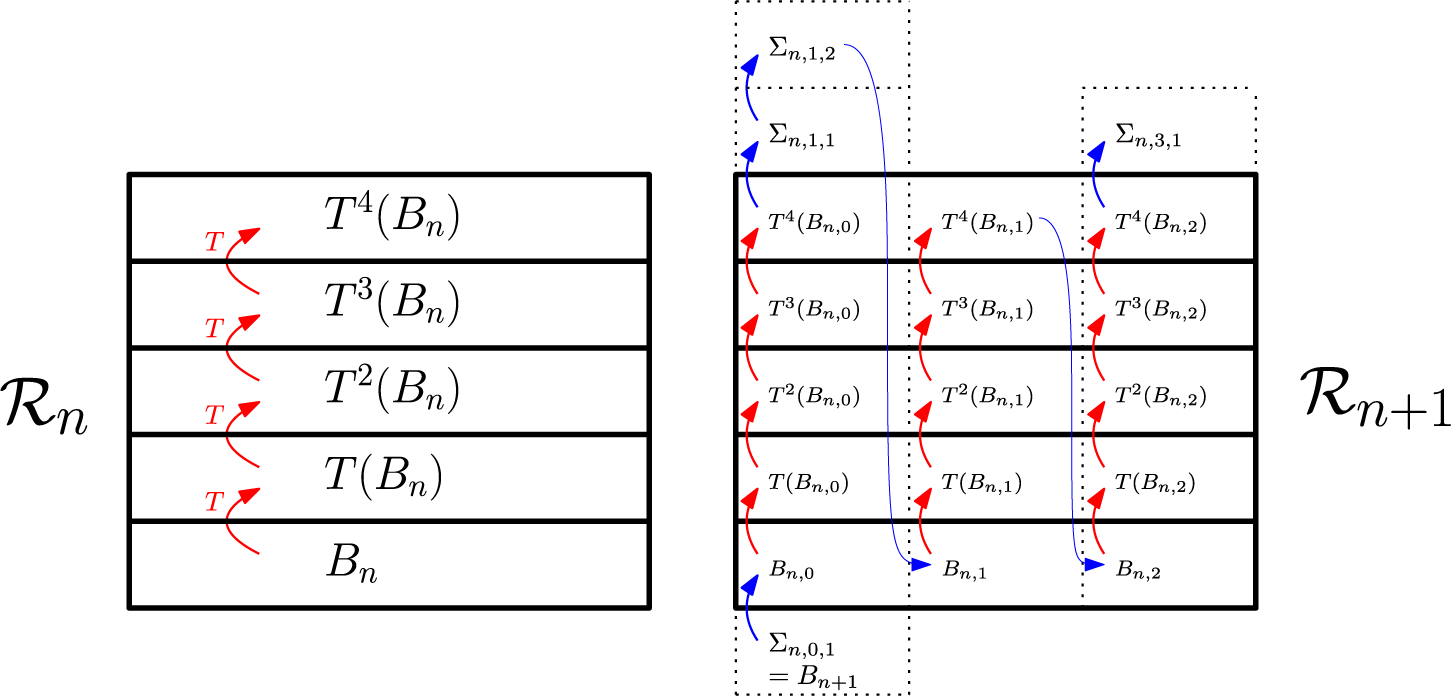
The terminology ‘cutting’, ‘spacing’, ‘tower’, ‘height’, etc., is justified by Definition 3.2 and Figure 4. There are many definitions of rank-one systems (see [Reference FerencziFer97] for a complete survey and various facts in this section). In this paper, the goal is to use the combinatorial structure given by the cutting-and-stacking method (see Figure 4).
An example of cutting-and-stacking construction with
 $h_n=5$
,
 $q_n=3$
,
 $\sigma _{n,0}=1$
,
 $\sigma _{n,1}=2$
,
 $\sigma _{n,2}=0$
,
 $\sigma _{n,3}=1$
. We then have
 $h_{n+1}=19$
.

Definition 3.2. A transformation
 $T\in \mathrm {Aut}(X,\mu )$
is of rank one if there exist:
-
(1) a sequence of cutting and spacing parameters
$\boldsymbol {p}=(q_n,(\sigma _{n,0},\ldots ,\sigma _{n,q_n}))_{n\geq 0}\in \mathcal {P}^{\mathbb {N}}$
satisfying (F)where
$$ \begin{align} \sum_{n=0}^{+\infty}{\frac{\sigma_n}{h_{n+1}}}<+\infty, \end{align} $$
$(h_n)$
and
$(\sigma _n)$
are the sequences associated to
$\boldsymbol {p}$
, as described in Definition 3.1;
-
(2) measurable subsets of X, denoted by
$B_n$
(for every
$n\geq 0$
),
$B_{n,i}$
(for every
$n\geq 0$
and
$0\leq i\leq q_n-1$
) and
$\Sigma _{n,i,j}$
(for every
$n\geq 0$
,
$0\leq i\leq q_n$
and
$1\leq j\leq \sigma _{n,i}$
; if
$\sigma _{n,i}=0$
, then there are no
$\Sigma _{n,i,j}$
) such that for all
$n\geq 0$
:-
(a)
$B_n,\ldots ,T^{h_n-1}(B_n)$
are pairwise disjoint; -
(b)
$(B_{n,0}, B_{n,1}, \ldots , B_{n,q_n-1})$
is a partition of
$B_n$
; -
(c)
$T^{h_n}(B_{n,i})= \begin {cases} \Sigma _{n,i+1,1}&\text { if }\sigma _{n,i}>0,\\ B_{n,i+1}&\text { if }\sigma _{n,i}=0\text { and }i<q_n-1; \end {cases}$
-
(d) if
$\sigma _{n,i}>0$
, then
$T(\Sigma _{n,i,j})= \begin {cases} \Sigma _{n,i,j+1}&\text { if }j<\sigma _{n,i},\\ B_{n,i}&\text { if }j=\sigma _{n,i}\text { and }i\leq q_n-1; \end {cases}$
-
(e)
$B_{n+1}= \begin {cases} \Sigma _{n,0,1}&\text { if }\sigma _{n,0}>0,\\ B_{n,1}&\text { if }\sigma _{n,0}=0, \end {cases}$
-


and if the Rokhlin towers  are increasing to the
 $\sigma $
-algebra
 $\mathcal {A}$
meaning that the
 $\sigma $
-algebra generated by
 $\{T^k(B_n)\mid n\in \mathbb {N},\ 0\leq k\leq h_n-1\}$
is
 $\mathcal {A}$
up to null sets (since
 $\mathcal {A}$
is standard, this also means that
 $\{T^k(B_n)\mid n\in \mathbb {N},\ 0\leq k\leq h_n-1\}$
separates the points). Note that
 $\mathcal {R}_0$
is the tower with only one level
 $B_0$
. The sets
 $\Sigma _{n,i,j}$
are called the spacers. In this paper, we will usually write:
-
•
as the subset covered by the nth tower
$\mathcal {R}_n$
; -
•
, where
$(X_n)^c$
denotes the complement of the subset
$X_n$
of X.
 as the subset covered by the nth tower

 , where


Since
 $X_n$
is increasing and
 $\mathcal {R}_n$
increases to the atomless
 $\sigma $
-algebra
 $\mathcal {A}$
, we have
 $\mu (X_n)\underset {n\to +\infty }{\to }1$
. In other words
 $\varepsilon _n$
tends to
 $0$
.
Before giving examples, the following lemmas give some easy properties on these systems to understand their combinatorial structure and the hypotheses required in the definition.
Lemma 3.3. Let
 $(h_n)$
and
 $(\sigma _n)$
be the sequences associated to
 $(q_n,(\sigma _{n,0},\ldots ,\sigma _{n,q_n}))_n\in \mathcal {P}^{\mathbb {N}}$
(see Definition 3.1). The following assertions are equivalent:
-
(1) the series
$ \sum \!{({\sigma _n}/{h_{n+1}})}$
converges (condition (F) in Definition 3.2); -
(2) the series
$ \sum \!{({\sigma _n}/{q_0\ldots q_n})}$
converges; -
(3) there exists a constant
$M_0\leq 1$
such that
$ h_{n+1}\underset {n\to +\infty }{\sim }({q_0\ldots q_n}/{M_0})$
,


and if one of these equivalent assertions is true, then
 $\sum _{n\geq 0}{({\sigma _n}/{q_0\ldots q_n})}=({1}/{M_0})-1$
.
Proof of Lemma 3.3
If the series
 $\sum \!{({\sigma _n}/{q_0\ldots q_n})}$
converges, so does the series
 $\sum \!{({\sigma _n}/{h_{n+1}})}$
since
 $h_{n+1}$
is greater or equal to
 $q_0\ldots q_n$
. Now assume that the series
 $\sum \!{({\sigma _n}/{h_{n+1}})}$
converges. Notice that we have
 $$ \begin{align*}\frac{\sigma_n}{h_{n+1}}=\frac{h_{n+1}-q_nh_{n}}{h_{n+1}}=1-q_n\frac{h_n}{h_{n+1}}\end{align*} $$
and since the series is convergent, the product
 $\prod {q_n({h_n}/{h_{n+1}})}$
converges to some
 $M_0>0$
, that is,
 $q_0\ldots q_n/h_{n+1}\to M_0$
. The constant
 $M_0$
is less than or equal to
 $1$
since we have
 $h_{n+1}\geq q_nh_n$
for every
 $n\geq 0$
. Finally, let us assume
 $q_0\ldots q_n/h_{n+1}\to M_0$
. Notice that we have
 $$ \begin{align*}\frac{\sigma_n}{q_0\ldots q_n}=\frac{h_{n+1}-q_nh_n}{q_0\ldots q_n}=\frac{h_{n+1}}{q_0\ldots q_n}-\frac{h_n}{q_0\ldots q_{n-1}},\end{align*} $$
so by telescoping consecutive terms, we get
 $\sum _{n\geq 0}{({\sigma _n}/{q_0\ldots q_n})}=\lim _{n\to \infty }({h_{n+1}}/{q_0\ldots q_n})-h_0=({1}/{M_0})-1$
and we are done for the equivalence between the three assumptions.
Lemma 3.4. Let
 $T\colon X\to X$
be a bimeasurable bijection. Assume that T preserves a non-zero measure
 $\mu $
and it admits a sequence of Rokhlin towers as in Definition 3.2. The following hold:
-
(1) the levels
$T^k(B_n)$
of the nth Rokhlin tower
$\mathcal {R}_n$
have
$\mu $
-measure
$ {\mu (B_0)}/{q_0\ldots q_{n-1}}$
; -
(2)
$\mu $
is finite if and only if condition (F) is satisfied. Furthermore, if
$\mu $
is a probability measure (this implies that T is a rank-one system), then
$\mu (B_0)=M_0$
and
$ h_{n+1}\leq ({q_0\ldots q_n}/{M_0})$
, where
$M_0$
is given by Lemma 3.3.


Proof of Lemma 3.4
For a fixed n, the levels of
 $\mathcal {R}_n$
have the same measure by T-invariance of the measure
 $\mu $
. Moreover, the first level
 $B_n$
is a disjoint union of
 $q_n$
levels
 $B_{n,0}, \ldots , B_{n,q_n-1}$
of
 $\mathcal {R}_{n+1}$
. Then, it is clear by induction that a level of
 $\mathcal {R}_n$
has measure
 ${\mu (B_0)}/{q_0\ldots q_{n-1}}$
. Since the sequence
 $(X_n)_{n\geq 0}$
is increasing to X, and
 $X_{n+1}$
is obtained from
 $X_n$
by adding
 $\sigma _n$
spacers, which are levels of
 $\mathcal {R}_{n+1}$
, we get
 $$ \begin{align} \mu(X)=\mu(X_0)+\sum_{n\geq 0}{\mu(X_{n+1}\!\setminus\! X_n)}=\mu(B_0)+\sum_{n\geq 0}{\frac{\mu(B_0)\sigma_n}{q_0\ldots q_n}}, \end{align} $$
so
 $\mu (B_0)$
is non-zero, and
 $\mu (X)$
is finite if and only if the sum
 $\sum _{n\geq 0}{({\sigma _n}/{q_0\ldots q_n})}$
is finite. Finally, let us assume that
 $\mu $
is a probability measure. This implies
 $\sum _{n\geq 0}{({\sigma _n}/{q_0\ldots q_n})}=({1}/{M_0})-1$
and, using equation (1), we get
 $\mu (B_0)=M_0$
. The measurable set
 $X_n$
is the disjoint union of
 $h_n$
levels of
 $\mathcal {R}_n$
, so the inequality
 $h_n\leq ({q_0\ldots q_{n-1}}/{M_1})$
follows from the fact that
 $\mu $
is a probability measure.
It is possible to build a finite measure-preserving transformation T of rank one with a given combinatorial setting
 $(q_n,(\sigma _{n,0},\ldots ,\sigma _{n,q_n}))_{n\geq 0}\in \mathcal {P}^{\mathbb {N}}$
satisfying the hypothesis (F). For instance, it suffices to build
 $(X_n)$
as an increasing sequence of intervals of
 $\mathbb {R}_+$
, with
 $B_{n,i}$
and
 $\Sigma _{n,i,j}$
being subintervals of equal length and disjoint (for a fixed n), each on which T is defined as an affine map, and with
 $B_{0}=[0,M_0]$
. The convergence of the series
 $\sum \!{({\sigma _n}/{h_{n+1}})}$
and Lemma 3.3 ensure that
 is equal to
 $[0,1]$
(up to a null set), so the Lebesgue measure on
 $[0,1]$
is a probability measure preserved by T. Notice that if the series is divergent, we can set
 $B_0=[0,1]$
and this defines T on the set of positive real numbers endowed with the Lebesgue measure, so this is an infinite measure-preserving transformation.
Therefore, for every
 $(q_n,(\sigma _{n,0},\ldots ,\sigma _{n,q_n}))_{n\geq 0}\in \mathcal {P}^{\mathbb {N}}$
satisfying condition (F), there exists a rank-one system having a cutting-and-stacking construction with these cutting and spacing parameters, this fact will be used in this paper since it enables us to only take into account the combinatorics behind the systems.
The hypothesis on the Rokhlin towers
 $\mathcal {R}_n$
aims not only to have
 $\varepsilon _n\to 0$
but also to define two isomorphic systems when they admit cutting-and-stacking constructions with the same cutting and spacing parameters. Moreover, if T admits such a construction with Rokhlin towers increasing to a sub-
 $\sigma $
-algebra
 $\mathcal {B}$
of
 $\mathcal {A}$
, then T, seen as an element of
 $\mathrm {Aut}(X,\mathcal {A},\mu )$
, is not necessarily a rank-one system but admits a rank-one system (T on the sub-
 $\sigma $
-algebra
 $\mathcal {B}$
) as a factor.
Two different families of cutting and spacing parameters do not necessarily define non-isomorphic systems. Indeed, in a construction of a rank-one system with parameters
 $q_n$
and
 $\sigma _{n,i}$
, one can decide to only consider a subsequence
 $\mathcal {R}_{n_k}$
of Rokhlin towers. For example, the new cutting parameters will be
 $q_{n_k}q_{n_k+1}\ldots q_{n_{k+1}-1}$
for
 $k\geq 0$
.
The rank-one systems form a class of ergodic and zero entropy systems. The easiest examples of rank-one systems are the irrational rotations
 $$ \begin{align*}R_{\theta}\colon z\in\mathbb{T}\mapsto e^{2i\pi\theta}z\in\mathbb{T}\end{align*} $$
for every irrational number
 $\theta $
, where
 $\mathbb {T}$
is the unit circle endowed with its Haar measure. These systems are not weakly mixing. Moreover, they have discrete spectrum and the point spectrum of
 $R_{\theta }$
is
 $\{e^{in\theta }\mid n\in \mathbb {Z}\}$
, so by the Halmos–von Neumann theorem [Reference Halmos and Von NeumannHVN42],
 $R_{\theta }$
and
 $R_{\theta '}$
are isomorphic if and only if
 $\theta =\theta '\text { mod }\mathbb {Z}$
or
 $\theta =-\theta '\text { mod }\mathbb {Z}$
.
The odometers are rank one. These are exactly the rank-one systems without spacers (that is,
 $\sigma _{n,i}=0$
), so the Rokhlin towers are partitions of the space. Such a system is isomorphic to the adding machine S in the space
 $\prod _{n\geq 0}{\{0,1,\ldots ,q_n-1\}}$
, namely the addition by
 $(1,0,0,0,\ldots )$
with carry over to the right, defined for every
 ${x\in \prod _{n\geq 0}{\{0,1,\ldots ,q_n-1\}}}$
by

and it preserves the product of uniform probability measures on each finite set
 $\{0,1,\ldots ,q_n-1\}$
. Denote the cylinders of length k by

If S is the odometer on the space
 $\prod _{n\geq 0}{\{0,1,\ldots ,q_n-1\}}$
, we can also set a partially defined map
 $$ \begin{align*}\zeta_n\colon X\setminus [q_0-1,\ldots,q_{n-1}-1]_{n}\to X\setminus [0,\ldots,0]_{n}\end{align*} $$
which is the addition by
 $$ \begin{align*}(\underbrace{0,\ldots ,0}_{n-1\text{ times}},1,0,0,\ldots)\end{align*} $$
(so S and
 $\zeta _1$
coincide on
 $X\setminus [q_0-1]_1$
). Then, we have
 $$ \begin{align*}B_n=[\underbrace{0,\ldots ,0}_{n\text{ times}}]_{n},\end{align*} $$
 $$ \begin{align*}B_{n,i}=[\underbrace{0,\ldots ,0}_{n\text{ times}},i]_{n+1}\end{align*} $$
and
 $B_{n,i}=\zeta _{n+1}^i(B_{n,0})$
for every
 $0\leq i\leq q_n-1$
, so it provides a scale in
 $B_n$
. Note that it is possible to recover the odometer S from these partially defined maps
 $\zeta _n$
(see Figure 5). In §5.1, the strategy will be to build S from partially defined maps
 $\zeta _n$
.
Example of odometer with
 $q_0=3$
,
 $q_1=2$
,
 $q_2=3$
.

In the class of odometers, the number of occurrences of every prime factors in the set
 $\{q_n\mid n\geq 0\}$
form a total invariant of conjugacy. As for irrational rotations, it is a consequence of the Halmos–von Neumann theorem since odometers have a discrete spectrum and their eigenvalues are given by these occurrences. In particular, odometers have eigenvalues non-equal to
 $1$
and are not weakly mixing; moreover, odometers and irrational rotations are not isomorphic. Notice that the Halmos–von Neumann theorem implies that the conjugacy classes among systems with a discrete spectrum coincide with the flip-conjugacy classes since the point spectrum of a system is a subgroup of
 $\mathbb {T}$
. If every prime number has infinite multiplicity in the set
 $\{q_n\mid n\geq 0\}$
, then the odometer is said to be universal. An odometer is dyadic if
 $2$
is the only prime factor.
Chacon’s map is the first example of weakly mixing system which is not strongly mixing [Reference ChaconCha69] and was the starting point for the notion of rank-one systems. It is a rank-one transformation defined with cutting and spacing parameters
 $q_n=3$
,
 $\sigma _{n,0}=\sigma _{n,1}=\sigma _{n,3}\,{=}\,0$
,
 $\sigma _{n,2}=1$
.
3.2 Flexible classes
Now we introduce classes of rank-one systems to which the main result of this paper applies. First, let us consider cutting-and-stacking constructions whose spacing parameters have controlled asymptotics. Recall that
 $\mathcal {P}^{\mathbb {N}}$
is the set of sequences of cutting and spacing parameters. As introduced in Definition 3.1,
 $(h_n)$
,
 $(\sigma _n)$
and
 $(Z_n)$
denote the sequences associated to a sequence in
 $\mathcal {P}^{\mathbb {N}}$
:
 $h_n$
is the height of the nth tower,
 $\sigma _n$
the number of new spacers at step n and
 $Z_n$
is the maximum number of spacers between two consecutive towers, over the first n steps.
Definition 3.5. A construction by cutting and stacking with cutting and spacing parameters
 $(q_n, (\sigma _{n,0},\ldots ,\sigma _{n,q_n}))_{n\geq 0}\in \mathcal {P}^{\mathbb {N}}$
is said to be CSP (controlled-spacing-parameter) if there exists a constant
 $C>0$
such that
 $Z_n\leq Ch_{n}$
for all n. It is furthermore BSP (bounded-spacing-parameter) if
 $Z_n\leq C$
and
 $\sigma _{n,0}=\sigma _{n,q_n}=0$
for all n. A rank-one system T is BSP if it admits a BSP cutting-and-stacking construction.
Odometers and Chacon’s map are examples of BSP rank-one systems. Moreover, BSP implies CSP. The interest in the BSP property is its stability after skipping steps in the cutting-and-stacking process, as stated in the following lemma.
Lemma 3.6. Given a BSP cutting-and-stacking construction, any subsequence of its Rokhlin towers still provides a BSP construction with the same constant C.
Proof of Lemma 3.6
Let
 $q_n$
and
 $\sigma _{n,i}$
be the cutting and spacing parameters of the BSP construction, C the bound for the spacing parameters
 $\sigma _{n,i}$
,
 $\mathcal {R}_n$
the associated towers and
 $\mathcal {R}_{n_k}$
a subsequence. Let k be an integer and assume
 $n_{k+1}=n_k+2$
. Denote by
 $q^{\prime }_{n_k}$
and
 $\sigma ^{\prime }_{n_k,i}$
the new cutting and spacing parameters from
 $\mathcal {R}_{n_k}$
to
 $\mathcal {R}_{n_{k+1}}$
. It is easy to show that
 $q^{\prime }_{n_k}=q_{n_k}q_{n_k+1}$
,
 $\sigma ^{\prime }_{n_k,0}=\sigma ^{\prime }_{n_k,q^{\prime }_{n_k}}=0$
and for every
 $1\leq j\leq q_{n_k+1}$
,
 $\sigma ^{\prime }_{n_k,(j-1)q_{n_k}+i}$
is equal to
 $\sigma _{n_k,i}$
if
 $1\leq i\leq q_{n_k}-1$
and
 $\sigma _{n_k+1,j}$
if
 $i=q_{n_k}$
(see Figure 6). Thus, the non-zero spacing parameters from
 $\mathcal {R}_{n_k}$
to
 $\mathcal {R}_{n_{k+1}}$
are of the form
 $\sigma _{n_k,i}$
or
 $\sigma _{n_k+1,i}$
and they are all bounded above by C. For
 $n_{k+1}$
bigger than
 $n_k+2$
, the result is now clear by induction.
If the parameters
 $\sigma _{n,q_n}$
are non-zero, then skipping steps in the cutting-and-stacking process will cause an accumulation of spacers above the last columns and the new spacing parameters will not be bounded if the subsequence is properly chosen so that the jumps
 $n_{k+1}-n_k$
increase quickly enough. We have the same problem for
 $\sigma _{n,0}$
(accumulation of spacers at the bottom of the first columns), and hence the conditions
 $\sigma _{n,0}=\sigma _{n,q_n}=0$
in the definition of BSP.
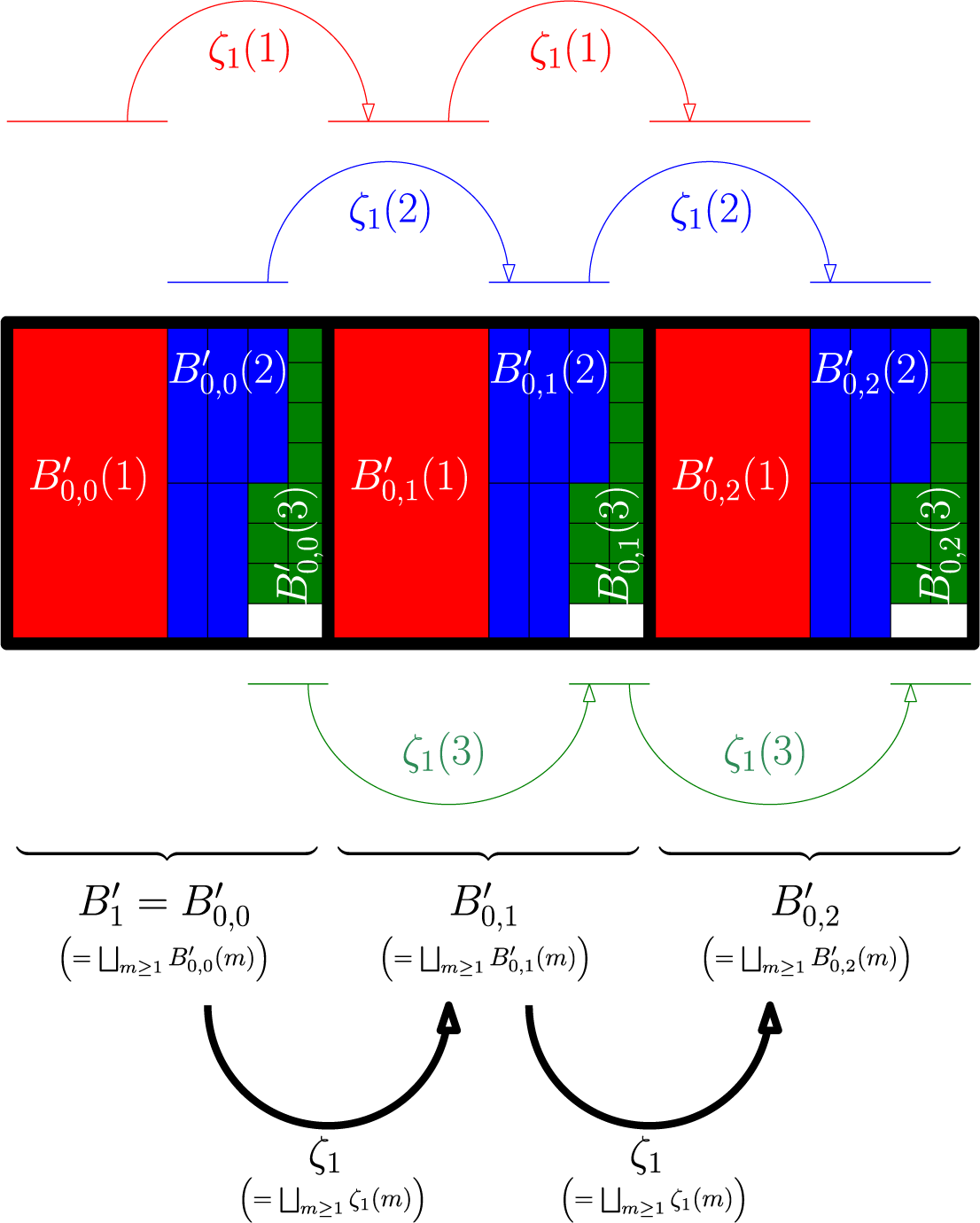
Illustration of the proof of Lemma 3.6, spacing parameters from
 $\mathcal {R}_n$
to
 $\mathcal {R}_{n+2}$
with
 $q_n=q_{n+1}=2$
(the coloured levels are the base and the roof of the towers).

Lemma 3.6 has no reason to hold for CSP construction that are not BSP. Indeed, the spacing parameters from
 $\mathcal {R}_{n_k}$
to
 $\mathcal {R}_{n_{k+1}}$
have to be compared with
 $h_{n_k}$
, the height of
 $\mathcal {R}_{n_k}$
. The comparison is easily obtained for the spacing parameters
 $\sigma _{n_k,i}$
,
 $0\leq i\leq q_{n_k}$
, but for the other spacing parameters, we only know that they are bounded above by
 $Ch_{n_k+1}, Ch_{n_k+2}, \ldots , Ch_{n_{k+1}-1}$
.
In the following, we will see other important CSP examples by considering classes containing ‘nice’ cutting-and-stacking constructions, meaning that we will be able to properly choose the parameters to have the desired quantification of the cocycles for the orbit equivalence built in §5.1. By definition, every flexible class
 $\mathcal {C}$
will be associated to some subset
 $\mathcal {F}_{\mathcal {C}}$
of
 $\mathcal {P}^{*}$
, which can be considered as sufficient conditions that the cutting and spacing parameters have to satisfy at each step for the underlying transformation to belong to
 $\mathcal {C}$
. Recall that
 $\mathcal P^*$
denotes the set of all finite sequences of cutting and stacking parameters.
Definition 3.7. A class
 $\mathcal {C}$
of rank-one systems is said to be flexible if there exists a subset
 $\mathcal {F}_{\mathcal {C}}$
of
 $\mathcal {P}^{*}$
satisfying the following properties:
-
(1) there exists a constant
$C>0$
such that for all
$ (q_n,(\sigma _{n,0},\ldots ,\sigma _{n,q_n}) )_{n\geq 0}\in \mathcal {P}^{\mathbb {N}}$
satisfying condition (F) in Definition 3.2, if
$\mathcal {F}_{\mathcal {C}}$
contains every projection
$ (q_k,(\sigma _{k,0},\ldots ,\sigma _{k,q_k}) )_{0\leq k\leq n}\in \mathcal {P}^{n+1}$
for
$n\geq 0$
, then these parameters define a CSP construction (with the constant C) and the underlying rank-one transformation is in
$\mathcal {C}$
; -
(2) there exists a cutting and spacing parameter
$(q_0,(\sigma _{0,0}\ldots ,\sigma _{0,q_0}))$
in
$\mathcal {F}_{\mathcal {C}}$
with
$q_0\geq 3$
; -
(3) there is a constant
$C'>0$
such that for all
$n\geq 1$
, if
$ (q_k,(\sigma _{k,0},\ldots , \sigma _{k,q_k}) )_{0\leq k\leq n-1}$
is in
$\mathcal {F}_{\mathcal {C}}$
, then there are infinitely many integers
$q_n$
such that
$ (q_k,\kern-0.1pt(\sigma _{k,0},\ldots ,\sigma _{k,q_k}\kern-0.1pt) )_{0\leq k\leq n}$
is in
$\mathcal {F}_{\mathcal {C}}$
for some
$\sigma _{n,0},\ldots ,\sigma _{n,q_n}$
satisfying the inequality where
$$ \begin{align*}\sigma_n\leq C'q_nh_{n-1},\end{align*} $$
$(h_{k})_{0\leq k\leq n+1}$
and
$(\sigma _k)_{0\leq k\leq n}$
denote the finite sequences associated to the finite sequence
$ (q_k,(\sigma _{k,0},\ldots ,\sigma _{k,q_k}) )_{0\leq k\leq n}$
of cutting and stacking parameters.


A rank-one system T is flexible if
 $\{T\}$
is a flexible class.
The third point of the definition aims to recursively choose the cutting parameters (and we want them to increase quickly enough) with an asymptotic control on
 $(\sigma _n)_n$
, while the first point guarantees that it is possible to do so for the underlying system to be in the class
 $\mathcal {C}$
. The second point is minor, but it is required for the initialization of the recursive construction of an odometer orbit equivalent to an element of our flexible class (see Lemma 5.10 and Remark 5.11). It also ensures that
 $\mathcal {F}_{\mathcal {C}}$
is not an empty set.
Notice that if a construction satisfies
 $Z_n\leq Ch_{n-1}$
for all n, then it is in particular CSP and we get
 $\sigma _n\leq C(q_n+1)h_{n-1}\leq 2Cq_nh_{n-1}$
as in the third point of Definition 3.7.
We now give examples of flexible classes. The proof is given in §4.
Proposition 3.8.
-
(1) Every BSP rank-one system is flexible.
-
(2) For every non-empty open subset
$\mathcal {V}$
of
$\mathbb {R}$
, the set
$\{R_{\theta }\mid \theta \in \mathcal {V}\cap (\mathbb {R}\setminus \mathbb {Q})\}$
is a flexible class. -
(3) For every irrational number
$\theta $
, the class of rank-one systems which have
$e^{2i\pi \theta }$
as an eigenvalue is flexible. -
(4) The class of strongly mixing rank-one systems is flexible.


Theorems A, C, E and F follow from Proposition 3.8 and the following theorem which is the main result.
Theorem 3.9. Let
 $\varphi \colon \mathbb {R}_+\to \mathbb {R}_+$
be a map satisfying
 $\varphi (t)\underset {t\to +\infty }{=}o (t^{1/3} )$
. If
 $\mathcal {C}$
is a flexible class, then there exists T in
 $\mathcal {C}$
which is
 $\varphi $
-integrably orbit equivalent to the universal odometer.
4 Proof of Proposition 3.8
In this section, we prove the four statements in Proposition 3.8.
4.1 BSP systems
Let T be a BSP rank-one system,  and
 $q_n$
,
 $\sigma _{n,i}$
the parameters of a BSP construction of T, with a constant
 $C>0$
. For every
 $n\geq 0$
and
 $j\geq 1$
, let
 $\sigma ^{(n,n+j)}_{0},\ldots ,\sigma ^{(n,n+j)}_{q_{n}\ldots q_{n+j-1}}$
be the spacing parameters from
 $\mathcal {R}_{n}$
to
 $\mathcal {R}_{n+j}$
, assuming that the steps for
 $\mathcal {R}_{n+1},\ldots ,\mathcal {R}_{n+j-1}$
are skipped during the construction (we then have
 $\sigma ^{(n,n+1)}_{i}=\sigma _{n,i}$
and also
 $\sigma ^{(n,n+j)}_{i}=0$
for i equal to
 $0$
and
 $q_n\ldots q_{n+j-1}$
by Lemma 3.6). The new cutting parameters are
 and are large enough with huge jumps j. Now, define

Using Lemma 3.6, the new spacing parameters
 $\sigma ^{(n_k,n_{k+1})}_{j}$
are bounded by C and we get
 $$ \begin{align*}\sum_{1\leq j\leq q^{(n_k,n_{k+1})}}{\sigma^{(n_k,n_{k+1})}_{j}}\leq Cq^{(n_k,n_{k+1})}.\end{align*} $$
The set of parameters
 $\mathcal {F}_{\mathcal {C}}$
thus witnesses that
 $\{T\}$
is flexible.
4.2 Irrational rotations
We now consider a construction from [Reference Drillick, Espinosa-Dominguez, Jones-Baro, Leng, Mandelshtam and SilvaDEJ+23]. For every irrational number
 $\theta $
, Drillick et al give an explicit cutting-and-stacking construction of a transformation T which is the irrational rotation of angle
 $\theta $
when the construction yields a finite measure-preserving system.
4.2.1 The construction in [Reference Drillick, Espinosa-Dominguez, Jones-Baro, Leng, Mandelshtam and SilvaDEJ+23]
Let
 $\theta $
be an irrational number and
 $[q_{-1};q_0, q_1,\ldots ]$
its continued fraction expansion, with
 and positive integers
 $q_0,q_1,\ldots $
. Let us assume that there is no integer n such that
 $q_k=1$
for every
 $k\geq n$
. We consider the sequence
 $(h_n)_{n\geq 0}$
defined by
 ,
 and
 for every
 ${k\geq 0}$
(the integer
 $h_k$
is the denominator of the kth convergent of the irrational number
 $\theta $
). Finally, for every
 $k\geq 0$
, we set
 $\sigma _{k,i}=0$
for every
 ${i\in \{0,1,\ldots ,q_k-1\}}$
, and
 ${\sigma _{k,q_k}=h_{k-1}}$
. Then, the sequence of cutting and stacking parameters
 $(q_k,(\sigma _{k,0},\ldots , \sigma _{k,q_k}))_{k\geq 0}$
provides a rank-one system. This system is the irrational rotation of angle
 $\theta $
if and only if condition (F) is satisfied, and this last condition holds if and only if the series
 $\sum _{k\geq 0}{({1}/{q_kq_{k+1}})}$
converges (see [Reference Drillick, Espinosa-Dominguez, Jones-Baro, Leng, Mandelshtam and SilvaDEJ+23, Theorems 3.1 and 5.1]).
Remark 4.1. Equivalently, we can define rank-one systems with cutting parameters potentially equal to
 $1$
, provided that there are infinitely many cutting parameters greater than or equal to
 $2$
, but our construction of orbit equivalence is not well defined with this weaker assumption. Therefore, in the proof of Proposition 3.8 for irrational rotations, one of the main goals is to avoid cutting parameters equal to
 $1$
.
Remark 4.2. It is proven in [Reference Drillick, Espinosa-Dominguez, Jones-Baro, Leng, Mandelshtam and SilvaDEJ+23] that the set of irrational numbers
 $\theta $
such that the associated series
 $\sum _{k\geq 0}\!{({1}/{q_kq_{k+1}})}$
converges has measure zero.
4.2.2 Proof of Proposition 3.8 for these systems
Let
 $\mathcal {V}$
be a non-empty open subset of
 $\mathbb {R}$
and

We now prove that
 $\mathcal {C}$
is a flexible class.
We first use the following basic fact from the theory of continued fractions: if A denotes the set of sequences
 $(q_i)_{i\geq -1}$
of integers such that
 $q_0,q_1,\ldots $
are positive, and if A is equipped with the induced product topology, then the map
 $$ \begin{align*}(q_i)_{i\geq -1}\in A\mapsto [q_{-1};q_0,q_1,\ldots]\in\mathbb{R}\setminus\mathbb{Q}\end{align*} $$
is a homeomorphism (see [Reference Einsiedler and WardEW11, Lemma 3.4] for instance). We can then fix integers
 $n_0\geq 0$
and
 $Q_{-1},Q_{0},\ldots ,Q_{n_0}$
(where
 $Q_{0},\ldots ,Q_{n_0}$
are positive) such that
 $Q_{0}\ldots Q_{n_0}$
is greater than or equal to
 $3$
and the following holds: for every irrational number
 $\theta $
, if the first coefficients of its continued fraction expansion are
 $Q_{-1},Q_{0},\ldots ,Q_{n_0}$
, then
 $\theta $
is in
 $\mathcal {V}$
.
We write  and we consider the set
 $\tilde {\mathcal {F}}(\boldsymbol {Q})$
of finite sequences
 $(\tilde {q}_k,(\tilde {\sigma }_{k,0},\ldots ,\tilde {\sigma }_{k,\tilde {q}_k}))_{0\leq k\leq n}$
such that
 $n\geq n_0$
and for all
 $k\in \{0,\ldots ,n\}$
,
 $$ \begin{align*}\begin{array}{ll} \tilde{q}_k=Q_k&\text{if }k\leq n_0,\\ \tilde{q}_k\geq 2&\text{if }k>n_0, \end{array}\end{align*} $$
and
 $$ \begin{align*}\begin{array}{ll} \tilde{\sigma}_{k,i}=0&\text{for }i\in\{0,\ldots,\tilde{q}_k-1\},\\ \tilde{\sigma}_{k,\tilde{q}_k}=\tilde{h}_{k-1}& \end{array}\end{align*} $$
(where
 $(\tilde {h}_k)_{0\leq k\leq n}$
is the associated height sequence and
 ). The finite sequences of
 $\tilde {\mathcal {F}}(\boldsymbol {Q})$
may not be finite sequences of cutting and stacking parameters in the sense of Definition 3.1, since the integers
 $Q_0,\ldots ,Q_{n_0}$
may be equal to
 $1$
. Moreover, even if the integers
 $Q_0,\ldots ,Q_{n_0}$
were greater than or equal to
 $2$
, we could not prove that
 $\mathcal {C}$
is a flexible class with
 $\mathcal {F}_{\mathcal {C}}=\tilde {\mathcal {F}}(\boldsymbol {Q})$
, since the first cutting parameters
 $\tilde {q}_1,\ldots ,\tilde {q}_{n_0}$
cannot be chosen large enough. Notice that, although we may have
 $\tilde {q}_k=1$
for some
 $k\in \{0,1,\ldots ,n_0\}$
, a finite sequence
 $(\tilde {q}_k,(\tilde {\sigma }_{k,0},\ldots ,\tilde {\sigma }_{k,q_k}))_{0\leq k\leq n}$
can still define the first
 $(n+1)$
steps of a cutting-and-stacking construction, and we associate to it another finite sequence
 $(q_k,(\sigma _{k,0},\ldots ,\sigma _{k,q_k}))_{0\leq k\leq n-n_0}$
corresponding to the cutting-and-stacking construction obtained from the previous one by skipping the steps
 $1, 2,\ldots ,n_0$
. We get
 $h_0=\tilde {h}_0=1$
,
 $q_0=Q_0\ldots Q_{n_0}\geq 3$
and
 $\text { for all } k\in \{1,\ldots ,n-n_0\}$
,
 $$ \begin{align*}\begin{array}{ll} q_k=\tilde{q}_{n_0+k}\geq 2,&\\ h_k=\tilde{h}_{n_0+k},&\\ \sigma_{k,i}=\tilde{\sigma}_{n_0+k,i}=0&\text{for }i\in\{0,\ldots,q_k-1\},\\ \sigma_{k,q_k}=\tilde{\sigma}_{n_0+k,\tilde{q}_{n_0+k}}=\tilde{h}_{n_0+k-1}=h_{k-1}&\text{if }k\geq 2. \end{array}\end{align*} $$
For
 $k=1$
, we have
 $\sigma _{1,q_1}=\tilde {h}_{n_0}$
, where
 $\tilde {h}_{n_0}$
is not equal to
 $h_0$
. Setting
 (this constant only depends on
 $Q_0,\ldots ,Q_{n_0}$
), we have
 $Z_1\leq Ch_1$
and
 $\sigma _{1}\leq C'h_0$
. We immediately get the inequalities
 $Z_k\leq Ch_k$
and
 $\sigma _{k}\leq C'h_{k-1}$
for
 $k\in \{2,\ldots ,n-n_0\}$
.
Let
 $\mathcal {F}(\boldsymbol {Q})$
be the set of finite sequences
 $(q_k,(\sigma _{k,0},\ldots ,\sigma _{k,q_k}))_{0\leq k\leq n-n_0}$
obtained from finite sequences
 $(\tilde {q}_k,(\tilde {\sigma }_{k,0},\ldots ,\tilde {\sigma }_{k,q_k}))_{0\leq k\leq n}\in \tilde {\mathcal {F}}(\boldsymbol {Q})$
. It is now easy to check that
 $\mathcal {C}$
is a flexible class, with the set of parameters
 and the constants C and
 $C'$
.
4.3 Systems with a given eigenvalue
Let
 $\theta $
be an irrational number and
 $\mathcal {C}$
the class of rank-one systems which has
 as an eigenvalue. In [Reference Danilenko and VieprikDV23], Danilenko and Vieprik present an explicit cutting-and-stacking construction of a system in
 $\mathcal {C}$
. The parameters are chosen in the following way (see [DV23, proof of Theorem 4.1]).
4.3.1 The construction of Danilenko and Vieprik
For every
 $n\geq 1$
, we fix a number
 $j_n\in \{1,\ldots ,n\}$
such that
 is less than
 $2\pi /n$
. Fix
 $n\geq 1$
, assume that
 $ (q_k,(\sigma _{k,0},\ldots ,\sigma _{k,q_k}) )_{0\leq k\leq n-1}$
has already been constructed with an auxiliary condition
 $$ \begin{align} h_{n}>\frac{n^4}{\delta_{n^2}}. \end{align} $$
Danilenko and Vieprik show the existence of a sequence
 $(\ell ^{(n)}_m)_{m\geq 1}$
of positive integers less than or equal to
 $2\pi /\delta _{n^2}$
, such that for every
 $m\geq 1$
,
 $$ \begin{align} |1-\unicode{x3bb}^{mh_{n}+(\ell^{(n)}_1+\cdots +\ell^{(n)}_{m})j_{n^2}}|<\frac{2\pi}{n^2}. \end{align} $$
Next, let
 $q_n$
be an integer large enough so that the auxiliary condition (2) holds at the next step, namely

(in [Reference Danilenko and VieprikDV23],
 $q_n$
is chosen as the smallest integer satisfying the property, but it is not needed, so there are infinitely many choices). Finally, the spacing parameters at this step are defined by
 $\sigma _{n,0}=\sigma _{n,q_n}=0$
and
 $\sigma _{n,m}=\ell ^{(n)}_mj_{n^2}$
for
 $1\leq m\leq q_n-1$
.
With these parameters satisfying conditions (2) and (3),
 $\unicode{x3bb} $
is an eigenvalue of the underlying rank-one system (see [DV23, proof of Theorem 4.1] for details).
4.3.2 Proof of Proposition 3.8 for these systems
Let us consider the same construction as above, but with the following auxiliary condition:
 $$ \begin{align} h_{n}>\max{\bigg (\frac{n^4}{\delta_{n^2}},\frac{(n+1)^4}{\delta_{(n+1)^2}}\bigg )}, \end{align} $$
which is stronger than the previous auxiliary condition (2). Note that the real numbers
 $\delta _i$
have been fixed before setting the parameters.
The subset
 $\mathcal {F}_{\mathcal {C}}$
of
 $\mathcal {P}^*$
is defined to be the set of finite sequences
 $ (q_k,(\sigma _{k,0},\ldots , \sigma _{k,q_k}) )_{0\leq k\leq n}$
constructed in a recursive way. Any cutting and spacing parameter
 $(q_0,(\sigma _{0,0},\ldots ,\sigma _{q_0,0}))$
is in
 $\mathcal {F}_{\mathcal {C}}$
, and if
 $ (q_k,(\sigma _{k,0},\ldots ,\sigma _{k,q_k}) )_{0\leq k\leq n-1}$
is in
 $\mathcal {F}_{\mathcal {C}}$
, then so is
 $ (q_k,(\sigma _{k,0},\ldots ,\sigma _{k,q_k}) )_{0\leq k\leq n}$
for every
 $(q_n,\sigma _{n,0},\ldots ,\sigma _{n,q_n})$
that we can obtain at the next step, as described above, but with the stronger auxiliary condition (4).
Let  be a sequence of cutting and spacing parameters. If all its projections are in
 $\mathcal {F}_{\mathcal {C}}$
, then
 $\boldsymbol {p}$
provides a CSP construction with
 $C=2\pi $
. Indeed, we have
 $\sigma _{n,m}=\ell _{m}^{(n)}j_{n^2}\leq 2\pi n^2/\delta _{n^2}<2\pi h_n$
. As mentioned above, conditions (2) and (3) imply that the sequence
 $\boldsymbol {p}$
provides rank-one systems which have
 $\unicode{x3bb} $
as an eigenvalue.
Finally, if
 $(q_k,(\sigma _{k,0},\ldots ,\sigma _{k,q_k}))_{0\leq k\leq n-1}$
is a finite sequence in
 $\mathcal {F}_{\mathcal {C}}$
, we can choose a large enough integer
 $q_n$
so that the following holds at the next step:
 $$ \begin{align*}h_{n+1}>\max{\bigg (\frac{(n+1)^4}{\delta_{(n+1)^2}},\frac{(n+2)^4}{\delta_{(n+2)^2}}\bigg )}\end{align*} $$
(in particular, the new auxiliary condition (4) is satisfied). We use the same spacing parameters as before, namely
 $\sigma _{n,m}=\ell _m^{(n)}j_{n^2}$
. Using
 $j_{n^2}\leq n^2$
and
 $\ell _m^{(n)}\leq ({2\pi }/{\delta _{n^2}})$
, this gives
 $$ \begin{align*}\sigma_n=(\ell^{(n)}_1+\cdots +\ell^{(n)}_{q_n-1})j_{n^2}\leq q_n\frac{2\pi n^2}{\delta_{n^2}}\leq q_n h_{n-1},\end{align*} $$
so the third point of Definition 3.7 is satisfied for
 $C'=1$
.
4.4 Strongly mixing systems
Let
 $\mathcal {C}$
be the class of strongly mixing rank-one systems. We consider the construction of Ornstein in [Reference OrnsteinOrn72]. The property the parameters have to satisfy at each step is given by the following lemma (in [Orn72, Lemma 3.2]), proven with a probabilistic method.
Lemma 4.3. Let N and K be positive integers and
 $\varepsilon>0$
,
 $\alpha>0$
. Then, there exist integers
 $m>N$
and
 $a_1,\ldots ,a_m$
such that:
-
•
$ |\!\sum _{i=j}^{j+k}{a_i} |\leq K$
for all
$1\leq j\leq j+k\leq m$
; -
• denoting by
$H(\ell ,k)$
the number of j such that
$\sum _{i=j}^{j+k}{a_i}=\ell $
, for
$1\leq j\leq j+k\leq m$
, then
$H(\ell ,k)<\alpha ({(m-k)}/{K})$
for every
$k<(1-\varepsilon )m$
.


The set of parameters
 $\mathcal {F}_{\mathcal {C}}$
is defined in a recursive way, as in §4.3: any cutting and spacing parameter
 $(q_0,(\sigma _{0,0},\ldots ,\sigma _{q_0,0}))$
is in
 $\mathcal {F}_{\mathcal {C}}$
, and from a finite sequence of parameters
 $ (q_k,(\sigma _{k,0},\ldots ,\sigma _{k,q_k}) )_{0\leq k\leq n-1}$
in
 $\mathcal {F}_{\mathcal {C}}$
,
 $ (q_k,(\sigma _{k,0},\ldots ,\sigma _{k,q_k}) )_{0\leq k\leq n}$
is also in
 $\mathcal {F}_{\mathcal {C}}$
if the new parameters can be written as
 $q_n=m$
and
 $\sigma _{n,i}=a_i+h_{n-1}$
, where
 $m,a_1,\ldots , a_m$
are integers whose existence is granted by Lemma 4.3 with
 $N> 10^n$
,
 $K=h_{n-1}$
,
 $\varepsilon =10^{n-3}$
and
 $\alpha =5/4$
. There are infinitely many possibilities for
 $q_n$
as N can be arbitrarily large. It is shown in [Reference OrnsteinOrn72] that cutting-and-stacking constructions with these parameters give strongly mixing systems, and it is clear that they are CSP with
 $C=2$
and the third point of Definition 3.7 is satisfied for
 $C'=2$
.
5 From flexible classes to the universal odometer
The goal of this section is to prove Theorem 3.9, namely that for every
 $\varphi \colon \mathbb {R}_+\to \mathbb {R}_+$
satisfying
 $\varphi (x)=o(t^{1/3})$
, any flexible class contains a rank-one system that is
 $\varphi $
-integrably orbit equivalent to the universal odometer.
5.1 The construction
5.1.1 Overview of the construction
We first present a natural adaptation to the case of the rank-one system of Kerr and Li’s construction of an explicit orbit equivalence between the universal odometer and any other odometers. We will then see that the quantification of the cocycles becomes more complicated due to the presence of non-zero spacing parameters.
Let
 $T\in \mathrm {Aut}(X,\mu )$
be a rank-one system and consider a cutting-and-stacking construction of this transformation with the same notation
 $q_n,\sigma _{n,i},\sigma _n,h_n,\mathcal {R}_n,\varepsilon _n,X_n$
as in Definition 3.2. From the sequence of Rokhlin towers
 $\mathcal {R}_n$
, new towers
 $\mathcal {R}^{\prime }_n$
will be built as Rokhlin towers for a new system S. These towers
 $\mathcal {R}^{\prime }_n$
will have no spacers, that is,
 $\sigma ^{\prime }_{n,i}=0$
, so they will be partitions of X. The construction will ensure that
 $\mathcal {R}^{\prime }_n$
increases to the
 $\sigma $
-algebra
 $\mathcal {A}$
using the fact that it is the case for
 $\mathcal {R}_n$
, so S will be an odometer. For the odometer S to be universal, we fix a sequence of prime numbers
 $(p_n)_{n\geq 0}$
such that every prime number appears infinitely many times, and every cutting parameter
 $q^{\prime }_n$
will be a multiple of
 $p_n$
.
We will recursively define S on subsets increasing to X up to a null set. More precisely, if the nth tower
 $\mathcal {R}^{\prime }_n$
has been built and its base and its height are denoted by
 $B^{\prime }_n$
and
 $h^{\prime }_n$
, then S is provisionally defined on all the levels of the tower except the highest one and maps the ith level to the
 $(i+1)$
th one. So,
 $\mathcal {R}^{\prime }_n$
is exactly
 $(B^{\prime }_n,S(B^{\prime }_n),\ldots ,S^{h^{\prime }_n-1}(B^{\prime }_n))$
and S is defined on
 $X\setminus S^{h^{\prime }_n-1}(B^{\prime }_{n})$
. To refine S, that is, to define it on a greater set, we have to build the next tower
 $\mathcal {R}^{\prime }_{n+1}$
and define S as for
 $\mathcal {R}^{\prime }_n$
. To do so and according to Definition 3.2, we have to determine a subdivision of the base
 $B^{\prime }_n$
into
 $q^{\prime }_n$
subsets
 $B^{\prime }_{n,0},\ldots ,B^{\prime }_{n,q^{\prime }_n-1}$
. We find a function
 $\zeta _{n+1}$
mapping bimeasurably each
 $B^{\prime }_{n,i}$
to
 $B^{\prime }_{n,i+1}$
for
 $0\leq i\leq q^{\prime }_n-2$
. On the subset
 of the roof
 $S^{h^{\prime }_n-1}(B_n)$
of
 $\mathcal {R}^{\prime }_n$
, S will coincide with
 $\zeta _{n+1}S^{-h^{\prime }_n}$
and will be defined on
 $X\setminus S^{h^{\prime }_{n+1}}(B^{\prime }_{n+1})=D_1\sqcup \cdots \sqcup D_{n+1}$
, where
 ${B^{\prime }_{n+1}=B^{\prime }_{n,0}}$
is the base of the new Rokhlin tower
 $\mathcal {R}_{n+1}$
for S. To sum up, S is successively defined by the finite approximations obtained from the maps
 $\zeta _n$
. Up to conjugacy,
 $\zeta _n$
is exactly the addition by
 $(\underbrace {0,\ldots ,0}_{n-1\text { times}},1,0,0,\ldots )$
with carry over to the right (as defined in §3.1), restricted to
 $[0,\ldots ,0]_{n-1}\setminus [0,\ldots ,0,q^{\prime }_{n-1}-1]_n$
.
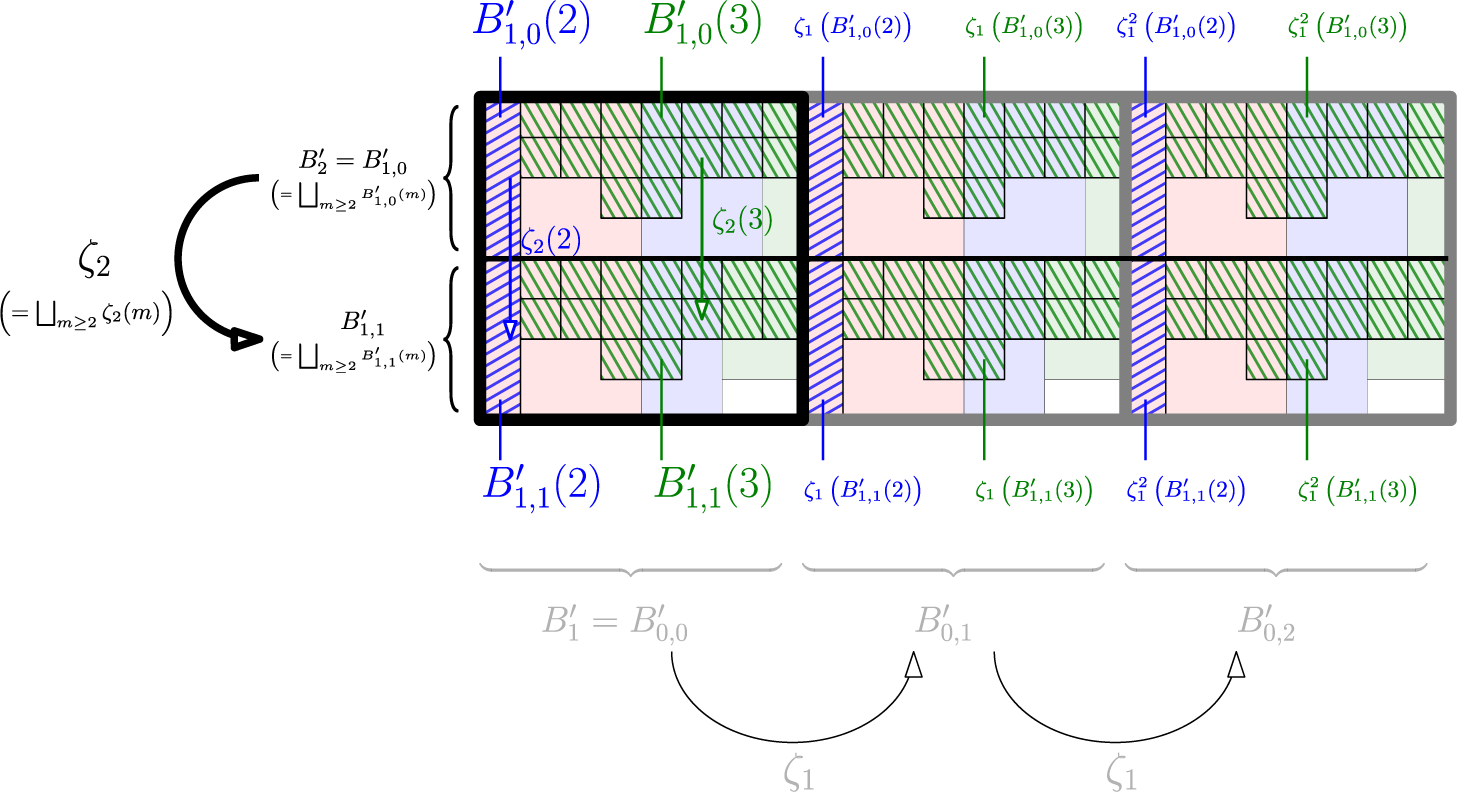
The construction of the maps
 $\zeta _n$
is by induction on
 $n\geq 0$
. At step n, we will actually define
 $$ \begin{align*}\zeta_{n+1}\colon B^{\prime}_{n,0}\sqcup\cdots\sqcup B^{\prime}_{n,q^{\prime}_n-2}\to B^{\prime}_{n,1}\sqcup\cdots\sqcup B^{\prime}_{n,q^{\prime}_n-1}.\end{align*} $$
To build
 $\zeta _{n+1}$
, a second induction on a parameter
 $m\geq n$
is required. Actually,
 $B^{\prime }_{n,i}$
will be the disjoint union of the
 $B^{\prime }_{n,i}(m)$
for
 $m\geq n$
, and this inner recursion consists in choosing m bricks to define
 $B^{\prime }_{n,i}(m)$
. By definition, the m bricks will be the m levels (that is, the levels of
 $\mathcal {R}_m$
) explicitly chosen to constitute
 $B^{\prime }_{n,i}(m)$
. Using powers of T, m bricks of
 $B^{\prime }_{n,i}$
are mapped to those of
 $B^{\prime }_{n,i+1}$
(there will be as many in
 $B_{n,i}$
as in
 $B^{\prime }_{n,i+1}$
) and this gives
 $\zeta _{n+1}$
whose orbits are included in those of T, implying immediately that the orbits of S satisfy the same property. The reverse inclusion between the orbits will be more difficult to prove and will be due to the choice of the bricks (see Remark 5.1 after the construction).
5.1.2 The construction
Here, T is a rank-one system in
 $\mathrm {Aut}(X,\mu )$
. We fix one of its cutting-and-stacking construction whose parameters are denoted as in Definition 3.2. Let
 $(p_n)_{n\geq 0}$
be a sequence of prime numbers such that every prime number appears infinitely many times.
In the following, we will assume that, given the cutting parameters of T, some positive integers
 $q^{\prime }_n$
and
 $t_{n,m}$
that we will introduce are well defined. In §5.3 (see Lemma 5.10), we will give conditions on the parameters of T for these quantities (and so the construction) to be well defined.
Step
$\textit {n}=1$
.

We first build
 $\mathcal {R}^{\prime }_1$
and
 $\zeta _1$
by an induction over
 $m\geq 1$
. We could denote by
 $\mathcal {R}^{\prime }_0$
the trivial tower
 $(X)$
with its base
 . At the end of step
 $n=1$
, S is not yet defined on the roof of the tower
 $\mathcal {R}^{\prime }_1$
, that is, on its highest level, which is a Rokhlin tower of S.
-
•
$m=1$
: let
$q^{\prime }_0>0$
be the largest multiple of
$p_0$
such that
$q^{\prime }_0\leq q_0-1$
. For every
$0\leq i\leq q^{\prime }_0-1$
, we define andcoinciding with T on its domain (hence, every subset
$$ \begin{align*}\zeta_1(1)\colon\bigsqcup_{0\leq i\leq q^{\prime}_0-2}{B^{\prime}_{0,i}(1)}\to\bigsqcup_{0\leq i\leq q^{\prime}_0-2}{B^{\prime}_{0,i+1}(1)}\end{align*} $$
$B^{\prime }_{0,i}(1)$
is composed of a unique
$1$
-brick
$T^i(B_{1})$
).Remark 7.1. At this step, we simply have to assume
$q_0>p_0$
for the integer
$q^{\prime }_0$
to be non-zero. However, for the well definition of other quantities at other steps, the conditions on the cutting parameters of T get increasingly more technical, which is the reason why we first assume that the parameters of T are chosen so that the positive quantities are well defined and we will then state the conditions in Lemma 5.10 (as mentioned before the beginning of the construction). -
•
$m>1$
: assume that the subsets
$B^{\prime }_{0,i}(M)$
have been built for every
$1\leq M\leq m-1$
and
$0\leq i\leq q^{\prime }_0-1$
. Let be the remaining piece of X at the end of the
$(m-1)$
th step (we could also define ).Remark 7.2. Notice that m-levels are either contained in
$W_{1,m}$
or disjoint from it since
$X\setminus W_{1,m}$
is composed of M-levels for
$1\leq M\leq m-1$
and the Rokhlin towers are nested. This will more generally hold true for
$W_{n,m}$
with
$n\geq 2$
.Let
$r_{1,m}$
be the number of integers such that
$T^j(B_m)\subseteq W_{1,m}$
, denoted by Let
$$ \begin{align*}0\leq j_{1}^{(1,m)} <j_{2}^{(1,m)} <\cdots <j_{r_{1,m}}^{(1,m)} <h_m.\end{align*} $$
$t_{1,m}$
be the positive integer (we assume that we can choose the cutting parameters of T for this integer to be positive, see Lemma 5.10) such that
$q^{\prime }_0t_{1,m}$
is the largest multiple of
$q^{\prime }_0$
such that
$q^{\prime }_0t_{1,m}<r_{1,m}$
. The first
$q^{\prime }_0t_{1,m}$
m-levels contained in
$W_{1,m}$
are now used as m-bricks; they are split in
$q^{\prime }_0$
groups of
$t_{1,m}$
m-bricks of the subsets
$B^{\prime }_{0,i}$
in the following way and the same will be done at steps
$n>1$
(the fact that the inequality
$q^{\prime }_0t_{1,m}<r_{1,m}$
is strict and the way we make the
$q^{\prime }_0$
groups will guarantee an easy control of the cocycles, see Lemma 5.4 used for Lemmas 5.16 and 5.19). For every
$0\leq i\leq q^{\prime }_0-1$
, we define and
$\zeta _1(m)$
coinciding with
$T^{ (j_{i+2+tq^{\prime }_0}^{(1,m)} )-(j_{i+1+tq^{\prime }_0}^{(1,m)} )}$
on
$T^{ (j_{i+1+tq^{\prime }_0}^{(1,m)} )}(B_m)$
for every
$0\leq i\leq q^{\prime }_0-2$
and
$0\leq t\leq t_{1,m}-1$
, so that each brick
$T^{ (j_{i+1+tq^{\prime }_0}^{(1,m)} )}(B_m)$
is mapped on another
$T^{ (j_{i+2+tq^{\prime }_0}^{(1,m)} )}(B_m)$
. Thus,
$\zeta _1(m)$
maps each
$B^{\prime }_{0,i}(m)$
on
$B^{\prime }_{0,i+1}(m)$
and this gives
$$ \begin{align*}\zeta_1(m)\colon\bigsqcup_{0\leq i\leq q^{\prime}_0-2}{B^{\prime}_{0,i}(m)}\to\bigsqcup_{0\leq i\leq q^{\prime}_0-2}{B^{\prime}_{0,i+1}(m)}.\end{align*} $$


 ).


 such that


End of step
$n=1$
.

For every
 $0\leq i\leq q^{\prime }_0-1$
, we define

(the set of its m-bricks for all
 $m\geq 1$
),
 and
 $$ \begin{align*}\zeta_1\colon\bigsqcup_{0\leq i\leq q^{\prime}_0-2}{B^{\prime}_{0,i}}\to\bigsqcup_{0\leq i\leq q^{\prime}_0-2}{B^{\prime}_{0,i+1}}\end{align*} $$
coinciding with the maps
 $\zeta _1(m)$
on their respective domain (see Figure 7).
First step of the construction (that is,
 $n=1$
). In §5.4, we will define sets
 $E_{n,m}$
for every pair of integers
 $(n,m)$
satisfying
 $m\geq n\geq 1$
. The set
 $E_{1,1}$
(respectively
 $E_{1,2}$
;
 $E_{1,3}$
) is the union of the red areas (respectively red and blue areas; red, blue and green areas).

The universal odometer S we want to build is partially defined on X. More precisely, we define it on the domain  of
 $\zeta _1$
so that it coincides with
 $\zeta _1$
. This gives the first Rokhlin tower
 . The next step will provide us with a refinement
 $\mathcal {R}^{\prime }_2$
of the tower
 $\mathcal {R}^{\prime }_1$
, allowing us to extend partially S on the highest level of the
 $\mathcal {R}^{\prime }_1$
.
Step
$n>1$
.

Assume that steps
 $1,\ldots ,n-1$
have been achieved. There are nested towers
 $\mathcal {R}^{\prime }_1,\ldots ,\mathcal {R}^{\prime }_{n-1}$
. The kth tower
 $\mathcal {R}^{\prime }_k$
has
 levels and its base
 $B^{\prime }_k$
is partitioned in
 $q^{\prime }_k$
levels
 $B^{\prime }_{k,0},\ldots ,B^{\prime }_{k,q^{\prime }_k-1}$
. These levels belong to
 $\mathcal {R}^{\prime }_{k+1}$
, whose base is
 , with
 $\zeta _{k+1}$
mapping
 $B^{\prime }_{k,i}$
to
 $B^{\prime }_{k,i+1}$
. The map S is defined on
 $D_1\sqcup \cdots \sqcup D_{n-1}$
using the maps
 $\zeta _1,\ldots ,\zeta _{n-1}$
, where
 $D_1\sqcup \cdots \sqcup D_{n-1}$
corresponds to the union of all the levels of
 $\mathcal {R}^{\prime }_{n-1}$
except its roof.
The map S is not yet defined on the roof of
 $\mathcal {R}^{\prime }_{n-1}$
. By partitioning
 $B^{\prime }_{n-1}$
in subsets
 $B^{\prime }_{n-1,0},\ldots ,B^{\prime }_{n-1,q^{\prime }_{n-1}-1}$
, we will define
 $\mathcal {R}^{\prime }_n$
which refines
 $\mathcal {R}^{\prime }_{n-1}$
and a function
 $\zeta _n$
mapping
 $B^{\prime }_{n-1,i}$
to
 $B^{\prime }_{n-1,i+1}$
. The extension of S will be defined on all the levels of
 $\mathcal {R}^{\prime }_n$
, except its roof (which is contained in the one of
 $\mathcal {R}^{\prime }_{n-1}$
). We will construct the subsets
 $B^{\prime }_{n-1,i}$
as was done for the subsets
 $B^{\prime }_{0,i}$
, except that we only use the ‘material’ in
 $B^{\prime }_{n-1}$
to form the m-bricks of each
 $B^{\prime }_{n-1,i}$
. To do so, notice that the base
 $B^{\prime }_{n-1}$
is exactly
 $B^{\prime }_{n-2,0}$
(the first subset in the subdivision of
 $B^{\prime }_{n-2}$
) which is the disjoint union of subsets of the form
 $B^{\prime }_{n-2,0}(m)$
for
 $m\geq n-1$
. Moreover, for all
 $n-1\leq M\leq m$
, every m-level is contained in an M-level, then we will pick the new m-bricks in
 $B^{\prime }_{n-2,0}(n), \ldots , B^{\prime }_{n-2,0}(m)$
. This motivates the definition of each set
 $W_{n,m}$
(the set of the remaining material to form m-bricks with an incremented integer m). We now discuss separately the following cases.
-
•
$m=n$
: set (5)and let
$r_{n,n}$
be the number of integers such that
$T^j(B_n)\subseteq W_{n,n}$
(note that we could have defined
$r_{1,1}=q_0$
), denoted by Let
$$ \begin{align*}0\leq j_{1}^{(n,n)} <j_{2}^{(n,n)} <\cdots <j_{r_{n,n}}^{(n,n)} <h_n. \end{align*} $$
$q^{\prime }_{n-1}$
be the largest multiple (we assume that we can choose the cutting parameters of T for this integer to be positive, see Lemma 5.10) of
$p_{n-1}$
such that
$q^{\prime }_{n-1}< r_{n,n}$
. We then define for every
$0\leq i\leq q^{\prime }_{n-1}-1$
, meaning that among the n-levels in
$W_{n,n}$
, the n-bricks at step
$(n,n)$
are exactly the first
$q^{\prime }_{n-1}$
ones (and set
$t_{n,n}=1$
for consistency later on). Let be the map coinciding with
$$ \begin{align*}\zeta_n(n)\colon\bigsqcup_{0\leq i\leq q^{\prime}_{n-1}-2}{B^{\prime}_{n-1,i}(n)}\to\bigsqcup_{0\leq i\leq q^{\prime}_{n-1}-2}{B^{\prime}_{n-1,i+1}(n)}\end{align*} $$
$T^{ (j_{i+2}^{(n,n)} )- (j_{i+1}^{(n,n)} )}$
on each
$B^{\prime }_{n-1,i}(n)$
, so that
$B^{\prime }_{n-1,i}(n)$
is mapped to
$B^{\prime }_{n-1,i+1}(n)$
.
-
•
$m>n$
: set (6)and let
$r_{n,m}$
be the number of integers such that
$T^j(B_m)\subseteq W_{n,m}$
, denoted by Let
$$ \begin{align*}0\leq j_{1}^{(n,m)} <j_{2}^{(n,m)} <\cdots <j_{r_{n,m}}^{(n,m)} <h_m.\end{align*} $$
$t_{n,m}$
be the positive integer (we assume that we can choose the cutting parameters of T for this integer to be positive, see Lemma 5.10) such that
$q^{\prime }_{n-1}t_{n,m}$
is the largest multiple of
$q^{\prime }_{n-1}$
such that
$q^{\prime }_{n-1}t_{n,m}<r_{n,m}$
. The first
$q^{\prime }_{n-1}t_{n,m}$
m-levels contained in
$W_{n,m}$
are now used as m-bricks at step
$(n,m)$
; they are split in
$q^{\prime }_{n-1}$
groups of
$t_{n,m}$
m-bricks of the subsets
$B^{\prime }_{n-1,i}$
in the following way. For every
$0\leq i\leq q^{\prime }_{n-1}-1$
, we define and
$\zeta _n(m)$
coinciding with
$T^{ (j_{i+2+tq^{\prime }_{n-1}}^{(n,m)} )- (j_{i+1+tq^{\prime }_{n-1}}^{(n,m)} )}$
on
$T^{ (j_{i+1+tq^{\prime }_{n-1}}^{(n,m)} )}(B_m)$
for every
${0\leq i\leq q^{\prime }_{n-1}-2}$
,
$0\leq t\leq t_{n,m}-1$
, so that each m-brick
$T^{ (j_{i+1+tq^{\prime }_{n-1}}^{(n,m)} )}(B_m)$
is mapped on another
$T^{ (j_{i+2+tq^{\prime }_{n-1}}^{(n,m)} )}(B_m)$
. Thus,
$\zeta _n(m)$
maps each
$B^{\prime }_{n-1,i}(m)$
on
$B^{\prime }_{n-1,i+1}(m)$
and this gives
$$ \begin{align*}\zeta_n(m)\colon\bigsqcup_{0\leq i\leq q^{\prime}_{n-1}-2}{B^{\prime}_{n-1,i}(m)}\to\bigsqcup_{0\leq i\leq q^{\prime}_{n-1}-2}{B^{\prime}_{n-1,i+1}(m)}.\end{align*} $$


 such that


 such that


End of step n.
We define for every
 $0\leq i\leq q^{\prime }_{n-1}-1$
,

(the set of its m-bricks for
 $m\geq n$
),
 $B^{\prime }_n=B^{\prime }_{n-1,0}$
and
 $$ \begin{align*}\zeta_n\colon\bigsqcup_{0\leq i\leq q^{\prime}_{n-1}-2}{B^{\prime}_{n-1,i}}\to\bigsqcup_{0\leq i\leq q^{\prime}_{n-1}-2}{B^{\prime}_{n-1,i+1}}\end{align*} $$
coinciding with the maps
 $\zeta _n(m)$
on their respective domain (see Figure 8 for step
 $n=2$
, after the first step illustrated in Figure 7).
From the first step (illustrated in Figure 7) to the second one. In
 $B^{\prime }_1$
, we inductively build
 $B^{\prime }_{1,i}(2), B^{\prime }_{1,i}(2), B^{\prime }_{1,i}(3), \ldots $
for every
 $0\leq i\leq q^{\prime }_1-1$
(in this example, we have
 $q^{\prime }_1=2$
). Each set
 $B^{\prime }_{1,i}(2)$
is composed of a unique
 $2$
-level in
 $B^{\prime }_{0,0}(1)\sqcup B^{\prime }_{0,0}(2)$
(that is, in the pale red and pale blue areas). Then each set
 $B^{\prime }_{1,i}(3)$
is composed of
 $3$
-levels in
 $B^{\prime }_{0,0}(1)\sqcup B^{\prime }_{0,0}(2)\sqcup B^{\prime }_{0,0}(3)$
(that is, in the pale red, pale blue and pale green areas) and so on. The structure that we build in
 $B^{\prime }_1=B^{\prime }_{0,0}$
can be translated in
 $B^{\prime }_{0,1}$
and
 $B^{\prime }_{0,2}$
using the map
 $\zeta _1$
. In §5.4, we will define sets
 $E_{n,m}$
for every pair of integers
 $(n,m)$
satisfying
 $m\geq n\geq 1$
. The set
 $E_{2,1}$
(respectively
 $E_{2,2}$
) is the union of the areas hatched in blue (respectively in blue or green).

As the base
 $B^{\prime }_{n-1}$
of
 $\mathcal {R}^{\prime }_{n-1}$
is partitioned in
 $B^{\prime }_{n-1,0}\sqcup \cdots \sqcup B^{\prime }_{n-1,q^{\prime }_{n-1}-1}$
, its highest level
 $S^{h^{\prime }_{n-1}-1}(B^{\prime }_{n-1})$
is partitioned in
 $S^{h^{\prime }_{n-1}-1}(B^{\prime }_{n-1,0})\sqcup \cdots \sqcup S^{h^{\prime }_{n-1}-1}(B^{\prime }_{n-1,q^{\prime }_{n-1}-1})$
. The map S is extended in the following way. On

it coincides with
 $\zeta _nS^{-(h^{\prime }_{n-1}-1)}$
. So S maps
 $S^{h^{\prime }_{n-1}-1}(B^{\prime }_{n-1,i})$
on
 $B^{\prime }_{n-1,i+1}$
. This gives a Rokhlin tower
 $\mathcal {R}^{\prime }_n$
for S, nested in the previous one, of base
 and height
 . Now S is defined on
 $(D_1\sqcup \cdots \sqcup D_{n-1})\sqcup D_n$
. The set
 $D_n$
consists in the levels of
 $\mathcal {R}_n$
, except the highest one, which are contained in the highest level of
 $\mathcal {R}^{\prime }_{n-1}$
.
Remark 5.1. Notice that the inclusion of the S-orbits in the T-orbits is easy since S is defined from maps
 $\zeta _n(m)$
which are ‘piecewise powers of T’.
The reverse inclusion will follow from the fact that we have
 $t_{n,n}=1$
for every
 $n\geq 1$
(at step
 $(n,n)$
, we form groups of only one n-level). Indeed, uniqueness implies that these chosen blocks are linked by
 $\zeta _n(n)$
and hence clearly by S (in contrast, an m-level, for
 $m>n$
, of
 $B^{\prime }_{n-1,i}$
is mapped by
 $\zeta _n(m)$
to only one of the
 $t_{n,m}$
m-levels of
 $B^{\prime }_{n-1,i+1}$
, and not to the other). Thus, ensuring that the unique n-brick of each
 $B^{\prime }_{n-1,i}$
is a large part of it that enables the system S to capture most of the T-orbits.
5.2 First properties of this construction
Recall that we consider a cutting-and-stacking construction of T with the same notation as in Definition 3.2 (
 $q_n$
,
 $\sigma _{n,i}$
,
 $\mathcal {R}_n$
,
 $X_n$
,
 $\varepsilon _n$
,
 $\ldots $
), and the sequences
 $(h_n)$
,
 $(\sigma _{n})$
and
 $(Z_n)$
associated to the cutting and spacing parameters, and the notation
 $q^{\prime }_n$
,
 $\mathcal {R}^{\prime }_n$
,
 $\ldots $
refer to the construction of S.
We state some important properties preparing for further results in §5.4. Many of them enable us to only take into account the combinatorics behind a cutting-and-stacking construction. We assume that all the ‘largest multiples’ (for every
 $n<m$
, the largest multiple
 $q^{\prime }_{n-1}$
of
 $p_{n-1}$
such that
 $q^{\prime }_{n-1}<r_{n,n}$
, and the largest multiple
 $q^{\prime }_{n-1}t_{n,m}$
of
 $q^{\prime }_{n-1}$
such that
 $q^{\prime }_{n-1}t_{n,m}<r_{n,m}$
) are non-zero. In §5.3 (see Lemma 5.10), we will see how to choose the parameters for the construction to be well defined.
Lemma 5.2. Every tower
 $\mathcal {R}^{\prime }_n$
is a partition of X.
Proof of Lemma 5.2
Let
 $n\geq 1$
. The levels of
 $\mathcal {R}^{\prime }_n$
are pairwise disjoint by the definition of
 $(W_{n,m})_{m\geq n}$
. It remains to show that
 $\mathcal {R}^{\prime }_n$
covers the whole space. Recall that
 $X_n$
denotes the subset covered by the tower
 $\mathcal {R}_n$
, and
 $\varepsilon _n$
the measure of its complement.
The result holds for
 $n=1$
since
 $\mu (W_{1,m})\underset {m\to +\infty }{\to }0$
. Indeed,
 $W_{1,m+1}\cap X_{m}$
is the union of the m-levels which are not chosen at step
 $(1,m)$
. By the definition of
 $t_{1,m}$
, there are at most
 $q^{\prime }_0$
. So we have
 $W_{1,m+1}\leq \varepsilon _m+q^{\prime }_0\mu (B_m)\to 0$
.
For
 $n>1$
, it suffices to show that the levels
 $B^{\prime }_{n-1,0},\ldots ,B^{\prime }_{n-1,q^{\prime }_{n-1}-1}$
of
 $\mathcal {R}^{\prime }_n$
form a partition of the base
 $B^{\prime }_{n-1}$
of
 $\mathcal {R}^{\prime }_{n-1}$
. We have to show that the measure of

tends to
 $0$
as
 $m\to +\infty $
. However, this set
 $\tilde {W}_{n,m}$
is the disjoint union of
 $\bigsqcup _{M\geq m+1} {B^{\prime }_{n-2,0}(M)}$
and
 $W_{n,m}$
. It is clear that
 $$ \begin{align*}\mu\bigg (\bigsqcup_{M\geq m+1}{B^{\prime}_{n-2,0}(M)}\bigg )\underset{m\to +\infty}{\to}0\end{align*} $$
since
 $\mu $
is a finite measure. The set
 $W_{n,m}$
is obtained from
 $W_{n,m-1}$
by adding
 $B^{\prime }_{n-2,0}(m)$
and removing
 $q^{\prime }_{n-1}t_{n,m-1}$
 $(m-1)$
-levels. Thus, we have
 $\mu (W_{n,m} )\underset {m\to +\infty }{\to }0$
by the definition of
 $(t_{n,m})_{m\geq n}$
. Hence, we have
 $\mu (\tilde {W}_{n,m} )\underset {m\to +\infty }{\to }0$
and we are done.
As a consequence, if
 $(\mathcal {R}^{\prime }_n)_n$
increases to the
 $\sigma $
-algebra
 $\mathcal {A}$
(this will be proved in Corollary 5.14), then S is a rank-one system without spacer, so this is an odometer.
Lemma 5.3. Let
 $n\geq 1$
. On the base
 $B^{\prime }_n$
of the nth S-Rokhlin tower
 $\mathcal {R}^{\prime }_n$
, S is defined as follows. For every
 $0\leq i\leq h^{\prime }_n-1$
, we have
 $$ \begin{align*}S^i=\zeta_1^{i_0}\ldots \zeta_n^{i_{n-1}}\quad\text{on }B^{\prime}_n\end{align*} $$
with  such that
 $$ \begin{align*} i=\sum\limits_{\ell=0}^{n-1}{q^{\prime}_0\cdots q^{\prime}_{\ell -1}i_{\ell}}=\sum\limits_{\ell=0}^{n-1}{h^{\prime}_{\ell}i_{\ell}}. \end{align*} $$
Proof of Lemma 5.3
By induction over
 $n\geq 1$
. It is clear for
 $n=1$
since S coincides with
 $\zeta _1$
on the levels of
 $\mathcal {R}^{\prime }_1$
except its roof. Assume that the result holds for
 $n\geq 1$
. The tower
 $\mathcal {R}^{\prime }_n$
is divided in
 $q^{\prime }_n$
subcolumns whose levels are exactly those of
 $\mathcal {R}^{\prime }_{n+1}$
, and the
 $i_n$
th subcolumn (
 $0\leq i_n\leq h^{\prime }_{n}-1$
) is the S-Rokhlin tower of height
 $h^{\prime }_n$
and base
 $B^{\prime }_{n,i_n}$
. Let
 $0\leq i\leq h^{\prime }_{n+1}-1$
. By the equality
 $B^{\prime }_{n+1}=B^{\prime }_{n,0}$
and by the definition of S from
 $\zeta _{n+1}$
(at the end of step
 $n+1$
of the construction),
 $S^i=S^j\zeta _{n+1}^{i_n}$
on
 $B^{\prime }_{n+1}$
for non-negative integers
 $i_n$
and j such that
 $i=i_nh^{\prime }_n+j$
and
 $j<h^{\prime }_n$
. The set
 $\zeta _{n+1}^{i_n}(B^{\prime }_{n,0})$
is equal to
 $B^{\prime }_{n,i_n}$
, so this is a subset of
 $B^{\prime }_{n}$
; hence the result by the induction hypothesis.
Therefore, the subset
 $D_n$
defined in the construction can be written as follows:
 $$ \begin{align} \begin{aligned} D_n&= \zeta_1^{q^{\prime}_0-1}\ldots \zeta_{n-1}^{q^{\prime}_{n-2}-1}\bigg (\bigsqcup_{0\leq i_n\leq q^{\prime}_{n-1}-2}{B^{\prime}_{n-1,i_n}}\bigg )\\ &= \zeta_1^{q^{\prime}_0-1}\ldots \zeta_{n-1}^{q^{\prime}_{n-2}-1}\bigg (\bigsqcup_{0\leq i_n\leq q^{\prime}_{n-1}-2}{\zeta_n^{i_n}(B^{\prime}_{n-1,0})}\bigg ) \end{aligned} \end{align} $$
and S coincides with
 $\zeta _n\zeta _{n-1}^{-(q^{\prime }_{n-2}-1)}\ldots \zeta _1^{-(q^{\prime }_0-1)}$
on
 $D_n$
.
By the cocycle of
 $\zeta _n(m)$
, we mean the integer-valued map defined on the domain of
 $\zeta _n(m)$
and which maps x to the unique integer k satisfying
 $\zeta _n(m)x=T^kx$
.
Lemma 5.4. The cocycle of
 $\zeta _n(m)$
is positive and bounded above by
 $h_{m-1}+Z_{m-1}$
.
Proof of Lemma 5.4
By definition, for fixed integers
 $0\leq i\leq q^{\prime }_{n-1}-2$
and
 $0\leq t\leq t_{n,m}-1$
, the cocycle on
 takes the value
 . Let us recall that the integers
 $$ \begin{align*}0\leq j_{1}^{(n,m)} <j_{2}^{(n,m)} <\cdots <j_{r_{n,m}}^{(n,m)} <h_m\end{align*} $$
are the sets of indices  such that
 $T^j(B_m)\subseteq W_{n,m}$
. Thus,
 $\Delta j$
is obviously positive. Let us fix an
 $(m-1)$
-level
 $\mathbb {B}^{\star }$
which is not chosen at step
 $(n,m-1)$
, so it is contained in
 $W_{n,m}$
. If m is equal to n, we can choose
 $\mathbb {B}^{\star }=B^{\prime }_{n-2,0}(n-1)$
. For
 $m>n$
, the existence of
 $\mathbb {B}^{\star }$
is granted by the fact that we have
 $q^{\prime }_{n-1}t_{n,m-1}<r_{n,m-1}$
. We write it as
 $\mathbb {B}^{\star }=T^{k_0}(B_{m-1})$
, where
 $k_0$
is an integer in
 .
By definition,
 $\Delta j$
is the least positive integer j such that
 $T^j(\mathbb {B})$
is in
 $W_{n,m}$
. Moreover, the m-levels of
 $\mathbb {B}^{\star }$
are in
 $W_{n,m}$
. Therefore, the consecutive m-levels
 $T(\mathbb {B}),\ldots ,T^{\Delta j-1}(\mathbb {B})$
are not in
 $\mathbb {B}^{\star }$
.
First case. In the tower
 $\mathcal {R}_m$
, assume that the m-levels
 $T(\mathbb {B}),\ldots ,T^{\Delta j-1}(\mathbb {B})$
are before
 $T^{k_0}(B_{m-1,0})$
, that is, before the first m-level of
 $\mathbb {B}^{\star }$
. Therefore, the enumeration
 $\mathbb {B},\ldots ,T^{\Delta j}(\mathbb {B})$
is included in the enumeration
 $$ \begin{align*}\Sigma_{m-1,0,1},\ldots,\Sigma_{m-1,0,\sigma_{m-1,0}},B_{m-1,0},\ldots,T^{k_0}(B_{m-1,0}),\end{align*} $$
implying that
 $\Delta j\leq \sigma _{m-1,0}+k_0\leq Z_{m-1}+h_{m-1}$
.
Second case. Now assume that
 $T(\mathbb {B}),\ldots ,T^{\Delta j-1}(\mathbb {B})$
are after
 $T^{k_0}(B_{m-1,q_{m-1}-1})$
, that is, after the last m-level of
 $\mathbb {B}^{\star }$
. Therefore, the enumeration
 $\mathbb {B},\ldots ,T^{\Delta j}(\mathbb {B})$
is included in the enumeration
 $$ \begin{align*} T^{k_0}(B_{m-1,q_{m-1}-1}),\ldots,T^{h_{m-1}-1}(B_{m-1,q_{m-1}-1}),\Sigma_{m-1,q_{m-1},1},\ldots,\Sigma_{m-1,q_{m-1},\sigma_{m-1,q_{m-1}}},\end{align*} $$
and we get
 $\Delta j\leq (h_{m-1}-k_0-1)+\sigma _{m-1,q_{m-1}}\leq h_{m-1}+Z_{m-1}$
.
Third case. Finally, if
 $T(\mathbb {B}),\ldots ,T^{\Delta j-1}(\mathbb {B})$
are between
 $T^{k_0}(B_{m-1,i})$
and
 $T^{k_0}(B_{m-1,i+1})$
for some
 $0\leq i\leq q_{m-1}-2$
, that is, between two consecutive m-levels of
 $\mathbb {B}^{\star }$
, then the enumeration
 $\mathbb {B},\ldots ,T^{\Delta j}(\mathbb {B})$
is included in the enumeration
 $$ \begin{align*}&T^{k_0}(B_{m-1,i}),\ldots,T^{h_{m-1}-1}(B_{m-1,i}),\Sigma_{m-1,i,1},\ldots,\Sigma_{m-1,i,\sigma_{m-1,i}},\\ &\quad B_{m-1,i+1},\ldots,T^{k_0}(B_{m-1,i+1}),\end{align*} $$
which gives
 $\Delta j\leq (h_{m-1}-k_0-1)+\sigma _{m-1,i}+(k_0+1)\leq h_{m-1}+Z_{m-1}$
.
Lemma 5.5. An m-brick at step n is included in an M-brick at step
 $n-1$
for some
 ${n-1\leq M\leq m}$
.
Proof of Lemma 5.5
This follows directly from the definition of
 $W_{n,m}$
in the construction (see §5.1). Indeed, the ‘
 $(M)$
’ in ‘
 $B^{\prime }_{n-2,0}(M)$
’ means that we only consider the M-bricks, at step
 $n-1$
, composing
 $B^{\prime }_{n-2,0}$
.
We now present a combinatorial description of the construction.
Lemma 5.6. The quantities
 $r_{n,m}, q_n, q^{\prime }_n, t_{n,m}, \sigma _{n}$
satisfy the following recurrence relation:

During the construction, some integers have been defined for consistency ( ,
 ). Note that in this lemma, we also define the integers
 $t_{n,m}$
for
 $n=0$
. This enables us to extend the relations
 $$ \begin{align*}r_{n,n}=q_{n-1}+t_{n-1,n}\quad\text{and}\quad r_{n,m}=q_{m-1}(r_{n,m-1}-q^{\prime}_{n-1}t_{n,m-1})+t_{n-1,m}\end{align*} $$
for
 $n=1$
.
Proof of Lemma 5.6
Case
 $n=1$
. For
 $m=1$
, the
 $r_{1,1}$
 $1$
-levels potentially chosen to be
 $1$
-bricks are exactly the levels of
 $\mathcal {R}_1$
, so we have
 $r_{1,1}=q_0+t_{0,1}$
since
 . We choose
 $q^{\prime }_0$
of them, where
 $q^{\prime }_0$
is the largest multiple of
 $p_0$
such that
 $q^{\prime }_0< r_{1,1}$
, so
 $q^{\prime }_0$
is equal to
 $\lfloor (r_{1,1}-1)/p_0\rfloor p_0$
. Finally,
 $q^{\prime }_0$
is obviously equal to
 $q^{\prime }_0t_{1,1}$
since
 . For
 $m>1$
, there are
 $r_{n,m}$
m-levels in
 $W_{1,m}$
: some of them are in the
 $r_{1,m-1}-q^{\prime }_{0}t_{1,m-1}$
 $(m-1)$
-levels which are not chosen at step
 $(1,m-1)$
and the other are the spacers from
 $\mathcal {R}_{m-1}$
to
 $\mathcal {R}_{m}$
. So, we have
 $$ \begin{align*}r_{1,m}=q_{m-1}(r_{1,m-1}-q^{\prime}_{0}t_{1,m-1})+\sigma_{m-1}\end{align*} $$
and we set  . We choose
 $q^{\prime }_0t_{1,m}$
of them as m-bricks, where
 $q^{\prime }_0t_{1,m}$
is the largest multiple of
 $q^{\prime }_0$
such that
 $q^{\prime }_0t_{1,m}<r_{1,m}$
, that is,
 .
Case
 $n>1$
. For
 $m=n$
, there are
 $r_{n,n}$
n-levels in
 $W_{n,n}=B^{\prime }_{n-2,0}(n-1)\sqcup B^{\prime }_{n-2,0}(n)$
. First, since we have
 $t_{n-1,n-1}=1$
, the set
 $B^{\prime }_{n-2,0}(n-1)$
is an
 $(n-1)$
-brick at step
 $n-1$
and it contains
 $q_{n-1}$
n-levels. Second,
 $B^{\prime }_{n-2,0}(n)$
is the union of
 $t_{n-1,n}$
n-bricks. Hence, we have
 $r_{n,n}=q_{n-1}+t_{n-1,n}$
. By definition,
 $q^{\prime }_{n-1}$
is equal to
 $\lfloor (r_{n,n}-1)/p_{n-1}\rfloor p_{n-1}$
and obviously to
 $q^{\prime }_{n-1}t_{n,n}$
with
 . For
 $m>n$
, there are
 $r_{n,m}$
m-levels in
 $W_{n,m}$
. This set is composed of
 $$ \begin{align*}\bigg (\bigsqcup_{n-1\leq M\leq m-1}{B^{\prime}_{n-2,0}(M)}\bigg )\setminus\bigg (\bigsqcup_{n\leq M\leq m-1}{\bigsqcup_{0\leq i\leq q^{\prime}_{n-1}-1}{B^{\prime}_{n-1,i}(M)}}\bigg )\end{align*} $$
and
 $$ \begin{align*}B^{\prime}_{n-2,0}(m).\end{align*} $$
The first one is the union of the
 $r_{n,m-1}-q^{\prime }_{n-1}t_{n,m-1}$
 $(m-1)$
-levels which are not chosen at step
 $(n,m-1)$
, and the second one is built at step
 $(n-1,m)$
from its
 $t_{n-1,m}$
m-bricks. So, we have
 $$ \begin{align*}r_{n,m}=q_{m-1}(r_{n,m-1}-q^{\prime}_{n-1}t_{n,m-1})+t_{n-1,m}.\end{align*} $$
We choose
 $q^{\prime }_{n-1}t_{n,m}$
of these m-levels as m-bricks at this step, where
 $q^{\prime }_{n-1}t_{n,m}$
is the largest multiple of
 $q^{\prime }_{n-1}$
such that
 $q^{\prime }_{n-1}t_{n,m}< r_{n,m}$
, that is,
 .
It will be more convenient to use the following slight modification of Lemma 5.6:
 $$ \begin{align} &\ \ \ t_{0,1}=0;\nonumber\\ \text{for }m\geq 2,\quad &\ \ \ t_{0,m}=\sigma_{m-1};\nonumber\\ \text{for }m=n\geq 1,\quad & \begin{cases} r_{n,n}=q_{n-1}+t_{n-1,n},\\ q^{\prime}_{n-1}\leq r_{n,n}-1,\\ t_{n,n}=1; \end{cases} \\ \text{for }m>n\geq 1,\quad & \begin{cases} r_{n,m}\leq q_{m-1}q^{\prime}_{n-1}+t_{n-1,m},\\ t_{n,m}\leq\dfrac{r_{n,m}-1}{q^{\prime}_{n-1}}. \end{cases}\nonumber \end{align} $$
This is a consequence of the inequalities
 $\lfloor x\rfloor \leq x$
and
 $r_{n,m-1}-q^{\prime }_{n-1}t_{n,m-1}\leq q^{\prime }_{n-1}$
(by the definition of
 $t_{n,m-1}$
).
As the strategy will be to recursively choose large enough cutting parameters
 $q_n$
for T, we would like to understand the asymptotic behaviour of
 $q^{\prime }_n$
as
 $q_n$
increases. Then, the goal is to find bounds for
 $q^{\prime }_n/q_n$
.
Lemma 5.7. For every
 $n\geq 0$
, we have
 $$ \begin{align*}q^{\prime}_{n}\geq q_{n}-(1+p_{n}).\end{align*} $$
Proof of Lemma 5.7
Using the equalities
 $q^{\prime }_{n}= \lfloor {r_{n+1,n+1}-1}/{p_{n}} \rfloor p_{n}$
and
 $r_{n+1,n+1}=q_{n}+t_{n,n+1}$
in Lemma 5.6, where the integer
 $t_{n,n+1}$
is non-negative, we get
 $$ \begin{align*}q^{\prime}_{n}\geq\bigg (\frac{r_{n+1,n+1}-1}{p_{n}}-1\bigg )p_{n}\geq q_{n}-1-p_{n}\end{align*} $$
and we are done.
We have found a lower bound for
 $q^{\prime }_n/q_n$
(up to some additional term
 $-(1+p_n)$
). Let us find an upper bound.
Lemma 5.8. For every
 $n\geq 1$
, we have
 $$ \begin{align*}q^{\prime}_{n}\leq 3q_{n}+\frac{\sigma_{n}}{q^{\prime}_{0}\ldots q^{\prime}_{n-1}}.\end{align*} $$
With an asymptotic control on
 $\sigma _n$
, using flexible classes, we will be able to get
 $q^{\prime }_n\leq 4q_n$
(see Lemma 5.12).
Proof of Lemma 5.8
By induction over  (with
 $n\geq 1$
) and using equation (8), we show that
 $$ \begin{align*}q^{\prime}_{n}\leq q_{n}\bigg (2+\sum_{j=1}^{i}{\prod_{k=1}^{j}{\frac{1}{q^{\prime}_{n-k}}}}\bigg )+t_{n-1-i,n+1}\prod_{k=1}^{i+1}{\frac{1}{q^{\prime}_{n-k}}}.\end{align*} $$
For
 $i=0$
, we have
 $q^{\prime }_{n}< r_{n+1,n+1}= q_{n}+t_{n,n+1}$
and
 $$ \begin{align*}t_{n,n+1}\leq \frac{r_{n,n+1}-1}{q^{\prime}_{n-1}}\leq\frac{1}{q^{\prime}_{n-1}} (q_{n}q^{\prime}_{n-1}+t_{n-1,n+1} )=q_{n}+\frac{t_{n-1,n+1}}{q^{\prime}_{n-1}},\end{align*} $$
so we get
 $q^{\prime }_{n}\leq 2q_{n}+({t_{n-1,n+1}}/{q^{\prime }_{n-1}})$
. For
 $0\leq i\leq n-2$
, we have
 $$ \begin{align*}t_{n-1-i,n+1}\leq\frac{r_{n-1-i,n+1}-1}{q^{\prime}_{n-2-i}}\leq\frac{1}{q^{\prime}_{n-2-i}} (q_{n}q^{\prime}_{n-2-i}+t_{n-2-i,n+1} )=q_{n}+\frac{t_{n-2-i,n+1}}{q^{\prime}_{n-2-i}}.\end{align*} $$
If the result holds true for i, we get
 $$ \begin{align*} q^{\prime}_{n}&\leq q_{n}\bigg (2+\sum_{j=1}^{i}{\prod_{k=1}^{j}{\dfrac{1}{q^{\prime}_{n-k}}}}\bigg )+\bigg (q_{n}+\dfrac{t_{n-2-i,n+1}}{q^{\prime}_{n-2-i}}\bigg )\prod_{k=1}^{i+1}{\dfrac{1}{q^{\prime}_{n-k}}}\\ &= q_{n}\bigg (2+\sum_{j=1}^{i+1}{\prod_{k=1}^{j}{\dfrac{1}{q^{\prime}_{n-k}}}}\bigg )+t_{n-1-(i+1),n}\prod_{k=1}^{i+2}{\dfrac{1}{q^{\prime}_{n-k}}}, \end{align*} $$
so the result is also true for
 $i+1$
.
Taking
 $i=n-1$
, this gives the lemma since
 $q^{\prime }_{\ell }\geq 2$
for every integer
 $\ell \geq 1$
.
5.3 Towards flexible classes
We now explain why flexible classes fit in this construction.
First, a condition for the construction to be well defined needs an inductive choice of the cutting parameters
 $(q_n)_{n\geq 0}$
of T (see Lemma 5.9). Second, a control on the spacing parameters will imply useful asymptotic controls for the quantification of the cocycles (see Lemma 5.12). Note that in the proof of Theorem 3.9 (see §5.5), we will need other estimates to quantify the cocycles. It will be possible, again using the definition of a flexible class, to inductively build large enough cutting parameters to have these estimates.
If the parameters are chosen according to a set
 $\mathcal {F}_{\mathcal {C}}\subseteq \mathcal {P}^*$
associated to a flexible class
 $\mathcal {C}$
, the underlying rank-one system has the desired property, that is, it is in
 $\mathcal {C}$
, and is orbit equivalent to the universal odometer, with some quantification guaranteed by the control of the spacing parameters and by the fact that the cutting parameters
 $q_n$
have been recursively chosen and large enough.
Lemma 5.9. Let T be a rank-one system with cutting and spacing parameters
 $$ \begin{align*}(q_n,(\sigma_{n,0},\ldots,\sigma_{n,q_n}))_{n\geq 0}\end{align*} $$
such that the construction in §5.1 is well defined. Then, for every
 $n\in \mathbb {N}$
,
 $q^{\prime }_n$
only depends on
 $(q_k,(\sigma _{k,0},\ldots ,\sigma _{k,q_k}))_{0\leq k\leq n}$
.
Then, the main novelty in this paper is to build the rank-one system T while we are building the universal odometer S. Once
 $(q^{\prime }_0,\ldots ,q^{\prime }_n)$
has been built from
 $(q_k,(\sigma _{k,0},\ldots ,\sigma _{k,q_k}))_{0\leq k\leq n}$
, we are free to choose
 $(q_{n+1},(\sigma _{n+1,0},\ldots ,\sigma _{n+1,q_{n+1}}))$
for the definition of
 $q^{\prime }_{n+1}$
. The recursive definition of the cutting parameters is one of the main ideas behind the definition of a flexible class, and it allows to find cutting parameters satisfying some assumptions, for example, the assumptions of the following lemma.
Lemma 5.10. Assume that for every
 $n\in \mathbb {N}$
,
 $$ \begin{align} q_n>\max{(p_n,q^{\prime}_0,\ldots,q^{\prime}_{n-1})}. \end{align} $$
Then, the construction is well defined, that is, all the ‘largest multiples’ are non-zero (that is, the largest multiple
 $q^{\prime }_{n-1}$
of
 $p_{n-1}$
such that
 $q^{\prime }_{n-1}<r_{n,n}$
, and the largest multiple
 $q^{\prime }_{n-1}t_{n,m}$
of
 $q^{\prime }_{n-1}$
such that
 $q^{\prime }_{n-1}t_{n,m}<r_{n,m}$
).
Remark 5.11. Without loss of generality, we can assume that
 $p_0$
is equal to
 $2$
. Therefore, the assumption of Lemma 5.10 for
 $n=0$
requires that
 $q_0$
is greater than
 $2$
, which explains the second item of Definition 3.7.
Proof of Lemma 5.10
First, let us prove this result at step
 $n=1$
of the outer recursion. At step
 $m=1$
of the inner recursion,
 $q_0$
is greater than
 $p_0$
, so
 $q^{\prime }_0$
(the largest multiple of
 $p_0$
such that
 $q^{\prime }_0\leq q_0-1$
) is positive. For a step
 $m>1$
, notice that there exists an
 $(m-1)$
-level which is not chosen at the previous step (as we have
 $r_{1,m-1}$
 $(m-1)$
-levels in
 $W_{1,m-1}$
and we choose
 $q^{\prime }_0t_{1,m-1}$
of them, with
 $q^{\prime }_0t_{1,m-1}<r_{1,m-1}$
) so its
 $q_{m-1}$
m-levels are in
 $W_{1,m}$
and this gives
 $r_{1,m}\geq q_{m-1}$
. Therefore, we have
 $r_{1,m}>q^{\prime }_0$
and
 $t_{1,m}$
is non-zero.
Now consider a step
 $n>1$
of the outer recursion. For
 $m=n$
,
 $B^{\prime }_{n-2,0}(n-1)$
is an
 $(n-1)$
-level in
 $W_{n,n}$
, so we have
 $r_{n,n}\geq q_{n-1}>p_{n-1}$
, and hence the positivity of
 $q^{\prime }_{n-1}$
. For
 $m>n$
, we have
 $r_{n,m}\geq q_{m-1}$
(same argument as for
 $n=1$
), this implies
 $r_{n,m}>q^{\prime }_{n-1}$
and
 $t_{n,m}$
is positive.
The next lemma refines the estimate given by Lemma 5.8, with assumptions which will be satisfied in the context of flexible classes.
Lemma 5.12. Let
 $(q_n,(\sigma _{n,0},\ldots ,\sigma _{n,q_n}))_{n\geq 0}$
be the parameters of a CSP construction of T with associated constant
 $C>0$
. Assume that there exists a constant
 $C'>0$
such that
 $$ \begin{align*}\text{ for all } n\geq 1,\quad \sigma_n\leq C'q_nh_{n-1}\quad\text{and}\quad q_{n}-(1+p_{n})\geq C'h_{n} \end{align*} $$
(for instance, if the third point of Definition 3.7 holds and if, given
 $(q_k,(\sigma _{0,k},\ldots , \sigma _{q_k,k}))_{0\leq k\leq n-1}$
,
 $q_n$
is chosen large enough). Then, we get the following bound:
 $$ \begin{align*}\text{ for all } n\in\mathbb{N},\quad \frac{q^{\prime}_n}{q_n}\leq 4.\end{align*} $$
Proof of Lemma 5.12
For
 $n=0$
, this is a consequence of the inequality
 $q^{\prime }_0\leq q_0-1$
. Now let us prove the result for
 $n\geq 1$
. Using Lemma 5.8, it suffices to get
 $$ \begin{align*}\text{ for all } n\geq 1,\quad \frac{\sigma_n}{q^{\prime}_0\ldots q^{\prime}_{n-1}}\leq q_n.\end{align*} $$
However, we have
 $$ \begin{align*}\sigma_n\leq C'q_n h_{n-1}\leq q_n (q_{n-1}-(1+p_{n-1}) ),\end{align*} $$
and the right-hand side is bounded above by
 $q_nq^{\prime }_{n-1}$
(by Lemma 5.7), so the result follows from the inequality
 $q^{\prime }_{n-1}\leq q^{\prime }_0\ldots q^{\prime }_{n-1}$
.
5.4 Equality of the orbits, universal odometer and quantitative control of the cocycles
Recall the notation for the construction of T by cutting and stacking, where
 $(q_n)_n$
and
 $(\sigma _{n,i})_{n,i}$
are respectively the cutting and spacing parameters. The tower
 $\mathcal {R}_n$
is the nth T-Rokhlin tower, its height is
 $h_n$
, it covers the subset
 $X_n$
of X,
 $\varepsilon _n$
is the measure of its complement,
 $Z_n$
is the maximum of the spacing parameters over the first n steps and
 $M_0$
is the measure of the unique
 $0$
-level
 $B_0$
.
We use similar notation
 $q^{\prime }_n$
,
 $h^{\prime }_n$
and
 $\mathcal {R}^{\prime }_n$
for S. We also set

for all
 $n\geq 1$
, and
 .
The construction is assumed to be well defined, considering a cutting-and-stacking definition of T with parameters satisfying the criterion (9) (see Lemma 5.10). Since S is piecewise given by powers of T, the S-orbits are included in the T-orbits. It remains to show the reverse inclusion, to prove that
 $(\mathcal {R}^{\prime }_n)_{n\geq 0}$
is increasing to the
 $\sigma $
-algebra
 $\mathcal {A}$
and to quantify the cocycles.
As in [Reference Kerr and LiKL24], we set

and

Since
 $B^{\prime }_{n-1,0}$
is exactly the base
 $B^{\prime }_n$
of
 $\mathcal {R}^{\prime }_n$
, the subsets
 $S^i(B^{\prime }_{n-1,0})$
, for
 $0\leq i\leq h^{\prime }_{n}-1$
, are exactly the levels of
 $\mathcal {R}^{\prime }_n$
which is a partition of X. So the motivation behind the definition of
 $E_{n,m}$
is first to approximate
 $B^{\prime }_{n-1,0}$
by its M-bricks for
 $n\leq M\leq m$
, and then the set
 $E_{n,m}$
is actually the union of the M-bricks, for
 $n\leq M\leq m$
, of step n of the outer recursion, and their translates by S in the other levels in
 $\mathcal {R}^{\prime }_n$
(the sets
 $E_{1,1}$
,
 $E_{1,2}$
,
 $E_{1,3}$
,
 $E_{2,1}$
and
 $E_{2,2}$
are illustrated in Figures 7 and 8). We get a better approximation of X as m increases and notice that
 $E_{n,m}$
is a subset of
 $X_m$
since every M-brick, for
 $n\leq M\leq m$
, is a union of m-levels. Finally, the sets
 $K_n$
, for
 $n\geq 1$
, are introduced to show that the system S captures the T-orbits (recall Remark 5.1).
Lemma 5.13. The following holds:
 $$ \begin{align*}\mu (X_m\setminus E_{n,m} )\leq\begin{cases} \dfrac{H^{\prime}_n}{h_m}&\text{for }n<m,\\[8pt] \dfrac{H^{\prime}_{n-1}+p_{n-1}h^{\prime}_{n-1}}{h_n}&\text{for }n=m. \end{cases}\end{align*} $$
Proof of Lemma 5.13
We prove the inclusions
 $$ \begin{align*}E_{n,m}\subset E_{n-1,m}\subset\cdots\subset E_{2,m}\subset E_{1,m}\subset X_m,\end{align*} $$
and we bound the measures of
 $X_m\setminus E_{1,m}$
and each set
 $E_{k,m}\setminus E_{k-1,m}$
. The result follows from the decomposition
 $$ \begin{align} X_m\setminus E_{n,m}= (X_m\setminus E_{1,m} )\sqcup\bigsqcup_{2\leq k\leq n}{ (E_{k-1,m}\setminus E_{k,m} )} \end{align} $$
and
 $\sigma $
-additivity of
 $\mu $
.
The set
 $E_{1,m}$
is composed of m-levels, so it is contained in
 $X_m$
. If
 $m=1$
, then
 ${X_m\setminus E_{1,m}}$
is the disjoint union of
 $r_{1,1}-q^{\prime }_0$
 $1$
-levels (see step
 $(1,1)$
of the construction). If
 $m>1$
, then
 $X_m\setminus E_{1,m}$
is the disjoint union of
 $r_{1,m}-q^{\prime }_0t_{1,m}$
m-levels (see step
 $(1,m)$
of the construction). By definition of
 $q^{\prime }_0$
(if
 $m=1$
) or
 $t_{1,m}$
(if
 $m>1$
), we thus have
 $$ \begin{align*}\mu (X_m\setminus E_{1,m} )\leq\begin{cases} \dfrac{p_0}{h_m}&\text{if }m=1,\\[8pt] \dfrac{h^{\prime}_1}{h_m}&\text{if }m>1 \end{cases}\end{align*} $$
(recall that
 $h^{\prime }_1=q^{\prime }_0$
).
Let  . The function
 $\zeta _k$
has been built to map each M-brick (
 $M\geq k$
) at step k to another. However, such a brick is contained in an
 $M'$
-brick (
 $k-1\leq M'\leq M$
) from the previous step
 $k-1$
(see Lemma 5.5). We then have
 $$ \begin{align*}\bigsqcup_{0\leq i_{k-1}\leq q^{\prime}_{k-1}-1}{\zeta_{k}^{i_{k-1}}\bigg (\bigsqcup_{k\leq M\leq m}{B^{\prime}_{k-1,0}(M)}\bigg )}\subseteq \bigsqcup_{k-1\leq M\leq m}{B^{\prime}_{k-2,0}(M)}.\end{align*} $$
Applying
 $\zeta _{1}^{i_0}\ldots \zeta _{k-1}^{i_{k-2}}$
and considering the union over
 $i_0,\ldots ,i_{k-2}$
, we get the inclusion
 $E_{k,m}\subseteq E_{k-1,m}$
and the equality
 $$ \begin{align*}\begin{array}{@{}l} E_{k-1,m}\setminus E_{k,m}\\ \quad=\displaystyle\bigsqcup_{\substack{0\leq i_0\leq q^{\prime}_0-1\\ \vdots\\0\leq i_{k-2}\leq q^{\prime}_{k-2}-1}}\!{\zeta_{1}^{i_0}\ldots \zeta_{k-1}^{i_{k-2}}\!\left(\underbrace{\bigg (\bigsqcup_{k-1\leq M\leq m}{B^{\prime}_{k-2,0}(M)}\bigg)\setminus\bigg (\bigsqcup_{k\leq M\leq m}{\bigsqcup_{0\leq i_{k-1}\leq q^{\prime}_{k-1}-1}{B^{\prime}_{k-1,i_k}(M)}}\bigg )}_{=:\ [\ast]}\right )}. \end{array} \end{align*} $$
So the measure of
 $E_{k-1,m}\setminus E_{k,m}$
is
 $q^{\prime }_0\ldots q^{\prime }_{k-2}\mu ([\ast ] )=h^{\prime }_{k-1}\mu ([\ast ] )$
by T-invariance. The set
 $[\ast ]$
is obtained from
 $W_{k,m}$
(see equations (5) and (6)) by removing the m-bricks that have been chosen at step
 $(k,m)$
. If
 $m=k$
, then
 $[\ast ]$
is the disjoint union of
 $r_{k,k}-q^{\prime }_{k-1}$
m-levels (see step
 $(k,k)$
of the construction). If
 $m>k$
, then
 $[\ast ]$
is the disjoint union of
 $r_{k,m}-q^{\prime }_{k-1}t_{k,m}$
m-levels (see step
 $(k,m)$
of the construction). By definition of
 $q^{\prime }_{k-1}$
(if
 $m=k$
) or
 $t_{k,m}$
(if
 $m>k$
), we thus have
 $$ \begin{align*}\mu ([\ast] )\leq\begin{cases} \dfrac{p_{k-1}}{h_m}&\text{if }m=k,\\[8pt] \dfrac{q^{\prime}_{k-1}}{h_m}&\text{if }m>k, \end{cases}\end{align*} $$
and
 $$ \begin{align*}\mu (E_{k-1,m}\setminus E_{k,m} )\leq\begin{cases} \dfrac{h^{\prime}_{k-1}p_{k-1}}{h_m}&\text{if }m=k,\\[8pt] \dfrac{h^{\prime}_{k}}{h_m}&\text{if }m>k. \end{cases}\end{align*} $$
Using equation (10) and
 $\sigma $
-additivity of
 $\mu $
, we get the following inequalities. If
 $m>n$
, we get
 $$ \begin{align*}\mu (X_m\setminus E_{n,m} )=\mu (X_m\setminus E_{1,m} )+\sum_{2\leq k\leq n}{\mu (E_{k-1,m}\setminus E_{k,m} )}\leq\sum_{1\leq k\leq n}{\frac{h^{\prime}_k}{h_m}}=\frac{H^{\prime}_n}{h_m}.\end{align*} $$
If
 $m=n$
, we get
 $$ \begin{align*}\begin{aligned} \mu (X_m\setminus E_{n,m} )&= (\mu (X_m\setminus E_{1,m} )+\sum_{2\leq k\leq m-1}{\mu (E_{k-1,m}\setminus E_{k,m} )} )+\mu (E_{n-1,n}\setminus E_{n,n} )\\ &\leq\sum_{1\leq k\leq m-1}{\frac{h^{\prime}_k}{h_m}}+\frac{p_{n-1}h^{\prime}_{n-1}}{h_n}\\ &=\frac{H^{\prime}_{n-1}}{h_n}+\frac{p_{n-1}h^{\prime}_{n-1}}{h_m} \end{aligned}\end{align*} $$
and we are done.
The quantity
 $H^{\prime }_{n-1}+p_{n-1}h^{\prime }_{n-1}$
only depends on
 $q^{\prime }_1,\ldots ,q^{\prime }_{n-2}$
which only depend on
 $(q_i,(\sigma _{i,j})_{0\leq j\leq q_i})_{0\leq i\leq n-2}$
(see Lemma 5.9), and
 $h_n$
is larger than
 $q_1\ldots q_{n-1}/M_0$
with
 $q_{n-1}$
appearing at step
 $n-1$
. Then, the strategy will be to recursively choose the cutting parameters
 $q_{n-1}$
so that
 $$ \begin{align} \frac{H^{\prime}_{n-1}+p_{n-1}h^{\prime}_{n-1}}{h_n}\underset{n\to +\infty}{\to}0. \end{align} $$
As
 $\mu (X_n)\underset {n\to +\infty }{\to }1$
, this gives
 $\mu (E_{n,n})\underset {n\to +\infty }{\to }1$
by Lemma 5.13.
Corollary 5.14. If
 $\mu (E_{n,n})\underset {n\to +\infty }{\to }1$
, then S is the universal odometer.
Proof of Corollary 5.14
By the definition of
 $q^{\prime }_n$
at step
 $(n,n)$
and by choice of the sequence
 $(p_n)$
, every prime number appears infinitely many times as a prime factor among the integers
 $q^{\prime }_0, q^{\prime }_1, q^{\prime }_2 ,\ldots .$
If S is an odometer, then it is clearly universal. It remains to show that
 $(\mathcal {R}^{\prime }_n)_{n\in \mathbb {N}}$
increases to the
 $\sigma $
-algebra
 $\mathcal {A}$
. Then, S is a rank-one system with zero spacing parameters by Lemma 5.2, so this is an odometer.
Consider a subsequence
 $(n_k)_{k\geq 0}$
such that the series
 $\sum _{k\geq 0}{\mu ((E_{n_k,n_k})^c)}$
is convergent. By the Borel–Cantelli lemma, the set
 is of full measure. Let
 $x,y\in X_0$
. Assume that they belong to the same level of
 $\mathcal {R}^{\prime }_n$
for every n larger that some threshold
 $N_0$
. The goal is to show that x and y are equal, so that
 $(\mathcal {R}^{\prime }_n)_{n\in \mathbb {N}}$
separates the points of a set of full measure and hence it increases to
 $\mathcal {A}$
.
By the definition of
 $X_0$
, there exists an infinite subset I of
 $\mathbb {N}$
, bounded below by
 $N_0$
, such that
 $E_{n,n}$
contains x and y for every
 $n\in I$
. Let us fix an integer
 $n\in I$
. By the definition of
 $E_{n,n}$
, x is in some
 $S^i(B^{\prime }_{n-1,0}(n))$
and y in some
 $S^j(B^{\prime }_{n-1,0}(n))$
, for
 $0\leq i,j\leq q^{\prime }_0\ldots q^{\prime }_{n-1}-1$
. However, x and y are in the same level of
 $\mathcal {R}^{\prime }_n$
; furthermore,
 $S^i(B^{\prime }_{n-1,0}(n))$
is included in the level
 $S^i(B^{\prime }_{n})$
and
 $S^j(B^{\prime }_{n-1,0}(n))$
in the level
 $S^j(B^{\prime }_{n})$
, so we have
 $i=j$
. Moreover, since we have
 $t_{n,n}=1$
, all the sets
 $S^k(B^{\prime }_{n-1,0}(n))$
are n-levels, that is, levels of the nth T-Rokhlin tower
 $\mathcal {R}_n$
, so x and y are in the same n-level. This holds for every
 $n\in I$
, so for infinitely many n. Moreover,
 $(\mathcal {R}_n)_{n\in \mathbb {N}}$
separates the points up to a null set, since T is rank-one; hence the result.
Lemma 5.15. For every
 $n\in \mathbb {N}$
, we have
 $$ \begin{align*}\mu(K_n)\geq \mu(X_n)-\mu (B_{n} )-2\mu (X_n\setminus E_{n,n} ).\end{align*} $$
Moreover,
 $\mu (K_n )\underset {n\to +\infty }{\to }1$
if
 $\mu (E_{n,n})\underset {n\to +\infty }{\to }1$
.
Proof of Lemma 5.15
The set
 $K_n$
is equal to
 $ (E_{n,n}\setminus B_n )\ \setminus \ T (X_n\setminus E_{n,n} )$
, so we get
 $$ \begin{align*}\begin{aligned} \mu (K_n )&\geq\mu (E_{n,n}\setminus B_n )-\mu (T (X_n\setminus E_{n,n} ) )\\ &\geq\mu (E_{n,n} )-\mu (B_{n} )-\mu (X_n\setminus E_{n,n} )\\ &=\mu(X_n)-\mu (B_{n} )-2\mu (X_n\setminus E_{n,n} ). \end{aligned}\end{align*} $$
The second result follows from the fact that
 $\mu (X_{n})\underset {n\to +\infty }{\to }1$
and
 $\mu (B_{n})\underset {n\to +\infty }{\to }0$
.
Lemma 5.16. For every
 $x\in K_n$
, there exists
 $k\in \mathbb {Z}$
such that
 $$ \begin{align*}|k|\leq 4(h_{n-1}+Z_{n-1})(h^{\prime}_{n-1})^2\end{align*} $$
and
 $T^{-1}x=S^kx$
.
Proof of Lemma 5.16
Let
 $x\in K_n$
. By the definition of
 $K_n$
, the points x and
 $T^{-1}x$
are in
 $E_{n,n}$
and there exists
 $1\leq i\leq h_n-1$
such that
 $x\in T^i(B_n)$
. Writing
 $E_{n,n}$
as
 $$ \begin{align*}E_{n,n}=\bigsqcup_{\substack{0\leq i\leq h^{\prime}_{n-1}-1\\0\leq i_{n-1}\leq q^{\prime}_{n-1}-1}}{S^i\zeta_n^{i_{n-1}} (B^{\prime}_{n-1,0}(n) )}=\bigsqcup_{\substack{0\leq i\leq h^{\prime}_{n-1}-1\\0\leq i_{n-1}\leq q^{\prime}_{n-1}-1}}{S^i (B^{\prime}_{n-1,i_{n-1}}(n) )},\end{align*} $$
it is clear that there exist
 $0\leq k_0,k_1\leq h^{\prime }_{n-1}-1$
such that
 and
 are in
 $\bigsqcup _{0\leq i_{n-1}\leq q^{\prime }_{n-1}-1}{B^{\prime }_{n-1,i_{n-1}}(n)}$
.
We first show that we can write
 $y=\zeta _n^{k_2}z$
for some
 $k_2$
, using the fact that
 $\zeta _n$
connects the n-bricks of step
 $(n,n)$
of the construction (since
 $t_{n,n}=1$
). Second,
 $\zeta _n$
can be written as a power of S and the equality
 $y=S^{k_3}z$
holds for some
 $k_3$
that we will be able to bound by Lemma 5.4. Finally, the result follows from the bound for each integer
 $k_0,k_1,k_3$
.
Step 1: Finding
 $k_2$
such that
 $y=\zeta _n^{k_2}z$
. Using Lemma 5.3, we can write
 $$ \begin{align*}x=\zeta_{1}^{i_0}\ldots \zeta_{n-1}^{i_{n-2}}y\quad\text{and}\quad T^{-1}x=\zeta_{1}^{j_0}\ldots \zeta_{n-1}^{j_{n-2}}z\end{align*} $$
for some integers
 $0\leq i_0,j_0\leq q^{\prime }_0-1, \ldots , 0\leq i_{n-2},j_{n-2}\leq q^{\prime }_{n-2}-1$
, and there exist
 $0\leq i_{n-1},j_{n-1}\leq q^{\prime }_{n-1}-1$
such that
 $$ \begin{align*}y\in B^{\prime}_{n-1,i_{n-1}}(n)\quad\text{and}\quad z\in B^{\prime}_{n-1,j_{n-1}}(n).\end{align*} $$
More precisely, by Lemma 5.5, and the fact that y and z are in n-bricks at step
 $(n,n)$
, we have
 $$ \begin{align*}x=\zeta_{1}(M_1)^{i_0}\ldots \zeta_{n-1}(M_{n-1})^{i_{n-2}}y\quad\text{and}\quad T^{-1}x=\zeta_{1}(L_1)^{j_0}\ldots \zeta_{n-1}(L_{n-1})^{j_{n-2}}z\end{align*} $$
with
 $k\leq L_k,M_k\leq n$
for every
 $1\leq k\leq n-1$
. By construction, T and the maps
 $\zeta _k(m)$
, for
 $1\leq k\leq n-1$
and
 $k\leq m\leq n$
, satisfy the following property: for every n-level
 $T^k(B_n)$
, with
 $0\leq k\leq h_n-1$
, contained in the domain of the map, if it is mapped to another n-level
 $T^{k+\ell }(B_n)$
, with
 $0\leq k+\ell \leq h_n-1$
, then the application coincides with
 $T^{\ell }$
on
 $T^k(B_n)$
. In other words, it consists in going up or down
 $|\ell |$
floors in the tower
 $\mathcal {R}_n$
, without going above its roof or below its base. Therefore, from
 $B^{\prime }_{n-1,i_{n-1}}(n)$
to
 $B^{\prime }_{n-1,j_{n-1}}(n)$
, the map

consists in successively going up or down in the tower, so this is a power of T given by the difference between the floor of
 $B^{\prime }_{n-1,i_{n-1}}(n)$
and that of
 $B^{\prime }_{n-1,j_{n-1}}(n)$
. The map
 $\zeta _n^{j_{n-1}-i_{n-1}}$
also satisfies this property, and thus
 $\zeta _n^{j_{n-1}-i_{n-1}}$
and
 $\tilde {S}$
coincide on
 $B^{\prime }_{n-1,i_{n-1}}(n)$
and
 $y=\zeta _n^{k_2}z$
with
 .
Step 2: Finding
 $k_3$
such that
 $y=S^{k_3}z$
. Using Lemma 5.3 and the equality
 $\zeta _n^i(B^{\prime }_n)=B^{\prime }_{n-1,i}$
, we have
 $S^{h^{\prime }_{n-1} (j_{n-1}-i_{n-1} )}y=z$
, we set
 and it remains to find a bound for
 $j_{n-1}-i_{n-1}$
. We need to get more information on the power of T, denoted by
 $T^{\ell }$
, which coincides with
 $\tilde {S}$
on
 $B^{\prime }_{n-1,i_{n-1}}(n)$
. By Lemma 5.4 and the definition of
 $\tilde {S}$
, we get
 $$ \begin{align*} |\ell |&\leq (h_{n-1}+Z_{n-1})(i_0+\cdots +i_{n-2}) +1 +(h_{n-1}+Z_{n-1})(j_0+\cdots +j_{n-2})\\ &\leq 2(h_{n-1}+Z_{n-1})(q^{\prime}_0+\cdots +q^{\prime}_{n-2})+1\\ &\leq 3(h_{n-1}+Z_{n-1})(q^{\prime}_0+\cdots +q^{\prime}_{n-2}), \end{align*} $$
where ‘
 $+1$
’ comes from ‘
 $T^{-1}$
’ in the expression of
 $\tilde {S}$
and has been bounded by
 ${(h_{n-1}+Z_{n-1})(q^{\prime }_0+\cdots +q^{\prime }_{n-2})}$
. The sum
 $q^{\prime }_0+\cdots +q^{\prime }_{n-2}$
is less than the product
 $q^{\prime }_0\ldots q^{\prime }_{n-2}=h^{\prime }_{n-1}$
, which gives
 $$ \begin{align*}|\ell|\leq 3(h_{n-1}+Z_{n-1})h^{\prime}_{n-1}.\end{align*} $$
Since
 $\zeta _n$
has a positive cocycle (by Lemma 5.4), the equality
 $\zeta _n^{ (j_{n-1}-i_{n-1} )}=T^{\ell }$
implies
 $|\ell |\geq |j_{n-1}-i_{n-1}|$
. Therefore, we find the bound
 $$ \begin{align*}|k_3|\leq 3(h_{n-1}+Z_{n-1})(h^{\prime}_{n-1})^2.\end{align*} $$
Step 3: Bounding the integer k such that
 $T^{-1}x=S^{k}x$
. By the definition of
 $k_0$
,
 $k_1$
and
 $k_3$
,
 $T^{-1}x$
is equal to
 $S^kx$
with
 which is thus bounded as follows:
 $$ \begin{align*} |k|&\leq |k_0|+|k_1|+|k_3|\\ &\leq 2(h^{\prime}_{n-1}-1)+3(h_{n-1}+Z_{n-1})(h^{\prime}_{n-1})^2\\ &\leq 4(h_{n-1}+Z_{n-1})(h^{\prime}_{n-1})^2, \end{align*} $$
and hence the result.
Corollary 5.17. If
 $\mu (E_{n,n})\underset {n\to +\infty }{\to }1$
, then T and S have the same orbits.
Proof of Corollary 5.17
It is clear that the S-orbits are contained in the T-orbits. By Lemma 5.15,
 $\bigcup _{n\in \mathbb {N}}{K_n}$
is of full measure, so the reverse inclusion follows from Lemma 5.16.
Remark 5.18. Corollary 5.17 holds for every rank-one system T. Indeed, skipping steps in the cutting-and-stacking process of T recursively increases the cutting parameters
 $q_n$
, it enables us to get criteria (9) and (11) (the first one implies that the construction in §5.1 is well defined, the second one that
 $\mu (E_{n,n})\to 1$
).
However, the quantification of the cocycles will not necessarily hold for all the rank-one systems, since we will need to control the quantities
 $Z_n$
depending on the spacing parameters (see §5.5).
Note that by Dye’s theorem, it was already known that every rank-one system is orbit equivalent to the universal odometer, but the proof of this theorem does not provide an explicit orbit equivalence, and thus prevents us from quantifying the cocycles.
Now the goal is to control the cocycle
 $c_S$
. The equalities in equation (7) in §5.2 and the decomposition of
 $B_{n-1,i}$
in bricks motivate the following definition:

It is the union of all the translates of the m-bricks at step
 $(n,m)$
composing
 $D_n$
. Note that S coincides with
 $\zeta _n(m)\zeta _{n-1}^{-(q^{\prime }_{n-2}-1)}\ldots \zeta _1^{-(q^{\prime }_0-1)}$
on
 $D_n(m)$
(since it coincides with
 $\zeta _n\zeta _{n-1}^{-(q^{\prime }_{n-2}-1)}\ldots \zeta _1^{-(q^{\prime }_0-1)}$
and
 $\zeta _n$
coincides with
 $\zeta _n(m)$
on the m-bricks at step n). The partition of
 $D_n$
into such subsets
 $D_n(m)$
, for
 $m\geq n$
, gives a fine control of the cocycle
 $c_S$
.
Lemma 5.19. For
 $1\leq n<m$
,
 $D_{n}(m)$
is contained in
 $X_m\setminus E_{n,m-1}$
and we have
 $$ \begin{align*}\mu(D_{n}(m))\leq \begin{cases} \varepsilon_{m-1}-\varepsilon_m+\dfrac{H^{\prime}_n}{h_{m-1}}&\text{if }m>n+1,\\[8pt] \varepsilon_{m-1}-\varepsilon_{m}+\dfrac{H^{\prime}_{n-1}+p_{n-1}h^{\prime}_{n-1}}{h_{n}}&\text{if }m=n+1. \end{cases}\end{align*} $$
For all
 $n\geq 1$
, we have
 $$ \begin{align*}\mu(D_{n}(n))\leq\frac{q^{\prime}_{n-1}}{h_n}.\end{align*} $$
Moreover, for every
 $x\in D_{n}(m)$
,
 $$ \begin{align*}|c_S(x)|\leq (h_{m-1}+Z_{m-1})h^{\prime}_{n-1}.\end{align*} $$
Proof of Lemma 5.19
For
 $1\leq n <m$
,
 $D_{n}(m)$
is composed of translates of the m-bricks used at step
 $(n,m)$
, so it is disjoint from the translates of the M-bricks used at step
 $(n,M)$
for
 $n\leq M\leq m-1$
; hence the inclusion
 $D_{n,m}\subseteq X_m\setminus E_{n,m-1}$
. The bound for
 $\mu (D_{n}(m))$
follows from the decomposition
 $X_m\setminus E_{n,m-1}=(X_m\setminus X_{m-1})\sqcup (X_{m-1}\setminus E_{n,m-1})$
and Lemma 5.13.
For
 $n\geq 1$
, by the definition of
 $D_n(n)$
and the
 $\zeta _i$
-invariance of the measure, we get
 $$ \begin{align*}\mu(D_{n}(n))=(q^{\prime}_{n-1}-1)\mu (B^{\prime}_{n-1,0}(n) )\leq q^{\prime}_{n-1}\mu (B^{\prime}_{n-1,0}(n) );\end{align*} $$
hence the result, since
 $B^{\prime }_{n-1,0}(n)$
is an n-level, so it has measure less than
 $1/h_n$
.
For the cocycle
 $c_S$
, we first decompose
 $D_n(m)$
in the following way:
 $$ \begin{align*}D_n(m)=\bigsqcup_{\ell}{\underbrace{\zeta_1^{q^{\prime}_0-1}\ldots \zeta_{n-1}^{q^{\prime}_{n-2}-1}(\beta_{\ell}))}_{=:D^{\ell}}},\end{align*} $$
where
 $(\beta _{\ell })_{\ell }$
is the family of m-bricks, at step
 $(n,m)$
, which constitute the subset
 $\bigsqcup _{0\leq i_n\leq q^{\prime }_{n-1}-2}{B^{\prime }_{n-1,i_n}(m)}$
. For a fixed
 $\ell $
, by Lemma 5.5, there exist
 $1\leq L_1\leq m,\ldots $
,
 $n-1\leq L_{n-1}\leq m$
such that
 $$ \begin{align*}D^{\ell}=\zeta_1^{q^{\prime}_0-1}(L_1)\ldots \zeta_{n-1}^{q^{\prime}_{n-2}-1}(L_{n-1}) (\beta_{\ell} )\end{align*} $$
and, on this subset, S coincides with
 $\zeta _n(m)\zeta _{n-1}^{-(q^{\prime }_{n-2}-1)}(L_{n-1})\ldots \zeta _1^{-(q^{\prime }_0-1)}(L_1)$
. Then, using Lemma 5.4, we get
 $$ \begin{align*}\begin{aligned} |(c_S)_{|D^{\ell}}|&\leq (h_{m-1}+Z_{m-1})((q^{\prime}_{0}-1)+\cdots +(q^{\prime}_{n-2}-1)+1)\\ &\leq (h_{m-1}+Z_{m-1})q^{\prime}_{0}\ldots q^{\prime}_{n-2}\\ &=(h_{m-1}+Z_{m-1})h^{\prime}_{n-1}, \end{aligned}\end{align*} $$
and hence the result.
5.5 Proof of Theorem 3.9
Let T be a rank-one system whose parameters satisfy criteria (9) and (11). The first one ensures that the construction is well defined (Lemma 5.10), the second one implies
 $\mu (E_{n,n})\to 1$
(Lemma 5.13), so we have an orbit equivalence between T and S (Lemma 5.17). We can then define the cocycles
 $c_T,c_S\colon X\to \mathbb {Z}$
by
 $$ \begin{align*}\text{ for all } x\in X,\quad Tx=S^{c_T(x)}x\quad\text{and}\quad Sx=T^{c_S(x)}x.\end{align*} $$
In Lemmas 5.16 and 5.19, we obtained bounds for the cocycles on precise subsets covering X:
 $(K_n)_n$
for
 $c_T$
,
 $(D_n(m))_{n,m}$
for
 $c_S$
. This will provide a bound for the
 $\varphi $
-integral of each cocycle. However, first, we need to change
 $\varphi $
via the following lemma inspired by [Reference Carderi, Joseph, Le Maître and TesseraCJLMT23, Lemma 2.12]. Without loss of generality,
 $\varphi $
has the properties given by the lemma and this will simplify the bound for each
 $\varphi $
-integral.
Lemma 5.20. Let
 $0<\alpha \leq 1$
and
 $\varphi \colon \mathbb {R}_+\to \mathbb {R}_+$
satisfying
 $\varphi (t)=o(t^{\alpha })$
. Then, there exists
 $\Phi \colon \mathbb {R}_+\to \mathbb {R}_+$
with the following properties:
-
•
$\Phi $
is increasing; -
•
$\Phi $
is subadditive:
$\text { for all } t,s\in \mathbb {R}_+,\ \Phi (t+s)\leq \Phi (t)+\Phi (s)$
; -
•
$\Phi (t)=o (t^{\alpha } )$
; -
•
$\varphi (t)=O (\Phi (t) )$
.


Proof of Lemma 5.20
Set
 $$ \begin{align*}\begin{aligned} \theta\colon &\mathbb{R}_+^* \to \mathbb{R}_+\\ &t \mapsto \min{ \bigg(1,\ \sup_{s\geq t}{\dfrac{\varphi(s)+1}{s}} \bigg)} \end{aligned}\end{align*} $$
and
 $$ \begin{align*}\begin{aligned} \Phi\colon& \mathbb{R}_+ \to \mathbb{R}_+\\ & t \mapsto \int_0^t{\theta(s)\,\mathit{d}s}. \end{aligned}\end{align*} $$
The map
 $\theta $
is positive-valued and non-increasing, so
 $\Phi $
is an increasing and subadditive function satisfying
 $\Phi (t)\geq t\theta (t)$
for every
 $t\in \mathbb {R}_+$
. The assumption
 $\varphi (t)=o(t^{\alpha })$
implies that
 $\theta (t)=\sup _{s\geq t}{({\varphi (s)+1})/{s}}$
for
 $t>0$
large enough, so we have
 $$ \begin{align*}\Phi(t)\geq t\theta(t)\geq t\sup_{s\geq t}{\frac{\varphi(s)+1}{s}}\geq\varphi(t).\end{align*} $$
Finally, for a fixed
 $\varepsilon>0$
, there exists
 $t_0>0$
such that
 $\varphi (s)\leq \varepsilon s^{\alpha }$
for every
 $s\geq t_0$
. For every
 $t\geq t_0$
, this gives
 $$ \begin{align*}\sup_{s\geq t}{\frac{\varphi(s)+1}{s}}\leq\sup_{s\geq t}{\bigg (\frac{\varepsilon}{s^{1-\alpha}}+\frac{1}{s}\bigg )}=\frac{\varepsilon}{t^{1-\alpha}}+\frac{1}{t}\end{align*} $$
and for every
 $t\geq t_0$
, we have
 $$ \begin{align*}\int_{t_0}^t{\theta(s)\,\mathit{d}s}\leq\int_{t_0}^t{\bigg (\frac{\varepsilon}{s^{1-\alpha}}+\frac{1}{s}\bigg )\,\mathit{d}s}=\frac{\varepsilon}{\alpha}t^{\alpha}+\ln{t} - \frac{\varepsilon}{\alpha}t_0^{\alpha}-\ln{t_0},\end{align*} $$
and hence
 $\Phi (t)=o(t^\alpha )$
.
Lemma 5.21. Assume that criteria (9) (in Lemma 5.10) and (11) (after Lemma 5.13) are satisfied. Let
 $\varphi \colon \mathbb {R}_+\to \mathbb {R}_+$
be an increasing and subadditive map. Then, setting

we have the following bound:
 $$ \begin{align} \int_{X}{\varphi(|c_T(x)|)\,\mathit{d}\mu}\leq\varphi(4(h_0+Z_0)(h^{\prime}_0)^2)+4\sum_{n=0}^{+\infty}{\Delta(n)}+4\sum_{n=0}^{+\infty}{\Delta_{\varepsilon}(n)}. \end{align} $$
Proof of Lemma 5.21
Motivated by Lemma 5.16, we will rather quantify the cocycle
 $c_{T^{-1}}$
defined on X (up to a null set) by
 $$ \begin{align*}T^{-1}x=S^{c_{T^{-1}}(x)}x.\end{align*} $$
It is equivalent to quantifying
 $c_T$
since we have
 $$ \begin{align*}\text{ for all } x\in X,\quad c_{T^{-1}}(x)=-c_T(T^{-1}x)\end{align*} $$
and
 $\mu $
is T-invariant.
Let
 $(K^{\prime }_n)_{n>0}$
be the partition of X inductively defined by

The subsets
 $K^{\prime }_n$
are pairwise disjoint and cover the whole space since we have
 $$ \begin{align*}K^{\prime}_1\cup\cdots\cup K^{\prime}_n=K_1\cup\cdots\cup K_n\end{align*} $$
and
 $\mu (K_{n})\to 1$
(using Lemma 5.15). By the fact that
 $K_n$
is included in
 $X_n$
, and by Lemmas 5.15 and 5.13, we have
 $$ \begin{align*}\begin{aligned} \mu(K^{\prime}_{n+1})&\leq\mu(X\setminus K_n)\\ &=\mu(X\setminus X_n)+\mu(X_n\setminus K_n)\\ &\leq\varepsilon_n+\mu (B_{n} )+2\mu (X_n\setminus E_{n,n} )\\ &\leq\varepsilon_n+\frac{1+2(H^{\prime}_{n-1}+p_{n-1}h^{\prime}_{n-1})}{h_n}. \end{aligned}\end{align*} $$
Since
 $K^{\prime }_{n+1}$
is contained in
 $K_{n+1}$
, Lemma 5.16 implies
 $$ \begin{align*}\text{ for all } x\in K^{\prime}_{n+1},\quad |c_{T^{-1}}(x)|\leq 4(h_n +Z_n)(h^{\prime}_n)^2.\end{align*} $$
We then get
 $$ \begin{align*}\begin{aligned} \int_{X}{\varphi(|c_T(x)|)\,\mathit{d}\mu}&= \int_{X}{\varphi(|c_{T^{-1}}(x)|)\,\mathit{d}\mu} \\&= \sum_{n=0}^{+\infty}{\int_{K^{\prime}_{n+1}}{\varphi(|c_{T^{-1}}(x)|)\,\mathit{d}\mu}}\\ &\leq \sum_{n=0}^{+\infty}{\mu(K^{\prime}_{n+1})\varphi(4(h_n+Z_n)(h^{\prime}_n)^2)}\\ &\leq \varphi(4(h_0+Z_0)(h^{\prime}_0)^2)\\ & +\sum_{n=1}^{+\infty}{\bigg (\varepsilon_n+\frac{1+2(H^{\prime}_{n-1}+p_{n-1}h^{\prime}_{n-1})}{h_n}\bigg )\varphi(4(h_n +Z_n)(h^{\prime}_n)^2)}. \end{aligned}\end{align*} $$
Now we use the assumptions on
 $\varphi $
to simplify the previous bound. We have
 $h^{\prime }_n=h^{\prime }_{n-1}q^{\prime }_{n-1}\leq h^{\prime }_{n-1}h_n$
(by construction, we have
 $q^{\prime }_{n-1}\leq r_{n,n}\leq h_n$
). By monotonicity and subadditivity, this yields
 $$ \begin{align*}\begin{aligned} \varphi(4(h_n+Z_n)(h^{\prime}_n)^2)&\leq \varphi(4(h_n+Z_n)(h^{\prime}_{n-1}h_n)^2)\\ &\leq 4(h^{\prime}_{n-1})^2 (\varphi(h_n^3)+\varphi(Z_nh_n^2) ) \end{aligned}\end{align*} $$
and we get the bound (13).
Lemma 5.22. Assume that criteria (9) (in Lemma 5.10) and (11) (after Lemma 5.13) are satisfied and that the following holds:
 $$ \begin{align*}\text{ for all } n\geq 0,\quad \frac{q^{\prime}_n}{q_n}\leq 4\end{align*} $$
(this is an assumption that we will be able to get by Lemma 5.12, using flexible classes). Let
 $\varphi \colon \mathbb {R}_+\to \mathbb {R}_+$
be an increasing and subadditive map. Then, setting

we have the following bound:
 $$ \begin{align} \int_X{\varphi(|c_S|)\,\mathit{d}\mu} &\leq \mu(D_1(1))\varphi((h_0+Z_0)h^{\prime}_0)\notag\\ &\quad +\sum_{n\geq 0}{\Gamma_1(n)}+\sum_{n\geq 0}{\Gamma_2(n)}+\sum_{n\geq 1}{\sum_{m\geq n+1}{\Gamma_3(n,m)}}\notag\\ &\quad +\sum_{n\geq 0}{\sum_{m\geq n+1}{\Gamma_{\varepsilon}(n,m)}}. \end{align} $$
Proof of Lemma 5.22
By Lemma 5.19, for each subset
 $D_n(m)$
, we found a bound for the cocycle
 $c_S$
on it, we then get
 $$ \begin{align*}\begin{aligned} \int_X{\varphi(|c_S|)\,\mathit{d}\mu}&= \sum_{m\geq n\geq 1}{\int_{D_{n}(m)}{\varphi(|c_S|)\,\mathit{d}\mu}}\\ &\leq \sum_{m\geq n\geq 1}{\mu(D_{n}(m))\varphi((h_{m-1}+Z_{m-1})h^{\prime}_{n-1})}\\ &\leq \mu(D_1(1))\varphi((h_0+Z_0)h^{\prime}_0)\\ &\quad +\sum_{n\geq 2}{\gamma_1(n)}+\sum_{n\geq 1}{\gamma_2(n)}+\sum_{n\geq 1}{\sum_{m\geq n+2}{\gamma_3(n,m)}}, \end{aligned}\end{align*} $$
where

Lemma 5.19 also yields a bound for the measure of each set
 $D_n(m)$
, which implies
 $$ \begin{align*}\begin{aligned} \gamma_1(n)&\leq\frac{q^{\prime}_{n-1}}{h_n}\varphi((h_{n-1}+Z_{n-1})h^{\prime}_{n-1}),\\ \gamma_2(n)&\leq\bigg (\varepsilon_{n}+\frac{H^{\prime}_{n-1}+p_{n-1}h^{\prime}_{n-1}}{h_{n}}\bigg )\varphi((h_{n}+Z_n)h^{\prime}_{n-1}),\\ \gamma_3(n,m)&\leq\bigg (\varepsilon_{m-1}+\frac{H^{\prime}_n}{h_{m-1}}\bigg )\varphi((h_{m-1}+Z_{m-1})h^{\prime}_{n-1}). \end{aligned}\end{align*} $$
For all
 $n\geq 2$
, note that we have
 $$ \begin{align*}\begin{aligned} \varphi((h_{n-1}+Z_{n-1})h^{\prime}_{n-1})&\leq \varphi((h_{n-1}+Z_{n-1})h^{\prime}_{n-2}h_{n-1})\\ &\leq h^{\prime}_{n-2} (\varphi(h_{n-1}^2)+\varphi(Z_{n-1}h_{n-1}) ) \end{aligned}\end{align*} $$
and
 $$ \begin{align*}\frac{q^{\prime}_{n-1}}{h_n}\leq \frac{q^{\prime}_{n-1}}{h_{n-1}q_{n-1}}\leq\frac{4}{h_{n-1}},\end{align*} $$
so wet get
 $$ \begin{align*}\gamma_1(n)\leq 4h^{\prime}_{n-2}\bigg (\frac{\varphi(h_{n-1}^2)}{h_{n-1}}+\frac{\varphi(Z_{n-1}h_{n-1})}{h_{n-1}}\bigg )=\Gamma_1(n-2).\end{align*} $$
For
 $\gamma _2(n)$
and
 $\gamma _3(n,m)$
, note that we have
 $$ \begin{align*}\text{ for all } n\kern1.3pt{\geq}\kern1.3pt 1,\text{ for all } m\kern1.3pt{\geq}\kern1.3pt n\kern1.3pt{+}\kern1.3pt1,\!\quad \varphi((h_{m-1}\kern1.3pt{+}\kern1.3pt Z_{m-1})h^{\prime}_{n-1})\kern1.4pt{\leq}\kern1.4pt h^{\prime}_{n-1}(\varphi(h_{m-1})\kern1.4pt{+}\kern1.4pt\varphi(Z_{m-1})),\end{align*} $$
so we get
 $$ \begin{align*}\begin{aligned} \gamma_2(n)&\leq \bigg (\varepsilon_{n}+\frac{H^{\prime}_{n-1}+p_{n-1}h^{\prime}_{n-1}}{h_{n}}\bigg ) h^{\prime}_{n-1}(\varphi(h_{n})+\varphi(Z_{n}))\\ &= \varepsilon_{n} h^{\prime}_{n-1}(\varphi(h_{n})+\varphi(Z_{n}))+ (H^{\prime}_{n-1}+p_{n-1}h^{\prime}_{n-1} ) h^{\prime}_{n-1}\bigg (\frac{\varphi(h_{n})}{h_{n}}+\frac{\varphi(Z_{n})}{h_{n}}\bigg )\\ &=\Gamma_{\varepsilon}(n-1,n)+\Gamma_2(n-1) \end{aligned}\end{align*} $$
and
 $$ \begin{align*}\begin{aligned} \gamma_3(n,m)&\leq (\varepsilon_{m-1}+\frac{H^{\prime}_n}{h_{m-1}} ) h^{\prime}_{n-1}(\varphi(h_{m-1})+\varphi(Z_{m-1}))\\ &= \varepsilon_{m-1} h^{\prime}_{n-1}(\varphi(h_{m-1})+\varphi(Z_{m-1}))+H^{\prime}_nh^{\prime}_{n-1}\bigg (\frac{\varphi(h_{m-1})}{h_{m-1}}+\frac{\varphi(Z_{m-1})}{h_{m-1}}\bigg )\\ &=\Gamma_{\varepsilon}(n-1,m-1)+\Gamma_3(n,m-1) \end{aligned}.\end{align*} $$
The bound (14) now follows immediately.
Proof of Theorem 3.9
Let
 $\mathcal {C}$
be a flexible class and
 $\varphi \colon \mathbb {R}_+\to \mathbb {R}_+$
a map satisfying
 $\varphi (t)\underset {t\to +\infty }{=}o (t^{1/3} )$
. If
 $\Phi \colon \mathbb {R}_+\to \mathbb {R}_+$
is another map satisfying
 $\varphi (t)=O (\Phi (t) )$
, then
 $\Phi $
-integrability implies
 $\varphi $
-integrability. Therefore, without loss of generality, we assume that
 $\varphi $
satisfies the assumptions of Lemma 5.20, that is,
 $\varphi $
is increasing and subadditive.
Using the definition of a flexible class, we will build T with large enough and inductively chosen cutting parameters
 $q_n$
. Let
 $\mathcal {F}_{\mathcal {C}}$
be an associated set of parameters, and fix the associated constants C and
 $C'$
given in Definition 3.7. First, choose any cutting and spacing parameter
 $(q_0,(\sigma _{0,0},\ldots ,\sigma _{0,q_0}))$
in
 $\mathcal {F}_{\mathcal {C}}$
such that
 $q_0\geq 3$
. Without loss of generality, we assume
 $p_0=2$
and we get
 $q_0>p_0$
, as required in the assumption of Lemma 5.10 for
 $n=0$
. For a fixed
 $n\geq 1$
, assume that
 $(q_k,(\sigma _{k,0},\ldots ,\sigma _{k,q_k}))_{0\leq k\leq n-1}$
has already been determined in
 $\mathcal {F}_{\mathcal {C}}$
, this immediately gives
 $q^{\prime }_0,\ldots ,q^{\prime }_{n-1}$
(see Lemma 5.9). The goal is to find the next parameters with
 $q_n$
large enough. Consider
 $\kappa _n>0$
such that for every
 $t\geq h_{n}\kappa _n$
, the following hold:
 $$ \begin{align} \kappa_n>\max{(p_n,q^{\prime}_0,\ldots,q^{\prime}_{n-1})}; \end{align} $$
 $$ \begin{align} \frac{H^{\prime}_{n}+p_{n}h^{\prime}_{n}}{t}\leq\frac{1}{n}. \end{align} $$
The assumption
 $\varphi (t)=o(t^{1/3})$
also implies the following inequations for a large enough
 $\kappa _n$
:
 $$ \begin{align} (1+2(H^{\prime}_{n}+p_{n}h^{\prime}_{n}) )(h^{\prime}_{n})^2\bigg (\frac{\varphi(t^3)}{t}+\frac{\varphi(Ct^3)}{t}\bigg )\leq\frac{1}{2^n}; \end{align} $$
 $$ \begin{align} (h^{\prime}_{n})^2 (\varphi(t^3)+\varphi(Ct^3) )\leq\frac{t}{2^nq_0\ldots q_{n-1}}; \end{align} $$
 $$ \begin{align} 4h^{\prime}_{n}\bigg (\frac{\varphi(t^2)}{t}+\frac{\varphi(Ct^2)}{t}\bigg )\leq\frac{1}{2^n}; \end{align} $$
 $$ \begin{align} (H^{\prime}_{n}+p_{n}h^{\prime}_{n} )h^{\prime}_{n}\bigg (\frac{\varphi(t)}{t}+\frac{\varphi(Ct)}{t}\bigg )\leq\frac{1}{2^{n+1}}; \end{align} $$
 $$ \begin{align} \text{for all } 1\leq\ell\leq n,\quad H^{\prime}_{\ell}h^{\prime}_{\ell-1}\bigg (\frac{\varphi(t)}{t}+\frac{\varphi(Ct)}{t}\bigg )\leq\frac{1}{2^{n+2}}; \end{align} $$
 $$ \begin{align} \text{for all } 0\leq\ell\leq n,\quad h^{\prime}_{\ell} (\varphi(t)+\varphi(Ct) )\leq\frac{t}{2^nq_0\ldots q_{n-1}}, \end{align} $$
for every
 $t\geq h_n\kappa _n$
. With inequations (17), (18), (19), (20), (21) and (22), we will respectively find bounds for the quantities
 $\Delta (n)$
,
 $\Delta _{\varepsilon }(n)$
,
 $\Gamma _1(n)$
,
 $\Gamma _2(n)$
,
 $\Gamma _3(n,m)$
and
 $\Gamma _{\varepsilon }(n,m)$
(see Lemmas 5.21 and 5.22).
We then set a new cutting parameter
 $q_n\geq \kappa _n$
large enough with associated spacing parameters
 $\sigma _{n,0},\ldots ,\sigma _{n,q_n}$
so that
 $(q_k,(\sigma _{k,0},\ldots ,\sigma _{k,q_k}))_{0\leq k\leq n}\in \mathcal {F}_{\mathcal {C}}$
,
 $\sigma _n\leq C'q_nh_{n-1}$
and the following additional assumptions are satisfied:
 $$ \begin{align} q_n-(1+p_n)\geq C'h_n \end{align} $$
and
 $$ \begin{align} \text{for all } 0\leq k\leq n-1,\quad q_n\geq C'2^{n-k}q_k. \end{align} $$
Let
 $(h_n)$
,
 $(\sigma _n)$
and
 $(Z_n)$
be the sequences associated to
 (as described in Definition 3.1),
 $(h^{\prime }_n)$
the height sequence of the cutting sequence
 $(q^{\prime }_n)_{n\geq 0}$
for the universal odometer that we build. We first check that the underlying system is finite measure preserving, that is, condition (F) in Definition 3.2 is satisfied. However, we have
 $$ \begin{align*}\frac{\sigma_n}{h_{n+1}}\leq\frac{C'q_nh_{n-1}}{q_nq_{n-1}h_{n-1}}=\frac{C'}{q_{n-1}},\end{align*} $$
so the summability easily follows from inequality (24). The underlying system preserves a probability measure, so it is rank-one. Moreover it belongs to
 $\mathcal {C}$
by the definition of a flexible class.
Inequality (15) ensures that criterion (9) holds and that the construction in §5.1 is well defined (see Lemma 5.10). Using
 $h_{n+1}\geq h_nq_n$
, the limit in equation (11) is a consequence of inequality (16) and implies
 $\mu (E_{n,n})\to 1$
. Inequality (23) implies
 $$ \begin{align*}\text{ for all } n\in\mathbb{N},\quad \frac{q^{\prime}_n}{q_n}\leq 4\end{align*} $$
(see Lemma 5.12).
Then, Lemmas 5.21 and 5.22 imply that the bounds in equation (13) for the
 $\varphi $
-integral of
 $c_T$
and equation (14) for the
 $\varphi $
-integral of
 $c_S$
hold. It remains to prove that these bounds are finite, namely that the series
 $$ \begin{align*}\sum_{n\geq 0}{\Delta(n)},\ \sum_{n\geq 0}{\Delta_{\varepsilon}(n)},\ \sum_{n\geq 0}{\Gamma_1(n)},\ \sum_{n\geq 0}{\Gamma_2(n)},\\ \sum_{n\geq 1}{\sum_{m\geq n+1}{\Gamma_3(n,m)}}\quad\text{and} \quad\sum_{n\geq 0}{\sum_{m\geq n+1}{\Gamma_{\varepsilon}(n,m)}}\end{align*} $$
converge.
Using the monotonicity of
 $\varphi $
and the inequalities
 $Z_{n+1}\leq Ch_{n+1}$
and (17) for
 $t=h_{n+1}$
(which is greater or equal to
 $h_n\kappa _n$
), we get
 $\Delta (n)\leq ({1}/{2^n})$
, so the series
 $\sum _{n\geq 0}{\Delta (n)}$
converges. It is also straightforward to see that the series
 $\sum _{n\geq 0}{\Gamma _1(n)}$
and
 $\sum _{n\geq 0}{\Gamma _2(n)}$
are convergent, using inequalities (19) and (20). Inequality (21) implies
 $\Gamma _{3}(n,m)\leq ({1}/{2^{m+1}})$
, so we get
 $$ \begin{align*}\sum_{m\geq n+1}{\Gamma_3(n,m)}\leq\frac{1}{2^{n+1}}\end{align*} $$
for every
 $n\geq 0$
, and the series
 $\sum _{n\geq 1}{\sum _{m\geq n+1}{\Gamma _3(n,m)}}$
converges.
For the other series
 $\sum _{n\geq 0}{\Delta _{\varepsilon }(n)}$
and
 $\sum _{n\geq 0}{\sum _{m\geq n+1}{\Gamma _{\varepsilon }(n,m)}}$
, we have to control the sequence
 $(\varepsilon _n)$
(recall that
 ). Denote by
 $M_0$
the measure of
 $B_0$
(the unique level of the T-Rokhlin tower
 $\mathcal {R}_0$
). For every
 $n\geq 1$
, we have
 $$ \begin{align*}\varepsilon_n=\sum_{k\geq n}{\frac{M_0}{q_0\ldots q_k}\sigma_k}\leq \sum_{k\geq n}{\frac{M_0C'h_{k-1}}{q_0\ldots q_{k-1}}}\leq\sum_{k\geq n}{\frac{C'}{q_{k-1}}}\leq \frac{1}{q_{n-1}}\sum_{k\geq n}{\frac{1}{2^{k-n}}}\leq\frac{2}{q_{n-1}},\end{align*} $$
using Lemma 3.4 and inequation (24).
Given
 $n\geq 0$
, inequation (22) and Lemma 3.4 imply
 $$ \begin{align*}(h^{\prime}_{n})^2(\varphi(h_{n+1}^3)+\varphi(Z_{n+1}h_{n+1}^2))\leq\frac{h_{n+1}}{2^{n}q_0\ldots q_{n-1}}\leq\frac{q_{n}}{2^{n}M_0}.\end{align*} $$
Combining this with the inequality
 $\varepsilon _{n+1}\leq 2/q_{n}$
, we then get
 $$ \begin{align*}\Delta_{\varepsilon}(n)=\varepsilon_{n+1}(h^{\prime}_{n})^2(\varphi(h_{n+1}^3)+\varphi(Z_{n+1}h_{n+1}^2))\leq\frac{1}{2^{n-1}M_0},\end{align*} $$
so the series
 $\sum _{n\geq 0}{\Delta _{\varepsilon }(n)}$
converges.
For fixed integers
 $n\geq 0$
and
 $m\geq n+1$
, inequation (22) and Lemma 3.4 imply
 $$ \begin{align*}h^{\prime}_{n}(\varphi(h_{m})+\varphi(Z_{m}))\leq\frac{h_{m}}{2^{m-1}q_0\ldots q_{m-2}}\leq\frac{q_{m-1}}{2^{m-1}M_0}.\end{align*} $$
Combining this with the inequality
 $\varepsilon _m\leq 2/q_{m-1}$
, we then get
 $$ \begin{align*}\Gamma_{\varepsilon}(n,m)=\varepsilon_{m}h^{\prime}_{n}(\varphi(h_{m})+\varphi(Z_{m}))\leq\frac{1}{2^{m-2}M_0}.\end{align*} $$
This gives
 $$ \begin{align*}\sum_{m\geq n+1}{\Gamma_{\varepsilon}(n,m)}\leq\frac{1}{2^{n-2}M_0}\end{align*} $$
for every
 $n\geq 0$
, so the series
 $\sum _{n\geq 0}{\sum _{m\geq n+1}{\Gamma _{\varepsilon }(n,m)}}$
converges.
Therefore, the cocycles
 $c_T$
and
 $c_S$
are
 $\varphi $
-integrable as wanted, which concludes the proof.
Remark 5.23. For
 $\varphi $
-integrability of
 $c_S$
, we only need to control quantities of the form
 $\varphi (u^2)/u$
and
 $\varphi (u)/u$
(
 $\varphi (u^3)/u$
does not appear). Therefore, Theorem 3.9 can be stated with a stronger quantification on the cocycle
 $c_S$
, namely
 $\psi $
-integrability with
 $\psi (t)=o(t^{1/2})$
(it suffices to replace
 $t^{1/3}$
by
 $t^{1/2}$
in inequation (22)).
We are now able to prove Theorem D.
Proof of Theorem D
Let
 $\varphi \colon \mathbb {R}_+\to \mathbb {R}_+$
be a map satisfying
 $\varphi (t)\underset {t\to +\infty }{=}o (t^{1/3} )$
. By Lemma 5.20, we may and do assume that
 $\varphi $
is increasing and subadditive.
Given a flexible class
 $\mathcal {C}$
, an associated set of parameters
 $\mathcal {F}_{\mathcal {C}}$
and constants C and
 $C'$
, the last proof shows that we can choose the parameters in the following way. First, we choose any cutting and spacing parameter
 $(q_0,(\sigma _{0,0},\ldots ,\sigma _{0,q_0}))$
in
 $\mathcal {F}_{\mathcal {C}}$
, with
 $q_0\geq 3$
. Then, if
 has been set, there exists a constant depending on
 $\varphi $
,
 $\mathcal {F}_{\mathcal {C}}$
, C,
 $C'$
and
 $\boldsymbol {p_n}$
, denoted by
 $\mathrm {K}_{\varphi }(\mathcal {F}_{\mathcal {C}}, C, C',\boldsymbol {p_n})$
, such that conditions (15), (16), (17), (18), (19), (20), (21), (22), (23) and (24) hold for every
 $q_n\geq \mathrm {K}_{\varphi }(\mathcal {F}_{\mathcal {C}}, C, C',\boldsymbol {p_n})$
, and it remains to find such an integer
 $q_n$
and spacing parameters
 $\sigma _{n,0},\ldots ,\sigma _{n,q_n}$
such that
 is in
 $\mathcal {F}_{\mathcal {C}}$
and the inequality
 $\sigma _n\leq C'q_nh_{n-1}$
holds.
Let  be a sequence of integers, where
 $n_0,Q_0,\ldots ,Q_{n_0}$
are positive and
 $Q_0\ldots Q_{n_0}\geq 3$
, and let us consider the set of parameters
 $\mathcal {F}(\boldsymbol {Q})$
built in §4.2, and the associated constants
 $C_{\boldsymbol {Q}}$
and
 $C^{\prime }_{\boldsymbol {Q}}$
. In this case, the spacing parameters
 $\sigma _{k,i}$
at step k are equal to
 $0$
or
 $h_{k-1}$
, so they are determined by the previous cutting parameters. Moreover, the first cutting parameter
 $q_0$
is equal to
 $Q_0\ldots Q_{n_0}$
. Therefore, for every finite sequence
 in
 $\mathcal {F}(\boldsymbol {Q})$
, we write
 $\mathrm {K}_{\varphi }(\boldsymbol {Q},q_1,\ldots ,q_{n-1})$
instead of
 $\mathrm {K}_{\varphi }(\mathcal {F}(\boldsymbol {Q}), C_{\boldsymbol {Q}}, C^{\prime }_{\boldsymbol {Q}},\boldsymbol {p_n})$
.
Recall that A denotes the set of sequences
 $(q_{i})_{i\geq -1}$
of integers such that
 $q_0,q_1,\ldots $
are positive. To every sequence
 $\boldsymbol {\varepsilon }=(\varepsilon _i)_{i\geq 0}\in \{0,1\}^{\mathbb {N}}$
, we associate a sequence
 $q(\boldsymbol {\varepsilon })\in A$
inductively defined by
 $$ \begin{align*} q(\boldsymbol{\varepsilon})_0&=q_0,\\ \text{for all } i\geq 0,\quad q(\boldsymbol{\varepsilon})_{i+1}&=\mathrm{K}_{\varphi}(\boldsymbol{Q},q(\boldsymbol{\varepsilon})_1,\ldots,q(\boldsymbol{\varepsilon})_{i})+\varepsilon_{i} .\end{align*} $$
Every sequence
 $\boldsymbol {\varepsilon }=(\varepsilon _i)_{i\geq 0}\in \{0,1\}^{\mathbb {N}}$
provides a sequence of parameters in
 $\mathcal {F}(\boldsymbol {Q})$
, whose cutting parameters are
 $q(\boldsymbol {\varepsilon })_0,q(\boldsymbol {\varepsilon })_1,\ldots ,$
and which gives rise to the irrational rotation of angle
 .
Let us now consider a non-empty open subset
 $\mathcal {V}$
of
 $\mathbb {R}$
and a finite sequence
 $\boldsymbol {Q}$
so that
 $\theta (\boldsymbol {\varepsilon })$
is in
 $\mathcal {V}$
for every
 $\boldsymbol {\varepsilon }\in \{0,1\}^{\mathbb {N}}$
. We get that the set of irrational numbers
 $\theta $
in
 $\mathcal {V}$
such that the irrational rotation of angle
 $\theta $
is
 $\varphi $
-integrably orbit equivalent to the universal odometer contains the set
 $\{q(\boldsymbol {\varepsilon })\mid \boldsymbol {\varepsilon }\in \{0,1\}^{\mathbb {N}}\}$
, so it is uncountable using the facts that the map
 ${\boldsymbol {\varepsilon }\in \{0,1\}^{\mathbb {N}}\mapsto q(\boldsymbol {\varepsilon })\in A}$
is injective and the continued fraction expansion is unique for every irrational number.
Acknowledgements
I am very grateful to my advisors François Le Maître and Romain Tessera for their support, fruitful discussions and valuable advice. I also wish to thank Mathieu Da Silva, Victor Dubach and Fabien Hoareau for their useful comments on the paper. Finally, I am very grateful to the referee for their careful reading, for many corrections and for pointing out mistakes in the proof of an earlier version of Proposition 1.2.