Introduction
It has long been stated that the purpose of the welfare state has been to provide a socially acceptable minimum standard of living to citizens occupying positions of disadvantage in the labour market (Marshall, Reference Marshall1950). Rather than providing merely a minimum standard of living, however, the social right to welfare affords citizens the right to ‘live the life of a civilized being’ (Marshall, Reference Marshall1950: 11), which implies notions of equality, inclusion and dignity and encapsulates Comte's notion of ‘bonheur’ (happiness) (Ple, Reference Ple2000).
While scholars have long debated the role of the welfare state in creating wellbeing (Pacek and Radcliff, Reference Pacek and Radcliff2008), this role has only recently been taken up by government, with few nations routinely collecting data on population subjective wellbeing (SWB) (Veenhoven, Reference Veenhoven, Hagerty, Vogel and Møller2002). However, this is not to suggest that politicians have overlooked SWB as an issue. For example, David Cameron (Reference Cameron2006), in his role as British opposition leader, stated that ‘improving our society's sense of well-being is, I believe, the central political challenge of our times’. Evaluating how welfare policies contribute to a society's sense of wellbeing, however, remains largely unexplored. Viewing welfare policies in this light paves the way for an examination of the happiness, quality of life or SWB that welfare policies produce, a view that runs counter to the dominant objective approach to social policy evaluation and development (Veenhoven, Reference Veenhoven, Hagerty, Vogel and Møller2002; Pacek and Radcliff, Reference Pacek and Radcliff2008).
Despite calls to evaluate welfare policies with respect to SWB (Hollar, Reference Hollar2003; Cook et al., Reference Cook, Davis, Mckenzie and Smyth2009; Cummins et al., Reference Cummins, Lau, Mellor and Stokes2009), quintessential measures of a country's wellbeing continue to focus on objective measures of per capita income and Gross National Product. As Ravallion and Lokshin (Reference Ravallion and Lokshin1999: 2) note, ‘when economists analyse the welfare impacts of policies, they typically assume people are the best judges of their own welfare, yet they resist directly asking people themselves whether they are better off. It is assumed instead that the economist knows on the bases of objective data on incomes.’ Given the disjuncture between lived experience and financial statistics, there has been a continued questioning of the validity and adequacy of such measures (Kenny, Reference Kenny2005; Eckersley, Reference Eckersley2009), primarily on the grounds that they fail to capture the experience of the population as many aspects of well-being pass outside markets and may in fact be competitive with them (Gasper, Reference Gasper2004). It is argued in this article, following Veenhoven (Reference Veenhoven, Hagerty, Vogel and Møller2002: 33), that ‘social policy is never limited to merely material matters: it is also aimed at matters of mentality. These substantially subjective goals require subjective indicators.’
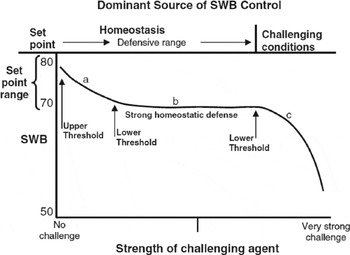
Changing levels of SWB as homeostasis is challenged

Measuring subjective wellbeing
Several key authors have taken up the challenge to promote the measurement and use of indicators of SWB. Veenhoven (Reference Veenhoven, Hagerty, Vogel and Møller2002, Reference Veenhoven and Eid2007) and Cummins (Reference Cummins2000, Reference Cummins, Lau, Mellor and Stokes2009) have done most to dispel the objections of policymakers, economist and social scientists. The conclusion of both researchers is that a subjective assessment of life satisfaction is both rigorous and necessary.
Two landmark studies conducted by Andrews and Withey (Reference Andrews and Withey1976) and Campbell and colleagues (Reference Campbell, Converse and Rodgers1976) solidified the notion that SWB could be reliably measured. Since this time, Cummins has proposed that not only is SWB incredibly stable, but that it operates within a ‘normal range’. Using data drawn from sixteen studies of population SWB (which used different measurement instruments and conducted in a variety of countries), Cummins (Reference Cummins1995:193) converted each reported population mean to a percentage of its scale maximum (SM) and found that ‘despite the use of very different methodologies, the combination of data from 16 unrelated studies into life satisfaction has yielded a mean of 75.02 per cent SM and a standard deviation of just 2.74’. Continuing this work, Cummins (Reference Cummins2010) used data from twenty-one Australian national surveys of SWB to propose a psychological mechanism of homeostasis, similar to physiological mechanisms which control body temperature and blood pressure.
Cummins (Reference Cummins2010) contends that under conditions of zero threat, SWB will average at approximately 75 points (on a 100-point scale). As mild sources of threat are experienced, the level of SWB will vary, but will remain within the set-point range of one standard deviation from the mean. However, as the strength of a threat (or the number of threats) intensifies, the ability of the homeostatic mechanism to maintain SWB is reduced. The outcome is that SWB is no longer controlled by homeostatic processes and as it is instead controlled by the challenging agent(s). During these times, measures of SWB will fall sharply.
Demonstrating the mechanisms that protect individuals from homeostatic defeat, Cummins compiles a range of evidence on external buffers, including income and supportive relationships. While Cummins contends that income cannot buy happiness, he notes that it can be used as a resource to alleviate some of the demands of daily living. As a result, those who lack financial resources are much more susceptible to the challenges posed by stressful events and circumstances. Similarly, supportive relationships can assist a person to moderate the influence of potential stressors, thereby making them more resilient. Demonstrating the additive effect of income and supportive relationships, Cummins notes the extreme predicament of single parents. Across the twenty-one surveys, only those single parents with an annual income over $60K reported a mean SWB within the normal range.
In addition to external buffers, Cummins (Reference Cummins2010: 8) proposes internal, psychological buffers of adaptation and habituation that ‘act over time to make us less aware of challenging experiences’. Cummins proposes the use of cognitive devices to make sense of consistent findings that people experiencing chronic health conditions report normal levels of SWB. However, while internal buffers can assist an individual to ‘cope’ with challenging circumstances, they cannot prevent homeostatic defeat if the challenges become too great. When this occurs, and SWB is no longer controlled by homeostasis, Cummins contends that the dominating emotional response to the stressor (either positive or negative) takes over. For those experiencing severe stress, whose wellbeing is referenced to negative emotions, Cummins (Reference Cummins2010: 13) contends that ‘this loss of positive mood is the essence of depression’.
Defining welfare policy success
The few large-scale studies that have examined how effectively the welfare state distributes SWB have produced vastly divergent results. Veenhoven (Reference Veenhoven2000: 109) deduced from his comparative study of forty-one nations from 1980 to 1990, that ‘the conclusion is clear: the scale of social insurance in a country makes no difference to the length, health and happiness of people's live in it’. Conversely, Pacek and Radcliff (Reference Pacek and Radcliff2008: 273) assert that SWB is enhanced by labour decommodification, echoing Einstein's contention that socialism ‘provides what is perhaps our best hope for improving the human condition’.
The failure of social and economic researchers to conclusively demonstrate the population benefits of an expanding welfare state has provided scope for theorists such as Charles Murray (Reference Murray and Lister1996a, Reference Murrayb) to suggest that generous welfare benefits encourage a culture of dependency that, rather than bolstering wellbeing, erodes recipient dignity. Within Western democracies, this latter position has gained the ascendency and has seen ‘a shift from Keynesian welfarism towards a political agenda favouring the relatively unfettered operation of markets’ (Larner, Reference Larner2000: 6). This neoliberal turn in contemporary social policy has seen a reconceptualisation of the welfare state within Liberal welfare regimes (Esping-Anderson, Reference Esping-Anderson1990), and has seen a shift in the aim of social security policy from originally providing recipients with an adequate income to now encouraging people to work (Saunders, Reference Saunders2002). The resultant ‘active labour market’ approach, taken up in a range of industrial democracies (OECD, 2007), has sought to improve the employability and employment of jobseekers and ultimately reduce welfare expenditure.
One of the new targets of such active labour market programs are single parents. These recipients, previously regarded as ‘deserving’, decommodified recipients now find themselves the unwitting ‘beneficiaries’ of the prospects offered by paid employment. Further, in contrast to voluntary programs, such as those found in the UK, in countries such as Australia, Canada, New Zealand and the United States, single parents have been compelled to take up employment ‘opportunities’ (for an overview of single parents' experiences of welfare to work programs across such countries, see Cook, in press).
The argument that SWB can be improved through employment relies on the assumption that wellbeing is derived from social participation (e.g., Putnam, Reference Putnam2000). Here, participation in the form of paid employment is assumed to create social capital that can be used to ‘produce’ SWB (Veenhoven, Reference Veenhoven and Eid2007). Further, participation is thought to foster a sense of control and inclusion. However, ‘this is not to say that more participation is always better and certainly not that participation in the public sphere is most conducive to subjective well-being’ (Veenhoven, Reference Veenhoven and Eid2007: 56). However, how welfare to work requirements have affected recipients has yet to be thoroughly examined.
To this end, a small group of statistical studies from Australia and the United States provide insight into single parents' SWB in light of their new-found welfare to work requirements (Alzate, Reference Alzate2006; Altman and Goldberg, Reference Altman and Goldberg2008; Cook et al., Reference Cook, Davis, Mckenzie and Smyth2009). These studies have highlighted the poor health status of welfare to work participants but have not yet provided convincing evidence of a quality of life benefit as a result of this transition. For example, the one study that did report a wellbeing benefit relied on participants’ retrospective evaluations of their life since leaving welfare (Altman and Goldberg, Reference Altman and Goldberg2008) and did not make use of a validated measure of SWB (for a review of SWB measurement see: Andrews and Withey, Reference Andrews and Withey1976; Diener et al., Reference Diener, Emmons, Larsen and Griffin1985; Pavot and Diener, Reference Pavot and Diener1993; Cummins, Reference Cummins1996). What this study seeks to evaluate is how a compulsory transition from welfare to work affects single parents' SWB over an eighteen-month period.
Policy and research context
Australia provides an interesting setting for this inquiry, and one that provides important insights for other states with both voluntary and involuntary active labour market programs. First, the Australian government has made explicit statements regarding the wellbeing benefits of welfare to work programs for participants, despite contradictory evidence regarding the psychological wellbeing of single parent income support recipients and their experience of welfare to work (see for example: Loxton et al., Reference Loxton, Mooney and Young2006; Kissane and Krebs, Reference Kissane and Krebs2007; Lee, Reference Lee2009). For example, when announcing the welfare to work measures in the 2005 budget papers (Commonwealth of Australia, 2005a, 2005b), the Liberal government described the benefits of employment as follows:
Increased participation in work from all Australians capable of work, including welfare recipients, increases individual wellbeing and is needed to help improve our future standard of living. (Commonwealth of Australia, 2005a: 5)
It is the veracity of this assertion that the current study aims to address.
As Australia is a relatively recent adopter of welfare to work measures for single parents, the introduction of reforms in 2006 made way for a ‘natural experiment’ where participants could be followed over the course of their welfare to work transition. As such, this study provides a unique assessment of the subjective experience of welfare to work, as it actually happened.
Method
Ethical approval was obtained prior to commencement. Participants were recruited through advertisements in free local newspapers, posters displayed in community centres and neighbourhood houses, and through national online newsletters such as those distributed by the Council for Single Mothers and their Children. Advertisements contained an email address and a local-call-cost phone number where participants could register their details. Inclusion criteria for the study were: being a single parent, receiving a government income support payment to which welfare to work requirements applied, and whose youngest child was of school age (which required them to participate in the most recent welfare to work reform activities).
Registered potential participants were contacted by the researcher who explained the study, confirmed they met the inclusion criteria and obtained their postal address. Eligible participants were then sent a questionnaire package, an information sheet outlining the study methods, a consent form and a reply-paid envelope. Eighteen months later, participants were mailed a follow-up package. Questionnaires were mailed back to the lead investigator. Participants were provided with a $20 retail gift card at baseline and follow-up for each completed survey.
A total of 619 people originally volunteered to participate. Of these 619 people originally sent a package, 353 (57.0 per cent) returned the questionnaire. Of these, 222 (62.9 per cent) returned a completed follow-up questionnaire. Those who completed the follow-up questionnaire had significantly fewer children (mean = 2.05) than those who did not (mean = 2.34; t = –2.55, p < 0.05), but did not differ on a range of other variables, such as parent or child age, hours worked, monthly income or baseline SWB.
As this analysis sought to examine the experience of benefit recipients who were compelled to increase their hours of employment, inclusion criteria were applied to narrow the sample to those participants working less than the required fifteen hours per week at baseline. As a result, twenty-eight people who did not provide their work hours were excluded, as were a further fifty-nine people who were working in excess of fifteen hours at baseline and thus already meeting their employment participation requirements. These exclusions provided a final sample of 135. The excluded participants did not differ significantly from the final sample on the variables listed above.
The sample was then divided into three groups comprised of: those who were not working at either baseline or follow-up (n = 72), hereafter referred to as those ‘not working’; those who were not working at baseline but who were working at follow-up (n = 27), hereafter referred to as those moving from ‘welfare to work’; and those who were working less than fifteen hours per week at baseline (n = 36), hereafter referred to as those who were required to ‘increase work hours’. The sample was divided in this manner to ensure that the data for baseline and/or follow-up ‘work hours’ and ‘change in work hours’ were more normally distributed for the ‘increase work hours’ and ‘welfare to work’ groups, respectively. As the work hours of those ‘not working’ remained constant over the course of the study, this group served as a control in the following analysis.
Measures
The baseline and follow-up packages assessed a range of variables, including SWB, work hours, income and demographics. SWB was measured using the Personal Wellbeing Index (PWI) (International Wellbeing Group, 2006) which is comprised of eight items including a global evaluation of life as a whole, and seven domains of life assessing satisfaction with standard of living, health, achievements, relationships, safety, community connectedness and future security. Each domain, including the global evaluation, is measured using an eleven point, end-defined scale ranging from 0 (completely dissatisfied) to 10 (completely satisfied). Individual scores are multiplied by 10 to give a percentile score from 0 to 100. The seven domain scores (excluding the global evaluation of life as a whole) are then summed and averaged to provide a mean score of SWB. There is evidence that the PWI is reliable and valid (Cummins et al., Reference Cummins, Eckersley, Pallant, van Vugt and Misajon2003), and correlates well with other SWB instruments (Renn et al., Reference Renn, Pfaffenberger, Platter, Mitmansgruber, Cummins and Höfer2009). Cronbach's alpha lies between 0.70 and 0.85 in Australian and overseas populations (International Wellbeing Group, 2006).
Hours worked each week, at each baseline and follow-up, were assessed using a single-item based on the Household Income and Labour Dynamics in Australia (HILDA) annual survey conducted by the Australian Government Department of Families, Housing, Community Services and Indigenous Affairs (Freidin et al., Reference Freidin, Watson and Wooden2002). Participants were asked, ‘Including any paid or unpaid overtime, how many hours do you usually work each week?’. Participants were provided with two boxes in which they could write a number from 00 to 99. ‘Change in work hours’ was calculated by subtracting hours usually worked at baseline from hours usually worked at follow-up, with positive values representing more hours worked at follow-up.
Twenty-one items were used to record participants’ sources and amounts of income; including post-tax employment income, government payments, child support and maintenance, private income streams, financial institution account interest, and income from ‘other’ sources. Categories were derived from the forty-three income categories used in the Australian Bureau of Statistics (ABS) (2008) Survey of Income and Housing. All income items were summed to produce a figure of ‘total monthly income’ at each baseline and follow-up. ‘Change in monthly income’ was calculated by subtracting baseline income from follow-up income with positive values indicating greater income at follow-up.
Analyses
Results were analysed using SPSS version 17.0. Paired sample t-tests and chi-square tests were used to assess any change in number of children, marital status and level of education within analysis groups over the course of the study. Chi-square tests and post-hoc comparisons using the Tukey HSD test were conducted to assess any differences in martial status, level of education, parent age, child age, number of children, baseline and follow-up monthly income, and change in work hours between the three groups.
For each sample, stepwise regression analyses were then used to assess the contribution of ‘change in work hours’ to the variance in each domain of the Personal Wellbeing Index. ‘Baseline work hours’, ‘baseline monthly income’, ‘change in monthly income’, ‘child age’ and the ‘baseline PWI domain score’ for each outcome variable were also entered into the model to assess any effect of these potential confounders. Stepwise regression analyses were employed to limit the number of variables included in the analysis and to reduce the chance of Type I error.
Results
Of the 135 participants who were included in the analysis, 98.3 per cent were the child's biological parent. The mean age of participants was 42.01 years (SD = 6.55) and the mean age of their youngest child was 10.70 years (SD = 2.24). Most participants (73.9 per cent) had two or fewer children. The majority of participants were divorced or separated (57.0 per cent) or never married (38.5 per cent) and had received an educational qualification such as a high school certificate (20.7 per cent), a trade or TAFE (technical or further education) certificate (28.1 per cent), or university qualification (15.6 per cent). The number of children, marital status and highest level of education did not differ between baseline and follow-up for each of the three analysis groups and were not significantly different across the three analysis groups.
Participants who were required to ‘increase work hours’ were working a mean of 8.33 hours per week at baseline (SD = 3.92; range 2–14 hours) which increased by 4.75 hours over the course of the study to an average of 13.08 hours at follow-up (SD = 11.10; range 0–40 hours). This increase in work hours was statistically significant (t = 2.568, p < 0.05). Post-hoc Tukey HSD tests also revealed that this increase in work hours was also significantly lower than the increase in work hours experienced by participants who moved from ‘welfare to work’. These participants, who were not working at baseline, increased their work hours to 15.94 hours per week at follow-up (SD = 9.46; range 2–46 hours).
Those participants who were ‘not working’ or who moved from ‘welfare to work’ had significantly lower incomes at baseline than those required to ‘increase work hours’. Participants who were ‘not working’ had a baseline mean monthly income of $1,713.37 (SD = $681.50). Those who moved from ‘welfare to work’ had a mean monthly income of $1,819.75 (SD = $832.41), whereas those who were already working at baseline (‘increase work hours’ group) had a mean monthly income of $2,731.97 (SD = $1,215.14). At follow-up, mean incomes for the three groups were: ‘not working’ mean = $2,141.21 (SD = $1,476.33); ‘welfare to work’ mean = $2,716.50 (SD = $1,261.90); ‘increase work hours’ mean = $2,671.70 (SD = $1,426.79). No significant differences were detected between groups for follow-up income or ‘change in income’ and no group significantly increased their income over time.
Predictors of subjective wellbeing
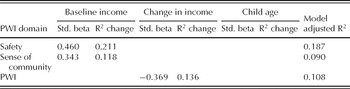
Using the stepwise regression method, significant models emerged for two of the analysis groups, with no significant results reported for the ‘not working’ participants. Several significant models were produced for participants who were required to ‘increase work hours’ (Table 1). ‘Baseline income’ and ‘change in monthly income’ were significant predictor variables for the domains ‘safety’ (F1, 32 = 8.580, Adj. R2 = 0.187, p < 0.01) and ‘community’ (F1, 32 = 4.267, Adj. R2 = 0.090, p < 0.05), and the PWI (F1, 31 = 4.886, Adj. R2 = 0.108, p < 0.05), respectively.
Predictors of change in SWB for participants required to increase work hours

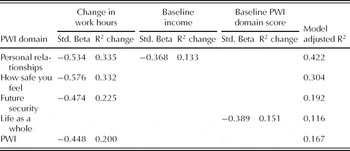
For participants who had moved from ‘welfare to work’, several significant models were produced including for the PWI (F1, 24 = 6.014, Adj. R2 = 0.167, p < 0.05), and the domains ‘personal relationships’ (F2, 23 = 10.128, Adj. R2 = 0.422, p < 0.01), ‘safety’ (F1, 24 = 11.914, Adj. R2 = 0.304, p < 0.01), ‘future security’ (F1, 24 = 6.955, Adj. R2 = 0.192, p < 0.05) and ‘life as a whole’ (F1, 24 = 4.275, Adj. R2 = 0.116, p < 0.05). Significant predictor variables are shown below (Table 2). ‘Change in work hours’ accounted for most of the variance (20−34 per cent) in the outcome variables.
Discussion
This is the first longitudinal study of its kind to examine the SWB of single parents over the course of their welfare to work transition. The results presented here provide important implications for policymakers and welfare researchers alike.
Benefits for single parents who are already working
For participants who were required to ‘increase work hours’, baseline income was the only predictor of their satisfaction with ‘personal safety’ and ‘sense of community’ at follow-up. This finding is consistent with SWB research that reports an income gradient (Cummins Reference Cummins2010).
The government's hypothesis that working more hours would improve wellbeing was not supported, although, given the small sample size, the null hypothesis cannot be rejected. While the increase in work hours for those required to ‘increase work hours’ was statistically significant, it may not have been practically significant for participants. In this case, the number of additional hours worked by participants at follow-up may not have been large enough to provide either the social capital benefits expected by government (Putnam, Reference Putnam2000; Veenhoven Reference Veenhoven and Eid2007) or exacerbate single parents' work/life stress (Pocock et al., Reference Pocock, Elton, Preston, Charlesworth, MacDonald and Baird2008). Further research is needed to evaluate the Australian government's requirement that single parents work fifteen or more hours per week to determine at what points work hours provide meaningful wellbeing benefits and conversely make managing work and family commitments more difficult. Countries with voluntary welfare to work requirements for single parents, such as the United Kingdom, allow single parents themselves to determine how much work they can accommodate.
Surprisingly, for participants already working at baseline (that is, those required to ‘increase work hours’), ‘change in income’ negatively predicted overall quality of life, with participants who reduced their incomes reporting better PWI scores at follow-up. It may be the case that these participants experienced lower incomes as their work hours increased and government benefits and other subsidies were withdrawn. This finding could provide evidence of the wellbeing benefits of employment for those who have already demonstrated that they can successfully engage in the labour market (that is those who were already working at baseline). This assertion is consistent with recent evaluations of active labour market programs where those with the fewest barriers to employment are most able to exit the welfare roll (Contini and Negri, Reference Contini and Negri2006; Dahl and Lorentzen, Reference Dahl and Lorentzen2003). However, without further research to explore the precise nature of participants’ income, employment and contextual situation, such definitive conclusions cannot be drawn. The fact that ‘change in income’ accounted for only 13.6 per cent of the variance in overall SWB supports the contention that other, more complex mechanisms are involved in improving participant wellbeing as income is reduced.
Predictors of change in SWB for participants moving from welfare to work

Benefits for those moving from welfare to work
For participants who moved from ‘welfare to work’, satisfaction with their personal relationships, safety, future security and overall SWB decreased as their work hours increased after controlling for monthly income. As such, the more participants worked, the more poorly they evaluated their SWB across a range of domains. While the mental health benefits of employment for poor women are unclear (Ali and Avison, Reference Ali and Avison1997; Baker and North, Reference Baker and North1999; Danziger, Carlson and Henly, Reference Danziger, Carlson and Henly2001; Gyamfi, Brooks-Gunn and Jackson, Reference Gyamfi, Brooks-Gunn and Jackson2001), the work characteristics most likely to improve mental health are full-time and stable employment (Zabkiewicz, Reference Zabkiewicz2010). These are not the types of jobs single parents moving from welfare to work have been found to attract (see for example: Riemer, Reference Riemer1997; Scott, Edin, London and Kissane, Reference Scott, Edin, London and Kissane2004; Cleaveland, Reference Cleaveland2005b; Ames, Brosi and Damiano-Teixeira, Reference Ames, Brosi and Damiano-Teixeira2006; Reschke and Walker, Reference Reschke and Walker2006) as the findings of this study seem to suggest – although the exact nature of single parents' work characteristics were not included in the analysis. Further, the positive mental health benefits from full-time and stable employment are increasingly unlikely for ‘welfare to work’ participants given the increasing flexibility of labour markets worldwide, including Australia (Hartman, Reference Hartman2005).
The findings reported here for participants moving from ‘welfare to work’ run counter to the purported benefits of the program, as espoused by the Australian government (Commonwealth of Australia, 2005a; Costello, Reference Costello2005). The disruption caused by a dramatic increase in work hours, in a job that provides little financial benefit, may explain these results. Using the parlance of SWB research (Cummins, Reference Cummins2010), the challenges posed by increased demands on parents' time and energy (without associated income benefits) may have defeated normal homeostatic processes. The long-term impact of such employment, however, remains unknown. Further research is needed to explore the SWB impact of welfare to work over the longer term.
Conclusions
The findings of this study reveal that an increase in work hours failed to provide improvements in SWB and, for those who were not working at baseline, actually reduced SWB. The results presented here are counter to the individual benefits described by the Australian government prior to the introduction of the welfare to work program (Commonwealth of Australia, 2005a, 2005b), which were used as a rationale for the program's implementation. The findings reported here are also contradictory to the findings of Altman and Goldberg (Reference Altman and Goldberg2008) who reported improvements in quality of life for single parents who were making the welfare to work transition in the United States.
As Cummins (Reference Cummins2010) contends, acute challenges to SWB can be overcome and homeostasis can be restored. From these data, however, it is unclear whether a move to employment represents an acute challenge, or whether the additional stress of combining work and family responsibilities poses a chronic challenge that will lead to permanent homeostatic defeat. The results from the ‘increase work hours’ analysis suggests that such challenges can be overcome, however; as alluded to previously, selection biases may be at play. It is unknown, for example, whether those not working at baseline faced more barriers to employment (such as physical and mental health issues, availability of transport, proximity to employment, etc.) than those already employed. These selection biases, however, can be regarded as further stressors that threaten unemployed single parents' SWB.
What can be gained from the findings of this study is that participants who are not already working are a particularly vulnerable group who face significant challenges associated with a mandatory transition from welfare to work. While is seems common-sense that those who need the most support will be least able to move from welfare to work, policies that impose participation requirements without meaningful efforts to improve the material, social and psychological resources available to single parents will perpetuate the negative results found here.
More work is now needed to identify the factors that support single parents to make a successful transition from welfare to work. By doing so, programs can target employment interventions to the needs of single parents to ensure an effective transition, and return quality of life to within the range normally experienced by the general population. If welfare to work programs continue to be cast in terms of social inclusion, as is the case in Australia (Social Inclusion Unit, 2009), then surely they must be judged on how well they provide inclusive experiences to participants, such as standard of living, achievements in life and feeling a level of future security comparable to members of the wider society.
Acknowledgements
This research was funded by the Australian Research Council as a Linkage Grant in partnership with and co-funded by the Brotherhood of St Laurence.