Introduction
Hosts of fleas are predominantly mammals, where 74% of the extant species of the order Siphonaptera have been recorded within the order Rodentia (Krasnov, Reference Krasnov2008; Whiting et al., Reference Whiting, Whiting, Hastriter and Dittmar2008). Most of the flea diversity takes place on small rodents belonging to the families Muridae and Cricetidae (Medvedev, Reference Medvedev1997; Ceballos and Oliva, Reference Ceballos and Oliva2005). However, researching on the relationship of host identity with flea infection parameters would aid in determining whether some host species play a critical role on flea diversity (Krasnov et al., Reference Krasnov, Shenbrot, Khokhlova and Degen2004a). Some factors that determine flea abundance at a global scale include those directly related to ecophysiological parameters of fleas and hosts, as well as others depending on the environment, like location or climatic season (Krasnov et al., Reference Krasnov, Shenbrot, Khokhlova and Poulin2006a; Lareschi and Krasnov, Reference Lareschi and Krasnov2010). It has been found that every flea species usually have specific abundance levels on some particular host species, and each host species regularly have similar and consistent flea abundance levels across regions (Krasnov et al., Reference Krasnov, Poulin, Shenbrot, Mouillot and Khokhlova2004b). Additionally, different infection parameters complement the information about the number of parasites on individuals and host populations (Durden et al., Reference Durden, Polur, Nims, Banks and Oliver2004). Therefore, evaluation of different infection parameters such as prevalence (percent of individuals parasitized) and mean abundance (mean number of parasites found in all hosts) (Bush et al., Reference Bush, Lafferty, Lotz and Shostak1997) enables comparing measurements of infection across two or more samples, in turn facilitating different biological interpretations. Thus, in order to better understand the ecological relationships between fleas and their hosts, it is relevant to investigate which host species would account for the differences in flea infection parameters at regional or local scales.
Mexico harbours high flea and rodent diversity, which is located particularly in mountain areas of central part of the country (Barrera, Reference Barrera1968; Ceballos and Oliva, Reference Ceballos and Oliva2005). In this region, the Trans-Mexican Volcanic Belt (TVB) is an area of significant biodiversity of mammals, with around 198 species (Escalante et al., Reference Escalante, Rodríguez-Tapia and Morrone2004; Ceballos and Oliva, Reference Ceballos and Oliva2005). Within the TVB also occur 60% of the 172 flea taxa and 53% of flea diversification nodes described for Mexico (Morrone and Gutiérrez, Reference Morrone and Gutiérrez2005; Acosta and Fernández, Reference Acosta, Fernández, Luna, Morrone and Espinosa2007; Acosta-Gutiérrez, Reference Acosta-Gutiérrez2014). Thus, the family Cricetidae (particularly the genera Peromyscus, Microtus and Reithrodontomys in central Mexico) harbours the majority of flea species (Morrone and Gutiérrez, Reference Morrone and Gutiérrez2005). Hence, some rodent species regularly show high flea prevalence (FP). For instance, Peromyscus melanotis Allen and Chapman (1897), Microtus mexicanus Saussure (1861) and Peromyscus difficilis Allen (1891) have shown high flea infections measured as FP or FMA in several sites of the TVB including Chichinautzin hill and Popocatépetl volcano (environs of Popocatépetl), Cerro Potosí Nuevo León and the Oriental Basin (Barrera, Reference Barrera1968; Tipton and Mendez, Reference Tipton and Mendez1968; Acosta and Fernández, Reference Acosta and Fernández2015).
In La Malinche National Park, (LMNP), an isolated volcano in the TVB, eight micromammal hosts and 11 flea species have been recorded in the temperate forest. In this location, host species such as P. difficilis, P. maniculatus Wagner (1845) and P. melanotis could be relevant on flea abundance (Acosta and Fernández, Reference Acosta, Fernández, Fernández and López-Domínguez2005). Considering that there are differences in the flea abundance among host species, putative key host species were searched for in regards to flea infection parameters at a local scale. Our aims were: to list micromammal flea species in LMNP; to characterize infection parameters of fleas on their host species and to search for differences of flea infection parameters among host taxa.
Material and methods
Study site
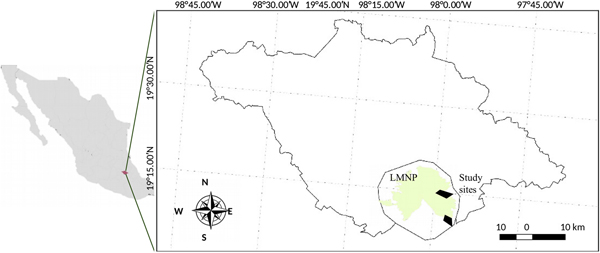
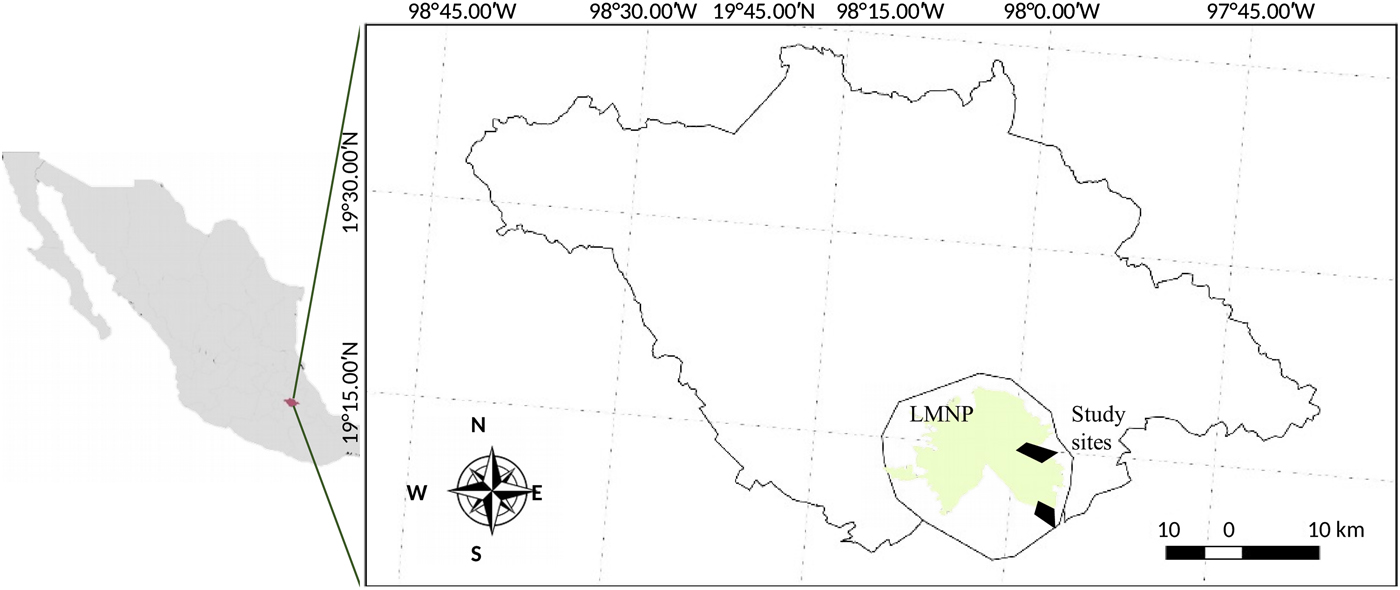
The study site is located in the oriental slope of the volcano of LMNP in Tlaxcala, Mexico (Fig. 1). The set of capture sites is between coordinates 19°11′ – 19°15′N and 97°57′ – 97°59′W with an altitude varying from 2850 to 3146 m. Weather in the area is temperate subhumid with a summer rainy season. The average monthly rainfall in summer is 60.2 mm (from April to October), with a winter rainfall of around 5% of the summer months (mean rainfall of 7.9 mm per month from January to March). The temperature in this area, recorded at the nearest weather station located at ‘La Malinche’ Research Station (LMRS), ranges between −2.8 and 21.8 °C. The mean temperature is 7 °C in winter and 11 °C in summer. The dominant vegetation in the sampled area includes conifer forests with pine species (Pinus montezumae, P. pseudostrobus, P. teocote), oaks (Quercus crassifolia, Q. laurina, Q. rugosa), fir (Abies religiosa), grasses (Muhlenbergia macroura and Stipa ichu) and crop lands (with seasonal plantations of Zea mays, Phaseolus vulgaris and Cucurbita sp.) (Villers and López, Reference Villers, López, Villers and López2004). There are 27 mammal species recorded in LMNP, including 11 micromammals: 10 mice and 1 shrew, four of them endemic to Mexico (Ruiz-Soberanes and Gómez-Álvarez, Reference Ruiz-Soberanes and Gómez-Álvarez2010).
Map of the study site with the capture sites.
Field and data collection
Eighteen trap sites were selected and were 500 m apart in order to obtain different host species. Each trap site was visited every 2 months from March 2014 to December 2015, resulting in each trap site being set and examined up to 10 times (sample campaigns). Through this period, a trapping effort of 10 115 traps/night was employed. In every trapping site were used 30 Sherman® traps baited with oat flakes during two nights. A grid of traps was set with 3 lines and 10 rows with a separation of 10 m between lines and rows. Traps were checked next morning and the individuals were taken to the LMRS laboratory for inspection: Each rodent was handled to measure their body weight, total length (from nose tip to tail end), tail, left hind foot and ear lengths (Hall, Reference Hall1981). Specimens were identified to a species level with taxonomic keys and photographs and were individually marked with a code of holes using an ear punch (Kent Scientific™ INS750075-5) (Hall, Reference Hall1981; Álvarez-Castañeda et al., Reference Álvarez-Castañeda, Álvarez and González-Ruiz2015). Rodent voucher specimens were housed in Colección de Vertebrados of Centro Tlaxcala de Biología de la Conducta.
To obtain flea samples, individual hosts were introduced into a transparent plastic bag. Each individual was thoroughly combed for 1 minute, particularly in the rump and head areas. Fleas were then collected from the bottom of the plastic bags and stored in labelled vials with 70% alcohol. Once sampling of the hosts was carried out, they were returned alive and uninjured to their original trapping site. It was possible to trap micromammals during two consecutive nights in every field campaign, if some individuals were captured twice in the same campaign, only fleas obtained during the first night were included in the analysis. In order to identify flea species, the procedure of Smit (Reference Smit1957) was used. Flea specimens were determined using the taxonomic keys of Traub (Reference Traub, Schmidt and Ross1950); Barrera (Reference Barrera1954); Hopkins and Rothschild (Reference Hopkins and Rothschild1962); Morrone et al. (Reference Morrone, Acosta and Gutiérrez2000); Acosta and Morrone (Reference Acosta and Morrone2003); Hastriter (Reference Hastriter and Hastriter2004) and Acosta (Reference Acosta2010). Mounted fleas were housed at Siphonaptera collection ‘Alfonso L. Herrera’, Museo de Zoología, Facultad de Ciencias, UNAM.
Data analysis and sample sizes
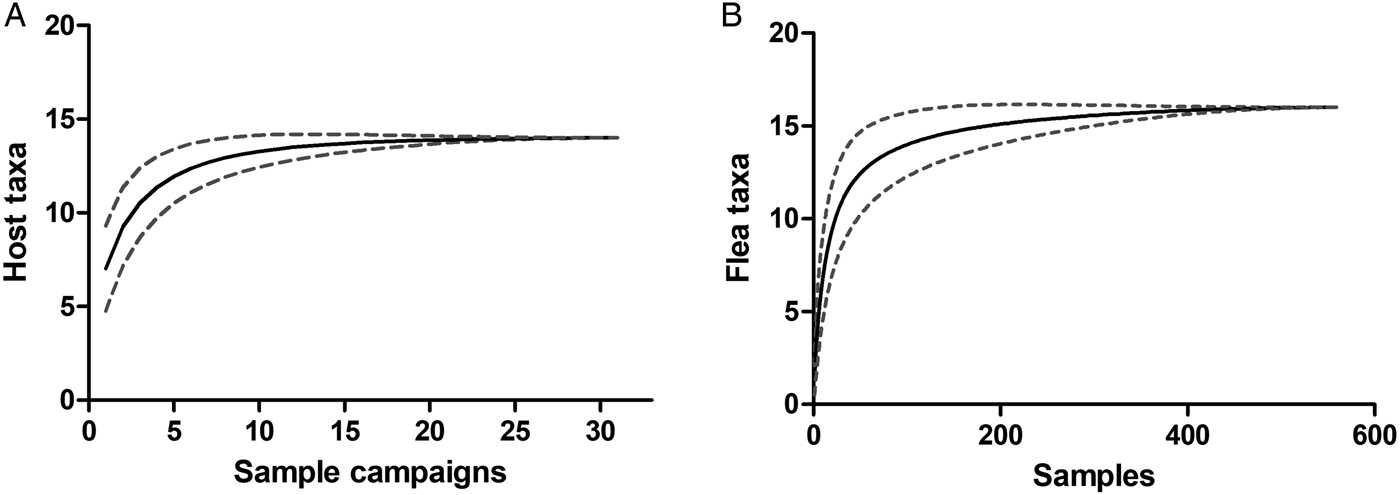
To verify the representativeness of our sampling both on host and flea taxa, sample-based rarefaction curves were computed with EstimateS version 9.10 (Colwell, Reference Colwell2013). Bootstrap was used to obtain estimations of the maximum number of species captured with n number of samples either for host or flea species.
In order to optimize flea species recognition, all flea samples from rare host species were identified, while from the commonest host species (Neotomodon alstoni and Peromycus melanotis) a subset of the flea samples was identified. This subset was selected randomly considering the representativeness of climatic seasons. Thus, according to Bootstrap, the asymptote for the two commonest hosts was reached at 14 flea species for N. alstoni with 101 samples and 12 for P. melanotis with 51 flea samples. A total of 708 flea specimens were stored for later full identification.
To identify the importance of host species on flea parasitism, flea infection parameters were used to provide information about the proportion of host parasitized in the population [prevalence (FP)], and the intensity of flea parasitism on the whole host population [mean abundance (FMA)]. Equations of infection parameters were defined according to Bush et al. (Reference Bush, Lafferty, Lotz and Shostak1997) as prevalence (FP) = number of infected hosts/total number of hosts; and mean abundance (FMA) = total number of fleas/total number of hosts. Additionally, it was tested if both flea infection variables were related by using a Pearson Correlation.
For statistical analyses, data were excluded from host species with reduced sample sizes (n < 12 individuals) in order to better fit modelling, thus the dataset for analyses involved 11 host species with n = 1257. Independent analyses were performed for (1) FP and (2) FMA. In every case, host species were assigned as a predictor, and site and sex as random factors. In the first case, the site might influence the host species composition and flea abundance due to distinct micro-environmental conditions including temperature and humidity (Krasnov et al., Reference Krasnov, Shenbrot, Khokhlova and Poulin2006a; Lareschi and Krasnov, Reference Lareschi and Krasnov2010). While for the second case, males are generally more parasitized than females on micromammal host species (Morand et al., Reference Morand, Goüy de Bellocq, Stanko and Miklisová2004). The goal was to exclude site and sex biases that could obscure the host identity effect on flea abundance. (1) For FP, the individual host datasets were arranged as either being infected or non-infected (expressed as 0 and 1; n = 1257). Then, a generalized linear mixed-effects model (GLMM) with binomial errors and a dispersion parameter of 1.3 was fitted (Crawley, Reference Crawley2007; Bates et al., Reference Bates, Maechler, Bolker and Walker2015). (2) For FMA among host species, a database with the total flea counts on every host individual (n = 1257) was used. Then a GLMM with a negative binomial distribution and a dispersion parameter of 0.74 given by the model was used. Data analyses were performed with R version 3.3.2 (R Development Core Team, 2016), using the packages lme4 (Bates et al., Reference Bates, Maechler, Bolker and Walker2015) and glmmADMB (Fournier et al., Reference Fournier, Skaug, Ancheta, Ianelli, Magnusson, Maunder, Nielsen and Sibert2012; Skaug et al., Reference Skaug, Fournier, Bolker, Magnusson and Nielsen2014).
Results
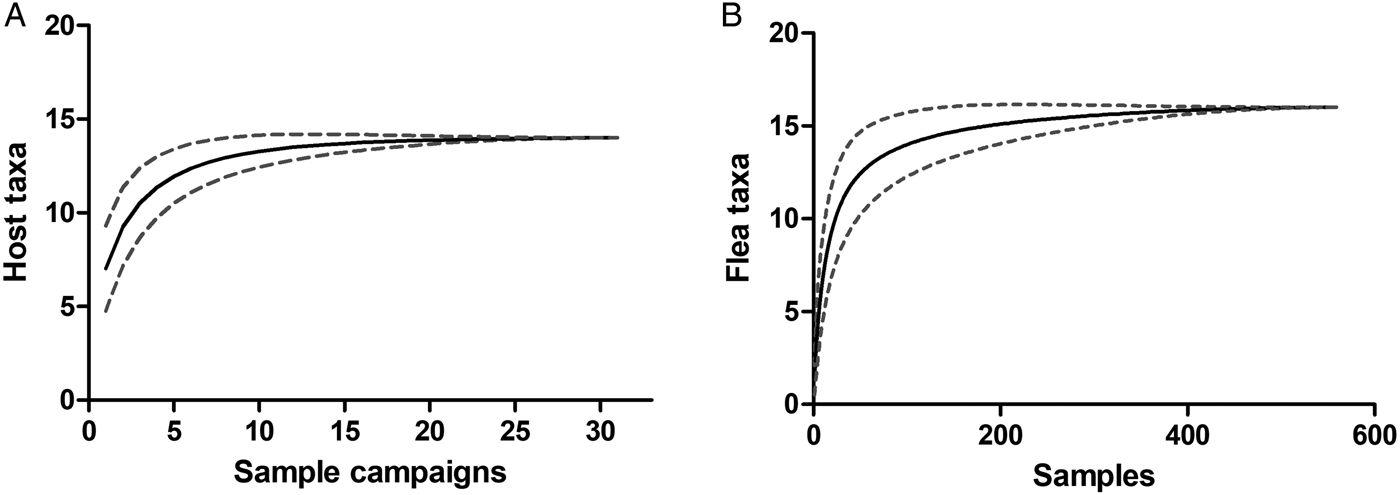
A total of 1902 individuals belonging to 13 species of rodents and 1 soricomorph (Sorex sp.) were captured. The analysis of rarefaction curves for hosts reflected the asymptote at 14 host taxa with 8 visits (with Bootstrap) for each trapping site (Fig. 2A). The relative abundances of these host species were in descending order as follows: Neotomodon alstoni Merriam (1898) (47%), Peromyscus melanotis (17%), Reithrodontomys fulvescens Allen (1894) (13%), Peromyscus difficilis (8), P. maniculatus (5%), P. gratus Merriam (1898) (3%), Heteromys irroratus Gray (1868) (2%), Sorex sp. (1%), then P. leucopus Rafinesque (1818), Reithrodontomys sumichrasti Saussure (1861), P. levipes Merriam (1898), Microtus mexicanus, Neotoma mexicana Baird (1955), and Reithrodontomys megalotis Baird (1857) (<1%).
Rarefaction curves of observed richness (± 95% CI) in field campaigns (Sample campaigns) (A) and flea samples (B). In graphic A, according to Bootstrap index, 14 host species are most probably found with eight visits to every trapping site. In graphic (B), 16 flea taxa are obtained from 208 vial samples containing micromammal fleas.
Micromammal flea species
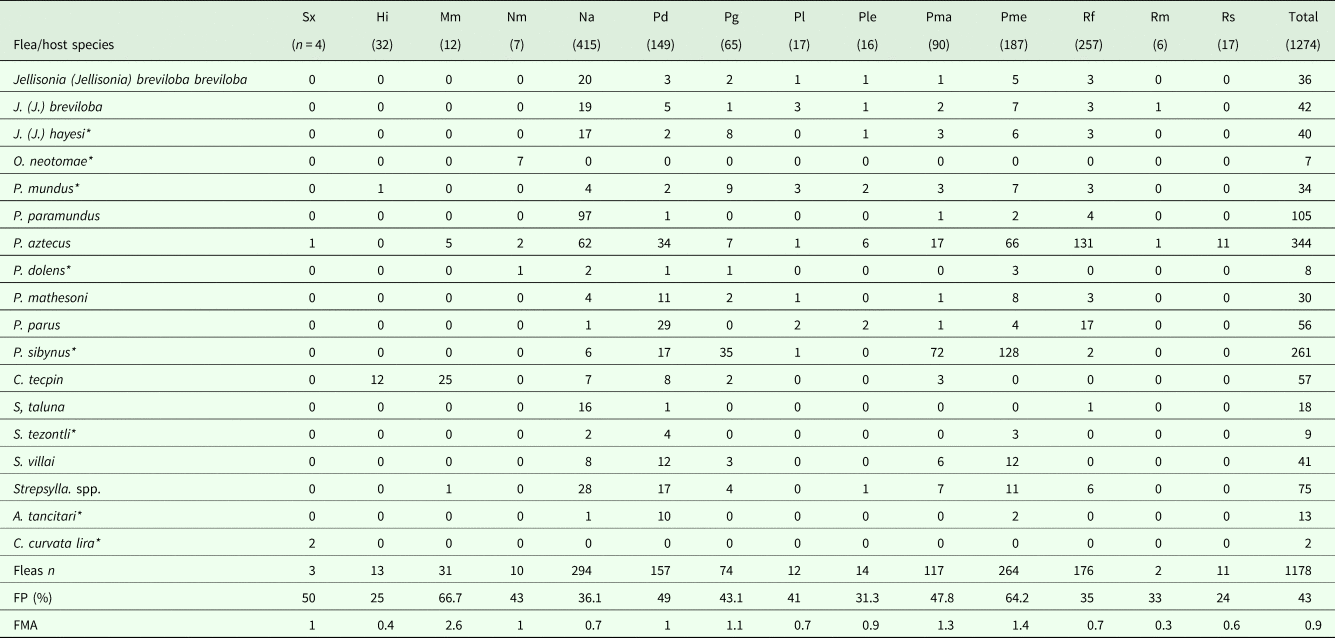
A total of 1886 fleas were collected from the sampled hosts (1902 individuals). From this, 1178 fleas obtained from 1274 host individuals were taxonomically identified. The rarefaction Bootstrap curve reached the asymptote at 16 flea species collected from 208 host samples (Fig. 2B). These 16 flea species belong to 8 genera and 3 families (Table 1). Eight flea species including 1 subspecies were new records for this area (Corrodopsylla curvata lira Traub (Reference Traub, Schmidt and Ross1950), Table 1). Flea taxa infesting more than one host species belong to the family Ceratophyllidae. The most common flea species were Plusaetis aztecus Barrera (Reference Barrera1954) on 13 different host taxa, Jellisonia (Jellisonia) breviloba ssp., and Pleochaetis mundus Jordan and Rothschild (1922) on 9 each one. Fleas infesting fewer host species were Atyphloceras tancitari Traub and Johnson (1952), Strepsylla taluna Traub and Johnson (1952) and Strepsylla tezontli Acosta (Reference Acosta2010), all of them found on three host species; while Orchopeas neotomae Augustson (1943) and C. curvata lira were found in one host species (Table 1).
Number of fleas of every flea species on every host species.
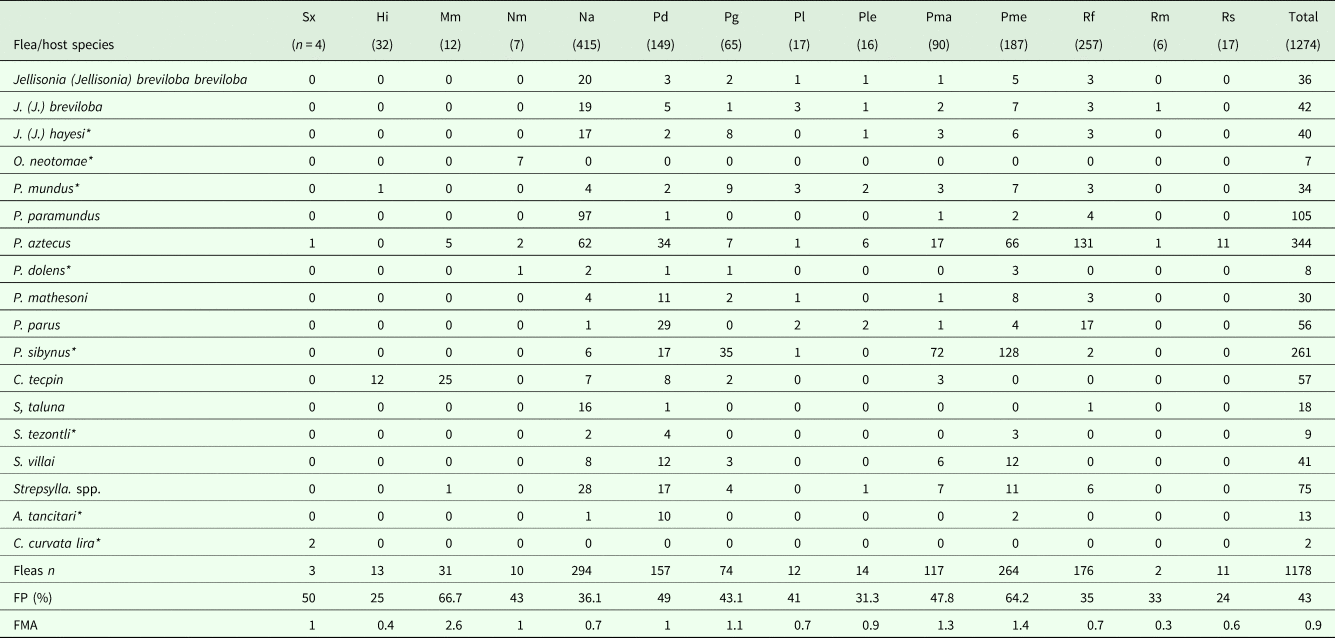
Table header shows host species and the number of individuals in the columns 2–15 as follows: Mm = Microtus mexicanus, Pme = P. melanotis, Pd = Peromyscus difficilis, Pma = P. maniculatus, Pg = P. gratus, Pl = P. leucopus, Na = Neotomodon alstoni, Rf = Reithrodontomys fulvescens, Ple = P. levipes, Hi = Heteromys irroratus, Rs = R. sumichrasti, Rm = R. megalotis, Nm = Neotoma Mexicana, Sx = Sorex sp. At the bottom of the table, Fleas n indicates the sum of fleas on every host species and below the overall values of percentage of flea prevalence (FP %) and flea mean abundance (FMA) for every host species. The last column indicates the sum of flea numbers for every species and the overall values for infection parameters.
*Not previously recorded flea taxa for the site.
Regarding flea richness on micromammal host species, P. difficilis and N. alstoni had the highest value with 14 flea species and 1 subspecies; and P. melanotis with 12 sp. and 1 subspecies. Host species with the lowest flea richness were H. irroratus, R. megalotis and Sorex sp., with two species each one, and R. sumichrasti with 1 species (Table 1).
Flea infection parameters on each host species
Both infection parameters of hosts FP and FMA were positively correlated (Pearson R 2 = 0.71, P < 0.001). Flea species with the highest infection parameters were Plusaetis aztecus, P. sibynus Jordan (1925) and Pleochaetis paramundus Traub (Reference Traub, Schmidt and Ross1950), and among the more prevalent also Strepsylla sp. Fleas with the lowest infection parameters were C. curvata lira, and O. neotomae. Excluding lowly represented host species (n < 12), P. aztecus appeared to have the highest FP on R. fulvescens, M. mexicanus and P. levipes. Plusaetis sibynus reached its highest FP on P. melanotis, P. maniculatus, and P. gratus. Pleochaetis paramundus showed the highest FP on N. alstoni and R. fulvescens (Table 1). Plusaetis aztecus reached the highest FMA on R. sumichrasti, R. fulvescens and M. mexicanus. Plusaetis sibynus occurred mainly on P. maniculatus, P. melanotis and P. gratus, and the same for Pleochaetis paramundus on N. alstoni and R. fulvescens (Table 1).
Influence of host species identity on flea infection parameters
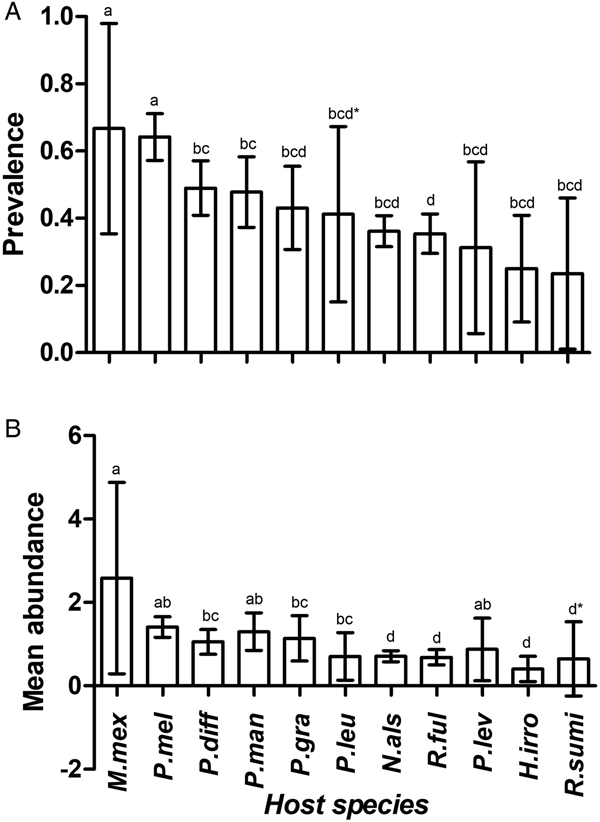
Evidence suggests that host species influenced FP (χ 2 = 47.96, df = 10, P < 0.001). Microtus mexicanus, P. melanotis, P. difficilis and P. maniculatus showed a FP significantly above the overall mean values (Fig. 3A). Post-hoc comparisons showed that P. melanotis showed higher FP than all other hosts except for M. mexicanus and P. leucopus (P < 0.05, P < 0.001; Fig. 3A). Then, M. mexicanus had significantly higher FP than R. fulvescens, H. irroratus and R. sumichrasti (P < 0.05). Similarly, P. difficilis had significantly higher FP than H. irroratus and R. fulvescens (P < 0.05). Finally, P. maniculatus had higher FP than R. fulvescens; Neotomodon alstoni than R. sumichrasti; and, the rodent species with the lowest FP though without statistical influence were R. sumichrasti, H. irroratus and P. levipes (Table 1).
(A) Differences in the numbers of infected vs non-infected host individuals (prevalence) among micromammal species (χ 2 = 47.96, df = 10, P < 0.001). Columns show mean ± 95% CI of infected (represented as 1) and non-infected individuals (0). Different letters indicate post-hoc statistical significant differences among host species. *The differences between P. melanotis and P. leucopus was nearly significant (P = 0.06). (B) Differences in the flea mean abundance among host micromammals (χ 2 = 52.64, df = 10, P < 0.001). Columns show mean ± 95% CI of the total abundance of host individuals. Different letters indicate post-hoc statistical significant differences among host species (*It was not possible to run a comparison between P. maniculatus vs R. sumichrasti).
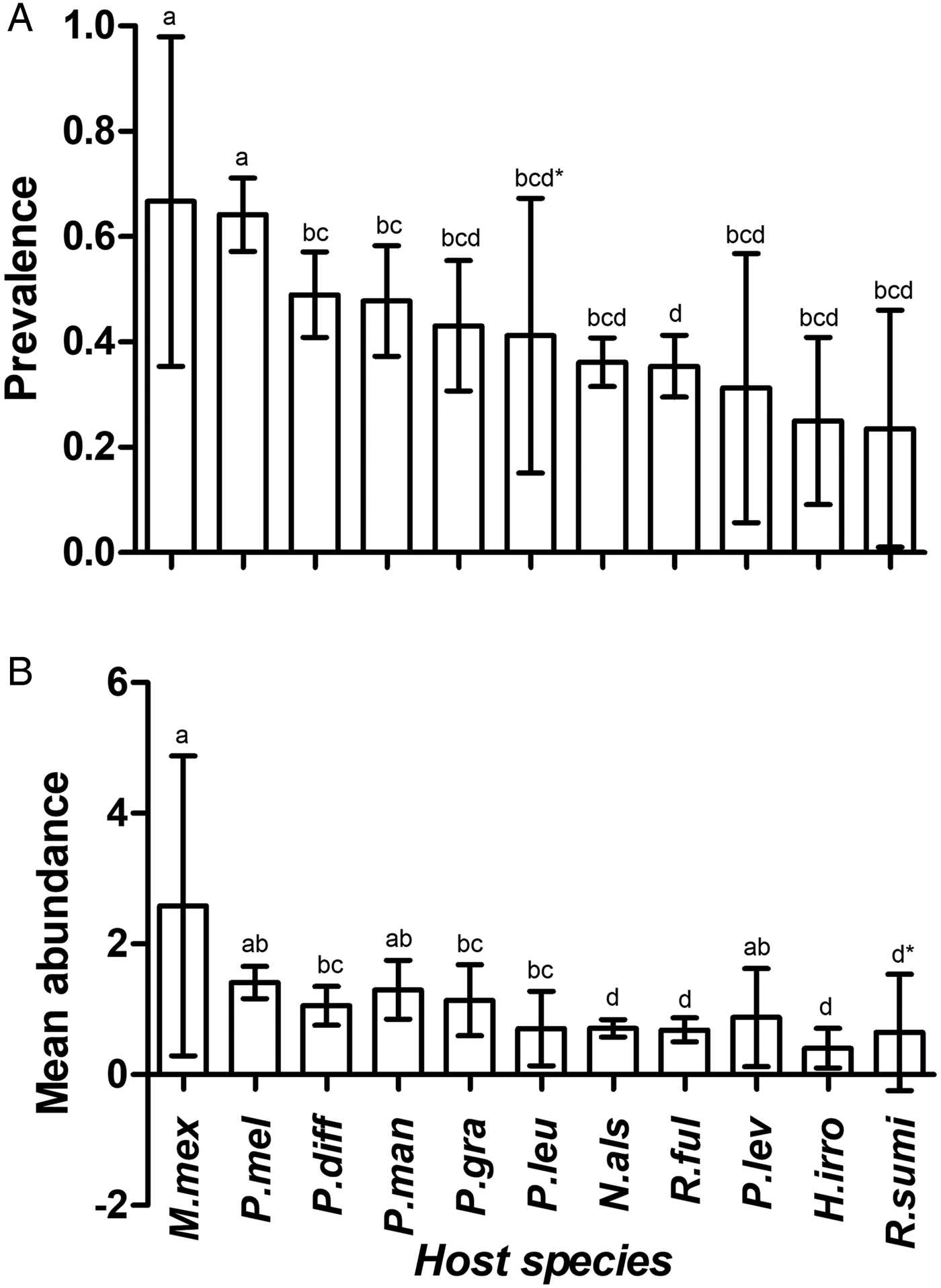
FMA was also influenced by host species (χ 2 = 52.64, df = 10, P < 0.001). Microtus mexicanus, P. melanotis, P. maniculatus, P. difficilis and N. alstoni had a higher FMA than their heterospecifics (Fig. 3B). Post-hocs showed that M. mexicanus had significantly higher flea abundance than P. gratus, P. difficilis, P. leucopus, N. alstoni, R. fulvescens, R. sumichrasti and H. irroratus (P < 0.05). Likewise, P. melanotis showed higher flea abundance than N. alstoni, R. fulvescens, R. sumichrasti and H. irroratus (P < 0.05). Then, P. maniculatus had higher FMA than N. alstoni, R. fulvescens and H. irroratus (P < 0.05). Lastly, FMA in P. difficilis was higher than in R. fulvescens (P < 0.01) and N. alstoni had higher FMA than H. irroratus (P < 0.05; Fig. 3B).
Discussion
Our results revealed that flea species richness and their infestation parameters differ among host micromammal species evidencing that host identity influences them. Host and flea species richness corresponded with the high diversity recorded for the Transmexican Volcanic Belt (TVB) and diversification nodes of fleas and rodents, described for Mexico (Morrone and Gutiérrez, Reference Morrone and Gutiérrez2005; Acosta and Fernández, Reference Acosta, Fernández, Luna, Morrone and Espinosa2007; Acosta-Gutiérrez, Reference Acosta-Gutiérrez2014; Escalante et al., Reference Escalante, Rodríguez-Tapia, Linaje, Morrone and Noguera-Urbano2014). Such as in other regions of North America and Mexico, Myomorphs rodents of the genus Peromyscus dominated wild micromammal assemblages (Calisher et al., Reference Calisher, Mills, Sweeney, Root, Reeder, Jentes, Wagoner and Beaty2005; Sánchez-Cordero et al., Reference Sánchez-Cordero, Peterson, Martínez-Meyer and Flores2005), this contrasts with the lower frequency of Soricomorph individuals. Particularly, the highest relative abundance of host species in the whole sample as N. alstoni, P. melanotis and P. difficilis agrees with findings in other locations of the TVB (Fa et al., Reference Fa, López-Paniagua, Romero, Gómez and López1990; Sánchez-Cordero and Canela-Rojo, Reference Sánchez-Cordero and Canela-Rojo1991), Nuevo León (Tipton and Mendez, Reference Tipton and Mendez1968) and the Oriental Basin (Acosta and Fernández, Reference Acosta and Fernández2015). The number of flea species found here, involved non-parantropic flea species differing to previously reported Pulex irritans in lagomorphs at LMNP (Acosta and Fernández, Reference Acosta, Fernández, Fernández and López-Domínguez2005). The flea species number on mice is one of the highest for a survey in a single location (LMNP) in Mexico and North America. In this regard, data from some locations was higher than ours in the USA (with 20 and 23 flea species, at Chuchupate, Campground, Ventura County, California and Colorado Rocky Mountain National Park, Davis et al., Reference Davis, Smith, Madon and Sitko-Cleugh2002; Eads and Campos, Reference Eads and Campos1983; respectively) and from Mexico (28 and 29 species, at Cerro Potosí, Nuevo León and environs of Popocatépetl, volcano, Barrera, Reference Tipton and Mendez1968; Tipton and Mendez, Reference Tipton and Mendez1968, respectively). The pattern of flea richness has been suggested to be higher in the Holarctic region (Krasnov et al., Reference Krasnov, Shenbrot, Khokhlova and Degen2004a). Correspondingly, in America, most of the studies have reported 12 or fewer flea species on mammals in a limited area e.g. from the southern regions Brazil, Bolivia and Argentina (de Carvalho et al., Reference de Carvalho, Serra-Freire, Linardi, de Almeida and da Costa2001; Pucu et al., Reference Pucu, Lareschi and Gardner2014; Sanchez and Lareschi, Reference Sanchez and Lareschi2018) and from North America in Missouri, Montana and Iowa (Kollars et al., Reference Kollars, Durden and Oliver1997; Brinkerhoff et al., Reference Brinkerhoff, Ray, Thiagarajan, Collinge, Cully, Holmes and Gage2008; Storm and Ritzi, Reference Storm and Ritzi2008). Thus, the flea richness found in LMNP is considered high and particularly alike with Nearctic region (Krasnov et al., Reference Krasnov, Shenbrot, Khokhlova and Degen2004a).
The flea species richness varied among hosts where some flea taxa reach high abundance in particular host species. This is a common pattern in other flea community studies across regions (South Africa; van der Mescht and Mathee, Reference van der Mescht and Matthee2017; Great Basin, USA-Mexico, Brinkerhoff et al., Reference Brinkerhoff, Ray, Thiagarajan, Collinge, Cully, Holmes and Gage2008; Palaearctic region, van der Mescht et al., Reference van der Mescht, Warburton, Khokhlova, Stanko, Vinarski, Korallo-Vinarskaya and Krasnov2018). In this study, six micromammal species hosted more than 10 flea species and two species (P. difficilis and N. alstoni) hosted around 90% of flea species recorded. In other studies, mice as M. mexicanus, P. maniculatus and P. melanotis also harboured between 11 and 13 flea species in Popocatépetl environs (Barrera, Reference Barrera1968). Peromyscus melanotis, harboured up to 15 flea species in one location (Cerro Potosí, Nuevo León, Mexico, Tipton and Mendez, Reference Tipton and Mendez1968). Likewise, P. difficilis and N. alstoni have been found among the hosts with more flea species in the mice community. Peromyscus difficilis had seven species in environs of Popocatépetl, nine in the Oriental Basin (Barrera, Reference Barrera1968; Acosta and Fernández, Reference Acosta and Fernández2015) and 10 in Cerro Potosí (Tipton and Mendez, Reference Tipton and Mendez1968), while N. alstoni had the highest flea richness in the previous study in LMNP (Acosta and Fernández, Reference Acosta, Fernández, Fernández and López-Domínguez2005) with 6 flea species. This agrees with observations from flea collections in Utah where hosts of Peromyscus size showed the highest flea richness (Bossard, Reference Bossard2006). Conversely, micromammals such as R. sumichrasti, N. mexicana, R. megalotis and Sorex sp. hosted few flea species (1–3). Similar results have been found on Sorex sp. (French, Reference French1982; Ayala-Barajas et al., Reference Ayala-Barajas, Morales, Wilson, Llorente and Ponce1988; Laakkonen et al., Reference Laakkonen, Henttonen, Hastriter, Niemimaa and Jarell2002; Acosta et al., Reference Acosta, Fernández, Llorente and Jiménez2008). Likewise, N. mexicana and R. megalotis had the lowest flea richness in environs of Popocatépetl (Barrera, Reference Barrera1968). It has to be noted the importance of these rare host species in the field because they contribute to the local mammal and parasite species richness influencing flea community structure and abundance (Linardi and Krasnov, Reference Linardi and Krasnov2013). Therefore, our results provide evidence for the importance of host identity in explaining the flea species richness, and host species such as P. difficilis, N. alstoni and P. melanotis apparently are key species that can drive the dynamic of flea community structure in this region.
Flea infection parameters for host species
The flea infections parameters (FP and FMA) were positively correlated in LMNP in concordance with a theory on fleas (Krasnov et al., Reference Krasnov, Stanko, Miklisova and Morand2005), ixodid ticks (Stanko et al., Reference Stanko, Krasnov, Miklisová and Morand2007) and for parasites in general (Poulin, Reference Poulin2007). Our results corroborate the statement about this positive correlation between parasite mean abundance and parasite prevalence is a general law in parasite ecology (Poulin, Reference Poulin2007). Subsequently, FP and FMA varied among micromammal host species studied in LMNP. Overall FP and FMA from all host species in this study is close to data from Myomorph rodents from other temperate forest, such as Chuchupate California, USA [overall FP 46.3% (range 24–100%), overall FMA 1.7 (range 0.6–2.7), Davis et al., Reference Davis, Smith, Madon and Sitko-Cleugh2002]. Although FP range from California seems higher than ours, excluding data from the California vole (Microtus californicus), which had the highest FP and FMA, bring the range closer to our results (24–54%). Similarly, our results of FP and FMA seem close to those of Myomorph rodents in two studies in Rocky Mountain National Park, Colorado, USA (FP 39–48.7% and FMA 1.1–2.1 (exclusively for P. maniculatus), Eads and Campos, Reference Eads and Campos1983; and overall FMA 0.6, range 0.3–1.3, Maher and Timm, Reference Maher and Timm2014). This makes sense because the Colorado study site is akin to LMNP in altitude and vegetation type. Nonetheless, overall infection parameters were higher than ours in a pine (Pinus spp.) plantations area (Dichato) in southcentral, Chile (overall FP averaged 67.4% and FMA 2.7, Bazán-León et al., Reference Bazán-León, Lareschi, Sánchez, Soto-Nilo, Lazzoni, Venegas, Poblete and Vásquez2013). The explanation here is that this area is immersed in the Chilean chaparral branded by distinct (to temperate forest) flea infection parameters (Friggens and Beier, Reference Friggens and Beier2010). Also, environs of Popocatépetl FMA showed higher values than our results (overall FMA 4, range 1.2–6.6, Barrera, Reference Barrera1968), even though vegetation is similar to LMNP. Moreover, the results were contrary to findings in the desert biome, such as in the Oriental Basin, Mexico (FP ranged 70–100% and FMA 1.5–4.2, Acosta and Fernández, Reference Acosta and Fernández2015) and Cerro Potosí, Nuevo Leon, Mexico (FP ranged 18–93% and FMA 0.27–13.5, Tipton and Mendez, Reference Tipton and Mendez1968). We considered here that Cerro Potosí is analogous to a desert biome because of its surroundings are composed of xeric shrubland. Highest infection parameters have regularly been found in deserts compared with other biomes because fewer host-habitats are available for fleas in these environments (Friggens and Beier, Reference Friggens and Beier2010).
Nevertheless, species with high infestation parameters not always host a high flea species richness. Host species as M. mexicanus, Sorex sp, and N. mexicana, have exhibited high flea infection parameters but low flea richness species. High FP and FMA, at least for N. mexicana and Sorex sp., corresponded with their specialist flea species (O. neotomae and C. curvata lira on each one, respectively). Both flea species are known to have low abundances in flea communities (C. curvata, Laakkonen et al., Reference Laakkonen, Henttonen, Hastriter, Niemimaa and Jarell2002; O. neotomae, Haas et al., Reference Haas, Wilson and McAllister2004). In contrast, M. mexicanus exhibited a high FP similar to findings from the Cerro Potosí (Barrera, Reference Barrera1968) and environs of Popocatépetl volcano (Tipton and Mendez, Reference Tipton and Mendez1968), but harbours low flea species richness. It seems that this mouse species shows consistently higher flea infection parameters among study sites (Barrera, Reference Barrera1968; Tipton and Mendez, Reference Tipton and Mendez1968). Results of M. mexicanus agree with other data in vole species, such as Microtus californicus, where its low flea richness contrasts with its high FP and FMA (Davis et al., Reference Davis, Smith, Madon and Sitko-Cleugh2002). Otherwise, there were host species with high flea infestation parameters and high flea species richness such as P. melanotis, P. difficilis, P. maniculatus and P. gratus. Individuals of P. difficilis and P. maniculatus also have been found with the highest flea infection parameters in the Oriental Basin and Cerro Potosí (Acosta and Fernández, Reference Acosta and Fernández2015; Tipton and Mendez, Reference Tipton and Mendez1968), while, P. melanotis had the highest FMA in the environs of Popocatépetl volcano, even more than P. difficilis and N. alstoni (Barrera, Reference Barrera1968). Therefore, these results provide evidence that different host species contribute with different flea infestation parameters. This appears to be a characteristic linked to the identity of each host and is exhibited in the different communities they are from.
There were two host species, M. mexicanus and P. melanotis, which excelled by having higher FP and FMA over the rest of host species. In this regard, some proposals have been considered that take into account the different factors that could explain the intraspecific aggregation of fleas on hosts, among these are the body mass and burrow complexity (Krasnov et al., Reference Krasnov, Stanko, Khokhlova, Mošanský, Shenbrot, Hawlena and Morand2006b). The flea abundance depends on host burrow structure and host body features since generally, flea pre-imaginal development occurs in the first and imago fleas on the second one (Krasnov, Reference Krasnov2008). Both species were half the body size among all host species compared, suggesting that body size could be of little importance on flea infection parameters in the study site. In the case of burrow complexity, individuals of M. mexicanus are known for their robust social habits and complex burrow galleries (Camacho, Reference Camacho1940). This suggests a high individual contact rate among individuals and suitable sites for flea breeding in the burrow, which could increase the flea infection parameters. However, P. melanotis builds simple tunnel burrows with vertical entrance (Hall and Dalquest, Reference Hall and Dalquest1963), suggesting that it is not relevant influencing flea infection parameters. An alternate explanation could account the high relative abundance of P. melanotis in this study. A high contact rate among individuals could increase flea transmission in a density-dependent fashion as it occurs in voles, domestic rats and others micromammals (Haukisalmi and Henttonen, Reference Haukisalmi and Henttonen1990; Stanko et al., Reference Stanko, Miklisová, Goüy de Bellocq and Morand2002; Abu-Madi et al., Reference Abu-Madi, Behnke, Mikhail, Lewis and Al-Kaabi2005; Young et al., Reference Young, Dirzo, McCauley, Agwanda, Cattaneo, Dittmar, Eckerlin, Fleischer, Helgen, Hintz, Montinieri, Zhao and Helgen2015). Relatively high FP on P. difficilis in LMNP agreed with previous reports in the Oriental Basin and Cerro Potosí (Tipton and Mendez, Reference Tipton and Mendez1968; Acosta and Fernández, Reference Acosta and Fernández2015) and is probably related with the high density of this species in some sites of LMNP. Nevertheless, high flea infection parameters as a consequence of the host density, it does not explain the lower FP and FMA for the endemic N. alstoni, the larger and more abundant mouse in LMNP. It has been observed that both parents in this species provide allogrooming towards their pups (Luis et al., Reference Luis, Carmona, Delgado, Cervantes and Cárdenas2000). So, it could be possible that allogrooming behaviour continues in adulthood, reducing the flea load as a consequence. Additionally, further studies about the immune response to fleas in this and other host species would shed light on this topic.
Alternatively, flea characteristics could provide an explanation to the abundance of fleas on each host, because the fecundity of fleas also depends on the host species that they are exploiting (Krasnov, Reference Krasnov2008). In this study, there were two flea species that showed a potential special association with their host, such as C. tecpin on M. mexicanus, and P. sibynus on P. melanotis, being more abundant on these hosts than the rest. In this way, it must be accounted for why these particular flea species are contributing with around 80 and 48% to the overall flea infection parameters of M. microtus and P. melanotis, respectively. This result suggests that flea identity species is also influencing the infection parameters in the flea communities.
To conclude, this study shows that host species identity is associated with flea infection parameters. Different host species might be key for particular flea species, thus the presence of the host and respective flea species contribute to enrich and modify the flea community structures in the temperate forest. This is the case for Peromyscus melanotis and P. difficilis, which have high flea richness and infection parameters, while M. mexicanus influences positively flea infection parameters with few flea species. Other factors need to be addressed in order to better understand what determines the flea infection parameters, such as flea species identity, which might account for a stronger influence on flea abundance than host species or location for instance (Krasnov et al., Reference Krasnov, Shenbrot, Khokhlova and Poulin2006a). Interestingly, it was observed that some flea species had a higher abundance on certain host species, such as the fleas P. sibynus on P. melanotis, C. tecpin on M. mexicanus and P. paramundus on N. alstoni. Most of the flea–host associations in this study resemble closely to the findings on the environs of Popocatépetl, suggesting a TVB montane pattern of host preference or specialization (Barrera, Reference Barrera1968). Then, complex network analyses could aid in determining specialization strategies among fleas and hosts. Additionally, to test the effect of factors related to hosts such as sex, age, reproductive condition, social behaviour, individual immunological state and factors related to the host habitat might allow to identify the role of other host-related factors on flea abundance.
Author ORCIDs
Fernando Aguilar Montiel, 0000-0002-6924-8480; Arturo Estrada-Torres, 0000-0001-5691-7844; Roxana Acosta, 0000-0002-2108-0447; Miguel Rubio-Godoy, 0000-0002-9743-4416; Jorge Vázquez 0000-0001-6050-6052.
Acknowledgements
The manuscript was reviewed by a Native English Speaker editor Dr Michael V. Cordoba. The authors are grateful to Minerva Flores Morales for her helpful comments on the manuscript; to Dra. Itzel Arias del Razo and Ing. Josué Vázquez Carcaño for the contribution with a map of Fig. 1, to Karla Hernández, Delia López, Carlos Morales, Hilda Castro, Luis Enrique Osorio, Jerónimo Cruz, Alicia Torres and Mariana Ramírez for their valuable aid in the field campaigns. The authors also appreciate the kindness of forest rangers and their chief Ing. Miguel Salinas Hernández of Malinche National Park Administration from Coordinación General de Ecología in Tlaxcala.
Financial support
This work was supported by the Cuerpo Académico Ecología y Evolución UATLX-CA-227 and a CONACYT Scholarship 209238/292146.
Conflict of interest
None.
Ethical standards
The Dirección General de Vida Silvestre, Secretaría de Medio Ambiente y Recursos Naturales, gave the authorizations (SGPA/DGVS/08661/14, and SGPA/DGVS/15396/15) to carry out the fieldwork. Handling procedures of wild micromammals followed the Guidelines of the American Society of Mammalogists (Sikes et al., Reference Sikes2016).