Background
Alzheimer's disease (AD) is characterized by cognitive impairment including deficits in measures of attention (McGuinness et al., Reference McGuinness, Barrett, Craig, Lawson and Passmore2010). Attention deficits emerge during the early stages of dementia (Perry et al., Reference Perry, Watson and Hodges2000) and may predict increased deterioration and progression to AD in mild cognitively impaired elderly people (Rapp and Reischies, Reference Rapp and Reischies2005). Attention has recently become of interest as a cognitive domain as it has been shown to be specifically associated with executive dysfunction (Perry and Hodges, Reference Perry and Hodges1999) and decline in activities of daily living (Bronnick et al., Reference Bronnick2006) in AD patients.
Psychostimulants, which work by increasing central dopamine (DA) and norepinephrine levels, are known to enhance alertness, reward salience, and motivation (Koob, Reference Koob1996) and are the standard treatment for attention-deficit hyperactive disorder. The psychostimulant methylphenidate (MPH) has also been shown to significantly improve attention deficits in other dopaminergic disorders such as Parkinson's disease (Auriel et al., Reference Auriel, Hausdorff, Herman, Simon and Giladi2006). Herrmann et al. (Reference Herrmann2008) found that increased inattention following a single dose of dextroamphetamine predicted greater improvements in apathy (ρ = −0.69, p = 0.02) in AD patients being treated with MPH. The authors proposed that lack of attention may be a predictor of treatment response to MPH, which is consistent with literature in normal controls suggesting that the effects of MPH vary depending on baseline dopamine levels (Cools et al., Reference Cools, Frank, Gibbs, Miyakawa, Jagust and D'Esposito2009). However, the study by Herrmann et al. (Reference Herrmann2008) did not assess attention as an outcome.
While attention is a distinct cognitive domain, it may also be associated with apathy. Links between apathy and attention are rational considering that dopaminergic neurons make projections to attention networks in the brain and attention-associated areas show reduced activity in apathetic patients (Lanctôt et al., Reference Lanctôt2007). Motivation, identified as one of the key deficits in apathy, is thought to be closely associated with attentional components in reward processing (Nieoullon and Coquerel, Reference Nieoullon and Coquerel2003; Ivanov et al., Reference Ivanov2012). Despite a theoretical common neurobiology, little is known about the relationship between apathy and attention in AD.
A recent randomized, placebo-controlled trial (ADMET) suggested that MPH was well tolerated and had positive effects on apathy, with a trend for increases in global cognition (Rosenberg et al., Reference Rosenberg2013). In this secondary analysis, we investigated the effect of MPH on attention in patients with apathy, as well as the relationship between attention and apathy changes following MPH treatment.
Methods
Study sample
Patients enrolled in ADMET (Rosenberg et al., Reference Rosenberg2013) at Sunnybrook Health Sciences Centre, Johns Hopkins University and the Medical University of South Carolina were used in this pre-planned secondary analysis. All study sites received approval from their individual research ethics board. ADMET was a phase II, randomized, double-blind, placebo-controlled study investigating the safety and efficacy of MPH (10 mg PO twice daily) versus placebo for six weeks for the treatment of apathy in AD patients. Patients were recruited from outpatient clinics, assisted living facilities affiliated with the clinics, referrals from local physicians, and advertisements in local media.
Procedures
The study methods have been described elsewhere (Drye et al., Reference Drye2013). Informed consent was provided by study participants or a legally authorized representative before the start of the trial. Eligible patients with mild-to-moderate AD (Mini-Mental State Examination, MMSE 10–26 inclusive) and clinically significant apathy (Neuropsychiatric Inventory, NPI Apathy ≥ 4) were randomized, with a 1:1 assignment ratio, to either MPH or placebo for six weeks. ADMET allowed use of stable doses of cognitive enhancers, selective-serotonin reuptake inhibitors, and serotonin–norepinephrine reuptake inhibitors as well as trazodone for sleep, but not treatment with other psychotropic medications. Study drugs (either MPH or placebo) were initiated at 5 mg PO twice daily, for three days. This was increased to the target dose of 10 mg PO twice daily (total of 20 mg per day) for the remainder of the trial.
Assessments were performed every two weeks (baseline, week 2, week 4, and week 6). Patients completed the Wechsler Adult Intelligence Scale Revised – Digit Span (DS) (Wheeler, Reference Wheeler1981), MMSE (Folstein et al., Reference Folstein, Folstein and McHugh1975), and modified AD Cooperative Study-Global Clinical Impression of Change (ADCS-CGIC) (Schneider et al., Reference Schneider1997). Caregivers provided information for the patient regarding the eligibility criteria, medical history, NPI (Cummings et al., Reference Cummings, Mega, Gray, Rosenberg-Thompson, Carusi and Gornbein1994), Apathy Evaluation Scale (AES; Marin et al., Reference Marin, Biedrzycki and Firinciogullari1991), and CGIC (Schneider et al., Reference Schneider1997). Vital signs, electrolyte panels, and ECG tests were also obtained from patients and adverse events solicited at each study visit to monitor safety throughout the trial. Procedures for test administration were standardized across all study sites.
For this pre-planned secondary analysis of the ADMET study, the DS (Wheeler, Reference Wheeler1981) was used to assess auditory attention and working memory. Digit sequences of progressively increasing length were read by the examiner and patients were instructed to repeat them in the same order for the forward condition. In the backward condition, patients were required to repeat the digits in the reverse order. One point was given for each correct sequence and the test was terminated when patients were unsuccessful on two trials of the same sequence length. Performance was summarized by DS forward (selective attention), DS backward (working memory), and DS total scores. Additionally, a scaled score based on standardized age norms was converted from the raw total score.
Statistical analysis
Baseline clinical and demographic characteristics were compared between response groups using Kruskal–Wallis test for continuous variables and χ2 or Fisher's exact test for categorical variables. All analyses of treatment effects were conducted according to the intention to treat principle. The treatment effect of MPH (δ) on attention measures compared the difference in change in DS measures from baseline to week 6 between MPH and placebo. This was assessed using linear mixed effects models with random intercept for each participant and adjusting for stratification by clinic. Specifically, differences between MPH compared with placebo (PLB) for changes from baseline were examined. Cohen's d (the difference between two means divided by the pooled standard deviation) was calculated for the crude difference in DS forward change scores.
Apathy responders were those patients who had an improvement of at least 3.3 points on the AES from baseline to end point based on the difference observed in the published pilot study (Herrmann et al., Reference Herrmann2008) and power calculations for ADMET (Drye et al., Reference Drye2013). The relationship between baseline attention measures and treatment response was assessed by (i) linear regression models of the change in AES score from baseline to week 6 and (ii) logistic regression models of apathy response. We also considered models of the association between attention and apathy response that controlled for education and explored response defined as a decrease in NPI apathy score by 1 point or more at week 6 and response defined as any improvement at CGIC scale from baseline (minimal, moderate, and marked improvement). Pearson correlation and 95% confidence intervals (CIs) were calculated for change in attention measures (DS total, forward, and backward) from baseline to week 6 versus change in apathy measures (AES) from baseline to week 6 for study completers.
Two sided p-value at 5% significance level were used to assess statistical significance. Results were not adjusted for multiple comparisons. Statistical analyses were used using SAS version 9.3 Copyright (c) 2002–2010 by SAS Institute Inc., Cary, NC, USA.
Results
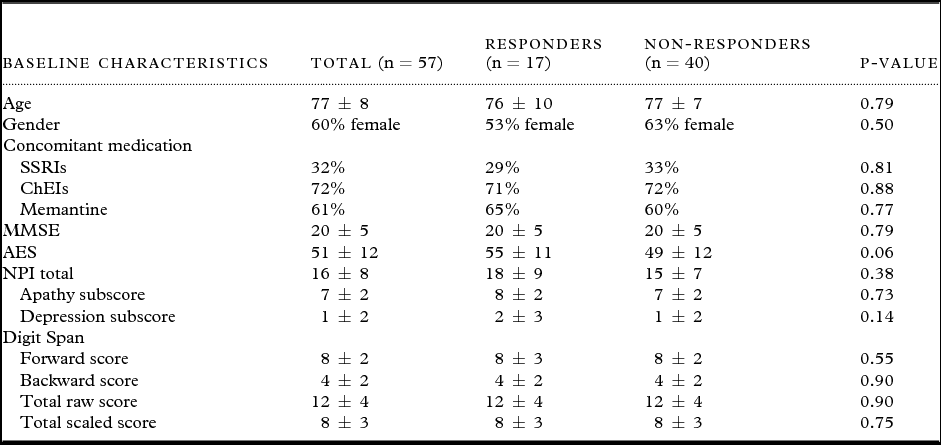
Sixty AD patients (37 women), with a mean ± SD age of 76 ± 8, MMSE scores of 20 ± 5, NPI total scores of 16 ± 8, NPI apathy scores of 7 ± 2, and AES scores of 51 ± 12 were randomized. The patients in each treatment arm (29 in the MPH group and 31 in the placebo group) were comparable on baseline characteristics (Rosenberg et al., Reference Rosenberg2013). While the number of participants taking ChEis or SSRIs at baseline (Table 1) was balanced by treatment group, memantine use was slightly imbalanced (MPH: 21/29, placebo: 16/31)(Rosenberg et al., Reference Rosenberg2013).
Baseline characteristics by responders in the AES

AES = Apathy Evaluation Scale; SSRIs = selective-serotonin reuptake inhibitor; ChEI = cholinesterase inhibitor; MMSE = Mini-Mental State Examination; NPI = Neuropsychiatric Inventory. Values indicate mean ± SD. Adjusted for unequal variances as needed.
Estimated difference in change in attention for the 60 patients from baseline to week 6 showed larger improvements (positive δ favors MPH) in DS forward score (δ = 0.87 (95% CIs: 0.06–1.68), p = 0.03, Cohen's d = 0.62) (Figure 1) and DS total score (δ = 1.01 (95% CIs: 0.09–1.93), p = 0.03) in those on MPH. The difference in improvement was not statistically significant for DS backward (δ = 0.17 (95% CIs: −0.66, 1.02), p = 0.68) though it showed a numerically greater improvement in the MPH group. Controlling for use of memantine did not change treatment effects on DS forward scores (δ = 0.87 (95% CIs: 0.06–1.68), p = 0.03).
Estimated change score (±SE) for Digit Span forward over time. Improvement (positive change scores) over six weeks in the MPH (methylphenidate) group (n = 29) was significantly greater than that found in the PLB (placebo) group (n = 31).
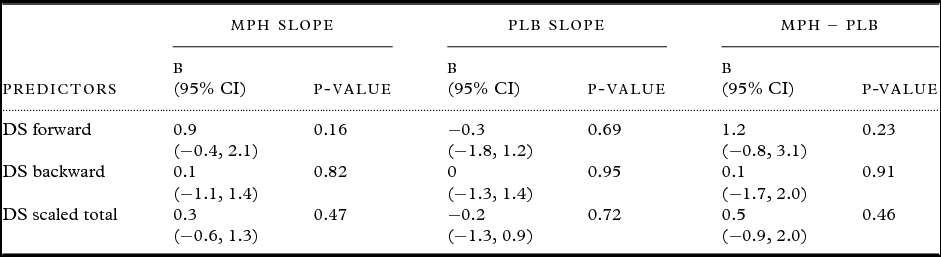
Of the 60 randomized, 57 participants completed the study with 17 patients showing improved apathy and 40 who did not improve (Table 1). Responders and non-responders were comparable on baseline measurements of attention except that responders had a trend toward higher baseline AES scores (p = 0.06). There were no significant correlations between change in AES and change in any of the attention measures for the 57 completers, the MPH group or the PLB group (data not shown). Baseline attention scores did not predict apathy outcome as measured by linear regression model (group differences in change scores) or logistic regression (log odds of improvement in MPH and placebo group by baseline score) (Tables 2 and 3). Controlling for education did not substantially change the size of the association between response and baseline attention. Sensitivity analysis with response using NPI apathy and CGIC apathy also showed no relationship (data not shown).
Linear slope of AES change scores by baseline attention scores and treatment group.
MPH = methylphenidate; PLB = placebo; DS = Digit Span.
Odds ratios for baseline attention as predictors of AES response based on logistic regression

MPH = methylphenidate; DS = Digit
Span; PLB = placebo.
Conclusion
The results of this study suggest that MPH improves selective attention in an elderly dementia population with apathy. While sustained attention or vigilance refers to the ability to maintain focus over long periods of time and divided attention is required to process multiple stimuli simultaneously, selective attention is defined as focus and concentration on a target stimulus while filtering out distractions (Perry and Hodges, Reference Perry and Hodges1999). Previous randomized, placebo-controlled trials with galantamine, a cholinesterase inhibitor that modulates nicotinic receptors, showed positive effects on different measures of attention, including both vigilance and selective attention (Vellas et al., Reference Vellas2005; Gorus et al., Reference Gorus, Lambert, De Raedt and Mets2007; Galvin et al., Reference Galvin2008). While there is evidence for the use of psychostimulants such as MPH for the treatment of apathy in AD (Herrmann et al., Reference Herrmann2008; Rosenberg et al., Reference Rosenberg2013), data on their effects on attention in this population are limited. In children and young adults with attention deficit hyperactivity disorder, psychostimulants have been shown to improve performance on tasks of divided, sustained, focused, and selective attention (Tucha et al., Reference Tucha, Mecklinger, Laufkotter, Klein, Walitza and Lange2006). Our findings indicate that improvements on selective attention did favor MPH in apathetic dementia patients following sixweeks of treatment. Further, the estimated change in DS forward found in this study (δ = 0.87) is greater than the difference found between those with mild versus moderate cognitive impairment in the Alzheimer's disease neuroimaging initiative (0.7) (Park et al., Reference Park2012), and demonstrates a moderate to high effect size (0.62), suggesting that MPH may have clinically significant effects on attention.
The correlation and response prediction analyses also suggest that attention and apathy may respond independently to MPH in this cohort of patients. There are several possible reasons for this. The neural substrates for apathy, thought to be the anterior cingulate and orbitofrontal cortex (Lanctôt et al., Reference Lanctôt2007), are likely not directly involved in all types of attention processing. It may be that the selective attention test used in this study measured a component of attention that is not closely associated with anterior cingulate or orbitofrontal-mediated motivation. Second, differing sensitivity to MPH may account for these differences. Low and therapeutically relevant doses of psychostimulants are cognitively enhancing via preferential stimulation of the prefrontal cortex (Berridge and Devilbiss, Reference Berridge and Devilbiss2011). In contrast, higher doses, by amplifying catecholaminergic tone more globally throughout the brain, are behaviorally activating (Kuczenski et al., Reference Kuczenski, Segal, Cho and Melega1995). In the dementia population, the presence of irritability, agitation, and psychosis reported in trials of patients treated with MPH (Galynker et al., Reference Galynker, Ieronimo, Miner, Rosenblum, Vilkas and Rosenthan1997; Herrmann et al., Reference Herrmann2008; Padala et al., Reference Padala2010) could signify behavioral effects in a subset of patients even at low doses. This is also consistent with the previous suggestion that the effects of dopaminergic agents depend on baseline dopaminergic activity (Cools and D'Esposito, Reference Cools and D'Esposito2011).
The differing responses may also indicate regional variability in dopaminergic disruption associated with AD. Post-mortem brains of AD patients show lower levels of dopamine (Storga et al., Reference Storga, Vrecko, Birkmayer and Reibnegger1996) and D2 receptor expression (Cross et al., Reference Cross, Crow, Ferrier, Johnson and Markakis1984) compared with age-matched controls, but the extent of this disruption varies substantially. Consistent with this variability, the dopaminergic mesocorticolimbic reward pathway is thought to be compromised in AD patients to a greater degree in those with apathy compared to those without (Mitchell et al., Reference Mitchell, Herrmann and Lanctôt2010). In a SPECT study of non-depressed AD patients, those with apathy had a distinct pattern of differences in areas associated with the dopaminergic mesocorticolimbic reward pathway (Lanctôt et al., Reference Lanctôt2007). Reduced striatal DA transporter uptake has also been correlated with greater apathy in dementia patients (David et al., Reference David2008). A probe of the DA reward system demonstrated that compared with controls, apathetic AD patients given d-amphetamine scored lower on tests of subjective positive effects (Lanctôt et al., Reference Lanctôt2008), possibly representing either loss or decreased sensitivity of post-synaptic dopaminergic receptors. As such, dopaminergic dysfunction is likely to be present and variable in an AD population with apathy and may be a factor in driving MPH to have independent effects on apathy and attention.
These results contrast with findings of a drug challenge study (Herrmann et al., Reference Herrmann2008), where inattention with d-amphetamine was predictive of a positive response to MPH for apathy. Conceptual differences, including the use of a different psychostimulant, may account for the contradictory findings. The purpose of the drug challenge was to probe the functional integrity of the DA reward system using a single dose of d-amphetamine rather than testing whether MPH-naive attention abilities could predict response. In fact, the authors suggested that the behaviorally activating mechanisms, which caused distractibility and subsequently inattention, might also be involved in ameliorating apathetic symptoms. This is consistent with the interpretation of the results discussed above.
There are some limitations to consider when interpreting the results of this study. The sample size was based on power calculations performed to evaluate efficacy of MPH (Drye et al., Reference Drye2013) with apathy and not attention as the primary outcome. While this study had sufficient power to detect changes in attention, the sample size may not have been adequate to detect significant associations between our two outcome measures. The definition of a responder was based on a previous pilot study and thus far has not been validated. Nevertheless, results from ADMET indicated that clinicians’ impression of change in apathy, measured by the CGIC, favored MPH, suggesting that a 3.3-point change on the AES was large enough to be clinically relevant. Another limitation is the use of a single measure of selective attention. The DS test, a measure of selective attention (DS forward) and working memory (DS backward), may not be tapping into the attention domains which might be more relevant to the motivation factor characteristic of apathy. While its short length and ease of administration is a benefit in studies with cognitively impaired patients, it would be interesting to explore more comprehensive assessments which target other types of attention. Similarly, activities of daily living, which have been linked with both attention and apathy (McPherson et al., Reference McPherson, Fairbanks, Tiken, Cummings and Back-Madruga2002; Bronnick et al., Reference Bronnick2006), were not measured in the present study. Finally, given the exploratory nature of this secondary analysis, adjustment was not made for multiple comparisons.
In addition to positive benefits for apathy, as demonstrated by NPI apathy score and modified ADCS-CGIC, as well as a trend for global cognition, as measured by the MMSE recently reported for MPH (Rosenberg et al., Reference Rosenberg2013), this analysis provides an initial signal supporting benefits on attention, suggesting multiple avenues for future research. For example, since all these patients exhibited apathy, MPH could be studied in non-apathetic patients, specifically as a cognitive enhancer. Also, in this study, MPH was given as an adjunctive therapy, thus its use as a monotherapy could be explored. Similarly, MPH was administered for six weeks and therefore the effects of long-term use are an important focus for future research, particularly in light of the fact that AD is neurodegenerative and evidence of tolerance in other populations (Swanson et al., Reference Swanson1999). Given that an impact on activities of daily living is important in establishing clinical relevance, future studies should evaluate whether MPH administration improves function. Finally, these results apply only to those patients with mild-to-moderate AD and it would be interesting to investigate patients with more severe AD and non-AD dementias, where the link between DA and attention has yet to be clarified. These data will be particularly important to better define the therapeutic role of MPH in clinical practice.
In summary, the benefit for selective attention found in this study, in addition to previously noted benefits for apathy, adds to the limited knowledge of MPH effects on AD patients and provides further support for its use in this population. Heterogeneity in response to treatment has prompted recent recognition of the importance of evaluating specific cognitive domains (Hendrix and Welsh-Bohmer, Reference Hendrix and Welsh-Bohmer2013). Attention is needed for working and episodic memory, and may also have positive effects on functional abilities (Baddeley et al., Reference Baddeley, Logie, Bressi, Della Sala and Spinnler1986; Perry and Hodges, Reference Perry and Hodges1999). This study provides some insight into the different effects MPH can produce in a heterogeneous disease such as AD.
Conflict of interest
All authors have completed the Unified Competing Interest form at www.icmje.org/coi_disclosure.pdf and declare that (1) KLL, SAC, NH, LTD, PBR, RWS, SEB, VV, and DLB have no relationships with any companies that might have an interest in the submitted work in the previous three years; (2) their spouses, partners, or children have no financial relationships that may be relevant to the submitted work; and (4) have no non-financial interests that may be relevant to the submitted work. Author JEM has relationships with NIA that might have an interest in the submitted work in the previous three years; (2) his spouses, partners, or children have no financial relationships that may be relevant to the submitted work; and (4) has no non-financial interests that may be relevant to the submitted work.
Description of authors’ roles
All authors contributed to the study design, data collection, data interpretation, and review of the paper. KLL and SAC drafted the paper. LTD and VV performed the data analyses for this study. All authors had full access to the data for the study and take responsibility for the integrity of the data and accuracy of the analysis.
Acknowledgments
The authors thank Corinne Fisher (St Michaels Hospital, Toronto) and Nicolaas Paul LG Verhoeff (Baycrest Hospital, Toronto).
This research was supported by funding from the sponsor National Institute on Aging (NIA) R01 AG033032-01 and 1 K08 AG029157-01A1. The NIA had no role in data collection, analysis, or drafting of the paper. All authors had full access to all of the data (including statistical reports and tables) in the study and can take responsibility for the integrity of the data and the accuracy of the data analysis.