INTRODUCTION
The reproductive mechanisms of sorghum (Sorghum bicolor L. Moench) include self-fertilization, open pollination, genetic and cytoplasmic male sterility systems, and even apomixis (Rao et al. Reference Rao, Murty, Rana, Chopra and Prakash2002). Furthermore, temperatures below 12°C during microsporogenesis induce pollen sterility in cold-sensitive genotypes (Brooking Reference Brooking1976; Wood et al. Reference Wood, Tan, Mamun and Sutton2006), a phenomenon that has been called ecological male-sterility (Ortiz & Carballo Reference Ortiz and Carballo1972). Sorghum varieties and hybrids adapted to the Mexican Highlands (regions up to 2200 m altitude, where early morning temperature during the growing season is below 12°C) have been developed (Livera & Carballo Reference Livera and Carballo1977; Mendoza Onofre Reference Mendoza Onofre1991; Osuna-Ortega et al. Reference Osuna-Ortega, Mendoza-Castillo and Mendoza-Onofre2003). This type of germplasm will be hereafter referred as ‘cold-tolerant’ (CT).
Pollen viability (cytoplasm density) in CT lines varies from 0·50 to 0·80, but seed yield in hand-made crosses of CT lines averages only 0·46 of the CT lines self-pollinated (Cisneros-López et al. Reference Cisneros-López, Mendoza-Onofre, Mora-Aguilera, Córdova-Téllez and Livera-Muñoz2007). The proportion of seeds relative to the number of flowers (seed set (SS)) in CT B-lines varied from 0·47 to 0·71 (Cisneros-López et al. Reference Cisneros-López, Mendoza-Onofre, Zavaleta-Mancera, González-Hernández, Córdova-Téllez, Hernández-Martínez and Mora-Aguilerain press). Depending on the species, the lower seed production observed in hand pollination compared to open pollination has been associated with poor pollen viability and germination (Young & Young Reference Young and Young1992) and few or underdeveloped pollen tubes (Marshall & Diggle Reference Marshall and Diggle2001). Other traits, such as pistil age (Bassetti & Westgate Reference Bassetti and Westgate1993b), scarcity of ovules, empty ovaries, seed abortion due to inbreeding depression (Wilcock & Neiland Reference Wilcock and Neiland2002), stigma senescence (Sun et al. Reference Sun, Suksayretrup, Kirham and Liang1991; Bassetti & Westgate Reference Bassetti and Westgate1993a) and a short stigma receptivity period (Dafni et al. Reference Dafni, Pacini, Nepi, Dafni, Kevan and Husband2005) may also be involved.
Pollen–pistil interactions include pollen grain adhesion, hydration, activation and germination, and further pollen tube growth to reach the ovule (Edlund et al. Reference Edlund, Sanson and Preuss2004). A positive pistil interaction with compatible pollen results in ovule fertilization. If pollen is non-compatible, some of the processes mentioned above would not be induced, or the pistil might reject the pollen tube (Cheung Reference Cheung1995). The most evident agronomic consequences of a poor pollination and/or ovule fertilization are a decrease in seed yield and an increase of sorghum vulnerability to ergot infection (Claviceps africana) (Wang et al. Reference Wang, Meinke, Ryley, Herde and Henzell2000).
The goals of the present study were: (1) to compare histological patterns from pollinated and non-pollinated pistils in a male-sterile A line; (2) to measure pollen germination in vivo as an indicator of stigma receptivity in A×B crosses and (3) to evaluate the pollen–pistil interaction during pollen germination and pollen tube growth of these crosses under chilling field conditions and its relationships with seed yield.
MATERIALS AND METHODS
Field traits
The experiment was conducted in Montecillo, State of México over 2 years, 2005 (sowing date 11 June; harvested in November) and 2006 (sowing date 9 May; harvested in October). Each experiment included six pairs of isogenic lines (identified here as A1/B1, A2/B2, A3/B3, A5/B5, A6/B6 and A9/B9, where A is the male-sterile female parent and B the pollen donor or maintainer line). Field temperature and relative humidity were registered by a climate station located 150 m from the experimental site. Each plot consisted of five rows, 5 m long and 0·92 m wide, with one plant every 0·15 m; the experimental unit was the three central rows. Plant to plant A×B crosses were done once with more than sufficient quantities of pollen in each pair of isogenic lines.
Morphological and anatomical pistil traits
Panicles of five plants were bagged until pollination and cut at the end of the flowering period of non-pollinated A-lines. In each panicle, 10 pistils were taken from a central branch in order to measure the lengths of the pistil (PsL), stigma (SgL), ovary (OvL) and style (StL; calculated as StL=PsL−(SgL+OvL)); the maximum ovary width was also measured (OvW) (Cisneros-López et al. Reference Cisneros-López, Mendoza-Onofre, Zavaleta-Mancera, González-Hernández, Córdova-Téllez, Hernández-Martínez and Mora-Aguilerain press).
Histological analysis was performed in pistils sampled from line A9 at 72 h after pollination (HAP) to observe pollen tube growth, using non-pollinated pistils as controls. Complete pistils were fixed in a Farmer solution (750 ml/l ethylic alcohol and 250 ml/l acetic acid) (Hodnett et al. Reference Hodnett, Burson, Rooney, Dillon and Price2005) and dehydrated in a series of isopropyl alcohol, transferred to xylene and infiltrated in paraffin. Longitudinal and transversal serial sections (10 μm thick) were obtained with a rotary microtome (American Optical Company® Mod. 820 Spencer). Pistil sections were stained with an aqueous solution prepared with safranin O (5 ml/l), NaCl (20 ml/l), fast green FCF (30 ml/l), ethylic alcohol (700 ml/l) (Zavaleta-Mancera & Engleman Reference Zavaleta-Mancera and Engleman1994). For observing the pollen tubes, serial pistils sections were stained with aniline blue at 10 ml/l in a phosphate buffer (pH 7·4), incubated for 20 h in the dark at 7°C and mounted in aniline blue (Westgate & Boyer Reference Westgate and Boyer1986). Sections were observed with light microscopy and epifluorescence UV filter (365 nm excitation and 397 nm emission) using a microscope Zeiss AXioskop 2 plus®. Photographs were taken with an AxionCam MRC5 camera and the AxionVision 4·4® image processor.
Pollen production (PP), size and viability
Pollen dry weight was measured daily from individual panicles of five plants of each B-line during the whole flowering period. PP was recorded as the sum of all daily samples from each panicle. At the beginning of anthesis, one branch from the middle of the influorescence of five male fertile plants was sampled and the pollen grain diameter (pollen diameter (PD)) was measured in a sample of 100 grains. The proportion of viable pollen (VP) of 10 anthers per branch (average of five microscope fields of 20 grains per anther) considered only grains with a typical size and shape, and cytoplasm density over 0·75 (Cisneros-López et al. Reference Cisneros-López, Mendoza-Onofre, Zavaleta-Mancera, González-Hernández, Córdova-Téllez, Hernández-Martínez and Mora-Aguilerain press).
Pollen germination and pollen tube growth in the pistil
At 18 HAP, a central branch was cut from three panicles of each A×B cross; 20 pistils were extracted, fixed in a Farmer solution (3:1) and stored at 7°C. Pollen germination and pollen tube growth were measured in 10 complete pistils with the ‘squashed, aniline blue and epifluorescence’ method (Martin Reference Martin1959; Hodnett et al. Reference Hodnett, Burson, Rooney, Dillon and Price2005; Cisneros-López et al. Reference Cisneros-López, Mendoza-Onofre, Zavaleta-Mancera, Mora-Aguilera, Córdova-Téllez, González-Hernández and Hernández-Martínez2006). Samples were observed in the epifluorescence microscope already mentioned, while digital photographs were taken with the camera and image processor previously described. The callose of pollen tubes was observed in blue–green fluorescence. The pollen grains adhered to the stigma (GPSg) and pollen tubes in the stigma (PTSg), style (PTSt) and ovary (PTOv) were counted. At 96 HAP, 40 complete pistils were extracted from a central branch of five pollinated panicles per genotype. The proportion of fertilized pistils (FP), i.e. with a widened ovary (Taylor & Obendorf Reference Taylor and Obendorf2001), was then calculated. The remaining branches in the panicle were left untouched until harvest, to measure seed yield and its components.
Yield components
Five panicles per genotype were harvested. When the seed had 13±2% moisture, seed yield per panicle (SY, g), mean seed weight (MSW, g; with three samples/panicle) and seeds/panicle (SP=SY/MSW) were measured. The proportion of seeds/flower/panicle (SS) was also estimated.
Statistical analysis
Two combined analyses of variance (PROC ANOVA) were made in a completely randomized design of treatments: one for the pistil traits (determined for A-lines) and pollen traits (determined for B-lines) traits, and another for the variables related with germination, growth of the pollen tube and reproductive traits (FP, SY, MSW and SP) of the A×B crosses. Standard errors of difference were calculated for all treatment means. For pollen germination and growth of the pollen tube, each pistil was considered as one repetition (total 10 repetitions) and for the other variables one panicle per repetition (five repetitions). Two sets of Pearson's simple correlations were generated with averaged data of the 2 years: one between the variables of pollen germination (GPSg, PTSg, PTSt and PTOv) v. reproductive traits, and another between the pistil (PsL, SgL, StL, OvL and OvW) and pollen (PP, VP and PD) traits v. those of pollen germination. Prior to the analysis, the variables expressed as proportions were transformed through the arcsine [Yi]1/2. The statistical package SAS 9.1 (SAS Institute 2002) was used.
RESULTS
A- and B-line traits
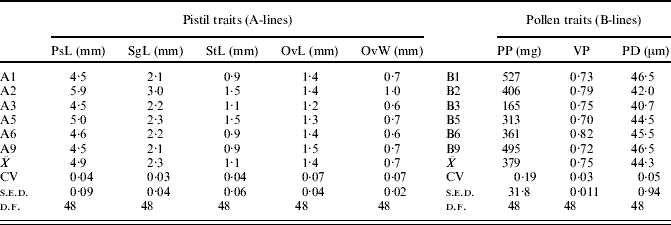
The pistil traits with the greatest phenotypic variability in A-lines were style length (range 0·9–1·5 mm), ovary length (1·2–1·5 mm) and ovary width (0·6–1·0 mm). With the exception of ovary length, the pistil traits of line A2 surpassed the group average by up to 36% (Table 1). Stigma length was the only trait with significant differences attributed to environmental (seasonal) differences (2·4 mm in 2006 v. 2·3 in 2005). Of the pollen traits, PP showed the greatest variation (165–527 mg). No genotype was best in all pollen traits in this group of lines; i.e. the two lines (B9 and B1) that produced the greatest amount of pollen (495 and 527 mg) also had the largest pollen grains (46·5 μm in diameter), but their viability (0·72 and 0·73) was lower than the group average (0·75). In 2005, the six B-lines averaged 300 mg of PP with 0·78 viability while in 2006 PP was higher (P⩽0·05) (459 mg) although with lower (P⩽0·05) viability (0·72).
Pistil traits in A-lines and pollen characteristics in B-lines. Means of two years (2005 and 2006) (adapted from Cisneros-López et al. Reference Cisneros-López, Mendoza-Onofre, Zavaleta-Mancera, González-Hernández, Córdova-Téllez, Hernández-Martínez and Mora-Aguilerain press)
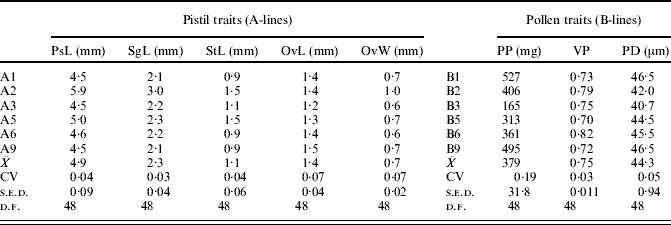
PsL, SgL, StL, OvL=length of pistil, stigma, style, ovary, respectively; OvW=ovary width; PP=pollen production; VP=proportion of viable pollen; PD=pollen diameter; CV=coefficient of variation; s.e.d.=standard error of difference; d.f.=degrees of freedom.
Histological study
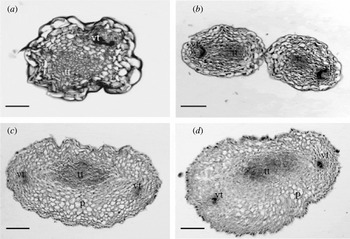
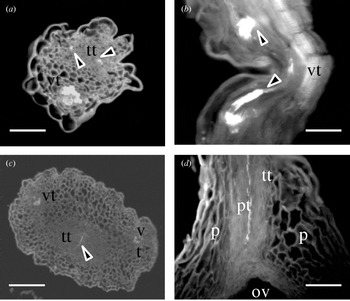
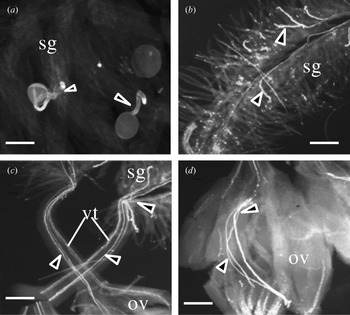
The serial transverse and longitudinal sections of non-pollinated pistils of line A9 showed the solid structure of the style and the presence of a transmitting tissue (Fig. 1a). In its transverse sections, the transmitting tissue can be recognized as a set of small cells arranged in a compact structure, without intercellular spaces (Fig. 1b). These cells were longitudinally elongated (Fig. 1c). The transmitting tissue appeared to be less compact in the basal zone than in upper sections (Fig. 1d). At 72 HAP, the style characteristics remained similar in pollinated pistils (Fig. 2), except that pollen tubes (identified by callose plugs) can be detected in longitudinal sections of the transmitting tissue from the stigma to the ovary, thus evidencing the pollen tube penetration in the pistil (Fig. 3a, b). At 18 HAP, growth of the pollen tube in stigma, style and even in ovary can be detected in the transmitting tissue, in a route parallel to vascular bundles (Fig. 4).
Light microscopy sections of the sorghum style (st) stained with Safranin O and Fast green FCF of non-pollinated flowers. (a) Longitudinal section of a branch (bar=100 μm). (b) Transversal section at the apical region (bar=100 μm). (c) Longitudinal section showing the transmission tissue (bar=100 μm). (d) Transversal section at the basal region of the two branches (bar=200 μm): ar=apical region; br=basal region; ovur=ovary upper region; tt=transmission tissue; vt=vascular tissue.

Serial transversal sections from the apex to the base of the sorghum style, stained with Safranin O and Fast green FCF at 72 HAP. (a) Style branch, apical region (bar=100 μm). (b) Two style branches, basal region (bar=100 μm). (c) Transition region, from the style to the ovary (bar=150 μm). (d) Ovary, upper region (bar=150 μm). p=parenchyma; tt=transmission tissue; vt=vascular tissue.

Pollen tube path in the transmission tissue of the sorghum style at 72 HAP. Paraffin sections stained with aniline blue and visualized with epifluorescence UV (excitation, 365 nm; emission, 397 nm). (a) Transversal section at the apical region of a stigma branch (bar=100 μm). (b) Longitudinal section of a stigma branch (bar=150 μm). (c) Transversal section at the upper region of the ovary (bar=150 μm). (d) Longitudinal section at the base of the style (bar=200 μm). cp=callose plugs; lov=locule of the ovary; p=parenchyma; pt=pollen tube; tt=transmission tissue; vt=vascular tissue. Arrows indicate callose of pollen tubes.

Pollen germination and pollen tube growth of sorghum at 18 HAP. Pistils were stained with aniline blue and squashed. Pollen tubes were visualized with epifluorescence UV (excitation, 365 nm; emission, 397 nm). (a) Pollen germination showing penetration in the papilla of the stigma (bar=50 μm). Growth of pollen tubes in stigma (b), style (c) and ovary (d) (bar=50 μm). ov=ovary; sg=stigma; vt=vascular tissue. Arrows indicate pollen tubes.

Pollen germination, pollen tube growth and seed production in A-lines
The combined ANOVAs indicated that genotypes had significant effects on: number of GPSg, PTSg, PTSt and PTOv; fertilized pistils (FP); SY; MSW; and seeds per panicle (SP). Years had significant effects on GPSg, PTSg, FP, SY, MSW and SP, while the G×E interaction affected GPSg, PTSg, PTSt, SY, MSW and SP. The coefficients of variation of the traits related with pollen germination and pollen tube growth (0·23–0·87) were higher than those of fertilized pistils, yield, and its components (0·05–0·15).
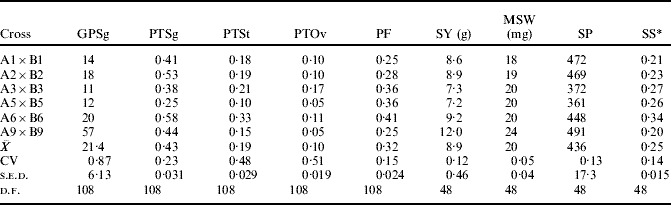
Averaged over crosses and years, at 18 HAP there were 21 pollen grains still adhered to the stigma, 10 germinated tubes in the stigma, 3·6 in the style, and just 1·4 reached the ovary base. Corresponding proportions of pollen tubes with respect to pollen grains on the stigma are shown in Table 2. In this sampling, the A9×B9 cross surpassed the other crosses in number of grains adhered to the stigma, although the proportion of pollen tubes growing in the different style sites was not different (P⩽0·05) from other A×B crosses with lower numbers for GPSt. At 96 HAP, from a sample of 40 pistils for each A×B cross, A6×B6 had more fertilized pistils than A9×B9 (0·41 v. 0·25), but at harvest A9×B9 had the greatest yield (12 g/panicle), greatest weight of individual seeds (2·4 g per 100 seeds) and remained within the superior group with regard to seeds/panicle (Table 2).
Pollen germination, growth of the pollen tube and seed production of A×B sorghum crosses, averaged over 2 years (2005 and 2006)
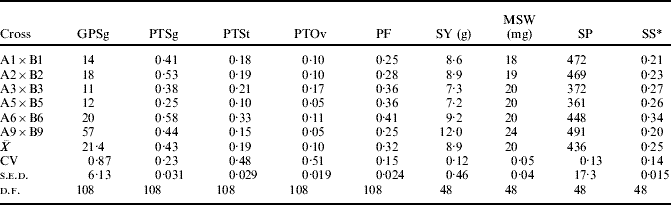
GPSg=pollen grains on the stigma; PTSg, PTSt, PTOv=proportion of pollen tubes in the stigma, style, and ovary at 18 HAP with regard to GPSg; FP=proportion of fertilized pistils at 96 HAP; SY=seed yield per panicle; MSW=mean seed weight; SP=seeds per panicle; SS=seed set. CV=coefficient of variation; s.e.d.=standard error of difference.
* Data from Cisneros-López et al. (Reference Cisneros-López, Mendoza-Onofre, Zavaleta-Mancera, González-Hernández, Córdova-Téllez, Hernández-Martínez and Mora-Aguilerain press). d.f.=degrees of freedom.
Seed yield was significantly correlated (P<0·05) with pollen germination and pollen tube growth (r=0·83–0·98), as well as with its components: MSW (r=0·57–0·91) and seed numbers (r=0·60–0·75). Also, the number of pollen tubes reaching the ovary correlated (r=0·75) with SP (P<0·05). Nevertheless, the proportion of fertilized pistils was not correlated (P>0·05) with the growth of pollen tubes (r⩽0·50), MSW (r=0·13), seed yield (r=0·52), or seed numbers (r=0·66). These results suggest that grain yield of sorghum depends more on pollen traits than on pistil traits.
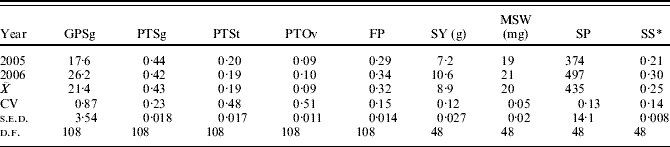
The magnitude of most traits (i.e. the number of grains adhered and germinated in the stigma, fertilized pistils, seed yield, MSW and seed numbers) were lower in 2005 (P⩽0·05) than in 2006 (Table 3). However, differences in pollen tube growth in the pistil between years were not significant. During the pollination period of both years, chilling temperatures prevailed: average minimum temperatures were 6 and 8°C, respectively, with maxima of 28·8 and 29·7°C; minimum average humidity was 44·6 and 49·4%, with maxima of 99·4 and 99·5%, respectively. Thus, the growing season in 2005 was colder and less humid than in 2006, probably because sowing was done 1 month later in 2005. The genotypes showed different responses of yield, and its components (SY, MSW and SP), in the two years.
Pollen tube growth and seed production traits in 2005 and 2006, averaged over six A×B sorghum crosses
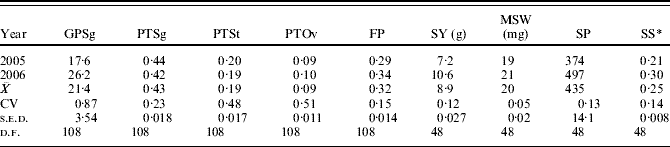
GPSg=pollen grains on the stigma; PTSg, PTSt, PTOv=proportion of pollen tubes in the stigma, style, and ovary at 18 HAP with regard to GPSg; FP=proportion of fertilized pistils at 96 HAP; SY=seed yield per panicle; 100SW=100 seeds weight; SP=seeds per panicle; SS=seed set. CV=coefficient of variation; s.e.d.=standard error of difference.
* Data from Cisneros-López et al. (Reference Cisneros-López, Mendoza-Onofre, Zavaleta-Mancera, González-Hernández, Córdova-Téllez, Hernández-Martínez and Mora-Aguilerain press). d.f.=degrees of freedom.
The lengths of pistils, stigmas and styles had little association with pollen germination and growth of pollen tubes (r=−0·02 to −0·42). None of the pollen grain variables was significantly associated with variables related to the pollen tube growth; neither was the correlation between viability (cytoplasm density) v. the number of GPSg and germinated in this structure.
DISCUSSION
A- and B-line traits
The morphological pistil traits of A-lines and the pollen diameter in B-lines differed between genotypes but were not affected by the season or by G×E interaction, suggesting that these traits are heritable, stable or with little phenotypic plasticity, as proposed by Vidal-Martínez et al. (Reference Vidal-Martínez, Clegg, Johnson, Osuna-García and Coutiño-Estrada2004) in Zea mays. However, the production and viability of pollen as well as grain yield were influenced by the environment (season) and by its interaction with genotype, features commonly found in the Mexican Highlands in CT male fertile B- and fertility restorer R-lines (Osuna-Ortega et al. Reference Osuna-Ortega, Mendoza-Castillo and Mendoza-Onofre2003). Compared to the pistil, pollen is a reproductive unit with a greater adaptation value (Heslop-Harrison Reference Heslop-Harrison2000); i.e. its diameter is a measure of the degree of maturity (Heslop-Harrison Reference Heslop-Harrison1982) and hydration capability (Lansac et al. Reference Lansac, Sullivan, Johnson and Lee1994), while its cytoplasm content expresses its viability and reserves for the tube growth (Dafni et al. Reference Dafni, Pacini, Nepi, Dafni, Kevan and Husband2005). These aspects, among others, are essential to initiate germination, and determine the stage at which relative humidity and temperature influence pollen viability (Lansac et al. Reference Lansac, Sullivan, Johnson and Lee1994).
There is no information for sorghum about the morphological variation of pistils among male-sterile lines and their role in pollen germination. In male-fertile R-lines, large variations have been found in stigma length (1–12 mm) and shape; moreover, the restorer lines with short stigmas (1–3 mm) have shown greater resistance to C. africana (Dahlberg et al. Reference Dahlberg, Bandyopadhyay, Rooney, Odvody and Madera-Torres2001), a morphological condition shown by all the A-lines in the present study (Table 1).
Pistil histology, pollen germination, pollen tube growth and seed yield
The vascular system, transmitting tissue and stylar canal (located in the union of both arms of the style) can be identified in pistils of fertile sorghum flowers prior to anthesis (Pizzolato Reference Pizzolato1991). The transmitting tissue is a specialized group of cells designed for pollen tube growth and has been observed in grasses such as Pennisetum glaucum (Willingale & Mantle Reference Willingale and Mantle1985) and Z. mays (Westgate & Boyer Reference Westgate and Boyer1986), as well as in dicotyledons such as Brugmansia suaveolens (Hudak et al. Reference Hudak, Walles and Vennigerholz1993). This is the first report on a male-sterile sorghum line showing the style with compact tissues before and after pollination (Figs 1 and 2), without any channel inside. It has been reported that the pollen tube may grow due to cellular lysis (Heslop-Harrison Reference Heslop-Harrison2000) or through spaces within the transmitting tract (Hudak et al. Reference Hudak, Walles and Vennigerholz1993). The pollen tubes growing in the transmitting tissue showed no evidence of cellular necrosis, thus suggesting that pollen tubes grow through the apoplast between adjacent cell walls (Fig. 3).
The high coefficients of variation in traits related to pollen germination and pollen tube growth (between 0·23 and 0·87) are probably due to a combination of factors: the sample size (Marshall & Diggle Reference Marshall and Diggle2001), the sigmoid shape of the accumulated germination curve of pollen (Sun et al. Reference Sun, Suksayretrup, Kirham and Liang1991); the lower number of pollen tubes than the pollen grains initially germinated (Hodnett et al. Reference Hodnett, Burson, Rooney, Dillon and Price2005; Price et al. Reference Price, Hodnett, Burson, Dillon, Stelly and Rooney2006); the low fertilization efficiency (many pollen grains germinate but do not fertilize) (Taylor & Obendorf Reference Taylor and Obendorf2001); and the interactions between the gametophyte (pollen and embryo sac) and sporophyte (ovary) tissues (Weterings & Russell Reference Weterings and Russell2004).
The proportion of pollen tubes in the stigma compared to pollen grains initially adhered ranged from 0·25 (A5×B5) to 0·58 (A6×B6) (Table 2), while the average proportion of pollen tubes at the base of the ovary was close to 0·10 of the pollen grains on the stigma (or 0·23 of the pollen tubes in the stigma) at 18 HAP. The number of pollen grains germinating in the stigma is an indicator of the receptivity of this organ (Dafni et al. Reference Dafni, Pacini, Nepi, Dafni, Kevan and Husband2005). In the present study, the B-lines produced 165–527 mg of pollen during the flowering period (Table 1), equivalent to an average of 27 mg/day. It may be inferred that the number of pollen grains was not a restrictive factor for seed yield production since: (a) more than sufficient quantities of pollen were used in the hand-made A×B crosses; (b) pollen viability of these B-lines ranged from 0·70 to 0·82 (Table 1) and (c) these lines produced between 500 and 700 pollen grains/anther (M. E. Cisneros-López, personal communication). Furthermore, it is known that only one pollen tube in the embryo sac is required for the double fertilization to take place (Taylor & Obendorf Reference Taylor and Obendorf2001; Weterings & Russell Reference Weterings and Russell2004). It is possible that the minimum average temperatures (6 and 8°C) in the field during pollination might be playing an important role in the pollen tube growth in addition to its known effect during microsporogenesis. Higher numbers of GPSg in sorghum have been reported, but only in studies done inside greenhouses (Sun et al. Reference Sun, Suksayretrup, Kirham and Liang1991; Hodnett et al. Reference Hodnett, Burson, Rooney, Dillon and Price2005; Price et al. Reference Price, Hodnett, Burson, Dillon, Stelly and Rooney2006). Among the factors that restrict pollen tube growth are pistil morphology (Heslop-Harrison Reference Heslop-Harrison1982), competition for nutrients (Herrero & Hormaza Reference Herrero and Hormaza1996) or for water and space in the stigma (Heslop-Harrison Reference Heslop-Harrison1982, Reference Heslop-Harrison2000), stigma age (Sun et al. Reference Sun, Suksayretrup, Kirham and Liang1991) and the compatibility with the parental tissues (Weterings & Russell Reference Weterings and Russell2004).
The A9×B9 cross (Table 2) surpassed the rest of A×B crosses in terms of GPSg, which would suggest a high degree of compatibility between the pistil of this A-line and the pollen from its B-line, as also suggested by Wilcock & Neiland (Reference Wilcock and Neiland2002). This cross also surpassed the other crosses in reproductive traits (SY, MSW, SP and SS) and it was expected to produce the greatest number of SP in the group, since the A9 line has 38% more flowers than the average (Cisneros-López et al., Reference Cisneros-López, Mendoza-Onofre, Zavaleta-Mancera, González-Hernández, Córdova-Téllez, Hernández-Martínez and Mora-Aguilerain press), and its isogenic line (B9) produced 31% more pollen than the group average (Table 1), with 0·72 of viable pollen. However, the proportion of pollen tubes reaching the ovary compared with those growing in the stigma of this cross was 0·08, the lowest of the group, while the corresponding proportion of the A5×B5 cross (the one with the lowest numbers of pollen tubes in stigma and ovary) was 0·30. Therefore, a low proportion of pollen tubes reaching the ovary do not seem to be a limiting factor for grain yield. Interestingly, the proportion of fertilized pistils amongst A×B crosses was less variable than the proportion of pollen tubes reaching the ovary, perhaps because the first was estimated in a constant sample of 40 stigma per genotype while the second was calculated from hand-made pollination in which non-controlled amounts of pollen were applied. Stigma age may be another factor influencing its receptivity, pollen germination and subsequent tube growth (Sun et al. Reference Sun, Suksayretrup, Kirham and Liang1991), and although this was not measured in the present experiment, the authors' field experience in manual pollination indicates that the stigma remains receptive at least 8 days after the end of flowering. No external damage of pistils such as wrinkling, discolouration, or deformation, which would imply changes in receptivity (Dafni et al. Reference Dafni, Pacini, Nepi, Dafni, Kevan and Husband2005) were observed in the present study. No pollen tubes with abnormal growth (twisted) or misdirected were observed either.
In summary, stigma receptivity of the crosses showed an acceptable degree of pistil–pollen compatibility in the pre- and post-fertilization stages, since seed production induced by hand pollination was satisfactory for agronomic purposes (7·2–12·0 g/panicle, 1·4–3·9 t/ha; Table 2).
The differences between years for the number of grains adhered and germinated in the stigma, and in the reproductive variables (Table 3), could be due to contrasts in humidity and temperature during the flowering period (Cisneros-López et al. Reference Cisneros-López, Mendoza-Onofre, Zavaleta-Mancera, González-Hernández, Córdova-Téllez, Hernández-Martínez and Mora-Aguilerain press), especially given that sowing was done 1 month later in 2005 than in 2006. In non-CT sorghum genotypes, pollen germination under in vitro conditions was not influenced by temperature changes between 20 and 40°C, but at 10°C it was less than 0·01 (Tuinstra & Wedel Reference Tuinstra and Wedel2000). When pollen grains have lost half of their water content at 25°C, their viability is lost and there will be no seed production (Lansac et al. Reference Lansac, Sullivan, Johnson and Lee1994). Previous in vivo germination studies of pollen and growth of pollen tubes of sorghum have been done inside greenhouses; an important feature of the present study is that it was done under field conditions.
Correlations among pistil, pollen traits, pollen germination and growing pollen tube
The differences between pollen germination and pollen tube growth in vitro v. in vivo reveal the significance of the pistil tissues on pollen germination (Cisneros-López et al. Reference Cisneros-López, Mendoza-Onofre, Zavaleta-Mancera, Mora-Aguilera, Córdova-Téllez, González-Hernández and Hernández-Martínez2006) and on pollen tube growth (Sánchez et al. Reference Sánchez, Bosch, Bots, Nieuwland, Feron and Mariani2004). The results indicate that stigma receptivity is not associated with the stigma and style lengths, although an association of this kind was reported by Dafni et al. (Reference Dafni, Pacini, Nepi, Dafni, Kevan and Husband2005) and explained by the stigma length being the first point of contact between pollen grains and pistil.
According to the present results, pollen viability and its competence to germinate and grow inside the pistil are not traits associated with grain yield in these CT A×B sorghum crosses. It is thus postulated that in these lines, seed production under chilling field conditions might be associated with embryogenesis problems and deficiencies in nutrients supply by the nucellus and endosperm (Heslop-Harrison Reference Heslop-Harrison1982; Weber et al. Reference Weber, Heim, Golombeck, Borisjuk and Wobus1998) or to sink–source effects among influorescence structures (Gambín & Borrás Reference Gambín and Borrás2005).
Pollen tube growth in the transmitting tissue of the style and ovary was observed running parallel to the vascular bundles at 18 HAP. Ovule fertilization was detectable at that time. The differences in seed production among the A×B crosses were not due to the amount and viability of pollen grains. The grain yield of these crosses grown under minimum temperatures between 6 and 8°C during flower differentiation and pollination ranged from 7 to 12 g/panicle.
The authors gratefully acknowledge the scholarship granted to the first author by the National Council of Science and Technology of Mexico (CONACYT). The support of staff of the Laboratory of Botany Colegio de Posgraduados-Campus Montecillo, México, is also appreciated.