A troubling number of students exhibit social, emotional, and behavioural problems that impact their ability to be successful in school (Bushaw & Lopez, Reference Bushaw and Lopez2010; Reinke, Stormont, Herman, Puri, & Goel, Reference Reinke, Stormont, Herman, Puri and Goel2011). Studies indicate that approximately one out of every five students has a diagnosable mental health disorder (Costello, Mustillo, Erkanli, Keeler, & Angold, Reference Costello, Mustillo, Erkanli, Keeler and Angold2003; Hoagwood & Erwin, Reference Hoagwood and Erwin2003), and many more exhibit milder forms of social, emotional and behavioural problems that do not reach clinical levels, but that nevertheless negatively impact their academic achievement. These problems are associated with an increased likelihood of short- and long-term negative outcomes (Beesdo-Baum & Knappe, Reference Beesdo-Baum and Knappe2012; Forness, Freeman, Paparella, Kauffman, & Walker, Reference Forness, Freeman, Paparella, Kauffman and Walker2012); and in some circumstances, may impair their learning as well (Trout, Nordness, Pierce, & Epstein, Reference Trout, Nordness, Pierce and Epstein2003). In addition to the personal suffering experienced by children and families affected by emotional difficulties, mental health problems also produce and elevate economic costs to society (WHO, 2003).
Over the past decades, there has been an increasing amount of evidence showing the benefits of school-based universal prevention programs and practices to prevent mental health problems and to promote academic success (Durlak, Weissberg, Dymnicki, Taylor, & Schellinger, Reference Durlak, Weissberg, Dymnicki, Taylor and Schellinger2011; Fisak, Richard, & Mann, Reference Fisak, Richard and Mann2011; Greenberg, Domitrovich, & Bumbarger, Reference Greenberg, Domitrovich and Bumbarger2001; Lowry-Webster, Barrett, & Dadds, Reference Lowry-Webster, Barrett and Dadds2001; Stopa, Barrett, & Golingi, Reference Stopa, Barrett and Golingi2010). The FRIENDS for Life program is an example of a school-based group prevention program that was developed in a clinical setting to treat childhood anxiety disorders, and later trialled as a universal prevention program in schools to promote students’ emotional competence (Iizuka, Barrett, & Morris, Reference Iizuka, Barrett, Morris, Essau and Ollendick2013). The program has shown promising results not only for the prevention and treatment of childhood anxiety and depression, but also for the improvement of self-concept, social skills and coping skills (Iizuka, Barrett, Gillies, Cook, & Miller, Reference Iizuka, Barrett, Morris, Essau and Ollendick2014).
However, in a meta-analysis of the efficacy of cognitive behavioural school-based interventions for youth with anxiety and depression, Mychailyszyn, Brodman, Read, and Kendall (Reference Mychailyszyn, Brodman, Read and Kendall2012) found that universal interventions have small effect sizes. Notwithstanding the efficacy of the FRIENDS Program, as well as other social and emotional learning (SEL) curricula, certain factors appear to moderate the impact of its effectiveness. For example, when the FRIENDS Program was implemented in disadvantaged communities involving multiple risk factors, such as limited parental education, exposure to violence, ethnic minority groups, orphans, and children from socio-economic disadvantage communities, the results have been mixed. Some studies found significant decreases in anxiety levels from pre- to post-tests (Barrett, Sonderegger, & Sonderegger, Reference Barrett, Sonderegger and Sonderegger2001; Barrett, Sonderegger, & Xenos, Reference Barrett, Sonderegger and Xenos2003; Cooley, Boyd, & Grados, Reference Cooley, Boyd and Grados2004), while other studies found little evidence for positive effects on anxiety (Barrett, Moore, & Sonderegger, Reference Barrett, Moore and Sonderegger2000; Gallegos, Rodriguez, Gomez, Rabelo, & Gutierrez, Reference Gallegos, Rodriguez, Gomez, Rabelo and Gutierrez2012). In a study conducted with South African children, the program's impact was only significant 4 months after the end of the intervention (Mostert & Loxton, Reference Mostert and Loxton2008). A common recommendation from all these studies, including a high proportion of at-risk students, was to seek increasing the effects of the program by including enhancements to the context in which the program is implemented.
Transferring evidence-based practices from clinical settings to community contexts, such as schools, is challenging (Mychailyszyn et al., Reference Mychailyszyn, Brodman, Read and Kendall2012). Implementing school-based universal prevention programs in schools located in communities characterised by low socio-economic status is potentially more challenging. Indeed, a recent report issued on the status of Australian schools concluded that Australian students from disadvantaged backgrounds are consistently achieving educational outcomes lower than their peers from higher socio-economic status (Gonski et al., Reference Gonski, Boston, Greiner, Lawrence, Scales and Tannock2011). One explanation for this achievement gap is that teachers who work in schools located in socio-economically disadvantaged communities report facing more challenging situations in their classrooms and, therefore, increased stress that results in greater burnout and lower social-emotional competence than teachers in more economically advantaged settings (Productivity Commission, 2012).
Researchers have recently begun to examine the relationship between teachers’ social-emotional competence and students’ outcomes. It has been argued that teachers who are socially and emotionally competent are in a better position to create a positive classroom climate (Jennings & Greenberg, Reference Jennings and Greenberg2009). Moreover, socially and emotionally competent teachers are more likely to establish and sustain supportive and encouraging relationships with students, coach students through conflict situations, encourage cooperation in the school, act as a role model for appropriate pro-social behaviour, and implement evidence-based programs and practices with fidelity (Jennings & Greenberg, Reference Jennings and Greenberg2009).
In a study conducted by Hui and Sun (Reference Hui and Sun2010), the authors investigated elementary school students’ satisfaction, considering the contribution of school contextual factors (teacher support, academic performance, peer support, peer conflict, and peer victimisation) and intrapersonal factors (hope and self-esteem). The results indicated that teacher support was the most significant predictor of school satisfaction across grades. Nurturing teachers’ social and emotional competence can be a powerful way of providing good education to students (Jennings & Greenberg, Reference Jennings and Greenberg2009).
Several primary prevention programs have been developed for teaching students self-control, social competence, positive peer relations, and interpersonal problem solving (CASEL, 2009). However, these programs focus on teaching these skills to students and do not provide explicit instructions to promote social and emotional literacy among teachers. Rather, they assume that the teacher is prepared to act as an effective emotional coach and role model (Jennings & Greenberg, Reference Jennings and Greenberg2009).
This way, rather than providing interventions focusing only on students’ outcomes, school systems should consider developing tools to improve teachers’ emotional competence first, so they would be in a better condition to support students’ social, emotional, and academic success (Jennings & Greenberg, Reference Jennings and Greenberg2009). Teachers are important role models for their pupils, especially when dealing with students from communities located in low socio-economic status where, in some cases, there is absence of other relevant positive role models in the students’ lives. However, there is limited research focusing on exploring methods for promoting teachers’ social and emotional competence (Jennings, Frank, Snowberg, Coccia, & Greenberg, Reference Jennings, Frank, Snowberg, Coccia and Greenberg2013).
Jennings and colleagues (Reference Jennings, Frank, Snowberg, Coccia and Greenberg2013) conducted a study with an intervention aimed at improving teachers’ social-emotional competence and wellbeing: the Cultivating Awareness and Resilience in Education (CARE) program. The results showed promising results in relation to the teachers’ outcomes; however, students’ outcomes were not evaluated. The authors suggested further studies should assess whether changes in the teachers’ outcomes would also improve the students’ outcomes.
The current study presents the results of a pilot study that evaluated whether implementing an Adult Resilience Program (ARP) to provide teachers with strategies to improve their social and emotional competence, in addition to training teachers to deliver the FRIENDS for Life program, would result in improvements in students’ social-emotional competence when implemented in a school located in a socio-economically disadvantaged community. To our knowledge, this is the first study to evaluate the impact of a combined intervention (ARP + FRIENDS for Life) that targets the social-emotional skills of both teachers and students on students’ emotional outcomes.
Methods
Participants
All the 72 teachers and 25 non-teaching staff from a school located in a low socio-economic status area were invited to join the Adult Resilience Program and the FRIENDS program professional development training. Teachers’ and school staff's average age was 42.5 (SD = 11.97), with 15.4 years of experience working with children (SD = 11). Data was only collected from Grades 6 and 7 students, as they were able to complete the evaluations with minimum support. Fifty-seven Grade 6 and Grade 7 students from a primary school located in a low socio-economic community in Queensland (Australia) had consent and completed all the assessments (31.67%). The sample consisted of 31 girls and 26 boys. Thirty-two students were from Grade 6 and 25 students from Grade 7 (age range from 10 to 12 years old). The school's location was ranked as the third most disadvantaged area in the greater Brisbane area in the Socio-Economic Indexes for Areas (SEIFA) by the Australian Bureau of Statistics (2008).
Procedure
Ethical clearance was obtained from the University of Queensland Research Ethics Committee, and informed consent was obtained from both parents and students prior to commencing data collection efforts.
All teachers and school staff received a full-day in-person professional development (PD) training in the FRIENDS for Life program at their schools at no cost. The PD training in the FRIENDS for Life program provided teachers and school staff with conceptual knowledge underlying the program, instructional strategies to support students’ social and emotional learning, and opportunities to practise implementing certain parts of the lessons.
After the training, approximately a week before the implementation of the FRIENDS for Life program began in the classroom, Grades 6 and 7 teachers administered the pre-test with their students. Participants were informed that their participation was voluntary and that they had the right to withdraw at any time. They were also advised that the information would be kept in confidence and secured in appropriate setting. Each question was read aloud to the group and their understanding of each item checked. Each child then individually rated each question in their own assessment pack.
The interventions started the following week, with trained teachers undertaking the Adult Resilience Program for themselves while delivering the FRIENDS for Life program for the students. Involvement in both (the ARP and the FRIENDS program) was voluntary and participant teachers received professional development credit hours required to maintain their registration as a teacher. Intervention materials included the (1) Adult Resilience Program participant's activity book for each participant, containing presented information, exercises, and homework activities; (2) the FRIENDS for Life group leader manual for each teacher, with the program's details, rationale and a guide to run each session of the program; (3) FRIENDS for Life participant's activity book for each student, containing the program's content, exercises, and homework activities.
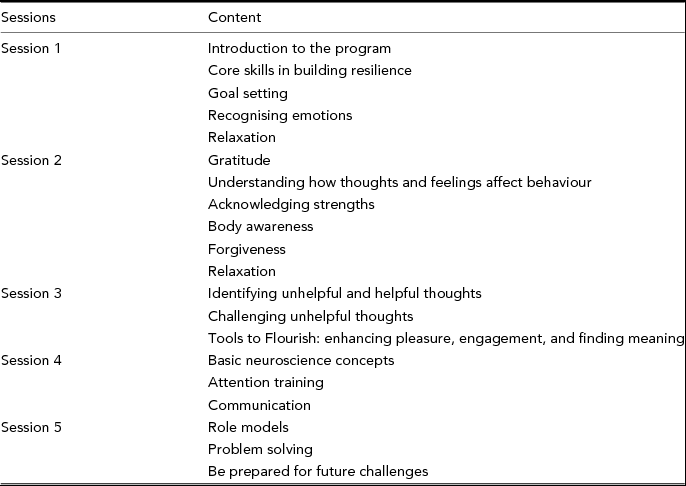
The intervention started in the middle of Term 1. The ARP for teachers and school staff consisted of five in-person sessions that lasted 2 hours each and were delivered after school hours by an experienced trainer. The ARP training was delivered over the course of one and a half school terms (approximately one session a fortnight). The FRIENDS for Life program was delivered to the students as a universal intervention in the classroom for approximately half an hour weekly during the same time period the teachers participated in the ARP training.
Approximately a week after the end of the interventions (end of term 2), students completed the post-intervention protocol, consisting of the same instruments they had completed at pre-test, with the addition of the social validity measure. The same procedure for testing was undertaken at 3 and 6 months after the end of the program. All the assessments were administered by the teachers using the same procedures as during the pre-test.
Intervention Protocol
The FRIENDS for Life program
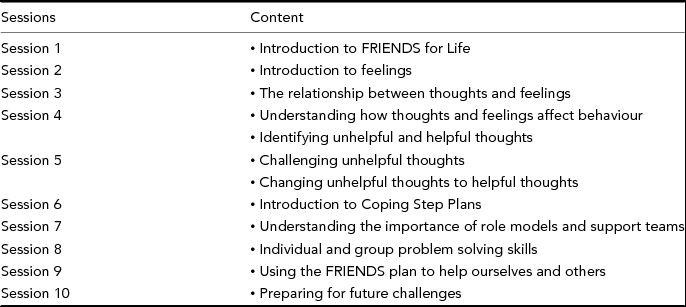
The FRIENDS for Life program is a 10-session manualised program grounded in the principles of cognitive-behavioural therapy (CBT), which was designed to promote general social-emotional health for children aged between 7 and 12 years old (Barrett, Reference Barrett2010). The program utilises a range of behavioural, physiological and cognitive strategies to teach children practical skills to identify their feelings, learn to relax, identify unhelpful thoughts and to replace them with more helpful thoughts, and confront and overcome challenging situations (Barrett, Reference Barrett2010).
FRIENDS for Life Program Content for Students

The Adult Resilience Program (ARP)
The ARP represents an upward extension of the widely used and evidence-based FRIENDS for Life program. It was developed by Barrett (Reference Barrett2011) and is similar to the FRIENDS for Life program in its cognitive behavioural grounding, but its activities and mode of delivery are appropriate for adults. The ARP has the goal to promote emotional resilience into adulthood and throughout the life span. Consistent with the FRIENDS Program, the ARP is based on the principles of the positive psychology that emphasise the teaching of skills to adults that enable them to better manage their emotions, deal with life challenging situations, and maintain an overall positive outlook on life (Barrett, Reference Barrett2011). The components of the program are described in Table 2. To our knowledge, this is the first study using the ARP in a school setting.
Adult Resilience Program Content for Teachers and Other School Staff
Instruments
Strengths and Difficulties Questionnaire (SDQ)
The SDQ is a widely used, 25-item standardised behavioural screening questionnaire designed for children aged 3 to 16 years old (Goodman, Reference Goodman1997). The measure is rated by a 3-point Likert scale ranging from not true to certainly true. The items yield one positive and four negative subscales: pro-social behaviour, emotional symptoms, conduct problems, hyperactivity/inattention, and peer relationship problems. A total difficulty score is computed by adding the four negative subscales. The SDQ has been found to be an efficient screening instrument for the identification of psychiatric disorders in young people (Warnick, Bracken, & Kasl, Reference Warnick, Bracken and Kasl2008). It has shown satisfactory internal reliability (Cronbach's α = .82) for the total scale. The SDQ total score was initially used as a screener to classify all the participants in 2 groups, namely ‘high difficulty’ and ‘low difficulty’. The test scores were also used to evaluate the impact of the interventions on promoting students’ emotional health.
Spence Children's Anxiety Scale (SCAS)
The SCAS is a questionnaire that assesses child anxiety (Spence, Reference Spence1997). It consists of 44 items assessing anxiety symptoms, including obsessions and compulsions, separation anxiety, social phobia, panic and agoraphobia, generalised anxiety, and physical injury concerns. The measure is rated by a 4-point Likert scale ranging from never to always. It has high internal reliability (Cronbach's α = .93) for the total scale.
Acceptability of the program
Social acceptability of the program was assessed by using the FRIENDS Social Acceptability Measure (Lowry-Webster, Barrett, & Lock, Reference Lowry-Webster, Barrett and Lock2003). Participants rated their overall satisfaction with the intervention on six questions each on a 5-point Likert scale ranging from strongly disagree to strongly agree (e.g., ‘In general, I believe the program is useful’, ‘I believe I benefitted from the program’). They were also asked to write comments about the program.
Data Analysis
Data reported in the SDQ norms for Australian adolescents (Mellor, Reference Mellor2005) suggest that a total score on the self-report form of 14 or above for boys and 12 or above for girls indicates that the individual is at risk of presenting difficulties. This value was used to assign the participants into one of two groups for analysis: (1) ‘high difficulty’ and (2) ‘low difficulty’. Classification of the individuals was based on the SDQ total scores obtained in the pre-test.
Given that the SDQ and the SCAS include ordinal data (i.e., Likert scale data) and test responses did not have a normal distribution, assumptions for parametric statistical analysis were violated. As a result, a conservative, non-parametric approach was adopted and the Friedman test was used to detect differences in both instruments (SDQ and SCAS) for the ‘high difficulty’ and the ‘low difficulty’ students across the four different testing times (pre-test, post-test, 3 and 6 months follow-ups). Wilcoxon tests were used on a follow-up basis to examine pairwise comparisons when the Friedman test was significant. A Bonferroni correction was to maintain the Type I error rate at an acceptable level, which resulted in a p value of .0083 (.05/6) to identify findings as statistically significant. Results are reported for the pairwise comparisons. Effect sizes (r) were calculated only for the pairwise post-hoc tests, as suggested by Field (Reference Field2005).
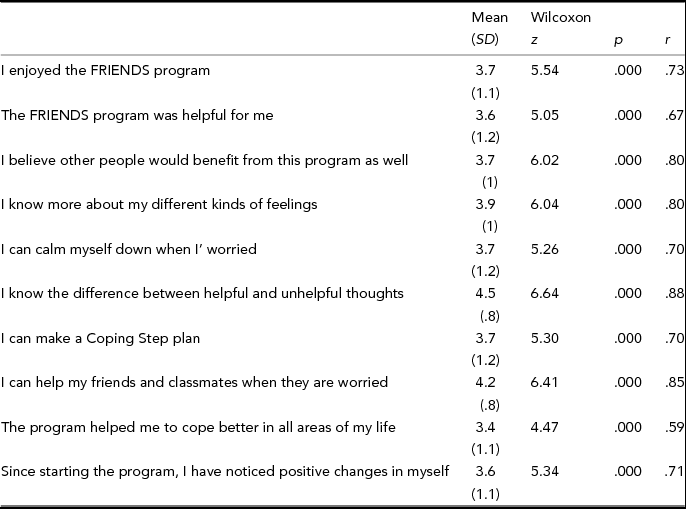
For the overall acceptability of the program we tested the scores given by all participants against a reference value of 2.5 (scale's midpoint value) using Wilcoxon signed-rank test for one sample, p < .05. If the average for a given question was greater than this reference value, then the program was interpreted as being positively evaluated.
Results
SDQ
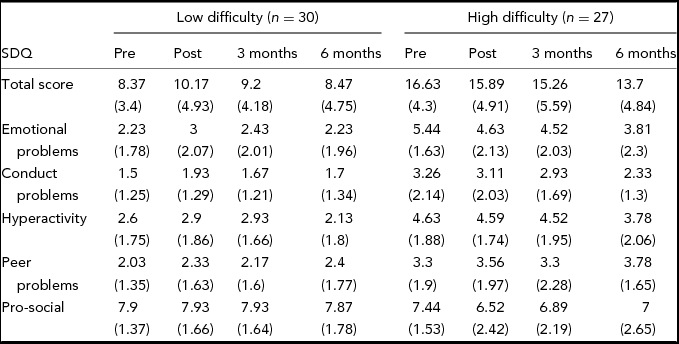
According to Goodman (Reference Goodman2001), it is expected that approximately 20% of children and adolescents will be at risk of presenting problems with worries, fears, sadness, behaviour or concentration at any moment. Based on the SDQ total score in the initial screening administered before the implementation of the Friends for Life program, 30 students were identified as being ‘low difficulty’ (52.6%), and 27 ‘high difficulty’ (47.4%). This percentage is higher than the test norms and justifies the need to promote social and emotional learning in schools from disadvantaged areas. Table 3 shows the scores obtained for both groups at each testing times. The results of the Friedman test showed that the total difficulties scores did not significantly differ over time for either of the groups for the SDQ total difficulties score: ‘low difficulty’ χ2(3) = 5.28, p = .15; ‘high difficulty’ χ2(3) = 7.11, p = .07.
Students’ SDQ Mean and Standard Deviation at Each Assessing Time
As the prosocial subscale is not included in the total scores for the SDQ, a separated Friedman's test was conducted with the prosocial subscale for both groups. No significant changes over time were found for this scale in both the ‘high difficulty’ group, χ2(3) = 6.10, p = .11, and the ‘low difficulty’ group, χ2(3) = 0.30, p = .96.
Despite the fact that the changes over time were not statistically significant, 13 out of the 27 students who were initially identified as ‘high difficulty’ moved to the ‘low difficulty’ group 6 months after the intervention. It means that 48% of the students who were initially ‘high difficulty’ at the beginning of the program were not in this group at the end of the intervention.
Anxiety
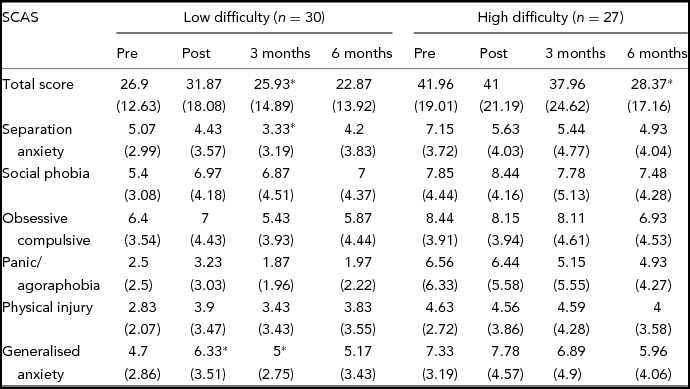
The Friedman test showed a significant decrease in the levels of total anxiety over time for both the ‘low difficulty’, χ2(3) = 16.83, p = .001, and the ‘high difficulty’ group, χ2(3) = 15.94, p = .001. Table 4 shows the students’ average scores on the SCAS at each assessing time.
Students’ SCAS Mean and Standard Deviation at Each Assessing Time
Note: *p < .008
Post-hoc tests showed that the SCAS total scores for the ‘low difficulty’ group at 3 months’ follow-up were significantly lower than in the post-test (Wilcoxon z = 3.20, p < .001, r = .58). The same tendency was found for the ‘high difficulty’ group, as the SCAS scores decreased significantly from the 3-month to the 6-month follow-up assessment (Wilcoxon z = 2.72, p = .003, r = .52).
Given the significant effect of the program on the SCAS total scores, we also analysed the subscales to check whether the effect of the program was more pronounced in one particular item. In relation to the ‘low difficulty’ group, we found significant changes in separation anxiety, χ2(3) = 15.01, p = .001, and generalised anxiety χ2(3) = 7.73, p = .05.
Post-hoc analyses for the ‘low difficulty’ group showed that the decrease in separation anxiety scores were statistically significant from the post-test to the 3-month follow-up test (Wilcoxon z = 2.74, p = .002, r = .50). An initial increase in generalised anxiety was found for this group (Wilcoxon z = 2.42, p = .007, r = .44), but this was followed by a significant decrease from the post-test to the 3-month follow-up assessment (Wilcoxon z = 2.82, p = .002, r = .52).
If we consider the SCAS total scores at pre-test, 16 students were initially identified as ‘high levels’ for anxiety before the intervention started. Six months after the end of the intervention, 12 out of the 16 students were no longer presenting high levels of anxiety. It means that 75% of the students who were showing high levels of anxiety at the beginning of the program were not in this group at the end of the intervention.
Acceptability of the Intervention
The measures of central tendency revealed that students in this study, on average, showed a positive acceptance of the program. The sample mean for each item was higher than the scale midpoint (2.5) in all components, showing that the program was well accepted by the students. Table 5 displays all means and standard deviations by item.
Mean Ratings by Students of the Acceptability of the Program
Note: 1 = strongly disagree, 4 = strongly agree.
Some of the Comments About the FRIENDS for Life Program, Written by Students
It was a very good idea that helped me to be more confident towards myself.
That was a really life changing experience.
I learnt how to be positive.
Just keep on doing it forever with other kids like me.
It made me calm.
It helps kids who are lonely to learn that having friends is not a bad thing.
It helped me build my confidence a bit more.
FRIENDS for Life changed me.
Discussion
This study represents a preliminary evaluation of a combined intervention targeting the social-emotional competence of teachers and students, with a primary focus on the outcomes of Grade 6 and Grade 7 students who were enrolled in a school located in a socio-economically disadvantaged community. Specifically, teachers participated in the ARP to learn specific skills to manage their stress and improve their resilience, while also delivering the FRIENDS for Life program to enhance students’ social-emotional skills and prevent emotional and behavioural problems.
Over the past two decades, a number of studies have shown that the FRIENDS for Life program is effective in decreasing students’ levels of anxiety when used as a universal intervention in schools, but some of studies conducted in schools located in socio-economically disadvantaged communities at risk recommended including enhancements to the context in which the program is implemented, to improve the program's impact. In this sense, increasing teachers’ awareness of the importance of social and emotional skills by providing them with the ARP while they implement the FRIENDS program in their classrooms has the potential to not only provide support for them to deal with daily challenges, but also to act as a mediating factor to the students’ future emotional competence.
Our findings support previous preventative implementation research, showing that the combined intervention had a positive impact on students’ emotional outcomes, with 75% of the students who were initially identified as presenting high levels of anxiety for the SCAS no longer presenting with these levels 6 months after the end of the program; and 48% of the students who were initially identified as ‘high difficulty’ for the SDQ total difficulties score were no longer in this group 6 months after the end of the intervention.
The results did not show significant changes in the SDQ scores over time. However, significant decreases in anxiety levels were found in the SCAS total scores. More specifically, students initially identified as ‘low difficulty’ had a significant decrease in the anxiety total score from post-test to 3-months’ follow-up assessment, and the group presenting with ‘high difficulty’ had a significant decrease in the total anxiety score from the 3-month to the 6-month follow-up assessment.
An initial increase in generalised anxiety at post-test was found for the ‘low difficulty’ group, but the scores decreased significantly from the post-test to the 3-month assessment. It is likely that the intervention might have induced students to notice things they did not notice before; in turn, students became more aware of their own feelings and challenges, increasing their scores in generalised anxiety. It can be the case that when dealing with communities in disadvantage, bringing more awareness to students can have an initial negative impact, and the emotional improvements commence only when students start using the skills learnt during the program, resulting in a decrease on the SCAS scores to the initial low levels. The results of the current study are similar to those reported by Mostert and Loxton (Reference Mostert and Loxton2008) with South African children. More specifically, they showed that positive results were obtained only after 4 months after the intervention.
Several studies on mental health in school reported that students prefer school-based mental health support and that schools could do much more to provide it (Boyd et al., Reference Boyd, Francis, Alsbett, Newnham, Sewell, Dawes and Nurse2007; Carnie, Berry, Blinkhorn, & Hart, Reference Carnie, Berry, Blinkhorn and Hart2011; Dean & Stain, Reference Dean and Stain2007; Hart, Berry, & Tonna, Reference Hart, Berry and Tonna2011). By the same token, our results show that the intervention was positively accepted by the students, reinforcing the fact that schools can support students to succeed not only socially and academically, but to also experience an overall positive sense of wellbeing (Huebner, Gilman, Reschly, & Hall, Reference Huebner, Gilman, Reschly, Hall, Lopez and Snyder2009; Levitt, Saka, Romanelli, & Hoagwood, Reference Levitt, Saka, Romanelli and Hoagwood2007).
Limitations and Future Directions
As with most preliminary studies, this study is not without its limitations. First and foremost, this is a preliminary study that looked at the combined effects of a social-emotional learning program and an adult resilience curriculum, but which did not employ rigorous experimental methods to disentangle the effects of each one of the interventions. Given that this study was supported by a Trust committed to engaging in work in low-income areas of Australia, a study examining the independent and combined effects of each of the interventions would require significantly larger samples and three treatment conditions and, therefore, cost considerably more money to conduct. Future research should investigate the independent and combined effects of the FRIENDS Program and the ARP.
Another limitation was the lack of a control group, but given the high amounts of stress among staff and the preliminary nature of this study, it was determined that a treatment group–only study would be sufficient to gather initial evidence as to whether the combination of the FRIENDS and ARP is effective when implemented in schools serving students from low-socioeconomic communities. Future studies should nevertheless seek to include control groups.
Conclusion
This is the first study examining a combined intervention (Adult Resilience Program for teachers and FRIENDS for Life for students) to promote social and emotional skills in schools. That is, by delivering the Adult Resilience Program to promote social and emotional skills among teachers, and training them to deliver the FRIENDS program in the classroom as a universal intervention, it was expected that students’ social and emotional competence would improve. Results from this study suggest that the combined intervention helped students to decrease their levels of anxiety when delivered as a universal strategy in the school setting. Students who were initially in the ‘low difficulty’ group showed an initial negative impact by increasing their scores in generalised anxiety at post-test; however, this was followed by a significant decrease from post-test to the 3-month follow-up. Participants evaluated the program as enjoyable and useful.
Acknowledgments
The authors thank the participant school for their commitment with our research project. We also thank the Pathways to Resilience Trust team for the support provided throughout the implementation of the FRIENDS and the Adult Resilience programs.