Introduction
In the last few decades, international, and many national, policy frameworks for understanding and tackling domestic abuse (DA) have taken significant strides forward; abuse is now commonly positioned within a gendered context and recognises that other structural factors, such as poverty and ethnicity, play into women's experiences of living with, and leaving, abusive relationships with intimate partners. This has led to policies and professional guidance, in the UK and elsewhere, aimed at improving practice in identifying and supporting DA sufferers framed by a structural understanding of DA. Such approaches aim to promote prevention, early recognition and mitigation of the effects of abuse, as well as the criminal prosecution of offenders.
Despite this, there is significant evidence that improving policy implementation in the real-world of practice remains problematic (Hague and Mullender, Reference Hague, Mullender, Skinner, Hester and Malos2005; Harwin, Reference Harwin2006). Challenges include: encouraging the uptake of broad definitions of abuse beyond physical violence alone; the continued under-reporting of abuse; and the task of developing appropriate (multi)-agency approaches to service design and delivery that promote safety for victims. These issues are inter-related and play out in the particular encounters which women have with front-line staff and organisational systems. Furthermore, there is evidence that the work required to make such encounters successful is more difficult when the relationship between social and economic circumstances and individual needs are not understood (Sokoloff and Dupont, Reference Sokoloff and Dupont2005). The problem, in other words, is that whilst language consistent with a structural understanding of abuse is evident at a policy level, putting this understanding into practice at an individual level is hampered both by structural constraints and variable practitioner awareness of how women's experiences of abuse are shaped by class, ethnicity and disability.
In this article we are interested in how structures shape women's experiences and in how practitioners practice structure. We take two theoretical perspectives – first, the concept of ‘candidacy’ (Dixon Wood, Reference Dixon-Woods, Kirk, Agarwal, Annandale, Arthur, Harvey, Hsu, Katbamna, Olsen, Smith, Riley and Sutton2005) and, second, the explicitly feminist frame of intersectionality (Crenshaw, Reference Crenshaw1991; Yuval-Davis, Reference Yuval-Davies2006), and ask whether they can better illuminate the experience of women navigating DA services. At the centre of our analysis is the idea that women undertake ‘journeys’ into and through services and, en route, encounter professionals of various kinds. We ask whether the two perspectives, singly and in combination, help to understand how such journeys and encounters are shaped by women's multiple roles and identities.
First, we outline what is meant by candidacy and intersectionality; second, we briefly expand on three challenges to policy implementation (definitions, under-disclosure and effective service provision); third, we describe the findings of a literature synthesis that investigates how these frames, separately and together, might improve our understanding of factors which aid or hinder women's help-seeking and service utilisation. We conclude that intersectional theory, in combination with candidacy, helps to make concrete to front-line workers the ways in which the structural determinants of abuse and their impact operate in the lived experiences of individual women.
The concept of candidacy
First conceptualised by Dixon-Woods et al. (Reference Dixon-Woods, Kirk, Agarwal, Annandale, Arthur, Harvey, Hsu, Katbamna, Olsen, Smith, Riley and Sutton2005, Reference Dixon-Woods, Kirk, Agarwal, Annandale, Arthur, Harvey, Hsu, Katbamna, Olsen, Smith, Riley and Sutton2006) in the context of health service utilisation, ‘candidacy’ represents a socially constructed process by which individuals identify themselves as candidates for particular conditions and interventions, and subsequently negotiate these candidacies with professionals operating in particular service regimes. Being a suitable ‘candidate’ for services is not an inert state – rather, individual perceptions are contingent on a range of dynamic social and cultural factors. The original model identifies seven stages: the self-identification of candidacy for intervention; the availability and accessibility of services; their ease of access; the work required to assert one's candidacy; professional decision making; the decision to accept or decline available or offered services; and localised conditions under which services are provided. Barriers to a smooth journey through services were found at structural, organisational, professional, social and individual levels.
Candidacy has been used to understand access to and utilisation of services within the health field, but has not yet been widely employed beyond. Elsewhere (Mackenzie et al., Reference Mackenzie, Conway, Hastings, Munro and O’Donnell2013) we report on a study employing a critical interpretive approach to test candidacy in other policy domains. We conducted an interpretive literature review, concluding that candidacy had resonance beyond health, but revealed elements which require augmentation and refinement. For example, our analysis foregrounded the existence of multiple candidacies where different roles and identities conjoin to influence positively or negatively the likelihood of help-seeking. Furthermore, candidacy would benefit, we argued, from a more nuanced and weighty exploration of the interactions at the macro and meso levels that shape personal and professional responses to social problems. It is the findings from this study that we aim to develop in this article.
The intersectional nature of DA and personal identities
Our second frame for considering the problems of definition, under-disclosure and the challenges of effective service provision is that of intersectionality. Described as one of the most important developments in feminist research (Davis, Reference Davis2008), intersectional theory posits the existence of multi-dimensional identities framed within social and political systems. Davis, for example, describes intersectionality as: ‘the interaction between gender, race and other categories of difference in individual lives, social practices, institutional arrangements, and cultural ideologies and the outcomes of these interactions in terms of power’ (2008: 68).
Intersectional theory moves, therefore, towards a more pluralistic understanding of gendered oppression – incorporating categories of identity such as ethnicity and class (Nixon and Humphreys, Reference Nixon and Humphreys2010). It has been used conceptually to understand issues such as harm reduction in drugs misuse and labour market participation, as well as DA specifically (Crenshaw, Reference Crenshaw1991; Browne and Misra, Reference Browne and Misra2003; Sokoloff and Dupont, Reference Sokoloff and Dupont2005; Smye et al., Reference Smye, Browne, Varcoe and Josewski2011). Intersectionality is not, however, without its critics. At an ideological level, it has been contested on the basis that it could potentially detract from the powerful message that DA is universally perpetrated and experienced regardless of ethnicity and class (Sokoloff and Dupont, Reference Sokoloff and Dupont2005). This message has been central to the lobby for better gender-based violence policy because it has ensured that DA is not perceived as a marginal problem for particular groups (such as low-income women, or women of specific ethnicity (Sokoloff and Dupont, Reference Sokoloff and Dupont2005). Its proponents, however, argue that better practice will ensue from a less generalised view of victims and abusers (Cramer and Plummer, Reference Cramer and Plummer2009; Nixon and Humphreys, Reference Nixon and Humphreys2010). Nonetheless, it is argued that intersectionality is conceptually knotted (for a full argument, see Walby et al., Reference Walby, Armstrong and Strid2012), and its implications for practice are muddy (Nixon and Humphreys, Reference Nixon and Humphreys2010). Nonetheless, despite its ‘theoretical, political, and methodological murkiness’ (Nash, Reference Nash2008) we suggest that it is plausible that, in conjunction with candidacy, intersectional theory offers a possible frame for understanding how multiple categories of role and identity relate to the problems of definition, disclosure and effective service provision.Footnote 1 Before testing the hypothesis that intersectional theory and the concept of candidacy can create synergies in our understanding of these interrelated problems, we turn to an expanded description of the problems themselves.
Three problems of improving services for individual women
We start with definitions of abuse, since both personal and professional responses to DA are shaped by policy definitions of the ‘problem’, and services are designed in response to those specific public conceptualisations.
Perceptions of DA as a social problem have evolved over decades, shaped by changing social and political attitudes (Fischer, Reference Fischer2003; Knoepfel et al., Reference Knoepfel, Larrue, Varone and Hill2007). Increased understanding of the multifaceted nature of DA is reflected in contemporary policy definitions which explicitly recognise a range of abusive behaviours; the World Health Organisation (WHO) defines violence against women as ‘any act of gender-based violence that results in, or is likely to result in, physical, sexual or mental harm or suffering to women, including threats of such acts, coercion or arbitrary deprivation of liberty, whether occurring in public or in private life’ (WHO, n.d.). As social intolerance of physical violence in personal relationships has risen, so too has an understanding of the mechanics of abusive relationships, including the way in which controlling and threatening behaviours almost always underpin physical abuse, and can ensnare women in damaging relationships even in the absence of overt physical assault (Stark, Reference Stark2007).
Yet, despite acknowledgement by policymakers that abusive relationships encapsulate multiple behaviours, policy interventions and practice on the ground tend to prioritise physical violence (Hearn and McKie, Reference Hearn and McKie2010). Media coverage, too, tends to focus on extreme cases of acute physical violence (Carlyle et al., Reference Carlyle, Slater and Chakroff2008) which fuel public perceptions that DA worthy of external intervention equates to physical violence (Hearn and McKie, Reference Hearn and McKie2010). There is a gap, therefore, between DA as it is conceptualised in policy and DA as it is personally experienced. An outcome of such a discrepancy is that ‘women underdefine themselves as abused’ (Mullender, Reference Mullender1996: 54). Definition, therefore, feeds directly into disclosure.
Under-disclosure of abuse is widely acknowledged to be a problem for policy and practice (Harwin, Reference Harwin2006), and many policies have attempted to tackle the issue (Ramsay et al., Reference Ramsay, Richardson, Carter, Davidson and Feder2002; Harwin, Reference Harwin2006). Examples in the UK include the introduction within health care of routine enquiry and protected time, where midwives in antenatal clinics provide an opportunity for women to speak to them without the presence of their partner (Bacchus et al., Reference Baachus, Mezey and Bewley2002; Price et al., Reference Price, Baird and Salmon2007). Nonetheless, there can be professional resistance to such approaches, particularly when professionals feel uncomfortable in knowing what support to provide (Ramsay et al., Reference Ramsay, Richardson, Carter, Davidson and Feder2002). We also know that women who disclose to professionals rarely do so in their first encounter (McKie et al., Reference McKie, Fennell and Mildorf2002).
Of course, disclosure is not just about whether women view themselves as fitting the definition of abused. Disclosure is actively inhibited by the perpetrators, and resistance to disclose is also known to be influenced by the anticipated reactions from professionals and by the nature of the support that is offered. In relation to the former, it is known that women's experiences of disclosure are not always positive (Peckover, Reference Peckover2003). The narrow definitions that may lead to under-reporting can also negatively influence practice through the implicit or explicit prioritisation of physical abuse by the professionals to whom women disclose (Garcia-Moreno, Reference Garcia-Moreno2002). In relation to the latter, it is known that effective services are those within which professionals respect women's choices, that recognise the inherent dangers involved in the disclosure, and that can deliver viable and joined-up solutions to the process of helping women leave abusive situations (Hague and Malos, Reference Hague, Mullender, Skinner, Hester and Malos2005). Enabling professions and institutions to enact these features is widely recognised by policy and the academic literature as highly problematic, particularly in the context of a policy environment that actively marginalises certain groups of victims (O’Connor, Reference O’Connor2002; Burman and Chantler, Reference Burman and Chantler2005; Mullender and Hague, Reference Mullender and Hague2005).
Having outlined key problems that compromise the professional support of women's routes into and through services, we now consider whether their journeys can be illuminated through the dual lens of candidacy and intersectionality and, in particular, whether intersectionality can add to what we already know about candidacy.
Approach to the literature synthesis
The approach used was modelled on Dixon-Woods and colleagues’ critical interpretive synthesis method (Reference Dixon-Woods, Kirk, Agarwal, Annandale, Arthur, Harvey, Hsu, Katbamna, Olsen, Smith, Riley and Sutton2006), which aims to develop higher-order constructs by the constant comparison of themes emerging from a purposively defined set of primary research papers. The approach is shaped by qualitative principles such as the appropriateness of purposive sampling, and of theoretical saturation as a means of determining when sufficient data have been gathered. More specifically, we undertook the following steps.
Searching and sampling from the literature
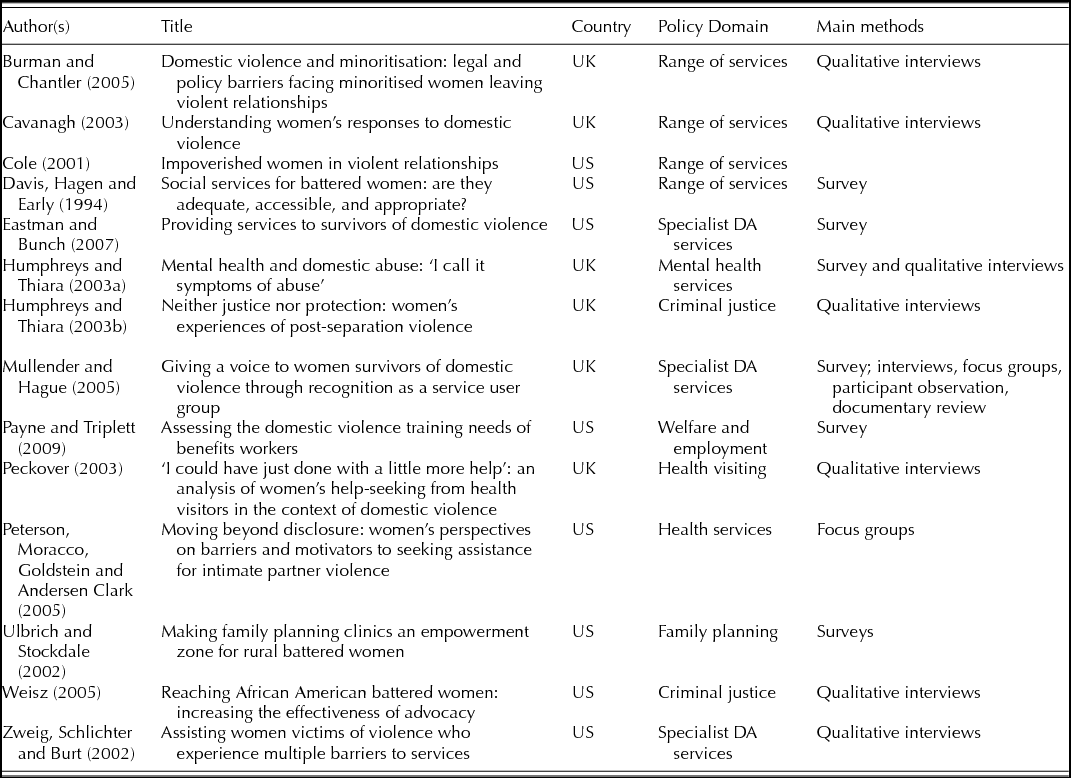
The approach to conducting critical interpretive reviews is described by Dixon Woods and colleagues (Reference Dixon-Woods, Kirk, Agarwal, Annandale, Arthur, Harvey, Hsu, Katbamna, Olsen, Smith, Riley and Sutton2006) and the specific process undertaken in this study is described in detail in Mackenzie et al. (Reference Mackenzie, Conway, Hastings, Munro and O’Donnell2013). Key social science databases such as the Applied Social Sciences Index and Abstracts and Sociological Abstracts were explored using terms relating to access/utilisation, entitlement, co-production, services and DA (described in more detail in Mackenzie et al., Reference Mackenzie, Conway, Hastings, Munro and O’Donnell2013). The resulting list of relevant papers was then expanded through our existing knowledge of the field, targeted citation searching and following key reference threads. From these, we purposively sampled to ensure that we had coverage of a range of services, methodological approaches and coverage of the journey through services imputed by Dixon Woods. In total, we reviewed fifteen English language papers relating to DA. The services covered by these included health services, criminal and civil proceedings, welfare benefits and women's refuges, and they included empirical work using both qualitative and quantitative survey methods and representing staff and user perspectives. Table 1 below provides a summary of the reviewed papers.
Papers selected for review

Data extraction and synthesis
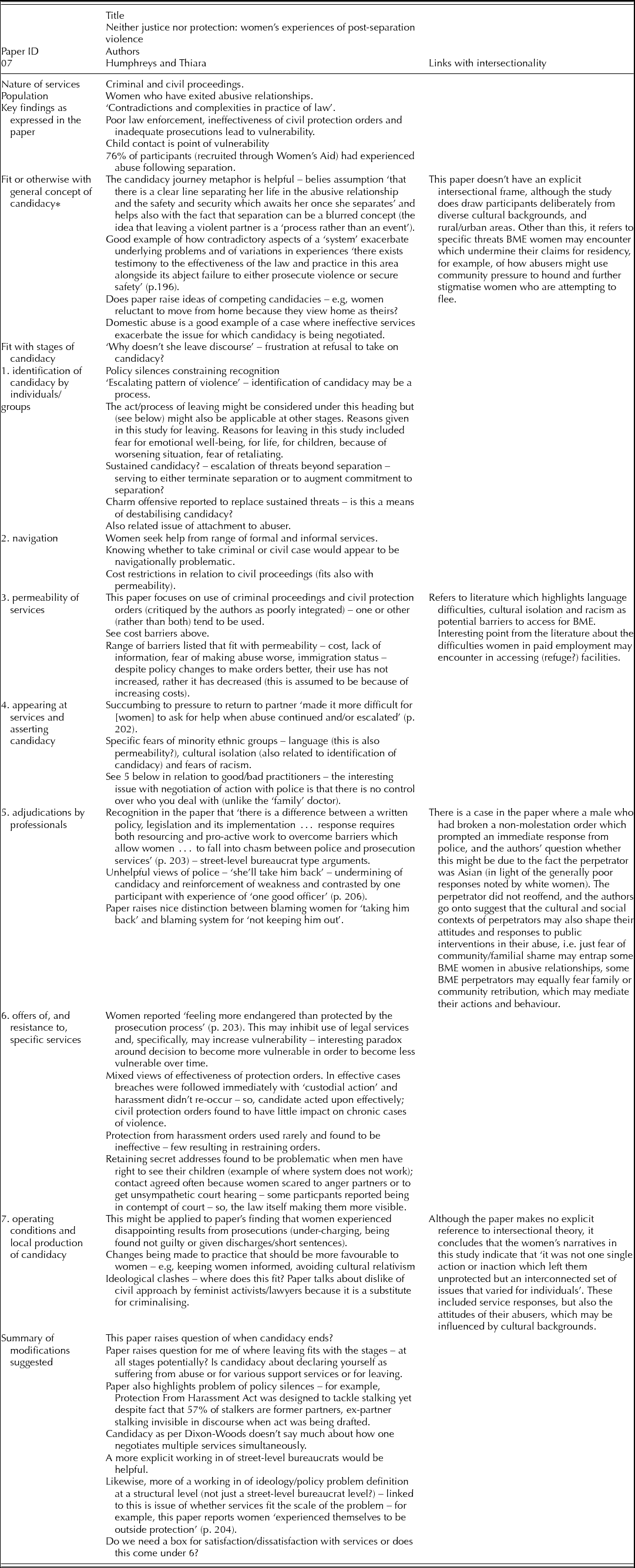
Next we extracted data from each identified source article, using a template to frame our reading and data extraction. This template allowed us to identify aspects of source articles that related to the seven stages of the candidacy ‘journey’. Each paper was then read for its connection with intersectional theory: was intersectionality explicitly referenced by the authors, and at what point of the candidacy journey might it illuminate women's disclosure of abuse and receipt of services. Each paper was read by two researchers; findings were then synthesised across individual templates and discussed within the research team with developing interpretations tested and validated. Table 2 provides an illustrative example of the data extracted from one paper.
An illustrative date extraction template
None of the papers reviewed used candidacy to describe or frame their studies and only one explicitly referenced intersectionality (Burman and Chantler, Reference Burman and Chantler2005, discussed below); nonetheless both of these concepts had considerable traction in synthesising findings. To increase clarity of presentation, we have collapsed Dixon Woods’ seven stage journey into three. First, we consider what the sampled studies say about the process of identifying oneself as a victim of DA (Dixon Wood's first stage of identification); second, we look at factors shaping service access and subsequently making a disclosure of abuse (subsuming Dixon Wood's stages of navigating and permeating services and asserting candidacy within these); and, third, we review service responses and how they are constrained (encompassing Dixon Wood's categories of professional adjudication of candidacy, acceptance/resistance to offered services and local operating conditions for services). At each stage, we reflect how macro level determinants of inequalities impact on service journeys.
1. Identification of one's status as a domestic abuse sufferer
The first stage in the candidacy journey as outlined by Dixon Woods is one's self-perception as a legitimate candidate for a particular condition or set of services. The literature indicates substantial congruence with the idea that candidacy for the DA sufferer is socially constructed, and that individual candidacies arise dynamically in the context of structural, social and personal circumstances. Cavanagh (Reference Cavanagh2003), for example, highlights how gendered roles and the need to prove oneself a ‘good’ partner challenge some women's willingness to self-label as sufferers of abuse while Humphreys and Thiara (Reference Humphreys and Thiara2003a, Reference Humphreys and Thiarab) explore how low self-esteem and depression resulting from abuse reduce the likelihood of women recognising victimhood. The mental health outcomes resulting from DA are both a ‘symptom’ and mask of candidacy; thus, it is through the very act of perpetration that abusers cover their tracks and inhibit disclosure.
How does intersectional theory play into the recognition of abuse by women themselves? Burman and Chantler (Reference Burman and Chantler2005) reference intersectional theory directly. This paper makes a strong case for how existing structures and policies operate to ‘minoritise’ groups of women – in other words, homogenised assumptions of abuse are structurally created and exclude/stigmatise women whose experiences are ‘different’. Although this paper is the only one to make use of intersectionality explicitly, a significant number of papers reviewed reflect concerns that resonate with its central principles. For example, in both the US and UK literature there is a focus on ethnicity as a driver of differential experience for abused women. In one American study, ethnicity is simply used as a descriptive category (Peterson et al., Reference Petersen, Kathryn, Moracco, Goldstein and Clark2005), but in others it is conceptualised in a more nuanced fashion (Weisz, Reference Weisz2005). Weisz (Reference Weisz2005: 92), for example, challenges the notion that DA is experienced in a universal fashion; there is, she claims, ‘no reason to assume that African American women's situations or understandings of their situations are the same as European American women’. The kinds of cultural difference that she hypothesises are products of historical and structural factors; she cites evidence that slavery in the US produced black female norms of endurance that resulted in under-acknowledgement of abuse. Ethnicity and culture combined with gender, in these cases, create multiple, potentially conflicting, candidacies for abused women.
The reviewed papers also considered other forms of identity that affect women's readiness to self-label themselves abused. Many comment on how poverty reduces the salience of abuse in women's lives. Peterson et al.'s (Reference Petersen, Kathryn, Moracco, Goldstein and Clark2005: 72) study of predominantly African-American women describes women for whom poverty takes precedence over tackling abuse: ‘it's easier to know when the next butt kicking is than to know when your next meal's coming.’ Consistent with intersectional theory, Weisz (Reference Weisz2005) discusses the co-existence of multiple facets of identity – that at the intersection of race and gender, DA, poverty, unemployment and child-caring roles also tend to reside and create complex patterns of experience that potentially inhibit the self-naming of abuse. Specific intersections of structural factors help, therefore, to understand the nature of candidacy for DA.
Viewing the DA literature through the lens of candidacy challenges it to be more cognisant of multiple candidacies (Mackenzie et al., Reference Mackenzie, Conway, Hastings, Munro and O’Donnell2013); what we argue here is that intersectionality in turn brings together a powerful set of structural arguments for better understanding the multiplicities that ensue.
2. Seeking services and making disclosures
Dixon Woods argues that candidacy can be affected by the ease of service access – only when women get to services can they weigh up the decision to disclose.
The reviewed literature highlighted that access to services is affected by cost, level of information about how to reach services and travel issues, including rurality. However, there are a number of issues related to accessibility apparent in the DA literature that, whilst congruent with candidacy, are not currently written in. First, women who choose to seek formal support in relation to DA will do so from professionals within a wide array of organisations from health, social services, housing and the police – the majority of whom are not specialists in DA. Therefore, the complex relationship that exists between partner organisations encountered in a health ‘journey’ is multiplied many times over in relation to help-seeking for abuse. Planning a pathway through services, therefore, becomes a significant drain on resources, particularly if one has limited access to a telephone, personal finance and non-surveillance opportunities (Humphreys and Thiara, 2003; Grossman et al., Reference Grossman, Lundy, George and Crabtree-Nelson2010).
The risk to individuals who are help-seeking makes DA a particular case when it comes to understanding journeys to/through services. The literature reminds us that women are most in danger of being killed by their partner when they leave or threaten to leave (Humphreys and Thiara, Reference Humphreys and Thiara2003b; Hamby, Reference Hamby2013). This makes every disclosure a threatening one, and women must weigh up the risks with the long-term benefits of gaining help (Humphreys and Thiara, Reference Humphreys and Thiara2003a; Peckover, Reference Peckover2003; Petersen et al., Reference Petersen, Kathryn, Moracco, Goldstein and Clark2005; Weisz, Reference Weisz2005).
Disclosing abuse is problematic for women with children if they are concerned about child protection consequences (Humphreys and Thiara, Reference Humphreys and Thiara2003b; Peckover, Reference Peckover2003; Peterson et al., Reference Petersen, Kathryn, Moracco, Goldstein and Clark2005). Once again the intersection of women's multiple identities as mother, partner and abused create complex pathways towards or away from services, and the intersectional frame helps to make sense of these identities in terms of how they relate to candidacy. Thus, having children may act as both spur to disclosure (enhancing candidacy) or motivation to leave abuse veiled (conflicting candidacy). Whilst this does not help service delivery in predicting what confluence of structural and role identities will lead to reduced or augmented candidacy, it provides a helpful frame for researchers, policymakers and practitioners to better understand the complexity of individual women's decision-making processes.
The importance of intersectionality as a frame is also revealed by literature that demonstrates that women are liable to fear and face misalignments between themselves and services in relation to their class and ethnicity (Cole, Reference Cole2001; Burman and Chantler, Reference Burman and Chantler2005; Weisz, Reference Weisz2005). Sen (Reference Sen1999) and Sokoloff and Dupont (Reference Sokoloff and Dupont2005) emphasise that fear of a prejudiced system affects decisions to disclose – for example, black women's fear of adding to a negative stereo-typing of African American men, and of a disproportionately punitive criminal justice response, acts as a barrier to accessing services. Once again, multiple candidacies are at stake and intersectional theory provides a helpful frame for understanding their structural determinants.
3. The response of services and how these are constrained
Dixon Woods argues that candidacy can be encouraged or undermined through the interactions that service users have with service providers. Our review found that the literature was highly congruent with this notion in a number of ways. First, women who are planning to disclose their abuse may look to service providers to open up a space for disclosure. In a study by Peckover (Reference Peckover2003: 279), for example, one woman says, ‘I remember waiting to be asked; thinking please ask me.’ The failure of professionals to open this space and acknowledge signs of abuse is potentially stigmatising and threatens to invalidate uncertain candidacy (Peckover, Reference Peckover2003; Cole, Reference Cole2001; Zweig et al., Reference Zweig, Schlichter and Burt2002; Humphreys and Thiara, Reference Humphreys and Thiara2003a; Petersen et al., Reference Petersen, Kathryn, Moracco, Goldstein and Clark2005). This demonstrates the potential importance of the types of policy developments in health care described earlier.
Second, practitioner failure to look for and read the gaps in a service-user's presentation is not simply a missed opportunity to provide support, it may also define the situation as one not worthy of intervention or, in the case of violent behaviour where the professional is able to witness the physical symptoms of abuse, to condone that abuse by not raising it with the woman (Zweig et al., Reference Zweig, Schlichter and Burt2002; Humphreys and Thiara, Reference Humphreys and Thiara2003a, Reference Humphreys and Thiara2003b).
Third, a view that only those who manage to leave are serious about wanting to do so can result in closing down candidacy (Cole, Reference Cole2001; Zweig et al., Reference Zweig, Schlichter and Burt2002; Humphreys and Thiara, Reference Humphreys and Thiara2003b). For example, the studies by Cavanagh (Reference Cavanagh2003) and Humphreys and Thiara (Reference Humphreys and Thiara2003a) demonstrate how women who have repeatedly returned to their abusive partners receive negative reactions from professionals (including Accident and Emergency doctors and the police). This is at odds with knowledge about the many varied trajectories between recognising abuse and putting an abusive relationship in the past (O’Connor, Reference O’Connor2002; Mullender and Hague, Reference Mullender and Hague2005; Hamby, Reference Hamby2013).
Fourth, not all practitioners, particularly those who are not specialists in DA, are aware of how women's opportunities to leave are shaped by structural factors. The work of Burman and Chantler (Reference Burman and Chantler2005) illuminates the marginalised role of women without recourse to public funds and therefore facing reduced refuge access, and of those women in low-paid employment who are unable to afford refuge places because they are not in receipt of housing benefit, and who, in moving out of their social networks lose opportunities for vital childcare, remind us of the macro level context within which individuals experience abuse. A lack of awareness, on the part of practitioners, of these structural constraints and how they feed into what Hamby (Reference Hamby2013) describes as the ‘careful calculus’ of women's decisions, is potentially damaging.
Fifth, women can be stigmatised by their treatment. Humphreys and Thiara (Reference Humphreys and Thiara2003a), for example, illuminate the experiences of abused women in receipt of mental health services, and conclude that treating women for the symptoms of mental illness (as opposed to the root causes of abuse) is liable to pathologise the woman and perpetuate the myth that she is to blame.
Finally, Zweig et al. (Reference Zweig, Schlichter and Burt2002) argue that professionals who operate with the notion of an ideal candidate may stigmatise those who do not fit the mould – their study of women who have been imprisoned, are sex workers or drug-users, shows how some ‘candidates’ are marginalised and their experiences made additionally problematic by service responses. The authors argue that: ‘the system questions women's credibility more when it comes to women with multiple barriers’ (Zweig et al., Reference Zweig, Schlichter and Burt2002: 168). This fits with Dixon-Woods et al.'s (Reference Dixon-Woods, Kirk, Agarwal, Annandale, Arthur, Harvey, Hsu, Katbamna, Olsen, Smith, Riley and Sutton2006: 8) observation that professionals can operate with a ‘repertoire of routine judgements’ that unconsciously penalise the most vulnerable.
Dixon-Woods and colleagues (Reference Dixon-Woods, Kirk, Agarwal, Annandale, Arthur, Harvey, Hsu, Katbamna, Olsen, Smith, Riley and Sutton2005, Reference Dixon-Woods, Kirk, Agarwal, Annandale, Arthur, Harvey, Hsu, Katbamna, Olsen, Smith, Riley and Sutton2006) argue that, in relation to health service usage, we should be mindful that non-receipt of services does not mean that services were not offered, but might be indicative of non-compliance with recommended treatments/services. The notion of ‘non-compliance’ is interesting in relation to DA. At its heart it contains a paradox: if professional advice prioritises leaving to the exclusion of other (more temporary) routes to alleviating the impacts of abuse, and that not-leaving or returning is viewed as a sign of weakness, then it may ask women to substitute one type of compliance for another – both may put her in actual physical danger (Cole, Reference Cole2001; Humphreys and Thiara, Reference Humphreys and Thiara2003b). Second, for safety to be prioritised, a range of policies, services and supports need to be in place simultaneously – this is made problematic where professionals have significant gaps in their knowledge of available supports and of the structural constraints on their use by particular marginalised groups (Peckover, Reference Peckover2003; Burman and Chantler, Reference Burman and Chantler2005; Payne and Triplett, Reference Payne and Triplett2009). Workers are not always in a position to guarantee safety or to resolve the problem for which candidacy is stated. Humphreys and Thiara illustrate this problem in their analysis of how women fare in the criminal and civil legal sphere, where they find that women ‘experienced themselves to be outside protection’ (Reference Humphreys and Thiara2003b: 204). Indeed, explicitly hostile policy decisions (within the UK, for example, national government decisions to cut funding for refuge places or to exclude women with insecure asylum status from refuge provision (Burman and Chantler, Reference Burman and Chantler2005)) are part of the structural landscape within which practitioners must operate and provide support.
Overall, data relevant to the intersectional frame are prominent in these studies. Taken together the studies demonstrate that a woman's location on a range of intersecting axes impinge on the construction of her candidacy. We turn now to the implications of our findings.
Conclusions and reflections
This article aimed to test if, and how, the theoretical frames of candidacy and intersectionality might be synthesised to improve understanding of the ways multiple roles and identities influence women's journeys into, and through, those services with a responsibility for alleviating the impact of DA. To our knowledge, these frames have not previously been brought together in relation to any social phenomenon. We found that an effective means of enriching the original concept of candidacy is by applying an intersectional lens to women's journeys through services. Connections between the concepts – in particular, their social constructionist perspectives on social processes – allow for mutual illumination of the more indistinct aspects of each. For candidacy, intersectionality's firm focus on overarching structural factors which shape experiences and determine outcomes offers a framework within which access and utilisation of services might be understood in structural terms. Critically, in the case of DA services, this promotes less fragmentary perceptions of women experiencing DA, whose exposure to gendered forms of violence co-exists within overlaying frames of multiple oppressions. At the same time, the acknowledged nebulousness of intersectional theory might be given more substantial form when viewed in conjunction with candidacy, a concept which offers a concrete delineation of women's experiences of accessing public services.
Our earlier reading of the DA literature helped to develop the notion of multiple candidacies whereby multiple roles and identities intertwine to repress and/or augment women's sense of candidacy. In this article, our key finding is that the concept of multiple candidacies, in particular, is advanced in important ways by intersectional theory which provides an explicitly structural vocabulary for delineating what makes candidacies multiple. Taken together, the frames simultaneously encourage women's identities to be dissected and made whole. This offers the potential for important developments that encompass both conceptual/empirical and practice domains.
In terms of conceptual/empirical developments, our findings suggest ways in which we might start to better operationalise intersectionality and the structural drivers of individual experience into a frame that lends itself to empirical testing. In particular, it suggests that efforts to understand the perspectives of women and professionals needs to take account of: (1) women's experiences at the junctions of multiple structures and how these relate to definitions and disclosure; (2) service providers’ understanding of these structural features and their relation to how DA is defined, experienced and reported; and (3) the scope of professionals and organisations to respond holistically to women's multiple, complex and potentially conflicting needs in ways that fully engage with their safety and the reality of the overarching political and policy landscape.
In terms of developments for practice, bringing together candidacy and intersectionality offers a means of concretising for practitioners the ways in which structural factors (poverty, class, gender, ethnicity and so on) meld in complex ways in the lives of individual women that will affect how they define themselves, the constraints on naming their abuse and the implications of service solutions for their actual lived lives. Importantly, this calls for an improved understanding not only of the gendered nature of abuse and of the lived experience of individual women living with and attempting to escape abuse, but also a broader understanding of how social structures define the problem of abuse and shape solutions. Improved practitioner awareness of intersectionality, rooted in an understanding of the complex pathways taken by women as they identify/act on candidacy, might offer a means by which the structural and political becomes recognisable in encounters with individual women. As such, the utility of intersectional awareness raising for policymakers and for practitioners is worthy of further exploration, particularly since the problem of how to practice ‘structure’ at an individual level is not limited to work with victims of abuse, but is inherent to front-line public service delivery from criminal justice through housing and education.
In summary, together candidacy and intersectionality offer a means of enhancing knowledge of how the political becomes enacted in the personal. Embedding such knowledge within practice repertoires offers the potential to develop more nuanced structural understandings of women's experiences and constraints. Empirical investigation of the applicability of this more nuanced version of multiple candidacies as a means of informing practice is necessary.