Introduction
Phyto-oestrogens are a diverse group of naturally occurring non-steroidal plant compounds, and due to their structural similarity with 17β-estradiol they have weak oestrogenic and/or anti-oestrogenic effects. Interest in phyto-oestrogens started in the 1980s after epidemiological studies comparing Western and Asian diets indicated that a diet with high content of phyto-oestrogens prevents predominant Western diseases such as cardiovascular diseases, hormone-related diseases (breast and prostate cancer) and postmenopausal symptoms in women (osteoporosis, hot flashes) (Kurzer and Xu, Reference Kurzer and Xu1997; Adlercreutz, Reference Adlercreutz2002; Duncan et al., Reference Duncan, Phipps and Kurzer2003).
The research on phyto-oestrogens has primarily focused on their occurrence in vegetables and there are few studies on food products of animal origin. However, ruminant feedstuffs contain phyto-oestrogens, which, after ingestion by the cow, can be transferred to the milk. The phyto-oestrogens in ruminant feedstuffs are mainly isoflavones, coumestans and lignans. The isoflavones are predominantly found in legumes. The content varies between plant species, with red clover having the highest content. The coumestans are mainly found in lucerne and in small amounts in white clover (Saloniemi et al., Reference Saloniemi, Wahala, Nykanen-Kurki, Kallela and Saastamoinen1995). The primary plant lignans are found in cereals, legumes and oilseeds used in concentrates (Thompson et al., Reference Thompson, Robb, Serraino and Cheung1991). However, there are few studies on the actual content in ruminant feedstuffs.
Most of the isoflavones occur as glucosides in the plant but are readily hydrolysed by endogenous glycosidases when the plant is eaten by the animal. In the rumen biochanin A and genistein are metabolised by the microorganisms to para-ethylphenol and other organic acids without oestrogenic effect, while formononetin is demethylated to daidzein, which can be reduced to equol, a more potent phyto-oestrogen. Coumestans does not appear to be metabolised in the rumen (Adams, Reference Adams1989). The major plant lignans are matairesinol and secoisolariciresinol, which are converted by the intestinal bacteria to enterolactone and enterodiol, respectively. Enterodiol can be further converted to enterolactone (Magee and Rowland, Reference Magee and Rowland2004).
The few available studies on the concentration of phyto-oestrogens in bovine milk report concentrations of isoflavones to be in the 0.1–9.0 μg/l range and the concentration of equol and enterolactone to be in the 45–401 and 14–40 μg/l ranges, respectively (King et al., Reference King, Mano and Head1998; Antignac et al., Reference Antignac, Cariou, Le Bizec and Andre2004; Purup et al., Reference Purup, Hansen-Møller, Sejrsen, Christensen, Lykkesfeldt, Leffers and Skakkebæk2005; Steinshamn et al., Reference Steinshamn, Purup, Thuen and Hansen-Møller2008). Steinshamn et al. (Reference Steinshamn, Purup, Thuen and Hansen-Møller2008) showed that milk from cows fed red clover silage had a significantly and several times higher concentration of isoflavones compared to milk from cows fed white clover silage. In contrast, the milk from cows fed white clover silage had the highest concentrations of the lignans enterodiol and enterolactone. They also showed that the effects of silage type on milk content of the individual phyto-oestrogens were related to the intake of the compound or its precursor. As the concentration and composition of the phyto-oestrogens differ among different types of feed, this implies that it is possible to influence the concentration and composition of the phyto-oestrogens in bovine milk.
To gain further insight into the content of phyto-oestrogens in ruminant feedstuffs and how the feedstuffs affect the concentration and composition of phyto-oestrogens in the milk, the aim of the experiment was to measure the concentration of isoflavones, coumestans and lignans in the feedstuffs as well as in milk from cows fed grass/clover silage (GCS), or lucerne silage or a mix of lucerne and maize silage.
Material and methods
Feeds
The four treatment diets were lucerne silage (LS), 2/3 lucerne silage and 1/3 maize silage (2/3LS), 1/3 lucerne silage and 2/3 maize silage (1/3LS) and GCS. The lucerne silage (Medicago sativa) was from first cut, and the maize silage was of the strain Blixxem. The GCS was from a sward established with 40% festulolium (Lolium multiflorum × Festuca pratensis), 40% diploid perennial ryegrass (Lolium perenne), 10% red clover (Trifolium pratense) and 10% white clover (Trifolium repens) (% of seeds).
All cows were fed a standard diet composed of (% of dry matter (DM)): rolled barley (10.8), rape seed cake (19.4), dried sugar beet pulp (9.6), vitamin mixture (0.14) and mineral mixture (0.72) and forage (59.3). The experimental treatment was the composition of the forage as mentioned above. The feed was offered ad libitum as total mixed rations twice daily at 0800 and 1400 h.
Animals and experimental design
Sixteen lactating Danish Holstein dairy cows were divided into four repeated 4 × 4 latin square design with four cows per treatment per period of 3 weeks. The division was based on parity and time to calving. Half of the cows were first parity and all cows were in the first half of lactation.
The cows were milked at 0430 and 1600 h. Milk samples were collected during morning milking on day 21 in each experimental period. The milk samples were frozen immediately after collection and stored at −20°C until analysis for phyto-oestrogens.
On day 6, 13 and 20 in each experimental period two samples of each silage type and concentrate were collected. One sample of each silage type and concentrate was analysed immediately for DM and the other samples were stored at −20°C. At the end of the experiment the stored silage and concentrate samples were pooled for each feedstuff to cover periods 1 and 2 and periods 3 and 4 and stored at −20°C until further analysis.
Analysis of feedstuffs
Concentrate DM was determined after drying in a forced air oven for 20 h at 103°C, and silage DM after drying at 60°C. Samples for chemical analyses were ground through a 1.0 mm screen. Ash was determined by combustion at 525°C for 6 h. Total N content was determined according to the Dumas principle (Hansen, Reference Hansen1989). Ash-free neutral detergent fibre (NDF) was analysed using a Fibertec according to Mertens (Reference Mertens2002). Crude fat was determined using a Soxhlet apparatus with petroleum ether extraction after 3 M HCl hydrolysis (Stoldt, Reference Stoldt1952).
Analysis of phyto-oestrogens in feed and milk samples
The feed and milk samples were analysed according to Steinshamn et al. (Reference Steinshamn, Purup, Thuen and Hansen-Møller2008). In brief, milk samples were deproteinised and defatted by mixing samples with acetate buffer (pH 5.2), heptane and acetone. The acetone phase was evaporated to dryness and the residue dissolved by adding water. Conjugates of the phyto-oestrogens were cleaved by incubating at 40°C for 4 h with a mixture of β-glucuronidase and sulphatase-type H2 from Helix Pomatia.
The feed samples were extracted with a mixture of ethanol and acetate buffer pH 5.0. The extract was incubated with Cellulase Ononuka R-10 for 16 h at ambient temperature and analysed using standard addition.
All samples were analysed using the liquid chromatography (LC)–mass spectrometry (MS)/MS technique for daidzein, genistein, formononetin, biochanin A, prunetin, coumestrol, matairesinol and secoisolariciresinol and the milk samples also for equol, enterodiol and enterolactone. All chemicals used were of analytical grade and obtained from Sigma-Aldrich (St. Louis, MO, USA).
Statistical analysis
For samples where the concentration of phyto-oestrogens was below the detection limit, the concentration was set equal to the detection limit before the calculations.
The data were analysed using the GLM procedure in Statistical Analysis Systems Institute (SAS) (1999). The following statistical model was used:

where Y is the dependent variable, μ the mean, α the fixed effect of lactation number i (primiparous and multiparous), β the fixed effect of period j (1–4), π the fixed effect of treatment k (LS, 2/3LS, 1/3LS and GCS), η the random effect of cow l within lactation number i; random residual variation εijkl∼N(0,σ 2). The effect of lactation number was only significant for prunetin. Thus, the effect of lactation number was taken out of the model.
The results are presented as least squares mean.
Results
Feed composition
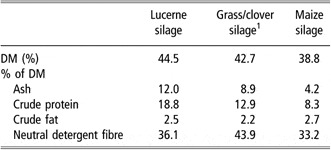
The chemical composition of the lucerne, grass/clover and maize silages is shown in Table 1. The GCS was composed of 97.4% grass and 2.6% clover (red and white clover). The very low proportion of clover was due to the intensive growth of festulolium in the spring.
Chemical composition of the lucerne, grass/clover and maize silages

DM = dry matter.
1Botanical examination: 97% grass and 3% clover.
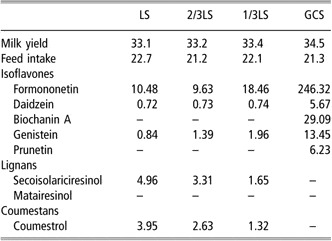
Table 2 shows the concentration of phyto-oestrogens in the feedstuffs. The concentration of formononetin and daidzein was many times higher for the GCS than the other feedstuffs. Furthermore, the concentration of genistein was also considerably higher in the grass/clover, and prunetin and biochanin A were only detectable in the GCS. In contrast, coumestrol and secoisolariciresinol were only detectable in the lucerne silage. Accordingly, the dietary content of isoflavones was higher and the content of coumestrol lower in the GCS diet than in LS, 2/3LS and 1/3LS diets. For the LS, 2/3LS and 1/3LS diets the concentrations of coumestrol and secoisolariciresinol increased with increasing content of lucerne while the concentration of isoflavones was similar overall (see Table 3).
Concentration of phyto-oestrogens in the feedstuffs (mg/kg DM)

DM = dry matter.
Milk yield (kg/day), feed intake (kg DM/day) and phyto-oestrogen intake (mg/kg DM per day) in relation to the diets lucerne silage (LS), 2/3 lucerne silage and 1/3 maize silage (2/3LS), 1/3 lucerne silage and 2/3 maize silage (1/3LS) or grass/clover silage (GCS)

DM = dry matter.
Feed intake and milk production
There were no significant differences in feed intake and milk yield between the groups (Table 3).
Concentration of phyto-oestrogens in milk
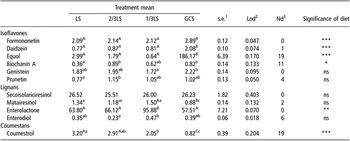
The detection limit of the assay and the number of samples below the detection limit is shown in Table 4, which also shows the measured concentration of phyto-oestrogens in the milk. The concentration of isoflavones in the milk was 0.4–2.9 μg/l except for equol where the concentration was 0.6–186 μg/l. The concentration of coumestrol was 0.8–3.2 μg/l. The concentration of lignans was 0.2–1.5 μg/l for matairesinol and enterodiol and 25–96 μg/l for secoisolariciresinol and enterolactone.
The concentration of phyto-oestrogens in bovine milk (μg/l) in relation to the diets lucerne silage (LS), 2/3 lucerne silage and 1/3 maize silage (2/3LS), 1/3 lucerne silage and 2/3 maize silage (1/3LS) or grass/clover silage (GCS)

a,b,c designate significant difference (P < 0.05) between treatments and A,B,C designate significant difference (P < 0.01) between treatments.
1Standard error.
2Limit of detection.
3Number of sample below the detection limit.
The concentrations of isoflavones formononetin, daidzein and equol in the milk were significantly higher (P < 0.001) for the GCS diet than for the LS, 2/3LS and 1/3LS diets. In particular, the concentration of equol was 62–291 times higher for GCS. There were no significant differences in the concentration of formononetin, daidzein and equol between LS, 2/3LS and 1/3LS. For the concentration of lignans, 1/3LS had a significantly higher concentration of enterolactone than the other groups (P < 0.001). The concentration of coumestrol was significantly higher for LS, 2/3LS (P < 0.001) and 1/3LS (P < 0.05) compared to GCS.
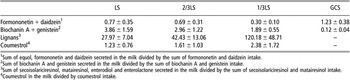
Table 5 shows the apparent recovery of the phyto-oestrogens from feed to milk. However, for the GCS diet the content of lignans and coumestrol in the feed was below the detection limit, and consequently the apparent recovery could not be calculated. The values varied very much for the different phyto-oestrogens with lowest recoveries for formononetin and daidzein and highest recoveries for lignans.
Mean ± s.d. for apparent recovery of phyto-oestrogens from feed to milk (μg/mg) in relation to the diets lucerne silage (LS), 2/3 lucerne silage and 1/3 maize silage (2/3LS), 1/3 lucerne silage and 2/3 maize silage (1/3LS) or grass/clover silage (GCS)

1Sum of equol, formononetin and daidzein secreted in the milk divided by the sum of formononetin and daidzein intake.
2Sum of biochanin A and genistein secreted in the milk divided by the sum of biochanin A and genistein intake.
3Sum of secoisolariciresinol, matairesinol, enterodiol and enterolactone secreted in the milk divided by the sum of secoisolariciresinol and matairesinol intake.
4Coumestrol in the milk divided by coumestrol intake.
Discussion
The concentrations of secoisolariciresinol, daidzein and genistein in the GCS were low compared to both the white and red clover silages in Steinshamn et al. (Reference Steinshamn, Purup, Thuen and Hansen-Møller2008). The concentrations of formononetin, prunetin and biochanin A for the GCS were high compared to the white clover silage but very low compared to the red clover silage in Steinshamn et al. (Reference Steinshamn, Purup, Thuen and Hansen-Møller2008). The low content of phyto-oestrogens in the GCS compared to the clover silages in Steinshamn et al. (Reference Steinshamn, Purup, Thuen and Hansen-Møller2008) is most likely due to the very low proportion of clover in the GCS in the present study.
The higher concentration of isoflavones in the GCS compared to the other feedstuffs was expected. The concentration of isoflavones is 1–2.5% of DM in red clover and 0.02–0.06% of DM in white clover but very low in lucerne (Saloniemi et al., Reference Saloniemi, Wahala, Nykanen-Kurki, Kallela and Saastamoinen1995; Wu et al., Reference Wu, Wang and Simon2003). Similarly, the high content of coumestrol in the lucerne silage is in line with the literature, which reports 25–65 p.p.m. coumestrol in lucerne and only minor quantities in clover (Saloniemi et al., Reference Saloniemi, Wahala, Nykanen-Kurki, Kallela and Saastamoinen1995). Similar to Steinshamn et al. (Reference Steinshamn, Purup, Thuen and Hansen-Møller2008), this study supports that forage has a higher content of lignans than concentrates. Further, this study showed that lucerne contains higher concentrations of secoisolariciresinol than GCS.
The concentrations of formononetin, daidzein, biochanin A, genistein, prunetin, matairesinol and enterodiol measured in the milk are in agreement with those found earlier (King et al., Reference King, Mano and Head1998; Antignac et al., Reference Antignac, Cariou, Le Bizec and Andre2004; Steinshamn et al., Reference Steinshamn, Purup, Thuen and Hansen-Møller2008). The concentration of equol is low for the LS, 2/3LS and 1/3LS diets compared to other experiments, probably due to the low concentration of isoflavones in the maize and lucerne silages. For the GCS diet, the concentration of equol is high when comparing to conventional milk but low compared to organic milk. The concentration of equol is reported to be 41–62 μg/l in conventional milk and 230–411 μg/l in organic milk (Purup et al., Reference Purup, Hansen-Møller, Sejrsen, Christensen, Lykkesfeldt, Leffers and Skakkebæk2005; Hoikkala et al., Reference Hoikkala, Mustonen, Saastmoinen, Jokela, Teponen, Saloniemi and Wähälä2007). The diets in organic dairy production usually have a higher proportion of leguminous feedstuffs, in particular clovers, than diets in conventional production. The concentration of equol seems to be highly dependent on the clover species with very high levels in milk from cows on red clover-based diets but levels similar to what has been reported for conventionally produced milk from cows on white clover-based diets (Steinshamn et al., Reference Steinshamn, Purup, Thuen and Hansen-Møller2008) probably due to the higher concentration of isoflavones in red clover than in white clover. In this study, the GCS had a relatively high concentration of formononetin and daidzein even though the proportion of clover was low. Therefore, a relatively high concentration of equol in the milk from the GCS diet was expected and an equol concentration in between that reported for organic and conventional milk seems reasonable taking into consideration the low clover content. A considerably higher content of phyto-oestrogens and particularly equol could most likely have been obtained with a higher clover proportion in the GCS.
The concentration of coumestrol has been below the detection limit in all or most samples in previous studies (Antignac et al., Reference Antignac, Cariou, Le Bizec and Andre2004; Steinshamn et al., Reference Steinshamn, Purup, Thuen and Hansen-Møller2008). In this study, the concentration of coumestrol was detectable in six out of 16 samples for the GCS diet and in 40 out of 48 samples for the LS, 2/3LS and 1/3LS diets. The low concentration in the milk based on the GCS diet and the higher concentration in the milk based on the LS, 2/3LS and 1/3LS diets with LS having the highest concentration reflect the content in the diets and thus were expected.
When looking at the concentration of lignans in the milk, the major part of matairesinol was converted to enterolactone whereas only a minor part of secoisolariciresinol was converted to enterodiol. However, some enterodiol could have been converted to enterolactone.
In this study, the concentration of secoisolariciresinol was many times higher and the concentration of matairesinol, enterolactone and enterodiol somewhat higher compared to Steinshamn et al. (Reference Steinshamn, Purup, Thuen and Hansen-Møller2008). In contrast, the content of secoisolariciresinol and matairesinol was higher in the diets used by Steinshamn et al. (Reference Steinshamn, Purup, Thuen and Hansen-Møller2008) than those used in this study. This could reflect a contribution from other lignans than those measured in these experiments for example lariciresinol and pinoresinol.
Apparent recovery for phyto-oestrogens from feed to milk has only been reported by Steinshamn et al. (Reference Steinshamn, Purup, Thuen and Hansen-Møller2008) before. For formononetin and daidzein the levels were in the same range in both studies. For biochanin A and genistein the level for the GCS diet was in the higher end of the recoveries found by Steinshamn et al. (Reference Steinshamn, Purup, Thuen and Hansen-Møller2008), and the levels for the LS, 2/3LS and 1/3LS diets were much higher. The apparent recovery for lignans was similar for the LS and 2/3LS diets compared to Steinshamn et al. (Reference Steinshamn, Purup, Thuen and Hansen-Møller2008) but much higher for the 1/3LS diet. Thus, overall the apparent recovery in this study was in the higher end for the GCS diet and similar and higher for the LS, 2/3LS and 1/3LS diets compared to Steinshamn et al. (Reference Steinshamn, Purup, Thuen and Hansen-Møller2008). Steinshamn et al. (Reference Steinshamn, Purup, Thuen and Hansen-Møller2008) suggest that the metabolism of the phyto-oestrogens in the gastrointestinal tract and the hepatic reconjugation before blood transport and secretion into the udder could be rate-limited. Considering the low clover content in GCS in this study, the concentration of phyto-oestrogens in the milk was surprisingly high compared to other studies. This supports that the transfer of phyto-oestrogens from feed to milk could be limited by something in the metabolism, diminishing the amount of phyto-oestrogens transferred to the milk with increasing content of phyto-oestrogens in the feed. Also in support, a higher recovery of biochanin A, genistein, lignans and coumestrol was associated with a lower content of the precursor in the feed. However, no pattern was observed for formononetin and daidzein. Still, more studies will have to confirm this and the mechanisms behind.
This study demonstrates that the concentration of phyto-oestrogens in bovine milk can be modulated through feeding of the cows and to a very large extent depends on the concentration of phyto-oestrogens and their precursors in the feeds of the cows. However, the concentration of phyto-oestrogens in bovine milk is low compared to food sources rich in phyto-oestrogens, i.e. the concentration of isoflavones is 5–10 mg/kg in soy milk and 13.5–67 mg/kg in tofu (Committee on Toxicity of Chemicals in Food, 2003). However, it is suggested that the clinical effectiveness of soy or other high-daidzein-containing products depend on the ability to metabolise daidzein to equol. For humans, there is substantial inter-individual variation in the bacterial metabolism of isoflavones in the gut. Studies have shown that only 30% to 50% of the population is capable of producing equol from daidzein (Lampe et al., Reference Lampe, Karr, Hutchins and Slavin1998; Rowland et al., Reference Rowland, Wiseman, Sanders, Adlercreutz and Bowey2000). Equol is superior to other isoflavones in its antioxidant activity (Arora et al., Reference Arora, Nair and Strasburg1998), has greater affinity to the oestrogen receptors than its precursor daidzein (Setchell et al., Reference Setchell, Brown and Lydeking-Olsen2002) and can bind 5α-dihydrotestosterone, thereby hindering its binding to the androgen receptor, thus altering growth and physiological hormone responses that are regulated by androgens (Lund et al., Reference Lund, Munson, Haldy, Setchell, Lephart and Handa2004). Therefore, milk with a high concentration of equol may be interesting as a dietary source of equol if the beneficiary effects of equol are confirmed.