Introduction
In contemporary times, despite significant advancements in various scientific fields, disasters and calamities remain one of humanity’s foremost concerns. These events occur independently of human actions, yet they are an inseparable part of human life, affecting all members of society without discrimination.1, Reference Kiyanmehr, Mofidi and Nejati2 A disaster is defined as a sudden or uncontrollable condition arising from natural or human-induced events that causes hardship for human communities, necessitating immediate and emergency responses.Reference Salvatian and Mehraban3 In other words, natural disasters are occurrences that lead to death, injury, and financial losses, which cannot be managed through conventional methods and available resources, ultimately requiring external assistance and services.Reference Novick and Marr4 According to Maskrey, the simultaneous occurrence of natural hazards such as floods, earthquakes, and storms, combined with the vulnerability of a region, constitutes a natural disaster.Reference Khanke, Mohammadi and Ahmadi5
Iran, due to its size, natural conditions, and climatic diversity, is considered one of the top ten disaster-prone countries in the world. Out of 40 recognized types of natural disasters, 31 occur within Iran, including floods, earthquakes, and avalanches, as well as unnatural incidents such as traffic accidents and plane crashes.Reference Araghizadeh, Saghafi Nia and Entezari6–Reference Abbasabadi-Arab, Mosadeghrad and Asgari8 Notably, 90% of Iran’s population is at risk from disasters caused by floods and earthquakes. Moreover, Iran ranks fourth in Asia regarding the frequency of natural disasters, with its vulnerability to earthquakes being a thousand times greater than that of the United States and a hundred times greater than that of Japan.Reference Khanke, Mohammadi and Ahmadi5 Reports from the International Disaster Database indicate that between 2000 and 2022, 107 types of natural disasters affected Iran, impacting a total of 18.5 million people, resulting in 29,796 fatalities and 45,722 injuries.Reference Hashemi Petrudi and Jalali9
Many regions worldwide are vulnerable and weak in the face of natural disasters. These disasters significantly contribute to economic, social, health, and welfare issues. Furthermore, due to the disruption of the natural course of life, they lead to severe consequences such as mortality, injuries, disabilities, destruction, and the emergence of numerous humanitarian needs, including shelter, food, clothing, and medical assistance, which require capable management at the level of executive institutions.Reference Khanke, Mohammadi and Ahmadi5 The adverse health effects of disasters can be divided into two categories: direct effects, such as injuries and psychological trauma, and indirect effects, including infectious diseases, malnutrition, and chronic illnesses. The indirect impacts arise from factors such as inadequate water supply and poor quality, environmental health disruptions, gaps in service delivery, overcrowding, and population displacement.Reference Khanke, Mohammadi and Ahmadi5 The Center for Epidemiology of Disasters reported in 2020 that 389 natural disasters, including earthquakes, volcanoes, floods, droughts, and fires, resulted in 15,080 deaths and affected approximately 98.4 million people, with economic losses amounting to $171.3 billion.Reference Abbasabadi-Arab, Khankeh and Mosadeghrad10 In 2021, around 432 natural disasters were reported, affecting 101.8 million people and resulting in 10,492 fatalities, with economic damages estimated at $252 million. In Asia, these incidents impacted 66% of individuals, accounting for 49% of the reported deaths.Reference Abbasabadi-Arab, Mosadeghrad and Asgari8 International organizations have reported that, in the past two decades, the number of disaster-related fatalities has decreased, while the number of affected individuals and the economic consequences of disasters have been on the rise.Reference Guha-Sapir, Vos, Below and Ponserre11
Health systems across various countries face numerous challenges in responding to disasters at local, national, and international levels.Reference Khankeh, Masoumi and Maher12 The lack of planning and organization to address disasters, along with insufficient training for personnel to manage crises, can lead to irreparable damage to a country’s health system.Reference Abbasabadi-Arab, Mosadeghrad and Asgari8
Programs designed for disaster scenarios aim to deliver the maximum health services to the largest number of individuals in society. During the response phase, having a systematic approach to design, implementation, and evaluation, along with adequate coverage and high-quality services, is crucial. It can be stated that these programs should be structured to ensure that quality health services reach the affected population and provide continuous and sustainable support.13 Given the significance of the topic, the formulation and implementation of programs and principles for the prevention and mitigation of the effects of natural disasters have gained considerable importance.Reference Ghanbari, Ardalan and Salari14 Disaster risk reduction represents a systematic approach to identifying, assessing, and managing disaster risks, aiming to reduce the socio-economic vulnerabilities of communities.Reference Twigg15 International experiences have shown that the success of disaster risk reduction programs relies on decentralized disaster management by governmental bodies and the active participation of all community members.Reference Ghanbari, Ardalan and Salari14 Currently, community-centered disaster management is considered one of the most important approaches to reducing disaster risks and associated costs.Reference Salajegheh and Pirmoradi16 Preparing communities for disasters reduces the consequences of such events, including mortality, physical and psychological injuries, and the outbreak of diseases, indicating that community preparedness can mitigate both short-term and long-term damages and challenges arising from disasters.Reference Ghanbari, Ardalan and Salari14
Considering the complexity of providing services during disasters in Iran, a qualitative research approach appears to be appropriate for capturing the depth and richness of the involved experiences. Quantitative data may only provide numerical information but often fail to fundamentally identify the emotions and contextual factors shaping the reality on the ground. Semi-structured interviews offer a platform for sharing experiences and ensure that findings do not solely rely on statistical averages but provide a comprehensive understanding of the realities.
This research aims to investigate the barriers and solutions for delivering services to affected groups, identifying strengths and weaknesses while proposing practical solutions for service delivery. The results of this research can be utilized by policymakers and managers within the country’s health system, such as the Ministry of Health, Treatment, and Medical Education, the Red Crescent Society, and accreditation managers, to establish infrastructure, improve processes, and implement corrective measures.
Methodology
Study Design and Participants
This study utilized a conventional qualitative content analysis design, conducted from 7 May 2024 to 2 July 2024. The aim of the study was to explain the obstacles and solutions to providing services to the affected groups and those in need of services and facilities in unexpected events.
The inclusion criteria consisted of individuals who were rich in information regarding the study’s objectives. The researchers employed purposeful sampling and interviewed individuals who were knowledgeable about the study’s subject matter. The inclusion criteria were as follows: (1) having substantial knowledge or experience relevant to the study objectives; (2) being a healthcare provider, emergency responder, disaster manager, or policymaker directly involved in service delivery during disasters; (3) having a minimum of one year of work experience in disaster response, crisis management, or emergency service provision; (4) willingness to participate and ability to provide informed verbal consent; and (5) adequate communication skills to express relevant experiences and insights during the interview.
The exclusion criteria were non-cooperation during the interviews.
The study was conducted with seventeen participants, including 14 academic experts and officials from executive agencies, as well as 3 individuals from affected areas.
The participants voluntarily took part in the interviews. The audio recordings and data remained confidential throughout the research. The study design was approved by the Ethics Committee of the Iranian Red Crescent Society.
Data Collection
In this study, semi-structured face-to-face interviews and a focus group discussion (FGD) were used for data collection.Reference Barriball and While17 Participation was voluntary, and no incentives were provided.
Access to the study participants was arranged through referral by the Safety Promotion and Injury Prevention Research Center at Shahid Beheshti University of Medical Sciences, sending research objectives and interview procedures to the participants, obtaining their informed consent, and conducting the interviews.
At the beginning of each interview, the researcher explained the objectives of the study and the interview procedure. After obtaining informed consent, the interviews were recorded with the participants’ permission. Two digital recorders were used during the interviews.
In cases where participants were not comfortable with the recording, efforts were made to take detailed notes and transcribe the conversation.
The location and time of the interviews were chosen by the participants. All interviews, except for two conducted with individuals from the affected regions of western Iran, were conducted in Persian. These two interviews were conducted by a researcher (M.H.P.) fluent in Kurdish, and the transcriptions and coding were later translated into Persian.
Before each interview, the research objectives were explained once again to the participants.
All participants were assured of confidentiality, and they were informed that they could end the interview at any time if they did not wish to continue. At the end of each interview, participants were asked to recommend other knowledgeable individuals they knew. The contact details of these individuals were obtained, and efforts were made to introduce them through the previous participant.
Interviews continued until no new themes emerged, reaching data saturation.Reference Fusch and Ness18
Initially, a list of questions was prepared based on the study’s objectives (Appendix 1). These questions were designed to cover all aspects of the study. Throughout the interview, additional questions were asked by the researcher to further explore the topics raised by the participants. The interviewers adapted the number and order of questions according to the content shared by the participants. The duration of the interviews ranged from 45 to 90 minutes.
Finally, the researchers conducted a 120-minute focus group discussion with eight faculty members and experts.
Data Analysis
The researchers applied conventional qualitative content analysis based on the method of Graneheim and Lundman.Reference Graneheim and Lundman19 This method includes the immediate execution of interviews, repeated reading for deep understanding, extracting themes, grouping similar themes into content categories, and naming each category based on its meaning.
Except for the interviews with individuals from the affected areas, the interviews were conducted independently by three researchers (Ne.N, F.P., Na.N.). In this content analysis method, the interviews were reviewed several times by the researchers on the same day and transcribed into text files. Each interview was carefully read multiple times, and after deep understanding, the themes were extracted. A systematic classification was used to identify the codes and underlying meanings. The codes were extracted based on the semantic units derived from the participants’ descriptions, and then grouped into subcategories based on similarities and differences. Finally, similar subcategories were grouped into a main category. Each subcategory and category was labeled based on its conceptual content.
Trustworthiness
To ensure trustworthiness, the researchers used Lincoln and Guba’s four criteria, which includeReference Lincoln and Guba20:
Credibility
A. To better understand and gain deeper insights into the topic, the research duration was six months, providing “Prolonged engagement” with the topic.
B. To ensure the study was rich, robust, and comprehensive, the Triangulation technique was employed. Data were collected from various sources, including note-taking, interviews, and FGDs. A wide range of individuals at different management levels participated in the interviews. Multiple researchers were involved in data analysis.
C. Peer debriefing was conducted by a member of the research team who reviewed and evaluated the transcriptions, groupings, and final findings (A.D.). Any ambiguities were addressed by two other team members.
D. Negative Case Analysis: Codes or statements that contradicted the views of other participants (analysis of negative or deviant cases) were analyzed and reviewed in other interviews and the FGD.
E. Member Check: To allow participants the opportunity to correct or add to their statements, the interview summaries were emailed to participants who had sufficient time to review and provide feedback one week after the interview.
Transferability
A. Thick Description: To enhance transferability, the details of the study design were written and described thoroughly, ensuring that other researchers could understand and replicate the process.
Dependability
A. Double Coding: In this study, 10% of the interviews were double coded, and the agreement was calculated. Five interviews were coded by F.P. & F.N., and the agreement was calculated by M.H.P., resulting in an agreement rate of over 90%.
Confirmability
A. External Audits: To increase reliability and validity, an external auditor reviewed all processes of the study, including data collection, transcription, data analysis, coding, and report writing (H.P.).
Results
Demographic Characteristics of Participants
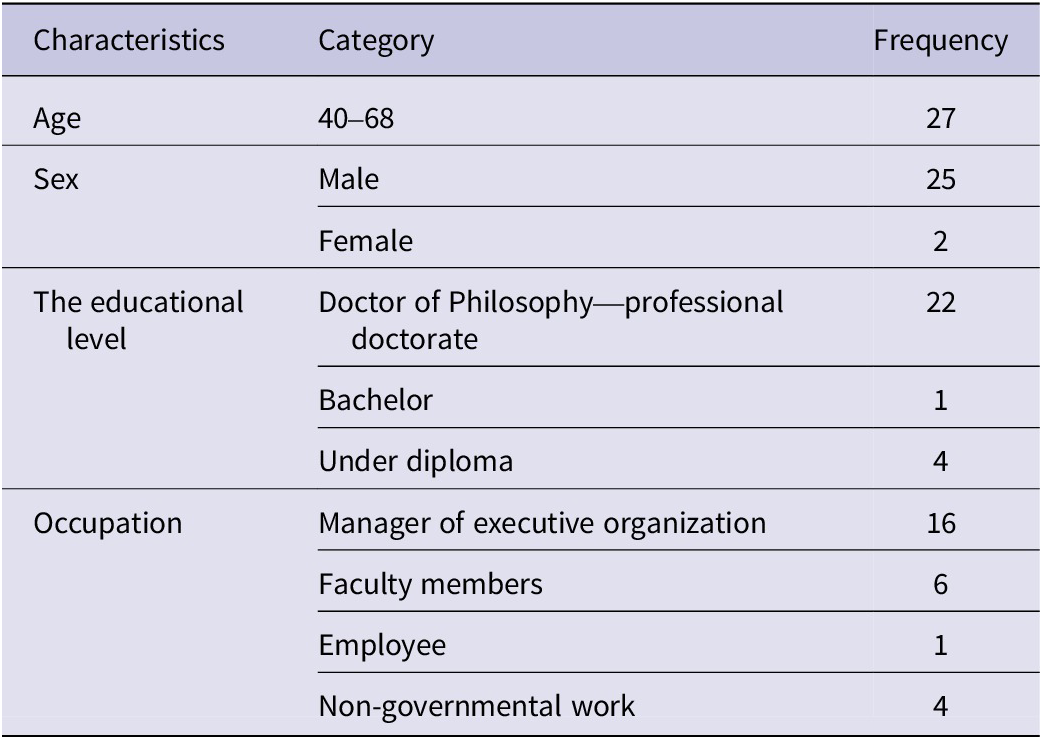
This study included 6 interviews with faculty members, 16 interviews with managers of executive organizations, and 3 interviews with individuals who had experienced crises and disasters. Additionally, a focused group discussion was arranged. The participants’ ages ranged from 40 to 68 years, and they held either Philosophiae Doctor (PhD) or professional doctorate degrees (Table 1).
Demographic characteristics of interview participants (n = 17)

Obstacles and Solutions in Providing Services During Unexpected Events
In this study, interviews were first transcribed and then coded. In the subsequent step, common themes were merged, leading to the classification of overarching concepts. A total of 348 themes were identified, ultimately refined to 245 themes after repetition analysis. These themes were categorized into eight main categories: “Management, Financial and Non-Financial Resources, Programs, Educational Affairs, Organizational Matters, Community Affairs, Participation, and Spiritual Affairs.” Additionally, 29 subcategories were extracted, which are presented in Table 2.
Explaining the obstacles and solutions to providing services to the affected groups and those in need of services and facilities in unexpected events

Barriers and Solutions Related to “Management”
One of the key issues highlighted by the interviewees pertains to management-related aspects. Based on the information gathered from the interviews, this category was subdivided into five subcategories: Information Dissemination, Task Management (including those related to the general public, officials, and service providers), Service Management (including those related to the general public, officials, and service providers), Response Management, and Prevention.
Among the challenges faced during natural disasters is the “lack of access to reliable and accurate information” regarding the number of residents in the affected area, the extent of damages incurred, and the available resources and conditions. Developing “clear and defined communication methods for service delivery tailored to each group (affected individuals, responders, crisis management teams, media)” along with “regular and transparent engagement with the community” can help mitigate these issues.
The “absence of a unified strategy” and “lack of transparency regarding the type of services and responsibilities” of relevant organizations highlight the need for “organizing the tasks of involved organizations” and “clearly defining the roles and responsibilities of individuals and organizations.” Another challenge mentioned is “providing services without considering individuals’ needs, household sizes, conditions, and available resources,” which calls for planning that aligns “Adjusting the number of responders, equipment, and disasters response systems with the severity of the incident.” Given that natural disasters are not unprecedented in our country, “promoting a culture of safety and disaster prevention” will be highly beneficial.
Quotes From Interviewees
“Which agency provides services to whom? Where is the service location? Where are the shelters?”
“Disorder and chaos occur because people are untrained, which may lead to blocked pathways and complicate rescue and service delivery efforts.”
Barriers and Solutions Related to “Financial and Non-Financial Resources”
Another significant issue raised by the interviewees pertains to barriers and solutions related to financial and non-financial resources (including equipment, human resources, infrastructure, and facilities). This category encompasses subcategories such as resource and equipment management, financial support and budget allocation, maintenance and repair of equipment, quality and quantity of resources and equipment, existing challenges in resources and infrastructure, and securing safe spaces and structures.
In disasters, “disruptions in the supply chain and lack of access to critical equipment” can hinder crisis management. Therefore, “diversifying and expanding resource availability,” both material and immaterial, can facilitate conditions for effective response. Interviewees notably pointed out the “lack of financial resources, especially in underprivileged areas,” emphasizing the need for “increased budget allocations for crisis management” as a proposed solution for budgetary issues. The “poor quality of equipment” and “limited access to medical supplies, food, water, and other necessities” during disasters complicate service delivery to affected individuals. Furthermore, “unsafe buildings” have been identified as another challenge in this context.
Example Quote Related to This Category
“In the field of healthcare, during disasters, we need to provide services immediately; we can’t ask people to pay for them. These costs are not accounted for in the ministry’s budget. For instance, in Guilan, we relocated over 130 patients from a private hospital in the east of Guilan within three hours; all these actions incur costs, and if something happens, we have to respond in multiple ways …”
Barriers and Solutions Related to “Programs”
Based on the interviews conducted, the category “Programs” was identified, which includes five subcategories: needs assessment, monitoring, evaluation, existing guidelines, and regulations. Interviewees expressed that “incomplete needs assessments during disasters,” “lack of effective monitoring of organizational performance,” “absence of systematic evaluation of services,” “insufficient comprehensive and updated programs,” and “ineffectiveness of certain regulations” could pose barriers to planning and delivering services to affected individuals. To address these challenges, strategies such as “engaging local communities in data collection for needs assessments,” “monitoring individual performance during disasters,” “utilizing monitoring and evaluation indicators,” and “revising existing laws and regulations” are recommended.
Example Quote Regarding Regulations
“We need to focus on the convergence of laws across different sectors in our regulations. For instance, if we have a regulation related to urban planning, it should align with health sector regulations and consider environmental and agricultural aspects as well. This alignment can be very beneficial.”
Barriers and Solutions Related to “Educational Affairs”
This category consists of four subcategories: public knowledge, training courses, lessons learned, and conducting research and documentation.
The existing problems include “insufficient public knowledge,” “inadequate training for responders and service personnel,” “repetition of past mistakes,” and “lack of permission for documentation dissemination.” These issues highlight the necessity for strengthening initiatives such as “conducting educational campaigns to raise public awareness about disasters response to enhance preparedness for disasters, ” “utilizing lessons learned from previous crises,” and “timely documentation and accurate data collection during crises.”
Example Quote Regarding Lessons Learned
“We should leverage lessons learned from past crises and observe what actions were successful by those who were directly or indirectly involved.”
Barriers and Solutions Related to “Organizational Affairs”
From the analysis of interview data, another category of barriers and solutions emerged related to “organizational affairs,” which includes three subcategories: administrative processes, organizational leadership, and inter-sectoral collaboration.
Challenges such as “lengthy administrative processes,” “lack of unified command leading to issues at intermediate and operational levels,” and “weakness in inter-sectoral collaboration” were identified. To address these issues, recommendations include “increasing transparency and accountability in administrative processes,” “eliminating non-specialized and irrelevant individuals or organizations,” and “ensuring internal and external preparedness. “
Example Quote Regarding Inter-Sectoral Collaboration
“In inter-sectoral collaborations, there is often a sense of ego; for example, people want to say they did this work alone. They may say, ‘Okay, you help me, but I will claim all the credit for what other organizations did.’ This is a significant problem.”
Barriers and Solutions Related to “Community Affairs”
Another issue raised by participants pertains to barriers and solutions related to “community matters.” This category consists of three subcategories: community participation, vulnerable groups, and consideration of cultural, social, and environmental factors.
Unfortunately, challenges such as the “weakness in social cohesion and cooperation during crises” and “lack of access to necessary services for specific demographic groups, including women, disabled individuals, patients, and older adults,” hinder service delivery to those affected by disasters. Strategies such as “engaging individuals fluent in local languages,” “empowering affected communities,” and “distributing services based on climate, culture, and socio-economic status of affected areas” can be beneficial.
Example Quote Regarding Vulnerable Groups
“We may have overlooked certain issues; for instance, after a crisis occurs, how much do we consider the mental health of the people? What actions are we taking for that?”
Solutions Related to “Participation”
In the category of “Participation,” three subcategories emerged from the analysis: social sector, public sector, and private sector. Strategies such as “engaging local communities in designing and implementing preparedness and response programs” and “establishing communication with representatives from non-governmental organizations” are crucial for strengthening this area.
Solutions Related to “Spiritual Affairs”
Another solution for improving service delivery to affected individuals during natural disasters is focusing on spiritual matters. This includes “enhancing the role of mosques and religious centers and utilizing cultural and religious teachings to promote a culture of prevention and social solidarity.”
Discussion
Natural disasters are always recognized as one of the serious challenges for human societies. These events can have severe consequences for the affected individuals, highlighting the need for appropriate and effective services during these times. This study examines the barriers and challenges faced in providing services to the victims of such incidents. The results of this research indicate that various obstacles, including public unawareness, managerial deficiencies, resource shortages, and lack of coordination among different organizations, can significantly impact the quality-of-service delivery to victims.
Numerous studies, including the present research, emphasize the importance of improving communication processes, knowledge management, and public awareness in disaster management. For instance, the study by Hosainiamini et al., which investigates the strategies of relief organizations to improve communication processes in disaster management, demonstrated that managing communication barriers plays a crucial role in enhancing preparedness and response to crises.Reference Hosainiamini, Rajabi and Behzad21 These findings align with the results of Peyravi et al., who addressed the challenges of knowledge management in reducing disaster risks.Reference Peyravi, Marzaleh and Khorram-Manesh22 Additionally, Fathollahzadeh et al. examined the challenges related to health infrastructure in disasters, identifying the lack of human and financial resources as major obstacles in managing health crises in Iran.Reference Fathollahzadeh, Salmani, Morowatisharifabad, Khajehaminian, Babaie and Fallahzadeh23 The results of this study are also consistent with the current research. Participants in the present study indicated that resource shortages, especially during crises, are among the primary barriers to providing services to victims. This shortage can manifest in financial, human, or even raw material terms. For example, the lack of sufficient funding to meet the basic needs of victims can lead to an inability to deliver effective services. Moreover, the shortage of trained employees can adversely affect the quality of service delivery. Training and empowering service employees, especially during crises, is crucial. In fact, adequate training can enhance their capacity to cope with incidents and manage crises.Reference Berlin and Carlström24 Without appropriate training programs, employees may encounter significant challenges when responding to emergencies. Various methods can be employed for employee training. For instance, Nguyen et al. investigated the impact of training rescue forces during internships using virtual reality and simulation. Their study showed that in a virtual environment, rescuers can practice the necessary skills without endangering their lives before experiencing real-world situations.Reference Nguyen, Jung and Dang25 In the current research, despite the specialists’ emphasis on training service providers, there is no mention of how employees should be trained, which may be due to the study’s focus on extracting barriers and solutions for service delivery comprehensively, without attention to details. Therefore, paying attention to the specifics of each solution could be a focus of future research.
Moreover, studies underscore the significance of organizational management and coordination among relevant entities. The study by Peyravi et al. revealed that weak coordination among organizations and institutions is one of the main obstacles in managing natural disasters.Reference Peyravi, Marzaleh and Khorram-Manesh22 Similar findings were reported by Jahangiri et al., which emphasize the importance of strengthening managerial structures for better disaster response.Reference Jahangiri, Izadkhah and Jamaledin Tabibi26 These results align with the research by Sojasi et al., which assessed crisis management in urban areas. They demonstrated that collaboration and coordination between urban and relief organizations are key factors in successfully managing crises.Reference Sojasi, Sadeghloo and Rayisi27 In the present study, managerial challenges and lack of coordination among various organizations during crises are also presented as major factors affecting the quality-of-service delivery to victims. Participants in this research stated that the existence of inefficient systems and lack of transparency in decision-making processes can lead to confusion and ineffectiveness during crises. Furthermore, the absence of prior experiences and learning from past incidents can result in the repetition of similar mistakes and increased vulnerability. These issues are often due to the lack of a clear and comprehensive strategy for crisis management.Reference Doroudi28 Based on the collected data, many institutions and organizations face serious challenges during crises due to the absence of effective planning. These challenges include insufficient resource allocation, lack of trained employees, and the absence of clear protocols for providing services to victims.
On the other hand, the research by Khankeh et al. focuses on the challenges of health services during crises. This study indicated that strengthening collaboration between health and relief organizations and improving managerial infrastructure could lead to more effective health services during disasters.Reference Khankeh, Khorasani-Zavareh, Johanson, Mohammadi, Ahmadi and Mohammadi29 These findings are consistent with the results of the study by Shamspour et al., which examined the challenges of the health system in facing disasters. They also emphasize the need for improving health infrastructure and increasing resources to effectively address crises.Reference Shamspour, Kavousi, Moazzami, Ghaiyoomi and Ahmadi Marzaleh30 Among these studies, enhancing disaster preparedness through strengthening communication, organizational management, and local participation has been identified as a shared priority. These studies agree on the necessity of training and preparedness as key components of disaster resilience.
However, the proposed approaches to address these challenges vary. Some studies emphasize organizational improvements at a macro level, while others suggest that local governments and community participation should be strengthened, indicating the need for a multi-layered approach to comprehensive disaster management in Iran. Overall, the findings of this study align with many previous studies on disaster management in Iran and the world. Strengthening managerial infrastructure, improving communication, and public education have been identified as key factors in effectively managing crises. Nevertheless, there remains a need for further research to gain a better understanding of the challenges and psychological pressures arising from crisis management and to propose suitable solutions to enhance collaboration among relevant entities and organizations.
Limitations
The study involved only 17 participants, which may not fully represent the diverse perspectives of all individuals affected by or involved in providing services during unexpected events. The study included participants from specific regions, which may limit the generalizability of the findings to other regions or countries that may have different cultural, social, or infrastructural contexts.
Conclusion
This study reveals key obstacles in disaster service delivery, including inadequate management, resources, and coordination. Solutions such as enhancing communication, clarifying roles, and promoting community participation can address these challenges. Strengthening public education, updating regulations, and integrating local cultural and spiritual support systems are essential for improving crisis response. The findings suggest that a holistic, community-driven approach can significantly improve service provision during unexpected events, fostering resilience and preparedness across various sectors. Effective coordination and resource allocation are vital for mitigating the impacts of future disasters.
Data availability statement
Not applicable.
Acknowledgments
We are grateful to all those who assisted us in conducting this research, including the interviewees. This study would not have been possible without their willingness to share their personal experiences and observations.
Author contribution
All authors contributed to the study’s design and conceptualization, participated in data collection and analysis, approved the final manuscript, and agreed to be accountable for all aspects of the work.
Funding statement
This study was funded by the Iranian Red Crescent Society.
Competing interests
None.
Using artificial intelligence chatbots
None.
Appendix 1
Semi-Structured Interview Questionnaire
The semi-structured interview questionnaire is designed to explore the perspectives of experts in disaster and emergency management. Additional follow-up questions may be asked by the interviewer to clarify or expand on participants’ responses.
Section A: Demographic and Professional Information
-
1. Full name
-
2. Gender
-
3. Professional field/area of expertise
-
4. Total years of work experience
-
5. Highest educational degree (e.g., PhD, Master’s, religious studies, etc.)
Section B: Barriers and Strategies in Disaster Response
-
6. In your opinion, what are the main obstacles to providing services to affected and vulnerable groups during disasters and emergencies?
-
7. What strategies would you recommend to overcome these obstacles?
-
8. From your perspective, what financial and economic barriers exist in providing services to affected and vulnerable individuals during disasters? What strategies do you suggest to address these barriers?
-
9. What cultural barriers do you perceive in delivering services to affected and vulnerable individuals during disasters, and what strategies would you recommend to overcome them?
-
10. In your view, what social barriers hinder service provision to affected and vulnerable individuals during disasters, and what strategies would you suggest to address them?
-
11. What obstacles exist regarding the availability and adequacy of facilities and equipment for disaster response, and what strategies would you recommend to overcome them?
-
12. In your opinion, what barriers exist concerning the physical environment (e.g., absence of designated bases or organizations for emergency response) in providing services during disasters? How could these be addressed?
-
13. What administrative and managerial obstacles hinder disaster response services, and what strategies would you recommend to overcome them?
-
14. Is a needs assessment conducted in each area for potential disaster response services? If not, do you believe such assessments are necessary?
-
15. Are facilities and equipment available in sufficient quantity and quality? Are they up-to-date and operational? What deficiencies exist?
-
16. Is service evaluation conducted after each intervention? Do you consider such evaluations necessary?
-
17. Which organizations are responsible for providing disaster response services? Is inter-organizational cooperation adequate, and is there a need for a higher level of coordination to manage these collaborations effectively?
-
18. How important is passive defense (civil defense/protection) in disaster management? Which organizations are involved, and how effective is their performance? What strategies would you recommend to enhance effectiveness in this area?