Introduction—Beneath the Multifaceted Presentation of Eating Disorders: Scratching the Surface
Feeding and eating disorders (FED) feature a multifactorial pathogenesis, described in DSM-5 as “characterized by a persistent disturbance of eating or eating-related behavior that results in altered consumption or absorption of food and that significantly impairs physical health or psychosocial functioning.” 1 FED, like most psychiatric disorders, seem to show a pathogenic mechanism that implies the interaction of neurobiological and genetic factors with the environment.Reference Culbert, Racine and Klump 2 FED, and in particular anorexia nervosa (AN) have often been labeled as a culture-bound disorder, linked to Western pressure toward maintaining a certain body image due to both aesthetic and moral canons. 3–5 However, other hypotheses are possible. In particular, more recently the scientific literature highlighted how psychopathological manifestations ascribable to FED may be found in different cultures and historical moments, although semantic aspects and the ways of subjectively experiencing and verbalizing the cognitive contents of the disorders may vary. A psychopathological nucleus featuring traits such as restricting/avoidant food intake (with or without compensatory behaviors), perfectionism, rituality, inflexibility, eventually associated with impulsivity and emotional dysregulation, seems to be a constant across time and cultures.Reference Dell'Osso, Abelli and Carpita 5 , Reference Bemporad 6 Since Classical antiquity, in Western culture, several kinds of beliefs encouraged the reach of purity of the soul through fasting behaviors (and a similar moral connotation is still detectable amongst modern patients with AN).5–8 Reports of self-starvation, which occasionally led to death are detectable since Pre-Christianity, particularly in ascetic practices linked to Stoicism and Gnostic philosophy.Reference Dell'Osso, Abelli and Carpita5, 7–9 During Middle Age, several cases of women who practiced extreme fasting as a peculiar female approach to asceticism and holiness have been reported (one of the most documented examples was St. Catherina from Siena). 10–12 This condition is known by the name of “anorexia mirabilis,” and, although differing from modern AN in the subjective motivation of fasting behaviors (obtaining holiness and control over body functioning, rather than drive for thinness), it seems to be characterized by similar traits of perfectionism, moral and behavioral rigidity, rituality, as well as by a similar pattern of restrictive food intake and compensatory behaviors with severe consequences for body health.Reference Dell'Osso, Abelli and Carpita 5 Other examples have been detected in the “miraculous maids” of Renaissance era, who fasted aiming to demonstrate an extraordinary ability to live without eating.Reference VFC 4 , Reference Vandereycken and Van Deth 11 , Reference Brumberg 13 Since the nineteenth century, the new role of the woman in the industrial society and the widespread Romantic ideal of a link between the beauty of the soul and an emaciated, languid body, paved the way for the modern association between beauty and thinness, which was also linked, from a moral point of view, to a desire of emancipation.Reference Dell'Osso, Abelli and Carpita 5 , Reference Vandereycken and Van Deth 11 On the other hand, the presence of FED, although with specific kinds of manifestations, was reported also in quite different social environments: in less industrialized countries of Asia and Africa, while authors highlighted lower rates of AN, atypical restrictive or avoidant eating behaviors seem to be detectable in rates that are comparable with that of Western countries, although often they are not labeled with the diagnosis of AN due to lack of an explicit drive for thinness or fat phobia.Reference Pike and Dunne 14 , Reference Van Hoeken, Burns and Hoek 15 More recently, along with the increasing media campaigns and debates about healthy food, new FED phenotypes emerged. Specific attention has been paid to orthorexia nervosa, a condition where restrictive behaviors are subjectively explained by the preoccupation with maintaining a healthy diet instead of a low weight.Reference Dell'Osso, Abelli and Carpita 5 , Reference Dell'Osso, Carpita and Muti 9 , Reference Dell'Osso, Abelli and Carpita 16 The presence of FED in different cultures and historical contexts, which not always feature a psychosocial pressure toward thinness,Reference Ngai, Lee and Lee 17 , Reference Schmidt 18 supports the crucial role of individual vulnerability factors (such as genetic/neurobiological assets) in the pathogenesis of these disorders. In this framework, the socio-cultural contexts may be better suited to explain the specific semantical facts linked to the various clinical presentations. It might be stated that the psychopathology of FED would vary across time and cultures depending on environmental factors, which would shape different phenotypes.Reference Dell'Osso, Abelli and Carpita 5 , Reference Schmidt 18 However, every phenotype is expected to share a common psychopathological nucleus (which not necessarily include the explicit desire to be thin), and a genetic and epigenetic illness trajectory.Reference Dell'Osso, Abelli and Carpita 5 , Reference Schmidt 18 In this framework, the attention should be paid to researches that investigated the nature of FED psychopathology. The first researchers who attempted to understand FED pathogenesis hypothesized a hormonal etiology, such as pituitary atrophy, psychodynamic interpretations raised the possible involvement of family environment, a factor that was believed to have a role also in autism.Reference Dell'Osso, Abelli and Carpita 5 , Reference Vandereycken and Van Deth 11 , Reference Brumberg 13 In the last decades increasing research focused on neurobiological and genetic causes of FED, and a multifactorial approach has been encouraged, while several authors stressed the similarities between AN and other kinds of disorders, from both a psychopathological and a neurobiological point of view.Reference Culbert, Racine and Klump 2 , Reference Marucci, Ragione and De Iaco 19 In particular, a large number of studies focused on the significant overlap between AN and obsessive–compulsive disorder (OCD), to the point that AN was hypothesized to be a specific subtype of OCD.Reference Altman and Shankman 20 Significant rates of comorbidities were also reported between FED and mood disorders, with authors that highlighted shared features such as impulsivity and rhythmicity dysregulation.Reference McElroy, Kotwal and Keck 21 Many promising contributions are focusing instead on the possible link between FED and autism spectrum disorder (ASD), a condition that also shows several interlaced relationships with both OCD and mood disorders.Reference Dell'Osso, Abelli and Carpita 5 , 22–26 The interest about a possible link between FED (especially AN) and ASD rose from the evidence of a familiar aggregation for these conditions, as well as of ASD-like traits amongst FED patients and abnormal eating behaviors amongst patients with ASD.Reference Dell'Osso, Abelli and Carpita 5 , 27–31 This hypothesis progressively gained more momentum, while an increasing number of studies was stressing a possible presence of gender-specific presentations in ASD, thus leading to a conceptualization of AN as a neurodevelopmental disorder.Reference Dell'Osso, Abelli and Carpita 5 , 31–35 In particular, according to this paradigm, AN might be considered as a female-specific manifestation of ASD, which would remain unrecognized due to a gender bias in ASD definition and clinical description, based only on male-specific presentations of the disorder.Reference Dell'Osso, Abelli and Carpita 5 , 27–35 ASD typical restricted interests and repetitive behaviors amongst females would be more often focused on different kinds of subjects, including food and diet: as stated by several authors, the pattern of pervasiveness, rigidity, and stereotyped behaviors, which characterize the focus on dietary habits in AN, closely resemble that of ASD patients.Reference Dell'Osso, Abelli and Carpita 5 , 27–39 From a broader point of view, this hypothesis could be considered in line with the above-reported changes in subjectively experiencing and verbalizing FED symptoms depending on socio-cultural environment.Reference Dell'Osso, Abelli and Carpita 5 Moreover, it is noteworthy that this conceptualization may also explain the strikingly higher prevalence of FED amongst females and, conversely, of ASD amongst males.Reference Dell'Osso, Abelli and Carpita 5 , 27–30 In addition, the recently increased interest toward a more dimensional approach to psychopathology led to progressively broadening the concept of ASD, focusing in particular on its subthreshold manifestations and on its link with other psychiatric conditions: as a result, further support has been provided to theoretical models featuring a neurodevelopmental approach for different kinds of mental disorders.Reference Dell'Osso, Lorenzi and Carpita 40 As stated above, while FED presentations may vary depending on time and cultures, several hypotheses have been raised about the nature of the psychopathological core of these manifestations, and recent research focused in particular on the link between AN and the autism spectrum. In this framework, this narrative literature review aims to summarize the most relevant findings about the overlap between FED and the autism spectrum, taking into account the most recent hypotheses about the psychopathology of both these conditions. In particular, on the basis of the available literature, we aim to discuss whether the autism spectrum might actually be considered, as previously hypothesized, the main component of FED psychopathological core, and the reliability of the conceptualization of AN as a female phenotype of ASD.
Methods
We performed a literature review of publications available on PubMed and Scopus databases about autism and eating disorders. Keywords used were “autism,” “Asperger,” “autistic disorder,” “autistic traits,” “eating disorders,” “anorexia,” “bulimia.” We evaluated research articles from 1980 to 2020, which were considered eligible if written in English.
FED and ASD: Prevalence Studies
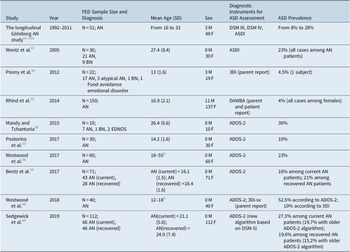
First studies suggesting a possible association between ASD and AN date back to 1983: in that year Gillberg reported three clinical cases featuring ASD children who have a female relative affected with AN. Gillberg pointed out also how AN patients often show typical ASD-like traits such as insistence on sameness and impaired social interactions.Reference Gillberg27 Moreover, he noted how a similar chromatographic profile of urinary excretion was detectable in these two conditions, suggesting that AN and ASD may share common pathogenic mechanisms, which would develop differently depending on gender. However, he left the question open, without further inquiries about possible neurobiological factors involved and/or about the specific role of gender in influencing ASD and AN symptomatology.Reference Gillberg27 Since 1990s, increasing attention has been provided to investigate the prevalence of ASD amongst patients with AN. Studies are summarized in Table 1. The first evidence came from a longitudinal investigation that was conducted in Sweden on a sample of 51 AN patients (although some of them recovered from the FED during the study) retrieving data from a wider cohort of adolescents with AN (“the Göteborg AN study”).41–53 Several studies were conducted on this sample, and the results reported from 1992 to 2011 were summarized in a systematic review by Huke et alReference Huke, Turk and Saeidi53 Their findings highlighted a prevalence of ASD ranging from 8% to 28%.41–53 ASD prevalence was significantly higher amongst patients with AN when compared with healthy controls (HC), and subjects with ASD and AN often show a worse outcome.41–53 AN patients with ASD showed also a poorer interpersonal functioning and neurocognitive performance when compared with HC.Reference Anckarsäter, Horfuander and Billstedt51 One of the points of interests of this research was the use of DSM criteria for the diagnosis of ASD—in some cases in addition to the Asperger Syndrome Diagnostic Interview (ASDI)—which led to significant changes (generally an increase) in ASD prevalence across time depending from which DSM edition was used.41–53 It is also noteworthy that not all the AN patients involved in the study had a stable diagnosis of restrictive AN: some of them showed binge-purging behaviors or also diagnosis switches between AN and bulimia nervosa (BN) during time. Despite that, no significant difference in ASD prevalence was found between patients with restrictive and binge-purging behaviors.Reference Råstam, Gillberg and Wentz49 Recently, the number of studies investigating the presence of ASD amongst patients with FED progressively increased, although with discrepancies in methods and sometimes with controversial results.Reference Westwood and Tchanturia30 Two researches employed parent report instruments for assessing ASD amongst patients with AN, finding a significantly lower prevalence when compared with other studies: Pooni et al in a sample of young subjects (8 to 16 years) with early onset eating disorders (20 patients with AN, 1 with BN, 1 with Food avoidance emotional disorder),Reference Pooni, Ninteman and Bryant-Waugh54 found only 1 subject (about 4.5% of the sample) with a diagnosis of ASD by means of the Developmental, Dimensional, and Diagnostic Interview (3Di) (while no ASD cases were found amongst HC), although reporting significantly higher rates of autistic traits (higher repetitive behaviors, and a trend vs higher social difficulties) amongst the patient group. Another study found a 4% rate of ASD (all cases were females) amongst 150 adolescents (137 females, 13 males) with AN, administering the Development and Well-being Assessment (DAWBA) to both parent and patients; however, more than a third of the sample showed significant impairment in social relationships.Reference Rhind, Bonfioli and Hibbs55 Most of the other studies, which investigated exclusively female patients with AN, used the Autism Diagnostic Observation Schedule, second edition (ADOS-2). Postorino et alReference Postorino, Scahill and De Peppo23 found a 10% rate of ASD in a sample of 30 adolescents with current AN, while Westwood et al found a 23% prevalence of ASD amongst 60 adult patients hospitalized for AN. Another study from the same groupReference Westwood, Mandy and Simic56 evaluated instead a sample of 40 adolescents hospitalized for AN, finding a prevalence of 52.5% of ASD according to the ADOS-2. However, in the same study, only 10% of the sample met the criteria for ASD according to parent reports about the presence of a developmental disorder during infancy (assessed by means of the 3Di, short version).
Studies About ASD Prevalence Among Patients with FED.

a For detailed information about each research involved in the longitudinal Göteborg AN study refer to the review of Huke et al.Reference Huke, Turk and Saeidi 53
b Age range (authors did not provide mean age).
In the last years, another study investigated the presence of ASD in a sample composed of 66 patients with a current diagnosis of AN, 46 patients recovered from AN, and 66 HC. The novelty of this study lies in the employment of the new algorithm for calculating ADOS-2 score, which is based on the DSM-5 criteria for ASD (eg, specific attention is provided to assess sensory sensitivities). Authors reported a significantly higher prevalence of ASD when using the new algorithm amongst both patients with a current diagnosis (27.3% vs 19.7%) and recovered patients (19.6% vs 15.2%). ADOS-2 score was not related to the presence of other psychopathological dimensions (such as eating disorder, anxiety, or depression symptomatology), suggesting the actual presence of a co-occurring diagnosis of ASD amongst these subjects. However, authors noted that patients recovered from AN showed intermediate score at the ADOS-2 when compared with the current AN group and with HC.Reference Sedgewick, Kerr-Gaffney and Leppanen 60 These results are in contrast with the study of Bentz et alReference Bentz, Jepsen and Pedersen 59 which, in a sample of young females with current AN (N = 43), recovered from AN (N = 28) and HC (N = 48), evidenced the presence of higher levels of social impairment in both patients with a current or past AN diagnosis. Moreover, these authors showed an ADOS-2 score above the clinical cut-off in 16% of the current patients and in 21% of the recovered: the ADOS-2 score was not associated with the state of the disorder or to other symptoms. However, it should be noted that in this sample a clinical diagnosis of ASD was excluded during recruitment procedures.
In this framework, only a scant number of studies assessed the presence of ASD in patients with FED other than AN. The longitudinal Swedish study, although originally focusing on AN, reported the presence of diagnosis switchings from AN to BN in the sample, without finding, as reported above, significant differences in ASD prevalence between patients with or without a stable diagnosis of AN.Reference Anckarsäter, Horfuander and Billstedt 51 In another study, conducted in a clinical sample of 30 adult patients with AN or BN, Wentz et alReference Wentz, Lacey and Waller 57 found a 23% rate of ASD by means of the ASDI: all cases were reported amongst AN patients. More recently, Mandy and TchanturiaReference Mandy and Tchanturia 58 published a case series of 10 women with FED and suspected ASD. Seven patients were diagnosed with AN, while one subject received a diagnosis of BN and other two a diagnosis of eating disorder not otherwise specified (EDNOS). According to their results, three subjects scored above the clinical cut-off of the ADOS-2 for ASD, while two scored in the range of the scale indicating the presence of subthreshold autism spectrum. All five subjects had a diagnosis of AN, and autistic-like symptoms seemed to be present before the onset of the FED. However, authors highlighted that, despite scoring below the cut-off for autism symptoms, two other subjects, diagnosed with EDNOS, seem to meet a diagnosis of ASD according to clinical history and assessment. Nickel et alReference Nickel, Maier and Endres 32 in a recent systematic review, confirmed that, in the available literature, ASD is most commonly diagnosed amongst patients with AN, while attention deficit hyperactivity disorder (ADHD) seems to be more frequently observed amongst patients with BN or binge-purging AN than in restrictive AN.
Switching the object of observation, it is noteworthy how atypical eating behaviors, often featuring selective and restrictive food intake, have been often described amongst subjects with ASD.Reference Marí-Bauset, Zazpe and Mari-Sanchis 61 , Reference Spek, van Rijnsoever and van Laarhoven 62 Fishman et alReference Fisman, Steele and Short 63 in 1996, mirroring the intuition of Gillberg, reported a case of a girl with ASD (autistic disorder) who developed AN, hypothesizing shared pathogenesis between these two conditions. This perspective is further complicated by the wide literature that suggested a link between ASD and gastrointestinal symptoms, including shared neurobiological underpinnings, featuring microbiota, and immune system alterations.Reference Carpita, Muti and Dell'Osso 64 , Reference Carpita, Marazziti and Palego 65 However, limited studies specifically addressed the prevalence of FED amongst subjects with ASD. According to the contribution of Sobanski et alReference Sobanski, Marcus and Hennighausen 66 amongst 36 males with Asperger’s disorder, a higher risk of low BMI was detectable, while four subjects presented disturbed eating behavior. On the other hand, Bolte et alReference Bölte, Ozkara and Poustka 67 reported that in a sample of 103 patients with ASD, no subject reported a diagnosis of AN, although 28% of male subjects and 3% of females showed a low BMI. Another study compared the presence of eating problems between female adolescents with (N = 56) or without (N = 56) Asperger’s disorder using the Eating attitude test, 26 item version (EAT-26). Results showed a higher risk of eating problems amongst ASD females (26.8% vs 7.1% of scores above the EAT-26 cut-off).Reference Kalyva 68 More recently, Karjalainen et alReference Karjalainen, Gillberg and Råstam 69 reported, in a sample of 228 adults with ASD and/or ADHD, a 7.9% rate of FED, without significant differences depending on gender and diagnosis. Amongst the ASD group (N = 74) they reported a prevalence of 10.8% of FED: in particular, 6.7% of AN, 2.7% of BN, 1.4% of Binge Eating Disorder (BED).
FED and the Broad Autism Spectrum
In the last two decades, in the broader framework of increasing interest toward a dimensional approach to psychopathology, the literature has focused on investigating the presence not only of full-blown ASD but also of subthreshold autistic traits amongst the clinical and general population.Reference Dell'Osso, Lorenzi and Carpita 40 , Reference Carpita, Carmassi and Calderoni 70 The label “autistic traits” aims to identify a set of characteristics similar to ASD typical symptoms, although of milder severity, such as aloof personality, difficulties in social relationships, and in expressing emotions, restricted or atypical interests. 70–77 Recently the importance of autistic traits has been increasingly highlighted, pointing out how these traits, also when subthreshold, seem to be associated with an increased vulnerability toward the development of psychiatric disorders, while they could also independently show relevant clinical correlates, such as negative ruminative thinking and suicidality.Reference Dell'Osso, Carpita and Muti 25 , Reference Dell'Osso, Lorenzi and Carpita 40 , Reference Carpita, Carmassi and Calderoni 70 , Reference Takara and Kondo 78 , Reference Dell'Osso, Bertelloni and Di Paolo 79 The presence of autistic traits has been firstly reported amongst family members of children with ASD, supporting the genetic underpinnings of the autism spectrum and shaping the concept of a “Broad autism phenotype.” 70–77 According to recent literature, while autistic traits seem to be continuously distributed across the general population, they seem to be more represented in specific high-risk groups and clinical sample of psychiatric patients with other disorders.Reference Dell'Osso, Carpita and Bertelloni 24 , Reference Dell'Osso, Carpita and Cremone 26 , Reference Dell'Osso, Carpita and Gesi 31 , Reference Takara and Kondo 78 , 80–86 In this conceptual framework, the number of studies investigating the presence of shared neurostructural and neurofunctional correlates between AN and the autism spectrum, as well as shared cognitive and behavioral profiles, has rapidly increased. These researches support previous studies that had already stressed how some characteristics that are known to be typical of ASD and of OCD (such as perfectionism, rigidity, inflexibility, restrictive interests) were also key features of AN, although specifically oriented toward diet and eating habits.Reference Dell'Osso, Abelli and Carpita 5 , Reference Dell'Osso, Carpita and Gesi 31 , Reference Zucker, Losh and Bulik 33 , 87–95 However, autism spectrum and AN might be even more deeply intertwined: in patients with AN is detectable a specific neurocognitive phenotype (similar to that typically reported in subjects of the autism spectrum),Reference Zucker, Losh and Bulik 33 which would feature rigidity in set-shifting tasks and in global processing (a trait that has been reported also amongst first degree relatives of ASD probands),Reference Westwood, Eisler and Mandy 29 , 96–101 as well as greater attention to details.Reference Anckarsäter, Horfuander and Billstedt 51 , Reference Baron-Cohen, Jaffa and Davies 101 , Reference Hambrook, Brown and Tchanturia 102 Moreover, social cognition and functioning seem to be altered in AN patients in a way that resemble that of ASD: in particular, AN patients show higher social anhedonia,Reference Tchanturia, Smith and Weineck 94 , Reference Tchanturia, Davies and Harrison 100 alexithymia,Reference Tchanturia, Davies and Harrison 100 impaired emotional intelligence, 102–104 and emotional processing.Reference Westwood, Eisler and Mandy 29 , Reference Davies, Schmidt and Stahl 105 , Reference Roberts, Tchanturia and Stahl 106 Even the Theory of Mind, whose impairment is one of the most relevant traits of ASD, seems to be compromised in AN, especially when advanced tasks are concerned.Reference Westwood, Eisler and Mandy 29 , Reference Tchanturia, Happe and Godley 37 , Reference Hambrook, Brown and Tchanturia 102 Data from neuroimaging studies reported amongst AN patients atypical neurostructural and functional alterations in specific areas of the social brain, such as amygdala, orbitofrontal cortex, and superior orbital sulcus, which are known to be significantly correlated with the presence of autistic traits.Reference Zucker, Losh and Bulik 33 , Reference Gillberg, Rastam and Wentz 107 , Reference Björnsdotter, Davidovic and Karjalainen 108 However, it should be noted that studies in this field showed high heterogeneity in methods, and should be considered in light of these limitations.
Although most of the researches focused on AN, relatively smaller literature focused on the presence of ASD-like neurocognitive profiles in other kinds of FED,Reference Dell'Osso, Carpita and Gesi 31 showing that autistic traits might not be limited to AN. According to the review of Lopez et alReference Lopez, Tchanturia and Stahl 99 studies about central coherence in FED patients reported that also subjects with BN may show difficulties in global processing, although this result was not confirmed by all the studies. On the other hand, Tchanturia et alReference Tchanturia, Anderluh and Morris 36 highlighted the presence of lower cognitive flexibility amongst both patients with AN and BN (but with different patterns of impairment), when compared with HC. When considering the social brain, social anhedonia seems to be equally represented in patients with AN and BN, while patients recovered from AN showed intermediate levels between FED and HC subjects.Reference Tchanturia, Davies and Harrison 100 Harrison et alReference Harrison, Sullivan and Tchanturia 109 reported poorer emotional regulation as well as social and angry-threat attention bias in both AN and BN patients, although patients with BN did not differ from HC in the Reading the Mind in the Eyes test, which was compromised specifically amongst patients with restrictive AN. Conversely, a more recent study reported amongst patients with BN and EDNOS the presence of a poorer emotional Theory of Mind, while AN patients did not score differently from HC.Reference Medina-Pradas, Navarro and Álvarez-Moya 110
In addition to this literature, a consistent number of studies, which recently have been object of a meta-analysis by Westwood et alReference Westwood, Eisler and Mandy 29 directly investigated the prevalence of autistic traits amongst patients with AN using the autism spectrum quotient (AQ), the most employed instrument in this field, or, alternatively, its brief version (AQ-10). Globally, the meta-analysis identified seven studies, reporting significant differences between adolescents or young women with AN and HC on AQ score, although patients with AN do not seem to reach the AQ cut-off score for the presence of clinically significant autism spectrum symptoms. On the other hand, considering that almost all these studies were conducted in samples composed exclusively by females, as Westwood et al pointed outReference Westwood, Eisler and Mandy 29 , Reference Westwood and Tchanturia 30 this result may be partially related to a gender bias in evaluating ASD presentation: the AQ, as most of the other instruments in this field, has been tailored on typical male manifestations of ASD.Reference Dell'Osso, Gesi and Massimetti 111 Similar results were highlighted by a recent study,Reference Karjalainen, Råstam and Paulson-Karlsson 112 which reported amongst AN patients a higher AQ score than amongst HC, although below the AQ cut-off. AQ scores seem to decrease in weight-recovered patients. Intriguingly, the same work reported also that ASD-related abnormal eating behaviors, as measured by the Swedish Eating Assessment for Autism spectrum disorders were more common amongst subjects with AN (including those weight-recovered) than amongst ASD patients.Reference Karjalainen, Råstam and Paulson-Karlsson 112
Only a few studies featured the use of psychometric questionnaires for measuring autistic traits amongst patients with FED other than AN. Vagni et alReference Vagni, Moscone and Travaglione 113 employed clinical evaluations supported by the AQ and the Ritvo Autism Asperger Diagnostic Scale Revised to evaluate the presence of autistic traits in a sample of 67 female patients with AN, BN, or BED, reporting a 33% prevalence of significant autistic symptoms, without differences depending from the specific diagnosis. More recently, Dell’Osso et alReference Dell'Osso, Carpita and Gesi 31 assessed the presence of autistic traits in a sample composed of 138 adults (mostly females) with different kinds of FED and 160 HC by means of Adult Autism Subthreshold Spectrum (AdAS Spectrum) questionnaire. This instrument has been recently developed to assess ASD symptoms according to DSM-5 criteria in adults without intellectual impairment: authors paid specific attention to include in the questionnaire also items that investigate female-specific ASD-like manifestations.Reference Dell'Osso, Gesi and Massimetti 111 Results from this study highlighted significantly higher autistic traits amongst patients with FED than amongst HC, although patients with restrictive AN showed higher autistic traits than patients with binge-purging behaviors (in this category authors included subjects with a diagnosis of binge-purging AN, BN, and BED). Patients with restrictive AN seemed to show also significantly higher levels of inflexibility, restrictive interest, and rumination, as measured by the AdAS Spectrum, as well as higher levels of interpersonal distrust and social insecurity as measured by the eating disorders inventory, version 2. On the basis of these results, it may be suggested that autistic traits were distributed on a continuum across FED, which would feature the highest grade of severity amongst subjects with AN, although being significantly present, in a milder degree and with different characteristics, in other kinds of FED.Reference Dell'Osso, Carpita and Gesi 31 However, further studies are needed to understand the measure and the quality of the relationship between autism and eating disorder spectra.
Rethinking FED: A Neurodevelopmental Approach
Researches on the relationships between autism spectrum and FED reported heterogeneous results. Considering prevalence studies, ASD prevalence seems to be higher amongst AN patients than amongst the general population.Reference Westwood and Tchanturia 30 , Reference Huke, Turk and Saeidi 53 It should be noted, on the other hand, that only a minority of subjects with AN reported an ASD diagnosis.Reference Westwood and Tchanturia 30 , Reference Huke, Turk and Saeidi 53 Autistic traits, as measured by psychometric questionnaires were found to be higher amongst FED (particularly AN) patients when compared with HC but they seem to not exceed the threshold for clinical significance.Reference Westwood, Eisler and Mandy 29 The scant literature that focused on other kinds of FED reported that also in these populations a significant presence of autistic-like traits was detectable, although generally to a lesser extent than in AN.Reference Dell'Osso, Carpita and Gesi 31 , Reference Tchanturia, Anderluh and Morris 36 , Reference Lopez, Tchanturia and Stahl 99 , Reference Tchanturia, Davies and Harrison 100 , Reference Harrison, Sullivan and Tchanturia 109 , Reference Medina-Pradas, Navarro and Álvarez-Moya 110 These promising evidences, however, should be confirmed by further and broader studies in larger samples, focusing mostly on larger samples. On the other hand, amongst ASD patients the presence of altered eating patterns is well-known, although little research investigated the specific presence of FED. 61–69
Several hypotheses have been proposed to explain the link between FED and ASD. Some authors are inclined to consider the presence of autistic-like features amongst AN patients as an epiphenomenon caused by chronic illness state and starvation.Reference Westwood, Eisler and Mandy 29 –Reference Dell'Osso, Carpita and Gesi 31 , Reference Pooni, Ninteman and Bryant-Waugh 54 , Reference Tchanturia, Smith and Weineck 94 In this perspective, it is noteworthy that studies that compared autistic traits between current and recovered AN patients reported controversial results.Reference Bentz, Jepsen and Pedersen 59 , Reference Sedgewick, Kerr-Gaffney and Leppanen 60 , Reference Tchanturia, Davies and Harrison 100 , Reference Karjalainen, Råstam and Paulson-Karlsson 112 Moreover, researches based on parent reports highlighted that often parents did not confirm a childhood history of ASD-like features for AN patients who showed significant autism spectrum symptoms at the time of the study.Reference Westwood, Eisler and Mandy 29 , Reference Westwood and Tchanturia 30 , Reference Westwood, Mandy and Simic 56 Other authors pointed out also that the relationship between ASD and FED may be present but unspecific, considering that both these two conditions are quite often associated with other psychiatric disorders.Reference Dell'Osso, Abelli and Carpita 5 , Reference Altman and Shankman 20 –Reference Dell'Osso, Carpita and Cremone 26 , Reference Dell'Osso, Carpita and Gesi 31 , Reference Westwood, Mandy and Simic 56
Conversely, as previously reported, an increasing number of researchers hypothesized a conceptualization of AN as a female phenotype of ASD, on the basis of comorbidity, familiar aggregation, and significant neurocognitive and behavioral overlap between ASD and AN.Reference Dell'Osso, Abelli and Carpita 5 , 27–31 , Reference Zucker, Losh and Bulik 33 , Reference Tchanturia, Anderluh and Morris 36 , Reference Tchanturia, Happe and Godley 37 , 87–108 The strong similarities between ASD and AN from a neurocognitive perspective are stressed by many studies that investigated specific autistic-like features (such as cognitive inflexibility, Theory of Mind alterations, impaired global processing, and emotional intelligence) in AN patients.Reference Zucker, Losh and Bulik 33 , Reference Tchanturia, Anderluh and Morris 36 , Reference Tchanturia, Happe and Godley 37 , 87–106 Similar evidences came also from neuroimaging studies,Reference Zucker, Losh and Bulik 33 , Reference Björnsdotter, Davidovic and Karjalainen 108 and further neurobiological links have been hypothesized.Reference Odent 22 The conceptualization of AN as a gender-specific presentation of ASD may also provide an intriguing model for the opposite gender differences in ASD and AN prevalence. 29–31 , Reference Tchanturia, Smith and Weineck 94 The conceptualization of AN as an ASD phenotype should be considered in light of the attention recently provided to the presence of gender-specific ASD presentations, that would feature a greater ability of females patients to recognize their social difficulties and mask them (often by imitating others’ behaviors).Reference Dell'Osso, Abelli and Carpita 5 , 27–35 Females with ASD frequently show higher levels of social anxiety: a condition, intriguingly, that is often comorbid with FED and that is associated with an impairment of the social brain and with a higher prevalence amongst females.Reference Lai, Baron-Cohen and Buxbaum 34 , Reference Lai, Lombardo and Auyeung 35 , 114–120 Moreover, the pattern of narrow interests and repetitive behaviors amongst females with ASD seems to be different from that typically reported amongst males, featuring more socially accepted topics such as spending time with animals, reading fictions, or dietary habits.Reference Dell'Osso, Abelli and Carpita 5 , 27–35 In this conceptual framework, it would be possible that, as stated by Westwood et alReference Westwood, Eisler and Mandy 29 , Reference Westwood and Tchanturia 30 the evaluation of autistic traits amongst FED patients would be underestimated by psychometric questionnaires, often tailored on the typical male presentations of ASD. The under-recognition of ASD symptoms amongst females may also justify the absence of a childhood history of ASD-like features amongst AN patients, reported by studies that employed parent reports.Reference Westwood, Eisler and Mandy 29 , Reference Westwood and Tchanturia 30 , Reference Westwood, Mandy and Simic 56
Recently some authors have further broadened this perspective, proposing a psychopathological model that hypothesizes the presence of a neurodevelopmental alteration at the basis of all psychiatric disorders: the specific kind and severity of the alteration and its interactions with other neurobiological, genetic (including sex), and environmental factors would determine different psychopathological trajectories.Reference Dell'Osso, Lorenzi and Carpita 40 , 121–124 These latters may span from full-blown ASD (as a result of the most severe neurodevelopmental alterations) to other kinds of psychiatric disorders, such as ADHD, but also Schizophrenia, Bipolar disorder, personality disorders, and FED.Reference Dell'Osso, Lorenzi and Carpita 40 , 121–124 This hypothesis would also allow explaining the reported lack of specificity in the association between ASD and AN, and the frequent comorbidity of both these conditions with other psychiatric disorders.Reference Dell'Osso, Abelli and Carpita 5 , Reference Altman and Shankman 20 –Reference Dell'Osso, Carpita and Cremone 26 , Reference Dell'Osso, Carpita and Gesi 31 , Reference Westwood, Mandy and Simic 56 In particular, FED could be considered as a possible psychopathological trajectory of a neurodevelopmental alteration, toward which female gender would act as one of many predisposing factors. In light of this model, it is worth mentioning, in the matter of FED, the reported association between autism spectrum and Borderline personality disorder, another condition more represented amongst females. 1 , Reference Dell'Osso, Cremone and Carpita 84 , Reference Dell’Osso, Muti and Lorenzi 123 , Reference Dell'Osso, Cremone and Carpita 125 Borderline personality disorder has been associated with higher levels of autistic traits and shows a significant comorbidity with FED (in particular with those FED that feature binge eating behaviors), as well as shared psychopathological traits (such as impulsivity and emotional dysregulation).Reference Suzuki, Miyaki and Eguchi 83 , 125–127 In addition, both Borderline personality disorder and FED (also in this case, in particular, FED other than restrictive AN) are associated with a history of traumatic experiences.Reference Suzuki, Miyaki and Eguchi 83 , Reference Dell’Osso, Muti and Lorenzi 123 , Reference Dell'Osso, Cremone and Carpita 125 , 128–130 This data may further support the less investigated association between autism spectrum and FED other than AN, which, starting from a neurodevelopmental alteration, may be the result of different psychopathological trajectories from those involved in restrictive AN, including also a different role of traumatic experiences.
This review should be considered in light of several limitations. Most of the literature reviewed here reported results from samples not homogeneous for socio-demographic characteristics, eligibility criteria of the patients, methodology, or diagnostic tools employed, limiting their reproducibility and extensibility. Moreover, research in this field is mainly focused on female gender. Most of the studies included only females or a minor number of males, therefore no study has properly compared ASD rates between males and females with FED. In order to better understand the role of gender in ASD development, further research should focus on the relationship between FED and autism spectrum amongst males, comparing the two genders with respect to ASD rates and psychopathological correlates.
Finally, this is not a systematic review, and the presentation of the matter provided by authors may be biased by the personal understanding of the field.
Globally, further investigation should be provided to the neurobiological and neurocognitive features of ASD and FED in order to clarify the relationship between these two conditions. A better understanding of the specific profile of ASD manifestations amongst females is also needed to decide whether or not FED should be considered a part of it. Moreover, it is also necessary to further broaden the field of investigation, casting light on the actual role of neurodevelopmental alterations in psychopathology. Improving our knowledge about this matter may also lead to modify the current methods of assessment and treatment of both ASD and AN, allow us to develop more specific diagnostic tools, new psychotherapeutic strategies, and eventually identify new targets for pharmacological therapy.
Disclosure
The authors do not have any conflicts of interest to disclose.