Introduction
Growing evidence suggests that early disturbances to neurodevelopment may increase the risk for neuropsychiatric and neurodevelopmental disorders and associated symptoms (Estes & McAllister, Reference Estes and McAllister2016; Gumusoglu & Stevens, Reference Gumusoglu and Stevens2019). Maternal immune activation (MIA) is one noted possible risk factor that has been proposed to interfere with fetal developmental trajectories, with theoretical models suggesting prenatal programming of neural development may adversely impact offspring later in life (Gumusoglu & Stevens, Reference Gumusoglu and Stevens2019). MIA is broadly defined as an excessive immune response during pregnancy. It has been defined by the presence of autoimmune diseases (Chen et al., Reference Chen, Zhong, Jiang, Zheng, Xiong, Ma and Chen2016), chronic immune conditions (asthma, allergies) (Croen, Grether, Yoshida, Odouli, & Van de Water, Reference Croen, Grether, Yoshida, Odouli and Van de Water2005), infections, and related syndromes of chronic immune activation (Jiang et al., Reference Jiang, Xu, Shao, Xia, Yu, Ling and Ruan2016) in pregnancy. It has been proposed that the immune response in the mother, mediated by cytokines, chemokines, inflammatory cells, and antibodies, may alter the carefully regulated environment in utero. The disruption in gestational conditions is posited to result in changes in offspring brain structure and function (Meltzer & Van de Water, Reference Meltzer and Van de Water2017). If supported, such models may assist the identification of at-risk children, novel treatment targets, and possible prevention mechanisms.
In animal models, MIA has been shown to disrupt the density and activation of microglia (Van den Eynde et al., Reference Van den Eynde, Missault, Fransen, Raeymaekers, Willems, Drinkenburg and Dedeurwaerdere2014) and immune markers (Parker-Athill & Tan, Reference Parker-Athill and Tan2010) to increase the expression of neuropsychiatric and neurodevelopmental problems. MIA has been shown to increase sensorimotor dysfunction, social deficits, repetitive behaviors, and depression- and anxiety-like behaviors in offspring (Gumusoglu & Stevens, Reference Gumusoglu and Stevens2019). To illustrate, modeling MIA in pregnant mice leads to impaired communication (measured by a decreased rate of ultrasonic vocalizations), decreased sociability, and increased repetitive/stereotyped behavior (marble burying and self-grooming tests) in offspring (Malkova, Yu, Hsiao, Moore, & Patterson, Reference Malkova, Yu, Hsiao, Moore and Patterson2012). In animal models, MIA has also been shown to influence brain structure and growth (Fatemi et al., Reference Fatemi, Earle, Kanodia, Kist, Emamian, Patterson and Sidwell2002), synapse morphology and physiology (Li et al., Reference Li, Missig, Finger, Landino, Alexander, Mokler and Bolshakov2018), and the development of various cell populations (Fatemi et al., Reference Fatemi, Earle, Kanodia, Kist, Emamian, Patterson and Sidwell2002). Central to MIA models of fetal development is the argument of a ‘multi-hit’ hypothesis. That is, prenatal immune challenges, combined with other environmental factors, such as stress, may lead to increased vulnerability for adverse outcomes in offspring (Giovanoli et al., Reference Giovanoli, Engler, Engler, Richetto, Voget, Willi and Meyer2013; Giovanoli, Weber, & Meyer, Reference Giovanoli, Weber and Meyer2014).
These animal models have led to proposals that MIA may increase fetal risk for the development of neuropsychiatric and neurodevelopmental disorders later in life, such as autism spectrum disorder (ASD), schizophrenia, mood disorders, and anxiety disorders (Estes & McAllister, Reference Estes and McAllister2016; Knuesel et al., Reference Knuesel, Chicha, Britschgi, Schobel, Bodmer, Hellings and Prinssen2014). Epidemiology studies in humans have found that maternal autoimmune conditions (Chen et al., Reference Chen, Zhong, Jiang, Zheng, Xiong, Ma and Chen2016; Khandaker, Zimbron, Lewis, & Jones, Reference Khandaker, Zimbron, Lewis and Jones2013) and infections during pregnancy (Benros, Mortensen, & Eaton, Reference Benros, Mortensen and Eaton2012; Jiang et al., Reference Jiang, Xu, Shao, Xia, Yu, Ling and Ruan2016) were associated with increased risk of ASD and schizophrenia in offspring. Maternal asthma and allergies have also been linked with increased risk (Gong et al., Reference Gong, Lundholm, Rejno, Bolte, Larsson, D'Onofrio and Almqvist2019) and severity of social symptoms in children with ASD (Patel et al., Reference Patel, Masi, Dale, Whitehouse, Pokorski, Alvares and Guastella2018). Maternal autoimmunity was further found to be more prevalent in individuals with autistic regression (Scott, Shi, Andriashek, Clark, & Goez, Reference Scott, Shi, Andriashek, Clark and Goez2017) and linked to acute-onset neuropsychiatric disorders and global regression in offspring (Jones et al., Reference Jones, Ho, Sharma, Mohammad, Kothur, Patel and Group2019). In cases of schizophrenia, those with prenatal influenza B exposure have shown significant decreases in verbal intelligence quotient than cases without this exposure (Ellman, Yolken, Buka, Torrey, & Cannon, Reference Ellman, Yolken, Buka, Torrey and Cannon2009). Recently, Giollabhui et al. showed that elevated maternal interleukin-8 was associated with increased externalizing symptoms in offspring at 9–11 years of age, while interleukin-1ra was associated with higher internalizing symptoms only in female offspring (Mac Giollabhui et al., Reference Mac Giollabhui, Breen, Murphy, Maxwell, Cohn, Krigbaum and Ellman2019).
It has been proposed that MIA represents a general risk factor indicating vulnerability for broad neurodevelopmental and neuropsychiatric problems in the offspring, where the level of conferred risk for specific symptoms is likely based on a combination of genetic and environmental interactions. For example, MIA may increase the risk and/or severity of ASD symptoms in those with an existing heritable risk of ASD. However, there have been no longitudinal studies determining whether MIA leads to a persistent risk for neurodevelopmental and neuropsychiatric symptoms across childhood and adolescence. Moreover, there has been limited research exploring the cumulative influence of MIA in such longitudinal studies.
This study aimed to address the influence of MIA on long-term behavioral and emotional problems across childhood and adolescence. We used a prospective pregnancy cohort, which collected data from mothers and their offspring from pregnancy to adulthood. Mental health assessments of each child were taken at ages 5, 8, 10, 14, and 17. We aimed to investigate whether maternal immune history during pregnancy was associated with increased behavioral and emotional problems in offspring. Specifically, we predicted that MIA would increase the risk for overall emotional and behavioral problems, including both internalizing and externalizing symptoms, across development. We also examined whether this risk would increase with reports of multiple MIA experiences during pregnancy.
Methods and materials
Participants
This was a prospective cohort study of pregnant women and their offspring. The Western Australia Pregnancy Cohort (Raine) Study recruited pregnant women from the public antenatal clinic at King Edward Memorial Hospital (Perth, Western Australia) or surrounding private clinics in Perth, Western Australia between May 1989 and November 1991 (Generation 1; N = 2868). The inclusion criteria were a gestational age between 16 and 20 weeks, English language skills sufficient to understand the study demands, an expectation to deliver at King Edward Memorial Hospital, and an intention to remain in Western Australia to enable future follow-up of their child. Participant recruitment and all subsequent cohort reviews were approved by the Human Ethics Committees at King Edward Memorial Hospital, Princess Margaret Hospital for Children (Perth, Western Australia), and/or the University of Western Australia. Parents/guardians and the adolescent or adult participant (Generation 2) provided written informed consent to participate at each follow-up.
Maternal immune history
Based on information collected during pregnancy and at 5-year follow-up, mothers (Generation 1) were classified into the following immune categories: (a) AAAE (Asthma/Allergy/Atopy/Eczema); (b) infection (during pregnancy); and (c) no AAAE or infection comparison group. Information regarding infections during pregnancy [specifically urinary tract infection (UTI), cold/flu, chest infection, herpes, other infections, and other viral infections] was extracted from a questionnaire completed by the mother at 18 weeks gestation. Information regarding maternal asthma and chorioamnionitis during pregnancy was extracted from antenatal information collected by nurses after birth. Information on allergies, hay fever, and eczema was collected from the mothers at 5-year follow-up. Mothers who reported these conditions before, during, or up to 5 years post-pregnancy were included in the AAAE group; however, the data did now allow us to distinguish when these conditions first appeared in the mothers. Mothers who did not report any AAAE or infection conditions were used as a comparison group.
Behavioral and emotional problems
Empirically based psychometric studies have shown that broad symptoms of mental health and neurodevelopment can be categorized into internalizing and externalizing syndromes across childhood (Achenbach, Reference Achenbach1991). The Child Behavior Checklist (CBCL) for ages 4–18 was administered for offspring (Generation 2) at the 5-, 8-, 10-, 14-, and 17-year follow-ups (Achenbach, Reference Achenbach1991).
This parent-rated questionnaire is one of the most widely used and well-accepted measures of child psychopathology (Pandolfi, Magyar, & Dill, Reference Pandolfi, Magyar and Dill2009; Schmeck et al., Reference Schmeck, Poustka, Dopfner, Pluck, Berner, Lehmkuhl and Lehmkuhl2001) and has been used in multiple longitudinal cohort studies to study psychiatric well-being across development (Ferdinand & Verhulst, Reference Ferdinand and Verhulst1995; Hofstra, Van der Ende, & Verhulst, Reference Hofstra, Van der Ende and Verhulst2000; Welham et al., Reference Welham, Scott, Williams, Najman, Bor, O'Callaghan and McGrath2009). This CBCL contains a list of 118 behavioral/emotional problem items that parents rate as: not true (score zero); somewhat or sometimes true (score one); or very or often true (score two) of their children. The CBCL is widely used in the research literature and shows good internal reliability and validity in several population settings (Achenbach, Reference Achenbach1991). The CBCL/4–18 produces a raw score that was transformed into three summary T scores (standardized by age and sex): (a) Total behavior; (b) Externalizing (delinquency, aggression) behavior; and (c) Internalizing (withdrawal, somatic complaints, anxious/depressed) behavior; these were analyzed as continuous variables referred to as ‘scores’. In addition, we analyzed patients who had CBCL T scores above 60, which is an established threshold of a clinically significant level of concern (Achenbach, Reference Achenbach1991), referred to as ‘morbidity’.
Statistical analyses
The frequency distributions of maternal age, smoking, and alcohol consumption were compared between the AAAE, infection, and comparison groups using a one-way ANOVA or χ2 test, as appropriate, to assess for independence. Generalized estimating equations (GEE; normal distribution) were used to investigate the effect of maternal immune status on the continuous CBCL scores, generating β coefficients and 95% confidence intervals (CI). GEE models (binomial distribution with logit link) were used to investigate CBCL morbidity (T score > 60) on the Total, Internalizing, and Externalizing scales, generating odds ratios (ORs) and 95% CIs. The models used a complete case, maximum likelihood estimation and accounted for the within-person correlation from repeated measures by specifying the participant ID as a clustering variable. The models were adjusted for maternal age (Sandin et al., Reference Sandin, Hultman, Kolevzon, Gross, MacCabe and Reichenberg2012), smoking (Herrmann, King, & Weitzman, Reference Herrmann, King and Weitzman2008), and alcohol intake (Gray, Mukherjee, & Rutter, Reference Gray, Mukherjee and Rutter2009) during pregnancy, and offspring sex, as these covariates are known to be associated with neurocognitive development. A model was also run for each MIA variable (AAAE, infection, and AAAE and infection combination groups) including an interaction term with offspring sex. To assess the significance of these interaction terms, these models were compared (using an ANOVA Wald Test) to a model including only the main effects term for the MIA and sex variables. Statistical analyses were performed using R 3.6.0 [gee (Carey, Reference Carey2015), ggplot2 (Wickham, Reference Wickham2016), and MatchIt (Ho, Imai, King, & Stuart, Reference Ho, Imai, King and Stuart2011) packages] and RStudio.
Results
Sample characteristics
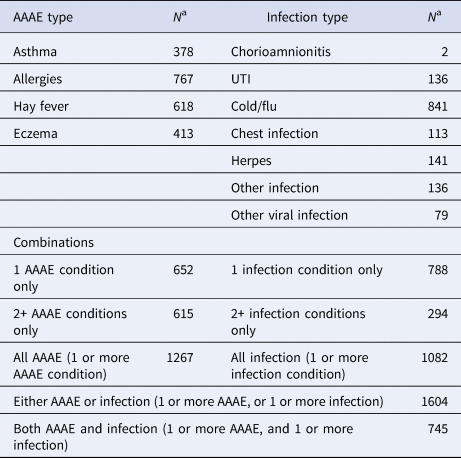
Of the 2868 live births in the Raine cohort, mothers whose immune status could not be categorized reliably, due to incomplete data, were removed reducing the cohort to 1905 participants (66%). The included mothers were older (~1.5 years) and fewer mothers in this group smoked than those that were excluded; the distributions of other variables were similar (online Supplementary Table S1). Of the remaining cohort (N = 1905; offspring 48.35% female, 51.65% male), 652 mothers reported one AAAE condition (asthma, allergies, hay fever, and eczema) and 615 reported more than one AAAE condition. One infection condition (chorioamnionitis, UTI, cold/flu, chest infection, herpes, other infections, and other viral infections) was reported by 788 mothers and 294 reported more than one infection. Altogether, 1604 mothers reported at least one type of immune activation (AAAE or infection), 745 reported both conditions, leaving 301 mothers that reported neither AAAE nor infection in the comparison group (Table 1). No difference was observed between the AAAE, infection, and comparison groups in alcohol intake during pregnancy and offspring sex; statistically significant differences were observed between the infection and comparison groups for maternal age and smoking (online Supplementary Table S2).
Frequencies of AAAE and infection conditions in the study cohort (N = 1905)

AAAE, Asthma/Allergy/Atopy/Eczema; UTI, urinary tract infection.
a Number of mothers in each group; mothers may be in more than one group for single each type of AAAE and infection condition.
Behavioral and emotional development
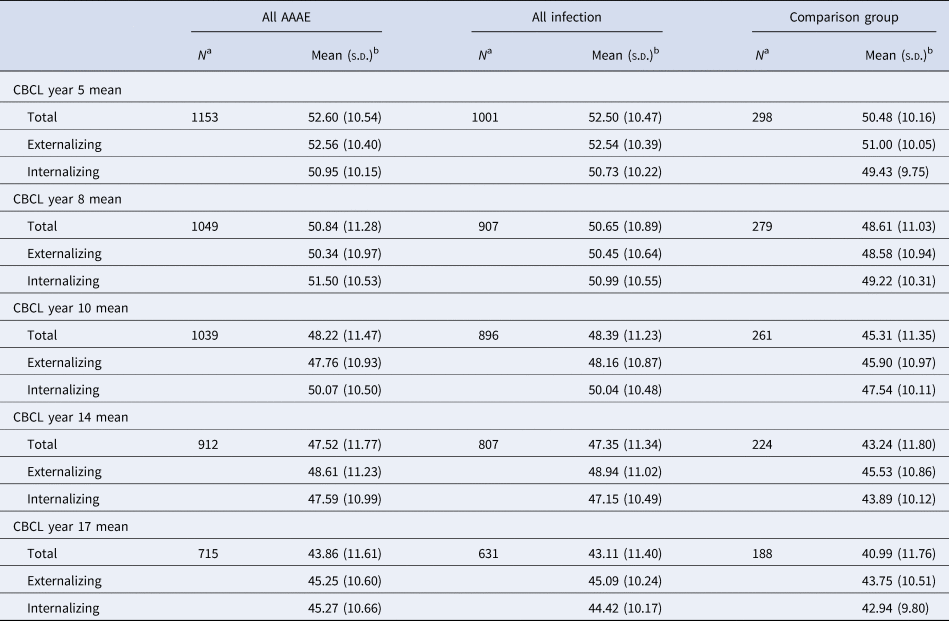
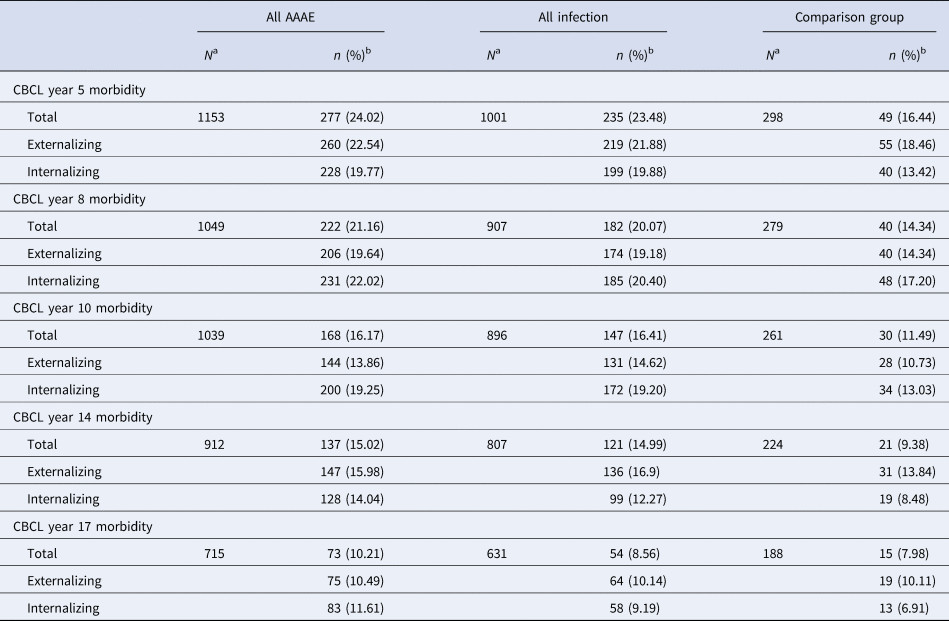
Table 2 presents means and standard deviations for CBCL scores, by follow-up, across childhood and adolescence for the AAAE, infection, and comparison groups. Analysis of our primary hypothesis showed that mean Total, Externalizing, and Internalizing scores were higher in the AAAE and infection groups compared to the comparison group and were consistent through all ages of 5, 8, 10, 14, and 17. At age 5, for instance, there was an approximately 50% increase in CBCL morbidity in the AAAE (24%) and infection (23.5%) groups compared to the comparison group (16.4%; Table 3). Data regarding the percentage of CBCL scores above 60 are presented separately for males and females in online Supplementary Tables S3 and S4, respectively.
Descriptive statistics of CBCL scores at each follow-up for the AAAE and infection groups in comparison with the remainder of the sample

AAAE, Asthma/Allergy/Atopy/Eczema; CBCL, Child Behavior Checklist; s.d., standard deviation.
a Number of mothers who completed the CBCL at each follow-up time point.
b CBCL scores are presented as means with standard deviations.
Percentage of behavioral and emotional morbidity (CBCL T score >60) at each follow-up for the AAAE and infection groups in comparison with the remainder of the sample

AAAE, Asthma/Allergy/Atopy/Eczema; CBCL, Child Behavior Checklist.
a Number of mothers who completed the CBCL at each follow-up time point.
b CBCL scores are presented as the number and percentage of participants in each group with a T score above 60.
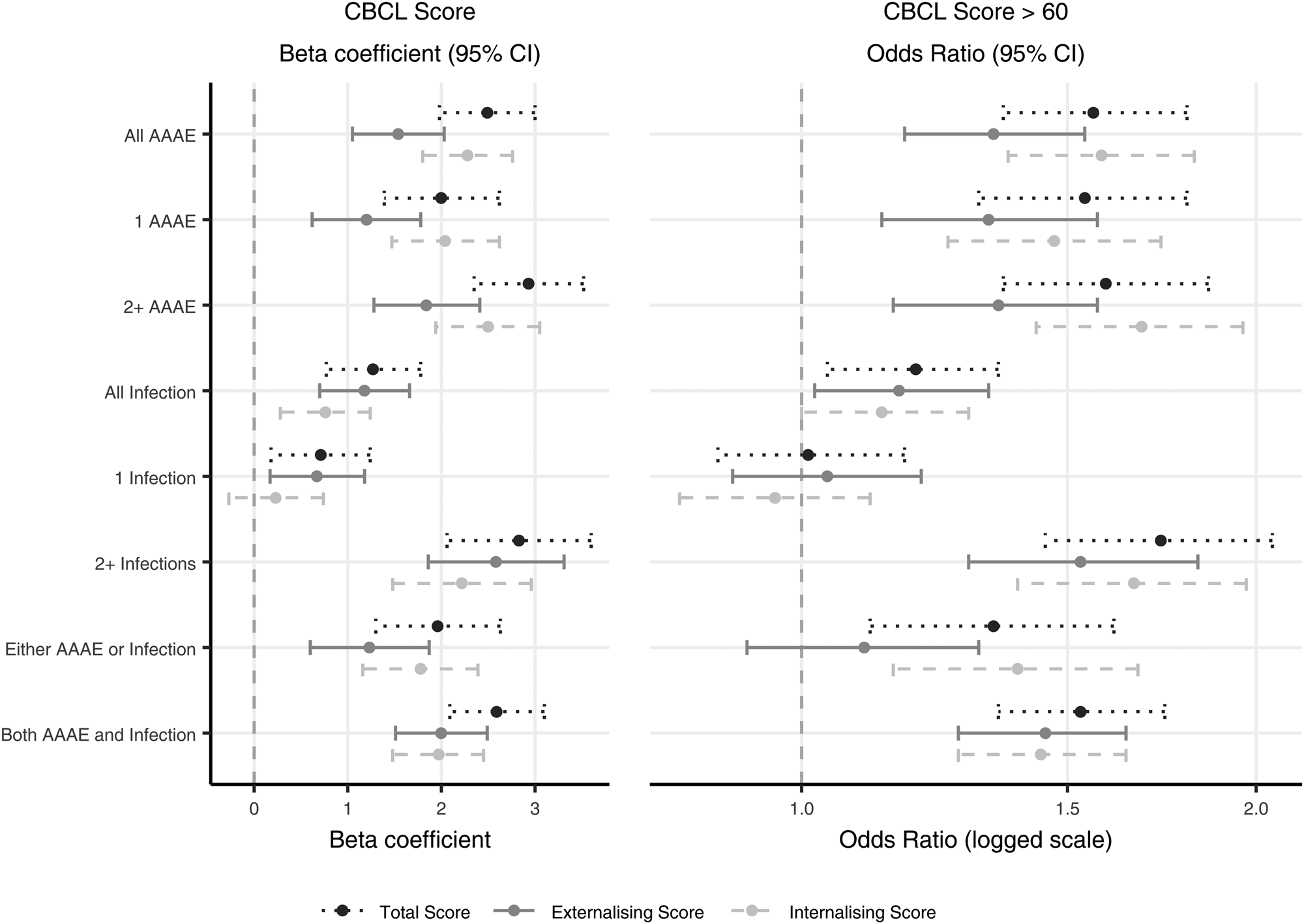
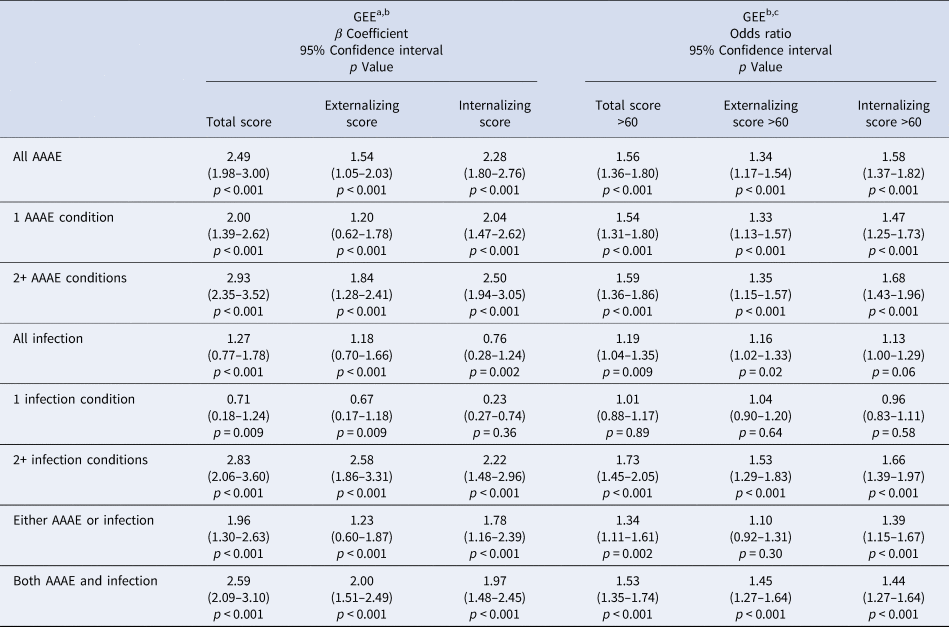
Exploratory analysis using GEE models was conducted to examine the continuous CBCL scores and CBCL morbidity across the AAAE and infection groups. Each type of AAAE and infection condition was analyzed individually (online Supplementary Table S5), except for chorioamnionitis, due to its small sample size (n = 2). The individual conditions were then analyzed in combination groups to assess the effects of overall MIA exposure (Table 4, Fig. 1). All AAAE conditions (one or more) were associated with significant increases in CBCL scores (β 1.54–2.49) and morbidity (OR 1.34–1.58) on the Total, Externalizing, and Internalizing scales. Within the AAAE group, a single AAAE condition was associated with significant increases in scores (β 1.20–2.04) and morbidity (OR 1.33–1.54) on all three scales. Two or more AAAE conditions were associated with larger increases in scores (β 1.84–2.93) and morbidity (OR 1.35–1.68) on all three scales (Table 4, Fig. 1).
Generalized estimating equation models showing relationships between MIA variables and offspring CBCL scores and morbidity. β Coefficients and odds ratios are shown with 95% confidence intervals. AAAE, Asthma/Allergy/Atopy/Eczema; CBCL, Child Behavior Checklist; CI, confidence interval.

Generalized estimating equation (GEE) models showing relationships between AAAE and infection combination groups and offspring CBCL scores at 5-, 8-, 10-, 14-, and 17-years of age

AAAE, Asthma/Allergy/Atopy/Eczema; CBCL, Child Behavior Checklist; GEE, generalized estimating equation.
a GEE (normal distribution) to assess continuous CBCL scores, generating β coefficients, 95% confidence intervals, and p values. β Coefficients above 0 indicate an increase in scores compared to the comparison group.
b GEE models adjusted for maternal age, smoking and alcohol intake during pregnancy, and offspring sex.
c GEE (binomial, logit link) to assess CBCL morbidity, generating odds ratios, 95% confidence intervals, and p values. Odds ratios above 1 indicate an increase in scores compared to the comparison group.
All infection conditions (one or more) were also associated with significant increases in CBCL scores (β 0.76–1.27) on all three scales and morbidity on the Total and Externalizing scales (OR 1.19 and 1.16, respectively). Within the infection group, a single infection condition was associated with increases in Total and Externalizing scores (β 0.71 and 0.67, respectively), but no significant increases in morbidity. However, two or more infection conditions were associated with larger increases in scores (β 2.22–2.83) and morbidity (OR 1.53–1.73) on all three scales (Table 4, Fig. 1).
For those whose mothers reported either AAAE or infection conditions (at least one of either), CBCL scores were significantly increased (β 1.23–1.96) on all three scales, while morbidity was increased on the Total and Internalizing scales (OR 1.34 and 1.39, respectively). For those whose mothers reported both AAAE and infection (at least one of each condition), larger increases in CBCL scores (β 1.97–2.59) and morbidity (OR 1.44–1.53) were observed across all three scales (Table 4, Fig. 1).
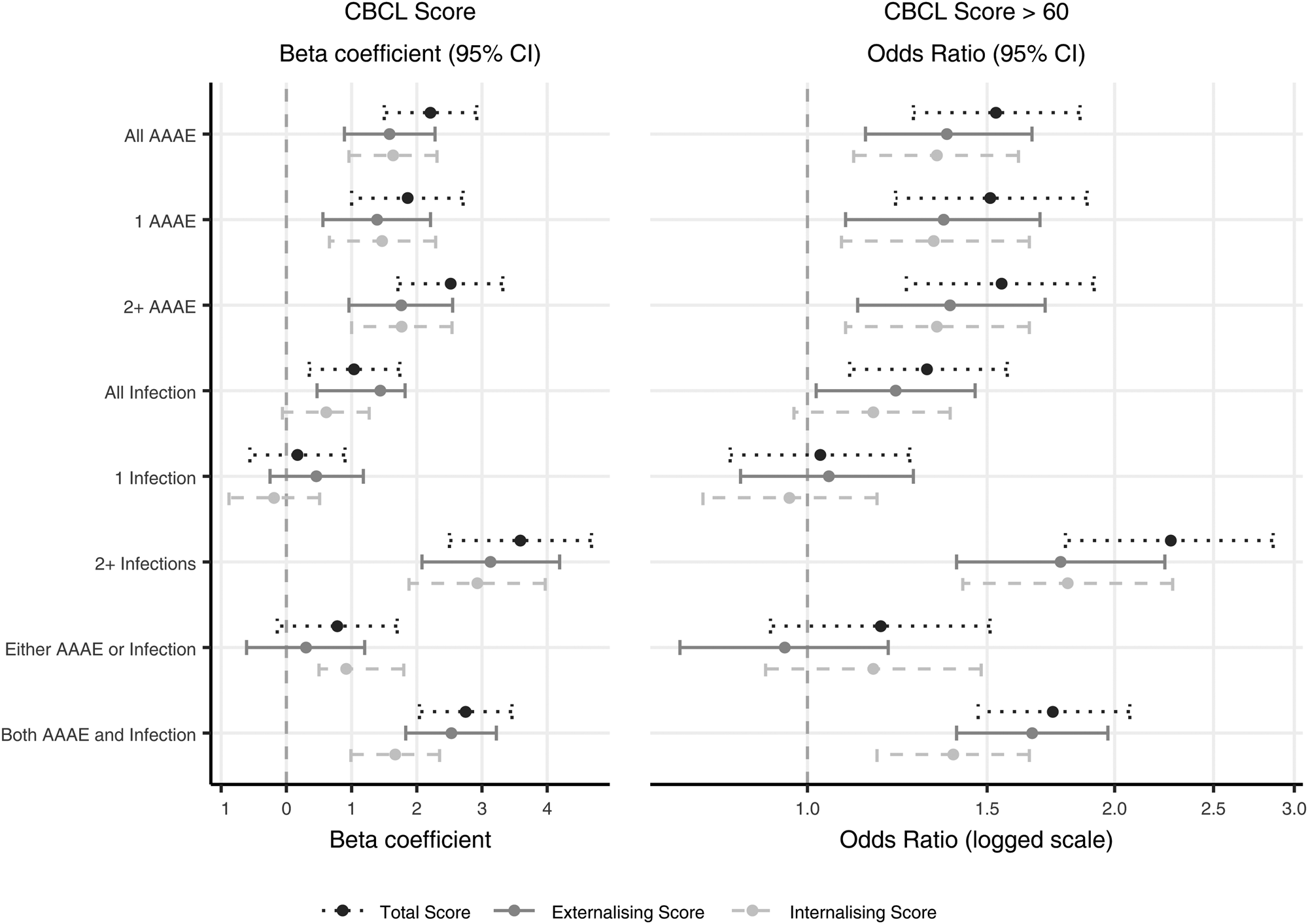
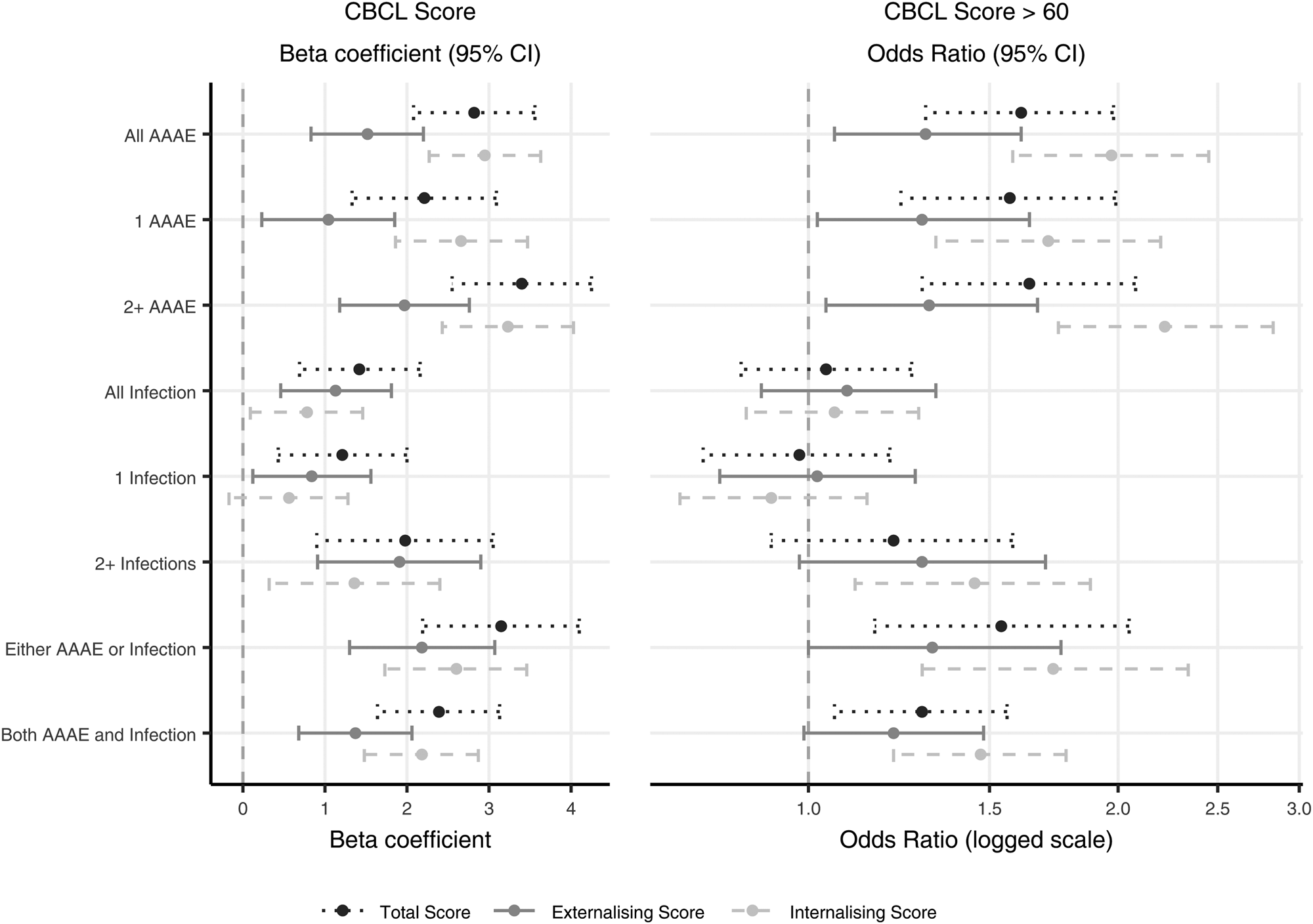
Regarding the effect of offspring sex on CBCL outcomes, two of the six models that were run with an interaction term between the MIA variables and offspring sex indicated a significant interaction effect; ‘infection count’ (number of infections; p = 0.002) and ‘either AAAE or infection’ (p < 0.001). To understand this, sex-stratified analyses are presented for all MIA variables in Fig. 2 (males, online Supplementary Table S6) and Fig. 3 (females, online Supplementary Table S7). As can be seen, the MIA variables had similar effects on all scales of the CBCL in males. However, in females, the MIA variables were associated with greater increases in scores on the Internalizing scale compared to the Externalizing scale. Specifically, for the two MIA variables where the sex interaction was significant, exposure to two or more maternal infections was associated with greater increases in CBCL scores in females. In contrast, overall exposure to either AAAE or infection conditions (one or more conditions) had a greater effect on CBCL scores in females, compared to males.
Generalized estimating equation models showing relationships between MIA variables and offspring CBCL scores and morbidity in males. β Coefficients and odds ratios are shown with 95% confidence intervals. AAAE, Asthma/Allergy/Atopy/Eczema; CBCL, Child Behavior Checklist; CI, confidence interval.

Generalized estimating equation models showing relationships between MIA variables and offspring CBCL scores and morbidity in females. β Coefficients and odds ratios are shown with 95% confidence intervals. AAAE, Asthma/Allergy/Atopy/Eczema; CBCL, Child Behavior Checklist; CI, confidence interval.

Due to the relatively smaller size of the comparison group, a sensitivity analysis, with a maternal age and offspring sex-matched design, was conducted (N = 301 with either AAAE or infection group and N = 301 from the comparison group). This analysis produced results that were identical in direction and broadly similar in magnitude with some results becoming non-significant, likely due to the reduction in power from the reduced cohort size (online Supplementary Table S8).
Discussion
This is the first longitudinal cohort study to investigate whether MIA is associated with increased behavioral and emotional problems in offspring throughout childhood and adolescence. Results showed that mean CBCL scores and percentage of morbidity were higher in the AAAE and infection groups than the comparison group, across the Total, Externalizing, and Internalizing CBCL scales. These effects were present at all assessed time points, throughout childhood and adolescence, suggesting that MIA is associated with a small but persistent adverse influence on early neuropsychiatric development. Each subtype of AAAE and infection was associated with increased Total CBCL scores and/or morbidity. Exploratory analysis suggested some variation in the magnitude of the association between individual conditions. When combined, all AAAE conditions and all infection conditions were both associated with increased CBCL scores and morbidity. Both males and females, when examined separately, also showed associations of MIA ad heightened CBCL scores. While males showed this association of MIA on both internalizing and externalizing symptoms, the effect was more pronounced for females on internalizing symptoms.
The observed effects were greater when mothers had more than one AAAE or infection condition and the effects were also more pronounced for those who reported both AAAE and infection. These effects were found in the combined analysis, as well as separately in both males and females. These results are the first we are aware to report a possible cumulative impact of MIA on neuropsychiatric development, which adds some additional support to the multi-hit hypothesis of MIA. Findings are consistent with our previous research showing that maternal asthma and allergies were associated with increased severity of social impairments in children with ASD (Patel et al., Reference Patel, Masi, Dale, Whitehouse, Pokorski, Alvares and Guastella2018). Similarly, infections during pregnancy have also previously been linked with an increased risk of ASD (Jiang et al., Reference Jiang, Xu, Shao, Xia, Yu, Ling and Ruan2016), schizophrenia (Khandaker et al., Reference Khandaker, Zimbron, Lewis and Jones2013), and other mental disorders (Lydholm et al., Reference Lydholm, Kohler-Forsberg, Nordentoft, Yolken, Mortensen, Petersen and Benros2019). The effect on CBCL scores and risk of morbidity varied between specific conditions and combination categories; notably, exposure to more than one MIA condition was associated with a greater elevation in CBCL scores than exposure to single MIA conditions. The increased vulnerability of females to internalizing behavior is well-documented in the literature (Bask, Reference Bask2015; Leadbeater, Kuperminc, Blatt, & Hertzog, Reference Leadbeater, Kuperminc, Blatt and Hertzog1999). These findings add to an existing body of work showing that offspring sex may be one factor that influences behavioral outcomes in response to MIA (Braun et al., Reference Braun, Carpentier, Babineau, Narayan, Kielhold, Moon and Palmer2019; Mac Giollabhui et al., Reference Mac Giollabhui, Breen, Murphy, Maxwell, Cohn, Krigbaum and Ellman2019; Rana, Aavani, & Pittman, Reference Rana, Aavani and Pittman2012). Overall, effect sizes from MIA across the Total, Internalizing, and Externalizing scales were largely similar, confirming our view that MIA is unlikely to be associated with a specific class of neurodevelopmental or mental health syndromes across populations; but rather, with wide-ranging behavioral and emotional outcomes.
Multiple overlapping mechanisms are likely involved in increasing the developmental risk of MIA. A multi-hit process is likely to place the fetus at greater risk of adverse outcomes, where existing genetic vulnerabilities, or compound exposures to MIA, lead to a greater risk of adverse neurodevelopmental and neuropsychiatric outcomes (Brown & Meyer, Reference Brown and Meyer2018). We propose that MIA confers broad risk for neurodevelopmental and neuropsychiatric outcomes in offspring, rather than specific syndromes, and this is at least partially moderated by the type and degree of MIA. The mechanisms underlying this relationship are likely to be multifaceted, involving different systems and pathways. Immune molecules, such as cytokines, chemokines, and antibodies, which are activated as a result of MIA, have long been thought to interfere with fetal development (Parker-Athill & Tan, Reference Parker-Athill and Tan2010). More recently, studies have shown that complex interplay between the gut, brain, and immune system plays an important role in neurodevelopment and mental health (Malan-Muller et al., Reference Malan-Muller, Valles-Colomer, Raes, Lowry, Seedat and Hemmings2018), highlighting the gut microbiome as a potential diagnostic and treatment target (Schnorr & Bachner, Reference Schnorr and Bachner2016). There is increasing evidence of bidirectional communication between the peripheral immune system and the central nervous system, where microglia have been suggested as mediators of MIA (Prins, Eskandar, Eggen, & Scherjon, Reference Prins, Eskandar, Eggen and Scherjon2018). Microglia are involved in the many aspects of neurodevelopment, including neuronal growth, migration, and survival, as well as synaptic pruning, function, and maturation (Mosser, Baptista, Arnoux, & Audinat, Reference Mosser, Baptista, Arnoux and Audinat2017). Abnormalities in microglia phenotype have been associated with MIA and may play an important role in neurodevelopmental and neuropsychiatric pathologies (Prins et al., Reference Prins, Eskandar, Eggen and Scherjon2018). Epigenetic modulation of genetic risk factors and interactions with the environment has also been implicated in MIA-related abnormalities (Basil et al., Reference Basil, Li, Dempster, Mill, Sham, Wong and McAlonan2014; Lombardo et al., Reference Lombardo, Moon, Su, Palmer, Courchesne and Pramparo2018).
Limitations
The prospective study design, spanning two decades, and a large community sample were clear strengths of the current study, providing adequate statistical power to investigate the relationship between maternal immune history and CBCL outcomes in offspring. Like most longitudinal studies, the Raine cohort has experienced an expected degree of sample attrition over time. However, the current findings were broadly consistent across the five different follow-up ages. The data in this cohort were largely collected prospectively; however, for this study, we included reports of allergies, hay fever, and eczema collected at 5 years post-pregnancy. This group included mothers who reported these conditions before, during, or up to 5 years post-pregnancy. Given the chronic nature of these conditions, we suspect that underlying immune aberrations would likely have been present in the mother during pregnancy (Abrahamsson, Sandberg Abelius, Forsberg, Bjorksten, & Jenmalm, Reference Abrahamsson, Sandberg Abelius, Forsberg, Bjorksten and Jenmalm2011; Darlenski, Kazandjieva, Hristakieva, & Fluhr, Reference Darlenski, Kazandjieva, Hristakieva and Fluhr2014; Vandenbulcke, Bachert, Van Cauwenberge, & Claeys, Reference Vandenbulcke, Bachert, Van Cauwenberge and Claeys2006). However, even when we examined the effect of asthma reports alone, collected at the time of pregnancy, the results of increased CBCL results remained significant across all time points (online Supplementary Table S3).
Data regarding infections were captured at 18 weeks gestation, meaning that our infection risk factor represents MIA during early gestation, a period during which MIA and stress have been linked to neuropsychiatric outcomes (Guo, He, Song, & Zheng, Reference Guo, He, Song and Zheng2019; Meyer, Nyffeler, Yee, Knuesel, & Feldon, Reference Meyer, Nyffeler, Yee, Knuesel and Feldon2008). Maternal autoimmunity, which has been shown as an important factor in neurodevelopment (Chen et al., Reference Chen, Zhong, Jiang, Zheng, Xiong, Ma and Chen2016; Jones et al., Reference Jones, Ho, Sharma, Mohammad, Kothur, Patel and Group2019; Scott et al., Reference Scott, Shi, Andriashek, Clark and Goez2017), was not investigated in this study and warrants examination in future studies. The type and timing of MIA during pregnancy has been noted as an important factor which might exert differential effects on neurodevelopment and requires further investigation in humans (Mac Giollabhui et al., Reference Mac Giollabhui, Breen, Murphy, Maxwell, Cohn, Krigbaum and Ellman2019; Meyer et al., Reference Meyer, Nyffeler, Engler, Urwyler, Schedlowski, Knuesel and Feldon2006; Rahman et al., Reference Rahman, Zavitsanou, Purves-Tyson, Harms, Meehan, Schall and Weickert2017).
We also note that variation can occur between parent-reported and self-reported ratings of behavioral and emotional problems, especially in adolescence (Rescorla et al., Reference Rescorla, Ginzburg, Achenbach, Ivanova, Almqvist, Begovac and Verhulst2013). Asthma and allergic conditions have been linked to depression (Opolski & Wilson, Reference Opolski and Wilson2005; Timonen et al., Reference Timonen, Jokelainen, Hakko, Silvennoinen-Kassinen, Meyer-Rochow, Herva and Rasanen2003); therefore, it is possible that mothers in the AAAE group may be more likely to experience internalizing symptoms themselves, and project these onto their offspring when reporting on the CBCL (Berg-Nielsen, Vika, & Dahl, Reference Berg-Nielsen, Vika and Dahl2003). This could explain the higher scores observed in this group overall on the Internalizing scale compared to the Externalizing scale. However, this effect may also have been driven by the increased Internalizing scores in females.
There are other possible confounders, such as mental health of mothers, recall bias in self-report of immune conditions, and use of medications during pregnancy, which could influence offspring outcomes and should be investigated in future studies. Diagnoses of conditions in children (such as ASD) were also not included; however, this study aimed to evaluate multi-dimensional neuropsychiatric symptoms, which we believe is a more powerful approach to study the interaction between child development and risk.
Future directions and conclusions
We report on an association between self-reported MIA and neuropsychiatric symptoms in children later in life. Studies evaluating the causal influences of MIA on neurodevelopment would be ethically challenging to conduct in humans. As a result, we cannot be certain that MIA causes observed elevations in symptoms for children, or whether other heritable and/or environmental features shared between mother and child contribute to this association. Future studies, utilizing novel study designs, are needed to further investigate the hypothesis that genetic factors likely interact with MIA to increase the risk for specific syndromes and symptom profiles (Crespi & Thiselton, Reference Crespi and Thiselton2011). For example, Thapar et al. investigated the relationship between prenatal smoking and attention-deficit/hyperactivity disorder in children who were conceived using Assisted Reproductive Technologies, enabling separation of environmental and inherited factors (Thapar et al., Reference Thapar, Rice, Hay, Boivin, Langley, van den Bree and Harold2009). There is a great need for future research utilizing strong predictive risk factors, such as MIA, to identify high-risk cohorts and detect important biomarkers in pregnancy. Sophisticated study designs with comprehensive biological marker analysis will shed further light on the role of MIA in child development. Alternative designs using preventative health interventions to reduce the risk of immune conditions during pregnancy, such as adequate medication for chronic conditions, increasing vaccination rates, and hygiene practices, may all be used to better understand the link between neurodevelopment and MIA.
In summary, we present the first longitudinal study to show an association between MIA and increased behavioral and emotional problems in children throughout childhood and adolescence. This study strengthens the hypothesis that immune system perturbations are highly relevant to prenatal programming and may cumulatively confer risk to the mental and developmental well-being of children.
Supplementary material
The supplementary material for this article can be found at https://doi.org/10.1017/S0033291720001580
Acknowledgements
We would like to acknowledge the Raine Study participants and their families for their ongoing participation in the study, and the Raine Study Team for study coordination and data collection.
Financial support
The core management of the Raine Study is funded by the University of Western Australia (UWA), Curtin University, Telethon Kids Institute, the Women and Infants Research Foundation, Edith Cowan University, Murdoch University, the University of Notre Dame Australia, and the Raine Medical Research Foundation. The data collection at 5-, 8-, and 10-year follow-up was supported by the National Health and Medical Research Council of Australia (NHMRC) and the Raine Medical Research Foundation. We also acknowledge funding from NHMRC grants for the collection of 14-year (Sly et al., ID 211912; Stanley et al., ID 003209) and 17-year (Stanley et al., ID 353514) follow-up data. The Raine Study has long-term support from the NHMRC. We also acknowledge Project Grants (1043664 and 1125449) to Adam J. Guastella. Funding sources did not have any role in analysis and interpretation of data; writing of the report; and the decision to submit the article for publication.
Conflict of interest
Patel, Dr Cooper, Dr Jones, Professor Whitehouse, Professor Dale, and Professor Guastella report no biomedical financial interests or potential conflicts of interest.
Ethical standards
The authors assert that all procedures contributing to this work comply with the ethical standards of the relevant national and institutional committees on human experimentation and with the Helsinki Declaration of 1975, as revised in 2008.