Introduction
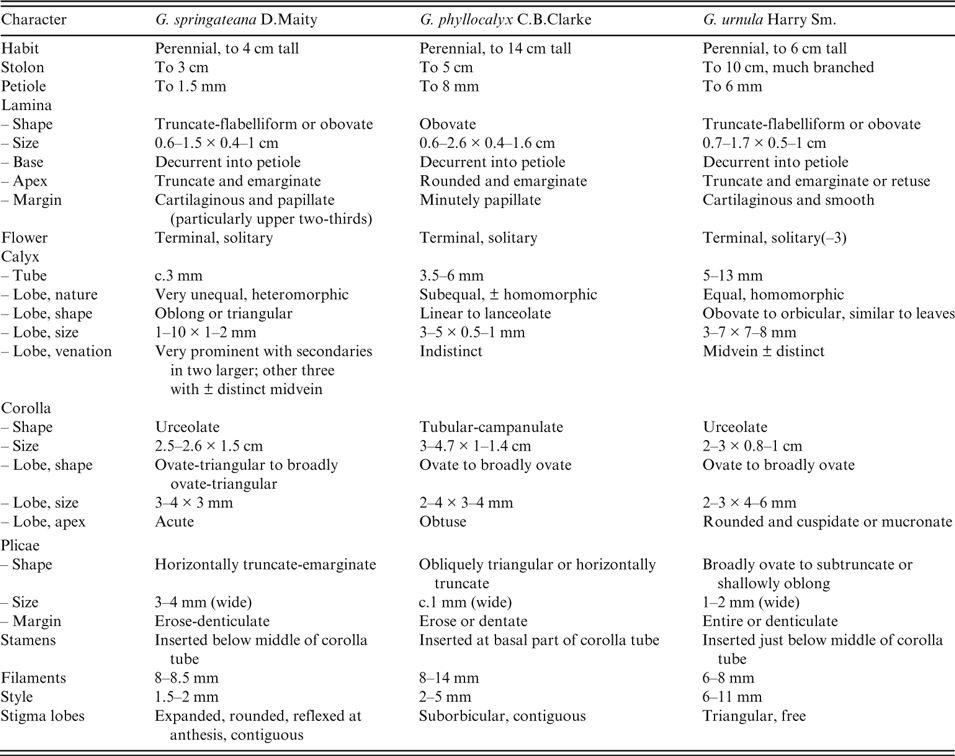
The genus Gentiana L. (Gentianaceae) comprises about 360 species and is widely distributed in the temperate and alpine regions of Northwest Africa (Morocco), America, Asia, Eastern Australia and Europe (Ho & Pringle, Reference Ho, Pringle, Wu and Raven1995; Mabberley, Reference Mabberley2008). In India there are about 62 species (Garg, Reference Garg1987), most of them distributed in the Himalaya. During an expedition to the Zemu and Lhonak valley in the Sikkim Himalaya, a few specimens of an attractive Gentiana were collected. Detailed literature studies (Clarke, Reference Clarke and Hooker1883; Garg, Reference Garg1987; Ubolcholaket, Reference Ubolcholaket1987; Ho & Pringle, Reference Ho, Pringle, Wu and Raven1995; Aitken, Reference Aitken and Long1999; Ho & Liu, Reference Ho and Liu2001; Hul, 2003), critical analysis of specimens and comparisons of almost all Gentiana species of the Himalaya (India, Nepal, Bhutan, Tibet) revealed this to be a new species, belonging in Gentiana section Phyllocalyx (Kusn.) T.N.Ho. It is related to Gentiana phyllocalyx C.B.Clarke, though it differs remarkably by its heteromorphic, oblong or triangular calyx lobes, short calyx tube, wider plicae and urceolate corolla. A detailed description, illustration and images of the new species are provided to facilitate its identity. A comparison of this new taxon with Gentiana phyllocalyx and G. urnula of section Frigida Kusn. is also provided (Table 1).
Comparison of morphological features of Gentiana springateana D.Maity, G. phyllocalyx C.B.Clarke and G. urnula Harry Sm.

Species Description
Gentiana springateana D.Maity, sp. nov. Sect. Phyllocalyx (Kusn.) T.N.Ho
Closely related to Gentiana phyllocalyx C.B.Clarke but calyx lobes very unequal, heteromorphic; larger two with leaf-like prominent venation; short calyx tube; urceolate corolla; wider plicae; short filaments and short style. – Type: Sikkim, between Kalapathar and Muguthang, 4500–4800 m, 13 vii 2013, Maity 20362 (holo CUH; iso CAL). Figs 1,2.
Gentiana springateana D.Maity. A, habitat; B, part of type population with one mature plant and three young (marked with arrows). (See online for a colour version of this figure.)
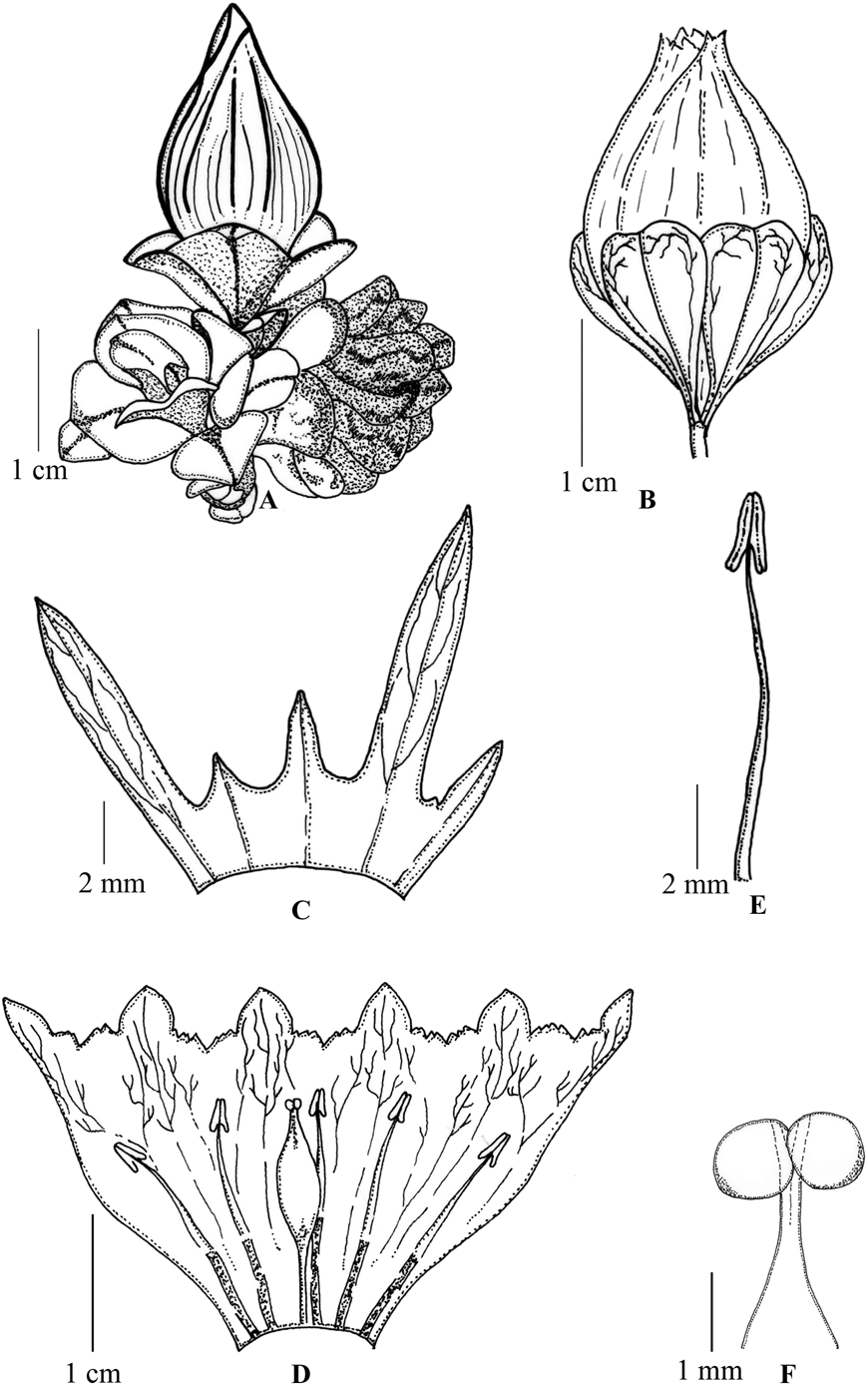
Gentiana springateana D.Maity. A, habit; B, flower (note base completely enveloped by upper two pairs of leaves); C, calyx split open (ventral face); D, corolla split open showing stamens and gynoecium (ventral face); E, stamen (note basifixed anther); F, style and stigma (note reflexed stigma at anthesis). Drawn from the holotype, Maity 20362 (CUH).
Perennial, glabrous herb, 3–4 cm tall (including flower) with sympodial growth; tap root weak, short. Leaves crowded at base, subsessile; stem leaves 1 pair; leaf blade truncate-flabelliform to obovate, 0.6–1.5 × 0.4–1 cm, base cuneate, decurrent into petiole, apex truncate-emarginate, margin cartilaginous, papillate (particularly apical two-thirds), midvein purplish, cartilaginous with prominent secondary on both sides (visible when dry); petiole to 1.5 mm long. Flower solitary, terminal. Calyx membranous, completely enveloped by upper two pairs of truncate-flabelliform to broad obovate leaves; tube short, c.3 mm long, narrowly campanulate; lobes oblong or triangular, 1–10 mm, very unequal; smaller one triangular, c.1 × 1 mm, apex acute; medium two ovate-triangular, c.3 × 1 mm, apex acute; larger two oblong, 8.5–10 × 1.5–2 mm, apex acute, margin entire; venation prominent with distinct secondaries. Corolla bright blue, urceolate, 2.5–2.6 × 1.5 cm; lobes ovate-triangular to broadly ovate-triangular, 3–4 × 3 mm, margin entire, apex acute; plicae horizontally truncate-emarginate, 3–4 mm wide, margin erose-denticulate. Stamens inserted at c.8 mm above base of corolla tube (below middle of corolla tube); filaments 8–8.5 mm, slightly expanded towards base; anthers ± sagittate, c.2 mm long, dorsifixed; gynophore slender, to 5 mm long. Ovary ellipsoid-ovoid, c.10 × 3 mm; style 1.5–2 mm; stigma lobes expanded, rounded, reflexed at anthesis, c.1 × 1 mm, contiguous.
Distribution. Endemic in the type locality, Sikkim.
Habitat. Plants growing on moss-covered rocks and loose soil in open alpine forests. As well as the specimens collected, several individuals along with young plants and seedlings were observed.
Flowering. June–July.
IUCN Red List Category. The type specimen was collected from a population of some 15 adult plants which covered an area of less than 1 sq. km. Juvenile plants or seedlings were also found. After a detailed search of the area around the type locality two populations were discovered. Given this situation, I consider the IUCN category of Critically Endangered (CR D) to be appropriate (IUCN, 2001).
Etymology. The specific epithet honours Lawrie S. Springate, 1951–2011, a renowned taxonomist and expert of eastern Himalayan plants, and my mentor, from whom I received most generous help as student and collaborator.
Paratype. Sikkim, below Lhunak La, 4800 m, 13 vii 2013, D. Maity 20366 (CUH).
Discussion
The presumed closest relative of the new species is Gentiana phyllocalyx. These two species share several morphological characters, viz. truncate-flabelliform or obovate leaves, the calyx completely enveloped by the upper pairs of leaves and expanded rounded or orbicular stigma, but Gentiana springateana differs greatly from G. phyllocalyx in its clearly heteromorphic calyx lobes, short calyx tube, urceolate corolla, wider plicae, short filament and style. Presently, the genus Gentiana L. is divided into several sections. Gentiana section Phyllocalyx (Kusn.) T.N.Ho is characterised by perennial habit; calyx being completely surrounded by the upper pair of broad obovate (truncate-flabelliform) leaves and expanded, contiguous (before anthesis) stigma lobes (Ho & Pringle, Reference Ho, Pringle, Wu and Raven1995; Ho & Liu, Reference Ho and Liu2001). The diagnostic features of the new species strongly support its inclusion within section Phyllocalyx.
Gentiana springateana is also related to G. urnula of G. section Frigida Kusn. by the shape of its leaves and urceolate corolla. However, the nature of the calyx, much shorter style and expanded stigma readily differentiate the new taxon from Gentiana urnula (see Table 1). There is no doubt that this new species is rare and locally endemic, and further botanical exploration of its distribution, habitat and ecology is highly recommended.
Acknowledgements
I am grateful to the Science & Engineering Research Board (SERB), Government of India, New Delhi for financial assistance to carry out the research programme and to the Department of Forests, Environment and Wildlife Management, Govt. of Sikkim, Home Department, Govt. of Sikkim, Superintendent of Police, Gangtok and 17th Mtn. Division, Indian Army for giving the necessary permission and support for my field visit. Prof. K. N. Gandhi, Harvard University and Prof. A. N. Sennikov, University of Helsinki are warmly thanked for their valuable suggestions. I am also grateful to Prof. G. G. Maiti, Prof. S. C. Santra, Dr A. Samal, Mr S. S. Rathore, Mr S. Das and S. Mitra for their help in the field and laboratory. The author appreciates the corrections and suggestions of the referees and Dr Mark Newman, Editor, who contributed greatly to the improvement of this manuscript.