The most enduring questions in international politics concern the origins of war and peace. Why do wars start, and once they have begun, when and why do they end? When do leaders make concessions to escape the fighting, and when do they stand firm? What happens when leaders, motivated perhaps by parochial interests, refuse to negotiate despite battlefield defeats?
The most prominent theoretical approach to answering these questions comes from the bargaining model of war, and within the bargaining model of war particular focus has been placed on the role of private information and divergent expectations about the consequences of fighting.Footnote 1 The difficulty of directly measuring information and beliefs has posed an obstacle to convincing tests of the informational mechanism, while in the absence of such tests theorists have developed a range of mutually incompatible predictions drawn from the same fundamental insights. In short, despite a general belief that information and beliefs play an important role in the onset and course of wars, much remains unsettled about the nature of the relationship.
This article advances the study of the informational mechanism in two ways. First, I unpack the logic of the informational explanation for war. Under the informational mechanism, war occurs when actors with serious political differences disagree about the likely consequences of war, and continues until revised expectations in response to wartime events bring the two sides’ demands into alignment. I identify three distinct perspectives that agree that war is driven by private information but disagree about how combatants respond to new information and hence under what conditions war is likely to end. I ultimately argue that settlement will be more likely when there has been extensive fighting to reveal information and following major shifts in battlefield success, but that recent spikes in war intensity will not have an independent effect on the probability of war termination. Moreover, building on work that demonstrates a connection between leadership turnover and decisions to end or continue an ongoing war, I argue that, especially in less democratic countries where leaders are less directly accountable to the public, replacing the existing leader may be part of the process by which lessons from the battlefield are translated into policy change.
Second, I introduce a novel data set of monthly battle deaths that allows for a more convincing test of these predictions. Tests of predictions about the process by which actors transition from war to peace have been hampered by the absence of good information about what is happening within wars, in particular on the battlefield. These data allow me to capture shifts over time in the intensity of fighting, as well as variation in war participants’ battlefield success. I thus am able to conduct more convincing tests of established but unverified hypotheses, while also testing more novel predictions.
Empirical analyses find robust support for the prediction that information revelation through battle sets the stage for war termination. I also show that leadership turnover is connected to settlement, and that turnover to nonculpable leaders, who are more willing to make the concessions necessary to bring war to a close, is particularly likely when war begins to go poorly. That this relationship holds in particular for nondemocracies, in which institutional constraints on the executive create more room for policy diversion, suggests that there are established means by which states ensure that leaders do not continue wars that society would prefer to end.
Information, Domestic Politics, and War
The informational perspective on war has deep roots in the international relations literature. Building on prior neorealist theories about the sources of international conflict, Fearon identified a set of mechanisms that could produce war between two rational actors who suffer (and hence prefer to avoid) the costs of fighting.Footnote 2 Although various scholars have proposed a range of different rationalist explanations for war, particular focus has been paid to the role of private information.Footnote 3 This logic has been used to examine questions about the origins, outcome, termination, and even recurrence of war.Footnote 4
Yet direct tests of the informational mechanism are notoriously difficult. The standard theoretical story—for example, that Iraq's Saddam Hussein invaded Kuwait because he believed that the United States lacked the resolve to reverse the conquest militarily—concerns beliefs about intentions, resolve, or capabilities, where both the initiator's beliefs and the target's resolve or intentions are almost impossible to measure systematically. As a result, the most convincing evidence for the informational mechanism comes from historical cases.Footnote 5 Statistical approaches have relied on indirect proxies, most commonly similar capability levels, that are plausible but open to multiple interpretations.Footnote 6 Indeed, because leaders should also recognize the logic of the informational mechanism, there is a strong theoretical reason to expect that it will be difficult to systemically identify situations in which private information is likely to lead to war.Footnote 7
An alternate approach, which I follow in this article, is to examine war duration and termination. In the informational mechanism, war occurs because leaders on the two sides disagree about how the conflict is likely to go, each believing that its side is stronger, more resolved, more likely to receive outside assistance, or otherwise better prepared for the war. Once fighting begins, the two sides’ conflicting expectations are put to the test, and given existing disagreements it is logically impossible for both to be borne out. Battles are particularly informative in this regard. If both sides expect to win a battle, then at least one must be surprised. If leaders expect their opponents to capitulate after a round of fighting, or a great power ally to bail them out if they get in trouble, then those expectations will be tested only once battles occur. As fighting reveals information, the two sides expectations converge; as expectations converge, so do political demands, until at last a settlement emerges that both sides prefer to continued fighting.Footnote 8 If the two sides in a dispute both expect to benefit from fighting, at least relative to what their opponent is willing to concede at the bargaining table, then the occurrence of fighting is necessary for expectations to change. Moreover, more intense and extended fighting, which reveals more about the opponent's resolve while also providing a better indication of the likely outcome of additional battles, should be more informative, and hence should be more likely to produce settlement.
Important questions remain, however, about both the validity of this standard story and the plausibility of various ancillary predictions about how actors respond to new information in war. Smith and Stam present a model with noncommon priors in which convergence can happen slowly if at all. Alternately, Fey argues that in some cases the existence of battlefield signals may actually decrease the probability of settlement.Footnote 9 Separately, papers by Fearon and by Langlois and Langlois demonstrate that changes to key assumptions about the credibility of war-ending settlements or the nature of private information can result in the standard convergence process being replaced by a war of attrition.Footnote 10
A similar disjuncture concerns the implications of the informational mechanism for war duration, with some authors contending that wars arising out of private information will tend to be short, whereas others argue that informational conflicts can easily be quite extended.Footnote 11 At the same time, direct tests of the informational mechanism in war duration and termination are limited and inconclusive. Although Blainey provides anecdotal evidence in favor of the hypothesis, Reiter finds that, at least for the sample of highly destructive wars that he analyzes, leaders frequently did not adjust their war aims in response to negative developments.Footnote 12 In an analysis of fifteen twentieth-century wars for which battle data were available, Ramsay found little evidence that informative battles hastened settlement.Footnote 13 Weisiger finds a contingent relationship between war intensity and the speed of settlement across a wider range of wars, but with a quite blunt measure of war intensity.Footnote 14 There is thus room for both greater clarity on the logic of the informational mechanism and better empirical tests.
Ultimately, I identify three different perspectives on the informational mechanism. In all three perspectives war occurs because private information leaves leaders unwilling to accede to opponents’ demands, and it ends when new information forces leaders to revise expectations, and hence war aims, into sufficient accordance to permit the identification of a mutually agreeable settlement. The three perspectives differ, however, in the relative importance of specific events within the war, and hence make competing predictions about the conditions under which opponents are likely to reach an agreement to end the war. The three perspectives ultimately differ with respect to their predictions across the following three hypotheses:
H1
Settlement will occur more quickly when the overall level of fighting in a war is relatively intense.
H2
Settlement will occur more quickly when recent fighting was unusually intense.
H3
Settlement will occur more quickly following substantial shifts in battlefield success.
The informational obsolescence perspective complicates the standard picture by noting that just as wartime events reveal previously hidden private information, efforts of the war participants to achieve strategic, technological, or diplomatic breakthroughs can generate new private information that can easily extend war.Footnote 15 The strategic innovations that led to the emergence of the modern system in World War I, the technological breakthroughs by both German and American scientists during World War II, and the sustained Japanese effort to recruit Soviet mediation in 1945 all provide examples of cases in which new and relevant information left past lessons open to question.Footnote 16 If new information renders past lessons obsolete, however, then the observation that participants have had many opportunities to learn will not guarantee that they will likely be open to settlement. Instead, learning will be pitted against the development of new information, with war ending only when enough information has emerged to counteract both the initial divergence in expectations and whatever new information has complicated the question since war began. From this perspective, intense recent fighting should be particularly predictive of war termination, as participants receive extensive information about the current state of affairs, whereas more temporally distant battles will play at best a limited role.
An outcome irrelevance perspective focuses on the implications of surprising battlefield developments. Wittman argues that major victories for one side will not necessarily facilitate war termination because the victor may raise war aims to a degree that offsets the loser's increased openness to concessions.Footnote 17 The increased confidence with which American leaders pushed for reunification of the Korean peninsula after victory at Inchon, in contrast to the early aim of simply preserving South Korean independence, provides the best-known example for this argument.Footnote 18 From this perspective, major battlefield victories would determine the content of peace agreements but not their timing, which would depend instead on the total amount of information revealed through past fighting.
I argue in contrast for a third perspective that takes issue with key elements of each previous argument. The informational obsolescence argument is correct that new private information is generated in war, but incorrect about the implications of this fact. For past learning to become irrelevant, new information would need to be both highly salient—having a significant impact on the outcome of the war should fighting continue—and, more critically, biased toward optimism. New high-salience private information is relatively rare—technological innovations along the lines of the tank or the atom bomb arise infrequently, and even major new developments are likely to be the basis for less variation in expectations than are pre-war questions such as whether the opponent will be willing to fight at all. The bigger problem, however, is that for new information to render past lessons irrelevant and thereby encourage continued fighting, it would have to be consistently positive to an implausible degree. If new private information is bad, as with internal military dissension in several powers in World War I, then it will amplify the effects of past lessons, providing incentive to settle before the enemy learns of one's unexpected weakness. From this perspective, I expect the sum of past information to be a good predictor of war termination, but once this information is taken into account I do not expect recent spikes in violence to further increase the probability of settlement.
By contrast, I expect that shifts in battlefield outcome will increase the probability of war termination as losers make concessions to escape the war. Leaders’ theories of victory frequently hinge on the expectation that a combination of factors will result in an eventual favorable shift in battlefield outcomes. As long as fighting is stalemated, both sides can retain expectations that future developments will shift the war in their favor, and hence will be less likely to make major concessions, even as they learn that the opponent is relatively resolved. A substantial worsening in battlefield outcomes strongly suggests that expectations of future improvements are unwarranted, however, and thus forces a more substantial revision in expectations for the loser. The outcome irrelevance perspective is, of course, correct that the winner can increase its demands to offset the loser's concessions, but such revisions should take place only when the victory is unexpected. Because the winner's initial war aims reflect the expectation of eventual success in fighting, success on the battlefield should be unsurprising. As a result, major shifts in battlefield success should induce the loser to make concessions that increase the probability of war termination on the winner's terms.
Table 1 summarizes the predictions of each perspective on the informational mechanism with respect to each of these three hypotheses.Footnote 19
Predictions from the different perspectives on the informational mechanism

The Intersection of Information and Domestic Politics
As typically articulated, the informational mechanism rests on the assumption that policy is set by actors (leaders) who aim to advance the interests of the nation, taking into account the limited information about what optimal policy choices may be. Studies focused on domestic politics have argued, however, that leaders may fail to achieve this standard, whether because they redirect policy to serve personal ends or because they simply fail to recognize what the optimal policy might be.Footnote 20 Thus, for example, Goemans argues that leaders of partial democracies, such as Germany in World War I, risk both loss of power and personal punishment should they settle a war on losing terms, and hence that they will prefer a gamble for resurrection to admitting defeat.Footnote 21 More broadly, Stanley argues that leaders may resist settlement to protect parochial interests, but also because psychological or organizational biases may prevent them from recognizing that settlement on the opponent's terms is appropriate.Footnote 22 She thus predicts and finds that shifts in the ruling coalition, which bring in actors with both differing interests and differing perspectives, will increase the probability of war termination. Croco similarly argues that if war goes poorly constituents punish leaders who either started a war or are allied to the initiating leader, but do not punish new leaders without clear ties to the initiator; as such, new nonculpable leaders can safely settle on terms the initiators would have rejected.Footnote 23 Both of these arguments predict that war termination is more likely when new leaders without ties to the war initiators take power.
H4
Leadership turnover will be associated with quicker settlement and with greater willingness to make concessions to exit losing wars, especially when the new leader is not viewed as responsible for the decision to fight the war.
This prediction, although plausible, remains to be systematically tested. Croco demonstrates that culpable leaders tend to achieve war outcomes that are better on average but that also exhibit higher variance, and that culpable leaders are likely to be punished for losing wars, whereas nonculpable leaders are not; her empirical analysis, however, does not explore war duration and termination. Stanley directly examines war duration, but a limited universe of cases—a consequence of focusing for data reasons on the post-1945 period—forces her to omit important covariates, and regressions that examine a broader list of interstate wars adopt the empirically questionable approach of coding leadership turnover only following the final change in leadership during a war. It is thus worth establishing that H4 holds in a broader set of cases.
Moreover, empirical support for H4 could arise from one of at least two separate theoretical logics. Under a principal-agent logic, leaders cynically divert policy to serve personal ends, for example, responding to worsening battlefield conditions by gambling for resurrection rather that making concessions to end the war because they anticipate losing power, freedom, or their lives if they accept defeat. If society is unable to constrain these leaders, then war will continue until either the gamble for resurrection plays out or the leaders lose office for unrelated reasons.
That said, H4 also follows logically from the informational mechanism under reasonable assumptions about the logic of domestic politics. Work on leaders convincingly demonstrates that they differ in their interpretations of optimal policy under similar circumstances.Footnote 24 Moreover, Stanley argues that limits on leader rationality may result in failure to respond appropriately to new information.Footnote 25 In this context, leaders may deviate from socially optimal policy not because they are pursuing personal interests but because their understanding of optimal policy is misguided. As a result, the revision in government beliefs and hence policy may occur either through the leader's own changing beliefs or through constraints placed on the leader by the rest of society, in the extreme through the leader's removal. Indeed, even if leaders would prefer to gamble for resurrection, if they anticipate or experience removal from office for not settling when war goes poorly, then policy will ultimately conform relatively closely to the logic of the informational mechanism.Footnote 26 Examples of leaders being removed in response to apparent defeat are readily available. In the Second Schleswig-Holstein War, the Danish king responded to unexpected defeats and the failure of a final appeal to Britain by replacing the government in anticipation of an armistice.Footnote 27 Similarly, the reluctance of the existing regime in Germany to acknowledge defeat in World War I led the government to abdicate when defeat seemed inevitable, ceding power to a civilian government that agreed to an armistice. In sum, leadership turnover could produce settlement either because the new leader lacks the incentive to gamble for resurrection or because the new leader was selected based on the recognition (on the basis of wartime events) that it was time to pursue peace.
Distinguishing between these two perspectives is not straightforward. That said, a key distinction concerns the circumstances under which leaders are replaced, especially by successors who are more likely to settle. If principal-agent dynamics are primarily responsible for the elongation of wars before leadership turnover, then turnover to new leaders, especially leaders who are amenable to settlement, should be uncorrelated with battlefield dynamics. By contrast, if leadership turnover is part of the process by which the informational mechanism unfolds, then we should expect downturns in battlefield success to predict transitions to leaders who are more open to settlement. Indeed, the logic of this argument can be taken one step further. Replacing leaders is only the most extreme means by which society can ensure that the leader does not pursue undesirable policies; in governments with thick institutions, options exist for reining in the leader short of removal, such as through legislative oversight of foreign policy.Footnote 28 If so, then replacement of the existing leader should be particularly likely when alternative options for reining in the leader are scarce, a situation that is more likely in nondemocracies.
Methods and Data
The hypotheses concern wartime decisions of whether to keep fighting or make peace and whether to replace an existing leader. Tests thus need to examine wartime developments, which I do using duration models. The unit of analysis is the day of fighting, from the perspective of the war as a whole for analyses of war termination, from the perspective of a given side in the war for analyses of the timing of concessions, and from the perspective of a specific country for analyses of the timing of leadership turnover.Footnote 29
Time-Varying Battle Death Data
Testing these arguments requires data that vary within wars. Although it is possible to use deaths in the war as a whole to generate a rough (and constant) estimate of war intensity for individual periods of the conflict, the resulting estimate is frequently incorrect, and the method of constructing the intensity variable (dividing war deaths by duration) introduces the dependent variable on the right-hand side of the regression equation. Moreover, only time-varying data can be used to assess hypotheses that depend on within-war changes, whether in how intense the fighting is in general or how well the war is going from an individual participant's perspective. A central contribution of this paper is thus to introduce novel data based on participant-level estimates for monthly battle deaths that allow for a more appropriate test of important hypotheses about war duration and termination.
Why Battle Deaths?
Before discussing the data, it will be worthwhile first to discuss the decision to focus on battle deaths, rather than possible alternative measures of intrawar developments. Broadly, this question takes two forms. First, why estimate deaths in fighting, rather than examine events at other levels of analysis, most obviously battles? Second, why examine battle deaths specifically, as opposed to other measures of wartime losses such as total deaths (including deaths in accidents or disease) or casualties (including the wounded and prisoners of war). In both cases, I argue that an approach based on battle deaths, although imperfect, is preferable for both theoretical and empirical reasons.
One alternative is to focus on battles or campaigns as the unit of analysis.Footnote 30 Indeed, studies that examine time-varying wartime events typically have taken this approach, either by working from the CBD90 (HERO) data set of battles assembled by the US Army or by coding events in a subset of battles in a war.Footnote 31 Advocates for this approach would argue that it is the results of battles, such as the successful German strike through the Ardennes in May 1940 or the failure of the final major German offensive in the Battle of the Bulge, that drive the decisions of wartime participants. Moreover, battles may constitute a significant victory for one side or the other without this development being reflected in the casualty figures. In the Russo-Polish War, for example, first the Bolsheviks in Ukraine and then the Poles outside Warsaw managed to fundamentally change the course of the war by striking aggressively through gaps in their opponents’ lines, forcing the opponent to withdraw in haste and surrender large areas of conquered territory.
The problem with using battles as the unit of analysis is that there is no agreed standard by which to code an event as a battle.Footnote 32 It is impossible to record every instance of combat in a major war, yet there is also no obvious point at which to distinguish between a battle and a minor skirmish that can be safely ignored. At the opposite extreme, extended bouts of fighting such as the siege of Sevastopol in the Crimean War or the Battle of Stalingrad in World War II could just as easily be broken into a series of component battles. Moreover, the way historians divide wars into battles is almost certainly endogenous to features of the war that we would like to use the battles to explain. For example, had World War II ended in June 1940 following the fall of France (a possibility to which Adolf Hitler was quite open and that the British seriously discussed), it is likely that we would refer today not to a single battle of France but to a series of battles from the Ardennes and Flanders to the French interior, as is the case with the various distinct battles preceding and following the Battle of Sedan in the Franco-Prussian War. Moreover, an approach that focuses on battles has no obvious way of dealing with guerrilla wars in which one participant specifically avoids major battles—it is telling, for example, that despite the overrepresentation of US battles in the CBD90 data set Ramsay had information for only a single battle from the Vietnam War.Footnote 33 An approach focused on battles also has difficulty dealing with conflicts such as the Western Front of World War I or the Iran-Iraq War in which constant fighting occurred along a basically fixed front.
Meanwhile, the occurrence of intense battles is unsurprisingly reflected in battle death counts. Although it is true that it is possible to have a decisive battle in the absence of major losses if one side manages to outmaneuver or outflank its enemy, in practice such developments, as in the Russo-Polish War or with the German breakthrough in the invasion of France, put the victor in a position to impose heavy casualties (including significant battle deaths) on the side that suffered defeat. Indeed, it is often the ability of the initial victor to exploit its advantage that determines whether the battle comes to be seen as decisive. All of these points imply that battle deaths have significant advantages over battles as a unit of analysis.
The second question is whether it would be preferable to use some other metric for losses, such as battle-related fatalities (the Correlates of War approach), casualties, or all deaths (including among civilians). For some questions, such as the determinants of the total human costs of war, battle deaths are obviously less appropriate than alternatives; for the purpose of examining how military developments affect political decision making in war, however, it makes sense to focus on military forces. One could also argue that military and political leaders care primarily about the number of soldiers they are able to put in the field, and thus that the distinction between a soldier who dies in combat and others who die of disease, suffer incapacitating injuries, or are taken prisoner is immaterial. Although data that account for all types of military losses would obviously be preferable, there are good reasons based on data availability for focusing on battle deaths. In many cases, battle deaths are the only figure available.Footnote 34 As for casualties or POW losses, even when data are available, different countries apply different standards, for example, counting as a casualty any injury that requires treatment or only those that require extended hospitalization.Footnote 35
Estimating Battle Deaths over Time
The coding process begins with the Correlates of War list of interstate wars.Footnote 36 Following convention in the literature, I disaggregate the world wars into component conflicts, a Western and an Eastern War in World War I and a total of eleven component wars in World War II. Using this list, I identified a best reasonable estimate for total participant-level battle deaths and for the date of conflict onset and termination, consulting tertiary, secondary, and occasionally primary sources on the conflict.Footnote 37 The next step was to gather available time-varying information on battle deaths during the war. In some cases, this information consisted of monthly death reports or of lists of the dates on which individual soldiers died, which could be easily converted into monthly battle death figures.Footnote 38 More commonly, the available information consists of data on deaths in particular battles or campaigns or over specified periods of the war. In these cases, where possible I first break the conflict into periods (for example, every year of Austria-Hungary's involvement in World War I, given information about total yearly Austro-Hungarian losses), and then assign incident and campaign deaths to the periods in the year in which the relevant fighting was occurring. This process, with rare exceptions, accounts for only a subset of deaths in the period in question; any residual deaths were then allocated at a constant rate over the period of interest. In a small number of cases, such as the Estonian and Latvian wars of liberation after World War I, the historical record contained information about periods of higher- and lower-intensity fighting for various participants, but did not contain information about incident-level deaths. Rather than assume that the intensity of fighting was constant over time in these cases, I generate relative intensity scores for different periods based on the historical accounts, which can then be used to generate estimates of monthly deaths for each participant. Coding decisions are recorded in narratives (which in total run to more than 400 pages), supplemented in many cases by additional statistical calculations.
As this description should make clear, in the vast majority of cases the data constitute estimates of battle deaths in a period rather than the (unrecorded or unavailable) true values. For my purposes in this study, however, the critical question is whether the data reasonably reflect periods of greater or lesser war intensity. To cite an extreme example, in the opening year of the Russo-Polish War little fighting occurred because the Bolsheviks were primarily concerned with winning the Russian Civil War. Fighting intensified dramatically in the final months of the war, however, culminating in the dramatic, and intensely fought, Battle of Warsaw. A naive approach that simply assumed that deaths per month were constant over the war would thus dramatically overestimate deaths for much of the war, only to dramatically underestimate them in the final stages. The estimates here, although likely technically incorrect in every month of the war, undoubtedly are far closer to the unknowable truth.
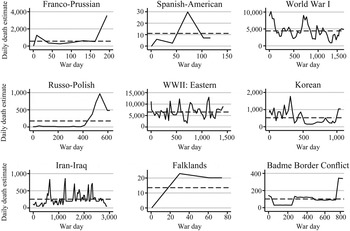
Figure 1 provides examples of the resulting data for a representative sample of wars, including estimates of daily death rates (summed for all participants) as well as a dotted line at the average death rate for the war as a whole.Footnote 39 As is evident, there is substantial variation in war intensity over the course of conflicts. There are cases such as the Russo-Polish War where intensity increased late in the war, as well as cases such as Korea in the 1950s where initial high-intensity fighting gave way to lower-intensity combat in later years. The Iran-Iraq War experienced a fairly constant baseline level of fighting interrupted by periodic spikes in intensity associated with Iranian offensives. Even in a case such as the 1998–2000 Badme Border War between Ethiopia and Eritrea, where estimated war intensity is quite close to the average for much of the conflict, there can be a late increase in intensity that is significant for some theories of decision making in war. Figure 1 also illustrates some of the admitted limitations of the data. For cases such as the Badme Border War, where information about deaths in incidents is limited, estimated intensity levels vary less over time than deaths likely did in reality. In some cases, battle death estimates understate effective losses, as in the Eastern War in World War II, where high prisoner of war losses in the initial months and at Stalingrad are not counted—both periods, though still intense, do not stand out as much in these data as they do in the historical record. Even given these limitations, however, these data clearly better capture wartime developments than any existing alternatives.
Monthly battle death estimates from a sample of interstate wars

I use these data to generate several specific variables for use in the analysis. The first is the total intensity in the war through the day in question, where intensity through day t ∈ T, T being the total number of days in the war, is the natural log of total battle deaths through day t, divided by the participants’ total population.Footnote 40 Formally, for the set P of participants in the war, intensity I through day t is calculated according the following formula:
 $${I_t} = \displaystyle{{\sum\limits_P {} \sum\limits_1^t {dead}} \over {\sum\limits_P {\,pop}}}$$
This variable is used to test H1, which predicts that higher levels of past fighting will increase the probability of settlement.
A second variable is needed to evaluate H2, which predicts that recent information is particularly salient by exploring whether the recent trend is toward higher-intensity fighting. This variable is constructed by comparing war intensity in the most recent sixty days of the war with war intensity for the war as a whole, according to the following formula:
 $$Recent\,Intensity = \displaystyle{{\sum\limits_{t - 60}^t {dead}} \over {\sum\limits_{t - 60}^t {dead} + \sum\limits_1^t {dead}}}. $$
recent intensity in this equation varies between 0 and 1, with values greater than .5 indicating that recent fighting has been more intense than average for the war.
A third variable is needed to capture battlefield trends. Analysis using this variable focuses on behavior of one side in the war, and uses shifts in loss exchange ratios to capture changing battlefield success. I define the variable battlefield trend for actor i at time t to be i's share of all battle deaths in a set period before day t minus the same share for the war as a whole. The variable thus is bounded between positive and negative 1, with positive values indicating that recent fighting has taken a turn for the worse from the country's perspective. The primary analysis uses the trend over the previous 60 days, though I also examine trends over 30, 90, and 120 days with similar results.
Leadership Turnover
For leadership turnover, I rely on Croco's data on leadership change in war.Footnote 41 Croco argues that leaders who are viewed as culpable for the decision to fight, either because they were in power when the war started or because they are of the same faction as the leader who started the war, will fear punishment and hence resist settlement when war is going poorly, whereas nonculpable leaders will not face the same concerns. She identifies a total of 355 leaders in interstate wars, of whom 96 were replaced before the war ended, 51 by nonculpable replacements.Footnote 42
For the analysis of war duration and termination, I generate several different variables to capture the effects of leadership turnover. If leaders who started wars pose obstacles to ending them, then their replacement by new leaders, especially in more powerful states that presumably have more control over wartime decision making, should facilitate peace. I use the Correlates of War's National Military Capabilities data set to calculate the percent of total wartime capabilities (that is, the sum of Composite Index of National Capability (CINC) scores across war participants) controlled by states that have experienced leadership turnover. In addition, the logic of the culpability argument holds that even nonculpable leaders who do not end wars are likely to assume culpability if they continue to fight them, implying that the effects of leadership turnover should weaken over time. For the primary analysis, I then generate variables that capture the percentage of wartime capabilities controlled by new leaders, with the effect of leadership turnover decreasing over time until the new leader is treated as fully culpable after one year has elapsed. To avoid overweighting the effects of turnover in very powerful states fighting asymmetric wars, I construct turnover scores separately for each side in the war and then sum them and divide by two. Formally, % new leader is defined as follows, where t is the day of the war, R s is the set of war participants on side s ∈ {1, 2} that have experienced leadership turnover since war onset and no more than 365 days previously, and d rt is the number of days that have elapsed since country r experienced turnover:
 $$\% New\,Leade{r_t} = \,\sum\limits_S {\displaystyle{{{\sum\limits_{R_{s}} {{cap}_r}\displaystyle{{365 - {d_{rt}}} \over {365}}}} \over {2\sum\limits_P {{cap}_p}}}}$$
More fine-grained tests require distinguishing between new culpable and new nonculpable leaders. I thus also derive the analogous variables % new culpable and % new nonculpable, which capture the share of capabilities (again declining over time) controlled by either new culpable leaders or new nonculpable leaders. I conduct further robustness checks, reported in the online statistical appendix, in which the effects of leadership turnover do not decline over time and in which I distinguish between turnover on the initiating and defending side in the conflict, in both cases finding quite comparable results.
For the analysis in which leadership turnover is the dependent variable, I simply use a dummy variable that takes a value of 0 if no turnover occurred in the country in question and 1 otherwise. To avoid double counting, I combine observations for the small number of countries that are involved in multiple wars simultaneously, comparing their casualty rates with those of their opponents across all wars. This approach means, for example, that Japanese deaths in border wars against the Soviet Union in 1938 and 1939 are combined with deaths fighting China in the Sino-Japanese War. In cases in which countries switch sides or exit wars only to reenter later, I treat the new period of involvement as a separate observation because the leader is now being judged for a different decision than the one that initially brought the country into the war. This process identifies a total of 427 leaders, of whom 103 are replaced during the war, 44 by a nonculpable substitute.Footnote 43
Additional Control Variables
The remaining control variables for the main duration analysis are drawn from my previous work; I summarize them briefly here, and in greater detail in the online appendix.Footnote 44 power shift is the degree to which relative capabilities among participants shift in the ten years prior to war; larger shifts are a proxy for leader expectations of larger future shifts and hence for commitment problems that should impede settlement. rough terrain impedes opponents’ efforts to grapple with each other and hence should be associated with longer wars. I use terrain data from Slantchev.Footnote 45 geographic contiguity similarly should facilitate interaction and hence shorten wars, at least relative to wars fought by opponents who are quite distant from each other. contiguity data come from the Correlates of War project; the variable is a dummy that takes a value of 1 if the primary dyad in the war shared a land border. Several studies have found that wars initiated by democracies have a particular profile, with the democracy tending to win fairly quickly.Footnote 46 I thus control for the presence of a democratic initiator, where a democracy is a country with a Polity IV score of 7 or above. relative capabilities are also often expected to have a significant effect on war duration; I thus control for the share of total capabilities in the war held by the stronger side, again using CINC scores.Footnote 47 Given the argument that multilateral conflicts have multiple veto points that can impede settlement, thereby lengthening the war, I control for the number of states involved in the war.Footnote 48 Given arguments that wars among the major powers are qualitatively different from other conflicts, I control for the presence of a great power on each side in a war (major power war).Footnote 49 Bennett and Stam argue that military strategy, broken into three categories of attrition/conventional war, blitzkrieg/maneuver, and guerrilla war/punishment, strongly influences war duration.Footnote 50 I thus use their coding scheme, which ranks different combinations of the strategies into an ordinal scale in which higher values would be expected to be associated with slower war termination. Finally, I control for the presence of significant cultural differences between the two countries in the primary dyad in the war, using Henderson and Tucker's operationalization of Huntington's classification of countries into different civilizations.Footnote 51
I also distinguish between settlement and conquest because the logic of the informational mechanism addresses the probability that opponents in a war will reach a negotiated agreement to end the war, rather than that one side simply overwhelms its opponent militarily. Thus, for example, Germany in 1945 did not decide to agree to a political settlement with its enemies (indeed, no settlement was on offer, given the policy of unconditional surrender); instead, Germany lost the ability to sustain conventional resistance. Wars are coded as ending in conquest from the perspective of the losing leader if that side's military surrenders in its entirety or disbands, or if the country is totally occupied. For analysis of the timing of concessions, I code a side in a war as making concessions if it is the loser of a war that ends through settlement, using Correlates of War data on war outcome to identify losers.Footnote 52
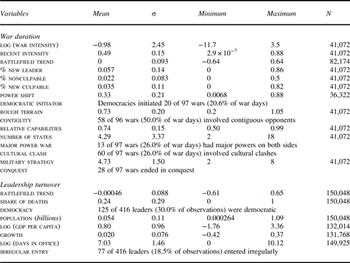
For the analysis of leadership turnover, I control for a variety of variables commonly used in studies of leadership. Leaders face a higher likelihood of replacement in democracies and when they have been in office for a relatively short period of time. In addition, Chiozza and Goemans find that leaders who enter office irregularly face markedly different experiences from leaders who enter regularly.Footnote 53 I follow Chiozza and Goemans and others in controlling for the country's total population (using data from the National Military Capabilities data set), albeit without a strong prior expectation about its relationship with turnover. time in office (logged) and irregular entry both come from the Archigos data set, supplemented by my codings for leaders who left office prior to 1870. Finally, I control for economic indicators, though given extensive missing data I also present results with these variables excluded. Both gdp per capita and growth are based on historical GDP estimates generated by Maddison.Footnote 54 Table 2 contains descriptive statistics for the different variables used in the analysis.
Descriptive statistics

Statistical Results
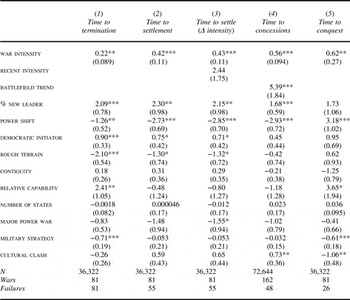
I present the results in two stages, focusing first on war duration and then turning to leadership turnover. Table 3 presents results for the analysis of war duration and war termination, focusing on tests of the informational hypotheses. Model 1 uses a Cox specification, examining duration until war termination.Footnote 55 Models 2 through 5 by contrast use a competing risks specification, with political settlement (Models 2 to 4) and military conquest (Model 5) the two possible forms of war termination. In all regressions, the reported results are variable coefficients (rather than hazard ratios). Positive coefficients imply that the variable is associated with an increased probability of war termination in any given day, and hence with a decreased expected war duration.
Battlefield deaths and war termination

Notes: * p < .1; ** p < .05; *** p < .01.
Throughout the analysis, I conduct a range of robustness checks to ascertain whether findings are driven by potentially arbitrary decisions about statistical specification. One set of robustness checks involves changes to the universe of cases: I add and remove cases in which there are grounds for uncertainty about whether the standard 1,000 death threshold for coding as a war was met; I drop several wars in which official heads of state on one side sincerely opposed their country's involvement in the war; I aggregate the world wars into single observations; and I drop some conflicts that arguably were internationalized civil wars. Second, I use alternate reasonable statistical specifications, replacing Cox models with a Weibull model and competing risks models with a Cox specification in which observations that fail because of competing risks are censored at the time of exit. Third, for analysis of war duration and the timing of concessions, I am forced to exclude seventeen wars because of missing data for the pre-war power shift variable. I thus conduct robustness checks with that variable omitted to ensure that the loss of observations is not biasing the results. Fourth, given reasonable concerns about battle death data quality, I conduct additional robustness checks in which I drop observations for which I have relatively low-quality data, operationalized in one of five ways: if estimates for total battle deaths are poor (because of wide variation in reasonable estimates in the literature, or because estimates for total deaths do not exist), if they are either poor or questionable (because significant variation in reasonable estimates exists, albeit with the low estimate no less than 75 percent of the high estimate, because the standard estimate in the literature is described as open to question, or because the final estimate required omitting non-battle deaths), if no information exists on the timing of deaths, if no quantitative information exists on the timing of deaths, or if information on the timing of deaths covers less than 25 percent of total deaths. Results from the robustness checks are reported in the online statistical appendix; unless otherwise noted in the discussion, results are robust to these changes.
The results in Table 3 shed light on the merits of the three informational hypotheses. First, consistent with H1, the more fighting that has occurred in the past, the more likely war is to end in the immediate future. The observation in Model 1 that more intense fighting is associated with quicker war termination potentially could reflect the increased likelihood that one side conquers the other, rather than that the revelation of information leads to settlement. The competing risks analyses in Models 2 through 4, however, reveal that increased war intensity is also associated with quicker settlement, though consistent with the alternative explanation higher war intensity is also associated with quicker conquest. In sum, the evidence is quite consistent with H1.Footnote 56 This result contrasts with findings in earlier studies, where intensity was only weakly related to war termination.Footnote 57 This difference is a consequence of improved data on both total deaths and the timing of deaths for a wide range of wars.
H2 predicts that wars will be more likely to end when recent fighting has been particularly intense. Model 3 tests this prediction by adding a variable that captures the extent to which recent war intensity is more or less intense than typical fighting for the war. Higher recent war intensity is associated with quicker settlement, but at a clearly statistically insignificant level. Closer examination reveals that, of wars that last more than two months, almost as many reached settlement following a lull (45 percent) as did following an increase in fighting (55 percent). This result also holds for war termination in general (including through conquest), and when using shorter or longer windows of time to capture recent trends. Contrary to the expectations of the information obsolescence perspective, therefore, there is little evidence to suggest that spikes in fighting increase the probability of war termination beyond the general effect accounted for by H1.
The final informational hypothesis is that changes in battlefield outcomes will be associated with quicker settlement, with countries experiencing worsening conditions more likely to make war-ending concessions. To test this prediction, I shift the unit of analysis to the individual side in a war, to examine the conditions under which one side in a war makes concessions. Model 4 reports the results from this analysis. When a country has suffered higher losses in recent fighting, it is substantially more likely to make the concessions necessary to bring an end to the war. A shift from the 50th percentile to the 90th percentile in the battlefield trend is associated with an 75 percent increase in the instantaneous probability of war termination. This result suggests that dramatic changes in battlefield outcomes are particularly informative, and hence is inconsistent with the outcome irrelevance perspective on the informational mechanism.
In sum, therefore, the results are consistent with the third perspective on the informational mechanism. Higher overall war intensity robustly predicts settlement, as do significant battlefield reversals. By contrast, recent spikes in the intensity of fighting have no clear relationship with the timing of war termination.
Table 3 also contains initial results on the connection between leadership turnover and war termination. Consistent with theoretical predictions, war termination is substantially more likely following leadership turnover. In some cases, such as the replacement of Hitler following his suicide or the shuffling of South Vietnamese leaders in the final days of the Vietnam War, countries replace leaders just before military collapse. That said, leadership turnover is also clearly associated with quicker settlement, as shown in Models 2 to 4.Footnote 58
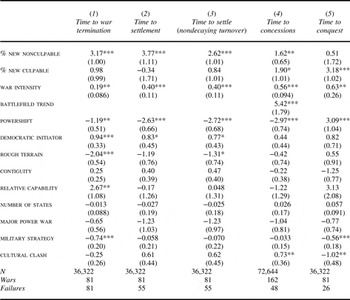
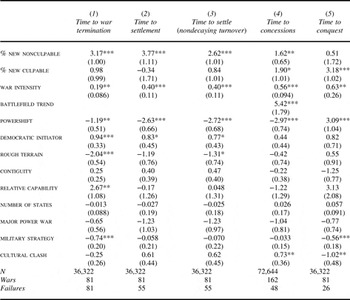
These results, however, do not distinguish between types of leadership turnover. Given the argument that new leaders behave differently depending on whether they had political ties to their predecessors, it makes sense to distinguish between leaders who retain culpability (because of ties to the leader who started the war) and leaders who are unlikely to be viewed as culpable. Table 4 presents these results. Although both types of leadership turnover are associated with quicker war termination, the effect is substantively stronger and is statistically significant only for transition to nonculpable replacement. The emergence of these leaders is associated with war termination through settlement (Model 2), and countries that they govern are more likely to make concessions to end wars (Model 4). By contrast, and consistent with the examples of Germany and South Vietnam, the emergence of new culpable leaders tends to precede war termination through the conquest of one side by the other. This effect is substantively significant: a shift from 0 to 0.5, which would correspond to a new nonculpable leader taking power in a country that is fighting without allies, produces more than a sixfold increase in the predicted probability of settlement. The primary analysis here relies on a measure of leadership turnover that declines over time, based on the argument that leaders gradually come to be seen as culpable if they do not end wars quickly, but Model 3 demonstrates that the results are robust to substituting a nondeclining measure.
Leadership turnover and war termination
Notes: * p < .1; ** p < .05; *** p < .01.
The results for control variables in Tables 3 and 4 are largely consistent with prior findings. Larger pre-war power shifts are associated with increased war duration, and in particular increased duration until settlement, consistent with a commitment problem story. Wars initiated by democracies also tend to be shorter on average, though less robustly, whereas rough terrain is associated with a substantial increase in predicted war duration. When relative capabilities are imbalanced, wars tend to be shorter, though this effect arises primarily because these wars reach conquest more quickly rather than because imbalance promotes quicker settlement. Similarly, military strategy influences war duration primarily through its effect on the speed of conquest. Other control variables either were consistently insignificant or, in the case of cultural difference, had an unanticipated relationship with the duration until conquest but did not pose an obstacle to settlement. The discussion thus far establishes that new nonculpable leaders are more likely to settle, but it leaves open questions about whether this effect primarily reflects informational or principal-agent dynamics. A first useful observation is that most wars are ended by the same leaders who began them: leader turnover of any kind occurs in less than a quarter of wars that end through settlement, and nonculpable leaders emerge in only 14 percent of such conflicts. That culpable leaders frequently settle on losing terms implies that in many cases they either need not fear significant punishment for defeat, as, for example, Weeks argues is the case for personalist dictators, or that they are sufficiently constrained by other forces in society that they cannot get away with gambling for resurrection.Footnote 59
Stronger evidence for the informational interpretation of the link between turnover and war termination would arise if turnover frequently is nonrandom. If nonculpable leaders come to power when the war is going poorly, then that would be evidence that leadership turnover is part of the broader information-updating process. This point would be particularly strong if such turnover is more likely in countries in which other institutional constraints on the leader are relatively weak.
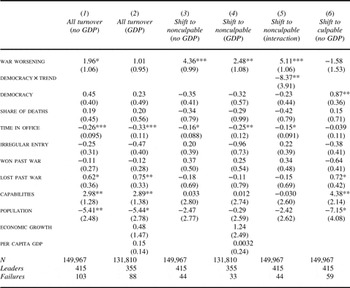
Table 5 examines these possibilities by focusing on the link between battlefield events and leadership turnover. In Models 1 and 2, the dependent variable is any kind of leadership turnover, whereas Models 3 to 5 focus on turnover to a nonculpable replacement and Model 6 focuses on turnover to a culpable replacement. As elsewhere, the aggregated results in Models 1 and 2 come from a Cox specification, whereas distinguishing among types of termination involves shifting to a competing risks framework. Models 1, 3, 5, and 6 omit controls for economic performance, whereas Models 2 and 4 include them, thereby controlling for an important determinant of leadership tenure, albeit at the cost of losing roughly a third of all observations to missing data. Except as noted, results for key variables with and without economic controls are quite comparable.
Determinants of leadership turnover

Notes: Standard errors are clustered by country. * p < .1; ** p < .05; *** p < .01.
The results are consistent with the predictions of the informational perspective. Worsening battlefield results are a marginally significant predictor of leadership turnover in Model 1, though the variable loses statistical significance in Model 2. The remaining models, however, reveal that the story is quite different for transition to new nonculpable as opposed to new culpable replacements.
Transition to nonculpable replacements is far more likely in the aftermath of worsening battlefield conditions; this result holds whether or not we control for economic variables and, as the online statistical appendix demonstrates, through a wide range of statistical robustness checks. By contrast, when battlefield conditions worsen, countries are if anything less likely to replace their current leader with a political ally who will also be seen as culpable. Based on the results in Model 3 and holding control variables at medians, a shift from a static war situation (the 50th percentile) to a value at the 90th percentile is associated with a threefold increase in the probability that a leader is replaced by a nonculpable alternative. There is thus strong evidence that countries make decisions about replacing leaders with battlefield events in mind. Model 5 adds an interaction between democracy and battlefield trends to test the prediction that leadership replacement will be more likely in countries where constraints on the executive are weak. Consistent with this prediction, the interaction term is negative and statistically significant; overall, democracies are if anything less likely to bring in a nonculpable replacement leader following battlefield defeat. By contrast, the large and significant positive coefficient for battlefield trend demonstrates that nondemocracies remain quite likely to shift to a nonculpable leader following substantial defeats. An analogous result holds when including economic controls. In short, worsening battlefield conditions are likely to promote transition to leaders who are more willing to settle, but only in nondemocracies where leaders would otherwise be relatively free to divert policy to serve their own ends.
Results for control variables are fairly weak. Leaders with longer tenure are less likely to be removed in general, though this relationship is less clear when examining types of turnover. Stronger states replace their leaders more often on average, though more populous states do so less often. Democracies experience more frequent turnover to culpable replacement leaders, but do not experience similar turnover to nonculpable replacement. A leader's past war experience also occasionally has the expected relationship with the probability of turnover, but is typically insignificant. Other controls are typically in the predicted direction but statistically insignificant, likely reflecting differences between wartime and peacetime circumstances and the limited statistical power associated with the reduced sample of leaders who have been at war.
Conclusion
What drives decisions to fight, as well as decisions to end ongoing wars? Within the bargaining model of war, the informational perspective argues that wars occur when the two sides disagree about the likely consequences of fighting, and end when events within the war bring expectations about the consequences of further fighting sufficiently close to agreement to permit settlement. Although this broad argument has been well understood, important theoretical debates persisted, and evidence that this process occurs has been less than fully compelling.
This article addresses these problems in the context of interstate war duration and termination, advancing our understanding of the informational mechanism in several respects. I delve into the theoretical argument, identifying several distinct arguments about the process of information updating that have important implications for the way in which wars driven by the informational mechanism unfold. An information obsolescence perspective holds that because new private information is generated over the course of a war, the lessons learned from earlier experiences will become irrelevant over time, and war termination will be more likely only when recent events have been particularly informative. I argue, however, that this perspective overstates the likely salience of new information and rests on an implausible assumption that the new information that leaders receive will be biased in a positive direction. An outcome irrelevance perspective holds that because the winners of battles can increase their war aims to offset the concessions that losers are willing to make, dramatic battlefield shifts will not increase the probability of peace. This perspective fails to account for the two sides’ preexisting theories of victory. In most cases, the side that achieves a significant victory based its war aims on the expectation that such a victory would eventually emerge, and hence will be unlikely to increase its demands to a degree that offsets its opponents’ increased openness to concessions. These arguments then imply that settlement in war will be more likely when more information has been revealed, for example, because a greater total amount of fighting has occurred, and when dramatic shifts in battlefield outcomes have occurred, but that taking these effects into account, spikes in battlefield intensity will not significantly increase the probability of peace.
The article also examines the domestic politics of the informational mechanism. Traditionally, the informational mechanism has ignored domestic politics, but building on work on leadership turnover in war, I argue that the replacement of leaders is at times part of the process by which the two sides update their beliefs. Leaders may resist settlement either for parochial reasons, as in diversionary war, or because psychological, ideological, or organizational biases make them discount negative information more than they should. In either case, the rest of society may respond to this behavior by reining leaders in, in the extreme through their removal from office. If this process is occurring, then we would expect new leaders, especially leaders who are more amenable to settling, to be more likely to take office in the aftermath of battlefield defeats. Moreover, we would expect this sort of leadership turnover to be more common when formal institutions constraining the leader's behavior are weaker, as in autocracies.
Tests of these arguments rely on new participant-level monthly estimates of battle deaths for the Correlates of War list of interstate wars. These data provide coverage for a wider range of wars than are examined in existing quantitative studies of wartime developments, and they avoid many of the problems that are inherent in data sets organized around battles. I combine these data with existing data on leadership turnover to examine the determinants of war termination. Better data permit me both to conduct a better test of the established prediction that information revelation through fighting will encourage peace and to examine more nuanced predictions about how changing battlefield circumstances connect both to peace and to leadership turnover. Results from these analyses are quite consistent with the posited hypotheses.
In sum, this article provides more compelling evidence of the informational mechanism than was previously available, while also providing more detail about how the updating of beliefs takes place. The finding that leaders are often replaced in response to battlefield defeats also stands in contrast to principal-agent perspectives, in which decisions about whether to continue or end wars are driven by leaders’ calculations about their personal interests. The evidence presented in this study cannot rule out principal-agent dynamics in war, but it provides a cautionary note that merely observing connections between leadership turnover and the termination and outcome of war does not guarantee that leaders are able to divert policy toward personal interests over extended periods of time. More generally, this article reinforces the tragic view of war: the evidence here is that violence occurs not because of the machinations of self-interested politicians but because leaders who are sincerely pursuing what they understand to be the general interest in the face of uncertainty fail to resolve their disagreements peacefully.
Supplementary Material
Supplementary material for this article is available at http://dx.doi.org/10.1017/S0020818316000059.