On 7 March 1966, to the shock and amazement of the American diplomatic community, President Charles de Gaulle withdrew France from the military leadership of the North Atlantic Treaty Organization (NATO). When he called for the removal of American troops from French soil where they had been stationed since the end of the Second World War, his American interlocutor, Secretary of State Dean Rusk, retorted, ‘and those in French cemeteries as well?’Footnote 1 The United States saw France's partial withdrawal from NATO as an insulting and traitorous rebuff of Allied commitments forged during and after the war. For the French, however, the action was considered a justifiable assertion of national sovereignty having little to do with the Allied contribution to the Liberation of France some twenty years earlier. At the heart of this exchange are American perceptions of French ingratitude for services rendered during the two world wars, in particular the Liberation of 1944–45. The incident was short-lived but rich in meaning.
Understanding this diplomatic exchange and tracking its reverberations is the aim of this essay. To decode its messages and meanings, real or imagined, I will draw on several disciplines and bodies of scholarship. They include cultural studies, history and politics, gender studies, international relations, and biomedical studies, and most important for this analysis, theories of the gift, which have been elaborated by anthropologists and others since the beginning of the twentieth century. My focus is on three pivot points in French-American relations: the Liberation period (1944–45), President Charles de Gaulle's withdrawal from the military command of NATO in 1966, and President Jacques Chirac's refusal to join the ‘coalition of the willing’ in 2003, a replay of sorts of the 1966 crisis.
At the heart of the sometimes contentious relationship between France and the United States is the Liberation of 1944–45, which has shaped postwar relations between the two countries in both symbolic and practical ways. The arrival of Allied forces brought four years of torment in Europe to an end. The American contribution to this effort was a massive operation that resulted in the loss of millions of dollars of materiel and, more important, the lives of some 2,500 American soldiers on 6 June 1944 alone, many of whom had never ventured beyond their home states, much less abroad. It was a monumental gesture, but with it came a cost, borne not only by the Americans but by the French as well.
How and why did the ‘gift’ of Liberation become what some scholars would call a ‘contested site of meaning’? To consider this question, we turn first and foremost to the work of French anthropologist Marcel Mauss. In his pathbreaking 1923 work, The Gift [Essai sur le don],Footnote 2 Mauss shows how relationships between individuals and groups are created, controlled, and reproduced through complex webs of exchange and reciprocity. The gift is freighted with expectations and triggers sets of duties and obligations on the parts of both giver and receiver. Gift exchange is a means of forging and securing bonds. It produces and reproduces identity. It shapes and perpetuates relationships. When giver and receiver share the same set of cultural premises, this unspoken communication is unproblematic. But what happens when the ‘gift’ – in this case the sacrifice of American lives – conveys different messages to givers and receivers across cultures? How can applying Mauss's ideas at the transnational level help us to understand the meanings, (mis)interpretations, and implications of the Liberation for actors on both sides of the Atlantic?
Mauss's life work emerged from and was shaped by the First World War. The teachings of sociology and anthropology, he hoped, could give Europeans a template for mutual understanding in the aftermath of the Great War. While Mauss based his theories on the practices of native peoples in the American Northwest and the Pacific Islands, he was intensely committed to bringing the new social sciences to bear on problems at home and, specifically, on the transnational politics of his day. Since its original publication, The Gift has inspired a century of commentary and elaboration. Scholars have applied, critiqued, and expanded theories of the gift.Footnote 3 While Mauss focused on gift-giving among individuals, families, clans, and tribes, his ideas might also apply to exchanges between modern nations. To my knowledge, however, few thinkers applied Mauss's ideas to the field of international relations until the twenty-first century.Footnote 4 Those studies are promising points of departure for this paper. Can Mauss's analysis of gift-giving help us to read a misunderstood yet deeply meaningful diplomatic exchange? Before addressing that question, some additional background and context are in order.
The Incident, Its Context and Repercussions
De Gaulle's decision to remove France from the integrated military command of NATO and to evict 27,000 American troops and their families based in France sparked an outcry on both sides of the Atlantic.Footnote 5 Some historians claim that it marked the nadir of French-American relations in the twentieth century.Footnote 6 The 1966 quip from Rusk to de Gaulle about the repatriation of American war dead was resurrected nearly forty years later in 2003, when then-president of France Jacques Chirac announced that France would not support the unilateral American decision to invade Iraq.Footnote 7 Rusk's audacious retort to de Gaulle, while amusing and eminently quoteworthy, would appear insignificant in the larger arena of relations between two friendly countries. The fact that it re-emerged nearly forty years later, in a different political context but for similar reasons, suggests that even a clever retort can have enduring symbolic power.Footnote 8
It would appear absurd to question, even in jest, whether Americans should remove their cemeteries in France. How could a representative of the US government display such impertinence in a face-to-face exchange with the president of France? It seemed like a cheap shot that struck at the very heart of the French-American relationship. That the diplomat in question had been Secretary of State Dean Rusk was more astonishing still; Rusk was a man of probity and measure. But it was at the express demand of his boss, President Lyndon B. Johnson, that Rusk made the caustic remark. Ever the diplomat, he had tried to talk the president out of it, but Johnson was adamant. The president was not known for mincing words of the unprintable sort, and he was furious with de Gaulle. Rusk recalls the incident in his memoirs:
When President de Gaulle decided to quit NATO, President Johnson was determined to do everything that de Gaulle asked us to do, simply as a matter of dignity, and get our forces out of France before the deadline. But de Gaulle's request went down hard in Washington. In fact, Johnson insisted that I ask de Gaulle, ‘Do you want us to move American cemeteries out of France as well?’ I carried out my instructions. De Gaulle, very embarrassed, had nothing to say.Footnote 9
Nor did members of the US Congress mince words in condemning de Gaulle's actions. The most virulent attack came from Representative L. Mendel Rivers, a Democratic representative from South Carolina who chaired the House Armed Services Committee from 1965–1970. He, too, proposed the repatriation of dead American soldiers, but for real. Rusk had asked in the spirit of irony. Rivers went further:
I cannot help but take note of what the United States has done for France during the last 50 years, and to realize how this generosity and good will are being rewarded by the ingratitude of President de Gaulle and the Government of France.
During the last 50 years, the American people have done more for France and the French people than any nation ever did for another. Twice within the last 50 years, the United States has come to the rescue of France in major wars at a terrible toll of lives and dollars. Sixty thousand five hundred and one American men lie in French cemeteries after giving their lives to save that nation from a disgraceful defeat.
Perhaps we should make our removal from French soil complete by reinterring the bodies of these American men on American soil.Footnote 10
In September of that same year (1966), Rivers’ subcommittee made a series of punishing proposals, including that France pay all relocation fees and French civilians working on US bases be terminated without severance pay.Footnote 11 His proposal to repatriate America's war dead did not gain traction in Congress or from the public. For one, the families of the fallen had little interest in disinterring their loved ones and shipping them across the ocean two decades after burial.
Much the same sort of debate erupted in the French parliament, but for different reasons.Footnote 12 One after the other, French senators across the political spectrum condemned de Gaulle's action.Footnote 13 They decried de Gaulle's shocking lack of consideration for France's ‘oldest ally’ and excoriated him for taking aim at the western Alliance that had been forged in the wake of the First World War. ‘In the history of the European peoples’, warned one senator, ‘ingratitude has always come at a high price.’Footnote 14 The president was taken to task for making a decision of this magnitude without consulting members of his cabinet or elected officials in parliament. Some questioned whether it was even constitutional for the president to make such a consequential ruling on his own. The prospect of repatriating dead American soldiers came up only peripherally,Footnote 15 although the French press had devoted several columns to it.
In what must have been a very long session, speakers rose one after the other to criticise de Gaulle's decision and demand an explanation from the government. Expressions of gratitude for America's role in the Liberation are threaded throughout their remarks. Senator Guy de La Vasselais wanted Americans to know that not all French were ‘ungrateful’.
Can it be possible for us to forget that at 6000 kilometers from their home, men hurled themselves off the coasts of England to come die on French soil? Is it possible not to have graven in memory the gaze of these soldiers who came to fight for a country that was not their own, that they didn't even know? To die for a homeland [patrie] that is not one's own, is the gift of courage to friendship. Footnote 16
In the course of the debate, there was also discussion of the role of moral emotion in politics. For socialist Senator Edouard Le Bellegou, it was neither possible nor desirable to isolate gratitude from politico-military concerns such as France's role in NATO.
The thousands of American dead that populate our cemeteries on our land attest to that, not to mention other reasons for our gratitude. […] This all deserves a bit of consideration when it comes to denouncing the agreement. […] This is a rather sentimental argument, to be sure, but I think just the same that it is valid, for one cannot exclude sentimentality from a debate such as this, and elevate ingratitude to the highest level as a rule of government. (Very good! Voices from the left.)Footnote 17
In defending the government's point of view, Secretary of State for Foreign Affairs Jean de Broglie called for keeping emotion out of politics.
Now let's get to the bottom of things. Foreign affairs is essentially a matter of composure under pressure [sang-froid, literally, cold-bloodedness], and in a discussion it is dangerous to mix feelings with reason. […] But cool-headedness does not mean indifference. […] No one dreams of undermining the capital of confidence and fondness [sympathie], nor the centuries-old friendship that characterizes our relationship on the individual and collective levels.Footnote 18
French expressions of gratitude for the American contribution to both wars have been profuse, abundant, and fulsome. From political elites and civic groups to families and individual citizens, demonstrations of gratitude have taken many forms. One need only to look to national and international commemorations of D-Day,Footnote 19 from 1945 to the present, for countless expressions of gratitude in the speeches of public officials, the pages of local newspapers, local goodwill initiatives,Footnote 20 and outreach to American families of the fallen, to name a few. Since its founding in May 1945, the French Comité du débarquement, or D-Day Commemoration Committee, has played a critical role in honouring the memory of Allied soldiers by erecting monuments, planning ceremonies, and preserving battle sites. It remains in existence to this day.Footnote 21
And yet, at times of stress in the transatlantic relationship, the United States has accused France of ingratitude. On such occasions, the ‘gift’ of Liberation has been deployed as a form of moral capital. Rusk's 1966 retort to de Gaulle implying that the French had forgotten their debt to the United States was a diplomatic performance for the sake of reasserting American moral entitlement. Alluding to the Liberation was meant to elicit feelings of guilt, humility, shame, and embarrassment in the French. With de Gaulle's decision, the United States had suffered a wound of pride (amour-propre, in the words of one French senator).Footnote 22 Reminding the French of the gift of Liberation was a symbolic way of recalibrating the unsettled relationship and restoring the United States to its proper position – on top.
France and NATO: De Gaulle's Wish List
De Gaulle asserted that France was withdrawing neither from the Atlantic alliance nor from NATO, but would no longer participate in ‘integrated commands’ where the United States played a dominant role. No French troops would remain under foreign command. All aspects of the American military presence in France were to be removed from French soil: American bases and personnel, supply depots and supply lines, and communications networks. The eviction included NATO institutions such as SHAPE (Supreme Headquarters Allied Powers Europe), which ultimately relocated to Brussels. The removal of American troops and their families was to take place within the year (although Johnson managed to obtain an extension). ‘No landlord serving notice of termination of a lease upon an undesirable tenant could have been more brusque’, quipped the eminent American statesman Dean Acheson.Footnote 23 The repatriation of thousands of Americans in short order would be a monumental project comparable to the Allied landings on D-Day, but a D-Day where the direction is reversed.
The United States considered de Gaulle's demands imperious, exaggerated, and ultimately harmful – not only to the transatlantic alliance in general but to France itself. Johnson's response was gracious but not without candour. ‘I am puzzled by your view that the presence of allied military forces on French soil impairs the sovereignty of France’, he wrote. ‘Those forces have been there at French invitation pursuant to a common plan to help ensure the security of France and her allies. I have always viewed their presence as a wise and far-seeing exercise of French sovereignty.’Footnote 24
From France's point of view, the 1966 debacle was not a blitz attack; De Gaulle had already signaled his intentions to modify France's participation in the alliance, but he had yet to furnish details or provide a timeline. As per the agreement at the 1949 founding of NATO, member countries would be called upon to reaffirm their commitments in twenty years’ time. Well in advance of the 1969 deadline, de Gaulle had insisted that France would not remain subservient to NATO's major player, the United States. Seven years earlier (1960), he had already removed French naval forces from NATO command and banned the installation of American nuclear arms on French territory, which more than hinted at changes to come.Footnote 25
Time and again, the French insisted that de Gaulle's withdrawal from NATO's military command did not constitute a rupture, reassuring NATO partners that France would remain part of the alliance but on different terms. De Gaulle himself made this clear,Footnote 26 as did his Minister of Foreign Affairs, Maurice Couve de Murville. Addressing the American press, France's chief diplomat reiterated the fact that de Gaulle had been advocating a revision of NATO since 1959,Footnote 27 a claim that was rebutted by his counterpart, American Secretary of State Dean Rusk.Footnote 28 Like de Gaulle, Couve de Murville was taken aback by the Americans’ response to a move they should have long anticipated. The real question was not so much why all of a sudden, he said, but rather, why so late?Footnote 29
Indeed, knowledge of de Gaulle's plan to modify France's role in NATO had been in the public domain for some time. In June 1965, nearly a year before the announcement of 7 March 1966, one reporter noted, ‘A taxi driver remarked the other day that “the general has no memory.” Not only can Americans complain about de Gaulle's lack of memory; there is considerable justification for regarding him as an ingrate.’Footnote 30 France's ingratitude for the ‘gift’ of Liberation was already on people's minds.
In fact, by 1965 French-American relations had already deteriorated to the point that a task force of US representatives had been dispatched to France to explore ways of healing the rift. Their report reads like de Gaulle's wish list. The mission found that de Gaulle's insistence on dealing with the US as an equal partner was not ‘anti-American’ as some in Congress had claimed, but rather a reasonable condition for a leader acting in his country's own best interests. They agreed with the French that the structure of NATO was outdated. The France of the 1960s was no longer hobbled from wartime devastation like the France of 1949, when NATO was founded, they said. It was time to reconceptualise the Atlantic alliance and its structures from a vertical, top-down, authoritarian arrangement with the United States at the summit to a horizontal configuration with the United States in partnership with France.Footnote 31 Their recommendations fell on deaf ears.
The rift of 1966 followed upon a long and fractious history that began with the Second World War. American officials had been wary of de Gaulle from the outset. Many decried what they viewed as his authoritarian tendencies, which they attributed, in large part, to his military background. De Gaulle managed to antagonise every American president from Roosevelt to Johnson. His clashes with Roosevelt were legendary, beginning in 1940 with the US refusal to acknowledge the legitimacy of de Gaulle's Free French based in London. From 1940–1944, the United States had stubbornly maintained its diplomatic mission in Vichy, seat of Maréchal Pétain's collaborationist regime. The US did not formally acknowledge de Gaulle's authority until October 1944, four months after D-Day (6 June) and four months after the establishment of the Provisional Government (Gouvernement provisoire de la République française, or GPRF) (3 June) in Algiers, which de Gaulle presided over.Footnote 32
Yet de Gaulle was the best insurance against a communist takeover of liberated France. When the communist-led resistance was poised to take over the occupied capital, Eisenhower's Third Army stood aside to permit Leclerc's division to be the first to enter Paris. It was critical to de Gaulle's legitimacy – and American interests – that French forces be the first to enter Paris. Once considered a bulwark against communism, de Gaulle appeared to be weakening the alliance in 1966 by making Western Europe more vulnerable to an incursion by the Soviet Union. Indeed, some worried that the French alienation of the United States, which had resulted in Americans’ perception of ingratitude, could drive France into the arms of the Soviet Union.Footnote 33
The memory of the Liberation of 1944–45 was never far from the uproar over de Gaulle's revision of France's role in NATO. Recalling the very raison d’être of the Atlantic alliance, Undersecretary of State George Ball remarked: ‘The nations of Europe that had been occupied, and particularly the leaders of France, were emphatic in telling us that Europeans could not endure another period of ‘Liberation’, he remembered. ‘This time they must be protected, not liberated.’Footnote 34 But it was Dean Rusk, the unlucky Secretary of State who had been tasked by Johnson to ask de Gaulle the caustic question about removing American casualties from French cemeteries, who called for some perspective. Emotional diplomacy should be reserved for positive expressions of friendship, not tensions between friends.
There are too many fundamental common interests between the United States and France to describe differences on particular questions as quarrels. Relations among great nations are not and should not be determined on the basis of personal feelings. […] There are too many American soldiers buried on French soil for us to think in terms of quarrels.Footnote 35
From Theatres of War to Theatres of Remembrance: American Cemeteries in France
American cemeteries in France are sacred lieux de mémoire, spaces and places of memory, that literally embody the gift of Liberation. According to Mauss's conceptual framework, gifts may take the form of goods or services. The Liberation was both. A gift-service (prestation in Mauss's terms) is ephemeral and immaterial; gift-goods are tangible things. When viewed through this lens, the Liberation was a gift-service, the materiality of which are the graves of the fallen. They anchor the ephemeral memory of the Liberation-service in a finite and stable space.
The ‘American bodies in French soil’ that became a highly-charged site of contestation in 1966 actually predated the Second World War. American military cemeteries in France have been part of the French landscape since 1920, when they were built to rebury the fallen soldiers of the First World War.Footnote 36 In 1946, France ceded the first tracts of land to the United States in perpetuity for the final resting place of American soldiers killed in the Second World War.Footnote 37 The cemeteries were built, designed and subsequently maintained by the American Battle Memorial Commission (ABMC), an independent governmental body created in 1923 that reports directly to the president.Footnote 38
Unlike civilian cemeteries or even the military cemeteries of the First World War, the American cemeteries of the Second World War were not conceived as mere resting places for the fallen; they were to serve as lasting monuments to American sacrifice and military power for all posterity.Footnote 39 Planners intended for these spaces to become sites of joint French and American pilgrimage and ceremonies.Footnote 40 The audience they had in mind, in addition to the families of the fallen, was the local population. Indeed, the cemeteries were an ocean away for American families. Most would never make the trip, despite the organised trips offered to some white widows and mothers in the postwar period.Footnote 41
The Second World War cemeteries were purposely designed to play a role in the American postwar diplomacy of memory, but the success of that mission depended, in part, on whether families of the fallen would choose to leave their fathers, sons, brothers and husbands buried abroad. After the First World War, competing lobbies fought for either repatriation of the dead or for leaving the fallen where they lay. Ultimately the War Department resolved the debate by offering families a choice of whether to leave their loved ones abroad or to bring them home. The same policy prevailed in the aftermath of the Second World War. American authorities hoped that families would opt to leave their fallen soldiers in France, and this time they did everything they could to promote this choice.Footnote 42 Not only was repatriation of the bodies extremely costly, it posed enormous logistical challenges. But there was another reason, this one symbolic and political: American cemeteries in Europe would be a constant and lasting reminder to local populations of America's partnership in the struggle for peace and freedom. Fallen combatants would continue to serve as their nation's ‘ambassadors’, even after death.
Even before the official Second World War military cemeteries were built, French citizens tended the graves of fighters who had been provisionally interred at or near the site where they died. There were scores of such burial sites, until the bodies were exhumed and consolidated in proper cemeteries at the end of the war. In some cases, American families requested that their loved ones remain where they died or had been found. To this day, these scattered graves are maintained by local communities.Footnote 43 In the aftermath of the D-Day landing and in defiance of the Germans, Norman citizens collected, buried, and mourned the bodies of dead American soldiers.Footnote 44
Among the most moving demonstrations of gratitude are the many private initiatives by individual French citizens who care for the graves of fallen American soldiers. Throughout the Second World War, local populations continued upkeep of American First World War cemeteries, in flagrant violation of orders from the collaborationist Vichy government.Footnote 45 Such acts by French civilians did not go unnoticed by the American military command. On a visit to the American military cemeteries in Europe in 1952, General Marshall awarded eleven French and Belgian caretakers with the Army Medal of Freedom for their exemplary service tending American soldiers’ graves.Footnote 46 Other spontaneous gestures of French gratitude include the adoption of American graves by individual citizens, families, and organisations. Like the parrainage [godfather] project at the Epinal cemetery in northeastern France, Les Fleurs de la Mémoire is a volunteer group that promotes the adoption of American graves at the Colleville-sur-Mer cemetery in Normandy.Footnote 47
In 1966, when the repatriation of American bodies from French cemeteries was raised again by the US Secretary of State at the behest of the US president, it was in the form of a rhetorical question. Twenty years after the inhumation of American combatants of the Second World War, there was no longer any doubt that their remains would stay in French soil; the answer to Rusk's query was by then a foregone conclusion. It was the coded question that mattered. Was France no longer grateful for the American gift of Liberation?
The Liberation as ‘Gift’
According to Mauss, there is no such thing as a ‘free’ gift; all gifts, whether in the form of goods or services, are embedded in a web of social relations. The proffering of a gift carries with it a responsibility or debt, whether explicit or implicit, on the part of the receiver. There is no promissory note attached. In fact, even the giver may be unaware of her own unspoken or unacknowledged expectations. The Normandy landings were not pure acts of altruism (if such a thing even exists). Americans and other Allies entered the European theatre because it was in their interest to do so. The threat of a Nazi takeover of Europe had grave implications for Americans, who preferred to fight a war on European territory rather than on their own. That the givers, in this case the Americans, had a stake in the outcome of the war does not discount the value or significance of the ‘gift of Liberation’, but it does complicate interpretations of the Liberation as a gift whose repayment appears to be without limit in kind and without expiration date.
French authorities understood that the Americans expected France's unconditional fealty to the United States in exchange for the ‘gift of Liberation’. Sometimes the Liberation was explicitly mentioned; at others it lurked just beneath the surface. The parties never contracted a ‘deal’ whose terms were transparent, yet US policymakers would reassess past ‘expenditures’ and make claims for repayment that the French found excessive and unwarranted. For de Gaulle (and later Chirac), France's national sovereignty had no price. The transatlantic partnership forged over centuries and soldered by America's contribution to the Liberation of France was invaluable, but it would not come at the expense of France's self-determination. The French Secretary of State for Foreign Affairs, Jean de Broglie, supported President de Gaulle's unilateral decision when he declared: ‘Better [to be] a difficult ally than a satellite nation.’Footnote 48
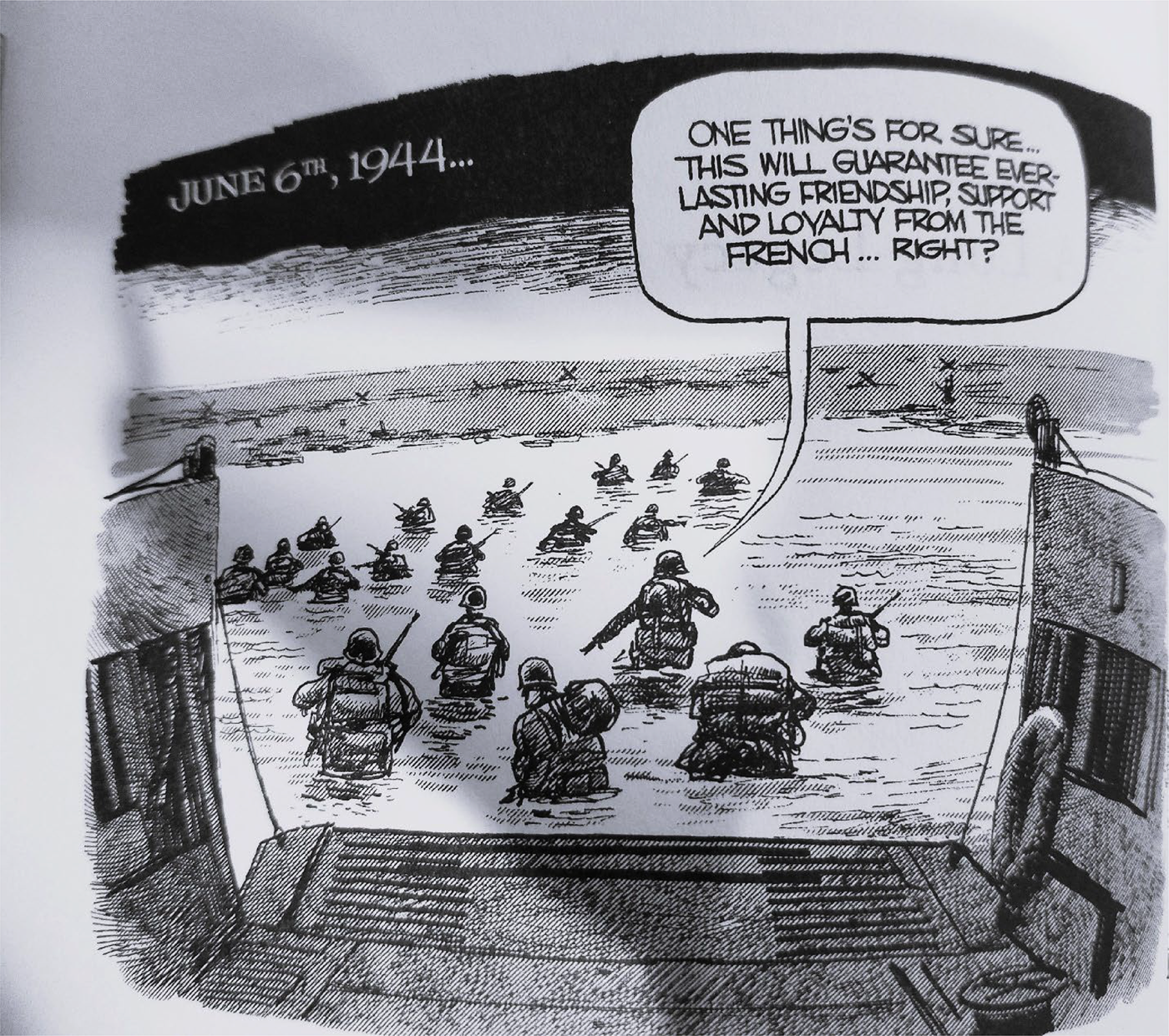
Yet the Americans counted on unqualified support from their ‘oldest ally’ [Figure 1]. Human lives could be individually tallied, but their collective value was immeasurable. For the French, national sovereignty had an analogous value; it was non-negotiable and inviolate. Honouring the American loss of life in service to the Liberation was not incompatible with the assertion of independent political thought and action. For French Senator Louis Jung, gratitude did not guarantee blind obedience. He stated this position in eloquent and moving terms on the floor of the French Senate. ‘To the American mother who asked me to put flowers on her son's grave, the son who had given his life to liberate France, I would like to say here that our conscience no longer permits us to follow you in your politics.’Footnote 49
San Diego Union Tribune, 2004. Photo credit: Steven Breen.

National autonomy was indissociable from national identity; the very existence of the nation depended on it. At stake for both parties were competing values, both incalculable, and therefore outside the bounds of customary exchange. Perhaps that is why the Liberation has been instrumentalised as moral leverage in times of conflict. Because human lives and national independence were deemed priceless, then reciprocation had to take another form. In the absence of reciprocation or the possibility of reciprocation, what remains other than the expression of gratitude?
The American performance of emotional diplomacy has consisted of reminding the French of their debt, or at very least, of the American contribution to both world wars, and in particular the Liberation of 1944–45 (where indebtedness is implied). The French have also performed emotional diplomacy by expressing gratitude, or at the very least by acknowledging the role of the United States in the Liberation (where gratitude is implied).Footnote 50 In speeches, interviews, and public exchanges, French references to the Liberation have become a standard trope used to nuance a critique, frame an objection, head off a criticism, or simply to reaffirm the special character of the French-American relationship.
A display of emotional diplomacy resurfaced in 2003, when President Jacques Chirac refused to join the Americans in invading Iraq on the now-debunked assertion that Iraq had weapons of mass destruction. In the storm of protest and indignation that followed, the 1966 exchange between de Gaulle and Rusk re-emerged in American news reports of Chirac's decision. In emulation of her predecessor Mendel Rivers, Ginny Brown-Waite, a Republican member of the House, proposed a ‘Heroes Repatriation Act’ to allow for the transfer of American war dead from ABMC cemeteries in France to the United States.Footnote 51 Others expressed their outrage by calling for a boycott of French luxury goods including wine, cheese, and pâté. Even the word ‘French’ in ‘French fries’ was deemed a sacrilege. Thanks to a resolution from Congressman Bob Ney, an Ohio Republican and chairman of the House Administration Committee, French fries were henceforth designated as ‘freedom fries’ in the cafeteria on Capitol Hill.
Nearly sixty years after the end of the Second World War, in a much-celebrated speech before the United Nations Security Council, French Minister of Foreign Affairs Dominique de Villepin made an impassioned denunciation of America's intention to invade Iraq. He ended his statement.
It is an old country, France, on an old continent, Europe, which has known wars, occupation, barbarism, which speaks to you today. A country that does not forget and knows how much it owes to the fighters for freedom who came from America and elsewhere.Footnote 52
By 2003, French performance of gratitude had become a common rhetorical practice. Here Villepin invoked France's experience of wartime suffering to explain his reasons for rejecting American militarism, then ended his speech with an acknowledgement of America's support for France during the Second World War. The tone of his conclusion may have been out of step with the rest of his speech, but it was also a way to soften his harsh remarks and even to defuse American resentment. While French expressions of gratitude may be instrumentalised to serve other purposes, does that make the sentiment any less sincere?
One might expect the power of the ‘gift of Liberation’ to diminish as the Second World War recedes in time, but so far that has not been the case. Nations have long memories. Even between friendly nations, there remains a virtual balance sheet of reciprocal favours and obligations. During the 1966 crisis, when the United States raised the issue of France's unpaid debt from the First World War, one angry French official claimed that France's debt had been settled in advance – by Lafayette!Footnote 53
The Liberated
A fuller picture of the Liberation, beyond the D-Day landings, calls into question the representation of the Liberation as ‘gift’. Allied armies landed on the French beaches of Normandy, but the Liberation was not strictly an American or even an Allied affair. As Allied armies advanced on two fronts, from Normandy in the west and Provence in the south, French resistance fighters prepared the way for them by strategic destruction of their own infrastructure. Bridges, railway lines, communication lines, and reserves of equipment and rolling stock were blown up or rendered useless. Working in tandem with Allied military planners and de Gaulle's external resistance in London and Algiers, resistance movements and groups of the interior ferried messages, collected intelligence, and supported Allied troops as they made their way across France. French prisoners-of-war who had escaped from German POW camps joined Allied forces. Last but not least, the inhabitants of towns and villages suffered immeasurable losses from Allied bombing raids. When the smoke cleared, French territory, farms, and factories lay in ruins. The death toll of French civilians reached nearly 300,000; that of French military has been assessed at approximately 250,000 – 123,000 of whom died in 1939–1940, and 43,000 fighting in the Liberation armies.Footnote 54 Characterising the Liberation as a gift diminishes the immense sacrifice of French military and civilians in winning back their own freedom.
While the local populations were grateful for Liberation, they sometimes found the liberators hard to bear. Military forces treated French territory first and foremost as utilitarian; concerns for the home communities were secondary. Of the Anglo-American Allied troops, it was the Americans who received the harshest criticism. Tensions were highest in the Norman cities of Cherbourg and Reims, where American troops stayed well beyond the end of the war (one and two years, respectively).Footnote 55 In the view of French inhabitants, the Americans took up too much space, both physically and metaphorically. They seemed oblivious to the sufferings and hardships of the local population. Most vexing of all was their tendency to avail themselves of what little food the French could access, despite the fact that soldiers already had the benefit of military rations.Footnote 56
In her study of the interactions between Allied troops and the French population of Normandy, Hilary Footitt both confounds and confirms Mauss's gift theory. French-American tensions derived from the respective roles of the parties not as givers and receivers, but as hosts and guests.Footnote 57 In this variant of the giver–receiver scenario, the local population identified as ‘hosts’ and saw the troops as their ‘guests’. The American troops were chez les Français – literally in the home of the French. The proffering of hospitality on one's own turf, however meager and in whatever form, obliges guests to behave in a respectful and culturally appropriate manner. Acknowledgement of the ‘debt’ implies a show of consideration for the host and the host's home, property, and mores. Failure to fulfil these expectations creates misunderstandings and sows discord. It is the same giver–receiver paradigm, but this time it is the French who are giving and the liberators who are displaying a lack of gratitude by abusing their hospitality. In this enactment of gift-giving where the roles are reversed, the resentments of the French toward the foreign troops can be understood in the same way as American accusations of French ingratitude.
French experience of the Liberation was specific to place and time. For those in the south of France, where resisters had liberated Marseille before the arrival of Allied troops, it was one of shared sacrifice and proud struggle. For those who lived near the Normandy beaches and towns that were heavily bombed, the local memory of Liberation was one of fear, death, and destruction – in short, victimhood. While some French were tending American graves and extolling the services of the liberators, their own private trauma took a back seat.Footnote 58 The loss of civilian lives and livelihoods, the destruction of the natural and built environment – however necessary to ending the occupation and winning the war – were long overshadowed by the deaths of the liberators. According to Kate Lemay, ‘Normans covertly dealt with their own difficult and and complex war history, in the context of political and social upheaval and even interpersonal violence, by becoming active caretakers of the Allied war cemeteries.’Footnote 59 A recovered collective memory of Liberation where both liberators and liberated played an active role eventually replaced an earlier version that cast the liberated as passive receivers of Liberation. This revision of the memory of Liberation, one that both accounted for French suffering and fused different regional experiences, had important implications for French national identity. At war's end, it was not only the French infrastructure and economy that required reconstruction; national identity had also taken a hit. This de Gaulle knew only too well.
The Gift and Identity
Gift-giving has implications for the identity of both giver and receiver. By embodying the very identity of the giver, gifts have a value-added component that makes them more than the thing that is given. Givers gain status and self-fulfilment by giving, but they also cede a part of themselves. Likewise, those on the receiving end broker a part of their identity in the exchange. Whether or not they have a choice, accepting the gift places recipients in a position of obligation that weakens their sense of an independent self.
Mauss asserts that power resides with the holder of the debt. When the gift has no price, as in the case of the sacrifice of human lives, it is unclear how it can be repaid – if ever.Footnote 60 A debt too monumental to be repaid in kind or in full entrenches giver and receiver in their relative positions of power. The cycle of exchange is broken, while the superiority enjoyed by the giver is secured. The asymmetrical nature of the relationship condemns the receiver to the impossible position of eternal indebtedness. This is what Fox and Swazey call ‘the tyranny of the gift’.Footnote 61
The full self, independent and debt-free, can only be properly restored through reciprocation – unless the cycle is broken, the terms are redefined, or the context has changed. By 1966, for de Gaulle, the context had changed. The postwar was out, the Cold War was in. It was time to steer a clear course between the United States and the Soviet Union by focusing on relationships among Europeans rather than on transatlantic ones. In de Gaulle's estimation, it was essential that France break free of its military subordination to the United States. By withdrawing France from the integrated military command of NATO, he aimed to make France whole again by restoring the country to its former grandeur (greatness). Only if France regained its independence in the fullest sense could de Gaulle fulfil his second, and arguably more important mission: to restore a sense of confidence and forward-looking national pride among the French, even his critics.
For de Gaulle, issues of French identity were paramount. ‘De Gaulle’, observed Henry Kissinger, ‘judges the merit of a policy not only by technical criteria but also by its contribution to France's sense of identity. More important than any specific policy issue is the rediscovery of a specifically French sense of purpose.’Footnote 62 If indebtedness has a deleterious effect on identity, as Maussian scholars have asserted, then it is easy to see why de Gaulle insisted on French autonomy vis à vis the United States. The identity of the giver nation had been greatly enhanced; the United States emerged from the Second World War with a newly acquired identity as a world power. French identity, by contrast, was in tatters.Footnote 63 Restoring a sense of national pride, repairing the humiliation of the defeat and re-asserting the primacy of France's values, lay at the heart of de Gaulle's foreign policy.
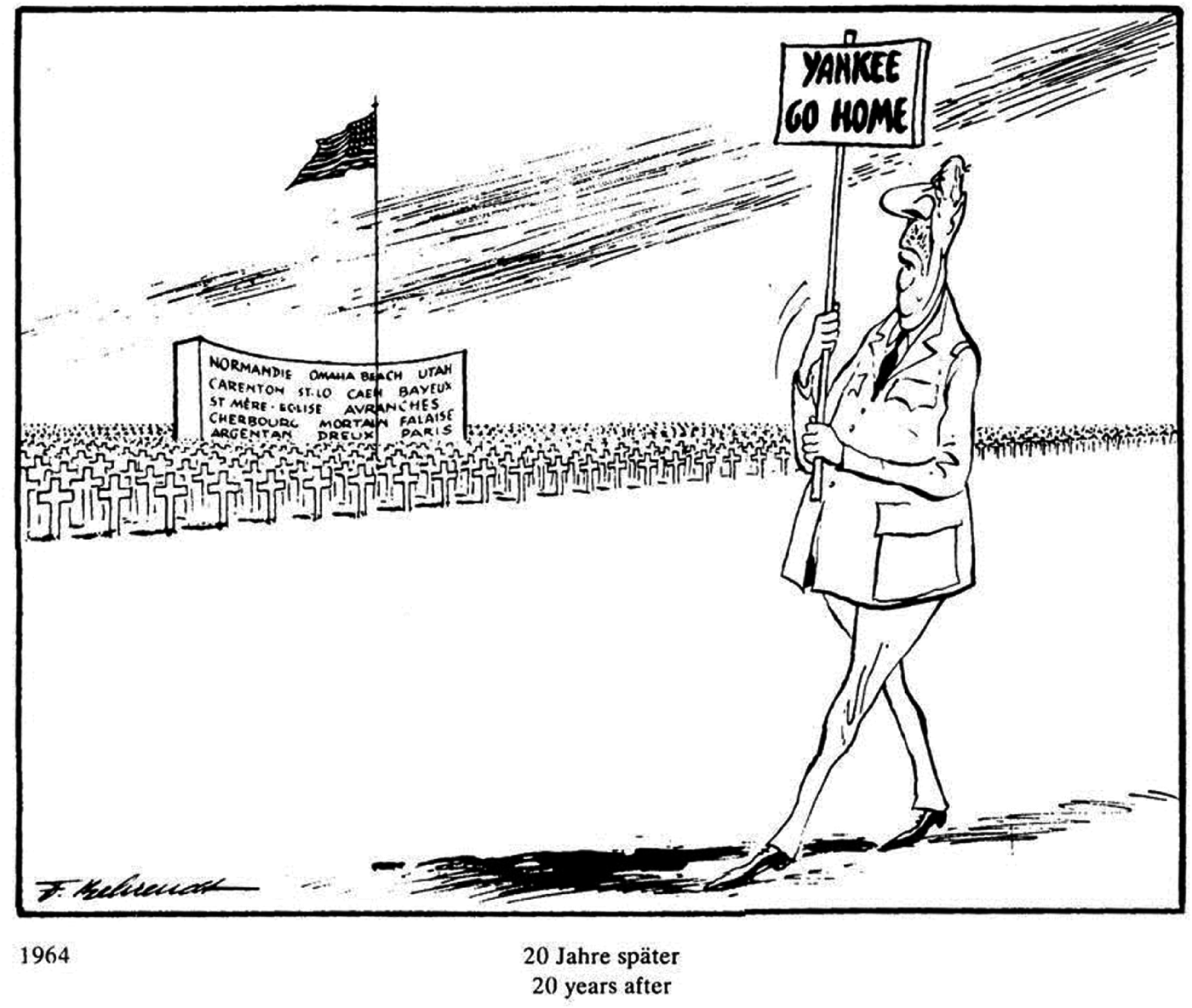
Twenty years had passed between the Liberation and de Gaulle's withdrawal of France from the military leadership of NATO. How salient was the debt at that point? Was it accruing interest or shrinking? Righting the imbalance between the giver nation and the receiver nation was perhaps de Gaulle's way of saying that as far as France was concerned, the debt, if indeed there was one, had been discharged. [Figure 2] The French–American relationship was surely asymmetrical when it came to raw military power, but for de Gaulle, France and the United States were peers in the arena of values. It was on that basis that de Gaulle laid claim to a co-equal partnership, or, as he called it, an ‘equilibrium’ of power.
A confident de Gaulle strides past an American cemetery, apparently oblivious to the graves of Americans who died in France during the Second World War. The names engraved on the curvilinear monument are those of Norman towns liberated after D-Day. The ‘Yankee Go Home’ sign is an ironic appropriation of the slogan adopted by French protesters, many of whom numbered among his arch-enemies, the French communists.
Source: Behrendt, Fritz. Helden und andere Leute, 25 Jahre Zeitgeschichte mit der Zeichenfeder kommentiert von Fritz Behrendt. Düsseldorf: Econ Verlag, 1975. 200 S. ISBN 3 430 11269 9.

Original Sin: The Defeat of May 1940
The counterpart to the Liberation is, of course, the defeat. It is as if the fall of France in May 1940 were – for Americans – France's original sin, an indelible moral tarnish inherent in citizenship and passed from generation to generation. Indeed, the defeat and ensuing German occupation of France is arguably more lasting in American memory, more infamous, than the collaborationist Vichy regime. Had France not been the perpetrator and victim of its own defeat in 1940, there would have been no need for the sacrifice of American lives in 1944–45. Unlike original sin, however, the defeat cannot be erased – at least it has not been erased so far. Until that time comes, the Liberation may well remain the gift that keeps on taking.
The defeat continues to function as a standard feature of the negative trope of Frenchness. The easy collapse of French defences, the tragic inadequacy of the Maginot Line, the ineptitude of military planners, the officer corps’ callous abandonment of the troops: for many American Francophobes, the fall of France in June 1940 figures as the defining moment of French perfidy and moral bankruptcy. It was unthinkable, incomprehensible – and unpardonable – that a major European ally of the First World War fall to German invaders in the short space of some six weeks. Critics who harp on the defeat give no consideration to the fact that France was outmanned and outgunned by the ‘hereditary enemy’.
American soldiers stationed in France in the Liberation era apparently held some of these same views. Our Friends the French [Nos Amis les Français], a training manual devised by the War Department for distribution to the troops, is comprised, catechism style, of a series of questions and answers about French history, culture, mores, and attitudes.Footnote 64 Whether the questions were indeed authentic or merely a stylistic device adopted for the sake of presentation, the author or authors claim that they emanated from the soldiers themselves.Footnote 65 Of the 112 entries, no fewer than seventeen are devoted to correcting negative impressions relating to the defeat of 1940.
The editor of the French translation, who happened to be writing in 2003 when Chirac had declined to join the American-led coalition to fight the Gulf War, identifies the original purpose of the book in an introductory note:
In order to know – as current events have just reminded us – whether we [the French] were ungrateful to the Americans who came to our rescue on two occasions, the response of the authors, also American, is not without mordancy [piquant].Footnote 66
The author or authors of the manual address a range of issues that derive from the defeat and a perceived lack of gratitude for American intervention. The following is in response to the comment ‘The French are not friendly.’
…[I]t is exceedingly difficult for people to be pleasant and friendly when they are hungry, cold, and have just endured six years of war, as have the French. And yet, the Americans who landed in Normandy or arrived in Paris just after its liberation still talk about the overwhelming demonstration of gratitude, generosity and friendship that the French have shown us.Footnote 67
The defeat of 1940 has become a recurring motif in American cultural discourse about the French, adopted even by postwar generations for whom the Second World War was far removed from personal history or family experience. One such example is the epithet ‘cheese-eating surrender monkeys’, popularised by the iconic television cartoon series The Simpsons, and repeated on the weekly comedy show Saturday Night Live.Footnote 68 The extent to which such sentiments will fade with time is impossible to determine. What is clear is that they have resurfaced time and again, among different constituencies, from American GIs in the 1940s and government officials, to the youthful audiences of popular TV shows of the 1990s and beyond.
Gender, Power and Identity
As the quintessential display of weakness, the defeat attributes to the French an undesirable ‘feminine’ quality. The liberators, by contrast, are ‘real men’. It is the classic ‘damsel in distress’ story of female vulnerability and male rescue.Footnote 69 The rescuers sacrifice themselves, or part of themselves, to save the damsel's life. Theirs is the supreme gift, one that defies reciprocation in equal measure. It is this inequality that secures the rescuers’ position of power for an indefinite period of time. Embedded in this gendered typology are dynamics of power.
It so happens that the rescuers in the case under examination here – the Allied armies – were comprised of men, but that is immaterial in this instance. Whatever their actual gender, rescuers (or givers) assume a dominant role that is coded as male.Footnote 70 In like fashion, the rescued, regardless of actual gender, is doubly female, both as victim and as the receiver of rescue. This gendered power dynamic has been hard-wired into the French–American relationship; it both preceded and followed the diplomatic exchange that is the focus of this article. It was precisely the respective positions of the United States and France as dominant and dominated, male and female, that de Gaulle aimed to unsettle when he withdrew France from the military command of NATO.Footnote 71
French and Americans are often represented in caricatures, drawings and text as a bickering couple, Uncle Sam and Marianne. Serious disputes qualify as ‘divorce’, joint endeavours are ‘liaisons’, reconciling is ‘making up’.Footnote 72 As for the dispute between the Americans and the French over de Gaulle's withdrawal from NATO, a French newspaper reported that the ‘French-American couple [was] going through a rough patch’.Footnote 73 Popular culture on both sides of the Atlantic is saturated with gendered metaphors and images, but they also characterise official representations.Footnote 74 When asked about the state of the US–France relationship in 2003, Secretary of State Colin Powell replied, ‘I wasn't too happy with the French. But they were there for us in 1776. We've been married for 230 years and […] in marriage counseling for most of that time.’Footnote 75
Years later, Secretary Powell once again distinguished himself as a master of the genre. His counterpart, French Minister of Foreign Affairs Hubert Védrine, criticised President George W. Bush's Manichean notion of global politics as ‘simplistic’.Footnote 76 Powell famously dismissed the remark by saying that Védrine was suffering from the ‘vapours’, a nineteenth-century pseudo-medical diagnosis of erratic behaviour in women. The following exchange took place during an interview of Védrine on the French radio:
Interviewer: Colin Powell, the head of diplomacy, wondered whether you had the ‘vapours’. President Bush […] found this retort interesting. How do you respond? Do you have the vapours?
Védrine: It is normal that he defend his secretary of state. But as I said the day before yesterday, [the remarks] were ‘virile exchanges’ between friends. They do not prevent us from talking to each other.Footnote 77
Védrine's dismissal of Powell's dismissal of his own dismissal is all the more pertinent for his gendered rendering of the exchange. The interviewer, who appears to be unaware of the gendered implications of vapours, defines it earlier in the interview as a state of ‘overexcitement [surchauffement]’. Védrine's response is a tacit acknowledgement that he understood Powell's remark to imply weakness and effeminacy.
Such exchanges, however off-handed, reveal and reinforce the gendered national identities that are deeply embedded in American and French mentalities. It is worth noting that President Roosevelt famously referred to de Gaulle as ‘the bride’ and ‘the temperamental lady’.Footnote 78 While gendered language and images are often intended as jokes, when mapped onto relations of power they convey far more than humour.
Frenchification is Feminisation
The gendering of Frenchness as feminine is nowhere so evident as in the American treatment of Senator John Kerry when he was a candidate for the presidency in 2004. Kerry's bid for the presidency landed at a time when anti-French sentiment was at its most virulent: the maelstrom of anti-France antipathy unleashed by Chirac's refusal to join the ‘coalition of the willing’ the preceding year had yet to subside. Ironically, Senator Kerry had voted in favour of the invasion of Iraq, but that mattered little. It was the ‘Frenchness’ of his appearance, his character, and his background that subjected him to relentless attacks in the press and even on the floor of the US Congress.Footnote 79
John Kerry had spent many years in France as a youth. Members of his family are French. His mother was born in Paris. And worse yet, Kerry is fluent in five languages – including French. In the eyes of some, this disqualified him from occupying the highest office in the land. He was called a ‘sissy’ and a ‘wuss’. He was criticised for ‘looking French’, for his ‘cosmopolitanism’ (a common epithet levelled at those deemed enemies of the nation – one need only think of the Jews of Europe in the 1930s), and for having pro-French values and ideas. Kerry even avoided answering questions from French-speaking journalists in French because it fuelled the attacks. Years later, as Secretary of State, Kerry attended a diplomatic conference in Canada where he met French Minister of Foreign Affairs Laurent Fabius. Kerry began by addressing his interlocuters in French but then switched to English. ‘And now I will speak in English’, he told the audience, ‘because otherwise I would not be allowed to return back home.’Footnote 80
Kerry was a victim of the American feminisation of France.Footnote 81 Frenchness has long been coded as ‘feminine’ in American (and British) culture. Weakness, indecisiveness, subtlety, fussy refinement: the traits associated with France and the French bear female gender tags.Footnote 82 Their opposites, by contrast, are marked as male, and no less important, as quintessentially American: economics and industry; military might; loyalty and ‘brotherhood’; plain speaking and pragmatism. Taken together, the two sets of qualities could be perceived as complementary; instead, they set Americans and French apart.
For Americans, France bears not only a marker of gender but also of upper-class privilege. Kerry's elite education and social origins (another source of resentment among American voters) only compounded his alleged ‘Frenchness’. This class-based notion of France may have had some saliency in the nineteenth- and early twentieth centuries, but it is at odds with contemporary reality. Yet the class-based association with France, which can cut both ways, remains stubbornly ingrained in the American imaginary.
References to the relationship between liberators and liberated are rich in gendered and even sexualised imagery. When in 1967 American officials insisted that the United States had no intention of violating French integrity by remaining in France after the Liberation, they were employing a gendered discourse, however unintentional. The violation here is figurative, but it also recalls the real violation of French women by American liberators. The image of the American soldier as the magnanimous dispenser of cigarettes and chocolate to the local population has its darker side. American soldiers’ treatment of French women, including numerous instances of reported rape, created painful dissensions between ‘liberators’ and the people they had come to liberate.Footnote 83
From ‘Coca-colonisation’ to ‘McDomination’
Contemporary interpretations of colonialism are also useful in understanding the asymmetrical relationship between the two countries. The Atlantic alliance was ‘an American protectorate set up in Europe under the cover of NATO’, claimed de Gaulle in February 1966.Footnote 84 When calling for the removal of the American military presence in France, he gave voice to a sentiment shared by many elements of the French population who viewed the presence of American military bases on French soil as a form of ‘colonisation’. Ironically, the American ‘liberators’ had taken the place of the German occupiers they had come to evict. By 1966, France was no longer an imperial power; the institutional vestiges of the French empire had been officially dismantled in 1962 with the independence of Algeria. To add insult to injury, the longtime colonisers had themselves become the colonised. It was a bitter pill to swallow for de Gaulle.
For the French Communist party (PCF) and other critics on the left, the D-Day arrival of the Americans qualified as an ‘invasion’.Footnote 85 It is easy to see why: the United States had made preparations for the occupation of France in the event of a communist takeover of power. Occupation currency had been minted. A military infrastructure was already in place; in fact, the four American military bases that had to be dismantled in 1966 were built on property that had already served as landing and refuelling depots during the war.Footnote 86 Yet over the years, American officials commemorating D-Day in France have insisted on the disinterested nature of their presence in Europe:
President Ronald Reagan (1984): [T]here is a profound, moral difference between the use of force for liberation and the use of force for conquest. […] Today, as 40 years ago, our armies are here for only one purpose – to protect and defend democracy. The only territories we hold are memorials like this one and graveyards where our heroes rest.Footnote 87
President Barack Obama (2014): We claimed no land other than the earth where we bury those who gave their lives under our flag, and where we station those who still serve under it.Footnote 88
When the American liberator-occupiers left France, their goods remained, from Jeeps and jeans to Coca-Cola and Spam. The French left, in particular the French Communist Party, railed against the ‘coca-colonisation’ of France in 1949.Footnote 89 By the 1990s, French critics were again denouncing American cultural influence, this time as ‘McDomination’.Footnote 90 It was an invasion of a different kind, one that could never be mistaken for Liberation.
The relationship of coloniser to colonised also encodes gender relations.Footnote 91 The coloniser, invariably male, infantilises, emasculates, and feminises his colonised subjects. The disparities of power between ‘female’ colonised nations and ‘male’ colonisers can be so extreme that gifts such as food aid are sometimes rejected, avoided, or shunned when the recipients recognise the impossibility of reciprocity. With the gift come humiliation, recognition of the recipient's inferior status, and a sense of entrapment.Footnote 92 This ambiguous aspect of the gift has long plagued international humanitarian aid programs, including the Marshall Plan of the postwar period.Footnote 93
The asymmetrical transatlantic relationship between giver and receiver is both reflected and reinscribed by the gendering of France as female. These gendered representations are deeply anchored in the American idea of France, and in the case of the American ‘invasion’, even in the idea the French have of themselves. Gendered identities of self and other sustain and support power relations between the two countries. They also play a vital role in shaping notions of gratitude and ingratitude, real or imagined, in the public arena.
Je t'aime. Moi non plus
Jacques Chirac's refusal to join the alliance against Saddam Hussein during the 2003 Gulf War erupted in a tsunami of American anti-French invective.Footnote 94 It was in many ways a replay of de Gaulle's infamous ‘rebuff’ of 1966 and appeared to seriously threaten the multisecular transatlantic relationship between France and the United States. In fact, Chirac's decision may have elicited an even more explosive response from the Americans, who once again took deep offense at yet another ‘abandonment’ by their French allies. As before, the gift of Liberation was instrumentalised in the debate. The rift was profound. Just as in 1966, however, the incident did not result in a permanent estrangement. If American expectations of a particular form of reciprocity were disappointed but the bond survived, had the gift of Liberation lost its mojo? What does this mean for the explanatory power of Mauss's theory of the gift?
Adopting a more global perspective helps us to understand the resilience of the French–American relationship. Seen from a wider angle, the distance between the two countries is smaller than it appears at close range. In his study of emotional diplomacy within global security communities, NATO and the UN, Simon Koschut shows that different rules of conduct apply to ‘insiders’ and ‘outsiders’. Insiders, such as France and the United States, share common values and common enemies – the security community outsiders.Footnote 95 The expression of negative emotion from outsiders is considered destabilising or threatening. The same negative emotion from a fellow insider is far less potent. Fractious behaviour between and among insiders has fewer consequences because insiders stop short of destroying the community bond. In short, in 1966 it was passable behaviour for the highest-ranking American diplomat to infer, in a face-to-face meeting with the French president, that bringing US troops home from France included the repatriation of dead bodies. Shocking though it may have been, Secretary Rusk's retort did not destroy a longstanding transnational partnership.
It is normal that differences divide – less so similarities. Yet it is precisely what Americans and French have in common that often divides them. Only among insiders can points of common accord become sources of strife. And insiders can have the luxury of criticising each other without inflicting permanent damage on the relationship. If, as George Bernard Shaw famously quipped, ‘England and America are two countries divided by a common language’, then France and the United States are two countries divided by a common cause.
In 1944 common purpose and cooperation were the message of the day. The GI handbook for understanding the French emphasises time and again the history, values, and principles that join the two nations. For these reasons, differences of opinion were not only to be tolerated but welcomed: ‘The French are independent. They are proud, individualistic. Like us. That is one of the reasons there is friction between us.’Footnote 96
On the seventieth anniversary of D-Day, President Barack Obama broke the infernal cycle of exchange where France is perpetually on the receiving end of American largesse.
Just last week, I received a letter from a French citizen. ‘Dear Mr. President and the American people’, he wrote, ‘[we are] honoured to welcome you […] to thank you again for all the pain and efforts of [the] American people and others in our common struggle for freedom.’
Today, we say the same to the people of France. Thank you, especially, for the generosity you've shown the Americans who've come here over the generations – to these beaches, and to this sacred place of rest for 9,387 Americans. At the end of the war, when our ships set off for America filled with our fallen, tens of thousands of liberated Europeans turned out to say farewell. And they pledged to take care of the more than 60,000 Americans who would remain in cemeteries on this continent ‘as if’, in the words of one man, ‘their tombs were our children's.’ You have kept your word, like the true friends you are. We are forever grateful.Footnote 97
The ‘gift’ of Liberation, and indeed America's contribution to both world wars, remain profoundly embedded in the moral and emotional economies of diplomacy between France and the United States. But a gift that is too monumental to be repaid in kind places the recipient in the position of indefinite indebtedness. When the giver expects reciprocity that involves a compromise of national identity and national sovereignty, real or perceived, the exchange is stalled and the relationship remains asymmetrical. If such a debt indeed exists, how much and what kind of gratitude will suffice to expunge it? French leaders have made it clear that national identity and political independence are not for sale. France may be allied with the United States, but it is not aligned.Footnote 98 True friends speak their mind to each other; allies, however indispensable, have the right to object to actions or policies that contravene their own principles.
To reprise the oft-cited phrase of French anthropologist Claude Lévi-Strauss, gift theory is ‘good to think with’. The gift analogy borrowed from Mauss helps to explain the cycles of gratitude and ingratitude, real or perceived, that have pervaded relations between French and Americans. But which French, which Americans? The ideas explored in this essay appear so fully diffused throughout the two societies that a satisfactory answer to those questions remains elusive. Expressions of gratitude and ingratitude have circulated among political elites and ordinary citizens on both sides of the Atlantic. Neither gratitude nor ingratitude, admiration or resentment, appear to be the exclusive preserve of the political left or right in either country. Nor do they appear to be confined to a particular generation – at least not so far. Memory of the Liberation, the gift that gives and takes, surfaces and recedes among different constituencies, at different times and in different spaces.
In the history of commemorations, the year 2024 is momentous: 4 April marks NATOs 75th anniversary, followed by the 80th anniversaries of D-Day (6 June) and the Liberation of Paris (25 August). For the first time, there will be no veterans of the 6 June 1944 landing in attendance at the annual commemorations in Normandy; the last of the first-wave survivors has perished. Will the next series of commemorations be virtual time capsules, where gratitude and ingratitude, admiration and resentment, repressed memory and recovered memory, are reenacted? Will the Liberation remain the gift that keeps on taking? Or will it recover its literal meaning, for all its banality: that of an unimaginably colossal and audacious military undertaking, the precondition for Allied victory in a long, treacherous, and murderous world war?