



1 Introduction
Let X be a compact connected Riemann surface and E a holomorphic vector bundle over X. A Lie algebroid on X is a locally free coherent analytic sheaf V on X equipped with a Lie algebra structure together with a holomorphic homomorphism of vector bundles
 $\phi \, :\, V\, \longrightarrow \, TX$
that intertwines the Lie algebra structure with the Lie bracket operation on
 $TX$
. The notion of holomorphic connections on a holomorphic vector bundle E on X extends to holomorphic Lie algebroid connections on E. In the definition of holomorphic Lie algebroid connections,
 $TX$
is replaced by V; the homomorphism
 $\phi $
is used in formulating the Leibniz identity.
Lie algebroid connections are quite similar to Simpson’s notion of
 $\Lambda $
-modules [Reference Simpson22–Reference Tortella24]. In fact, Lie algebroid connections simultaneously generalize a number of geometric structures that appear in differential geometry, algebraic geometry, and foliations. It also appears in mathematical physics [Reference Cortés and Martínez8, Reference Lazzarini and Masson13]. Some examples of topics where Lie algebroid connections appear: Higgs bundles [Reference Hitchin12, Reference Simpson21, Reference Simpson22]; twisted Higgs bundles [Reference Nitsure16]; flat connections [Reference Simpson21]; logarithmic or meromorphic connections [Reference Boalch6, Reference Bremer and Sage7, Reference Deligne9, Reference Nitsure17]; and foliations [Reference Evens, Lu and Weinstein10, Reference del Pino and Presas18, Reference del Pino and Witte19] (see also the references in these works).
In [Reference Biswas, Kumar and Singh4], a criterion for the existence of a Lie algebroid connection on E was given under the assumption that the vector bundle V is stable.
Parabolic vector bundles are generalizations of holomorphic vector bundles. Parabolic vector bundles on Riemann surfaces were introduced by Mehta and Seshadri in [Reference Mehta and Seshadri15], and their definition was further developed by Maruyama and Yokogawa to higher-dimensional projective varieties [Reference Maruyama and Yokogawa14]. In [Reference Mehta and Seshadri15], it was shown that the polystable parabolic vector bundles of rank r and parabolic degree zero, with parabolic structure over S, on a compact Riemann surface X correspond to the representations of the fundamental group of the complement
 $X\setminus S$
into
 $\mathrm {U}(r)$
. More generally, polystable parabolic Higgs bundles of rank r and parabolic degree zero on X, with parabolic structure over S, correspond to the completely reducible representations of the fundamental group of the complement
 $X\setminus S$
into
 $\text {GL}(r,{\mathbb C})$
[Reference Simpson20].
In this context, it is natural to ask whether Lie algebroid connections extend to the setup of parabolic vector bundles. Our aim here is to address this question.
Let
 $S \,=\, \{x_1,\, \ldots ,\, x_m\}\, \subset \, X$
be a nonempty finite subset, whose elements will be called the parabolic points. Let
 $E_*$
be a parabolic vector bundle over X with parabolic structure over S (see Section 2.2 for the definition). A connection on a parabolic vector bundle
 $E_*$
is a logarithmic connection on the underlying holomorphic vector bundle E which is singular over S such that the residue of the connection over any
 $x\, \in \, S$
is compatible with the parabolic structure of
 $E_*$
over x.
Every parabolic vector bundle can be expressed as a direct sum of indecomposable parabolic vector bundles. A parabolic vector bundle
 $E_*$
admits a connection if and only if the parabolic degree of every parabolic vector bundle which is a direct summand of
 $E_*$
is zero [Reference Biswas and Logares5, Theorem 1.1].
Given a Lie algebroid
 $(V,\, \phi )$
and a parabolic vector bundle
 $E_*$
, we define parabolic Lie algebroid connections on
 $E_*$
(see Definition 3.2). If
 $V\,=\, TX\otimes {\mathcal O}_X(-S)$
and
 $\phi $
is the natural inclusion map of
 $TX\otimes {\mathcal O}_X(-S)$
in
 $TX$
, then a parabolic Lie algebroid connection on
 $E_*$
is a usual connection on the parabolic vector bundle. After having the definition of a parabolic Lie algebroid connection, we address the question of giving a criterion for the existence of a parabolic Lie algebroid connection on a parabolic vector bundle.
As mentioned before, the definition of a connection on a parabolic vector bundle
 $E_*$
uses the residue, over the points of S, of a logarithmic connection. Given a Lie algebroid
 $(V,\, \phi )$
, for any Lie algebroid connection D on a holomorphic vector bundle F on X, we construct a
 $\mathbb C$
-linear homomorphism
 $$ \begin{align*}{\mathcal S}_x\, :\, F_x\, \longrightarrow\, F_x\otimes \mathrm{cokerel}(\phi)_x\,=\, F_x\otimes {\mathcal Q}_x \end{align*} $$
for every
 $x\, \in \, X$
(see (2.7)). This homomorphism is a generalization of the notion of the residue of a logarithmic connection.
Before defining a parabolic Lie algebroid connection, we introduce the weaker notion of a quasi-parabolic Lie algebroid connection. We prove the following (see Proposition 3.2).
Proposition 1.1 Let
 $(V,\, \phi )$
be a Lie algebroid and
 $E_*$
a parabolic vector bundle. A Lie algebroid connection
 $D\,:\, E\,\longrightarrow \, E\otimes V^*$
on the vector bundle E underlying
 $E_*$
gives a quasi-parabolic Lie algebroid connection on the parabolic vector bundle
 $E_*$
if and only if the following two statements hold:
-
(1) For every
 $x\, \in \, S$
, the homomorphism
${\mathcal S}_x$
preserves the quasi-parabolic filtration of
$E_*$
over x.
-
(2) For all
$x\, \in \, S$
, the homomorphism of fibers
$\phi ^*_x\, :\, (K_X)_x\, \longrightarrow \, V^*_x$
is the zero map.



A parabolic Lie algebroid connection on
 $E_*$
is a quasi-parabolic Lie algebroid connection on
 $E_*$
such that the action of
 ${\mathcal S}_x$
on each graded piece of the quasi-parabolic filtration of
 $E_*$
over x is given by the parabolic weight of that graded piece (see Definition 3.2).
Next, we develop a parabolic analog of the Atiyah exact sequence in the setup of Lie algebroids. First, we introduce the notion of generalized parabolic Lie algebroid connections, and the sheaf
 $\mathcal {C}_{E_*,V}$
of generalized parabolic Lie algebroid connections on
 $E_*$
, which is a holomorphic vector bundle over X, fits into a short exact sequence (see (3.18)). A parabolic Lie algebroid connection on
 $E_*$
is precisely a holomorphic splitting of (3.18).
Let
 $(V,\, \phi )$
be a Lie algebroid such that the homomorphism
 $\phi $
vanishes over S. Then, the dual homomorphism
 $\phi ^*\, :\, K_X\, \longrightarrow \,V^*$
also vanishes over S, and hence it produces a homomorphism
 $$ \begin{align*}\widetilde{\phi}^* \,\, : \,\, K_X \otimes {\mathcal O}_X(S) \,\,\longrightarrow\,\, V^*. \end{align*} $$
In Section 4, we give a criterion for the existence of parabolic Lie algebroid connections on a parabolic vector bundle. The following is proved (see Theorem 4.3).
Theorem 1.2 Let
 $(V,\, \phi )$
be a Lie algebroid such that V is stable and the homomorphism
 $\phi $
vanishes over S. Let
 $E_*$
be a parabolic vector bundle on X. Then, the following two statements hold:
-
(1) If the above homomorphism
$\widetilde {\phi }^*$
is not an isomorphism, then
$E_*$
admits a parabolic Lie algebroid connection. -
(2) If
$\widetilde {\phi }^*$
is an isomorphism, then
$E_*$
admits a parabolic Lie algebroid connection if and only if the parabolic degree of every parabolic direct summand of
$E_*$
is zero.


Finally, in the last section, we study integrable Lie algebroid connections and their moduli by analyzing them in the framework of parabolic
 $\Lambda $
-modules in the sense of [Reference Simpson22] and [Reference Alfaya1]. It is shown that the integrable quasi-parabolic Lie algebroid connections are equivalent to the parabolic
 $\Lambda $
-module structures in the sense of Definition 5.1 [Reference Alfaya1, Definition 2.5]. Defining the semistable parabolic Lie algebroid connections in this context, we prove the following theorem (see Theorem 5.3).
Theorem 1.3 Let
 $(V,\,\phi )$
be any Lie algebroid such that
 $\phi |_S\,=\,0$
. For every system of weights
 $\alpha \,=\,\{\{\alpha _i^x\}_{i=1}^{l_x}\}_{x\in S}$
, every parabolic type
 $\overline {r}\,=\,\{\{r_i^x\}_{i=1}^{l_x}\}_{x\in S}$
, and every degree d, there exists a quasi-projective coarse moduli space
 $\mathcal {M}_{(V,\phi )}(\alpha ,\,\overline {r},\,d)$
of semistable integrable parabolic
 $(V,\,\phi )$
-connections
 $(E_*,\,D)$
on
 $(X,\,S)$
, with
 $D\,:\,E\,\longrightarrow \, E\otimes V^*$
,
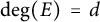 $\deg (E)\,=\,d$
,
 $\dim (E_x^i/E_x^{i+1})\,=\,r_x^i$
and system of weights
 $\alpha $
.
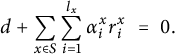
If V is a line bundle, then this moduli space is nonempty if and only if either:
-
•
$(V,\,\phi )\,\,\ne \,\, (TX(-S),\ i\,:\,TX(-S)\,\hookrightarrow \, TX)$
, or -
•
$(V,\,\phi )\,\,=\,\,(T(-S),\ i\,:\,TX(-S)\,\hookrightarrow \, TX)$
and
$$ \begin{align*}d+\sum_{x\in S} \sum_{i=1}^{l_x} \alpha_i^x r_i^x \,\,=\,\, 0.\end{align*} $$


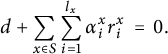
If V is a stable bundle, then for the moduli space to be nonempty, it is sufficient to have either:
-
•
$\operatorname {im} \phi \ne TX(-S)$
, or -
•
$\operatorname {im} \phi = TX(-S)$
and
$$ \begin{align*}d+\sum_{x\in S} \sum_{i=1}^{l_x} \alpha_i^x r_i^x \,=\, 0.\end{align*} $$


2 Lie algebroid connections and parabolic bundles
2.1 Lie algebroid connection
Let X be a compact connected Riemann surface. The holomorphic cotangent and tangent bundles of X will be denoted by
 $K_X$
and
 $TX,$
respectively. The first holomorphic jet bundle of a holomorphic vector bundle W on X will be denoted by
 $J^1(W)$
; so
 $J^1(W)$
is a holomorphic vector bundle on X that fits in the following short exact sequence of holomorphic vector bundles on X:
 $$ \begin{align*}0\, \longrightarrow\, W\otimes K_X \, \longrightarrow\, J^1(W) \, \longrightarrow\, W \, \longrightarrow\, 0. \end{align*} $$
A
 $\mathbb {C}$
-Lie algebra structure on a holomorphic vector bundle V on X is a
 $\mathbb {C}$
-bilinear pairing defined by a sheaf homomorphism
 $$ \begin{align*}[-,\, -] \,\,:\,\, V\otimes_{\mathbb C} V \,\, \longrightarrow\,\, V, \end{align*} $$
which is given by an
 ${\mathcal O}_X$
-linear holomorphic homomorphism
 $$ \begin{align*}J^1(V)\otimes J^1(V)\, \longrightarrow\, V\end{align*} $$
of vector bundles, such that
 $$ \begin{align*}[s,\, t]\,=\, -[t,\, s]\ \ \text{ and }\ \ [[s,\, t],\, u]+[[t,\, u],\, s]+[[u,\, s],\, t]\,=\,0\end{align*} $$
for all locally defined holomorphic sections
 $s,\, t,\, u$
of V. The Lie bracket operation on
 $TX$
gives the structure of a Lie algebra on it.
A Lie algebroid on X is a pair
 $(V,\, \phi )$
, where
-
(1) V is a holomorphic vector bundle on X equipped with the structure of a
$\mathbb {C}$
-Lie algebra, -
(2)
$\phi \, :\, V\, \longrightarrow \, TX$
is an
${\mathcal O}_X$
-linear homomorphism such that
$$ \begin{align*}\phi([s,\, t])\,=\, [\phi(s),\, \phi(t)] \end{align*} $$
for all locally defined holomorphic sections
$s,\, t$
of V, and -
(3)
$[s,\, f\cdot t]\,=\, f\cdot [s,\, t]+\phi (s)(f)\cdot t$
for all locally defined holomorphic sections
$s,\, t$
of V and all locally defined holomorphic functions f on X.







The above homomorphism
 $\phi $
is called the anchor map of the Lie algebroid. (See [Reference Alfaya and Oliveira2] for more details.)
Remark 2.1 Observe that the above condition (2) is actually a consequence of conditions (1) and (3), since, for all holomorphic local sections
 $s,t,u$
of V and each locally defined holomorphic function f in
 $\mathcal {O}_X$
, we have, on the one hand,
 $$ \begin{align*}[[s,\,t],\,fu]\,=\,f[[s,\,t],\,u]+\phi([s,\,t])(f) u\end{align*} $$
and, on the other hand,
 $$ \begin{align*}[[s,\,t],\,fu]\,=\,[[s,\,fu],\,t]+[s,\,[t,\,fu]]\,=\,[f[s,\,u]+\phi(s)(f)u,\,t] \end{align*} $$
 $$ \begin{align*}+[s,\,f[t,\,u]+\phi(t)(f) u] \,=\, f[[s,\,u],\,t]-\phi(t)(f)[s,\,u]+\phi(s)(f)[u,\,t] \end{align*} $$
 $$ \begin{align*}-\phi(t)(\phi(s)(f)) u + f[s,\,[t,\,u]]+\phi(s)(f)[t,\,u] +\phi(t)(f)[s,\,u]+\phi(s)(\phi(t)(f))u \end{align*} $$
 $$ \begin{align*}=\, f[[s,\,t],\,u]+\left( \phi(s)(\phi(t)(f))-\phi(t)(\phi(s)(f))\right) u\nonumber \end{align*} $$
 $$ \begin{align*}=\, f[[s,\,t],\,u]+[\phi(s),\, \phi(t)](f) u.\nonumber \end{align*} $$
As these coincide for each local holomorphic section u of V and each local holomorphic function f, we must have
 $$ \begin{align*}\phi([s,\,t])\,\,=\,\,[\phi(s),\,\phi(t)].\end{align*} $$
Let
 $(V,\, \phi )$
be a Lie algebroid on X. We have the dual homomorphism
 $$ \begin{align} \phi^*\,:\, K_X\, \longrightarrow\, V^* \end{align} $$
of
 $\phi $
. Let
 $$ \begin{align} q\,\, :\,\, V^* \,\, \longrightarrow\,\, V^*/\phi^*(K_X)\,\,=:\,\, {\mathcal Q} \end{align} $$
be the corresponding quotient map. Note that the above coherent analytic sheaf
 ${\mathcal Q}$
may have torsion. For any point
 $y\, \in \, X$
, the quotient
 ${\mathcal Q}/\mathbf {m}_y {\mathcal Q}$
, where
 $\mathbf {m}_y\, \subset \, {\mathcal O}_X$
is the maximal ideal associated with y, will be denoted by
 ${\mathcal Q}_y$
.
The fiber over any point
 $y\,\in \, X$
of any vector bundle W on X will be denoted by
 $W_y$
.
A Lie algebroid connection on a holomorphic vector bundle E on X is a first-order holomorphic differential operator
 $$ \begin{align*}D\,\,:\,\, E\,\,\longrightarrow\, \, E\otimes V^* \end{align*} $$
such that
 $$ \begin{align} D(fs) \,=\, fD(s) + s\otimes \phi^*(df) \end{align} $$
for all locally defined holomorphic section s of E and all locally defined holomorphic function f on X, where
 $\phi ^*$
is the homomorphism constructed in (2.1). (See [Reference Atiyah3] for usual holomorphic connections.)
Consider a Lie algebroid connection
 $D\,:\, E\,\longrightarrow \, E\otimes V^*$
on E. Fix a point
 $x\, \in \, X$
. Take any
 $v\, \in \, E_x$
. Choose a holomorphic section s of E, defined on an open neighborhood U of x, such that
 $s(x)\,=\, v$
. Consider
 $D(s)\, \in \, H^0\left (U,\, (E\otimes V^*)\big \vert _U\right )$
. Let
 $$ \begin{align} \widehat{s} \,:=\, (\mathrm{Id}_E\times q)(D(s))(x) \, \in\, E_x\otimes {\mathcal Q}_x \end{align} $$
be the image, where q is the projection in (2.2). If
 $s_1$
is another holomorphic section of E, defined on an open neighborhood of x, with
 $s_1(x) \,=\, v$
, then
 $$ \begin{align} s-s_1\,\,=\,\, f\cdot t, \end{align} $$
where t is a holomorphic section of E defined on an open neighborhood of x, and f is a holomorphic function defined around x with
 $f(x)\,=\, 0$
. From (2.3) and (2.5), it follows that
 $$ \begin{align} (D(s) -D(s_1))(x) &= t(x)\otimes \phi^*(df)(x) + f(x)\cdot (D(t))(x)\nonumber \\ &=t(x)\otimes \phi^*(df)(x), \end{align} $$
because
 $f(x)\,=\, 0$
. Since
 $q(\phi ^*(df))\,=\, 0$
, where q is the projection in (2.2), from (2.6), it follows that
 $$ \begin{align*}\widehat{s} \,=\, (\mathrm{Id}_E\times q)(D(s))(x) \,=\, (\mathrm{Id}_E\times q)(D(s_1))(x).\end{align*} $$
Consequently, we get a linear map
 $$ \begin{align} {\mathcal S}_x\,\,:\,\, E_x\,\, \longrightarrow\,\, E_x\otimes {\mathcal Q}_x \end{align} $$
that sends any
 $v\, \in \, E_x$
to
 $\widehat {s}\,:=\, (\mathrm {Id}_E\times q)(D(s))(x)$
, where s is any holomorphic section of E, defined around x, with
 $s(x)\,=\, v$
.
Notice that this linear map
 $\mathcal {S}_x$
can be defined for any Lie algebroid connection and over each point of the curve
 $x\,\in \,X$
; not necessarily a parabolic point in S (parabolic points are introduced in Section 2.2). Let
 $S\, \subset \, X$
be a reduced effective divisor on X. In the special case of logarithmic connections – where
 $(V,\, \phi )\,=\,(TX(-S),\, i:TX(-S)\hookrightarrow TX)$
– we have
 $\phi |_x\, =\, 0$
for
 $x\, \in \, S$
, so
 $\mathcal {Q}_x\,=\,(K_X\otimes {\mathcal O}_X(x))|_x \,= \, \mathbb {C}$
(Poincaré adjunction formula) and the map
 $\mathcal {S}_x$
becomes the usual notion of residue of a logarithmic connection. Thus, we can understand
 $\mathcal {S}_x$
as a natural generalization for arbitrary Lie algebroids – and arbitrary points – of the residue map. In fact, in the next section, we will see that, when
 $x\in S$
is a parabolic point, the map
 $\mathcal {S}_x$
plays exactly the same role as the residue in the characterization of parabolic Lie algebroid connections.
2.2 Parabolic bundles
Let
 $S \,=\, \{x_1,\, \ldots ,\, x_m\}\, \subset \, X$
be a nonempty finite subset, whose elements will be called the parabolic points. Let E be a holomorphic vector bundle over X. A quasi-parabolic structure on E over
 $x\, \in \, S$
is a strictly decreasing filtration of subspaces of the fiber
 $E_x$
 $$ \begin{align} E_x \,=\, E^1_x \,\supsetneq\, E^2_x \,\supsetneq\, \, \cdots\, \supsetneq\, E^{\ell_x}_x\,\supsetneq\, E^{\ell_x+1}_x \,=\, 0. \end{align} $$
A parabolic structure on E over
 $x\, \in \, S$
is a quasi-parabolic filtration as in (2.8) together with a sequence of real numbers
 $$ \begin{align} 0 \,\leq\, \alpha^x_1 \,< \,\cdots\, <\, \alpha^x_{\ell_x} \,< \,1. \end{align} $$
Note that
 $\ell _x\, \geq \, 1$
if
 $E\, \not =\, 0$
. A parabolic structure on E is parabolic structure on E on every
 $x\, \in \, S$
(see [Reference Maruyama and Yokogawa14, Reference Mehta and Seshadri15]). A parabolic vector bundle on X consists of a vector bundle E on X together with a parabolic structure on E. For notational convenience, such a parabolic vector bundle will also be denoted by
 $E_*$
.
Take a parabolic vector bundle
 $$ \begin{align} E_*\,=\, (E,\, \{\{E^i_x\}_{i=1}^{\ell_x}\}_{x\in S},\, \{\{\alpha^x_i\}_{i=1}^{\ell_x}\}_{x\in S}) \end{align} $$
as above. For any
 $x\,\in \, S$
and any
 $1\,\leq \, i\,\leq \,\ell _x+1$
, let
 ${\mathcal E}_{x,i}$
be the unique holomorphic vector bundle on X that fits in the following short exact sequence of coherent analytic sheaves on X:
 $$ \begin{align} 0\, \longrightarrow\, {\mathcal E}_{x,i}\, \xrightarrow{\,\,\,\iota_{x,i}\,\,}\, E \, \longrightarrow\, E_x/E^i_x\, \longrightarrow\, 0. \end{align} $$
So
 ${\mathcal E}_{x,i}$
is identified with E over the complement
 $X\setminus \{x\}$
. These
 $\{{\mathcal E}_{x,i}\}$
form a decreasing sequence of subsheaves of E for each
 $x\,\in \,S$
:
 $$ \begin{align} E\,=\,{\mathcal E}_{x,1}\,\supsetneq\, {\mathcal E}_{x,2} \,\supsetneq\,\cdots \,\supsetneq\, {\mathcal E}_{x,l_x} \,\supsetneq \,{\mathcal E}_{x,l_x+1}\,=\,E\otimes {\mathcal O}_X(-x). \end{align} $$
Consider the endomorphism bundle
 $\text {End}(E)\,=\, E\otimes E^*$
. It has a coherent analytic subsheaf
 $$ \begin{align} \text{End}_P(E)\, \subset \, \text{End}(E) \end{align} $$
defined by the following condition: For any open subset
 $U\, \subset \, X$
, any
 $$ \begin{align*}s\,\, \in\,\, H^0(U,\, \text{End}(E)\big\vert_U)\end{align*} $$
lies in
 $H^0(U,\, \text {End}_P(E)\big \vert _U)$
if and only if
 $s(x)(E^i_x)\, \subset \, E^i_x$
for all
 $x\, \in \, S\bigcap U$
and
 $1\, \leq \, i\, \leq \, \ell _x$
. Let
 $$ \begin{align} \text{End}_n(E)\, \subset \, \text{End}_P(E) \end{align} $$
be the subsheaf defined by all s as above such that
 $s(x)(E^i_x)\, \subset \, E^{i+1}_x$
for all
 $x\, \in \, S\bigcap U$
and
 $1\, \leq \, i\, \leq \, \ell _x$
.
The notions of semistable, stable, and polystable vector bundles generalize to the parabolic context (see [Reference Maruyama and Yokogawa14, Reference Mehta and Seshadri15]). A parabolic vector bundle
 $E_*$
is called stable (respectively, semistable) if for any nontrivial subbundle
 $F\subset E,$
we have the following inequality between the parabolic slopes of
 $E_*$
and the induced parabolic structure on F by
 $E_*$
:
 $$ \begin{align*}\frac{\deg(F)+\sum_{x\in S}\sum_{i=1}^{l_x} \alpha_i^x (\dim(E_x^i\cap F_x)-\dim(E_x^{i+1}\cap F_x))}{\operatorname{rk}(F)} \end{align*} $$
 $$ \begin{align*}<\, \,\,\, \text{(respectively, }\le \text{)}\,\,\, \frac{\deg(E)+\sum_{x\in S}\sum_{i=1}^{l_x} \alpha_i^x (\dim(E_x^i)-\dim(E_x^{i+1}))}{\operatorname{rk}(E)}. \end{align*} $$
We call the quotient
 $$ \begin{align*}\text{par-}\mu(E_*) \,=\, \frac{\deg(E)+\sum_{x\in S}\sum_{i=1}^{l_x} \alpha_i^x (\dim(E_x^i)-\dim(E_x^{i+1}))}{\operatorname{rk}(E)}\end{align*} $$
the parabolic slope of
 $E_*$
. A parabolic vector bundle
 $E_*$
is called polystable if it is a direct sum of stable parabolic bundles of the same parabolic slope. Also, the notion of Harder–Narasimhan filtration of vector bundles extends to the parabolic context (see [Reference Maruyama and Yokogawa14]).
3 Connections on parabolic bundles
3.1 Quasi-parabolic Lie algebroid connections
Let
 $(V,\, \phi )$
be a Lie algebroid on X. Take a parabolic vector bundle
 $E_*$
on X as in (2.10).
Definition 3.1 A quasi-parabolic Lie algebroid connection on
 $E_*$
is a Lie algebroid connection
 $$ \begin{align*}D\,\,:\,\, E\,\,\longrightarrow\, \, E\otimes V^* \end{align*} $$
on E (see (2.3)) such that
 $$ \begin{align} D({\mathcal E}_{x,i}) \,\, \subset\, \, {\mathcal E}_{x,i}\otimes V^* \end{align} $$
for all
 $x\, \in \, S$
and every
 $1\, \leq \, i\, \leq \, \ell _x+1$
(see (2.11)).
Lemma 3.1 Fix
 $x\, \in \, S$
and
 $1\, \leq \, i\, \leq \, \ell _x$
. Take a Lie algebroid connection
 $$ \begin{align*}D\ :\ E\ \longrightarrow \ E\otimes V^*\end{align*} $$
such that the homomorphism
 ${\mathcal S}_x$
in (2.7) maps
 $E^i_x\, \subset \, E_x$
to
 $E^i_x\otimes {\mathcal Q}_x$
. Then, D produces a homomorphism
 $$ \begin{align*}{\mathbb D}_{x,i} \,\, :\,\, {\mathcal E}_{x,i}\,\, \longrightarrow\,\, (E_x/E^i_x)\otimes\phi^*((K_X)_x) \,\,\subset\,\, (E_x/E^i_x)\otimes V^*_x, \end{align*} $$
which satisfies the identity
 ${\mathbb D}_{x,i}(f\cdot s) \,=\, f(x)\cdot {\mathbb D}_{x,i}(s)$
for every holomorphic section s of
 ${\mathcal E}_{x,i}$
defined around
 $x\, \in \, S$
and every holomorphic function f defined on an open neighborhood of x, where
 $\phi ^*$
is the homomorphism in (2.1).
Proof We have the following diagram of homomorphisms:

where
 $\iota _{x,i}$
and
 $q_x$
are the homomorphisms in (2.11) and (2.2), respectively, while
 $\gamma $
is the tensor product of the natural projection
 $V^*\, \longrightarrow \, V^*_x$
with the composition of maps
 $E\, \longrightarrow \, E_x\, \longrightarrow \, (E_x/E^i_x)$
, and
 $\beta _1$
is the tensor product of the identity map of
 $E_x/E^i_x$
with the natural inclusion map
 $\phi ^*((K_X)_x)\, \hookrightarrow \, V^*_x$
; the row at the bottom of (3.2) is exact. The given condition that
 ${\mathcal S}_x$
maps
 $E^i_x$
to
 $E^i_x\otimes {\mathcal Q}_x$
is equivalent to the condition that the composition of maps in (3.2)
 $$ \begin{align*}(\mathrm{Id}_{E_x/E^i_x}\otimes q_x)\circ \gamma\circ D\circ\iota_{x,i}\,\,:\,\, {\mathcal E}_{x,i}\,\, \longrightarrow\,\, (E_x/E^i_x)\otimes {\mathcal Q}_x \end{align*} $$
vanishes. Consequently,
 $\gamma \circ D\circ \iota _{x,i}$
produces a homomorphism
 $$ \begin{align*}{\mathbb D}_{x,i}\,:\, {\mathcal E}_{x,i}\, \longrightarrow\, (E_x/E^i_x)\otimes \phi^*((K_X)_x). \end{align*} $$
From (2.3), we conclude that
 ${\mathbb D}_{x,i}(f\cdot s) \,=\, f(x)\cdot {\mathbb D}_{x,i}(s)$
for every holomorphic section s of
 ${\mathcal E}_{x,i}$
defined around x and every holomorphic function f defined around
 $x\,\in \, X$
(note that the image of s in
 $E_x/E^i_x$
vanishes).
Proposition 3.2 Take a Lie algebroid connection
 $D\,:\, E\,\longrightarrow \, E\otimes V^*$
. It gives a quasi-parabolic Lie algebroid connection on the parabolic vector bundle
 $E_*$
if and only if the following two statements hold:
-
(1) For every
$x\, \in \, S$
, the homomorphism
${\mathcal S}_x$
in (2.7) maps
$E^i_x\, \subset \, E_x$
to
$E^i_x\otimes {\mathcal Q}_x$
for all
$1\, \leq \, i\, \leq \, \ell _x+1$
. -
(2) For all
$x\, \in \, S$
, the homomorphism of fibers
$\phi ^*_x\, :\, (K_X)_x\, \longrightarrow \, V^*_x$
(see (2.1)) is the zero map.





Proof First, assume that D gives a quasi-parabolic Lie algebroid connection on the parabolic vector bundle
 $E_*$
. Fix any
 $x\, \in \, S$
and
 $1\, \leq \, i\, \leq \, \ell _x+1$
. Take any
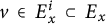 $v\, \in \, E^i_x\, \subset \, E_x$
, and choose a holomorphic section s of E, defined on an open neighborhood U of x, such that
 $s(x)\,=\, v$
. From (2.11), it follows that
 $s\, \in \, H^0(U,\, {\mathcal E}_{x,i}\big \vert _U)$
. From (3.1), we know that
 $$ \begin{align*}D(s)\,\, \subset\,\, H^0\left(U,\, ({\mathcal E}_{x,i}\otimes V^*)\big\vert_U \right). \end{align*} $$
Therefore,
 $\widehat {s}$
in (2.4) satisfies the condition
 $$ \begin{align*}\widehat{s}\, \in\, ({\mathcal E}_{x,i})_x\otimes {\mathcal Q}_x \,=\, ({\mathcal E}_{x,i}\otimes {\mathcal Q})_x.\end{align*} $$
Now, from the construction of map
 ${\mathcal S}_x$
in (2.7), it follows immediately that
 ${\mathcal S}_x(v)\, \in \, E^i_x\otimes {\mathcal Q}_x$
.
To prove the second statement in the proposition, take any
 $x\, \in \, S$
and any
 $w\, \in \, E_x$
. Since the first statement in the proposition holds, Lemma 3.1 says that
 $$ \begin{align*}{\mathbb D}_{x,i} \,\, :\,\, {\mathcal E}_{x,i}\,\, \longrightarrow\,\, (E_x/E^i_x)\otimes\phi^*((K_X)_x) \,\,\subset\,\, (E_x/E^i_x)\otimes V^*_x. \end{align*} $$
Furthermore, we have
 $$ \begin{align} {\mathbb D}_{x,i}\,\,=\,\, 0, \end{align} $$
because D takes
 ${\mathcal E}_{x,i}$
to
 ${\mathcal E}_{x,i}\otimes V^*$
. From (3.3), we will deduce the second statement that
 $\phi ^*_x$
is the zero homomorphism.
For this, take any
 $v\, \in \, E_x\setminus E^i_x$
for some i (note that
 $E_x\setminus E^i_x$
is nonempty when
 $i\,=\, \ell _x+1$
), and choose a section
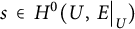 $s\, \in \, H^0(U,\, E\big \vert _U)$
on a small open neighborhood U of x such that
 $s(x)\,=\, v$
. Fix a holomorphic function f on U such that
 $f(x)\,=\, 0$
and
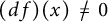 $(df)(x)\, \not =\, 0$
. Then, from (2.11), it follows that
 $$ \begin{align*}f\cdot s \,\, \in\,\, H^0(U,\, {\mathcal E}_{x,i}\big\vert_U).\end{align*} $$
Now, using (2.3), we have
 $$ \begin{align} D(f\cdot s)(x) \,=\, f(x)\cdot D(s)(x) + s(x)\otimes\phi^*(df)(x) \,=\, s(x)\otimes \phi^*(df)(x) \end{align} $$
because
 $f(x)\,=\, 0$
. Let
 $\widehat {\gamma }\, :\, E_x\, \longrightarrow \, E_x/E^i_x$
be the quotient map. Note that
 ${\mathbb D}_{x,i}$
satisfies the condition
 $$ \begin{align*}{\mathbb D}_{x,i}(f\cdot s)\,\,=\,\, (\widehat{\gamma}\otimes \mathrm{Id}_{V^*_x})(D(f\cdot s)(x))\end{align*} $$
(see its construction in Lemma 3.1). Hence, from (3.4), it follows that
 $$ \begin{align*}{\mathbb D}_{x,i}(f\cdot s)\,\,=\,\,(\widehat{\gamma}\otimes \mathrm{Id}_{V^*_x})(D(f\cdot s)(x)) \,\,=\,\, \widehat{\gamma}(s(x))\otimes \phi^*(df)(x). \end{align*} $$
Now, (3.3) implies that
 $$ \begin{align} \widehat{\gamma}(s(x))\otimes \phi^*(df)(x)\,\,=\,\,{\mathbb D}_{x,i}(f\cdot s)\,\,=\,\,0. \end{align} $$
Note that
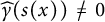 $\widehat {\gamma }(s(x))\,\not =\, 0$
because
 $s(x)\,=\, v\, \in \, E_x\setminus E^i_x$
. Hence, from (3.5), it follows that
 $\phi ^*(df)(x)\,=\, 0$
. Since
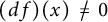 $(df)(x)\, \not =\, 0$
, we conclude that the homomorphism
 $\phi ^*_x\, :\, (K_X)_x\, \longrightarrow \, V^*_x$
is the zero map. This proves the second statement in the proposition.
To prove the converse, assume that the two statements in the proposition hold. We need to show that D is a quasi-parabolic Lie algebroid connection on
 $E_*$
.
Since the first statement holds, D produces a homomorphism
 $$ \begin{align*}{\mathbb D}_{x,i} \,\, :\,\, {\mathcal E}_{x,i} \,\, \longrightarrow\,\, (E_x/E^i_x)\otimes\phi^*((K_X)_x) \,\,\subset\,\, (E_x/E^i_x)\otimes V^*_x \end{align*} $$
(see Lemma 3.1). Now, the second statement implies that
 ${\mathbb D}_{x,i}\,=\, 0$
. Therefore, using (3.2), it follows that
 $\gamma \circ D\circ \iota _{x,i}\,=\, 0$
. Hence, from (2.11), we know that D maps
 ${\mathcal E}_{x,i}$
to
 ${\mathcal E}_{x,i}\otimes V^*$
. This completes the proof.
Remark 3.3 Observe that condition (2) of Proposition 3.2 only depends on the Lie algebroid
 $(V,\,\phi )$
and not on the Lie algebroid connection nor on the parabolic vector bundle. It implies that for a Lie algebroid
 $(V,\,\phi )$
to admit parabolic representations in the form of quasi-parabolic
 $(V,\,\phi )$
-connections
 $(E_*,\,D)$
, it is necessary that
 ${\phi ^*|_S\,=\,0}$
. We will further analyze this fact from the perspective of Simpson’s theory of
 $\Lambda $
-modules [Reference Simpson22] in Section 5. Observe that, if we assume the necessary condition
 $\phi _x^*\,=\,0$
, then we have
 $\mathcal {Q}_x\,=\,V_x$
for each parabolic point
 $x\,\in \, S$
, so the map
 $\mathcal {S}_x$
becomes a map
 $$ \begin{align*}{\mathcal S}_x\,\,:\,\, E_x\,\, \longrightarrow\,\, E_x\otimes V_x\end{align*} $$
over parabolic points.
3.2 Parabolic Lie algebroid connections
Let D be a quasi-parabolic Lie algebroid connection on a parabolic vector bundle
 $E_*$
. From Proposition (3.2)(2), we have that the homomorphism of fibers
 $\phi ^*_x\, :\, (K_X)_x\, \longrightarrow \, V^*_x$
is the zero map for every
 $x \,\in \, S$
. Consequently, the homomorphism
 $\phi ^* \,:\, K_X \,\longrightarrow \, V^*$
factors through the natural homomorphism
 $K_X \,\hookrightarrow \, K_X \otimes {\mathcal O}_X(S)$
, where
 $S\,=\, \sum _{i=1}^m x_i$
is the reduced effective divisor; in other words, we have a unique homomorphism
 $$ \begin{align} \widetilde{\phi}^*\,\, : \,\, K_X \otimes {\mathcal O}_X(S) \,\,\longrightarrow\,\, V^* \end{align} $$
whose restriction to the subsheaf
 $K_X\, \subset \, K_X \otimes {\mathcal O}_X(S)$
coincides with
 $\phi ^*$
.
Note that for every
 $x\, \in \, S$
, we have
 $(K_X \otimes {\mathcal O}_X(S))_x \,=\, \mathbb {C}$
(Poincaré adjunction formula [Reference Griffiths and Harris11, p. 146]). Consider the homomorphism
 $q(x)\, :\, V^*_x\, \longrightarrow \, {\mathcal Q}_x$
(see (2.2)). Composing it with
 $\widetilde {\phi }^*(x)$
in (3.6), we have
 $$ \begin{align} \psi_x \,:\, \mathbb{C}\,=\, (K_X \otimes {\mathcal O}_X(S))_x \, \longrightarrow\, {\mathcal Q}_x. \end{align} $$
From (2.11), we have an exact sequence
 $$ \begin{align} 0\, \longrightarrow\, {\mathcal E}_{x,i+1}\, \longrightarrow\, {\mathcal E}_{x,i} \, \longrightarrow\, E^i_x/E^{i+1}_x\, \longrightarrow\, 0 \end{align} $$
for all
 $x\, \in \, S$
and
 $1\, \leq \, i\, \leq \, \ell _x$
. Since the quasi-parabolic Lie algebroid connection D preserves
 ${\mathcal E}_{x,i}$
(see (3.1)), from (3.8), we have a commutative diagram
 $$ \begin{align} \begin{matrix} 0 & \longrightarrow & {\mathcal E}_{x,i+1} & \longrightarrow & {\mathcal E}_{x,i} & \longrightarrow & E^i_x/E^{i+1}_x & \longrightarrow & 0\\ &&\,\,\, \Big\downarrow D &&\,\,\, \Big\downarrow D &&\,\,\, \Big\downarrow \widehat{D}\\ 0 & \longrightarrow & {\mathcal E}_{x,i+1}\otimes V^* & \longrightarrow & {\mathcal E}_{x,i}\otimes V^* & \longrightarrow & (E^i_x/E^{i+1}_x)\otimes V^* &\longrightarrow & 0, \end{matrix} \end{align} $$
where
 $\widehat {D}$
is induced by D. Since D satisfies (2.3), we have
 $$ \begin{align} \widehat{D}(fs) \,=\, f\cdot\widehat{D}(s) + s\otimes \phi^*(df) \end{align} $$
for any section s of
 $E^i_x/E^{i+1}_x$
(note that
 $E^i_x/E^{i+1}_x$
is a torsion sheaf supported at x) and any holomorphic function f defined around
 $x\, \in \, X$
. Consider the composition of maps
 $$ \begin{align} (\mathrm{Id}_{E^i_x/E^{i+1}_x}\times q)\circ \widehat{D}\,\,:\,\, E^i_x/E^{i+1}_x \,\, \longrightarrow\,\, (E^i_x/E^{i+1}_x)\otimes {\mathcal Q}_x, \end{align} $$
where q is the homomorphism in (2.2). From (3.10), it follows that
 $(\mathrm {Id}_{E^i_x/E^{i+1}_x}\times q)\circ \widehat {D}$
has the property
 $$ \begin{align*}(\mathrm{Id}_{E^i_x/E^{i+1}_x}\times q)\circ \widehat{D}(fs) \,\,=\,\, f\cdot (\mathrm{Id}_{E^i_x/E^{i+1}_x}\times q)\circ\widehat{D}(s),\end{align*} $$
and hence
 $(\mathrm {Id}_{E^i_x/E^{i+1}_x}\times q)\circ \widehat {D}$
produces a
 $\mathbb C$
-linear homomorphism
 $$ \begin{align} \widehat{D}_{i,x}\,\,:\,\, E^i_x/E^{i+1}_x \,\, \longrightarrow\,\, (E^i_x/E^{i+1}_x)\otimes {\mathcal Q}_x \end{align} $$
of fibers.
Definition 3.2 The quasi-parabolic Lie algebroid connection D will be called a parabolic Lie algebroid connection if the homomorphism
 $\widehat {D}_{i,x}$
in (3.12) coincides with the homomorphism
 $E^i_x/E^{i+1}_x \,\, \longrightarrow \,\, (E^i_x/E^{i+1}_x)\otimes {\mathcal Q}_x$
defined by
 $v\, \longmapsto \, v\otimes (\psi _x(\alpha ^x_i))$
, where
 $\psi _x$
is the homomorphism in (3.7) and
 $\alpha ^x_i$
is the parabolic weight in (2.9).
3.3 The Atiyah exact sequence
Let
 $(V, \, \phi )$
be a Lie algebroid on X. We first define generalized Lie algebroid connections on a vector bundle over an open subset of X.
Take an open subset
 $U\, \subset \, X$
, and denote
 $S_U\, :=\, U \bigcap S$
. Fix a holomorphic function w on U. The restriction
 $(V,\, \phi )\big \vert _U$
of the Lie algebroid
 $(V,\, \phi )$
to the open subset U will be denoted by
 $(V_U,\, \phi _U)$
. A generalized Lie algebroid connection with weight w on a holomorphic vector bundle
 ${\mathcal W}$
defined over U is a holomorphic differential operator
 $$ \begin{align*}D \,\,:\,\, {\mathcal W} \,\,\longrightarrow \,\, {\mathcal W} \otimes V^*_U\end{align*} $$
satisfying the Leibniz rule
 $$ \begin{align} D(fs) \,\,=\,\, f D(s)\, +\, w \cdot s \otimes \phi^*_U (df), \end{align} $$
where f is any locally defined holomorphic function on U and s is any locally defined holomorphic section of
 $\mathcal W$
. Note that D is a Lie algebroid connection on
 $\mathcal W$
if
 $w \,\equiv \, 1$
.
A generalized Lie algebroid connection on a holomorphic vector
 $\mathcal W$
defined over U is a pair
 $(w,\, D)$
, where w is a holomorphic function on U and D is a generalized Lie algebroid connection on
 $\mathcal W$
with weight w.
Take a generalized Lie algebroid connection
 $(w,\, D)$
on
 ${\mathcal W}\, \longrightarrow \, U$
. Consider the homomorphism
 $$ \begin{align*}(\mathrm{Id}_{\mathcal W}\otimes q)\circ D\,\, :\,\, {\mathcal W}\,\, \longrightarrow\,\, {\mathcal W}\otimes {\mathcal Q}\big\vert_U, \end{align*} $$
where q is the projection in (2.2). From (3.13), it follows immediately that
 $(\mathrm { Id}_{\mathcal W}\otimes q)\circ D (f\cdot s)\,=\, f\cdot q\circ D (s)$
, where s is any locally defined holomorphic section of
 $\mathcal W$
and f is any locally defined holomorphic function on U. Therefore,
 $(\mathrm {Id}_{\mathcal W}\otimes q)\circ D$
produces a
 $\mathbb C$
-linear homomorphism of fibers
 $$ \begin{align} {\mathcal S}_x\,\,:\,\, {\mathcal W}_x\, \,\longrightarrow\, \,{\mathcal W}_x\otimes {\mathcal Q}_x \end{align} $$
for every point
 $x \,\in \, U$
.
Take a holomorphic vector bundle E over X. Let
 $\mathcal {C}_{E,V}$
denote the sheaf of generalized Lie algebroid connections on E over X. So the sections of
 $\mathcal {C}_{E,V}$
over an open set
 $U \,\subset \, X$
are the generalized Lie algebroid connections on
 $E\big \vert _U$
. It is evident that
 $\mathcal {C}_{E,V}$
is a locally free coherent analytic sheaf fitting in the short exact sequence
 $$ \begin{align} 0\, \longrightarrow\, \text{End}(E)\otimes V^* \, \longrightarrow\, \mathcal{C}_{E,V} \, \stackrel{\sigma}{\longrightarrow}\, {\mathcal O}_X \, \longrightarrow\, 0; \end{align} $$
the above projection
 $\sigma $
sends any locally defined generalized Lie algebroid connection
 $(w,\, D)$
on
 $E\big \vert _U$
to the holomorphic function w.
Let
 $E_*\,=\, (E,\, \{\{E^i_x\}_{i=1}^{\ell _x}\}_{x\in S},\, \{\{\alpha ^x_i\}_{i=1}^{\ell _x}\}_{x\in S})$
be a parabolic vector bundle on X. Take a Lie algebroid
 $(V, \, \phi )$
on X satisfying the following condition: For every
 $x\, \in \, S$
, the homomorphism of fibers
 $\phi ^*_x\, :\, (K_X)_x\, \longrightarrow \, V^*_x$
(see (2.1)) is the zero map.
Take an open subset
 $U\, \subset \, X$
. A generalized quasi-parabolic Lie algebroid connection on
 $E_*$
over U is a generalized Lie algebroid connection
 $$ \begin{align*}D\,\,:\,\, E\big\vert_U \,\,\longrightarrow\, \, (E\otimes V^*)\big\vert_U \end{align*} $$
on
 $E\big \vert _U$
(see (2.3)) such that
 $$ \begin{align} D({\mathcal E}_{x,i}\big\vert_U) \,\, \subset\, \, ({\mathcal E}_{x,i}\otimes V^*)\big\vert_U \end{align} $$
for all
 $x\, \in \, S\bigcap U$
and every
 $1\, \leq \, i\, \leq \, \ell _x+1$
(see (2.11)).
The following is a generalization of Proposition 3.2.
Lemma 3.4 A generalized Lie algebroid connection
 $(w,\, D)$
on
 $E\big \vert _U$
gives a generalized quasi-parabolic Lie algebroid connection on the parabolic vector bundle
 $E_*\big \vert _U$
if and only if the following holds: For every
 $x\, \in \, S\bigcap U$
, the homomorphism
 $$ \begin{align*}{\mathcal S}_x\,\,:\,\, E_x\, \,\longrightarrow\, \, E_x\otimes {\mathcal Q}_x \end{align*} $$
in (3.14) maps
 $E^i_x\, \subset \, E_x$
to
 $E^i_x\otimes {\mathcal Q}_x$
for all
 $1\, \leq \, i\, \leq \, \ell _x+1$
.
Proof If
 $(w,\, D)$
is a generalized quasi-parabolic Lie algebroid connection, then for any
 $x\, \in \, S\bigcap U$
, from (3.16), it follows immediately that
 ${\mathcal S}_x(E^i_x)\, \subset \, E^i_x\otimes {\mathcal Q}_x$
for all
 $1\, \leq \, i\, \leq \, \ell _x+1$
.
The proof of the converse statement is very similar to the proof in Proposition 3.2. The details are omitted.
Let
 $(w,\, D)$
be a generalized quasi-parabolic Lie algebroid connection on
 $E_*\big \vert _U$
. Then, using (3.9), it follows that the homomorphisms
 ${\mathcal S}_x\big \vert _{E^i_x}$
,
 $1\,\leq \, i\, \leq \, \ell _x$
(see Lemma 3.4), produce homomorphisms
 $$ \begin{align} \widehat{D}_{i,x}\,\,:\,\, E^i_x/E^{i+1}_x \,\, \longrightarrow\,\, (E^i_x/E^{i+1}_x)\otimes {\mathcal Q}_x \end{align} $$
(see (3.12)).
A generalized parabolic Lie algebroid connection on
 $E_*\big \vert _U$
is a generalized quasi-parabolic Lie algebroid connection
 $(w,\, D)$
on
 $E_*\big \vert _U$
such that for every
 $x\, \in \, S\bigcap U$
, and every
 $1\,\leq \, i\, \leq \, \ell _x$
, the homomorphism
 $\widehat {D}_{i,x}$
in (3.17) coincides with the homomorphism
 $$ \begin{align*}E^i_x/E^{i+1}_x \,\, \longrightarrow\,\, (E^i_x/E^{i+1}_x)\otimes {\mathcal Q}_x\end{align*} $$
defined by
 $v\, \longmapsto \, w(x)\cdot v\otimes (\psi _x(\alpha ^x_i))$
, where
 $\psi _x$
is the homomorphism in (3.7) and
 $\alpha ^x_i$
is the parabolic weight in (2.9).
The sheaf of generalized parabolic Lie algebroid connections on
 $E_*$
is evidently a subsheaf of
 $\mathcal {C}_{E,V}$
(see (3.15)). In fact, it is a coherent analytic subsheaf of
 $\mathcal {C}_{E,V}$
. The sheaf of generalized parabolic Lie algebroid connections on
 $E_*$
will be denoted by
 $\mathcal {C}_{E_*,V}$
.
Lemma 3.5 The sheaf of generalized parabolic Lie algebroid connections on
 $E_*$
, namely,
 $\mathcal {C}_{E_*,V}$
, fits in the following short exact sequence of holomorphic vector bundles on X:
 $$ \begin{align} 0\, \longrightarrow\, \mathrm{End}_n(E)\otimes V^* \, \longrightarrow\, \mathcal{C}_{E_*,V} \, \stackrel{\sigma}{\longrightarrow}\, {\mathcal O}_X \, \longrightarrow\, 0, \end{align} $$
where
 $\mathrm {End}_n(E)$
is defined in (2.14).
Proof Restrict the homomorphism
 $\sigma $
in (3.15) to the subsheaf
 ${\mathcal C}_{E_*,V}\, \subset \, {\mathcal C}_{E,V}$
. The projection
 $\sigma $
in the lemma is this restriction. Next, note that if
 $D_1$
and
 $D_2$
are two generalized quasi-parabolic Lie algebroid connections on
 $E_*\big \vert _U$
such that
 $\sigma (D_1)\,=\, \sigma (D_2)$
, then we have
 $$ \begin{align*}D_1-D_2\, \in\, H^0(U,\, (\text{End}_P(E)\otimes V^*)\big\vert_U),\end{align*} $$
where
 $\text {End}_P(E)$
is defined in (2.13). Furthermore, for any
 $s\, \in \, H^0(U,\, (\text {End}_P(E)\otimes V^*)\big \vert _U)$
, it is evident that
 $D_1+s$
is a generalized quasi-parabolic Lie algebroid connection on
 $E_*\big \vert _U$
.
Now, by comparing the residues at the parabolic points, it is straightforward to check that if
 $D_1$
is a generalized parabolic Lie algebroid connection on
 $E_*\big \vert _U$
, then
 $D_1+s$
is a generalized parabolic Lie algebroid connection on
 $E_*\big \vert _U$
if and only if
 $s\, \in \, H^0\left (U,\, (\text {End}_n(E)\otimes V^*)\big \vert _U \right )$
.
From the definition of
 $\mathcal {C}_{E_*,V}$
, it follows immediately that a parabolic Lie algebroid connection on
 $E_*\big \vert _U$
is precisely a holomorphic splitting of the short exact sequence in Lemma 3.5 over
 $U\, \subset \, X$
. More precisely, if
 $$ \begin{align*}\tau\, \, :\,\, {\mathcal O}_U\,\, \longrightarrow\,\, \mathcal{C}_{E_*,V} \end{align*} $$
is a holomorphic splitting of the short exact sequence in Lemma 3.5 over
 $U\, \subset \, X$
(so
 $\sigma \circ \tau \,=\, \mathrm {Id}_{{\mathcal O}_U}$
), then
 $\tau (1)$
is a parabolic Lie algebroid connection on
 $E_*\big \vert _U$
. Conversely, if D is a parabolic Lie algebroid connection on
 $E_*\big \vert _U$
, then we have a holomorphic splitting
 $$ \begin{align*}\tau'\, \, :\,\, {\mathcal O}_U\,\, \longrightarrow\,\, \mathcal{C}_{E_*,V} \end{align*} $$
of the short exact sequence in Lemma 3.5 over
 $U\, \subset \, X,$
which is uniquely determined by the condition that
 $\tau '(1)\,=\, D$
.
The short exact sequence in Lemma 3.5 will be called the Atiyah exact sequence of
 $E_*$
for the Lie algebroid
 $(V, \, \phi )$
.
4 A criterion for parabolic Lie algebroid connections
Let
 $(V,\, \phi )$
be a Lie algebroid on X such that for all
 $x\, \in \, S$
, the homomorphism of fibers
 $\phi ^*_x\, :\, (K_X)_x\, \longrightarrow \, V^*_x$
(see (2.1)) is the zero map.
Consider the short exact sequence of holomorphic vector bundles on X in Lemma 3.5. The obstruction to its holomorphic splitting is given by a class
 $$ \begin{align} \zeta\,\, \in\, \, H^1(X,\, \text{Hom}({\mathcal O}_X,\, \mathrm{End}_n(E)\otimes V^*)) \,\,=\,\, H^1(X,\, \mathrm{End}_n(E)\otimes V^*). \end{align} $$
We have
 $\mathrm {End}_n(E)^*\,=\, \mathrm {End}_P(E)\otimes {\mathcal O}_X(S)$
, where
 $\mathrm {End}_P(E)$
is defined in (2.13). Therefore, using Serre duality,
 $$ \begin{align} \zeta\,\, \in\,\, H^0(X,\, \mathrm{End}_P(E)\otimes V\otimes K_X\otimes \mathcal{O}_X(S))^* \end{align} $$
(see (4.1)). In other words, for every parabolic vector bundle
 $E_*$
, there is a naturally associated homomorphism
 $$ \begin{align} \zeta\, \,:\,\, H^0(X,\, \mathrm{End}_P(E)\otimes V\otimes K_X\otimes \mathcal{O}_X(S)) \,\, \longrightarrow\,\, {\mathbb C}. \end{align} $$
The following proposition is a parabolic analog of [Reference Biswas, Kumar and Singh4, Proposition 3.1].
Proposition 4.1 Assume that the following two conditions hold:
-
(1) The vector bundle V is stable, and
-
(2)
$\mathrm {rank}(V)\,\, \geq \,\, 2$
.

Then, any parabolic vector bundle
 $E_*$
admits a parabolic Lie algebroid connection.
Proof First, assume that
 $$ \begin{align*}\text{degree}(V) \, \geq\, \mathrm{rank}(V)\cdot (\text{degree}(TX)-\# S)\,=\, \mathrm{rank}(V)\cdot (\text{degree}(TX)-m).\end{align*} $$
Since V is a stable vector bundle of rank at least two, from this we conclude that there is no nonzero homomorphism from V to
 $TX\otimes {\mathcal O}_X(-S)$
, or in other words, there is no nonzero homomorphism from V to
 $TX$
that vanishes over S. In particular, the homomorphism
 $\phi $
is the zero map (note that
 $\phi $
vanishes over S because
 $\phi ^*$
vanishes over S). Therefore, a parabolic Lie algebroid connection on
 $E_*$
is simply a strongly parabolic Higgs field on
 $E_*$
. In particular,
 $D\,\equiv \, 0$
is a parabolic Lie algebroid connection on
 $E_*$
. Hence,
 $E_*$
admits a parabolic Lie algebroid connection.
Next, assume that the following two conditions hold:
-
(1)
$\text {degree}(V) \,< \, \mathrm {rank}(V)\cdot (\text {degree}(TX)-m)$
, and -
(2) the parabolic vector bundle
$E_*$
is parabolic semistable.


From the above inequality
 $\text {degree}(V) \,< \, \mathrm {rank}(V)\cdot (\text {degree}(TX)-m),$
it follows immediately that
 $$ \begin{align} \text{degree}(V\otimes K_X\otimes \mathcal{O}_X(S)) \, \, <\,\, 0. \end{align} $$
Also, the vector bundle
 $V\otimes K_X$
is stable because V is stable. Equip
 $V\otimes K_X$
with the trivial parabolic structure, meaning it has no nonzero parabolic weights. The parabolic vector bundle obtained this way will be denoted by
 $(V\otimes K_X)_*$
. Note that
 $(V\otimes K_X)_*$
is parabolic stable because
 $V\otimes K_X$
is stable and
 $(V\otimes K_X)_*$
has no nonzero parabolic weights.
Since
 $E_*$
is parabolic semistable, and
 $(V\otimes K_X)_*$
is parabolic stable, it follows that the parabolic tensor product
 $E_*\otimes (V\otimes K_X)_*$
is parabolic semistable. We have
 $$ \begin{align*}\text{par-}\mu(E_*\otimes (V\otimes K_X\otimes \mathcal{O}_X(S))_*)&= \text{par-}\mu(E_*) + \text{par-}\mu((V\otimes K_X\otimes \mathcal{O}_X(S))_*)\\& = \text{par-}\mu(E_*) +\mu(V\otimes K_X\otimes \mathcal{O}_X(S))\,\, <\,\, \text{par-}\mu(E_*) \end{align*} $$
(see (4.4)). Since both
 $E_*\otimes (V\otimes K_X)_*$
and
 $E_*$
are parabolic semistable, this implies that there is no nonzero parabolic homomorphism from
 $E_*$
to
 $E_*\otimes (V\otimes K_X\otimes \mathcal{O}_X(S))_*$
. In other words, we have
 $$ \begin{align*}H^0(X,\, \mathrm{End}_P(E)\otimes V\otimes K_X\otimes \mathcal{O}_X(S))\,=\, H^0(X,\, \mathrm{Hom}(E_*,\, E_*\otimes (V\otimes K_X\otimes \mathcal{O}_X(S))_*)) \,=\, 0. \end{align*} $$
Consequently, the homomorphism
 $\zeta $
in (4.3) is the zero map. So
 $\zeta $
in (4.2) satisfies the condition that
 $\zeta \,=\, 0$
, and hence
 $\zeta $
in (4.1) vanishes. This means that the short exact sequence of holomorphic vector bundles on X in Lemma 3.5 splits holomorphically. Therefore,
 $E_*$
admits a parabolic Lie algebroid connection.
Finally, assume that the following two conditions hold:
-
(1)
$\text {degree}(V) \,< \, \mathrm {rank}(V)\cdot (\text {degree}(TX)-m)$
, and -
(2) the parabolic vector bundle
$E_*$
is not parabolic semistable.


Let
 $$ \begin{align} 0\, =\, F^0_* \, \subsetneq\, F^1_* \, \subsetneq\, F^2_* \, \subsetneq\, \cdots \, \subsetneq\, F^{n-1}_* \, \subsetneq\, F^n_*\,=\, E_* \end{align} $$
be the Harder–Narasimhan filtration of the parabolic vector bundle
 $E_*$
.
Take any
 $$ \begin{align} \theta \,\, \in\,\, H^0(X,\, \mathrm{End}_P(E)\otimes V\otimes K_X). \end{align} $$
We have
 $$ \begin{align} \theta(F^i_*)\, \subset\, F^{i-1}_* \otimes V\otimes K_X \end{align} $$
for all
 $1\, \leq \, i\, \leq \, n$
(see (4.5)) which is deduced by simply repeating the argument in the proof of [Reference Biswas, Kumar and Singh4, Proposition 3.1] and using (4.4).
Now consider
 $\mathcal {C}_{E_*,V}$
in Lemma 3.5. Let
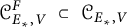 $$ \begin{align*}\mathcal{C}^F_{E_*,V}\,\, \subset\,\, \mathcal{C}_{E_*,V} \end{align*} $$
be the subsheaf defined by the following condition: A holomorphic section
 $$ \begin{align*}s\, \in\, H^0(U,\, \mathcal{C}_{E_*,V}\big\vert_U),\end{align*} $$
defined over an open subset
 $U\, \subset \, X$
is a section of
 $\mathcal {C}^F_{E_*,V}\big \vert _U$
if
 $s(F^i) \, \subset \, (F^i\otimes V^*)\big \vert _U$
for all
 $1\, \leq \, i\, \leq \, n$
(see (4.5)). Similarly, let
 $$ \begin{align*}\mathrm{End}^F_n(E)\,\, \subset\,\, \mathrm{End}_n(E) \end{align*} $$
be the subsheaf defined by the following condition: A holomorphic section
 $$ \begin{align*}s\, \in\, H^0(U,\, \mathrm{End}_n(E)\big\vert_U),\end{align*} $$
defined over an open subset
 $U\, \subset \, X$
is a section of
 $\mathrm {End}^F_n(E)\big \vert _U$
if
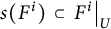 $s(F^i) \, \subset \, F^i\big \vert _U$
for all
 $1\, \leq \, i\, \leq \, n$
. Note that
 $\mathcal {C}^F_{E_*,V}$
(respectively,
 $\mathrm {End}^F_n(E)$
) is a holomorphic subbundle of
 $\mathcal {C}_{E_*,V}$
(respectively,
 $\mathrm {End}_n(E)$
). Then, we have a commutative diagram
 $$ \begin{align} \begin{matrix} 0 & \longrightarrow & \mathrm{End}^F_n(E)\otimes V^* & \longrightarrow & \mathcal{C}^F_{E_*,V} & \stackrel{\sigma}{\longrightarrow} & {\mathcal O}_X & \longrightarrow & 0\\ &&\,\,\,\Big\downarrow\beta &&\Big\downarrow &&\Big\Vert\\ 0 & \longrightarrow & \mathrm{End}_n(E)\otimes V^* & \longrightarrow & \mathcal{C}_{E_*,V} & \stackrel{\sigma}{\longrightarrow} & {\mathcal O}_X & \longrightarrow & 0, \end{matrix} \end{align} $$
where the vertical maps are the natural inclusion maps, the rows are exact, and the bottom exact sequence is the one in Lemma 3.5.
From (4.8), it follows that
 $\zeta $
in (4.1) lies in the image of the homomorphism
 $$ \begin{align*}\beta_*\,\, :\,\, H^1(X,\, \mathrm{End}^F_n(E)\otimes V^*)\,\, \longrightarrow\,\, H^1(X,\, \mathrm{End}_n(E)\otimes V^*) \end{align*} $$
induced by
 $\beta $
in (4.8). More precisely,
 $$ \begin{align} \beta_*(\zeta^F)\,\,=\,\, \zeta, \end{align} $$
where
 $\zeta ^F\, \in \, H^1(X,\, \mathrm {End}^F_n(E)\otimes V^*)$
is the extension class for the top short exact sequence in (4.8).
Now, using (4.7) and (4.9), it can be deduced that
 $\zeta (\theta )\,=\, 0$
, where
 $\zeta $
is the homomorphism in (4.3). Indeed, this follows by simply repeating the argument in the proof of [Reference Biswas, Kumar and Singh4, Proposition 3.1]. Hence,
 $\zeta $
in (4.1) vanishes. This implies that the short exact sequence of holomorphic vector bundles on X in Lemma 3.5 splits holomorphically, and consequently,
 $E_*$
admits a parabolic Lie algebroid connection.
The following proposition is a parabolic analog of [Reference Biswas, Kumar and Singh4, Lemma 3.2].
Proposition 4.2 Assume that
 $\mathrm {rank}(V)\,\, =\,\, 1$
. Let
 $E_*$
be a parabolic vector bundle on X. Then, the following two statements hold:
-
(1) If
$\widetilde {\phi }^*\,\, : \,\, K_X \otimes {\mathcal O}_X(S) \,\,\longrightarrow \,\, V^*$
in (3.6) is not an isomorphism, then
$E_*$
admits a parabolic Lie algebroid connection. -
(2) If
$\widetilde {\phi }^*$
in (3.6) is an isomorphism, then
$E_*$
admits a parabolic Lie algebroid connection if and only if the parabolic degree of every parabolic direct summand of
$E_*$
is zero.



Proof If
 $\widetilde {\phi }^*$
in (3.6) is an isomorphism, then a parabolic Lie algebroid connection on
 $E_*$
is a holomorphic connection on the parabolic bundle
 $E_*$
. Therefore, the main result of [Reference Biswas and Logares5] is the second statement of the proposition.
To prove the first statement, assume that
 $\widetilde {\phi }^*$
in (3.6) is not an isomorphism.
First, consider the case where
 $\text {degree}(V)\, \geq \, 2(1-\text {genus}(X))-m$
. Note that
 $$ \begin{align*}H^0(X,\, \text{Hom}(K_X\otimes{\mathcal O}_X(S),\, V^*)\,=\, 0 \end{align*} $$
if
 $\text {degree}(V)\,> \, 2(1-\text {genus}(X))-m$
. Also, any nonzero homomorphism
 $K_X\otimes {\mathcal O}_X(S)\,\longrightarrow \, V^*$
is an isomorphism if
 $\text {degree}(V)\, = \, 2(1-\text {genus}(X))-m$
. So we conclude that
 $\widetilde {\phi }^*\,=\, 0$
. Hence, any strongly parabolic Higgs field on
 $E_*$
, in particular the zero Higgs field, is a parabolic Lie algebroid connection on
 $E_*$
.
Now, assume that
 $$ \begin{align} \text{degree}(V)\, < \, 2(1-\text{genus}(X))-m. \end{align} $$
We also assume that
 $\phi \,\,\not =\,\, 0$
, because if
 $\phi \,=\, 0$
, then, as before,
 $E_*$
has a parabolic Lie algebroid connection given by the zero Higgs field.
Take any
 $$ \begin{align*}\theta \,\, \in\,\, H^0(X,\, \mathrm{End}_P(E)\otimes V\otimes K_X). \end{align*} $$
Let
 $$ \begin{align} 0\, =\, F^0_* \, \subsetneq\, F^1_* \, \subsetneq\, F^2_* \, \subsetneq\, \cdots \, \subsetneq\, F^{n-1}_* \, \subsetneq\, F^n_*\,=\, E_* \end{align} $$
be the Harder–Narasimhan filtration of the parabolic vector bundle
 $E_*$
. From (4.10), we know that
 $\text {degree}(V\otimes K_X)\, <\, 0$
. Hence,
 $\theta $
must be nilpotent with respect to the filtration in (4.11), meaning
 $\theta (F^i_*)\, \subset \, F^{i-1}_*\otimes V\otimes K_X$
for all
 $1\, \leq \, i \, \leq \, n$
. Now, as in the proof of Proposition 4.1, this implies that
 $\zeta (\theta )\,=\, 0$
, where
 $\zeta $
is the homomorphism in (4.3). Hence,
 $\zeta $
in (4.1) vanishes, and thus the short exact sequence of holomorphic vector bundles on X in Lemma 3.5 splits holomorphically. This implies that
 $E_*$
admits a parabolic Lie algebroid connection.
Combining Propositions 4.1 and 4.2, we have the following theorem.
Theorem 4.3 Assume that the vector bundle V is stable. Let
 $E_*$
be a parabolic vector bundle on X. Then, the following two statements hold:
-
(1) If
$\widetilde {\phi }^*$
in (3.6) is not an isomorphism, then
$E_*$
admits a parabolic Lie algebroid connection. -
(2) If
$\widetilde {\phi }^*$
is an isomorphism, then
$E_*$
admits a parabolic Lie algebroid connection if and only if the parabolic degree of every parabolic direct summand of
$E_*$
is zero.


5 Integrable parabolic connections and parabolic
$\Lambda $
-modules

Any Lie algebroid
 $(V,\,\phi )$
has an associated graded complex
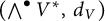 $(\bigwedge ^\bullet V^* ,\, d_V)$
called the Chevalley–Eilenberg–de Rham complex of
 $(V,\,\phi )$
. In degree 0, the map
 $d_V^0\,:\, \mathcal {O}_X \,\longrightarrow \, V^*$
is
 $\phi ^*\circ d$
and, for any locally defined section
 $\omega \,\in \,\bigwedge ^nV^*$
with
 $n\,>\,0$
, the differential
 $d_V(\omega )$
is constructed as follows: Given local sections
 $v_1,\,\ldots ,\, v_{n+1}$
of V, define
 $$ \begin{align*}d_V(\omega)(v_1,\,\ldots,\,v_{n+1})\,\,=\,\,\sum_{i=1}^n (-1)^{i+1} \phi(v_i)(\omega(v_1,\,\dots, \,\widehat{v}_i,\,\dots,\, v_{n+1})) \end{align*} $$
 $$ \begin{align*}+\, \sum_{1\le i < j \le n+1} (-1)^{i+j} \omega([v_i,\, v_j],\, v_1,\,\dots,\, \widehat{v}_i,\, \dots, \,\widehat{v}_j,\, \dots , \, v_{n+1}). \end{align*} $$
In terms of this complex, a
 $(V,\,\phi )$
connection on E can be described as a map
 ${D\,:\,E\,\longrightarrow \, E\otimes V^*}$
such that
 $$ \begin{align*}D(fs)\,\,=\,\,fD(s)+s\otimes d_V(f).\end{align*} $$
Any
 $(V,\,\phi )$
-connection D on E extends naturally to a map
 $$ \begin{align*} D\,:\, E\otimes \bigwedge\nolimits^{\bullet} V^* \,\longrightarrow\, E\otimes \bigwedge\nolimits^{\bullet +1} V^{*} \end{align*} $$
using the rule
 $$ \begin{align*}D(s\otimes \omega)\,\,=\,\,D(s)\wedge\omega + s\otimes d_V(\omega).\end{align*} $$
We say that the connection D is integrable (or flat) if
 $$ \begin{align*}D\circ D\,\,=\,\,0.\end{align*} $$
By [Reference Tortella24, Section 2.3], this is equivalent to the following. For each
 $v\,\in \, V$
, let
 $D_v \,\in \, \operatorname {End}_{\mathbb {C}}(E)$
be the
 $\mathbb {C}$
-linear endomorphism of E induced by contracting the connection D with v. Then, D is integrable if and only if for each
 $v,\,w\,\in \, V,$
we have
 $$ \begin{align} D_{[u,\,v]}\,\,=\,\,[D_u,\,D_v]. \end{align} $$
Given a Lie algebroid
 $(V,\,\phi )$
, let
 $\Lambda _{V}$
denote its universal developing algebra, which is constructed as follows (see, for instance, [Reference Tortella24]). Let
 $$ \begin{align*}U\,\,=\,\, \bigotimes\nolimits^\bullet( \mathcal{O}_X\oplus V) / \end{align*} $$
 $$ \begin{align*}\left \langle u\otimes v - v \otimes u - [u,\,v], \, v\otimes f - f \otimes v - \phi(v)(f) \,\big\vert\,\, f\,\in\, \mathcal{O}_X, \, u,\,v \,\in\, V \right \rangle\end{align*} $$
be the quotient, where
 $\bigotimes ^\bullet W$
denotes the tensor algebra on W. Let
 $i \,:\,\mathcal {O}_X\oplus V \, \hookrightarrow \, U$
be the canonical inclusion and let
 $U^\dagger \,\subset \, U$
be the subalgebra generated by
 $i(\mathcal {O}_X\oplus V)$
. Then,
 $$ \begin{align*}\Lambda_V\,\,=\,\,U^\dagger \, /\, \left \langle i(f,0)\cdot i(g,v)-i(fg,fv) \,\big\vert\,\, f,\,g \,\in\, \mathcal{O}_X, v\,\in\, V\right\rangle.\end{align*} $$
Intuitively,
 $\Lambda _V$
is the sheaf of associative
 $\mathcal {O}_X$
-algebras generated by V with the relations
 $v\cdot w-w\cdot v\,=\,[v,\,w]$
and
 $v\cdot f - f \cdot v \,=\, \phi (v)(f)$
for local holomorphic sections v and w of V and locally defined holomorphic functions f. The natural grading on the tensor algebra
 $\bigotimes ^\bullet ( \mathcal {O}_X\oplus V)$
induces a filtration on the algebra
 $\Lambda _V$
 $$ \begin{align*}\Lambda_V^0\,\subset\, \Lambda_V^1\,\subset \,\Lambda_V^2\,\subset \,\cdots \,\subset\, \Lambda_V\end{align*} $$
such that
 $\Lambda _V^0 \,=\,\mathcal {O}_X$
,
 $\Lambda ^1_V\,=\,\mathcal {O}_X\oplus V$
and
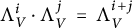 $\Lambda _V^i \cdot \Lambda _V^j \,=\, \Lambda _V^{i+j}$
for all
 $i,\,j$
(see [Reference Tortella24, Section 4] and [Reference Alfaya1, Lemma 2.2]). The previous construction through
 $U^\dagger $
ensures that the action of
 $\Lambda _V^0\,=\,\mathcal {O}_X$
on
 $\Lambda _V$
agrees with its
 $\mathcal {O}_X$
-module structure. This filtration gives the algebra
 $\Lambda _V$
the structure of a split quasipolynomial sheaf of rings of differential operators (in the sense of [Reference Simpson22, Section 2]) and, by [Reference Tortella24, Theorem 1.2], there exists a bijective correspondence between the integrable
 $(V,\,\phi )$
-connections
 $D\,:\,E \,\longrightarrow \, E\otimes V^*$
on a vector bundle E and the
 $\Lambda _{V}$
-module structures
 $$ \begin{align*}\widetilde{D}\,\,:\,\,\Lambda_{V} \otimes E \,\,\longrightarrow\,\, E\end{align*} $$
on E such that the
 $\mathcal {O}_X$
-module structure induced by the
 $\Lambda _V$
-module structure coincides with the natural
 $\mathcal {O}_X$
-module structure of E.
In this framework, where Lie algebroid connections are understood as actions of a sheaf of differential operators on the bundle, a general (possibly non-integrable)
 $(V,\, \phi )$
-connection on E is equivalent to a map of
 $\mathcal {O}_X$
-bimodules
 $$ \begin{align*}\widetilde{D}\,\,:\,\, \Lambda_V^1 \otimes_{\mathcal{O}_X} E\,\,\longrightarrow\,\, E.\end{align*} $$
Notice that, as
 $\Lambda _V^1$
generates
 $\Lambda _V$
, any
 $\Lambda _V$
-module structure on a vector bundle E is determined by the action of
 $\Lambda _V^1$
on it. However, not any action of
 $\Lambda _V^1$
on a vector bundle extends to an action of
 $\Lambda _V$
. The obstruction to this extension is precisely the integrability (5.1) of the associated
 $(V,\,\phi )$
-connection.
Taking into account these correspondences, the description and analysis of parabolic Lie algebroid connections carried out in the previous sections can then be studied alternatively in the framework of parabolic
 $\Lambda $
-modules. For any sheaf of ring of differential operators
 $\Lambda $
, a notion of parabolic
 $\Lambda $
-module on a marked curve
 $(X,\,S)$
was defined in [Reference Alfaya1] as follows.
Definition 5.1 [Reference Alfaya1, Definition 2.5]
A parabolic
 $\Lambda $
-module on
 $(X,\,S)$
is a locally free
 $\Lambda $
-module
 $\widetilde {D}\,:\,\Lambda \otimes E\,\longrightarrow \, E$
over X together with a parabolic structure on E over S
 $$ \begin{align*}E_x \,=\, E^1_x \,\supsetneq\, E^2_x \,\supsetneq\, \, \cdots\, \supsetneq\, E^{\ell_x}_x\,\supsetneq\, E^{\ell_x+1}_x \,=\, 0,\end{align*} $$
 $$ \begin{align*}0 \,\leq\, \alpha^x_1 \,< \,\dots\, <\, \alpha^x_{\ell_x} \,< \,1,\end{align*} $$
such that its associated decreasing sequences of subsheaves of E (see (2.10) and (2.12))
 $$ \begin{align*}E\,=\,{\mathcal E}_{x,1}\,\supsetneq \,{\mathcal E}_{x,1} \,\supsetneq \, \dots \,\supsetneq\, {\mathcal E}_{x,l_x} \,\supsetneq\, {\mathcal E}_{x,l_x+1}\,=\,E(-x)\end{align*} $$
satisfy the condition that the image of
 $\Lambda \otimes \mathcal {E}_{x,i}$
under the morphism
 $\widetilde {D}\,:\,\Lambda \otimes E \,\longrightarrow \, E$
lies in
 $\mathcal {E}_{x,i}$
for all
 $i\,=\, 1,\,\ldots ,\, l_x+1$
and all
 $x\,\in \, S$
.
It is clear, from the construction, that having a quasi-parabolic
 $(V,\, \phi )$
-connection
 $D\,:\,E\,\longrightarrow \, E\otimes V^*$
on a parabolic vector bundle
 $E_*$
in the sense of Definition 3.1 is equivalent to having a map of
 $\mathcal {O}_X$
-bimodules
 $$ \begin{align*}\widetilde{D}\,:\, \Lambda^1_V\otimes_{\mathcal{O}_X} E \,\longrightarrow \,E\end{align*} $$
such that
 $\widetilde {D}(\Lambda _V^1\otimes _{\mathcal {O}_X} \mathcal {E}_{x,i})\,\subset \, \mathcal {E}_{x,i}$
. Thus, an integrable quasi-parabolic
 $(V,\,\phi )$
-connection in the sense of Definition 3.1 is equivalent to a parabolic
 $\Lambda _V$
-module structure on
 $E_*$
in the sense of Definition 5.1.
From this new framework, we can see that the Lie algebroid
 $(V,\phi )$
must satisfy certain conditions for quasi-parabolic Lie algebroid connections to exist.
Proposition 5.1 Let
 $(V,\,\phi )$
be a Lie algebroid. For quasi-parabolic
 $(V,\,\phi )$
-connections to exist, it is necessary that
 $\phi \, :\,V\,\longrightarrow \, TX$
factors through
 $TX\otimes {\mathcal O}_X(-S)$
.
Proof Assume that there exists a
 $(V,\,\phi )$
-connection
 $\widetilde {D}\,:\,\Lambda _V^1\otimes _{\mathcal {O}_X} E \,\longrightarrow \, E$
preserving a quasi-parabolic structure
 $E_*$
on E. In particular, it must satisfy, for each
 $x\,\in \,S$
,
 $$ \begin{align*}\widetilde{D}(\Lambda_V^1\otimes_{\mathcal{O}_X} E(-x)) \,\,\subseteq\,\, E(-x).\end{align*} $$
Let v be a local section of V, and let f be a local section of
 $\mathcal {O}_X(-x)$
while s be any local section of E. Then, as
 $\widetilde {D}$
is a map of
 $\mathcal {O}_X$
-bimodules, we must have
 $$ \begin{align*}\widetilde{D}([v,\,f]\otimes s) \,\,=\,\, \widetilde{D}((v\cdot f - f\cdot v)\otimes s)\,\,=\,\, \widetilde{D}(v\otimes fs)-f\widetilde{D}(v\otimes s).\end{align*} $$
The first summand of the right-hand side is the action of v on
 $fs\,\in \, E(-S)$
. The homomorphism
 $\widetilde {D}$
preserves
 $E(-x)$
if and only if the outcome also lies in
 $E(-x)$
. The second summand of the right-hand side also belongs to
 $E(-x)$
, since f is a local section of
 $\mathcal {O}_X(-x)$
. Thus, we have
 $\widetilde {D}([v,\,f]\otimes s)\,\in \, E(-x)$
. However,
 $$ \begin{align*}\widetilde{D}([v,\,f]\otimes s)\,\, =\,\, \widetilde{D}(\phi(v)(f) \otimes s)\,\,=\,\, \phi(v)(f) s\end{align*} $$
and the only way for this to belong to
 $E(-x)$
for each local section
 $s\,\in \, E$
is to have
 $[v,f]=\phi (v)(f)\,\in \, \mathcal {O}_X(-x)$
for each v and f. In other words,
 $\mathcal {O}_X(-x)$
must be a Lie ideal in
 $\Lambda ^1_V$
. As this holds for all
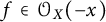 $f\,\in \, \mathcal {O}_X(-x)$
, we must have
 $\phi (v) \,\in \, TX(-x)$
and, therefore,
 $\phi $
must factor through
 $TX(-x)$
for each
 $x\,\in \, S$
. This completes the proof.
Remark 5.2 Observe that
 $\phi $
factors through
 $TX(-S)$
if and only if the homomorphism
 $\phi ^*\,:\,K_X\,\longrightarrow \, V^*$
vanishes at each
 $x\,\in \, S$
. This precisely coincides with condition (2) of Proposition 3.2. Also observe that, if this condition is satisfied, then the sheaf
 $\mathcal {Q}$
defined in (2.1) always satisfies
 $\mathcal {Q}_x\,=\,V_x^*$
for each
 $x\,\in \,S$
.
Moreover, the proof of Proposition 5.1 also shows that if the anchor map
 $\phi $
factors through
 $TX(-S)$
, then any action
 $\widetilde {D}\,:\,\Lambda _V^1\otimes E\,\longrightarrow \,E$
on a vector bundle E must preserve the subsheaf
 $E(-S)$
. As a consequence, the construction of the residue of a parabolic
 $\Lambda $
-module at a parabolic point from [Reference Alfaya1, Section 6] extends naturally to any action
 $\widetilde {D}\,:\,\Lambda _V^1\otimes _{\mathcal {O}_X} E\,\longrightarrow \, E$
, even if there only exists an action of
 $\Lambda _V^1$
instead of the entire algebra
 $\Lambda _V$
.
Let
 $x\,\in \, S$
be a parabolic point, and let
 $i_x\,:\,\{x\}\,\hookrightarrow \, X$
be the inclusion map. Since
 $\widetilde {D}$
preserves
 $E(-x)$
, we have the following commutative diagram of sheaves of
 $(\mathcal {O}_X,\,\mathcal {O}_X)$
-bimodules:

inducing a morphism
 $$ \begin{align*}\widetilde{D}_x \, : \,V\otimes_{\mathcal{O}_X} (i_x)_* E_x\, \longrightarrow\, (i_x)_*E_x.\end{align*} $$
Taking the pullback by
 $i_x$
yields a residue map
 $$ \begin{align*}\widetilde{\mathcal{S}}_x\,:\, V_x\otimes E_x \,\longrightarrow\, E_x\end{align*} $$
and
 $\widetilde {D}$
is quasi-parabolic if and only if
 $\widetilde {\mathcal {S}}_x$
preserves the filtration
 $\{E_x^i\}$
of E. Under the identification of
 $\mathcal {Q}_x$
with
 $V_x^*$
(see Remarks 3.3 and 5.2), this agrees with condition (1) of Proposition 3.2.
A quasi-parabolic connection is parabolic in the sense of Definition 3.2 if the induced map
 $$ \begin{align*}\widetilde{\mathcal{S}}_x\,:\, V_x\otimes E_x^i/E_x^{i+1} \,\longrightarrow\, E_x^i/E_x^{i+1}\end{align*} $$
coincides with the map
 $$ \begin{align} v\otimes s \,\, \longmapsto \,\, \alpha_i^x \widetilde{\phi}_x (v) s \end{align} $$
for
 $v\,\in \,V_x$
and
 $s\,\in \, E_x^i / E_x^{i+1}$
, where
 $\widetilde {\phi }_x$
is the restriction of
 $\phi $
at each point
 $x\, \in \, S$
considered as a map to its image on
 $TX(-S)_x$
which, by Poincaré adjunction formula [Reference Griffiths and Harris11, p. 146], is isomorphic to
 $\mathbb {C}$
:
 $$ \begin{align*}\widetilde{\phi}_x \,\,:\,\, V \,\,\stackrel{\phi_x}{\longrightarrow}\,\, TX(-S)_x \cong \mathbb{C}.\end{align*} $$
The agreement between these two frameworks for studying parabolic Lie algebroid connections allows us to apply [Reference Alfaya1, Theorem 5.8] to prove the existence of moduli spaces of semistable parabolic Lie algebroid connections, for the following natural notion of parabolic stability. A Lie algebroid connection
 $D\,:\,E\,\longrightarrow \,E\otimes V^*$
is called semistable if for each
 $F\,\subset \, E$
preserved by
 $D,$
we have
 $$ \begin{align*}\frac{\deg(F)+\sum_{x\in S}\sum_{i=1}^{l_x} \alpha_i^x (\dim(E_x^i\cap F_x)-\dim(E_x^{i+1}\cap F_x))}{\operatorname{rk}(F)} \end{align*} $$
 $$ \begin{align*}\le\, \frac{\deg(E)+\sum_{x\in S}\sum_{i=1}^{l_x} \alpha_i^x (\dim(E_x^i)-\dim(E_x^{i+1}))}{\operatorname{rk}(E)}. \end{align*} $$
Observe that if
 $E_*$
is a semistable parabolic vector bundle, then
 $(E_*,D)$
is semistable for each parabolic Lie algebroid connection D on
 $E_*$
.
Theorem 5.3 Let
 $(V,\,\phi )$
be any Lie algebroid such that
 $\phi |_S\,=\,0$
. For every system of weights
 $\alpha \,=\,\{\{\alpha _i^x\}_{i=1}^{l_x}\}_{x\in S}$
, every parabolic type
 $\overline {r}\,=\, \{\{r_i^x\}_{i=1}^{l_x}\}_{x\in S}$
, and every degree d, there exists a quasi-projective coarse moduli space
 $\mathcal {M}_{(V,\phi )}(\alpha ,\,\overline {r},\,d)$
of semistable integrable parabolic
 $(V,\,\phi )$
-connections
 $(E_*,\,D)$
on
 $(X,\,S)$
, with
 $D\,:\,E\,\longrightarrow \, E\otimes V^*$
,
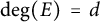 $\deg (E)\,=\,d$
,
 $\dim (E_x^i/E_x^{i+1})\,=\,r_x^i$
and system of weights
 $\alpha $
.
If V is a line bundle, then this moduli space is nonempty if and only if either:
-
•
$(V,\,\phi )\,\,\ne \,\,(TX(-S),\, i\,:\,TX(-S)\,\hookrightarrow \, TX)$
, or -
•
$(V,\,\phi )\,\,=\,\,(TX(-S),\,i\,:\,TX(-S)\,\hookrightarrow \, TX)$
and
$$ \begin{align*}d+\sum_{x\in S} \sum_{i=1}^{l_x} \alpha_i^x r_i^x \,=\, 0.\end{align*} $$



If V is a stable bundle, then for the moduli space to be nonempty, it is sufficient to have either:
-
•
$\operatorname {im} \phi \,\ne \, TX(-S)$
, or -
•
$\operatorname {im} \phi \,=\, TX(-S)$
and
$$ \begin{align*}d+\sum_{x\in S} \sum_{i=1}^{l_x} \alpha_i^x r_i^x \,=\, 0.\end{align*} $$


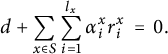
Proof The existence of a quasi-projective coarse moduli space
 $\mathcal {M}$
of quasi-parabolic Lie algebroid connections follows directly from the previous discussion on the equivalence between the quasi-parabolic
 $(V,\,\phi )$
-connections and the parabolic
 $\Lambda _V$
-modules by applying [Reference Alfaya1, Theorem 5.8]. The condition (5.2) of being a parabolic connection can be rephrased as a set of residual conditions in the sense of [Reference Alfaya1, Definition 6.2] as follows. Let
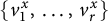 $\{v_1^x,\, \ldots ,\, v_r^x\}$
be a basis of
 $V_x$
for each
 $x\,\in \, S$
. For each
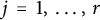 $j\,=\,1,\,\ldots ,\,r$
, let
 $\overline {R}_j$
be the following set of sections of
 $\Lambda _V|_x$
:
 $$ \begin{align*}\overline{R}_j=\left\{(-\alpha_i^x \widetilde{\phi}_x (v_j^x), v_j^x) \,\in\, \mathcal{O}_X|_x \oplus V_x \,\subset\, \Lambda_V|_x\right \}_{x\in S,\, i=1,\ldots, l_x}. \end{align*} $$
Then,
 $\overline {R}_j$
constitutes a residual condition for
 $\Lambda _V$
over the parabolic points S and a quasi-parabolic connection
 $(E_*,D)$
is
 $\overline {R}_j$
-residual in the sense of [Reference Alfaya1, Definition 6.2] for each
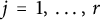 $j\,=\,1,\,\ldots ,\,r$
if and only if (5.2) is satisfied for every
 $v_j^x\,\in \, V_x$
. Since (5.2) is linear in V and
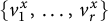 $\{v_1^x,\,\ldots ,\, v_r^x\}$
is a basis of V, this is equivalent to have (5.2) for each
 $v\,\in \, V$
and, therefore, to have a parabolic Lie algebroid connection. By [Reference Alfaya1, Theorem 6.3], for each j,
 $\overline {R}_j$
-residual parabolic
 $\Lambda _V$
connections form a closed subscheme
 $\mathcal {M}_j$
of the moduli space
 $\mathcal {M}$
of quasi-parabolic Lie algebroid connections. Thus, the intersection
 $\mathcal {M}_{(V,\phi )}(\alpha ,\,\overline {r},\,d) \,:=\,\cap _j \mathcal {M}_j$
is a closed subscheme of
 $\mathcal {M}$
corepresenting the moduli of semistable integrable parabolic
 $(V,\,\phi )$
-connections.
Let us analyze the non-emptiness conditions. Assume first that V is a line bundle. First of all, observe that if V is a line bundle, then each parabolic Lie algebroid connection
 $D:E\longrightarrow E\otimes V^*$
is automatically integrable, as we have
 $\wedge ^2 V = 0$
and, therefore, the map
 $$ \begin{align*}D\circ D \,:\, E\,\longrightarrow \,E\otimes \wedge^2 V^*\end{align*} $$
is always zero. Thus, the moduli space is nonempty if and only if there exists a semistable parabolic Lie algebroid connection.
For any curve X, the moduli space of semistable parabolic bundles on X with degree d, parabolic system of weights
 $\alpha $
and parabolic type
 $\overline {r}$
is nonempty and, therefore, there exists at least one parabolically polystable vector bundle
 $E_*$
on
 $(X,\,S)$
for the system of weights
 $\alpha $
.
First, suppose that
 $(V,\,\phi )\,\,\ne \,\, (TX(-S),\,i\,:\,TX(-S)\,\hookrightarrow \, TX)$
. Then, by Proposition 4.2, the parabolic vector bundle
 $E_*$
admits a parabolic Lie algebroid connection
 $D\,:\, E\,\longrightarrow \, E\otimes V^*$
. As
 $E_*$
is polystable, it is semistable and, therefore,
 $(E_*,\,D)$
is semistable, so it yields a point in
 $\mathcal {M}_{(V,\phi )}(\alpha ,\,\overline {r},\,d)$
.
Next, assume that
 $(V,\,\phi )\,\,=\,\, (TX(-S),\,i\,:\,TX(-S)\,\hookrightarrow \, TX)$
and that
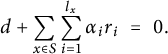 $$ \begin{align*}d+\sum_{x\in S} \sum_{i=1}^{l_x} \alpha_i r_i \,\,=\,\, 0.\end{align*} $$
As
 $E_*$
was taken to be polystable, any direct summand of
 $E_*$
must have the same parabolic slope as that of
 $E_*$
. Let r be the rank of E. Since the parabolic vector bundle
 $E_*$
has parabolic slope
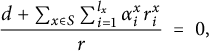 $$ \begin{align*}\frac{d+\sum_{x\in S} \sum_{i=1}^{l_x} \alpha_i^x r_i^x}{r} \ = \ 0,\end{align*} $$
each direct summand of
 $E_*$
must have parabolic slope
 $0$
, and, therefore, parabolic degree
 $0$
. Thus,
 $E_*$
satisfies the conditions of part (2) of Proposition 4.2 and, hence, there exists a parabolic Lie algebroid connection on
 $E_*$
, which is, again due to the semistability of
 $E_*$
, a semistable parabolic Lie algebroid connection.
To show the converse, let us suppose that
 $(E_*,\,D)$
is a semistable parabolic Lie algebroid for the Lie algebroid
 $(TX(-S),\,i\,:\,TX(-S)\,\hookrightarrow \, TX)$
. Then, by [Reference Biswas and Logares5], each direct summand of
 $E_*$
must have parabolic degree
 $0$
, and therefore, the parabolic degree of
 $E_*$
must be zero, so
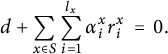 $$ \begin{align*}d+\sum_{x\in S} \sum_{i=1}^{l_x} \alpha_i^x r_i^x \,=\, 0.\end{align*} $$
This completes the proof for line bundles. Now, assume that V is stable and
 $\operatorname {rk}(V)\ge 2$
. Let
 $L\,=\,\operatorname {im} \phi \subseteq TX(-S)$
. If
 $L\,=\,0$
, then a Lie algebroid connection for
 $(V,\phi )$
is simply an
 $\mathcal {O}_X$
-linear map
 $D\,:\,E\,\longrightarrow \, E\otimes V^*$
. Thus, the map
 $D=0$
then constitutes a parabolic integrable Lie algebroid connection on
 $E_*$
. Suppose that
 $L\ne 0$
. Then, L is a line bundle. The previous argument on the line bundle case and the hypothesis of the theorem imply that the polystable bundle
 $E_*$
admits an
 $(L,\,i:L\hookrightarrow TX(-S))$
-parabolic connection
 $$ \begin{align*}\nabla\, : \, E\,\longrightarrow\, E\otimes L^*.\end{align*} $$
By composition with
 $\operatorname {id}_E\otimes \phi ^*$
, we obtain then a quasi-parabolic Lie algebroid connection
 $$ \begin{align*}D\, : \, E\,\longrightarrow\, E \otimes L^* \,\stackrel{\operatorname{id}\otimes \phi^*}{\longrightarrow}\, E\otimes V^*.\end{align*} $$
If we call
 $D_v\,:\, E\,\longrightarrow \, E$
the induced map by contracting with
 $v\,\in \, V$
, then we have, by construction,
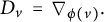 $$ \begin{align*}D_v\, =\,\nabla_{\phi(v)}.\end{align*} $$
Observe that D is a Lie algebroid connection for
 $(V,\phi )$
, as, for each local sections v in V ands in E and each local holomorphic function
 $f,$
we have
 $$ \begin{align*}D_v(fs) \, =\,\nabla_{\phi(v)}(fs)\, =\, f\nabla_{\phi(v)}(s)+s\otimes \phi(v)(f) \, =\, fD_v(s)+s\otimes \phi(v)(f).\end{align*} $$
As
 $\nabla $
is parabolic, it satisfies (5.2) and, by construction, D clearly also satisfies (5.2), so it is also parabolic. On the other hand, since
 $L\subset T_X(-S)$
is a line bundle, then
 $\nabla $
is integrable. Therefore, for each pair of local sections u and v of
 $V,$
we have the following:
 $$ \begin{align*}D_{[u,v]}\, =\, \nabla_{\phi([u,v])}\, =\, \nabla_{[\phi(u),\phi(v)]} \, =\,[\nabla_{\phi(u)},\,\nabla_{\phi(v)}] \, =\,[D_u,\,D_v]\end{align*} $$
so D is integrable. As before, since
 $E_*$
is polystable, then
 $(E_*,D)$
is semistable and, therefore, it represents a point in the moduli space.
Acknowledgements
We thank the referee for a helpful suggestion.



