The statue of Stamford Raffles in the heart of the city-state of Singapore is a constant reminder of the imperial connection to its citizens, residents and tourists, a saga that started 200 years ago in 1819. Britain's acquisition of Singapore certainly changed the momentum of its trade, commercial and political relations in Asia. It also created a unique identity for Singapore in Southeast Asia by connecting it, from the midst of the Malay World, to the global economy.Footnote 1 British policy and governance shaped the economy, landscape, institutions and demography with significant reverberations in the contemporary state. The British enforced a seamless connection and mobility of men, money and authority across the region, redrawing existing circuits of trade and commerce, migration and power. In extending the Empire's reach from the subcontinent to Southeast Asia, they also reversed the trajectories and the importance of the once-active Indian presence in the region. New dynamics of accommodations and contestations arose between and among local and colonial powers in the competition to gain supremacy over Asian markets and resources. This article brings to light one of the less-studied narratives of diasporic Indian history: the development of Indian transnational business networks in Singapore, and their integral role in flows of capital, which has often been overshadowed by the parallel history of Indian labour migrations across the Indian Ocean.
It is well recognised that the mobility of Indians between the subcontinent and Singapore was circumscribed by colonial strategy, leading to both involuntary and voluntary migrations. What is not often discussed is the difference in the way the British strategised the economic growth of India and Singapore quite distinctly, leading to not only different economic archetypes, but also different paradigms of interactions between races and communities through similar administrative machinery. While the vast Indian subcontinent provided a market for selling products from the factories of Europe and sourcing (and producing) necessary raw materials, Singapore, a much smaller geographical entity, was developed as a trading hub to enhance economic connectivity with China and the Eastern world. Indian communities were to play a significant part in the economic story of both geographies in different ways.
While in the subcontinent, it was a struggle for existence and readjustments in the onslaught of the ‘drain of wealth’, in Singapore, it was about seeking new opportunities through new products and ethnic networks, making the best use of similar colonial administrative machinery, but avoiding contestations and marked visibility. This approach was quite unlike the emergence of the new Indian capitalist class from the 1920s onwards in the subcontinent, who were not only vocal in negotiating with the colonial authorities, but also substantially supportive of anti-British political movements. This divergent disposition of the respective Indian business communities who were intrinsically connected to their regional and linguistic groups and caste affiliations in the subcontinent and made good use of intra-ethnic networks needs to be explored further. This article also examines the growth of Indian business communities in Singapore during this period in relation to changing trajectories in their economic interactions in the subcontinent, and how and whether this affected their relations with other communities in regional markets.
Narratives of migration reconstructed
Indian migration and settlement in the Malay Peninsula has been substantially studied both through lenses of Western narratives as well as from perspectives of Asian historians and almost unanimously structured under labour history discourses. Key studies by Arasaratnam, Sandhu, Mani, Huff and Turnbull or even more recent ones by Amrith,Footnote 2 all adhere to the prevalent historiographical focus on labour migration from the subcontinent. Undoubtedly, this focus can be well justified, given the historical demographic profile of a majority of the Indian migrants in Malaya. However, in the process, the imperial strategy of creating Singapore as a trading hub since 1819 and the participation of free Indian migrant traders and merchants as a significant category in the making of colonial Singapore remain minimally discussed. Thus, in spite of being intimately connected, the prisms of historiography and the imagining of population composition and lived-spaces in the Malay Peninsula and Singapore have been quite distinct. The British had also positioned Singapore distinctly from the rest in making it a part of the Straits Settlements, with certain regulations and policy implications taking a different path from the rest of Malaya.
Thus, one can envisage two distinct dimensions of British policy. First, they created a unique role in both laying down the structure of governance and economic functions of both colonies, and also created the agency for influencing and manipulating that structure in diverse ways. The structural framework for Singapore was that of the trading port and a strategic hub. Relaxed migration rules and a free market economy attracted and created opportunities for large numbers of Chinese migrants in diverse occupations and business operations, including the Straits Chinese, who developed strong commercial links with the colonial authorities, adopted English elite lifestyles, spoke and published in English, yet remained rooted in their Hokkien and Peranakan culture.Footnote 3 Second, at the same time, the new colony was assisted with administrative recruits from the Indian subcontinent and also linked to the Legislative Council as well as the Supreme Court in India. Thus, Singapore was effectively ruled from India for nearly fifty years.Footnote 4 One might then envision that the closeness of the Indians to the colonial British in the machinery of governance and law and order would ensure a definite advantage to the Indians in the socioeconomic landscape of Singapore. No doubt, there were certain benefits for a few groups, even though it might have remained at a superficial layer only. The British colonial elite, with their ‘Anglican, royalist, military and paternalistic character’,Footnote 5 managed to create a master narrative that strengthened ethnic divergences and politicised them to create irreconcilable differences that have endured with long-lasting legacies beyond the colonial era.
Colonial policies and regulations also affected how individual ethnic groups were positioned, restructured and interacted economically and socially. Some commercial groups like the Chettiars were facilitated by the colonial economy to expand into Southeast Asia, which brought them significant prosperity. Others like the Sindhis were driven to venture out of their homeland after the British annexation of Sindh,Footnote 6 and they soon adapted into a globe-trotting trading diaspora dealing with products which catered to the colonisers’ tastes and needs. The Parsis were active in the China trade, and many took up residence in the Chinese treaty ports.
Indians also bore the brunt of colonial agency in other ways. They were disliked by the local people in Singapore/Malaya as either ruthless lawkeepers (as civil and military personnel), or looked down upon as impoverished labourers and coolies (Klings and Bangalis, derogatory terms used to refer to Indians).Footnote 7 Indians in Singapore also suffered racial discrimination and exploitation at the hands of the colonists in the same manner as in the subcontinent. Thus, the various Indian business communities who sustained themselves and prospered in Singapore had a peripheral existence supported by communal networks, and adapted and accommodated to life within the colonial economic project. Much of the business-focused migration outside India was temporary. As Claude Markovits points out, ‘Rarely did commercial migrants leave India with the avowed intention of settling abroad for good.’Footnote 8 The aim was to maintain communication with the homeland periodically and also return with the earnings for retirement in most cases. The introduction of steamships reduced travel time, leading to the ease of this voluntary migration that was heavily male-dominated and mostly short-term, if not transient. However, their presence for years at a time also supported the visibility and emergence of the communities and merchants who opted for a more permanent presence.
In positing the significance of Indian business communities in Singapore, a comparative context to the economic developments, especially the changed structures of production as well as the transformation of their counterparts’ circumstances in the Indian subcontinent may be helpful.
Economic transformation in India
David Washbrook posed an important question about whether ‘British rule fundamentally alter(ed) the structures’ through the ‘imposition of “superior” European arms, technology and ideology’ or ‘did it rest lightly on top of pre-existing structures and serve to sustain established elites?’Footnote 9 While Washbrook particularly focused on South Indian society and structure, this question may be equally applicable to the other regions of the subcontinent. Many scholars have studied the transformation of the old economic order leading to colonial supremacy, empirically and otherwise. Immanuel Wallerstein focuses on two kinds of qualitative changes that came about when India was incorporated into the world economy — reorganisation of the structure of production resulting in the social division of labour, and restructuring of the political order with new economic participation.Footnote 10 There is certainly no doubt about the dominant structural changes that came about with colonial rule. However, it is uncertain whether pre-colonial economic models in India were so fragile as to have been completely overwhelmed, given that regional networks of production and the movement of commercial capital were not only confined to the subcontinent, but quite prominent in the world of maritime trade and commerce.
Historians like Sudipta Sen have also questioned Wallerstein's characterisation of what seemed like the wholesale appropriation and incorporation of the Indian economy into the global system ‘in one bold stroke of capitalist expansion’.Footnote 11 On the other hand, research by Om Prakash has shown how the local merchants and artisans played into the hands of the English East India Company (EIC)'s initial investments and procurement patterns when Bengal emerged as the largest producer of luxury textiles by the late seventeenth century catering to the Euro–Asian trade circuits. This generated positive income, employment and output for the local market, supporting about 10 per cent of the total textiles workforce.Footnote 12 Thus part-time local artisans chose to become full-time textile producers and relocate to aurungs (local manufacturing centres),Footnote 13 financially supported by European companies and involuntarily becoming a part of the regional and global production network.
This advantageous momentum took a different turn from the second half of the eighteenth century with British territorial and administrative acquisitions both in the South and in Bengal (1757, 1764), changing the whole power game. Procurement of textiles was now placed under a Commercial Resident who took coercive steps to their advantage with low wages and the imposition of contractual obligations. A special Superintendent of Resources was also appointed to collate information on the merchants and trading community for the purpose of easing out their operations.Footnote 14 Through such economic manoeuvres, the EIC's exports increased substantially during the second half of the eighteenth century, with a corresponding decrease in bullion imports. One important source of funding export investment was the surplus from provincial revenues (as obtained from the Diwani or revenue rights of Bengal). Furber's calculation of the economic drain between 1783 and 1793 from India to Britain was 1.8 million pounds.Footnote 15 Similar to the fate of the Bengal textile weaver, the opium-growing peasant was also subjected to ‘significant non-market pressures by the English East India Company as well as by its employees operating in their private capacity’.Footnote 16 Thus, the stage was set for a new era of impoverishment unknown in Indian history, leading to widspread displacement, accommodation and migration.
The European traders, on the other hand, simultaneously began their intrusion into the local market by participating in the world of trade and patronage in the courts of various Indian rulers, kings and nawabs,Footnote 17 where rituals of the darbar (courtly audience) and gift exchanges were conducted in lieu of trading rights (sanads and farmans). These rights could range from exemptions from tax and customs duties to privileges of building factories, etc. In Sen's words, the
East India Company in the latter half of the eighteenth century was reaching out for the instruments of control, surveillance, and violence to establish a set of rules and practices that would guarantee the ‘freedom of trade’ while at the same time ensuring the flow of revenue.Footnote 18
Foreign merchants, traders and government representatives took many significant steps to gain access to local markets, thus, gradually acclimatising themselves to local practices and strengthening their foothold in various parts of the subcontinent. It would be impossible to suggest that the Company's servants overpowered the local merchants and trading communities at a stroke of magical genius. On the contrary, there was considerable collaboration and support extended to the merchants and traders by the British in a decadent Mughal economy.
Yet, eventually, with the Company's stronghold over the economy and the administration and linking the subcontinent to global supply and demand, the economic narrative turned around in its favour for almost two centuries. The economic power of large investments, a uniform system of currency, and structural revolution, laced with racial contempt and discrimination, led to the marginalisation of many in the indigenous business communities. Many established pre-colonial bankers and traders shut their businesses permanently, or suffered severe downgrading of status. However, the resilience of the overall Indian indigenous business communities — partly formed from caste-based inheritance, intra-ethnic support networks and occupational specialisation, and partly from the ability to take on new opportunities — survived, with new generations of trading bodies and the formation of new capitalist classes.
The Singapore–India connection
The strong threads of similarities and interactions between the not-so-distant geographical entities of Singapore and India have been well discussed in popular and academic discourse. The acquisition of Singapore was crucial to British expansion in Asia — it secured a strategic location in the Malacca Strait, and as Secretary of Foreign Affairs Lord Canning argued in the House of Commons in 1824, was a victory that would complete the making of the British Indian empire.Footnote 19
When Stamford Raffles, an agent of the EIC, made an agreement with Sultan Hussein of Johore in 1819, Singapore came under the rule of the Governor General in India, based in Calcutta (now Kolkata) and continued that status for about half a century till the Straits Settlements was brought directly under British rule in 1867 as a crown colony.Footnote 20 Quite naturally, Indians came in substantial numbers to feed into the administrative, commercial, defence and service requirements of the newly established port-city. Raffles himself came to Singapore with an entourage of 120 sepoys and lascars, domestic servants and Indian assistants.Footnote 21 The civil servants (mostly from the Bengal Regiment or officers of the Madras army), clerical and technical staff were Indians. In addition Indian labourers were employed in the plantations and estates, the public works department, and in harbours and docks.
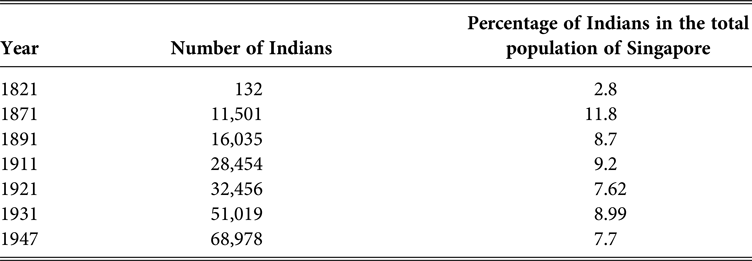
As Singapore developed as a free port, Indian merchants and traders did not stay far behind, and formed a part of the voluntary migrants. Singapore also served as a convict colony and the number of convicts from the subcontinent sent there increased from about 1,100 to 1,200 in 1841 to 2,275 by 1860.Footnote 22 They served as an important and cheap labour force in all infrastructure and landmark building projects in early Singapore, including Fort Canning, Government House, the General Hospital at Pearl's Hill and St. Andrew's Cathedral. In spite of being closely connected to many key facets of the development of the port-city and its administrative machinery, and the promotion of a ‘free port and open emporium’ with an ‘unrestrictive immigration policy’,Footnote 23 Indians always remained a demographic minority in Singapore (see table 1).
Population figures of Indians in Singapore 1821–1947
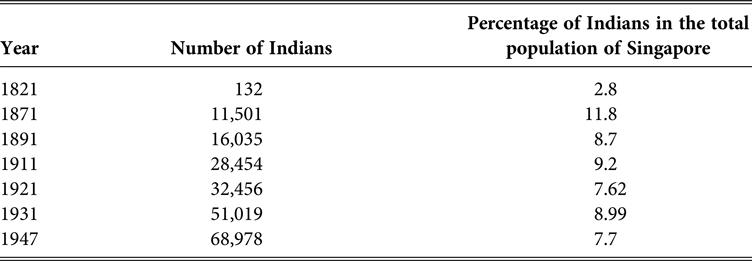
Sources: K.S. Sandhu, ‘Indian Immigration and Settlement in Singapore’, in Indian Communities in Southeast Asia, ed. K.S. Sandhu and A.Mani (Singapore: ISEAS, 1993), table 30.1, p. 775; C.A. Vlieland, British Malaya: A Report on the 1931 Census and on certain problems of vital statistics (London: Crown Agents for the Colonies, 1932), table 8, p. 126.
Notably, Singapore was also kept politically apart from the governance structure of much of Malaya in order to maintain its status as a colonial entrepôt. It was segregated as a part of the Straits Settlements to de-link Singapore's labour market from its traditional hinterland and also regulate its population flows. Adam McKeown and Sunil Amrith have both argued that the increase in migration flows was accompanied by surveillance, segregation and discrimination with a gender imbalance in migration policy and the increasing use of identity documents.Footnote 24 Large numbers of Indian labourers, mainly lower-caste Tamils, were brought in from the 1830s onwards for ‘general municipal and other developmental works in a rapidly developing economy’ to fill a gap in workforce.Footnote 25 The Chinese were the largest group of immigrants, however, with their numbers rising from 55,000 in 1871 to 87,000 in 1881 to 164,000 by 1901.Footnote 26 Indians were the second largest group by 1860, but their numbers fell from 13,000 in 1860 to 12,000 in 1880; theirs was the only migrant group whose numbers declined.Footnote 27
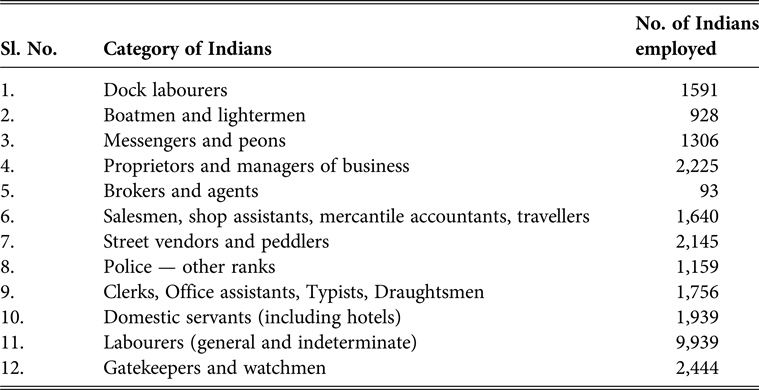
Thus Singapore developed as a predominantly ‘Chinese city’, with Indians participating in assisting colonial governance on the one hand and providing necessary labour for its economic growth on the other. In creating this demographic structure, the authorities strategised an advantageous political and economic model that maintained the facade of diversity and cosmopolitanism necessary for a free market, while developing racially segregated residential enclaves and delegating different occupations and activities for various communities (see table 4). This policy was crucial in creating a narrative of Indians as a labouring population — convict, indentured, or voluntary — at the same time ignoring the traders, merchants, professionals and others in service who did not have much agency and preferred to remain invisible and indifferent. Colonial policy thus marginalised the Indians in Singapore, giving rise to what Tan Tai Yong and Andrew Major describe as a ‘subaltern Indian community’,Footnote 28 a perception that continued in the post-1965 nation-state.
In the broader framework, Singapore thrived and flourished as a trading port with global connections, and like all other colonial port cities, shaped up as a ‘plural society’ in Furnivall's words, with a medley of races that ‘mix but do not combine’.Footnote 29 To the Indian mercantile communities, who had traversed the Southeast Asian waters since ancient times, colonial rule ensured that continuity, though with different hierarchical political structures and new frameworks of commodities and border crossings. Large-scale labour migration was a new phenomenon resulting from colonial policy to address labour shortages in plantation economies, particularly following the abolishing of the slave trade. This colonial strategy gave rise to the dominant historical narrative of Indian Ocean migration to Singapore (and Malaya). Thus, the small Indian trading communities, who had been a significant and influential merchant diaspora and presence in the region since ancient times, became a part of this dichotomy, restructured themselves in the new economic trajectories, and served different needs of the imperial order.
Prevalent historical narratives of Singapore have largely ignored the role of Indian pioneers such as Narayana Pillai,Footnote 30 who was one of the earliest Indian businessmen to come to the island (relocating from Penang). Pillai was also an interpreter and clerk for the British who accompanied Raffles when he first landed in Singapore in 1819. The Indian merchants and traders came in much smaller numbers than the labourers. However, as early as 1822, when a committee was appointed to demarcate areas for different groups of people, the Chulias were given land up the Singapore River,Footnote 31 an area of prime commercial importance to all trading groups.Footnote 32
The entourage of the Bengal Native Infantry and the ‘bazaar contingent’ of washermen, milkmen, tea-makers, and domestic servants from India were brought in by Raffles to serve and guard imperial interests. Thus, the colonial chapter of ‘what was to be the greatest free port of the Indian Ocean’,Footnote 33 Singapore, was facilitated by different categories of Indians as service providers for colonial benefit. According to the first Census drawn up in 1824, Malays were the largest ethnic community, followed by the Chinese and Bugis. There were also 756 Indians, 74 Europeans, 16 Armenians and 15 Arabs. There were about 12 European firms who were mostly agents for London or Calcutta commercial houses.Footnote 34 By 1845, Indians comprised about 10 per cent of the population. In 1846, there were 43 merchant houses, one of which was Parsi.Footnote 35 Turnbull states that while Indians had a considerable presence in the urban areas by the mid-nineteenth century, they ‘made comparatively little impact’ since they were more prominent as individuals rather than community leaders or representatives.Footnote 36
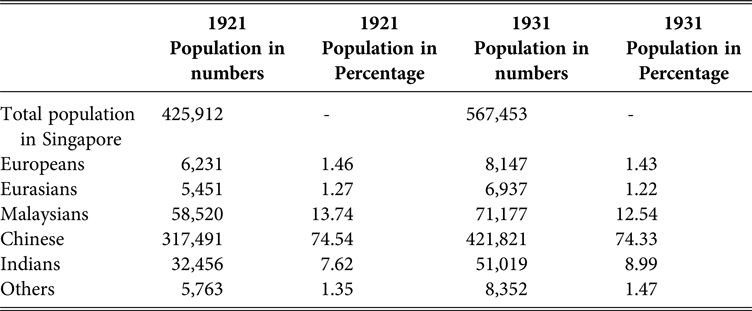
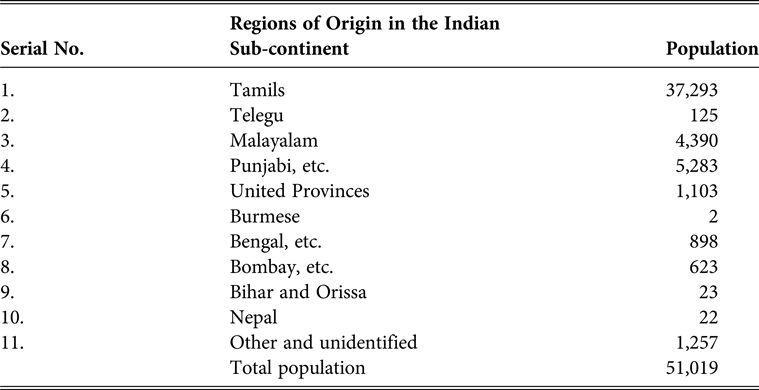
The British did not consider the rich Parsis as Indians; neither did the Parsis mingle with the others in the diverse Indian community, who were mostly petty tradesmen, labourers and ferrymen.Footnote 37 Maintaining a distance from the ‘subaltern’ identity also facilitated closer connections with British status and power for the Parsis, particularly, in the light of their close connections in the China trade. The country trade that already existed across the Bay of Bengal eventually extended through the Malacca Straits into China, thus, accelerating the movement of free commercial migrants trading in Indian jute, cotton, wheat and opium to Singapore in exchange for pepper and other spices, sago, tin and silver dollars.Footnote 38 Markovits calculated that ‘approximately a quarter of a million Indians were engaged in trading and finance activities outside India around 1930’. The share of trading migrants in the Indian population ranged between 5 per cent and 6 per cent in Malaya and nearly 20 per cent in Burma.Footnote 39Tables 2 and 3 (and partially table 1), based on the Census Reports of 1931, indicate the trends in the demographic composition of Singapore as well as the diversity of the Indian community.
Comparative population figures in 1921 and 1931 in Singapore
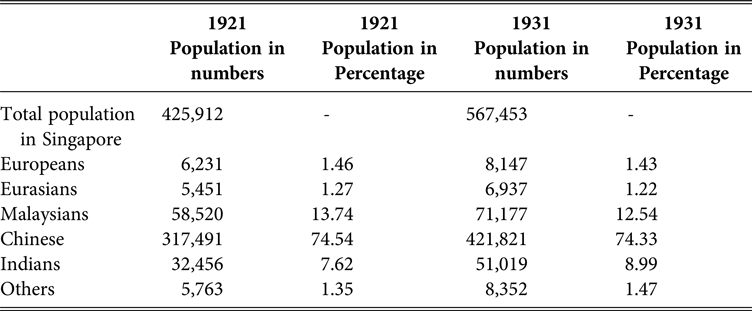
Source: Based on Vlieland, British Malaya, table 8, p. 126.
Regional distribution of the Indian population in the settlement of Singapore, 1931
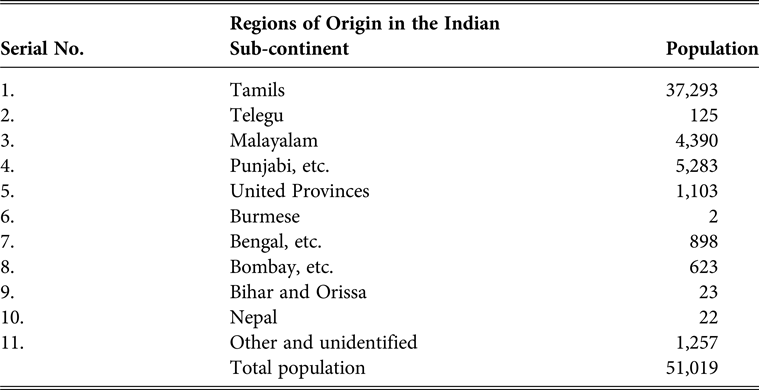
Source: Based on Vlieland, British Malaya, Table 62: Straits Settlements – Indians by Race, p. 193.
Lived spaces, occupations and identity formation
The earliest concentration of Indians was in and around the Market Street and Chulia Street area, and later, in the High Street area, north of the Singapore River,Footnote 40 and not Serangoon Road (which has been called ‘Little India’ only since the 1980s). These lived-spaces reflected the varied occupational patterns and economic status in the community. Priority was given to market interactions and trading communities, as the British desired these spaces to be. However, as noted, there were also Indians who were employed at different levels of government, ranging from chief clerks, engineers in the public works department, technical subordinates, printing office operators, foremen, to survey department apprentices.Footnote 41 The introduction of English education in the Indian subcontinent to serve the running of British administrative machinery at lower costs bore fruit in creating this category of moderately educated skilled and semi-skilled workers, who had a distinct advantage of employment in the colonial public service over other races in Singapore. Police and armed force personnel were another group where Indians dominated in terms of numbers. Some of the categories of occupations in the Census of 1931 are given in table 4.
Occupational structures of Indians in Singapore, 1931: Some categories
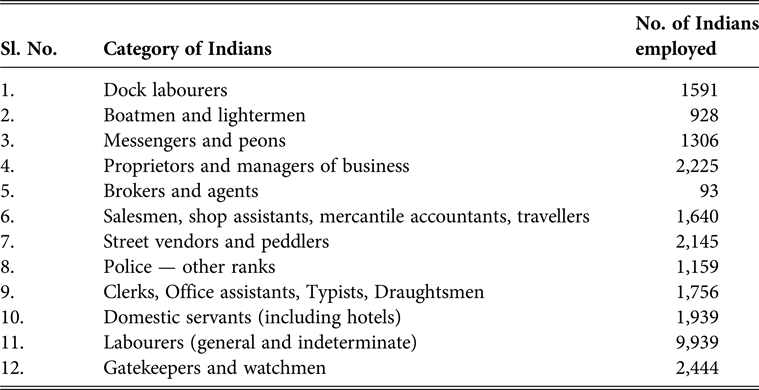
Note: Numbers include both males and females though the numbers of females are almost negligible in most categories.
Source: Calculations and categories based on Vlieland, British Malaya, table 127, pp. 273–6.
At the same time, as a growing centre for Southeast Asian trade, Singapore attracted many wealthy Chinese businessmen in the region who invested in the plantation economy (for example gambier, later rubber) and manufacturing. Thus, at the turn of the twentieth century, ‘Singapore was a cosmopolitan city, but largely an Anglo-Chinese preserve’.Footnote 42 The Nanyang Chinese had been already operating in places like Penang, Melaka, Manila and Riau through intricate regional commercial networks. The Indians also had a larger mercantile presence in Penang carrying on intra-Asian trade. Gradually many Indian traders and merchants located themselves in Singapore, mostly as wholesale and retail merchants (especially in the High Street area) and also as prominent financiers (Chettiars in the Market Street area). The distinct difference with their Chinese counterparts was in the latter's system of intra-community networks and business culture (guangxi), with their large investments in manufacturing as well as in their preferred trading partners and regions, in some cases.
Whereas most of the Chinese businessmen operated within the Southeast and East Asian regions, Indians were trading extensively with the Japanese, particularly in the 1930s, and also stretching across the Indian Ocean into the Middle East and Africa. These merchants ranged from petty traders to big family businesses.Footnote 43
Japan's pre-war industrial development and trade had a significant effect on British trade in Malaya. The Report of the Trade Commission in 1933–34 showed extensive evidence of ‘enchroachment made by Japan’. The percentage of Japanese imports into Malaya increased from an average of 2.7 per cent in 1907–1911 and 4.5 per cent in 1921 to 4.4 per cent in 1932 and 7.6 per cent in 1933.Footnote 44 Prices offered by Japanese dealers were much lower in comparison to other sources. An important reason for this were their different business models. Whereas Japanese conducted business on an ‘open market’ basis, British colonial trade was carried on through a system of agents and sub-agents, thus resulting is substantial price-cutting between importers in Singapore handling the same products. Simultaneously, a boycott of Japanese goods by Chinese traders in view of the growing tensions between China and Japan created opportunities for the Indian merchants to make the most of Japan's ‘export drive’. Many Indian business houses already had establishments in Japan, especially in the textile business (silk, cotton and artificial silk).Footnote 45 There were branch offices of the same Indian firms in different locations across Southeast Asia (for example, Bangkok) and Japan (Kobe, etc.).Footnote 46 The Trade Commission report stated:Footnote 47
In cotton and silk goods in particular a large share of the distribution as well as the import is in the hands of the Indians and Arab dealers. In general Japanese importers sell for cash: short terms of credit are given sometimes but they are far less liberal than the periods of 60 to 90 days still customary with many European importers. Rapid turnover assists importers and dealers to handle Japanese goods at low profit margins.
Thus, Indian business networks stretched outwards into the Far East and contributed to their growing prosperity, at least till the outbreak of the Second World War.
In Raffles’ town planning, different lived and market spaces emerged across the island, some of which bore strong Indian characteristics like the High Street, Market Street, Arab Street and Serangoon Road areas. As described in my earlier work, these areas did not only have a high concentration of Indian residents, but also Indian-owned wholesale and retail businesses in the shophouses that formed an important feature of architectural landscape in these lived-spaces. A broad ‘North’ and ‘South’ demarcation was visible.
A broad category might … be drawn between the High Street, the main periphery of activities of the North Indian merchants and the Serangoon Road dominated by the South Indian merchants, mainly Tamils. On the other hand, a product-wise division would find both the Sindhis and the Tamils engaged in the textile business though the Tamils often dealt in retail trade, but in different enclaves. Tamils were also engaged in the dairy business in a big way, and so were the men from Bihar. Similarly, the spice traders were both from the Gujarati as well as the Tamil community. To consider other complexities, there could be a religious similarity between the Bohra Muslims from Gujarat, based in Arab Street and mostly dealing with textiles and spices, and the Moplahs or the Malabari Muslims from Kerala, also situated in the Arab Street, but mainly catering to the food and restaurant business. One of the earliest group of traders were the Chulias or the Tamil Muslims from the Coromandel Coast, who had established the Al-Abrar Mosque at South Bridge Road as early as around 1827.Footnote 48
Some of the old firms which thrived for more than two or three generations were Ranchoddas Purushottamdas & Co. (established c.1905) and Waghji Lamidas (1906). Ranchoddas set up a transshipment business taking rice from Bangkok to Zanzibar, returning with cloves from Zanzibar to Indonesia and/ or shipping sugar from Indonesia to India and the Middle East, thus participating in the circulation of commodities across the Indian Ocean.Footnote 49 Even earlier, there were names like the Angullias and Isabhai and Company since the 1850s, Nagandas Pushotam in the 1880s, F.M. Noordin in 1900, and the Nomanbhoys, who came in 1905. Another old trading firm was that of the Jumabhoys, which was established in 1915. By the 1920s, they had offices in Surabaya, Semarang and Hong Kong and an office in Bombay by 1928. Rajabali Jumabhoy worked as Commission Agent for exports in the Middle East as well, exporting large quantities of coffee to Muscat and Dubai, and also to Bahrain, Basra and other ports in the Persian Gulf.Footnote 50 Some of the other firms which survived for 50 years or more were A.T.E. Maskati, E.J. Motiwalla, Wassiamull's, Chhotirmall's Gian Singh, Framroz Aerated Waters, R. Pushotam, A.A. Valibhoy and P. Govindasamy Pillai. The main exports from Singapore, according to some oral history records, included sago flour, betel nuts, gum-benzoin, long pepper, nutmeg, copra, sago seeds, maize, tapioca seeds and rattan, which were mainly sent to India. Chillies and turmeric powder were sent to Ceylon (Sri Lanka). India and Ceylon were two of the most important markets for these traders.Footnote 51
The Sindhis in Southeast Asia had one of the most extensive intra-ethnic networks. They were amongst the earliest of the trading communities to have their own merchant association (Sindhi Merchants Association in Singapore, founded in 1921). They also provided boarding facilities for Sindhis in transit to other parts of Southeast Asia. They also interacted with the government on policies on imports, exports and quotas.Footnote 52 The Punjabis were also represented in business, and important names emerged like the Gian Singh Group, Bajaj Brothers and Hardial Singh Company.Footnote 53 Both Punjabis and Sindhis were deeply affected by the Partition of India in 1947. While many lost their homes and their homeland, they were also rehabilitated with the help of their community networks, and many settled in Singapore and other places in Southeast Asia permanently.
Serangoon Road developed as an Indian settlement only in the later half of the nineteenth century.Footnote 54 In fact, Serangoon, along with Bukit Timah and Changi roads had important gambier and pepper plantations,Footnote 55 and there was some rice cultivation beyond the Race Course Road which runs off Serangoon Road. However, this area was more popular for cattle farming because of its abundant grassland and fresh water. This legacy remains in the names of the roads and the main market — Buffalo Road, Kerbau (buffalo) Road and Tekka market.Footnote 56 In the late nineteenth century, however, Serangoon Road was not an Indian enclave, as Sharon Siddique and Nirmala Puru Shotam have pointed out: out of 20 building plans submitted in 1885, three names were that of Chinese and the rest were Indians.Footnote 57 Ethnic diversity prevailed among the business establishments and residential quarters, with Chinese, British and Eurasians alongside Indians.Footnote 58
Thus, the Serangoon Road area emerged as an interactive lived space for not only Indian, but also Chinese, Anglo-Indian and British residents who were retired civil servants or middle-level entrepreneurs, or both, and also small businessmen, not essentially ‘coolies’. The labouring class existed as ‘coolies’ (including a lot of Chinese migrants) mostly as port and dockyard workers and convicts. At the other end of the social scale, there were numerous Indians also working in the colonial administration as clerks, lawyers, and doctors. Former Singapore President S.R. Nathan's autobiography gives us interesting insights into the everyday lives and occupations of Indians in twentieth-century colonial Singapore.Footnote 59 The growth of the Indian population in the area arose from the proximity of the gaol (at the junction of Bras Basah and Bencoolen roads) where Indian convict labourers were used for road and building construction. Besides, there were municipal labour lines or plank buildings built by the government to house the Indian migrant workers in the area.
The history of this expanding settlement has contributed significantly in nurturing the popular imagining of Indians in Singapore. The Serangoon Road area, named as ‘Little India’ in the 1980s, became the representative space that characterised the minority community. This lived-space developed, as mentioned, from land allocation and everyday necessities of diverse groups. The businesses that flourished and developed were organic, local and retail in nature. Besides the large number of general provision stores, flower shops, jewellery stores, restaurants and eateries also generated considerable business mostly catering to the local residents. Many Indian enterprises located in either Market Street or High Street were also sourcing and distributing products to Southeast Asia, the Middle East or Africa, while being intricately connected to their respective ethnic and financial networks in the Indian subcontinent.
However, in post-1965 Singapore, many of these colonial links were disrupted, particularly with political turmoil on the Malaysian front and the Indonesian Konfrontasi. Many Indian traders, who survived on regional trade, lost out badly. They had to either close their businesses or diversify into new products and clients under new systems of governance. Many successful businessmen, especially from northern India, who had successful business networks, moved to Hong Kong and other places. According to one account from the oral history recordings in the National Archives of Singapore, there were about 500 businessmen engaged in the wholesale textile business in the High Street area, which dwindled to around 40 to 50 shops by 1985.Footnote 60 Even if the figures cited are but one businessman's impressions rather than the official record, it definitely reflects the magnitude of business interactions, and their decline in living memory. High Street served as a space for fashionable shopping in the 1960s to 1970s before the development of Orchard Road. The festival of Deepavali was also celebrated with a lot of fanfare in the area then.Footnote 61
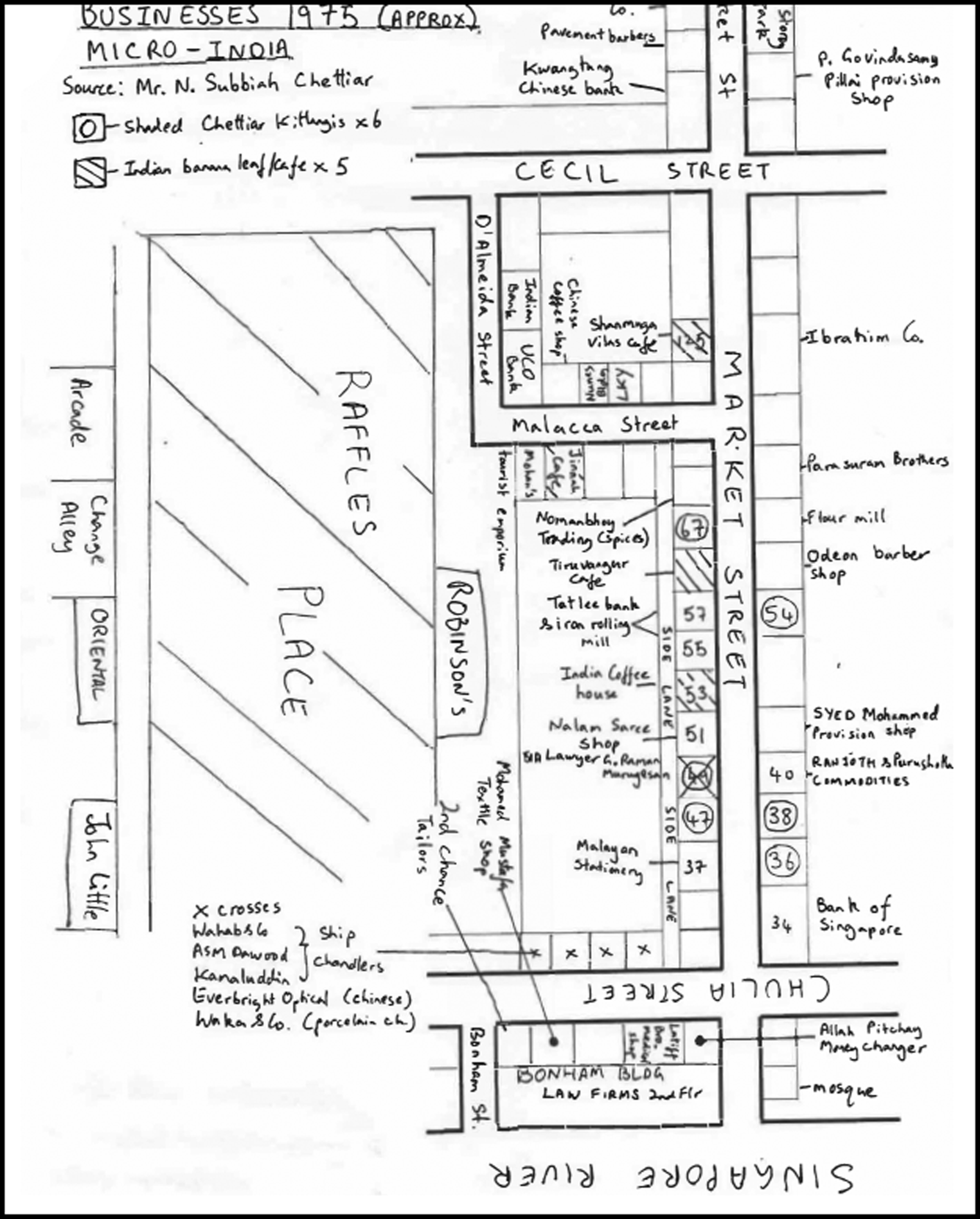
Similarly, Market Street, also known as Chetty Theruvu (Chetty Street in Tamil) housed several kittangis (Chettiar shophouses cum homes), at one point there were around seven kittangis housing about 300 firms.Footnote 62 The childhood experiences of Subbiah Lakshmanan, a Chettiar, who grew up in the area in the 1960s to 1970s are inscribed in the map drawn up by him (map 1). However, there were enormous changes with the process of urban renewal and restructuring of colonial spaces in independent Singapore, and the landscape changed completely for both High Street and Market Street. If either of these spaces were chosen to be representative of the Indian community in post-1965 urban restructuring policies, the representation of Indians in post-colonial Singapore would have certainly been very different.
Street map: Memories of childhood in Market Street. Hand-drawn by Subbiah Lakshmanan reflecting his own and his friends and relatives’ memories of establishments in the Market Street and Chulia Street areas of Singapore (courtesy of Subbiah Lakshmanan)

Indian migration experiences related to trade and commerce emerged with certain common characteristics. Traders and merchants generally did not plan to settle permanently in Singapore, at least in the initial years. The migrant population was male-dominated and in most cases, wives were not permitted to accompany their husbands. Employees in most trading firms were recruited from the subcontinent. They came initially with one to three year contracts; the employers provided passage, food and lodging. The shophouses served as places of work as well as residence. The average salary of a manager at the end of the 1930s was Rs.125–150, and for assistants, it ranged between Rs.25 to Rs.50, payable in India.Footnote 63 Many employees learnt the trade and later started their own business with access to information and a network. The rising momentum of nationalism in the Indian subcontinent also led to parents choosing to send their adult children to Singapore with such employment opportunities rather than making them vulnerable to the potentially dangerous struggle for independence. Girishchandra Kothari, a Gujarati textile merchant in later years, started his life as an employee with a two-year contract with the firm P.S. Jamnadas and Company in 1941 with an above-average salary of Rs.1,200 a year.Footnote 64 A Sindhi businessman, Bhagwan H. Melwani, later the managing director of A.B. Melwani Pte Ltd, also started his career as an employee at his uncle's shop from 1941 to 1947.Footnote 65 These and other enterprising young men usually made good money by establishing new firms and using their networks to hire employees, obtain credit and help with expansion. Endogamous marriage alliances also helped in furthering these ambitions.
Reflections
If migration to Singapore in the nineteenth and twentieth centuries was about ‘prosperity and opportunity’, as Amrith suggests,Footnote 66 to certain communities, it may also have been a way to sustain the traditional business acumen of many Indian regional merchant groups who had to bear the onslaught of British colonial economic restructuring in the subcontinent. They had to reorganise themselves with new adaptations and economic models to carry on with their professions or businesses, make their ventures profitable, and also to negotiate and accommodate the new system.
The long colonial encounter led to the growth of a new capitalist class in the subcontinent, which also began to manifest in different political leanings. Though markets, products and operations had to be adapted to a large extent, most emerging big names amongst the Indian business communities were founded on hereditary caste-based kinship and trade networks. Interestingly, the corresponding Indian business communities in Singapore did not align themselves with the Indian capitalist lobbies in the subcontinent, who were actively negotiating with the British, for example, on trade discrepancies and tariff concessions. Indian business communities in Singapore were mostly accommodating of British interests, though there were a few big names like Rajabali Jumabhoy, heading the Indian Chamber of Commerce in the 1930s, who actively pushed for certain trade concessions.Footnote 67 Thus, though a minority within a minority community, the Indian business groups had a substantial and visible presence in Singapore in the colonial period, with some big merchants also maintaining a close relationship with the government.
However, Indian businesses were never a part of the conventional narrative of colonial understanding of Asian interactions, thus remained on the fringes of an almost forgotten story. The Indian networks functioned, according to some scholars, ‘outside the purview or interest of the colonial state’.Footnote 68 Others like Markovits claim that the indifference was partly due to colonial administrators’ inability to comprehend the complexities of the ethnic networks, and partly choosing to ignore them.Footnote 69 Colonial hegemony and governance undoubtedly was a key factor in establishing the Orientalist narrative, leaving a lasting legacy in post-colonial nation-states.
A publication commemorating 150 years of Singapore in 1969 depicted British and Chinese merchants as superior to any other communities in the annals of merchant houses.Footnote 70 This conception prevailed in the imagined hierarchies of cultures and communities in Singapore, and all Indians perhaps seemed to appear the same shade as convicts or other labourers, and the presence of Indian commercial groups remained almost invisible. It is surprising, however, that the location of the earliest Indian religious sites (indicative of the earliest Indian settlements) like the Mariamman Temple and the Chulia Mosque, which lay beyond the vicinity of the popular perception of Indian labour lines, was not a cause for questioning in academic and public discourses.
The marginalised presence of the Indian firms and merchant communities in Singapore and Southeast Asia continued in the post-colonial era. The emergence of distinct nation-states with new boundaries and thus subject to new national policies changed the flows of human mobilities significantly. It led to the disruption of strong intra-ethnic economic networks with the subcontinent and a loss of homeland ties, which had been a major source of their sustenance throughout the colonial period. The changing geopolitics of a post-colonial Asia, vulnerabilities of new nation-states and emerging Cold War vibes also led to major diversifications in terms of business models and products as well as the retreat or closure of many middle-sized and small firms. There was also an increasing tendency to seek opportunities beyond Southeast Asia, particularly in unknown territories and challenging markets, thus resulting in business ventures in Africa (Shabbirbhai Hassanbhai, Chanrai Group), CIS countries (Tolarams), Australia (Paras Ram Bros).Footnote 71 These Indian firms spread far and wide with headquarters in Singapore, unlike their Chinese counterparts in Southeast Asia. (The idea of guangxi continued to work considerably well even in the changed geopolitical environment, with some exceptions).
With renewed connections and economic convergences between Singapore and India in the twenty-first century, the colonial linkages of different business communities have been evoked, drawing on familiar business cultures and intra-ethnic networks. However, the structural differences of the ‘old’ and the ‘new’ are distinctly visible in terms of business models, sectors of operations, products and business associations. It is interesting to note that in the Government Linked Company (GLC)-dominated investment trajectories of Singapore companies in India, the initial private entrepreneurs who had taken the risk of investing in the Indian market, which posed numerous challenges, were Singapore Indians (Gopinath Pillai, Shabbirbhai Hasanbhai, Satpal Khattar) all of whose forefathers had migrated to Singapore in the colonial period, thus perhaps inadvertantly drawing a full circle and re-linking the age-old connecting threads. It may be kept in mind that Indian companies were the largest group of foreign companies in Singapore in 2018, numbering around 8,000. After two centuries, there are indeed opportunities to rethink the migrant labour-focused historical narrative as the primary feature of Singapore's connections with India.