1. Introduction
The Palaeo-Tethys convergence zone, located between the Indochina and Sibumasu blocks in SE Asia, was formed by subduction of Palaeo-Tethyan oceanic crust beneath the present western margin of the Indochina Block (e.g. Barber et al. Reference Barber, Ridd, Crow, Ridd, Barber and Crow2011). The Sukhothai Arc evolved within the convergence zone and was characterized by the eruption of volcanic successions, intrusion of I-type granitoids, deposition of forearc basin sediments and the development of a back-arc basin (e.g. Barr & Macdonald, Reference Barr and Macdonald1991; Ueno & Hisada, Reference Ueno and Hisada2001; Sone & Metcalfe, Reference Sone and Metcalfe2008; Metcalfe, Reference Metcalfe2013). In addition, the convergence zone contains an accretionary complex that records oceanic plate stratigraphy and mélange formation (Hara et al. Reference Hara, Wakita, Ueno, Kamata, Hisada, Charusiri, Charoentitirat and Chaodumrong2009). An island arc system in the convergence zone reached its peak during the Early to early Late Triassic, and became inactive owing to closure of the Nan and Sa Kaeo back-arc basins and collision of the Sukhothai Arc – Indochina Block with the Sibumasu Block (Sone & Metcalfe, Reference Sone and Metcalfe2008; Hara et al. Reference Hara, Tokiwa, Kurihara, Charoentitirat, Ngamnithiporn, Visetnat, Tominaga, Kamata and Ueno2018). This sequence of events marked a change in tectonic setting from accretion to collision tectonics associated with continental growth during the Triassic.
Recently, various studies have used detrital zircon U–Pb dating of clastic rocks to investigate the evolution of microcontinents (or blocks or terranes) that were derived from Gondwana break-up and subsequently amalgamated in Asia (e.g. Myrow et al. Reference Myrow, Hughes, Goodge, Fanning, Williams, Peng, Bhargava, Parcha and Pogue2010; Aitchison et al. Reference Aitchison, Xia, Baxter and Ali2011; Burrett et al. Reference Burrett, Zaw, Meffer, Lai, Khositanont, Chaodumrong, Udchachon, Ekins and Halpin2014). The U–Pb age spectra of these detrital zircons have been shown to differ between microcontinents, meaning that the spectra are useful for distinguishing the sediment provenance, basement erosion, sediment transportation and palaeogeography of each microcontinent. Detrital zircon U–Pb age spectra have been obtained from Triassic sediments of the Indochina Block in Thailand (Arboit et al. Reference Arboit, Collins, Morley, King and Amrouch2016b; Yan et al. Reference Yan, Huang, Zhao, Zhang, Liu, Charusiri and Veeravinantanakul2017), the Sibumasu Block in eastern Myanmar (Cai et al. Reference Cai, Ding, Yao, Laskowski, Xu, Zhang and Sein2017) and southwestern China (Song et al. Reference Song, Sua, Dong, Song, Allen, Wang and Hu2020), and the South China Block in southern China (Hu et al. Reference Hu, Cawood, Du, Xu, Wang, Wang, Ma and Hu2017).
In the present study, we use detrital zircon U–Pb ages to investigate island arc development in the Palaeo-Tethys convergence zone during the Triassic. We have previously reported detrital zircon U–Pb ages from Triassic sediments of the accretionary complex in the Inthanon Zone (Hara et al. Reference Hara, Kon, Usuki, Lan, Kamata, Hisada, Ueno, Charoentitirat and Charusiri2013), the forearc basin in the Sukhothai Arc (Hara et al. Reference Hara, Kunii, Miyake, Hisada, Kamata, Ueno, Kon, Kurihara, Ueda, Assavapatchara, Treerotchananon, Charoentitirat and Charusiri2017), and the Sa Kaeo Back-arc Basin (Hara et al. Reference Hara, Tokiwa, Kurihara, Charoentitirat, Ngamnithiporn, Visetnat, Tominaga, Kamata and Ueno2018) in the Palaeo-Tethys convergence zone in Thailand. Here, we present new detrital U–Pb ages for Triassic sediments from the Indochina Block (Huai Hin Lat and Nam Phong formations), the Sibumasu Block (Mae Sariang Group) and the Nan Back-arc Basin (Pha Som Metamorphic Complex and associated formations).
Zircon U–Pb ages for igneous rocks have been compiled and interpreted with respect to the tectonic development of the Palaeo-Tethys convergence zone (Wang et al. Reference Wang, Qian, Cawood, Liu, Feng, Zhao, Zhang, He and Zhang2018) and the collisional zone between the Indochina and South China blocks (Nguyen et al. Reference Nguyen, Feng, Zi, Zhao, Tran, Ngo, Tran and Nguyen2019; Thanh et al. Reference Thanh, Hieu, Minh, Nhuan and Thuy2019). These age data for igneous activity are helpful for understanding the tectonic setting of provenance regions for clastic rocks, as recorded by syn-depositional zircons that provide clues to active tectonics at the time of sedimentation, and by inherited zircons from older tectonic events. Here, we report new detrital zircon U–Pb age spectra and interpret these data together with a compilation of published U–Pb ages for igneous rocks and detrital zircon ages from areas in and adjacent to the Palaeo-Tethys convergence zone. We provide new insights into the sediment provenance and sediment supply system for the Indochina Block, the Sibumasu Block, the accretionary complex and the Nan Back-arc Basin, using detrital zircon U–Pb ages. Finally, we use these data to reconstruct the regional tectonic evolution.
2. Geological outline of Triassic sediments in the Palaeo-Tethys convergence zone
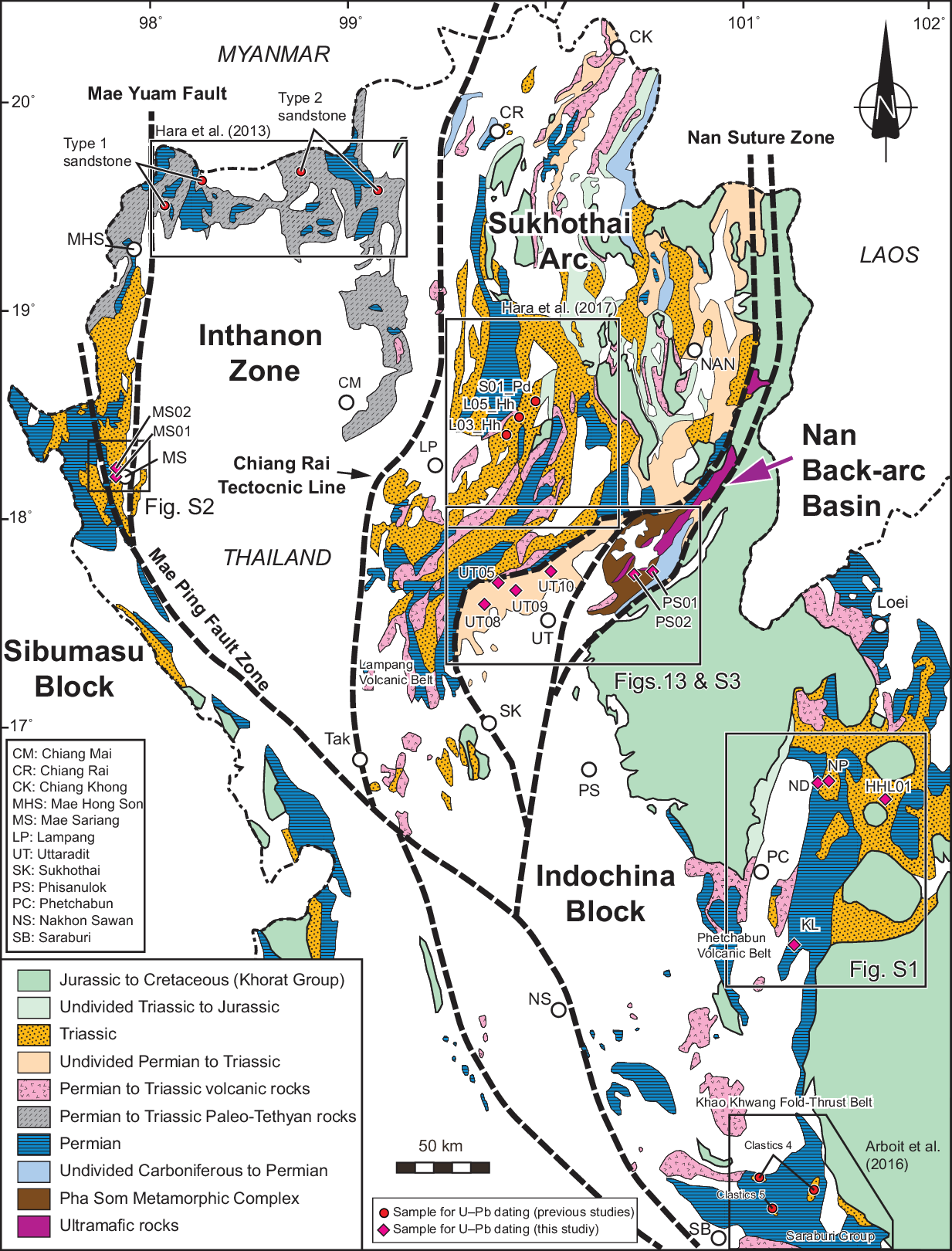
The Triassic Palaeo-Tethys convergence zone in northern Thailand is divided into the following geotectonic units from east to west: the Indochina Block, the Sukhothai Arc, the Inthanon Zone and the Sibumasu Block (Fig. 1). The Indochina Block has remained within the palaeo-equatorial region since it broke away from Gondwana during the Early Devonian (Metcalfe, Reference Metcalfe2002, Reference Metcalfe2006). The Sukhothai Arc is considered to represent an island arc with a forearc basin and a back-arc basin that formed by subduction of Palaeo-Tethys oceanic crust (Ueno & Hisada, Reference Ueno and Hisada2001; Sone & Metcalfe, Reference Sone and Metcalfe2008; Hara et al. Reference Hara, Kunii, Miyake, Hisada, Kamata, Ueno, Kon, Kurihara, Ueda, Assavapatchara, Treerotchananon, Charoentitirat and Charusiri2017, Reference Hara, Tokiwa, Kurihara, Charoentitirat, Ngamnithiporn, Visetnat, Tominaga, Kamata and Ueno2018). The Inthanon Zone is interpreted to represent nappes of Palaeo-Tethyan rocks thrust westward over a marginal part of the Sibumasu Block (Barr & Macdonald, Reference Barr and Macdonald1991; Caridroit et al. Reference Caridroit, Vachard and Fontaine1992; Ueno & Hisada, Reference Ueno and Hisada2001; Hara et al. Reference Hara, Wakita, Ueno, Kamata, Hisada, Charusiri, Charoentitirat and Chaodumrong2009). The Sibumasu Block, which forms the eastern part of the Cimmerian continent (Sengör, Reference Sengör1979), is characterized by a Gondwanan stratigraphy (Ueno, Reference Ueno2003; Metcalfe, Reference Metcalfe2006). Below, we summarize the Triassic sediments within each geotectonic unit in northern Thailand. A geological map of the study area is presented in Figure 2.
Tectonic map of SE Asia, showing major units and fault zones. Modified after Ueno et al. (Reference Ueno, Kamata, Uno, Charoentitirat, Charusiri, Vilaykham and Martini2018) and Hara et al. (Reference Hara, Ito, Tokiwa, Kong and Lim2020).

Geological map of northern Thailand, showing sample localities for U–Pb dating. The geological map is based on the 1:1,000,000 scale geological map of Thailand (Department of Mineral Resources, 1999).

2.a. Indochina Block
The Triassic non-marine sediments of the Huai Hin Lat and Nam Phong formations were deposited in the western Indochina Block (Khaowiset & Chanfoo, Reference Khaowiset and Chanfoo2009), associated with the Indosinian orogeny (Fig. 2; Fig. S1 (in the Supplementary Material available online at https://doi.org/10.1017/S0016756820001028)). The Indosinian orogeny occurred in SE Asia, caused by continental collisions during the Triassic (e.g. Carter & Clift, Reference Carter and Clift2008). Three orogenic events were identified in the Indosinian orogeny during the Early to Middle Triassic (I), Late Triassic (II) and Early to Middle Jurassic (III), evidenced by large unconformity within the Triassic to Jurassic sediments in the Khorat Plateau of NE Thailand (Booth & Sattayarak, Reference Booth, Sattayarak, Ridd, Barber and Crow2011). The Huai Hin Lat Formation is composed of fluvial and alluvial-fan deposits, together with organic-rich lacustrine mudstone interbedded with volcaniclastic rocks. Fossils of plants, pollens and spores, conchostracans, and vertebrates suggest a Norian age for the formation (e.g. Chonglakmani, Reference Chonglakmani, Ridd, Barber and Crow2011). The Huai Hin Lat Formation corresponds to the Kuchinarai Group in the Khorat Plateau Basin, was deposited in an extensional environment in a series of half grabens during the Late Triassic and overlies the Indosinian I unconformity (Booth & Sattayarak, Reference Booth, Sattayarak, Ridd, Barber and Crow2011; Minezaki et al. Reference Minezaki, Hisada, Hara and Kamata2019). The Nam Phong Formation is characterized by fluvial deposits composed of micaceous sandstone, conglomerate and mudstone. This formation unconformably overlies the Huai Hin Lat Formation across the Indosinian II unconformity and has been assigned a Rhaetian age on the basis of stratigraphic relationships and fossil evidence (Chonglakmani, Reference Chonglakmani, Ridd, Barber and Crow2011). The Nam Phong Formation is regarded as the basal sequence of the Khorat Group (Chonglakmani, Reference Chonglakmani, Ridd, Barber and Crow2011).
In this study, we also focus on the Permian sediments of the Nam Duk and Khao Luak formations to understand temporal variations in sediment provenance. Both formations are interpreted as slope to basin sediments that were deposited on the margin of a carbonate platform and show heterotopic facies relationships. They have been assigned Early–Middle Permian ages (Ueno & Charoentitirat, Reference Ueno, Charoentitirat, Ridd, Barber and Crow2011).
2.b. Sibumasu Block
The Mae Sariang Group comprises marine sediments and is distributed on the eastern margin of the Sibumasu Block (Fig. 2; Fig. S2 (in the Supplementary Material available online at https://doi.org/10.1017/S0016756820001028)). The Mae Sariang Group consists of chert, interbedded chert and mudstone, limestone, interbedded sandstone and mudstone, and sandstone (Kamata et al. Reference Kamata, Sashida, Ueno, Hisada, Nakornsri and Charusiri2002; Chonglakmani, Reference Chonglakmani, Ridd, Barber and Crow2011). Kamata et al. (Reference Kamata, Sashida, Ueno, Hisada, Nakornsri and Charusiri2002) reported radiolarians from hemipelagic chert that indicate an Anisian to early Carnian age. In addition, the bivalves of Halobia sp., Daonella sp. and Posidonia sp. have been found in sandstone and mudstone (Chonglakmani, Reference Chonglakmani, Ridd, Barber and Crow2011). Palaeontological data suggest a depositional age of chert for the Mae Sariang Group ranging from the Anisian to Carnian. Based on stratigraphy and lithofacies, the Mae Sariang Group is subdivided into the Kong Sum (Tr1), Pratru Muand (Tr2) and Mae Laeb (Tr3) units from bottom to top, which are interpreted as having been deposited in a deep submarine fan environment located on the eastern margin of the Sibumasu Block (Srinak et al. Reference Srinak, Hisada, Kamata and Charusiri2007). The Anisian to early Carnian cherts occupied the lower part of the Pratru Muand Unit. The Kong Sum, Pratru Muand and Mae Laeb units are assigned as the Early to Middle, Middle to Late, and Late Triassic sediments, respectively (Srinak et al. Reference Srinak, Hisada, Kamata and Charusiri2007). We collected sandstone samples from the Pratru Muand Unit (Tr2).
2.c. Accretionary complex in the Inthanon Zone
An accretionary complex related to subduction of Palaeo-Tethyan oceanic crust has been identified within the Inthanon Zone (Wakita & Metcalfe, Reference Wakita and Metcalfe2005; Hara et al. Reference Hara, Wakita, Ueno, Kamata, Hisada, Charusiri, Charoentitirat and Chaodumrong2009). Ocean plate stratigraphy (OPS) is important for understanding the evolution of ancient accretionary complexes, as it represents the original stratigraphy of the ocean floor before incorporation into an accretionary complex at the trench (Matsuda & Isozaki, Reference Matsuda and Isozaki1991; Wakita & Metcalfe, Reference Wakita and Metcalfe2005). In the Inthanon Zone, the OPS comprises basalt, chert, limestone and clastic rocks (e.g. Wakita & Metcalfe, Reference Wakita and Metcalfe2005; Hara et al. Reference Hara, Wakita, Ueno, Kamata, Hisada, Charusiri, Charoentitirat and Chaodumrong2009; Metcalfe et al. Reference Metcalfe, Henderson and Wakita2017). Basalts of the Palaeo-Tethyan oceanic crust have an oceanic intra-plate affinity, with mostly ocean-island basalt (OIB) characteristics (Phajuy et al. Reference Phajuy, Panjasawatwong and Osataporn2005; Wang et al. Reference Wang, He, Zhang, Srithai, Feng, Cawood and Fan2017). Chert formation was characterized by deposition of pelagic radiolarian chert without terrigenous material during the Devonian to Middle Triassic and a hiatus during the Late Carboniferous (Kamata et al. Reference Kamata, Ueno, Hara, Ichise, Charoentitirat, Charusiri, Sardsud and Hisada2009, Reference Kamata, Hara, Ueno, Sardsud, Charoentitirat, Charusiri and Hisada2012). Deposition of the Devonian to Carboniferous cherts was associated with the opening of the Palaeo-Tethys and included inputs of organic matter and tuffaceous materials (Hara et al. Reference Hara, Kurihara, Kuroda, Adachi, Kurita, Wakita, Hisada, Charusiri, Charoentitirat and Chaodumrong2010). Pelagic chert deposition in the Palaeo-Tethys was limited to the Permian to Middle Triassic. Palaeo-Tethyan limestones (Doi Chiang Dao Limestone) consist of seamount-type carbonate rocks that accumulated under pelagic conditions without input of terrigenous material during the Carboniferous to Permian (Ueno et al. Reference Ueno, Miyahigashi and Charoentitirat2010; Metcalfe et al. Reference Metcalfe, Henderson and Wakita2017). The clastic rocks occur in association with the Palaeo-Tethyan oceanic rocks and are composed of disrupted sandstone and mudstone, and mélange (Hara et al. Reference Hara, Wakita, Ueno, Kamata, Hisada, Charusiri, Charoentitirat and Chaodumrong2009).
2.d. Forearc basin sediments in the Sukhothai Arc
Permian to Triassic forearc basin sediments of the Ngao, Lampang and Song groups in the Sukhothai Arc constitute a succession of repeated carbonate- and turbidite-dominant facies (Chaodumrong & Burrett, Reference Chaodumrong and Burrett1997; Chonglakmani, Reference Chonglakmani, Ridd, Barber and Crow2011; Ueno & Charoentitirat, Reference Ueno, Charoentitirat, Ridd, Barber and Crow2011; Hara et al. Reference Hara, Kunii, Miyake, Hisada, Kamata, Ueno, Kon, Kurihara, Ueda, Assavapatchara, Treerotchananon, Charoentitirat and Charusiri2017). The Triassic turbidite-dominant facies constitute the Hong Hoi Formation (Lampang Group) and the Pha Daeng Formation (Song Group), as typical examples of forearc basin sediments. The Hong Hoi Formation is a typical turbidite succession consisting of sandstone and mudstone, with intervening conglomeratic beds. The depositional age of this formation is Ladinian to Carnian, based on the occurrence of bivalves, ammonoids and radiolarians (Chonglakmani, Reference Chonglakmani, Ridd, Barber and Crow2011; Kamata et al. Reference Kamata, Ueno, Miyahigashi, Hara, Hisada, Charoentitirat and Charusiri2016). The Pha Daeng Formation contains red to grey silty sandstone, siltstone, mudstone, and minor limestone and volcaniclastics (Chonglakmani, Reference Chonglakmani, Ridd, Barber and Crow2011). This formation contains early to middle Carnian bivalves and ammonoids (Chonglakmani, Reference Chonglakmani, Ridd, Barber and Crow2011).
2.e. Back-arc basin sediments behind the Sukhothai Arc
The Nan Back-arc Basin within the Nan–Uttaradit Suture Zone is characterized by ophiolitic ultramafic to mafic rocks such as peridotite, amphibolite, gabbro, pyroxenite and serpentinite (Hutchison, Reference Hutchison1975; Macdonald & Barr, Reference Macdonald and Barr1984; Barr & Macdonald, Reference Barr and Macdonald1987; Barr & Charusiri, Reference Barr, Charusiri, Ridd, Barber and Crow2011); the Pha Som Metamorphic Complex of metavolcanic and metasedimentary rocks, and piedmontite–quartz schists (Singharajwarapan & Berry, Reference Singharajwarapan and Berry1993, Reference Singharajwarapan and Berry2000); Permian limestone (Ueno & Charoentitirat, Reference Ueno, Charoentitirat, Ridd, Barber and Crow2011); and pelagic cherts that contain Permian and Middle Triassic radiolarians (Hada et al. Reference Hada, Bunopas, Ishii, Yoshikura and Metcalfe1999; Saesaengseerung et al. Reference Saesaengseerung, Sashida and Sardsud2008; Yang et al. Reference Yang, Feng, Shen, Malila and Chonglakmani2009). The metamorphic rocks have previously been interpreted as a remnant of an accretionary complex (Singharajwarapan & Berry, Reference Singharajwarapan and Berry1993, Reference Singharajwarapan and Berry2000), but more recently have been regarded as basin-filling sediments that originally covered the ophiolite sequence, corresponding to the Triassic Pong Nam Ron Formation in the Sa Kaeo Back-arc Basin within the Sa Kaeo–Chanthaburi Suture Zone (Hara et al. Reference Hara, Tokiwa, Kurihara, Charoentitirat, Ngamnithiporn, Visetnat, Tominaga, Kamata and Ueno2018). The zircon U–Pb ages of gabbros (311 Ma) and metabasalts (316 Ma) of the Nan Back-arc Basin (Yang et al. Reference Yang, Qian, Feng, Shen and Chonglakmani2016), basaltic andesite (294 Ma) and gabbro (279 Ma) of the Nan Back-arc Basin (Wang et al. Reference Wang, Yang, Zhang, Qian, Gan, Wang, Wang and Senebouttalath2020a), and felsic igneous rocks (283–275 Ma) of the Pailin Crystalline Complex of the Sa Kaeo Back-arc Basin (Hara et al. Reference Hara, Ito, Tokiwa, Kong and Lim2020) suggest that magmatism in the back-arc basins occurred during the Late Carboniferous to Early Permian. The Nam Pat Group is composed of conglomerate, interbedded sandstone and mudstone, and mudstone, which are exposed along the eastern margin of the Pha Som Metamorphic Complex (Fig. S3 (in the Supplementary Material available online at https://doi.org/10.1017/S0016756820001028)) and are also interpreted as back-arc basin sediments (Moonpa & Motanated, Reference Moonpa and Motanated2018). In the present study, we focus on the metasedimentary rocks of the Pha Som Metamorphic Complex to investigate back-arc filling sediments in northern Thailand (Fig. 2; Fig. S3 (in the Supplementary Material available online at https://doi.org/10.1017/S0016756820001028)). The metasedimentary rocks underwent pumpellyite–actinolite facies metamorphism, comprise psammitic schist and pelitic phyllite and are the dominant rocks in the Pha Som Metamorphic Complex (Singharajwarapan & Berry, Reference Singharajwarapan and Berry2000).
Permian and Triassic marine sediments are distributed adjacent to and west of the Pha Som Metamorphic Complex, and encompass the Permian Lab Lae Formation, the Middle Triassic Khao Phueng Formation and the Upper Triassic Mae Choey Formation (Vimuktanandana et al. Reference Vimuktanandana, Meesuk, Wongprayoon and Manoi2008a, b; Chonglakmani, Reference Chonglakmani, Ridd, Barber and Crow2011). The Lab Lae and Khao Phueng formations are composed mostly of sandstone and slate accompanied by minor limestone and chert. Both formations correspond to the Permian Uttaradit Group as defined by Ueno & Charoentitirat (Reference Ueno, Charoentitirat, Ridd, Barber and Crow2011). However, Thassanapak et al. (Reference Thassanapak, Udchachon, Chonglakmani and Feng2011) reported Middle Triassic radiolarians from chert within the Lab Lae Formation, although it is noted that the diagnostic fossils were obtained from limestone and chert, not from clastic rocks. We conducted U–Pb dating of detrital zircons from sandstones of both formations to understand their maximum depositional ages and tectonic setting of deposition. The Mae Choey Formation unconformably overlies the Permian and Triassic marine sediments (Vimuktanandana et al. Reference Vimuktanandana, Meesuk, Wongprayoon and Manoi2008b) and was probably deposited during the Late Triassic termination of the Sukhothai Arc system (Saengsrichan et al. Reference Saengsrichan, Wongprayoon, Charusiri, Choowong and Thitimakorn2008).
3. Methods of geochemical analysis and U–Pb zircon dating
Major- and trace-element contents of glass beads (powder sample: Li2B4O7 = 1:2) were determined by X-ray fluorescence (XRF; Rigaku RIX3000) at Niigata University (Niigata, Japan). The total Fe content is presented as Fe2O3. Loss on ignition (LOI) was measured by weighing the samples before and after heating at 850 °C for 2 h. The Sc, Hf, U and rare-earth element (REE) contents were determined by inductively coupled plasma – mass spectrometry (ICP-MS) using an Agilent 7500a instrument housed at Niigata University. Samples were prepared using a combined acid digestion procedure (HCl and HF). Analytical accuracy is estimated to be better than 8 % as indicated by analyses of geological reference materials BHVO-2 (US Geological Survey) and JB-2 (Geological Survey of Japan). Analytical precision is better than 5 % relative, based on repeat analyses.
U–Pb dating was performed on zircons from sandstones. The zircon grains were hand-picked, mounted on glass slides and embedded in Petropoxy. Cathodoluminescence (CL) imaging was performed with a scanning electron microscope (SEM) (JEOL JSM-6510) equipped with a CL system (Gatan Mini CL) at Shinshu University (Matsumoto, Japan) to observe internal structures and zoning of the zircons and identify suitable sites for U–Pb dating (Fig. S4 (in the Supplementary Material available online at https://doi.org/10.1017/S0016756820001028)). U–Pb isotope ratios were determined by quadrupole-type laser ablation–ICP–MS (LA-ICP-MS; Agilent7700x) at Nagoya University (Nagoya, Japan), following the methods of Orihashi et al. (Reference Orihashi, Nakai and Hirata2008) and Kouchi et al. (Reference Kouchi, Orihashi, Obara, Fujimoto, Haruta and Yamamoto2015). Analyses were performed using a 213 nm solid-state LA system (ESi/New Wave Research NWR213) with a spot size of 25 μm, a repetition rate of 10 Hz and an energy density of 11.7 J cm−2. Analyses of the NIST SRM 610 standard (Walder et al. Reference Walder, Abell, Platzner and Freedman1993) were calibrated against standard zircon 91500 (Wiedenbeck et al. Reference Wiedenbeck, Alle, Corfu, Griffin, Meier, Oberli, von Quadt, Roddick and Spiegel1995). The NIST SRM610 standard was used as the external standard for age determinations. Accuracy was monitored through repeated analyses of the Plešovice zircon standard (Sláma et al. Reference Sláma, Košler, Condon, Crowley, Gerdes, Hanchar, Horstwood, Morris, Nasdala, Norberg, Schaltegger, Schoene, Tubrett and Whitehouse2008). Ages were calculated and concordia diagrams (Fig. S5 (in the Supplementary Material available online at https://doi.org/10.1017/S0016756820001028)) constructed with Isoplot v.4.15 (Ludwig, Reference Ludwig2012). The majority of the determined detrital zircon U–Pb ages are concordant within an analytical uncertainty of 2σ. Only concordant data were used to calculate detrital zircon U–Pb ages. 238U–206Pb ages are reported for zircons younger than 1000 Ma and 206Pb–207Pb ages for those 1000 Ma or older.
4. Sandstone petrography and geochemistry
We describe the petrography of the sandstones based on thin-section observations and modal analyses, and use the Qm–F–Lt diagram with tectonic fields proposed by Dickinson et al. (Reference Dickinson, Beard, Brakenridge, Erjavec, Ferguson, Inman, Knepp, Lindberg and Ryberg1983). In addition, sandstone geochemistry is useful for understanding the composition of source rocks and their tectonic setting. We use the La–Th–Sc ternary diagram of Bhatia & Crook (Reference Bhatia and Crook1986) and the V–Cr–Th*10 ternary diagram of Hara et al. (Reference Hara, Tokiwa, Kurihara, Charoentitirat, Ngamnithiporn, Visetnat, Tominaga, Kamata and Ueno2018) for understanding the provenance and tectonic setting of the studied sandstones, employing Th as a typical incompatible element, Sc, V and Cr as compatible elements, and La as a light REE. In addition, trends from mafic to felsic volcanic and igneous rocks were estimated from the mean values of geochemical data for basalts from the Sa Kaeo Back-arc Basin (Hara et al. Reference Hara, Tokiwa, Kurihara, Charoentitirat, Ngamnithiporn, Visetnat, Tominaga, Kamata and Ueno2018), basalt–andesite and felsic volcanic rocks from the Sukhothai Arc (Srichan et al. Reference Srichan, Crawford and Berry2009), and Phanerozoic granitic rocks (Condie, Reference Condie1993). New geochemical data generated during this study are listed in Table S1 (in the Supplementary Material available online at https://doi.org/10.1017/S0016756820001028).
4.a. Indochina Block
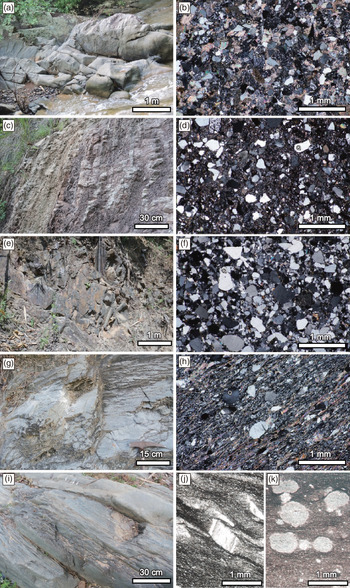
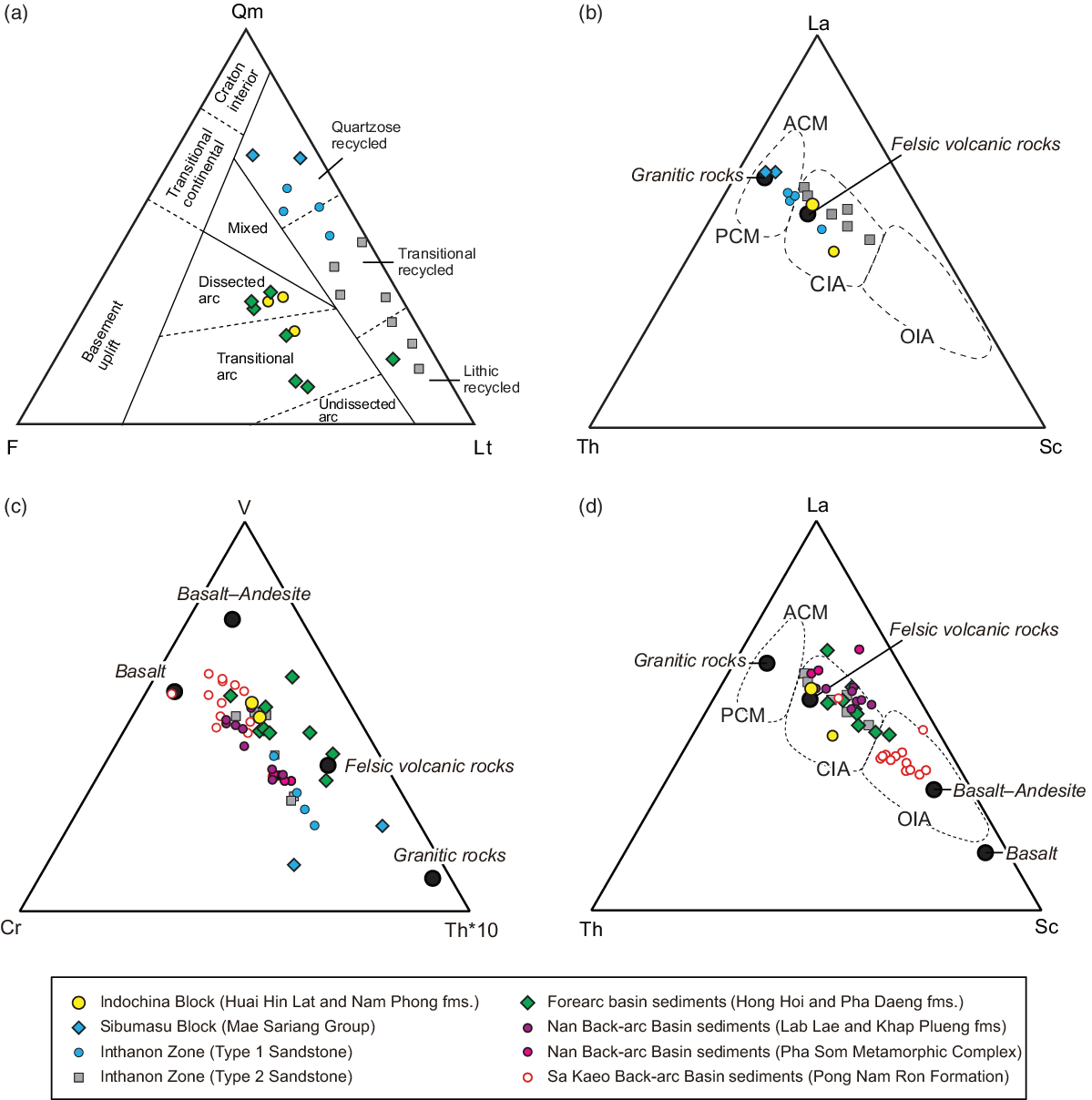
The sandstone of the Huai Hin Lat Formation was collected from the Dat Fa Member (Chonglakmani, Reference Chonglakmani, Ridd, Barber and Crow2011), consisting of argillaceous limestone and calcareous sandstone and shale (Fig. 3a). The sandstone comprises lithic sandstone with infilling secondary calcite (Fig. 3b). The Nam Phong Formation is characterized by red-brown micaceous sandstone (Fig. 3c), and comprise poorly sorted lithic sandstone (Fig. 3d). The sandstones plot in the ‘dissected arc’ and ‘transitional arc’ fields in a Qm–F–Lt diagram (Fig. 4a). The lithic fragments are composed mostly of felsic volcanic rocks and polycrystalline quartz. Geochemically, the sandstones cluster in the ‘continental island arc’ field in an La–Th–Sc diagram (Fig. 4b) and plot between basalt and felsic volcanic rocks in a V–Cr–Th*10 diagram (Fig. 4c).
Outcrop photographs and photomicrographs of sandstones for detrital zircon U–Pb dating and of slates. (a) Bedded sandstone of the Huai Hin Lat Formation (sample HHL01). (b) Sandstone from the Huai Hin Lat Formation in the Indochina Block (sample HHL01). (c) Interbedded sandstone and mudstone of the Nam Phong Formation (sample NP). (d) Sandstone from the Nam Phong Formation in the Indochina Block (sample NP). (e) Massive sandstone of the Mae Sariang Group (sample MS02). (f) Sandstone from the Mae Sariang Group in the Sibumasu Block (sample MS01). (g) Psammitic schist of the Pha Som Metamorphic Complex (sample MS01). (h) Psammitic schist from the Pha Som Metamorphic Complex (sample PS02). (i) Metasandstone of the Lab Lae Formation (sample UT10). (g) Slate bearing andalusite from the Lab Lae Formation (sampling location at UT02). (k) Slate bearing cordierite from the Lab Lae Formation (sampling location at UT08). (g) Metasandstone from the Lab Lae Formation (sample UT10). Q: quartz; P: plagioclase; Lv: lithic fragment of volcanic rocks; Cal: calcite.

Sandstone petrography and geochemistry. (a) Qm–F–Lt diagram with tectonic fields. Qm: monocrystalline quartz; F: feldspar (plagioclase and K-feldspar); Lt: lithic fragments and polycrystalline quartz. (b) La–Th–Sc ternary diagram for sandstones from the Indochina and Sibumasu blocks and the accretionary complex. (c) V–Cr–Th*10 ternary diagram. (d) La–Th–Sc ternary diagram for sandstones from forearc and back-arc basins. OIA: oceanic island arc; CIA: continental island arc; ACM: active continental margin; PCM: passive continental margin.

4.b. Sibumasu Block
Sandstones of the Mae Sariang Group in the Sibumasu Block (Fig. 3e) have previously been classified as lithic sandstone (Srinak et al. Reference Srinak, Hisada, Kamata and Charusiri2007) but in the present study are characterized as being more quartzose and plot in the ‘quartzose recycled’ field in a Qm–F–Lt diagram (Fig. 4a). Quartz grains are abundant and usually are rounded–subrounded (Fig. 3f). Geochemically, the sandstones fall into the ‘active and passive continental margin’ field in an La–Th–Sc diagram (Fig. 4b) and plot in felsic volcanic and igneous rock sources in a V–Cr–Th*10 diagram (Fig. 4c).
4.c. Accretionary complex in the Inthanon Zone
Sandstones of the Inthanon Zone have been classified into two types on the basis of detrital zircon U–Pb age spectra: Type 1 sandstones from the western part of the zone, and Type 2 sandstones from the eastern part (Hara et al. Reference Hara, Kon, Usuki, Lan, Kamata, Hisada, Ueno, Charoentitirat and Charusiri2013). Hara et al. (Reference Hara, Kunii, Hisada, Ueno, Kamata, Srichan, Charusiri, Charoentitirat, Watarai, Adachi and Kurihara2012) described the petrography and geochemistry of sandstones from the accretionary complex without reference to their type. In the present study, we distinguish the two types using sandstone data from Hara et al. (Reference Hara, Kunii, Hisada, Ueno, Kamata, Srichan, Charusiri, Charoentitirat, Watarai, Adachi and Kurihara2012). In a Qm–F–Lt diagram, Type 1 sandstones plot in the ‘transitional recycled’ and ‘quartzose recycled’ fields, and Type 2 sandstones in the ‘transitional recycled’ and ‘lithic recycled’ fields (Fig. 4a). In an La–Th–Sc ternary diagram, the Type 1 and Type 2 sandstones plot between the ‘continental island arc’ and the ‘continental margin’ fields (Fig. 4b) and show sources from basalt to felsic volcanic rocks (Fig. 4c). These petrological and geochemical data suggest that Type 1 sandstones are relatively dominated by quartz and are sourced from felsic igneous rock, whereas Type 2 sandstones are more lithic and are sourced from intermediate volcanic rocks.
4.d. Forearc basin sediments
According to Hara et al. (Reference Hara, Kunii, Miyake, Hisada, Kamata, Ueno, Kon, Kurihara, Ueda, Assavapatchara, Treerotchananon, Charoentitirat and Charusiri2017), sandstones from the forearc basin sediments of the Hong Hoi and Pha Daeng formations are lithic wackes dominated by volcanic fragments. The sandstones fall in the ‘dissected arc’ and ‘transitional arc’ fields in a Qm–F–Lt diagram (Fig. 4a). The geochemical data suggest that the sandstones were sourced from basalt to basalt–andesite to felsic volcanic rocks in a V–Cr–Th*10 diagram (Fig. 4c) in the ‘continental island arc’ setting in an La–Th–Sc diagram (Fig. 4d).
4.e. Back-arc basin sediments
The pumpellyite–actinolite psammitic schists of the Pha Som Metamorphic Complex show a well-developed foliation defined by the shape-preferred orientation of micaceous minerals (Fig. 3g, h). A weak foliation is observed in sandstone of the Lab Lae and Khao Phueng formations (Fig. 3i), referred to here as ‘metasandstone’. The Lab Lae and Khao Phueng formations were affected by contact metamorphism and bear andalusite and cordierite within slate (Fig. 3g, k). These psammitic schists and metasandstones are unsuitable for modal analysis because most of the sandstone grains have been destroyed by deformation, making it particularly difficult to distinguish between lithic fragments and matrix. Geochemical data show a high degree of similarity between the psammitic schists and metasandstones, and plot between basalt and felsic volcanic rock sources in a V–Cr–Th*10 diagram (Fig. 4c), and in a continental island arc setting in an La–Th–Sc diagram (Fig. 4d). In contrast, sandstones of the Pong Nam Ron Formation in the Sa Kaeo Back-arc Basin display the signature of a basalt-dominant provenance (Hara et al. Reference Hara, Tokiwa, Kurihara, Charoentitirat, Ngamnithiporn, Visetnat, Tominaga, Kamata and Ueno2018; Fig. 4c, d).
5. Detrital zircon U–Pb ages: results and review
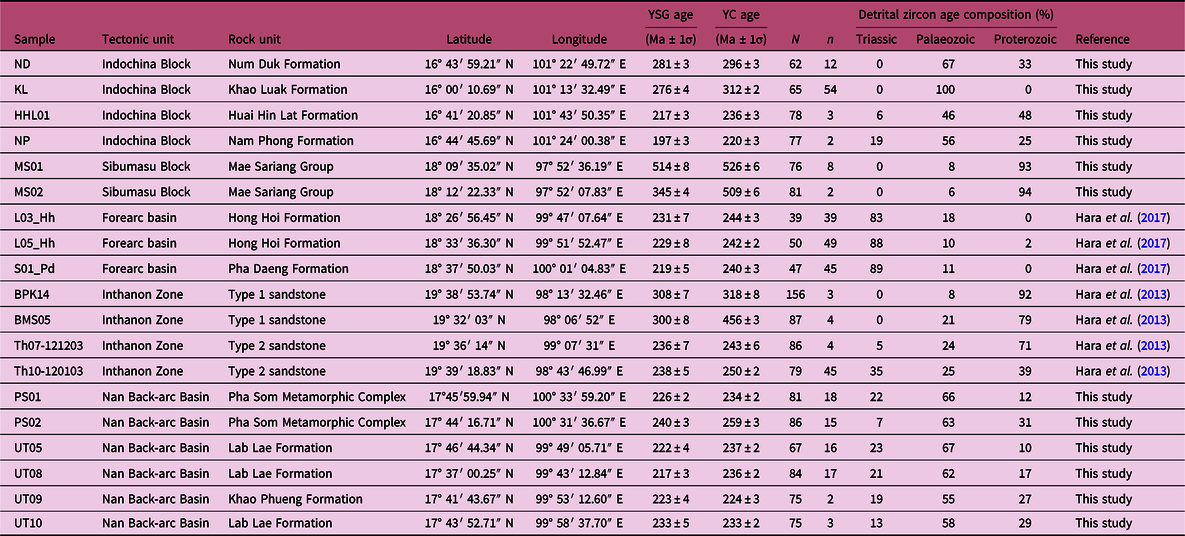
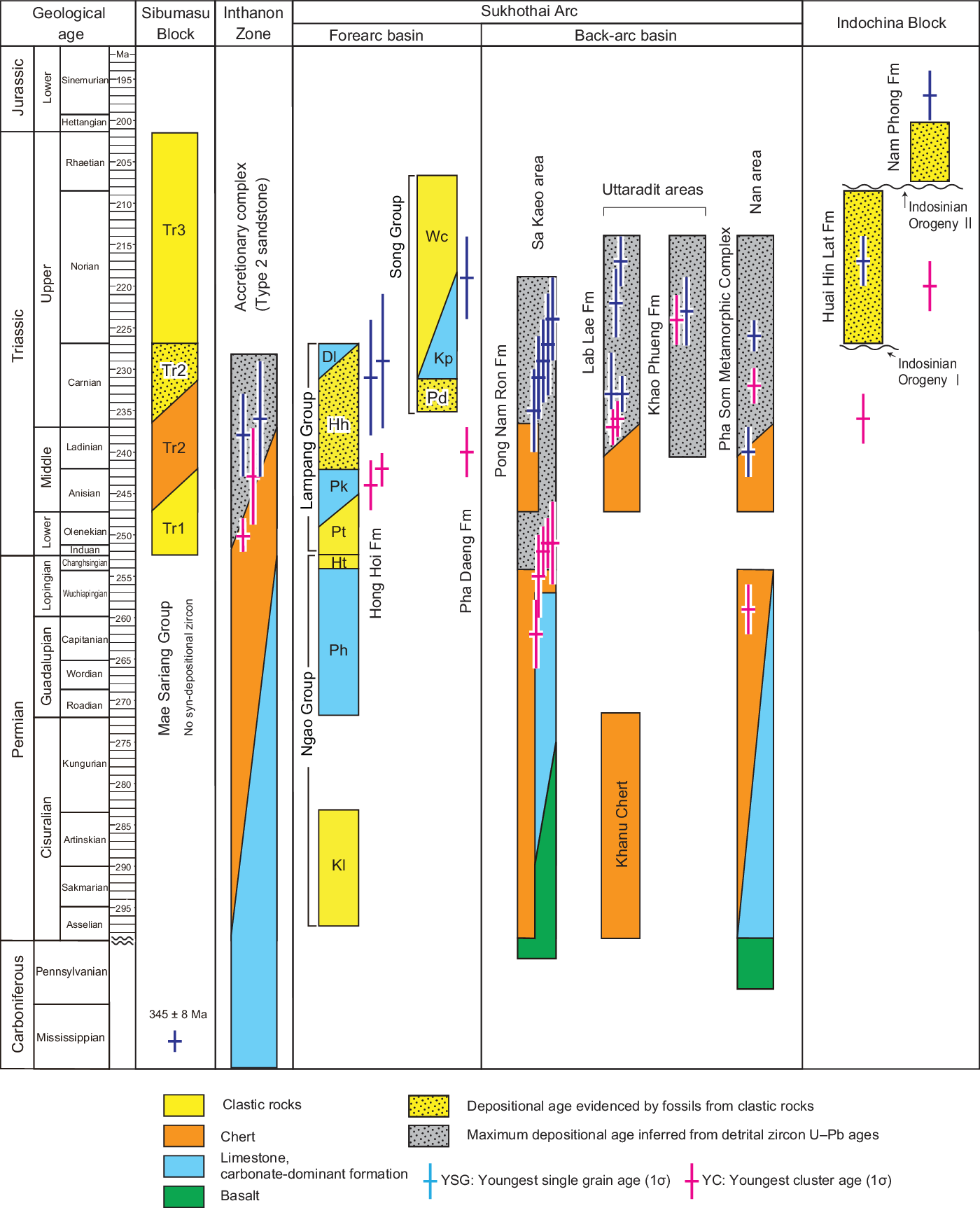
Two detrital zircon U–Pb ages were used to constrain the maximum depositional age of each sample: the youngest single-grain (YSG) zircon age and the weighted mean age of the youngest cluster (YC) that overlaps within 1σ uncertainty. In our previous studies, we used the term ‘YC1σ’ for the latter age type, but here we use ‘YC’ to avoid confusion with the YC1σ method defined by Dickinson & Gehrels (Reference Dickinson and Gehrels2009). The YC1σ was estimated by the weight mean age of the youngest group that overlaps within 1σ uncertainty for the YSG. The YSG and YC U–Pb ages for each sample are presented in Table 1. We deduce the depositional ages using fossil evidence and the maximum depositional age inferred from the YSG and YC ages (Fig. 5). Isotopic data for the detrital zircon U–Pb dating are listed in Table S2 (in the Supplementary Material available online at https://doi.org/10.1017/S0016756820001028).
Summary of sandstone samples and detrital zircon U–Pb ages

YSG: youngest single grain; YC: youngest cluster; N: number of concordant data; n: number of grains used for YC age calculation.
Summary stratigraphic column showing depositional ages and detrital zircon U–Pb ages in the Palaeo-Tethys convergence zone. U–Pb ages for the accretionary complex in the Inthanon Zone, forearc basin sediments in the Sukhothai Arc and sediments in the Sa Kaeo Back-arc Basin are from Hara et al. (Reference Hara, Kon, Usuki, Lan, Kamata, Hisada, Ueno, Charoentitirat and Charusiri2013, Reference Hara, Kunii, Miyake, Hisada, Kamata, Ueno, Kon, Kurihara, Ueda, Assavapatchara, Treerotchananon, Charoentitirat and Charusiri2017, Reference Hara, Tokiwa, Kurihara, Charoentitirat, Ngamnithiporn, Visetnat, Tominaga, Kamata and Ueno2018). Tr1: Kong Sum Unit, Tr2: Pratru Muand Unit, and Tr3: Mae Laeb Unit of the Mae Sariang Group; Kl; Kiu Lom Formation, Ph: Pha Huat Formation, and Ht: Huai Thak Formation of the Ngao Group; Pt: Phra That Formation, Pk: Pha Kan Formation, Hh: Hong Hoi Formation, and Dl: Doi Long Formation of the Lampang Group; Pd: Pha Daeng Formation, Kp: Kang Pla Formation, and Wc: Wang Chin Formation of the Song Group.

5.a. Indochina Block
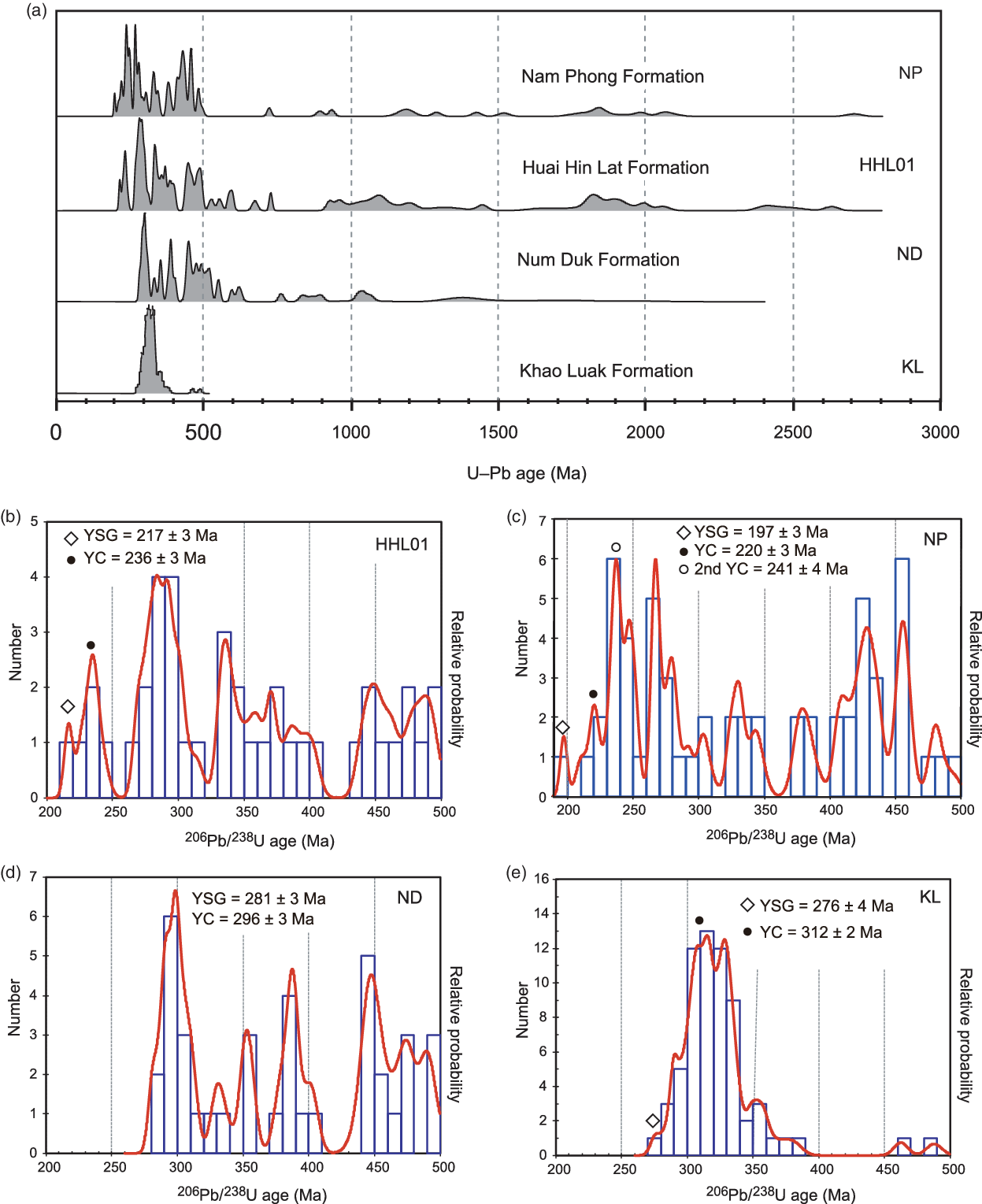
Four sandstone samples were analysed using LA-ICP-MS detrital zircon U–Pb dating: sample HHL01 from the Huai Hin Lat Formation, sample NP from the Nam Phong Formation, sample ND from the Num Duk Formation, and sample KL from the Kao Luak Formation (Fig. 2; Fig. S1 (in the Supplementary Material available online at https://doi.org/10.1017/S0016756820001028); Table 1). Almost of all of the detrital zircons separated from the Triassic sandstones (samples HHL01 and NP) are characterized by multiple age clusters comprising Triassic (250–200 Ma), Early to Middle Permian (299–260 Ma), Carboniferous (350–300 Ma), Ordovician to earliest Devonian (490–400 Ma), and minor Proterozoic and Archaean peaks (Fig. 6). The youngest ages are 217 ± 3 Ma (YSG) and 236 ± 3 Ma (YC) for sample HHL, and 197 ± 3 Ma (YSG) and 220 ± 3 Ma (YC) for sample NP. The YSG age for the Huai Hin Lat Formation corresponds to the depositional age based on fossil data, whereas the YSG age for the Nam Phong Formation is Early Jurassic, which is slightly younger than that indicated by fossil records (Fig. 5).
Relative U–Pb age probability plots and age distribution histograms for detrital zircons from the Indochina Block. (a) All ages. (b) Ages younger than 500 Ma. 206Pb/238U ages are given for zircons younger than 1000 Ma and 207Pb/206Pb ages for zircons 1000 Ma or older. The 2nd YC age is the weighted mean age of the second-youngest cluster (for sample NP).

Sample ND from the Permian Nam Duk Formation shows similar multiple age peaks to those of the Triassic samples HHL01 and NP, and lacks Triassic detrital zircons (Fig. 6). Sample ND yields a 281 ± 3 Ma YSG age and a 296 ± 3 Ma YC age, both Early Permian. In contrast, sample KL from the Kao Luak Formation is characterized by a single peak, with a 276 ± 4 Ma YSG age (Early Permian) and a 312 ± 2 Ma YC age (latest Carboniferous), with minor early Palaeozoic zircons (Fig. 6).
5.b. Sibumasu Block
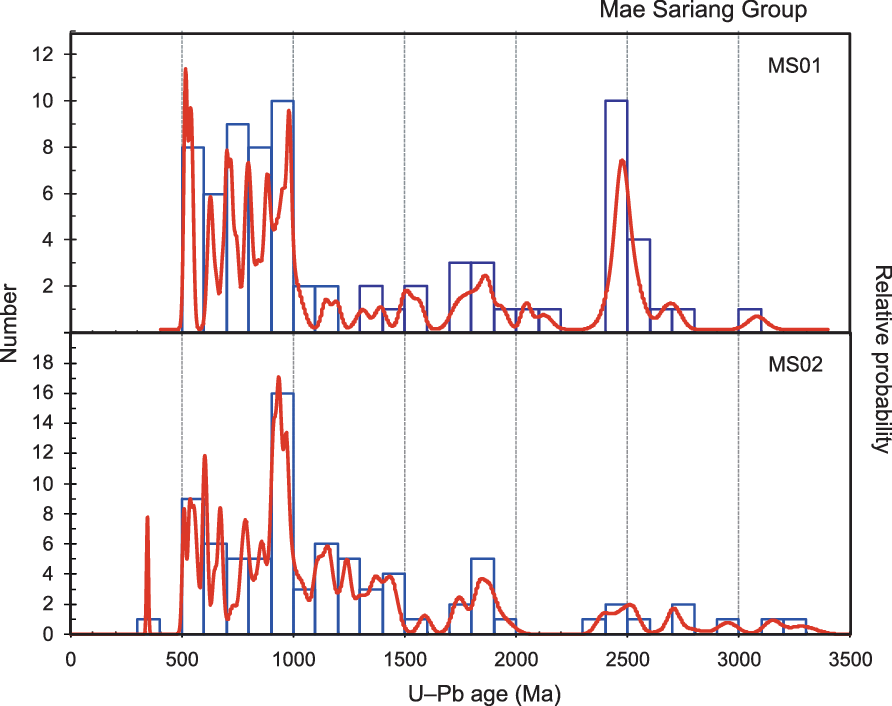
Two samples (MS01 and MS02) from the Pratru Muang Unit (Tr2) of the Mae Sariang Group were analysed using U–Pb dating (Fig. 2; Fig. S2 (in the Supplementary Material available online at https://doi.org/10.1017/S0016756820001028); Table 1). The detrital zircons have multiple main peaks for the Cambrian (550–500 Ma), early Neoproterozoic (1000–900 Ma) and early Palaeoproterozoic (2500–2400 Ma), with various minor peaks (Fig. 7). One youngest single grain of 345 Ma (Early Carboniferous) is included in sample MS02. Syn-depositional Triassic zircons and Permian zircons are absent from the Mae Sariang Group (Fig. 5).
Relative U–Pb age probability plots and age distribution histograms for detrital zircons from sedimentary rocks of the Sibumasu Block. 206Pb/238U ages are given for zircons younger than 1000 Ma and 207Pb/206Pb ages for zircons 1000 Ma or older.

5.c. Accretionary complex in the Inthanon Zone
The Type 1 sandstones (samples BPK14 and BMS05) collected from the western Inthanon Zone (Fig. 2) are characterized by multiple detrital zircon age peaks, including the Late Carboniferous (320–300 Ma), Cambrian (600–500 Ma), early Neoproterozoic (1000–900 Ma) and early Palaeoproterozoic (2500–2400 Ma), with several minor age peaks. The youngest (Late Carboniferous) peak is very weak. The Type 2 sandstones (samples Th07-121203 and Th10-120103) collected from the eastern Inthanon Zone (Fig. 2) show a pronounced age peak of 250–240 Ma (Early–Middle Triassic). Sample Th07-121203 also includes multiple peaks at 420, 700 and 800 Ma. In contrast, sample Th10-10103 shows a single peak of 243 Ma, with other zircons presenting a spread of ages. Samples Th07-121203 and Th10-120103 of the Type 2 sandstones give YSG ages of 236 Ma and 238 Ma and YC ages of 250 Ma and 243 Ma, respectively, which are interpreted as the maximum depositional age of the accretionary complex in the Inthanon Zone (Fig. 5).
5.d. Forearc basin sediments
U–Pb ages of the forearc basin sediments were obtained from two samples of the Hong Hoi Formation (L03_Hh and L05_Hh) and one sample of the Pha Daeng Formation (S01_Pd) (Hara et al. Reference Hara, Kunii, Miyake, Hisada, Kamata, Ueno, Kon, Kurihara, Ueda, Assavapatchara, Treerotchananon, Charoentitirat and Charusiri2017). Three samples present a single clear peak with 230–220 Ma YSG ages and 244–240 Ma YC ages (Middle to early Late Triassic), corresponding to the depositional age estimated by fossil records (Fig. 5). The YSG age of sample S01_Pd from the Pha Daeng Formation is about 10 Ma younger than that from the Hong Hoi Formation, although the YC ages are similar (Fig. 5).
5.e. Back-arc basin sediments
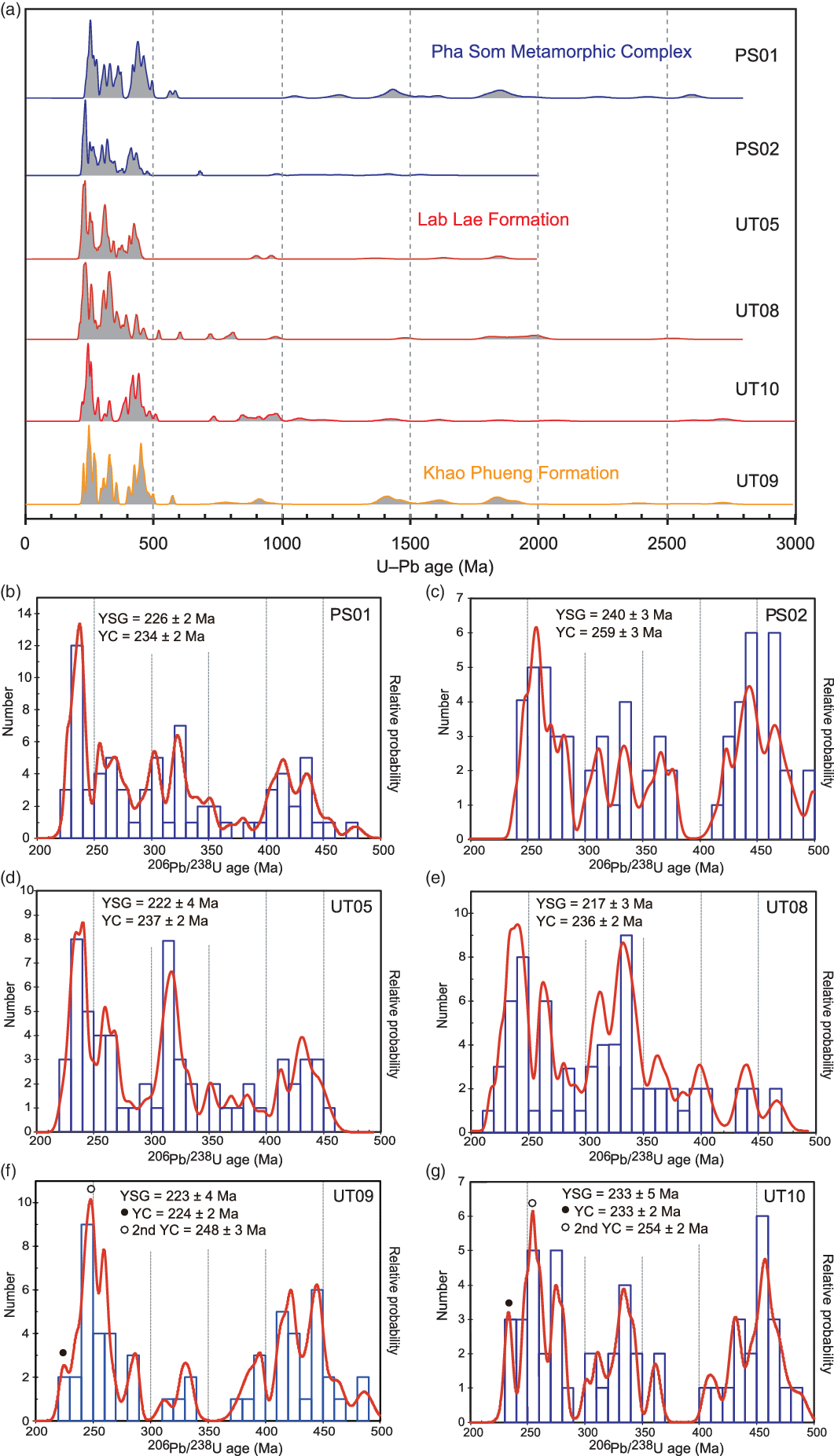
Detrital zircons from two samples of the Pha Som Metamorphic Complex (PS01 and PS02), three samples of the Lab Lae Formation (UT05, UT08 and UT10) and one sample of the Khao Phueng Formation (UT09) were dated using LA-ICP-MS (Fig, 2; Fig. S3 (in the Supplementary Material available online at https://doi.org/10.1017/S0016756820001028); Table 1). All samples show similar characteristics of multiple main peaks of Triassic (260–220 Ma), Carboniferous (350–300 Ma), and Ordovician to Silurian (490–400 Ma) ages, with minor Proterozoic peaks (Fig. 8). Although different peak intensities for the YC ages are observed between samples, the distributions of the peaks are the same. Samples PS01, UT05 and UT08 have clear YC ages of 237 to 234 Ma. In contrast, samples UT09 and UT10 show weak YC age peaks of 223 ± 4 Ma and 233 Ma ± 5 Ma, respectively. Sample PS02 yields a 240 ± 3 Ma YSG age and a 259 ± 3 Ma YC age, presenting older. The YSG and YC ages (apart from the YC age of PS02) range from 240 to 217 Ma, or Middle to Late Triassic. These YSG and YC ages are regarded as the maximum depositional age of the back-arc sediments (Fig. 5).
Relative U–Pb age probability plots and age distribution histograms for detrital zircons from back-arc basin sediments behind the Sukhothai Arc. (a) All ages. (b) Ages younger than 500 Ma. 206Pb/238U ages are given for zircons younger than 1000 Ma and 207Pb/206Pb ages for zircons 1000 Ma or older. Samples PS01 and PS02 are from the Pha Som Metamorphic Complex; samples UT05, UT08 and UT10 are from the Lab Lae Formation; and sample UT09 is from the Khao Phueng Formation. The 2nd YC age is the weighted mean age of the second-youngest cluster.

6. Tectonic implications for the Palaeo-Tethys convergence zone
6.a. Potential source rocks of detrital zircons
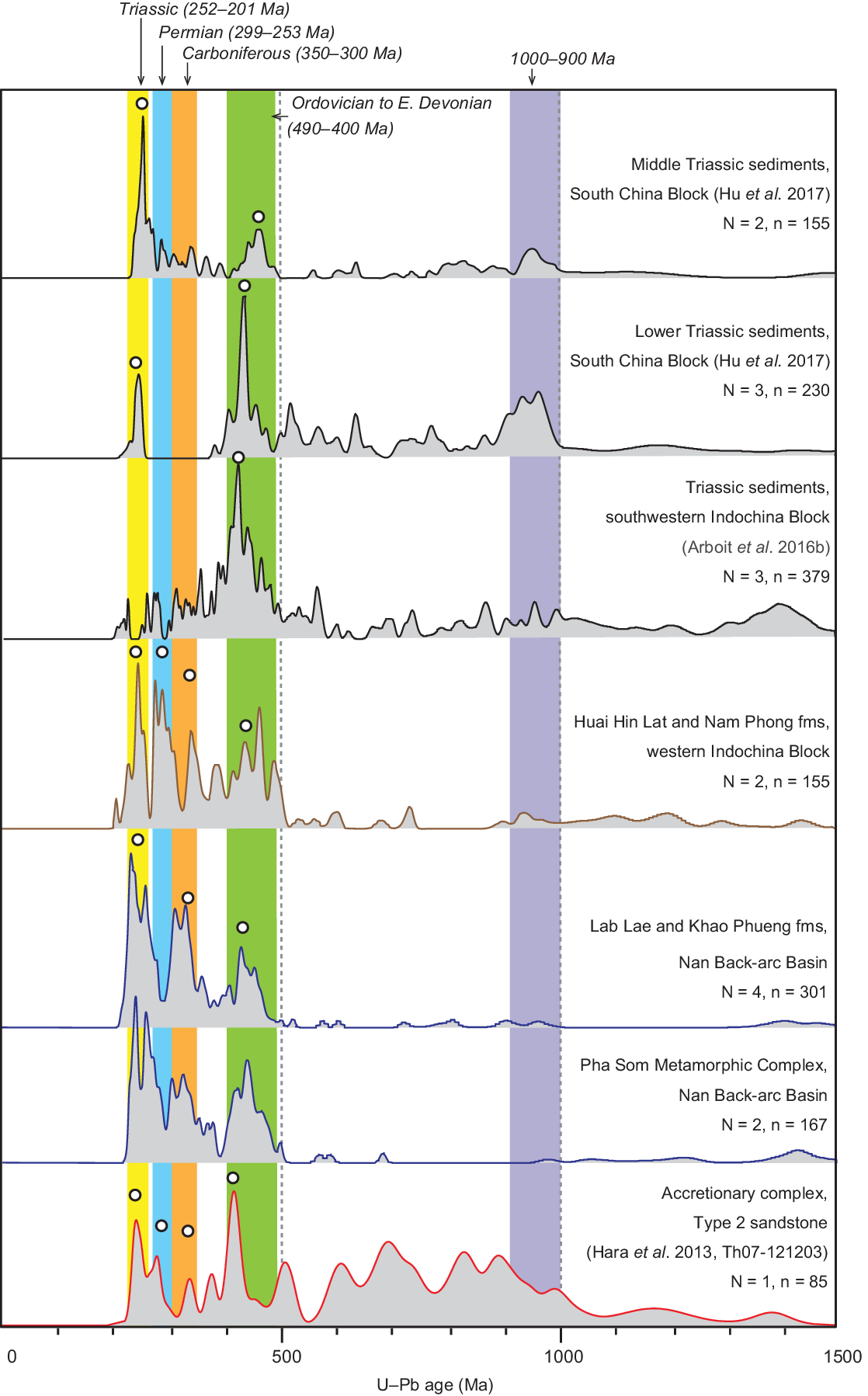
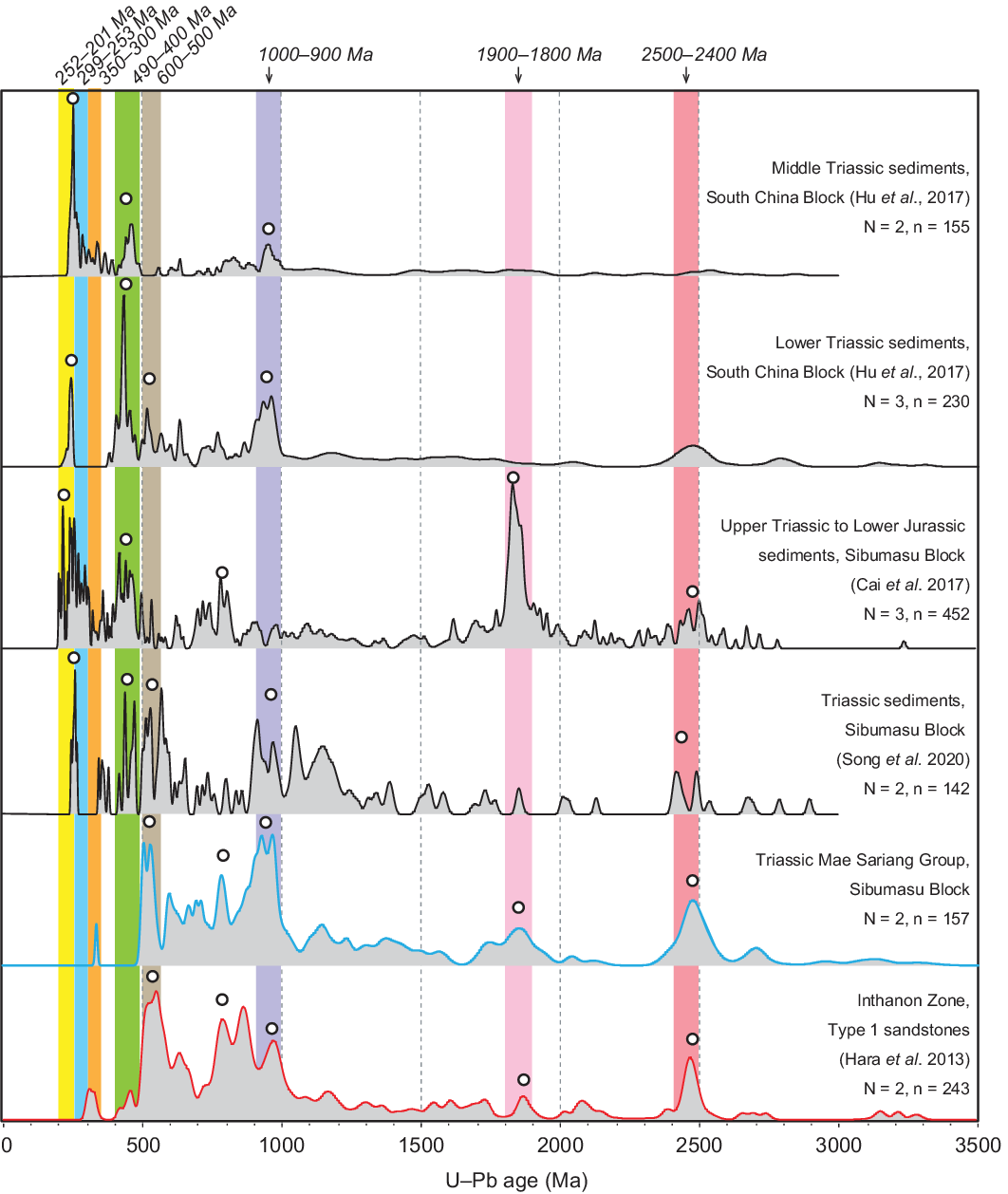
For interpreting the provenance of detrital zircons, we present in Figures 9 and 10 the combined zircon age data for the Indochina Block (samples HHL01 and NP), the Pha Som Metamorphic Complex (samples PS01 and PS02), the Lab Lae and Khao Phueng formations (samples UT05, UT08, UT09 and UT10), the accretionary complex in the Inthanon Zone for the Type 1 sandstones (BPK14 and BMS05) and the Type 2 sandstone (Th07-121203), and the Sibumasu Block (MS01 and MS02). Clear multiple peaks can be identified from the detrital zircon U–Pb age spectra: Triassic (252–201 Ma), Permian (299–253 Ma), Carboniferous (350–300 Ma), Ordovician to earliest Devonian (490–400 Ma), Cambrian (600–500 Ma), early Neoproterozoic (1000–900 Ma), late Palaeoproterozoic (1900–1800 Ma) and early Palaeoproterozoic (2500–2400 Ma). The potential source rocks of these zircons are discussed below.
Detrital zircon age spectra of Triassic sediments from the Indochina Block and the Nan Back-arc Basin (ages of <1500 Ma). Compiled data for the southwestern Indochina Block and the South China Block are from Arboit et al. (Reference Arboit, Collins, Morley, King and Amrouch2016b) and Hu et al. (Reference Hu, Cawood, Du, Xu, Wang, Wang, Ma and Hu2017), respectively. The Type 2 sandstone from the accretionary complex is from Hara et al. (Reference Hara, Kon, Usuki, Lan, Kamata, Hisada, Ueno, Charoentitirat and Charusiri2013). The open circle shows remarkable peak.

Detrital zircon age spectra of Triassic sediments from the Sibumasu Block. Compiled data for the Sibumasu Block in Myanmar and for the South China Block are from Cai et al. (Reference Cai, Ding, Yao, Laskowski, Xu, Zhang and Sein2017) and Hu et al. (Reference Hu, Cawood, Du, Xu, Wang, Wang, Ma and Hu2017), respectively. The Type 1 sandstones from the accretionary complex are from Hara et al. (Reference Hara, Kon, Usuki, Lan, Kamata, Hisada, Ueno, Charoentitirat and Charusiri2013). The open circle shows the remarkable peak.

The studied early Palaeoproterozoic (2500–2400 Ma) zircons are inferred to be sourced from Archaean basement erosion and are commonly observed in the peri-Gondwana terranes of the Truong Son, South China, Qiangtang, Lhasa and Sibumasu blocks (Myrow et al. Reference Myrow, Hughes, Goodge, Fanning, Williams, Peng, Bhargava, Parcha and Pogue2010; Burrett et al. Reference Burrett, Zaw, Meffer, Lai, Khositanont, Chaodumrong, Udchachon, Ekins and Halpin2014). The late Palaeoproterozoic (1900–1800 Ma) zircons are interpreted to be sourced from the Lesser Himalayan igneous event (De Celles et al. Reference DeCelles, Gehrels, Najman, Martin, Carter and Garzanti2004; Kohn et al. Reference Kohn, Paul and Corrie2009) and the Barramundi orogeny in northern Australia (Burrett et al. Reference Burrett, Zaw, Meffer, Lai, Khositanont, Chaodumrong, Udchachon, Ekins and Halpin2014). The early Neoproterozoic (1000–900 Ma) and Cambrian (600–500 Ma) zircons are inferred to be supplied from the Grenvillian orogeny (1350–900 Ma) and the Pan African orogeny (680–500 Ma), respectively (Myrow et al. Reference Myrow, Hughes, Goodge, Fanning, Williams, Peng, Bhargava, Parcha and Pogue2010; Lin et al. Reference Lin, Yeh, Lee, Chung, Iizuka and Charusiri2013; Burrett et al. Reference Burrett, Zaw, Meffer, Lai, Khositanont, Chaodumrong, Udchachon, Ekins and Halpin2014).
The Ordovician to earliest Devonian (490–400 Ma) zircons are interpreted to be sourced from the 423 Ma rhyolite in the Loei area in Thailand (Zhao & Feng, Reference Zhao and Feng2016), and the 450–418 Ma rhyolitic and dacitic tuff and diorite dike in northwestern Lao PDR (Laos) (Long et al. Reference Long, Zhang, Huang, Yang, Chen and Bayless2019). These igneous activities, also identified in SW Yunnan in China, occurred in an active continental margin along the western margin of the Indochina Block (Liu et al. Reference Liu, Wang, Deng, Li, Li and Ripley2020). In addition, many igneous intrusions and extrusions dated between 520 and 402 Ma have been reported from the adjoining area to the east, around the Kham Duk Complex and the Kontum Massif in central Vietnam and southern Lao PDR (Nguyen et al. Reference Nguyen, Feng, Zi, Zhao, Tran, Ngo, Tran and Nguyen2019; Minh et al. Reference Minh, Dung, Hung, Minh, Yu and Hieu2020; Wang et al. Reference Wang, Zhang, Qian, Senebouttalath, Wang, Wang, Gan and Zaw2020b). In addition, 435–403 Ma and 446–427 Ma granitic rocks have been reported from the Truong Son Belt in northeastern Lao PDR (S Wang et al. Reference Wang, Mo, Wang and Ye2016; Y Wang et al. Reference Wang, Zhang, Qian, Senebouttalath, Wang, Wang, Gan and Zaw2020b). This early Palaeozoic magmatism occurred in an active continental margin adjacent to a subduction zone along the South China Block (Nakano et al. Reference Nakano, Osanai, Owada, Nam, Charusiri and Khamphavong2013), and was caused by the initiation of subduction and subsequent microcontinent collision between the Kontum Massif and Truong Son Belt (Faure et al. Reference Faure, Nguyen, Hoai and Lepvrier2018; Nguyen et al. Reference Nguyen, Feng, Zi, Zhao, Tran, Ngo, Tran and Nguyen2019).
The Carboniferous zircons (350–300 Ma) are inferred to be derived from Carboniferous intrusive and volcanic rocks distributed along the Phetchabun (Loei – Phetchabun – Phai Sali) Volcanic Belt in central Thailand through to Lao PDR (Barr & Charusiri, Reference Barr, Charusiri, Ridd, Barber and Crow2011), which have yielded U–Pb ages of 350–315 Ma (Qian et al. Reference Qian, Feng, Yang, Wang, Chonglakmani and Monji2015) and 306–304 Ma (Kamvong et al. Reference Kamvong, Zaw, Meffre, Maas, Stein and Lai2014). Qian et al. (Reference Qian, Feng, Yang, Wang, Chonglakmani and Monji2015) proposed that this Carboniferous magmatism occurred in an active continental margin along the western margin of the Indochina Block. Carboniferous detrital zircons are abundant in the studied sandstone from the Permian Khao Luak Formation (Fig. 6e), suggesting Carboniferous igneous rocks as the provenance.
Possible source rocks of the Permian detrital zircons (299–253 Ma) are only sporadically distributed in the Indochina Block. These include a 259 Ma rhyolite in the Phetchabun Volcanic Belt (Salam et al. Reference Salam, Zaw, Meffre, McPhie and Lai2014), and 257 Ma hornblendite and hornblende gabbro, 285 Ma biotite granite (including Carboniferous inherited zircons) and 253 Ma hornblende granite in the Wang Nam Khiao area, central Thailand (Fanka et al. Reference Fanka, Tsunogae, Daorerk, Tsutsumi, Takamura, Endo and Sutthirat2016, Reference Fanka, Tsunogae, Daorerk, Tsutsumi, Takamura and Sutthirat2018). A 266 Ma granite has been recorded in eastern Myanmar along the Sukhothai Arc (Gardiner et al. Reference Gardiner, Searle, Morley, Whitehouse, Spencer and Robb2016). Andesitic volcaniclastic rocks underlying middle Permian limestone are considered as evidence of Permian igneous activity in NW Cambodia (Udchachon et al. Reference Udchachon, Thassanapak and Burrett2018). Permian zircons have been found in felsic igneous rocks in western Cambodia and are related to magmatism in the Sa Kaeo Back-arc Basin (Hara et al. Reference Hara, Ito, Tokiwa, Kong and Lim2020). The studied sandstone from the Num Duk Formation includes abundant Early Permian detrital zircons (Fig. 6d), suggesting Permian igneous rocks as the provenance. However, Permian igneous activity along the western margin of the Indochina Block was probably only locally distributed, and the Num Duk Early Permian detrital zircons could also have been sourced from more widespread Permian igneous activity along the northern margin of the Indochina Block that occurred as a result of southward subduction of oceanic crust before collision with the South China Block (Thanh et al. Reference Thanh, Hieu, Minh, Nhuan and Thuy2019).
The Triassic detrital zircons (252–201 Ma) have many possible provenances. Volcanic rocks dated at 242–220 Ma have been reported from the Lampang Volcanic Belt (Barr et al. Reference Barr, Macdonald, Dunning, Ounchanum and Yaowanoiyothin2000, Reference Barr, Macdonald, Ounchanum and Hamilton2006; Srichan et al. Reference Srichan, Crawford and Berry2009; Qian et al. Reference Qian, Feng, Chonglakmani and Monji2013, Reference Qian, Wang, Feng, Zi, Zhang and Chonglakmani2016b, c, Reference Qian, Wang, Srithai, Feng, Zhang, Zi and He2017; Wang et al. Reference Wang, Qian, Cawood, Liu, Feng, Zhao, Zhang, He and Zhang2018) and are associated with the development of the Sukhothai Arc (Barr & Charusiri, Reference Barr, Charusiri, Ridd, Barber and Crow2011). Igneous rocks yielding ages of 249–238 Ma have been identified in the Phetchabun Volcanic Belt (Kamvong et al. Reference Kamvong, Zaw, Meffre, Maas, Stein and Lai2014; Salam et al. Reference Salam, Zaw, Meffre, McPhie and Lai2014; Qian et al. Reference Qian, Feng, Wang, Yang, Chonglakmani and Monji2016a; Wang et al. Reference Wang, Qian, Cawood, Liu, Feng, Zhao, Zhang, He and Zhang2018). The latest Permian to Triassic igneous rocks have also been reported in the Khao Khwang Fold–Thrust Belt (Arboit et al. Reference Arboit, Collins, Morley, Jourdan, King, Foden and Amrouch2016a). In addition, abundant Early–Middle Triassic igneous and metamorphic rocks formed in the collision zone between the South China and Indochina blocks (Faure et al. Reference Faure, Nguyen, Hoai and Lepvrier2018; Thanh et al. Reference Thanh, Hieu, Minh, Nhuan and Thuy2019).
6.b. Indochina Block and spatial variations in provenance
In Figure 9, we present the combined data of detrital zircon U–Pb ages from the Huai Hin Lat and Nam Phong formations located in the western Indochina Block, as well as data from Triassic sediments in the southern margin of the South China Block (Hu et al. Reference Hu, Cawood, Du, Xu, Wang, Wang, Ma and Hu2017) and the southwestern Indochina Block in the Saraburi area of central Thailand (Khao Khwang Fold–Thrust Belt; Arboit et al. Reference Arboit, Collins, Morley, King and Amrouch2016b). Our detrital zircon U–Pb ages for the Huai Hin Lat and Nam Phong formations show similar peak spectra to those determined for the same formations by Yan et al. (Reference Yan, Huang, Zhao, Zhang, Liu, Charusiri and Veeravinantanakul2017), although their data additionally include abundant Early Triassic zircons in the Huai Hin Lat Formation. The detrital zircon U–Pb age spectra from these two formations show main peaks for the Triassic (252–201 Ma), Permian (299–253 Ma), Carboniferous (350–300 Ma), Ordovician – earliest Devonian (490–400 Ma) and minor Proterozoic ages. Below, we discuss the sediment supply system using U–Pb ages of detrital zircon grains and their inferred provenance (Fig. 11a).
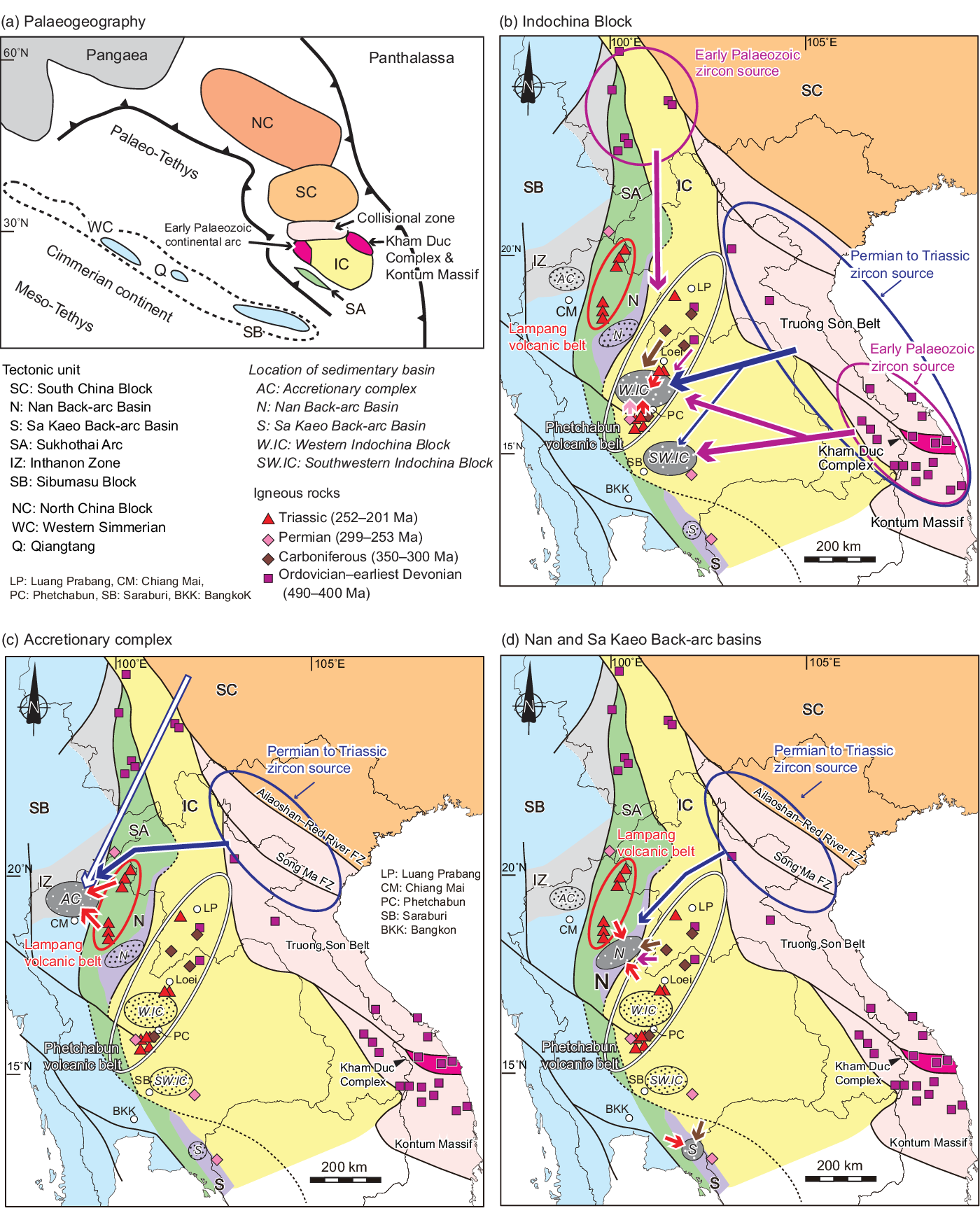
Palaeogeography and sediment supply system and potential provenance for sedimentary deposits of the Indochina Block, the accretionary complex and the Nan and Sa Kaeo back-arc basins during the Triassic. (a) Palaeogeography. Modified from Metcalfe (Reference Metcalfe2013). (b) Indochina Block. (c) Accretionary complex in the Inthanon Zone. (d) Nan and Sa Kaeo back-arc basins. See Section 6b, d, e for details. U–Pb ages of igneous rocks are from Fanka et al. (Reference Fanka, Tsunogae, Daorerk, Tsutsumi, Takamura, Endo and Sutthirat2016, Reference Fanka, Tsunogae, Daorerk, Tsutsumi, Takamura and Sutthirat2018), Zhao & Feng (Reference Zhao and Feng2016), Wang et al. (Reference Wang, Qian, Cawood, Liu, Feng, Zhao, Zhang, He and Zhang2018), Liu et al. (2019), Long et al. (Reference Long, Zhang, Huang, Yang, Chen and Bayless2019), Nguyen et al. (Reference Nguyen, Feng, Zi, Zhao, Tran, Ngo, Tran and Nguyen2019), Thanh et al. (Reference Thanh, Hieu, Minh, Nhuan and Thuy2019), Minh et al. (Reference Minh, Dung, Hung, Minh, Yu and Hieu2020) and Wang et al. (Reference Wang, Zhang, Qian, Senebouttalath, Wang, Wang, Gan and Zaw2020b). The arrow indicates the direction of sediments supply.

Although early Neoproterozoic zircons (1000–900 Ma) are fairly abundant in the South China Block (Hu et al. Reference Hu, Cawood, Du, Xu, Wang, Wang, Ma and Hu2017), zircons of this age are rare in the Indochina Block (Arboit et al. Reference Arboit, Collins, Morley, King and Amrouch2016b; this study). The differing relative abundances of early Neoproterozoic zircons between the South China and Indochina blocks are probably related to differences in the basement rocks of these two blocks (Burrett et al. Reference Burrett, Zaw, Meffer, Lai, Khositanont, Chaodumrong, Udchachon, Ekins and Halpin2014).
Clear Ordovician – earliest Devonian peaks are also identified in the South China and Indochina blocks. The 490–400 Ma zircons in the South China Block and the Indochina Block were probably derived from the same Ordovician to earliest Devonian rocks of the Kham Duc Complex and the Kontum Massif in central Vietnam, and igneous rocks along an active continental margin of the western Indochina Block in northern Lao PDR and southwestern China. In particular, the southwestern Indochina Block (Khao Khwang Fold–Thrust Belt) includes abundant 450–400 Ma zircons (Arboit et al. Reference Arboit, Collins, Morley, King and Amrouch2016b). Arboit et al. (Reference Arboit, Collins, Morley, King and Amrouch2016b) proposed that detrital zircons were supplied to the southwestern Indochina Block from the NE in the collision zone between the South China and Indochina blocks. Our alternative proposition is that the 450–400 Ma zircons were also derived from a more easterly location, corresponding to the distribution of the Kham Duc Complex and the Kontum Massif (Fig. 11b).
Clear peaks of Permian (299–253 Ma) and Carboniferous (350–300 Ma) detrital zircon ages are observed for samples from the western Indochina Block, with lesser contributions from the southwestern Indochina and South China blocks. These zircons were likely sourced from the Phetchabun Volcanic Belt. Triassic zircons (252–201 Ma) are also abundant in the South China and western Indochina blocks. These zircons are interpreted to have been supplied from the collision zone between the South China and Indochina blocks and from the Lampang and Phetchabun volcanic belts.
In contrast, the southwestern Indochina Block (Khao Khwang Fold–Thrust Belt) contains few Triassic (252–201 Ma), Permian (299–253 Ma) or Carboniferous (350–300 Ma) zircons. Thus, the Triassic sediments show a spatial difference in zircon provenance between the western and southwestern parts of the Indochina Block. Triassic sediments in the western Indochina Block (Huai Hin Lat and Nam Phong formations) were sourced from the South China –Indochina collision zone and the Phetchabun Volcanic Belt, whereas those in the southwestern Indochina Block were sourced solely from the collision zone (Fig. 11a). In addition, the Permian Nam Duk Formation has a similar peak age composition to those of the Triassic Huai Hin Lat and Nam Phong formations, as well as a lack of Triassic zircons, but also shows a Late Carboniferous – Early Permian age peak. Thus, both temporal and spatial variations in provenance are observed in the Permian to Triassic sediments of the Indochina Block.
6.c. Sibumasu Block and Permian–Triassic hiatus in igneous activity
Detrital zircon U–Pb ages of the Triassic Mae Sariang Group in NW Thailand show major peaks for the Cambrian (600–500 Ma), early Neoproterozoic (1000–900 Ma), late Palaeoproterozoic (1900–1800 Ma) and early Palaeoproterozoic (2500–2400 Ma), with only one Early Carboniferous (345 Ma) grain and no Permian zircons or Triassic syn-depositional zircons (Fig. 10). Detrital zircon U–Pb ages of the Triassic sediments of the Sibumasu Block in SW China (Gongshan–Baochan Block) have representative peaks for 2500–2400 Ma, 1750–1500 Ma, 1200–900 Ma, 600–500 Ma, and very few Permian zircons (Song et al. Reference Song, Sua, Dong, Song, Allen, Wang and Hu2020), presenting similar peak composition to those of the Mae Sariang Group. The Upper Triassic to Lower Jurassic sediments of the Sibumasu Block in eastern Myanmar (Loi-an Group) adjacent to NW Thailand show a pronounced 1900–1800 Ma peak (Cai et al. Reference Cai, Ding, Yao, Laskowski, Xu, Zhang and Sein2017), correlating with the Lesser Himalayan igneous event, and less clear peaks of 1000–900 Ma and 600–500 Ma, corresponding to the Grenville and Pan African orogenies, respectively. In addition, Ordovician – earliest Devonian (490–400 Ma) and Permian–Triassic (299–201 Ma) zircons are abundant in the Sibumasu Block in Myanmar. The Permian–Triassic zircons are interpreted to have been supplied from the Sukhothai Arc after the closure of the Palaeo-Tethys (Cai et al. Reference Cai, Ding, Yao, Laskowski, Xu, Zhang and Sein2017). Middle Triassic I-type granitoids are found in the western Sibumasu Block and were generated in association with Meso-Tethys oceanic plate subduction beneath the Sibumasu Block (Searle et al. Reference Searle, Whitehouse, Robb, Ghani, Hutchison, Sone, Ng, Roselee, Chung and Oliver2012; Metcalfe, Reference Metcalfe2013). These granitoids are another possible source of Triassic zircons in sediments of the western Sibumasu Block in Myanmar. In addition, an active continental margin was developed along the northern part of the Sibumasu Block during the Neoproterozoic to Cambrian, based on detrital zircon study of metasedimentary rocks from the Chaung Magyi Group in Myanmar (Dew et al. Reference Dew, Morley, Myint and Collins2019). The granites and gneiss in the Sibumasu Block have inherited zircon core ages during the Proterozoic to Palaeozoic (particularly Neoproterozoic and Cambrian), suggesting the recycled material from protolith of granitoids (Dew et al. Reference Dew, Collins, Glorie, Morley, Blades, Nachtergaele, King, Foden, De Grave, Kanjanapayont, Evans, Alessio and Charusiri2018; Kanjanapayont et al. Reference Kanjanapayont, Klötzli and Frank2020). These inherited zircon ages also correspond to major peaks of detrital zircon ages estimated from the Mae Sariang Group in the Sibumasu Block. The Mae Sariang Group records clearly igneous activities during the Neoproterozoic to Cambrian, based on detrital zircon ages.
On the other hand, the Mae Sariang Group does not record igneous activity younger than 500 Ma. The Sibumasu Block was separated from the Gondwana during the Late Carboniferous to Early Permian, evidenced from rift-related basaltic magmatism dated to 310–280 Ma (Liu et al. Reference Liu, Wang, Deng, Li, Li and Ripley2020). Morley (Reference Morley2018) proposed that the Sibumasu Block comprised a ribbon continent, with the Mae Sariang Group being deposited along the rift trough and extensional basin that were generated by crustal thinning during the Permian. This scenario involving a lack of igneous activity within the Sibumasu Block during this period supports the observed lack of Permian to Triassic zircons in the Mae Sariang Group. Hisada et al. (Reference Hisada, Sugiyama, Ueno, Charusiri and Arai2004) reported abundant detrital chromian spinels from sandstones of the Mae Sariang Group, indicating a source consisting of ultramafic and mafic rocks. Geochemical data suggest that the chromian spinels were characterized by three types of rock, namely, ocean floor peridotite, chromitite and intra-plate basalt (Hisada et al. Reference Hisada, Sugiyama, Ueno, Charusiri and Arai2004). These chromian spinels were supplied from an older orogeny and/or tectonic event that occurred before 500 Ma, or possibly from an unidentified ophiolite generated by crustal thinning during the Late Carboniferous to Permian.
6.d. Accretionary complex in the Inthanon Zone and revision of sandstone classification
The Inthanon Zone accretionary complex identified by Hara et al. (Reference Hara, Wakita, Ueno, Kamata, Hisada, Charusiri, Charoentitirat and Chaodumrong2009) was formed as a result of Palaeo-Tethys oceanic plate subduction. Our previous work on sandstone petrography and geochemistry (Hara et al. Reference Hara, Kunii, Hisada, Ueno, Kamata, Srichan, Charusiri, Charoentitirat, Watarai, Adachi and Kurihara2012) and detrital zircon U–Pb ages (Hara et al. Reference Hara, Kon, Usuki, Lan, Kamata, Hisada, Ueno, Charoentitirat and Charusiri2013) for this accretionary complex has allowed the sandstones to be classified into two types: Type 1 (represented by samples BPK14 and BMS05) and Type 2 sandstones (samples Th07-121203 and Th10-120103).
The Type 1 sandstone samples show peak U–Pb age compositions that are very similar to those of the Mae Sariang Group in the Sibumasu Block, consisting of peaks for the Carboniferous (350–300 Ma), Cambrian (600–500 Ma), early Neoproterozoic (1000–900 Ma), late Palaeoproterozoic (1900–1800 Ma) and early Palaeoproterozoic (2500–2400 Ma), and a lack of Permian to Triassic ages. A Qm–F–Lt discrimination diagram shows that the Type 1 sandstones plot between the sandstones of the Mae Sariang Group (quartzose recycled) and the Type 2 sandstones (transitional and lithic recycled) (Fig. 4a). On the basis of the unique age spectra shown by samples from the Sibumasu Block, we propose that the Type-1 sandstones originated from the Mae Sariang Group in the Sibumasu Block, despite the Mae Sariang Group presenting a slightly more quartz-dominant sandstone composition.
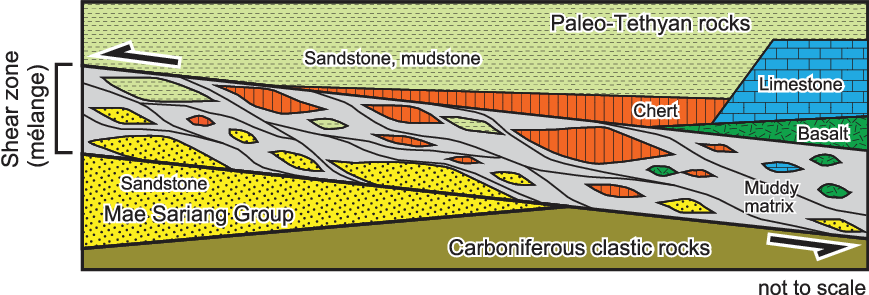
The Inthanon Zone is interpreted to represent nappes of Palaeo-Tethyan rocks thrust westward over a marginal part of the Sibumasu Block (Ueno & Hisada, Reference Ueno and Hisada2001; Barber et al. Reference Barber, Ridd, Crow, Ridd, Barber and Crow2011; Morley, Reference Morley2018; Mangkhemthong et al. Reference Mangkhemthong, Morley and Srichan2019). This mélange is also thrust over Carboniferous sedimentary rocks (Hara et al. Reference Hara, Wakita, Ueno, Kamata, Hisada, Charusiri, Charoentitirat and Chaodumrong2009). Hara et al. (Reference Hara, Wakita, Ueno, Kamata, Hisada, Charusiri, Charoentitirat and Chaodumrong2009) obtained mélange including blocks of Permian chert and Type 1 sandstone (sample BPK14) within an argillaceous matrix. Our new results using U–Pb dating suggest that this mélange also contains fragments of the Mae Sariang Group in the Sibumasu Block as Type 1 sandstones (Fig. 12). This style of mélange, which includes rock fragments of both hanging wall and footwall, is interpreted as a collision-related mélange (Festa et al. Reference Festa, Dilek, Pini, Codegone and Ogata2012) or a polygenetic mélange between detachment thrusts (Festa et al. Reference Festa, Pini, Ogata and Dilek2019).
Schematic model of mélange formation in the western Inthanon Zone. See Section 6c for details.

For the Type 2 sandstones, sample Th07-121203 displays multiple detrital zircon age peaks of Triassic (252–236 Ma), Permian (299–253 Ma), Carboniferous (350–300 Ma), earliest Devonian (420–400 Ma), and Cambrian (540–500 Ma), and sample Th10-120103 shows a clear single Triassic peak with minor older zircons. Sample Th07-121203 shows similar age peak compositions to those of Triassic sediments in the western Indochina Block (Huai Hin Lat and Nam Phong formations), including abundant 1000–500 Ma zircons, as well as Triassic sediments in the South China Block (Hu et al. Reference Hu, Cawood, Du, Xu, Wang, Wang, Ma and Hu2017) (Fig. 9). These age spectra suggest that the zircons of sample Th07-121203 were supplied from both the Indochina and South China blocks, and also Triassic zircons from the Sukhothai Arc. In contrast, the provenance of most zircons of sample Th10-120103 was the Sukhothai Arc during the Triassic, similar to the origin of forearc sediments (Hara et al. Reference Hara, Kunii, Miyake, Hisada, Kamata, Ueno, Kon, Kurihara, Ueda, Assavapatchara, Treerotchananon, Charoentitirat and Charusiri2017), although with minor older zircons. Minezaki et al. (Reference Minezaki, Hisada, Hara and Kamata2019) proposed that the Indosinian I unconformity that formed during the Early to Middle Triassic was a result of collision between the South China and Indochina blocks. Abundant detrital materials, including zircons of various ages, were supplied to the Palaeo-Tethys subduction zone at the trench by the resultant crustal uplift and erosion of the collision zone and margins of the South China and Indochina blocks during the Indosinian I orogeny (Fig. 11c). These trench-fill sediments ultimately formed the accretionary complex.
The studied Type 1 sandstones were collected from the western Inthanon Zone close to the Sibumasu Block, whereas the Type 2 sandstones were obtained from the area to the east, adjacent to the Sukhothai Arc. These Type 1 and Type 2 sandstones were produced by different styles of mélange formation, with the former being collision-related and the latter being subduction-related. The petrography and geochemistry of the sandstones from the Inthanon Zone that were examined by Hara et al. (Reference Hara, Kunii, Hisada, Ueno, Kamata, Srichan, Charusiri, Charoentitirat, Watarai, Adachi and Kurihara2012) should therefore be considered as being distinguished by Type 1 and Type 2 sandstones.
6.e. Nature and distribution of basin-filling sediments in the Nan Back-arc Basin
The Pha Som Metamorphic Complex has been regarded as derived from basin-filling sediments covering an ophiolite sequence in the Nan Back-arc Basin as well as from sediments of the Pong Nam Ron Formation in the Sa Kaeo Back-arc Basin (Hara et al. Reference Hara, Tokiwa, Kurihara, Charoentitirat, Ngamnithiporn, Visetnat, Tominaga, Kamata and Ueno2018, Reference Hara, Ito, Tokiwa, Kong and Lim2020). Our detrital zircon U–Pb ages suggest that the protolith of the psammitic schists was Triassic sandstones. In addition, the age spectra of the psammitic schists are similar to those of the Indochina Block sedimentary rocks but do not correspond to those of forearc basin sediments. These features support the origin of the Pha Som Metamorphic Complex as metamorphosed basin-filling sediments of the Nan Back-arc Basin. Further, geochemical data for the metasandstones of the Lab Lae and Khao Phueng formations show similar characteristics to psammitic schist from the Pha Som Metamorphic Complex and suggest a provenance from dominant basalt to felsic volcanic rocks in a continental island arc setting (Fig. 4c, d). The detrital zircon U–Pb age spectra for the metasandstones and psammitic schists are also similar, showing mostly Late Permian – Triassic (260–220 Ma), Carboniferous (350–300 Ma) and Ordovician – earliest Devonian (490–400 Ma) peaks, with minor Proterozoic contributions (Fig. 8). These features suggest that the protolith of the metasandstones was likely the same as that of the Pha Som psammitic schists. We infer that the Lab Lae and Khao Phueng formations should also be regarded as Triassic basin-filling sediments of the Nan Back-arc Basin (Fig. 13).
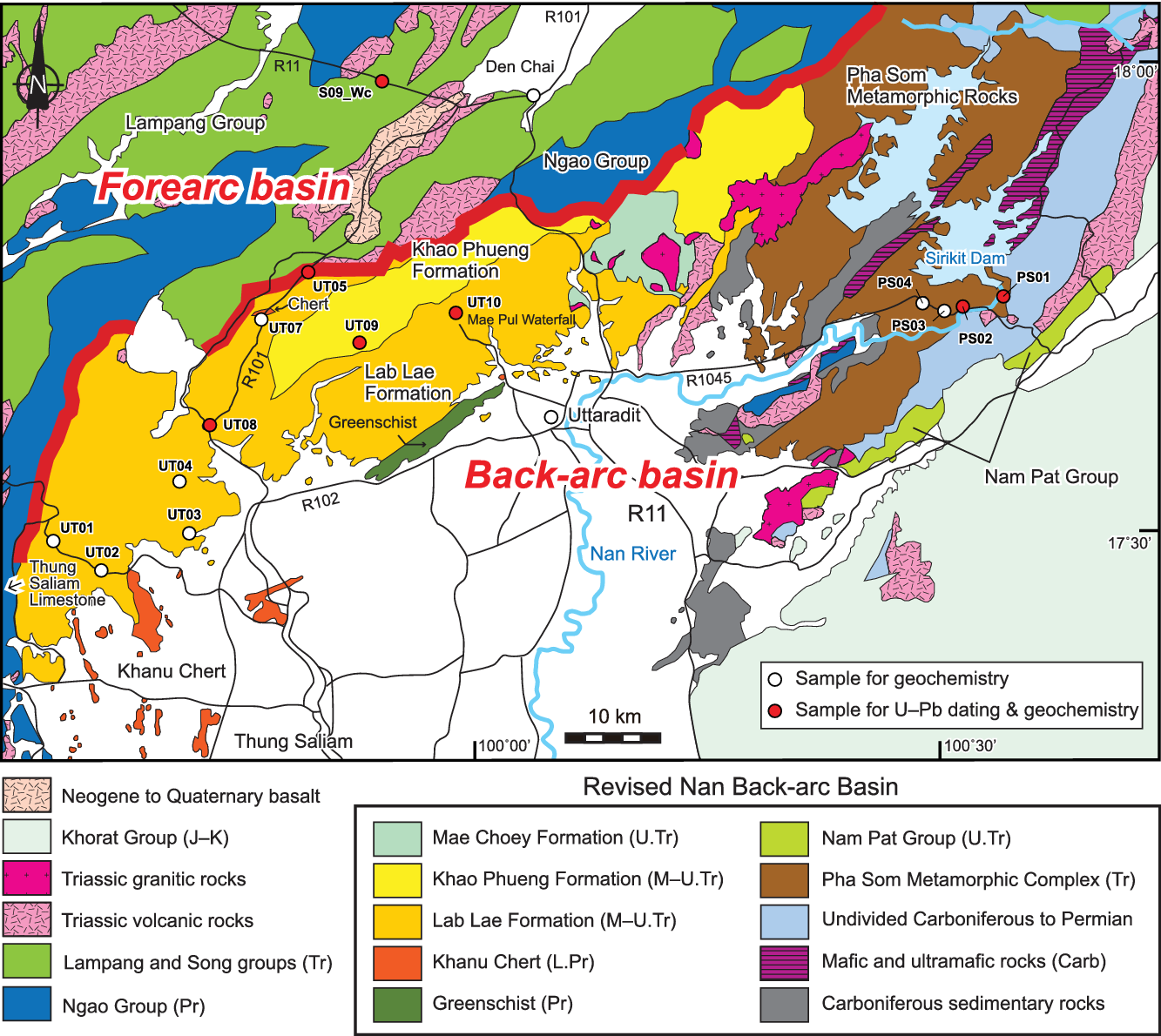
Tectonic division of forearc and back-arc basins in the Uttaradit area. Carb: Carboniferous; Pr: Permian; Tr: Triassic; J: Jurassic; K: Cretaceous; L: Lower; M: Middle; U: Upper. The figure location is shown in Figure 2.

However, these rocks subsequently underwent different metamorphic evolutions, whereby the psammitic schists were subjected to pumpellyite–actinolite facies regional metamorphism (Singharajwarapan & Berry, Reference Singharajwarapan and Berry2000), and the metasandstones of the Lab Lae and Khao Phueng formations were affected by contact metamorphism (Fig. 3g, k). The maximum depositional age inferred from our detrital zircon U–Pb ages suggests that the regional metamorphism took place after the Late Triassic, probably as a result of closure of the Nan Back-arc Basin due to collision between the Indochina Block and the Sukhothai Arc. The contact metamorphism, in contrast, was caused by Triassic intrusions of granitic magma.
Previously, the depositional age of the Lab Lae Formation, which corresponds to the Uttaradit Group of Ueno & Charoentitirat (Reference Ueno, Charoentitirat, Ridd, Barber and Crow2011), has been assigned to the Permian based on limited fossil evidence of fusulinids, inozans and sphinctozoan sponges from limestone. However, no evidence has been obtained from clastic rocks. Our detrital zircon U–Pb age spectra for the clastic rocks of the Lab Lae Formation and the Uttaradit Group show that the ages of these rocks should be revised as Triassic at oldest. According to the spatial distribution of sandstone geochemistry and detrital zircon U–Pb ages, basin-filling sediments of the Nan Back-arc Basin are widely distributed in both the Nan–Uttaradit (around the reservoir of the Sirikit Dam) and northern Sukhothai (around Thung Saliam) areas (Fig. 13). In Thung Saliam, the Khanu Chert bearing Early Permian radiolarians (Sashida & Nakornsri, Reference Sashida, Dheeradilok, Hinthong, Chaodumrong, Putthapiban, Tansathien, Utha-aroon, Sattyarak, Nuchanong and Techawan1997) is also distributed along the southern margin of the Lab Lae Formation. The depositional setting of the Khanu Chert has not been specifically investigated, although Ueno & Charoentitirat (Reference Ueno, Charoentitirat, Ridd, Barber and Crow2011) considered it to have been formed in a relatively deep-marine setting in a forearc basin if the chert belonged to the Sukhothai Arc. However, we alternatively propose that the Khanu Chert was deposited in the Nan Back-arc Basin, given that we assign the Lab Lae Formation to basin-filling sediments of the Nan Back-arc Basin. In addition, the Khanu Chert is underlain by phyllitic tuff (Bunopas, Reference Bunopas1981), which we identified as greenschist in our field observations (Fig. 13). This chert and tuff/greenschist probably correspond to the cover sediments overlying the ophiolite sequence, as well as to Permian pelagic chert reported from the Nan Back-arc Basin (Hada et al. Reference Hada, Bunopas, Ishii, Yoshikura and Metcalfe1999; Yang et al. Reference Yang, Feng, Shen, Malila and Chonglakmani2009) and Sa Kaeo Back-arc Basin (Hada et al. Reference Hada, Bunopas, Ishii, Yoshikura and Metcalfe1999; Saesaengseerung et al. Reference Saesaengseerung, Agematsu, Sashida and Sardsud2009; Udchachon et al. Reference Udchachon, Thassanapak and Burrett2018). In addition, Middle Triassic radiolarians have been reported from chert of the Lab Lae Formation (Thassanapak et al. Reference Thassanapak, Udchachon, Chonglakmani and Feng2011, Reference Thassanapak, Udchachon, Feng and Burrett2017) and Khao Phueng Formation (Vimuktanandana et al. Reference Vimuktanandana, Meesuk, Wongprayoon and Manoi2008b). Thassanapak et al. (Reference Thassanapak, Udchachon, Chonglakmani and Feng2011, Reference Thassanapak, Udchachon, Feng and Burrett2017) interpreted the Middle Triassic chert as having been deposited along a continental margin on the forearc side. However, our evidence for the Lab Lae and Khao Phung formations as back-arc basin-filling sediments suggests that deposition of Middle Triassic chert in both formations occurred in the Nan Back-arc Basin (Hada et al. Reference Hada, Bunopas, Ishii, Yoshikura and Metcalfe1999; Saesaengseerung et al. Reference Saesaengseerung, Sashida and Sardsud2008). In addition, the Thung Salim Limestone, which has been assigned to the Permian Uttaradit Group (Ueno & Charoentitirat Reference Ueno, Charoentitirat, Ridd, Barber and Crow2011), probably corresponds to limestone distributed in the Nan Back-arc Basin (Hada et al. Reference Hada, Bunopas, Ishii, Yoshikura and Metcalfe1999). In conclusion, rocks of the Nan Back-arc Basin, particularly basin-filling sediments covering the ophiolite sequence, are far more widely distributed than previously thought (Fig. 13).
The back-arc-basin-filling sediments, consisting of the Pha Som Metamorphic Complex and the Lab Lae and Khao Phueng formations, display mostly similar detrital zircon U–Pb age spectra peaks to those of sedimentary rocks from the western Indochina Block (Fig. 9). However, the Permian peak is lacking in the back-arc-basin-filling sediments. Permian igneous activity occurred locally around the western margin of the Indochina Block (Fig. 11d). The detrital zircon U–Pb ages from basin-filling sediments in the Sa Kaeo Back-arc Basin (Pong Nam Ron and O Smoet formations) present a clear peak of Late Permian to Early Triassic with minor Palaeozoic and Proterozoic signatures, suggesting a large contribution to these sediments from rocks produced by the Late Permian to Early Triassic igneous activity (Hara et al. Reference Hara, Tokiwa, Kurihara, Charoentitirat, Ngamnithiporn, Visetnat, Tominaga, Kamata and Ueno2018, Reference Hara, Ito, Tokiwa, Kong and Lim2020). In addition, the sandstones of the Sa Kaeo Back-arc Basin indicate a more basaltic provenance compared with those of the Nan Back-arc Basin (Fig. 4c, d). The differences in sandstone petrography and in the age spectra of detrital zircons thus suggest a spatial difference in provenance for sandstones from the Nan and Sa Kaeo back-arc basins (Fig. 11d).
7. Tectonic setting inferred from detrital zircon U–Pb ages in the Palaeo-Tethys convergence zone
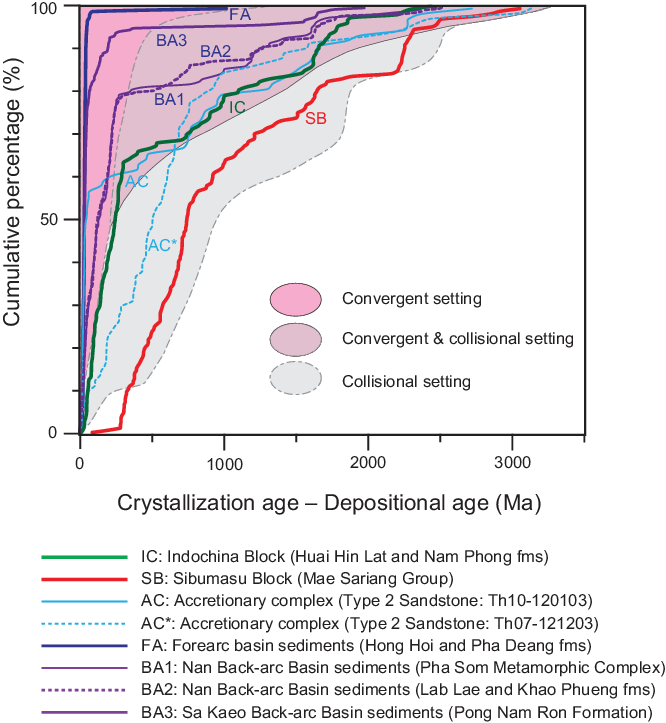
In this study, we have identified differences in detrital zircon U–Pb age spectra of Triassic sediments in the Palaeo-Tethys convergence zone between the Indochina and Sibumasu blocks, including an island arc system with an accretionary complex, a forearc basin and a back-arc basin (Figs 9 and 10). Here, using detrital zircon U–Pb ages, we classify tectonic settings associated with active island arc development induced by Palaeo-Tethys oceanic plate subduction. Cawood et al. (Reference Cawood, Hawkesworth and Dhuime2012) proposed a division of tectonic setting through convergent, collisional and extensional settings on the basis of differences between the ‘crystallization age of detrital zircons’ and ‘depositional age’ on a cumulative percentage curve of detrital zircon ages. Our data, translated to the cumulative percentage curve with the tectonic setting fields of Cawood et al. (Reference Cawood, Hawkesworth and Dhuime2012) superimposed, are presented in Figure 14. The curves suggest that the forearc basin sediments fall in the convergent setting field, the Nan and Sa Kaeo back-arc basin sediments and the Indochina Block correspond to a convergent to collisional setting, the Sibumasu Block plots in the collisional setting field, and the accretionary complex varies from convergent to collisional settings. Figure 14 shows a close correspondence between tectonic setting and the occurrence of younger igneous activity (including production of syn-depositional zircons), older igneous activity and Proterozoic basement rocks.
Cumulative percentage curve diagram for detrital zircon ages from Triassic sediments within the Palaeo-Tethyan convergence zone. The tectonic fields of convergent and collisional setting are based on the difference between the crystallization age of detrital zircons and the depositional age, as proposed by Cawood et al. (Reference Cawood, Hawkesworth and Dhuime2012).

In northern Thailand, records of Palaeozoic to Triassic igneous activity are well preserved in the Indochina Block and the Sukhothai Arc, as described in Section 6. To investigate the tectonic evolution of the Palaeo-Tethys convergence zone, we selected three important detrital zircon U–Pb age intervals: Triassic, Palaeozoic and Proterozoic. The Triassic zircons are regarded as syn-depositional zircons and were sourced from igneous rocks of the Sukhothai Arc (the Lampang Volcanic Belt) and the Phetchabun Volcanic Belt, which we interpret as tectonic settings termed ‘island arc with back-arc basin, isolated from the Indochina Block’ and ‘continental island arc along the western margin of the Indochina Block’, respectively. The Palaeozoic zircons originated from Ordovician to earliest Devonian igneous rock along the western margin of the Indochina Block (northern Thailand, Lao PDR to SW China), and around the Kham Duc complex and the Kontum Massif in the collision zone (central Vietnam), and Carboniferous igneous rocks of the Phetchabun Volcanic Belt. During this period, igneous rocks were generated in an active continental margin tectonic setting within the western Indochina Block (Qian et al. Reference Qian, Feng, Yang, Wang, Chonglakmani and Monji2015; Liu et al. Reference Liu, Bi, Guo, Zhou and Wang2019). In addition, magmatism occurred in an active continental margin adjacent to a subduction zone along the South China Block (Nakano et al. Reference Nakano, Osanai, Owada, Nam, Charusiri and Khamphavong2013), and was caused by the initiation of subduction and subsequent microcontinent collision (Faure et al. Reference Faure, Nguyen, Hoai and Lepvrier2018; Nguyen et al. Reference Nguyen, Feng, Zi, Zhao, Tran, Ngo, Tran and Nguyen2019). The Palaeozoic zircons were thus derived from an active continental margin of the western Indochina Block, and collision zone between the Indochina and South China blocks. The Proterozoic zircons were supplied from erosion of peri-Gondwana basement rocks and later by the Grenvillian and Pan African orogenies, prior to the initiation of break-up of the Gondwanan supercontinent.
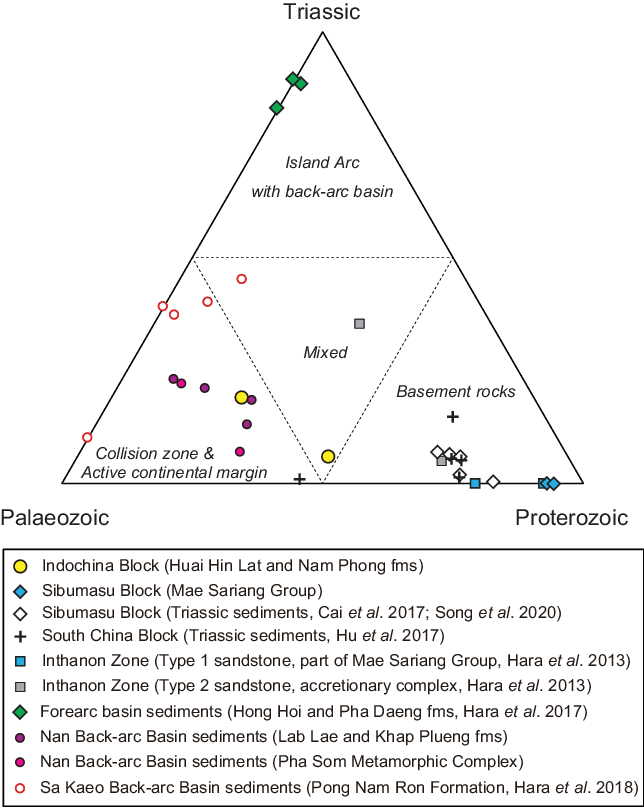
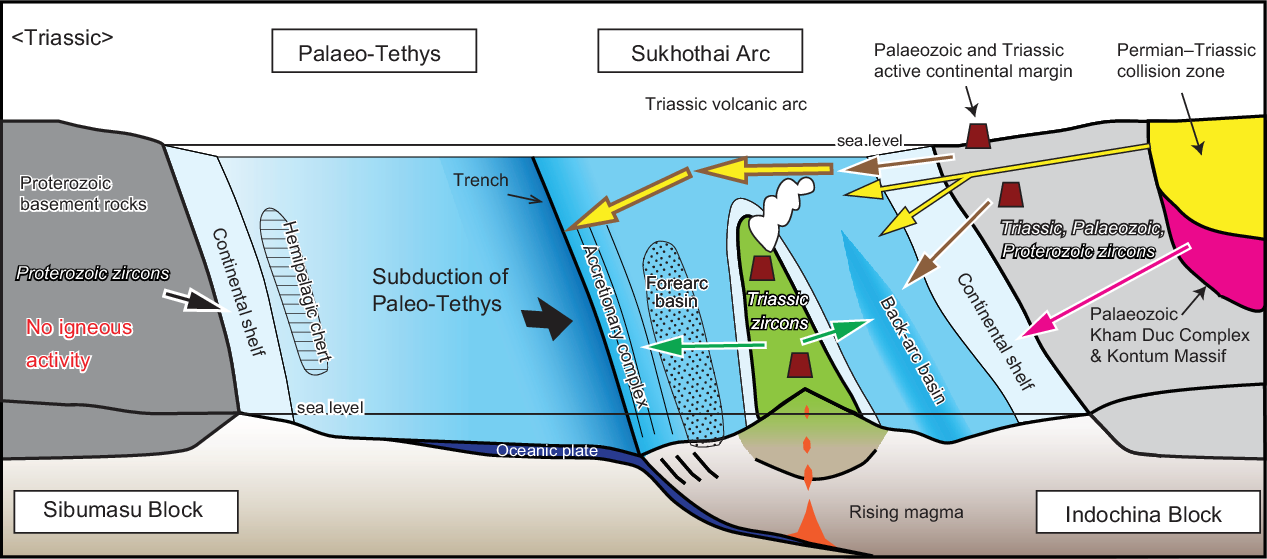
The ternary diagram of Triassic–Palaeozoic–Proterozoic ages in Figure 15 allows detrital zircon age data to be related to tectonic setting. In addition, the detrital zircon supply system is illustrated in Figure 16, associated with tectonic setting in provenance. This diagram reveals that the forearc basin sediments have a strong contribution from the Triassic Sukhothai Arc. The Sukhothai Arc and the Nan Back-arc basin were a barrier to most of the sediment supply from the Indochina Block. Sedimentary rocks from the Indochina Block and the Nan and Sa Kaeo back-arc basins are associated with a Palaeozoic active continental margin in the western Indochina Block, and Palaeozoic and Permian to Triassic collision zones between the Indochina and South China blocks. These depositional basins present a contribution from the tectonic setting of an active continental margin and a continental collision. In contrast, sedimentary rocks of the Sibumasu and South China blocks show mostly elements of continental basement, suggesting a passive margin environment during deposition. The accretionary complex shows either a mixed source or predominantly continental basement elements.
Triassic–Palaeozoic–Proterozoic ternary diagram showing detrital zircon age composition of Triassic sediments within the Palaeo-Tethyan convergence zone. See Section 7 for details.

Schematic model of sedimentary supply system with tectonic setting during the Triassic.

The tectonic model for the Palaeo-Tethys convergence zone proposed by Ueno & Hisada (Reference Ueno and Hisada2001), including development of the Sukhothai Arc and Nan Back-arc Basin, has been supported by recent studies (e.g. Sone & Metcalfe, Reference Sone and Metcalfe2008; Hara et al. Reference Hara, Wakita, Ueno, Kamata, Hisada, Charusiri, Charoentitirat and Chaodumrong2009, Reference Hara, Tokiwa, Kurihara, Charoentitirat, Ngamnithiporn, Visetnat, Tominaga, Kamata and Ueno2018; Kamata et al. Reference Kamata, Ueno, Hara, Ichise, Charoentitirat, Charusiri, Sardsud and Hisada2009; Barber et al. Reference Barber, Ridd, Crow, Ridd, Barber and Crow2011; Sone et al. Reference Sone, Metcalfe and Chaodumrong2012; Metcalfe, Reference Metcalfe2013; Wang et al. Reference Wang, Qian, Cawood, Liu, Feng, Zhao, Zhang, He and Zhang2018). Detrital zircon U–Pb ages have previously been used for provenance analysis of microcontinents derived from Gondwana. We have interpreted our detrital zircon U–Pb ages in terms of the tectonic setting of the Palaeo-Tethys convergence zone with respect to the presence of Proterozoic basement, the development of a Palaeozoic active continental margin and collision zone, and the formation of a Triassic island arc (Fig. 15). Overall, our study has shown that detrital zircon U–Pb dating is a highly useful tool for identifying sediment provenance and tectonic setting in the Palaeo-Tethys convergence zone.
Conclusions
-
1) Most of the detrital zircons in sedimentary rocks of the Indochina Block were sourced from the collision zone between the Indochina and South China blocks, the active continental margin of the western Indochina Block. Sediments of the Indochina Block show a spatial difference in provenance between the western and southwestern areas.
-
2) Sibumasu Block sedimentary rocks were supplied by Archaean basement erosion (2500–2400 Ma) and by the Grenville (1000–900 Ma) and Pan African (600–500 Ma) orogenies. These rocks contain no record of Permian to Triassic igneous activity, which was associated with the development of an extensional basin generated by crustal thinning within the Sibumasu Block during the Permian.
-
3) The provenance of the accretionary complex comprised the Sukhothai Arc and the Indochina and South China blocks. Detrital zircons from the accretionary complex show a range of ages and were supplied by crustal uplift and erosion related to the Indosinian I orogeny. In addition, the mélange in the western Inthanon Zone, which was generated by westward thrusting of the accretionary complex over the Sibumasu Block, includes sandstones of the Triassic Mae Sariang Group of the Sibumasu Block.
-
4) The Pha Som Metamorphic Complex, the Lab Lae and Khao Phueng formations, and the Khanu Chert are inferred to have originated as basin-filling sediments in the Nan Back-arc Basin. Sediments of the Nan Back-arc Basin are widely distributed not only in the Nan–Uttaradit area but also in the northern Sukhothai area.
-
5) In addition to identifying sediment provenance in microcontinental blocks derived from Gondwana, we also used the detrital zircon U–Pb ages to detect temporal variations in tectonic setting in the Palaeo-Tethys convergence zone. Four main settings are identified: continental basement erosion during the Proterozoic, development of an active continental margin in the western Indochina Block during the Palaeozoic, a collision zone between the Indochina and South China blocks during the Palaeozoic, and Permian to Triassic, and formation of an active Sukhothai Arc and continental margin in the western Indochina Block during the Triassic.
Supplementary material
To view supplementary material for this article, please visit https://doi.org/10.1017/S0016756820001028
Acknowledgements
We thank Prof. P. Charusiri, Prof. K. Hisada, Prof. K. Ueno, Dr Y. Kamata and Mr S. Assavapatchara for valuable comments on the geology and tectonics of Thailand, Prof. K. Yamamoto and Mr K. Shimura for support during zircon U–Pb dating at Nagoya University, and Ms R. Nohara for assistance during geochemical analyses at Niigata University. We are grateful to Dr V. Chutakositkanon, Dr P. Peerasit, Ms C. Phuchareanchaiwon, Ms C. Pothichiya, Mr R. Leotphayakkarat, Ms I. Chanpheng, Ms T. Pengtha, Ms P. Khamfoo and Mr K. Suzuki for their support during field surveys and sampling, and staff of the thin-section preparation laboratory at the Geological Survey of Japan for their assistance. Thanks are also due to Prof. S. Hubbard, Prof. I. Metcalfe and anonymous reviewers for constructive and valuable comments on the manuscript.
Declaration of Interest
The authors declare no conflicts of interest.