Quality of sibling relationships in school-age children
During school age, the emotional climate created in a sibling relationship is sometimes positively charged (resulting in higher closeness; Coplan, Arbeau, & Armer, Reference Coplan, Arbeau and Armer2008; McHale & Crouter, Reference McHale, Crouter and Brody1996; Perlman, Garfinkel, & Turrell, Reference Perlman, Garfinkel and Turrell2007; Whiteman, Solmeyer, & McHale, Reference Whiteman, Bernard, Jensen and Caspi2011), while at other times it is negatively charged (resulting in higher conflict or domineering behaviour; Brody, Reference Brody2004; Buist et al., Reference Buist, Metindogan, Coban, Watve, Paranjpe, Koot and Meeus2017; Dunn, Reference Dunn, Grusec and Hastings2007; Faith, Elledge, Newgent, & Cavell, Reference Faith, Elledge, Newgent and Cavell2015; McGuire, Manke, Eftekhari, & Dunn, Reference McGuire, Manke, Eftekhari and Dunn2000; Morgan, Shaw, & Olino, Reference Morgan, Shaw and Olino2012; Recchia & Witwit, Reference Recchia and Witwit2017; Stormshak, Bellanti, Bierman, & Conduct Problems Prevention Research Group, Reference Stormshak, Bellanti and Bierman1996). The sibling relationship is one of the longest in an individual’s life, with siblings spending more time with each other than with their parents (McHale & Crouter Reference McHale, Crouter and Brody1996; Whiteman, Bernard, & Jensen, Reference Whiteman, Bernard, Jensen and Caspi2011). The presence of a positive climate in a sibling relationship is very important for children’s emotional growth. It has been found that a close and warm sibling relationship contributes to a sense of security, as well as to an increase in the confidence of bashful children (Coplan et al., Reference Coplan, Arbeau and Armer2008). Nonetheless, siblings often come into conflict. During that period, siblings fight each other in the context of a power struggle or for reasons of self-interest as, for instance, the use and ownership of personal items (McGuire et al., Reference McGuire, Manke, Eftekhari and Dunn2000), sometimes resulting in incidents in which they exhibit aggressive behaviour. The relevant literature suggests that intense conflict and physical aggression between siblings is positively linked with negative adjustment in children (Stormshak et al., Reference Stormshak, Bellanti and Bierman1996), and such children are regarded as less acceptable by their peers (Brody, Reference Brody2004). Moreover, children who habitually exhibit domineering behaviour toward their siblings tend to exhibit similar behaviour toward their peers in school (Faith et al., Reference Faith, Elledge, Newgent and Cavell2015). Under such circumstances, children who are systematically bullied by their siblings are likely to develop a passive attitude in their interpersonal relationships with their schoolmates, and may also suffer bullying at school (Dunn, Reference Dunn, Grusec and Hastings2007). However, when the sibling relationship is characterised by equality, children are more able to develop social skills, which in turn contributes to their fostering positive interpersonal relationships with their peers (Perlman et al., Reference Perlman, Garfinkel and Turrell2007). Moreover, harmonious sibling relationships can have a protective function in victimisation situations (Faith et al., Reference Faith, Elledge, Newgent and Cavell2015). Aggressive children who experience a sibling relationship with a small degree of belligerent behaviour but at the same time are recipients of affection seem to function with more emotional self-control and psychosocial adaptability than the children who initiate conflict and experience no affection with their siblings (Stormshak et al., Reference Stormshak, Bellanti and Bierman1996). In addition, boys who experience conflict with their siblings tend to have worse social skills when they start attending school (Stormshak et al., Reference Stormshak, Bellanti and Bierman1996).
Quality of sibling relationships in relation to cohesion and adaptability
A family is a dynamic system whose function is determined by a multitude of environmental and inherent factors. Cohesion and adaptability are among the prevalent factors studied in the sibling literature (Minuchin, Reference Minuchin1974). Cohesion is defined as the degree of emotional bonding between family members, while adaptability refers to the ability of the family system to change in response to the situational and developmental stresses that the family experiences through its life cycle. The prevalent climate within a family is of crucial importance and is apparently connected with the quality of sibling relationships (Dawson, Pike, & Bird, Reference Dawson, Pike and Bird2015; Della Porta & Howe, Reference Della and Howe2017; Fosco, Stormshak, Dishion, & Winter, Reference Fosco, Stormshak, Dishion and Winter2012; Furman & Giberson, Reference Furman, Giberson and Shulman1995; Gamble & Yu, Reference Gamble and Yu2014; Noller, Feeney, Sheehan, Darlington, & Rogers, Reference Noller, Feeney, Sheehan, Darlington and Rogers2008; Richmond & Stocker, Reference Richmond and Stocker2008; Volling & Belsky, Reference Volling and Belsky1992; Yu & Gamble, Reference Yu and Gamble2008).
The processes involved in the shaping of sibling relationships follow the ‘logic’ of the development of any individual or relational processes; they are the products of their continuous dynamic interplay with their social context (Sameroff, Reference Sameroff2009). In considering family functioning, studies have examined sibling relationships in relation to family cohesion and adaptability during different growth periods (early childhood, adolescence or adulthood; Dawson et al., Reference Dawson, Pike and Bird2015; Della Porta & Howe, Reference Della and Howe2017; Fosco et al., Reference Fosco, Stormshak, Dishion and Winter2012; Gamble & Yu, Reference Gamble and Yu2014; Milevsky, Smoot, Leh, & Ruppe, Reference Milevsky, Smoot, Leh and Ruppe2005; Modry-Mandell, Gamble, & Taylor, Reference Modry-Mandell, Gamble and Taylor2007; Richmond & Stocker, Reference Richmond and Stocker2008; Tippett & Wolke, Reference Tippett and Wolke2015; Whiteman et al., Reference Whiteman, Solmeyer and McHale2015). For example, it has been found that when there is closeness and supportive tendencies within the family, the sibling relationship is characterised by affection and a minimum of competitiveness (Gamble & Yu, Reference Gamble and Yu2014). Moreover, with regard to the question of whether the degree of family cohesion is connected with sibling behavioural problems during adolescence, it appears that there is a negative correlation between family cohesion and conflict between siblings during that period (Richmond & Stocker, Reference Richmond and Stocker2008). The research conducted on the relationship between the degree of aggressive behaviour in a sibling relationship during adolescence and the emotional climate of the family found that there is a connection between a positive family climate and a lower level of conflict in sibling relationships (Yu & Gamble, Reference Yu and Gamble2007). Furthermore, the research has also focused on the degree to which satisfaction within the family affects the sibling relationship upon entering adulthood, suggesting that people coming from a family background where there is satisfaction within the family and between the parents, and where the siblings are emotionally closer, communicate more and support each other to a greater extent (Milevsky, Reference Milevsky2004).
The aforementioned studies examined sibling relationships and family cohesion and adaptability. Nevertheless, the quality of sibling relationships during school age in relation to adaptability and cohesion has not been fully examined in general, and particularly in Greece. Therefore, the present study contributes to reduce this gap, focusing on the investigation of the quality of sibling relationships during school age in relation to family cohesion and adaptability among intact Greek families.
Consequently, the aim of the present study is to assess the quality of sibling relationships of Greek school-age children in relation to two specific components of family functioning; namely, cohesion and adaptability (Olson, Reference Olson1986). Due to the fact that there are conflicting findings in the literature, in the present study we proceed with research questions instead of hypotheses. More specifically, we address the following questions:
1. What is the quality of the sibling relationship and the family functioning (cohesion and adaptability), as reported by the children and their parents?
2. What is the role of the parents’ educational level and the birth order of the participating siblings, and of the siblings’ gender agreement regarding quality of the sibling relationship?
3. What are the interrelationships of the sibling relationship and family functioning as reported by the children and their parents?
Method
Participants
The sample consisted of 251 intact Greek, two-child families (with at least one primary school-age child), constituting a sample of 502 participants (251 parents, with 1 parent participating from each family, and 251 children). The families reside in the wider region of Thessaloniki in northern Greece. The selection of the sample was conducted through snowballing and the families were contacted at school. Out of the 270 initially selected families, 251 agreed to participate in the study (N = 251; response rate, 93%). The parents’ age ranged from 37 to 42 (M age = 39 years old). Regarding parental education, 91 mothers (36%) and 84 fathers (33%) had a university education, while 160 mothers (64%) and 167 fathers (67%) had a high school education. Of the participating siblings, 142 (57%) were first-born, and 116 (46%) were boys.
Measures
The Family Adaptability and Cohesion Evaluation Scales III (FACES III)
The Family Adaptability and Cohesion Evaluation Scales III (FACES III; Olson Reference Olson1986, 337) was designed to evaluate family cohesion and adaptability, based on the circumplex model of family functioning. Cohesion is defined as the degree of emotional bonding between family members, and adaptability refers to the ability of the family system to change in response to situational and developmental stress. FACES III is a 20-item, paper-and-pencil, self-report questionnaire with each question answered on a 5-point scale (0 = almost never, and 4 = almost always). Its adaptation to Greek (Bibou, Stogiannidou, Papageorgiou, & Kioseoglou, Reference Bibou, Stogiannidou, Papageorgiou and Kioseoglou2002) supports its use in a Greek population. All 30 items are administered twice in order to identify the perceptions of the respondents’ actual and ideal family functioning (e.g., ‘Describe your family now’ and ‘Ideally, how you would like your family to be?’ respectively). Three scores are computed to indicate the family type, as well as its adaptability and cohesion. Moreover, for the purposes of this study, we calculated the difference between actual and ideal perceptions, as well as between the parents’ and children’s perceptions as a measure of the respective divergences.
The Sibling Relationship Questionnaire (SRQ)
The Sibling Relationship Questionnaire (SRQ; Furman & Buhrmester, Reference Furman and Buhrmester1985) identifies four dimensions of the sibling relationship: Warmth/Closeness, Conflict, Rivalry, and Relative Status/Power. The Warmth/Closeness dimension consists of likeness, admiration of/by sibling, prosocial behaviour and friendship with sibling. The Conflict dimension describes the conflicts between siblings and their competition. Rivalry is focused on the individual’s perception and appreciation for parental and paternal bias. Finally, Relative Status/Power concentrates on the sibling’s ability to care and their sovereignty over the other sibling. The SRQ is a self-report, 48-item questionnaire, with a 5-point format. Its adaptation to Greek (Adamis, Tsamparli, & Talanti, Reference Adamis, Tsamparli and Talanti2015) supports its use with a Greek population. Moreover, for the purposes of this study, we calculated the difference between the parents’ and children’s perceptions in order to obtain a measure of their convergence or divergence.
Procedures
The questionnaires were administered at a school site in April 2014 by a member of the research team when the parents completed the questionnaire during an educational meeting at the school. All the participants were ensured anonymity. The students and their parents were asked to answer all the questionnaire items, based on their own understanding about themselves and their family. The questionnaire completion time was 30–35 minutes.
Ethics
The study was conducted in compliance with the ethical standards of research with human subjects of the University of the Aegean. The research protocol was approved by the Aegean University Institutional Review Board. Appropriate permissions were obtained to conduct the research at school.
Results
Analyses were conducted with the Statistical Package for Social Sciences 21 (SPSS 21). To investigate the statistically significant difference from the theoretical measure of central tendency, the non-parametric Wilcoxon Signed Rank Test was employed (due to statistically significant deviation from normality). It should be noted that we report both the median and the mean to facilitate the readers’ understanding of the reported results. To investigate the statistically significant difference between two independent groups, the non-parametric Mann-Whitney U test was conducted (due to statistically significant deviation from normality). Factor analysis (principal axis factoring, with an oblimin rotation) was conducted to investigate the structure of latent variables, considering both family functioning and sibling relationship. The level of statistical significance was selected at p < .05.
Sibling relationship and family functioning
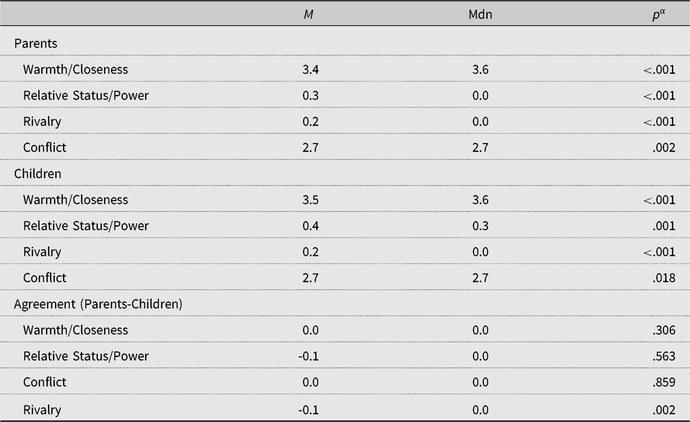
Considering the quality of sibling relationship, the one-sample Wilcoxon median test (see Table 1) revealed for both parents and their children statistically significant higher perceptions in the SRQ scales of Warmth/Closeness and Relative Status/Power, while statistically significant lower perceptions were found in the SRQ scale of Rivalry and Conflict. Moreover, with respect to the parents–children agreement, the children were found to hold statistically significantly higher rivalry perceptions than their parents.
Sibling Relationship Quality

Note: aOne-sample Wilcoxon median test (from the neutral 3 for the SRQ scales Warmth/Closeness and Conflict; from the neutral 1 for the SRQ scale Rivalry; from the neutral 0 for the SRQ scale Relative Status/Power and for the Parents–Children agreement scales).
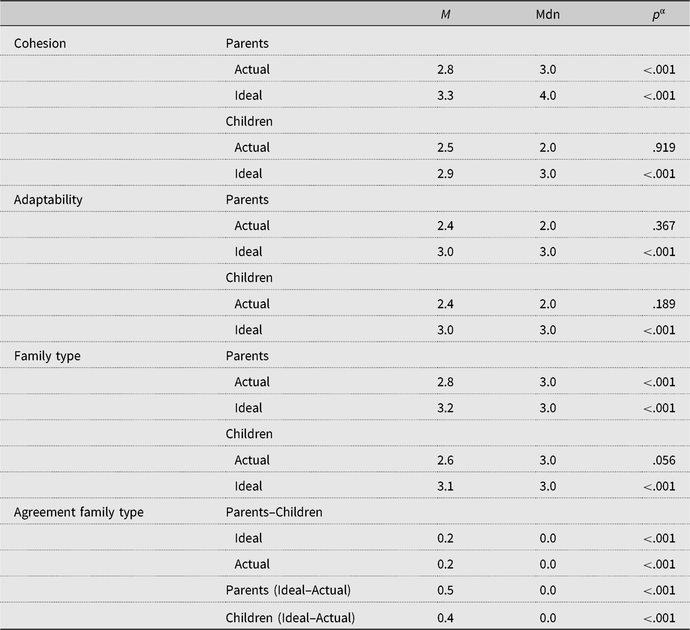
Considering family functioning, the one-sample Wilcoxon median test revealed that all the ideal perceptions held by both the parents and their children were statistically significantly higher than the theoretical neutral (see Table 2). With regard to the actual perceptions, the analyses results revealed that only the parents reported statistically significantly higher perceptions than the theoretical neutral only for cohesion and family type. Furthermore, with respect to the parents–children family-type perceptions agreement, the parents reported statistically significantly higher perceptions than their children. Moreover, the ideal perceptions are statistically significantly higher than the actual for both parents and children.
Family Functioning (Cohesion and Adaptability)

Note: aOne-sample Wilcoxon median test (from the neutral 2.5 for the FACES III scales and from the neutral 0 for the parent–child agreement scales).
Sibling relationship and family functioning: parental educational level
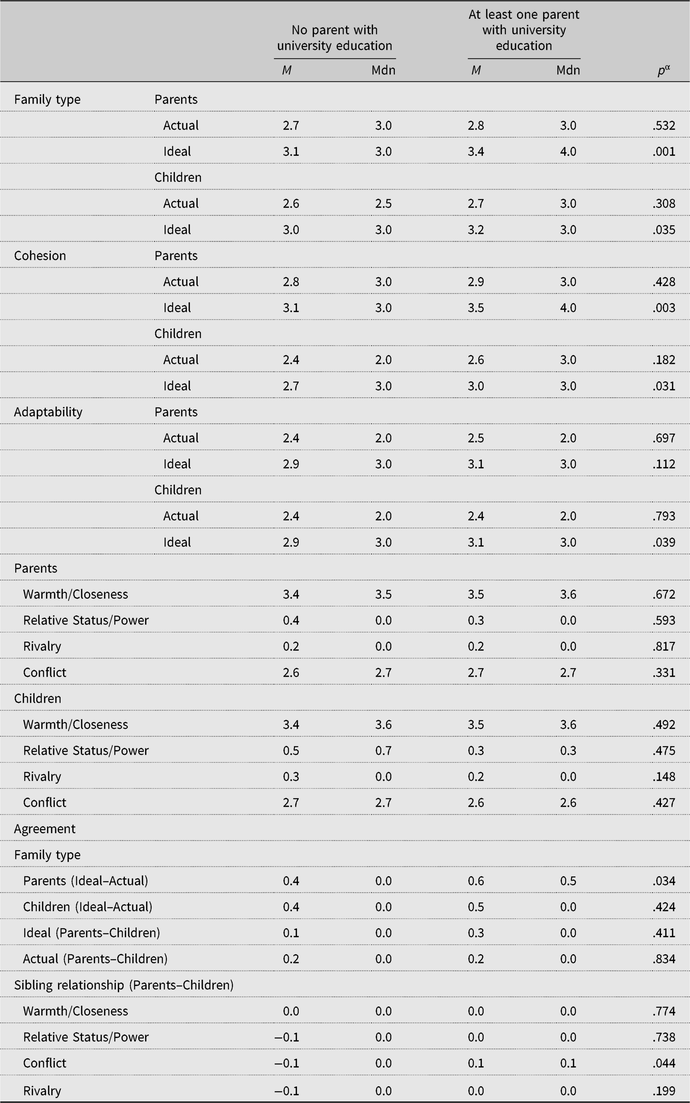
Considering parental education (see Table 3), the independent samples Mann-Whitney U test revealed no statistically significant differences in the ideal family functioning (family type, adaptability and cohesion) and the quality of sibling relationship (Warmth/Closeness, Conflict, Rivalry, and Relative Status/Power). Nevertheless, it was revealed that in the families with at least one parent having a university education, the ideal perceptions of family functioning were statistically significantly higher for both parents and their children, except for the adaptability of the parents).
Family Functioning, Sibling Relationship and Parental Education

Note: aNon parametric independent samples Mann-Whitney U test.
Furthermore, with respect to the parents–children family-type perceptions agreement, parents of the families with at least one parent having a university education reported statistically significantly higher agreement between their ideal and actual perceptions than parents of the families without a university education.
Finally, considering the parents–children agreement about family functioning and sibling relationship, only one statistically significant difference was found. In the families with at least one parent having a university education the parents reported higher conflict than their children, while in the families with both parents not having a university education, the children reported higher conflict than their parents.
Sibling relationship and family functioning: siblings’ birth order
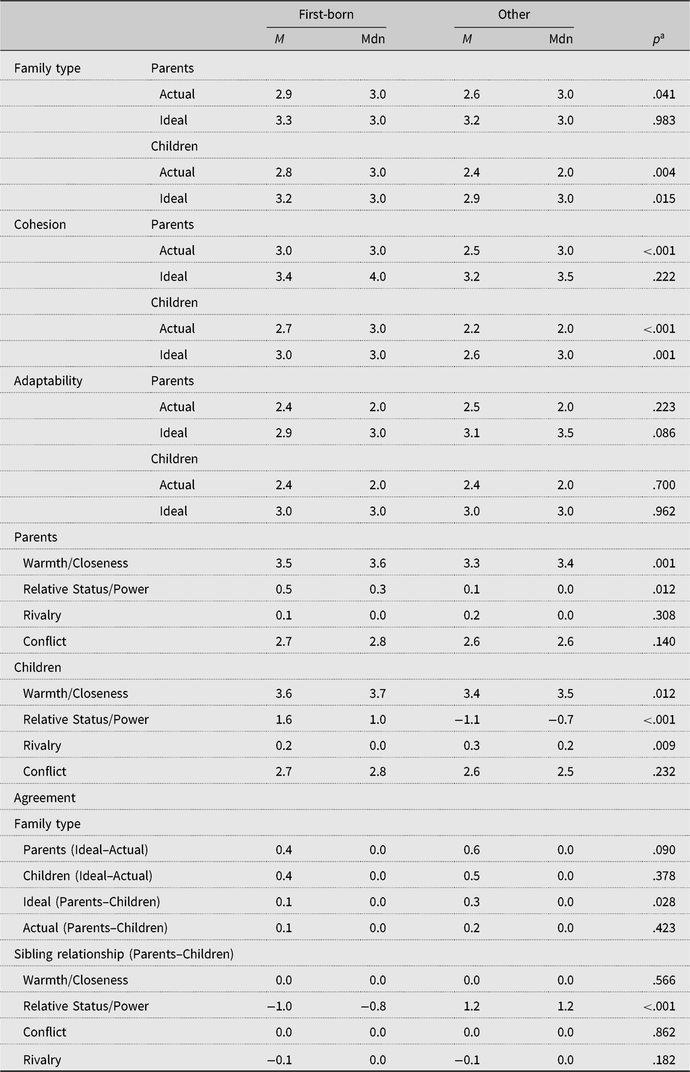
Regarding siblings’ birth order and family functioning (see Table 4), the independent samples Mann-Whitney U test revealed that in the families in which the participating sibling was first-born, his/her perceptions of family type and cohesion, both ideal and actual, were statistically significantly higher, while no statistically significant differences were found in the perceived adaptability. Similar differences were found only in the reported actual perceptions by the parents. Moreover, with respect to the parents-children family-type perceptions agreement, the difference between the ideal perceptions of the parents and the children were statistically significantly lower in the families where the participating sibling was the first-born (though in both cases the parents’ perceptions were higher than their children’s).
Family Functioning, Sibling Relationship and Birth Order

Note: aNon parametric independent samples Mann-Whitney U test.
Regarding the sibling’s birth order and sibling relationship (see Table 4), the independent samples Mann-Whitney U test revealed that in the families in which the participating sibling was the first-born, both the first-borns and their parents reported statistically significantly higher Warmth/Closeness, while only the first-born (and not their parents) reported statistically significantly lower rivalry. Considering Relative Status/Power, the parents of the first-born and the first-born child reported statistically significantly higher perceptions (though the parents’ perceptions were positive for both family types, while the first-borns’ perceptions were positive and the others were negative). Moreover, considering the parents–children agreement about sibling relationship, only one statistically significant difference was found: in the families with a participating first-born sibling, the parents reported lower Relative Status/Power than their children, while in those families where the participating sibling was not the first-born, the children reported higher Relative Status/Power than their parents.
Sibling relationship and family functioning: siblings’ gender agreement
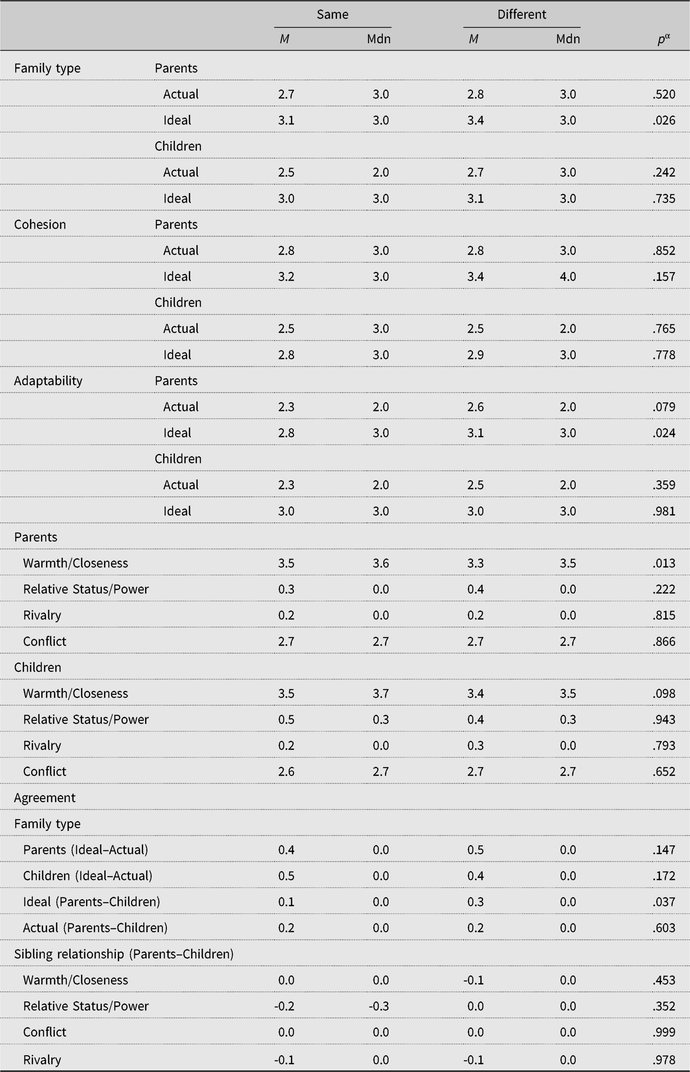
Considering the siblings’ gender agreement and the quality of sibling relationship (see Table 5), the independent samples Mann-Whitney U test revealed only one statistically significant difference: the parents whose children had the same gender reported statistically significantly higher Warmth/Closeness than the parents with different gender children. No statistically significant differences were found in the parents–children agreement.
Family Functioning, Sibling Relationship and Siblings’ Gender Agreement

Note: aNon parametric independent samples Mann-Whitney U test.
Considering the siblings’ gender agreement and family functioning (see Table 5), the independent samples Mann-Whitney U test revealed statistically significant differences only in the parents’ ideal perceptions of family type and adaptability in favour of the parents in families of siblings with different gender. Moreover, with respect to the parents–children family-type perceptions agreement, the difference between the ideal perceptions of the parents and the children were statistically significantly lower in the families where the siblings had the same gender (though in both cases the parents’ perceptions were higher than their children).
Sibling relationship and family functioning: interrelationships
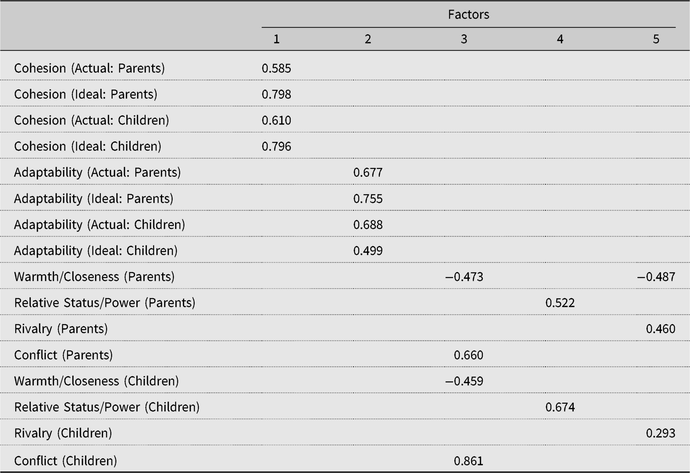
Regarding the interrelationships among the family functioning and sibling relationship dimensions, principal axis factoring with an oblimin rotation was conducted, revealing a five-factor structure (65.46% of total variance explained; see Table 6). Specifically, the meaning of the five factors is outlined as follows: (a) Cohesion (ideal and actual, parents and children), (b) Adaptability (ideal and actual, parents and children), (c) Warmth/Closeness and Conflict (parents and children), (d) Relative Status/Power, and (e) Rivalry (with a negative cross-loading of parents’ Warmth/Closeness). The identified latent structure supports the conceptual independence of the two constructs (family functioning and quality of sibling relationship). Importantly, it appears that the participating parents and their children seem to respond as a system in the sense that for each of the measured constructs and their dimensions, the respective perceptions of both parents and their children load at the same factor.
Family Functioning and Sibling Relationship: Factor Analysis

Note: Principal axis factoring. Rotation method: Oblimin with Kaiser Normalisation 65.462% variance.
Discussion
The purpose of the present study was to examine the quality of sibling relationships in Greek families with school-age children (intact families with two children) in relation to the family functioning (the degree of family cohesion and adaptability), taking into consideration parental education level, birth order, and the siblings’ gender agreement.
According to the findings of this study, the quality of sibling relationship is related to family cohesion and adaptability. Parents reported higher cohesion of family relationships than their children, which is in line with existing research findings, according to which individuals who are in a parental role have more positive feelings about their families than their peers who do not carry such roles (Svetina, Zabret, & Bajec, Reference Svetina, Zabret and Bajec2015). Furthermore, the parents reported a higher degree of adaptability only in families with siblings of different gender, perhaps because parents recognise that children of different gender have different needs, and thus the they have to adapt accordingly. What this finding suggests is that the parents, as adults who have more life experience and also the ability (to a higher degree than their children) to have a more broad-ranging cognisance of the relationships within the family, also have the conviction that any difficulties arising in relationships can be overcome. Part of being an adult is having the capacity to assess conflict more realistically, that is, the ability to reduce dramatic feelings and differences among family members.
Concerning the quality of the sibling relationship for the degree of parents–children agreement, we found a statistically significant difference between them only in the Rivalry dimension, with the parents reporting less polarisation than children, which accords with previous research findings (Dreikurs & Dinkmeyer, Reference Dreikurs and Dinkmeyer1979; Furman & Buhrmester, Reference Furman and Buhrmester1985; McHale & Crouter, Reference McHale, Crouter and Brody1996; Sanders, Reference Sanders2004; Whiteman et al., Reference Whiteman, Bernard, Jensen and Caspi2011). Furthermore, the cohesion reported by both parents and children is statistically related in a negative way with children’s conflict. Perhaps when there is emotional bonding between family members, siblings are more likely to settle their differences constructively and avoid conflicts. This finding confirms other studies (Richmond & Stocker, Reference Richmond and Stocker2008; Yu & Gamble, Reference Yu and Gamble2008), according to which the positive emotional climate goes hand in hand with less conflict in the sibling relationship. As to the quality of sibling relationship and family functioning in relation to the participating sibling’s birth order, a statistically significant difference was found: the first-born children reported greater cohesion and greater Warmth/Closeness when compared to the second-born children. This is in agreement with findings according to which the first-born, to a greater degree than the second-born, retains closer relationships with their siblings, attempts communication more frequently, and emotionally invests more in the sibling relationship (Pollet & Nettle, Reference Pollet and Nettle2009). Perhaps first-born children seek closeness because they take upon themselves the ‘parental’ role toward their younger siblings (Sheehan, Darlington, Noller, & Feeney, Reference Sheehan, Darlington, Noller and Feeney2004). On the other hand, the second-born children reported higher polarisation in comparison to first-born children. Possibly, the second-born children experience more polarisation as they aspire (to a greater degree) to compete with or even surpass their first-born siblings as their strive for parental attention (Dreikurs & Dinkmeyer, Reference Dreikurs and Dinkmeyer1979). When the obtained data originate from the parents and their second-born children, higher levels of cohesion are reported in the ideal level of parents from children (i.e., higher disparity toward the parents when it is the second-born children reporting than when it is the first-born ones) and higher parent cohesion in the ideal level compared to the actual (i.e., higher disparity toward the parent ideal when it is the second-born children reporting than when it is the first-born children).
It may be hypothesised that the second-born children have lower expectations in terms of ideal level, which may be affected by their place in the birth order where they have a secondary role with fewer responsibilities in the family life compared to the first-born children (Dreikurs & Dinkmeyer, Reference Dreikurs and Dinkmeyer1979). Hence, we have a bigger disparity toward parents (as to the ideal cohesion level) when it is the second-born children who do the reporting. Regarding the siblings’ gender agreement, the findings indicate that there is a difference in the sibling relationship and family functioning. According to the findings of the study, the parents in families with children of different gender scored statistically significantly lower than those in families with children of the same gender. This finding is consistent with those studies reporting that same-gender siblings tend to report greater closeness and emotional support in comparison to the siblings of different gender, as well as a greater frequency of contact and communication (Frank, Reference Frank2007; Milevsky et al., Reference Milevsky, Smoot, Leh and Ruppe2005; Poortman & Voorpostel, Reference Poortman and Voorpostel2009; Scharf, Shulman, & Avigad-Spitz, Reference Scharf, Shulman and Avigad-Spitz2005; Spitze & Trent, Reference Spitze and Trent2006; Tafoya & Hamilton Reference Tafoya and Hamilton2012; Voorpostel, Van Der Lippe, & Flap, Reference Voorpostel, Van Der Lippe and Flap2012; White, Reference White2001). One of the reasons that accounts for this closeness might be that being the same gender, they have similar interests and hence are likely to interact more than siblings of a different gender.
Regarding the structure of latent variables, a five-dimension structure was revealed: Cohesion, Adaptability, Warmth/Closeness and Conflict, Relative Status/Power, Rivalry). The breakdown of the factors supports the validity of our decision to study the relationship of family cohesion and adaptability, as it validates the distinction between the two constructs and among most of the dimensions within the sibling relationship (with the exception of Warmth/Closeness and Conflict, which seem to be in the same dimension).
The present research confirms a consistent finding in family research that there is a discrepancy in the understanding of family relationships among family members. Up to the present there is no general agreement as to why these differences arise; however, different factors have been suggested, including the individual’s role in the family group (Svetina et al., Reference Svetina, Zabret and Bajec2015), measurement issues (Manders et al., Reference Manders, Cook, Oud, Scholte, Janssens and De Bruyin2007; Stanley, Reference Stanley, Hofferth and Casper2007), age (Furman & Buhrmester, Reference Furman and Buhrmester1992), cognitive and emotional changes corresponding to the developmental stage of an individual’s life cycle (Ohannessian, Laird, & De Los Reyes, Reference Ohannessian, Laird and De Los Reyes2016; Spear, Reference Spear2000), cultural differences (Peretolcina & Liders, Reference Peretolcina and Liders2014), and gender (Shulman & Scharf, Reference Shulman and Scharf2010).
In conclusion, family members seem to have a kind of ‘double vison’ of their family relationships. On one hand, they seem to share a common perception of their family relationships as a system, and at the same time they report individual differences. According to research findings, these differences, as already mentioned, are mainly due to idiosyncratic (sex, age) characteristics of the individual. We would also like to suggest that this finding may be interpreted in different ways: (a) the perceived differences in their emotional bonds could be an indication of healthy family functioning in the sense that healthy families enhance differentiation and alterity in their members (Bowen, Reference Bowen1976); (b) it may also reflect more or less serious — justified or not — discrepancies in the way children perceive or experience their parents as ‘protecting’ and ‘caring’ figures/mentors in their lives or who are invited to resolve conflict issues or developmental challenges and secure a balanced family climate and family functioning.
Conclusions and recommendations for future research
We are able to understand the quality of the sibling relationship only when we examine it within the family where it actually takes place (Brody, Stoneman, & McCoy, Reference Brody, Stoneman and McCoy1994). Along those lines, family cohesion and adaptability play a crucial part. Accordingly, the findings of the present study, which focused on school-age siblings in Greek families, revealed that family cohesion (on both the actual and the ideal level) and adaptability (ideal level) have an impact on the quality of the sibling relationship. The present study focused on four-member families (two parents and two children) as this family composition is the most common form of family in Greece (Kogidou, Reference Kogidou and Karavatos2004). It seems that for the Greek family, the more positive the emotional climate is within the family, the more warmth and less discord prevail in the sibling relationship. Nevertheless, there is a disparity based on gender combination as to Warmth/Closeness (according to the parents’ perception), with less Warmth/Closeness in families with children of different gender when compared to families with siblings of the same gender.
Additionally, the educational level plays an important part. Both parents and children report a higher degree of ideal family type and cohesion, as well as more Warmth/Closeness (parents), when at least one of the parents has a higher education background.
Moreover, birth order appears to have an effect on how children perceive both the quality of the sibling relationship and their family’s functioning. The first-born children have the sense that there is more cohesion (actual and ideal level) within their family, as well as more Warmth/Closeness in the sibling relationship (parents and children) in comparison with second-born children, whereas second-born children perceive that there is more polarisation compared to first-born children.
Consequently, the quality of the sibling relationship is affected by the family’s cohesion and adaptability, as well as by their parents’ education level, and the gender and birth order of the siblings. In future studies it would be important to examine sibling relationships, cohesion and adaptability among Greek families in which siblings go through early childhood or adolescence.
Limitations
The main limitations of the present research were: (a) the snowballing process through which the sample was obtained means it was not random and may affect the external validity of our results (Iosifidis, Reference Iosifidis2003, Reference Iosifidis2008); (b) as the present study drew upon questionnaires and quantitative analyses, it could be argued that a qualitative approach with in-depth interviews would have helped to gain deeper understanding of the identified phenomena; (c) a greater number of parameters should have been taken under consideration in the research design as the factors influencing family functioning are multiple, including traumatic events related to loss (e.g., death, employment, illness), social risk factors (e.g., recession), the relation of the family to other social systems (e.g., extended family, community). Additionally, cultural parameters were not included in the research design. Further, as the statistical analyses did not use confirmatory factor analysis, equation hierarchical models were not considered necessary.
Implications for practice
The probing of the present study’s subject is important since it contributes to revealing the dynamics of the sibling relationship within the Greek family during the school-age period. As the quality of the sibling relationship is interconnected with family function (cohesion and adaptability), it becomes clear that a positive emotional climate is a sine qua non condition for children to experience a positive sibling relationship as well as a positive sense of the sibling’s individual self. Therefore, specialists working with families and especially with children should above all be concerned with ameliorating the family’s emotional climate and strengthening the family’s cohesion and adaptability when it is needed. Additionally, the present research indicates that specialists who usually focus on the parent–child relationship should equally focus on the sibling relationship, either for assessing a behavioural outcome or for designing their intervention.