Introduction
Analyses of female reproduction focus on the fertile period from menarche to menopause. Studies describing the characteristics of the menstrual cycle (Jiménez et al., Reference Jiménez, Rubén and Posada1999; Artiles, Reference Artiles2001) are currently of considerable importance because of the continued decline in the number of pregnancies in many countries of the world, including Cuba. In this population, the decrease in pregnancy rate has caused the cessation of demographic replacement (crude reproduction rate lower than one female child per woman) from 1978. As a result, the population has shown a high level of demographic ageing (Díaz et al., Reference Díaz, García, Linares, Rabelo and Díaz2010) and an advanced demographic transition (Miró, Reference Miró2003; Alfonso, Reference Alfonso2006).
According to data from the National Statistics Office, Havana is the Cuban province with the lowest birth rate; and Plaza de la Revolución is the municipality with the lowest pregnancy rate and highest demographic ageing of the fifteen municipalities of the capital (Oficina Nacional de Estadística, 2008). This urban municipality is in the north-central province of Havana, where many of the central government departments are located. The population shows an advanced demographic condition due to its favourable socioeconomic situation, such as tourism and municipal services, the largest hospital network in the country and cultural, recreation and sport facilities (Antón, Reference Antón2006).
The causes of the decrease in the number of pregnancies in the municipality are multiple, but include the high level of scholastic qualification in Cuba – of women in particular – and high number of women in the workforce. Other social variables influencing the decrease in pregnancy rate are the development of medical care in reproduction and maternal and child health, the increased use of contraception, the legal and institutional practice of interrupting unwanted pregnancies and the country's family planning policy (Carmenate et al., Reference Carmenate, Díaz, Toledo, Martínez, Prado, Wong, Moreno and Moreno1997). Since 1990, the severe economic crisis and the difficulty of access to housing have been other factors influencing the use of birth control (Gran & Lopez, Reference Gran and López2003).
This paper deals with the reproductive pattern of Cuban women living in Plaza de la Revolución in Havana, through the study of the most influential factors that have caused this municipality to show the lowest pregnancy rate and the highest demographic ageing in the country.
Methods
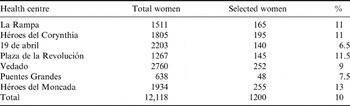
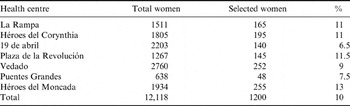
Data used in this study were obtained from a survey of 1200 post-fertile women between the ages of 55 and 64 years (average 59.8 years) born between 1942 and 1953, so that they had survived the fertile period and had reproductive histories that were final and definitive. The sample size was decided in order to obtain 10% of the studied population, which was 12,118 in 2006 when this research was initiated (Oficina Nacional de Estadística, 2008). Information was obtained as a first step from the seven health centres of the Havana municipality of Plaza de la Revolución and the interviews were subsequently completed in the women's homes. Table 1 shows the percentages of women interviewed in each health centre, which were obtained according to the proportion of women in each age range for each polyclinic. These percentages were between 5% and 15% in order for the sample to be representative. The sample was random, stratified and had a confidence level of 95% (5% error).
Frequency distribution of interviewed women aged 55–64 years by health centre, Plaza de la Revolución, Havana, Cuba, 2006
The survey included two kinds of variables: a) socio--demographic variables: age of woman, marital status, rural/urban residence and education level; and b) reproductive history variables: number of marriages per woman, date and number of pregnancies (pregnancy rate, p), miscarriages (miscarriage rate, m), abortions (abortion rate, a), deliveries (delivery rate, d) and live births (birth rate, b), age at menarche and menopause, use of contraception and age at first sexual intercourse of women. Miscarriage was defined as involuntary termination of a pregnancy occurring before 20 weeks of gestation, and abortion as induced termination. Deaths occurring from the 20th week of gestation until delivery were considered as late fetal deaths.
The analysis of menopause age was done taking into account the fact that there are two types of menopause: natural and surgical. The crude reproductive period is the period during which women can reproduce and is defined as the difference between ages at menopause and menarche. The effective reproductive period was determined by the age difference between the first and last pregnancy.
The study was a retrospective and transversal analysis, where the influence of biological and socio-cultural factors (independent variables) on the rate of live births (b) and abortions (a) (dependent variables) was studied through the ‘decision tree’ method and considering 5% (p<0.05) as level of statistical significance. The decision tree consists of nodes (independent variables) with outgoing edges (internal nodes) and some terminal or decision nodes. In this analytic method, each internal node (effect of variables) splits into two or more sub-groups (new influential variables) according to their values. This method is a non-parametric statistical analysis that classifies the target variable in groups considering the predictor that better explains its variability. Each division is again ramified into new branches according to the new significant predictors, forming a hierarchical structure, such as a tree (Marvez et al., Reference Marvez, Weis, Houry and Ernst2003). The algorithm used (CRT, Classification and Regression Tree) sets the cut-offs that maximize the internal homogeneity in the nodes, so that all cases in a node are similar to one another and different from the cases of the other node. The construction of the decision tree is top-down, by choosing a variable at each step that best splits the set of items. The algorithm measures the homogeneity of the target variable within the subsets. All statistical analyses were performed using SPSS software version 16.0.
Results and Discussion
These women living in the municipality of Plaza de la Revolución were born in different provinces of the country; 25.7% of them had a rural origin and the rest (74.3%) urban. This distribution is similar to that obtained in the entire Cuban population, where 75.4% of women are from urban areas (Oficina Nacional de Estadística, 2008). Of the women sampled, 26.6% had a university education, which suggests a high social indicator compared with the entire Cuban population. The 1200 studied women had 4563 pregnancies and 4609 embryos, distributed according to number of embryos per pregnancy in 4518 singles, 44 twins and one triplet. Since the 30 ectopic pregnancies registered were excluded from the study, the total number of embryos studied was reduced to 4579.
Marriage pattern
Although frequency of the marital status ‘consensual union’ (cohabiting union) has increased recently in Cuba (Catasús, 2008), as well as in other Latin American countries (García & Rojas, Reference García and Rojas2002; Rodríguez, Reference Rodríguez, Arriagada and Aranda2004), the most frequent marital status in the studied women is the civil marriage, and most had been married only once. Almost half of the studied women (40.9%) had divorced once, and one woman in every five (19.3%) had divorced two or more times. The average age at first marriage was 20.4 years, a younger age than that registered in other Latin American countries (García & Rojas, Reference García and Rojas2001), while the average age at first divorce or separation was 29.8 years. This early age of marital union means women have had little social and psychological training for marriage and family life, which is also complicated by the shortage of housing and resources to build a new home (Benítez, Reference Benítez2003; Díaz-Briquets, Reference Díaz-Briquets2009). Almost half of the interviewed women (44.8%) had married twice, and 11.6% of them had married a third time.
Female reproductive period
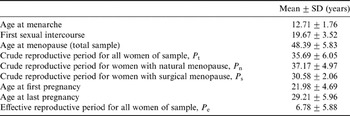
Table 2 shows the average and standard deviation age characteristics of the fertile period of the sampled women. The average age at menarche for all women studied was 12.71 years, i.e. their first menstruation occurred between 1955 and 1966, which is consistent with the good health and quality of life of the population. This average age at menarche corresponds with that reported by Laska-Mierzejewska (Reference Laska-Mierzejewska1970) in this same population and time period. The age at menarche did not show any secular change, and held steady at around 12–13 years during the second half of the 20th century (Prado et al., Reference Prado, Jiménez and Rubén2002). The temporal stability of the age at menarche contrasts with the evolutional decrease observed in other populations, such as Spanish women (Prado, Reference Prado1984), where a temporal change was particularly evident in the group that was economically less well-off.
Female fertility variables, women aged 55–64, Plaza de la Revolución, Havana, Cuba, 2006
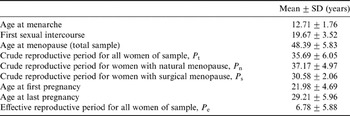
First sexual intercourse occurred approximately two years later than in the general Cuban population (Oficina Nacional de Estadística, 2010), with the group of 45- to 54-year-old women beginning sexual activity at 17.9 years. These results agree with the findings of a study on Cuban adolescents conducted in 2005 (Cutie et al., Reference Cutie, Laffita and Toledo2005), which indicated a decrease in the age at first sexual intercourse. Of the 15- to 19-year-old women, 46.9% had had their first sexual intercourse before they were 15. On the other hand, the sampled Cuban women showed an earlier age at first sexual intercourse than that observed in Spanish women aged 56–70 years, who had their first sexual intercourse when they were an average age of 23.8 (De Sanjose et al., Reference De Sanjose, Cortés, Méndez, Puig-Tintore, Torné and Roura2008). The age at menopause was late as a result of the older age of natural menopause (49.9 years), clearly older than the age of surgical menopause, which was six and a half years younger.
The crude reproductive period was two years shorter than that obtained by Vázquez (Reference Vázquez2002) in the same population (37.6±4.4 years), and the one registered in Spanish women older than 50 (36.7±3.8 years) by Fernández & Prado (Reference Fernández and Prado2005). This difference can be explained by the shorter reproductive period of women with surgical menopause than women who had natural menopause (seven years). This result is in agreement with those reported by Diaz et al. (Reference Díaz, Toledo, Fuillerat, Martín, Wong, Moreno and Matos2004) in the Cuban population (37.8 years versus 29.0 years). If the woman's age at first pregnancy greatly surpasses the age at menarche and the last pregnancy occurs 20 years before menopause starts, a very short effective reproductive period results, since reproduction starts late and ends early. This limit of effective reproductive period can be partially explained by the use of contraceptives in this population, among other factors.
Measure of reproductive fitness
The studied post-menopausal women showed a rate of almost four pregnancies per woman (p=3.81) during all their fertile period. This high reproductive fitness reduced to half at delivery (d=1.94 deliveries per women; and b=1.89 live births per woman), mainly due to the high frequency of abortions. About 40% of the pregnancies were voluntarily interrupted (1868 abortions in 4579 pregnancies). However, the low number of fetal deaths (58) explains why the difference between delivery and live birth rates was so small. Although the actual birth rate (b=1.89) is very close to the two children reported by mothers as the ideal number, 30% of them had only one live birth.
Nearly half of all women (43.8%) had a first pregnancy between the ages of 20 and 24. However, the adolescent pregnancy rate (between 12 and 19 years) was also high (32.4%) because of early sexual activity. This means 76.2% of women had at least one child by the age of 25, presumably a much higher rate than in the United States and Spain, where the average ages at first birth were, respectively, 25.4 in 2010 (Martin et al., Reference Martin, Hamilton, Ventura, Osterman, Wilson and Mathews2012) and 30.2 in 2011 (Instituto Nacional de Estadística, 2012). From the age of 25, the frequency of pregnancies decreases with increasing maternal age. Although 829 women successfully completed their first pregnancies with live birth deliveries, the frequency of reproductive failures (304) was also high, especially due to the number of abortions (200), which was twice the number of miscarriages (104).
75.2% of the women reported that they had practised some form of contraception, especially between consecutive pregnancies, a result that agrees with that reported by Gran & López (Reference Gran and López2003). The most common method was the IUD (64.7%), followed by the pill (15.3%), female sterilization (11.2%), diaphragm (9.2%) and condoms (4.8%). The high use of the IUD reported among Cuban women contrasts with a study carried out in the United States (Brunner & Huber, Reference Brunner and Huber2009), which found female and male sterilization and contraceptive pills to be the leading contraceptive methods for women aged 35–44 years. Female sterility (women without pregnancies) was 3%, very close to that found by Diaz et al. (Reference Díaz, Toledo, Fuillerat, Martín, Wong, Moreno and Matos2004) in this population (3.3%).
Reproduction pattern: determinants of live birth rate
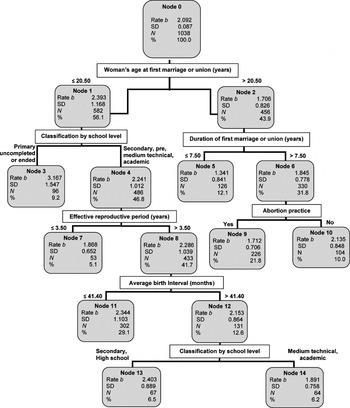
The decision tree illustrated in Fig. 1 shows the live birth rate of mothers with more than one child (Node 0) to be 2.092 children, and the influence of several social and bio-demographic maternal variables on this reproductive rate.
Decision tree for factors influencing rate of live births (b). N, number of cases; SD, standard deviation.

The most influential variable was the woman's age at first marriage or union (Nodes 1 and 2), since the birth rate of women married before 20.5 years (Node 1) was higher (0.687 more children) than those who married later (Node 2). These results agree with those obtained by Raj et al. (Reference Raj, Sagurti, Balaiah and Silverman2009) in India, who registered a higher reproductive rate in women who marry early. Among the first female group with the most reproduction (Node 1), the following determinant was the level of schooling. Thus women with primary education incomplete (Node 3) had nearly one child (0.926) more than those who studied secondary or higher levels (Node 4). This result agrees with that reported by Álvarez & Rubén (Reference Álvarez and Rubén1973) in their study of fertility in the same population, as well as with other studies performed in different countries, which concluded that more educated mothers have lower reproductive levels (Handa, Reference Handa2000; Murthi, Reference Murthi2002). In turn, among women with a higher education level (Node 4), those who reproduced during an effective reproductive period longer than 3.5 years (Node 8) had almost half a child more (0.418) than those who reproduced in a shorter period (Node 7). When women reproduced longer than 3.5 years (Node 8), those that did so with a slower reproductive rhythm, i.e. with birth intervals greater than 3.5 years (41.4 months; Node 12), had a slightly lower average rate of births (0.191 lower) than those who reproduced at a faster reproductive rhythm (Node 11). And among these last women (Node 12), mothers with a lower educational level (Node 13) had again more offspring, with half (0.512) a child more than women with a higher academic level (Node 14).
The second branch of the tree (Node 2) shows that women whose first marriage lasted more than 7.5 years (Node 6) had half a child (0.504) more than those with shorter lasting marriages (Node 5). But among these most reproductive women (Node 6), abortion determined that mothers who practised it had almost half a child less (Node 9) than those who did not (Node 10). Thus, the close relationship between the reproductive history of marriages, the differential school level, the highly prevalent practice of abortion and the average of live births shows the peculiar characteristics of the reproductive pattern of this population.
Abortion pattern: abortion as a method of birth control
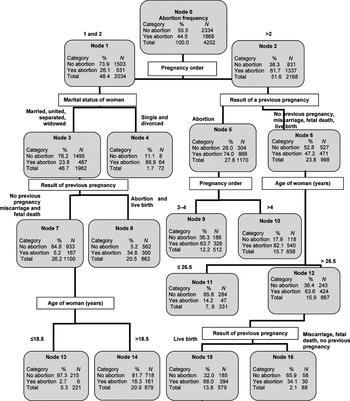
Figure 2 (Node 0) shows that the significant influence of abortion on reproductive fitness reduces to about half the number of pregnancies that end with a successful delivery. Abortion is regulated by several bio-demographic variables (Teixeira & Machado, Reference Teixeira and Machado2004; Rasch et al., Reference Rasch, Gammeltoft, Knudsen, Tobiassen, Ginzel and Kempf2008), which are considered by pregnant women before deciding whether or not to abort.
Decision tree for determinants of frequency of induced abortions. N, number of cases; SD, standard deviation.

The most influential variable on this female decision was the order of pregnancy: that is, the number of preconceptions and number of previous offspring. Women pregnant for the third time or more decided to abort a percentage nearly three times higher (Node 2) than those who were pregnant once or twice (Node 1). This result agrees with the ideal number of offspring that women reported in the survey (two children), and coincides with that obtained in the National Fertility Survey of 2009 (Oficina Nacional de Estadística, 2010). This reproductive behaviour indicates that when the desired number of children is reached, the practice of abortion begins, so as to limit to two children per family, confirming the use of abortion as a method of birth control (Gran & López, Reference Gran and López2003). A study carried out in Sweden obtained slightly different results, concluding that abortion rates were the lowest in women pregnant for the second time, increased when the woman already had 2 or 3 children and then decreased for higher order pregnancies (Tullberg & Lummaa, Reference Tullberg and Lummaa2001).
Among women pregnant for the first or second time (Node 1), those who were single or divorced (Node 4) carried out nearly four times more abortions than married, widowed or separated women (Node 3). This result indicates that women without a stable marital union decide to interrupt an unwanted pregnancy more often than those who have marriage stability, confirming the close relationship between reproductive history and marriage status. A study by Jones et al. (Reference Jones, Darroch and Henshaw2002) in the United States in the period 2000–2001 registered a higher abortion rate among single women than those married at least once, since two-thirds of all abortions were carried out by unmarried women. Similar results were found in the same country in 2008 by the Centre for Disease Control and Prevention (Pazol et al., Reference Pazol, Zane, Parker, Hall, Berg and Cook2011), since over 84% of all abortions registered that year were performed on single women.
Among those women who have fewer abortions (Node 3), the practice of abortion was especially rare when they had no offspring (Node 7) compared with women who had a live birth (Node 8). Those women had few abortions because they had no previous pregnancies or had suffered miscarriages or their pregnancies had resulted in fetal deaths (Node 7). This result supports the use of abortion as a means of regulating family size for women who had at least one living child. This result is similar to that reported by the National Study on Socio-Cultural Characteristics of Abortion in Cuba (Gran et al., Reference Gran, Nieto, Pujol, Gutiérrez and Welti1996), in which women with abortions interrupt a following pregnancy more frequently (16.3%) than those whose pregnancies ended always in delivery. These results are similar to those obtained by Heikinheimo et al. (Reference Heikinheimo, Gissler and Suhonen2008) in Finland, where 14.2% of the women with a previous abortion sampled had at least one more abortion in the follow-up period. In women with a lower frequency of abortions (Node 7) the probability of abortion increased significantly if they were older than 18.5 years (Node 14), compared with those who were younger (Node 13).
When the order of pregnancy was higher than two (Node 2), the frequency of abortions increased if each previous pregnancy was aborted (Node 5) compared with women who did not practise abortion (Node 6), thus demonstrating abortion as a means of birth control. This percentage increased when the order of pregnancy was higher than four (Node 10), which confirms the use of abortion birth control in those cases where the number of offspring is larger than the desired two. These results contrast with those obtained by a study carried out in the United States, which found that 73% of women having an abortion had had at least one previous pregnancy, and the highest abortion rate was recorded among those women who had had only one delivery, whereas this rate decreased with increasing parity. Furthermore, over half of all these women wished to have more children (Jones et al., Reference Jones, Darroch and Henshaw2002).
However, when the previous pregnancy was not aborted (Node 6), women older than 26.5 years (Node 12) carried out more abortions in subsequent pregnancies than earlier ones (Node 11), showing again the higher recurrence of abortion in older mothers. Finally, in this group of older mothers (Node 12), those whose previous pregnancy was a live birth (Node 15) had more abortions than those who did not have pregnancies or whose pregnancies ended unsuccessfully: that is, they ended in miscarriages (Node 16). A study by Tullberg & Lummaa (Reference Tullberg and Lummaa2001) found that Swedish women were more likely to have an abortion when they were younger than 20 or older than 40 years, and the same results were found among women in Denmark (Rasch et al., Reference Rasch, Gammeltoft, Knudsen, Tobiassen, Ginzel and Kempf2008). However, a study in the United States recorded the highest abortion rate among women in their twenties (84 per 1000), and a much lower rate for women under (42 per 1000) and above (29 per 1000) that age (Jones et al., Reference Jones, Darroch and Henshaw2002).
Conclusions
The reproductive history of the Cuban mothers analysed in this sample indicates that they had an early menarche and late menopause, which gave them a long reproductive period, that is, a high reproductive potential. However socio-cultural factors, such as contraception and abortion practice, explain the low effective reproductive period and, as a result of this, a low reproductive fitness.
The reproductive pattern of these women is characterized by a low birth rate (about two births per woman) in contrast with the high pregnancy rate, which was almost double, confirming the importance of abortion as a means of birth control. This peculiar reproductive strategy of birth control through abortion is practised mostly by mothers who have reached the desired family size (two children). The most influential factors on the rate of live births were the women's age at first marriage, demonstrating the close relationship between reproductive and marital histories.
One of the most influential variables on the mothers' decision to abort as a method of birth control was a pregnancy order higher than two, a number of children larger than desired. The probability of abortion also increased in older mothers and when the previous pregnancy ended in a live birth or another abortion. This high frequency of abortion is also seen among single mothers.
Acknowledgments
The authors thank Erik Lundin for reviewing the manuscript. This work was supported partially by the project CGL2006-02978 of the Spanish Ministerio de Ciencia e Innovación.