Introduction
In Greece, fertility declined from a little under 4 children per woman in 1939 (Michaleas, Reference Michaleas2005, p. 632), to around 2.2 children per woman in 1956–1980 and to 1.26 children per woman in 1999 (EDKA, 2015; see also Kotzamanis et al., Reference Kotzamanis, Franco and Begeot1994; Kotzamanis, Reference Kotzamanis2000). These temporal trends were accompanied by a smaller reduction in cohort-completed fertility, which for the generations born in 1926–1930 and 1931–1935 was 2.2 children per woman, for those born in 1946–1950 2.07 children per woman and was slightly lower in the subsequent generations (Siampos, Reference Siampos1994). At the same time, mean age at childbearing decreased from 30 years in 1956 to 26 years in 1980, and increased to 30 years in 1999 (EDKA, 2015); mean age at marriage decreased from around 25 years in 1956 to 22.6 years in 1980, increasing to 29 years in 2010 (ELSTAT, 2015).
However, even though from the point of view of formal demography much is known about fertility trends and the demography of marriages during the 20th century (see for example Balourdos et al., Reference Balourdos, Ntontis and Spyropoulou2007; Peristera & Kostaki, Reference Peristera and Kostaki2007, Reference Peristera and Kostaki2015; Kotzamanis & Sofianopoulou, Reference Kotzamanis and Sofianopoulou2009; Kostaki et al., Reference Kostaki, Moguerza, Olivares and Psarakis2009), comparative studies of anthropological populations living on mainland Greece are rare. Hatzisavva and Xirotiris (Reference Hatzisavva and Xirotiris2003) and Zafeiris et al. (Reference Zafeiris, Hatzisavva and Xirotiris2015) studied Metsovo (Epirus, Greece) and Zafeiris and Xirotiris (Reference Zafeiris and Xirotiris2007) studied the demographic and genealogical structure of the Vlachic population of Karitsa (Pieria) and of the Christian Roma of Aratos (Zafeiris & Xirotiris, Reference Zafeiris and Xirotiris2002). Zafeiris (Reference Zafeiris2010) studied several aspects of the marriage system based on marriage cohorts in a large sample from the Department of Rhodopi (Greek Thrace). From the point of view of historical demography, apart from some papers concerning island populations, such as for example those of Hionidou (Reference Hionidou1993) and Gavalas (Reference Gavalas2002, Reference Gavalas2005, Reference Gavalas2008), other approaches, though not strictly demographic, focused on mainland Greece, including for example those of Bournova (Reference Bournova1995) for Rapsani and Caftanzoglou (Reference Caftanzoglou1994, Reference Caftanzoglou1997) for Syrrako.
The aim of the present work was to contribute to a better knowledge of Greek anthropological populations from the point of view of anthropological demography. The main research question concerned the temporal trends of completed fertility and its differentials amongst selected populations located on the northern Greek mainland during the 20th century. However, the temporal trends of fertility were studied in parallel with the evolution of some characteristics pertaining to marriages for two main reasons. Firstly, during the traditional or transitional phase of societal development, marriage was closely connected to fertility levels. It signalled the onset of the family formation process and determined the duration of exposure to the risk of pregnancy (see for example Henry & Piotow, Reference Henry and Piotow1979; Nag & Singhal, Reference Nag and Singhal2013). Secondly, as pointed out in the historical demography studies in Europe by Hajnal (Reference Hajnal1965) and Laslett (Reference Laslett1983), the family formation process was firmly related to the dominant marriage system; consequently, variations in this had a direct impact on fertility levels. In addition, this impact was probably more important than initially thought, as shown by other authors (Kaser, Reference Kaser2001; Szoltysek, Reference Szołtysek2007; Kertzer & Hogan, Reference Kertzer and Hogan1991).
Methods
Study populations
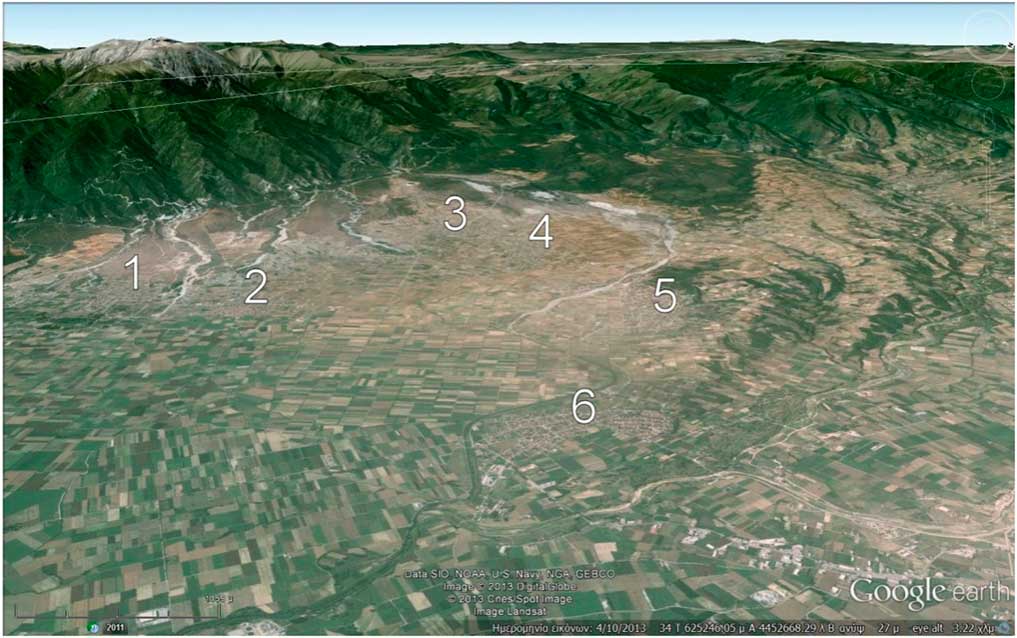
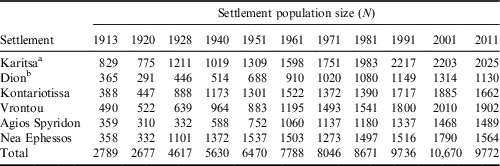
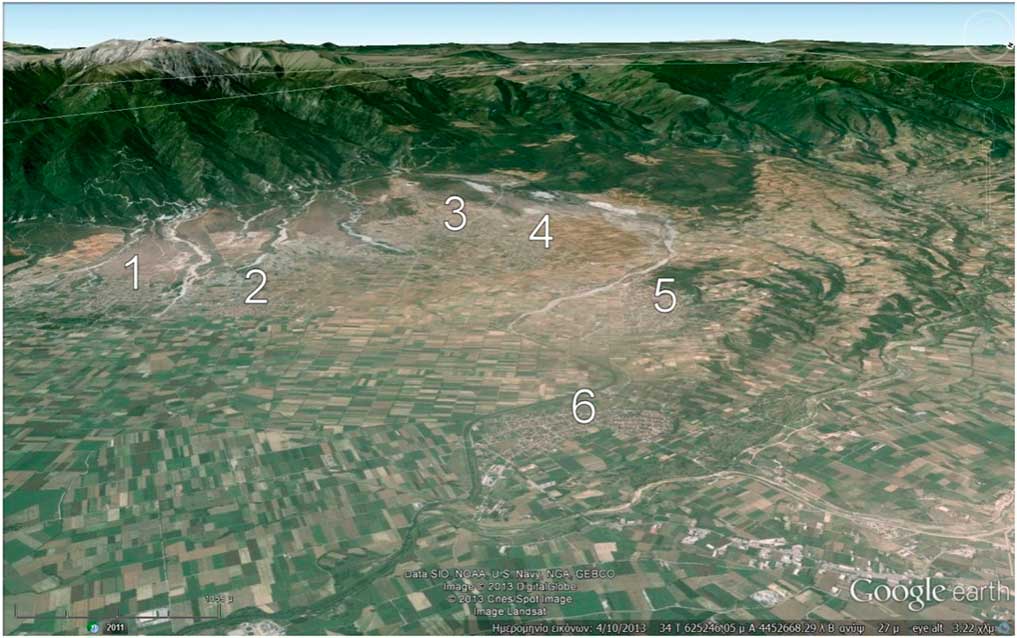
The analysis was based on the population of the Dion settlements in northern Greece. Dion is a municipality of the Pieria Department of Greece, consisting of seven settlements (Fig. 1; Table 1). The study settlements had a total population of 4617 in 1928 (de facto population) and 9772 in 2011 (permanent population; Table 1).
Map showing the study settlements: 1, Dion; 2, Karitsa, 3; Vrontou, 4; Agios Spyridon, 5; Kontariotissa, 6; Nea Ephessos (Google Earth, 2015; authors’ own elaboration).
The population size of the study settlements according to the official census
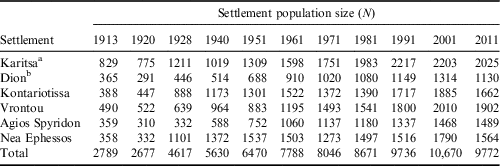
a Includes the related mountainous settlement of Fteri.
b Includes the related settlement of Kalyvia Malathrias. The population of Platanakia was omitted as it was not studied.
Data source: ELSTAT, 2015.
Figures for 2001 and 2011 refer to the permanent population of the settlements. The figures for the other censuses refer to the de facto population.
The study area became part of the Greek state in October 1912, during the 1st Balkan War (see Clogg, Reference Clogg1995, pp. 87–112), and constitutes a characteristic example of how fertility levels could be influenced by the different socioeconomic and cultural backgrounds of a population. The settlements of the studied municipality were partially or totally formed by populations originating from other rural areas of Greece (internal mobility) and from Asia Minor and the Black Sea coast. Dion was an area of ex-tsifliks (large tracts of privately owned land), whose roots date back to the Ottoman Empire (see Nitsiakos Reference Nitsiakos1997, pp. 2–3). By the 19th century, mountainous pastoralist families renting parts of the tsiflik lands (in order to winter their flocks in the lowland pastures) had started to settle down permanently. As a result, the pre-existing temporary settlements were enlarged and new settlements were established. After the defeat of Greece in the Greek–Turkish War of 1919–1922 and the mass influx of refugees to the country from Asia Minor, a refugee population was also installed in two of the studied settlements (see below).
The historical background and the initial characteristics of the studied populations contributed to the understanding and interpretation of the observed evolution of fertility levels. In Vrontou, a significant number of pastoralists, probably Vlachs (an Aromanian-speaking and ex-mountainous population), were added to the local population after the 1800s and a mixed population was gradually formed (Koukoudis, Reference Koukoudis2001). Karitsa, Dion and Agios Spyridon are inhabited mainly by Vlachs and to a lesser degree by Sarakatsans (a Greek-speaking ex-mountainous population; Koukoudis, Reference Koukoudis2001). The local population of Nea Ephessos tripled between 1913 and 1928, because of the influx of immigrants (from Ephessos and Asia Minor). To the local population of Kontariotissa, refugees from an Asian Minor village were added after 1923 (Koukoudis, Reference Koukoudis2001).
However, because the populations of the study settlements were small they were grouped into four larger units: 1. ‘Refugees’: the refugee population of Nea Ephessos and Kontariotissa; 2. ‘Northern Dion’: the rest of the population of Nea Ephessos and Kontariotissa (excluding refugees); 3. ‘Middle Dion’: the population of Agios Spyridon and Vrontou; and 4. ‘Southern Dion’: the population of Dion and Karitsa. In this way, a population originating from Asia Minor was identified along with two mainly ex-pastoralist populations of newcomers in the plains of Pieria (Middle Dion and Southern Dion) and one of mainly local population (Northern Dion).
Data
The archive of the Civil Register Office of the Municipality of Dion was the main data source. In particular, the Registrar General (Dimotologio) and the Civil Register Books (certificates of birth, death and marriage) were used for the construction of the paternal genealogical trees and pedigrees of the population. The Registrar General is a family registration archive which contains information about each member of a nuclear family (surnames, names, demographic events and so on). When an offspring is married, if male he is transcribed to a new family registry and if female to the new husband’s family record and he/she is deleted from the paternal one. In the case of a divorce, the wife is transcribed into a new family registry too. The new registry includes the member’s number of the family of origin. At the same time the member’s number of the family of destination is included in their paternal family. In that way the demographic history of each person in the archive can be retraced until its deletion, due to death or permanent migration and transcription to another municipality. Consequently, following the history of each person, the reconstruction of life lines and the construction of paternal pedigrees of the population were attempted. The information of the life lines was updated, if absent, and cross-checked with the aid of the Civil Register Books.
The pedigrees of the population were constructed and used as a basic research tool in the subsequent fieldwork, which started in July 2004 and lasted several months with the aid of informants from all the families and pedigrees of the local population. Among the objectives of the fieldwork was to check the accuracy of the demographic data. In addition, the genealogical relationships were checked and any missing demographic data, including migration, were filled in. It has to be noted that during the fieldwork it was found that the Civil Register Office’s data were of supreme quality. Especially for migration, this control was necessary from a methodological point of view but also essential for the analysis, because the Registrar General may contain people that live quite distant from their place of origin, but for political or/and social reasons preferred not to ‘remove’ their family administrative records to their new place of residence.
Consequently, the final analysis was carried out with all the necessary information from Register certificates, after completing data and cross-examination of the birth place of the women and children, place of marriage and other relevant information such as migration history, as provided by the fieldwork. The analysis was limited to women who married and reproduced exclusively within the studied settlements. This was to ensure the homogeneity of cultural and socioeconomic factors affecting the demographic regime of the settlements. When reproductive history was not complete the case was omitted from the analysis. Data covered a period from the last decades of the 19th century up to 2005.
The main indicator used to evaluate fertility levels and their differentials and temporal fertility trends was a woman’s mean number of Children Ever Born (CEB). However, to provide a better understanding of the studied behaviour, additional marriage system variables were considered. First, Mean Age at First Marriage (MAFM) signalled the onset of sexual activity in women, while the first time point of reproduction in the human life course was described by the age of the mother at her first live child (Mean Age at First Child, MAFC). Similarly, the mean age of the mother at her last child was considered as an ending variable describing the completion of reproductive life (Mean Age at Last Child, MALC). A measure of the duration of the reproductive life defined by the two aforementioned variables was the mother’s Reproductive Span (RS), calculated as the time between the first and the last birth child plus one year; in this way the entire childbearing span of a woman was considered (Stevenson et al., Reference Stevenson, Everson and Crawford1989). Finally, the Mean Age at Childbearing (MACB) was calculated as the mean age of all the births of the women of the study populations. These characteristics, along with factors like breast-feeding and post-partum amenorrhoea and the socioeconomic context, have been considered to be the determinants of fertility in a variety of populations (Bongaarts et al., Reference Bongaarts, Frank and Lesthaeghe1984; Wood, Reference Wood1990).
Decennial and quinquennial birth cohorts of women were considered. Only first marriages were analysed. For the variables MALC, CEB, MACB and RS, only completed families were taken into consideration. Also for these variables, women were more than 45 years of age at the end of the research or their marriage had not been dissolved through divorce or the death of a spouse before the age of 45. For the other two variables (MAFM and MAFC) all cases selected for the analysis were used.
For the cohorts born after 1920, all calculations were based on the exact dates of the relevant demographic events. For the cohorts born before then, and when only the year of an event was known, the middle of the year was defined as the ‘exact date’. This was the only possible solution; otherwise the size of the samples would have been very small. Additionally, the number of cases analysed for each indicator depended on the availability of necessary initial information. For example, the ‘age of the mother at last child’ requires the exact knowledge of the mother’s birth date and the exact date of her last delivery, while the ‘reproductive span’ requires the exact dates of her first and last deliveries. Obviously, the number of cases analysed for each of these variables was different if the exact birth date of some women was unknown or likewise any of the relevant dates of deliveries. This was the only solution that could be given, as if only women whose entire life-history events were known with day precision were taken into consideration, the number of cases for analysis would have become rather smaller.
Analysis
Statistical non-parametric tests were applied in order to test the mean differences between the different birth cohorts, but also between the different population groups within each birth cohort. The test used was the Kruskal–Wallis H test, which is considered to be the non-parametric alternative to the one-way ANOVA, and an extension of the Mann-Whitney U test, to allow the comparison of more than two independent groups (see McDonald, Reference McDonald2014). The test values and significance levels are presented in the tables.
Finally, bivariate and multiple regression analyses were applied to each of the study populations in which the dependent variable was ‘children ever born’ (CEB) and the independent variables were those given above. Mean age of the mother at first child (MALC) was excluded from this analysis because this has been shown to be strongly related to mean age at marriage. The aim was to check which of these variables affected fertility in a significant way, i.e. which of them can be considered to be its predictors. The requirements for applying that method were also checked and no significant deviations from them were found (normal probability of the standardized residuals, scatterplot of the standardized residuals against each of the predictor variables, scatterplot of the standardized residual versus the fitted values and index plot of the standardized residual). The coefficient of determination, the statistical significance and the relevant equations are given in Table 7 (see Chatterjee & Hadi, Reference Chatterjiie and Hadi2012).
Results
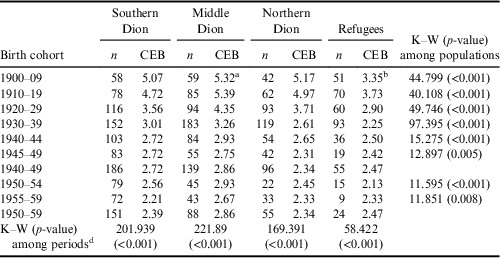
Over the study period fertility levels decreased in all the northern Greece settlements studied (Table 2). Fertility was higher in the older cohorts; an abrupt decrease was observed for women born from 1920 to 1939 and afterwards the decrease in fertility levels was smoother. Clearly, World War II, the occupation of the country by invaders (Italians, Germans and Bulgarians) and the civil war that followed contributed greatly to this picture.
Mean number of children ever born (CEB) for womenFootnote a marrying and reproducing in the study settlements
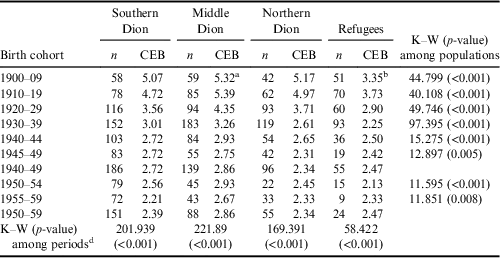
a Women >45 years of age with completed families, first marriages.
b Maximum among settlements.
c Minimum among settlements.
d Calculations based on 10-year cohorts until 1930–39 and 5-year cohorts thereafter.
K–W: Kruskal–Wallis H test.
Women born in the study settlements in the first two decades of the 20th century had quite diverse fertility behaviours. There was a ‘high-fertility’ group formed by all the populations in the Municipality of Dion (with the exception of refugees), where the mean number of children ever born (CEB) was more than 5 children per woman (completed families). Moderate fertility was observed in the Refugee populations of Dion. The CEB in this group ranged from 3.4 to 3.7 children per woman. This diversity remained for the cohorts born up to 1939 and for the younger cohorts a convergence was observed. In comparison to the other groups, the fertility levels of Southern Dion remained higher and this was true for all the observed cohorts (Table 2).
Overall, fertility transition is evident. All of Pieria’s populations had reduced their fertility by the end of the study to within the range 2.2 to 2.7 children per woman for women born in 1955–59. Women from Dion seemed to have given birth to slightly more children than had the population of the entire country, as indicated by the differences between the CEB and the cohort fertility rate (described in the Introduction section).
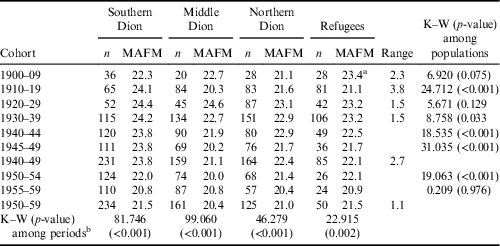
In order to understand the observed fertility and its temporal trends, the mean age at first marriage (MAFM) was examined. The variability in this was high among the study populations (Table 3). The same was true for its temporal trends; however, some chance fluctuations could not be ruled out due to the small number of cases analysed in some cohorts. In Southern Dion the MAFM increased from the first to the second cohort; however, the small number of cases in the first cohort must be taken into consideration. Women born between 1910 and 1949 would, on average, get married by the age of 24. For women belonging to the birth cohorts formed after 1945–49 the MAMF, following a decreasing trend, reached approximately 21 years. In Northern Dion, the MAFM increased in the first cohorts. Women born between 1920 and 1944 got married, on average, by the age of 23. Thereafter MAFM gradually decreased to around 21 years. In Middle Dion, the MAFM fluctuated significantly for women born up until 1944, and remained at about 20–21 years thereafter. In the refugee population of this area, women were getting married by the age of 22–23 and only those born in the 1910s and in 1955–59 were getting married about one year earlier.
Mean age at first marriage (MAFM) of women in the regions of Dion
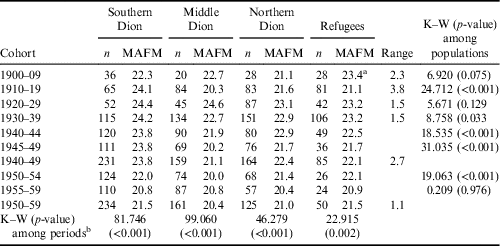
a Maximum among settlements.
b Calculations based on 10-year cohorts until 1930–39 and 5-year cohorts thereafter.
K–W: Kruskal–Wallis H test.
Compared with the entire rural population of Greece, where the MAFM rose slightly from 24.3 years in 1928 to 24.8 years in 1938 (ELSTAT, 2015), some similarities were found for most of the birth cohorts formed up until 1930–39 in Southern Dion. On the other hand, the other three areas presented systematically lower values, corresponding to a younger calendar of marriage. It should be noted that the MAMF in the entire population of Greece decreased from 24.5 years in 1956 to 22.6 in 1980.
Generally, the observed variability of other populations of Greece was significant. In Rapsani, women were getting married by their 26th year (Bournova, Reference Bournova1995). In Syrrako, a Vlachian village in the Epirus district, the relevant figure was 20 years (Caftatzoglou, Reference Caftanzoglou1997). Gavalas (Reference Gavalas2002), based on family reconstitution data, found that in Naoussa and Kostos the median age at marriage for several marriage cohorts formed between 1904 and 1933 was 22 years for females and rose to 26 years for the 1934–43 cohort. Hionidou (Reference Hionidou1993, p. 177) found that in Mykonos a rather increasing overall trend in the age at marriage of brides prevailed: from less than 21 years in 1859–68 to about 24 years in 1939–48 and 1949–59.
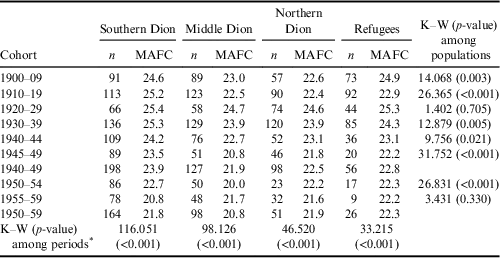
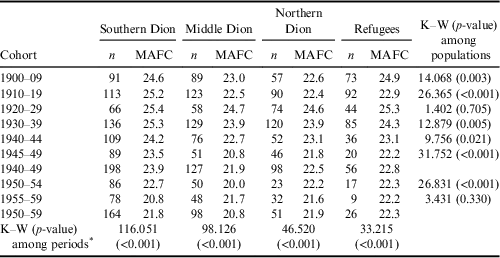
The temporal trends in the mean age of mothers at first child (MAFC) were examined in order to see to what extent the fluctuations described above are affected by the calendar of fertility (Table 4). For almost all cohorts, the MAFC was systematically lower in Northern and Middle Dion compared with Southern Dion and the Refugee population. For the 1920–29 cohort, the MAFC was the highest observed of all settlements. This was probably due to the harsh historical conditions resulting from the occupation of the country by the German army during World War II and subsequent civil war. In the youngest cohorts, the evolution of behaviour was reflected in a systematic decrease in the MAFC. This evolution was true for all settlements, but was relatively more abrupt for Middle Dion and resulted in the minimization of the differences between settlements. As a matter of fact, for the cohort of 1955–59 the differences found among the populations were not statistically significant. The same was the case for the 1920–29 cohort, where the MAFC was around 25 years.
Mean age at first child (MAFC) for women marrying and reproducing in the study settlements
Calculations based on 10-year cohorts until 1930–39 and 5-year cohorts thereafter.
K–W: Kruskal–Wallis H test.
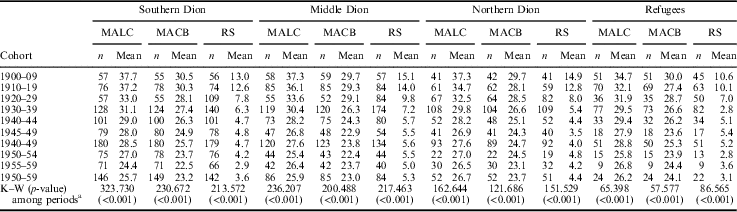
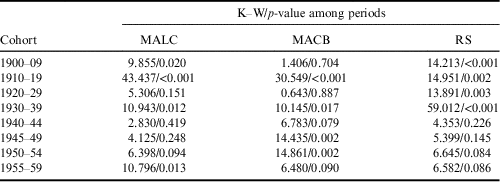
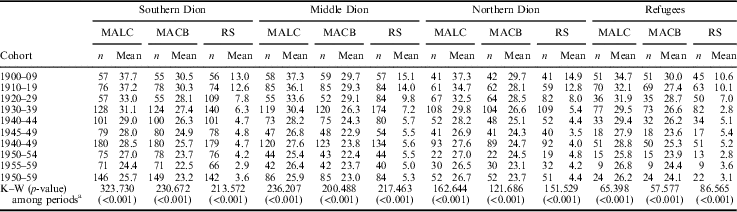
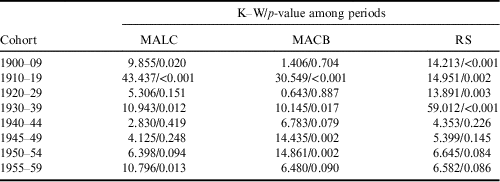
The mean age of the mother at last child (MALC, Table 5; see also Table 6) was clearly higher in older cohorts for all groups, with the Refugee population recording a comparatively lower value. In the youngest cohorts, the evolution of behaviour was reflected in a systematic decrease in MALC. This decreased in the range of 23–35% in rural Pieria. Consequently, the mean age at childbearing decreased in the younger cohorts. If the mean age of mother at first child presented a slight decrease, that of the last child was responsible for the significant reduction in the reproductive span (RS). The changes in RS were more significant: more than −65%, excluding Northern Dion (−35.1%). Concerning these three indicators, it is notable that in the youngest cohorts the differences among groups were minimized. This was confirmed using the Kruskal–Wallis H test: while the differences among the periods were statistically significant for all the variables, among the populations they became insignificant after the 1940–44 cohort for RS and MALC. However, an open question remains: To what extent were these factors affecting fertility? Or, put another way, which of them can be considered to be an estimator of fertility?
Mean age of the mother at last child (MALC), mean age at childbearing (MACB) and reproductive span (RS) for women in Dion
a Calculations were based on 10-year cohorts until 1930–39 and 5-years cohort afterwards.
Statistical comparisons of mean age of mother at last child (MALC), mean age at childbearing (MACB) and reproductive span (RS) for women in Dion
Completed families, mother >45 years old, first marriage for both spouses.
It should be noted that the very high mean age at last child in the older cohorts could indicate that these populations were at what Henry (Reference Henry1961) called the ‘natural fertility’ stage, and that they were progressively departing from it. However, fieldwork evidence has suggested that several birth control methods were known and practised by the study populations: for instance, coitus interruptus, aimed at controlling fertility after the birth of the first or second child. Birth spacing analysis (not included in this paper) could clarify if, and to what degree, these populations were at a ‘natural fertility’ state in the past.
Differences were found in comparison with the total population of Greece, where mean age at childbearing, even if calculated using a different procedure, had a decreasing trend until the 1980s and increased thereafter (period measures, own calculations based on fertility data from ELSTAT, 2015). For Naoussa and Kostos, two villages on Paros Island, Gavalas (Reference Gavalas2002) found that the median age of the mother at last child decreased only by 3 years (from about 40 to 37 years) between the 1894–1903 and 1944–1953 marriage cohorts, which is only a 7.5% decrease, and this is indicative of the existing variability among the populations of Greece. Based on the country’s demographic history, it seems that the most important differences found between the studied populations were concentrated on the onset time and pace of transition and not on the transition mechanism itself, which is common to all of them.
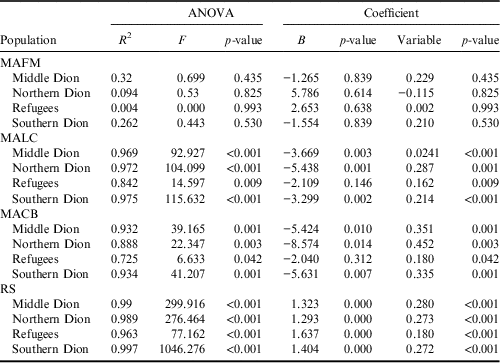
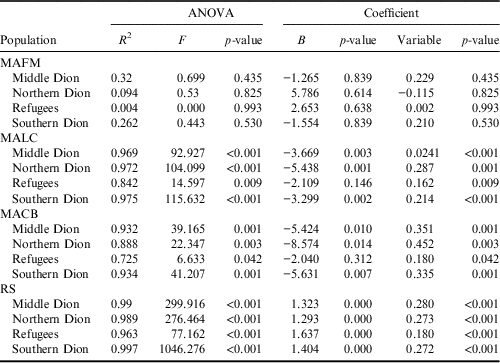
A bivariate analysis was carried out with children ever born (CEB) as the dependent variable and MAFM, MALC, MACB and RS as independent variables (Table 7). The analysis revealed some interesting findings. First, the mean age at first marriage of the women (MAFM) was not found to be a predictor of fertility. On the one hand, the coefficient of determination of the relevant equation R 2 was very low, and on the other hand it was not statistically significant (p>0.05). In other words, the number of children a woman had was independent of the time of marriage. This is actually expected, as the fluctuations and temporal trends in age at marriage were accompanied by significant reductions in the other variables, and in that way one could reasonably conclude that these could have had a more important impact on fertility.
Bivariate and multiple regression analyses of children ever born (CEB) and independent variables
First marriage for both spouses.
Actually, all of the variables can be considered as predictors of fertility as the coefficient of determination of the relevant equations R 2 was very high and statistically significant, even in the population of refugees. Thus, it was not when a woman started her reproductive period, but rather when she stopped and how long her reproductive period lasted that were significant. One more question arises concerning the possibility of building a model that could explain the mechanism of fertility reduction in the study populations. A stepwise multiple regression analysis revealed that the observed trends in fertility could almost entirely be explained by the reproductive span (RS), which as described in the Methods section contains information about the age of a woman at her first and last deliveries. All the other variables were removed by the model (equation shown in Table 7) for the variable RS. Thus, in the study populations fertility could only be evaluated by analysing the duration of the reproduction span of women.
Discussion
This study examined the fertility transition in northern populations of Greece in the 20th century. It has some limitations, the most important being the small number of cases analysed, which may have produced chance fluctuations in the estimations of the study variables. Mainly for the older cohorts, some important demographic information, if absent from the archives, was impossible to find for some families during the fieldwork as none of the family members was still alive or living in the villages. In other cases, the time that had passed since the birth of these cohorts was significant and thus the personal and collective memory was too weak to allow the collection of accurate information. Thus, only cases for which detailed demographic data were available were included in the analysis. At the same time, the available data can be considered a random sample of the study populations as there was no evidence of data distortion due to social, economic or other reasons. The village populations were homogeneous in their social and economic characteristics, and the availability and precision of the data were independent of the families, as shown by the examination of the family pedigrees.
The observed fertility transition should to be evaluated in terms of the local socioeconomic and cultural environments, and changes in these over time (for the role of the socioeconomic transformations in fertility differentials see, for example, Caldwell, Reference Caldwell2001; Vézina et al., Reference Vézina, Gauvreau and Gagnon2014; Breschi et al., Reference Breschi, Mazzoni, Esposito and Pozi2014). At the end of the 19th century economic life in northern Greece was organized around tsifliks and the economic impoverishment of the inhabitants is evident (Kofos, Reference Kofos1992, pp. 54–55). In the 1920s, after the appropriation of the tsifliks, the livestock sector faced a severe crisis, not only in Pieria but all over Greece (Svoronos, Reference Svoronos1986, p. 125; Nitsiakos, Reference Nitsiakos1997), and the local people progressively adapted to cultivation. World War II and the following Greek Civil War (1946–1949; Clogg, Reference Clogg1995, pp. 127–151) caused economic stagnation and social disruption in all the populations studied. During that time the dominant type of family was the extended family, especially in the pastoral mountainous or ex-mountainous populations included in this study (see Alexakis, Reference Alexakis1975; Nitsiakos, Reference Nitsiakos1997; Caftatzoglou, Reference Caftanzoglou1994; Zafeiris & Xirotiris, Reference Zafeiris and Xirotiris2007), as also observed in the Balkan Peninsula in the 19th and the first half of the 20th centuries (Kaser, Reference Kaser2012, p. 110). Marriage was pre-arranged under the mediation of matchmakers and controlled by the older generation in order for the needs of family development to be fulfilled. Through them broad social networks were created, improving the social status of a family, and because of the increased collaboration within these networks livestock, agricultural production, domestic economy and security were enhanced (Zafeiris & Xirotiris, Reference Zafeiris and Xirotiris2007; for security, see Kaser, Reference Kaser2012, p. 109; for social networks and status attainment see Lin, Reference Lin1999, Bernardi & Klaerner, Reference Bernardi and Klaerner2014; for the social networks and human agency see Dwiartama & Rosin, Reference Dwiartama and Rosin2014). Marriage was then a necessity in all the study populations; it was – and still is – feasible and desirable (see Dixon, Reference Dixon1971). Typically, apart from those with physical or mental disabilities, everyone was expected to get married.
Marriage in the study populations over the period considered must be seen as a social construct that served positively the social and economic needs of the family and was directly connected to the ‘production’ of children. This isn’t to say that age at marriage directly affected fertility; on the contrary, it cannot be seen as one of its predictors but it seems that marriage was the only socially accepted context for procreation. So illegitimate births and premarital sexual intercourse were strictly prohibited in the past, and great effort was put into the social control of women’s sexuality, as reported by Ioannidou-Kapolou (Reference Ioannidou-Kapolou2004) for the entire country. Several social norms, rituals and folklore customs emphasized the importance of marriage in the human life cycle while reassuring the virginity of the bride (Varvounis, Reference Varvounis2013, pp. 145–150).
The study examined the number of prenuptially conceived births. In the modern literature, 245 days is considered to be the lowest duration between gestation and last ovulation (Jukic et al., Reference Jukic, Baird, Weinberg, McConnaughey and Wilcox2013) in order for a birth to be considered preterm. The chronological distance between marriage and first birth was calculated. If a woman gave birth to her child at least 245 days after marriage, her child was considered to be either conceived prenuptially or born prematurely. In the studied populations, the level of ‘prenuptially conceived births’ fluctuated between 6.2 and 13.3% of all births in the older cohorts (1900–09 until 1940–44). Many of these births were preterm, but the rest signify that sexual intercourse occurred before marriage in some couples. Some prenuptially conceived children were of engaged couples, and some of eloping couples. If premarital sex had not been limited, the number of prenuptially conceived births would have been higher than that observed, as it is difficult to support the hypothesis that contraception and induced abortion were widespread or efficient for those ‘older’ cohorts.
In this way marriage served as a means of ensuring the economic and social future of the family. In this scheme children would have had a profound utilitarian value (see Nauck, Reference Nauck2014; Werding, Reference Werding2014), which was more than evident in the older cohorts of women. For example, in the pastoralist communities children would help with the grazing of herds and the processing of dairy products. In the cultivators, because farming was not mechanized, the whole family worked in the fields, aided by members of other families from kinship-based social networks, or other social groups. Even new houses or rooms within existing houses were built with the aid of relatives. These are some examples that justify the increased fertility of the older women. These women gave birth until a relatively advanced age, thus increasing the populations’ mean age at first child, mean age at last child and reproductive span. This was also true for the refugees, but the values of these variables were lower, indicating lower fertility.
Thus, the ‘old’ cohorts of the refugee population presented ‘moderate fertility’, and this was the case for ‘younger’ cohorts too. This can certainly be attributed to the uncertainty refugees faced at the time of the formation or the maturity of the older cohorts. Similar findings have been published for other populations, and especially minority groups (Goldscheider & Uhleberg, Reference Goldscheider and Uhlenberg1969), although the refugees themselves did not really have a minority status. Because of their forced migration their socioeconomic status in those days was low and the difficulties they faced in their struggle for survival were important, even for basic issues such as housing, nutrition and health, including the total collapse of their social structures (see Refugee Settlement Commission, 1928a, b; Divani, Reference Divani1995, p. 300; Svoronos, Reference Svoronos1986, p. 125).
In younger cohorts a new phase of socioeconomic transformation occurred in local populations which was correlated to the historical momentum of each era, affecting not only the observed completed fertility but also the other marriage variables. World War II, the occupation of the country by invaders and the civil war that followed certainly had a negative effect on fertility levels. After the civil war, the whole area entered an economic growth period, but this growth was not sufficient to support the population and a wave of emigration occurred in the late 1950s and 1960s. Meanwhile, a solution to the economic stagnation was found with the general adoption of new crops, especially tobacco, after the arrival of Asia Minor refugees, along with the progressive but very slow modernization of agricultural production (see Varmazis, Reference Varmazis2014). In addition, socioeconomic development in the area in more recent times is evident and, according to the Human Development Index (HDI) for 1991, Pieria was placed in 25th position among the departments of the country (Panas & Ninni, Reference Panas and Ninni2004). At the end of the study period Pieria Plain was still an agricultural area, but at the same time many of its people were involved in the secondary and tertiary sectors of the economy (66% of the population were farmers and 34% were employed in other sectors in 1991; data source ELSTAT, 2015). As economic development continued, and with the changing socioeconomic environment, fertility levels were affected, resulting in a reduction in the mean age at childbearing, mean age at last child and reproductive span.
As expected, the study populations responded to the progressive increasing costs of childrearing and their lower utilitarian value (see Nauck, Reference Nauck2014; Werding, Reference Werding2014) as a result of modernization, and reduced the number of children they had to ensure the sustainability of their families. The perception of family roles and of children changed (see Knodel & Van de Walle, Reference Knodel and van de Walle1986; Cleland & Wilson, Reference Cleland and Wilson1987). Women became more empowered (see Basu, Reference Basu1998; Das Gupta, Reference Das Gupta2013) through their involvement in the market economy – another of the several socioeconomic transformations that occurred in Greece in the 20th century. However, in contrast with Becker’s (Reference Becker1993) proposition, according to which an increase in the educational level of women and in their participation in the labour force may reduce their propensity to marry, in Pieria Plain the opposite happened, as has been observed elsewhere (for example in Latin America: Fussel & Palloni, Reference Fussel and Palloni2004).
As for the Vlachic population of Pieria, over time they assimilated with the rest of the Greek population. The use and the usability of their Vlachic idiom reduced, the adoption of the Greek language became universal and many married non-Vlachic persons. The cultural diffusion processes were further enhanced due to television and radio use, but more importantly through the action of human networks established from repatriated former emigrants and other people in their places of work (Bernardi & Klaerner, Reference Bernardi and Klaerner2014). At the same time, there was a progressive change from the extended family to the nuclear family. Thus, according to the 2001 census (own calculations based on data from ELSTAT, 2015) in the municipality of Dion ‘multi-nuclear family’ households constituted 13.1% of all households. Because of this, the timing of marriage changed too, following a fluctuating but in general decreasing trend mainly in females. It seems that economic development enhanced further the ability of people to marry earlier, facilitating the creation of nuclear families. The increasing financial resources of older persons allowed the generations to maintain independent households, which caused a decrease in the mean age at marriage of women and an increase in the incidence of nuclear families, as happened elsewhere (see Sussman & Steinmetz, Reference Sussman and Steinmetz1988, pp. 576–578; also, Lee Reference Lee1999), and fertility in nuclear families was lower than in extended familes.
As the nuclear family gradually dominated, premarital sexual intercourse became more common, resulting in a kind of ‘sexual revolution’ (see Greenwood & Guner, Reference Greenwood and Guner2010). In most of the younger cohorts ‘prenuptially conceived births’ exceeded 20%, reaching a value of 34% for the 1975–79 cohort, but births were still taking place within marriage. Such high rates are in accordance with the low prevalence of contraception (apart from withdrawal and condom) and high abortion rates observed in the Greek population (Ioannidou-Kapolou, Reference Ioannidou-Kapolou2004).
However, even if the traditional control of women’s sexuality diminished over time, it has not totally disappeared, even recently, as has generally been observed in Greek agrarian populations (see Ioannidou-Kapolou, Reference Ioannidou-Kapolou2004). At the same time, marriage remained feasible and desirable for cultural reasons. The Greek Orthodox Church and Greek culture have served to preserve, to some extent, the traditional family model (see Loizos & Papataxiarchis, Reference Loizos and Papataxiarchis1991), despite the structural and other changes that had occurred (Georgas, Reference Georgas1989).
Even today marriage in Greece is considered of ‘supreme value’ and a ‘necessary condition’ for procreation (Loizos & Papataxiarchis, Reference Loizos and Papataxiarchis1991). This value placed on marriage is probably why the proportion of illegitimate births has remained relatively low in Greece: 1.2% in 1926–28, 1% in 1966–68 and 2.4% in 1992 (ELSTAT, 2015). Similar results have been found in smaller, geographically localized populations. Gavalas (Reference Gavalas2005) found that the relevant figures for Naoussa and Kostos (Paros Island) were around 2% at the beginning, and 0.3% by the end of the 20th century. Hionidou (Reference Hionidou1993) found the rate of illegitimate births in Mykonos to be below 2% (mid-19th until mid-20th centuries). In the study populations only eight cases of illegitimate births were found in about 3000 marriages, and the parents later married. However, there is a possibility that illegitimate births may have occurred in the past, but were not registered in the Civil Register archives.
Consequently, the studied cohorts lived in a social context where family formation was crucial for the survival and reproduction of the population and marriage was the only accepted and possible pathway to reaching this goal. However, from the older to younger cohorts, and as long as the demographic transition continued, even though age at marriage was declining, and thus the available time a couple had for procreation was increasing and fertility might have increased too, the opposite happened. The populations responded to the changing socioeconomic environment, and with the use of contraception became capable of shortening their reproductive span to only few years after marriage. It seems that by the end of the study period a converging trend in fertility levels with the entire population of the country occurred. However, this was delayed chronologically in Dion. Fertility transition was more advanced in the entire population of Greece and simply after some time the populations from Dion followed.
Conclusions
Significant differences were observed in the reproductive strategies of the study populations of Pieria Plain in northern Greece in the 20th century, as measured by age at marriage, sexual activity and procreation in the older cohorts of women. Women tended to give birth to many children, but the historical and political circumstances and socioeconomic characteristics of the study populations affected significantly their fertility levels. Over time, changes occurred in their mean age of marriage and other demographic characteristics of the marriage system, which led to a fertility decline. This decline started with a gradual reduction in the upper limit of procreation and shortening of the time spent on procreation, as expressed by the reproductive span. As a result, over time women gave birth to fewer children and on average at younger ages. Fertility decline was the result of historical momentum and several socioeconomic transformations and cultural diffusion processes that occurred in the populations studied.
It seems then that local circumstances, local cultural characteristics and socioeconomic environment had a great impact on fertility among the older cohorts. National and ‘hyper-national’ (that is ‘beyond national borders’) factors played a significant role too. Among these were World War II, the occupation of the country by the Italians, Germans and Bulgarians and the civil war that followed. However, even though these populations retained many of their characteristics over time, it seems that in the younger cohorts of women the general socioeconomic changes that occurred in Greece played a more important role, as these populations were heading towards their assimilation. After all, fertility levels maintained a dynamic character imposed by the local structures, which, in their turn, were part of broader national and hyper-national structures, as was the case in Sicily (see Schneider & Schneider, Reference Schneider and Schneider1998).
Ethical Approval. The authors assert that all procedures contributing to this work comply with the ethical standards of the relevant national and institutional committees on human experimentation and with the Helsinki Declaration of 1975, as revised in 2008.
Conflicts of Interest. The authors have no conflicts of interest to declare.
Funding. This research received no specific grant from any funding agency, commercial entity or not-for-profit organization.