Introduction
Ototoxicity is a term that describes cochlear and vestibular organ damage resulting from exposure to various therapeutic agents or chemical substances.Reference Ahmed, Hannigan, MacDougall, Chan and Halmagyi 1 More specifically, ototoxicity is the functional impairment and cellular degeneration of inner-ear tissues caused by therapeutic agents. The most common ototoxic drugs currently in clinical use include the following: aminoglycoside antibiotics, platinum-based chemotherapeutic agents (cisplatin and carboplatin), loop diuretics, macrolide antibiotics and antimalarial drugs.Reference Turnidge and Waterston 2
Aminoglycosides, such as gentamicin, are readily used as antibiotics because of their potent activity against several bacterial infections (e.g. enterococci, mycobacteria and multidrug-resistant Gram-negative bacteria), despite well-known side effects, like ototoxicity and nephrotoxicity.Reference Kemp 3 Any solution applied to the middle-ear cavity can pass through the round window and cause side effects on the cochlear and vestibular apparatus. To date, aminoglycoside-induced hearing loss is most prevalent in developing countries where these drugs are typically the only affordable antibiotics available. However, intratympanic gentamicin has become an important treatment modality in the management of unilateral Ménière's disease over the past decade.Reference Cohen-Kerem, Kisilevsky, Einarson, Kozer, Koren and Rutka 4 Several different modalities of gentamicin administration to the tympanic cavity have been utilised. For example, vertigo can be controlled by using local gentamicin injections to achieve a chemical labyrinthectomy. However, this regimen is known to negatively affect hearing.Reference Salt, Gill and Plontke 5
In 1978, Kemp reported the production of acoustic energy by the outer cochlear hair cells, which he termed ‘otoacoustic emissions’ (OAEs) (as cited by Tepel).Reference Tepel 6 The energy that comes from the outer hair cells spreads through the base of the stapes, ossicles, tympanic membrane and external ear canal. This acoustic energy can be measured by a sensitive microphone placed within the ear canal. There are different types of OAEs, but distortion product OAE (DPOAE) technology has good frequency specificity and has been widely used in studies. Measurement of DPOAEs in a rat model was reported for the first time in 1996 by Khvoles et al.Reference Khvoles, Freeman and Sohmer 7 and has since become a topic of interest in numerous studies.Reference Khvoles, Freeman and Sohmer 8 – Reference Hatzopoulos, Di Stefano, Albertin and Martini 10
N-acetylcysteine has been utilised as a treatment for several diseases, ranging from chronic bronchitis to toxic liver damage. The antioxidant effects of N-acetylcysteine are based on the following characteristics: free radical scavenger, glutathione (γ-glutamyl-cysteinyl-glycine) production substrate, mitochondrial protectant, glutamate excitotoxicity inhibitor, lipid peroxidation inhibitor and necrosis inhibitor. Its protective effects against acoustic trauma have already been documented.Reference Saliba, El Fata, Ouelette and Robitaille 11 Several studies have addressed its mechanisms, protective doses and methods of administration in acoustic trauma. However, there are only a few in vitro studies focusing on the effect of N-acetylcysteine on aminoglycoside ototoxicity.Reference Kubow, Woodward, Turner, Nicodemo, Long and Zhao 12 – Reference Boztepe, Gün, Gür, Karakuş, Bilal and Arda 14
Vitamin A acts as an anti-apoptotic agent through its active metabolite retinoic mechanism. Specifically, all-trans-retinoic acids have been shown to inhibit the apoptosis of T cells, leukaemia cells and haematopoietic cells, and to attenuate hydrogen peroxide induced apoptosis in mesangial cells and fibroblasts.Reference Shim, Kang, Ahn and Chung 15 Vitamin A, through its metabolite agent β-carotene, prevents lipid peroxidation.Reference Muurling and Stankovic 16 Various studies suggest vitamin A reduces noise-induced hearing loss via its antioxidant effects.Reference Emmett and West 17
In this study, we examined the roles of systemic N-acetylcysteine and vitamin A in the prevention of gentamicin ototoxicity. Both are readily available, safe agents already in clinical use. We administered both agents via simple transtympanic injections, with the goal of utilising a more translational approach.
Materials and methods
Animals
The protocol used in this study was approved by the Institutional Animal Care and Use Committee, and the animals were treated in accordance with this protocol. We used 58 adult male Wistar rats weighing 250–300 g. All rats had free access to food and water, and were maintained in an environment with a controlled temperature (25 °C), with 12-hour light/dark cycles.
All rats were evaluated by otoscopy. Cerumen in the ear canal was cleaned prior to distortion product OAE (DPOAE) testing.
Study design
All rats were anaesthetised intraperitoneally with 50 mg/kg ketamine hydrochloride and 10 mg/kg xylazine on days 2, 4 and 6. Rats were monitored for 30 days to ensure tympanic membrane re-epithelisation. At the end of the study period, all rats were decapitated under deep anaesthesia using intravenous sodium pentothal.
Prior to the end of the study period, nine rats from different groups died. We excluded seven rats because of a lack of re-epithelisation of the tympanic membrane. Hence, a total of 42 rats were utilised in the study.
The DPOAE measurements were obtained for left ears prior to drug administration (baseline recording) and on day 30. Rats with normal hearing, as confirmed by DPOAE testing, were divided into the following four groups: group 1 (n = 12) received left intratympanic injection of 0.2 cc saline (40 mg/ml); group 2 (n = 10) received left intratympanic injection of 0.2 cc gentamicin (40 mg/ml); group 3 (n = 10) received an intraperitoneal injection of 100 000 IU palmitate in the form of vitamin A after the left intratympanic injection of 0.2 cc gentamicin (40 mg/ml); and group 4 (n = 10) received an intraperitoneal injection of 300 mg/kg N-acetylcysteine after the left intratympanic injection of 0.2 cc gentamicin (40 mg/ml).
Otoacoustic emissions testing
We included rats with normal DPOAE measurements, which we confirmed prior to drug administration. The DPOAE recordings were performed in a quiet room, where we measured the left ears of both control and experimental rats. After administration of anaesthesia, an earphone was inserted into the external ear canal via a plastic adapter, which released the primary tones. The DPOAEs were recorded in terms of distortion product grams (DP grams). The intensity of the primary tones was constant and the DPOAE data were recorded at different frequencies (1, 1.5, 2, 3, 4, 6 and 8 kHz), with a frequency plan of F2. Both signal-to-noise ratio and distortion product levels were evaluated during DPOAE procedures. All rats were decapitated at the end of the study under deep anaesthesia with intravenous sodium pentothal.
Statistical analysis
For the data analyses, SPSS® software (version 21) and PAST softwareReference Hammer, Harper and Ryan 18 were used. Kolmogorov–Smirnov and Shapiro–Wilk tests were used to assess the compatibility of single variant values with normal distribution. An omnibus test was used to assess the compatibility of multiple variant values with normal distribution. A paired-samples t-test was performed to measure dependent variants. A general linear model repeated analysis of variance was used to assess the interaction of repeated measurements of the variants amongst the groups. Least significant difference and Games-Howell tests were used for post hoc analyses. Data were processed in terms of 95 per cent confidence intervals, and p-values lower than 0.05 were accepted as statistically significant.
Results
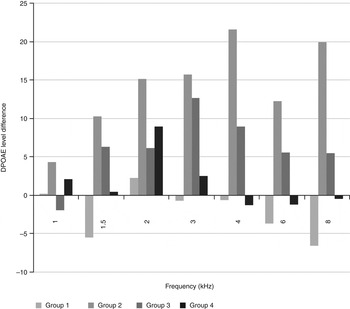
The distortion product OAEs (DPOAEs) measured at baseline and on day 30 were recorded and assessed. In group 3 (gentamicin plus vitamin A group) and group 4 (gentamicin plus N-acetylcysteine group), the differences between DPOAE levels per frequency range obtained at baseline and on day 30 were lower than group 2 (gentamicin-only group) levels at all frequencies (Figure 1). In group 2, significant deterioration was observed at all frequencies compared to group 1 (saline injection group). Regarding group 3 and group 4, vitamin A had a better protective effect at 1 and 2 kHz, whilst N-acetylcysteine had a better protective effect at 1.5, 3, 4, 6 and 8 kHz (Figure 1).
Differences between distortion product otoacoustic emission (DPOAE) levels per frequency range obtained at baseline and on day 30.

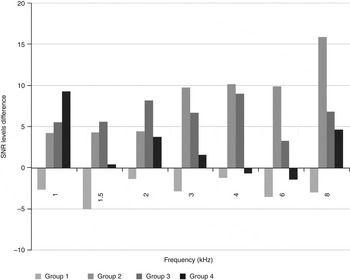
Signal-to-noise ratio levels per frequency range obtained at baseline and on day 30 for group 3 were lower than group 2 at 3, 4, 6 and 8 kHz. Group 4 had lower signal-to-noise ratio levels than group 2 at 1.5, 2, 3, 4, 6 and 8 kHz (Figure 2). When the signal-to-noise ratio levels at 3, 4, 6 and 8 kHz were compared amongst group 3 and group 4, N-acetylcysteine was more protective for all frequencies (Figure 2).
Differences between signal-to-noise ratio (SNR) levels per frequency range obtained at baseline and on day 30.

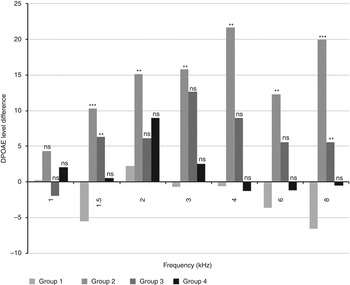
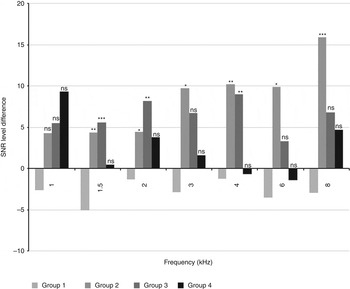
Gentamicin and saline groups significantly differed in both DPOAEs and signal-to-noise ratio levels at all frequencies except 1 kHz (Figures 3 and 4). When group 3 and group 4 DPOAE levels were compared to the saline group levels, N-acetylcysteine had a significant protective effect at 1.5, 2, 3, 4, 6 and 8 kHz, whilst vitamin A had a significant protective effect at 2, 3, 4 and 6 kHz. Regarding signal-to-noise ratio levels, N-acetylcysteine had a significant protective effect at 1.5, 2, 3, 4, 6 and 8 kHz, whilst vitamin A had a significant protective effect at 3, 6 and 8 kHz (Figure 4).
Statistical comparison of differences between distortion product otoacoustic emission (DPOAE) levels per frequency range obtained at baseline and on day 30. ns = Non-significant at 0.05 level; ***significant at 0.001 level; **significant at 0.01 level

Statistical comparison of differences between signal-to-noise ratio (SNR) levels per frequency range obtained at baseline and on day 30. ns = Non-significant at 0.05 level; **significant at 0.01 level; ***significant at 0.001 level; *significant at 0.05 level

Discussion
Eardrops containing gentamicin are commonly prescribed by otolaryngologists for treatment of external otitis, chronic suppurative otitis media and discharging tympanostomy tubes. Although topical aminoglycoside ototoxicity appears to be infrequent, there is indisputable data suggesting that this may develop if eardrops reach the middle ear in the presence of a tympanic membrane perforation or defect. Chemical labyrinthectomy achieved by local gentamicin injections, a treatment modality utilised in unilateral Ménière's disease, has become more popular over the past decade. This treatment is known to negatively affect hearing.Reference Salt, Gill and Plontke 5
Data from animal studies suggest that ototoxicity is caused by the formation of reactive oxygen species and can be attenuated by antioxidants. Much progress has been made in understanding the mechanism(s) responsible for inner-ear hair cell degeneration.Reference Cheng, Cunningham and Rubel 19 In this study, we utilised an animal model to investigate the roles of systemic N-acetylcysteine and vitamin A in the prevention of gentamicin ototoxicity.
Gentamicin damages the outer hair cells, starting from the basal region of the cochlea, and progressing to the middle and apical regions. As lower frequencies are affected, this may lead to permanent damage in speech discrimination scores.Reference Miman, Ozturan, Iraz, Erdem and Olmez 20 The damage to outer hair cells is evaluated by distortion product OAE (DPOAE) testing.Reference Hatzopoulos, Di Stefano, Albertin and Martini 10
The in vitro work performed by Feghali et al. introduced N-acetylcysteine as a potential antioxidant for the prevention of aminoglycoside ototoxicity.Reference Feghali, Liu and Van Der Water 21 The drug is widely used as a nebulised mucolytic and as an antidote for acetaminophen poisoning, where it directly regenerates glutathione in hepatocytes. Recently, it has been used successfully in several models of ischaemic and toxic injuries to the heart, kidney, liver and lungs.Reference Weinbroum, Rudick, Ben-Abraham and Karchevski 22 , Reference Mazzon, Britti, De Sarro, Caputi and Cuzzocrea 23 In each of these infections, it is thought that the activity of N-acetylcysteine is mediated, at least in part, by its antioxidant properties. The beneficial effect of N-acetylcysteine on cochlear function observed in this study may be explained by its antioxidant properties. The low molecular weight of N-acetylcysteine (163.2 g/mol) also makes it an excellent candidate for administration across the round window membrane.
Vitamin A is a family of hydrocarbons, which includes retinol, retinal, retinoic acid and several provitamin A carotenoids (e.g. β-carotene).Reference Damodaran, Parkin and Fennema 24 Retinoic acid is an active metabolite of vitamin A that regulates a wide range of biological processes, including cell proliferation, differentiation and morphogenesis. Retinoic acid has been shown to inhibit the apoptosis of T cells, leukaemia cells and haematopoietic cells, and to attenuate hydrogen peroxide induced apoptosis in mesangial cells and fibroblasts.
In this study, N-acetylcysteine had a significant protective effect at 1.5, 2, 3, 4, 6 and 8 kHz, whilst vitamin A had a significant protective effect at 2, 3, 4 and 6 kHz, as measured by DPOAE levels. According to signal-to-noise ratio levels, N-acetylcysteine had a significant protective effect at 1.5, 2, 3, 4, 6 and 8 kHz, whilst vitamin A had a significant protective effect at 3, 6 and 8 kHz.
Otoacoustic emissions are an ideal, non-invasive tool to detect cochlear activity. Otoacoustic emissions are sounds that arise from the vibrations of the outer hair cells in the cochlea that are transmitted by the middle ear and tympanic membrane from the external auditory canal. These emissions can be measured and recorded by a small, sensitive microphone placed in the external auditory canal. In this study, DPOAE testing was chosen to independently evaluate the integrity of the auditory system.
The DPOAE protocol in animal experiments varies little, except with regard to the F1 and F2 stimulus intensity and the variability of the DP gram.Reference Sockalingam, Freeman, Cherny and Sohmer 9 , Reference Lopez-Gonzalez, Guerrero, Rojas and Delgado 25 The range in frequencies utilised to study DPOAEs varies depending on the species of animal used in the investigation. For example, for a signal-to-noise ratio of 3 dB SPL or more: Hyppolito et al. determined that 1.5 kHz is necessary in guinea pigs;Reference Hyppolito, de Oliveira, Rossato and Holanda 26 Hatzopoulos et al. determined that over 4 kHz is necessary in Sprague-Dawley rats;Reference Hatzopoulos, Di Stefano, Albertin and Martini 10 Lopez-Gonzalez et al. determined that 1–6 kHz is necessary in Wistar rats;Reference Lopez-Gonzalez, Guerrero, Rojas and Delgado 25 and Sockalingam et al. determined that 2–8 kHz is necessary in albino rats.Reference Sockalingam, Freeman, Cherny and Sohmer 9 McAlpine and Johnstone observed cisplatin ototoxicity through DPOAE testing with input/output function shape fixing when the frequency was 8 kHz.Reference McAlpine and Johnstone 27 In this study, we carried out the protocol with a fixed intensity of 70 dB SPL, attaining measurable responses from 3 kHz for a signal-to-noise ratio of 6 dB SPL or more.
Increasing evidence suggests that intracellular free radical generation is the mechanism responsible for aminoglycoside-induced cochlear damage. This has led to the successful protection of the cochlea against ototoxicants via inhibition of intracellular free radical production.
This study does have some limitations. We did not measure the concentration of the intratympanic drug within the inner ear, nor did we examine the middle ear with an electron microscope prior to gentamicin application.
-
• Aminoglycosides, such as gentamicin, are antibiotics used for a number of bacterial infections
-
• Any solution applied to the middle-ear cavity can pass through the round window and may affect other ear regions
-
• This study aimed to examine systemic N-acetylcysteine and vitamin A for gentamicin ototoxicity prevention in rats
-
• Gentamicin-induced hearing loss in rats may be reduced by concomitant use of vitamin A and N-acetylcysteine
-
• N-acetylcysteine may be slightly more effective than vitamin A
In conclusion, this study suggests that gentamicin-induced hearing loss in rats may be limited to some extent by the concomitant use of vitamin A and N-acetylcysteine. Dose-dependent changes will need to be further investigated in future studies. In addition, studies focused on the morphological changes may shed light on the protective effects of vitamin A and N-acetylcysteine.