INTRODUCTION
In late August 2013, news reports revealed that U.S.-based JPMorgan Chase had been hiring the children of prominent Chinese families and government officials.[Footnote 1] In fact, JPMorgan Chase's ‘Sons and Daughters’ program had been operating in China since 2006: Chinese applicants who had elite pedigrees were preferred to other applicants, a practice frowned upon as nepotism and bribery in the U.S.[Footnote 2] The government documents and public records did not definitively link those hiring practices to the firm's ability to win business, nor did they suggest that the employees were unqualified. The program became a major scandal, although other instances of firms hiring people with personal ties to important stakeholders had escaped notice.[Footnote 3] To address how such events are perceived, we examine whether societies agree about the perceived fairness and perceived profitability of hiring candidates with personal ties, and whether cultural and national contexts play a role in affecting the consensus.
The practice of hiring people with personal ties occurs worldwide (e.g., Bian, Reference Bian1997; Bridges & Villemez, Reference Bridges and Villemez1986; Marx, Reference Marx1988; Williamson & Cable, Reference Williamson and Cable2003; Yakubovich, Reference Yakubovich2005), despite employees’ common perceptions of favoritism (Padgett & Morris, Reference Padgett and Morris2005), which can lead to job stress (Arasli & Tumer, Reference Arasli and Tumer2008) and turnover intentions (Arasli, Bavik, & Ekiz, Reference Arasli, Bavik and Ekiz2006). In some cases, employers may hire someone with whom they have a personal tie even though they know that the hiring decision will be perceived negatively by other employees or by society. In other instances, those involved may perceive the same hiring decision differently. Perceptions of fairness can rely on insufficient information or only on information to which people pay attention (Lind, Reference Lind, Greenberg and Cropanzano2001; Van den Bos, Lind, & Wilke, Reference Van den Bos, Lind, Wilke and Cropanzano2001). Hiring decisions often involve limited information (Nishii, Lepak, & Schneider, Reference Nishii, Lepak and Schneider2008) or conflicting information about the same candidate (Kulik, Roberson, & Perry, Reference Kulik, Roberson and Perry2007). In these circumstances, hiring decisions may elicit negative reactions even when an employer has good intentions in hiring a personal tie. For example, an employer may perceive hiring a friend as fair because the friend is highly qualified, but other employees may perceive the hiring decision as unfair because of the personal relationship. In the case of JPMorgan Chase, an employer may perceive hiring the daughter of a government official as justifiable for gaining benefits from her personal connections; but other employees may still react negatively and perceive unfairness to other applicants. In both cases, negative reactions can occur when employees lack consensus in their perceptions of the same hiring decision.
To systematically examine the sources of consensus, or lack of consensus, in the perceptions of hiring decisions involving personal ties, we propose that the national environment plays a primary role. We focus on differences between China and the U.S. We propose that comparing the two countries is theoretically meaningful because both cultural beliefs and the formalization of institutions are important factors contributing to perceptions of hiring decisions, and both countries are substantially different on these two aspects. To elaborate, Americans and Chinese people differ in their beliefs about the relationship between personal and professional spheres. Protestant relational ideology, found predominantly in the U.S., emphasizes a clear boundary between personal and professional spheres (Sanchez-Burks, Reference Sanchez-Burks2002; Reference Sanchez-Burks, Staw and Kramer2004). Confucian relationalism, found predominantly in East Asia, does not differentiate between personal and professional relations, and emphasizes primacy of personal ties over distal ties (Hwang, Reference Hwang2009). Cross-cultural studies have found that, compared with Americans, Chinese are more likely to endorse particularism (Trompenaars, Reference Trompenaars1994), to prefer close ties over distal ties, and to have affective relationships with professional ties (Chua, Morris, & Ingram, Reference Chua, Morris and Ingram2009).
Furthermore, cross-national differences in the formalization of institutions also create differences in the instrumental value of social capital in the hiring context. In China, where formal institutions are still developing, people must use social capital derived from personal ties to facilitate business activities (Guo & Miller, Reference Guo and Miller2010; Hitt, Ahlstrom, Dacin, Levitas, & Svobodina, Reference Hitt, Ahlstrom, Dacin, Levitas and Svobodina2004; Luo, Huang, & Wang, Reference Luo, Huang and Wang2012; Nolan, Reference Nolan2011; Xin & Pearce, Reference Xin and Pearce1996). This is exemplified by the Chinese practice of guanxi; that is, the use of personal ties for professional gain (e.g., Chen & Chen, Reference Chen and Chen2009; Chen, Chen, & Huang, Reference Chen, Chen and Huang2013; Chen, Chen, & Xin, Reference Chen, Chen and Xin2004), which influences hiring practices among domestic and foreign firms in China (Nolan, Reference Nolan2011).
Cross-national differences in cultural beliefs about the relationship between personal and professional spheres and about the institutional role of social capital in interorganizational relations suggest that Chinese will be generally more tolerant than Americans when employers hire someone with whom they have personal ties. We take a more nuanced approach to examining cultural and institutional influences on perceptions of hiring those with personal ties by focusing on cross-national comparisons in the level of consensus in perceptions within each country. We follow this approach for two reasons. First, we recognize that perceptions are likely to vary within each country, and that variance is as essential as general tendencies for characterizing the national environment. For instance, some scholars reported changing attitudes about guanxi (Guthrie, Reference Guthrie1998), and the effect of governmental ties on firm performance has declined in recent years (Luo et al., Reference Luo, Huang and Wang2012), suggesting that we cannot assume a uniform acceptance of hiring personal ties in China. Second, variance within each country is itself an important area of inquiry. Within each country, employers, job candidates, employees, and other stakeholders must have shared beliefs or ‘common ground’ (cf. Bechky, Reference Bechky2003; Clark, Reference Clark1996; Okhuysen & Bechky, Reference Okhuysen, Bechky and Locke2010) about how to perceive hiring decisions. Otherwise, without consensus within the national environment, even well-intended hiring decisions may backfire.
Through this study, we aim to offer three theoretical contributions. First, we contribute to research on international human resources management (HRM) that has found cross-national differences in HRM practices (e.g., Aycan, Kanungo, & Sinha, Reference Aycan, Kanungo and Sinha1999; Conner, Reference Conner2003; Virick, Lilly, Simmons, & Liao, Reference Virick, Lilly, Simmons and Liao2008) by examining the influence of the national environment on variance in human resource (HR) perceptions within the country. Second, we expand research on the ethics of HRM practices (Arvey & Renz, Reference Arvey and Renz1992; Chen et al., Reference Chen, Chen and Xin2004; Gilliland, Reference Gilliland1993; Greenwood, Reference Greenwood2012; Virick et al., Reference Virick, Lilly, Simmons and Liao2008) by assessing whether differences in cultural beliefs and institutions are associated with cross-national differences in the perceptions of ethically ambiguous HRM practices. Third, we answer general calls for further research on within-national variance in organizational behavior (Au, Reference Au1997; Tsui, Nifadkar, & Ou, Reference Tsui, Nifadkar and Ou2007) by providing a theoretical and empirical account of how the national environment influences levels of consensus in an important organizational domain.
THEORETICAL BACKGROUND AND HYPOTHESES
Categorization and Consensus
To examine the role of the national environment in shaping the level of consensus in perceptions of hiring those with personal ties, we incorporate cognitive anthropological research on consensus (Romney, Weller, & Batchelder, Reference Romney, Weller and Batchelder1986), cognitive psychological research on categorization (Murphy, Reference Murphy2002), and cultural psychological research on chronic accessibility (Hong, Chiu, Morris, & Benet-Martinez, Reference Hong, Chiu, Morris and Benet-Martinez2000). Our approach begins with two premises: that the evaluation of hiring decisions is a categorization process (Kulik et al., Reference Kulik, Roberson and Perry2007), and that the content of each category can have areas of both consensus and lack of consensus within a population (Keller & Loewenstein, Reference Keller and Loewenstein2011; Loewenstein, Ocasio, & Jones, Reference Loewenstein, Ocasio and Jones2012). Specifically, we focus on levels of consensus in participants’ categorization of hiring decisions involving personal ties as instances of fairness (公平 in Chinese) and profitability (有利可图 in Chinese) categories, as well as participants’ overall evaluations of hiring decisions.
Fairness is important in personnel selection (Arvey & Renz, Reference Arvey and Renz1992; Gilliland, Reference Gilliland1993; Hosmer, Reference Hosmer1987), as employees often perceive unfairness when personal ties are hired (e.g., Chen et al., Reference Chen, Chen and Xin2004; Virick et al., Reference Virick, Lilly, Simmons and Liao2008). Profitability is important because hiring decisions are made primarily to bring human capital to the organization; personal ties can increase social capital and thereby indirectly influence firm performance (e.g., Luo et al., Reference Luo, Huang and Wang2012). Moreover, fairness and profitability considerations can shape whether people view hiring decisions positively or negatively, corresponding to their ethical and economic considerations when they judge ambiguous situations in business settings (Tenbrunsel & Smith-Crowe, Reference Tenbrunsel and Smith-Crowe2008).
During the categorization process, individuals are most likely to categorize situations based on their typicality (Heinze, Münte, & Kutas, Reference Heinze, Muente and Kutas1998; McCloskey & Glucksberg, Reference McCloskey and Glucksberg1979). They may categorize hiring decisions involving personal ties as fair, profitable, or both, depending on two salient category features: qualifications and type of personal tie. A candidate's qualifications are primary criteria in personnel selection (Hitt & Barr, Reference Hitt and Barr1989) and can influence whether individuals perceive a hiring decision as fair or unfair (Singer & Singer, Reference Singer and Singer1991). The type of personal tie can provide varying information about perceived fairness and profitability of a hiring decision. On one hand, direct personal ties with the employer, which we call employer ties (cf. Chen et al., Reference Chen, Chen and Xin2004), such as relationships based on kinship or close friendship, are likely to be perceived as nepotism (Padgett & Morris, Reference Padgett and Morris2005) or cronyism (Khatri, Tsang, & Begley, Reference Khatri, Tsang and Begley2005). On the other hand, job candidates who are associated with business partners or government officials, which we call stakeholder ties (Luo et al., Reference Luo, Huang and Wang2012; Peng & Luo, Reference Peng and Luo2000), are likely to be perceived as carriers of social capital.
Because information about a hiring decision can include various features such as information about the candidate's qualifications and type of personal tie, consensus in categorization may depend on consistency among the features. Inconsistency between category features may generate ambiguous categorization processes (Folstein, Van Petten, & Rose, Reference Folstein, Van Petten and Rose2008; Kulik et al., Reference Kulik, Roberson and Perry2007), so that individuals are likely to share dissimilar information about a category in communicating with others (Garrod & Doherty, Reference Garrod and Doherty1994), which, in turn, will prevent a consistent approach to categorizing (Brennan & Clark, Reference Brennan and Clark1996), and so will limit categorization consensus within a population (Loewenstein et al., Reference Loewenstein, Ocasio and Jones2012). If a candidate shows inconsistent information about qualifications and personal relationship with the employer or a stakeholder, a lack of consensus is likely. For example, a highly qualified candidate might generate perceptions of fairness, but if the candidate is also the son of the employer, that could indicate unfairness.
Although consistency is important in the categorization of hiring decisions involving personal ties as instances of fairness and profitability, it is equally important to understand how the two categories influence the overall evaluation of the hiring decision. People can consider either ethical or instrumental aspects of an organizational issue (Tenbrunsel & Smith-Crowe, Reference Tenbrunsel and Smith-Crowe2008). Research on affirmative action hiring in the U.S. shows that balancing concerns of fairness and profitability can be particularly problematic in the overall evaluation of hiring decisions (Harrison, Kravitz, Mayer, Leslie, & Lev-Arey, Reference Harrison, Kravitz, Mayer, Leslie and Lev-Arey2006). Because information about a hiring decision can show either fairness or profitability features, a hiring decision may provide information that has consistent features of two categories, yet the two categories provide conflicting information. For example, a hiring decision can provide information that matches profitable features yet provide other information that matches unfair features. In this case, because fairness and profitability are each considered in evaluating a hiring decision, consensus that a hiring decision is profitable but unfair, or fair but unprofitable will likely lead to low consensus in the overall positive or negative evaluation of the hiring decision.
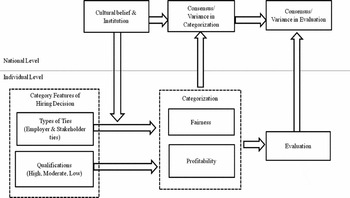
Figure 1 shows an overview of our theoretical model. At the individual level, category features – qualifications and types of personal ties – will be used to categorize hiring decisions as instances of fairness and/or profitability. This, in turn, will be used for an overall evaluation. Consistency of features in the categorization at the individual level will then lead to consensus at the national level. We further propose that cultural beliefs and institutions at the national level will influence the categorization process by drawing attention to one or more category features.
Conceptual Model

The national environment can influence the relationship between category features and consensus in categorization and evaluation in two ways. First, cultural beliefs across nations vary in the information chronically accessible to individuals (Hong et al., Reference Hong, Chiu, Morris and Benet-Martinez2000), so individuals in different cultures will pay attention to different category features during the categorization process, which then influences whether they will pay attention to consistent or inconsistent category features. For example, Americans and Chinese people have differences regarding the salience of social–emotional concerns at work (e.g., Chua et al., Reference Chua, Morris and Ingram2009), so that they will pay different attention to candidates’ qualifications and personal ties. The national environment will cause them to have different perceptions of consistency or inconsistency of features and thus they will differ in categorization consensus. Second, specific conditions within the national environment can provide additional context to the information provided in a hiring decision, so that some category features are more salient. For example, China's lack of formal institutions creates a need for social capital derived from personal ties (Hitt et al., Reference Hitt, Ahlstrom, Dacin, Levitas and Svobodina2004; Luo et al., Reference Luo, Huang and Wang2012; Nolan, Reference Nolan2011; Xin & Pearce, Reference Xin and Pearce1996), which in turn makes personal ties salient in determining whether a hiring decision is profitable. This can alter the pattern of consensus within the national environment by making some features more salient.
Hypotheses Development
Cultural beliefs in judging fairness in hiring
When individuals judge hiring fairness, qualifications are the most fundamental consideration; if they perceive the candidate lacks qualifications, they may perceive procedural bias in personnel selection (Gilliland, Reference Gilliland1993). Previous studies that examine fairness perceptions of hiring decisions involving personal ties have focused on a candidate's qualifications or personal ties as separate factors (e.g., Padgett & Morris, Reference Padgett and Morris2005). However, in practice, the candidate's qualifications and personal ties to the employer or an important stakeholder can be simultaneously presented.
We propose that when a candidate is perceived as highly qualified, qualifications will trump information about personal ties because perceived unfairness requires apparent bias in the hiring process. Therefore, hiring a highly qualified candidate will likely be perceived as fair regardless of personal ties to the employer or important stakeholder. The hiring of a completely unqualified candidate will likely be perceived as unfair regardless of the personal tie to the employer or important stakeholder, as a perceived lack of qualifications provides sufficient information to indicate favoritism (Harrison et al., Reference Harrison, Kravitz, Mayer, Leslie and Lev-Arey2006). Therefore, we predict that given information about a candidate's qualifications and personal ties, only information indicating moderate (i.e., neither high nor low) qualifications of a candidate with personal ties can potentially foster ambiguity in observers’ judgment of fairness, as the judgment depends on which feature of the category people give most attention. In other words, sole attention to the personal ties involved in the hiring decision may lead to judgment of unfairness, whereas attention to the moderate qualifications may alleviate concerns associated with personal ties.
For the hiring of a moderately qualified candidate with personal ties, we propose that whether there will be ambiguity in perceived fairness depends on the cultural beliefs about the personal and professional spheres. As discussed earlier, American cultural beliefs emphasize a clear boundary between personal and professional spheres (Sanchez-Burks, Reference Sanchez-Burks2002; Reference Sanchez-Burks, Staw and Kramer2004). By contrast, East Asian cultural beliefs emphasize primacy of personal ties over distal ties (Hwang, Reference Hwang2009; King, Reference King1991). On the surface, these cross-national differences may imply that Chinese people will be more tolerant of the hiring of personal ties because the practice is so prevalent (Virick et al., Reference Virick, Lilly, Simmons and Liao2008), regardless of qualifications. However, Chinese people might not necessarily perceive the hiring of personal ties as fair. Given the chronic accessibility of the importance of personal relationships, Chinese people are more likely to pay considerable attention to information about the personal tie and disregard information about the qualifications. They may infer that the hiring decision is based on personal ties rather than qualifications. Moreover, Chinese people can be more sensitive to potential negative externalities, and thus be less tolerant, when personal ties are hired (e.g., Chen & Chen, Reference Chen and Chen2009). As a result, when considering a job candidate with moderate qualifications and personal ties to the employer or stakeholder, Chinese people may focus only on what they perceive as unfair aspects of the personal ties and ignore information about the candidate's qualifications. Thus as a group, Chinese people should have a high consensus that hiring moderately qualified candidates with personal ties is unfair. They should concede that hiring moderately qualified candidates with no ties (i.e., strangers) is fair, rather than attribute the hiring to personal ties, they would focus solely on the candidates’ qualifications.
Americans, by contrast, can also consider potential favoritism when moderately qualified candidates have personal ties. However, because of cultural beliefs focusing on professional contexts (Sanchez-Burks, Reference Sanchez-Burks2002), the salience of qualifications may be chronically accessible. Therefore, Americans are more likely to wrestle with the issue of whether moderate qualifications outweigh potential favoritism associated with personal ties, as both sources of information match inconsistent features of fairness. Consequently, Americans are likely to have lower consensus in judging the fairness of hiring personal ties with moderate qualifications. For moderately qualified strangers with no ties, Americans, like their Chinese counterparts, should highly concede that the hiring is fair because they have no inconsistent personal ties information.
Hypothesis 1: There will be more consensus within China than in the U.S. that hiring moderately qualified candidates with personal ties (both employer and stakeholder ties) is unfair. There will be consensus in both nations that hiring moderately qualified candidates with no ties is fair.
Formal institutions in judging profitability in hiring
In addition to cross-national differences in attention to moderate qualifications in judging the fairness of hiring personal ties, we propose cross-national differences in the perceived profitability of hiring individuals with stakeholder ties, but not with employer ties. These differences do not stem from differences in cultural beliefs, but from differences in the formalization of institutions within the national environment. As discussed earlier, in China, formal institutions are still developing, forcing employers to rely on stakeholder ties to cope with institutional voids in the environment (Guo & Miller, Reference Guo and Miller2010; Hitt et al., Reference Hitt, Ahlstrom, Dacin, Levitas and Svobodina2004; Nolan, Reference Nolan2011; Xin & Pearce, Reference Xin and Pearce1996). Stakeholder ties provide employers with social capital required to fill institutional voids by facilitating interorganizational transactions and interactions with governmental sectors (Batjargal & Liu, Reference Batjargal and Liu2004; Hitt, Lee, & Yucel, Reference Hitt, Lee and Yucel2002). Thus in China, hiring someone with a stakeholder tie, such as a friend or relative of a government official, may contribute to organizational performance in general by increasing the organization's social capital (Luo et al., Reference Luo, Huang and Wang2012). As observers in China are likely to have chronically accessible information about their employer's instrumental concerns, they probably will also pay attention to information regarding the instrumental benefit of hiring a stakeholder's personal tie. Thus the personal tie to the stakeholder, in itself, is a feature of profitability within the Chinese context.
When the candidate is well-qualified, cross-national differences in the formalization of institutions are unlikely to play a role, as Americans are also likely to perceive a qualified candidate as offering profitability (Dyer & Reeves, Reference Dyer and Reeves1995). Whether in China or in the U.S., any candidate perceived as highly qualified would be perceived as having potential to contributing to organizational performance. We expect individuals in both nations will concede profitability in the hiring of highly qualified candidates, regardless of personal ties.
For the hiring of unqualified candidates with stakeholder ties, perceived profitability may depend on the institutional environment. In China, a stakeholder tie provides particularly salient additional instrumental value when the candidate is unqualified, as the hiring decision signals that the stakeholders are receiving a favor. Guided by the principle of social exchange reciprocity (Gouldner, Reference Gouldner1960), stakeholders are likely to return the favor; the enhanced social capital increases potential profitability. Therefore, Chinese employees will believe that hiring someone with stakeholder ties conveys social capital through stakeholder reciprocity; that is, chronically accessible information that matches the category feature of profitability. We would not expect this effect for hiring unqualified candidates with employer ties or no ties, as the perceived social capital gained from the employer ties will not compensate for the perceived reduction in human capital caused by hiring an unqualified candidate.
Meanwhile, formal institutions are already developed in the U.S. (Peng, Reference Peng2002), so hiring stakeholder ties to gain social capital provides limited instrumental benefits. As a result, Americans will likely consider only qualifications in assessing the profitability of the hiring decision. Therefore, they will probably concede that hiring unqualified candidates of all types of ties – employer, stakeholder, and no ties – is unprofitable.
Hypothesis 2: There will be consensus in China that the hiring of unqualified candidates with stakeholder ties is profitable, whereas there will be consensus in the U.S. that the hiring of unqualified candidates with stakeholder ties is unprofitable. There will be consensus in both nations that hiring unqualified candidates with or without employer ties is unprofitable.
Considerations of fairness and profitability in the overall evaluation of hiring
As noted earlier, a hiring decision involving personal ties can be categorized as unfair yet profitable (or vice-versa), creating ambiguity in the overall evaluation of the hiring decision. As with the role of ambiguity in lowering categorization consensus, we can expect that hiring decisions categorized as unfair yet profitable or as fair yet unprofitable are likely to have low consensus, since people within the environment can disagree about how to weigh one factor over the other.
We predict that Chinese and American observers will judge fairness or profitability in opposite directions, as they will in categorizing whether hiring unqualified candidates with stakeholder ties is profitable, as predicted in hypothesis 2. We expect differences in consensus levels in overall evaluations of hiring unqualified candidates with stakeholder ties for two reasons. As discussed earlier, we expect that both Chinese and American individuals will concede unfairness in the hiring of unqualified candidates with stakeholder ties, as the lack of qualifications compounded with personal ties indicates selection bias. In the U.S., the consensus that the hiring decision is unfair is consistent with the consensus that the hiring decision is unprofitable because Americans are unconcerned about attaining additional instrumental value from stakeholder ties. As a result, we predict that, overall, Americans will negatively evaluate the hiring of unqualified candidates with stakeholder ties. However, in China, the consensus that the hiring decision is unfair is inconsistent with the consensus that the hiring decision is profitable. This creates ambiguity, which lowers consensus levels. Thus, Chinese observers evaluate the hiring decision positively or negatively depending on how they weigh fairness or profitability in their overall evaluation of the hiring decision. Without a clear convention for weighing each factor, we predict Chinese will have lower consensus that they should negatively evaluate hiring unqualified candidates with stakeholder ties.
Hypothesis 3: There will be more consensus in the U.S. than in China that the hiring of unqualified candidates with stakeholder ties is evaluated negatively overall.
METHOD
Overview of Studies
To examine consensus levels in China and the U.S. in perceptions of fairness, profitability, and overall evaluation of hiring personal ties, we conducted two online surveys and analyzed the survey data using Cultural Consensus Model analysis (CCM) (Borgatti & Carboni, Reference Borgatti and Carboni2007; Borgatti & Halgin, Reference Borgatti, Halgin, Carrington and Scott2011; Keller & Loewenstein, Reference Keller and Loewenstein2011; Weller, Reference Weller2007). This included a categorization and evaluation task to rate specific scenarios involving the hiring of personal ties with varying levels of qualifications. By using CCM analyses, our approach enabled us to determine both the direction and consensus level in the judgment of each hiring decision.
CCM analyses examine consensus levels within a population by analyzing whether participants agree with each other within a particular domain. Participants rate scenarios as to whether a hiring decision is fair, profitable, and positive or negative overall, and responses are then transformed into a participant-by-participant agreement matrix and submitted to an unrotated, minimum residual factor analysis. We first test whether the ratio of the first and second eigenvalues is higher than 3:1 to indicate overall consensus (Weller, Reference Weller2007), as the first eigenvalue captures variance explained by complete agreement on all items for the entire sample. If overall consensus is found, a specific consensus score for each hiring decision is calculated by aggregating each participant's score of 1 (fair/profitable/positive) or −1 (unfair/unprofitable/negative) weighted by the participant's first factor loading score on the factor analysis. The weights are used to consider whether each participant is representative of the population as a whole, as participants with high first factor scores are likely to agree with others across items (see Keller & Loewenstein, Reference Keller and Loewenstein2011). Aggregate consensus scores then range from −1 to 1, with 1 (or −1) indicating a strong consensus about the hiring decision, while a score closer to 0 indicates weak or no consensus.
We conducted two pilot studies to generate and validate situations of hiring personal ties, and one main study to test our hypotheses. The data were collected from three independent samples in both China and the U.S. Pilot Study 1 collected natural situations in which specific hiring decisions involved hiring those with personal ties, including stories about the content of specific ties and varying qualification levels, based on the American and Chinese participants’ real-life experiences. Pilot Study 2 further validated the hiring scenarios involving employer ties and stakeholder ties by examining the consensus levels in the overall evaluation of the hiring decisions. The validated scenarios were used in the main study to test the three hypotheses.
Pilot Study 1: Scenario Generation
To develop hiring decision scenarios grounded in real-life experiences, we first used online platforms to conduct open-ended surveys; using Sojump with twenty participants from China and Mechanical Turk with twenty participants from the U.S. Those methods of participant recruitment have been demonstrated to yield reliable data (for Mechanical Turk, see Buhrmester, Kwang, & Gosling, Reference Buhrmester, Kwang and Gosling2011; for Sojump, see Yang, Liu, Fang, & Hong, Reference Yang, Liu, Fang and Hong2014).[Footnote 4] Each participant was asked to provide two examples of hiring decisions they experienced or heard about in which the hired candidate had a close personal relationship with the employer. Participants gave one example showing positive organizational results and one showing negative organizational results. As we expected, results of this open-ended questionnaire revealed instances of employer ties in which the new hires had personal relationships with employers, such as friends, relatives, and spouses; and instances of stakeholder ties, such as relatives and friends of customers or government officials considered key organizational stakeholders.
We also identified contextual information that generated various hiring decision categorizations. First, participants mentioned that the candidates had personal characteristics that influenced their views on the hiring decision: qualifications such as ‘special expertise’ or ‘little knowledge and experience’, and previous work-related ethical on unethical behaviors such as ‘helped former colleagues’ or ‘showed counterproductive work behaviors at the previous organization’. Besides personal characteristics, they mentioned the supply of prospective candidates in the job market (as discussed in Aycan, Reference Aycan2005). These areas of contextual information, combined with different ties, provided key features of a hiring decision that we then used to assess evaluations.
Pilot Study 2: Evaluation Task
Participants
Participants were working adults recruited through the same two online platforms as in Pilot Study 1: 100 participants from each country. The two samples were similar in their gender ratio (CN: male = 50.50%, U.S.: male = 56.50%) and age (CN: mean = 30.30 years, SD = 6.67; U.S.: mean = 34.30 years, SD = 12.00), except the American participants had longer work experience (CN: mean = 7.80 years, SD = 6.46, U.S.: mean = 15.30 years, SD = 10.92), t (198) = 8.36, p < .01).
Research design and procedure
The online survey included 64 short hiring scenarios based on the situations generated in Pilot Study 1. Each scenario included information about the personal ties and contextual information. We selected eight types of ties from the scenario generation: three employer ties (high-school classmate, cousin, and wife of the manager), four stakeholder ties (relatives or friends of a government official or an important client), and no personal ties (a stranger) as a baseline. We also included information on eight hiring contexts,[Footnote 5] including three levels of qualifications (no related degree or work experience, a related degree but no related work experience, both a related degree and work experience), three levels of work ethics-related behavior (slacking off at work, doing everything asked, going out of the way to help the organization), one job market context (a shortage of applicants) and one with no contextual information. As a result, each participant was presented with 64 hiring scenarios (eight personal ties by eight contexts). Two examples: ‘The manager hires his high-school classmate who has no related degree or experience’ and ‘The manager hires a relative of an important client. The hired candidate has a reputation for going out of her or his way to help the organization’. To measure overall evaluation, participants evaluated each hiring scenario by answering Good or Bad to the question: ‘Is this hiring decision good or bad for the organization’? We randomized the order of scenarios to rule out potential order effects.
Results
CCM Results for China and the U.S
To assess whether consensus occurred across all items within each country, we conducted two CCM analyses using UCINET 6.2 (Borgatti, Everett, & Freeman, Reference Borgatti, Everett and Freeman2002), each based on participants’ overall evaluation within China and the U.S. (respectively). For CCM results in both countries, the first-factor to second-factor ratios were higher than 3:1 (CN: 15.8/2.41 = 7.22, US: 20.09/2.93 = 6.88), and few participants had negative first-factor loadings, demonstrating some level of consensus within each country, and thus we could examine specific consensus scores by weighing participants’ first factor scores.
Consensus scores for employer ties and stakeholder ties
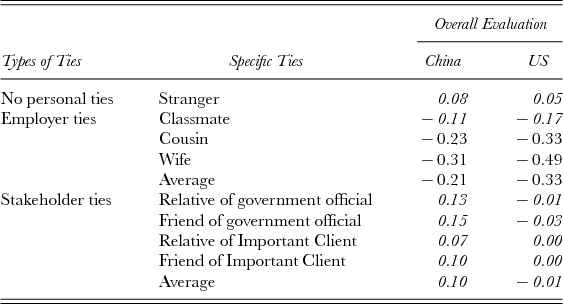
We first calculated the consensus scores for hiring each specific tie by averaging the responses across eight types of contextual information. Again, aggregate consensus scores of 1 and −1 indicate a strong consensus for a positive or negative evaluation respectively, while a score closer to 0 indicates weak or no consensus. As Table 1 shows, both the U.S. and China showed negative perceived consensus about hiring of most types of employer ties, except for weak negative consensus about hiring the classmate of the employer. On average, both countries showed negative consensus about hiring employer ties (CCN = −0.21; CUS = −0.33). For hiring stakeholder ties, all ties had the same pattern. China showed weak positive consensus but the U.S. showed no consensus (CCN = 0.10; CUS = −0.01). Considering the consistency in the evaluations for specific ties that constitute employer ties and stakeholder ties, we aggregated scores across specific ties for employer ties and stakeholder ties in our main study.
Consensus scores for evaluating the hiring of personal ties in China and the United States (Pilot Study 2)

Notes: The closer the scores are to 1, the more consensus that the hiring is good for the organization; the closer the scores are to −1, the more consensus that the hiring is bad for the organization; the closer the scores are to zero, the less consensus to either categorization.
Italic indicates a lack of a consensus in evaluation.
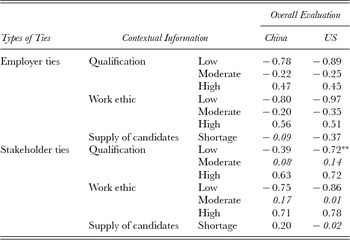
To examine the contingent effects of contextual information on evaluating hiring decisions, we averaged the employer ties and stakeholder ties for each type of contextual information. As Table 2 shows, across all ties, we found weak or no consensus for hiring stakeholder ties only at the moderate level of qualification and work ethic in both China (CCN = 0.08; CCN = 0.17) and the U.S. (CUS = 0.14; CUS = 0.01). We therefore included only qualification levels as contextual information in the main study.
Consensus scores for personal ties with contextual information in China and the United States (Pilot Study 2)

Notes: The closer the scores are to 1, the more consensus that the hiring is good for the organization; the closer the scores are to −1, the more consensus that the hiring is bad for the organization; the closer the scores are to zero, the less consensus to either categorization.
Italic indicates a lack of a consensus in evaluation.
**indicates significant cross-national differences in the consensus scores at p < 0.01.
Main Study
Sample and procedure
We used the same online platforms as in the pilot study to recruit an independent set of participants in China and the U.S. After excluding random responses (N = 6 in China; N = 3 in the U.S.) and those who finished within 20 minutes (N = 29 in China; N = 16 in the U.S.), our final sample included 200 Americans and 200 Chinese.[Footnote 6] The two samples had similar gender ratios (CN: male = 40.50%, U.S.: male = 39.50%) and ages (CN: mean = 30.34 years, SD = 5.53; U.S.: mean = 33.50 years, SD = 11.17), but the Americans had longer working experience (CN: mean = 7.70 years, SD = 5.35, U.S.: mean = 14.61 years, SD = 10.29), t (398) = 8.36, p < 0.01). Participants were paid 12RMB in China and $1.50 in the U.S. for participation.
Hiring decision categorization items
We included the same eight personal ties as in Pilot Study 2, but included only four types of contextual information, with three levels of the applicant's qualifications (highly qualified, moderately qualified, and not qualified) and the baseline (without contextual information). The crossing of eight types of ties and four types of contexts gave rise to 32 hiring decisions. For each decision, participants rated whether the decisions were (1) fair (1 = not at all fair, 2 = slightly unfair, 3 = slightly fair, and 4 = very fair); and (2) profitable (1 = not at all profitable, 2 = slightly unprofitable, 3 = slightly profitable, 4 = very profitable); and (3) overall evaluation (1 = very bad, 2 = somewhat bad, 3 = somewhat good, 4 = very good). Participants rated the same hiring decisions three times in a randomized order.
Data analysis
We followed the same CCM analysis to test consensus within each country as in Pilot Study 2. Because these analyses require the scores to be dichotomous as well, we transformed the 4-point ratings into a dichotomous variable by recoding ratings of 1 and 2 into −1, and ratings of 3 and 4 into 1.
MAIN STUDY RESULTS
Results of CCM Analyses across Items
We first conducted a CCM analysis across all items to determine whether each country showed an overall consensus. We found that the ratio of the eigenvalues for first factor to second factor was higher than 3:1 (CN: 72.33/15.49 = 4.67; U.S.: 86.81/18.32 = 4.74), and only three people in each country had negative first factor scores, indicating a general consensus in the categorization of hiring decisions as instances of fairness and profitability and the overall evaluation within China and the U.S. The first factor explained 47% of variance in China and 54% of variance in the U.S. The second factor explained 22% of variance in China and 25% of variance in the U.S. This ratio provided evidence of overall consensus, but with significant disagreement in each country (Weller, Reference Weller2007).
Results for Consensus of Specific Hiring Decision
To test our hypotheses about cross-national differences in consensus for specific hiring decisions, we calculated consensus scores and ran ANCOVAs on these consensus scores using SPSS. We used country as a between-subject factor, controlling for work experience and gender to examine the cross-national differences in consensus scores. Because we had 18 pairs of comparisons, to avoid false discovery of null differences, we used the Bonferoni adjustment for p-value, and F-ratios with less than p-value = 0.002 were considered significant (p-value = 0.05 divided by 18, rounded down to the nearest two decimal points) (cf. Benjamini & Yekutieli, Reference Benjamini and Yekutieli2001).
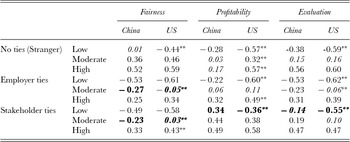
Table 3 shows the consensus scores for each hiring decision. Again, the closer the score is to −1, the more consensus that the hiring is unfair, unprofitable, and bad; the closer the score is to 1, the more consensus that the hiring is fair, profitable, and good; the closer the score is to zero, the less consensus about the categorization. Consistent with hypothesis 1, we found more consensus among the Chinese in judging the hiring of moderately qualified employer ties as unfair (CCN = −0.27), than the Americans (CUS = −0.05, F(1, 396) = 19.00, p < 0.002). A similar cross-national difference was found in judging the fairness of hiring moderately qualified stakeholder ties (CCN = −0.23, CUS = 0.03, F(1, 396) = 28.88, p < 0.002). Also, as predicted, both nations showed high consensus that hiring moderately qualified candidates with no ties is fair (CCN = 0.36, CUS = 0.46). As a whole, these findings support hypothesis 1.
Consensus scores for categorizing the hiring of personal ties in China and the United States (Main Study)

Notes: 1 = Fair, profitable and good for the organization, −1 = Unfair, unprofitable and bad for the organization. The closer the scores are to 1, the more consensus that the hiring is fair, profitable, and good for the organization; the closer the scores are to −1, the more consensus that the hiring is unfair, unprofitable and bad for the organization; the closer the scores are to zero, the less consensus in categorizations.
Italic indicates a lack of a consensus, and bold fonts highlight the consensus scores pertaining to our hypotheses.
**indicates significant cross-national differences in the consensus scores at p < 0.002.
For judging the profitability of stakeholder ties, we found consensus among the Chinese that hiring unqualified candidates with stakeholder ties is profitable, but consensus among Americans that it is unprofitable (CCN = 0.34, CUS = −0.36, F(1, 396) = 225.17, p < 0.002). Both nations conceded that hiring unqualified candidates with employer ties (CCN = −0.22; CUS = −0.60) or no ties (CCN = −0.28; CUS = −0.57) to be unprofitable, although American participants showed significantly stronger consensus. Taken as a whole, the findings support hypothesis 2.
For the overall evaluation of hiring unqualified candidates with stakeholder ties, Americans conceded that it was negative for the organizations, but the Chinese did not (CCN = −0.14, CUS = −0.55, F(1, 396) = 85.03, p < 0.002), thus supporting hypothesis 3.
Supplementary Results for Relationship between Categorization and Evaluation
To further explore the cross-national differences in how fairness and profitability influence the overall evaluation of hiring of low-qualified stakeholder ties, we ran regression analysis (using the four-point raw scores from 1 = unfair/unprofitable/bad to 4 = very fair/profitable/good) and compared the models derived from the Chinese and American samples. Table 4 shows the univariate statistics, correlations of each variable (fairness and profitability) with overall evaluation, and the multiple regression weights for the two nations, controlling for gender and work experience.
Descriptives, correlations and multiple regression weights in evaluating the hiring of unqualified candidates with stakeholder ties in China and the United States (Main Study)

Note: 1 = Unfair/unprofitable/bad for the organization, 4 = Very fair/profitable/good for the organization.
**indicates significant differences at p < 0.01.
Comparison of the fit of the model from the Chinese and American samples revealed that although fairness and profitability each predicted the overall evaluation significantly in both samples, the model accounted for more variance in the U.S. sample than in the Chinese sample [U.S.: R 2 = 0.56, F(4, 195) = 22.27, p < 0.001; China: R 2 = 0.35, F(4, 195) = 6.80, p < 0.001; difference in R 2 values, z = 2.65, p < 0.01]. Furthermore, we compared the unstandardized beta coefficients of fairness and profitability across nations and both contributed significantly, as Table 4 shows. We found no significant differences in how Chinese and Americans weighted fairness (z = −1.55, p > 0.05) and profitability (z = 0.35, p > 0.05) in the overall evaluation.
Therefore, although our findings indicated that the two samples differ in their level of consensus in the evaluation of hiring low-qualified stakeholder ties as negative overall (as stipulated in hypothesis 3), participants in both countries weighed the contributing factors – fairness and profitability – in similar ways. However, given the larger R2 for the model found in the American sample, Americans may focus more on fairness and profitability in constructing the overall evaluation than do Chinese, who may have other considerations beyond fairness and profitability. This is consistent with the lower consensus found among Chinese participants in their overall evaluation of hiring low-qualified stakeholder ties; other competing concerns may exist beyond viewing the hire as unfair yet profitable.
DISCUSSION
When employees lack consensus in their perceptions about hiring decisions involving personal ties, unintended negative reactions may result. Similarly, cultural differences may cause individuals to vary in their perceptions of personal ties in hiring practices. Because China and the U.S. vary greatly in their cultural beliefs and in their institutions, we compared individuals from these two cultures to measure their levels of consensus regarding the fairness and profitability and overall evaluations of hiring personal ties. Our results pointed to two key cross-national differences in consensus levels. First, Chinese people showed a greater level of consensus that hiring moderately qualified personal ties was unfair. Second, Americans conceded that the hiring of unqualified candidates with stakeholder ties was unprofitable, but Chinese conceded that it was profitable. Americans reached a greater level of consensus that hiring unqualified candidates with stakeholder ties was negative overall.
By finding differences in areas of consensus in perceptions of hiring someone with personal ties, our findings have implications for several research areas. First, we found a lack of consensus among Americans as to whether the hiring of moderately qualified personal ties is fair or unfair. Americans give relatively little attention to relational cues in work settings (Sanchez-Burks, Reference Sanchez-Burks2002; Reference Sanchez-Burks, Staw and Kramer2004), so they may not necessarily consider the hiring of moderately qualified candidates with personal ties as unfairly biased. The lack of consensus indeed indicates selective attention to either personal ties or candidates’ qualifications when the qualifications are ambiguous. Previous research on perceptions of hiring decisions within the U.S. has shown that when Americans perceive that the hiring decision is based on personal ties, they may underestimate the hiree's qualifications (Padgett & Morris, Reference Padgett and Morris2005). We call for particular attention to ambiguous hiring decisions, because in the U.S. national context a misalignment of fairness perceptions is salient and can create negative reactions and perceptions of conflict of interests. Future research can address how a lack of consensus about the fairness of such hiring practices affects outcomes, and also show that the outcomes differ in other national contexts.
Second, by finding consensus in China that it is unfair to hire moderately qualified candidates with personal ties, our results have implications for research on Confucian relationalism (Chen et al., Reference Chen, Chen and Huang2013; Hwang, Reference Hwang2009; Ip, Reference Ip2009). Because previous research suggests that Chinese people have a proclivity to favor personal ties over other ties in both personal and professional domains (Chen et al., 2013; Hwang, Reference Hwang2009; Trompenaars, Reference Trompenaars1994), our findings are somewhat counterintuitive. In particular, although previous research would suggest that Chinese people would deem the hiring of personal ties as relatively fair compared with the American view (Virick et al., Reference Virick, Lilly, Simmons and Liao2008), our findings suggest otherwise, and point to a different outcome of Confucian relationalism. Individuals observing their employers hiring personal ties do not benefit from the relational exchanges, and therefore they are unlikely to judge the practice favorably. Observers in China, because of strong cultural beliefs about the importance of personal ties, are likely to pay more attention to the relational aspects of a hiring decision and ignore information about qualifications. Thus, despite previous work suggesting that employers in China may feel obliged to help their personal ties, many employees in China are likely to be unsympathetic. Future research can address this potential gap between hiring practices and perception of hiring practices in China.
Third, our findings regarding Chinese perceptions about hiring of unqualified candidates with stakeholder ties contribute to research on the role of guanxi as a compensation for China's institutional voids (Peng & Heath, Reference Peng and Heath1996; Xin & Pearce, Reference Xin and Pearce1996). Interestingly, although we found Chinese consensus that the practice is unfair, we also found consensus that it is profitable and a lack of consensus regarding its overall evaluation. Because the practice involves the hiring of unqualified candidates, the profitability rationale is unlikely to be based on the candidate's human capital contributions. Rather, Chinese people may see an instrumental value through future reciprocity, which is consistent with previous discussions that guanxi practice in China may breed corruption by encouraging business partners to violate fair trade and government authorities to seek rents (Dunfee & Thomas, Reference Dunfee and Warren2001; Su & Littlefield, Reference Su and Littlefield2001). Future research can examine the underlying mechanisms explaining why Chinese individuals perceive profitability in the hiring of unqualified candidates with stakeholder ties.
Further, Chinese people differed from Americans, not in their perception that hiring unqualified candidates with stakeholder ties to be unfair, but in the level of consensus in their overall evaluation. We found no evidence that Americans and Chinese weigh fairness and profitability differently. Instead, our results suggest that the Chinese are divided in their views about hiring unqualified candidates with stakeholder ties overall; they concede that the practice is unfair but profitable. Future research can address why some Chinese individuals place more or less weight on fairness or profitability concerns in their overall evaluation.
Finally, although we find that the two nations differ regarding hiring decisions, they similarly concede overall profitability and positivity in hiring highly qualified candidates with stakeholder ties. Given the role of social capital in China (e.g., Luo et al., Reference Luo, Huang and Wang2012; Xin & Pearce, Reference Xin and Pearce1996), we would expect the Chinese to concede fairness in hiring qualified candidates with stakeholder ties, but U.S. participants actually have stronger fairness consensus about hiring highly qualified candidates with stakeholder ties (CCN = 0.33, CUS = 0.43, F(1, 396) = 12.37, p < 0.002). That is, American participants also consider the instrumental value of social connections in fairness judgments. This suggests a possible motivation behind JPMorgan Chase's pursuit of well-qualified candidates with elite pedigrees.
Theoretical Contribution of Our Approach
Our research contributes to the literature on culture's role in fairness judgments of HRM practices (e.g., Arvey & Renz, Reference Arvey and Renz1992; Morris & Leung, Reference Morris and Leung2000) by expanding cross-national research to include examinations of intranational variance and by incorporating theories on categorization, consensus, and chronic accessibility to explain why different consensus levels occur within and across countries.
Our study, although focused on fairness and profitability categorization of hiring decisions, has applications beyond the HRM context. The study provides a mechanism for understanding how the national environment shapes the moral climate of an organization (Macklin, Martin, & Mathison, in press; Sidani & Thornberry, Reference Sidani and Thornberry2012). In addition, the premise that the national environment shapes consensus levels by drawing people's attention to one or more category features can apply to many other organizational questions about consensus. As Figure 1 shows, our theoretical and empirical approach began with the premise that perceptions are shaped by attention to category features of a focal phenomenon. Cultural beliefs and institutions can moderate the influence of category features on perceptions by drawing attention to one or more features. This basic theoretical model can also be used to evaluate other managerial issues involving potential variance in perceptions, such as whether managers and subordinates within the same country share the same perceptions regarding good leadership (i.e., implicit leadership theory; House, Javidan, Hanges, & Dorfman, Reference House, Javidan, Hanges and Dorfman2002) or whether people within the same country share the same mental negotiation models (Liu, Friedman, Barry, Gelfand, & Zhang, Reference Liu, Friedman, Barry, Gelfand and Zhang2012). Moreover, by treating intranational variance as information rather than noise, this approach also allows cross-national comparisons beyond the main comparisons of general tendencies (Au, Reference Au1997; Tsui et al., Reference Tsui, Nifadkar and Ou2007).
Limitations and Future Research Implications
As in all empirical research, our study has limitations. First, while we used cultural beliefs and institutions as theoretical explanations for cross-national differences in levels of consensus, future research can test the specific beliefs and institutional factors that mediate cross-national differences in consensus. Second, although China and the U.S. present stark differences in cultural beliefs and institutions, future research can examine cultural and institutional factors in other national environments. Third, because our study was cross-sectional, we could compare the content of people's categories of fairness, profitability, and their overall evaluation. Future research may explore the issue further by examining the dynamic cognitive processes that lead to varying patterns of consensus. Fourth, although we collected data from individuals, our examination was at the population level. Future research may examine the social and psychological factors that influence whether individuals actually follow consensus patterns in their perceptions of hiring decisions.
Managerial Implications
Besides the theoretical implications of our results, our findings have managerial implications regarding HR practices. Previous research in international HRM has often advised ‘when in Rome, do what the Romans do’ (e.g., Aycan, Reference Aycan2005; Aycan, Kanungo, & Sinha, Reference Aycan, Kanungo and Sinha1999; Mendonca & Kanungo, Reference Mendonca and Kanungo1994), based on the premise that the national environment determines the appropriateness of an HRM practice (e.g., Schneider, Reference Schneider1988). Multinational corporations operating in China often adjust hiring practices to fit local environments; they hire personal ties because the practice appears appropriate for the local environment (e.g., Nolan, Reference Nolan2011). Our findings suggest that countries may lack consensus in perceptions about hiring candidates with personal ties, so practitioners must be cautious when adjusting hiring practices to fit national environments. In such cases, such as in varying perceptions about hiring unqualified candidates with stakeholder ties in China, employers may engage in hiring practices that fit the national environment, but also understand how to address potential conflict arising from different perceptions within the specific national context.
CONCLUSION
Our study presents an opportunity to study the role of cultural and institutional factors in shaping perceptions of HRM practices, looking at how nations and people within nations differ. We present a new theoretical and empirical approach to identifying why differences occur within the nation by examining the specific features that shape perceptions of ethically ambiguous HRM practices. Our study helps us understand how people perceive ethically ambiguous HRM practices and provides a foundation for further and broader inquiries into the role of the national environment in shaping perceptions and judgment. Cultural beliefs and institutions play a complex role in shaping perceptions of managerial issues, requiring an understanding of how the specific features of the focal phenomenon may lead to more or less consensus. For a comprehensive understanding of the impact of cultural beliefs and institutions on perceptions, we must go beyond cross-cultural comparisons of general tendencies and consider the factors that lead to intranational variation. We hope our study deepens our understanding of emerging issues in hiring decisions across borders, such as the JPMorgan Chase case described in this article's introduction.