Introduction
Individuals with schizophrenia have higher rates of cardiovascular risk factors compared to the general population (Laursen et al. Reference Laursen, Munk-Olsen and Vestergaard2012; Mitchell et al. Reference Mitchell, Vancampfort, Sweers, van Winkel, Yu and De Hert2013a , Reference Mitchell, Vancampfort, De Herdt, Yu and De Hert2013b ). Metabolic syndrome (MetS) is defined as a clustering of at least three of interrelated cardiovascular risk-factor abnormalities, including abdominal obesity, hyperglycemia, hypertension, high triglycerides or low high-density lipoprotein (HDL) cholesterol levels (Grundy et al. Reference Grundy, Cleeman, Daniels, Donato, Eckel, Franklin, Gordon, Krauss, Savage, Smith and Spertus2005). The Clinical Antipsychotic Trials of Intervention Effectiveness (CATIE) study reported the MetS prevalence in schizophrenia as 40.9% using the National Cholesterol Education Program – Adult Treatment Panel III criteria (NCEP-ATP-III) which is significantly high compared to the general population (McEvoy, Reference McEvoy2005; NCEP 2001). The age-adjusted prevalence of MetS is 23% in the US general population (Beltrán-Sánchez et al. Reference Beltrán-Sánchez, Harhay, Harhay and McElligott2013). The prevalence of type 2 diabetes mellitus (DM) in schizophrenia is also double that of the general population (Stubbs et al. Reference Stubbs, Vancampfort, De Hert and Mitchell2015).
MetS and its components are important risk factors for developing cognitive impairment and dementia (Biessels et al. Reference Biessels, Staekenborg, Brunner, Brayne and Scheltens2006; Yaffe, Reference Yaffe2007; van den Berg et al. Reference van den Berg, Kloppenborg, Kessels, Kappelle and Biessels2009; Qiu & Fratiglioni, Reference Qiu and Fratiglioni2015). Schizophrenia is characterized by significant cognitive impairment which contributes to the functional deficit in this disorder (Bora et al. Reference Bora, Yücel and Pantelis2010; Green, Reference Green2016). Neurodevelopmental abnormalities play an important role in cognitive impairment in schizophrenia (Bora, Reference Bora2015). Other authors have argued that schizophrenia can be characterized by a neurodegenerative process and progressive cognitive decline (McGlashan & Fenton, Reference McGlashan and Fenton1993). However, longitudinal studies in chronic and first-episode and high-risk individuals have not found evidence of ongoing cognitive decline in schizophrenia (Bora & Murray, Reference Bora and Murray2014; Szöke et al. Reference Szöke, Trandafir, Dupont, Méary, Schürhoff and Leboyer2008). While post-onset cognitive decline is not a general feature of schizophrenia, it still might be argued that progressive cognitive decline might be evident in smaller subset of patients in the context of non-illness-related factors including MetS. Therefore, it is important to establish the potential contribution of MetS to cognitive deficits in schizophrenia. The relationship of MetS and cognition has received limited attention in patients with schizophrenia until recently. The CATIE study did not show any relationship between the presence of MetS and cognitive impairments in schizophrenia (Meyer et al. Reference Meyer, Nasrallah, McEvoy, Goff, Davis, Chakos, Patel, Keefe, Stroup and Lieberman2005). A subsequent report from the same sample suggested that diabetes but not other components of MetS was associated with cognitive deficits in schizophrenia (Takayanagi et al. Reference Takayanagi, Cascella, Sawa and Eaton2012). The findings of the CATIE study also suggested an unexpected relationship between elevated cholesterol and triglyceride levels and better cognitive functioning (Nasrallah, Reference Nasrallah2015). However, a number of studies reported a significant relationship between MetS (and its components) and cognitive impairment in schizophrenia (Dickinson et al. 2008; Friedman et al. Reference Friedman, Wallenstein, Moshier, Parrella, White, Bowler, Gottlieb, Harvey, McGinn, Flanagan and Davis2010; Lindenmayer et al. Reference Lindenmayer, Khan, Kaushik, Thanju, Praveen, Hoffman, Cherath, Valdez and Wance2012). There are significant methodological differences across studies investigating the effects of MetS components on cognition in schizophrenia. Currently, it is not clear whether or not cognitive deficits in schizophrenia are specifically associated with some components of MetS. It is also important to estimate the effect size of cognitive deficits associated with MetS in schizophrenia as the use of antipsychotics is one of the important factors contributing to weight gain and increased prevalence of MetS in schizophrenia.
Our aim was to systematically review, using meta-analytic methods whenever possible, the available studies investigating the effect of MetS and its components on cognition in schizophrenia. We hypothesized that MetS and its components would be significantly related to the severity of cognitive deficits in schizophrenia.
Method
Study selection
PRISMA guidelines were used in conducting this meta-analysis (Moher et al. Reference Moher, Liberati, Tetzlaff and Altman2009). A literature search was conducted using the databases Pubmed, PsycINFO and Scopus to identify the relevant studies (January 1990 to June 2016) using the combination of key words as follows: (schizophrenia) AND (‘metabolic syndrome’ OR ‘diabetes’ OR ‘hypertension’ OR ‘obesity’ OR ‘dyslipidemia’) AND (cognition). Reference lists of published reports were also reviewed for additional studies. Inclusion criteria for the qualitative part of the review were studies that: (1) examined cognitive abilities in schizophrenia/schizoaffective disorder; (2) investigated the effect of MetS or its components [abdominal obesity/body mass index (BMI), diabetes/hyperglycemia, hypertension/increased systolic pressure, increased triglyceride levels, low HDL (or high low-density lipoprotein (LDL))]. For the quantitative part of the review (meta-analysis), there were additional inclusion criteria: (1) reported sufficient data to calculate the effect size and s.e. of the neuropsychological measure including results of parametric statistics (i.e. t and F values); (2) compared the performances of patients with schizophrenia with and without MetS (or components); (3) minimum of four studies meeting inclusion criteria being available for meta-analysis of cognitive domains for each of the group comparisons [i.e. schizophrenia with and without MetS component of interest (or MetS)].
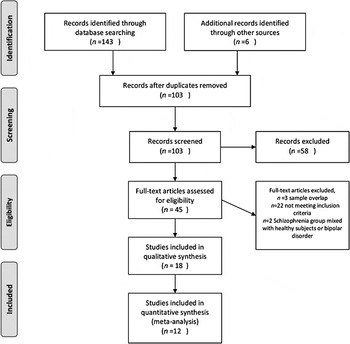
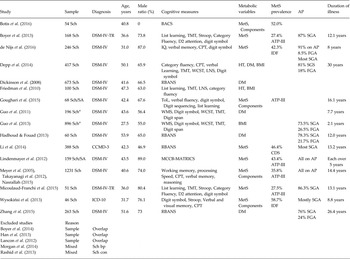
The selection process is summarized in Fig. 1. Three studies were excluded as their samples were overlapping with other studies included. A total of 18 studies including two conference papers were included in the qualitative part of the current systematic review and 12 of these studies were included in the meta-analysis (Table 1). Two conference reports were excluded from the quantitative part of the review (Nasrallah, Reference Nasrallah2015; Botis et al. Reference Botis, Miclutia and Vlasin2016). Two other studies were not included in the quantitative review as they did not report sufficient data to calculate effect sizes. We contacted authors of these papers but we were not able to obtain this data from the authors (Wysokiński et al. Reference Wysokiński, Dzienniak and Kłoszewska2013; Goughari et al. Reference Goughari, Mazhari, Pourrahimi, Sadeghi and Nakhaee2015). Two other studies were not included in the meta-analysis as there was no sufficient number of studies to conduct a meta-analysis for the effect of component of MetS reported in these studies (Friedman et al. Reference Friedman, Wallenstein, Moshier, Parrella, White, Bowler, Gottlieb, Harvey, McGinn, Flanagan and Davis2010; Guo et al. Reference Guo, Zhang, Wei, Lv, Wu and Zhao2013). In remaining 12 studies, we were able to conduct meta-analyses for neurocognitive studies comparing performances of schizophrenia patients with (n = 854) and without (n = 1389) MetS and with (n = 518) and without (n = 2379) DM. It was not possible to conduct meta-analyses for the effects of co-morbidity of hypertension, obesity, and dyslipidemia due to a small number of studies available. Five of the included studies investigated relative contributions of components of MetS on cognition in schizophrenia through multivariate regression analyses and we also reviewed the findings of these studies.
Flow diagram for systematic review of studies investigating the effects on metabolic syndrome and its components on cognition in schizophrenia (from Moher et al. Reference Moher, Liberati, Tetzlaff and Altman2009; doi:10.1371/journal.pmed1000097). For more information visit www.prisma-statement.org.

Characteristics of the studies included in the current systematic review and meta-analysis

MetS, Metabolic syndrome; Sch, schizophrenia; AP, antipsychotic; BACS, Brief Assessment of Cognition in Schizophrenia; TMT, Trail making test; ATP-III, National Cholesterol Education Program – Adult Treatment Panel III criteria; SGA, second-generation antipsychotic; CPT, Continuous Performance test; IDF, International Diabetes Federation; FGA, first-generation antipsychotic; WCST, Wisconsin Card Sorting test; LNS, Letter Number sequencing; HT, hypertension; DM, diabetes mellitus; BMI, body mass index; RBANS, Repeatable Battery for the Assessment of Neuropsychological Status; WMS, Wechsler memory scale; CCMD-3, Chinese Classification of Mental Disorders Version 3; CDS, Chinese Diabetes Society;
a Including schizophreniform.
Statistical analyses
When available, overall cognitive test score was used as a measure of general cognition. In other studies, an effect size for general cognition was calculated by averaging effect size of individual cognitive domains. The same method was also used to calculate effect size of cognitive domains if more than one cognitive variable was available for a cognitive domain. Cognitive domains included in the current review were memory, processing speed, attention, executive function, working memory and verbal fluency (see Supplementary Table S1 for cognitive tests under each domain).
Meta-analyses were performed using packages in the R environment (OpenMetaAnalyst, Metafor) (Viechtbauer, Reference Viechtbauer2010; Wallace et al. Reference Wallace, Dahabreh, Trikalinos, Lau, Trow and Schmid2012). Effect sizes were weighted using the inverse variance method and a random-effects model (DerSimonian–Laird estimate) (p value for significance <0.05). Homogeneity of the distribution of weighted effect sizes was tested with the Q test. Tau-squared (τ 2), an estimate of between-study variance, was used as a measure of the magnitude of heterogeneity in the random-effects model. The possibility of publication bias was assessed with funnel plots and Egger's test. The significance threshold of Egger's test was defined as p = 0.1 due to the small number of studies included. Subgroup analyses were performed for studies that were statistically matched for gender and for studies that explicitly assured the inclusion of type 2 DM.
Results
Quantitative findings
MetS
There was a significantly smaller percentage of males in the schizophrenia + MetS group compared to other schizophrenia patients [64.9% v. 75.6%, relative-risk (RR) 0.92, 95% confidence interval (CI) 0.86–0.98, p < 0.001]. Individuals with schizophrenia and MetS were significantly older (d = 0.21, 95% CI 0.10–0.33, Z = 3.6, p < 0.001) compared to other patients with schizophrenia. The groups were well matched for the duration of education (d = 0.04, 95% CI −0.21 to 0.30, Z = 0.33, p = 0.74). There were no significant between-group differences for the severity of positive (d = 0.03, 95% CI −0.09 to 0.16, Z = 0.53, p = 0.59) and negative (d = 0.06, 95% CI −0.06 to 0.18, Z = 1.0, p = 0.31) symptoms.
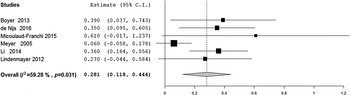
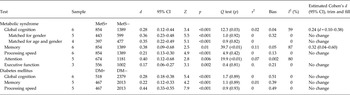
Global cognition was significantly impaired in patients with schizophrenia + MetS compared to other patients with schizophrenia (d = 0.28, 95% CI 0.12–0.44) (Table 2) (Fig. 2). The effect size for the impairment in global cognition was larger in a subgroup analysis of studies that were statistically matched for gender (d = 0.36, 95% CI 0.23–0.48). In meta-analyses of individual cognitive domains, patients with schizophrenia + MetS performed significantly worse than other patients with schizophrenia in memory (d = 0.39, 95% CI 0.09–0.69), attention (d = 0.40, 95% CI 0.12–0.68), processing speed (d = 0.21, 95% CI 0.13–0.30) and executive function (d = 0.17, 95% CI 0.06–0.27). The distribution of effect sizes for each of these cognitive domains were heterogeneous for global cognition (I 2 = 59%, τ 2 = 0.03), memory (I 2 = 88%, τ 2 = 0.11), and attention (I 2 = 80%, τ 2 = 0.07). Inspection of funnel plots and Egger's tests found evidence of publication bias for attention, memory and global cognition. There were very slight reductions in estimated effect sizes in between-group differences for global cognition and memory in trim-and-fill analyses (Table 2).
Forest plot of cognitive differences between schizophrenia patients with and without metabolic syndrome.

Mean weighted effect sizes for neurocognitive differences between schizophrenia with and without metabolic syndrome (MetS) or diabetes mellitus

d, Effect size of between-group difference; CI, confidence interval; Bias, p value of Egger's test; d, Cohen's d.
There was insufficient number of studies to conduct meta-analyses to investigate the effects of MetS on working memory and verbal fluency in schizophrenia. Two studies reported a negative effect of MetS on verbal fluency (Boyer et al. Reference Boyer, Richieri, Dassa, Boucekine, Fernandez, Vaillant, Padovani, Auquier and Lancon2013; Micoulaud-Franchi et al. Reference Micoulaud-Franchi, Faugere, Boyer, Cermolacce, Richieri, Faget, Philip, Vion-Dury and Lancon2015). Lindenmayer et al. (Reference Lindenmayer, Khan, Kaushik, Thanju, Praveen, Hoffman, Cherath, Valdez and Wance2012) but not Meyer et al. (Reference Meyer, Nasrallah, McEvoy, Goff, Davis, Chakos, Patel, Keefe, Stroup and Lieberman2005) found a significant relationship between working memory impairment and MetS (see Supplementary Table S2).
Diabetes mellitus
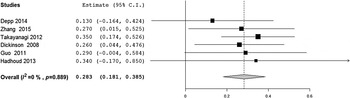
There was a significantly a smaller percentage of males in the schizophrenia + DM group compared to other schizophrenia patients (63.2% v. 72.2%) (RR 0.90, 95% CI 0.83–0.97, p < 0.001). Global cognition was significantly impaired in patients with schizophrenia + DM compared to other patients with schizophrenia (d = 0.28, 95% CI 0.18–0.38) (Table 2) (Fig. 3). The effect size for the impairment in global cognition was similar in a subgroup analysis of studies that were statistically matched for gender (d = 0.30, 95% CI 0.05–0.56). The severity of cognitive impairment in studies that clearly assured the inclusion of type 2 DM only (d = 0.27, 95% CI 0.07–0.47) were not significantly different compared to level of impairment (d = 0.29, 95% CI 0.17–0.41) in other studies (Q bet = 0.02, p = 0.89).
Forest plot of cognitive differences between schizophrenia patients with and without diabetes mellitus.

In meta-analyses of individual cognitive domains, patients with schizophrenia + DM performed significantly worse than other patients with schizophrenia in memory (d = 0.19, 95% CI 0.06–0.32) and processing speed (d = 0.44, 95% CI 0.33–0.55). The distributions of effect sizes for each of these cognitive domains were homogenous (Table 2). There was no evidence of publication bias.
Two of these studies included in the meta-analysis investigated the relationship between cognitive deficits and diabetes-related parameters (duration and age of onset). Both of these studies found a significant relationship between cognitive deficits and longer duration and younger onset of DM (Dickinson et al. 2008; Guo et al. Reference Guo, Zhang, Zhu, Lian, Lu and Zhao2011). In another study, poor control of DM as measured by HbA1c was negatively associated with cognition in males with schizophrenia (Zhang et al. Reference Zhang, Han, Zhang, Hui, Jiang, Yang, Tan, Wang, Li and Huang2015).
There was no sufficient number of studies to conduct meta-analyses for investigating the effects of DM on executive function, attention, working memory and verbal fluency in schizophrenia (Supplementary Table S2). A few studies reported more impaired executive function and attention in schizophrenia + DM patients compared to other schizophrenia patients (Guo et al. Reference Guo, Zhang, Zhu, Lian, Lu and Zhao2011; Takayanagi et al. Reference Takayanagi, Cascella, Sawa and Eaton2012).
Qualtitative findings
Hypertension
Two of three studies (Friedman et al. Reference Friedman, Wallenstein, Moshier, Parrella, White, Bowler, Gottlieb, Harvey, McGinn, Flanagan and Davis2010; Depp et al. Reference Depp, Strassnig, Mausbach, Bowie, Wolyniec, Thornquist, Luke, McGrath, Pulver, Patterson and Harvey2014; Botis et al. Reference Botis, Miclutia and Vlasin2016) that investigated the relationship between hypertension and cognitive impairment in schizophrenia reported more severe cognitive impairment in individuals with schizophrenia + hypertension compared to other patients (Supplementary Table S2). Paradoxically, Wysokiński et al. (Reference Wysokiński, Dzienniak and Kłoszewska2013) reported better cognitive abilities in patients with schizophrenia and high systolic blood pressure compared to other patients. However, this study has not reported cognitive abilities in the subgroup of patients receiving antihypertensives and findings might be confounded by the very high incidence of dyslipidemia in the overall sample (40 of 46 patients).
Abdominal obesity and BMI
Two of three studies that investigated the relationship between obesity and cognitive impairment in schizophrenia (Guo et al. Reference Guo, Zhang, Wei, Lv, Wu and Zhao2013; Wysokiński et al. Reference Wysokiński, Dzienniak and Kłoszewska2013; Depp et al. Reference Depp, Strassnig, Mausbach, Bowie, Wolyniec, Thornquist, Luke, McGrath, Pulver, Patterson and Harvey2014) reported that schizophrenia patients with co-morbid obesity had performed significantly worse than other patients with schizophrenia (Supplementary Table S2). BMI itself was not significantly correlated with cognitive deficits in these studies.
Dyslipidemia
Two studies (Wysokiński et al. Reference Wysokiński, Dzienniak and Kłoszewska2013; Botis et al. Reference Botis, Miclutia and Vlasin2016) found that patients with dyslipidemia had more cognitive deficits in several domains including executive function, verbal memory and attention than other schizophrenia patients (Supplementary Table S2).
Multivariate regression analyses and relative effects of MetS components on cognitive impairment
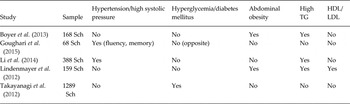
Five studies reported multivariate regression analyses exploring effects of components of MetS of cognitive functions in schizophrenia (Table 3). Each of the components of MetS was found to make a significant contribution to cognitive impairment above and beyond the effect of other components of MetS in at least one study. High triglyceride level was a significant predictor in three studies, hypertension and abdominal obesity in two studies, hyperglycemia and high LDL in one study. There was a significant variance for the percentage of individual MetS components across studies.
Studies reporting multiple regression analyses between cognitive abilities and components of metabolic syndrome

Sch, Schizophrenia; TG, triglycerides; HDL, high-density lipoprotein; LDL, low-density lipoprotein.
Discussion
The current qualitative and quantitative systematic review was undertaken to appraise and synthesize the available evidence regarding effects of MetS and its components on cognition in schizophrenia. The quantitative part of the review suggests that schizophrenia patients with co-morbid MetS or DM have significantly more severe cognitive deficits compared to other patients with schizophrenia. In the qualitative part of the review, there was evidence for a relationship between each of the components of MetS and cognitive impairment in schizophrenia.
The effect sizes for the effect of both MetS (d = 0.28) and DM (d = 0.28) on overall cognitive impairment and on individual cognitive domains (d = ranging from 0.17 to 0.44) in schizophrenia were small but are likely to be clinically relevant. Cognitive impairment in schizophrenia is characterized by deficits with large effect sizes in executive function, memory, processing speed, attention, working memory and social cognition (Mesholam-Gately et al. Reference Mesholam-Gately, Giuliano, Goff, Faraone and Seidman2009; Bora et al. Reference Bora, Yücel and Pantelis2010; Bora & Pantelis, Reference Bora and Pantelis2013; Savla et al. Reference Savla, Vella, Armstrong, Penn and Twamley2013). While most of the cognitive deficits in schizophrenia are likely to be related to neurodevelopmental abnormalities (Bora, Reference Bora2015), current findings suggest that MetS and its components might contribute to further cognitive decline in some patients with schizophrenia. However, it is important to note that cognitive deficits can also contribute to higher prevalence of MetS and its components in schizophrenia rather than being a consequence of them as neurodevelopmental cognitive deficits can lead to poor decision making and unhealthy lifestyle. Moreover, it is important to consider the potential role of confounders which can exacerbate the association between MetS and cognitive impairment including between-group differences in medications (i.e. clozapine), illness severity and socioeconomic factors. Unfortunately, it is not possible to exclude the contribution of such factors due to lack of reported information. On the other hand, there are also several factors that can mask the full extent of negative effects of MetS on cognition in schizophrenia. One of these factors is the gender imbalance for MetS. In schizophrenia, MetS is more common among females than males. For example, in the CATIE study, MetS prevalence was 51.6% in females compared to 36.0%, for males (McEvoy, Reference McEvoy2005). This is an important confounder as male gender is associated with more severe cognitive deficits in schizophrenia (Leung & Chue, Reference Leung and Chue2000; Bora et al. Reference Bora, Yucel and Pantelis2009). The only study that found no significant effect of MetS on cognition in schizophrenia (Meyer et al. Reference Meyer, Nasrallah, McEvoy, Goff, Davis, Chakos, Patel, Keefe, Stroup and Lieberman2005) had significantly more females in the schizophrenia + MetS group. Importantly, the distribution of effect sizes for cognitive differences between patients with and without MetS across studies was no longer heterogeneous in the subgroup analysis of gender-matched studies. Another factor that can minimize our ability to detect the true extent of the negative effect of MetS on cognition is the categorical nature of MetS criteria. In studies included in this systematic review, schizophrenia patients without MetS include many patients who met one or two MetS criteria. For example, in Boyer et al. (Reference Boyer, Richieri, Dassa, Boucekine, Fernandez, Vaillant, Padovani, Auquier and Lancon2013), 45% of patients meeting one or two criteria were members of the schizophrenia without MetS group. Similarly, in studies comparing schizophrenia with and without DM, many patients in the without-DM group have other components of MetS. Therefore, in future studies, it is important to compare cognitive abilities in schizophrenia patients with co-morbidity of MetS and its individual components with patients who have none of the individual components of MetS. On the other hand, longitudinal studies investigating effects of the development of MetS and its components starting from early years of the psychotic disorder can help to disentangle cause and effect and can differentiate the characteristics of cognitive deficits that predates the onset of MetS from the cognitive impairment that develops as a consequence of cardiovascular risk factors. The potential role of neurochemical mediators such as leptin on cognitive impairment associated with cardiovascular risk factors has been also advocated (Farr et al. Reference Farr, Tsoukas and Mantzoros2015).
Another consideration is the relative importance of individual components in MetS in explaining the relationship between cardiovascular risk factors and cognitive impairment in schizophrenia. It was not possible to estimate effect sizes for the association between cognitive impairment in schizophrenia and hypertension, obesity and dyslipidemia due to the small number of studies available. However, multivariate regression analyses in five studies explored the relative contributions of individual components of MetS on cognition in schizophrenia. The most commonly significant predictor in these studies was elevated triglyceride level, followed by abdominal obesity and hypertension. On the other hand, DM was the most significant predictor of cognitive impairment in schizophrenia in the largest of the available studies. Multicollinearity might be an important factor to understand negative findings for some of the MetS components to be a significant predictor in some studies but not others as individual components of MetS are highly correlated with each other. Between-study differences for the prevalence rate of individual MetS components and their co-occurrence rate with other components can explain the variability of best predictor of cognitive impairment in schizophrenia. Current evidence suggests that each of the individual components of MetS, which are well-established risk factors for atherosclerosis, might have a negative effect on cognition in schizophrenia. These cognitive deficits are most likely related to metabolic changes associated with micro- and macro-cerebrovascular alterations leading to structural and functional abnormalities in the brain. Indeed, a recent comprehensive review suggested that all cardiovascular risk factors including hypertension, DM, increased adiposity, and hyperlipidemia are independently associated with changes in brain imaging including abnormalities in white-matter microstructure and functional connectivity, gray-matter reductions and white-matter hyperintensities (Friedman et al. Reference Friedman, Tang, de Haas, Changchien, Goliasch, Dabas, Wang, Fayad, Fuster and Narula2014).
These findings might have potential implications for management of patients with schizophrenia. In the general population, evidence suggests that weight-reduction programs and bariatric surgery can improve cognition (Siervo et al. Reference Siervo, Arnold, Wells, Tagliabue, Colantuoni, Albanese, Brayne and Stephan2011; Handley et al. Reference Handley, Williams, Caplin, Stephens and Barry2016). Similar trials should be considered to be designed for schizophrenia to test the effectiveness of a similar approach in improving cognition in these patients.
The current systematic review has a number of limitations. The cross-sectional nature of the studies involved is an important consideration for establishing the nature of the relationship between MetS and cognitive deficits in schizophrenia. The number of studies available were small, especially for some individual components of MetS. Some cognitive domains were not investigated at all (i.e. social cognition) or others were investigated by a smaller number of studies. The heterogeneity of cognitive tasks used to assess cognitive domains is another consideration. Many studies did not include data regarding other variables which can contribute to cardiovascular risks such as alcohol use and physical exercise levels.
In conclusion, our findings suggest that there is consistent evidence for significant relationship between cognitive impairment in schizophrenia and MetS and its components.
Supplementary material
The supplementary material for this article can be found at https://doi.org/10.1017/S0033291716003366.
Acknowledgements
Dr Bora is supported by The Scientific and Technological Research Council of Turkey (TÜBİTAK) BİDEB 2232 fellowship
Declaration of Interest
None