Introduction
Despite advances in organ preservation protocols, total laryngectomy or pharyngo-laryngectomy remain the optimal primary treatments for a significant proportion of patients with advanced laryngeal and hypopharyngeal carcinoma. These procedures are also necessary as salvage therapy for treatment failures following chemo-radiotherapy or radiotherapy.
The key functional outcomes after pharyngo-laryngectomy or total laryngectomy relate to voice and swallowing, given that having a stoma is predetermined. Surgical voice restoration is offered as standard treatment for most patients, performed as part of total laryngectomy or pharyngo-laryngectomy, either at the time of resection or as a delayed secondary procedure. In a minority of patients, oesophageal speech is developed.
In this study, we defined pharyngo-laryngectomy as an operation in which a significant amount of the pharynx is removed, requiring a flap for pharyngeal reconstruction. In clinical research and case reports on pharyngo-laryngectomy, the emphasis has been on the choice and technique of reconstruction.Reference Clark, Gilbert, Irish, Brown, Neligan and Gullane1
However, there are other issues relevant to pharyngo-laryngectomy, which vary in clinical practice. These include the choice (when one exists) of (1) non-circumferential or circumferential pharyngo-laryngectomy; and (2) pharyngo-laryngectomy or total laryngectomy (for borderline cases). A significant contributing factor in these decisions is the functional outcome of surgery. There is much evidence on the functional outcomes of total laryngectomy.Reference Woodard, Oplatek and Petruzzelli2, Reference de Casso, Slevin and Homer3 However, there is much less data available on the outcomes of pharyngo-laryngectomy, and none, to our knowledge, on the functional outcomes of pharyngo-laryngectomy compared with total laryngectomy. Such knowledge is valuable when advising and obtaining consent from patients, and also in the surgical decision-making process.
This study aimed to evaluate the above key outcomes in patients undergoing pharyngo-laryngectomy (defined as total laryngectomy with pharyngectomy and flap reconstruction), and to compare them with the outcomes of total laryngectomy (with primary closure).
Materials and methods
Patients
Patients included in the study had undergone total laryngectomy or pharyngo-laryngectomy, as part of treatment of carcinoma of the larynx and/or pharynx, in Manchester Royal Infirmary or Christie Hospital, Manchester, between 2002 and 2007. All patients had a minimum of 12 months' cancer-free follow up after their final treatment.
We excluded from the study patients who had undergone additional ablative procedures (e.g. total or partial glossectomy), as well as those for whom data were inadequate or missing.
Surgical technique
In patients receiving total laryngectomy, a standard, wide-field, total laryngectomy was carried out. All patients underwent primary tracheoesophageal puncture and speech valve insertion. Cricopharyngeal myotomy was always performed.
Patients receiving pharyngo-laryngectomy underwent a total laryngectomy together with an oncologically appropriate amount of pharyngeal resection, resulting in a non-circumferential or circumferential defect. All pharyngo-laryngectomy patients also underwent pharyngeal reconstruction using a flap (i.e. used for mucosal closure). Most pharyngo-laryngectomy patients underwent primary tracheoesophageal puncture and speech valve insertion; a minority underwent these as secondary procedures. From 2003 onwards, Montgomery salivary bypass tubes were used for all pharyngo-laryngectomy patients. Patients undergoing pharyngo-laryngectomy with oesophagectomy and gastric transposition had secondary insertion of speech valves.
Our policy was that any patient receiving pharyngo-laryngectomy (i.e. pharyngectomy to or beyond the apex of the piriform fossa) should undergo reconstruction with a flap for mucosal closure. Therefore, no pharyngo-laryngectomy patients underwent primary closure. When choosing whether a resection and reconstruction should be non-circumferential or circumferential, our policy was that a strip of posterior pharyngeal wall of at least 10 mm width the be left after resection.
Functional outcome measures
Swallowing and voice development were assessed from each patient's hospital and speech therapy records, according to a previously described protocol.Reference de Casso, Slevin and Homer3
Briefly, voice production was assessed by dividing patients into: (1) those who developed fluent voice (defined as an intelligible voice, used in a similar manner to pre-operative speech, and produced via surgical voice restoration or oesophageal voice); and (2) those who were unable to produce sufficient voice to communicate verbally freely, and/or those whose voice was of insufficient quality and who required additional vocal assistance from an electro-larynx.
Swallowing was assessed by classifying patients into one of three groups: (1) those who were able to swallow solids in an unrestricted fashion; (2) those able to swallow soft food only; and (3) those only able to drink fluids, and/or who required supplemental oral nutrition and/or enteral feeding (e.g. via a gastrostomy tube).
Clinical data
Clinical data were obtained from patients' medical notes and a tumour database. Data included basic patient details, tumour details (including stage and site), operation details and post-operative problems (including occurrence of flap failure or fistula, and the need for dilatation).
Statistical analysis
Data were analysed using cross-tabulation and the chi-square or Fisher exact tests, utilising the Statistical Package for the Social Sciences version 16.0 software program. Multivariate analysis was performed using forward, stepwise, multiple (binary) logistic regression. All tests were two-tailed and were considered significant at p values of less than 0.05.
Results
Ninety-seven patients were included in the study, 79 men and 18 women. The median patient age was 63 years (range, 40–83 years).
The following pathology was noted: squamous cell carcinoma (92 patients), adenoid cystic carcinoma (one), medullary thyroid carcinoma (one), stenosis following radiotherapy (two) and radionecrosis (one).
All patients underwent primary or secondary surgical voice restoration.
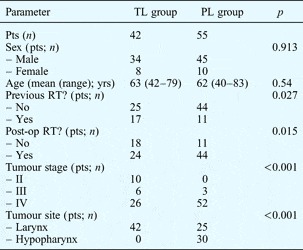
Forty-two patients underwent total laryngectomy and 55 patients pharyngo-laryngectomy; data are shown in Table I. There were significantly more salvage cases in the total laryngectomy group (p = 0.027); this explains this group's significantly greater number of patients with earlier tumour (T) stage disease (p < 0.001), and significantly lower frequency of post-operative radiotherapy (p = 0.015). As expected, the pharyngo-laryngectomy group had a significantly greater number of cases with tumour arising from the hypopharynx (p < 0.001).
Surgical groups: patient data

TL = total laryngectomy; PL = pharyngo-laryngectomy; pts = patients; yrs = years; RT = radiotherapy; post-op = post-operative
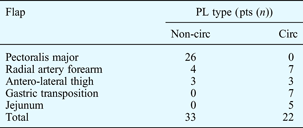
In the pharyngo-laryngectomy group, 33 patients had non-circumferential resections and 22 circumferential resections. Table II shows the flap types used in this group.
Flaps used in pharyngo-laryngectomy group

PL = pharyngo-laryngectomy; pts = patients; circ = circumferential
Post-operative fistulae developed in six of the 42 total laryngectomy patients (all were managed conservatively) and in 12 of the 55 pharyngo-laryngectomy patients (six required another flap, using the pectoralis major muscle).
Overall functional results
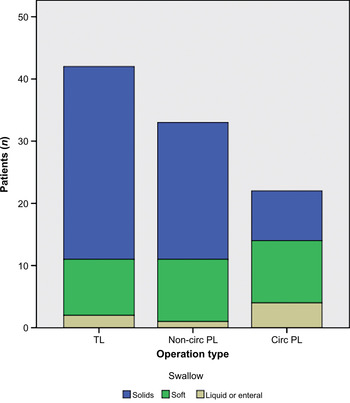
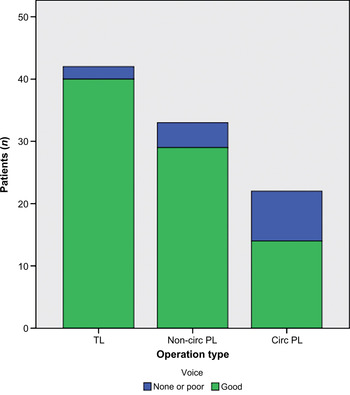
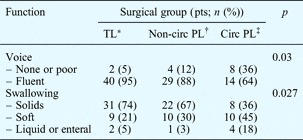
The overall voice and swallowing results for the total laryngectomy, non-circumferential pharyngo-laryngectomy and circumferential pharyngo-laryngectomy patients are shown in Figures 1 and 2 and Table III. Both voice outcomes (p = 0.03) and swallowing outcomes (p = 0.027) varied significantly amongst these groups.
Histogram showing patients' swallowing outcomes. TL = total laryngectomy; circ = circumferential; PL = pharyngo-laryngectomy

Histogram showing patients' voice outcomes. TL = total laryngectomy; circ = circumferential; PL = pharyngo-laryngectomy

Functional results

*n = 42; †n = 33; ‡n = 22. TL = total laryngectomy; PL = pharyngo-laryngectomy; circ = circumferential
There were significantly worse voice outcomes (p = 0.037) and swallowing outcomes (p = 0.041) after circumferential pharyngo-laryngectomy, compared with non-circumferential pharyngo-laryngectomy. As shown by Figures 1 and 2, there were no significant differences in voice outcome (p = 0.23) or swallowing outcome (p = 0.655), comparing total laryngectomy and non-circumferential pharyngo-laryngectomy patients.
To test whether the worse outcomes of circumferential pharyngo-laryngectomy were due to poor results of gastric transposition, patients within this group were divided into those receiving gastric transposition and those receiving free flaps. There was no significant difference between these two groups, for either voice outcomes (p = 0.604) or swallowing outcomes (p = 0.672).
Therefore, voice and swallowing outcomes were similar in the total laryngectomy and non-circumferential pharyngo-laryngectomy patients, but were significantly worse in the circumferential pharyngo-laryngectomy patients compared with either of the other two groups.
Eleven patients required dilatation. This was not significantly associated with the operation type (either pharyngo-laryngectomy versus total laryngectomy (p = 0.459) or non-circumferential pharyngo-laryngectomy versus circumferential pharyngo-laryngectomy (p = 0.425)) or fistula development (p = 0.213).
Potential confounding factors
Previous radiotherapy had no significant effect on voice outcomes (p = 0.22) or swallowing outcomes (p = 0.608). Likewise, post-operative radiotherapy had no significant effect on voice (p = 0.252) or swallowing (p = 0.587). Female patients had significantly worse voice outcomes than male patients (p = 0.011), but swallowing outcomes did not differ significantly (p = 0.69). Disease stage had no significant effect on voice (p = 0.136) or swallowing (p = 0.468). Patients with hypopharyngeal tumours had significantly worse voice outcomes than those with non-hypopharyngeal tumours (p = 0.04); it is possible that this result occurred because all hypopharyngeal tumour patients were in the pharyngo-laryngectomy group (including those with circumferential procedures). However, there was no significant influence on swallowing (p = 0.107), comparing these same two groups.
Post-operative fistulae occurred in 18/97 patients (i.e. six of 42 total laryngectomy patients, four of 33 non-circumferential pharyngo-laryngectomy patients and eight of 22 circumferential pharyngo-laryngectomy patients), and affected both voice outcomes (p = 0.001) and swallowing outcomes (p = 0.009). There was a significant difference in fistula frequency between the groups (p = 0.049), due to a higher frequency in the circumferential pharyngo-laryngectomy group.
Multivariate analysis was carried out using a stepwise model of all variables. When swallowing was reduced to a binary classification (i.e. liquid or enteral versus soft or solid), only fistula occurrence emerged in the final model (p = 0.05). When swallowing was classified as solid versus soft or liquid, only operation classification emerged in the final model (p = 0.016). For voice, the variables in the final model were sex (p = 0.016), operation classification (p = 0.022) and fistula (p = 0.025).
Discussion
In this study, we found that the key functional outcomes of voice and swallowing were very similar for both non-circumferential pharyngo-laryngectomy with flap reconstruction and standard, wide-field total laryngectomy. Voice fluency rates were 95 per cent in the total laryngectomy group and 88 per cent in the non-circumferential pharyngo-laryngectomy group, while rates for fluid-only nutrition (with or without gastrostomy) were 5 and 3 per cent, respectively. However, we found poorer outcomes for both voice (p = 0.03) and swallowing (p = 0.027) after circumferential pharyngo-laryngectomy, compared with the other operative procedures. (For clarity, we emphasise that all pharyngo-laryngectomies involved flaps for pharyngeal reconstruction, i.e. there were no cases with primary closure.)
The poorer outcomes after circumferential pharyngo-laryngectomy could be due, at least in part, to a higher fistula rate (p = 0.05), as there was a significant association between this and both voice (p = 0.001) and swallowing (p = 0.009) outcomes. However, multivariate analysis indicated that both operation type (p = 0.022) and fistula occurrence (p = 0.025) independently influenced voice outcome. For swallowing outcomes, the only variable in the multivariate model was fistula for poor swallow (i.e. liquid or enteral, p = 0.05) and operation type for good swallow (i.e. solid vs soft or liquid, p = 0.016).
Therefore, the occurrence of a post-operative fistula is an important determinant of vocal and swallowing outcomes, but does not account for all the effect of operation type, the exception being in predicting very poor swallowing outcomes.
We acknowledge the inherent limitations of this retrospective study, with three distinct groups of patients. As a retrospective study, the assessment of voice (especially) and swallowing function was somewhat blunt, and could be more accurate and/or detailed in a prospective study. However, we aimed to assess patients' crude ability to gain fluent, natural voice for day-to-day communication. Similarly, there are more detailed assessment tools for dysphagia, such as the M D Anderson Dysphagia Inventory.Reference Chen, Frankowski, Bishop-Leone, Hebert, Leyk and Lewin4 However, these are general instruments, and some items are not relevant to patients undergoing total laryngectomy (e.g. assessment of aspiration).
Our study focused on the two specific, variable functional outcomes that are arguably of most importance to patients undergoing total laryngectomy or pharyngo-laryngectomy: voice and swallowing. Indeed, given the fact that having a permanent stoma is a fixed outcome after total laryngectomy, the key variable determinants of quality of life after laryngectomy or pharyngo-laryngectomy (and what patients want to know about) are successful development of fluent speech and good quality swallowing.
We also analysed the need for dilatation procedures, and found no differences between the surgical groups in this respect. Relatively few of our patients (11/97) required dilatations. In any case, the more important end result was patients' ability to swallow. When dilatations are required, they are usually performed radiologically. We found this approach to be safe and fairly convenient for patients.Reference Williams, Kasir, Penny, Homer and Laasch5
The functional outcomes in our two pharyngo-laryngectomy groups are broadly in line with others' experience. Thiele et al. reported full nutrition rates of 92 per cent following jejunal grafting.Reference Theile, Robinson, Theile and Coman6 Lewin et al. studied patients undergoing surgical voice restoration, and reported fluent speech in 63 and 89 per cent of those with circumferential defects reconstructed with jejunal and anterolateral thigh flaps, respectively.Reference Lewin, Barringer, May, Gillenwater, Arnold and Roberts7 Our circumferential pharyngo-laryngectomy group was too mixed to draw conclusions regarding the advantages of different flap types.
Few authors have reported their experience of circumferential and non-circumferential defect reconstruction. Clark et al. studied post-pharyngo-laryngectomy morbidity in 85 patients undergoing non-circumferential resection and 68 undergoing circumferential resection. Whilst most measures of morbidity (including flap-related morbidity) were higher in the circumferential group, the overall gastrostomy tube dependence was higher in the non-circumferential group (21 vs 10 per cent), as was the fistula rate (38 per cent).Reference Clark, Gilbert, Irish, Brown, Neligan and Gullane1 In contrast, our non-circumferential resection group had a lower incidence of gastrostomy or liquid-only swallowing (one of 33; 3 per cent), and a fistula rate of 12 per cent (four of 33). Clark and colleagues' choice of flaps for non-circumferential resection was similar to ours (both studies favoured pectoralis major flaps for these defects). Clark et al. had more patients undergoing salvage surgery, compared with our pharyngo-laryngectomy group (52 vs 20 per cent, respectively). The two studies differed in the use of salivary bypass tubes: Clark et al. used these only in some of their circumferential resection patients, while we used them in all non-circumferential pharyngo-laryngectomy patients. This may be one factor contributing to a low fistula rate (and therefore a better functional outcome).Reference Varvares, Cheney, Gliklich, Boyd, Goldsmith and Lazor8 Salivary bypass tubes help minimise salivary leakage in the event of minor flap (or pharynx) dehiscence, as well as helping to prevent anastomotic strictures.Reference Murray, Gilbert, Vesely, Novak, Zaitlin-Gencher and Clark9
To our knowledge, there have been no previous reports comparing pharyngo-laryngectomy (with flap reconstruction) with standard, wide field, total laryngectomy as the ‘gold standard’. Our findings are relevant to three areas of clinical practice.
Firstly, our results are useful when advising patients about their expected level of function after pharyngo-laryngectomy surgery, and when obtaining informed consent. Our findings indicate that, if a non-circumferential defect is achieved and reconstructed, similar functional results can be achieved as with standard total laryngectomy with primary closure.
Secondly, it is not uncommon to encounter borderline cases which could be resected and reconstructed using either standard total laryngectomy with primary closure or non-circumferential pharyngo-laryngectomy with a flap. These cases often involve advanced supraglottic tumours. On the basis of our experience, we would advocate that surgeons have a low clinical threshold for performing non-circumferential pharyngo-laryngectomy, as (1) the functional outcome is very similar, and (2) early surgery will increase the likelihood of negative surgical margins, an important prognostic indicator of survival.
Thirdly, there is some debate about the point at which, for oncological or functional reasons, a circumferential resection plus reconstruction should be performed rather than a non-circumferential resection. From a functional point of view, our data suggest that non-circumferential pharyngo-laryngectomy gives better results. Therefore, if (and only if) the oncological margins of resection are not compromised, there is merit in pursuing a non-circumferential resection. Does this mean that leaving a relatively small strip of posterior pharyngeal wall is worthwhile? It is difficult to comment. However, this sort of case (in which a relatively small strip of pharynx was left, of at least 10 mm diameter) was reasonably well represented in our non-circumferential resection group. Generally, our policy has been to avoid circumferential pharyngo-laryngectomy if it is safe and possible to do so, and our study results suggest that this approach is worthwhile in terms of function.
• The functional results of modern total laryngectomy (i.e. voice and swallowing) are usually acceptable
• In this series, non-circumferential pharyngo-laryngectomy (with flap reconstruction) had similar functional results to total laryngectomy
• The functional results of circumferential pharyngo-laryngectomy were poorer; this was partially due to post-operative fistula formation
We continue to use a pectoralis major myocutaneous island flap for most non-circumferential defects. By doing so, we find that operating time is minimised, donor site morbidity is low and the flap failure rate is zero.Reference Merve, Mitra, Swindell and Homer10 In women and younger or fitter patients, we prefer Anterolateral thigh (ALT) flaps for non-circumferential defects.
In patients who do require circumferential resection, there is an on-going need to improve functional outcomes. Our data indicate that avoiding post-operative fistulae is crucial, particularly in preventing poor swallowing outcomes. Continued use of tubed ALT flaps for circumferential pharyngo-laryngectomy reconstruction may also improve functional outcomes, as noted by others, to the point of closing the gap between non-circumferential and circumferential pharyngo-laryngectomy functional results.Reference Lewin, Barringer, May, Gillenwater, Arnold and Roberts7, Reference Murray, Gilbert, Vesely, Novak, Zaitlin-Gencher and Clark9, Reference Yu, Hanasono, Skoracki, Baumann, Lewin and Weber11 Yu et al. recently reported a series of 114 patients reconstructed with ALT flaps, 67 of whom had circumferential defects; the incidence of fistulae was 9 per cent and that of adequate swallowing (for nutrition) 91 per cent, suggesting that this approach may be the way forward for this group of patients.Reference Yu, Hanasono, Skoracki, Baumann, Lewin and Weber11
Conclusion
The functional results of circumferential pharyngo-laryngectomy are significantly worse than those of both non-circumferential pharyngo-laryngectomy and total laryngectomy. However, the functional results of non-circumferential pharyngo-laryngectomy (with flap) and total laryngectomy (with primary closure) are very similar.
Acknowledgement
The support of the National Institute of Health Research (NIHR) Manchester Biomedical Research Centre (BRC) is acknowledged.