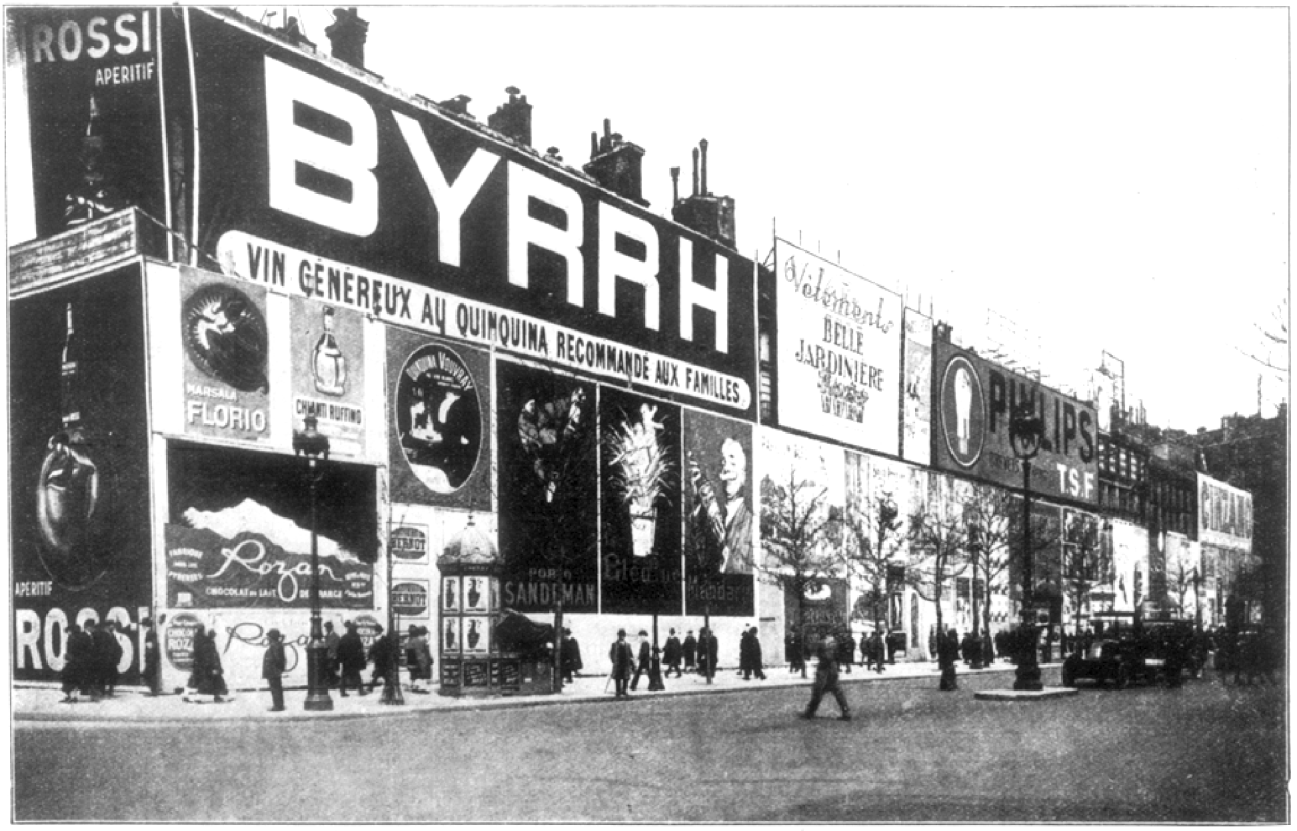
On 23 August 1940, the Vichy regime enacted the ‘Loi contre l'alcoolisme. This legislation banned the manufacture and sale of aperitifs based upon alcohol distilled from anything other than grapes. It also halted publicity for aperitifs in newspapers, on the radio, and billboards. A decree of September 1941 went further, prohibiting advertising for any distilled alcohols. By July 1942, all alcohol advertising was finally banned in France. The manufacture, sale, or distribution of publicity objects was also forbidden. Café owners, retailers, and wholesalers were given six months to surrender such objects to their local préfecture. Within the same period, existing advertising was to be ripped down: ‘Posters and billboards must be removed or completely effaced in France.’Footnote 1
Repressive wartime alcohol policies were not unprecedented in France. Requirements for alcohol supplies in the manufacture of explosives, together with concerns for morale and public health, had led to extensive anti-alcohol measures during the Great War. Restrictive licensing hours were introduced from 1914 and absinthe was prohibited in 1915.Footnote 2 The Vichy regime's anti-alcohol legislation was couched in terms of public health and included the requisitioning of alcohol for explosives and transport to Germany. However, Vichy's ‘exceptional and involuntary experiment in alcoholic disintoxication’ was remarkable because the policy originated not in the reality of alcoholic products, but rather in the ways they were perceived and represented.Footnote 3 Distilled alcohol beverages were targeted despite the fact that, between 1920 and 1940, their consumption had declined by 39 per cent. Wine remained inviolate, even though, during the same period, consumption had risen by 22 per cent.Footnote 4 Furthermore, the regime did not simply attack alcoholic products. Visual manifestations of alcohol, particularly advertising, were assaulted in unprecedented ways.Footnote 5 The legislation revealed that alcohol could no longer be disassociated from its advertising. For the regime, wholesale destruction of alcohol advertising represented an important attack upon the despised Third Republic with which such publicity was closely identified. As Marcel Marion of the Parti populaire français proclaimed: ‘Thanks to us, the France of camping, of sports, of dances, of voyages, of collective hiking will sweep away the France of aperitifs, of tobacco dens, of party congresses and long digressions.’Footnote 6
This article reassesses French interwar advertising through the case study of alcohol. It suggests that the ferocity of Vichy's assault upon alcohol advertising and the regime's identification of such publicity with interwar France does not square with views that the period's advertising had been retarded, underdeveloped, or at least evolving slowly through the adoption of American techniques.Footnote 7 The very success of alcohol advertising enabled Vichy to ascribe a great deal of importance to a product whose consumption had actually declined during the interwar period.
The current historiography of French advertising turns around Americanization, either as a model for emulation or, indeed, as a process which self-consciously had to be fought against. French interwar advertising is almost always examined within the context of the United States, where advertising was a serious profession responding to the needs of a highly specific consumer model.Footnote 8 American firms had pioneered the use of advertising to ‘educate’ people in accordance with extensive market research and ‘scientific’ studies of consumer profiles and behaviour. US advertisers were the first to address their advertising and marketing directly at consumers rather than wholesalers and retailers.Footnote 9 For Victoria de Grazia, French advertising developed during this period through gradual application of American models.Footnote 10 Her influential analysis fits into the wider historiography of Americanization, suggesting that all that was modern originated in the United States which proceeded to impose its will and ways on Europeans who either adapted or were destroyed.Footnote 11 Marie-Emmanuelle Chessel explains that American innovations inspired French advertisers to define their methods and become technical specialists through professional training and organizations.Footnote 12 American advertising also provides the context for developments in France for Marjorie Beale. She suggests that French businesses responded to the unattractive commerciality, obsessively detailed description of objects, stereotypical representations of daily life, and standardized appeals of American ‘scientific’ advertising by devising their own science of advertising rooted in native psychological and philosophical tradition.Footnote 13
As this article suggests, there was a specifically French way of advertising. Rather than the concerted attempt to adjust American advertising to French sensibilities described by Beale, French publicity techniques followed a domestic trajectory that reached back to the Belle Époque.Footnote 14 Traditional advertising techniques were highly adapted to the specificities of the domestic market.Footnote 15 French advertising was not retarded simply because it appeared less clearly utilitarian than its American counterpart. Indeed, as the case of alcohol demonstrates, there is little to be gained by analysing French interwar advertising and the consumerism that it reflected through the prism of Americanization.
Consumerism along American lines required a large urban and middle-class population with disposable income. During this period France remained largely rural; by 1931 urban dwellers comprised only 51·2 per cent of wage earners.Footnote 16 Low salaries also shaped the French market. Although per capita income increased unsteadily from a base of 100 in 1913 to 688 by 1938, wages were between 40 and 50 per cent inferior to those in the United States.Footnote 17 In France, the luxury consumer durables that fashioned American advertising trends were unattainable for many; in 1928 a Hoover cost 855 francs when skilled workers earned only 5 and 6 francs per hour.Footnote 18 French manufacturers of expensive consumer durables were thus reluctant to court the mass market and their advertising was relatively unimportant. Carmakers like Renault, technically capable of mass production, ignored the potential demand and rejected cheaper models in favour of expensive ones that promised higher profit. French radio makers kept prices so high that, by 1932, radio stores could offer discounts of 40 per cent and still make a living.Footnote 19 The advertising and consumption of the luxury products that shaped American models had little influence on French techniques and practices.
French consumerism had its own specific characteristics. Although the domestic market in luxury consumer durables was underdeveloped, France possessed a highly competitive sector in non-durables, particularly food and drink. Lower French salaries meant that food and drink continued to account for 60 per cent of the average household budget and the same percentage of retail sales. This figure had changed little since the Belle Époque, declining from 66 per cent in 1896 to 62 per cent by 1938.Footnote 20 Alcohol sales accounted for nearly 9 per cent of household food budgets. Since the Belle Époque, there had been a continual evolution in the variety and quality of food and drink purchased; between 1880 and 1938 wine consumption rose by 45 per cent, milk and meat consumption by 50 per cent, coffee by 186 per cent, and chocolate by 240 per cent.Footnote 21 Concurrent increases in the branding of such products suggest that consumer choice was operating throughout this period.
Whilst aggressive sales techniques and marketing were vital in the American market to inform consumers about the necessity and exploitation of new industrial products, they were less suited to the basic products that were core to French consumers. Although no single industry can be fully representative of wider French advertising trends, it makes sense to focus upon those products that were key to the development of France's consumerism during this period.Footnote 22 Together with foodstuffs and tobacco, alcohol represented one of France's most significant non-durable goods. The alcohol sector was the third most important field for advertisers, accounting for 15·2 per cent of publicity expenditure (after pharmaceuticals which comprised 39·5 per cent and department stores with 24 per cent).Footnote 23
Of the simple non-durable goods, alcoholic beverages followed one of the clearest commercial trajectories from the late nineteenth century. Ever since the Belle Époque, alcohol advertisers had been obliged to distinguish their products in a crowded marketplace; they aimed to encourage consumers to sample new brands of familiar products and foster brand loyalty, rather than to experiment with new products of limited appeal.Footnote 24 Marketing, branding, and aesthetics were therefore more important in France than the explanation and argument of American ‘scientific’ advertising. French advertising and marketing also took account of the important position held by retailers and wholesalers within the French distribution system.Footnote 25 The American innovation of directing advertising at consumers, rather than retailers and wholesalers, was irrelevant for alcoholic products. With one drinking facility for every eighty-one men in France by 1937, alcohol advertisers targeted the country's half million or so cafés, bars, and wine merchants just as directly as individual drinkers.
This article therefore suggests that, rather than representing ‘retardation’, distinctions between French and American advertising were simply a function of the different products that French advertisers were selling and the society in which they operated. Separate French advertising traditions developed accordingly. Whilst French advertisers were certainly inquisitive about American models, their fascination was primarily motivated by an awareness that greater professionalization might mitigate some of the negativity with which their industry was viewed. Discussion of American models did not often extend to the way in which products were advertised and marketed. French advertising had little to gain from evolving along foreign lines until the nature of domestic consumption itself shifted.
French advertisers were pragmatic actors in an established, but highly specific consumer market. This article demonstrates that advertising did not create a new consumer culture,Footnote 26 control consumers,Footnote 27 or act as a form of ‘private sector Keynsianism’Footnote 28 as some theorists of advertising have suggested. It concurs with Jean Baudrillard's suggestion that ‘advertising is rarely the leader in changing consumer patterns’. Indeed a focus on interwar French alcohol advertising illustrates the manifold ways in which advertising acted as a mirror to society, reflecting cultural and economic factors together with consumers' habits and lifestyles.Footnote 29 The alcohol market reveals the extent to which interwar French advertising and consumption patterns were rooted in the social and economic changes of the Belle Époque. Not only did the social transformations that gave rise to advertising make certain basic mass-produced products more important, but they also altered the criteria for consumption and the qualities of goods deemed desirable. In this context, alcohol advertising confirms the example of the cigarette market. Cigarette usage spread due to standardization and changing social mores; such changes were reflected rather than initiated by advertising.Footnote 30 Products, consumers, and contemporary society created advertising strategies, not the other way round.
Debates over American and French styles of advertising are less important than historians have suggested, particularly when advertising is examined as a phenomenon that is as much socio-cultural as entrepreneurial. French advertising strategy was shaped both by the need to sell a popular product in a competitive market and by the enhancement of pre-existing strategies, rather than by theoretical or nationalistic considerations. As this article argues, advertising did not shape French consumerism. Instead, advertising successfully reflected established consumer patterns and interwar French society to such a degree that, by 1940, the Vichy regime had earmarked it for destruction.
I
The interwar years saw the development of the French advertising industry. Investments in advertising increased in real value between 1900 and 1938 from 100 million francs to 2,000 million francs.Footnote 31 Yet the advertising industry was disliked and mistrusted by the French.Footnote 32Vendre suggested in 1924 that: ‘The American public, just like their English counterparts, have confidence in advertising, reading it for information. In utter contrast, the French public defies it.’Footnote 33 In 1921, the first issue of La Publicité grumbled: ‘For a long time, our public has dismissed pages of advertisements and advertising posters. It sees any advertising as bluff or lies.’Footnote 34 Such fears were supported by the publication in 1931 of a series of articles criticizing advertisements by the daily newspaper L'Intransigéant: ‘The French are the people who most dread advertising. They think of it with horror.’Footnote 35 Many French intellectuals followed the lead of Georges Duhamel who attacked advertising in his 1931 work entitled Scènes de la vie future.Footnote 36
Until the Second World War, most French companies were reluctant to believe that investing in publicity was beneficial: ‘It is rare to find an industrialist or businessman in France who undertakes advertising with pleasure … a major advertising effort is missing in many cases.’Footnote 37 French companies seldom had advertising departments and those that did were underdeveloped. In 1932, Renault had 792 commercial workers but only twenty-four were employed in its publicity division.Footnote 38 During the interwar period, French businesses, overwhelmingly led by engineers and technicians, favoured technical issues over sales.Footnote 39
The power of small business was another factor in French negativity towards advertising. In rural France, everyday products such as food, pharmaceuticals, and particularly alcohols were generally sold within village stores or in cafés.Footnote 40 Retailers were far from professionals; even in 1938, 55 per cent had a supplementary form of employment and were known as ‘demi commerçants’. These small retailers kept minimal stock and viewed new brands as an unnecessary expense.Footnote 41 They bought from wholesalers with whom they often enjoyed long generational relationships. Advertising had little role because it mostly concerned new brands with no place in the system. Retailers feared that advertisers would harm the relationship that they held with the customer. In traditional distribution networks, it was the retailer who advised his client. It was felt that ‘Advertising puts manufacturers in a dominant position, forcing retailers to adhere to recommended prices and giving them no concessions.’Footnote 42
In response to such problems, the industry attempted to modernize and acquire an aura of professionalism and respectability. Over the period, advertisers developed a specialist press with magazines such as La Publicité (1903), Réussir (1925), and Vendre (1923). The magazines combined advice and surveys on marketing and advertising with a range of reports on the industry in other countries, particularly America. Advertising companies also became larger and more integrated. The century-old company Havas, separated into press, catalogue, and poster divisions during the late nineteenth century, was finally reunited as a single unit in 1920. Its monopoly was broken by the arrival of agencies such as Succès (1926), Publicis (1927), and Synergie (1932). These organizations incorporated all aspects of publicity, which they presented as a new science.Footnote 43 The new companies forced hitherto independent players in the advertising industry, such as artists, to play a team role in the increasingly integrated field.Footnote 44
The advertising industry began to resemble a real profession. Professional bodies were formed such as the Corporation des techniciens de la publicité (1920) and the Chambre Syndicale de la publicité. A federation of independent unions was formed with the Fédération française de la publicité (1934). In the same year, the industry founded its own Paris club, the Maison de la publicité, which counted 1,000 members by 1940. Specialist training and diplomas were also developed. Although some advertising had been included in the curriculum of Haute école de Commerce since 1911, it only accounted for ten hours per year by 1913. In 1927, the industry created the École technique de la publicité with specialist lessons on co-ordinating strategy, directing collaborators, and technical aspects such as editing, drawing, reproduction, impression, and diffusion of advertising.
The adoption of professional models pioneered in the USA did not represent the wholesale importation of American techniques, or even their self-conscious rejection. Rather, such developments were the attempts of a well-developed industry to garner respectability and built upon its substantial achievements.
The French were already ‘pioneers in advertising’. Belle Époque Paris was ‘a modern capital of consumption, a city of boulevards, cafés, electric lights, apartments, advertising posters, the metro, cinema, restaurants and parks’.Footnote 45 The city's so-called ‘spectacular culture’ was held together by the twin pillars of advertising and retailing. Belle Époque advertising had provided the symbol systems essential to the construction of a consumer society. In both iconographic and verbal forms as brand names or brand representations, symbols provided useful shorthand for a public being transformed into consumers. With developments in lithography and photography, Belle Époque Paris was saturated with images, particularly advertising posters that integrated words with images. Jostling for the viewer's attention on crowded walls, posters were as striking and clear as possible. French advertising was adapted to national life in its urban and rural manifestations. The grands magasins initiated displays of wax mannequins, absinthe companies pioneered publicity accessories which were sent to cafés throughout the Hexagon, the press integrated advertising into its columns, companies developed prospectuses and printed catalogues whilst advertisers experimented with new techniques using electric lighting in towns and wall paintings in villages.Footnote 46
During the interwar period, French advertising drew upon its own traditions and techniques. Certainly the industry responded to widespread cynicism and mistrust by adopting tactics demonstrating that it was a well-ordered and rational profession. Yet new American-inspired models were primarily organizational. Whilst interwar advertising professionals ran their businesses and structured the industry along the lines of the highly successful American advertising industry, the methods that they used were rooted in domestic traditions.
II
If modern advertising was born during the Belle Époque, so were modern alcoholic beverages. During the Belle Époque, as wine became costly due to the phylloxera epidemic, advances in the production of sugar-beet alcohol led to cheaper distilled alcohol. A shot of cheap ‘cognac’ made from beet alcohol sold for ten centimes while, even in 1907, a glass of ordinary wine in Paris cost more.Footnote 47 Beet alcohol expanded the alcohol market by making a whole range of cheap cognac, aperitifs, and fortified wines, hitherto produced with expensive wine alcohol, available to the ordinary consumer. By 1900, beverages based upon sugar-beet alcohol accounted for over half of all distilled alcohol drinks sold in France.Footnote 48 Between 1850 and 1890, wine consumption only rose by 26 per cent from 20·8 million hectolitres to 28 million hectolitres, yet taxed consumption of distilled alcohol products rose by 65 per cent from 585,000 hectolitres to 1·7 million hectolitres.Footnote 49
The development of sugar-beet alcohol, together with the penury and expense of wine, led to the growth of modern aperitifs. New machinery, railway building, and mass-production techniques transformed aperitif production from a regional industry. For the first time beverages could be mass-produced and transported to a national market, particularly the expanding urban conurbations of Paris, Marseilles, and Lyons. In these cities, spiralling numbers of bars and cafés catered to a new urban working class for whom the bonds of sociability were frequently formed around alcohol consumption. Diverse manufacturers multiplied and, by 1900, France boasted 1,500 aperitif brands. In 1891, an article entitled ‘Vive l'apéro’, published in the Revue vinicole, noted that the aperitif had become a national habit.Footnote 50 Absinthe was the most important of the new aperitifs, accounting for approximately 20 per cent of such consumption, but the Belle Époque also saw the creation of other tipples such as quinquina wines, bitters, gentian drinks, and vermouths.
Such a lucrative, but competitive market meant that advertising assumed a vital importance for aperitif and absinthe producers, who could distinguish their merchandise and appeal to different consumer requirements. It was not unusual for an alcohol company to spend one quarter or even one third of its outgoings on publicity.Footnote 51 When Saint-Raphaël was floated as a public company in 1898 its new statutes obliged the company ‘to spend over a maximum period of five years, a capital sum of 500,000 francs for advertising in the name of Saint-Raphaël quinquina’.Footnote 52
Absinthe producers, in particular, established traditions of marketing, advertising, and branding that later influenced the aperitif advertising of interwar France. From Peureux in the Saône, Noilly et Fils in Lyons, Pernod Fils, Berger, and Cusenier in the Midi to Duval and Hémard in the Ile de France, brand names proliferated, offering a guarantee of quality.Footnote 53 Once branding was established, advertisers conferred individual identities upon their products, associating them with the exoticism, health, seduction, and regional traditions that consumers craved. Advertising posters linked striking images with brand names. Information about the product was incorporated within the advertising image, rather than through textual argument. Absinthe Parisienne demonstrated the product's health-giving qualities with an advertisement featuring a seductive woman accompanied by a doctor. Both figures lean on a life-size bottle which carries the label ‘Santé’.Footnote 54 Different classes and political persuasions were identified and targeted with products such as ‘Absinthe anti-Juive’ and ‘Absinthe Président Sadi Carnot’.Footnote 55 Great attention was given to products that accompanied absinthe such as carafes, saucers, water fountains, and match strikers.Footnote 56 As the commercialization of absinthe makes clear, Belle Époque advertising was shaped both by the product and the society in which it operated.
Contemporaries often inferred that alcohol publicity was typical of Belle Époque advertising. In 1893, Villier de l'Isle-Adam (1838–89) produced a short story entitled ‘L'affichage celeste’ (The heavenly billboard). It predicted the use of electric lights to generate an absolute publicity where advertising messages were projected upwards to shine among the stars. ‘What emotion concerning dessert liqueurs … if one were to perceive, in the south of Regulus, this heart of the lion, on the very tip of the ear of corn of the virgin, an Angel holding a small flask in hand, while from his mouth comes a small paper on which could be read the words: My, it's good!’ For the economist, Charles Gide (1847–1932),
Society has been inundated by advertising. Buried beneath this flood, consumers have been corrupted by cravings for unnecessary objects. They long for a prodigious variety of absinthes and aperitifs only because manufacturers and retailers have covered the walls with juxtaposed posters repeating a hundred times: Byrrh! Byrrh! Byrrh! Or Kling! Kling! Kling! until the consumer is hypnotized.Footnote 57
The Belle Époque had shaped, and been shaped by, the distilled alcohol industry, particularly the production and advertising of aperitifs. Yet, by the turn of the century, the dizzying rise in distilled alcohol consumption began to slow; the phylloxera epidemic waned and wine became cheaper and more abundant. In the decade before the Great War, whilst wine consumption rose sharply, distilled alcohol consumption began to fall. This was not simply a result of increased temperance campaigning and the prohibition of absinthe in 1915. It also demonstrates the extent to which distilled alcohol consumption was primarily influenced by variations in the supply and price of wine. By the interwar period, French wine supply had entered a dramatic period of over-production and low prices, in part due to increased Algerian supply. The 1920s and 30s were characterized by falls in distilled alcohol consumption of 35 per cent during the 1920s and 18 per cent during the 1930s.Footnote 58 These correlated almost exactly with rises in wine consumption. With little potential to rationalize production further, the only answer for alcohol manufacturers was to invest heavily in the type of advertising that had been so successful during the Belle Époque.
III
The highly varied alcohol sector remained important for French advertisers during the interwar period. Aperitifs were modern industrial products, frequently rooted in traditional, regional recipes. They differed from other French alcohols, especially wine, in several respects which made them highly dependent upon advertising. Whereas wine was an ordinary consumer product that was drunk with meals and usually purchased in a generic form, aperitifs, although not luxuries, were certainly not basic household products, particularly in working-class homes. The aperitif market was extremely competitive and each aperitif relied upon a powerful image that advertisers had to construct or maintain. Unlike wine, aperitifs were most frequently consumed outside the home in cafés and bars. Advertisers were not simply targeting final consumers, but also intermediaries, including the café owners and wholesalers who supplied them. Certain private wine firms such as Nicolas and Clos du Postillon imitated the advertising techniques of the aperitif industry to brand their products, distinguishing them from other generic ‘vin de pays’.Footnote 59 Whilst the success of independent wine and cider producers relied primarily upon the quality of the harvest, aperitif or wine companies depended upon the zeal with which they marketed and distributed their products.
The economic conjuncture of the interwar years increased the reliance of the sector upon advertising. French exports, especially luxury goods, steadily declined between 1930 and 1936. The situation was especially difficult for alcohol manufacturers. The double blow of recession and American prohibition led to an increased concentration upon home markets and more modest consumers. This, in turn, created a greater reliance upon advertising and marketing for the alcohol business, ensuring that the most recognizable advertisements and slogans in the alcohol sector originated in the depression period, particularly during the 1930s.Footnote 60
Companies devoted an ever-larger proportion of resources to advertising during the 1930s. Cinzano, established as a French company, made a profit of 11,267,337 francs between 1934 and 1935. During the same period, it spent 4,569,000 francs on marketing and advertising.Footnote 61 By 1938, Vendre marvelled at the scale of aperitif advertising: ‘Only a statistician or astronomer could say how many posters have been published for aperitifs since the beginning of this century! I pity the poor artists who are constantly being asked to create something original in this direction.’Footnote 62
The alcohol companies began to employ personnel whose sole role was to deal with advertising. Companies needed to distribute their growing advertising budgets, select media supports, buy advertising space, and homogenize their message, images, and supports with a commercial policy. It became necessary to engage either an agence de publicité (advertising agency) or a chef de publicité (advertising director). There seems to have been no clear pattern amongst alcohol companies. Whilst ‘Vins de Postillon’ engaged an in-house chef de publicité, it was the commercial director of Marie Brizard et Roger who managed the advertising budget and called upon an agence de publicité, Géo Arundel 1928.Footnote 63 Alcohol companies required a sales approach that targeted wholesalers, retailers, and consumers. Advertising permeated every stage of the sales process. Wholesalers supplied cafés, bars, and small wine sellers, who in turn sold the products on to individual consumers. Aperitif manufacturers were one of the earliest French businesses to break into local retail networks. After all, it was futile to persuade customers to request a particular brand if it was unavailable at the point of sale. It was vital that the café patron liked a particular aperitif. He could be a valuable publicity machine amongst his clientele. Much effort was made to market products to retailers. Vendre pointed out repeatedly:
It is important that the retailer is on your side … he will know how to impose the product on the consumer … Turn the retailer into a sympathizer. If you can, before unleashing your advertising efforts to increase places where the product is sold, you shouldn't neglect to multiply the sales agents acting to interest the retailer in your product … You should show that it is in his own interest to push your product.Footnote 64
Aperitif companies often offered gifts as a prize for efficient selling: ‘Like many aperitif companies, Dubonnet distributes a free gift, almost automatically, for a certain number of bottles sold. It is rather like a bonus.’Footnote 65
Travelling salesmen were another important aspect of the aperitif companies' marketing strategy and they were instructed to cultivate the retailer's sympathy: ‘A little bit of vulgarity will help travelling salesmen. The representative of a spirit company should come into a wine shop with his hat fixed on his head, and, after a few minutes of conversation, he should be able to rest both elbows on the bar counter.’Footnote 66 This approach also allowed companies to adjust to the geographical specificities of the French market. Whereas publicity was well received in the Midi, it was disliked in Brittany and Normandy. In these regions, Marie Brizard et Roger adapted their strategy by eschewing advertisements in the local press and limiting poster advertising. Instead the company used extensive networks of commercial travellers and offered free tasting opportunities at local fairs, markets, and cafés.Footnote 67
Following the traditions of Belle Époque absinthe producers, aperitif companies produced a variety of primes (branded articles and gifts) which could be prominently displayed in cafés and bars. Vendre ran a special edition on these gifts in 1934 which claimed that the recession had made them all the more necessary: ‘Loyal customers … are becoming more and more rare – little gifts help keep friendship alive.’ The article praised aperitif manufacturers for their skilful distribution of gifts which enabled them to enter the private world of the drinking establishment.Footnote 68 Aperitif manufacturers offered café equipment like ashtrays, water carafes, ice buckets, window displays, bills, and menu covers.Footnote 69 Calendars were important branded gifts because of ‘their constant utility, given that everything about the article reminds the retailer of the address and details of your company’.Footnote 70 Companies produced writing sets and bookmarks for the comfort and convenience of the café habitué.Footnote 71 Other gift objects included folders for transport timetablesFootnote 72 and maps.Footnote 73 Increasingly anxious to associate themselves with the conviviality of café life, the companies offered gifts to encourage card playing and ensure that it was accompanied by their own brand of aperitif. In a 1935 advertisement, Pikina showed a sketch of a card game. The slogan reads ‘Atout! … je gagne … et je prends: Pikina (Trump … I win … and I can have: a Pikina).Footnote 74 Companies such as Dubonnet, Byrrh, and Bonal distributed packs of playing cards and mats prominently displaying their brand names. Dubonnet playing cards and mats were featured in a half page advertisement in L'Illustration offering free copies of the ‘extracts of the official rules for the game of Belotte, edited by Dubonnet’. The rules integrated Dubonnet into the game: ‘We repeat that every time it is essential to utter clearly the words: “I play” or “I pass” or “un dubonnet”.’Footnote 75
Whilst aperitif and wine companies spread their advertising to cafés, they also extended it to groups who were unlikely to frequent cafés. Children were important targets. Vendre, the marketing magazine, had suggested that children could influence their parents: ‘We can only interest the child in something that is destined for him personally and that his Mother will obtain when she buys our product … the object meant for the child should be carefully chosen, for example … an advertising desk-blotter.’Footnote 76 There can be no doubt that aperitif companies attempted to appeal directly to children. Companies manufactured a host of publicity materials specifically for children. School materials were particularly popular. These included exercise book covers produced by Du Mesnil and Byrrh.Footnote 77 Byrrh even produced multiplication tables, included in a small booklet filled with advertisements for the aperitif; the back page was entitled ‘rules of how to be a good child.’Footnote 78 Other companies produced small games such as Dubonnet's ‘chien à couper’, presented in a small pochette entitled ‘grand-mère et Dubonnet’.Footnote 79
Housewives were another important group targeted by alcohol companies who recognized their responsibility for household purchases. With this in mind, several companies demonstrated that alcohols were useful cooking ingredients. Even Ricard, usually viewed as a masculine drink, appealed to housewives in this way. In 1939, the company distributed a booklet of recipes based on the aperitif, created by the chefs of the city's finest restaurants, to wealthier western Parisian households: ‘In this collection you will find refined and delectable recipes that have been composed by the head chefs of some of the capital's finest restaurants. These have been put together for you by Ricard.’ The chef of the Tour d'Argent had created ‘crêpes fourrées au Ricard and ‘truite saumonée au Ricard’ whilst the Restaurant de la Tour Eiffel offered the ‘filet du turbot soufflé au Ricard’ and ‘charlotte au Ricard’. Maxim's suggested ‘timbale de fruits de mer Ricard’, ‘loup au fenouil flambé au Ricard’, ‘langoustine au Ricard’, and ‘omelette flambée au Ricard’.Footnote 80
Aperitif companies also targeted bourgeois homes across France to whom they sent prospectuses or catalogues, similar to those produced by the large department stores. These were printed on good quality paper with illustrations and aimed to convince the recipients that aperitif advertising was aesthetically pleasing.Footnote 81 Nicolas, a specialist in this type of advertising offered annual price lists produced by famous artists such as Bernard Buffet (1918), André Derain (1926), and Cassandre (1931). So keen was the company to ensure that these mailings reached their clientele that, from 1920, it offered concierges complementary bottles of wine to distribute them.Footnote 82
Direct mailing also offered wealthier consumers the opportunity to purchase branded gifts that could be displayed in their homes just like the simple ashtrays and water carafes in humble bars and cafes. Cusenier offered a special list of branded products that came with ‘artistic gift boxes’. Such gift packs ranged in price from 60 to 300 francs and were given exotic names such as ‘L’Émir, le Boyard, la Satrape, le Maharaja'. They also offered the liqueur bottles themselves as luxury, collectable, items with limited editions produced by Lalique, Lachenal, and Herbst, ‘perfect liqueurs in a valuable casket, here is an original gift of sure taste, here is a gift that everyone will like. This is the gift of a worldly man; it is the gift that a wise businessman will present to his best customers, it is the gift that a woman will joyfully give to her husband.’Footnote 83
IV
Whilst marketing targeted all classes of potential customer at every stage of the sales process, it was also recognized that clear images had to be created for specific brands and that these had to be widely disseminated in order to ensure maximum consumer recognition. Brand names were extensively advertised and new, memorable ones were often created. Older established brands created catchy slogans or characters and even engaged celebrities to endorse their products. Rather than waiting for the actual creation and selection of advertising supports, the images of products were formulated at the very start of the publicity process. These efforts were spearheaded by various categories of advertising professionals involved in marketing and salesmanship together with creative writers and artists.
The overcrowded nature of the French alcohol market gave customers a multitude of aperitifs from which to choose. Given the similarity of certain aperitifs, producers ensured that customers automatically requested their own brand when ordering a drink. This does not seem to have been a conscious attempt to apply the ‘scientific’ techniques of American-style advertising, instead it fitted into the domestic traditions of aperitif advertising.Footnote 84 As Paul Reboux, the editor of Paris-Soir, explained: ‘The only thing that counts … is that when we feel like an aperitif … we immediately find its name in our memory or in front of our eyes.’Footnote 85 The manufacturers of new aperitifs went to great lengths to choose memorable names. Adolphe Grès called their new wine-based aperitif, launched in 1930, Fred-Zizi, much to the hilarity of the advertising magazine Vendre. Footnote 86 In 1924, Sadi Lecointe launched an aperitif called Un Zing. Vendre was impressed by the name:
the chosen name ‘un zing’ appears to us as a good find. One might say that it is a little bit vulgar. Not at all, it's good honest fun. And good honest fun is just what is needed here. We would even go so far as to bet that customers will order ‘un zing’ just for the fun of saying this colourful, colloquial name.Footnote 87
A product's brand name was of primary importance and manufacturers were anxious to demonstrate in their advertisements and publicity materials that it was not enough to ask for a drink by the generic term. A Byrrh advertisement of the period made the point. It featured a woman in a café asking for ‘Un quinquina’. The waiter replies: ‘Respectfully Madame, for your palate and your stomach, never order “un quinquina”, always state clearly “un Byrrh”.’Footnote 88 The multiplicity of different brands meant that many smaller companies took advantage of the customer's confusion. Indeed a joke of the period concerned an aperitif whose brand name was registered as ‘La Même’ (The Same). When the customer ordered another drink, the waiter would ask what he wanted. It was usual to reply ‘La Même!’Footnote 89 As the joke demonstrates, registering a brand name did not necessarily help because consumers often asked for the product in abbreviated forms. Although Saint-Raphaël had been registered as a brand in Lyons in 1890 and Paris in 1897, the company continued to complain that customers asking for ‘Un Raphaël’ or even ‘Un Raphaël-Citron’ were not legally obliged to receive a genuine Saint-Raphaël because they had not specified the registered trade name. In 1921, the company succeeded in an appeal to the court in Agen, confirming that ‘the appellations and abbreviations: un Raphaël, Raphaël, are the incontestable property of the Société Saint-Raphaël’. The judgement stated that a waiter was legally obliged to serve ‘Saint-Raphaël quinquina to the exclusion of any other product’ in response to any of the following orders: ‘Give me some Raphaël’, ‘Serve me un Raphaël’, ‘Bring me un Saint-Raphaël Citron’, ‘I'll have un Raphaël Citron.’ The company published the decision in an open letter declaring that ‘there is therefore no more confusion possible with all the ancient counterfeits. The simple word Raphaël has the same significance and the same value as Saint-Raphaël quinquina.’Footnote 90
As well as ensuring that consumers asked for the product by its brand name, aperitif companies attempted to make consumers visually aware of the product's appearance. As Suze explained:
Like all quality merchandise, Suze hasn't escaped counterfeit. Many unscrupulous companies haven't hesitated to imitate the shape of the bottle and the label. Some have gone so far as to use a similar name in order to try and lead to confusions with the true brand … Demand a Suze and watch carefully that the liquor served to you is in the original bottle with the label of our company and our guarantee stamp … It can happen exceptionally that a few unscrupulous retailers will try to pass off as Suze another product that costs them a little less and which, like any imitation, doesn't contain any of the healthy properties of the true brand.Footnote 91
Upon changing its packaging, Pernod issued extensive publicity materials describing the new bottle and warning: ‘To avoid all confusion, pay careful attention to our new presentation.’Footnote 92 The efforts to help consumers recognize the genuine product meant that publicity of the period often featured the bottles. Picon always showed its three products, Pikina, Amer, and Curaçao in posters with the slogan ‘méfiez-vous des contrefaçons’ (beware of counterfeits).Footnote 93
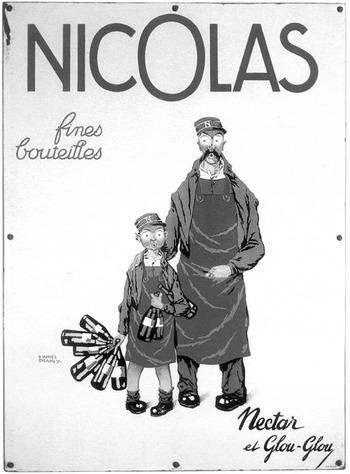
Manufacturers went to great lengths to market a powerful brand image. Several alcohol companies even created anthropomorphic advertising characters, known as personnage-types that personified the brand.Footnote 94 These characters originated in the reluctance of French poster artists to copy the ‘realism’ of American advertising that used stereotyped representations of daily life. For Louis Chéronnet, editor of Arts et decoration, the only truly acceptable representation of people was the ‘personnage-type’ which represented the product and not the consumer. Vendre proclaimed that ‘a faceless firm needs a personage-type’.Footnote 95 Large wine firms like Nicolas and Clos du Postillon particularly favoured such characters because they endowed these Paris-based commercial companies with the natural, jovial image of wine. The most iconic of these personnage-types was created by the Nicolas wine company. To celebrate the company's centenary year in 1922, its director, Etienne Nicolas, commissioned a booklet about the company. On the last page, a little known Swiss artist, Jules Isnard, known as Dransy, sketched a small wine deliveryman with saucer eyes and a narrow moustache.Footnote 96 Inspired by the deliverymen of the ancient Paris wine merchant ‘Le Paven’, Dransy's character, known as ‘Nectar’, was eventually joined by ‘Glou Glou’, a delivery boy, and ‘Félicité’, a female companion.Footnote 97 Nectar became an immediate success and continued to evolve into new artistic styles with the collaboration of different artists, appearing in poster campaigns until well after the Second World War. Footnote 98 Nicolas had created an exaggerated figure, full of charm, carrying twelve bottles of wine in each hand: ‘Nicolas's Nectar is a winner because he's a jovial mind-boggler who makes us smile as soon as we find ourselves face to face with him.’Footnote 99 Like Michelin's ‘Bibendum’, he became a successful and recognizable emblem for the firm.Footnote 100 Moreover, the use of a Parisian delivery man conveyed the impression that Nicolas was a local, Parisian firm; a useful technique given that the Paris region was one of the company's biggest markets: ‘Nectar, the deliveryman was adopted immediately as an old-style Parisian by the middle classes as well as the man in the street. No one would be surprised to see him appear in person.’Footnote 101
‘Nectar’ by Dransy, 1922, Bibliothèque Forney, Paris.

Contemporaries were aware of how important it had been for Nicolas to create such a recognizable and universally admired symbol. Vendre wrote that ‘Nectar is a character with an unequalled humour and an amazing suggestive power … it is no exaggeration to say that Nectar posters are amongst the best that we have ever seen … they make us laugh and they make us buy.’Footnote 102 The director of Nicolas explained that: ‘Nectar has become a veritable salesman in the service of the Nicolas company.’Footnote 103 The figure was so popular that a song called ‘Nectar’, written by the famous duo, Vincent Scotto and Maurice Hermite, was featured at the Folies Bergères. Advertising featuring Nectar appeared on large billboards all over Paris to the delight of contemporaries: ‘Nectar finally in flesh and blood – I mean in aluminium on the walls of Paris … this character has definitively entered into our life. He is amongst us, almost alive.’Footnote 104
‘Nectar’ advertising, Vendre, Feb. 1934.

Other companies quickly followed to create their own ‘personage-types’, although none ever elicited the same degree of admiration and recognition as Nectar. Another wine firm, Clos du Postillon, created a jovial character called the Postillon, a corpulent bon vivant, always portrayed with a glass or bottle of wine. The Postillon figure was ‘hilarious and clearly keen to empty lots of bottles. His silhouette is not easily forgotten.’Footnote 105 The Postillon appealed to more modest consumers: ‘Le Clos du Postillon targets the average consumer whose throat, submitted to straitened pecuniary circumstances, must be content with good old family plonk … the company puts into its advertising, all the prejudices, all the bad taste of this lower class.’ Indeed the Postillon was often accompanied by the slogan: ‘Le bon vin à la portée de tous’ (Good wine within everyone's reach).Footnote 106
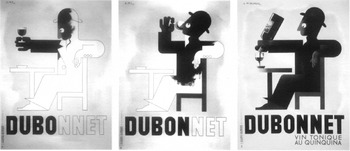
The aperitif companies also attempted to create their own ‘personnage-types’. Unlike the wine companies whose personnage-types were real characters, those of the aperitif companies were primarily supports for slogans. Saint-Raphaël continued to develop ‘rouge et blanc’, two silhouetted waiters in red and white, the company's symbols since 1900. They were continually renewed and portrayed in various situations throughout the interwar years, including a famous poster produced in 1937 by Charles Loupot showing them climbing the Eiffel Tower.Footnote 107 Cointreau's pierrot was another famous character: ‘everyone knows the famous clown who figures on all the advertising and containers of Cointreau … the public would find that without its traditional character, Cointreau would taste different’.Footnote 108 The small ‘bonhommes’, simplistic figures designed by Cassandre for Dubonnet and Bonal also come to symbolize their companies. The Dubonnet figure, ‘the famous little fellow … a sensation from his first outing’, was particularly popular.Footnote 109
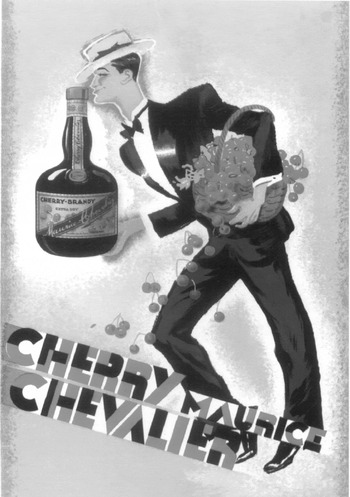
As well as ‘personnage-types’, aperitif companies also had the power and finances to encourage celebrity product endorsement. Cinema and music hall had created a host of famous faces in interwar France. Product endorsement became an important element of aperitif advertising. Mistinguett and Maurice Chevalier had contracts to promote Cherry Rocher. Their pictures and autographs would appear in advertising posters with the playful slogan: ‘Le cherry de mon chéri est mon cherry.’Footnote 110 Maurice Chevalier appeared in avowedly modernist posters from 1930, holding a basket of cherries with his trademark boater touching a large bottle of the liqueur. The slogan was simply ‘Cherry Chevalier’. Campari used a host of cinema stars such as Gaby Morlay, with the slogan: ‘L'apéritif préféré de nos étoiles, c'est le Campari (The favourite aperitif of our stars is Campari).Footnote 111 By the late 1930s, as sport grew in popularity, famous sportsmen also began to endorse aperitifs. One Suze advertisement featured the French middleweight boxing champion Edouard Tenet:
In order to maintain and develop his power, Edouard Tenet, middleweight champion of Europe, scrupulously submits to a hard and severe training routine and gives up any stimulants during this period. Do as Edouard Tenet … always have a Suze before and after physical effort because Suze, based on fresh gentian roots, with its stimulating and regenerating properties is the best tonic for real sportsmen.Footnote 112
‘Cherry Maurice Chevalier’, unknown artist, 1930, Bibliothèque Forney, Paris.

For the aperitif companies, a memorable slogan was indispensable. This part of branding strategy, primary in French advertising traditions, ensured that the name of products automatically occurred to consumers when they wanted a specific type of drink.Footnote 113 It was suggested that a slogan should be short and memorable; its aim was to ‘engrave the name and nature of a product upon all minds’.Footnote 114 The best known of the interwar aperitif slogans was ‘Dubo, Dubon, Dubonnet’. Unusually the slogan was actually conceived by Cassandre, the artist, to accompany his new 1932 poster featuring the bonhomme in various stages of Dubonnet consumption.Footnote 115 The slogan began to appear independently from the bonhomme, most famously along Paris metro tunnels. Other well-known slogans of the period included Bonal's ‘Ouvre l'appétit’ (Opens the appetite), again conceived by Cassandre to accompany another ‘bonhomme’ in a 1935 poster. Most slogans, such as Picon's ‘Pourquoi Picon? Parce que c'est bon’ (Why Picon? Because it's good) and Amourette's ‘Et l'on revient toujours à sa première amourette’ (And you always go back to your first love), conceived separately from the poster producers, were particularly used for radio and loudspeaker publicity.
‘Dubo, Dubon, Dubonnet’ by Cassandre, 1932, Bibliothèque Forney, Paris.

The development of aperitif slogans particularly interested the surrealist writer, Robert Desnos, for whom slogan writing had provided a supplementary income during the interwar years. His friend, the writer and erstwhile advertising broker, Armand Salacrou, provided him with many contacts within the industry. Salacrou wrote that: ‘It's Robert who wrote the little radio poems used by the brands whose advertising budgets I managed.’Footnote 116 Publicity slogan writing suited Desnos's surrealist love of word games: ‘It is perhaps in the advertising slogan that his acrobatic virtuosity in vocabulary, his prodigious science of abbreviation … allied to a sense of popular poetry, was best shown … how many products of various types saw their sales figures soar after a Desnos slogan.’Footnote 117 Desnos was flattered by the exposure of his slogans saying that they made him feel that ‘I am the most listened-to poet in Europe.’Footnote 118 His wife, Youki, explained how he teased friends who claimed never to listen to radio ‘jingles’. They would complain:
– ‘It's you, you bastard … who annoys us with those things! Besides, we never listen to them … we switch off as soon as they start.’
– ‘Oh! Yes!’ Robert replied derisively. And he started to hum as he offered aperitifs. ‘Quand je bois un cinzano’ …
– ‘Oh, oh, oh, oh, oh, oh’, automatically hummed the choir … It was the proof that the slogans had certainly penetrated their consciousness.
Desnos's many aperitif slogans included Amer Picon's ‘Joie certaine / toujours saine / quand on boit l'Amer Picon / un délice sans malice / buvez de l'Amer Picon (Certain joy / always healthy / when you drink Amer Picon / delicious without being malicious / drink Amer Picon). He also produced several long-lasting campaigns for Berger, ‘Ah! que je suis content! / à la bonne heure! / la bonne heure en effet c'est l'heure du Berger (Oh, how happy I am / at the right time! / the right time is Berger time), and ‘Ah! Midi! Sept heures! L'heure du Berger / La meilleure de la journée / grâce à l'anis berger. Parfumé, savoureux, délicat’ (Oh! Midday! Seven o’clock / The best of the day / thanks to Berger anis. Perfumed, flavoursome and delicate). Footnote 119 The latter was soon abbreviated for use in poster campaigns to ‘Midi, 7 heures. L'heure du Berger’ (Midi, seven o'clock. Berger time) and has been used by the company ever since.Footnote 120
The slogans, brand names, and advertising characters of aperitif companies demonstrated an application of sales and marketing tactics that were well adapted to the French market. Attempts to force automatic and unconscious recognition on to consumers were developed by aperitif advertisers to suit the uniquely competitive nature of their sector and extended the traditional importance of branding in the French alcohol market. The use of professional marketing techniques allied to the involvement of gifted artists and writers in the early formulation of brand identity resulted in striking slogans and memorable advertising characters. These could then be transferred to specific advertising media such as newspapers, posters, and billboards where the core images, already created, could continue to be developed.
V
Having branded their products with the creation of clever slogans and attractive advertising characters, alcohol manufacturers disseminated images of their products to consumers. Advertisers realized that products were not simply defined by the content of advertisements; the supports and sites chosen for their advertising also contributed to the drink's image. Their ambitious advertising spread throughout the country. The press, streets, monuments, transportation, and countryside became a vast set on to which aperitif brands and their imagery could be projected. Alcohol advertising began to fill the sounds of interwar France as slogans and brand names were transmitted in radio broadcasts or used as loudspeaker announcements.
If consumers were to learn the brand names of particular drinks, they had to hear them repeated constantly. The development of advertising using loudspeakers and radio advertising helped the diffusion of aperitif slogans. Cointreau and Vins GRAP used loudspeaker vans to tour France whilst other companies transmitted their slogans with loudspeakers fixed in busy railway stations. In the Gare Saint-Lazare, for example, ten advertising jingles were constantly repeated each day. Several slogans were particularly formulated for use in railway stations, such as Cinzano's ‘Tant pis, je prendrai le train suivant. Mon Cinzano, d'abord (Too bad, I'll catch the next train. My Cinzano first).Footnote 121
The rapid development of radio advertising after the founding of Radiola in 1922, the first public broadcasting station, encouraged aperitif companies to formulate slogans which could be played at various times, the cost depending upon the number of listeners at particular periods, in the form of communiqués.Footnote 122 Whilst radio advertising represented only 0·76 per cent of advertising spending in 1938, it increased in importance over the period as the number of officially declared radios (on which a tax was imposed) grew from 500,000 in 1930 to 5,500,000 by 1939. It was estimated that each radio had at least three listeners.Footnote 123Vendre suggested that ‘radio advertising is indispensable. The power of radio is considerable.’Footnote 124 Radio advertising was particularly favoured by alcohol companies.Footnote 125
As well as hearing an aperitif's brand name and slogan repeated constantly, it was important that they were also seen everywhere. Daily newspaper advertising was the largest individual advertising medium, holding 50 per cent of French advertising in 1933. Yet in comparison with the United States and United Kingdom, where newspapers held 80 per cent of all advertising, French newspaper advertising remained poorly developed. Advertising only represented 20 per cent of the income for France's five largest newspapers, Paris-Soir, Le Petit Parisien, Le Journal, Le Matin, and L'Intransigeant. In America, the corresponding figure was 74 per cent.Footnote 126 Advertisements in the France's daily press tended to be mediocre and ugly, often thrown together on the back page known as ‘the wall’ (le mur), with large gaps between images and text. Newspapers were also notoriously unreliable, reticent to guarantee insertion dates or editions. Aperitif advertisers therefore limited their press advertising to small box-style ‘annonces’ which simply gave the name of the product and occasionally a brief slogan.Footnote 127
Yet the periodical, pictorial press was a popular host for advertisements, especially amongst aperitif companies. It more than adequately compensated for the unreliability of the daily press and enabled aperitif companies to target specific social groups. By the 1930s, the preferred title for aperitif advertisers was L'Illustration because of its loyal bourgeois readership. As one correspondent put it: ‘Like every good French bourgeois, I take L'Illustration – its reading is part of my Sunday in the same way as my morning stroll in the Bois de Boulogne.’Footnote 128 In 1913, the magazine earned nearly 2·3 million francs from advertising, which had nearly quadrupled by 1924 to 10 million francs and tripled again to reach 33 million francs in 1929.Footnote 129L'Illustration prided itself upon the artistic nature of its advertisements, claiming that: ‘The advertisements in L'Illustration are selected with great care.’Footnote 130 There was a considerable increase in advertisements after 1929 as companies, hit by a decline in exports, began to concentrate upon the home market.Footnote 131 The magazine was forced to produce a separate advertising supplement, claiming that it would preserve the quality of the publication.Footnote 132
The advertisements in the pictorial press such as L'Illustration were often smaller versions of the posters and billboards of the period. Although affichage murale (bill-sticking) seemed to be ubiquitous in interwar France, it was in fact declining in popularity amongst advertisers. The wall poster had been an important part of French advertising strategy since the Belle Époque, in particular after the law of 29 July 1881 which allowed freedom of affichage. In 1901, 25 per cent of advertising spending was devoted to poster production. By 1938, a six-fold increase in taxes imposed on affichage murale, together with the development of alternative advertising supports, meant that this figure had fallen to 8·1 per cent. Surtaxes were also charged by communes; in Paris these added 25 per cent to the basic tax by 1926.Footnote 133Vendre pointed out that a month-long poster campaign had become more expensive than an advertisement in L'Illustration. The magazine had calculated that whilst an average poster campaign, limited to town centres, cost 40,000 francs, a more widely diffused campaign cost 60,000 francs and a ‘good poster campaign that includes a few stations and some busy crossroads as well as the boulevards and the town centre would be priced at 80,000 francs … in comparison, a page in L'Illustration, which has a circulation of 160,000, distributed in twelve countries, costs 14,000 francs.’Footnote 134
Notwithstanding, the poster remained more important in France than elsewhere. In the United States, it represented only 1 per cent of advertising spending by 1938.Footnote 135 Critics of the medium came from within the advertising industry. The magazine Vendre ran a series of articles in 1927 questioning the efficacy of the poster, ‘A controversy. Does the poster sell?’ Many advertising professionals interviewed by the magazine accepted that the medium was outdated and slow moving, pointing to large American companies such as Gibbs and Palmolive who no longer used posters. However, representatives of the alcohol industry, including the managing directors of Nicolas, Dubonnet, and Clos du Postillon, affirmed that the poster remained an important tool.Footnote 136 Dubonnet and Nicolas continued to devote one third of their advertising budgets to posters. M. Jacques, the commercial director of Dubonnet, said that ‘any new poster campaign is immediately followed by an increase in sales’.Footnote 137 Indeed posters and billboards suited the business strategies of aperitif companies. The long-lasting nature of these media and their production procedures meant that advertising campaigns using posters remained relatively static and slow moving. Whilst this was problematic for companies with rapidly developing products, it helped aperitif companies who rarely renewed their image or products; their entire strategy was based on trustworthiness and durability. Long-lasting poster and billboards campaigns were undertaken by aperitif companies because ‘if you stick the slogan on every wall, make it appear on every screen … people will end up knowing your name’.Footnote 138
If posters were losing ground commercially during the period, they were gaining in terms of artistic notoriety, especially after the 1925 Exposition des arts décoratifs in Paris where they were included in the Arts de la rue section.Footnote 139 In 1929, the Union des artistes modernes (UAM) was created in the name of ‘utilitarian beauty’.Footnote 140 The new group brought together new talents like Leonetto Capiello (1875–1942), Cassandre (1901–68), Jean Carlu (1900–99), and Charles Loupot (1892–62), who followed the high aesthetic standards and traditions of nineteenth-century French poster artists such as Jules Chéret and Toulouse-Lautrec.Footnote 141 Poster artists in France increasingly worked at opposing currents to their contemporaries in the United States where advertising posters tended to be mediocre in quality, using chromatic or photographic methods to portray simply the product.Footnote 142 French poster artists were particularly keen to engage with their audience through art and such a strategy was reflected in the success of interwar aperitif advertising posters. For Carlu: ‘The poster should be a work of art … Its role is to link a name to an image in the spirit of propaganda.’Footnote 143 Carlu was also keen to integrate the advertising slogans with the image and felt that the poster had to replace words with images: ‘The poster becomes a sort of ideogram, that is to say, a graphic sign expressing an idea directly without the need for words.’Footnote 144 Although at odds with contemporary American ‘scientific’ advertising based on extensive argument, such simplicity fitted the requirements of aperitif companies. As the commercial director of Dubonnet argued, ‘these days the poster needs to be above all simple – an image or a name. The poster is not there to make an argument.’Footnote 145
The excellent artistic qualities of posters and billboards, together with their durability, led to their increasing visibility during this period. The aperitif industry's strong reliance upon these visual media of posters and billboards is the principal reason that its advertising appeared to be so important in interwar France. Visual advertising supports were particularly diverse in cost, durability, and visibility. Whilst paper posters were the cheapest form of affichage, they were easily destroyed by weather or vandalism.Footnote 146 Large billboards (panneaux-réclames) combined the aesthetic qualities of posters with the durability of metal and the predominance of size, ‘Billboards are nothing more than extra large posters, painted on canvas or metal or stone … their large dimensions almost always give them a visibility which can only be overcome by competition from neighbouring posters which are even bigger.’Footnote 147 Painted wall advertisements were even more visible and so long lasting that their faded letters can, even today, be seen in parts of France. With little alteration in the basic product being advertised, successful images and ideas could be recycled over many years.
Billboard and wall advertising spread throughout rural France where it often met with hostility.Footnote 148 Aperitif companies, anxious to stress their centrality in traditional French life, associated their largely industrial products with la France profonde and traditional alcohols by making their products a visible part of the French countryside. Such advertising was placed near transport networks, on roadsides, and railways. Many writers evoked the way that advertising filled country fields with fantastical figures linked to aperitifs.
I was transported with admiration in front of these enormous bottles of Saint Raphaël. These giant characters … how, had they gotten there, right in the middle of fields? Those silhouettes of Saint Raphaël café waiters seemed to me to be works of art, only comparable with Cointreau's clown and I never tired of these marvels.Footnote 149
VI
Paris was the kingdom of aperitif advertising during the interwar period. Aperitif advertisers found the city to be an obvious location with its large population, diversity, and high number of visitors. In addition, being associated with the metropolis added to the sophistication of certain aperitifs. Aperitif posters and their images became an inescapable aspect of Parisian life. The municipal authorities limited unregulated affichage around historic monuments such as Place des Vosges, Place de la Concorde, Place Vendôme, Palais Royal, Opéra, Panthéon, Louvre, Tuileries, and Champs Elysées and on houses where they might obscure air or light,Footnote 150 but money was to be made by selling advertising space on communal walls, newspaper kiosks, Morris columns, and in the metro.Footnote 151 Advertising space was even sold on public urinals (vespasiennes), much to the fascination of Georges Brassaï who featured four of them, covered with aperitif advertising, in a series of photographs taken for his 1932 collection ‘Paris de Nuit’.Footnote 152 Parisian doctors complained that newly installed public conveniences rapidly filled with aperitif advertising: ‘The municipality of Paris has proceeded to replace its ancient vespasiennes with edifices that better meet hygiene standards. And already their walls are covered with aperitif advertising.’Footnote 153 It was impossible to escape the constant repetition of images and slogans. For the writer, Léon-Paul Fargue, advertising had become such an integral part of Parisian life that its disappearance would quite literally be a nightmare, rendering Paris unrecognizable to its inhabitants:
Walls of Paris, artists' entries, vespasiennes, telephone directories, ash-trays, seat backs, magazines lying in bathrooms … I saw you tonight, deprived of your images, I dreamt that advertising was dead and I believed myself to be blind. Passers-by hurried through streets that were no longer rue du Bac, rue de la Paix nor rue des Abbesses. They hurried asphyxiated, deprived of their toothbrushes, their soap, their wine and their aperitifs … the metro went through naked stations … taxis got lost … the newspapers became unreadable.Footnote 154
As the number of posters around Paris grew, aperitif advertisers increasingly sought to make their own the most noticeable. Large billboards solved the problem of posters which were often posted on top of each in other in a confusing array. Dubonnet ensured that the company's advertising was as visible as possible. Its posters were isolated by surrounding them with textual borders that used white letters on a blue background ‘so as to obtain a violent opposition of colours with the main poster’.Footnote 155
Advertisements in Paris, Vendre, May 1927.

Aperitif advertisers increased the impact of their advertisements by careful consideration of the locations where they were to be placed. Central locations where large, artistic advertisements could remain for a long time were useful in reinforcing general brand recognition. However, advertisements for aperitifs with a more populist, cheaper image were placed in working-class residential areas, where they reminded customers to include the product in their shopping or order it at the café. In such areas, simple paper posters could be attached and constantly renewed. The director of Clos du Postillon explained that his company's campaigns were focused upon ‘working class and out of the way areas’ without obvious advertising sites. This obliged the company ‘to stick our paper posters anywhere we can, often in rather mediocre conditions of visibility’.Footnote 156
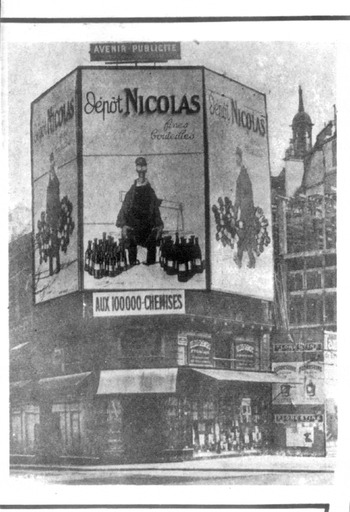
Advertisers colonized central Paris, aware that associating their images and slogans with such sites gave massive exposure to their products. M. Cambournac of Nicolas said that: ‘The success of a poster placement obviously depends upon a top category site: on very busy arteries and crossroads etc. I reckon that no site is too expensive when it is really excellent.’Footnote 157 Advertisers particularly favoured famous areas of Paris that would increase the iconic status of their advertising.Footnote 158 Advertisements were also sited in areas with large numbers of passers-by and café terraces where they acted as reminders of the need for a drink and indeed which aperitif to order. Whilst they favoured the Grands Boulevards, Place Blanche with its reputation as a destination for pleasure seekers was chosen as a site for the most expensive and long-lasting form of advertisement; the painted wall.Footnote 159
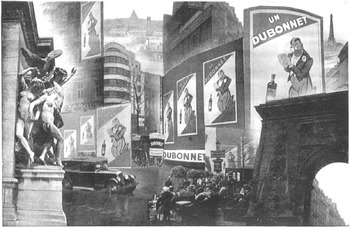
Poster artists adapted their work, conscious that now it formed part of the urban surroundings. Advertising was increasingly integrated into the physical entity of Paris, its streets, buildings, and monuments: ‘The poster becomes more and more monumental. It is part of the monumental ensemble.’Footnote 160 As Cassandre wrote, ‘the poster must integrate itself to architectural masses, furnish façades that are more and more spread out, animate not only a few walls and houses, but also enormous cubes of stone, even whole neighbourhoods’.Footnote 161 There was a strange dialectic relationship between the aperitif producers and the cityscape, as Paris, increasingly filled with their advertising, came to be closely associated with the aperitif billboard. Advertisers reproduced this aspect of Paris, kingdom of the aperitif, in their advertisements. Dubonnet produced an advertisement showing its posters and billboards superimposed over various parts of Paris.Footnote 162 Marie Brizard's posters also often reproduced a building façade displaying its advertising.Footnote 163
Dubonnet advertisement, L'Illustration, 13 Feb. 1932.

Advertising had become so associated with Paris that it soon came to be an important aspect in photographic and cinematographic representations of the city. Aperitif advertising was used by foreigners in the creation of an ‘authentic’ vision of contemporary Paris. The director of Nicolas described how an American film maker had asked for copies of the companies' advertising posters in order to produce a film set of Paris: ‘First National, an American film company wanted to reconstitute a view of Paris in 1927 in Hollywood. They asked us to send Nectar posters because they are so much identified with the appearance of the city.’Footnote 164 Aperitif advertisers were aware that their choice of location was not simply governed by the number of passers-by. They also had to consider the frequency with which it would be reproduced as a background to events. The director of Nicolas said that his company had fifty large billboard advertisements in Paris and suggested that in the best areas, billboards would find their way into photographs and films:
The importance of the site on the corner of Boulevard Haussmann and Boulevard des Italiens cannot be exaggerated, posters are not only seen by everyone there, but they also benefit from being photographed a great deal. There cannot be a film or a photograph that has not had them in the background.Footnote 165
The sites for aperitif advertising in Paris were not simply fixed placements. The Paris bus system was a key site for aperitif advertisements. With 4,000 vehicles covering 45,000 kilometres every hour, Paris buses were highly visible advertising placements. Spaces were sold to advertisers on the interior and exterior of all vehicles. In addition, 1,500 buses were reserved for one single advertiser. Vendre suggested that bus advertising would be encountered by many people and especially recommended advertisers to hire space on bus routes along the Grands Boulevards where they would be seen by over 100,000 passers-by per hour.Footnote 166
If aperitifs covered Paris above ground, then they were equally prolific under the city. French aperitif advertisers, generally satisfied with long-term advertising, were prepared to pay a premium to place posters in a metro station away from bad weather or vandalism. In addition: ‘All social classes meet in the metro … placing posters in the metro creates a great notoriety.’Footnote 167 Indeed the French metro system was the first to have included special advertising sites in its original building plans. Certain busy lines such as line one, with over one hundred million travellers per year, were particularly attractive to advertisers.Footnote 168
The metro system offered varied opportunities for advertisers. Large posters could be placed on station platforms where they would be seen by those on trains as well as those in the station itself. Smaller posters could be placed in the corridors of stations where they would last longer than above ground. Advertisements could also be placed inside metro trains at the back of carriages, on luggage racks, and lanterns.Footnote 169 The Dubonnet company adopted the long-lasting strategy of painting its slogan ‘Dubo, Dubon, Dubonnet’ on to metro tunnels. Dubonnet's commercial director explained that this strategy supported the company's attempts at fostering brand-name recognition. The company made great efforts to maintain its metro campaign, sending a team of five men into the tunnels every night to ensure that Dubonnet's advertising was always in peak condition.Footnote 170 Indeed Dubonnet's extensive advertising in the Paris metro led to their product being strongly identified with the transport system. This, in turn, was reflected in some of the company's advertising, as the metro became part of the product's image. There was constant interplay between aperitifs, their branding, advertisements, placements, and image.
French advertisers relied heavily upon developing tried and tested advertising methods, but they were also willing to integrate new technologies. Aperitif and wine companies pioneered advertising films. Retailers could hire a projector and show films in their cafés, accompanied by music and distributions of cards. Over a hundred companies had used this method by 1931.Footnote 171 However, alcohol manufacturers increasingly preferred to show their films in cinemas as simple advertisements or even short films, ‘the correct method is using advertising films that can be projected in a shop window, an exhibition stall or even during the programme of a movie theatre that accepts such films’.Footnote 172 Cinema advertisements were particularly used by wine companies like Nicolas who called them, ‘a new and powerful advertising weapon … cinema best attracts the gaze … it is simply a series of images’.Footnote 173 By 1934, it was suggested that publicity films could be shown during the interval in the form of documentaries, pedagogical features, and films destined for children.Footnote 174
Other novel techniques adopted by the companies included using the burgeoning interest in aviation to serve advertising. The Byrrh company had its own aeroplane which advertised the aperitif by dropping advertising cards, some of which offered a free air trip.Footnote 175 In addition, aperitif advertisers, particularly Byrrh, pioneered sports sponsorship during the period.Footnote 176 The Tour de France represented an annual festival of aperitif advertising, especially after 1930 when Henri Desgranges, its inventor and manager, decided that national teams would replace factory teams. To finance the new system, he introduced a publicity caravan that added profit and colour to the Tour. A procession of advertising cars and trucks preceded or followed the riders. Alcohol advertisers were keen to associate themselves with this popular event.Footnote 177
It was little surprise therefore that, for the Vichy regime, aperitif advertising was inextricably linked with interwar France. It became an integral element of daily life throughout France in towns, villages, transport networks, and leisure activities. It was particularly associated with Paris, becoming such a central aspect of the cityscape that it met with praise rather than resistance:
Posters are in our streets. Along the boulevards and avenues they are like an open-air salesroom, a popular gallery of rich tonality, with imperious and suggestive callings. We do not always happily obey them but often we are charmed by a happy idea, the warmth of their colours, their elegance or the humour of their motifs and we pause awhile amused and seduced.Footnote 178
VII
As the case study of alcohol advertising demonstrates, French interwar advertising was neither retarded nor derivative. French advertisers proved to be pragmatic actors within a specifically French consumer market, drawing upon those domestic traditions and techniques that were best adapted to native consumerism and cultural practices. French advertisers were highly skilled at marketing, branding, and advertising those affordable and desirable non-durable goods, such as alcoholic beverages, that were important to French consumers during this period. Rather than looking across the Atlantic and borrowing ill-adapted American advertising techniques, French advertisers reached back to their own Belle Époque traditions of branding and advertising. The specialist training, companies, and magazines of the interwar years allowed advertisers to refine these techniques and adapt them to contemporary consumer conditions and subtle changes in the alcohol sector. Discourses of professionalization certainly drew upon the American advertising industry, but they were primarily an attempt to make the French advertising profession more respectable. American techniques themselves were little utilized because they remained largely irrelevant to French consumers, producers, and the goods on sale.
Advertising therefore reflected existing consumer patterns rather than shaping them. France did not lag behind in developing consumerism, but had possessed its own distinctive consumer society since the late nineteenth century. Interwar advertising techniques grafted themselves on to native consumer traditions and allowed them to flourish. French advertisers could not alter the nature of French consumption. Without substantial social and economic changes, modern durable products of the type that had shaped American advertising could not advance in France. Instead, advertisers worked with non-durable products, such as alcohol, shaping their methods accordingly.
By the interwar period, the low price of wine had given aperitif producers an added incentive to invest in advertising. The nature of alcoholic products themselves had not changed; advertisers did not require new practices so they simply perfected older ones. The marriage of a traditional French product like alcohol with the modern mass communications represented by the advertising industry was a peculiarly symbiotic relationship. The alcohol companies' need for extensive publicity offered advertisers a unique opportunity to polish their strategies, creating striking and memorable campaigns for a typically French product. Improved communications allowed alcohol advertising to be diffused throughout the country, targeting different groups of consumers in original ways and becoming part of the fabric of interwar France.
Yet, the very reasons that make the use of advertising and branding by the alcohol industry an interesting example also mean that alcohol is a special case. Advertising, branding, and marketing had been essential to the alcohol industry since the Belle Époque. In many ways, aperitifs were early examples of modern consumer products, in the sense that image and branding became a more important factor in consumer choice than the need for the product itself.Footnote 179 Aperitifs were industrial products relying upon two specific manufacturing processes – that of the drink itself and the creation of a brand. Only with the identity and image endowed upon it by this brand name did the beverage become an ‘aperitif’ and this had been the case well before the new developments in interwar advertising. Whether or not the advertising industry had been ‘modernized’ in the ways that Marie-Emmanuelle Chessel and Marjorie Beale have suggested, alcohol producers would still have relied upon traditional methods of advertising and branding to sell aperitifs. Their techniques thus drew upon the well-developed domestic traditions of alcohol advertising. Alcohol companies such as Saint-Raphaël, which had spent a quarter of their budgets on advertising during the Belle Époque, scarcely needed convincing by magazines like Vendre of the importance of investing in advertising. New developments in marketing and advertising were embraced by the alcohol sector with particular enthusiasm and quickly adapted to traditional methods.
Alcohol publicity demonstrates that advertising is as much a cultural and social phenomenon as a business practice. Advertisements held a mirror up to the society in which they operated, reflecting its aesthetic concerns, class, gender, generational and regional differences, and new technologies. French advertisers were masters at adapting established advertising traditions to reflect contemporary social and cultural mores. Traditional and innovative methods operated in tandem and reinforced each other with the use of similar slogans and jingles.
When French alcohol advertising is assessed within a national context, it looks surprisingly modern. Like modern multinational companies, it sold brands, rather than products. In the crowded alcohol market, alcohol producers sold Dubonnet, Saint-Raphaël, Byrrh, or Cap Corse rather than quinquina wine, just as contemporary fast-food restaurants sell McDonald's or Burger King rather than hamburgers. Once powerful brands are established, advertising acts simply as a support. This changes the nature of advertising which, rather than offering information, reinforces brand identity by using creativity, abstraction, and aesthetic innovation. Such techniques are routinely used today in contemporary advertising when single slogans or symbols, such as the Nike ‘swoosh’ or its slogan ‘Just do it’ are recycled, placed within diverse contexts and surrounded with different images. Such symbols exist within their flat abstract world, simplifying, or typifying, rather than attempting to represent reality. Interwar French advertisers pioneered the development of an entire symbolic structure that supported brands with graphics (logos, crests), trade dress (packaging, vehicles, buildings, product form), spokesmen (celebrities, salesmen, characters, and mascots), words (slogans, jingles, abbreviations, and taglines) together with sounds (auditory icons). These still form the basis of branding in modern advertising.Footnote 180 In this way, French interwar advertising appears to be more closely related to contemporary advertising than the supposedly more advanced American ‘scientific’ advertising of the same period.
The success of interwar French advertising meant that Vichy's anti-alcohol campaign was as much about reclaiming the sights and sounds of France from the aperitif as liberating the French from their alcoholism. Aperitif brands had become symbols of the despised Third Republic. They were an inescapable aspect of the cityscape and countryside, providing the backdrop to its buildings, transportation networks, and streets. Integral to the cultural landscape, aperitif advertisements and brand names were employed by novelists and film makers to conjure up contemporary scenes, personalities, and moods. The efforts and innovations of French advertisers meant that aperitifs enjoyed total identification with the society in which they had been represented. French consumerism and modernization were essentially marked by Gallic flair and Belle Époque tradition, not American science. Home grown commercialism meant that, by 1940, representations had become more important than reality.