


“I asked Einstein whether in an ideally perfect (of course utopian) ... physical representation ... of the universe the qualities of immediate experience (what we called metaphorically the ‘internal illumination’ of ... living-awake brains) were left out. He replied in his characteristic, humorous manner (I translate from the German in which he used a rather uncouth word): ‘Why, if it weren’t for this ‘internal illumination’ [i.e., sentience] the world would be nothing but a pile of dirt!” (Herbert Feigl in conversation with Albert Einstein, Princeton, 1954).Footnote 1
Introduction
This paper considers a cluster of issues surrounding the metaphysics of consciousness. In particular, it focuses on the ontological status of phenomenal properties—or qualia. These raw feels of experience come in a wide variety of types: from the bodily affect associated with—or perhaps constitutive of—emotion and mood, to hunger pangs and indigestion pains, and the various other sorts of bodily sensations that we enjoy or suffer; from the rich visual and auditory imagery of day and night dreams to the sensation of balance, so strikingly noticed when lost in states of vertigo or intoxication. The mysterious nature of qualia—often expressed in terms of the so-called explanatory gapFootnote 2—is not Descartes’s mystery.Footnote 3 It is not the mystery of how two radically different and independent substances causally interact. Rather, it is the mystery of how conscious experience emerges from, and depends on, neural activity, and how experience could in turn causally influence subsequent neural activity. For, as an emergent by-product of a neurophysiology that is seemingly causally sufficient for all our actions, it is difficult to see how experience could be causally relevant. Yet identifying qualia with their neural “correlates”Footnote 4 is seen by many to be both anthropocentric and eliminativistic.
One strategy for retaining irreducible qualia is to explicate their relation to their neural and functional correlates as one of supervenience. David Chalmers, for example, maintains that while qualia are neither physical nor functional properties, they nevertheless “naturally supervene” on functional organization; they are, as he calls them, “organizational invariants,” properties that do not vary over physically disparate realizations of the same functional organization.Footnote 5 However, Chalmers’s notion of supervenience is consistent with the causal impotency of qualia. The structural/functional properties of a system may very well be causally sufficient for all of that system’s behaviour, thereby excluding qualia from causal relevance.Footnote 6 There is, however, an employment of the notion of supervenience in defence of nonreductive mental causation. In particular, Ausonio Marras has marshalled a sustained defence of supervenient causation. While Marras’s account focuses on intentional properties, he is inclined to extend it to qualia. This account of supervenient causation is both elegant and perspicuous; nevertheless, I argue that a relation of supervenience is too weak to secure the efficacy of experiences. More precisely, I argue that nonreductive supervenience accounts of mental causation in general have difficulty avoiding causal exclusion and, importantly, that the situation is particularly bad in the case of qualia. Insofar as qualia are not functional properties, the function-realizer relation does not obtain, and thus, the metaphysical link between supervenient and subvenient properties arguably present in the case of intentional properties is absent in the case of qualia. However, the identification of quale types with their neural “correlates” dispels the spectre epiphenomenalism, and what’s more, squares nicely both with the phenomenology of embodiment and the subjectivity of experience. Finally, strategies for accommodating multiple realizability—the supposed bane of mind-brain identity theory—are proffered and it is concluded that the multiple realizability of consciousness in no way precludes the identification of human qualia with sets of physical properties of human organisms. In sum, rather than being anthropocentric and eliminativistic, a thoroughgoing materialism concerning qualia, when properly construed, avoids the epiphenomenalism endemic to dualistic accounts while at the same time retaining what Feigl and Einstein referred to metaphorically as the “internal illumination” of sentience.
I. Nonreductive Physicalism and the Exclusion Problem
The benefits and drawbacks of identifying mental properties with physical properties are familiar. On the plus side, identifying mental properties with the physical properties with which they lawfully co-vary avoids the pitfalls of epiphenomenalism, and, as is argued in the final section, coheres nicely with the embodied and subjective nature of consciousness. However, identity theory was deemed too “chauvinistic,”Footnote 7 too brain- and human-centric; not only does identifying pain with neural activity in the human central nervous system seem to preclude artificial systems from ever instantiating that property—that is, from ever having pain experiences—it seems to preclude any non-human organism from having pain experiences.Footnote 8 In short, mind-brain property—or type—identity appears to be too strong.Footnote 9 Rather, the argument goes, we should adopt a nonreductive—or token—physicalism.Footnote 10 According to nonreductive physicalism, every event is a physical event—that is, instantiates a physical property; hence every mental event instantiates some physical property or other. Nevertheless, mental properties are not physical properties. According to Marras, it is useful to explicate nonreductive physicalism in terms of a relation of supervenience (holding over properties of “coarse-grained” events) which has three components:
Supervenience: Mental properties supervene on physical properties if and only if: 1) Necessarily, for any mental property M, an event x instantiates M only if it instantiates some physical property P or other; 2) Necessarily, any event y instantiates that property P only if it also instantiates M; and 3) M depends on and is determined by P, but not conversely.Footnote 11
So whenever P is instantiated, M is instantiated, and whenever M is instantiated, some P or other is instantiated—though it need not be the same P in every system. As well, M depends on P, and P determines M. This dependence relation is somewhat obscure. In general, it implies that there is no mental difference without a physical difference.Footnote 12 To say that the mental depends on and is determined by the physical is to say, in Jaegwon Kim’s words, “that the mental nature of a thing is entirely fixed by its physical nature ... [and] [w]hat does the determining must be taken to be, in some sense, ontologically prior to, or more basic than, what gets determined by it.”Footnote 13 For emergentists, qualia depend on their subvening physical properties in the sense that these properties somehow cause or produce qualia. Qualia “emerge” from this underlying neural activity. In the case of nonreductive physicalism, the dependence is neither causal nor productive. Again, there is an important metaphysical asymmetry between M and P in the sense that while all mental events have physical properties, most physical events do not have mental properties. Hence, to say that the mental depends on and is determined by the physical is, at the very least, to assert the metaphysical primacy of the physical. For the nonreductive functionalist—the version of nonreductive physicalism on which we will focus—this reflects the fact that mental properties are realized or implemented by the subvening physical properties, that is, P realizes the causal role definitive of M. Moreover, through this function-realizer relation, M inherits its causal potency from P. For any M, there is some P that fills the causal role definitive of M. In sum, for the nonreductive functionalist, supervenience protects the irreducibility and autonomy of the mental while retaining the primacy of the physical. Moreover, by allowing for an indefinite number of physical realizations of the mental, it is able to accommodate the multiple realizability of mental properties as well. However, can supervenience successfully avoid epiphenomenalism? And is its utility in this regard reduced when it comes to the case of qualia?
Kim for one has offered a sustained critique of nonreductive functionalism.Footnote 14 First, we should note that Kim adopts a rather robust notion of causation explicated in terms of generation. “Causation as generation, or effective production and determination, is in many ways a stronger relation than mere counterfactual dependence, and it is causation in this sense that is fundamentally involved in the problem of mental causation.”Footnote 15 Though I cannot make the case here, I agree with Kim that it is causal potency in this stronger sense that is required to capture mental causation and agency. What I have in mind is causation in the sense of the propagation and channelling of energy. Sentient beings—at least all those that we know about—are self-organizing systems; far from thermodynamic equilibrium, they must maintain themselves by acquiring, expending, propagating, and channelling energy.Footnote 16 Neurophysiological properties are causally efficacious in this regard. Our question, then, is what sort of account is required to secure the causal efficacy of conscious experiences in this rather strong sense?Footnote 17
According to Kim, the property dualism implied by nonreductive functionalism cannot avoid causal exclusion. Even if mental properties supervene on physical properties, to the extent that mental properties are distinct from the physical properties that are the causes of behaviour, they are excluded from causal relevance. There are three central elements to Kim’s exclusion challenge:Footnote 18
Realism: Non-eliminativism about qualia requires that they be causal properties, “properties in virtue of which an event enters into causal relations it would otherwise not have entered into.”Footnote 19
Closure: If the instantiation of a physical property “has a cause that occurs at t, it has a [sufficient] physical cause that occurs at t.”Footnote 20
Exclusion: No single property instantiation “can have more than one sufficient cause occurring at any given time—unless it is a genuine case of overdetermination.”Footnote 21
Marras (forthcoming) criticizes this way of formulating the exclusion challenge for implicitly adopting a fine-grained conception of events according to which events are property instantiations. Marras offers a formulation of the exclusion challenge meant to cohere with a coarse-grained conception of events:
Exclusion*: “No event e can be caused by an event c in virtue of two distinct properties of c, where having either one of those properties is sufficient for c’s causing e, unless it is a case of genuine overdetermination.”Footnote 22
In this case we might say that events cause what they do in virtue of the properties they instantiate. In the mind-body context, we might therefore ask, did c cause e in virtue of its mental property or in virtue of its physical property? If it did so in virtue of its physical property, then the mental property is excluded from causal relevance.
To get clear on what genuine overdetermination amounts to, consider the familiar two-bullet scenario: two bullets—each of which is individually and independently fatal—are fired simultaneously. In this scenario, the death of the victim is genuinely overdetermined since each bullet was sufficient to bring about that effect. However, the argument goes, such cases are exceedingly rare and exceptional. With respect to overdetermined mind-body causation, we would have a highly implausible systematic overdetermination of actions such that the mental properties and the physical properties in question would each be independently sufficient to bring about the action. Setting aside this sort of systematic overdetermination, the exclusion argument holds that for any action A, say pain behaviour, there is a physical cause P that is sufficient for A (closure). According to exclusion, if P is sufficient for A, then no other property is relevant. Thus, if pain quale Q is distinct from P, then it is excluded from causal relevance, thereby rendering it epiphenomenal. However, according to realism, epiphenomenal qualia are ripe for elimination. The British emergentist Samuel Alexander puts the point nicely in the first decades of the twentieth century when he likens epiphenomenal consciousness to “a species of noblesse which depends on the work of its inferiors, but is kept for show and might as well, as undoubtedly would in time, be abolished.”Footnote 23 Kim refers to this as Alexander’s Dictum: if mental properties are real, then they are causally efficacious.Footnote 24 After all, it is difficult to make sense of the claim that the phenomena with which we are most intimately acquainted are entirely without causal potency. How, for example, can we have intimate knowledge of conscious phenomena that cause nothing, including other mental states?Footnote 25 The only solution, Kim contends, is to abandon the property dualism of nonreductive physicalism; for mental properties to exert causal influence in a physical world, and more specifically, for them to enter into the causal economy of those systems that have them, they must be physical properties. Unfortunately, Kim’s reduction strategy founders precisely when it comes to conscious experiences. We return to this point in the final section.
II. Supervenience and the Inheritance ThesisFootnote 26
One nonreductive strategy for avoiding causal exclusion involves interpreting the supervenience relation in such a way that the supervening properties somehow inherit causal potency from the physical properties on which they supervene.Footnote 27 Call this the Inheritance Thesis. Marras for example, has advanced a number of responses to Kim’s exclusion challenge, employing supervenience to explicate the inheritance of mental efficacy.Footnote 28 While Marras’s rejoinders are generally framed with respect to intentional properties, one might plausibly extend them to qualia, thereby offering a dualist—though (token) physicalist—account of qualia, which nevertheless avoids epiphenomenalism.Footnote 29
To begin with, it is worth emphasizing that according to nonreductive physicalism, there is no exclusion problem with regard to events; every event is a physical event. However, we can still wonder whether mental properties are causally relevant in these events. Mental events, it would seem, are only causally relevant qua physical properties. That is to say, mental events are causally relevant not in virtue of instantiating a mental property but in virtue of instantiating a physical property. Thus, if mental properties are causally potent, they must somehow derive or inherit this potency from their subvenient base. One attempt to explicate this using the relation of supervenience, involves distinguishing physical and mental levels of description. Call this the Levels of Description Thesis. According the Levels of Description Thesis, either mental or physical properties can be causally relevant in a mental event depending on the level of description under consideration. In other words, we can determine which properties of an event are the causally relevant ones, “with reference to the type of effect we are considering.”Footnote 30 In cases of mental causation, it must be determined whether the type of effect in question is mental or physical. For any instance of mental causation, the physical property of the cause will be causally relevant with respect to the physical property of the effect and the mental property of the cause will be relevant with respect to the mental property of the effect. To explain this, Marras draws an analogy between supervenient causation and a gunshot which simultaneously wounds and deafens its victim.Footnote 31Qua wound, it is the well-directedness of the gunshot that is causally relevant, whereas qua deafness it is the loudness of the gunshot that is causally relevant. Likewise for mental events, which also allow for two levels of description, one at the subvenient physical level and one at the supervenient mental level. With respect to cause C and event E, at the subvenient level it is in virtue of C having physical property P and E having physical property P* that C causes E. At the supervenient level, it is virtue of C having mental property M and E having mental property M* that C causes E. Since we have relativized the efficacy of a property in the cause to the corresponding property of the effect, we seem to avoid any causal overdetermination. In this case, the properties in question are causally relevant with respect to different kinds of effects.
One general concern with the Levels of Description Thesis is that it does not seem to deliver mind-body interaction. Perhaps this is unfair. After all, Marras would insist that the relata of causal relations are events and that, on his view, all events are physical events. Yet Marras also wants mental properties to be causally relevant. It is unclear how, on Marras’s view, we can get mental-to-physical and physical-to-mental causal relevance. Even if this account works, M is seemingly only causally relevant with respect to M* and is never causally relevant with respect to P or P*. Put differently, how can mental properties be causally relevant with respect to the physical goings on in the body—and vice versa—if M is only causally relevant with respect to other Ms? To be sure, Marras’s account of the supervenience relation holds that P determines M, but Marras does not take this dependence relation to be causal in nature. In any case, this relation of dependence is one-way; mental properties never determine physical properties, whether causally or metaphysically. One line of response might be to distinguish actions from behaviour, the former construed intentionally, the latter, mechanically; now we might say that a pain event causes pain-related actions in virtue of instantiating a mental property and pain-related behaviours in virtue of instantiating a physical property. However, it is seemingly not open to Marras to talk about the causal relevance mental properties might bear to physical properties, or to talk of the causal relevance of mental properties on the physiology of the body.Footnote 32
There is a risk here of conflating different senses of “property.” In the broadest sense, one might take different properties to correspond with different predicates.Footnote 33 Notice that such a promiscuous conception of properties precludes mind-brain identity theory in principle since the identity theorist is committed to at least two ways of describing the same property; if pain is c-fibre excitation, then we can describe the very same property using either the vocabulary of neuroscience or the vocabulary of introspection. The identity thesis, it would seem, presupposes a more “ontic” conception of properties, according to which differences in causal powers and potentialities individuate genuine or first-order properties.Footnote 34 Consider again the gunshot example; vibrations propagated through the air are causally distinct from the mass, velocity, direction, and density of the bullet. We are not simply describing the event in different ways; we are referring to causally distinct properties. Furthermore, the properties in question are causally distinct not because we can describe them in different ways. In this example, at least, we describe them in different ways precisely because they are causally distinct. In fact, unlike Marras’s subvenient-supervenient property dualism, the property in virtue of which deafness is caused and the property in virtue of which the fatal wound is caused are causally sufficient, independent causes that sustain their effects in counterfactual independence from one another. We return to this point shortly.
For now, it is important to emphasize the causal dependence inherent in the Levels of Description Thesis. Again, according to this thesis, the causal potency of mental properties is determined by—inherited from—the physical properties on which they supervene. In this respect, however, mental properties are causally identical to their subvening base properties. Given an ontic conception of properties, if M has the same causal powers as its subvening P, then the physical and mental levels of description begin to look like two different ways of describing the very same property. And indeed, as Marras recognizes, the same property can be described and referred to in different ways.Footnote 35 Again, despite the fact that the languages of neurophysiology and introspective phenomenology utilize very different predicates, they may very well refer to the same properties, namely certain physical properties of the central nervous system. We ought not to infer dualism from the fact that there are different levels or contexts of description, for the contexts in which these levels of language are used may very well be referentially opaque.
More recently, Marras has challenged Kim’s appeal to “genuine” overdetermination in his exclusion argument against nonreductive functionalism. First he argues that Kim has not convincingly demonstrated that the systematic overdetermination of P* by both M and P is not a genuine case of overdetermination. If it is a case of genuine overdetermination, then exclusion is avoided, just as the genuine overdetermination of the two-bullet scenario does not exclude either bullet from causal relevance. Second, supposing that it is not a case of genuine overdetermination, Marras maintains that Kim has not convincingly demonstrated that either M or P is independently sufficient for P*. If neither is independently sufficient, then the causal relevance of either need not exclude the relevance of the other. Again, in this case we avoid exclusion.
Concerning genuine overdetermination, Marras admits that systematic independent overdetermination would be a strange bird indeed. It would be surprising, to say the least, if we found in nature examples of systematic overdetermination comparable to the two-bullet scenario. As he puts it, “if fortuitous, such massive overdetermination would be mysterious, and if the result of purposeful design, it would be miraculous.”Footnote 36 Moreover, Marras agrees with Kim that supervenient mental causation differs from standard examples of genuine independent overdetermination in that it is neither rare nor independent of causation at the subvenient physical level. But Marras nevertheless queries: “why should non-ordinary, dependent overdetermination be any less ‘genuine’ than independent overdetermination, as long as it is non-mysterious—resulting not from chance or design, but from the natural order (as it would in worlds in which supervenience obtains)?”Footnote 37 Supervenience, Marras maintains, posits a lawful dependence relation, where M and P are co-occurrent by the natural order of things, rather than by wildly fortuitous mystery or miracle. And why should the fact that M depends on P prevent it from being an overdetermining cause of P*? In short, Marras concludes, Kim has failed to make the case that dependent overdetermination is less genuine than the independent overdetermination of the two-bullet scenario.
Suppose, however, that one were to concede that the only genuine overdetermining causes are independent ones. In this case, Marras argues, one might rightly challenge Kim’s contention that either M or P must be individually causally sufficient for P*. That is to say, since Kim insists that M and P are not genuine overdetermining causes of P*, it would be natural to conclude that neither M nor P is independently sufficient for P*, and consequently, exclusion would again be avoided. Marras concludes that Kim has not ruled out either possibility.
While Marras effectively exploits ambiguities inherent in Kim’s explication of the exclusion problem, it is far from clear that his Inheritance Thesis successfully mitigates the epiphenomenalist threat. In the two-bullet scenario, each bullet constitutes an independent cause of the effect, and each sustains the effect in counterfactual independence from the other. When two bullets strike the victim at the same time, both are sufficient for causing the fatal wound because both propagate energy capable of causing the fatal damage. In other words, each is causally sufficient for bringing about the mortal wound. Indeed, the counterfactual independence of the alternative causes reflects—and is a consequence of—the fact that they are each causally sufficient for causing the fatal wound. By contrast, the very dependence of M on P, given the supervenience of the former on the latter, means that M is not causally sufficient for effecting P*. In other words, if dependent (supervenient) overdetermination implies both that M and P are distinct, and nothing performs causal work beyond P’s contribution (closure), then there will be no work left to which M can contribute. After all, epiphenomenalism is consistent with supervenience, and hence, appeal to that dependence relation will do little to confer genuine causal efficacy to M, especially if P is causally sufficient for P*.
Alternatively, if M and P are not genuine overdetermining causes of P*, then perhaps neither M nor P is independently sufficient for P*. In this case, however, we avoid exclusion only at the cost of violating closure. In fact, there appears to be a lurking ambiguity here between nomological and causally sufficiency. According to Marras’s account of the supervenience relation, M and P are nomologically sufficient for P*—that is, as a matter of natural law, P* will occur if both M and P occur. However, what is to be made of the claim that P is not independently sufficient for P*? Neither the identity theorist nor the nonreductive physicalist would deny closure, that is, that P is causally sufficient for P*. According to identity theory, mental properties are identified with—and integrated within—the causal economy of the animal; according to the nonreductive functionalism, mental properties are more abstract properties than those neurophysiological properties that causally mediate between perception and behaviour. Consider, whether she is an identity theorist or nonreductivist, the neurophysiologist is not worried that the physical properties that she studies will prove causally insufficient for their behavioural effect. It is not as if a utopian explanation of neurophysiological functioning will be incomplete if we only appeal to physical properties. In addition, notice that identity bridges the gap between nomological and causal sufficiency; if Ms are Ps, then when one is nomologically and causally sufficient for P*, the other is, and neither is under threat of exclusion for failing to make a causal contribution to P*.
There are, then, significant worries with appealing to supervenience to explain mental causation. Perhaps in the case of intentional properties—where we conceive of intentional properties as abstract functional properties—the supervenience account will be more resistant to these sorts of challenges. After all, the causal status of abstract functional properties is a tricky issue that goes well beyond the scope of our present discussion. Regardless, the situation is seemingly much worse in the case of qualia since the supervenience relation in the case of qualia is no longer one of function-realizer, if one concedes, as Marras (and Kim—see below) does, that qualia are not causal role properties amenable to abstract functional analyses. Without this function-realizer relation, there seems little hope of explaining how higher-level (supervenient) causes can have their effect via their subvening base properties. Here we seem to be left with the bare natural supervenience advanced by Chalmers where qualia are not abstract functional properties realized by their physical subvenient base, but are organizational invariants which depend on, or emerge from, the (causally relevant) structural/functional properties with which they lawfully co-vary.Footnote 38 In the absence of a function-realizer relation, the Inheritance Thesis loses much of its initial plausibility. Even putting aside any problems with the Inheritance Thesis, without being able to explicate the supervenience relation in terms of a function-realizer relation, the inheritance of causal potency from the subvening properties becomes deeply mysterious if not impossible. Despite the employment of the relation of supervenience, then, in the case of conscious experience, the epiphenomenalist implications of nonreductive physicalism are exacerbated. Alexander’s Dictum appears more relevant now than ever.
III. From Supervenience to Embodiment
Given the apparent limitations of accounting for mental causation in terms of the relation of supervenience—especially in the case of the qualities of experience—why not simply opt for the benefits of identifying qualia with their neural “correlates?” After all, as we have seen, even on the supervenience view, there is an important sense in which qualia, if not epiphenomenal, are causally equivalent with their neural correlates.Footnote 39 If qualia are causally equivalent to, and spatiotemporally coincident with, their neural “correlates,” what reason do we have to persist in maintaining a property dualism? There are at least two reasons why one might continue to resist the pull of parsimony: 1) fears about eliminating subjectivity, thereby effectively eliminating conscious experience, and 2) fears about being overly anthropocentric, thereby denying the multiple realizability of conscious experience. Given that the relation of supervenience is consistent with multiple realizability, and supposing that it preserves subjectivity by preserving irreducible subjective properties, we must ask, can a strict identity accommodate subjectivity and multiple realizability while at the same time avoiding epiphenomenalism?
To begin with, when properly construed, identifying qualia with their neural “correlates” is not only consistent with the subjectivity of experience, it helps explain the seemingly privileged and private access one has to one’s own experiences. Herbert Feigl, for one, has made a powerful case for a version of identity theory that preserves the subjective character of experience.Footnote 40 According to what I call Feigl’s “twofold-access theory,”Footnote 41 the “raw feels” of sentience are identical with some of the very same phenomena studied by neurophysiologists. Yet only the subject of that neural activity enjoys or suffers those experiences. As Feigl puts it, “the states of direct experience which conscious human beings ‘live through’ … are identical with certain … aspects of [their] neural processes…. We may say, what is had-in-experience ... is identical with the object of knowledge ... [described] by molar neurophysiology.”Footnote 42 On this view, when I describe my pain experience to my neurophysiologist as she observes and describes the corresponding neural activity, we are both referring to the very same phenomenon. She can literally see my pain, in as much as she can see any neural activity, and when I introspect my pain, I am reflecting on my own neurological activity. In fact, under the right circumstances I could visually observe my own pain experience.Footnote 43 Of course, my neurophysiologist cannot have my pain experience. Not being the subject of my neural activity she can neither live through nor introspect my pain experiences. She can only live through her own neural activity. This is the sense in which qualia are private: being neurophysiological and embodied, qualia are internal to the organisms that have them. To be sure, any plausible account of consciousness will have to accept that some states—say, certain functional states—are private and privileged. But arguable twofold-access theory presents an attractive way of explicating this privacy; the private, first-person, perspective is the perspective had by the organism which is living through—is the subject of—the neural activity in question. I can no more have another’s experiences than I can be the subject of another’s neural activity. Barring certain science fiction scenarios, we can say that under normal circumstances, only I can live through my own neural activity; it is after all, my body! This, I believe, squares nicely with the phenomenology of bodily affect—emotion, mood, appetite and so on—which is itself fully embodied and organism-centric.Footnote 44 However, none of this is to say that others cannot refer to, observe, and study my experiences, nor is it in principle impossible to verify their presence or individuate them one from another from a third-person perspective. Hence, the subjective perspective is preserved and privacy explained. Only I can experience my pain, not because pains are non-physical or immaterial, but because only I can be the subject of my own excited c-fibres.Footnote 45
As we have seen, Kim also advocates identifying mental and physical properties, arguing that supervening mental properties cannot avoid causal exclusion. To ground the needed reduction, Kim advances an account of mental properties in the spirit of the reductive functionalism of David Lewis and David Armstrong.Footnote 46 Indeed, Kim has become convinced that “the functionalist conception of mental properties is required for mind-body reduction.”Footnote 47 Once functionalized, the argument goes, we can reduce the mental property to the (species-specific) physical property which plays that causal role in that system.
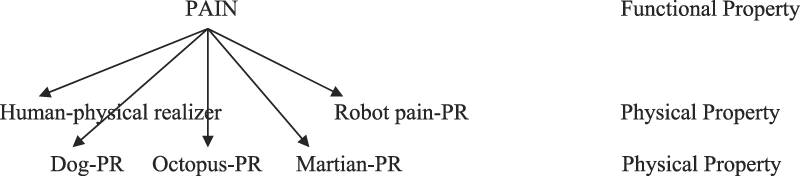
Note well, this reduction strategy has the benefit of supplying the conceptual link between the properties being reduced (mental properties) and the properties to which they are reduced (physical properties). Pain is—by definition—a certain sort of functional property and the physical properties to which it is reduced are precisely the physical properties that realize that function. But here’s the rub: as many have argued over the last thirty years—and as Kim himself concedes—qualia do not seem amenable to such an analysis.Footnote 48 Put most generally, rather than being relational abstract causal role properties, qualia appear rather to be intrinsic to the systems that have them. After all, there would appear to be nothing in principle to preclude a wide multiplicity of qualia from playing the same causal role in different systems.Footnote 49 Failing to meet this model of reduction, qualia are once again rendered epiphenomenal! We find ourselves at a “choice point,” Kim concludes. “[E]ither [we] retain supervenient and yet irreducible (that is, non-functionalizable) mental properties, say qualia, but accept their causal impotence, or [we] embrace mental eliminativism and deny the reality of these irreducible properties.” But according to Alexander’s Dictum “eliminativism and epiphenomenalism both come to pretty much the same thing: mental irrealism.”Footnote 50 This conclusion is, of course, highly unpalatable.Footnote 51 Nothing could be more real than the qualities of affect, imagery, and sense that constitute my conscious existence; as Einstein puts it, a universe bereft of phenomenology would be nothing but a pile of “dirt.” In sum, while Kim correctly identifies the epiphenomenalist threat which irreducible mental properties present, his reductive functionalism fails to accommodate those very mental properties—qualia—which are most ripe for exclusion.
Kim’s response to the exclusion problem, at least with respect to conscious experiences, fails. This is not so surprising since it is predicated on viewing all mental properties as functional kinds, that is, on viewing all mental properties as functional properties that are more abstract than their physical realizers are. Yet qualia do not seem to be more abstract than the central states of sentient organisms. Indeed, it is precisely their intrinsic nature that stymies functional analyses—whether they are the reductive functional analyses of the sort propounded by Kim and Lewis, or the nonreductive analyses of the sort proffered by nonreductive physicalists like Marras. Rather, qualia appear, as Ned Block suggests, to be identical, not with abstract causal role properties, but with the physical properties that realize those roles.Footnote 52 Given that qualia are spatiotemporally coincident with their “correlates,” and given the pressures of avoiding epiphenomenalism, the move to identity is arguably the best explanation of the relationship between experience and neural activity. We can further bolster this argument to the best explanation by recognizing that Feigl’s version of identity theory preserves and explains the subjective and private nature of experience. Nevertheless, there is still the supposed multiple realizability of consciousness; is not the (type) identity of qualia with their neural “correlates” unduly anthropocentric and “chauvinistic?”
Although Putnam’s multiple realizability objection has had a powerful influence on contemporary theories of mind, its import, at least for our purposes, has been wildly overestimated. For one thing, Putnam’s insight failed to recognize the possibility of species-specific mind-brain identities.Footnote 53 In fact, both coarse-grained functionalism and multiple realizability itself seem to imply species-specific covariance. Consider Christopher Hill’s “absent function role objection” to functionalist accounts of sensations. In a sense, this objection is the flipside of Block’s more familiar absent qualia objection.Footnote 54 Rather than leading to the conclusion that functionalist accounts are overly liberal in their ascriptions of consciousness to systems, Hill’s objection attempts to show that such accounts can also be overly chauvinistic insofar as they seemingly deny certain sorts of sensations to organisms that apparently have them. Consider a folk-functional analysis of pain. Suppose pain is an abstract causal role property analyzed in terms of its causal relations to sensory inputs, behavioural outputs, and to other mental states. Yet the neonate, while it may have the sensation of pain, does not have the causal connections to other mental states (and perhaps behavioural outputs) which are definitive of pain. After all, the neonate presumably does not have the right sort of beliefs and desires concerning pain experiences.Footnote 55 The situation is worse for conscious—yet far less mentally advanced—animals.Footnote 56 For while the multiply realizability intuition implies that such creatures are conscious, they lack the human folk psychology under which sensations are functionally analysed. One natural response to this line of objection is to distinguish levels of functional complexity. Not being causally related to our more sophisticated set of intentional properties, the functional analysis of the dog’s sensations will be simpler—or at the very least different. However, notice the species-specific implications of this move: if quale types are functional types—as the folk-functionalist maintains—and if the dog instantiates different functional properties when in pain, it instantiates different pain qualia. Human pain qualia are distinct from dog pain qualia. Thus, even on an abstract functional analysis, we must relativize sensation types to species types.
Kim embraces this species-specific covariance, employing the notion of species-specific identities in support of his reductionist project. He maintains that the multiple realizability argument itself presupposes species-specific covariance. While Putnam’s argument “perhaps shows that the strong connectability of mental properties vis-à-vis physical properties does not obtain; it presupposes that species specific strong connectability does hold.”Footnote 57 Putnam’s argument presupposes the realization of human pain by a different physical property from, say, dog pain or Martian pain. And while pain simpliciter may be more abstract than the various physical properties that realize it, these instantiations of pain simpliciter—human pain, dog pain, Martian pain, etc.—are themselves embodied, causally relevant neurophysiological properties. Kim refers to this as “The Structure-Restricted Correlation Thesis.” For any system type T that instantiates quale type Q a specific neural property P constitutes a necessary and sufficient condition in T for the occurrence of Q.Footnote 58 In this case, we no longer face the metaphysical asymmetry which seemed to preclude the identification of qualia with physical properties of the body. The upshot, then, is that while consciousness may be realizable across many physically disparate systems, human qualia—the qualities of the sensory and affective manifold of human experience—are sets of neural properties of the human organism.
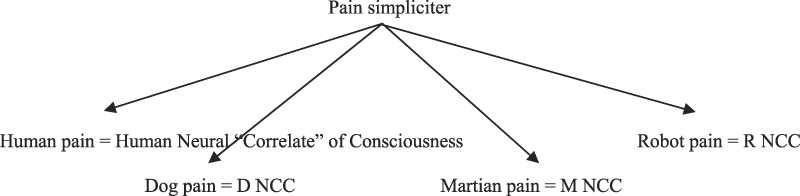
To be sure, the example of human pain, per se, is overly simplistic and glosses a rich and complex plethora of qualitatively distinct experiences. As we all know from experience, there is a wide variety of different sorts of pain we can suffer. We can characterize pains in terms of sharpness or dullness, burning or cramping, throbbing or shooting; and in terms of a pain’s bodily location, whether it is a head- or a toothache, stomach indigestion, or the soreness of an arthritic joint. Stomach pain, for instance, will itself come in a number of physically distinct forms, even within a single species.

The situation may be even more complex, for there may be sufficient (relevant) physical differences between individual humans—or even in the same human over time—to suggest that these individuals are living through qualitatively distinct experiences when confronted with the same stimulus. There are familiar examples: one would not expect a person with red-green colour blindness to have a typical manifold of colour experiences. Likewise, the synesthete, whose auditory perception of music evokes colour sensations, will enjoy a very different aesthetic experience from my own.Footnote 59
More generally, we can envisage future laboratory scenarios where neurologists discover that in 10% of a population of humans the neural “correlates” for, say, red colour experience are significantly different from the other 90%, perhaps involving neural activity in parts of the brain usually associated with other experiential types. In this case, we might expect that the conscious perception of, say, fire hydrants comes in at least two qualitatively and physically distinct varieties, even within humans.Footnote 60 In fact, there is at least some empirical support for the supposition that there are, or could be, cases of radical and systematic experiential differences between individuals on the scale of a spectrum inversion.Footnote 61 Similarly, psychophysical research into unique hues suggests that there are significant—though difficult to detect—differences in colour experiences in the general population.Footnote 62
In short, even within a species there may be many, many shades of experience.Footnote 63 This will undoubtedly render the individuation of qualia within a species quite messy. However, it is important to bear in mind that many, perhaps most, of the neurological differences between individual members of a species will not make an experiential difference. Presumably, those specializing in the study of the neural correlates of consciousness will ignore what they deem to be irrelevant physical differences between subjects in their identification and individuation of these “correlates.” Of course, determining which differences are relevant ones will be no easy task.Footnote 64 Although the individuation of experiential types even within our own species will be difficult and messy, insofar as they are neurophysiological phenomena, conscious experiences will be integrated into the web of causal relations that result from perception and result in behaviour.Footnote 65
Conclusion
Kim is right, I think, that mind-body property dualism has difficulty avoiding causal exclusion. Marras’s appeal to the relation of supervenience is one attempt to mitigate the epiphenomenalist threat through the dependence/determination relation of functional realization. However, the Inheritance Thesis is problematic. Significantly, for our purposes, the fact that the function-realizer relation does not obtain in the case of qualia further weakens the prospects for causal inheritance. Nevertheless, we can avoid exclusion by identifying (species-specific) qualia with their neural “correlates.” Unfortunately, Kim’s reductionist project demands, he thinks, reductive explanations that are only possible if we adopt reductive functionalism. While his account may avoid exclusion in the case of some mental properties, it fails to accommodate the qualities of experience. Ironically, then, Kim’s response to the very problem which he has advanced against nonreductivists fails in the case of conscious experience. However, rather than grounding the identity in a reductive explanation, we can view the case for identity as an argument to the best explanation. Identifying conscious experiences with their neural “correlates” has two distinct advantages: not only does it avoid epiphenomenalism and irrealism, it retains—even makes sense of—the subjectivity and embodiment of experience since the neural activity of a sentient organism is both internal to that organism and such that only that organism can be its subject. When I describe my pain experience to my doctor as she observes and describes her stimulation of the corresponding neural activity, we are both referring to the same phenomenon, though we apprehend it from very different perspectives and refer to it using very different vocabulary. In this case, we dispel the threat of epiphenomenalism while at the same time reifying, and even to some extent demystifying, conscious experience.Footnote 66


