



%20--%3e%3c!DOCTYPE%20svg%20PUBLIC%20'-//W3C//DTD%20SVG%201.0//EN'%20'http://www.w3.org/TR/2001/REC-SVG-20010904/DTD/svg10.dtd'%3e%3csvg%20version='1.0'%20id='Layer_1'%20xmlns='http://www.w3.org/2000/svg'%20xmlns:xlink='http://www.w3.org/1999/xlink'%20x='0px'%20y='0px'%20width='64px'%20height='64px'%20viewBox='5.5%20-3.5%2064%2064'%20enable-background='new%205.5%20-3.5%2064%2064'%20xml:space='preserve'%3e%3cg%3e%3ccircle%20fill='%23FFFFFF'%20fill-opacity='0'%20cx='37.785'%20cy='28.501'%20r='28.836'/%3e%3cpath%20fill='%23595959'%20d='M37.441-3.5c8.951,0,16.572,3.125,22.857,9.372c3.008,3.009,5.295,6.448,6.857,10.314%20c1.561,3.867,2.344,7.971,2.344,12.314c0,4.381-0.773,8.486-2.314,12.313c-1.543,3.828-3.82,7.21-6.828,10.143%20c-3.123,3.085-6.666,5.448-10.629,7.086c-3.961,1.638-8.057,2.457-12.285,2.457s-8.276-0.808-12.143-2.429%20c-3.866-1.618-7.333-3.961-10.4-7.027c-3.067-3.066-5.4-6.524-7-10.372S5.5,32.767,5.5,28.5c0-4.229,0.809-8.295,2.428-12.2%20c1.619-3.905,3.972-7.4,7.057-10.486C21.08-0.394,28.565-3.5,37.441-3.5z%20M37.557,2.272c-7.314,0-13.467,2.553-18.458,7.657%20c-2.515,2.553-4.448,5.419-5.8,8.6c-1.354,3.181-2.029,6.505-2.029,9.972c0,3.429,0.675,6.734,2.029,9.913%20c1.353,3.183,3.285,6.021,5.8,8.516c2.514,2.496,5.351,4.399,8.515,5.715c3.161,1.314,6.476,1.971,9.943,1.971%20c3.428,0,6.75-0.665,9.973-1.999c3.219-1.335,6.121-3.257,8.713-5.771c4.99-4.876,7.484-10.99,7.484-18.344%20c0-3.543-0.648-6.895-1.943-10.057c-1.293-3.162-3.18-5.98-5.654-8.458C50.984,4.844,44.795,2.272,37.557,2.272z%20M37.156,23.187%20l-4.287,2.229c-0.458-0.951-1.019-1.619-1.685-2c-0.667-0.38-1.286-0.571-1.858-0.571c-2.856,0-4.286,1.885-4.286,5.657%20c0,1.714,0.362,3.084,1.085,4.113c0.724,1.029,1.791,1.544,3.201,1.544c1.867,0,3.181-0.915,3.944-2.743l3.942,2%20c-0.838,1.563-2,2.791-3.486,3.686c-1.484,0.896-3.123,1.343-4.914,1.343c-2.857,0-5.163-0.875-6.915-2.629%20c-1.752-1.752-2.628-4.19-2.628-7.313c0-3.048,0.886-5.466,2.657-7.257c1.771-1.79,4.009-2.686,6.715-2.686%20C32.604,18.558,35.441,20.101,37.156,23.187z%20M55.613,23.187l-4.229,2.229c-0.457-0.951-1.02-1.619-1.686-2%20c-0.668-0.38-1.307-0.571-1.914-0.571c-2.857,0-4.287,1.885-4.287,5.657c0,1.714,0.363,3.084,1.086,4.113%20c0.723,1.029,1.789,1.544,3.201,1.544c1.865,0,3.18-0.915,3.941-2.743l4,2c-0.875,1.563-2.057,2.791-3.541,3.686%20c-1.486,0.896-3.105,1.343-4.857,1.343c-2.896,0-5.209-0.875-6.941-2.629c-1.736-1.752-2.602-4.19-2.602-7.313%20c0-3.048,0.885-5.466,2.658-7.257c1.77-1.79,4.008-2.686,6.713-2.686C51.117,18.558,53.938,20.101,55.613,23.187z'/%3e%3c/g%3e%3c/svg%3e)
%20--%3e%3c!DOCTYPE%20svg%20PUBLIC%20'-//W3C//DTD%20SVG%201.0//EN'%20'http://www.w3.org/TR/2001/REC-SVG-20010904/DTD/svg10.dtd'%3e%3csvg%20version='1.0'%20id='Layer_1'%20xmlns='http://www.w3.org/2000/svg'%20xmlns:xlink='http://www.w3.org/1999/xlink'%20x='0px'%20y='0px'%20width='64px'%20height='64px'%20viewBox='5.5%20-3.5%2064%2064'%20enable-background='new%205.5%20-3.5%2064%2064'%20xml:space='preserve'%3e%3cg%3e%3ccircle%20fill='%23FFFFFF'%20fill-opacity='0'%20cx='37.637'%20cy='28.806'%20r='28.276'/%3e%3cg%3e%3cpath%20fill='%23595959'%20d='M37.443-3.5c8.988,0,16.57,3.085,22.742,9.257C66.393,11.967,69.5,19.548,69.5,28.5c0,8.991-3.049,16.476-9.145,22.456%20C53.879,57.319,46.242,60.5,37.443,60.5c-8.649,0-16.153-3.144-22.514-9.43C8.644,44.784,5.5,37.262,5.5,28.5%20c0-8.761,3.144-16.342,9.429-22.742C21.101-0.415,28.604-3.5,37.443-3.5z%20M37.557,2.272c-7.276,0-13.428,2.553-18.457,7.657%20c-5.22,5.334-7.829,11.525-7.829,18.572c0,7.086,2.59,13.22,7.77,18.398c5.181,5.182,11.352,7.771,18.514,7.771%20c7.123,0,13.334-2.607,18.629-7.828c5.029-4.838,7.543-10.952,7.543-18.343c0-7.276-2.553-13.465-7.656-18.571%20C50.967,4.824,44.795,2.272,37.557,2.272z%20M46.129,20.557v13.085h-3.656v15.542h-9.944V33.643h-3.656V20.557%20c0-0.572,0.2-1.057,0.599-1.457c0.401-0.399,0.887-0.6,1.457-0.6h13.144c0.533,0,1.01,0.2,1.428,0.6%20C45.918,19.5,46.129,19.986,46.129,20.557z%20M33.042,12.329c0-3.008,1.485-4.514,4.458-4.514s4.457,1.504,4.457,4.514%20c0,2.971-1.486,4.457-4.457,4.457S33.042,15.3,33.042,12.329z'/%3e%3c/g%3e%3c/g%3e%3c/svg%3e)
1. Introduction
Artificial intelligence (AI), particularly deep learning, is rapidly transforming astronomy by enabling the analysis of complex, large-scale datasets that are otherwise intractable with traditional approaches. In the context of star formation and the interstellar medium (ISM), AI offers powerful tools for handling high-dimensional data, linking simulations with observations, and uncovering the physical connections that drive the formation and evolution of cosmic gas structures.
Star formation is a fundamental process that connects the scales of planetary systems to galactic dynamics. Its interplay with the ISM, a turbulent reservoir of gas and dust that both forms and recycles stars, drives the baryonic cycle of the universe (Spitzer Reference Spitzer1978; Cox and Reynolds Reference Cox and Reynolds1987; McKee and Ostriker Reference McKee and Ostriker2007; Heyer and Dame Reference Heyer and Dame2015; Krumholz et al. Reference Krumholz, McKee and Bland-Hawthorn2019; Molinari et al. Reference Molinari, Bally, Glover, Moore, Noriega-Crespo, Plume, Testi, Vázquez-Semadeni, Zavagno, Bernard and Martin2014; Naab and Ostriker Reference Naab and Ostriker2017; Tacconi et al. Reference Tacconi, Genzel and Sternberg2020; Saintonge and Catinella Reference Saintonge and Catinella2022). Yet the underlying physics remains highly complex: turbulence, magnetic fields, gravity, and stellar feedback interact in nonlinear ways across multiple spatial and temporal scales.
Among these processes, stellar feedback plays a particularly important role by injecting energy and momentum into the surrounding medium (Krumholz et al. Reference Krumholz, Bate, Arce, Dale, Gutermuth, Klein, Li, Nakamura and Zhang2014), an effect thought to contribute to the inefficiency of star formation in the Milky Way (Krumholz et al. Reference Krumholz, McKee and Bland-Hawthorn2019). Detecting and quantifying feedback features in large molecular line datasets, however, is challenging. Here, AI has begun to make a decisive impact: three-dimensional convolutional neural networks trained on synthetic observations now enable the systematic identification of feedback structures, yielding new insights into how feedback regulates ISM dynamics (Xu et al. Reference Xu, Offner, Gutermuth and Van Oort2020a,b).
Beyond feedback detection, AI encompasses a broad suite of approaches for probing the ISM and star formation. Discriminative models can be used to infer properties such as protostellar outflow characteristics and magnetic field orientations (Xu et al. 2023a), while generative models, including diffusion-based methods (Xu et al. Reference Xu, Tan, Hsu and Zhu2023c,b, Reference Xu, Karcheski, Law, Zhu, Hsu and Tan2025) and Schrödinger bridge approaches (Zhu et al. Reference Zhu, Xu, Deng, Tan and Russakovsky2025), provide a pathway for recovering intrinsic physical quantities such as gas density, interstellar radiation fields, and magnetic field strengths. By leveraging magnetohydrodynamic (MHD) simulations as physical priors, these generative AI frameworks connect highly degenerated observational data with the underlying physical state of molecular clouds.
In this proceeding, we present a brief overview of our work under the theme of AI4Astro, focusing on applications of AI to star formation and the ISM. The proceeding is organized into two main parts: (1) discriminative models applied to the segmentation of stellar feedback structures, and (2) generative models aimed at inferring the physical properties of the ISM from observational data, guided by MHD simulations.
2. Discriminative AI for Stellar Feedback and Outflow Detection
Studying the dynamical structures of stellar feedback requires analyzing molecular line data cubes in three dimensions. However, visually identifying feedback structures, such as bubbles and protostellar outflows, in these large and complex datasets is both challenging and inefficient. To address this, we developed casi-3d, a 3D convolutional neural network designed to identify stellar feedback structures in position-position-velocity (PPV) molecular line cubes (Xu et al. Reference Xu, Offner, Gutermuth and Van Oort2020a,b).
casi-3d is trained on synthetic observations generated from MHD simulations combined with radiative transfer calculations using radmc-3d. The model learns to recognize feedback signatures within the simulated data and can then be applied to real observations, predicting the locations of feedback features and estimating outflow mass fractions on a voxel-by-voxel basis. This pixel-level approach enables more accurate mass and energy estimates compared to traditional masking techniques. Figure 1 illustrates an example of casi-3d’s prediction of a bubble structure in CO line emission, highlighting its ability to delineate feedback at high fidelity.
Comparison of bubble identification using traditional circular masking and AI-based pixel-level masking at the location of a bubble structure.

Applying casi-3d to observations of the Ophiuchus, Taurus, Perseus, and Orion molecular clouds (Xu et al. Reference Xu, Offner, Gutermuth, Kong and Arce2022a), we demonstrated its robustness across diverse environments. The results reveal a linear scaling relation between outflow mass and the number of young stellar objects (YSOs), with each YSO contributing on average about one solar mass of outflow material. Furthermore, we found that protostellar outflow energy modifies the spatial power spectrum of CO integrated intensity maps, introducing a break at a physical scale of
 $\sim$
0.5 pc. This characteristic scale matches the typical outflow size and may correspond to the dominant scale of mass and energy injection into molecular clouds.
In a follow-up study, we applied casi-3d to construct a sample of 200 protostellar outflows exhibiting blue- and redshifted CO emission in nearby molecular clouds (Xu et al. Reference Xu, Offner, Gutermuth and Tan2022b). We investigated the relationship between outflow orientations and magnetic field directions traced by Planck 353 GHz dust polarization. Our analysis reveals a highly significant correlation (
 $p \sim 10^{-4}$
), ruling out a random distribution of relative orientations. Instead, the results show a preferred alignment, with relative position angles peaking at
 $\sim 30^{\circ}$
and a broad dispersion of
 $\sim 50^{\circ}$
. This alignment suggests that magnetic fields play a dynamical role in regulating the launching and propagation directions of protostellar outflows.
Together, these results demonstrate that discriminative AI models such as casi-3d provide a powerful and systematic framework for detecting stellar feedback and quantifying its physical impact on molecular clouds, offering insights that are otherwise inaccessible with traditional methods.
3. Generative AI for Inferring Physical Properties of Molecular Clouds
Generative AI, particularly diffusion-based models, provides a powerful framework for extracting hidden physical properties of molecular clouds from limited or projected observables. Unlike traditional empirical fitting or direct regression approaches, diffusion models leverage stochastic noise modeling to learn a robust generative mapping between observables and underlying physical fields.
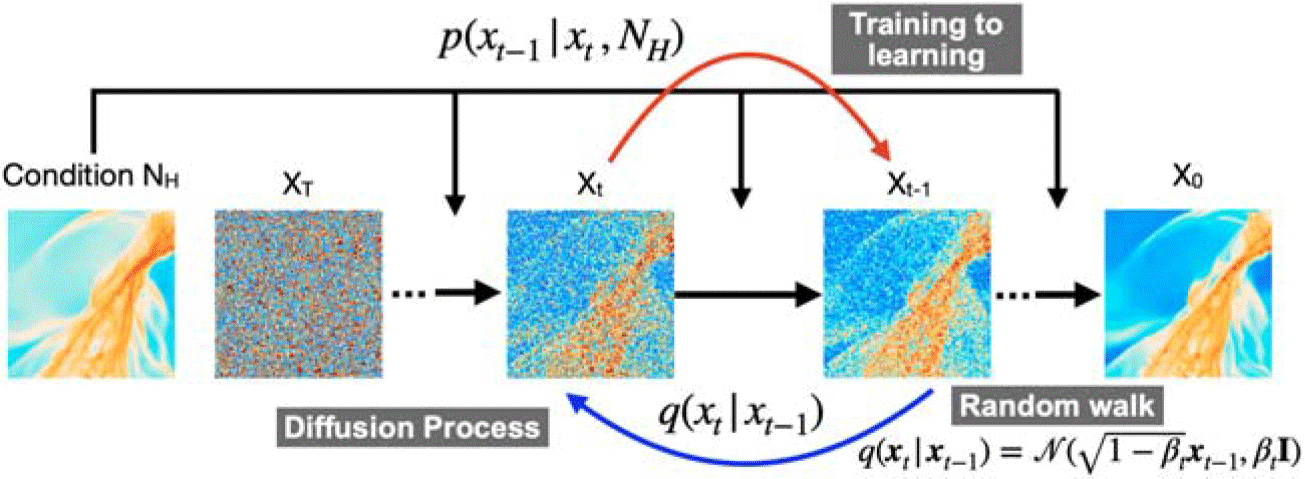
We first implement the Denoising Diffusion Probabilistic Model (DDPM) to estimate the volume or number density of giant molecular clouds (GMCs) from projected mass surface density maps (Xu et al. Reference Xu, Tan, Hsu and Zhu2023c). The training dataset consists of MHD simulations covering diverse magnetic field strengths and dynamical scenarios, including both colliding and noncolliding GMCs. The diffusion model is trained on surface density maps paired with mass-weighted number density maps from multiple viewing angles. Compared with empirical power-law fits and conventional neural-network regressions (casi-3d), the DDPM achieves nearly an order-of-magnitude improvement in predicting number density. Figure 2 illustrates the principle of DDPM, where the model learns to denoise random Gaussian perturbations conditioned on physical observables, such as dust or molecular line emission, to recover the true physical field.
DDPM framework. The model is trained to extract underlying physical properties from noisy backgrounds represented by Gaussian distributions, while conditioning on observables such as dust emission or molecular line emission.

Building on this foundation, we extend DDPMs to quantify radiation feedback in star formation. Using synthetic dust emission maps (4.5, 24, and 250
 $\mu$
m) from STARFORGE MHD simulations, we train DDPMs to predict the strength of the interstellar radiation field (ISRF). The models achieve excellent agreement with ground truth values, even under strong radiation fields (Xu et al. Reference Xu, Offner, Gutermuth, Grudić, Guszejnov and Hopkins2023b), offering a novel means to probe feedback distributions in environments strongly shaped by nearby clusters.
We further apply diffusion models to estimate magnetic field strength in GMCs (Xu et al. Reference Xu, Karcheski, Law, Zhu, Hsu and Tan2025). Three DDPM variants are trained using combinations of column density, dust polarization angles, and nonthermal velocity dispersion. The most comprehensive three-channel DDPM outperforms both traditional statistical methods (e.g., Davis-Chandrasekhar-Fermi) and simplified model variants, avoiding the systematic overestimations common in classical approaches.
Finally, we explore Diffusion Schrödinger Bridge (DSB) models for inverse inference in dynamical astrophysical systems (Zhu et al. Reference Zhu, Xu, Deng, Tan and Russakovsky2025). Our Astro-DSB variant incorporates pairwise domain assumptions tailored for GMC dynamics, applied to both simulated data and real observations of the Taurus B213 filament. Two key findings emerge: (1) Astro-DSB improves interpretability, learning efficiency, and predictive power over conventional astrostatistical and machine learning baselines; and (2) probabilistic generative modeling provides superior generalization in out-of-distribution cases, where unseen initial conditions or dominant physical processes diverge from the training set. This highlights the promise of physics-aware generative models in bridging the gap between simulations and observations, offering interpretable and robust tools for studying molecular cloud evolution and star formation.
4. Toward Interpretable and Physically Grounded AI in Star Formation Studies
In this proceeding, we highlighted recent advances in applying generative AI techniques to infer physical properties of molecular clouds, with a particular emphasis on diffusion-based models. Our results demonstrate that Denoising Diffusion Probabilistic Models can significantly outperform traditional empirical and machine learning approaches in estimating key quantities such as gas density, interstellar radiation field strength, and magnetic field properties. More recently, the introduction of Diffusion Schrödinger Bridge models offers a promising new direction. By explicitly modeling paired domains and bridging forward and backward dynamics, DSBs provide not only higher predictive accuracy but also improved interpretability in understanding astrophysical processes within GMCs.
Looking ahead, the interpretability of generative AI is likely to play a central role in its integration into astrophysics. Unlike conventional discriminative approaches that rely heavily on correlations within the training data, DSBs and related generative models can capture underlying physical symmetries and dynamics, making them more robust in out-of-distribution regimes and more aligned with physical intuition. This property opens opportunities for bridging the gap between machine learning inference and physics-driven modeling.
Future work will focus on extending generative AI frameworks to multi-modal observational inputs, combining dust extinction, molecular line spectra, and polarization maps within a unified modeling scheme. At the same time, developing physics-aware architectures that embed conservation laws and causal relations will be essential for making generative AI models not only predictive but also explanatory. Ultimately, these advances point toward a future where generative AI acts as a powerful tool for both discovery and interpretability in astrophysical research, helping to uncover the governing processes of star formation and molecular cloud evolution.


 Open access

