Public health officials routinely promote individual preparedness behaviors, including stockpiling supplies for emergency use, participating in first aid and CPR trainings, and developing household emergency plans. Despite numerous efforts across the United States to promote individual disaster preparedness over the last decade, rates of key behaviors remain largely unchanged, and there is widespread recognition that traditional efforts are not having an impact beyond simply increasing awareness.Reference Uscher-Pines, Chandra, Acosta and Kellermann 1 Encouraging preparedness behaviors is critical for both individual and public health, as individual preparedness behaviors often have important positive spillover effects for the community in addition to private benefits to the individual. However, this also means that addressing these issues sometimes requires individuals to change their behavior in ways that benefit others more than themselves. Public health preparedness efforts often focus on educating individuals in the hopes that receiving information alone will change behaviors. These policies are implicitly based on the theory of rational choice, which assumes that given correct information, individuals will correctly and carefully weigh the costs and benefits of their actions. Yet, we often observe behavior that departs from what rational choice theory predicts, and well-intentioned preparedness efforts often fail to achieve their goals.
The field of behavioral economics offers tools that may help public health practitioners address barriers to desired behaviors that support and enhance disaster preparedness and response. Behavioral economics is based on the idea that individuals’ choices are affected by systematic and predictable cognitive biases and that these same biases can be used to encourage desired behaviors. Recently, behavioral economics has been popularized through books such as Nudge Reference Thaler and Sunstein 2 and Thinking, Fast and Slow, Reference Kahneman 3 which highlight approaches that have been used to encourage a variety of activities, like quitting smoking, signing up to be an organ donor, increasing retirement savings, and getting voters to turn out in an election. However, interventions utilizing concepts from behavioral economics have not yet been widely used and validated for efforts related to disaster preparedness and response, even though these behaviors share important similarities (such as immediate costs but delayed or uncertain benefits) with those that have been successfully influenced by behavioral economics approaches.
This guide presents a few ideas on how leaders of state and local health departments can use behavioral economics to support and improve disaster preparedness and response efforts. We describe the cognitive biases most relevant to disaster preparedness and response behaviors, propose some example interventions that can be applied and tested, and discuss considerations for implementation.
METHODS
We reviewed the literature on behavioral economics and its application to a range of contexts to identify key biases that impact behavior and decision-making. We also reviewed behavioral economics-inspired interventions that have proven effective in other related contexts, as well as conducting a separate literature review on disaster behavior, including evacuation behavior, public panic, and bystander response. This literature has insights into the biases that impact and behaviors that strengthen disaster preparedness and response.
We also conducted 8 semistructured interviews with representatives of state and local health departments. We sought to obtain a diverse sample that represented different regions of the United States as well as both urban and rural populations. Six were recruited in partnership with the National Association of County and City Health Officials. Two were recruited from among the pool of stakeholders that regularly participate in National Health Security Strategy-related research. In the stakeholder interviews, we discussed the behaviors that health departments seek to influence and the levers they currently use to influence behaviors and interact with the public (eg, social media, direct interaction via trainings, and health fairs) to identify gaps in current practice and areas of innovation. We also presented a range of behavioral economics-inspired interventions and asked participants to brainstorm how and in what circumstances the interventions could be applied.
We conducted 3 focus groups with a total of 9 federal officials within and outside of the Office of the Assistant Secretary for Preparedness and Response. Focus groups followed the general format of the semistructured interviews with nonfederal stakeholders. Finally, we held informal consultations with RAND experts in risk communication, decision-making, and economics outside of the study team.
In all interviews and focus groups, 1 member of the study team took notes; the rest of the team reviewed the notes for accuracy and completeness. The study team determined emergent themes by consensus. This study was approved by RAND’s Institutional Review Board. Focus group and interview participants provided verbal consent.
KEY COGNITIVE BIASES IN DISASTER PREPAREDNESS AND RESPONSE
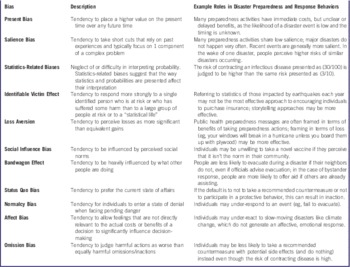
We present a brief overview of key cognitive biases in the literature that were verified by stakeholders as relevant for behaviors related to disaster preparedness and response. A more comprehensive list of biases from the literature and examples of their role in select preparedness and response behaviors are included in Table 1, but this list is not exhaustive.
Decision-Making Biases Relevant to Disaster Preparedness and Response

Present Bias
Present bias refers to the phenomenon that people often place a higher value on the present time over any future time.Reference Kahneman and Tversky 4 Given a bias toward the present, people exhibit limited willpower to make choices that pay off in the future. 5 , Reference Mullainathan and Thaler 6 For instance, given a choice between a reward of $20 now or $50 a year from now, most study participants chose $20 now, indicating they valued the present at roughly 3 times as much as the future.Reference Green, Fristoe and Myerson 7 Present bias is a big challenge to disaster preparedness, as many preparedness activities involve actions with an immediate cost, but unclear or delayed benefits.
Salience Bias
When making decisions, people typically take mental shortcuts that rely on past experiences or focus on 1 component of a complex problem, while ignoring other relevant information based on their perception of how salient that information is. Thus, the salience bias is a tendency to only act on information currently on the top of one’s mind.Reference Samson 8 , Reference Dolan, Hallsworth, Halpern, King and Vlaev 9 Many emergency preparedness activities share the characteristic of low salience since major disasters do not happen very often, though recent events are generally more salient.
Statistics-Related Biases
People are subject to several kinds of statistics-related biases, most often the neglect of or difficulty in interpreting probabilities, such as the risk of a disaster event. One example of a statistical bias is ratio bias, which is the tendency for people to judge risks expressed as large-number ratios (30/100) to be higher than those expressed with small-number ratios (3/10), even when the ratios are equivalent.Reference Bonner and Newell 10
Identifiable Victim Effect
The identifiable victim effect refers to the weaker emotional response to large numbers of anonymous “statistical” lives at risk (eg, smoking kills hundreds of thousands of Americans each year), compared with the strong emotional response to a story about an “identified” individual victim. In many cases, referring to statistics may not be the most effective approach for promoting preparedness behaviors.
Loss Aversion
Loss aversion is the tendency to perceive losses as more significant than equivalent gains. Tversky and Kahneman were among the first to experimentally show how loss aversion can affect decision-making.Reference Tversky and Kahneman 11 Their study showed that whether choices were framed in terms of gains or losses in human life changed participants’ choices about the right decision to make, even though the options were equivalent in terms of expected number of deaths. When the framing about the outcome of 1 option for 600 people was changed from 200 people will be saved for sure (framed in terms of gains) to 400 hundred people will die for sure (framed in terms of loss), approximately 3 out of 4 people changed their decision on the outcome they preferred, even though these outcomes are equivalent.
Social Influence Bias
Research suggests that appeals to individuals to behave according to social norms can often inspire prosocial behaviors, such as donating money, blood, or organs; volunteering; and recycling, even though these behaviors are not predicted by rational choice models, since the primary benefits do not accrue to the individual. However, this bias towards social influences can also lead to undesirable behaviors if they are perceived to be the social norm. In the case of bystander response, one individual is much more likely to come to the aid of other victims if others are already assisting.
BEHAVIORAL ECONOMICS-INSPIRED PREPAREDNESS INTERVENTIONS
Behavioral economics approaches inspire a range of interventions that both acknowledge and make use of people’s decision-making biases. Behavioral economics interventions can be broken into 2 categories: communication interventions and programmatic interventions. Communication interventions involve changes in how messages are framed and disseminated. These types of interventions are relatively low cost, straightforward to implement, and can be integrated into existing efforts. On the other hand, programmatic interventions that necessitate the setting up of distinct programs or adoption of new policies require more sustained and concentrated efforts on the part of an organization’s staff. Here, we present details on 1 low-cost, easy-to-implement communication approach that invokes social norms as well as a more ambitious programmatic intervention that uses a commitment device. We also include brief descriptions of 5 other communication and programmatic intervention approaches that were identified as promising by interview participants. Although the disaster preparedness literature is rife with research on how to frame information and what kinds of messaging inspire preparedness actions,Reference Mileti, Bandy and Bourque 12 connecting communication and programmatic interventions to their theoretical underpinnings in behavioral economics can help practitioners maximize their effectiveness and avoid common implementation pitfalls.
Communication Intervention: Invoking Social Norms
Description
As noted previously, the desire to conform or adhere to social norms can be used to promote some disaster preparedness and response behaviors. Interventions using social norms leverage the observable norms of the majority to influence the behaviors of the minority. Social norms messaging can also be combined with loss framing, as in the message “Don’t risk your health—more and more Americans choose not to smoke!”
Evidence
Social norms have been successfully employed to promote water and energy conservation. For example, researchers in 1 study aiming to reduce water use from hotel laundry tested a message invoking a social norm (“Please reuse your towels; the majority of our guests do so”) instead of the typical conservation messages framed in terms of environmental protection (“Please reuse your towels to protect the environment”). The study found this social norms-based message to be more effective than the traditional approach for encouraging towel reuse (44.1% versus 35.1%).Reference Goldstein, Cialdini and Griskevicius 13 Similar patterns have been observed in voter mobilization efforts: Messages emphasizing concern about low turnout were less effective for motivating potential voters to go to the polls than messages suggesting that turnout was likely to be high.Reference Gerber and Rogers 14
When using social norms for messaging, a key decision is whether to use the approach in a universal campaign (ie, aimed at the general population) or a targeted campaign (ie, aimed at a particular group), since the prevailing social norm may vary by subpopulation.Reference Berkowitz 15 For example, rates of binge drinking or drug use may differ between urban and suburban populations. The prevailing social norm then shapes whether the message should employ a descriptive norm (“most people are vaccinating their kids and so should you”) or an injunctive norm (“your neighbors know that smoking is bad”). The type of social group involved also determines which type of message would be most appropriate; for relatively homogeneous populations, most members may feel like part of the community and thus may respond well to community norm messages such as “most citizens of our town don’t text and drive.” For heterogeneous communities, it may be necessary to create different messages for different subpopulations.
Possible Uses in Disaster Preparedness and Response
A social norms approach might be used to encourage social distancing measures. Rather than traditional messages that provide information or give direct instructions (“Cover your cough;” “Stay home when you are sick;” “Notify the doctor if you recently have been to West Africa and feel sick”), these messages could be rephrased as social norms: “Most people protect others from their cough by covering their mouth;” “Don’t be the odd person out—stay at home when you feel sick;” “Over 95% of Americans agree that the best way to deal with a possible Ebola infection is to immediately consult a qualified health care facility.” Social norms can also be explicitly established through the use of public commitments, such as when doctors hang a signed statement in their waiting room declaring they are committed to antibiotic stewardship (ie, only prescribing antibiotics in accordance with guidelines).Reference Meeker, Knight and Friedberg 16
Considerations for implementation
For a social norm intervention to be effective, the message has to be true. If the information is not believable (eg, “most of your classmates do not take drugs” in a school where drug use is clearly visible), the message will not be perceived as credible. Social norms campaigns should be context-specific, and the message content and presentation should be adapted to any specific target populations. Other considerations include the authority of the messenger and the appeal and clarity of the message.
Another important consideration is whether invoking a descriptive norm could have unintended consequences or “boomerang” effects, which occur when people who behave better than the norm start to behave worse after learning that they were exceeding the social norm. This occurs because people tend to conform to the group behavior, even if the norm is less desirable. Using descriptive and injunctive norms together can reduce the likelihood of a boomerang effect. For example, Schultz and colleagues found that the use of descriptive norms to communicate household energy consumption relative to a neighborhood average resulted in an increase in energy consumption of 8% per day for households consuming less energy than the neighborhood average.Reference Schultz, Nolan, Cialdini, Goldstein and Griskevicius 17 However, when an injunctive norm, in the form of a happy or sad face sticker, was added to these messages, the boomerang effect disappeared.
Programmatic Intervention: Commitment Devices
Description
A commitment device is a choice that an individual makes in the present to restrict future options. It helps an individual carry out future plans, typically by laying out consequences (eg, shame, a financial penalty) if a goal is not reached.Reference Bryan, Karlan and Nelson 18 Behavioral economists often recommend commitment devices as a way to help people overcome present bias. There are 2 main types of commitment devices: soft and hard. Soft commitment devices result primarily in psychological consequences, such as a feeling of shame or disappointment, whereas hard devices result in economic penalties for failure. Because many commitment devices involve financial consequences, they also leverage loss aversion bias. Examples of commitment devices are painting one’s nails with a bitter-tasting polish to prevent nail-biting or agreeing to pay a sum of money if a weight loss goal is not met.Reference Bryan, Karlan and Nelson 18
Evidence
Commitment devices are increasingly being used to encourage people to exercise, lose weight, and quit smoking. In 1 study, researchers randomly offered people who wanted to quit smoking the opportunity to commit money that would only be returned if they passed an objective nicotine test several months later. Among the participants who were offered and accepted the commitment device, 35% successfully quit smoking, whereas only 9%–15% of the control participants successfully quit (depending on attrition assumptions). Smokers who were merely offered the commitment device had quit rates 3.4% to 5.7% higher than those who were not offered the commitment device.Reference Giné, Karlan and Zinman 19
Asking individuals to commit their implementation intentions in writing can also motivate action.Reference Milkman, Beshears, Choi, Laibson and Madrian 20 Signing one’s name to these intentions can further create a feeling of commitment and can be even stronger when the intention is made publicly. Many people choose to commit to goals on websites such as stickK.com, a free web-based tool with which individuals can enter into commitment contracts by publically reporting goals and defining the stakes. Hard commitment devices involving financial consequences are becoming increasingly popular; stickK.com reports that individuals have pledged over $20 million in support of their commitments. 21
Possible Uses in Disaster Preparedness and Response
There are numerous situations in disaster preparedness and response in which individuals want to engage and follow through on a particular course of action but ultimately fail to do so. For example, an individual might see the value in stockpiling water and want to do it, but never gets around to going to the store, buying the water, and identifying a place to store it. To encourage stockpiling water or food, the interested individual could be asked to pledge in writing that he or she will procure sufficient supplies in the next week, or could be invited to make use of the stickK.com website to set up a hard commitment device.
Considerations for Implementation
For commitment devices to work, participating individuals must want to engage in a given behavior and acknowledge that they may not follow through on the preferred course of action without extra help. They also need to willingly volunteer to take steps to ensure that they will follow through. Commitment device interventions work particularly well in groups with which an organization has an established relationship or a “captive” audience of people who have already elected to participate in some other activity. In particular, this approach can be effective with an organization’s own employees or volunteers.
However, commitment device interventions can be logistically challenging for public agencies to administer, especially when the interventions are “hard” devices that involve a financial stake. Hard commitment devices are also not ideally suited for low-income individuals who may lack money to put up in advance.
Other Communication Interventions
Framing Messages in Terms of Loss
As noted previously, individuals typically dislike losses more than they value equivalent gains (loss aversion) and tend to focus more on present costs and benefits than future gains (present bias).Reference Thaler and Sunstein 2 Thus, public health practitioners might seek to frame messages in ways that play on individuals’ desire to avoid losses. A campaign utilizing a behavioral economics approach might emphasize that failing to vaccinate your family against flu could result in household economic losses, possibly through missed work or medical treatment costs. However, an important nuance is that such interventions work best when the results of a potential preparedness action are uncertain.Reference Rothman and Salovey 22 For example, receiving a flu vaccine does not guarantee that an individual will not catch flu, whereas remaining abstinent will virtually guarantee that someone will not catch a sexually transmitted infection. Messages utilizing loss aversion bias are more effective for promoting actions with uncertain effects (the former scenario) than more certain effects (the latter scenario).
Representing Small Probabilities
As previously discussed, people often neglect or have difficulty interpreting probabilities and avoid statistical calculations (statistics-related bias). They also tend to believe the risk of an emergency is too small to affect them (salience bias). To counter these tendencies, risks can be communicated as frequencies rather than probabilities (eg, 1 in 10 rather than 10%) and presented in reference to a longer time interval (eg, risk of earthquake over 30 years rather than a single year).Reference Fischhoff, Brewer and Downs 23 , Reference Sheppard, Janoske and Liu 24 Messages with statistics are most effective when delivered by peersReference Wood, Mileti, Kano, Kelley, Regan and Bourque 25 and after a salient event.
Other Programmatic Interventions
Change the Default
Since many people stick with defaults because of status quo bias, strategically choosing the “right” default can encourage desired behaviors. For example, an opt-out rather than opt-in default has been shown to increase organ donation rates by 16%.Reference Johnson and Goldstein 26 Some defaults are already being used for disaster preparedness and response including enrollment in emergency alerts on mobile phones unless people take steps to opt out. Other applications might include automatically enrolling health care providers in volunteer databases and assigning public health staff to disaster preparedness and response duties as part of their regular responsibilities. It is important, however, to consider whether any change in default poses a major burden, nuisance, or could be perceived as governmental overreach.
Plan-Making and Mental Mapping
Plan-making and mental mapping interventions make certain actions more salient by asking individuals to write down the details of the process by which they will accomplish a particular goal. Also, an individual’s decision to make a plan can be strengthened by sending reminders about 1 or more steps that the individual has committed to doing.Reference Dale and Strauss 27 Plan-making and mental mapping interventions have been shown to be effective in many areas, including increasing voter turnoutReference Nickerson and Rogers 28 and increasing flu vaccination rates.Reference Milkman, Beshears, Choi, Laibson and Madrian 20 Many disaster preparedness and response behaviors require multiple steps and the need to overcome various logistical barriers, and thus are good candidates for these interventions. Such actions might include stockpiling emergency supplies or developing a household emergency plan.
Financial Micro-Incentives
Some health departments and payers already use financial incentives to promote preparedness behaviors (eg, signing up for first responder training), but insights from behavioral economics can be used to make these programs more efficient. For example, financial incentives are most effective when paid at the same time the activity takes place, rather than after the activity, since people discount the value of future gains. Similarly, people tend to prefer a small chance of winning a larger prize to a guaranteed (but smaller) payment.Reference Loewenstein, Asch and Volpp 29 These insights imply that limited resources for preparedness participation incentives may be better employed as a decently-sized lottery on the day of signups, rather than distributing small but equal participation incentives a few weeks later.
DISCUSSION
Public health practitioners can find it challenging to influence individuals’ decisions and behaviors in ways that enhance public safety and community resilience. Since traditional approaches have fallen short, it is critical to look for innovative approaches. The field of behavioral economics offers a range of tools that are generally under-utilized. Although untested in disaster preparedness and response, the low cost and potentially high yield of these interventions warrant further investigation and testing.
However, behavioral economics has some important limitations. Communities are diverse with respect to language and culture and have different levels of trust in government and financial resources. As with any other intervention, behavioral economics approaches might need to be adapted to specific situations and populations. Whereas some individuals are comfortable with allowing the government to play the role of “choice architect” (selecting how choices will be presented to the to increase the likelihood that members of the public will make the socially desirable choice), others are not;Reference Jachimowicz and McNerney 30 public health officials may need to take these feelings into account. Behavioral economics approaches can also backfire if the target population regards such interventions as overly paternalistic.
Although the current evidence base for behavioral economics in disaster preparedness and response is weak, it is clear that behavioral economics has achieved results in similar decision-making contexts both within and outside of health. Strengthening the evidence base requires public health practitioners to experiment with and evaluate the impact of behavioral economics-inspired interventions, and they can use the material described here to inform such efforts. When routinely applied, behavioral economics approaches may enable public health officials to make use of cognitive biases to increase the impact of their efforts.
Acknowledgments
This study was supported under contract with the U.S. Department of Health and Human Services, Assistant Secretary for Preparedness and Response.