In Australia, approximately one in four adolescents are victimised at school every few weeks or more often (Cross et al., Reference Cross, Shaw, Hearn, Epstein, Monks, Lester and Thomas2009), with exposure to chronic bullying victimisation likely to result in physical, psychological and emotional symptoms (Garbarino, Reference Garbarino2001), maladjustment (Stadler, Feifel, Rohrmann, Vermeiren, & Poustka, Reference Stadler, Feifel, Rohrmann, Vermeiren and Poustka2010) and contribute to lasting long-term negative mental health (Carney, Reference Carney2008; Newman, Holden, & Delville, Reference Newman, Holden and Delville2005; Vaillancourt et al., Reference Vaillancourt, Duku, Becker, Schmidt, Nicol, Muir and MacMillan2011). Understanding the developmental pathways of bullying through the use of trajectories allows the examination of distinctive trajectories for subpopulations of those who bully others and those who are bullied by others, based on the frequency of behaviour and the associated predictors and outcomes (Nagin & Tremblay, Reference Nagin and Tremblay2001). Previous adolescent bullying trajectory analyses have examined the relationship between associated adolescent, family, and peer risk factors for each trajectory (Pepler, Jiang, Craig, & Connolly, Reference Pepler, Jiang, Craig and Connolly2008). Previous victimisation trajectory analyses have focused on primary school children and the relationship between intra- and interpersonal functioning, and social and emotional difficulties for each trajectory (Boivin, Petitclerc, Feng, & Barker, Reference Boivin, Petitclerc, Feng and Barker2010; Goldbaum, Craig, Pepler, & Connolly, Reference Goldbaum, Craig, Pepler and Connolly2003). This article uses longitudinal data to examine the relationship between adolescent chronic victimisation trajectories and emotional and behavioural difficulties as students transition from primary to secondary school — where an increase in school bullying seems to occur (Cross et al., Reference Cross, Shaw, Hearn, Epstein, Monks, Lester and Thomas2009).
This research extends previous studies of chronic victimisation, which has found adolescents with poorer social and emotional wellbeing in primary school were more likely to be chronically victimised, and those students who report greater victimisation on transitioning into secondary school also report poorer mental health outcomes at the end of the second year of secondary school (Lester & Cross, Reference Lester and Cross2013; Lester, Cross, Dooley, & Shaw, Reference Lester, Cross, Dooley and Shaw2012b).
Adolescents with greater emotional and behavioural difficulties report a less favourable quality of life (including more pain and discomfort, lower self-esteem and greater difficulty with school and peer activities), more problems with their physical health, and higher health risk behaviours (such as smoking and alcohol use) than adolescents who report fewer emotional and behavioural difficulties (Sawyer et al., Reference Sawyer, Arney, Baghurst, Clark, Graetz, Kosky and Zubrick2000). Given the importance of social relationships during adolescence, emotional and behavioural difficulties place adolescents at risk of school and wider social exclusion (Juvonen, Graham, & Schuster, Reference Juvonen, Graham and Schuster2003). Many cross-sectional studies show an association between victimisation and emotional and behavioural difficulties in primary and secondary school students, with involvement in bullying victimisation associated with increased total behaviour problems, hyperactivity, conduct problems, peer problem scores, and lower pro-social behaviour scores than those not involved in bullying (Horowitz & Garber, Reference Horowitz and Garber2006; Rigby, Reference Rigby2003; Wolke, Woods, Bloomfield, & Karstadt, Reference Wolke, Woods, Bloomfield and Karstadt2000). A longitudinal study found that adolescents who were chronically victimised scored higher on emotional and behavioural difficulties and were worst affected, when compared to escaped victims, non-victims and new victims of school bullying (Smith, Talamelli, Cowie, Naylor, & Chauhan, Reference Smith, Talamelli, Cowie, Naylor and Chauhan2004). In adolescence, the impact of bullying on social, physical and mental health can be severe and long lasting (Carney, Reference Carney2008) while also affecting academic performance (Johnson, Reference Johnson2009).
The current study investigated the relationship of adolescent victimisation trajectories with emotional and behavioural difficulties for males and females from the end of primary school (Grade 7 — age 12) to the end of the second year of secondary school (Grade 9 — age 14). It compares the emotional and behavioural difficulties of students who were not bullied over the four time points with those who reported low levels of stable victimisation, low levels of increasing victimisation and medium levels of increasing victimisation.
Methods
The data in this study were taken from a larger longitudinal study, the Supportive Schools Project (SSP), conducted in Perth, Western Australia, which aimed to develop, implement and evaluate the effectiveness of whole-of-school strategies to reduce the prevalence of frequent bullying behaviours as well as positively influence common mediators of bullying. Data from only the study comparison schools are used in this analysis as the intervention is not a focus of this article. The study was approved by the Edith Cowan University Human Research Ethics Committee and the relevant Catholic Education school authorities.
Sampling and Data Collection
To reduce the rate of transition attrition as students move from primary to secondary schools, secondary schools affiliated with the Catholic Education Office (CEO) of Western Australia were recruited to participate in the study. Students within many Catholic schools in Australia are more likely than students attending schools in other sectors (e.g., government schools) to move from primary to secondary schools in intact groups. Cohort data were collected during the SSP from 3,462 students from 21 of the 28 Catholic secondary schools in Western Australia. The seven schools that declined to participate in the study cited other priorities within their school and demanding staff workloads. All invited CEO schools were stratified according to the total number of students enrolled at the school and each school's socio-economic status (SES) to help to control for the influence of these two factors on student bullying behaviour. These schools were then randomly selected and randomly assigned to an intervention or comparison group (Cross, Hall, Waters, & Hamilton, Reference Cross, Hall, Waters and Hamilton2008). The data used in this article were collected from 1,800 students assigned to comparison schools (n = 11 schools) in four waves from 2005 to 2007. To collect data relating to their pretransition experience, all Grade 7 students enrolled to commence in Grade 8 at each of the 21 participating secondary schools received a baseline survey while in Grade 7 at their respective primary schools. Parents of Grade 8 students at the 21 secondary schools who had not been recruited in Grade 7 (because they were not on the school enrolment lists) were approached for consent for their child's participation at the first follow-up.
Active consent (where parents gave written permission for their child to participate) was requested from all parents; if any parents did not respond to this active consent approach, up to two follow-up letters were mailed to parents requesting their passive consent, where they were required to opt out if they did not wish their child to participate (Ellickson & Hawes, Reference Ellickson and Hawes1989). This two-layered consent process resulted in 93% of parents whose children were enrolled in the 21 recruited secondary schools consenting to their child participating in the study.
The student cohort was surveyed at the end of Grade 7 (mean age 12 years), the beginning and end of Grade 8 (mean age 13 years old), and the end of Grade 9 (mean age 14 years old). In total, 3,462 (92% of the total recruited) students completed questionnaires at least at one time point, with 3,123 (90%) responding to at least three of the four data collection points. One half of the students surveyed were male and 70% attended a co-educational secondary school versus a single sex secondary school. Responses from only the students from the SSP study comparison schools were used in the analysis detailed below.
Measures
Victimisation
To assess physical, relational and verbal victimisation, a seven-item categorical index adapted from items/scales developed by Rigby and Slee (Reference Rigby and Slee1998) and Olweus (Reference Olweus1996) was used. The items assessed physical (hit, kicked and pushed around; had money or other things broken or taken away from them; made to feel afraid they would get hurt), verbal (made fun of and teased in a hurtful way; called mean and hurtful names), and relational (students ignored them, didn't let them join in, or left them out on purpose; students told lies about them and tried to make other students not like them) bullying during the current term (10 weeks) at school. Students were asked how often they were bullied and rated each item on a 5-point scale (1 = ever, 2 = once or twice, 3 = every few weeks, 4 = about once a week, 5 = most days). A definition of bullying, supported by illustrations of the behaviours, was provided in the questionnaire. Confirmatory factor analysis performed on the victimisation scale confirmed its unidimensionality (CFI > 0.9, SMR < 0.10 at all time points). A victimisation score was calculated at each time point for each student by averaging the seven items, with a higher score reflecting more experiences of victimisation (average alpha = 0.86).
Emotional and behavioural difficulties
The Strengths and Difficulties Questionnaire (Goodman, Reference Goodman1997) comprises 25 items measured on a 3-point scale (0 = not true, 1 = somewhat true, 2 = certainly true). Five subscales (emotional symptoms, conduct problems, hyperactivity, peer problems, pro-social) and an overall score were calculated in accordance with the scale author's instructions. A higher score indicates greater problems for the emotional symptoms (average alpha = 0.74), conduct problems (average alpha = 0.64), hyperactivity (average alpha = 0.73) and peer problems (average alpha = 0.60) subscales. A higher score for the pro-social subscale (average alpha = 0.64) indicates strong social skills.
Statistical Analysis
Analyses were conducted using MPlus v6 and STATA v12. Victimisation trajectories were modelled on the comparison group within MPlus with the censored normal distribution used to account for the censoring at the lower bounds of the victimisation scale. A polynomial relationship was used to link victimisation with time. All four time points from longitudinal data collected at the end of Grade 7 to the end of Grade 9 were used in the calculation of trajectories. Missing data at each time point were handled through Full Information Maximum Likelihood (FIML) estimation in Mplus v6, enabling the use of all students with at least one valid score in the analyses. FIML assumes missing at random and produces unbiased parameter estimates and standard errors of the data (Wothke, Reference Wothke, Little, Schnabel and Baumert1998). More detailed methods are explained in detail in Lester et al. (Reference Lester, Cross, Dooley and Shaw2012b). Separate mixed regression models were fitted in Stata v12 for males and females and were used to determine whether emotional and behavioural difficulties measured at four times points differed within victimisation trajectories and over time. A three-level mixed regression model was fitted to the data to account for the repeated observations of emotional and behavioural difficulties (level 1) nested within students (level 2), whom in turn are clustered within schools (level 3).
Results
Trajectories of Victimisation
Developmental trajectories of victimisation were identified using the semi-parametric group-based trajectory approach (Nagin, Reference Nagin2005), with best fitting models determined through fit statistics, theoretical justification and interpretability. All students were then assigned to a trajectory group based on their individual probability scores. Trajectory analyses were conducted separately on the male and female samples (as significant differences in distributions were found by gender), resulting in a four-group solution for males and a three-group solution for females. The male victimisation trajectories consisted of four groups: not bullied (32% of students who did not report victimisation over the time period), low stable (56% of students who reported low levels of victimisation — victimisation occurring once or twice over the past term — across the four time points), low increasing (7% of students who reported low levels of victimisation at the end of primary school and the beginning of secondary school, with victimisation increasing to high levels by the end of the second year of secondary school) and medium stable (5% of students who reported medium levels of victimisation — victimisation occurring every few days over the past term — at the end of primary school and during the first 2 years of secondary school). For females, the three victimisation trajectory groups consisted of: not bullied (37%), low stable (57%), and low increasing (6%). No high decreasing or high stable trajectory groups were found for males or females, nor stable medium trajectory for girls.
Emotional and Behavioural Health Predictors of Trajectories of Victimisation
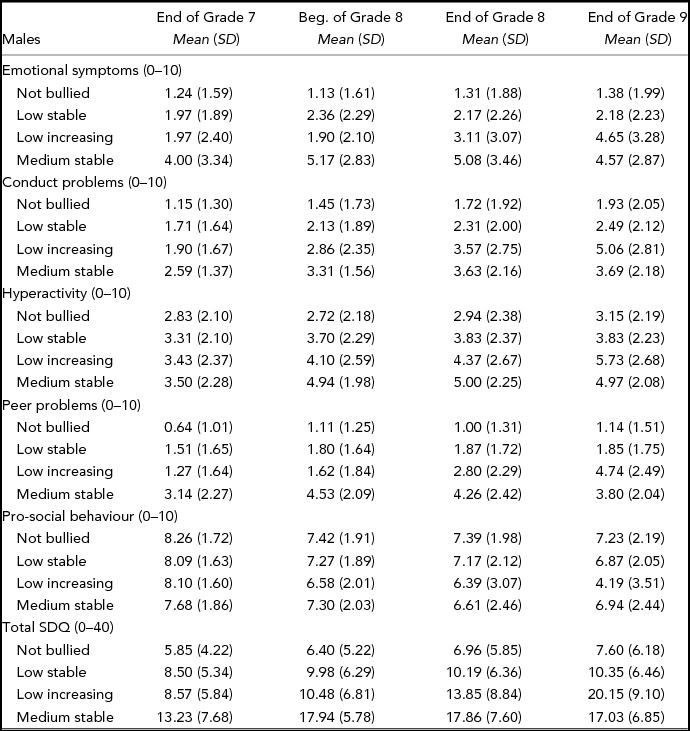
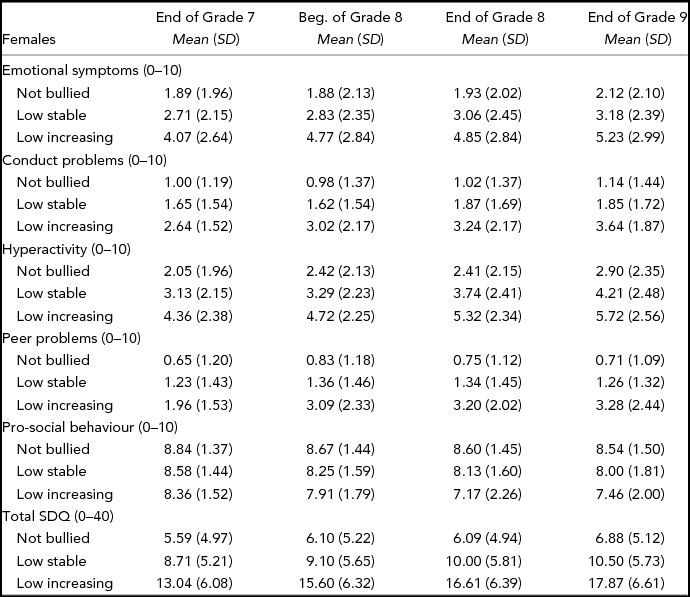
Subscales of the SDQ (emotional symptoms, conduct problems, hyperactivity, peer problems, and pro-social) were explored as outcomes of victimisation trajectory group membership at each of the four time points. At all four time points, males and females in the not bullied trajectory group reported fewer emotional symptoms, conduct problems, hyperactivity and peer problems, and greater pro-social behaviour than males and females in other victimisation trajectory groups (Tables 1 and 2).
Descriptive Statistics of Emotional and Behavioural Difficulties at Four Time Points by Victimisation Trajectories for Males

Prevalence and Descriptive Statistics of Emotional and Behavioural Difficulties at Four Time Points by Victimisation Trajectories for Females
Emotional symptoms
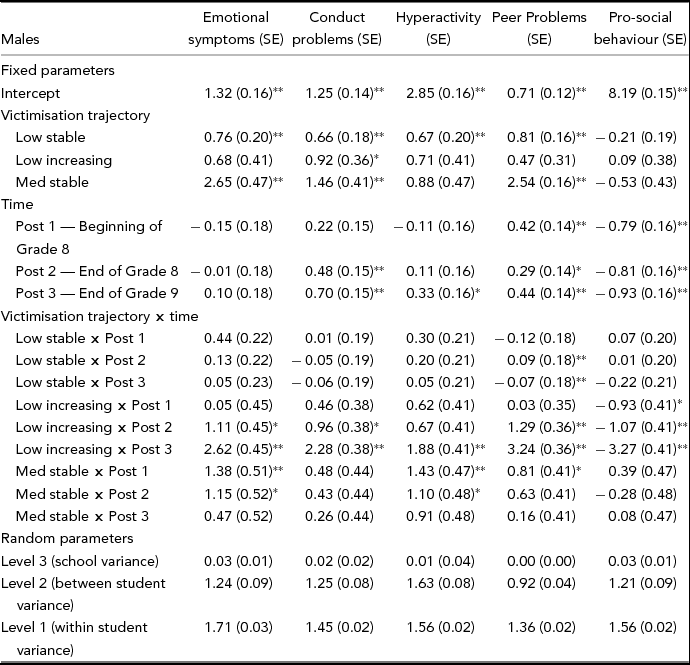
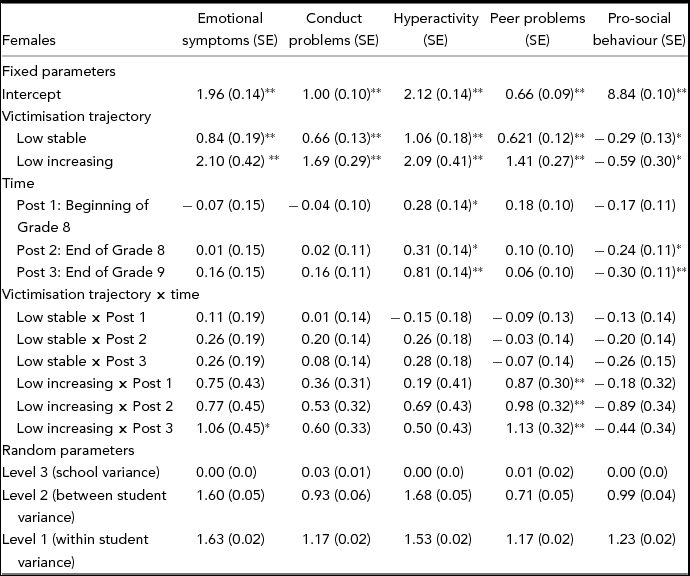
The results of the fixed part of the multilevel model indicated males in the low increasing trajectory group had significantly higher emotional symptoms scores at the end of Grade 8 and Grade 9 than the not bullied victimisation group. Further, the medium stable victimisation trajectory had significantly higher emotional symptoms scores during Grade 8 than the not bullied victimisation group (Table 3). Females in the low increasing trajectory group had significantly higher emotional symptoms scores at the end of Grade 9 than the not bullied victimisation group (Table 4).
Multi-Level Modelling Results of Emotional and Behavioural Difficulties for Males, Adjusted for Time, Victimisation Trajectory and Victimisation Trajectory × Time
Note: *p < .05, **p < .01. Reference categories: Victimisation trajectory — not bullied; Time — Baseline — End of Grade 7.
Multi-Level Modelling Results of Emotional and Behavioural Difficulties for Females, Adjusted for Time, Victimisation Trajectory and Victimisation Trajectory × Time
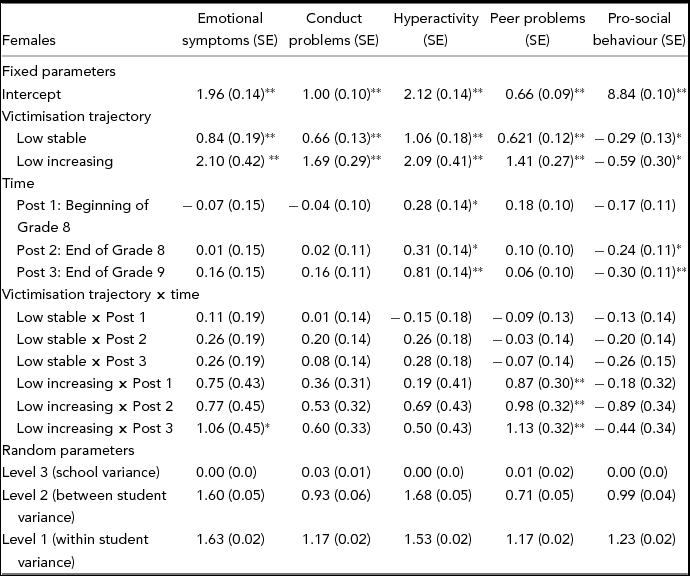
Note: *p < .05, **p < .01. Reference categories: Victimisation trajectory — not bullied; Time — Baseline — End of Grade 7
Conduct problems
Males in the low increasing trajectory group had significantly higher conduct problem scores at the end of Grade 8 and Grade 9 than the not bullied victimisation trajectory (Table 3). There were no statistically significant differences between female conduct problems scores across time and trajectory group compared to the not bullied trajectory group (Table 4).
Hyperactivity
The results of the fixed part of the multilevel model indicated males in the low increasing trajectory group had significantly higher hyperactivity scores at the end of Grade 9 than the not bullied victimisation group, and the medium stable victimisation trajectory had significantly higher hyperactivity scores during Grade 8 than the not bullied victimisation group (Table 3). There were no statistically significant differences between female hyperactivity scores across time and trajectory group compared to the not bullied trajectory group (Table 4).
Peer problems
Males in the low stable and low increasing trajectory groups had significantly higher peer problem scores at the end of Grade 8 and Grade 9 than the not bullied victimisation group, and the medium stable victimisation trajectory had significantly higher peer problem scores during Grade 8 than the not bullied victimisation group (Table 3). Females in the low increasing trajectory group had significantly higher peer problem scores during secondary school than the not bullied victimisation group (Table 4).
Pro-social behaviour
The results indicate males in the low increasing trajectory group had significantly lower pro-social scores during secondary school than the not bullied victimisation group (Table 3). There were no statistically significant differences between female pro-social scores across time and trajectory group compared to the not bullied trajectory group (Table 4).
Discussion
This 3-year longitudinal study followed students from the end of primary school (Grade 7) to the end of the second year of secondary school (Grade 9), measuring victimisation and mental, emotional and social wellbeing. There is a paucity of published longitudinal studies following adolescents that examine the relationship between victimisation and emotional and behavioural difficulties over time. The relationship between victimisation trajectory group membership and emotional and behavioural difficulties from the end of primary school to the end of the second year of secondary school is explored in this article.
In this study, just over half the students experienced low stable victimisation, 4% reported medium stable levels of victimisation, and a further 4% were victimised infrequently at the start of secondary school, with victimisation increasing over the second year of secondary school. Forty per cent of adolescents experienced no or little victimisation at the end of primary school and throughout secondary school. Gender differences were found in both the shape of the victimisation trajectories and the number of trajectory groups (males: not bullied, low stable, low increasing and medium increasing trajectories; females: not bullied, low stable and low increasing trajectories), with males reporting higher levels of chronic victimisation.
The emotional and behavioural difficulties examined included emotional symptoms, conduct problems, hyperactivity, peer problems, and pro-social behaviour. Results differed by gender with respect to increasing victimisation trajectories, with males displaying both a low and medium increasing trajectory, while females displayed only a low increasing trajectory. Males who were in increasing victimisation trajectories (i.e., had been victimised at least once or twice a term with victimisation increasing after commencing secondary school) reported greater emotional symptoms, conduct problems, hyperactivity and less pro-social behaviour in secondary school compared to male students who had not reported being bullied, whereas those in a stable victimisation trajectory (i.e., had been victimised at least once or twice a term since the end of primary school) had greater peer problems in secondary school. Females who reported an increase in victimisation at the beginning of secondary school also reported greater emotional symptoms and peer problems in secondary school than females who did not report being bullied. Males reported greater emotional and behavioural difficulties than females at all levels of victimisation.
A study by Wolke et al. (Reference Wolke, Woods, Bloomfield and Karstadt2000) found victims of physical or verbal victimisation had the highest rates of emotional and behavioural problems. Similar results were found in primary school children in a study by Woods, Done, and Hardeep (Reference Woods, Done and Hardeep2009), who concluded relational victims appear to be at higher risk of both loneliness and emotional problems, finding relational bullying harder to deal with than physical bullying. In a previous examination of the different types of victimisation (physical, verbal and relational) experienced by students in this study, students categorised with a high substantial risk of clinically significant SDQ scores showed higher levels of verbal and relational victimisation than physical victimisation (Lester & Cross, Reference Lester and Cross2013). These results indicate that the relationship between SDQ and victimisation is bidirectional, with SDQ both a cause and consequence of victimisation.
Previous studies on primary school children have shown that although externalising and internalising behaviours were related to victimisation, they were not related to children's propensity to become increasingly victimised over time (Hodges & Perry, Reference Hodges and Perry1999). The relationship between victimisation and internalising and externalising problems has been described as transactional (Griffin & Gross, Reference Griffin and Gross2004), with possible protective factors being peer, family, teacher and school support. Hence, negative peer interactions have a potentially harmful effect on physical, mental and social wellbeing (Cross et al., Reference Cross, Shaw, Hearn, Epstein, Monks, Lester and Thomas2009; Lester, Cross, Dooley, & Shaw, Reference Lester, Cross, Dooley and Shaw2012a; Pranjic & Bajraktarevic, Reference Pranjic and Bajraktarevic2010; Shin & Daly, Reference Shin and Daly2007), with peer support moderating experiences of distress from victimisation (Davidson & Demaray, Reference Davidson and Demaray2007). The ability to make new friends (Akos & Galassi, Reference Akos and Galassi2004), the number of friends and quality of friendships (Pellegrini & Bartini, Reference Pellegrini and Bartini2000), having friends who are able to help and protect, and being accepted by the peer group are the main social factors identified as protective against bullying victimisation (Hodges & Perry, Reference Hodges and Perry1996). Students with greater peer support are also more likely to intervene to stop bullying (Lodge & Frydenberg, Reference Lodge and Frydenberg2005).
Supportive family relationships, which include parental warmth, supervision, support and involvement, have also been found to reduce externalising behaviour (Wallen & Rubin, Reference Wallen and Rubin1997), improve emotional health (Resnick et al., Reference Resnick, Bearman, Blum, Bauman, Harris, Jones and Udry1997), and decrease involvement in problem behaviours and substance use, delinquency and depression (Mason, Kosterman, Hawkins, Haggerty, & Spoth, Reference Mason, Kosterman, Hawkins, Haggerty and Spoth2003; Shochet, Homel, Cockshaw, & Montgomery, Reference Shochet, Homel, Cockshaw and Montgomery2008). Moreover, family security and support has been found to be more relevant as a protective factor against victimisation for younger rather than older adolescents, with victimised adolescents with low family support at higher risk for developing mental health problems than those with higher family support (Stadler et al., Reference Stadler, Feifel, Rohrmann, Vermeiren and Poustka2010).
Teacher and school support can compensate for a lack of family support, protecting against the risks of peer victimisation (Demaray & Malecki, Reference Demaray and Malecki2003; Stadler et al., Reference Stadler, Feifel, Rohrmann, Vermeiren and Poustka2010). Teacher support and feeling connected to teachers is associated with positive social and emotional health outcomes such as better peer relationships, increased social competence, academic success and reduced participation in health risk behaviours (Hill & Madhere, Reference Hill and Madhere1996). School connectedness is an important predictor of adolescent health, with highly connected students less likely to be involved in health risk behaviours (Bond et al., Reference Bond, Butler, Thomas, Carlin, Glover, Bowes and Patton2007) and to experience mental health problems (Shochet et al., Reference Shochet, Homel, Cockshaw and Montgomery2008). School support has increasing importance in older adolescents (Stadler et al., Reference Stadler, Feifel, Rohrmann, Vermeiren and Poustka2010) as adolescents shift away from a reliance on family to a reliance on peers. Both teacher and school support have been found to moderate the relationship between internalising distress and peer victimisation (Davidson & Damaray, Reference Davidson and Demaray2007).
It is important to identify as early as possible students who are experiencing increasing victimisation. Targeted interventions for students in increasing victimisation trajectories should focus on reducing internalising and externalising behaviours while supporting the development of positive relationship skills and encouraging help-seeking behaviours. Successful interventions for addressing internalising behaviours include the promotion of coping skills, problem solving and positive social interactions (Terzian, Hamilton, & Ericson, Reference Terzian, Hamilton and Ericson2011), whereas self-control, emotional regulation, conflict resolution or social competency skills programs can be used to intervene in externalising behaviours (Wilson & Lipsey, Reference Wilson and Lipsey2007). Implementation of programs targeted at internalising and externalising behaviours have resulted in increased school performance and school participation and a decrease in the incidence, prevalence and severity of anxiety, depression and substance use disorders (Australian Government Department of Health, 2003; Wilson & Lipsey, Reference Wilson and Lipsey2007). Programs with differing emphases for males and females may be required.
Strengths and Limitations
There are several strengths of this study. Most importantly, the 2-year (four time points) longitudinal nature of the research design over the transition from primary to secondary school enabled the determination of trajectory groups and predictors at a time that can be socially challenging for most students. Moreover, these findings are robust due to the large sample of students (90%) who completed questionnaires in at least three of the four data collection points. Despite these strengths, there are several limitations to this study. First, the use of self-report of victimisation and emotional and behavioural difficulties could result in some of the associations being due to shared method variance. Peer, teacher or parent reports would be useful in examining the relationships between victimisation and emotional and behavioural difficulties. The Strength and Difficulties Questionnaires completed by parents and teachers are generally better predictors than those self-completed by adolescents (Goodman, Ford, Simmons, Gatward, & Meltzer, Reference Goodman, Ford, Simmons, Gatward and Meltzer2000). Given that the Strength and Difficulties Questionnaire is a screening tool and a brief measure of mental health, care needs to be taken in data interpretation. In addition, the collection of data at home among Grade 7 students was inconsistent with classroom-based data collection procedures used in Grades 8 and 9. To reduce the impact of these differences, an explicit and standard protocol (as used in the classroom) was provided to parents for all Grade 7 assessments; however, parents still may have indirectly or directly influenced their children's responses to the questionnaire. While absentee students and those lost to follow-up (approximately 11%) were more involved in bullying perpetration or victimisation behaviours in Year 7, this potential bias is unlikely to influence the results substantially given the large number of respondents at each data collection. The confounding of aggressive victims on the victimisation results in this study is also thought to be minimal due to the small proportion (between 0–4%) of students who reported being victimised at any time point and also reported victimising others ‘every few weeks’ or more often. Further, the results may not generalise to other similar aged student populations, as the sample included only Catholic primary and secondary schools within the Perth metropolitan area. Finally, the trajectory groups were calculated over a relatively short time period (three grade levels) and as such, the associations between victimisation behaviours and emotional and behavioural difficulties may have been established prior to the commencement of the study.
Conclusion
The results from this study show that for adolescents there is a strong relationship between internalising and externalising behaviours and victimisation over the transition period from primary to secondary school. There is a need to intervene at the end of primary school and during the transition period with whole-school bullying prevention programs and social wellbeing programs that encourage peer, family, teacher and school support and connectedness to prevent the continuation or escalation of chronic victimisation from primary to secondary school and to improve the emotional wellbeing of adolescents. Social architecture that encourages protective factors to reduce bullying over the transition period are encouraged. Due to the gender differences found in this study, programs with differing emphases for males and females may be required.
Acknowledgments
We thank Melanie Epstein, Erin Erceg, and Stacey Waters for their contributions to the Supportive Schools Project (SSP), and the SSP study schools and their staff, parents, and students. The SSP Project and this study were funded by the Western Australian Health Promotion Foundation (Healthway) and the research supported by the Child Health Promotion Research Centre (CHPRC) at Edith Cowan University, Western Australia.