


Over the past 150 years, democratic regimes have dismantled legal barriers to the political participation of women and minorities. Yet women, minorities, and minority women remain substantially underrepresented in high-level political positions worldwide (Bird, Saalfeld, and Wüst Reference Bird, Saalfeld and Wüst2011; Cederman, Min, and Wimmer Reference Cederman, Min and Wimmer2009; Paxton and Hughes Reference Paxton and Hughes2007).Footnote 1 To rectify persisting inequalities, most countries in the world have adopted quotas—laws or policies requiring candidate lists or representative bodies to include women; racial, ethnic, or religious minorities; or members of other targeted groups (Dahlerup Reference Dahlerup2006; Htun Reference Htun2004; Krook Reference Krook2009). To date, however, researchers have not empirically evaluated how quotas affect minority women.
Liberal political theorists who advocate group-based representation suggest two different views regarding the effects of quotas on minority women. On one hand, by addressing only one dimension of inequality at a time, e.g., sex or ethnicity, quotas may reinforce within-group inequalities (e.g., Young Reference Young, Shapiro and Kymlicka1997).Footnote 2 On the other hand, because women and minorities are significantly underrepresented in politics, any policy that increases their presence may boost the chance that a more heterogeneous group of women or minorities will be elected (e.g., Mansbridge Reference Mansbridge1999).
Intersectionality scholarship also produces competing expectations. Grounded in black and multiracial feminist thought, theories of intersectionality conceptualize sexism, racism, and other forms of bigotry as interrelated systems that create “multiple barriers” to power (Collins Reference Collins2000; Crenshaw Reference Crenshaw1989; Reference Crenshaw, Fineman and Mykitiuk1994; Glenn Reference Glenn, Ferree, Lorber and Hess1999; McCall Reference McCall2005; Weber Reference Weber2001). Thus, although minority women could theoretically benefit from either gender or minority quotas, they may, in fact, benefit from neither (Hancock Reference Hancock2007). But intersectionality research also finds that minority women's dual identities can sometimes provide them with strategic opportunities (Fraga et al. Reference Fraga, Martinez-Ebers, Lopez, Ramírez and Reingold2008). Minority women may be able to emphasize their gender or minority status in different institutional contexts to enhance electability.
In this article, I suggest that support for one or the other of these competing perspectives depends on the structure of quota systems; some quota systems are associated with enhanced minority women's legislative representation, whereas other quota systems leave minority women behind. Specifically, which groups are targeted (i.e., women, minorities, or both) and the level at which quotas are regulated (i.e., national level, party level, or both) might explain how quotas impact minority women's descriptive representation. As standalone policies, gender and minority quotas should increase minority women's legislative representation, although to a lesser extent than for majority women and minority men, respectively. Additionally, because national gender quotas affect all political parties in a system, including those that tend to represent minority groups, such policies may more effectively advance minority women's representation than gender quotas voluntarily adopted by one or more political parties.
How gender and minority quotas interact is also likely to produce variation in minority women's legislative representation, at least in part because different quota systems present different levels of threat to majority men. Minority women are especially likely to benefit when national gender policies are adopted alongside minority quotas, a system I characterize as “tandem quotas.” In the presence of tandem quotas, adding minority women to the national legislature helps to satisfy both gender and minority quotas; their election unseats fewer majority men. In contrast, in what I call “mixed quota” systems, a combination of party gender quotas and national minority quotas, minority women should not benefit much. Because mixed quotas are regulated at different levels and by different actors, the strategic advantage afforded to minority women by their dual identities in tandem systems is lost. That is, minority women no longer do double duty, so their election displaces more majority men than in tandem systems.
Differences in quota systems potentially have profound consequences for minority women's political representation. Using hierarchical linear modeling, I analyze how gender and minority quotas—both as separate policies and in combination—affect the election of women from 328 majority and minority groups to national legislatures in 81 democratic and semidemocratic countries. An added benefit of this research is that it constitutes the first global empirical analysis of the factors that predict minority women's legislative representation. Before turning to these analyses, however, I first discuss types of quota policies adopted around the world, theorize how quotas might advance diversity in disparate ways, and introduce other factors likely to impact minority women's representation in national legislatures.
VARIATION IN QUOTA POLICIES AND ADOPTION
Quota policies are generally designed to advance descriptive representation—the “numeric similarity between legislative bodies and the electorate they represent in terms of gender, race, ethnicity, or other demographic characteristics” (Paxton, Kunovich, and Hughes Reference Paxton and Hughes2007, 265; Pitkin [Reference Pitkin1967] 1972). Both theorists and empirical researchers have been critical of the link between descriptive and substantive representation, arguing that female and minority legislators are not necessarily better able to represent the interests and policy preferences of women and minorities (e.g., Swain Reference Swain1993; Young Reference Young, Shapiro and Kymlicka1997).Footnote 3 Still, arguments for descriptive representation have continued to gain currency as more and more countries adopt policies to redress the political underrepresentation of marginalized groups (Squires Reference Squires, Lovenduski and Norris1996).
On a global scale, political quotas are quite diverse, shaping the political representation of a wide range of social groups. Quotas today advance representation by sex, race, ethnicity, nationality, religion, caste, language, age, disability, profession, and location of residence (Krook and O'Brien Reference Krook and O'Brien2010). Gender quotas are the most prevalent. By 2008, more than 100 countries had adopted gender quotas in some form (IDEA 2007–08; Krook Reference Krook2009). But minority quotas are not uncommon, affecting national legislatures in more than 20 countries (Htun Reference Htun2004; Reynolds Reference Reynolds2005).
Quotas also vary in the level at which they are regulated, some through constitutional provisions or electoral laws, and others through party rules. About one-third of all countries regulate the political representation of one or more groups at the national level, sometimes dubbed “legal quotas.” Some countries with legal quotas reserve seats in parliament, filling seats through special electoral rolls, separate party lists, or separate mechanisms for direct appointment (Htun Reference Htun2004). In other countries, national electoral laws regulate representation by requiring all political parties to field a certain share of women or minority candidates. For instance, in Singapore, parties must field at least one minority candidate in all multimember districts. Argentina was the first country to adopt a national candidate quota for women in 1991, and countries such as Armenia, Belgium, Peru, and the Philippines have since followed suit (IDEA 2007–08; Jones Reference Jones1996). In still other countries, gender quotas have been adopted by one or more political parties as voluntary measures.
National gender quotas that regulate representation at the candidate level also vary in the manner and degree to which they are enforced. Simply requiring that parties field female candidates does not ensure their election. Parties may run women in unwinnable districts or place them at the bottoms of party lists. Thus, some quotas include placement mandates—rules about the order of men and women on candidate electoral lists. Another important consideration is whether quotas include sanctions for noncompliance. Without penalties for failure to comply with provisions, quotas may be merely “window dressing” (Ballington Reference Ballington2004, 14). For example, after Honduras instituted a 30% gender quota without any consequences for noncompliance, most parties simply ignored the quota, and the gender composition in the national parliament changed little (Paxton and Hughes Reference Paxton and Hughes2007).
That quotas are not randomly distributed across countries further complicates their evaluation. The type of quota adopted differs according to a country's geographic region, party ideology, level of democracy, and electoral system, and according to the type of group targeted (Dahlerup Reference Dahlerup2006; Reference Dahlerup2007; Htun Reference Htun2004). Voluntary party quotas are particularly widespread in the West. Indeed, in the majority of Western democracies, one or more political parties employ a gender quota. Within countries, parties and politicians on the ideological left are generally more likely to favor quota adoption (Caul Reference Caul1999; Dubrow Reference Dubrow2010). Less democratic countries trend toward reserved seat quota systems, and national quotas regulating parties are more frequently adopted in proportional representation (PR) electoral systems (Dahlerup Reference Dahlerup2006). Gender quotas more often regulate the proportion of women candidates in one or more political parties, whereas minority quotas tend to operate through reserved seats at the national level (Htun Reference Htun2004). In assessing the effects of different quota policies, therefore, it may be important to account for factors such as geographic region and a country's electoral system.
EFFECTS OF QUOTAS ON LEGISLATIVE DIVERSITY
The relative success of different types of quota policies in generating legislative diversity has been heavily debated in recent years. Yet little consensus about which type of quota is best for promoting representation of marginalized groups has emerged. One reason is that the vast majority of research on quota effects focuses on one or two countries at a time or a single geographic region (e.g., Baldez Reference Baldez2004; Bauer Reference Bauer2008; Htun and Jones Reference Htun, Jones, Craske and Molyneux2002; Schmidt and Saunders Reference Schmidt and Saunders2004; but see Paxton, Hughes, and Painter Reference Paxton, Hughes and Painter II2010, Tripp and Kang Reference Tripp and Kang2008). Empirical research on quotas also tends to ignore minorities and minority women. In fact, no cross-national study yet has empirically evaluated the effects of gender or minority quotas on minority representation. Even the highly contextualized case study research on gender quotas does not assess how quotas affect minority women.
Research on quotas has left at least three important questions unanswered. First, do quotas effectively increase the political representation of minority females relative to their majority female and minority male counterparts? Second, which policies—party gender quotas, national gender quotas, or minority quotas—tend to benefit minority women the most? Third, do minority women benefit or suffer from the simultaneous presence of these policies? I now consider each of these questions in turn.
Do gender or minority quotas increase the political representation of minority women? On one hand, as a standalone policy, gender quotas may benefit only women from dominant groups. Research suggests that advocacy designed to promote the interests of minority groups tends to prioritize advantaged members, for example, male rather than female minorities (Strolovitch Reference Strolovitch2007). Similarly, intersectionality scholars warn that any legislation targeting “women” may not effectively aid minority women (Crenshaw Reference Crenshaw, Fineman and Mykitiuk1994). More directly, political theorists who defend group-based representation caution that gender quotas will benefit highly educated middle- to upper-class women from dominant racial, ethnic, or religious groups (Mansbridge Reference Mansbridge1999; Reference Mansbridge2005). Where women's movements have pressed for quotas, concerns of this sort have been echoed by quota opponents. In India, for example, efforts to pass a gender quota at the national level have been continuously undermined by claims that the proposed quota legislation would benefit only elite Hindu women from upper castes.
On the other hand, at least one recent comparative study presents empirical evidence that quotas help to recruit nonelite women into politics. Geissel and Hust (Reference Geissel and Hust2005) find that German political parties with gender quotas are more likely to elect women with working class backgrounds and women without a university education. It follows that gender quotas may also benefit other nonelite women, including women from racial, ethnic, or religious minority groups. Scholars have also argued that because women are significantly underrepresented in politics, any policy that increases their presence may boost the chance that a more heterogeneous group of women will be elected (Mansbridge Reference Mansbridge1999; Paxton and Hughes Reference Paxton and Hughes2007). Given these competing expectations, I suggest the following hypothesis:
H1: Gender quotas will increase minority women's representation in national legislatures, but to a lesser extent than for majority women.
Minority quotas may follow a similar pattern. Indeed, there are reasons to expect that special group rights for minorities may disproportionately benefit minority men. Throughout history, efforts by dominant groups to incorporate minorities into the political system have often served minority men. In the United States, for example, efforts at redistricting to improve the political representation of blacks increased the representation of black men more than that of black women (Darcy, Hadley, and Kirksey Reference Darcy, Hadley and Kirksey1993). Furthermore, the design of the typical minority quota may disadvantage women. Minority quotas tend to set aside a small number of seats in the legislature (Krook and O'Brien Reference Krook and O'Brien2010). Given that women are generally disadvantaged in terms of resources and political experience (Paxton and Hughes Reference Paxton and Hughes2007), women may be less likely to fill quota seats without requirements to include women.
Yet, in many countries, minority women today are better positioned than in times past to benefit from policies targeting minority communities. Recent research suggests that by defining norms, exerting pressure on states, interacting with local women's movements, and providing resources and training to women, the activities of international organizations matter for the incorporation of women into national-level politics (Paxton, Hughes, and Green Reference Paxton, Hughes and Green2006). Over the last few decades, the international women's movement has become a much broader and more inclusive force for change, as women from a wider range of nationalities, identities, and backgrounds have taken on leadership and organizing roles (Weldon Reference Weldon2006). Taken together, these statements suggest that as the international women's movement has grown more inclusive, the gains observed in women's political representation overall may also extend to minority women. Thus, I suggest the following:
H2: Minority quotas will benefit the election of minority women.
Which quota policies benefit minority women most? The majority of political research to date has found that minority women's outcomes are more often tied to the fortunes of minority men than to those of majority women (Kymlicka Reference Kymlicka1995; Mansbridge and Tate Reference Mansbridge and Tate1992). Consider, for example, the progression of universal suffrage in countries like Australia, where white women had suffrage rights decades before Aboriginal women, who gained suffrage alongside Aboriginal men. Political representation often follows a similar pattern—minority women are elected to national legislatures for the first time years after minority men, but decades after majority women. In Canada, for example, the first woman was elected to the House of Commons in 1920, but the first African-Canadian woman was not elected until 1972, nine years after the first African-Canadian man was elected. And in Ecuador, indigenous women candidates have only been fielded by the Pachakutik Movement, despite a national gender quota requiring all parties to include women (Pacari Reference Pacari2002). Because the electoral fates of minority women are often tied to those of minority men, minority quotas may be more likely than gender quotas to benefit minority women. This leads to the following hypothesis:
H3: Minority quotas will be more beneficial for minority women than gender quotas.
Not all gender quotas may be equally effective at increasing the political representation of minority women. In particular, party quotas alone may be less likely than national policies to benefit minority women. If minorities tend to align with particular parties (Htun Reference Htun2004), there is no guarantee that the political party that most often represents the interests of a minority community will adopt a gender quota. Indeed, as of 2008, there were no ethnic, religious, or indigenous political parties that had voluntarily adopted party gender quotas. Therefore, I suggest the following:
H4: National gender quotas will generate higher levels of minority women's political representation than party gender quotas.
Another important consideration, however, is what happens to the political fortunes of minority women when countries adopt measures to increase the political representation of both women and minorities. In the presence of tandem quotas, a combination of national gender and minority quotas, adding minority women to the national legislature helps satisfy both gender and minority targets. Arguably, minority women's dual identities benefit them precisely because their inclusion allows majority men to retain the maximum amount of seats. Research has not explored the effect of the use of tandem quotas on minority women's legislative representation nationally. But one early case study of women's political representation in local politics in India documents the recruitment of a Muslim woman over her husband “because she could take advantage of the effort to bring in both women and Muslims” (Wolkowitz Reference Wolkowitz and Afshar1987, 213). Generalizing this case suggests that in countries where both women and minorities are judged deserving of special electoral consideration, minority women may face fewer barriers to entering and succeeding in the political arena. I suggest the following:
H5: Tandem quotas (minority quotas together with national gender quotas) will increase the political representation of minority women to a greater degree than either national gender quotas or minority quotas alone.
Still, even countries with both gender and minority quotas may have low levels of minority women in parliament if these policies do not interact with one another. That is, the combination of national minority quotas and gender quotas regulated at the party level, which I call mixed quotas, may increase the representation of minority men and majority women without extending any benefits to minority women. Mixed quotas may be less successful than tandem quotas at generating gains in minority women's representation simply because national gender quotas are more effective at generating change for women than party measures. But mixed quotas may benefit minority women less often than tandem quotas for other reasons. For example, mixed quotas suggest that women and minorities mobilized separately for change, and minority women are likely to be marginalized within both of these movements. Furthermore, the failure of women to gain national gender quotas may evidence resistance to women's political representation, at least by certain political parties, making minority women less likely to benefit from minority quotas. Therefore, I expect
H6: Mixed quotas (minority quotas together with party gender quotas) will increase the political representation of minority women to a lesser degree than either minority quotas or party-level gender quotas alone.
EXPLAINING VARIATION IN MINORITY WOMEN'S POLITICAL REPRESENTATION
Before the analysis, it is important to acknowledge that the countries that adopt quotas may be the very countries already most disposed to elect women, minorities, and/or minority women to national legislatures. Although I cannot fully resolve this endogeneity problem, I am able to consider, and later account for, factors other than quotas that might be associated with variation in minority women's political representation.Footnote 4 Because cross-national research to date has not evaluated variation in minority women in national legislatures, I draw extensively on research on women's representation, which considers factors that affect the “supply” of and the ”demand” for women candidates (Randall Reference Randall1987). To a lesser extent, I also draw on case-based research on minority representation.
The supply of women able to compete successfully for high-level political office is thought to be a product of socioeconomic or structural factors. Yet support for socioeconomic variables in cross-national research is mixed at best. Research finds that female labor force participation rates are an important determinant of female legislative representation only about half the time (e.g., Gray, Kittilson, and Sandholtz Reference Gray, Kittilson and Sandholtz2006; Kunovich and Paxton Reference Kunovich and Paxton2005). Research also tends to consider effects of economic development more generally. Although women's representation and economic development are not linearly related, economic development does condition how political institutions affect women's legislative outcomes (Hughes Reference Hughes2009). Accounting for cross-national differences in women's structural position and level of economic development may therefore be necessary to isolate the effects of quotas on minority women's political representation.
In addition to supply-side factors, institutional differences in political systems also create a different demand for women politicians (Paxton and Kunovich Reference Paxton and Kunovich2003). For instance, research consistently documents that PR electoral systems facilitate women's election in much higher numbers than in plurality–majority systems (e.g., Kenworthy and Malami Reference Kenworthy and Malami1999; Matland and Studlar Reference Matland and Studlar1996). Parties in PR systems are thought to be more conscious of balancing tickets to attract support from different constituencies. Minority representation scholarship similarly emphasizes electoral system effects (Bird Reference Bird2004; Lijphart Reference Lijphart, Grofman and Lijphart1986; Rule and Zimmerman Reference Rule and Zimmerman1994). Bird (Reference Bird2004) theorizes that PR systems with preference voting (where voters may change the order of candidates on party lists) should encourage both party support for minority candidates and minority mobilization. However, not all scholars agree that PR is best for minority representation. Even if successful at forming parties, small minority groups may find it difficult to obtain the minimum number of votes for representation in parliament (Shugart Reference Shugart, Rule and Zimmerman1994). Because minority populations are often regionally concentrated, plurality–majority systems can effectively increase the representation of minority groups (Lijphart Reference Lijphart, Grofman and Lijphart1986). Recent research also suggests that minority women may face particular obstacles to election in PR systems; in particular, religiously based ethnic political parties elect fewer women only in these systems (Holmsten, Moser, and Slosar Reference Holmsten, Moser and Slosar2010).
Additional demand-side factors thought to influence the representation of women and minority groups include district magnitude—the number of seats from a legislature that are elected in each district—and party ideology. Theoretically, having to run multiple candidates in the same district should encourage parties to include more diverse candidates that appeal to different segments of the electorate. However, multimember districts may also dilute the voting power of spatially concentrated minority groups, preventing the election of minority representatives (Gay Reference Gay2001; Persons Reference Persons, Rule and Zimmerman1992). Left-leaning parties are believed to be more egalitarian in their gender attitudes and more likely to promote traditionally underrepresented groups (Beckwith Reference Beckwith1992; Caul Reference Caul1999; Norris Reference Norris1985). Across countries, left party prominence has been shown to increase the percentage of women in legislative positions (Kenworthy and Malami Reference Kenworthy and Malami1999; Reynolds Reference Reynolds1999; Rule Reference Rule1987). Yet the importance of leftist parties may be decreasing as parties across the spectrum increasingly nominate women as candidates (Caul Reference Caul1999).
Cultural factors, expected to influence both the supply of and the demand for female candidates, form a third important explanation for variation in levels of female participation in parliament. Research on women's political representation often models the effects of cultural differences across countries by including country-level measures of region and/or dominant religion (e.g., Kenworthy and Malami Reference Kenworthy and Malami1999; Paxton Reference Paxton1997; Reynolds Reference Reynolds1999; Rule Reference Rule1987). Generally, this research finds that Scandinavian countries tend to outpace the rest of the world in women's legislative representation, whereas regions such as the Middle East and Asia tend to fall behind the West.
Overall, a range of socioeconomic, political, and cultural factors likely impact the political representation of minority women. In the next section, I explain how I evaluate the effects of these factors to test the aforementioned hypotheses.
DATA AND METHODS
Country and Group Selection
My aim was to collect data on the composition of national legislatures from all democratic and semidemocratic countries (Freedom House 2007; Marshall and Jaggers Reference Marshall and Jaggers2007) that are recognized as independent by the United Nations and had at least ½ million population in 2005. In total, I identified 122 countries that warrant inclusion based on these sampling criteria. Of the total sample, I was able to obtain data for 81 countries spanning the West (N = 19 of 20), Eastern Europe (N = 19 of 22), Latin America and the Caribbean (N = 16 of 21), the Middle East and North Africa (N = 8 of 10), Asia (N = 12 of 17), and sub-Saharan Africa (N = 7 of 32). Compared to the full sample, the countries included in the analyses underrepresent sub-Saharan Africa and countries without a single majority group.
I selected majority and minority groups by following three general steps. First, I determined which social cleavages (e.g., racial/ethnic, religious, linguistic) in a country were most salient and divided the country's population into associated mutually exclusive categories. Second, I researched other potential minorities in each country that could be missed by focusing on central axes of disadvantage. Third, I verified that numerically small groups were not, in fact, dominant and that larger groups were not, in fact, marginalized or disadvantaged. I include groups formally recognized by governments as minorities but also groups with no such recognition.Footnote 5 No groups were excluded solely based on size.Footnote 6 In each step, I relied on five data sources for all countries: the CIA “World Factbook” (CIA 2005–07), “Country Reports on Human Rights Practices” (USDS 2001–08a), “Report on International Religious Freedom” (USDS 2001–08b), the “World Directory of Minorities and Indigenous Peoples” (Minority Rights Group International 2008), and the “Minorities at Risk Dataset” (Minorities at Risk Project 2007). I also drew upon country-specific sources, including human rights reports and published scholarship spanning a wide range of disciplines. Country-specific research was especially important for cases that deemphasize minority identities and/or ban data collection by race/ethnicity (e.g., France). In total, I identified 431 majority and minority groups across the 81 countries analyzed in my sample. Appendix A provides a list of countries, elected groups, and associated election years. For region- and country-specific data sources and for additional discussion of group selection and coding, see Appendix B. (Supplemental online Appendices A-C are available at http://www.journals.cambridge.org/psr2011014).
Data Collection
From December 2005 to December 2007, I collected data on the share of seats in the lower or single house of the national legislature occupied by all majority and minority groups.Footnote 7 For each country's most recent election, I obtained individual-level information such as legislator names, political party, constituency, legislator sex, and minority status whenever possible. The central source of data on legislators was parliamentary web sites. Supplementary data sources included human rights reports, election web sites and archives, news, recent scholarship, and in some cases other scholars.Footnote 8 Because sources were sometimes not available in English, I employed 17 research assistants with foreign language skills to help to collect data in 14 languages: Arabic, Bulgarian, Dutch, French, German, Hindi, Kiswahili, Mandarin Chinese, Polish, Portuguese, Russian, Serbo-Croatian, Spanish, and Turkish. To ensure accuracy, I aggregated data on sex and minority status for each country and cross-checked the data with the Inter-parliamentary Union (IPU 2008), which provides information on women's legislative representation, and the U.S. Department of State's “Country Reports on Human Rights Practices” (USDS 2001–08a), which often list data on minority representation.
Generally, legislators coded as minorities were “visible” to citizens, media, or scholars through appearance, language, or name, or legislators self-identified as group members. That is, individuals for whom minority status is hidden and choose not to disclose their status are not captured as minority representatives. For example, in much of Latin America, the majority of the population has indigenous heritage but does not necessarily self-identify as indigenous. Only if a candidate declares his/her identity or is identified by media sources as representing a specific indigenous group would I code a candidate as indigenous. On the flip side, when minority identity is politically advantageous, an individual could claim minority group affiliation disingenuously.Footnote 9 Yet I do not investigate the veracity of individual claims; if an individual self-identifies as a member of a minority group, I code him or her as such.
Of the 431 groups originally identified, I only analyze 328 groups that successfully gained representation in the lower or single house of the national legislature. Selecting the sample in this way focuses the analyses on factors that help or hinder minority women in places where minorities can feasibly gain representation. If neither men nor women from a group gain representation, political dynamics reflect minority politics rather than intersectionality. Therefore, if men and/or women from a group hold at least one seat in the legislature, I include that group in the analyses. Auxiliary analyses using all 431 groups do not lead to different conclusions regarding quota effects but do affect the significance of model controls in some models (see footnote 15)
Measures
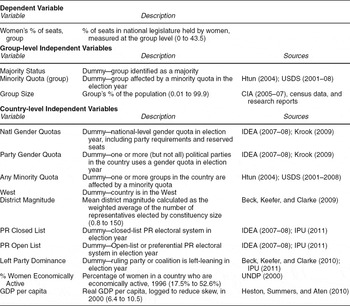
The measures used throughout the quantitative analyses are presented in Table 1. The dependent variable is the percentage of women serving in the lower or single house of the national legislature, measured at the group level. For example, in 2004 black women in the United States held 2.8% of seats in Congress, so the dependent variable for blacks in the United States is 2.8.
Measures and Data Sources

The major theoretical variables of interest measure whether groups and countries are impacted by gender and minority quotas. I consider only those policies that affect national legislatures, and I exclude quotas that promote representation solely by age, disability, or profession. I employ two gender quota variables: National gender quota and Party gender quota. Countries with national gender quotas have adopted electoral laws regulating women's representation in all political parties, or they reserve seats for women. To exclude quotas that are largely “window dressing” and instead code quotas likely to be effective at changing the gender composition of legislatures, I code only gender quotas that regulate at least 10% of candidates or seats; and those that include electoral list requirements, sanctions for noncompliance, and/or reserved seats.Footnote 10 Party gender quotas are coded in countries where at least one party elected to the national legislature has adopted a gender quota, but no national policy regulates the gender of representatives.
Minority quotas include all policies that require the descriptive representation of minority groups.Footnote 11 Minority quota (group) is coded so that groups receive a “1” only if directly affected by quota legislation. Minority quota (country) is coded “1” if any group in a country is affected by a minority quota. So, for example, New Zealand uses a quota to guarantee representation for the indigenous Maori people. For Minority quota (group), only Maori is coded as having a minority quota. For Minority quota (country), all of New Zealand is coded as having a minority quota. (See supplemental online Appendix C for a full listing of quota policies by country.)
As noted in Table 1, I also use eight control variables: the group's share of the population (Group size), percentage of women in the workforce (% Women economically active), economic development (Logged GDP per capita), use of an open-list/preferential or closed-list PR electoral system (PR open list and PR closed list), average district magnitude (District magnitude), whether the ruling party or coalition is left-leaning (Left party dominance), and whether the country is Western (West). I also test effects of other world regions, dominant religion, level of democracy, ethnoreligious heterogeneity, and the Gender-related Development Index (GDI) in auxiliary analyses (Marshall and Jaggers Reference Marshall and Jaggers2007; United Nations 2002).Footnote 12 Including these predictors does not alter the substantive findings regarding the effects of quotas on majority and minority women's legislative representation. However, including these measures sometimes affects the statistical significance of other predictors; I reference these findings in the results where relevant.
To collect information on group size, I began with the CIA “Factbook,” which often reports official statistics from country censuses. In many cases, I also went directly to country censuses so that I could aggregate data to reflect the majority and minority categories I selected. I also drew from recent published research on minority groups, which often provides population estimates for groups lacking official population statistics. Last, I selectively used data from the Joshua Project (2008), an online source of data on ethnicity and religion worldwide that is hosted by the U.S. Center for World Mission. For groups with disputed population statistics, I collected upper and lower estimates and used the averages of these values.
Hierarchical Linear Models
I use hierarchical linear modeling (HLM) to investigate the political representation of majority and minority women. HLM is well suited to address the complexity of minority women's political outcomes, as variation in women's representation can be modeled at the group level while the effects of country-level policies are assessed. In the presence of clustered data (in this case, groups clustered within countries), HLM has numerous advantages over OLS regression, including correct estimation of standard errors, limited aggregation bias, and straightforward estimation of cross-level interactions (Hox Reference Hox2002; Kreft and de Leeuw Reference Kreft and de Leeuw1998; Park and Lake Reference Park and Lake2006; Raudenbush and Bryk Reference Raudenbush and Bryk2002).
Although HLM is flexible enough to include both fixed and random effects, fixed parameters are typically estimated with greater precision than random parameters, and multilevel models often cannot estimate more than a random intercept and another random predictor (Hox Reference Hox2002; Porter Reference Porter2005). I therefore model all effects as fixed except for Majority status, which is treated as a random coefficient in models analyzing all groups. To assist in interpretation and model convergence, I grand-mean center all predictors without natural and interpretable zero points (Hox Reference Hox2002; Kreft, de Leeuw, and Aiken Reference Kreft, de Leeuw and Aiken1995).
Because some of the country-level covariates have a small number of missing data, I use multiple imputation, one of the two best procedures for handling missing data (Allison Reference Allison2002). Although HLM 6.04 cannot directly estimate models with missing data, the program does have routines for estimating multiply imputed datasets. Therefore, I use multiple imputation routines in SAS 9.2 to generate five level-two datasets (seed number = 2,564) and enter these data into the HLM program.
I check the robustness of all final models through the use of partial plots and a variety of other diagnostics (leverage (hat), Cook's D, DFFits, DFBetas, etc.) (Bollen and Jackman Reference Bollen, Jackman, Fox and Long1990). Compiling these results led to the identification of several potential outliers (e.g., Bosnia-Herzegovina, Burundi). These cases are removed from the analysis individually and in groups, and significant differences are footnoted in the results section (see footnote 20). Given the large number of groups with no female representatives, especially in the minority-only sample, I also test models including various transformations of the dependent variable.Footnote 13 Because results for all reported models are consistent with these auxiliary analyses, I report models for the untransformed dependent variable to ease interpretation. I find no evidence of problems arising from multicollinearity in the models reported.
RESULTS
Distribution of Quotas Worldwide
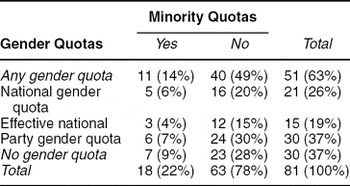
Table 2 presents the distribution of gender and minority quotas by type. In the 81 countries analyzed, the most common policy is a gender quota, used by 63% of countries. Party gender quotas (in 37% of countries) are more frequent than national gender quotas (in 26% of countries, or 19% if limited to countries with effective national measures). Although less common than gender quotas, minority quotas are not rare, being present in 22% of the sample. In countries with minority quotas, all but two use reserved seats (see supplemental online Appendix C). Eleven countries, 14% of the sample, have both gender and minority quotas. About 6% of countries in the sample have a mix of national gender and minority quotas—4% when “window dressing” quotas are removed—and 9% of countries use mixed quotas (national minority and party gender quotas). Only about one-quarter of countries, 28%, were not using gender or minority quotas during the elections analyzed. Notably, however, two of these countries, Kyrgyzstan and Yemen, subsequently adopted gender quotas.
The Distribution of Gender and Minority Quotas in 81 Countries

Coding Notes: “Effective national” gender quotas are a subset of all national gender quotas that regulate at least 10% of candidates or seats and include party list requirements, use sanctions for noncompliance, and/or reserve seats.
Quota Effects on Majority and Minority Women's Legislative Representation
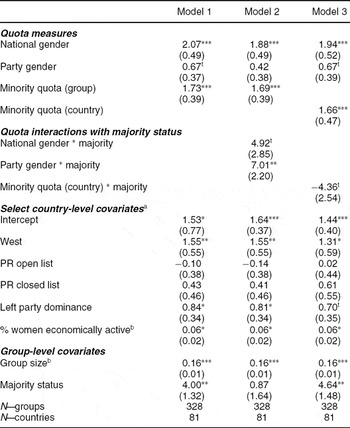
Table 3 presents the results of the hierarchical linear models predicting the shares of legislative seats held by all women in 81 countries. Including all women facilitates comparisons between quota effects for women from majority and minority groups. The first column presents the results from Model 1, the baseline model. With quota effects not allowed to vary across majority and minority groups, all quotas significantly increase women's representation. National policies are generally more effective at increasing women's representation than party-level measures. Women from groups living in countries with national gender quotas are represented at levels 2.1% higher than women in countries with no gender quotas. The effect size is slightly smaller, 1.7%, for women from groups affected by minority quotas. Across all three policy types, party gender quotas are the least effective at increasing women's presence in national legislatures, being associated with a 0.7% increase in group women.
Hierarchical Linear Models Predicting Majority and Minority Women's Share of Legislative Seats for 328 Groups in 81 National Legislatures

***p < .001, **p < .01, *p < .05, tp < .10; standard errors are in parentheses.
aDistrict magnitude and GDP per capita are also included in all models but never reach statistical significance (results not displayed).
bDenotes that the variable is grand mean centered.
Note: “Minority quota (group)” is a group-level measure reflecting that a minority quota exists for a given group. “Minority quota (country)” is a country-level measure reflecting that a quota exists for any minority group in the country. PR, proportional representation electoral system.
Of the country-level covariates, women from groups living in the West are better represented than in non-Western countries, and women benefit from both greater labor force participation and left party dominance. In contrast, district magnitude and GDP per capita do not significantly affect women's representation in national legislatures.Footnote 14 Interestingly, measured at the group level, women are no better represented in closed- or open-list PR systems than in plurality–majority systems.Footnote 15 Predictably, women from larger groups obtain more legislative seats. But the group size variable also intimates women's political underrepresentation. On the average, a 20% increase in a group's population share produces an increase in women's legislative representation by 3.2%. Even controlling for group size, women from majority groups are also represented at significantly higher levels than their minority counterparts—by a margin of 4%.
Model 2 tests whether the effects of gender quotas on women's political representation vary by majority/minority status. The interaction terms suggest that both national and party gender quotas significantly increase majority women's representation to a greater degree than for minority women, 4.9% and 7.0%, respectively, providing support for Hypothesis 1. Yet, also as expected, national gender quotas appear to benefit minority women to a greater extent than do party gender quotas. National gender quotas increase the legislative representation of women from minority groups by 1.7%, on average, whereas party gender quotas have no significant effects on minority women's political representation.
Model 3 reports results considering the effects of a minority quota for any group in the country on women's political representation. Previously, I evaluated the effect of quotas on groups specifically targeted by quota policies. Here, I test how the presence of minority quotas in a country affects the political representation of women from all groups. The significant negative interaction term between minority quotas and majority status suggests that, indeed, the benefit of majority status for women's representation is reduced in the presence of minority quotas. A less rosy way of looking at it, however, is that minority quotas may lead to lower levels of majority women's representation than in countries with no quotas. Majority women's predicted seat share drops from 20.4% without quotas to 17.6% with minority quotas only.Footnote 16
Effects of Mixed and Tandem Quotas on Minority Women's Political Representation
In contrast to Table 3, which includes all women, Table 4 analyzes the political representation of minority women only. Moving to a more targeted analysis of minority women's legislative outcomes serves two purposes. First, I am able to evaluate the robustness of earlier findings regarding the effects of different quota policies on minority women's representation. I am also able to consider how policies addressing the political underrepresentation of women and minorities interact to influence the election of minority women. Yet these latter results should be interpreted with caution, given the small share of countries overall with tandem and mixed quotas (see Table 2).
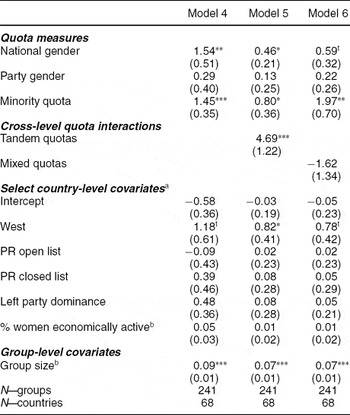
Hierarchical Linear Models Predicting Minority Women's Share of Legislative Seats for 241 Groups in 68 National Legislatures

***p < .001, **p < .01, *p < .05, tp < .10; standard errors are in parentheses.
aMean district magnitude and GDP per capita are also included as controls in all models, but never reach statistical significance (results not displayed).
bDenotes that the variable is grand mean centered.
Note: Tandem quotas interact national gender and minority quotas. Mixed quotas interact party gender and national minority quotas. PR, proportional representation electoral system.
Located in the first column of Table 4, Model 4 displays the results of the baseline model predicting women's share of legislative seats for minority groups only. Consistent with the results thus far, both national gender and minority quotas benefit minority women, but party quotas do not. When only minority groups are analyzed, the effect of minority quotas on women's political representation is almost identical to that of national gender quotas. Against the expectations in Hypothesis 3, minority quotas do not have a stronger effect than gender quotas on minority women's legislative outcomes. Of the control variables, only group size and Western residence are statistically significant.Footnote 17 The differences in the control variables between Tables 3 and 4 are that in all models predicting minority women's political representation only, the effects of left party dominance and women's economic activity are not significantly different from zero. Thus, similarly to party-level gender quotas, closed-list PR systems and women's overall levels of economic activity appear to benefit majority women, but not minority women.Footnote 18
Next, in Model 5, I analyze the effects of tandem quotas—the cross-level interaction between national gender quotas and quotas for minority groups. The results support Hypothesis 5, which predicts that a combination of national policies regulating gender and minority status benefits minority women to a greater degree than either policy alone.Footnote 19 Plugging the results into a predicted equation, I find that without any national or party quotas, women from a median-sized minority group hold 2.5% of seats in the legislature. But with tandem quotas, minority women's share of legislative seats increases more than fivefold to 13.9%. Further, both national gender quotas and minority quotas continue to have significant main effects on minority women's legislative outcomes even when not present in combination. Later, I consider how variation even among tandem quota polices may impact minority women's political representation.
Model 6 tests a second interactive model that evaluates the effects of mixed quotas on minority women's political representation. Controlling for important group- and country-level covariates, mixed quotas do not significantly reduce the effectiveness of minority quotas. Although the coefficient of the interaction term appears in the expected direction, the effect falls short of statistical significance (failing to support Hypothesis 6).Footnote 20 Unlike tandem quotas, a combination of party gender quotas and minority quotas does not benefit minority women, compared to party gender or minority quotas alone.
Minority Women's Odds of Election Relative to Other Groups
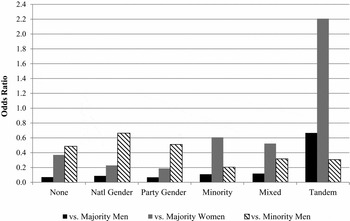
Before we turn to a summary discussion of findings, Figure 1 displays a final set of descriptive results using odds ratios.Footnote 21 Calculated as the average odds that minority women are elected relative to majority men, majority women, and minority men in countries with varied quota policies, values over 1 indicate that accounting for population, minority women have higher average odds of election than the comparison group, whereas values under 1 mean that the minority women have lower relative odds of election. For example, the first black bar in the figure suggests that in a country with no quota, the odds that a minority woman is elected compared to a majority man are 0.07—1 in 14. Overall, Figure 1 provides a visual summary of the effects of quotas on minority women's legislative representation. The results largely mirror those in the multivariate analysis.
Odds that Minority Women Are Elected to the National Legislature Relative to Majority Men, Majority Women, and Minority Men in Countries with Different Quota Systems, 2005–07

The odds ratios also provide some new information. Specifically, we are able to see whether and how the odds of election of majority and minority men are different in countries with gender and/or minority quotas. What is perhaps most striking about men's odds of election is that most quotas do little to reduce the odds of majority men's election. For all quotas other than tandem, majority men's odds of elections are roughly 8–15 times the odds of minority women's election, even accounting for differences in population size. Tandem quotas, alternatively, do appear to come at some expense to majority men's seats (as well as to majority women's seats). With tandem quotas, minority women's odds of election are only 0.67 those of majority men, or 1.5 times less likely to be elected, a substantial improvement. Minority men, alternatively, benefit from minority quotas in any form, whether as standalone policies or in combination with gender quotas. It is only when gender quotas are present without minority quotas that minority men's odds of election decrease.
DISCUSSION AND CONCLUSIONS
The increasing adoption of quotas around the world is changing the face of national politics. Women, minorities, and minority women are entering national legislatures in numbers that usually could not have been achieved through regular electoral mechanisms. In this article, I considered the effects of quotas on minority women's political representation. I find that without the assistance of quotas, minority women's representation is abysmally low. Their odds of election are 1 in 14 compared to majority men, 1 in 2 compared to minority men, and 1 in 3 compared to majority women. But, with the assistance of quotas, some or all of these odds improve.
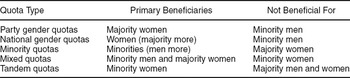
I present a summary of the results from both multivariate and descriptive analyses in Table 5. Notably, discussion of effects of quotas on majority and minority men's representation are drawn from the descriptive results, and must be regarded as more speculative. Similarly, results for tandem and mixed quotas today only affect a small number of countries and groups, so results must be interpreted with caution. For each quota policy, I list groups that are primary beneficiaries and groups that appear not to benefit. So, for example, the first row of the table indicates that majority women benefit from party gender quotas but that minority men may not. Although party gender quotas do not necessarily reduce minority women's representation compared to countries with no quotas, minority women are not a primary beneficiary. If women's movements are unsuccessful pressuring for gender quotas at the national level, movements for party gender quotas should consider party incentives for including diverse women candidates.
Summary of Effects of Quota Policies for Minority and Majority Women and Men

Looking broadly at the primary beneficiaries of quotas, the results suggest that as standalone policies, gender and minority quotas tend to benefit primarily majority women and minority men. Minority women do benefit from national gender quotas or minority quotas to a lesser degree. But majority women appear to be the only beneficiaries of party gender quotas. The picture changes substantially, however, when these policies combine. The few countries with tandem quotas have dramatically higher levels of minority women's legislative representation than any other institutional configuration of quotas. Mixed quotas, however, do not appear to change the tendency of minority quotas to benefit minority men and party gender quotas to benefit majority women.
Given a limited number of seats in national legislatures, expanding the representation of some groups necessarily reduces the representation of other groups. Gender quotas alone appear to increase women's representation at some expense to minority men's election odds. Similarly, when minority quotas are used without gender quotas, women's representation is low. Thus, quotas designed to increase the representation of one marginalized group appear to come often at the expense of other marginalized groups, rather than majority men. When policies combine, however, the picture can change. I conclude tentatively here that tandem quotas most directly challenge rule by majority groups. Though minority women benefit more from tandem quotas than majority women, tandem quotas may be the policy that most effectively takes a large share of seats from majority men.
Ironically, however, it is majority men's efforts to remain in power that may ultimately drive higher levels of minority women's representation in some contexts. The case of Burundi demonstrates this process well. In addition to using a 30% national gender quota, Burundi reserves three seats for the Twa, or pygmies, and mandates an overall 60/40% split between majority and minority ethnic groups. Gender and ethnicity are both regulated at the national level through the same mechanism: coopting seats. All political parties compete for 101 seats, but following the elections, additional members are coopted to ensure that the quotas are met. In 2005, for example, 18 additional seats were coopted after the election. Because a minority woman can meet both the ethnic and gender requirements while filling only a single seat, the election or cooptation of minority women means that more majority men can be included in the legislature while still meeting the quota. Indeed, of the 18 coopted positions, more than half (55%) are minority women. In all, 57% of the women representatives in Burundi's 2005 National Assembly were minorities, quite striking given that minorities only make up 15% of the population. In the context of interacting mechanisms to promote women and minorities, the dual identities of minority women benefit them politically.
In contrast, mixed quotas, a combination of national minority quotas and party gender quotas, often do not offer strategic advantages for minority women. The limitations of mixed quotas for minority women are well illustrated using the case of Fiji. Forty-six of the 71 seats are elected on the basis of ethnic identity (23 majority Fijians, 19 Indo-Fijians, 1 Rotuman, and 3 “general register” seats to represent smaller minority groups). The other 25 constituencies are open seats, where representatives of different ethnicities may compete against one another. The Fiji Labour Party, a multiracial party that represents the Indo-Fijian minority and a small share of majority Fijians, adopted a 20% gender quota in the 1990s (Krook Reference Krook2009). In 2006, however, the party only fulfilled the gender quota in the open seats. Consequently, Indo-Fijian women, despite making up about 18% of Fiji's total population, won only 1% of the seats in the Fijian House of Representatives. Although the underlying reasons for minority women's low levels of candidacy in Fiji are beyond the scope of this study, it is clear that the simultaneous presence of party gender and national minority quotas does not benefit minority women in this case. Hypothetically, an effective national quota requiring that women make up 30% of all candidates, regardless of constituency type, would increase the political representation of Indo-Fijian women.
Overall, tandem quotas appear to be more effective at increasing minority women's election because they are more likely to facilitate interactions between gender and minority policies. But even tandem quotas are unlikely to benefit minority women in at least two cases. First, if a national gender quota regulates only a small percentage of seats or lacks enforcement mechanisms, the quota is unlikely to promote women's representation regardless of majority/minority status. Second, if a minority quota facilitates the election of only one or two representatives from each minority group or party, even an effective gender quota may be rendered ineffective in promoting minority women's election. A case that demonstrates both of these exceptions well is Romania, which uses an ineffective national gender quota and allocates a single seat to each of 18 minority groups. In 2004, of the 40 seats occupied by ethnic minorities in Romania's Chamber of Deputies, only 2 were held by women.
Quotas are not a cause of legislative diversity, but a mechanism to facilitate greater representation of marginalized groups. Thus, I again acknowledge that the effects of quotas in these analyses may be capturing country variation in support for female or minority representation. Yet close examination of individual cases reveals that quota adoption is often politically motivated (Krook and O'Brien Reference Krook and O'Brien2010) and may occur in contexts where broad-based support for such policies is absent (Krook Reference Krook2009; Paxton and Hughes Reference Paxton and Hughes2007). Even when cultural factors are particularly unfavorable to greater female representation, gender quotas may still transform legislatures. For instance, Muslim-majority countries have historically had low levels of women's political representation (Paxton Reference Paxton1997; Paxton, Hughes, and Green Reference Paxton, Hughes and Green2006). But well-crafted quota legislation has increased women's numbers in Muslim-majority countries. After adoption of a national gender quota in 2005, women's seat share in Afghanistan increased from 4% to 25%; Kyrgyzstan similarly saw a jump in 2007 from 0% to 26% women; and after reinstitution of lapsed quota legislation in 2002, women's representation in Pakistan rose from 2% to 21%. Such sweeping changes may have profound consequences, demonstrating to parties that women can effectively compete for political office and can do the job once elected (Bhavnani Reference Bhavnani2009; Johnson with Kabuchu and Kayonga Reference Johnson, Kabuchu and Kayonga2003).
Yet scholarship to date has done little to understand how quotas affect the political fortunes of those at the intersection of gender and minority status—minority women. This research suggests that majority men continue to hold onto power across the globe at least in part because countries tend to implement gender quotas or minority quotas rather than both. As a consequence, quotas tend to help either women or minorities to gain significant levels of representation. But, given the increasing popularity of quotas, it is possible that more and more countries will include measures to address the political representation of both women and minorities. How these policies interact with one another has important and seemingly predictable implications for both overall levels of legislative diversity and the specific political fortunes of minority women.
What about other kinds of quotas? Certainly, efforts to increase or balance the representation of marginalized groups are not limited to the political arena. Across the world, quotas have been used in areas such as higher education, housing, the military, and the workplace. In fact, a new wave of gender quotas of a different variety may be upon us. Following Norway's lead, Iceland, Spain, and France recently passed laws requiring that large public firms include 40% women on management boards, and similar measures are being debated elsewhere in the West. My results suggest that effective policies for women's inclusion may promote minority women's interests as well. So gender quotas for corporate boards may also help minority women.
Perhaps an even more effective way to change the majority-male dominance of the most successful of the world's corporations would be to include quotas for both women and other marginalized groups. Still, the likelihood that both majority and minority women get a seat at the table is likely to be a function of the specifics of the quota policies themselves. To pose a hypothetical example, if a corporate board has 10 members, setting aside 4 seats for women and 2 seats for minorities is unlikely to benefit minority women. At the same time, instituting a rule that 40% of members must be women and 20% must be members of minority groups is likely to facilitate minority women's incorporation, but may, in fact, lead to underrepresentation of majority women. A third strategy would be to use nested quotas—requiring that women be included among minorities, or that minorities be included among women. Such a policy would ensure minority women's inclusion without overly displacing other disadvantaged groups.
The logic driving this argument likely also applies to a broader set of diversity initiatives beyond quotas. My results suggest that minority women are likely to be better served when similar actors and/or initiatives serve the interests of both women and minorities. I do not mean to suggest here that organizations, initiatives, policies, or movements designed to address women's interests or minority interests alone are problematic or unimportant. But to ensure that gains for one marginalized group do not come at the expense of others, and to best promote the interests of those at the intersections of disadvantage, policymakers must take seriously feminist claims that forces of sexism, racism, and other forms of prejudice are inextricably linked. Efforts to ameliorate inequalities across a broad range of groups, provided those efforts inform one another, may best promote diversity.




Comments
No Comments have been published for this article.