PROBLEM STATEMENT
According to the World Health Organization, mortality from cardiovascular (CV) disease is the most common cause of death worldwide (1). Many of these patients experience acute coronary syndrome (ACS), which is a term that encompasses acute myocardial infarction and unstable angina (Reference Kelm and Strauer2). Decisions regarding approval, reimbursement, and usage of treatments for ACS are consistently made through expert opinion, which are typically formed on the basis of clinical effectiveness determined through randomized clinical trials (Reference Mühlbacher and Bethge3). Therefore, the value of alternative treatments depend on subjective assessments by decision makers using a different set of criteria. In this process, the question of how patients with ACS value different characteristics of their treatment may not be considered. Studies have shown that clinician judgments and therapeutic targets are not always in concordance with patient preferences and goals (Reference Mühlbacher and Juhnke4). Therefore, it is imperative that both clinician and patient stakeholder values are incorporated into the reimbursement decision-making process.
POLICY CONTEXT
Regulatory and reimbursement entities, including the Institute for Quality and Efficiency in Health Care (IQWiG) and the Food and Drug Administration (FDA) have recently required identification and weighting of patient-centered endpoints in health technology assessment (HTA) particularly in the pharmaceutical market (Reference Hummel, Volz and van Manen5;Reference Mühlbacher, Bridges and Bethge6) and medical products (Reference Ho, Gonzalez and Lerner7–Reference Glaeske10). To this end, regulatory IQWiG decisions regarding approval, reimbursement or pricing require explicit or implicit trade-offs between the potential benefits and risks, costs and, in certain circumstances, the mode of administration of healthcare delivery. The goal of this policy context is to use patient preference-elicitation to focus patients’ benefits.
Attributes or characteristics of the intervention are identified. Data for patient preference and priorities generated, analyzed, and interpreted. This information is treated as a new and complementary source of evidence. In this way, clinical trial data can be complemented by incorporating the perspectives of patients when evaluating technologies for regulatory decision making.
HEALTH TECHNOLOGY ASSESSMENT
Decisions in healthcare necessitate a careful assessment of the available alternatives. As a result, it is imperative to weight criteria used to assess alternative health technologies, and assessment of trade-offs between multiple decision criteria is challenging (11). In the absence of any gold standard, regulatory agencies are searching for transparent and consistent guidance to benefit-risk assessment. Efforts are increasingly being made to include and consider multiple criteria in the HTA process (11) and several countries in Europe show increasing interest in multi-criteria decision analysis (MCDA) approaches. In Germany, IQWiG recommends MCDA techniques like Analytic Hierarchy Process (AHP) or Discrete Choice Experiment (DCE) to weight multiple endpoints (Reference Danner, Hummel and Volz12;Reference Mühlbacher and Kaczynski13). The use of MCDA methods in healthcare systems is in line with the current paradigm shift toward patient-centered health care. MCDA aims at a structured and transparent decision-making process, while incorporating and aligning the patients’ perspective with the experts’ judgment. Eliciting the willingness to trade-off between multiple decision criteria, like risks or benefits, from different stakeholder perspectives can do this (Reference Diaby, Goeree, Hoch and Siebert14).
STUDY PERSPECTIVE AND RESEARCH OBJECTIVE
The aim of this study was to determine patient priorities for long-term drug therapy after experiencing ACS. Patient-relevant endpoints were identified and analyzed using AHP.
TESTABLE HYPOTHESIS AND RATIONALE FOR AHP
The following questions were posed: from patients’ perspective, what are the essential properties of an optimal antiplatelet agent for the secondary prevention of ACS? It has been hypothesized that the (reduction of the) mortality risk is of highest value for patients. In addition it should be tested if the mode of administration contributed to the overall patients benefit. AHP has been proposed by IQWiG as a suitable approach to determining patient priorities.
DECISION-MAKING CONTEXT
Burden of Disease
In Germany, the myocardial infarction is confirmed in 15 percent of the two million suspected cases of ACS that present to the emergency department (Reference Post and Münzel15). Myocardial infarction is often caused by either a partial or total coronary occlusion most commonly caused by an atherosclerotic plaque rupture. Sustained occlusion causes myocardial injury or necrosis, and may lead to potentially irreversible reduction in heart function. In some cases, ACS can be life-threatening (Reference Van de Werf, Bax and Betriu16).
Treatment
The primary goal of therapy after ACS is immediate reperfusion of the coronary artery and the prevention of CV mortality and re-infarction. This primary objective can be achieved by improving preventive, diagnostic and therapeutic interventions. In particular, medical therapy, that includes antithrombotic agents, is central to secondary prevention of CV events (Reference Hamm17). After successful acute treatment, patients are still facing an increased risk of a myocardial infarction (re-infarction or postinfarction), suffering a stroke or similar long-term risks, depending on the severity of their coronary heart disease (Reference Johansson, Stallberg and Tornling18).
METHODS AND STUDY DESIGN
Analytic Hierarchy Process
AHP is a multi-criteria decision approach, developed by Thomas Saaty in the 1970s (Reference Saaty19). It is a process to structure complex and unstructured decision-making problems to derive a systematic, optimized and rationally accountable decision (Reference Meixner and Haas20). One of the first applications of AHP was by Dolan in 1989 (Reference Dolan21). Danner et al. 2011 demonstrated how AHP can be used as a method for eliciting patient priorities to integrating patients’ views into HTA (Reference Danner, Hummel and Volz12).
Within AHP, the decision problem is simplified by hierarchically structuring in criteria (attributes), sub-criteria (level), and alternatives. For each hierarchical level, a pairwise comparison between single items is presented and rated by the respondent on a scale from 1 to 9. Priority statements can be inferred from these comparisons, which reflect the values of the specific element (attribute or level) (Reference Meixner and Haas20). After hierarchical elements are evaluated, the relative weights of the criteria, sub-criteria, and alternatives were calculated. The data were analyzed to derive relative importance and weights using evaluation matrices and the eigenvector calculation (Reference Saaty22). Priority statements were also checked for consistency to evaluate validity (Reference Helm, Manthey, Scholl and Steiner23). A matrix A= (aij) was considered consistent if aij * ajk = aik for any i, j, k = 1, . . . ., n (Reference Saaty22). For example, if decision A is twice as important as decision B, and decision B is three times more important than C, then A should be six times more important than C (Reference Danner, Hummel and Volz12;Reference Belton24).
Decision Model (Attribute and Levels)
A literature review was conducted to document the current state of antiplatelet options for the treatment of ACS. Databases searched were PubMed, Medline, and Cochrane Library. We sought to identify potential properties and characteristics of antiplatelet agents from a general and patient perspective. Key search terms included antiplatelet drug, coronary artery disease, acute coronary syndrome, long term treatment, preferences, coronary thrombosis/*drug therapy, and patient relevant endpoints. German and English articles were included and the search was updated throughout during the process of the study. Of 14,027 initial search results, 534 articles underwent abstract review. In total, 243 full texts were included and analyzed (Reference Mühlbacher and Bethge3).
Next, a preliminary qualitative study was conducted. Ten subjects who experienced ACS were recruited for qualitative semi-structured interviews to confirm and test the relevance of the treatment characteristics found in the literature review. Moreover, the interviews were used to evaluate the clarity of the questionnaire design, the quality of the scales used, and the understandability of the attributes and levels included (Reference Mühlbacher and Bethge3).
After content analysis of the interviews five final criteria were determined (three levels each) which were used for the quantitative AHP survey. A patient friendly introduction with a short explanation about the content of each attribute and the segmentation of the related levels was given to the participants (see Supplementary Table 1). The description style of the attributes and their corresponding levels was based on the classification scheme provided by the U.S. Department of Health and Human Services and the Office of Human Research Protection of the FDA (30).
Data Collection Plan (Sample Size, Stratification and Recruitment)
Patient recruitment and interviews were performed by an external third party agency. Data were collected from December 2012 until February 2013 using standardized face-to-face surveys and computer-assisted personal interviews (CAPI). Subjects were instructed and assisted by a trained interviewer. Adult patients (>18 years) diagnosed with and hospitalized for ACS within the last 2 years were included in the survey. Patients were asked to indicate whether they suffered from ST-segment elevation myocardial infarction (STEMI) or non–ST-segment elevation myocardial infarction/unstable angina (NSTEMI/UA). The goal was to recruit a final sample with a ratio of 3:7 patients with a diagnosis of STEMI to NSTEMI/UA (Reference Mühlbacher and Bethge3).
Ethical Considerations
All respondents were informed about the study objectives and procedures, and its potential risks and benefits prior the participation. Informed consent was obtained voluntarily and all participants could stop the survey at any time. Personal, surgeries, tests, and medication was not collected, therefore, an ethics approval was not mandatory.
Data Collection (Instrument, Elicitation Technique, Tasks Design)
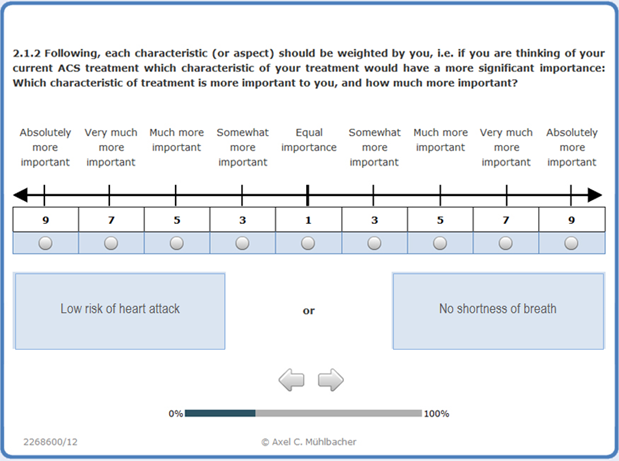
Based on the preliminary qualitative study, the final decision model was established. Patient-relevant characteristics were extracted and included in the survey instrument (questionnaire). Overall, the final questionnaire consisted of three parts. The first part included socio-demographic questions, such as age, gender, weight, height, marital status, occupation, and educational attainment. The second part encompassed the explanations of the attributes of the ACS drug therapy and the realistic representations of their levels. This section also included the paired comparisons of the second AHP-hierarchy level. The last and third part of the questionnaire covered the 10 paired comparisons of the first AHP-hierarchy level (see example in Supplementary Figure 1).
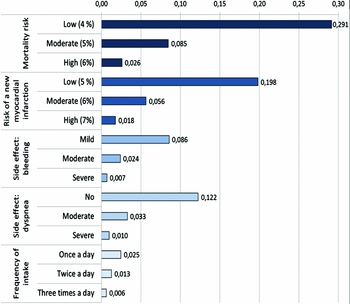
AHP results: Global weights for each level.

Experimental Designs
To reduce the burden on participants, the minimum number of pairwise comparisons required for the experimental design were chosen for AHP. To form and compose all necessary pairwise comparisons, a matrix was prepared for each unit of the hierarchy from which all required pair comparisons are derived (Reference Helm and Steiner25). In this process, K*(K-1)/2 (where K = number of criteria) is calculated for each element, so that every element of a hierarchy unit is correlated to every other element of this unit (Reference Saaty26). This survey is based upon a full hierarchy design which required a total of twenty-five paired comparisons. For the first AHP-hierarchy level, 10 pairwise comparisons were generated from the five attributes on the basis of the matrix. The comparison of the second AHP-hierarchy level elements was done with 15 pairwise comparisons. In total, each participant had to answer 25 AHP paired comparisons.
Data Analysis
AHP was used to analyze the individual priorities of the patients and arrive at a group decision. Because the data obtained was analyzed at the group level, and results of a “group decision” emerged (Reference Helm and Steiner25). To achieve this, individual results were aggregated by a mathematical algorithm to a group decision (Reference Saaty26). To compress the individual decision to a group decision different algorithms are available such as the arithmetic, the geometric mean, the mode, or the median. For AHP, the geometric mean is commonly recommended because this algorithm allows the aggregated values of the upper diagonal matrix to correspond with the reciprocals of the lower diagonal matrix (Reference Meixner and Haas20;Reference Saaty27). This algorithm has been used to integrate individual judgments of several decision makers in the decision-making process elsewhere (Reference Danner, Hummel and Volz12;Reference Meixner and Haas20;Reference Ijzerman, van Til and Snoek28).
The individual judgments obtained using the pairwise comparisons were compiled into a group decision. This was done by calculating the arithmetic mean, transferred into the evaluation matrixes and normalized as well as repeatedly square. As result the relative weights or priority values of the (sub-) criteria could be estimated (Reference Saaty26). The eigenvector method was used to calculate weights of the individual criteria and the associated sub-criteria (local and global AHP-estimates). To identify the final local and global AHP-estimates a certain number of iterations should be used for determining the attribute and level weights.
To determine internal consistency, all AHP decisions are subjected to a consistency test using the formula
 ${\rm{CR}} = {\rm{\ }}\frac{{{\rm{CI}}}}{{\rm{R}}}$
, where the consistency index (CI) is determined by
 ${\rm{CI}} = \frac{{{{\rm{\lambda }}_{{\rm{max}} - {\rm{n}}}}}}{{{\rm{n}} - 1}}$
(Reference Saaty26). The consistency ratio (CR), as a measure of performance within the AHP, is obtained by comparing the CI with the RI (random consistency index) (Reference Saaty29). RI is an average random consistency index derived from a sample of randomly generated reciprocal matrices. The AHP includes a consistency index for an entire hierarchy. If CR is not less than 0.20, the judgments should be revised.
RESULTS
Respondents Characteristics
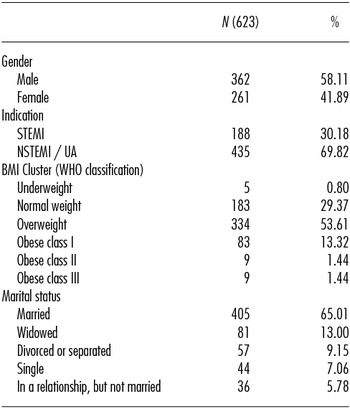
A total of 743 complete records were transferred to the database, where consistency checks were applied. One data set was found to be inconsistent, where an attribute (level) with a negative trait was preferred five times or more within the pairwise comparisons (Reference Mühlbacher and Bethge3). The final consistency check for face validity resulted in a total of 120 records removed. A final analytic cohort was comprised of 623 subjects, of which 30 percent (n = 188) and 70 percent (n = 435) previously experienced an STEMI and NSTEMI/UA, respectively.
Study Sample (N = 623)

Sociodemographic Data
Approximately half of the study participants (58.11 percent; n = 362) were male. The youngest patients were between 23 and 27 years old, the oldest patients were between 88 and 92 years old. Among participants, 46.87 percent (n = 292) were between 53 and 67 years old and thus constituted the largest age group of patients surveyed. Nearly two-thirds of the patients (n = 405) were married (65.01 percent). The highest proportion within educational levels was an intermediate high school certificate that was present in 25.52 percent (n = 159) of respondents. With respect to employment status, 38.84 percent (n = 242) were in retirement, 34.35 percent patients surveyed (n = 214) were employed full-time at the time of the survey (see Table 1).
Analytic Hierarchy Process
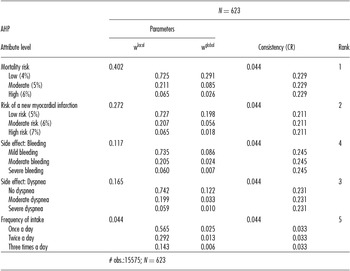
The evaluation of the AHP took the priority judgments of 623 patients with ACS into account. This resulted in 15,575 available pairwise comparisons. Due to a failure within the AHP consistency check, sixty subjects were excluded from AHP estimation.
The iterative process of multiplying the matrices was performed. To identify the final local and global AHP estimates, eight iterations were used to determine attribute weights, and nine iterations for the generation of level weights. The results of the consistency check for all participants and the weights derived from the determined ranking criteria are shown in Table 2.
Estimated Local and Global Parameters of the Analytic Hierarchy Process

Based on the first level of the hierarchy (attributes) the highest ranked parameter was “mortality risk” (0.402). “Frequency of intake” (0.044) was ranked last in the valuation indicating that this attribute is of relatively minor importance to patients with ACS (Figure 1). The consistency check revealed that the pairwise comparisons on the attribute-hierarchy level are consistent, as the CR is 0.044. Only on the hierarchy level of sub-criteria was the consistency index over 0.20, indicating that respondents did not always answer in a consistent manner.
DISCUSSION
Interpretation of AHP-Results
Our analysis with AHP showed that participants had clear preferences for all attributes presented. The most important attribute patients considered when deciding between long term treatment with antiplatelets after ACS was a “reduction of mortality risk.” Therefore, patient priorities may be in concordance with clinician judgements.
The “risk of a new myocardial infarction” (ranked 2nd) was slightly less important to the patients in the AHP than “reduction in mortality risk” but higher than “side effect: dyspnea” (ranked 3rd) followed by “bleeding” (ranked 4th) and “frequency of intake” (ranked 5th).
A possible explanation for ranking dyspnea higher than bleeding is that patient function is more severely affected by shortness of breath. Moreover, patients may not feel capable of self-treating any episodes of dyspnea. Finally, dyspnea appears to be associated with restriction of daily function and a possible reduction in quality of life as dyspnea, as anxiety associated with anticipating dyspnea can be very distressing (Reference Hayen, Herigstad and Pattinson31).
In contrast, a bleeding event might be perceived as a treatable condition and considered less burdensome even if it can have life-threatening consequences. Finally, many of patients who have experienced ACS have also experienced shortness of breath. Therefore, the ranking of attributes by patients may not be in concordance with primary endpoints of RCTs. Bleeding as side effect (which in severe cases can be life threatening) is valued much higher by experts. It can be seen that the judgments of experts are not always congruent with the patients view (Reference Johnson, Lancsar and Marshall32). As shown in Federspiel et al. 2011 patients may accept a higher risk of mortality for an improved quality of life (Reference Federspiel, Stearns and van Domburg33). Such differences in preferences should be taken into account during decision making processes.
The knowledge about the relative importance of shortness of breath for the patients can be used within treatment decisions or patient education regarding these side effects or for targeted assessment and prevention measures. It could also be seen that the “frequency of intake” of a drug plays a rather minor role in the patients assessment of treatment characteristics.
Based on the assessment of the patient's priorities, a preference-based investigation shows the patient preferences for the medical treatment after an ACS (see Mühlbacher and Bethge Reference Mühlbacher and Bethge2015). With a Discrete Choice Experiment, the results obtained were validated and the therapeutic features weighted according to their preferability (Reference Mühlbacher and Bethge3).
Limitations of the Study
Several limitations should be noted with respect to this study. First, the manner in which patients evaluate their preferences can be influenced by various factors, such as the information provided, the experiences of patients within the indication as well as cognitive skills becomes important (Reference Helm and Steiner25;Reference Louviere, Islam, Wasi, Street and Burgess34). Therefore, priorities may vary depending on the decision context. During the interpretation of the results this has to be taken in consideration.
In light of contextual influences, it may be reasonable for future studies to conduct specific subgroups analyses (Reference Helm and Steiner25). The current study assessed the benefit assessment perspectives of patients who experienced ACS in the context of benefit assessment focuses on the perspective of the affected population. Therefore, no subgroups estimates were analyzed as this was not the primary objective of the present study. However, it must be assumed that heterogeneity in response behavior can be present. For example, it is very likely that a 23-year-old patient may make decisions differently than a 92-year-old patient (Reference Johnson35). Furthermore, level ranges are known to have an influence on respondents’ choices (Reference Hensher36). The perceived realism of level range of dyspnea from “no dyspnea” to “severe dyspnea” may have an impact on the relative importance of this attribute.
The AHP method displayed some problems during application. Some patients reported that paired comparisons on the subcriteria level were redundant and not realistic. Furthermore, the lack of consistency in the value judgments on this level displayed that there may been issues with the use of AHP for collection of patient priorities at this level. In addition, the relatability to real-world scenarios of AHP must be questioned. Patients stated, that they perceived a lack of reference to reality, which should be considered in the further interpretation and use of the AHP (Reference Mühlbacher and Kaczynski37).
CONCLUSION
In the current climate of today's healthcare, concepts of “patient involvement” and “shared decision making” are gaining increasing attention and importance in decision making. Analyzing patient preferences, priorities and goals should be highly prioritized, including those patients who receive treatment after ACS (Reference Mühlbacher and Bethge3).
In this study, we measured patient needs, priorities and expectations and showed that reducing “mortality risk” is by far the most important criterion in drug treatment after ACS. Thus, this endpoint may have major importance for the ACS treatment and relevance to patient choice of therapy.
In the context of this study, we demonstrated that AHP is an appropriate method to estimate group decision and identify patient-relevant characteristics in terms of possible treatment alternatives (Reference Hummel, Volz and van Manen5;Reference Danner, Hummel and Volz12;Reference Dolan, Isselhardt and Cappuccio38).
Apart from the methodological difficulties that arose during the study, the results are valuable for group decision making. AHP presents a practical approach that can help to improve communication between patients, providers, and other stakeholders. In addition, the AHP method has the potential to support clinical decision making (e.g., within clinical practice or HTA decisions) (Reference Danner, Hummel and Volz12;Reference Dolan, Isselhardt and Cappuccio38) and to improve the quality of patient care. Therapeutic strategies can be designed on the basis of patient-oriented findings and discussions on an individual basis, resulting in greater alignment of patient goals and clinician recommendations.
SUPPLEMENTARY MATERIAL
Supplementary Figure 1: http://dx.doi.org/10.1017/S0266462316000428
Supplementary Table 1: http://dx.doi.org/10.1017/S0266462316000428
CONFLICTS OF INTEREST
AstraZeneca GmbH, Germany funded this study.