Introduction
Executive deficits are prominent and persistent cognitive impairments after brain injury, which are often the result of frontal lobe or posterior-subcortical damage. These deficits include impairments in planning, self-monitoring and goal-directed behavior (Cicerone, Levin, Malec, Stuss, & Whyte, Reference Cicerone, Levin, Malec, Stuss and Whyte2006; Hart & Evans, Reference Hart and Evans2006; Stuss, Reference Stuss2011). Even subtle executive deficits can provoke difficulties in learning and performing daily life activities, hampering quality of life (Boelen, Spikman, Rietveld, & Fasotti, Reference Boelen, Spikman, Rietveld and Fasotti2009). Therefore, the development of rehabilitation interventions focusing on executive dysfunction is warranted. One of these interventions is Goal Management Training, which entails learning and applying an algorithm that subdivides complex tasks into multiple task steps (Robertson, Reference Robertson1996). During Goal Management Training patients are prompted to keep both the final goal and the task steps active in working memory, and to monitor their behavior and intentions during the execution of each task step.
Several studies have shown that Goal Management Training contributes to a better performance on everyday tasks in brain-injured patients. Levine et al. (2000) were the first to examine its effects in a randomized controlled trial in which Goal Management Training was compared to motor skills training in thirty patients with traumatic brain injury. Only Goal Management Training resulted in significant improvements on everyday paper-and-pencil tasks, such as proofreading a short text or grouping columns of words into categories. Moreover, they reported improvement in meal-preparation abilities in a patient with encephalitis after application of Goal Management Training. More recently, Grant, Ponsford, and Bennett (Reference Grant, Ponsford and Bennett2012) investigated the efficacy of Goal Management Training on day-to-day financial management using a multiple-case design. Three of the four brain-injured participants who completed the training fulfilled or even exceeded their a priori predicted levels of goal attainment. Other studies that applied Goal Management Training in larger groups of patients with acquired brain injury combined it with other cognitive rehabilitation methods. For example, auditory cueing was integrated into Goal Management Training (Fish et al., Reference Fish, Evans, Nimmo, Martin, Kersel, Bateman and Manly2007; Manly, Hawkins, Evans, Woldt, & Robertson, Reference Manly, Hawkins, Evans, Woldt and Robertson2002). Others (Miotto, Evans, De Lucia, & Scaff, Reference Miotto, Evans, De Lucia and Scaff2009; Spikman, Boelen, Lamberts, Brouwer, & Fasotti, Reference Spikman, Boelen, Lamberts, Brouwer and Fasotti2010) combined Goal Management Training with problem solving therapy.
In addition to Goal Management Training, another well-investigated method for training everyday tasks is errorless learning. Here, the occurrence of errors during the learning process is prevented in contrast to “normal” trial-and-error learning, in which errors may occur naturally (Baddeley, Reference Baddeley1992). Previous studies have shown that an errorless learning approach in patients with memory impairments improves task performance compared to trial-and-error learning (Clare & Jones, Reference Clare and Jones2008; Kessels & De Haan, Reference Kessels and De Haan2003). The original assumption was that errorless learning is beneficial for amnesic patients, because errors made during learning are not explicitly corrected but implicitly consolidated in memory (Baddeley & Wilson, Reference Baddeley and Wilson1994). Recently, the advantage of errorless learning in amnesia has been attributed to the shortcomings of explicit memory in building rich contextual representations (Fish, Manly, Kopelman, & Morris, 2015). When errors occur during learning, both errors and correct responses, and their identity have to be stored. Explicitly remembering and discriminating so much potentially conflicting information is impaired in subjects with memory deficits, who are compelled to rely more upon implicit memory processes when learning. Therefore, amnesic patients may easily confuse correct and erroneous information previously encountered.
In contrast, persons without cognitive deficits reap the benefits of committed errors, compared with people who have memory capacity limitations. Recent fMRI and non-invasive brain stimulation research (Hammer, Mohammadi, Schmicker, Saliger, & Munte, Reference Hammer, Mohammadi, Schmicker, Saliger and Munte2011; Hammer, Tempelmann, Münte, Reference Hammer, Tempelmann and Münte2013) suggests that healthy people recruit more prefrontal brain areas in errorful (memory) learning conditions when compared with errorless learning conditions.
Frontal areas are also involved in planning and performing executive multistep tasks. It is well known, that while planning and carrying out these multistep tasks, patients with executive problems already overcharge their executive processing system, resulting in so-called “goal-neglect” (Duncan, Reference Duncan1986). Concurrently monitoring and correcting errors (i.e., error monitoring) during task execution increases the demands on this already vulnerable executive system. Therefore, errors might be confused with correct actions and stored accordingly. Hence, errorless learning may also be beneficial for executively impaired patients. However, little research has been performed investigating the benefits of errorless learning in executively impaired patients (Clare & Jones, Reference Clare and Jones2008). Cohen, Ylvisaker, Hamilton, Kemp, and Claiman (Reference Cohen, Ylvisaker, Hamilton, Kemp and Claiman2010) used errorless learning in a single patient with both memory and executive deficits. Here, several everyday domains were trained, including communication in social situations (e.g., selecting appropriate conversation topics using cue cards), prospective memory (e.g., remember to bring items when leaving home) and activities in daily living (for example, completing budget sheets, and performing banking transactions). Results showed an improvement in everyday tasks as well as beneficial effects on the patients’ quality of life. In addition, Pitel et al. (Reference Pitel, Beaunieux, Lebaron, Joyeux, Desgranges and Eustache2006) used errorless learning in two patients with memory and executive deficits, and showed that this approach was effective in teaching these patients complex semantic information. These limited findings stress the need to further investigate errorless learning in dysexecutive patients.
Patients with executive dysfunction typically display problems in both strategic behavior and outcome monitoring, which includes the inability to identify and keep track of their own errors. Therefore, a combination of Goal Management Training and errorless learning may be beneficial. That is, errorless learning may overcome impaired outcome monitoring which is essential for successful application of the Goal Management Training algorithm. As a result, preventing the occurrence of errors may optimize the outcome of Goal Management Training in patients with executive dysfunction. In the present multicenter single-blinded randomized controlled trial, both the Goal Management Training strategy and its application in individually selected everyday tasks (i.e., treatment goals) were taught using error reducing methods. That is, the algorithm itself was presented using a stepwise approach and the treatment goals were practiced in accordance with the principles of errorless learning. We hypothesize that a combined errorless learning and Goal Management Training is more effective than conventional Goal Management Training in brain-injured patients with executive deficits.
Methods
Participants
Brain-injured patients referred for outpatient cognitive rehabilitation were recruited between 2012 and 2014. To be eligible for inclusion, participants had to have executive impairments due to an acquired brain injury of non-progressive nature (e.g., traumatic brain injury or stroke). They had to be in the chronic stage (minimal post-onset time of 3 months). Executive impairments were assessed with a comprehensive neuropsychological testing, including seven executive function tests. Test inclusion criteria were (a) a standard score of 1.5 SD below the normative mean on at least two out of the seven executive function tests, or (b) a standard score between 1 and 1.5 SD below the normative mean on at least four of these tests, or (c) a standard score of 1.5 SD below the normative mean on one executive function test and a standard score between 1 and 1.5 SD below the normative mean on at least 2 of the remaining executive function tests. Age of the participants had to be between 18 and 70 years at onset and they had to live independently at home. Patients were excluded if they were unable to understand or speak Dutch (for the participants in the Netherlands) or Italian (for the participants in Italy), had severe non-executive comorbidity (such as amnestic syndrome, neglect or aphasia), or a history of neurodegenerative disease or psychiatric disorder. Based on previous research examining the effects of a structured 6-week Goal Management Training on cognitive failures (Van Hooren et al., Reference Van Hooren, Valentijn, Bosma, Ponds, van Boxtel, Levine and Jolles2007), a sample size of 32 participants in each group was required to detect an effect size of 0.6 with a power of 0.80 and alpha set at 0.05. This estimated sample size is comparable with other studies evaluating the efficacy of different types of Goal Management Training (e.g., Spikman et al., Reference Spikman, Boelen, Lamberts, Brouwer and Fasotti2010; Van Hooren et al., Reference Van Hooren, Valentijn, Bosma, Ponds, van Boxtel, Levine and Jolles2007).
Procedure
A detailed description of the study rationale and protocol is described in Bertens, Fasotti, Boelen, and Kessels (Reference Bertens, Fasotti, Boelen and Kessels2013). Four rehabilitation institutions participated in the study: Rehabilitation Medical Centre Groot Klimmendaal (Arnhem, the Netherlands), Sint Maartenskliniek (Nijmegen, the Netherlands), Centro Polifunzionale Don Calabria (Verona, Italy), and Associazione Trauma Cranico Daccapo, (Padua, Italy). The study is registered at the Netherlands Clinical Trials Registry (reference no. NTR3567) and approved by the Medical Review Ethics Committee region Arnhem-Nijmegen (reference NL38019.091.11). Participants gave written informed consent before taking part in the study and all data was obtained in compliance with the Helsinki Declaration. The trial is reported in accordance with the CONSORT guidelines (Schulz, Altman, & Moher, Reference Schulz, Altman and Moher2010).
The psychologists of the participating centers identified potential participants and the neuropsychological test battery was administered to assess executive impairments. Randomization was performed by the first author using a computerized block randomization procedure with a block size of 4 by generating a random number list using Random Allocation Software (RAS; http://randomallocatio.sourceforge.net/). The allocation was performed in the order of recruitment using the aforementioned randomly generated sequences. Patients were blind for treatment condition and were only told that two variants of Goal Management Training were compared, without further specification. Three trained research assistants, blind to treatment allocation, assessed the patients’ videotaped task performance by evaluating task steps at baseline and after training.
Interventions
In both treatment arms a trainer taught the patient to apply the Goal Management Training strategy (Robertson, Reference Robertson1996) to improve everyday task performance. This strategy consists of five stages which relate to different aspects of goal-directed behavior. During stage 1, a “stopping” moment is introduced for increasing awareness and attention. In stage 2, a goal (i.e., activity of daily living) is selected. The task steps leading to this goal are defined and imprinted in working memory during stages 3 and 4, respectively. In stage 5, the steps are not only executed, but also “checked” after execution. The purpose of these checkpoints is to monitor if actions are still in line with plans and to verify if attention is still focused on the task steps and the final goal. If not, the patient has to restart the entire algorithm from stage 1 (Levine et al., Reference Levine, Robertson, Clare, Carter, Hong, Wilson and Stuss2000). In the present study, both the experimental (errorless) and the conventional Goal Management Training comprised of eight 1-hr individual sessions, administered twice a week by trainers. These trainers were occupational therapists (N=4) and psychologists (N=7) with a background in neuropsychology. To warrant treatment fidelity, all sessions of both treatments were described in detail in the corresponding protocols. Each trainer followed a 4- to 5-hr practice session led by the main researcher before engaging in patient-related activities. Moreover, the first 4 sessions (and more, if deemed necessary) were given by the main researcher and the trainer in conjunction to ensure protocol adherence. The main researcher could always be contacted when necessary. All trainers taught patients in both conditions. Sessions 1–4 took place in the participating centers, whereas sessions 5–8 took place at the participants’ home or in the participants’ work environment, depending on the selected treatment goals. The first two sessions were identical in both treatment arms. In the first session, patients were informed about cognitive and executive impairments after brain injury. Moreover, the participants were given several questionnaires and were asked to complete and return these questionnaires at the start of the second session. During the second session, two individual treatment goals were established. These goals were chosen by the patient in cooperation with the trainer. For both goals, Goal Attainment Scaling schemes (i.e., defining potential levels of outcome) were completed by the trainer, also in cooperation with the participant.
Experimental Intervention
The experimental treatment consisted of Goal Management Training with an errorless learning approach, that is, both the acquisition and application of the Goal Management Training strategy were taught using error reducing methods. This suggests active guidance from a trainer to prevent the occurrence of errors or guessing. Therefore, errorless learning techniques, including verbal and written instructions, cue cards and modeling were used. The occurrence of errors during the individual training sessions was not rated, but errors were reduced to a minimum by these error-prevention strategies. During sessions 3 and 4 (hence the first two sessions of this treatment arm), the two previously selected everyday tasks were subdivided into multiple task steps and written down in schemes which were rehearsed verbally. Care was taken that these schemes did not include any erroneous or ambiguous steps. These steps were practiced in sessions 5 and 6. In these sessions, instructions and cues were faded after successful performance of the steps (i.e., without hesitation or errors). After each task step in sessions 7 and 8, the patient was taught to check whether the action was performed correctly and whether it resulted in the planned (subordinate) goals. “Checking” of the task steps is a crucial part of the final stage of the Goal Management Training algorithm. Consequently, both treatment goals were errorlessly taught and fully integrated into the Goal Management Training strategy.
Control Intervention
In the conventional Goal Management Training errors were allowed to occur. Patients were taught to apply the Goal Management Training algorithm to the execution of the tasks using trial-and-error learning. In this condition the trainer did not prevent errors during the acquisition and the application of the Goal Management Training strategy, but provided feedback afterward, that is, in response to errors. Also, trainers neither assisted the patients in solving problems, nor actively prompted or guided the task performance. As a consequence, errors occurred frequently, but these were not rated during the individual learning sessions. After having selected two activities of daily living (i.e., the treatment goals) in sessions 1 and 2, the trainer described the Goal Management Training algorithm in session 3 in general terms. Subsequently, the participant was asked to define and write down the task steps of both treatment goals in Goal Management Training schemes during sessions 4 and 5. The trainer did not assist in defining the task steps, but encouraged the participant to complete the schemes. If a participant made any errors, the trainer did not intervene, as the participants themselves had to detect and correct these during the training. The selected everyday activities were actually practiced in sessions 6 and 7, again using a trial-and-error approach. The trainer motivated the participant to actively perform the activity and to solve any problems that occurred during the task performance. Finally, task performance could be further optimized in session 8 using the previously completed Goal Management Training schemes.
Outcome Measures
Everyday task performance
The primary outcome was task performance of the trained tasks, as rated by assessors who were blinded for treatment arm. Execution of these tasks was filmed twice, once at baseline (after the second session) and once after training (after the eighth session). These films were used to rate the performance using a standardized rating based on a method developed by Dechamps et al. (Reference Dechamps, Fasotti, Jungheim, Leone, Dood, Allioux and Kessels2011). Assessors subdivided each task into individual task steps. Subsequently, performance of each task step was scored on a 3-point rating scale: (0) stood for an absent/incomplete step; (1) meant a questionable/ineffective step: such a task step was not correctly performed or not carried out in correct order; (2) denoted a competent/correct step, that is, a step that was successfully performed and achieved in the correct sequence. The raw ratings were converted into percentage scores to allow statistical comparison of data from different activities of daily living. For each participant the two percentage treatment goals were averaged to obtain one everyday task performance score per participant, both at baseline and after treatment.
Goal attainment scaling
A secondary outcome measure was goal attainment scaling, used to quantify the extent to which treatment goals were achieved (Bovend’Eerdt, Botell, & Wade, Reference Bovend’Eerdt, Botell and Wade2009; Kiresuk & Sherman, Reference Kiresuk and Sherman1968). Goal attainment scaling enables to evaluate individual goals in a standardized way, using predefined levels of achievement based on current and expected performance (Turner-Stokes, Reference Turner-Stokes2009) and is frequently used in rehabilitation research. A 6-point Goal Attainment Scale (Steenbeek, Meester-Delver, Becher, & Lankhorst, Reference Steenbeek, Meester-Delver, Becher and Lankhorst2005) was used, in which level 0 represents the expected level of achievement and −2 describes the baseline level. Level −1 represents partial achievement, −3 represents a worsening of achievement level, and +1 and +2, respectively, indicate small and remarkably better than expected levels of achievement. Goal Attainment Scale schemes (i.e., defining the six possible levels of achievement) for both treatment goals were completed by the trainer in cooperation with the participant during the second session. After the intervention, both the patient and trainer indicated the achieved level, resulting in separate patient and trainer Goal Attainment Scale scores.
Moreover, a comprehensive neuropsychological assessment, with a duration of approximately 90 minutes and consisting of Dutch and Italian (for the Dutch and Italian participants, respectively) versions of widely used and well-validated tests, was administered to determine the eligibility of the recruited patients and to obtain a cognitive profile of the participants. The main aspects of executive functioning were assessed using Verbal Fluency tests (category and letter fluency; Schmand, Groenink, & Van den Dungen, Reference Schmand, Groenink and Van den Dungen2008) for response generation, a Modified Six Elements Test (MSET; Bertens, Frankenmolen, Boelen, Kessels, & Fasotti, Reference Bertens, Frankenmolen, Boelen, Kessels and Fasotti2015) and the Zoo Map Test (subtest of the Behavioral Assessment of the Dysexecutive Syndrome; Wilson, Alderman, Burgess, Emslie, & Evans, Reference Wilson, Alderman, Burgess, Emslie and Evans1996) measuring planning, Letter-Number Sequencing (LNS; subtest of the Wechsler Adult Intelligence Scale – Third Edition; Wechsler, Reference Wechsler1997) to assess working memory, the Go/No-Go subtest from the Test for Attentional Performance (TAP 2.1; Zimmermann & Fimm, Reference Zimmermann and Fimm2007) to measure inhibition and the Brixton Spatial Anticipation test (Burgess & Shallice, Reference Burgess and Shallice1997) to assess concept shifting. In addition, memory was assessed using the Rivermead Behavioural Memory Test; the RBMT-3 (Wilson et al., Reference Wilson, Greenfield, Clare, Baddeley, Cockburn, Watson and Nannery2008) was used for the Dutch participants and the RBMT (Wilson, Cockburn, Baddeley, & Hiorns, Reference Wilson, Cockburn, Baddeley and Hiorns1989) for the Italian participants. The Alertness subtest of the TAP 2.1 (Zimmermann & Fimm, Reference Zimmermann and Fimm2007) was administered to assess attention and concentration. For the neuropsychological test variables raw scores were reported in accordance with the test’s manuals. The National Adult Reading Test (NART; Nelson & O’Connell, Reference Nelson and O’Connell1978) was used to estimate premorbid IQ, that is the Dutch (Schmand, Lindeboom, & Harskamp, Reference Schmand, Lindeboom and Harskamp1992) and Italian (Sartori, Colombo, Vallar, Rusconi, & Pinarello, Reference Sartori, Colombo, Vallar, Rusconi and Pinarello1995) versions for the Dutch and Italian participants, respectively. Several questionnaires were administered to assess subjective cognitive function. Self-reported executive functioning was assessed using the Executive Function Index (EFI; Spinella, Reference Spinella2005), cognitive complaints were measured by the Cognitive Failures Questionnaire (CFQ; Broadbent, Cooper, FitzGerald, & Parkes, Reference Broadbent, Cooper, FitzGerald and Parkes1982), dysexecutive behavior was assessed with the Dysexecutive Questionnaire (DEX; Wilson et al., Reference Wilson, Alderman, Burgess, Emslie and Evans1996) completed by the patient and a proxy separately, and quality of life was assessed using the RAND 36-item Short Form Health Survey (RAND-36; Brazier et al., Reference Brazier, Harper, Jones, O’Cathain, Thomas, Usherwood and Westlake1992). These questionnaires were completed after the first session.
Statistical Analysis
Possible demographic differences between the groups at baseline were investigated using t tests or nonparametric tests for nominal or ordinal variables (sex distribution, type of brain injury, and time since injury). In addition, we conducted an analysis of covariance on the primary outcome measure, the video performance ratings. To adjust for baseline differences, the post treatment scores of the errorless learning Goal Management Training and the conventional Goal Management Training groups were evaluated with video rating baseline scores and, when applicable, demographic differences as covariate(s). Changes between baseline and post-treatment for the groups separately were analyzed using paired samples t tests. The adjusted effect size (Cohen’s d) was calculated by dividing the adjusted treatment effect (i.e., adjusted mean errorless learning Goal Management Training minus adjusted mean conventional Goal Management Training) by the residual standard deviation (i.e., the adjusted root mean square error; cf. Graff et al., Reference Graff, Vernooij-Dassen, Thijssen, Dekker, Hoefnagels and Olde Rikkert2006). We also computed the proportion of patients who achieved a clinically significant improvement, that is, an improvement of at least two standard deviations from the baseline mean (Evans, Margison, Barkham, Reference Evans, Margison and Barkham1998; Jacobson & Truax, Reference Jacobson and Truax1991). We analyzed the Goal Attainment Scale scores by converting the raw scores for both goals of each patient into one t-score (Kiresuk & Sherman, Reference Kiresuk and Sherman1968; Turner-Stokes & Williams, Reference Turner-Stokes and Williams2010). The t-scores of the patients and those of the trainers were analyzed separately. Because baseline Goal Attainment Scale scores were equal for all patients, only post treatment (achieved) Goal Attainment Scale scores were compared using t tests. Here, effect sizes were calculated using Cohen’s d. We conducted paired samples t tests to evaluate the difference between baseline and post-treatment for each treatment arm. For the statistical analyses IBM SPSS 20.0 was used and alpha was set at 0.05 for all analyses.
Results
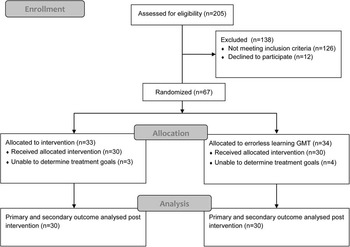
A total of 205 patients were tested to evaluate executive functioning and eligibility. Of these, 79 patients fulfilled the inclusion criteria of whom 12 patients refused to participate (unable to undergo treatment twice a week, or not interested in participating in a study). Three patients in the errorless learning Goal Management Training and four in the conventional group did not complete the treatment because no treatment goals could be established. The remaining 60 patients all completed the training with 30 patients in the experimental errorless learning Goal Management Training and 30 in the conventional Goal Management Training. The CONSORT diagram (Figure 1) shows the flow of the participants through the trial.
Flow of participants through the trial.

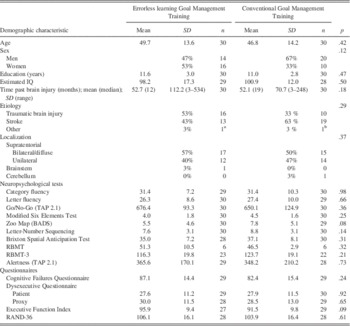
Table 1 shows the demographic characteristics and the baseline performance on the neuropsychological tests and questionnaires for both groups. Demographic features (age, sex distribution, estimated IQ, and years of education) and type and duration of brain injury did not differ between the two groups. Furthermore, there were neither differences in cognitive functioning as measured by the neuropsychological tests, nor in cognitive complaints and quality of life as reported by the participants and proxies using the questionnaires.
Baseline characteristics of the errorless learning Goal Management Training group and conventional Goal Management Training group

Note. TAP=Test for Attentional Performance; BADS=Behavioural Assessment of the Dysexecutive Syndrome; RBMT=Rivermead Behavioural Memory Test; RAND-36=RAND 36-item Short Form Health Survey.
a Brain tumor (resection).
b autoimmune encephalitis.
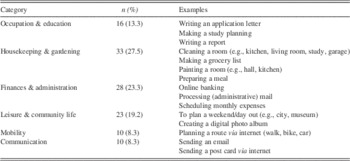
Table 2 presents a categorical overview and examples of the selected treatment goals (categories in accordance with Vlagsma et al., Reference Vlagsma, Koerts, Fasotti, Tucha, Van Laar, Dijkstra and Spikman2015). The treatment goals covered the main aspects of daily living. Most treatment goals were related to housekeeping (including gardening) (28%), usually cleaning a space or room, followed by financial and administrative goals (23%) such as conducting an online banking transaction, and goals concerning the management of leisure time (19%) like planning a day trip. Remaining goals were related to mobility (8%; e.g., route planning) and communication (8%; e.g., sending an email).
Treatment goals divided into categories

Outcome Variables
Everyday task performance
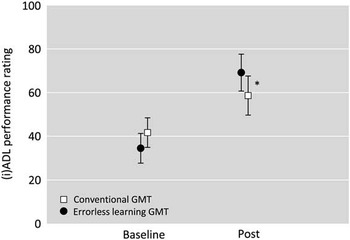
Figure 2 shows the results of the performance on the primary outcome variable (everyday task performance as measured by the video performance ratings) at baseline and post training. Both the errorless learning and the conventional Goal Management Training group performed better on everyday tasks after training compared to baseline. The errorless learning Goal Management Training group (M=69.13; SD=23.59) performed significantly better on activities of daily living than the conventional Goal Management Training group (M=58.63; SD=25.01) after adjusting for the performance at baseline (M=34.48; SD=18.99 for the errorless learning Goal Management Training group; M=41.67; SD=18.93 for the conventional Goal Management Training group), F(1,57)=8.02, p=.006, with a higher adjusted difference in performance of 15.43 (95% CI 4.52 to 26.35). Cohen’s effect size value (d=0.74) indicates a moderate to large effect. Paired sample t tests showed that both groups improved significantly with a mean difference of 34.65 (95% CI 25.81 to 43.50; t(29)=8.02; p<.001) for the errorless learning Goal Management Training group and a mean difference of 16.96 (95% CI 9.93 to 24.00; t(29)=4.93; p<.001) for the conventional Goal Management Training group. Overall, 43% of the patients who received the combined errorless learning and Goal Management Training and 13% of the patients who received the conventional training achieved a clinically significant improvement.
Mean (95% confidence interval) scores on assessment of everyday task performance at baseline and post-treatment in the errorless learning Goal Management Training group and conventional Goal Management Training group. *baseline adjusted p=.006.

Goal attainment scaling
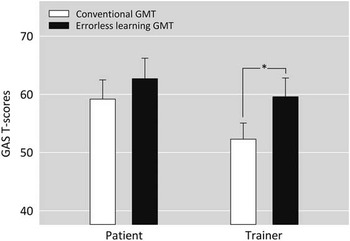
Compared to baseline both the trainers and the patients reported significantly higher post treatment goal attainment scores in both treatment arms. For the errorless learning Goal Management Training the mean differences were 22.01 (95% CI [18.65, 25.37]; t(29)=13.39; p<.001) for the trainer scores and 25.11 (95% CI [21.43, 28.79]; t(29)=13.97; p<.001 ) for the patient scores. For the conventional Goal Management Training the mean differences were 14.67 (95% CI [11.77, 17.57]; t(29)=10.35; p<.001) for the trainer scores and 21.60 (95% CI [18.16, 25.03]; t(29)=12.87; p<.001) for the patient scores. No significant difference was found for the achieved Goal Attainment Scale results scored by the patients between the errorless learning Goal Management Training (M=62.71; SD=9.85) and the conventional Goal Management Training (M=59.20; SD=9.19); t(58)=1.43; p=.16). The Goal Attainment Scale scores scored by the trainers were significantly higher for the patients who received errorless learning Goal Management Training (M=59.61; SD=9.00) compared to the conventional Goal Management Training group (M=52.27; SD=7.76); t(58)=3.38; p=.001, with a treatment difference of 7.34 (95% CI [2.99, 11.68]) and a large effect size (d=0.87). According to the trainers, patients who received errorless learning Goal Management Training achieved their goals to a larger extent than the patients who received conventional Goal Management Training (Figure 3).
Mean (95% confidence interval) scores on Goal Attainment Scale filled by patients and trainers post-treatment for the errorless learning Goal Management Training group and conventional Goal Management Training group. *p=.001.

Discussion
Brain-injured patients with executive impairments perform better in everyday executive tasks when these have been learned with a combination of errorless learning and Goal Management Training instead of Goal Management Training alone. Both video performance rating scores from independent assessors and goal attainment scores obtained from trainers indicate that errorless Goal Management Training is superior to conventional Goal Management Training. Goal attainment as reported by the participating patients did not show a difference between the two learning methods. This apparent contrast between the patient and the trainer goal attainment scores may be explained by the patients’ lack of insight (Schiehser et al., Reference Schiehser, Delis, Filoteo, Delano-Wood, Han, Jak and Bondi2011; Sherer et al., Reference Sherer, Bergloff, Levin, High, Oden and Nick1998) that may have led them to overestimate their levels of everyday functioning. Their relatively high goal attainment scores in both treatment arms support this explanation. The trainers, who were not blind for treatment condition, may have been biased in scoring the extent of goal achievement. This may have resulted in an overly positive view of the combined errorless learning and Goal Management Training and may also explain the discrepancy with the ratings by the patients themselves.
A recent systematic review (Krasny-Pacini, Chevignard, & Evans, Reference Krasny-Pacini, Chevignard and Evans2014) identified 12 studies that investigated the efficacy of Goal Management Training in patients with acquired brain injury. This review argued that Goal Management Training was most effective when it was combined with other intervention methods. Moreover, the authors of the review recommended to use patients’ individual selected goals including everyday tasks, plan more than one training session per week with a total training duration of at least 15 sessions and to use external cues or prompts, such as periodically content-free auditory alerts (“bleeps”; Manly et al., Reference Manly, Hawkins, Evans, Woldt and Robertson2002) to remind the participants to apply the Goal Management Training strategy. In our study, external cueing was given by using errorless learning techniques such as verbal and visual instructions (e.g., cue cards) used for learning the task steps and the application of the Goal Management Training strategy (i.e., prompting to include “checking moments” after execution of each task step and reminding to keep the overall goal actively in mind).
Although the efficacy of errorless learning has traditionally been investigated in laboratory tasks, various recent studies have examined the effects of errorless learning on the performance of everyday tasks. These studies, however, have mainly focused on amnesic patients, such as patients with Alzheimer’s dementia or Korsakoff’s syndrome (see De Werd, Boelen, Olde Rikkert, & Kessels, Reference De Werd, Boelen, Olde Rikkert and Kessels2013; Middleton & Schwartz, 2012, for critical reviews). Our study is the first to combine Goal Management Training and errorless learning to investigate the previously hypothesized benefits (Clare & Jones, Reference Clare and Jones2008) of errorless learning for training everyday task performance, specifically in executively impaired patients.
In contrast to earlier studies that investigated the effects of Goal Management Training on one or two predefined daily tasks (Fish et al., Reference Fish, Evans, Nimmo, Martin, Kersel, Bateman and Manly2007; Grant et al., Reference Grant, Ponsford and Bennett2012; Levine et al., Reference Levine, Robertson, Clare, Carter, Hong, Wilson and Stuss2000) or on questionnaires and standardized tests (Manly et al., Reference Manly, Hawkins, Evans, Woldt and Robertson2002; Miotto et al., Reference Miotto, Evans, De Lucia and Scaff2009), the current study had a tailored approach by using everyday tasks selected by the patients. By using the current rating method and calculating percentage scores, the performance on a variety of tasks could be compared, which made it possible to evaluate the eligibility of the experimental treatment for training a broad spectrum of everyday tasks. The individually chosen treatment goals may also have contributed to the motivation of the participants, as all participants completed the training once treatment goals were established.
Previous studies have shown that Goal Management Training is an effective training method for persons with executive problems. Therefore, we did not include a condition in which participants simply practiced the selected tasks (i.e., without the Goal Management Training strategy). As a result, our approach did not allow an assessment of the efficacy of Goal Management Training as such, in addition to the effects of repeated task practice. Future trials should therefore include more treatment arms, including a “task-practice only” group and an “errorless learning only” group.
Pinpointing treatment goals was not feasible in seven patients, possibly due to lack of awareness as a consequence of their executive deficits. However, this may also have been due to several other factors, such as motivational problems, avoidance behavior or fear of failure. Another limitation of our study was that it was not possible to blind the trainers to treatment condition. As a result, rater bias cannot be ruled out with respect to the Goal Attainment Scale scores of the trainers. Moreover, the trainers were instructed in how to use the treatment protocols and gave several sessions in conjunction with the main researcher before delivering the training independently. However, treatment integrity was not systematically monitored, which is also a limitation. Furthermore, the examined intervention was task-specific and transfer to untrained tasks may hence not be expected. However, one could also argue that if the Goal Management Training algorithm was successfully acquired using an errorless approach, it may also be applied in non-trained tasks. Transfer effects could not be studied using the present setup, but future studies could also investigate whether untrained tasks benefit from an errorlessly acquired goal management strategy. For now, the application of errorless Goal Management Training must focus on tasks that are functionally important to the individual. In addition, no follow-up measurements were included. Therefore, the maintenance of the treatment effect is unknown, which should be investigated in future research.
In conclusion, our study is the first to show that combining errorless learning with Goal Management Training improves everyday tasks performance in brain-injured patients with executive impairments. Old errors do not always lead to new truths in executively impaired patients due to an inadequate monitoring of errors and behavior. Avoiding errors during the acquisition of daily activities circumvents a dysfunctional error-monitoring system and consequently prevents the implicit consolidation of errors in memory. Executive impairments after brain injury may have a devastating impact on everyday life (Burgess & Simons, Reference Burgess and Simons2005; Dawson, Binns, Hunt, Lemsky, & Polatajko, Reference Dawson, Binns, Hunt, Lemsky and Polatajko2013) and compromise functional independence (Levine et al., Reference Levine, Robertson, Clare, Carter, Hong, Wilson and Stuss2000). Consequently, training individually selected daily tasks contributes to a more independent functioning of brain-injured patients and thus may decrease the amount of assistance needed at home or in vocational settings. The combination of errorless learning and Goal Management Training is a valuable contribution to cognitive rehabilitation in clinical practice.
Acknowledgments
We thank all participants and trainers for their contribution. The study is funded by the National Initiative Brain and Cognition (NIBC, grant #056-11-011). This quick-result project is embedded in the pillar “The Healthy Brain, Program Cognitive Rehabilitation”. The trial was registered with the Netherlands Clinical Trials Registry, www.trialregister.nl, no. NTR3567. Conflict of interest: None declared.