Each year, millions of indigent and middle-income Americans encounter the civil justice system pro se, without legal representation (Legal Services Corp. 2009; Rhode Reference Rhode2009). For many Americans, supply-side barriers to obtaining counsel prevent access to justice—in practice, many attorneys are financially unable or unwilling to represent individuals with potentially meritorious legal claims. In addition, demand-side barriers also prevent access to justice—many Americans are financially unable to pay for legal representation (DOJ 2010; Albiston and Sandefur Reference Albiston and Sandefur2013; Kaiser and Quintanilla Reference Kaiser and Quintanilla2014; Daniels and Martin Reference Daniels and Martin2015). Troublingly, when individuals press their claims pro se, they fail at virtually every stage of civil litigation (Nielsen and Nelson Reference Nielsen, Nelson, Nielsen and Nelson2005). Unrepresented claimants are less likely to receive early settlement offers and much more likely to have their case dismissed. By and large, pro se claimants fail to receive materially meaningful access to justice. This deficit in materially meaningful relief is most often attributed to a deficiency in the quality and merit of pro se claims. The past decade has witnessed a renaissance in the empirical study of access to justice problems (Sandefur Reference Sandefur2010; Albiston and Sandefur Reference Albiston and Sandefur2013). As of yet, however, psychological science has not been harnessed to explore the reasons pro se parties fare so poorly and, specifically, no work has examined the stereotypes lawyers and law-trained individuals hold of pro se parties.
In this article, we draw on psychological science and experimental methods to investigate the vexing problem of why pro se claimants fare so poorly within the civil justice system. Specifically, we harness social psychological theories and methods to investigate these pressing access to justice questions: Does a claimant's pro se status, itself, have a signaling effect on lawyers and legal officials, even after controlling for case quality and merit? Do lawyers and legal officials hold negative stereotypes about pro se claimants? Do these stereotypes help explain the adverse treatment of pro se parties? And finally, if so, is the signaling effect of pro se status a function of socialization within the legal profession? That is, do law-trained individuals (i.e., law students and lawyers) perceive and treat pro se claimants differently than members of the lay public? By empirically examining these questions, we seek to contribute to a broader and deeper understanding of access to justice and to reveal psychological barriers that pro se claimants contend with that meaningfully shape their material outcomes.
We examined the signaling effect of pro se status in the federal civil rights context, specifically in the context of a female employee who asserts a claim of sex discrimination under Title VII. In so doing, we conducted a social psychological experiment with members of the public, law students, and lawyers that held the quality and merit of the claimant's case constant, and subtly manipulated the presence or absence of her pro se status. This psychological experiment was designed to demonstrate the extent to which the mere presence or absence of counsel alters perceptions of a claimant and her claim, thereby affecting an important material outcome, that is, the size of the settlement a claimant ultimately obtains. We conclude by calling for sociolegal research in a wide range of civil justice contexts beyond the federal civil rights context, including family law, landlord tenant, and small claims court, and for quantitative and qualitative research investigating how a claimant's pro se status intersects and interacts with other social identities—including race, national origin, gender, sexual orientation, and socioeconomic status—to influence their experiences and outcomes.
Empirical Perspectives on the Pro Se Phenomenon
Prior Studies on the Effect of Pro Se Status Across the Civil Justice System
While a rising tide of Americans encounter the civil justice system without legal representation, most prior empirical studies demonstrate that claimants who fail to secure legal representation suffer worse legal and material outcomes than those with counsel (Schoenholtz and Jacobs Reference Schoenholtz and Jacobs2001; Seron et al. Reference Seron, Frankel, Van Ryzin and Kovath2001; Kerwin Reference Kerwin2004; Sandefur Reference Sandefur2010). For example, a meta-analysis of twelve studies revealed that securing legal representation increased the likelihood of receiving a favorable outcome anywhere between 1.19 times to 13.79 times compared to the likelihood of receiving a favorable outcome when pro se (Sandefur Reference Sandefur2010). The magnitude of this difference turned on the complexity of the legal context, procedures, and problems involved. This meta-analysis demonstrated that in fields of average complexity in trial courts, pro se claimants are on average 6.5 times more likely to lose than counseled claimants.
Civil justice researchers offer several reasons why unrepresented parties fare worse than counseled parties. First, counseled claimants receive the benefit of lawyers whose legal expertise may guide claims through complex legal thickets, thereby resulting in better outcomes (Kritzer Reference Kritzer1998; Sandefur Reference Sandefur2015). Second, lawyers may lend not only substantive and procedural knowledge, but strategic expertise on how, where, and when to best harness procedures (Shanahan, Carpenter, and Mark Reference Shanahan, Carpenter and Mark2016), and relational expertise when interacting with legal officials and court personnel (Sandefur Reference Sandefur2015). Third, lawyers may choose clients with stronger cases, seeking to spend time and resources on cases of higher value (Sandefur Reference Sandefur2010). And fourth, the type of person who successfully secures legal representation may have different personality traits and communication skills than one who fails to do so (Sandefur Reference Sandefur2010).
Unrepresented claimants may also experience confusion with complex documents and procedures. Indeed, court surveys reveal that despite the existence of self-help counters in some courts, unrepresented claimants feel that court personnel fail to provide them sufficient assistance (Landsman Reference Landsman2012). Finally, it is plausible that legal officials and law-trained individuals may hold biases or negative stereotypes about pro se litigants (Landsman Reference Landsman2012). These negative beliefs may not be confined to concerns about court management and efficiency. For example, legal officials describe pro se claimants as having a variety of worrisome personal characteristics (Landsman Reference Landsman2012). Some legal officials perceive pro se claimants as irrational people who bring frivolous claims. Taken together, each of these explanations may explain the divergent material outcomes between represented and pro se parties in particular contexts.
Most quantitative studies that examine access to justice use archival data and consistently show that uncounseled parties fare worse than counseled parties (Albiston and Sandefur Reference Albiston and Sandefur2013). Indeed, most prior empirical studies examine the effect of legal representation by comparing and contrasting case histories using court records. For researchers wishing to isolate the causal effect of legal representation—and the mechanisms that undergird the effect—one difficulty of archival studies is disentangling whether pro se parties fare more poorly than counseled parties because of the presence or absence of legal representation or because of attorney case selection effects. Regarding case selection, lawyers may choose to represent cases of higher quality and merit.
Several randomized controlled studies (RCTs) have sought to disentangle these causal influences by randomly assigning some unrepresented claimants to receive counsel while others remained uncounseled, thereby eliminating attorney case selection as an explanation. For example, Seron et al. (Reference Seron, Frankel, Van Ryzin and Kovath2001) randomly assigned counsel to unrepresented tenants awaiting hearings in landlord-tenant cases before the Manhattan Housing Court. This study revealed a noteworthy effect of legal representation: counseled claimants were more than four times more likely than pro se tenants to retain possession of their apartments (Seron et al. Reference Seron, Frankel, Van Ryzin and Kovath2001). Another experiment revealed only a modest improvement in outcomes for poor clients (Stapleton and Teitelbaum Reference Stapleton and Teitelbaum1972) and a third found that an offer of representation by a law student delayed resolution of poor clients' claims without increasing their probability of success (Greiner and Pattanayak Reference Greiner and Pattanayak2012; Selbin et al. Reference Selbin, Charn, Alfieri and Wizner2012).
Taken together, the extant literature reveals that in many contexts, there is a reliable effect of legal representation by which uncounseled parties fare worse than their counseled counterparts. Moreover, prior empirical studies elucidate a benefit of controlling, when possible, for the effect of case quality and merit to allow for causal inferences about the signaling effect of pro se status itself. Finally, the large majority of work examining the effect of legal representation has explored the direct effects of counsel (or no counsel) on litigation outcomes. Indeed, no empirical studies of which we are aware have explored the psychological mechanisms—or psychological reasons—that explain why uncounseled parties fare worse in litigation matters. The present work examines this question in the federal civil rights context and explores the psychological mechanisms of the signaling effect.
The Pro se Phenomenon in the Context of Federal Civil Rights and Employment Discrimination Cases
One civil justice context of particular concern is the civil rights context. Like other areas of civil justice, the number and percentage of pro se claimants in federal civil rights cases has risen sharply (Nielsen, Nelson, and Lancaster Reference Nielsen, Nelson and Lancaster2010; Kaiser and Quintanilla Reference Kaiser and Quintanilla2014). For example, although the Administrative Office of the US Courts reports that the uncounseled rate in US federal district courts across all civil cases (excluding prisoner petitions) is 10.9 percent, Bloomberg Law's database reveals that of the 12,619 federal employment discrimination cases filed in 2013, 24.1 percent were filed uncounseled. Thus, for federal employment discrimination cases, the pro se rate has risen from approximately 20 percent (Myrick, Nelson, and Nielsen Reference Myrick, Nelson and Nielsen2012) to 24 percent over the past decade (Kaiser and Quintanilla Reference Kaiser and Quintanilla2014). Prior research, moreover, highlights racial disparities in the rate at which claimants secure counsel: African Americans, Hispanic Americans, and Asian Americans are less likely than whites to secure representation (Myrick, Nelson, and Nielsen Reference Myrick, Nelson and Nielsen2012). These racial disparities persist even after controlling for plaintiffs' occupational status, gender, age, type of discrimination, and EEOC assessment of the case's strength (Myrick, Nelson, and Nielsen Reference Myrick, Nelson and Nielsen2012).
The problem is that pro se parties who assert federal employment discrimination claims rarely secure materially meaningful access to justice, including monetary awards for lost back pay attributable to unlawful discrimination, reinstatement to a prior position, promotion, or halting unlawful employer conduct. Among claimants who reach dispositive motion stages, those who proceed pro se almost invariably lose (Nielsen, Nelson, and Lancaster Reference Nielsen, Nelson and Lancaster2010). Indeed, prior studies reveal that pro se parties are three times more likely to have their cases dismissed on the pleadings, twice as likely to have their cases dismissed at summary judgment, and far less likely to receive early or comparable settlements (Nielsen, Nelson, and Lancaster Reference Nielsen, Nelson and Lancaster2010). Legal officials tend to explain these trends by suggesting that, given the existence of fee-shifting statutes that compensate attorneys who bring successful claims, litigants who proceed pro se are irrational people with frivolous claims. While fee-shifting statutes do award fees to attorneys who represent prevailing plaintiffs (Albiston and Nielsen Reference Albiston and Nielsen2006; Farhang and Spencer Reference Farhang and Spencer2014), a variety of structural and doctrinal barriers imposed in the last decade sharply decrease the incentives for attorneys who wish to represent civil rights claimants with legitimate grievances (Albiston and Nielsen Reference Albiston and Nielsen2006; Brake and Grossman Reference Brake and Grossman2007; Nelson, Berrey, and Nielsen Reference Nelson, Berrey and Nielsen2008). Despite these rising supply-side barriers on obtaining counsel and, thus, the growing percentage and number of unrepresented parties, many legal officials have not updated their negative preconceptions and stereotypes about pro se civil rights claimants.
The Signaling Effect of Pro se Status
In this article, we hypothesized that the mere presence of a claimant's pro se status sends a signal that influences the psychology of how law-trained persons perceive, appraise, and value a pro se party's claims. While anecdotal evidence suggests that legal officials and lawyers may hold negative stereotypes about pro se parties, as of yet there has been no social psychological or experimental research of this phenomenon. The present work addresses this gap by connecting access to justice with psychological science.
In this research, we were primarily interested in whether the effect of pro se status alters a meaningful material outcome: settlement values awarded to claimants. We were also interested in whether pro se status itself shapes people's perceptions about claimants, including negative stereotypes along the primary person-perception dimensions of warmth and competence (Cuddy, Fiske, and Glick Reference Cuddy, Fiske and Glick2007), as well as perceptions of the litigant as a complainer. Finally, if we found that pro se status operates as a signal that disadvantages uncounseled parties, we wished to explore whether this phenomenon may be exacerbated by socialization in the legal profession.
The Present Research
To investigate the signaling effect of pro se status, we conducted social psychological experiments using a realistic case file in a Title VII sex discrimination case. In the Title VII case, a high-tech company (Atlantic Technologies) failed to promote a female computer programmer, Ms. Smith, to a manager position in circumstances that were ambiguous, potentially suggesting misconduct. We conducted a mixed-design experiment with two factors. We first manipulated the between-subject factor of the presence/absence of counsel. That is, participants were randomly assigned to review a Title VII file in one of the two conditions: Ms. Smith was either pro se or counseled. Because the psychological experiment held case quality (merit) constant, and randomly assigned participants into a condition in which the claimant was either pro se or counseled, the experiment allowed an internally valid and robust causal test of the signaling effect of pro se status.
Second, we harnessed a within-subject factor to explore whether the effect of pro se status might emerge more strongly at different points in the litigation life cycle. Specifically, each participant reviewed the Title VII case at three successive dispute stages: the presuit demand stage, the summary judgment stage, and the trial stage. This within-subject factor represented the sociolegal concept of the dispute pyramid (Miller and Sarat Reference Miller and Sarat1980; Galanter Reference Galanter1983). Prior research reveals that employment discrimination grievances have a steep attrition along the dispute pyramid, disproportionately falling out of the civil justice system at early stages of the pyramid (Nielsen and Nelson Reference Nielsen, Nelson, Nielsen and Nelson2005). While we theorized that the size of the claimant's settlement award would increase as she persisted in the dispute pyramid toward trial, this within-subject factor allowed examination of the signaling effect of pro se status across multiple stages of the dispute pyramid.
Third, because the case file entailed a sex discrimination claim, we included participant gender as a control variable so that results would not be attributable to participants' own group membership. Prior social psychological and political science research has evidenced gender differences in how men and women perceive and evaluate ambiguous instances of sex discrimination (Major, Quinton, and Schmader Reference Major, Quinton and Schmader2003; Boyd, Epstein, and Martin Reference Boyd, Epstein and Martin2010; Kaiser and Wilkins Reference Kaiser and Wilkins2010), thus controlling for participant gender allowed us to examine the effect of pro se status above and beyond this perceiver characteristic.
Finally, we conducted the above mixed-design experiment with three different populations: the lay public, law students, and lawyers. We recruited members of the lay public online, and law students and lawyer graduates of the same law school. Given research on the socialization effects of law school and the transmission of professional values and attitudes within law schools (Erlanger and Klegon Reference Erlanger and Klegon1978; Mertz Reference Mertz2007), we theorized that the signaling effect of pro se status might be a phenomenon that emerges as a function of socialization in the legal profession (Friedman Reference Friedman and Teubner1986; Sarat and Felstiner Reference Sarat and Felstiner1995). Because legal officials, attorneys, and law school faculty (themselves often former practicing attorneys) may perceive pro se litigants as having more worrisome personal characteristics than counseled parties (Landsman Reference Landsman2012), these stereotypes may be transmitted—consciously or unconsciously—to law students during the course of their legal education and summer work experiences.
Primary Hypotheses
Signaling Effect of Pro Se Status
We hypothesized that, above and beyond case quality and merit (holding these factors constant):
-
1. Pro se claimants will receive worse material outcomes (i.e., smaller settlement awards) than counseled claimants.
-
2. Law-trained individuals will hold negative stereotypes of pro se, relative to counseled, claimants.
Settlement Values and the Dispute Pyramid
Moreover, consistent with literature on the dispute pyramid, we also hypothesized that:
-
1. As a claimant ascends the dispute pyramid, the value of a settlement award will rise. On balance, the value of a settlement award will be greater at trial than at summary judgment, and greater at summary judgment than presuit.
Socialization in the Legal Profession
Finally, consistent with the literature on socialization in the legal profession, we hypothesized that:
-
1. The signaling effect of pro se status will intensify with professional socialization. That is, if the signaling effect of pro se status is a function of professional socialization, then law-trained individuals will exhibit bias against pro se claimants, whereas the public may not.
-
2. Similarly, if knowledge of the dispute pyramid is a function of professional socialization, then law-trained participants will award settlement values that reflect the claimant's ascent of the dispute pyramid, whereas the public may not.
Research Overview
Method
Participants
To examine whether the signaling effect of pro se status is a function of legal socialization, we sampled three populations: the lay public, law students at a large midwestern law school, and lawyer graduates of the same midwestern law school who currently practice employment discrimination litigation. By holding the law school (and thus the particular schooling) of the legal-trained samples constant, the lawyers sample allowed for a more internally valid and controlled examination of the legal socialization hypothesis.
The experiment was first conducted with adult members of the general public recruited online on Amazon Mechanical Turk (Paolacci et al. Reference Paolacci, Chandler and Ipeirotis2010). Our original sample consisted of 200 participants, but forty-three participants were excluded from our analysis for not completing all three dispute stages in the survey or for failing the attention or manipulation checks (described below). Our final sample (N = 157) consisted of sixty-five women and ninety-two men who had, on average, completed at least some courses at a four-year university. Participants self-identified as white/European American (81.5 percent), black/African American (5.7 percent), Latino/a (2.5 percent), Asian American/Pacific Islander (5.7 percent), Native American (0.6 percent), and bi/multiracial (3.8 percent).
The experiment was next conducted with law students enrolled at a large midwestern law school. Our original sample consisted of 228 participants, but 30 participants were excluded from our analysis for not completing all three dispute stages in the survey or for failing the attention or manipulation checks. Our final sample (N = 198) consisted of 90 women and 108 men. Participants self-identified as white/European American (79.8 percent), black/African American (4.5 percent), Latino/a (3.0 percent), Asian American/Pacific Islander (5.6 percent), and bi/multiracial (3.5 percent).
Last, the experiment was conducted with fifty lawyers who graduated from the same midwestern law school and who currently practice employment discrimination law. Eleven participants were excluded from our analysis for not completing all three stages or for failing the attention or manipulation checks. Our final sample (N = 39) consisted of sixteen women and twenty-three men. Participants self-identified as white/European American (87.2 percent), black/African American (5.1 percent), Latino/a (2.6 percent), and bi/multiracial (5.1 percent). The vast majority of employment discrimination lawyers (97.3 percent) held eleven or more years of legal experience and most represented defendants (66.7 percent).
Materials and Procedure
The study was conducted online using a survey software program that allows for random assignment of participants to condition. After providing informed consent, participants were randomly assigned to either a pro se condition or counseled condition, where participants reviewed a realistic Title VII file involving a claim of sex discrimination. Each participant reviewed the pro se (counseled) claim at three chronological stages (i.e., the presuit demand stage, summary judgment stage, and trial stage), which represented the within-subject aspect of the experiment. At the presuit demand stage, participants reviewed an internal law firm memorandum prepared by counsel for the defendant describing the presuit demand of the pro se (counseled) claimant. At the summary judgment stage, participants reviewed a bench memorandum describing the pro se (counseled) case. At the trial stage, participants reviewed a trial summary describing the pro se (counseled) claim. At each stage after reviewing the Title VII case file, participants indicated the settlement award that the defendant should provide, an explanation for their decision, and rated the perceived merit of the case. At the first stage possible—the presuit demand stage—participants rated their impressions and stereotypes of the claimant.
Pro Se Status Manipulation
Participants read a case file in which the claimant was either unrepresented or counseled. In the pro se condition, the case file clearly indicated that the plaintiff was pro se at each stage: presuit (e.g., “Ms. Smith is currently not represented by counsel.”); summary judgment (e.g., CM-ECF docket stated “Eliza Smith [PRO SE]”); and trial (e.g., “My name is Eliza Smith, and I am representing myself without counsel.”)
In the counseled condition, the case file clearly indicated that the plaintiff was represented at each stage: presuit (e.g., “Ms Smith is currently represented by counsel.”); summary judgment (e.g., CM-ECF indicated a “LEAD ATTORNEY TO BE NOTICED”); and trial (e.g., “My name is [redacted], and I am representing the plaintiff, Eliza Smith.”).
Dispute Stages
All details of the employment discrimination case file were held constant, except for a manipulation of the claimant's pro se or counseled status. At the presuit demand stage, participants reviewed a realistic law firm memorandum describing the plaintiff's failure to promote claim and her presuit demand for relief. The law firm memorandum was from an associate to a partner at the law firm representing the defendant. The format, length, and content of the memo were based on realistic internal law firm memos.
Next, at the summary judgment stage, participants reviewed a bench memorandum prepared by a law clerk for a judge regarding the defendant's motion for summary judgment, which sought to dismiss the plaintiff's failure to promote claim. While similar to the internal memorandum, the bench memorandum provided additional details about the plaintiff's employment, such as the general requirements for the promotion and the timeline of the events. The format, length, and content of the bench memorandum were based on exemplars of bench memorandums created by federal law clerks in civil rights cases and the only detail that varied by condition was whether the plaintiff was pro se or counseled.
Finally, at the trial stage, participants were provided a realistic trial summary. While similar to both the internal memorandum and bench memorandum, the trial summary offered additional details about the testimony and evidence at trial. Again, the only detail that differed between conditions was whether the party was pro se or counseled. We designed these realistic Title VII materials at each stage to ensure a high degree of ecological and external validity.
After participants provided their judgments of the case at the three stages, participants answered a manipulation check ensuring that they understood (and remembered) whether the plaintiff had secured counsel or not, and two attention checks (Oppenheimer, Meyvis, and Davidenko Reference Oppenheimer, Meyvis and Davidenko2009) ensuring that they carefully attended to what they read and were not simply answering randomly. Finally, participants were asked to provide demographic information.
Measures
Settlement Amount Awarded
We were primarily interested in the divergent material outcomes between pro se claimants and counseled claimants; therefore, our primary dependent measure asked participants to select the appropriate size for the defendant's settlement offer to resolve the dispute. The dependent measure stated: “Please imagine that you represent Atlantic Technologies and that you are advising your client about the appropriate size of Atlantic's out-of-court settlement … Using the below range, please mark the appropriate size of Atlantic's opening settlement to Ms Smith to resolve this dispute.” At each stage of the dispute process, participants selected values between $0 and $75,000 for the amount they felt was appropriate. An open-ended question then asked participants to explain why they selected the amount chosen.
Perceived Merit of the Sex Discrimination Claim
At each dispute stage, participants evaluated the merit, plausibility, and believability of the failure to promote claim (e.g., “Please rate the merit of Ms. Smith's gender discrimination claim.”). Participants rated these three items on a seven-point scale ranging from 1 (Not at all) to 7 (Very). After an exploratory factor analysis revealed that these three items loaded onto a single factor, the three items were averaged together to create a perceived merit composite for each stage: presuit demand (Cronbach's α = .87), summary judgment (α = .92), and trial (α = .95), with higher scores indicating greater perceived merit of the sex discrimination claim.
Stereotypes of the Claimant
At the presuit demand stage, participants engaged in a social perception task that assessed their stereotypes about and impressions of the claimant. Participants completed measures about the claimant on two primary person-perception dimensions: warmth and competence (for a discussion of these primary dimensions of person perception, see Cuddy, Fiske, and Glick Reference Cuddy, Fiske and Glick2007). Participants also completed measures examining whether they perceived the claimant as a complainer. We provide a brief description of these three dimensions and specific measures below.Footnote 1 Exploratory factor analyses revealed that each of these items loaded onto the three intended factors: warmth, competence, complainer, and each construct showed strong internal reliability.
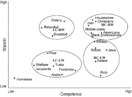
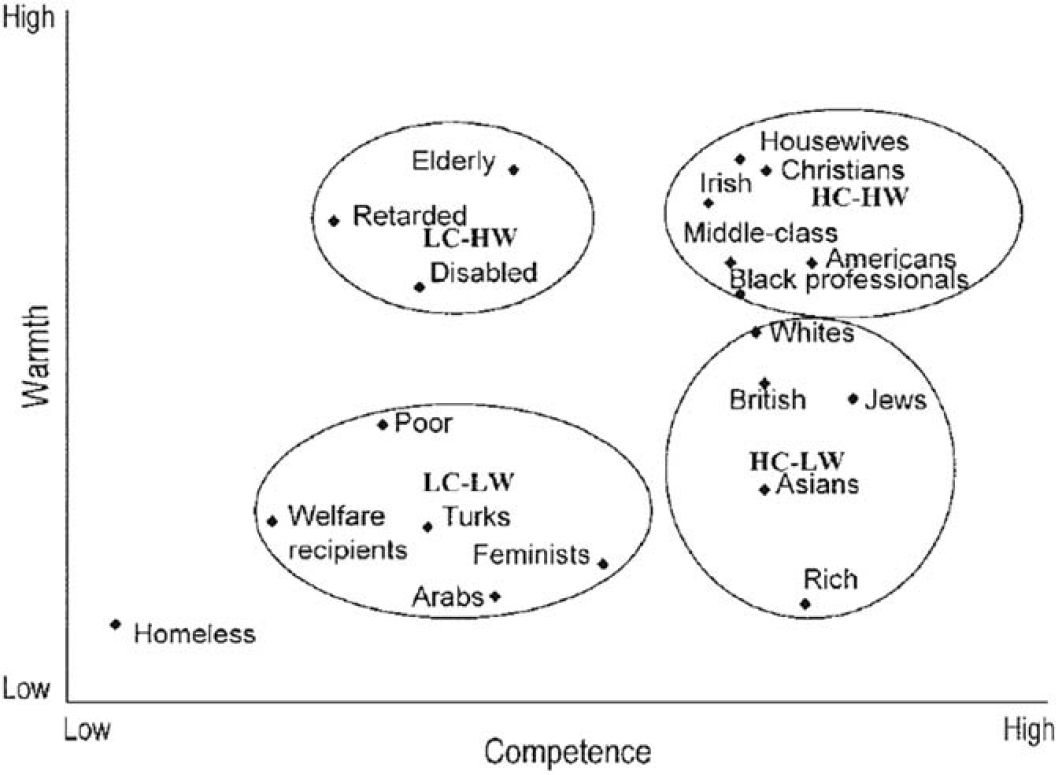
With regard to warmth and competence, these two dimensions are theorized to be orthogonal to each other and have been mapped in previous work to form a two-dimensional matrix that illustrates fundamental aspects of person-perception (see Figure 6 later in this article). In social psychological literature, this two-dimensional matrix is referred to as the BIAS (Behaviors from Intergroup Affect and Stereotypes) map (Cuddy, Fiske, and Glick Reference Cuddy, Fiske and Glick2007). The BIAS map identifies how different social groups (e.g., women, men, etc.) are perceived along the dimensions of warmth and competence and links the contents of those group stereotypes to the emotions and discriminatory behavioral tendencies that stem from such perceptions.
Warmth
Participants rated the claimant on three social perception items—warmth, compassionate, and considerate—which assessed their stereotypes of the claimant as a warm person (e.g., “Ms. Smith is a warm person.”) (Cuddy, Fiske, and Glick Reference Cuddy, Fiske and Glick2007). These three items were averaged to create a warmth composite (Cronbach's α = .91) and higher scores indicate a more positive impression.
Competence
Participants also rated the claimant on four social perception items—competence, good coworker, good work ethic, and hirable—which assessed their stereotypes of the claimant as a competent person and employee (e.g., “Ms. Smith is competent.” “Ms. Smith seems to have a good work ethic.”) (Kaiser and Miller Reference Kaiser and Miller2001; Shelton and Stewart Reference Shelton and Stewart2004; Cuddy, Fiske, and Glick Reference Cuddy, Fiske and Glick2007). These four items were averaged to create a competence composite (Cronbach's α = .90) and higher scores indicate a more positive impression.
Complainer
Participants rated the claimant on three items—complainer, troublemaker, and argumentative—which assessed their impression of the claimant as a complainer (Kaiser and Miller Reference Kaiser and Miller2001; Shelton and Stewart Reference Shelton and Stewart2004). These three items were averaged to create a composite of the claimant as a complainer (Cronbach's α = .86) and higher scores indicate a more negative impression.
Manipulation Check and Attention Checks
After completing all three stages of the materials, participants answered a manipulation check and two attention checks. The manipulation check ensured that participants could correctly identify and remember—after completing the study—whether the claimant was represented or not. The initial attention check ensured that participants could correctly identify having reviewed materials at the presuit demand stage, summary judgment, and trial stage, and the second attention check ensured that participants could correctly identify that the plaintiff sued because of sex discrimination.
Among members of the public, 90 percent passed the manipulation check and 91 percent and 99 percent passed the first and second attention checks, respectively. As is methodologically recommended, we excluded individuals who did not pass the checks (Oppenheimer, Meyvis, and Davidenko Reference Oppenheimer, Meyvis and Davidenko2009); thus the final sample consisted of 157 participants. Among law students, 88 percent passed the manipulation check and 100 percent and 100 percent passed the first and second attention checks, respectively, leaving a final sample of 198 law students. Among lawyers, 86 percent passed the manipulation check and 100 percent and 100 percent passed the first and second attention checks, respectively, leaving a final sample of thirty-nine practicing attorneys.
Results
Analytic Strategy
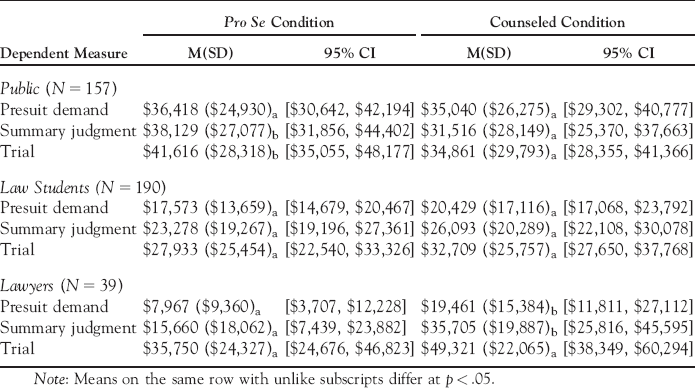
We began by analyzing the effect of pro se status on settlement awards received by the claimant who alleged sex discrimination. Our research design first called for a 2 (pro se status: pro se vs. counseled) × 3 (dispute stage: presuit, summary judgment, and trial) mixed-design ANCOVA (Field Reference Field2009) to be conducted on the dependent measure of settlement value with each sample to examine whether there was a biasing effect of pro se status among the public, law students, and lawyers on monetary awards. The first factor was the between-subject factor of whether the claimant was pro se versus represented. The second factor was the within-subject factor of dispute stage (i.e., the stage at which the participant reviewed the claimant's case: presuit demand, summary judgment, or trial). This second factor was treated as a repeated measure because each participant reviewed the case at the three stages of the dispute pyramid. Last, participant gender was included as a control variable. As such, we conducted a 2 (pro se: yes, no) × 3 (dispute stage: presuit demand, summary judgment, trial) mixed-design ANCOVA, with participant gender (gender: men, women) entered as a control variable. This analysis was conducted with each sample. All means and standard deviations for settlement awards across dispute stages are reported in Table 1.
Means, Standard Deviations, and 95 Percent CI of Settlement Values

| Pro Se Condition | Counseled Condition | |||
|---|---|---|---|---|
| Dependent Measure | M(SD) | 95% CI | M(SD) | 95% CI |
| Public (N = 157) | ||||
| Presuit demand | $36,418 ($24,930)a | [$30,642, $42,194] | $35,040 ($26,275)a | [$29,302, $40,777] |
| Summary judgment | $38,129 ($27,077)b | [$31,856, $44,402] | $31,516 ($28,149)a | [$25,370, $37,663] |
| Trial | $41,616 ($28,318)b | [$35,055, $48,177] | $34,861 ($29,793)a | [$28,355, $41,366] |
| Law Students (N = 190) | ||||
| Presuit demand | $17,573 ($13,659)a | [$14,679, $20,467] | $20,429 ($17,116)a | [$17,068, $23,792] |
| Summary judgment | $23,278 ($19,267)a | [$19,196, $27,361] | $26,093 ($20,289)a | [$22,108, $30,078] |
| Trial | $27,933 ($25,454)a | [$22,540, $33,326] | $32,709 ($25,757)a | [$27,650, $37,768] |
| Lawyers (N = 39) | ||||
| Presuit demand | $7,967 ($9,360)a | [$3,707, $12,228] | $19,461 ($15,384)b | [$11,811, $27,112] |
| Summary judgment | $15,660 ($18,062)a | [$7,439, $23,882] | $35,705 ($19,887)b | [$25,816, $45,595] |
| Trial | $35,750 ($24,327)a | [$24,676, $46,823] | $49,321 ($22,065)a | [$38,349, $60,294] |
Note: Means on the same row with unlike subscripts differ at p < .05.
Next, we turned to the effect of legal socialization on settlement awards. As such, our research design called for a 2 (pro se: yes, no) × 3 (dispute stage: presuit demand, summary judgment, trial) × 3 (population: public, law students, lawyers) mixed-design ANCOVA, with participant gender (gender: men, women) entered as a control variable to be conducted on settlement values. This mixed-design allowed a direct test of whether legal socialization moderated (amplified) either the effect of pro se status or the effect of ascending the dispute pyramid on settlement awards. The latter analysis investigated two-way interactions between population × pro se status and population × dispute stage.
Third, after concluding that the adverse effect of pro se status operated most acutely among law-trained participants (i.e., law students and lawyers), we conducted mixed-design ANCOVAs to examine the signaling effect of pro se status on law-trained participants' impressions and stereotypes about the claimant and her claim.
Last, to examine whether participants' stereotypes of the claimant explained the effect of pro se status on settlement value, we conducted a mediation analysis. That is, we empirically examined whether pro se status influenced participants' impressions of the claimant, which, in turn, influenced the settlement value that participants awarded the claimant. The latter test examined whether pro se status signals worrisome stereotypes, which, in turn, influence a meaningful material outcome, settlement value.
The Signaling Effect of Pro se Status on Settlement Values
Public
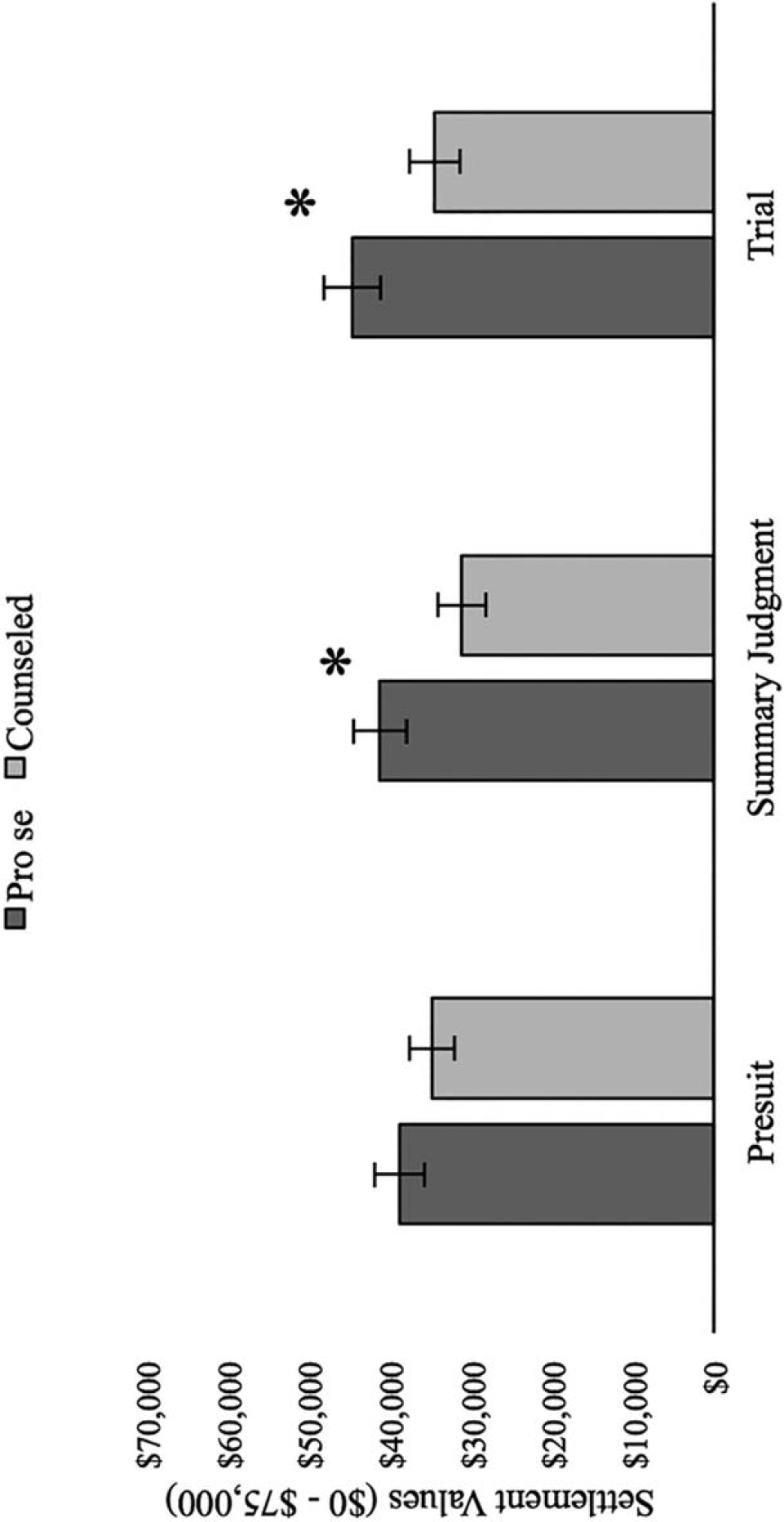
Turning first to the public, the two-way ANCOVA on settlement awards revealed a marginally significant main effect of pro se status, F(1, 154) = 3.86, p = .051, ηp 2 = .024. Strikingly, however, the pattern was in the reverse direction of the hypothesized effect: across dispute stages, the public awarded the claimant more when she was pro se (M = $38,721, SD = $24,841) than counseled (M = $33,806, SD = $26,140). Collapsing across dispute stages, the estimated marginal mean difference awarded to the pro se (vs. counseled) claimant was $8,066, 95% CI [–$45, $16,177].
The ANCOVA also revealed a marginally significant main effect of dispute stage, F(1.71, 264.00) = 3.09, p = .055, ηp 2 = .02.Footnote 2 Pairwise comparisons, however, indicated that only the difference between summary judgment (M = $34,633, SD = $27,758) and trial (M = $38,045, SD = $29,211) was significant, p = .039 (i.e., meaning that for the public, settlements were not significantly different when awarded presuit vs. summary judgment, p = 1.000, or presuit vs. trial, p = .327.).
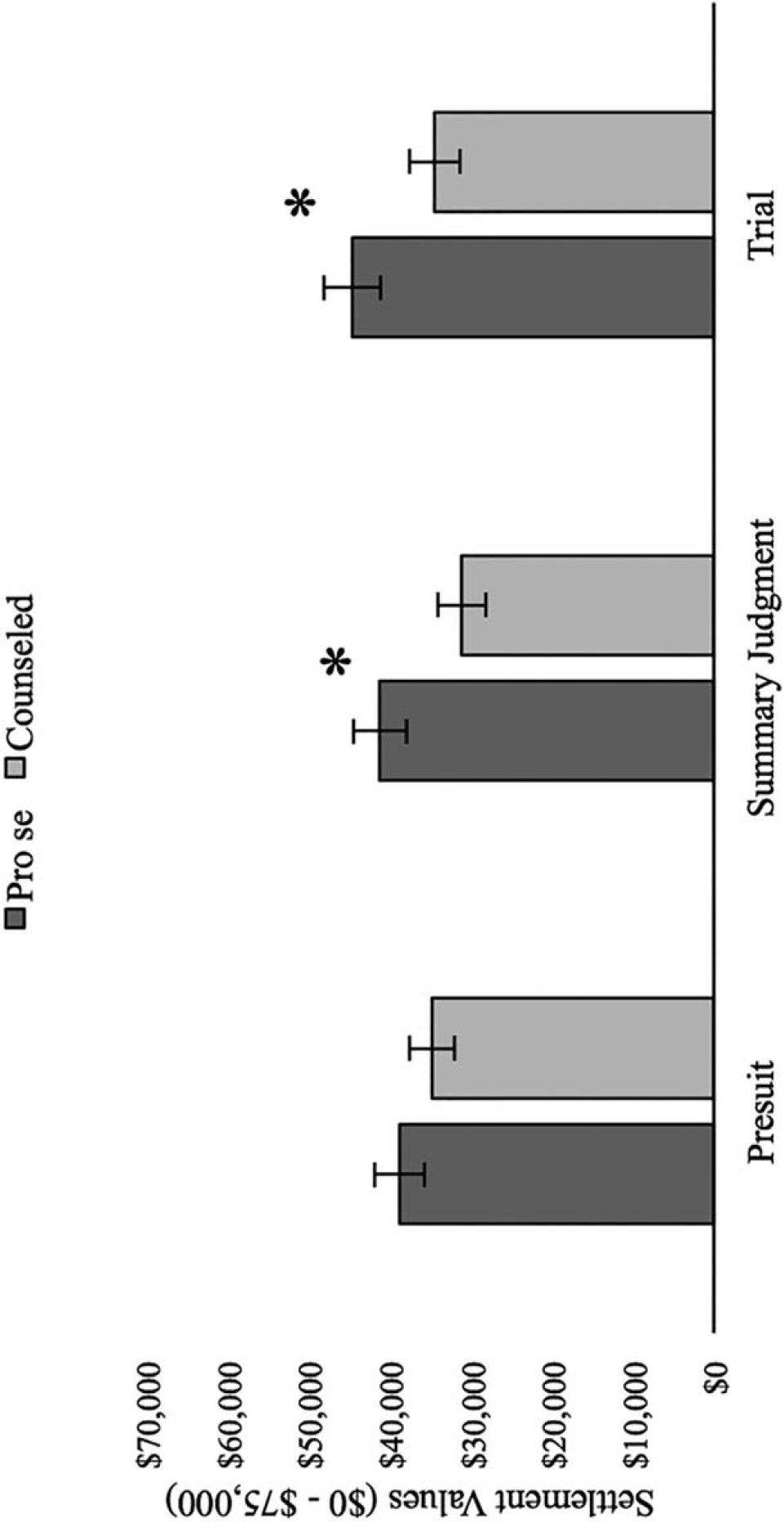
Finally, the ANCOVA revealed a marginally significant interaction between the dispute stage and the pro se status manipulation, F(1.71, 264.00) = 2.81, p = .070, ηp 2 = .02 (see Figure 1).Footnote 3 While the effect of pro se status was not significant at the presuit demand stage, t(156) = .98, p = .331, ηp 2 = .00, 95% CI [–$4,160, $12,275], the public awarded significantly more settlement dollars to the pro se claimant than the counseled claimant at summary judgment, t(156) = 2.26, p = .025, ηp 2 = .03, and at trial, t(156) = 2.14, p = .034, ηp 2 = .03. At summary judgment, the estimated difference in favor of the pro se claimant was $10,060, 95% CI [$1,283, $18,836] and at trial it was $10,079, 95% CI [$794, $19,366].
Estimated Mean Settlement Values Awarded by the Public to the Pro Se/Counseled Claimant at Each Dispute Stage
Note: Standard errors are represented by the error bars attached to each column. *p < .05, +p < .10.
Law Students
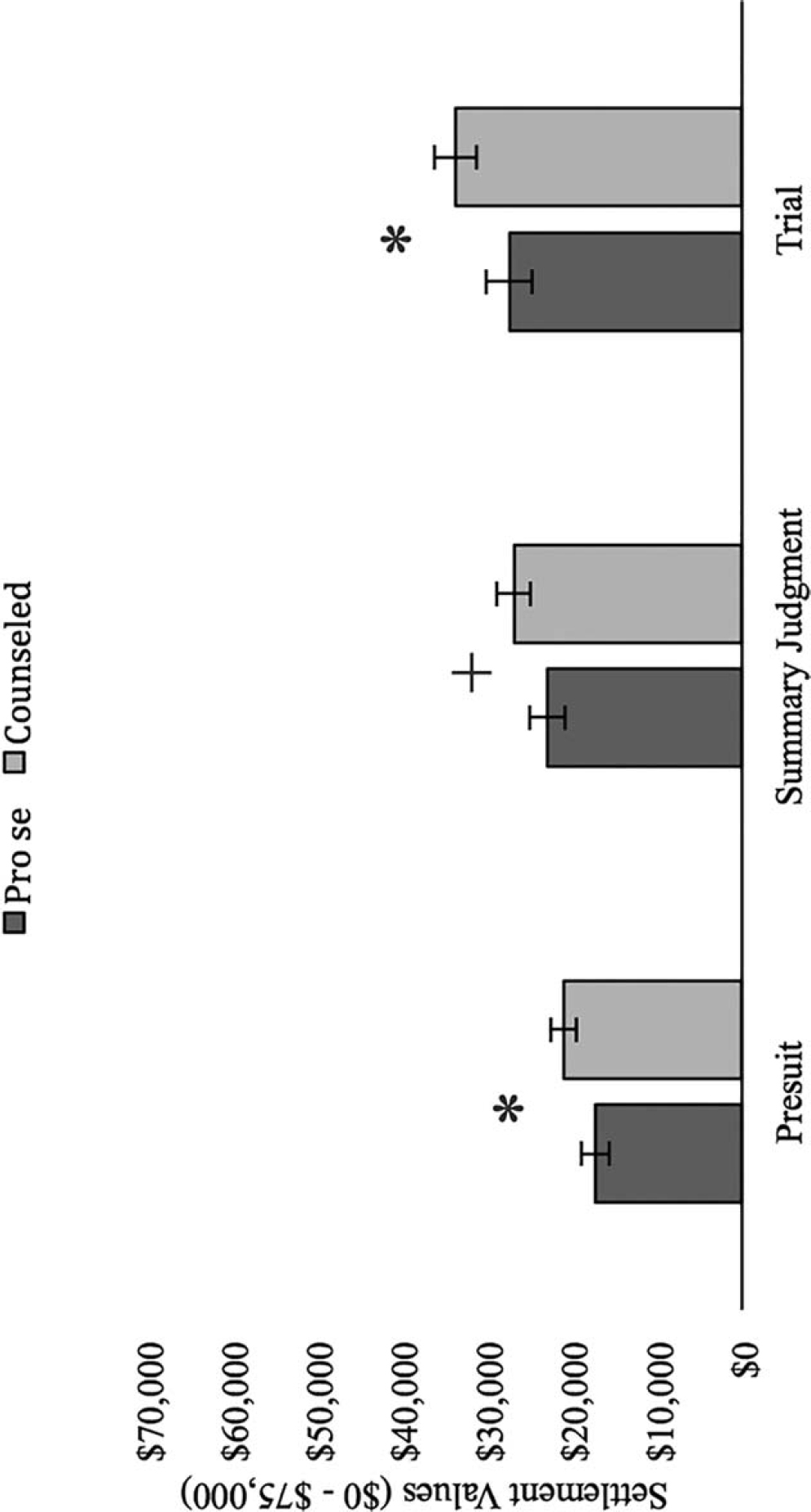
Turning next to law students, the two-way ANCOVA on settlement awards revealed a marginally significant main effect of pro se status, F(1, 187) = 3.40, p = .067, ηp 2 = .02. Here, consistent with our hypothesis, the adverse effect of pro se status began to emerge. Across dispute stages, law students awarded the claimant less when she was pro se (M = $22,327, SD = $16,931) than counseled (M = $26,020, SD = $18,582). Collapsing across dispute stages, the estimated marginal mean difference awarded to the pro se (vs. counseled) claimant was –$4,709, 95% CI [–$9,745, $327].
The ANCOVA also revealed a significant main effect of dispute stage, F(1.62, 303.56) = 35.52, p = .000, ηp 2 = .16. Pairwise comparisons revealed that all three dispute stages differed in settlement values, with awards increasing as the claimant ascended the dispute pyramid. That is, law students awarded more settlement dollars at trial (M = $30,497, SD = $25,661) than at summary judgment (M = $24,789, SD = $19,820), p < .000, and more settlement dollars at summary judgment than presuit (M = $19,107, SD = $15,636), p < .000.
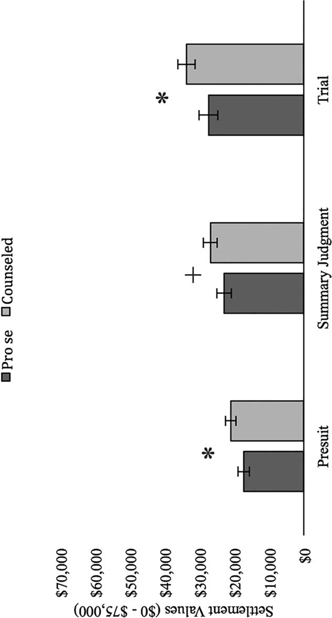
Finally, the ANCOVA did not indicate an interaction between the dispute stage and pro se manipulation, F(1.62, 303.56) = .55, p = .540, ηp 2 = .00 (see Figure 2).Footnote 4 At each dispute stage, the signaling effect of pro se trended in the theorized direction. Law students awarded less settlement dollars to the pro se claimant than the counseled claimant presuit, t(187) = −1.67, p = .097, ηp 2 = .02. Presuit, the estimated difference against the pro se claimant was –$3,778, 95% CI [–$8,241, $684]. Moreover, law students awarded less to the pro se claimant than the counseled claimant at summary judgment, t(187) = −1.38, p = .168, ηp 2 = .01. At summary judgment, the estimated difference against the pro se claimant was –$3,997, 95% CI [–$9,645, $1,690]. Finally, law students awarded less to the pro se claimant than the counseled claimant at trial, t(187) = −1.72, p = .087, ηp 2 = .02. At trial, the estimated difference against the pro se claimant was –$6,371, 95% CI [–$13,678, $936].
Estimated Mean Settlement Values Awarded by Law Students to the Pro Se/Counseled Claimant at Each Dispute Stage
Note: Standard errors are represented by the error bars attached to each column. *p < .05, +p < .10.
Lawyers
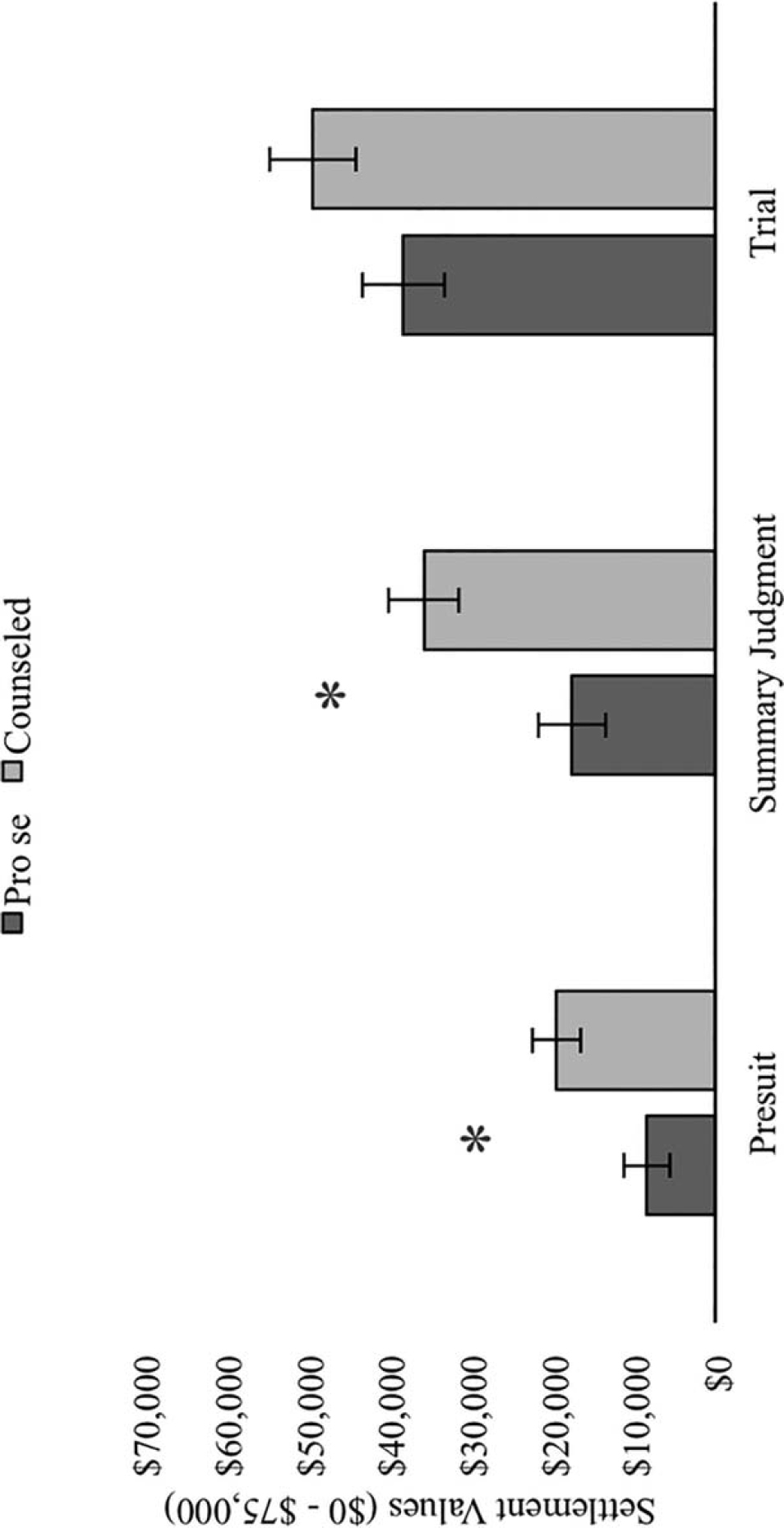
Turning last to lawyers, the two-way ANCOVA on settlement awards revealed a significant main effect of pro se status, F(1, 36) = 7.784, p = .008, ηp 2 = .18. Consistent with our hypothesis, lawyers awarded the claimant far less when she was unrepresented (M = $19,792, SD = $15,157) that when counseled (M = $34,829, SD = $15,556). Collapsing across dispute stages, the estimated marginal mean difference in awards to the pro se (vs. counseled) claimant was –$13,450, 95% CI [–$23,227, –$3,627].
The ANCOVA also revealed a significant main effect of dispute stage, F(1.58, 57.03) = 49.52, p = .000, ηp 2 = .58. All three dispute stages differed, with settlement awards increasing as the claimant proceeded within the dispute pyramid. Lawyers awarded more settlement dollars at trial ($42,013, SD = $24,005) than at summary judgment ($24,912, SD = $21,239), p < .000, and more settlement dollars at summary judgment than presuit ($13,272, SD = $13,627), p < .000.
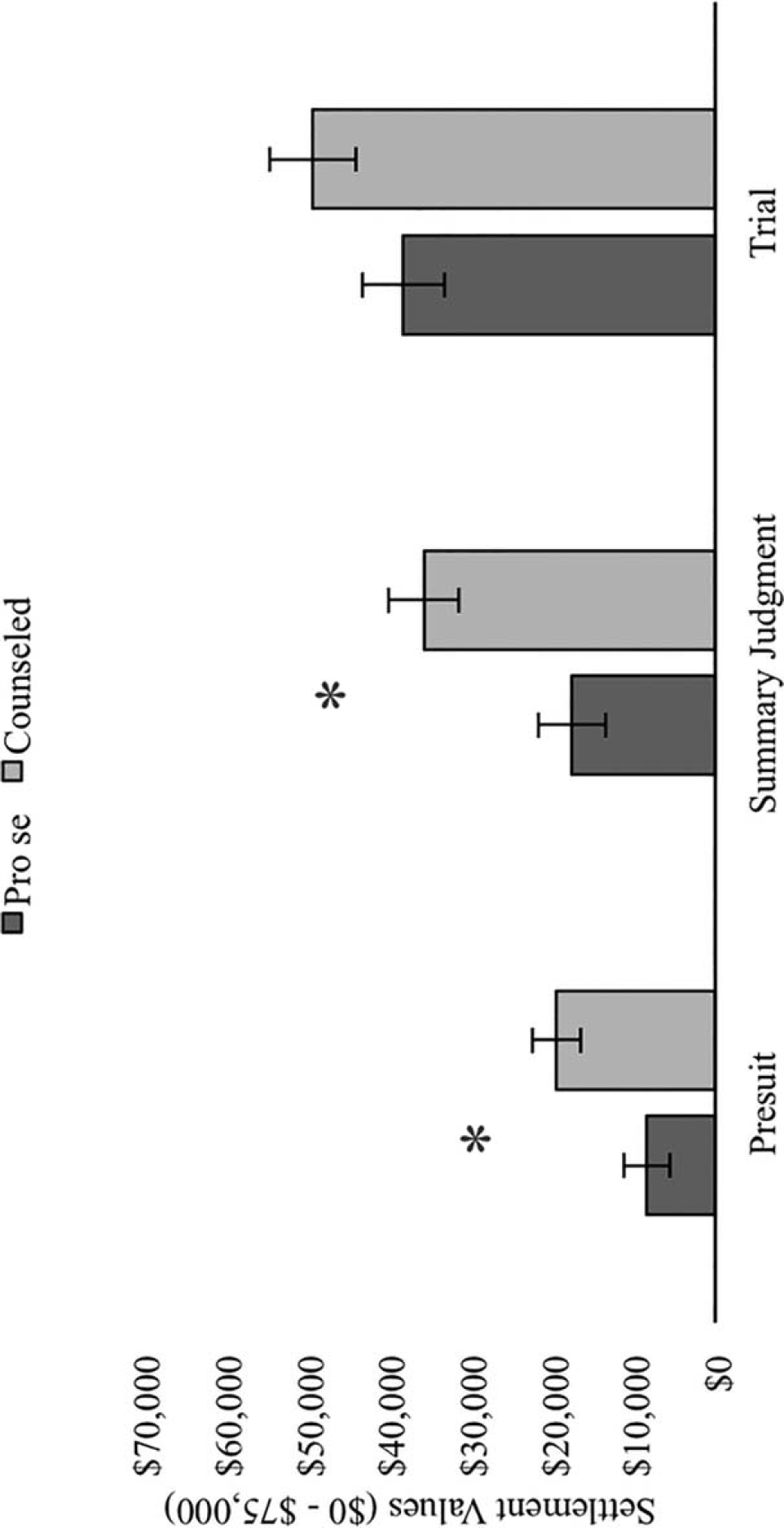
Finally, the ANCOVA did not reveal a significant interaction effect between pro se status and dispute stage, F(1.74, 62.53) = .92, p = .391, ηp 2 = .03 (see Figure 3).Footnote 5 More robustly than with law students, differences in settlement values emerged in the direction theorized by the signaling effect of pro se status. Mainly, lawyers awarded significantly far less to the pro se claimant than the counseled claimant presuit, t(36) = −2.70, p = .011, ηp 2 = .17. Presuit, the estimated difference against the pro se claimant was –$11,070, 95% CI [–$19,399, –$2,742]. Lawyers also awarded significantly far less to the pro se claimant at summary judgment, t(36) = −3.04, p = .004, ηp 2 = .21. At summary judgment, the estimated difference against the pro se claimant was –$18,173, 95% CI [–$30,286, –$6,060]. Finally, lawyers' awards trended less to the pro se claimant than the counseled claimant at trial, t(36) = −1.52, p = .137, ηp 2 = .06. At trial, the estimated difference against the pro se claimant was –$11,107, 95% CI [–$25,930, $3,716].
Estimated Mean Settlement Values Awarded by Lawyers to the Pro Se/Counseled Claimant at Each Dispute Stage
Note: Standard errors are represented by the error bars attached to each column. *p < .05, +p < .10.
Discussion
In sum, these three studies reveal the emergence of a signaling effect of pro se status among law students and a substantial signaling effect among practicing lawyers when awarding settlement values. Among the law-trained samples, the presence of a claimant's pro se status caused a substantial decrease in the settlement value at each successive stage of the dispute pyramid: presuit demand, summary judgment, and trial. In marked contrast, the public awarded claimants higher settlement awards when they proceeded pro se than when they were counseled—championing and rewarding the perhaps scrappy, uncounseled claimant who decided to go it alone. These results suggest that the effect of pro se status may be a product of socialization in the legal profession—as only the law-trained samples exhibited the effect and the effect became stronger as law-trained individuals gained more experience practicing law. To examine this theory of legal socialization directly, we next investigated whether population interacted with either pro se status or dispute stage to influence settlement dollars.
Examining the Legal Socialization Hypothesis
Analytic Strategy
We next examined the effect of legal socialization on settlements awarded by conducting a three-way mixed-design ANCOVA and directly examining the role of population. In this mixed design, we again harnessed dispute stage as a repeated-measure factor, but this time we included two between-subject factors: pro se status and population. Thus, this analysis consisted of a 2 (pro se: yes, no) × 3 (dispute stage: presuit demand, summary judgment, trial) × 3 (population: public, law student, lawyer) mixed-design ANCOVA, with participant gender again entered as a control (i.e., a covariate).
The purpose of this analysis was to examine whether socialization within the legal profession influenced settlement values. Accordingly, we report whether the effects of pro se status or dispute stage were qualified by an interaction with population.Footnote 6 We now turn to the first relevant 2 (pro se status) × 3 (population) interaction.
Legal Socialization and the Signaling Effect of Pro Se Status
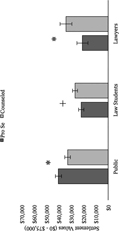
The ANCOVA revealed the predicted two-way interaction between pro se status and population on settlement value, F(2, 379) = 5.82, p = .003, ηp 2 = .03 (see Figure 4), indicating moderation of the signaling effect of pro se status by population.
Estimated Mean Settlement Values Awarded by Each Group to the Pro Se/Counseled Claimant Across Dispute Stages
Note: Standard errors are represented by the error bars attached to each column. *p < .05, +p < .10.
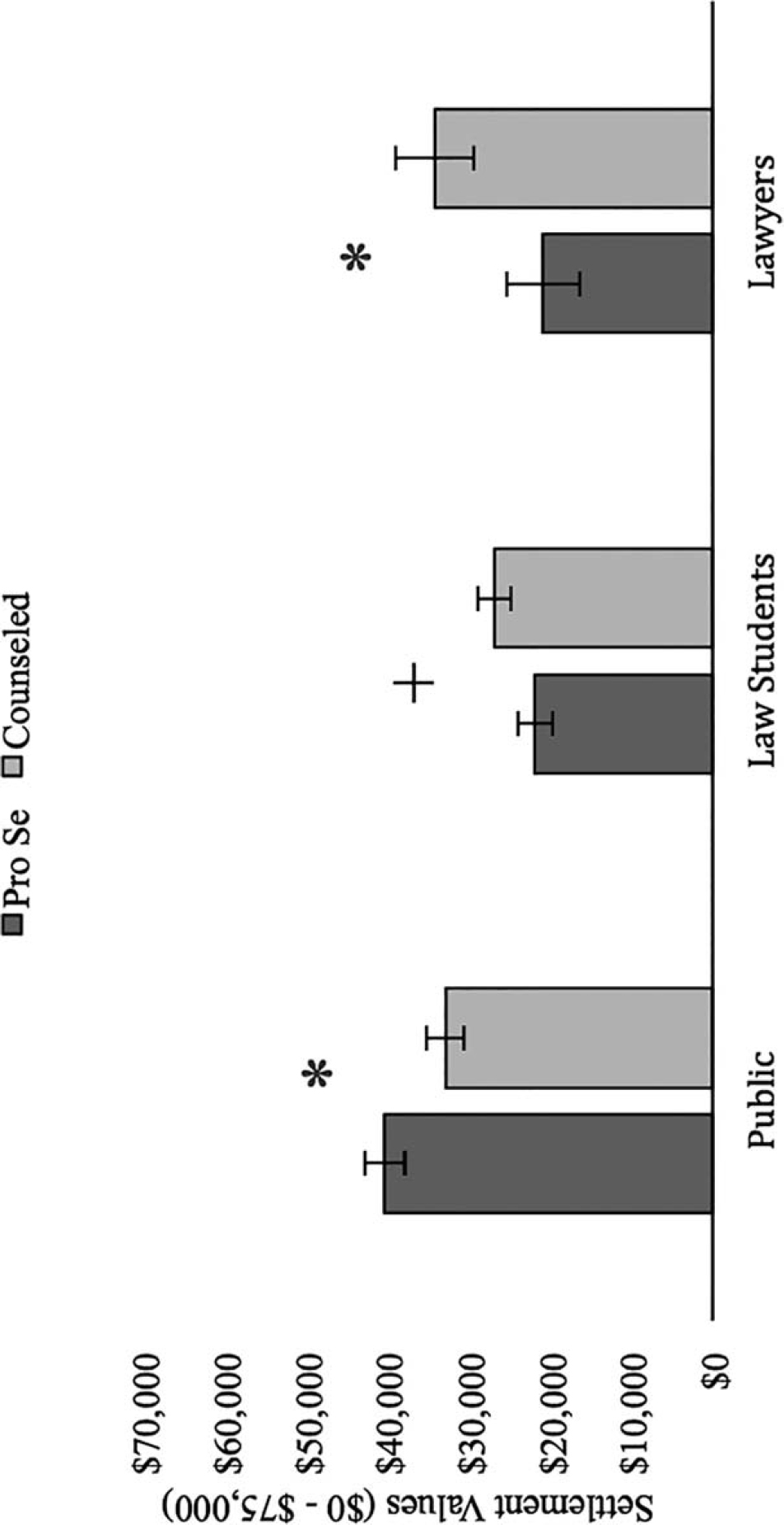
Consistent with the independent tests reported above, simple effects tests revealed that the public awarded pro se claimants significantly more settlement dollars than counseled claimants, F(1, 379) = 4.93, p = .027, ηp 2 = .01, 95% CI [$848, $13,926], law students trended less for pro se claimants than counseled claimants, F(1, 379) = 2.79, p = .096, ηp 2 = .01, 95% CI [–$10,930, $890], and lawyers awarded pro se claimants significantly less than counseled claimants, F(1, 379) = 4.09, p = .044, ηp 2 = .01, 95% CI [–$26,353, –$376].
Examining the interaction the other way allowed for a direct exploration of whether each population was similarly influenced by the pro se status of the claimant. The legal socialization hypothesis posits that law-trained participants will differ in their treatment of pro se (vs. counseled) claimants more so than members of the lay public, due to their socialization in the legal profession. Follow-up tests revealed that the effect of pro se status was significantly different for the public compared both with law students, F(1, 379) = 7.53, p = .006, 95% CI [$3,517, $21,298], and lawyers, F(1, 379) = 7.93, p = .005, 95% CI [$6,261, $35,242]. However, the effect of pro se status was not significantly different when comparing the two law-trained samples (i.e., law students and practicing lawyers), F(1, 379) = 1.32, p = .252, 95% CI [–$5,958, $22,646]. To summarize, while the public appears to evaluate uncounseled claimants more favorably than counseled claimants, law school students began perceiving pro se claims as having less value than counseled claims, and among practicing lawyers the signaling effect of pro se status was robust. This direct analysis of the effect of population suggests that law-trained individuals treat pro se claimants differently than does the public.
Legal Socialization and the Dispute Pyramid
Next, we examine the second relevant two-way interaction between dispute stage and population to explore the role of legal socialization in settlement awards. This analysis examines whether socialization in the legal profession predicts different amounts of settlement as a claim proceeds through the dispute pyramid. Is the public as sensitive to dispute stage as the legally trained are, such that settlement awards vary (and enlarge) as the claimant ascends the dispute pyramid?
To examine this question, we examined the 3 (dispute stage) × 3 (population) two-way interaction on settlement awards. The predicted two-way interaction between dispute stage and population was significant, F(3.322, 629.48) = 17.36, p = .000, ηp 2 = .08, indicating moderation of the effect of dispute stage by population.Footnote 7
A simple effects test examined the effect of dispute stage (presuit, summary judgment, trial) for each population separately. While the public awarded the claimant significantly different amounts within the dispute pyramid, Pillai's trace (ΛPillai = .017) F(2, 378) = 3.308, p = .038, ηp 2 = .02, only the settlement values at summary judgment and trial differed (i.e., the settlement values awarded presuit and trial did not differ, p = .499, nor did the values awarded presuit and at summary judgment, p = 131). In contrast, law students awarded the claimant significantly and consistently more settlement dollars as she scaled the dispute pyramid from presuit to summary judgment to trial, Pillai's trace (ΛPillai = .12) F(2, 378) = 24.98, p < .000, ηp 2 = .12, as did lawyers, Pillai's trace (ΛPillai = .15) F(2, 378) = 33.82, p < .000, ηp 2 = .15 (see Table 1).
Consistent with the legal socialization hypothesis regarding the dispute pyramid, we find that dispute stage did not influence the public's valuation of the claim; however, ascent of the dispute pyramid markedly affected law students' and lawyers' valuations of the claim. Law-trained individuals appear to place greater monetary value on claims that ascend the dispute pyramid. We think it plausible to conclude that these law-trained participants believed, all else equal, that as claims proceed up the dispute pyramid, they carry a greater likelihood of recovery.
Discussion
In accord with the legal socialization hypothesis, these findings highlight first that the signaling effect of pro se status appears to be a phenomenon socialized by taking part in the legal profession. While members of the public did not assign less value to the plaintiff's claim because of her unrepresented status, law-trained individuals awarded the pro se claimant less than counseled claimants even though the facts and merit of the cases remained constant. For law-trained individuals, the mere presence of a claimant's pro se status caused a downward valuation of the pro se claim. As a result, among law-trained individuals, pro se status appears to operate as a signal that meaningfully affects the material relief that a claimant will likely obtain.
Second, and analogously, socialization within the legal profession influences whether individuals assign greater settlement value to claims that scale the dispute pyramid. Unlike members of the lay public, law-trained individuals awarded greater settlement value to claims as they ascended the dispute pyramid, suggesting that law-trained individuals impart a greater expected recovery to cases that proceed to later stages of the litigation lifecycle.
Having revealed that law-trained individuals exhibit biased treatment (i.e., settlement value) based on claimants' pro se status, we next sought to examine whether pro se status also influences law-trained individuals' perceptions of pro se claimants and their claims.
Stereotypes About Pro se Claimants Among the Law-Trained
Does pro se status itself influence the way that law-trained individuals perceive a claimant and their claim? Below, we examined these questions.
Perceived Merit of the Claim
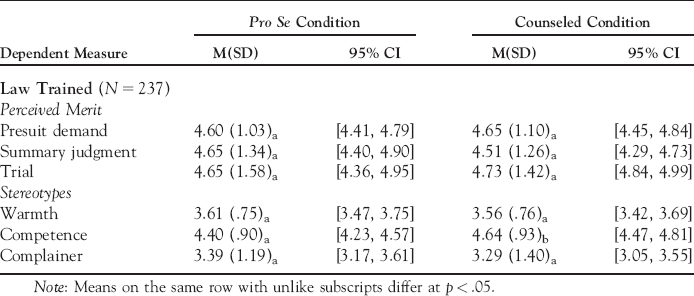
At each dispute stage, law students and lawyers were asked to evaluate the perceived merit of the plaintiff's claim. The grand means for each stage were: presuit demand (M = 4.62, SD = 1.06), summary judgment (M = 4.57, SD = 1.30), and trial (M = 4.70, SD = 1.40). As these merit scores rise above the midpoint of the seven-point scale, this sex discrimination case was perceived as moderately meritorious.
To evaluate the effect of pro se status on perceived merit, we conducted a 2 (pro se: yes, no) × 3 (dispute stage: presuit demand, summary judgment, trial) two-way ANCOVA, controlling for participant gender. All means and standard deviations are reported in Table 2.
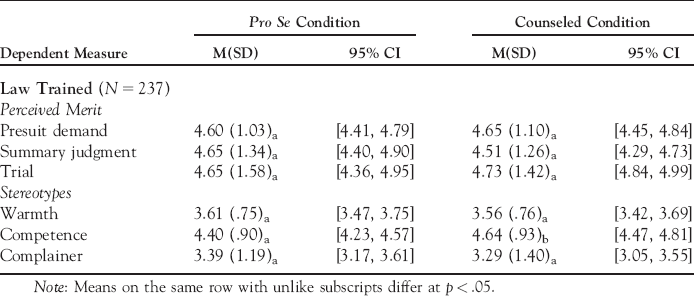
Means, Standard Deviations, and 95% CI of Perceived Merit and Stereotypes
| Pro Se Condition | Counseled Condition | |||
|---|---|---|---|---|
| Dependent Measure | M(SD) | 95% CI | M(SD) | 95% CI |
| Law Trained (N = 237) | ||||
| Perceived Merit | ||||
| Presuit demand | 4.60 (1.03)a | [4.41, 4.79] | 4.65 (1.10)a | [4.45, 4.84] |
| Summary judgment | 4.65 (1.34)a | [4.40, 4.90] | 4.51 (1.26)a | [4.29, 4.73] |
| Trial | 4.65 (1.58)a | [4.36, 4.95] | 4.73 (1.42)a | [4.84, 4.99] |
| Stereotypes | ||||
| Warmth | 3.61 (.75)a | [3.47, 3.75] | 3.56 (.76)a | [3.42, 3.69] |
| Competence | 4.40 (.90)a | [4.23, 4.57] | 4.64 (.93)b | [4.47, 4.81] |
| Complainer | 3.39 (1.19)a | [3.17, 3.61] | 3.29 (1.40)a | [3.05, 3.55] |
Note: Means on the same row with unlike subscripts differ at p < .05.
The ANCOVA revealed a nonsignificant main effect of pro se status, F(1, 234) = .12, p = .728, ηp 2 = .00; a significant main effect of dispute stage, F(1.76, 410.61) = 3.49, p = .037, ηp 2 = .02. The two-way interaction was not statistically significant, Pillai's trace (ΛPillai = .02) F(1.99, 233) = 1.99, p = .139, ηp 2 = .02, indicated that perceived merit was not moderated by pro se status or dispute stage.
Contrary to our hypothesis, the claimant's pro se status did not appear to influence the perceived merit of her claim (which was perceived as consistently and moderately strong across the dispute stages).Footnote 8
Stereotypes of the Claimant
Analytic Strategy
We next investigated the stereotypes that law-trained participants hold of pro se claimants along the three person-perception dimensions: warmth, competence, and complainer. Law students and lawyers rated their perceptions of the claimant at the presuit demand stage—the earliest stage possible. For each dependent measure, we conducted a one-way, between-subjects ANCOVA examining the influence of the claimant's pro se status. Again, given the theorized gender differences regarding the different ways that men and women perceive sex discrimination cases, we included participant gender as a control. All means and standard deviations are reported in Table 2.
Warmth and Competence
Law-trained individuals rated the plaintiff slightly below the midpoint on warmth (M = 3.58, SD = .75), and slightly above the midpoint on competence (M = 4.52, SD = .92). This pattern signifies that, on average, participants perceived the sex discrimination claimant as being somewhat competent but also somewhat unlikeable.
On warmth, the ANCOVA did not reveal a significant effect of pro se status, F(1, 232) = .23, p = .636, ηp 2 = .00. Thus, pro se status did not influence the degree to which law-trained individuals perceived the claimant as warm—the unrepresented (M = 3.61, SD = .75) and counseled (M = 3.56, SD = .76) claimants were perceived as equally unlikeable.
On competence, however, the ANCOVA revealed a significant effect of pro se status, F(1, 234) = 4.76, p = .030, ηp 2 = .02, such that the unrepresented claimant was perceived as significantly less competent (M = 4.40, SD = .90) than the counseled claimant (M = 4.64, SD = .93). Interestingly, a trend emerged in which law-trained men perceived the claimant to be less competent than did law-trained women, F(1, 234) = 2.78, p = .097, ηp 2 = .01.
In sum, the claimant's pro se status significantly influenced stereotypes about the claimant's competence, but not her warmth.
Complainer
Overall, law-trained participants perceived the claimant as somewhat of a complainer (M = 3.34, SD = 1.30). An ANCOVA did not reveal a significant effect of pro se status, F(1, 234) = .75, p = .389, ηp 2 = .00. Interestingly, law-trained men perceived the claimant to be more of a complainer than did law-trained women, F(1, 234) = 6.33, p = .013, ηp 2 = .03; however, the claimant's pro se status did not affect these perceptions.
Discussion
In sum, these analyses show that pro se status influenced only perceptions of the claimant's competence (i.e., her abilities, work ethic, and hirability) among the law-trained sample. Law students and lawyers perceived the uncounseled claimant as less competent than the counseled claimant—even though the case facts were identical. Interestingly, pro se status did not influence the perceived merit of the claim (which was held constant along with the case facts) or perceptions of the claimant's warmth or whether she was a complainer. Law students and lawyers perceived the case as moderately meritorious and the counseled and uncounseled claimants as somewhat unlikeable and as somewhat complaining.
Competence Stereotypes Mediate the Effect of Pro se Status on Settlement Awards Among Law-Trained Participants
Analytic Strategy
Last, we explored the extent to which the effect of pro se status on settlement awards might be explained (i.e., mediated) by perceptions of the claimant's competence. Our prior analyses revealed that among law-trained participants, the signaling effect of pro se status primarily affected stereotypes about the claimant's competence. Thus, the mediation analysis explored whether these competence perceptions statistically mediated the effect of pro se status on settlement awards. That is, does pro se status increase the perception of the claimant as incompetent, which, in turn, reduces the settlement value that legally trained individuals award her?
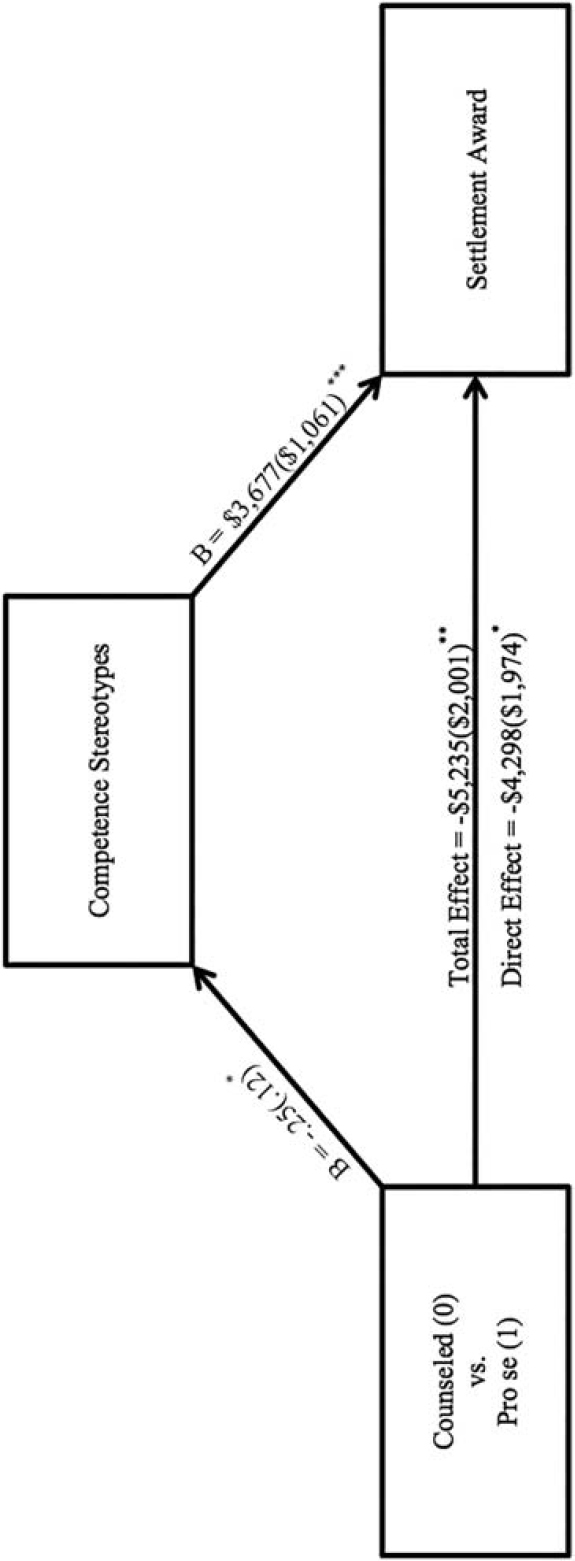
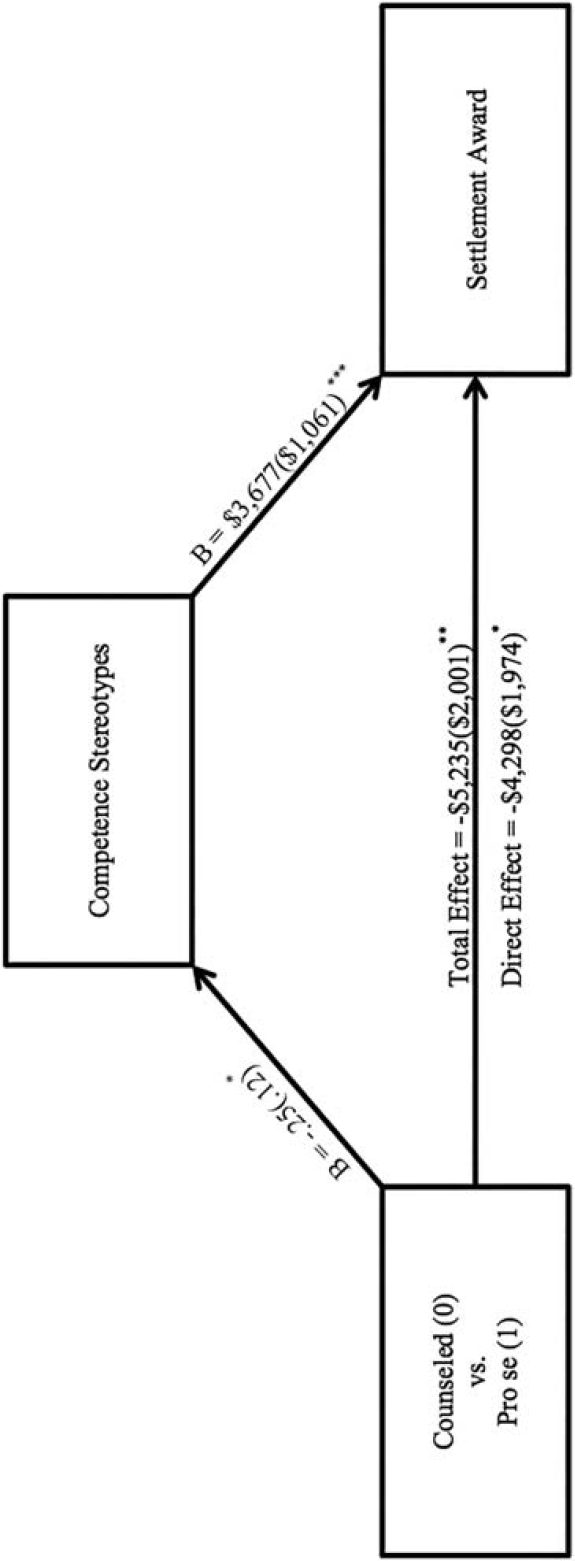
Using the PROCESS macro for SPSS (10,000 bootstrapped resamples; Model 4; Hayes 2013), we regressed each participant's settlement awarded at the presuit demand stage on the between-subjects factor of pro se status (dummy coded: 0 = counseled claimant and 1 = pro se claimant) and entered competence perceptions as the mediator in the analysis. We also included participant gender as a control variable to account for the gender differences previously observed.
Results
Consistent with the results reported above, the total effect of pro se status on settlement awards was statistically significant, –$5,235 ($2,001), p = .010, 95% CI [–$9,179, –$1,292]. The mediation analysis examined whether this total effect of pro se status could be explained by the indirect effect of pro se status through competence stereotypes.
As illustrated in Figure 5, the effect of pro se status dampened impressions of the claimant's competence (b = –.25, p = .037). These diminished impressions of the claimant's competence, in turn, predicted lower settlement awards (b = –$3,677, p = .001). After accounting for the effect of pro se status on competence stereotypes, the total effect of pro se status on settlement awards fell from –$5,235 ($2,001), p = .010 to –$4,298 ($1,974), p = .030, 95% CI [–$8,187, –$409]. Moreover, the indirect effect of pro se status on settlement awards through stereotypes of the claimant's competence was –$937 ($529), 95% CI [–$2,279, –$140]. Because the confidence interval of the indirect effect does not include zero, we see evidence that competence stereotypes mediated the effect of pro se status on settlement awards.
Mediation Model Representing the Meditational Path of the Signaling Effect of Pro Se Status on Settlement Awards Through Competence Stereotypes About the Claimant * p < .05, ** p < .01, *** p < .001
Discussion
In sum, we observe that pro se claimants are perceived as less competent than counseled claimants and that these stereotypes explain why the law-trained award uncounseled claimants lower settlement awards. While these diminished perceptions of uncounseled claimants are consistent with previous literature and anecdotes on the negative impressions that law-trained individuals hold of uncounseled litigants (Landsman Reference Landsman2012), it is quite possible that additional psychological mechanisms may explain why a claimant's pro se status influences his or her outcome. For example, the effect of pro se status may also influence lawyers' perceptions about how courts would likely greet the claims of pro se claimants or their expectation about whether courts would likely dismiss an unrepresented litigant's case. Future research is needed to explore these additional explanations.
General Discussion
Taken together, these findings illuminate a social psychological explanation for the divergence in material outcomes between pro se and counseled claimants in the federal civil rights context. Not only do lawyers convey legal expertise to clients, and select cases of higher quality and merit, but in the civil rights context, the mere absence of counsel sends a signal that influences the psychology of how law-trained people value pro se claimants and their claims. Legal officials and lawyers hold biases that operate against unrepresented parties who bring civil rights claims. In short, a civil right claimant's pro se status sends a signal about the claimant and the monetary value of their claim.
These experiments held constant the civil right claimant's case, thereby controlling for the merit and quality of her claim and controlling for case selection effects. While the effect of pro se status did not statistically affect the perceived merit of the claim (which was perceived as moderately strong and held constant by design), the claimant's pro se status robustly influenced the perceived monetary value of her claim. Unlike the public, law-trained individuals steeply discounted the value of the unrepresented litigant's claim at virtually every dispute stage: presuit, summary judgment, and trial. As a result, the pro se claimant obtained smaller settlement awards and diminished material outcomes. As suggested by the signaling effect hypothesis, pro se status affects the value ascribed to claimants and their claims. These results also suggest that the signaling effect may turn on socialization within the legal profession.
Moreover, the mere presence or absence of a claimant's pro se status affected the perceptions and appraisals of the claimant by law-trained individuals. These perceptions operated to the pro se claimant's disadvantage. The pattern of results is troubling in light of research on the BIAS map (Cuddy, Fiske, and Glick Reference Cuddy, Fiske and Glick2007). On balance, the claimant was moderately disliked, and perceived as moderately competent. Significantly, for law-trained individuals, pro se status diminished perceptions of the claimant's competence (i.e., competence, ability, work ethic, and hirability). As such, social psychological research suggests that pro se status may alter where claimants reside on the BIAS map. The presence of pro se status (i.e., the absence of counsel) may shift claimants from moderate-competence, low-warmth on the BIAS map to low-competence, low-warmth (see Figure 6). Research on the BIAS map suggests that, like welfare recipients and the poor, pro se claimants may be treated with contempt, disgust, or neglect (Cuddy, Fiske, and Glick Reference Cuddy, Fiske and Glick2007).
Scatter Plot and Cluster Analysis of Groups on Competence and Warmth Ratings
Note: HC-HW = high-competence, high-warmth; HC-LW = high-competence, low-warmth; LC-HW = low-competence, high-warmth; LC-LW = low-competence, low-warmth.
Source: Cuddy, Fiske, and Glick (Reference Cuddy, Fiske and Glick2007).
As previously described, after selecting an appropriate settlement value, participants explained why they selected the amount chosen. Many attorneys left explanations consistent with this theory. For example, one lawyer explained, “the procedural hurdles, hostile case law, overworked judges, and unsavvy pro se plaintiffs, along with the paucity of evidence in this case, make the entire scenario extremely unlikely to work out for Ms. Smith.” Another lawyer explained the $11,000 settlement award to the pro se claimant as follows: “Not represented by counsel. It's meaningful but not so large that it will cause her to reevaluate her claim and hire counsel.” And another lawyer who awarded the pro se claimant $35,000 at trial explained:
A settlement offer here needs to reflect the weight of the evidence and the relative weakness of Atlantic's case. However, the fact that Ms. Smith is a pro se plaintiff must be considered. The offer cannot be so substantial as to communicate to her that Atlantic believes she has [won]. They want to keep alive in her mind the fear that she might lose and walk away with nothing—a fear that likely would be very small if she were represented.
Finally, throughout the study and across populations, the data revealed another problematic but consistent effect that we controlled for in order to examine the independent effect of pro se status. Consistent with previous literature (Major, Quinton, and Schmader Reference Major, Quinton and Schmader2003; Boyd, Epstein, and Martin Reference Boyd, Epstein and Martin2010; Kaiser and Wilkins Reference Kaiser and Wilkins2010), we find that women who assert sex discrimination claims face significant gender differences in the ways they are perceived and the valuation of their sex discrimination claims. Men ascribed less value to the sex discrimination claimant than did women, and law-trained men were more likely to derogate the claimant as a complainer, less competent, and to perceive her claim as less meritorious than did law-trained women.
Conclusion
We concur with other scholars who have concluded that the time is ripe to reenvision and reinvigorate access to justice research. In particular, we believe that this is an extraordinary moment to connect empirical access to justice research with psychological science. Psychological science has become a hub science offering powerful theories and methods to explore the vexing access to justice problems that remain unresolved (Cacioppo Reference Cacioppo2007). Prior research has left largely unexplored the psychological processes affecting access to justice, including how legal officials perceive, appraise, and evaluate pro se claimants and the psychological consequences of denying the public access to justice.
While this contribution has revealed the signaling effect of pro se status in a particular kind of case (i.e., an employment discrimination claim) against a female plaintiff, future research is warranted to examine the intersectional nature and potential double disadvantage of particular civil rights claimants and claims. For example, some classes of claims may be discounted more than others, such as civil rights claims, and perhaps employment discrimination claims in particular (Quintanilla Reference Quintanilla2011; Reinert Reference Reinert2015). Open questions remain about whether the signaling effect operates in other civil justice contexts, including family law, small claims, and the landlord-tenant context, for example. Moreover, in the civil rights context, existing research reveals racial disparities, with African Americans, Hispanic Americans, and Asian Americans less likely than whites to obtain representation (Myrick, Nelson, and Nielsen Reference Myrick, Nelson and Nielsen2012). As such, future research is warranted to examine the possibility of multiple disadvantages that exacerbate the signaling effect depending on the race, national origin, ethnicity, gender, class, immigration status, and sexual orientation of the claimant (Sandefur Reference Sandefur2008; Best et al. Reference Best, Edelman, Hamilton Krieger and Eliason2011; cf. Deibels and Czopp 2011). Finally, stark power differentials may aggravate the signaling effect of pro se status, such as when a one-shot claimant is pro se and a repeat-player opposing party is represented by counsel (Shanahan, Carpenter, and Mark forthcoming). These urgent questions remain for future inquiry.
Some civil justice reformers, however, may think the signaling effect of pro se status unproblematic. They may believe, for example, that there is a kernel of truth to the worrisome negative stereotypes held of uncounseled parties (Prothro and Melikian Reference Prothro and Melikian1955). For another day, we leave inquiry into whether law-trained individuals engage in the fundamental attribution error (Ross and Nisbett Reference Ross and Nisbett1991) when neglecting the role of recent structural and societal changes to the legal and economic landscape that make obtaining legal counsel more difficult (Daniels and Martin Reference Daniels and Martin2015).
In closing, we offer evidence and cast light on this gap in the literature, but many research questions remain. In the future, we believe that beyond law students and lawyers, research should be conducted with state and federal judges to examine whether the signaling effect of pro se status emerges among judicial officials and court personnel as well. Further, we call for future research on interventions that may dampen the signaling effect and reduce bias against pro se plaintiffs. By casting light on answers to these questions, a broader and deeper understanding of what access to justice means and the psychological consequences of a pro se claimant's lack of counsel will emerge. Our hope is that this evidence-based understanding may inform the next generation of interventions to better address the biases and stereotypes that pro se parties encounter and experience within the civil justice system.