

1. Introduction
This paper investigates a fundamental question in development economics: How does migration from a less developed country to a more advanced one influence economic growth? It delves into the trade-off between the short-term advantages of enhanced educational opportunities for the offspring of low-skilled migrants and the long-term challenges stemming from a possible rise in low-skilled immigration spurred by improved educational prospects.
This article analyzes the impact of migration on economic growth using a two-country overlapping generations model with endogenous fertility. It demonstrates that unrestricted migration can impede growth and evaluates public policies designed to mitigate this negative effect. The novelty of the paper is to study the effect of educational policy in the host economy on human capital accumulation while considering the incentive for further immigration. The model’s contribution is to show that providing additional free educational services for immigrant children to enhance the efficiency of investment in their education can increase the attractiveness of migration for lower-skilled individuals, which can outweigh the positive effect of this policy on the acquisition of human capital. In contrast, taxing immigrants dissuades lower-skilled migration and can support human capital accumulation if the revenues are earmarked for educational subsidies.
Extensive research has consistently demonstrate that first- and second-generation immigrant children from various less-developed countries, particularly in Europe, often exhibit lower educational outcomes compared to their native peers (e.g., Riphahn, Reference Riphahn2003; Nielsen et al., Reference Nielsen, Rosholm, Smith and Husted2003; Schnepf, Reference Schnepf2007; Algan et al., Reference Algan, Dustmann, Glitz and Manning2010; Dustmann et al., Reference Dustmann, Frattini and Lanzara2012; Ludemann & Schwerdt, Reference Ludemann and Schwerdt2013).Footnote 1 These suboptimal educational attainments not only impede the intergenerational assimilation of immigrants into host societies but also are associated with numerous societal challenges, such as higher rates of unemployment, criminal behavior, and dependence on welfare programs. As a result, both scholars and policymakers have called for targeted support initiatives aimed at enhancing the educational performance of immigrant children (Heckmann, Reference Heckmann2008; Janta & Harte, Reference Janta and Harte2016). This study offers novel insights into the consequences of such policies, which have largely been overlooked in both academic literature and public policy discussions.
The present analysis is performed in a two-country growth model in the tradition of Galor and Tsiddon (Reference Galor and Tsiddon1997) building on Azarnert (Reference Azarnert2023), where the effect of population sorting on economic growth was analyzed in a model, in which public knowledge spillovers from the more advanced core amplify the productivity of investment in children’s human capital in the periphery.Footnote 2
The central premise of this paper is as follows. Suppose that for some exogenous reasons, such as, for instance, limited proficiency in the dominant language or disparities in the socio-economic backgrounds, the efficiency of educating immigrant children is lower than that of local indigenous children. As lower educational efficiency leads to diminished levels of acquired productive human capital and subsequently lowers adult productivity, the host country’s government has an incentive to provide supplementary education for underprivileged immigrant children to enhance their skill acquisition. If these additional public educational services complement parental investments in their children’s education, and if parents derive utility from both the quantity and quality of their children, then, logically, beyond the direct positive impact on immigrant children’s human capital, this policy would also alter the parental quantity-quality trade-off in favor of quality. This entices immigrant parents to increase their own educational investments in their children at the expense of reducing investment in the number of children. The consequence is an unambiguous positive effect on human capital accumulation and growth. On the other hand, if the extra education is provided freely to families, it enhances the attractiveness of further immigration for lower-skilled individuals from less developed countries. This influx reduces the average level of human capital among immigrants, generating an equally clear negative effect on human capital accumulation and growth that can outweigh the initial positive effect. This result is opposite of the outcomes in a framework where the incentive for further in-migration is not considered, and hence the provision of additional educational services for immigrant children necessarily improves human capital accumulation in the host country.
To model migration, I follow the classical approach in the brain drain literature that a less developed economy open to out-migration loses its higher-skilled workers, as has been broadly established for international (Miyagiwa, Reference Miyagiwa1991) and internal (Zhang, Reference Zhang2002) types of migration.Footnote 3 To generate positive self-selection among migrants, the present model refers to the cost of migration.Footnote 4 This allows us to derive a threshold level of human capital that divides the source economy’s population into two groups: the more skilled, for whom migration is optimal, and the less skilled, for whom migration is not worthwhile.
In the model, brain drain migration always reduces the total (and average) human capital stock in the less developed source economy. Regarding the host economy, the impact of migration on its average level of human capital remains ambiguous. It can be positive, if skilled emigrants from the less developed economy possess, on average, more human capital than the local agents in the more advanced economy, or negative, if newcomers are on average less skilled than the indigenous population.Footnote 5 When immigrants are less skilled than the indigenous population, their arrival depresses the average level of human capital in the host economy, lowering the rate of return on investment in human capital for the next generation through a global or atmospheric externality.
In this paper, I concentrate on a growth-depleting immigration, as consistent with the findings in the studies of global migration, such as, for example, Docquier et al. (Reference Docquier, Machado and Sekkat2015) and Delogu et al. (Reference Delogu, Docquier and Machado2018), who argue that, in general, new migrants are slightly more educated than those left behind in their origin countries (i.e., there exists a positive selection in emigration), but less educated than natives in the host countries (i.e., there exists a negative selection in immigration).Footnote 6 I derive the precise conditions under which immigration adversely influences the inter-temporal evolution of human capital in the host economy and explore public policy interventions to mitigate a negative effect.
The idea of an income tax paid by highly skilled emigrants to compensate their home-country society for the negative externality imposed by their out-migration on those remaining in their home country has been actively debated since 1970s, when it was originally proposed by Jagdish Bhagwati. (See, for example, McHale (Reference McHale, Bhagwati and Hanson2009) and Docquier and Rapoport (Reference Docquier and Rapoport2012), where some further references can be found.)
In this work, I expand the discussion toward a tax imposed on immigrants to compensate the host-country society for the negative externality induced by immigration. Drawing a parallel with the brain drain tax proposed by Bhagwati, this form of redistribution might be termed a “brain dilution tax.”
This type of taxation mirrors contemporary practices in certain countries, notably in Europe, where legal status is granted to foreign investors. I present and analyze the impact of this tax on human capital accumulation in both the receiving and sending economies. The analysis demonstrates that, for the receiving economy, the effect of taxation is twofold: First, the tax raises the threshold level of human capital required for migration to be worthwhile, thereby reducing the overall volume of immigration and increasing the average quality of immigrants. Second, redistributing the tax revenues as educational subsidies can mitigate the negative effect of immigration on human capital accumulation when directed specifically to immigrant children, and can even boost human capital accumulation if extended for all children born in the economy, irrespective of their origin. With respect to the sending economy, a tax imposed on immigrants in the host economy curbs the out-migration-induced decline in the average level of human capital, promoting economic growth. Moreover, as the purpose of this tax is to correct an immigration-driven negative externality in the host country, the proposed brain dilution tax appears to be more justified and easier to implement in practice compared to the classical brain drain tax.
Further, in their analysis of the consequences of liberalizing migration, Docquier et al. (Reference Docquier, Machado and Sekkat2015) and Delogu et al. (Reference Delogu, Docquier and Machado2018) demonstrate that the gains are concentrated predominantly in the poorer source regions, where GDP per worker increases substantially, while the wealthier destination regions experience a decline in the share of college graduates in the labor force and GDP per worker. Moreover, in Delogu et al. (Reference Delogu, Docquier and Machado2018) it is shown that, despite the gradual mitigation of the negative impact of immigration through human capital accumulation, the decrease in the proportion of college graduates and the GDP per worker in the host regions can persist in the long run. The redistribution scheme proposed in this paper offers a means to address this adverse effect.
The present paper is also related to Mountford and Rapoport (Reference Mountford and Rapoport2011) who developed a two-country model where prospects of migration affects the rate of return to education in both the sending and receiving economies, thereby affecting human capital accumulation and fertility in both places. They show that the Brain Drain can have a positive effect on human capital accumulation in the sending economy depending on the relative strength of the incentive (or brain gain) or dilution (or brain drain) effects. If the dilution effect of a brain drain dominates the incentive effects to accumulate human capital, the current trends toward predominantly skilled emigration from poor to rich countries may increase inequality in the distribution of income in the long run as relatively poor countries, which growth prospects are negatively affected, grow larger in terms of population.Footnote 7 By reducing the human capital losses from the brain drain for the losing countries and thereby slowing down their population growth, the brain dilution tax proposed in this study could help counteract a potential rise in global inequality.
Naturally, primary policy tools for managing immigration, such as border controls and domestic enforcement, take precedence over those explored in this paper. However, taxation of immigrants can serve as a complementary measure operating alongside border enforcement. Moreover, a significant portion of immigration occurs through channels such as refugee and asylum claims (Fernández-Huertas Moraga and Rapoport, Reference Fernández-Huertas Moraga and Rapoport2014, Reference Fernández-Huertas Moraga and Rapoport2015; Azarnert, Reference Azarnert2018), family reunification (Groenendijk, Reference Groenendijk2006; Honohan, Reference Honohan2009), or family formation (Strasser et al., Reference Strasser, Kraler, Bonjour and Bilger2009). The mechanism proposed in this paper would be especially effective in deterring lower-skilled immigrants entering through these routes.
2. The basic structure of the model
Consider an overlapping-generations economy that operates over an infinite discrete time horizon. In every period, the economy produces a single homogenous good using a constant-returns-to-scale technology with human capital as the only input. In each generation, agents live for two periods: childhood and adulthood. During childhood, individuals acquire human capital. During adulthood, they work, become parents and bring up their offspring. As parents, adult individuals allocate a positive fraction of their time to feeding and raising their children and invest in the education of their children.
Suppose the world that consists of two entities: a more advanced, more developed economy denoted by
 $MD$
, and a less advanced, less developed economy denoted by
 $LD$
. For some exogenous reason, in the more advance country wages and the average level of human capital are higher than those in the less advanced country.
To specify the pattern of migration, suppose that in the beginning of the second period of life, young adult individuals from the poorer less developed economy can migrate to the richer more developed economy. If young adults migrate, they work, become parents, bring up and educate their children in their new destination country.
2.1. Wages, the cost of migration, and the types of individuals
First, suppose that in economy
 $i$
 $(i = MD,{\rm{ }}LD)$
, the wage per efficiency unit of labor,
 ${w^i},$
is fixed over time as follows from, for example, the assumption of a constant returns to scale technology with a single factor of production. Secondly, to introduce migration, we suppose that a young adult born in the less developed economy, who decides to migrate in period
 $t$
to the more developed economy, incurs a cost of migration equal to
 ${M_t}$
. We also assume that migration involves no losses of human capital, so that any unit of human capital acquired in the home country prior to migration is as productive as the skills acquired in the destination country.
Since by construction in this model, only one way of migration can be worthwhile, in the world economy under consideration there are potentially three types of individuals: (1)
 $MD$
, individuals born in the more developed economy, (2)
 $LD$
, individuals born in the less developed economy, who remain in their country of birth, and (3)
 $M$
, individuals born in the less developed economy, who migrate to the more developed economy. The conditions that lead to the decision to migrate are analyzed below in Section 2.5.
2.2. The formation of human capital
In any period
 $t$
, an adult of type
 $j$
 $(j = MD,{\rm{ }}LD,{\rm{ }}M)$
born in economy
 $i$
 $(i = MD,{\rm{ }}LD)$
, is characterized by a skill level
 ${h_t}$
that is distributed according to the cumulative density function
 ${F_t}( \cdot )$
over the strictly positive support
 $[h_t^{i,\min },{\rm{ }}h_t^{i,\max }].$
It is assumed throughout that in period
 $t$
, the average level of human capital in the more advanced economy is higher than that in the less advanced economy;
 $\bar h_t^{MD} \gt \bar h_t^{LD}$
.
In each period of life, individuals are endowed with one unit of time. In the first period, children devote their entire time to the acquisition of human capital. The acquired human capital increases if their time investment is supplemented with real resources invested in their education.
The human capital level of a child, who becomes an adult in period
 $t+1,$
depends on the parental real expenditure on that child’s education,
 ${e_t}$
, and on the average level of human capital of all adult individuals in economy in period
 $t$
, which is defined as
 $\bar h_t^i = \int {{h_t}dF_t^i({h^i})}, $
according to the human capital production function, or learning technology described by
 $$h_{t+1}^i = \Theta ({e_t},\bar h_t^i), \quad {\rm{ if \;}}i = MD,{\rm{ }}LD.$$
This learning technology captures an external spillover effect that arises from the average society’s level of human capital,
 ${\bar h_t}.$
Such formulation is consistent with the so-called global or atmospheric externality, which implies that an increase in the average level of human capital in the society as a whole increases the rate of return on investment in human capital for the children’s generation. First introduced by Tamura (Reference Tamura1991), the assumption that the average level of human capital in society is an input in the production of human capital for each individual became common in the literature. This externality has been utilized, for instance, by Tamura (Reference Tamura1996), Galor and Tsiddon (Reference Galor and Tsiddon1997), de la Croix and Doepke (Reference de la Croix and Doepke2003; Reference de la Croix and Doepke2004), Azarnert (Reference Azarnert2008; Reference Azarnert2009; Reference Azarnert2010a), and Aksan and Chakraborty (Reference Aksan and Chakraborty2014), among many others.
A particular form of human capital production function is specified below in equation (6).
2.3. The optimization of parents
Agents of any type derive utility from their own consumption in adulthood and from the total future income of their children in the economy where those children were born.Footnote
8
The utility function of an individual of any type
 $j$
(
 $j = MD,{\rm{ }}LD,{\rm{ }}M$
) born at time
 $t - 1$
is therefore
 $$U_t^j = (1 - \beta )\log C_t^j + \beta \log (I_{t+1}^{N,j}),$$
where
 $C_t^j$
is an individual’s own consumption,
 $I_{t+1}^{N,j}$
is the future income of that individual’s offspring, as defined in equation (4), and
 $\beta \in (0,{\rm{ }}1)$
captures the relative weight given to children.Footnote
9
In every period t, adult individuals are endowed with one unit of time which is allocated between childbearing and labor force participation. In either economy, the cost of feeding and raising children is measured in terms of work time foregone at
 $\delta $
per child. The cost of acquiring human capital in any economy
 $i$
is measured in units of the wage per efficiency unit of labor in that economy,
 ${w^i}$
. Migrants from the
 $LD$
to the
 $MD$
economy also pay the cost of migration,
 ${M_t}.$
Individuals are assumed to behave as atomistic agents, so that the migrants disregard the impact of their migration decision on the average levels of human capital,
 $\bar h_t^i$
, and consequently on the productivity of investment in children’s human capital in both their origin and destination economies. Similarly, all agents neglect the effect of their decision with respect to the number and quality of their offspring on the average level of human capital in the next generation.
To maximize utility, an adult of any type
 $j$
simultaneously chooses a current consumption,
 $C_t^j$
, the number of children,
 $N_t^j$
, and invests
 $e_t^j$
units of
 ${w^i}$
in each child’s education subject to the following budget constraint:
 $$C_t^j + {\rm{ }}{w^i}(\delta {h_t} + e_t^j)N_t^j \le {w^i}{h_t},\quad\;\;{\rm{if}}\,j = i = MD,{\rm{ }}LD,$$
 $$C_t^j + {w^i}(\delta {h_t} + e_t^j)N_t^j \le {w^i}{h_t} - {M_t}, \;\;{\rm{if}}\,j = M{\rm{\; and \;}}i = MD.$$
The right-hand side of equation (3) represents an adult’s income (after subtracting migration costs for the
 $M$
–type agents), which is allocated between consumption and the total cost of rearing children.
The total potential future income of that individual’s offspring is represented by the expression:
 $$I_{t + 1}^{N,j} = N_t^j{h_{t + 1}}{w^i},\quad{\rm{if}}\,\left\{ \matrix{ j = MD,{\rm{ }}M,{\rm{ }}i = MD, \hfill \cr j = i = LD. \hfill \cr} \right.$$
The next subsection discusses the solution for the parents’ optimization problem for a particular form of the human capital production function.
2.4. Choice of fertility and investment in education
From optimization, an adult’s consumption is:
 $$C_t^j = (1 - \beta )\left\{ \matrix{ {w^i}{h_t},\quad\quad\quad\;{\rm{ if \;}}\left\{ \matrix{ j = i = MD, \hfill \cr j = i = LD, \hfill \cr} \right. \hfill \cr {w^i}{h_t} - {M_t},\quad{\rm{ if \;}}j = M{\rm{\; and \;}}i = MD. \hfill \cr} \right.$$
That is, a fraction
 $1 - \beta $
of an adult’s net full income is allocated to consumption and hence a fraction
 $\beta $
is dedicated to childrearing.
To characterize optimal choices concerning fertility and investment in education, we postulate the following technology of human capital production:Footnote 10
 $$h_{t + 1}^j = A\left\{ {\matrix{ {{{(\mu + e_t^j)}^\gamma }{{(\bar h_t^i)}^{1 - \gamma }}, \quad\quad{\rm{ if \;}}j = i = MD,{\rm{ }}LD{\rm{,}}} \cr \!\!\!{{{(\mu + \alpha e_t^j)}^\gamma }{{(\bar h_t^i)}^{1 - \gamma }}, \quad \;\;{\rm{ if \;}}j = M,{\rm{ }}i = MD{\rm{ }}} \cr } } \right.$$
where
 $A\gt1$
,
 $\mu \gt0$
,
 $0 \lt \alpha \le 1,$
and
 $0 \lt \gamma \lt1$
. (6)
This learning technology implies that, while the efficiency of the educational investment in the offspring of the locally-born parents in either economy equals to unity, the efficiency of the investment in the education of the offspring of the migrants from the
 $LD$
economy born in the
 $MD$
economy equals to
 $0 \lt \alpha \le 1.$
In all other respects, children of the migrants from the
 $LD$
economy born in the
 $MD$
economy become similar to the offspring of the indigenous population in the
 $MD$
economy.
Based on equation (6), the optimal choice of investment in children’s education for an individual of any type in either economy is determined by the following expression:
 $$e_t^j = \left\{ {\matrix{ {{{\gamma \delta {h_t} - \mu } \over {1 - \gamma }}, \quad \quad \;{\rm{ if \;}}j = MD,{\rm{ }}LD,} \cr \!\!\!\!\!\!\!\!\!\!\!\!\!{{{\gamma \delta {h_t} - ({\mu \mathord{\left/ {\vphantom {\mu \alpha }} \right.} \alpha })} \over {1 - \gamma }},\quad {\rm{ if \;}}j = M.{\rm{ }}} \cr } } \right.{\rm{ }}$$
so that, according to (6),
 $$h_{t + 1}^j = A{\left( {{\gamma \over {1 - \gamma }}} \right)^\gamma }\left\{ {\matrix{ {{{\left( {\delta {h_t} - \mu } \right)}^\gamma }{{(\bar h_t^i)}^{1 - \gamma }}, \quad \;\; {\rm{ if \;}}j = MD,{\rm{ }}LD,{\rm{ }}i = MD,} \cr \!\!\!\!\!\!\!\!\!\!\!\!\!{{{\left( {\alpha \delta {h_t} - \mu } \right)}^\gamma }{{(\bar h_t^i)}^{1 - \gamma }}, \quad {\rm{ if \;}}j = M,{\rm{ }}i = MD{\rm{.}}} \cr } } \right.$$
Given the amount of resources allocated to children’s education, the desired fertility for agent of any type is:
 $$N_t^j = \beta (1 - \gamma )\left\{ {\matrix{ \!{{{\left( {\delta - ({\mu \mathord{\left/ {\vphantom {\mu {{h_t}}}} \right.} {{h_t}}})} \right)}^{{\rm{ - 1}}},}\quad\quad\quad\quad\quad\quad\quad\quad{\rm{ if }} \; j = i = MD, LD,} \cr \!\!{{{\left( {\delta - ({\mu \mathord{\left/ {\vphantom {\mu {\alpha {h_t}}}} \right.} {\alpha {h_t}}})} \right)}^{{\rm{ - 1}}}}\left( {1 - ({{{M_t}} \mathord{\left/ {\vphantom {{{M_t}} {{w^i}{h_t}}}} \right.} {{w^i}{h_t}}})} \right),\quad\!\!{\rm{ if \;}}j = M,{\rm{ }}i = MD.} \cr } } \right.$$
Equation (7) shows that the optimal choice of investment in the offspring’s education and consequently their human capital levels (Eq. 8) is positively related to the parent’s human capital, although parental human capital does not enter the learning technology directly. Equation (9) demonstrates the conventional negative relationship between the parental level of human capital and the choice of fertility.
In the following section, I derive conditions that lead to the decision to migrate.
2.5. The decision to migrate
To characterize individual choice with respect to migration, recall that by definition in this model, in period t, the average level of human capital in the more developed economy exceeds that in the less developed economy,
 $\bar h_t^{MD} \gt \bar h_t^{LD}$
, which implies a higher return on investment in children’s education in the more developed economy. At the same time, the efficiency of educational investment in the offspring of immigrants is lower
 $(0 \lt \alpha \le 1).$
Also, in period t, the wage per unit of efficiency labor in the more developed economy is higher than in the less developed economy,
 ${w^{MD}} \gt {w^{LD}}$
, while migrants must cover the costs of migration,
 ${M_t}$
. Therefore, young adult individuals from the less developed country decide to migrate if their utility in the case of migration is higher than their utility in their country of birth;
 $U_t^M \gt U_t^{LD}$
.
Substituting an individual’s own consumption along with the income of that individual’s offspring in the case of migration, as shown in equations (5) and (4), respectively (
 $j = M$
), into the utility function (2) and comparing the result to the level of utility in the absence of migration (
 $j = LD$
) allows us to calculate the following threshold level of human capital:Footnote
11
 $${\hat h_t} = {{{M_t}} \over {{w{\hskip0.5pt}^{MD}} - {w^{{\hskip0.5pt}LD}}{{\left( {\left( {{{{{\left( {{{\alpha \delta {h_t} \,- \,\mu } \over {\delta {h_t} \,- \,\mu }}} \right)}^{1 - \gamma }}} \mathord{\left/ {\vphantom {{{{\left( {{{\alpha \delta {h_t} - \mu } \over {\delta {h_t} - \mu }}} \right)}^{1 - \gamma}}} \alpha }} \right.} \alpha }} \right){{\left( {{{\bar h_t^{LD}} \over {\bar h_t^{MD}}}} \right)}^{1 - \gamma }}} \right)}^\beta }}}.$$
The threshold level defined in equation (10) divides the population in the less developed economy into two groups:
-
1. Individuals with human capital levels lower than the threshold
 ${\hat h_t}$
who choose to remain in the
$LD$
economy.
-
2. Individuals with human capital levels greater than the threshold
${\hat h_t}$
who choose to migrate to the
$MD$
economy.


The following proposition summarizes the main result of this section concerning the effect of the efficiency of the investment in immigrant children’s education on migration pattern.
Proposition 1:
A higher efficiency of the investment in immigrant children’s education (as captured by an increase in a given parameter
 $\alpha $
) reduces the threshold level of human capital
 ${\hat h_t}$
and hence increases migration from the
 $LD$
economy to the
 $MD$
economy.
Proof. Eq. (10).
3. Dynamical system: migration, human capital accumulation, and public policy interventions
This section analyzes the dynamic behavior of the average levels of human capital in either economy. To characterize the effect of migration on the inter-temporal evolution of human capital, I examine how migration in period
 $t$
affects the average level of human capital in the subsequent period, assuming for simplicity that migration is not possible in the next period, and so forth. First, I show that free uncontrolled migration can decrease the average level of human capital. Next, I consider a public policy intervention in the
 $MD$
economy and demonstrate that providing better education for immigrant children can further reduce human capital accumulation. In contrast, taxing immigrants (i.e., introducing a brain dilution tax) can not only encourage human capital accumulation in the
 $MD$
economy but also have a beneficial effect on the acquisition of human capital in the
 $LD$
economy.
3.1. The average level of human capital
In economy
 $i$
(
 $i = MD,{\rm{ }}LD$
), the average human capital level in period
 $t+1$
is defined as shown in equation (11):
 $$\bar h_{t + 1}^i \equiv \int {{h_{t + 1}}dF_{t + 1}^i(h)} = {{\int {N_t^j{h_{t + 1}}dF_t^i(h)} } \mathord{\left/ {\vphantom {{\int {N_t^j{h_{t + 1}}dF_t^i(h)} } {\int {N_t^jdF_t^i(h)} }}} \right.} {\int {N_t^jdF_t^i(h)} }},\,\,\,i = j = MD,{\rm{ }}LD.$$
Distinguishing parents of each type and given the number of children and the levels of human capital investment among all types of agents as determined in Section 2.4 and with human capital production function as given in equation (6), in the absence of migration (denoted by superscript
 $NM$
), the average level of human capital in economy
 $i$
is as shown in equation (12):
 $$\bar h_{t + 1}^{i,NM} = A{\left( {{\gamma \over {1 - \gamma }}} \right)^\gamma }{{\int {{{(\delta {h_t} - \mu )}^{\gamma - 1}}{h_t}dF_t^i} } \over {\int {{{(\delta - {\mu \over {{h_t}}})}^{ - 1}}dF_t^i} }}{(\bar h_t^{i,NM})^{1 - \gamma }}{\rm{, \,\,\,\,if }}\,\,i = MD,{\rm{ }}LD.$$
Correspondingly, with free migration (denoted by superscript
 $FM$
), the average levels of human capital in each of the economies are as shown in equations (13) and (14) for the
 $MD$
and the
 $LD$
economies, respectively:
 $$\!\!\!\!\!\!\!\!\!\!\!\!\!\!\!\!\!\!\!\!\!\!\!\!\!\!\!\!\!\!\!\!\!\!\!\!\!\!\!\!\!\!\!\!\!\!\!\!{\rm{ }}\bar h_{t + 1}^{MD,FM} = A{\left( {{\gamma \over {1 - \gamma }}} \right)^\gamma }{(\bar h_t^{MD,FM})^{1 - \gamma }}\left[ {\int\limits_{} {{{(\delta {h_t} - \mu )}^{\gamma - 1}}{h_t}dF_t^{MD}} } \right.{\rm{ }}$$
 $$ \!\!\!\!\!\!\!\!\!\!\!\!\!\!\!\!\!\!\!\!\!\!\!\!\!\!\!\!\!\!\!+ {{\left. {\int\limits_{{h_t} \gt {{\hat h}_t}} {(1 - {{{M_t}} \over {{w^{MD}}{h_t}}}){{(\alpha \delta {h_t} - \mu )}^{\gamma - 1}}{h_t}dF_t^{MD}} } \right]} \mathord{\left/ {\vphantom {{\left. {\int\limits_{{h_t} \gt {{\hat h}_t}} {(1 - {{{M_t}} \over {{w^{MD}}{h_t}}}){{(\alpha \delta {h_t} - \mu )}^{\gamma - 1}}{h_t}dF_t^{MD}} } \right]} {}}} \right.} {}}$$
 $$\;\;\;\;\;\;\;\;\;\;\;\;\;\;\;{\rm{ }}\left[ {\int\limits_{} {{{(\delta - ({\mu \mathord{\left/ {\vphantom {\mu {{h_t}}}} \right.} {{h_t}}}))}^{ - 1}}dF_t^{MD}} } \right.{\rm{ + }}\,\,\left. {\int\limits_{{h_t} \gt {{\hat h}_t}} {(1 - {{{M_t}} \over {{w^{MD}}{h_t}}}){{(\delta - ({\mu \mathord{\left/ {\vphantom {\mu {\alpha {h_t}}}} \right.} {\alpha {h_t}}}))}^{ - 1}}dF_t^{LD}} } \right]$$
and
 $${\rm{ }}\bar h_{t + 1}^{LD,FM} = A{\left( {{\gamma \over {1 - \gamma }}} \right)^\gamma }{(\bar h_t^{LD,FM})^{1 - \gamma }}\left[ {{{\int\limits_{{h_t} \lt {{\hat h}_t}} \!\!\!\!{{{(\delta {h_t} - \mu )}^{\gamma - 1}}{h_t}dF_t^{MD}} } \mathord{\left/ {\vphantom {{\int\limits_{{h_t} \lt {{\hat h}_t}} {{{(\delta {h_t} - \mu )}^{\gamma - 1}}{h_t}dF_t^{MD}} } {\int\limits_{{h_t} \lt {{\hat h}_t}} {{{(\delta - ({\mu \mathord{\left/ {\vphantom {\mu {{h_t}}}} \right.} {{h_t}}}))}^{ - 1}}dF_t^{LD}} }}} \right.} \!\!\!\!{\int\limits_{{h_t} \lt {{\hat h}_t}} \!\!\!\!{{{(\delta - ({\mu \mathord{\left/ {\vphantom {\mu {{h_t}}}} \right.} {{h_t}}}))}^{ - 1}}dF_t^{LD}} }}} \right]{\rm{.}}$$
where the threshold
 ${\hat h_t}$
is as determined in equation (10).
Comparing the levels of human capital under free migration (
 $\bar h_{t+1}^{i,FM}$
) to those in the absence of migration (
 $\bar h_{t+1}^{i,NM}$
), as shown in equations (13), (14) and (12), allows us to determine precisely whether migration in period
 $t$
increases or decreases the average level of human capital in period
 $t+1$
in either economy. Thus, if
 $\bar h_{t+1}^{i,FM} \gt \bar h_{t+1}^{i,NM}$
, free migration increases human capital in economy
 $i$
. In contrast, if
 $\bar h_{t+1}^{i,NM} \gt \bar h_{t+1}^{i,FM}$
, the average level of human capital in economy
 $i$
is higher in the absence of migration. An illustrative numerical example for a brain-diluting migration is provided below in Section 3.3.
3.2. Public policy interventions
If free uncontrolled migration leads to a reduction in human capital accumulation (
 $\bar h_{t+1}^{i,NM} \gt \bar h_{t+1}^{i,FM}$
), an appropriate public policy intervention in the
 $MD$
economy can help increase per-capita human capital. Thus, for example, we can consider the following three possibilities:
-
1. Providing additional free educational services, financed by taxes levied “outside the model,” for immigrant children to increase the efficiency of the investment in their education.
-
2. A lump-sum tax imposed on adult immigrants by the absentee government to finance a subsidy for the acquisition of human capital for immigrant children.
-
3. A lump-sum tax imposed on adult immigrants by the absentee government to finance a subsidy for the acquisition of human capital for all children in the society.
Proceeding now to the public policy interventions, the average levels of human capital in each of the economies can be easily computed following the same steps as in equations (13) and (14). Thus, improving the efficiency of the investment in the education of immigrant children, captured here by an increase in the parameter
 $\alpha $
, as under Scenario 1, not only directly increases the human capital of immigrant children (Eq. 8,
 $j = M$
), but also alters the parental quantity-quality trade-off in favor of quality enticing immigrant parents to increase their investment in the education of their offspring (Eq. 7,
 $j = M$
) and reduce the investment in the number of children (Eq. 9,
 $j = M$
), thereby generating an unambiguous positive effect on human capital accumulation and growth. On the other hand, as summarized in Proposition 1, a higher efficiency of the investment in immigrant children’s education reduces the threshold level of human capital
 ${\hat h_t}$
(Eq. 10), making migration more appealing to lower-skilled individuals from the
 $LD$
economy. As a decline in the threshold level
 ${\hat h_t}$
is associated with a reduction in the lower bound of human capital among migrants, an increase in
 $\alpha $
reduces the average level of human capital among immigrants, generating an equally unambiguous negative effect on human capital accumulation and growth the
 $MD$
economy. The net effect is therefore uncertain and depends on the relative strength of the two opposing effects. At the same time, for the
 $LD$
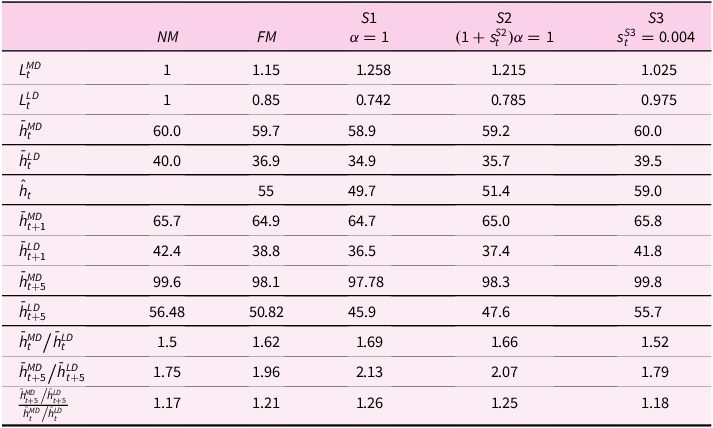
economy, it augments the magnitude of the outflow of relatively higher-skilled individuals, thereby reducing the average level of human capital in the parental generation and thus slowing down the process of human capital accumulation in that economy. An illustrative example highlighting the growth-depleting effect of an increase in the efficiency of investment in immigrant children’s education is provided in Table 1 in Section 3.3.
Numerical example: Five cases under discussion

Source: Author’s calculations. In the computations of the average levels of human capital it has been assumed that from period
 $+2$
on, the efficiency of the educational investment in the immigrants’ children is equal to that of the offspring of the local indigenous population
 $(\alpha =1).$
With the lump-sum tax,
 $T_t^{S2}$
, levied in the
 $MD$
economy on immigrants from the
 $LD$
economy with a redistribution of the proceeds as a subsidy at rate
 $s_t^{S2}$
for the education of immigrant children, as under Scenario 2 (denoted by superscript
 $S2$
), the required budget constraint for the redistribution is as follows:
 $$T_t^{S2}\int\limits_{{h_t} \gt \hat h_t^{S2}} {N_{t - 1}^{LD}dF_{t - 1}^{LD}({h^{LD}})} = {w^{MD}}s_t^{S2}\int\limits_{} {N_t^{M,S2}e_t^{M,S2}dF_t^{M,S2}({h^M}).} {\rm{ }}$$
With the adjusted
 $\bar h_t^{i,S2},$
the difference in this case is that the threshold becomes:
 $$\hat h_t^{S2} = {{{M_t} + T_t^{S2}} \over {{w^{MD}} - {w^{LD}}{{\left( {\left( {{{{{\left( {{{\alpha (1 + S_t^{S2})\delta {h_t} - \mu } \over {\delta {h_t} - \mu }}} \right)}^{1 - \gamma}}} \mathord{\left/ {\vphantom {{{{\left( {{{\alpha (1 + s_t^{S2})\delta {h_t} - \mu } \over {\delta {h_t} - \mu }}} \right)}^{1 - \gamma}}} {\alpha (1 + s_t^{S2})}}} \right.} {\alpha (1 + S_t^{S2})}}} \right){{\left( {{{\bar h_t^{LD,S2}} \over {\bar h_t^{MD,S2}}}} \right)}^{1 - \gamma }}} \right)}^\beta }}},$$
while the optimal fertility choice, the investment in the offspring’s education and resulting children’s levels of human capital among immigrants are, respectively:
 $$N_t^{M,S2} = {{\beta (1 - \gamma )} \over {\delta - ({\mu \mathord{\left/ {\vphantom {\mu {\alpha (1 + s_t^{S2}){h_t})}}} \right.} {\alpha (1 + s_t^{S2}){h_t})}}}}\left( {1 - {{{M_t} + T_t^{S2}} \over {{w^{MD}}{h_t}}}} \right){\rm{, }}$$
 $$e_t^{M,S2} = {{\gamma \delta {h_t} - ({\mu \mathord{\left/ {\vphantom {\mu {\alpha (1 + s_t^{S2})}}} \right.} {\alpha (1 + s_t^{S2})}})} \over {1 - \gamma }},{\rm{ }}$$
and
 $$h_{t + 1}^{M,S2} = A{\left( {{\gamma \over {1 - \gamma }}(\alpha (1 + s_t^{S2})\delta {h_t} - \mu )} \right)^\gamma }{(\bar h_t^{MD,S2})^{1 - \gamma }}.$$
With the lump-sum tax,
 $T_t^{S3}$
, imposed on immigrants to finance a subsidy for the acquisition of human capital for all children in the more developed society at rate
 $s_t^{S3}$
as under Scenario 3 (denoted by superscript
 $S3$
), the required budget constraint for the redistribution is:
 $$T_t^{S3}\!\!\int\limits_{{h_t} \gt \hat h_t^{S3}} \!\!{N_{t - 1}^{LD}dF_{t - 1}^{LD}({h^{LD}})}\! = \!{w^{MD}}s_t^{S3}\left( \!{\int\limits_{} {N_t^{MD,S3}e_t^{MD,S3}dF_t^{MD}({h^{MD}})}\! + \!\!\int\limits_{} \!{N_t^{M,S3}e_t^{M,S3}\!dF_t^M({h^M})} \!} \right){\rm{. }}$$
In this case, with the adjusted
 $\bar h_t^{i,S3}$
, the threshold is:
 $$\hat h_t^{S3} = {{{M_t} + T_t^{S3}} \over {{w^{MD}} - {w^{LD}}{{\left( {\left( {{{{{\left( {{{\alpha (1 + s_t^{S3})\delta {h_t} - \mu } \over {\delta {h_t} - \mu }}} \right)}^{1 - \gamma}}} \mathord{\left/ {\vphantom {{{{\left( {{{\alpha (1 + s_t^{S3})\delta {h_t} - \mu } \over {\delta {h_t} - \mu }}} \right)}^{1 - \gamma}}} {\alpha (1 + s_t^{S3})}}} \right.} {\alpha (1 + s_t^{S3})}}} \right){{\left( {{{\bar h_t^{LD,S3}} \over {\bar h_t^{MD,S3}}}} \right)}^{1 - \gamma }}} \right)}^\beta }}}$$
and the results of the optimization for all individuals in the
 $MD$
economy are affected, as shown in equations (22) – (24):
 $$N_t^j = \beta (1 - \gamma )\left\{ {\matrix{ {{{\left( {\delta - ({\mu \mathord{\left/ {\vphantom {\mu {(1 + s_t^{S3}){h_t}}}} \right.} {(1 + s_t^{S3}){h_t}}})} \right)}^{{\rm{ - 1}}}}{\rm{, \quad \quad \quad \quad \quad \quad if }}j = MD,} \cr \!\!\!{{{\left( {\delta - ({\mu \mathord{\left/ {\vphantom {\mu {\alpha (1 + s_t^{S3}){h_t}}}} \right.} {\alpha (1 + s_t^{S3}){h_t}}})} \right)}^{{\rm{ - 1}}}}\left( {1 - {{{M_t} + T_t^{S3}} \over {{w^{MD}}{h_t}}}} \right){\rm{, \quad \!\!\!\! if }}j = M.{\rm{ }}} \cr } } \right.$$
 $$e_t^j = \left\{ {\matrix{ {{{\gamma \delta {h_t} - ({\mu \mathord{\left/ {\vphantom {\mu {(1 + s_t^{S3})}}} \right.} {(1 + s_t^{S3})}})} \over {1 - \gamma }},{\rm{\quad\;\; if \;}}j = MD,{\rm{ }}} \cr \!\!\! {{{\gamma \delta {h_t} - ({\mu \mathord{\left/ {\vphantom {\mu {\alpha (1 + s_t^{S3})}}} \right.} {\alpha (1 + s_t^{S3})}})} \over {1 - \gamma }},\quad{\rm{ if \;}}j = M.{\rm{ }}} \cr } } \right.$$
and
 $$h_{t + 1}^j = A{\left( {{\gamma \over {1 - \gamma }}} \right)^\gamma }\left\{ {\matrix{ {{{\left( {(1 + s_t^{S3})\delta {h_t} - \mu } \right)}^\gamma }{{(\bar h_t^{MD,S3})}^{1 - \gamma }},\quad\; \; {\rm{ if \;}}j = MD,} \cr \!\!\!{{{\left( {\alpha (1 + s_t^{S3})\delta {h_t} - \mu } \right)}^\gamma }{{(\bar h_t^{MD,S3})}^{1 - \gamma }},\quad{\rm{ if \;}}j = M{\rm{. }}} \cr } } \right.$$
Therefore, taxing migrants, as under Scenarios 2 and 3, increases the threshold levels,
 $\hat h_t^{S2}$
and
 $\hat h_t^{S3}$
, as shown in equations (16) and (21). As a consequence, as opposite of the effect of the increase in the efficiency of the investment in immigrant children’s schooling
 $(\alpha ),$
it reduces migration yielding a positive effect on the average skill levels in either economy.
As for the subsidy for the acquisition of human capital among immigrant children,
 $s_t^{S2},$
as under Scenario 2, it reduces the threshold,
 $\hat h_t^{S2},$
and increases the level of human capital among immigrant children (Eq. 19) with a positive overall effect on human capital accumulation in the
 $MD$
economy if the later effect dominates. Following the same intuition as under Scenario 1, educational subsidy,
 $s_t^{S2},$
also generates an unambiguously negative effect on human capital accumulation in the
 $LD$
economy. Providing a subsidy for acquiring education for all children in the
 $MD$
economy, whether born to immigrant and or local parents, as outlined in Scenario 3, limits the effect of the subsidy,
 $s_t^{S3},$
on the threshold level,
 $\hat h_t^{S3},$
thereby reducing the negative effect on human capital accumulation in either economy.
Furthermore, as a subsidy is provided not only to the offspring of immigrants but also to children of the local parents, the overall positive effect on human capital accumulation in the
 $MD$
economy can be strong enough to outweigh the negative effect of the lower-skilled immigration. An illustrative example for a brain dilution taxation that reduces the negative effect of a lower-skilled immigration on human capital accumulation in the
 $MD$
economy if the revenue is redistributed to support human capital investment in immigrant children, and improves human capital accumulation if the proceeds are used as educational subsidies for all children in the society follows in Table 1 in Section 3.3.
3.3. Numerical illustration: Migration, human capital, population growth, and public policy interventions
To characterize the effect of migration on the evolution of human capital in either economy, suppose that, in period
 $t$
, in the presence of migration, the adult population in the
 $MD$
economy includes both individuals born in this economy and migrants, while in the
 $LD$
economy the adult population consists solely of individuals who remain in their country of origin:
 $$L_t^i \equiv \left\{ {\matrix{ {\int {N_{t - 1}^idF_{t - 1}^i(h)} + \int\limits_{{h_t} \gt {{\hat h}_t}} {N_{t - 1}^{LD}dF_{t - 1}^{LD}({h^{LD}}),} {\rm{\;\;\;\; if \;}}i = MD,} \cr {\int\limits_{{h_t} \lt {{\hat h}_t}} {N_{t - 1}^idF_{t - 1}^i(h),} {\rm{ \quad \quad \quad \quad \quad \quad \quad \quad \quad if \;}}i = LD.{\rm{ }}} \cr } } \right.$$
Also assume for simplicity that, in period
 $t$
, in the absence of migration, the size of the adult population in either economy is normalized to unity;
 $L_t^{i,NM} \equiv \int {N_{t - 1}^i dF_{t - 1}^i(h)} =1$
,
 $i = LD,{\rm{ }}MD$
.
Consider the following five cases: (1) the absence of migration, (2) free migration, (3) public policy intervention: Scenario 1, (4) public policy intervention: Scenario 2, and (5) public policy intervention: Scenario 3, (denoted by
 $NM,{\rm{ }}FM, \,$
 $S1,{\rm{ }}S2,{\rm{\; and \;}}S2,$
respectively).
To provide a numerical example, suppose that the parameters in the model are as follows:
 $\delta =0.15$
,
 $\beta =0.4$
,
 $\mu =1$
,
 $\gamma =0.5$
,
 $\alpha =0.85$
,
 ${w^{MD}}=1.4$
,
 ${w^{LD}}=0.7$
, and
 $A=3.$
Also suppose that in period
 $t,$
the cost of migration from the
 $LD$
economy to the
 $MD$
economy equals to 38.26
 $({M_t}=38.26).$
Further, for comparability, suppose that, under Scenario 1, the absentee government provides additional free educational services for immigrant children, financed by the taxes levied “outside the model,” to equalize the efficiency of the investment in their education to that of the offspring of the locally born parents
 $({\alpha ^{S1}}{\rm{ }}=1),$
whereas, under Scenario 2, the government provides a subsidy for immigrant children, financed by the taxes imposed on adult immigrants,
 $T_t^{S2},$
to similarly enhance the efficiency of the investment in their schooling to the same level as that of the local children;
 $\alpha (1 + s_t^{S2})=1.$
Finally, suppose that, under Scenario 3, the subsidy, financed by a lump-sum tax levied on adult immigrants, is provided for all children born in the economy at rate 0.004;
 $s_t^{S3}=0.004.$
To complete the description of the world, suppose that the distribution of human capital is such that in period
 $t$
, in the more developed economy, human capital is distributed equally around
 $\bar h_t^{MD}=60$
with the lower bound
 $\bar h_t^{MD,\min }=40$
and the upper bound
 $\bar h_t^{MD,\max }=80$
. In a similar manner, in the less advanced economy, the distribution of human capital is such that human capital is distributed equally around
 $\bar h_t^{LD}=40$
with the lower bound
 $\bar h_t^{LD,\min }=20$
and the upper bound
 $\bar h_t^{LD,\max }=60$
.
Table 1 presents the results for the five cases under discussion. As can be seen, free migration (
 $FM$
) in period
 $t$
decreases the average level of human capital in either economy in period
 $t+1$
, relative to the case, when migration is absent (
 $NM$
) (
 $\bar h_{t+1}^{MD,NM} \gt \bar h_{t+1}^{MD,FM}$
and
 $\bar h_{t+1}^{LD,NM} \gt \bar h_{t+1}^{LD,FM}$
). If free migration is human capital diluting as in Case 2 (
 $FM$
), we can consider the public policy interventions to help improve human capital accumulation, as specified above under Scenarios (1) to (3) in Section 3.2. However, following the intuition presented in Section 3.2, providing free educational services for immigrant children, as under Scenario 1 (
 $S1$
), can work against its stated goal, further reducing human capital accumulation in the host economy
 $(\bar h_{t+1}^{MD,FM} \gt \bar h_{t+1}^{MD,S1}$
). In contrast, a lump-sum tax imposed on adult immigrants to finance a subsidy for the acquisition of human capital for immigrant children, as under Scenario 2 (
 $S2$
), can help mitigate a negative effect of human capital depleting migration
 $(\bar h_{t+1}^{MD,S2} \gt \bar h_{t+1}^{MD,FM}$
). Furthermore, if the proceeds are redistributed to finance an educational subsidy for all children, as under Scenario 3 (
 $S3$
), public policy intervention can help improve human capital accumulation in the
 $MD$
economy not only relative to the case of free migration (
 $FM$
), but also relative to the situation when migration is absent (
 $NM$
)
 $(\bar h_{t+1}^{MD,S3} \gt \bar h_{t+1}^{MD,NM} \gt \bar h_{t+1}^{MD,S2} \gt \bar h_{t+1}^{MD,FM} \gt \bar h_{t+1}^{MD,S1}$
). With regard to the sending economy, the effect of migration and public policy interventions in the
 $MD$
economy on human capital accumulation in this country follows the pattern observed in the
 $MD$
economy except for Case 5, when the inter-temporal increase in the average level of human capital in the
 $LD$
economy from period
 $t$
to period
 $t+1$
is positive, but smaller than in the absence of migration
 $(\bar h_{t+1}^{LD,NM} \gt \bar h_{t+1}^{LD,S3} \gt \bar h_t^{LD} \gt \bar h_{t+1}^{MD,FM} \gt \bar h_{t+1}^{LD,S2} \gt \bar h_{t+1}^{LD,S1}$
).
As follows from the property of the learning technology (6) with respect to the average level of human capital in the society, the effect of migration and public policy interventions on human capital levels in each of the economies evolves further from one generation to the next. With time, these effects tend to intensify, leading to greater disparities across the countries regarding their average levels of human capital. Notably, under Scenario 3, the outcome closely resembles that which would occur in the absence of migration. A comparison of period
 $t+5$
to period
 $t$
is presented in Table 1.
As can be seen,
 $${{{{\bar h_{t + 5}^{MD,S1}} \mathord{\left/ {\vphantom {{\bar h_{t + 5}^{MD,S1}} {\bar h_{t + 5}^{LD,S1}}}} \right.} {\bar h_{t + 5}^{LD,S1}}}} \over {{{\bar h_t^{MD,S1}} \mathord{\left/ {\vphantom {{\bar h_t^{MD,S1}} {\bar h_t^{LD,S1}}}} \right.} {\bar h_t^{LD,S1}}}}} \gt {{{{\bar h_{t + 5}^{MD,S2}} \mathord{\left/ {\vphantom {{\bar h_{t + 5}^{MD,S2}} {\bar h_{t + 5}^{LD,S2}}}} \right.} {\bar h_{t + 5}^{LD,S2}}}} \over {{{\bar h_t^{MD,S2}} \mathord{\left/ {\vphantom {{\bar h_t^{MD,S2}} {\bar h_t^{LD,S2}}}} \right.} {\bar h_t^{LD,S2}}}}} \gt {{{{\bar h_{t + 5}^{MD,FM}} \mathord{\left/ {\vphantom {{\bar h_{t + 5}^{MD,FM}} {\bar h_{t + 5}^{LD,FM}}}} \right.} {\bar h_{t + 5}^{LD,FM}}}} \over {{{\bar h_t^{MD,FM}} \mathord{\left/ {\vphantom {{\bar h_t^{MD,FM}} {\bar h_t^{LD,FM}}}} \right.} {\bar h_t^{LD,FM}}}}} \gt {{{{\bar h_{t + 5}^{MD,S3}} \mathord{\left/ {\vphantom {{\bar h_{t + 5}^{MD,S3}} {\bar h_{t + 5}^{LD,S3}}}} \right.} {\bar h_{t + 5}^{LD,S3}}}} \over {{{\bar h_t^{MD,S3}} \mathord{\left/ {\vphantom {{\bar h_t^{MD,S3}} {\bar h_t^{LD,S3}}}} \right.} {\bar h_t^{LD,S3}}}}} \gt {{{{\bar h_{t + 5}^{MD,NM}} \mathord{\left/ {\vphantom {{\bar h_{t + 5}^{MD,NM}} {\bar h_{t + 5}^{LD,NM}}}} \right.} {\bar h_{t + 5}^{LD,NM}}}} \over {{{\bar h_t^{MD,NM}} \mathord{\left/ {\vphantom {{\bar h_t^{MD,NM}} {\bar h_t^{LD,NM}}}} \right.} {\bar h_t^{LD,NM}}}}}$$
As for the relative size of the countries in terms of population, as follows from the normalization of the size of adult population in either economy to unity, in period
 $t$
, migration mechanically reduces the size of the source country relative to the destination country. However, with time, population size of the less developed source economy will increase relative to that of the more developed host economy due to a higher fertility in the former. As a consequence, at some point, the total population in the
 $LD$
economy will overtake that in the
 $MD$
economy.Footnote
12
From this period on, the economies will diverge in terms of both average human capital and the size of population. A numerical example is provided in Table (A1) in Appendix.
By mitigating the loss of human capital caused by brain drain in the source country, the policy intervention discussed under Scenario 3 constrains the relative growth of its population vis-à-vis the host country, slowing down the divergence in population sizes between the two countries compared to what would occur under unrestricted migration and the other two scenarios:
 $${{{{L_{t + 5}^{MD,NM}} \mathord{\left/ {\vphantom {{L_{t + 5}^{MD,NM}} {L_{t + 5}^{LD,NM}}}} \right.} {L_{t + 5}^{LD,NM}}}} \over {{{L_t^{MD,NM}} \mathord{\left/ {\vphantom {{L_t^{MD,NM}} {L_t^{LD,NM}}}} \right.} {L_t^{LD,NM}}}}} \lt {{{{L_{t + 5}^{MD,S3}} \mathord{\left/ {\vphantom {{L_{t + 5}^{MD,S3}} {L_{t + 5}^{LD,S3}}}} \right.} {L_{t + 5}^{LD,S3}}}} \over {{{L_t^{MD,S3}} \mathord{\left/ {\vphantom {{L_t^{MD,S3}} {L_t^{LD,S3}}}} \right.} {L_t^{LD,S3}}}}} \lt {{{{L_{t + 5}^{MD,FM}} \mathord{\left/ {\vphantom {{L_{t + 5}^{MD,FM}} {L_{t + 5}^{LD,FM}}}} \right.} {L_{t + 5}^{LD,FM}}}} \over {{{L_t^{MD,FM}} \mathord{\left/ {\vphantom {{L_t^{MD,FM}} {L_t^{LD,FM}}}} \right.} {L_t^{LD,FM}}}}} \lt {{{{L_{t + 5}^{MD,S2}} \mathord{\left/ {\vphantom {{L_{t + 5}^{MD,S2}} {L_{t + 5}^{LD,S2}}}} \right.} {L_{t + 5}^{LD,S2}}}} \over {{{L_t^{MD,S2}} \mathord{\left/ {\vphantom {{L_t^{MD,S2}} {L_t^{LD,S2}}}} \right.} {L_t^{LD,S2}}}}} \lt {{{{L_{t + 5}^{MD,S1}} \mathord{\left/ {\vphantom {{L_{t + 5}^{MD,S1}} {L_{t + 5}^{LD,S1}}}} \right.} {L_{t + 5}^{LD,S1}}}} \over {{{L_t^{MD,S1}} \mathord{\left/ {\vphantom {{L_t^{MD,S1}} {L_t^{LD,S1}}}} \right.} {L_t^{LD,S1}}}}}$$
Thus, the brain dilution tax proposed in this study may also help counteract a potential increase in global inequality that can be exacerbated by brain drain migration, as poorer economies grow larger in terms of population (Mountford and Rapoport, Reference Mountford and Rapoport2011).
4. Conclusion
This article studies the effect of educational policy in the host economy on human capital accumulation and economic growth. The analysis is performed in the context of a growth model with endogenous fertility, in which the incentives for further immigration are taken into account. I demonstrate that providing additional free educational services for immigrant children, aimed at improving the efficiency of investments in their education, can increase the appeal of migration for lower-skilled individuals from less advanced countries, which can outweigh the positive effect of this policy on the acquisition of human capital. In contrast, taxation of immigrants in the host economy reduces lower-skilled migration and can promote human capital accumulation if the proceeds are redistributed as an educational subsidy. For the source economy, such taxation curbs the decline in the average level of human capital caused by emigration, thereby positively influencing the country’s economic growth and slowing down population growth. I propose a novel redistribution scheme – a “brain dilution tax” – that appears to be more justified and easier to implement in practice compared to the classical brain drain tax.
Supplementary material
The supplementary material for this article can be found at https://doi.org/10.1017/dem.2025.4
Acknowledgments
I would like to thank Hillel Rapoport and two anonymous referees for valuable suggestions. I also thank participants at the 1st International Conference on ‘Health, Environment, Development and Growth Economies: New Perspective and Challenges (HEDGE) (Pisa 2024) for their comments. Support from the Basic Research Program of HSE University is gratefully acknowledged.
Competing interests
The author declares that he has no known competing financial interests or personal relationships that could have appeared to influence the work reported in this paper.