INTRODUCTION
Weed competitive crops and cultivars are important components of integrated weed management (IWM) that are useful in both conventional and organic (and other low-input) sustainable farming systems of arid and semi-arid environments (Callaway, Reference Callaway1992). If a crop cultivar can tolerate weeds, it may reduce the need for herbicides (Christensen, Reference Christensen1995) and improve yield stability in weedy fields (Lindquist and Mortensen, Reference Lindquist and Mortensen1998). Several cases of crop cultivars, including maize (Zea mays), with improved tolerance to weeds are reported in the literature (Forcella, Reference Forcella1987).
Velvetleaf (Abutilon theophrasti) is a major weed of maize, cotton (Gossypium hirsutum), soyabean (Glycine max), sorghum (Sorghum bicolor) and other crops in many countries (Spencer, Reference Spencer1984; Werner et al., Reference Werner, Curran, Harper, Roth and Knievel2004). It is ranked as one of the most troublesome weeds in the USA (Stoller et al., Reference Stoller, Wax and Alm1993) and increasingly in other parts of North America (Andersen et al., Reference Andersen, Menges and Conn1985; Warwick and Black, Reference Warwick and Black1986) and Europe (Sattin et al., Reference Sattin, Zanin and Berti1992), since it can decrease grain yield of major crops (e.g. maize) up to 80% depending on field conditions and weed density (Lindquist et al., Reference Lindquist, Mortensen and Johnson1998). The specific name (theophrasti) of this weed was given in honour of the Greek philosopher and botanist Theophrastus (372–287 BC). Nowadays, the competitive nature of this species and the reduced number of available herbicides as a consequence of EU legislation have resulted in velvetleaf becoming an increasing problem in row crops of the country. It should be noted that the major spread of this weed has occurred mainly in western Greece (Travlos, personal observations) and this could be attributed to the requirement of velvetleaf for greater soil moisture (Holt and Boose, Reference Holt and Boose2000), which is normally available in this area. Velvetleaf control is difficult, primarily due to thousands of extremely long-lived hard seeds and its rapid and vigorous growth (Horowitz and Taylorson, Reference Horowitz and Taylorson1984; Roggenkamp et al., Reference Roggenkamp, Mason and Martin2000). Moreover, it also exhibits genetic traits characteristic of colonizers, including polyploidy, self-fertilization and high levels of population differentiation (Warwick, Reference Warwick1990; Warwick and Black, Reference Warwick and Black1986).
In order to develop efficient herbicide use and to provide a logical basis for the development of an IWM system, information on the critical period of weed control is essential (Swanton and Weise, Reference Swanton and Weise1991). Several studies have been conducted on many crop-weed interactions, including maize and velvetleaf (Hall et al., Reference Hall, Swanton and Anderson1992). In maize, the critical period of weed control typically ranges until the eight-leaf stage (Hall et al., Reference Hall, Swanton and Anderson1992). This period is not a static phenomenon and is influenced by many factors, such as nutrient status (Evans et al., Reference Evans, Knezevic, Lindquist and Shapiro2003), weed density (Cardina et al., Reference Cardina, Regnier and Sparrow1995; Cousens, Reference Cousens1985) and time of emergence (Bosnic and Swanton, Reference Bosnic and Swanton1997).
Several studies report that the relative time of weed emergence with respect to the crop was more important than other parameters, such as weed density, in determining the need for post-emergence control (Chikoye et al., Reference Chikoye, Weise and Swanton1995; Knezevic et al., Reference Knezevic, Weise and Swanton1994). However, few studies have evaluated in detail the significance of each particular stage inside that critical weed-crop period. Furthermore, little information is available on the effect of weed species and the timing of emergence that may result in minimal agronomic impact, i.e. few or no weed seeds produced and little or no crop yield loss (Clay et al., Reference Clay, Kleinjan, Clay, Forcella and Batchelor2005; Tollenaar et al., Reference Tollenaar, Nissanka, Aguilera, Weise and Swanton1994). Reproductive output of velvetleaf is usually enormous but also highly variable (Zanin and Sattin, Reference Zanin and Sattin1988). Information on seed return as influenced by time of emergence is required to predict future population changes (Bosnic and Swanton, Reference Bosnic and Swanton1997). Few reports have evaluated the combined impact of time of velvetleaf emergence on yield components of several maize hybrids and velvetleaf growth and reproductive output. The objectives of this research were: (i) to determine the effects of A. theophrasti emergence date on biomass and fecundity of velvetleaf and maize yield components and (ii) to evaluate the competitiveness of four maize hybrids under field conditions in Greece.
MATERIALS AND METHODS
Experimental site
A field experiment was conducted in 2009 and was repeated in 2010 in a commercial field in the Vonitsa region of western Greece (lat. 38°53′ N; long. 20°53′ E). The soil was a clay loam, whose physicochemical characteristics (0–15 cm depth) were clay 283 g kg−1, silt 320 g kg−1, sand 396 g kg−1, organic C content 16.1 g kg−1, pH (1:2 H2O) 8.1, CaCO3 12 g kg−1 and organic matter content of 27 g kg−1. The previous crop was alfalfa (Medicago sativa).
Four maize hybrids, namely ‘Pako’, 108-d relative maturity (RM), ‘Mitic’, 125-d RM, ‘Agrister’, 108-d RM, and ‘Arma’, 130-d RM, were planted on 8 April 2009 and 17 April 2010. The four hybrids are commonly used in Greece, having a FAO index of 500–700, plant height (moderate/high) and productivity (stable and high). They were planted in 75-cm rows at an approximate density of 70 000 to 80 000 seeds ha−1. Before plot establishment each year, nitrogen and phosphorus were incorporated with a harrow into the soil at 180 and 60 kg ha−1, respectively. All four hybrids emerged on 17 April 2009 and 25 April 2010.
Experimental treatments and design
Velvetleaf seed was collected from plants in nearby fields during the previous year for each experiment. Seed was stored at 5 °C from the time of harvest until use the following spring. The weed infestation was achieved by broadcasting at a rate of 9.8 kg ha−1 of velvetleaf seed and incorporating into the soil (5 cm depth) with a rotovator. Dates of velvetleaf sowing were 10 to 15 d before maize produced 1, 3, 5 and 7 leaves (V1, V3, V5 and V7, respectively). This procedure was followed so that velvetleaf emergence coincided with the above mentioned maize growth stages (Hall et al., Reference Hall, Swanton and Anderson1992). Shortly after their emergence, weed seedlings were thinned to the desired density (two weed seedlings m−1 of row). Any target weeds that emerged within the planted area after the first weeds had emerged were removed, leaving the oldest weeds in place.
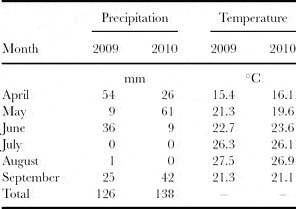
The experimental design was a split-plot in a randomized complete block with four blocks (replicates). Plot size was 10 × 6 m. In each plot, five subplots of 2 × 6 m were created and included eight rows of maize. Rows were numbered 1 to 8 from right to left. Rows 1, 2, 7 and 8 were border rows. Yield data were collected from rows 3 and 4, while velvetleaf plants were sampled from rows 5 and 6. The main factor was maize hybrid. The split factor was velvetleaf emergence date, while there were also control subplots, which were kept weed free during the growing season by the post-emergence application (V2 maize stage) of 0.04 kg a.i. ha−1 of nicosulfuron and by several cultivation or hand-hoeing treatments. In the other subplots, weeds were hand-removed during both growing seasons, while only velvetleaf remained after the assigned maize growth stage. Irrigation and other common cultural practices were conducted as needed during the growing seasons. Mean monthly temperature and rainfall data recorded near the experimental area are given in Table 1.
Mean monthly precipitation and temperature during the field experiments in 2009 and 2010.

Samplings and measurements
Plant height and aboveground dry weight for velvetleaf were determined at 12 weeks after maize sowing in both growing seasons. Velvetleaf canopy area was determined on the same date by measuring the broadest part of five randomly selected plants in two directions and multiplying these dimensions. During the growing season maize height was measured weekly for 20 randomly selected maize plants and growth rate (cm day−1) was calculated. At grain maturity (end of August for both growing seasons), ears of 10 of the above mentioned maize plants (of the centre row of each sub-sub plot) were hand-harvested and dried at 80 °C until constant weight was achieved. Grain yield, kernels per row, kernels per plant and kernel weight were determined. Maize and velvetleaf plants were hand-harvested from the centre 2-m section of the yield rows. The number of velvetleaf seeds per plant was determined after seed capsules were collected and opened and seeds were threshed and cleaned.
Statistical analysis
A combined over years analysis of variance (ANOVA) was conducted for all data and differences between means were compared at the 5% level of significance using the Fisher's protected l.s.d. test. The ANOVA indicated no significant velvetleaf emergence date or maize hybrid × year interaction; therefore means are averaged over both years. Regression analysis was used to fit relationships between velvetleaf emergence date and velvetleaf dry weight, canopy area, and seed production. All statistical analyses were conducted using the Statsoft software package (Statsoft, Inc. 2300 East 14th Street, Tulsa, OK 74104, USA).
RESULTS AND DISCUSSION
Weed biomass, canopy area, and seed production
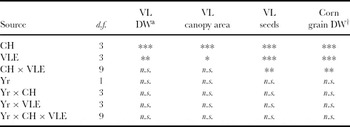
Velvetleaf biomass and canopy area were significantly affected by the competing maize hybrid and the weed emergence date (Table 2). Maize hybrid and emergence timing of velvetleaf also had a significant effect on maize grain yield and velvetleaf fecundity. Moreover, the interaction between the above-mentioned factors was significant for each parameter except velvetleaf dry weight and canopy area.
Analysis of variance for corn hybrid (CH), velvetleaf emergence date (VLE), and year (Yr) effects on velvetleaf (VL) growth and fecundity and corn grain yields.

* p < 0.05; ** p < 0.01; *** p < 0.001>.
† dry weight.
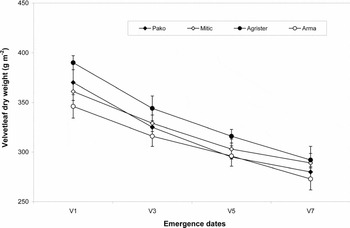
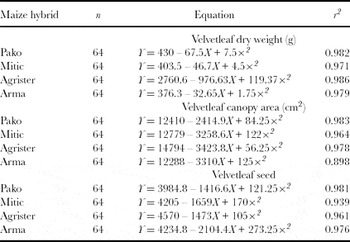
Regarding velvetleaf biomass production, Arma and Mitic seem to suppress velvetleaf weight more than Pako and Agrister for all emergence dates. Arma suppressed biomass of velvetleaf emerging at the V1 maize growth stage almost as much as the other hybrids did at V3 stage (Figure 1; fitted relationships given in Table 3). Late weed emergence is common in cases of an early post-emergence herbicide application. Lindquist and Mortensen (Reference Lindquist and Mortensen1998) showed that maize hybrids differ in suppression of weed growth, while Tollenaar et al. (Reference Tollenaar, Nissanka, Aguilera, Weise and Swanton1994) reported that the total weed biomass did not differ among maize hybrids.
Response of velvetleaf dry weight maize hybrid and velvetleaf emergence date at 12 weeks after sowing. Regression equations fitted for each hybrid are given in Table 3. Vertical bars denote standard errors of the means.

Regression equations for velvetleaf growth components at 12 weeks after sowing and fecundity as a function of the number of maize leaves at velvetleaf emergence date.

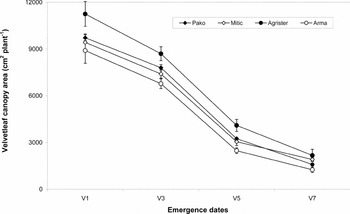
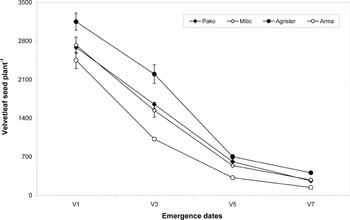
Weed canopy area and seed production decreased with increasing duration of the weed-free period, and this decrease was proportional to time (Figures 2 and 3; fitted relationships given in Table 3). In particular, depending on the maize hybrid, the earliest velvetleaf emergence had about 6- to 7-fold canopy area and 10- to 17-fold seed production compared with the latest emergence stage (V7). Furthermore, keeping the field free of velvetleaf through at least V5 seems crucial to reduce the competitiveness and future presence of this weed. Canopy area and seed production of A. theophrasti emerging at V5 were 46–64% and 63–69% lower than the V3 stage, respectively (Figures 2 and 3). Maximum canopy area of velvetleaf ranged between 8900 and 11 250 cm2 plant−1 for the several maize hybrids (Figure 2). Generally, a larger canopy developed for plants growing from seed sown before crop emergence than for seed sown at later dates, as previously reported by Clay et al. (Reference Clay, Kleinjan, Clay, Forcella and Batchelor2005). The competitiveness of Arma is also noticeable; the velvetleaf canopy area of early emerged plants (V1) was more than 20% lower than the value for Agrister (Figure 2).
Response of velvetleaf canopy area to maize hybrid and velvetleaf emergence date at 12 weeks after sowing. Regression equations fitted for each hybrid are given in Table 3. Vertical bars denote standard errors of the means.

Response of velvetleaf fecundity to maize hybrid and velvetleaf emergence date at the day of harvest (18–19 weeks after sowing). Regression equations fitted for each hybrid are given in Table 3. Vertical bars denote standard errors of the means.

Studying the reproductive ability of weeds is an important component of a successful IWM system, since we need to have a prediction of weed occurrence in the next growing seasons. A. theophrasti is considered to be a prolific seed producer, and a single plant can produce more than 8000 seeds that may remain viable in the soil for 50 years or more (Spencer, Reference Spencer1984). Hartzler (Reference Hartzler1996) observed that only 8% of the velvetleaf seed produced germinated the year after seed production with an additional 15% emerging within a four-year period. In another study, under ideal conditions for velvetleaf germination and emergence, only 54% of the seed emerged the year after seed production (Forcella, Reference Forcella1987). That means that even low densities of velvetleaf may produce sufficient seed to cause an economic problem for many years. Our results are in accordance with previous studies, which reveal the reduced fecundity of late-emerged velvetleaf plants and suggest little impact on the soil seed bank (Lindquist et al., Reference Lindquist, Mortensen and Johnson1998). The production of the largest number of seeds by early-emerging weeds has been reported for several species (Knezevic and Horak, Reference Knezevic and Horak1998), while significant differences have been reported among several maize hybrids concerning their ability to suppress velvetleaf capsule and seed production (Lindquist and Mortensen, Reference Lindquist and Mortensen1998). Our results are also in agreement with previous studies referring to differences of up to 60–65% of the velvetleaf seed production under several maize hybrids (Lindquist and Mortensen, Reference Lindquist and Mortensen1998), while the highest differences refer to the late emergence of the weed. Therefore, if we cannot avoid the early emergence of velvetleaf in the crop, then hybrid selection will only have a small influence on weed suppression in terms of the enrichment of the soil seed bank.
Crop grain yield
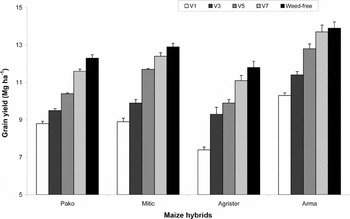
The ANOVA indicated that grain yield of maize was affected by the emergence date of velvetleaf, by maize hybrid and by their interactions (Table 2). Variability in maize yield loss because of velvetleaf interference may have a very wide range and this has been attributed to many factors, including differences in field conditions, weed density and relative time of emergence (Cousens et al., Reference Cousens, Brain, O'Donovan and O'Sullivan1987; Lindquist et al., Reference Lindquist, Mortensen and Johnson1998; Werner et al., Reference Werner, Curran, Harper, Roth and Knievel2004). Lindquist and Mortensen (Reference Lindquist and Mortensen1998) showed that a velvetleaf density of four plants m−1 of row could result in yield losses of 20–45% compared to weed-free maize. Our study highlights the significance of the relative emergence of A. theophrasti, since at even lower weed densities than the above mentioned (two plants m−1 of row), yield loss could be up to 40% if the weed emerges at almost the same time as maize (Figure 4). Our results show that the grain yield of maize hybrids with velvetleaf emerging at V5 and V7 stages were approximately 8–16% and 1–6% lower than the corresponding weed-free values, respectively (Figure 4). It should be noted that 5% has been suggested as the maximum tolerable yield loss in maize (Hall et al., Reference Hall, Swanton and Anderson1992) and has been used in the literature as a hypothetical value for the action threshold for maize (Knezevic et al., Reference Knezevic, Weise and Swanton1994). The above-mentioned yield losses for the two emergence dates and all the maize hybrids indicate the highly competitive nature of velvetleaf at least until maize has five leaves, since after that growth stage the yield losses are very low. Therefore, early emerging velvetleaf will certainly require control.
Response of grain yield of the four maize hybrids to velvetleaf emergence date at the day of harvest (18–19 weeks after sowing). Vertical bars denote standard errors of the means.

Crop growth rate
Our calculations have also shown that the rates of height increase (indication of crop growth rate) were different among the maize hybrids. Indeed, for the first 40 days after sowing, the relative growth rates were 1.31, 1.48, 1.05 and 1.75 cm plant−1 day−1 for Pako, Mitic, Agrister and Arma, respectively. Moreover, from our study it seems that there were significant differences between the competitive ability of the hybrids: hybrids with a relatively high first growth rate (such as Arma and Mitic), were more weed competitive than the other hybrids, even at high weed-pressure situations (early emergence), since they rapidly reach their crucial stage (3–5 leaves). On the contrary, in hybrids with a medium first growth rate, the length of the weed-free period is more crucial, since early weed competition can cause higher yield losses (>30%). Therefore, aggressive initial growth seems to have a key role on the crop competitiveness. Tollenaar et al. (Reference Tollenaar, Nissanka, Aguilera, Weise and Swanton1994) and Lindquist and Mortensen (Reference Lindquist and Mortensen1998) showed that the effect of weed interference on maize yield varies with maize hybrid but not consistently. Our results are also in agreement with previous studies in which several maize hybrids competed relatively poorly with early emerging weeds (Mohler et al., Reference Mohler, Frisch and Pleasant1997; Travlos et al., Reference Travlos, Economou and Kanatas2011). It is also noticeable and in accordance with previous studies (Lindquist and Mortensen, Reference Lindquist and Mortensen1998), that the ranking of hybrids in their ability to suppress velvetleaf seed production was similar to their ranking of relative tolerance (minimum yield loss). Our results confirm that the hybrid with greatest yield relative to weed-free yield (Arma) also resulted in the lowest velvetleaf seed production.
Crop grain components
Among the several maize grain components, the number of kernels per plant was the parameter that was most affected by the emergence date of A. theophrasti (Table 4). Indeed, in the case of early emerging velvetleaf (just after maize emergence) the number of kernels per maize plant was about 26 and 28% lower than late emerging velvetleaf (V7) and weed-free plots, respectively. Maize grain yield differences between velvetleaf emergence treatments could largely be attributed to the number of kernels produced, since it is well documented that maize grain yield is mainly determined by kernel number per unit land area (Cirilo and Andrade, Reference Cirilo and Andrade1994; Otequi et al., Reference Otequi, Nicolini, Ruiz and Dodds1995).
CONCLUSIONS
To date, no studies have extensively and in parallel evaluated the combined impact of time of velvetleaf emergence and maize hybrid on maize grain yield and velvetleaf growth and reproductive output under the semi-arid conditions of the Greek summer. The results of this study indicate that both maize hybrid and time of velvetleaf emergence relative to maize growth stage were fundamental in determining the outcome of the competition between maize grain yield and velvetleaf growth and fecundity. In the present study, a delay of about 10 d in weed emergence, which could be accomplished by early herbicide application or mechanical weed control, could reduce grain yield loss ranging from 5 to 16%. Keeping the field weed-free through at least V3 seems crucial for optimal maize growth, while the late velvetleaf emergence (V7) does not significantly reduce grain yield. The bulk of the negative effects of competition and interference on maize yield occurs during this period (V3 to V7 growth stages). On the contrary, another interesting finding is that there are still many seeds produced by the later emerging velvetleaf plants, which can easily contaminate the field and preserve the seed bank for the next growing seasons. Moreover, our results confirm that maize hybrid might have an impact on the weed competitive ability and should be taken into account by the maize growers. Growth rate seems to be among the factors that are strongly correlated with weed competitiveness, while further research is required to rank the competitiveness of more maize hybrids. Such information could be useful for extension personnel, in order to recommend suitable hybrids. However, selection among maize hybrids as a tool in integrated weed management will have a small influence on weed suppression, unless we avoid the early emergence of velvetleaf in the field.